Acts 2:32

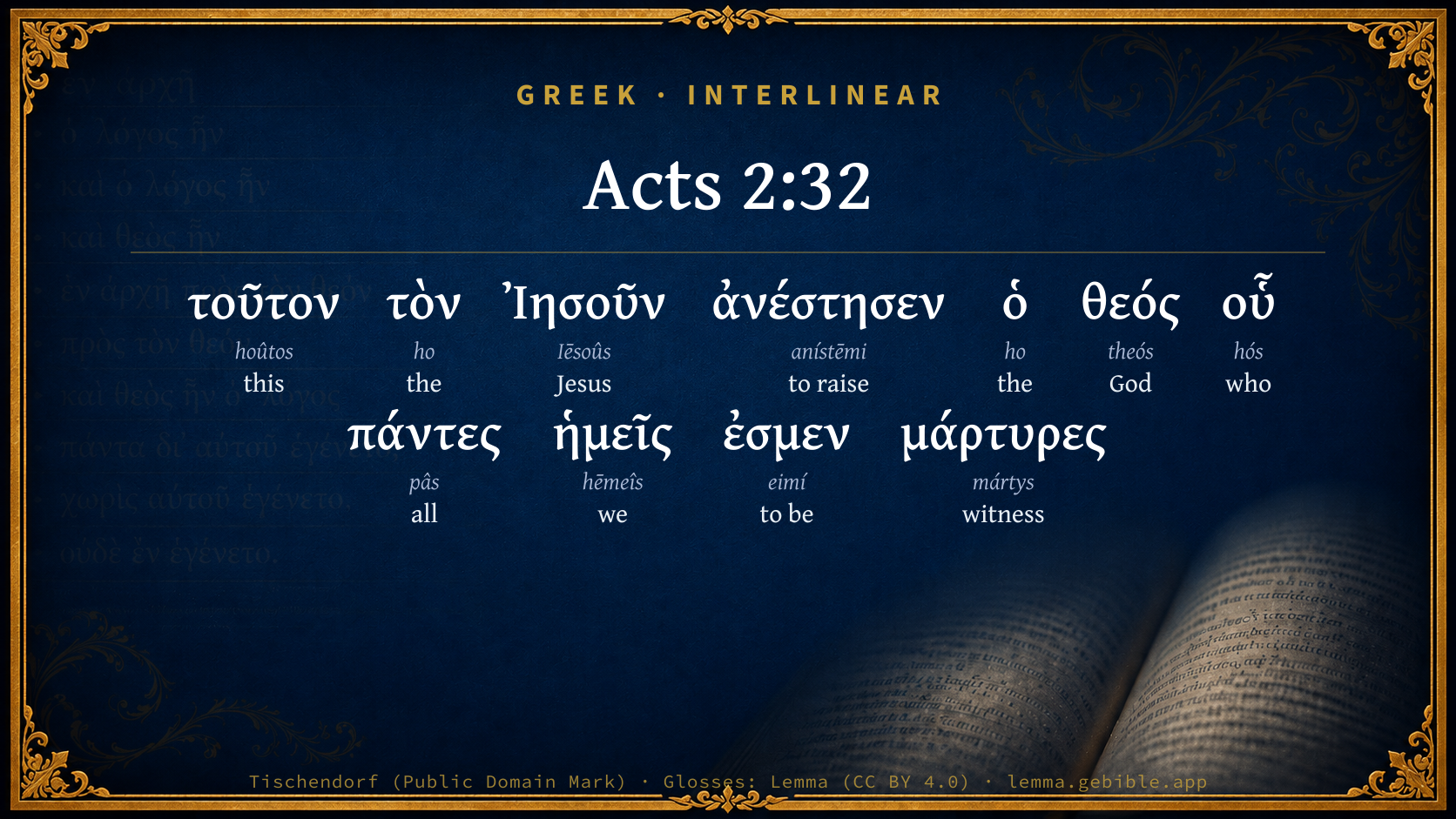
Greek (Tischendorf 8th ed.) Acts 2:32 appears in the Greek New Testament. The text above is from the Tischendorf 8th edition. Each word links to its Strong’s number and a concise gloss. Click any word for its full Thayer’s Greek Lexicon entry.
Download image
Cite this verse

Acts 2:32 (World English Bible). Public Domain. Lemma interlinear Bible study tool, https://lemma.gebible.app/v/acts/2/32.

Show BibTeX & RIS
BibTeX
RIS
English Translation
This Jesus God raised up, to which we all are witnesses.
World English Bible · Public Domain
Download a study sheet

One document with this verse’s original text, its word-by-word gloss line, the meaning frame, cross-references with their text, attributed commentary, and full source and license credits — printable, and it pastes into notes with its structure intact.

This verse Autodidact and up

Study sheet (.html) Plain text (.txt)

A passage Seminary Student

Up to 50 verses in one chapter. A passage sheet keeps up to 6 commentary sources and 12 cross-references per verse, in the order this page ranks them, and says so on the sheet whenever that leaves anything out. Ask for a single verse and you get the Autodidact verse sheet above.

Everything on this page stays free to read, with no account — the sheet is a download of what is already on screen, not access to it.

Want to remove ads? Support Godless Engineer
Compare translations 3

The same verse in 3 English versions, stacked beneath the original-language interlinear above. Click any original word for its lexicon entry.

Each is an independent rendering of the whole verse — the interlinear is not word-aligned to these translations.

Highlighted words mark where these versions differ — a whole-verse word diff, not a word-by-word alignment.

  • World English Bible Public Domain
    This Jesus God raised up, to which we all are witnesses.
  • King James Version Public Domain
    This Jesus hath God raised up, whereof we all are witnesses.
  • unfoldingWord Literal Text CC BY-SA 4.0
    This Jesus, God has raised up, of which we all are witnesses.

unfoldingWord Literal Text — © unfoldingWord, licensed CC BY-SA 4.0. Word-aligned USFM3 via Door43 (git.door43.org/unfoldingWord/en_ult).

Versions to compare (up to 4)

3 of 4 selected

Show all 19 translations

Every available English version of this verse, each an independent rendering of the whole verse.

  • World English Bible Public Domain
    This Jesus God raised up, to which we all are witnesses.
  • Berean Standard Bible Public Domain
    God has raised this Jesus to life, to which we are all witnesses.
  • Majority Standard Bible Public Domain
    God has raised this Jesus to life, to which we are all witnesses.
  • King James Version Public Domain
    This Jesus hath God raised up, whereof we all are witnesses.
  • American Standard Version (1901) Public Domain
    This Jesus did God raise up, whereof we all are witnesses.
  • Revised Version (1885) Public Domain
    This Jesus did God raise up, whereof we all are witnesses.
  • Geneva Bible (1599) Public Domain
    This Iesus hath God raised vp, whereof we all are witnesses.
  • Douay-Rheims (1899) Public Domain
    This Jesus hath God raised again, whereof all we are witnesses.
  • Young's Literal Translation Public Domain
    `This Jesus did God raise up, of which we are all witnesses;
  • Literal Standard Version CC BY-SA 4.0
    God raised up this Jesus, of which we are all witnesses;
  • Unlocked Literal Bible CC BY-SA 4.0
    This Jesus—God raised him up, of which we all are witnesses.
  • unfoldingWord Literal Text CC BY-SA 4.0
    This Jesus, God has raised up, of which we all are witnesses.
  • Darby Bible Public Domain
    This Jesus has God raised up, whereof all *we* are witnesses.
  • World Messianic Bible Public Domain
    This Yeshua God raised up, to which we all are witnesses.
  • Webster's Bible Public Domain
    This Jesus hath God raised up, of which we all are witnesses.
  • Free Bible Version CC BY-SA 4.0
    God has raised this Jesus from the dead, and we're all witnesses of that.
  • Bible in Basic English Public Domain
    This Jesus God has given back to life, of which we all are witnesses.
  • Text-Critical English NT CC BY 4.0
    This Jesus God has raised up, of which we are all witnesses.
  • Tyndale New Testament (1534) Public Domain
    This Iesus hath God raysyd vp wherof we all are witnesses.

Literal Standard Version (2020), Covenant Press — licensed CC BY-SA 4.0. Text via the HelloAO Bible API (eBible.org). Unlocked Literal Bible (unfoldingWord) — licensed CC BY-SA 4.0. Text via the HelloAO Bible API (eBible.org). unfoldingWord Literal Text — © unfoldingWord, licensed CC BY-SA 4.0. Word-aligned USFM3 via Door43 (git.door43.org/unfoldingWord/en_ult). Free Bible Version, Dr. Jonathan Gallagher — licensed CC BY-SA 4.0. Text via the HelloAO Bible API (eBible.org).

Word by word

More ways to search: Search by grammar → Find every occurrence → Compare this word →

Practice this passage: Drill this verse → Learn its vocabulary →

μάρτυρες
mártys
G3144
“witness”
Noun, Nominative, Plural, Masculine
Part of Speech
Noun
Case
Nominative
Number
Plural
Gender
Masculine
Full Thayer's Definition

Origin: of uncertain affinity

TDNT: 11:54,6

1. a witness a. in a legal sense b. an historical sense 1. one who is a spectator of anything, e.g. of a contest c. in an ethical sense 1. those who after his example have proved the strength and genuineness of their faith in Christ by undergoing a violent death
  1. τοῦτον hoûtos G3778 “this” Demonstrative pronoun, Accusative, Singular, Masculine
  2. τὸν ho G3588 “the” Article, Accusative, Singular, Masculine
  3. Ἰησοῦν Iēsoûs G2424 “Jesus” Noun, Accusative, Singular, Masculine
  4. ἀνέστησεν anístēmi G450 “to raise” Verb, Aorist, Active, Indicative, 3rd person, Singular
  5. ὁ ho G3588 “the” Article, Nominative, Singular, Masculine
  6. θεός theós G2316 “God” Noun, Nominative, Singular, Masculine
  7. οὗ hós G3739 “who” Relative pronoun, Genitive, Singular, Masculine
  8. πάντες pâs G3956 “all” Adjective, Nominative, Plural, Masculine
  9. ἡμεῖς hēmeîs G2249 “we” Personal pronoun, 1st person, Nominative, Plural
  10. ἐσμεν eimí G1510 “to be” Verb, Present, Active, Indicative, 1st person, Plural

About this verse

These counts appear in no published source. They are computed here, from the morphology-tagged text and Lemma’s own curated glosses. What Lemma adds →

11
words
10
distinct lemmas
Acts
section

Shared distinctive vocabulary

μάρτυρες witness G3144 occurs in 35 verses of the Greek New Testament. Also found in:

Repetition

A word recurs within this verse:

Cross-references

10

Topical passages linked to Acts 2:32 in the Treasury of Scripture Knowledge — connected by theme and wording, ordered by reader-vote popularity; previews shown in the World English Bible.

  • Acts 3:15 and killed the Prince of life, whom God raised from the dead, to which we are witnesses.
  • Acts 1:8 But you will receive power when the Holy Spirit has come upon you. You will be witnesses to me in Jerusalem, in all Judea and Samaria, and to the uttermost parts of the earth."
  • Acts 1:22 beginning from the baptism of John, to the day that he was received up from us, of these one must become a witness with us of his resurrection."
  • Luke 24:46–48 He said to them, "Thus it is written, and thus it was necessary for the Christ to suffer and to rise from the dead the third day,
  • Acts 2:24 whom God raised up, having freed him from the agony of death, because it was not possible that he should be held by it.
  • Acts 4:33 With great power, the apostles gave their testimony of the resurrection of the Lord Jesus. Great grace was on them all.
  • John 15:27 You will also testify, because you have been with me from the beginning.
  • John 20:26–31 After eight days again his disciples were inside, and Thomas was with them. Jesus came, the doors being locked, and stood in the midst, and said, "Peace be to you."
  • Acts 5:31–32 God exalted him with his right hand to be a Prince and a Savior, to give repentance to Israel, and remission of sins.
  • Acts 10:39–41 We are witnesses of everything he did both in the country of the Jews, and in Jerusalem; whom they also killed, hanging him on a tree.

Cross-references courtesy of OpenBible.info (CC BY 4.0).

Commentary

Notes on Acts 2:32 from classic Christian and Jewish commentators (each source and its license shown beneath its notes). The classic Christian expositions comment on the surrounding passage and are grouped to its opening verse, so a note may address several verses; the Jewish commentaries on the Tanakh (Rashi and others) are per-verse, so they appear only where the commentator wrote on this verse.

Lemma curates 59 commentaries, every one of them public domain or Creative Commons licensed, each selected and text-cleaned for this edition rather than reprinted as found. About our sources →

Joseph Benson's Commentary

Act 2:32-36. This Jesus — Whom we assert to be the true Messiah; hath God raised up — According to the tenor of his promise; whereof — Of which resurrection; we all are witnesses — On our personal and certain knowledge; having seen him with our eyes, and examined into the truth of the matter with all possible care. Therefore, being by the right hand of God — That is, by God’s almighty power, exalted from the grave to heaven; or, as some read the clause, Being exalted to the right hand of God, to supreme power, majesty, and glory; and having received of the Father — As the great anointed one of the Lord; the promise of the Holy Ghost — The Holy Ghost promised to his disciples; he hath — Agreeably to the notices he gave us before his ascension; shed forth this miraculous effusion of it, the effects of which ye now see and hear. For David himself — Who has not yet been raised from the dead; is not — With respect to his body; ascended into heaven — To be advanced there to the highest dignity and power: but he saith — In another Psalm, (where he plainly shows that he spoke of another person, and such another as was superior to himself, even his Lord;) The Lord — Namely, Jehovah, (the word here used;) said unto my Lord — That is, God the Father said unto the Messiah, (whom, though in one sense David’s son, he honoured as his Lord;) Sit thou on my right hand — Be thou invested with the highest power and glory; until I make thy foes — All that are so presumptuous as to persist in hostility to thee; thy footstool — Until I lay them prostrate at thy feet, so that thou mayest trample upon them at pleasure, as entirely subdued. See note on Psa 110:1. This text is here quoted with the greatest address, as suggesting, in the words of David, their great prophetic monarch, how certain their own ruin must be, if they went on to oppose Christ. It may be proper to observe here, that in these two verses there is an allusion to two ancient customs: one, to that of kings placing those persons on their right hands to whom they intended the highest honour; as Solomon did Bathsheba, when sitting on his throne, 1Ki 2:19; and the other, to the custom of conquerors, who used to tread on the necks of their vanquished enemies, as a token of their entire victory and triumph over them. Therefore — Upon the whole, from this concurrent evidence, both of prophecy and miracle, and from the testimony God has given to that Jesus whom we preach, not only by his resurrection from the dead, but by the effusion of the Holy Spirit on his followers; let all the house of Israel know assuredly — How contrary soever it may be to their former apprehensions and rooted prejudices; that God hath made that same Jesus, whom ye have rejected and crucified, both Lord and Christ — Hath demonstrated him to be the expected Messiah, and hath constituted him the King of his people, and Lord of all: let them know certainly that this truth has now received its full confirmation, and we our full commission to publish it. Thus Peter shows, in a striking light, what aggravated wickedness they had been guilty of, in that they had crucified one whom God designed to glorify, and had put him to death as a deceiver, who had given such pregnant proofs of a divine mission.

Joseph Benson's Commentary on the Old and New Testaments (1811–1818) — public domain. Text from a community e-Sword module.

MacLaren's Expositions of Holy Scripture

Alexander MacLaren

Acts

PETER’S FIRST SERMON

Act 2:32 - Act 2:47.

This passage may best be dealt with as divided into three parts: the sharp spear-thrust of Peter’s closing words {Act 2:32 - Act 2:36}, the wounded and healed hearers {Act 2:37 - Act 2:41}, and the fair morning dawn of the Church {Act 2:42 - Act 2:47}.

I. Peter’s address begins with pointing out the fulfilment of prophecy in the gift of the Spirit {Act 2:14 - Act 2:21}.

It then declares the Resurrection of Jesus as foretold by prophecy, and witnessed to by the whole body of believers {Act 2:22 - Act 2:32}, and it ends by bringing together these two facts, the gift of the Spirit and the Resurrection and Ascension, as effect and cause, and as establishing beyond all doubt that Jesus is the Christ of prophecy, and the Lord on whom Joel had declared that whoever called should be saved. We now begin with the last verse of the second part of the address.

Observe the significant alternation of the names of ‘Christ’ and ‘Jesus’ in Act 2:31 - Act 2:32. The former verse establishes that prophecy had foretold the Resurrection of the Messiah, whoever he might be; the latter asserts that ‘this Jesus’ has fulfilled the prophetic conditions. That is not a thing to be argued about, but to be attested by competent witnesses. It was presented to the multitude on Pentecost, as it is to us, as a plain matter of fact, on which the whole fabric of Christianity is built, and which itself securely rests on the concordant testimony of those who knew Him alive, saw Him dead, and were familiar with Him risen.

There is a noble ring of certitude in Peter’s affirmation, and of confidence that the testimony producible was overwhelming. Unless Jesus had risen, there would neither have been a Pentecost nor a Church to receive the gift. The simple fact which Peter alleged in that first sermon, ‘whereof we all are witnesses,’ is still too strong for the deniers of the Resurrection, as their many devices to get over it prove.

But, a listener might ask, what has this witness of yours to do with Joel’s prophecy, or with this speaking with tongues? The answer follows in the last part of the sermon. The risen Jesus has ascended up; that is inseparable from the fact of resurrection, and is part of our testimony. He is ‘exalted by,’ or, perhaps, at, ‘the right hand of God.’ And that exaltation is to us the token that there He has received from the Father the Spirit, whom He promised to send when He left us. Therefore it is He-’this Jesus’-who has ‘poured forth this,’-this new strange gift, the tokens of which you see flaming on each head, and hear bursting in praise from every tongue.

What triumphant emphasis is in that ‘He’! Peter quotes Joel’s word ‘pour forth.’ The prophet had said, as the mouthpiece of God, ‘I will pour forth’; Peter unhesitatingly transfers the word to Jesus. We must not assume in him at this stage a fully-developed consciousness of our Lord’s divine nature, but neither must we blink the tremendous assumption which he feels warranted in making, that the exaltation of Jesus to the right hand of God meant His exercising the power which belonged to God Himself.

In Act 2:34, he stays for a moment to establish by prophecy that the Ascension, of which he had for the first time spoken in Act 2:33, is part of the prophetic characteristics of the Messiah. His demonstration runs parallel with his preceding one as to the Resurrection. He quotes Psa 110:1 - Psa 110:7, which he had learned to do from his Master, and just as he had argued about the prediction of Resurrection, that the dead Psalmist’s words could not apply to himself, and must therefore apply to the Messiah; so he concludes that it was not ‘David’ who was called by Jehovah to sit as ‘Lord’ on His right hand. If not David, it could only be the Messiah who was thus invested with Lordship, and exalted as participator of the throne of the Most High.

Then comes the final thrust of the spear, for which all the discourse has been preparing. The Apostle rises to the full height of his great commission, and sets the trumpet to his mouth, summoning ‘all the house of Israel,’ priests, rulers, and all the people, to acknowledge his Master. He proclaims his supreme dignity and Messiahship. He is the ‘Lord’ of whom the Psalmist sang, and the prophet declared that whoever called on His name should be saved; and He is the Christ for whom Israel looked.

Last of all, he sets in sharp contrast what God had done with Jesus, and what Israel had done, and the barb of his arrow lies in the last words, ‘whom ye crucified.’ And this bold champion of Jesus, this undaunted arraigner of a nation’s crimes, was the man who, a few weeks before, had quailed before a maid-servant’s saucy tongue! What made the change? Will anything but the Resurrection and Pentecost account for the psychological transformation effected in him and the other Apostles?

II. No wonder that ‘they were pricked in their heart’!

Such a thrust must have gone deep, even where the armour of prejudice was thick. The scene they had witnessed, and the fiery words of explanation, taken together, produced incipient conviction, and the conviction produced alarm. How surely does the first glimpse of Jesus as Christ and Lord set conscience to work! The question, ‘What shall we do?’ is the beginning of conversion. The acknowledgment of Jesus which does not lead to it is shallow and worthless. The most orthodox accepter, so far as intellect goes, of the gospel, who has not been driven by it to ask his own duty in regard to it, and what he is to do to receive its benefits, and to escape from his sins, has not accepted it at all.

Peter’s answer lays down two conditions: repentance and baptism. The former is often taken in too narrow a sense as meaning sorrow for sin, whereas it means a change of disposition or mind, which will be accompanied, no doubt, with ‘godly sorrow,’ but is in itself deeper than sorrow, and is the turning away of heart and will from past love and practice of evil. The second, baptism, is ‘in the name of Jesus Christ,’ or more accurately, ‘upon the name,’-that is, on the ground of the revealed character of Jesus. That necessarily implies faith in that Name; for, without such faith, the baptism would not be on the ground of the Name. The two things are regarded as inseparable, being the inside and the outside of the Christian discipleship. Repentance, faith, baptism, these three, are called for by Peter.

But ‘remission of sins’ is not attached to the immediately preceding clause, so as that baptism is said to secure remission, but to the whole of what goes before in the sentence. Obedience to the requirements would bring the same gift to the obedient as the disciples had received; for it would make them disciples also. But, while repentance and baptism which presupposed faith were the normal, precedent conditions of the Spirit’s bestowal, the case of Cornelius, where the Spirit was given before baptism, forbids the attempt to link the rite and the divine gift more closely together.

The Apostle was eager to share the gift. The more we have of the Spirit, the more shall we desire that others may have Him, and the more sure shall we be that He is meant for all. So Peter went on to base his assurance, that his hearers might all possess the Spirit, on the universal destination of the promise. Joel had said, ‘on all flesh’; Peter declares that word to point downwards through all generations, and outwards to all nations. How swiftly had he grown in grasp of the sweep of Christ’s work! How far beneath that moment of illumination some of his subsequent actions fell!

We have only a summary of his exhortations, the gist of which was earnest warning to separate from the fate of the nation by separating in will and mind from its sins. Swift conviction followed the Spiri-given words, as it ever will do when the speaker is filled with the Holy Spirit, and has therefore a tongue of fire. Three thousand new disciples were made that day, and though there must have been many superficial adherents, and none with much knowledge, it is perhaps not fanciful to see in Luke’s speaking of them as ‘souls’ a hint that, in general, the acceptance of Jesus as Messiah was deep and real. Not only were three thousand ‘names’ added to the hundred and twenty, but three thousand souls.

III. The fair picture of the morning brightness, so soon overclouded, so long lost, follows.

First, the narrative tells how the raw converts were incorporated in the community, and assimilated to its character. They, too, ‘continued steadfastly’ {Act 1:14}. Note the four points enumerated: ‘teaching,’ which would be principally instruction in the life of Jesus and His Messianic dignity, as proved by prophecy; ‘fellowship,’ which implies community of disposition and oneness of heart manifested in outward association; ‘breaking of bread,’-that is, the observance of the Lord’s Supper; and ‘the prayers,’ which were the very life-breath of the infant Church {Act 1:14}. Thus oneness in faith and in love, participation in the memorial feast and in devotional acts bound the new converts to the original believers, and trained them towards maturity. These are still the methods by which a sudden influx of converts is best dealt with, and babes in Christ nurtured to full growth. Alas! that so often churches do not know what to do with novices when they come in numbers.

A wider view of the state of the community as a whole closes the chapter. It is the first of several landing-places, as it were, on which Luke pauses to sum up an epoch. A reverent awe laid hold of the popular mind, which was increased by the miraculous powers of the Apostles. The Church will produce that impression on the world in proportion as it is manifestly filled with the Spirit. Do we? The s-called community of goods was not imposed by commandment, as is plain from Peter’s recognition of Ananias’ right to do as he chose with his property. The facts that Mark’s mother, Mary, had a house of her own, and that Barnabas, her relative, is specially signalised as having sold his property, prove that it was not universal. It was an irrepressible outcrop of the brotherly feeling that filled all hearts. Christ has not come to lay down laws, but to give impulses. Compelled communism is not the repetition of that oneness of sympathy which effloresced in the bright flower of this common possession of individual goods. But neither is the closed purse, closed because the heart is shut, which puts to shame so much profession of brotherhood, justified because the liberality of the primitive disciples was not by constraint nor of obligation, but willing and spontaneous.

Act 2:46 - Act 2:47 add an outline of the beautiful daily life of the community, which was, like their liberality, the outcome of the feeling of brotherhood, intensified by the sense of the gulf between them and the crooked generation from which they had separated themselves. Luke shows it on two sides. Though they had separated from the nation, they clung to the Temple services, as they continued to do till the end. They had not come to clear consciousness of all that was involved in their discipleship, It was not God’s will that the new spirit should violently break with the old letter. Convulsions are not His way, except as second-best. The disciples had to stay within the fold of Israel, if they were to influence Israel. The time of outward parting between the Temple and the Church was far ahead yet.

But the truest life of the infant Church was not nourished in the Temple, but in the privacy of their homes. They were one family, and lived as such. Their ‘breaking bread at home’ includes both their ordinary meals and the Lord’s Supper; for in these first days every meal, at least the evening meal of every day, was hallowed by having the Supper as a part of it. Each meal was thus a religious act, a token of brotherhood, and accompanied with praise. Surely then ‘men did eat angels’ food,’ and on platter and cup was written ‘Holiness to the Lord.’ The ideal of human fellowship was realised, though but for a moment, and on a small scale. It was inevitable that divergences should arise, but it was not inevitable that the Church should depart so far from the brief brightness of its dawn. Still the sweet concordant brotherhood of these morning hours witnesses what Christian love can do, and prophesies what shall yet be and shall not pass.

No wonder that such a Church won favour with all the people! We hear nothing of its evangelising activity, but its life was such that, without recorded speech, multitudes were drawn into so sweet a fellowship. If we were like the Pentecostal Christians, we should attract wearied souls out of the world’s Babel into the calm home where love and brotherhood reigned, and God would ‘add’ to us ‘day by day those that were being saved.’

Alexander MacLaren, Expositions of Holy Scripture (1904–1910) — public domain. Text from a community e-Sword module.

Tyndale Open Study Notes

Tyndale Open Resources

2:32-36 God raised Jesus from the dead, and we are all witnesses of this: The witness theme is often repeated in Acts (e.g., 3:15; 4:33; 5:32; 10:39-43). The capstone of this message is that God the Father, as he had promised, was now pouring out his Holy Spirit on the church through the risen Jesus. All Israel was called upon to recognize that God had acted decisively to make the crucified Jesus both Lord and Messiah!

Tyndale Open Study Notes — © Tyndale Open Resources, licensed CC BY-SA 4.0. Text via the HelloAO Bible API.

Bengel's Gnomon

Johann Albrecht Bengel

Act 2:32. Τοῦτον τὸν Ἰησοῦν, this Jesus) Act 2:23; Act 2:36, τοῦτον, Him, this same Jesus.—ἀνέστησεν, hath raised up) from the dead.—οὗ, of Whom [but Engl. Vers. whereof]) namely, of GOD, who effected it: ch. Act 5:32, “We are His witnesses of these things;” Act 10:41, “God showed Him openly; not to all the people, but unto witnesses chosen before of God, even unto us, who did eat and drink with Him after He rose from the dead:” 1Co 15:15.

Bengel's Gnomon of the New Testament — English translation (T&T Clark, Edinburgh, 1860) — public domain. Text from a community e-Sword module.

Expositor's Greek Testament

ed. W. Robertson Nicoll

Act 2:32 . οὗ : may be masculine = Christ, cf. Act 13:31 , but is taken as neuter by Blass (so too Overbeck, Holtzmann, Weiss, Wendt, Felten). Bengel remarks “nempe Dei qui id fecit,” and compares Act 5:32 , Act 10:41 , and 1Co 15:15 .

The Expositor's Greek Testament, edited by W. Robertson Nicoll (1897–1910) — public domain. Text from a community e-Sword module.

Geneva Bible (1599)

Geneva Bible translators

Peter witnesseth that Jesus Christ is the appointed everlasting King, which he proveth manifestly by the gifts of the holy Ghost,and the testimony of David.

Geneva Bible (1599) marginal notes — public domain. Text via Bolls.life.

Adam Clarke's Commentary

Verse 32. Whereof we all are witnesses.] That is, the whole 120 saw him after he rose from the dead, and were all ready, in the face of persecution and death, to attest this great truth.

Adam Clarke's Commentary on the Bible (1810–1826) — public domain. Text from a community e-Sword/MySword module.

John Calvin's Commentaries

32. This Jesus After that he had proved by the testimony of David, that it was most requisite that Christ should rise again, he saith, that he and the rest of his fellows were such witnesses as saw him with their eyes after his resurrection. For this text will not suffer this word raised up to be drawn into any other sense. Whereupon it followeth that that was fulfilled in Jesus of Nazareth which David did foreshow concerning Christ. After that he intreateth of the fruit or effect. For it was requisite for him to declare that first, that Christ is alive. Otherwise it had been an absurd and incredible thing that he should be the author of so great a miracle. Notwithstanding he doth therewithal teach us, that he did not rise for his own sake alone, but that he might make the whole Church partaker of his life, having poured out the Spirit.

John Calvin's Commentaries (1540-1563) — public domain. Text from the Calvin Translation Society English edition (1840s-50s) via the Christian Classics Ethereal Library (ccel.org). Calvin's coverage is partial (roughly two-thirds of the Bible); uncommented books and verses are honest gaps, never fabricated. The 19th-century editor's footnotes and remarks are omitted so the notes are faithfully Calvin's own voice.

Ellicott's Commentary for English Readers

(32) This Jesus hath God raised up . . .—From the first the Apostles take up the position which their Lord had assigned them. They are witnesses, and before and above all else, witnesses of the Resurrection.

A Bible Commentary for English Readers, edited by Charles John Ellicott (1878–1897) — public domain. Text from a community e-Sword module.

The Cambridge Bible for Schools and Colleges

gen. ed. J. J. S. Perowne

32. This Jesus hath God raised up] (i.e. from the dead). The verb here, and the noun translated resurrection in the previous verse, are parts of the same word, and make the statement very forcible in the Greek. David spake of a resurrection, which manifestly was not his own, but here is now come to pass the resurrection of Jesus, of which we all are witnesses. The all is probably to be confined to Peter and the eleven, with whom he is more closely connected in this speech (see Act_2:14) than with the rest.

The Cambridge Bible for Schools and Colleges (gen. ed. J. J. S. Perowne; Cambridge University Press, 1878–1918) — public domain. Text from a community e-Sword module.

John Gill's Exposition

This Jesus hath God raised up,.... That is, from the dead,

whereof we are all witnesses; namely, of his resurrection, they having seen him, and heard him, and ate, and drank, and conversed with him since his resurrection; and which was true, not of the twelve apostles only, but of the whole company: or "we are all his witnesses"; either of God, who raised Christ from the dead; or of Christ who was raised by him; and indeed, they bore testimony to the whole of this, to Christ, and to his resurrection, and to its being done by God the Father.

John Gill's Exposition of the Whole Bible (1746–1763) — public domain (CC PDM 1.0). Text via the HelloAO Bible API.

Trapp's Complete Commentary

John Trapp

32 This Jesus hath God raised up, whereof we all are witnesses.

Ver. 32. Hath God raised up] Adam died, and we hear no more of him; but the second Adam rose and reigneth for ever.

John Trapp, A Commentary or Exposition upon All the Books of the Old and New Testament (1647–1656) — public domain. Text from a community e-Sword module.

Albert Barnes' Notes on the Bible

This Jesus - Peter, having shown that it was predicted that the Messiah would rise, now affirms that such a resurrection occurred in the case of Jesus. If it was a matter of prophecy, all objection to the truth of the doctrine was taken away, and the only question was whether there was evidence that this had been done. The proof of this Peter now alleges, and offers his own testimony, and that of his brethren, to the truth of this great and glorious fact.

We are all witnesses - It seems probable that Peter refers here to the whole 120 who were present, and who were ready to attest it in any manner. The matter which was to be proved was that Jesus was seen alive after he had been put to death. The apostles were appointed to bear witness of this. We are told by Paul 1Co 15:6 that he was seen by more than five hundred brethren, that is, Christians, at one time. The 120 assembled on this occasion were doubtless part of the number, and were ready to attest this. This was the proof that Peter alleged; and the strength of this proof was, and should have been, perfectly irresistible:

They had seen him themselves. They did not conjecture it or reason about it; but they had the evidence on which people act every day, and which must be regarded as satisfactory the evidence of their own senses.

(2)The number was such they could not be imposed on. If 120 persons could not prove a plain matter of fact, nothing could be established by testimony; there could be no way of arriving at any facts.

(3)The thing to be established was a plain matter. It was not that they “saw him rise.” That they never pretended: Impostors would have done this. But it was that they saw him, talked, walked, ate, drank with him, being alive, after, he had been crucified. The fact of his death was matter of Jewish record, and no one called it in question. The only fact for Christianity to make out was that he was seen alive afterward, and this was attested by many witnesses.

(4)They had no interest in deceiving the world in this thing. There was no prospect of pleasure, wealth, or honor in doing it.

(5)They offered themselves now as ready to endure any sufferings, or to die, in attestation of the truth of this event.

Albert Barnes' Notes on the Bible (1834–1885) — public domain. Text from a community e-Sword/MySword module.

Matthew Poole's English Annotations

This Jesus, whom ye crucified, and we preach,

Whereof we all are witnesses: they had now received the power spoken of and promised Act 1:6, and testify what they had heard, and seen, and felt, and all agree in; though they could get nothing by it, but hatred and persecution, nay, death.

Matthew Poole's English Annotations on the Holy Bible (1683–1685) — public domain. Text from a community e-Sword/MySword module.

Whedon's Commentary on the Bible

Daniel D. Whedon

32. We—The men whose divine authority you have seen demonstrated in this pentecostal miracle.

Witnesses—See note on Luk_1:2. Our eyes can testify the accordance of fact with prophecy.

Daniel D. Whedon (gen. ed.), Commentary on the Old and New Testaments (1874–1909) — public domain. Text from a community e-Sword module.

The Pulpit Commentary

Did God raise up for hath God raised up, A.V. Are witnesses. (Act_1:22, note)

The Pulpit Commentary (1880–1919), ed. H.D.M. Spence-Jones & Joseph S. Exell — public domain. Text from a community e-Sword module.

John Wesley's Explanatory Notes

He foreseeing this, spake of the resurrection Of Christ - St. Peter argues thus: It is plain, David did not speak this of himself. Therefore he spake of Christ's rising. But how does that promise of a kingdom imply his resurrection? Because he did not receive it before he died, and because his kingdom was to endure forever, 2 Sam. vii, 13.

John Wesley, Explanatory Notes Upon the Whole Bible (1754–1765) — public domain. Text via the GEBible commentary corpus.

McGarvey & Pendleton's Commentaries

J. W. McGarvey

32, 33. Thus far in his argument, the speaker has proved that the Messiah must rise from the dead to ascend his throne; but he has yet to prove that Jesus was thus raised, and was, therefore, the Messiah of whom David had spoken. He proves the resurrection by the testimony of himself and the eleven other witnesses standing with him: (32) " This Jesus has God raised up, of which we are all witnesses. " Here the twelve unimpeached witnesses testifying to a sensible fact, and presenting their testimony with all the authority belonging to miraculously attested messengers from God. This was sufficient, as to the resurrection. But it must also be proved that after he arose he ascended to heaven and sat down upon his throne. It would be unavailing, for this purpose, to urge the fact that the twelve had seen him ascend; for their eyes had followed him no further than the cloud which received him out of sight. But he presents, in proof, this immersion in the Holy Spirit, which the multitude were witnessing, and which could be effected by no one beneath the throne of God. (33) " Therefore, being to the right hand of God exalted, and having received from the Father the promise of the Holy Spirit, he has shed forth this which you now see and hear. " What they then saw and heard was both the proof that he who sent it down had ascended the throne of heaven, and the assurance that Peter spoke by divine authority in declaring this fact.

J. W. McGarvey (with Philip Y. Pendleton), Commentaries on the New Testament (The Fourfold Gospel, 1914; Acts; and the epistles) — public domain. Text from a community e-Sword/MySword module.

The People's New Testament

B. W. Johnson

32. This Jesus hath God raised up. David foretold it; we are all witnesses of it. There were, including himself, at least twelve witnesses there who had seen the risen Lord again and again. The next point is the exaltation of Christ to a heavenly throne.

B. W. Johnson's The People's New Testament with Notes (1889–1891) — public domain. Electronic text from the Christian Classics Ethereal Library (CCEL) ThML edition.

unfoldingWord translationNotes

Door43 World Missions Community

General Information:

The word "we" refers to the disciples and those that witnessed the risen Jesus after his death. (See: Exclusive and Inclusive "We")

General Information:

Here, the second word "this" refers to the disciples' speaking in other languages when they received the Holy Spirit.

God raised him up

This is an idiom. AT: "God caused him to live again" (See: Idiom)

having been exalted to the right hand of God

This can be stated in active form. AT: "because God has exalted Jesus up to his right hand" (See: Active or Passive)

having been exalted to the right hand of God

"Right hand of God" here is an idiom that means that Christ will rule as God, with God’s authority. AT: "Christ is in the position of God" (See: Idiom)

he has poured out what

Here the words "poured out" mean that Jesus, who is God, made these events to happen. It is implicit that he does this by giving the Holy Spirit to the believers. AT: "he has caused to happen these things that" (See: Idiom and Assumed Knowledge and Implicit Information)

poured out

Here the words "pour out" mean to give generously and abundantly. See how you translated a similar phrase in Acts 2:17. AT: "given abundantly" (See: Idiom)

translationWords

Jesus

God

raise

testimony

right hand

receive

promise

Holy Spirit

God the Father

unfoldingWord translationNotes — © Distant Shores Media and the Door43 World Missions Community, licensed CC BY-SA 4.0. Source: git.door43.org/Door43/en_tn.

Cambridge Greek Testament for Schools and Colleges

32. ἀνέστησεν, raised up (from the dead). The word takes up the ἀνάστασις of the previous verse. The English cannot mark by similarity of word the forcible character of the Greek, which would be given in sense somewhat thus: ‘David spake of a resurrection, which manifestly was not his own, but here is now come to pass the resurrection of Jesus, of which we all are witnesses.’ The πάντες is probably to be confined to Peter and the Eleven, with whom he is more closely connected in this speech (see Act 2:14) than with the rest.

Cambridge Greek Testament for Schools and Colleges (Cambridge University Press, 1896; 21 vols, various authors incl. Carr, Maclear, Plummer, Farrar, Lumby, Moule, M. R. James, Simcox) — public domain. Text from a community e-Sword module.

Alford’s Greek Testament

Henry Alford

32.] From ver. 25 has been employed in substantiating the Resurrection as the act of God announced by prophecy in old time: now the historical fact of its accomplishment is affirmed, and the vouchers for it produced.

οὗ] either masc., see ch. 1:8; 13:31,—or neut. The former seems most probable as including the latter. ‘We are His witnesses,’ would imply, ‘We testify to this His work,’ which work implied the Resurrection.

πάντες, first and most properly the Twelve: but, secondarily, the whole body of believers, all of whom, at this time, had probably seen the Lord since His Resurrection; see 1Co 15:6.

Henry Alford, The Greek Testament (1849–1861) — public domain. Text from a community e-Sword module.

Lesson kit

Teaching starters — assembled from the data on this page, not authored interpretation. Every prompt links to the verse data it draws on. Edit before teaching.

Acts, in the Acts, opens this verse with 11 words (10 distinct Greek lemmas). Its most distinctive word is mártys (“witness”). A historical commentator’s framing appears above. Read the whole chapter for the surrounding context.

Discussion questions

  1. How does “witness” (mártys) shape what this verse is saying?
  2. Matthew 18:16 shares the word «witness» with this verse. How do the two illuminate each other?
  3. “the” occurs 2× in this one verse. What is the effect of the repetition?
  4. These translations render this verse differently; the difference is in the English rendering, not the original. What questions does that raise?
  5. Reading how Joseph Benson's Commentary and MacLaren's Expositions of Holy Scripture read this verse, where do the two commentators agree and where do they part?

Things to notice

Reading settings

Reading text

Shown beneath each verse's original-language words.

Old Testament
Old Testament edition

Read the OT as the Masoretic Hebrew (MT) or the Greek Septuagint (LXX).

English shown for the Greek Septuagint (in the Hebrew ↔ Greek comparison).

Comparing translations? Open the Compare panel on any verse page to stack up to four side by side.