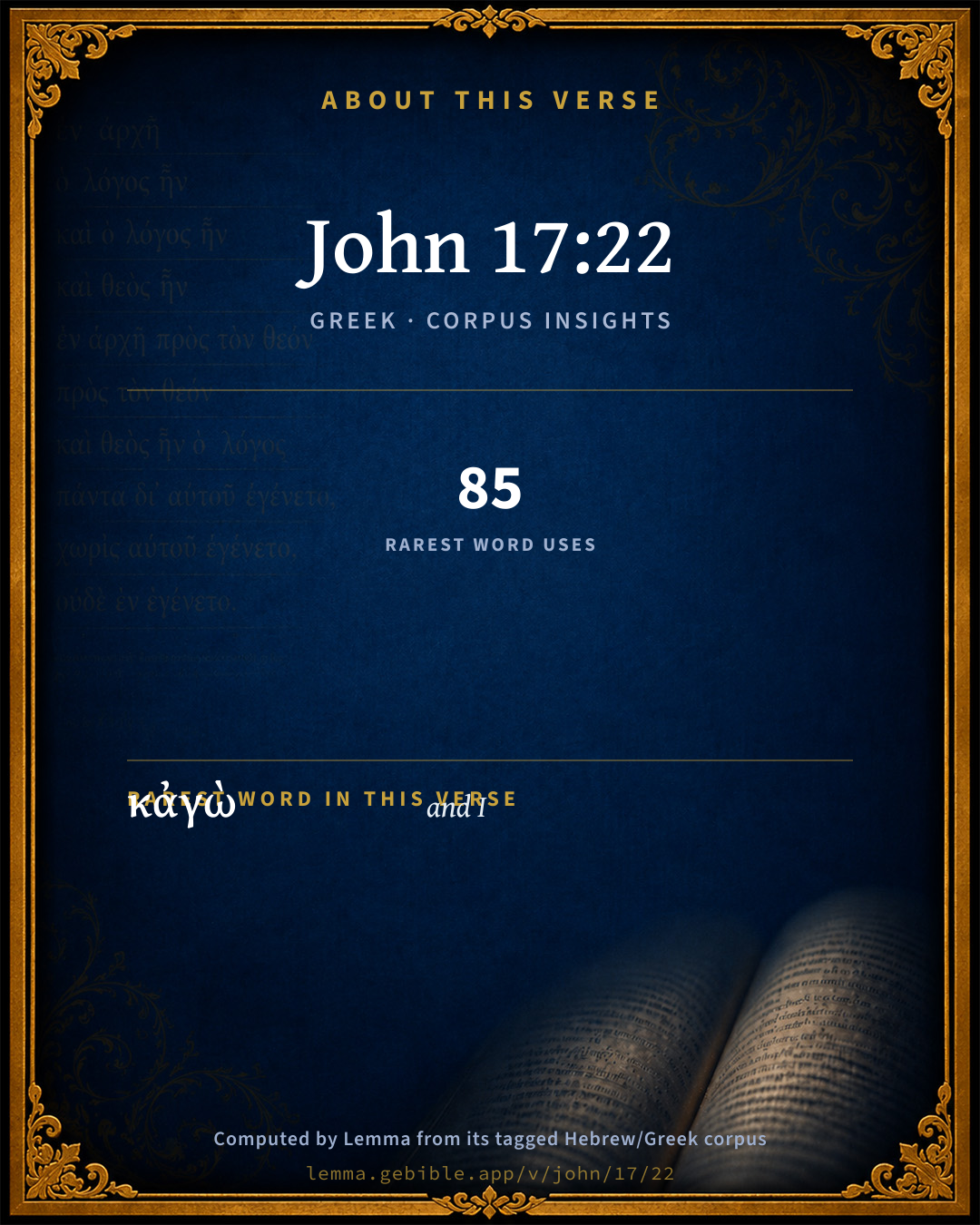
John 17:22

Greek (Tischendorf 8th ed.) John 17:22 appears in the Greek New Testament. The text above is from the Tischendorf 8th edition. Each word links to its Strong’s number and a concise gloss. Click any word for its full Thayer’s Greek Lexicon entry.
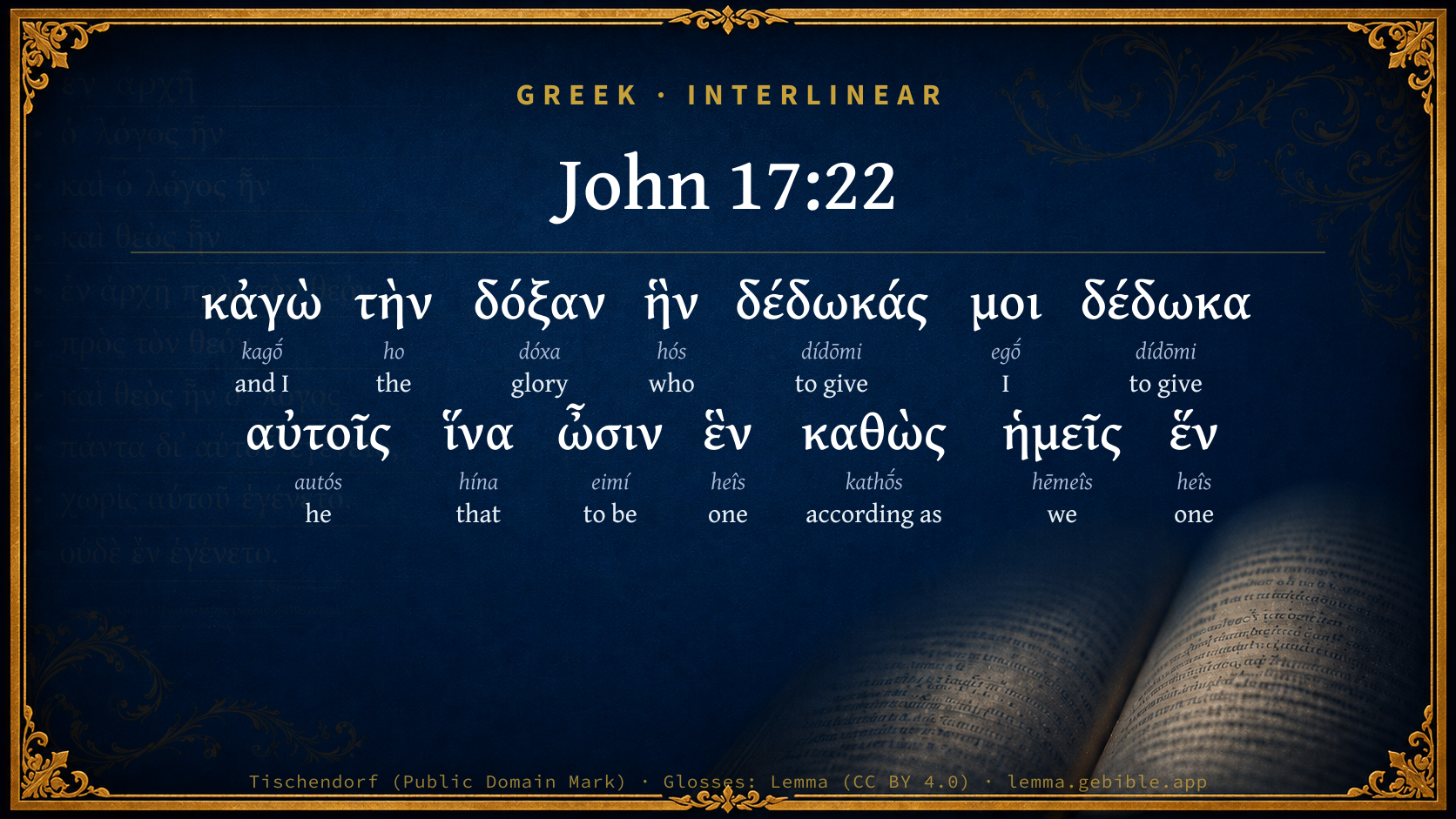
Download image
Cite this verse

John 17:22 (World English Bible). Public Domain. Lemma interlinear Bible study tool, https://lemma.gebible.app/v/john/17/22.

Show BibTeX & RIS
BibTeX
RIS
English Translation
The glory which you have given me, I have given to them; that they may be one, even as we are one;
World English Bible · Public Domain
Download a study sheet

One document with this verse’s original text, its word-by-word gloss line, the meaning frame, cross-references with their text, attributed commentary, and full source and license credits — printable, and it pastes into notes with its structure intact.

This verse Autodidact and up

Study sheet (.html) Plain text (.txt)

A passage Seminary Student

Up to 50 verses in one chapter. A passage sheet keeps up to 6 commentary sources and 12 cross-references per verse, in the order this page ranks them, and says so on the sheet whenever that leaves anything out. Ask for a single verse and you get the Autodidact verse sheet above.

Everything on this page stays free to read, with no account — the sheet is a download of what is already on screen, not access to it.

Want to remove ads? Support Godless Engineer
Compare translations 3

The same verse in 3 English versions, stacked beneath the original-language interlinear above. Click any original word for its lexicon entry.

Each is an independent rendering of the whole verse — the interlinear is not word-aligned to these translations.

Highlighted words mark where these versions differ — a whole-verse word diff, not a word-by-word alignment.

  • World English Bible Public Domain
    The glory which you have given me, I have given to them; that they may be one, even as we are one;
  • King James Version Public Domain
    And the glory which thou gavest me I have given them; that they may be one, even as we are one:
  • unfoldingWord Literal Text CC BY-SA 4.0
    The glory that you gave to me, I also have given to them so that they would be one, just as we are one:

unfoldingWord Literal Text — © unfoldingWord, licensed CC BY-SA 4.0. Word-aligned USFM3 via Door43 (git.door43.org/unfoldingWord/en_ult).

Versions to compare (up to 4)

3 of 4 selected

Show all 19 translations

Every available English version of this verse, each an independent rendering of the whole verse.

  • World English Bible Public Domain
    The glory which you have given me, I have given to them; that they may be one, even as we are one;
  • Berean Standard Bible Public Domain
    I have given them the glory You gave Me, so that they may be one as We are one—
  • Majority Standard Bible Public Domain
    I have given them the glory You gave Me, so that they may be one as We are one—
  • King James Version Public Domain
    And the glory which thou gavest me I have given them; that they may be one, even as we are one:
  • American Standard Version (1901) Public Domain
    And the glory which thou hast given me I have given unto them; that they may be one, even as we `are' one;
  • Revised Version (1885) Public Domain
    And the glory which thou hast given me I have given unto them; that they may be one, even as we are one;
  • Geneva Bible (1599) Public Domain
    And the glory that thou gauest me, I haue giuen them, that they may be one, as we are one,
  • Douay-Rheims (1899) Public Domain
    And the glory which thou hast given me, I have given to them; that they may be one, as we also are one:
  • Young's Literal Translation Public Domain
    `And I, the glory that thou hast given to me, have given to them, that they may be one as we are one;
  • Literal Standard Version CC BY-SA 4.0
    And I have given to them the glory that You have given to Me, that they may be one as We are one—
  • Unlocked Literal Bible CC BY-SA 4.0
    The glory that you gave me, I have given to them, so that they will be one, just as we are one:
  • unfoldingWord Literal Text CC BY-SA 4.0
    The glory that you gave to me, I also have given to them so that they would be one, just as we are one:
  • Darby Bible Public Domain
    And the glory which thou hast given me I have given them, that they may be one, as we are one;
  • World Messianic Bible Public Domain
    The glory which you have given me, I have given to them, that they may be one, even as we are one,
  • Webster's Bible Public Domain
    And the glory which thou gavest to me, I have given to them; that they may be one, even as we are one.
  • Free Bible Version CC BY-SA 4.0
    I have given them the glory that you gave me, so that they may be one, just as we are one.
  • Bible in Basic English Public Domain
    And the glory which you have given to me I have given to them, so that they may be one even as we are one;
  • Text-Critical English NT CC BY 4.0
    I have given them the glory that yoʋ gave me, so that they may be one, just as we are one,
  • Tyndale New Testament (1534) Public Domain
    And that glory that thou gavest me I have geven them that they maye be one as we are wone

Literal Standard Version (2020), Covenant Press — licensed CC BY-SA 4.0. Text via the HelloAO Bible API (eBible.org). Unlocked Literal Bible (unfoldingWord) — licensed CC BY-SA 4.0. Text via the HelloAO Bible API (eBible.org). unfoldingWord Literal Text — © unfoldingWord, licensed CC BY-SA 4.0. Word-aligned USFM3 via Door43 (git.door43.org/unfoldingWord/en_ult). Free Bible Version, Dr. Jonathan Gallagher — licensed CC BY-SA 4.0. Text via the HelloAO Bible API (eBible.org).

Word by word

More ways to search: Search by grammar → Find every occurrence → Compare this word →

Practice this passage: Drill this verse → Learn its vocabulary →

κἀγὼ
kagṓ
G2504
“and I”
Personal pronoun, 1st person, Nominative, Singular, Aramaic form
Part of Speech
Personal pronoun
Person
1st person
Case
Nominative
Number
Singular
Degree
Aramaic form
Full Thayer's Definition

Origin: from G2532 and G1473 (so also the dative case kamoi kam-oy', and accusative case kame kam-eh'

TDNT: None

1. and I 2. I also, I as well, I likewise, in like manner I 3. even I, this selfsame I
  1. τὴν ho G3588 “the” Article, Accusative, Singular, Feminine
  2. δόξαν dóxa G1391 “glory” Noun, Accusative, Singular, Feminine
  3. ἣν hós G3739 “who” Relative pronoun, Accusative, Singular, Feminine
  4. δέδωκάς dídōmi G1325 “to give” Verb, Perfect, Active, Indicative, 2nd person, Singular
  5. μοι egṓ G1473 “I” Personal pronoun, 1st person, Dative, Singular
  6. δέδωκα dídōmi G1325 “to give” Verb, Perfect, Active, Indicative, 1st person, Singular
  7. αὐτοῖς autós G846 “he” Personal pronoun, Dative, Plural, Masculine
  8. ἵνα hína G2443 “that” Conjunction
  9. ὦσιν eimí G1510 “to be” Verb, Present, Active, Subjunctive, 3rd person, Plural
  10. ἓν heîs G1520 “one” Adjective, Nominative, Singular, Neuter
  11. καθὼς kathṓs G2531 “according as” Adverb
  12. ἡμεῖς hēmeîs G2249 “we” Personal pronoun, 1st person, Nominative, Plural
  13. ἕν heîs G1520 “one” Adjective, Nominative, Singular, Neuter

About this verse

These counts appear in no published source. They are computed here, from the morphology-tagged text and Lemma’s own curated glosses. What Lemma adds →

14
words
12
distinct lemmas
Gospels
section

Repetition

Words recur within this verse:

  • δέδωκάς to give G1325 ×2
  • ἓν one G1520 ×2

Cross-references

21

Topical passages linked to John 17:22 in the Treasury of Scripture Knowledge — connected by theme and wording, ordered by reader-vote popularity; previews shown in the World English Bible.

  • 2 Corinthians 3:18 But we all, with unveiled face beholding as in a mirror the glory of the Lord, are transformed into the same image from glory to glory, even as from the Lord, the Spirit.
  • John 14:20 In that day you will know that I am in my Father, and you in me, and I in you.
  • Mark 16:17–20 These signs will accompany those who believe: in my name they will cast out demons; they will speak with new languages;
  • John 1:16 From his fullness we all received grace upon grace.
  • Ephesians 2:20 being built on the foundation of the apostles and prophets, Christ Jesus himself being the chief cornerstone;
  • 2 Corinthians 5:20 We are therefore ambassadors on behalf of Christ, as though God were entreating by us. We beg you on behalf of Christ, be reconciled to God.
  • 1 John 3:24 He who keeps his commandments remains in him, and he in him. By this we know that he remains in us, by the Spirit which he gave us.
  • Mark 6:7 He called to himself the twelve, and began to send them out two by two; and he gave them authority over the unclean spirits.
  • John 1:14 The Word became flesh, and lived among us. We saw his glory, such glory as of the one and only Son of the Father, full of grace and truth.
  • John 15:18–19 If the world hates you, you know that it has hated me before it hated you.
  • 2 Corinthians 6:1 Working together, we entreat also that you not receive the grace of God in vain,
  • Luke 22:30 that you may eat and drink at my table in my Kingdom. You will sit on thrones, judging the twelve tribes of Israel."
  • John 17:24 Father, I desire that they also whom you have given me be with me where I am, that they may see my glory, which you have given me, for you loved me before the foundation of the world.
  • John 20:21–23 Jesus therefore said to them again, "Peace be to you. As the Father has sent me, even so I send you."
  • Acts 5:41 They therefore departed from the presence of the council, rejoicing that they were counted worthy to suffer dishonor for Jesus' name.
  • Romans 15:15–20 But I write the more boldly to you in part, as reminding you, because of the grace that was given to me by God,
  • 1 John 1:3 that which we have seen and heard we declare to you, that you also may have fellowship with us. Yes, and our fellowship is with the Father, and with his Son, Jesus Christ.
  • Philippians 1:29 Because it has been granted to you on behalf of Christ, not only to believe in him, but also to suffer on his behalf,
  • Colossians 1:24 Now I rejoice in my sufferings for your sake, and fill up on my part that which is lacking of the afflictions of Christ in my flesh for his body's sake, which is the assembly;
  • 2 Thessalonians 1:5–10 This is an obvious sign of the righteous judgment of God, to the end that you may be counted worthy of the Kingdom of God, for which you also suffer.
  • Revelation 21:14 The wall of the city had twelve foundations, and on them twelve names of the twelve Apostles of the Lamb.

Cross-references courtesy of OpenBible.info (CC BY 4.0).

Commentary

Notes on John 17:22 from classic Christian and Jewish commentators (each source and its license shown beneath its notes). The classic Christian expositions comment on the surrounding passage and are grouped to its opening verse, so a note may address several verses; the Jewish commentaries on the Tanakh (Rashi and others) are per-verse, so they appear only where the commentator wrote on this verse.

Lemma curates 59 commentaries, every one of them public domain or Creative Commons licensed, each selected and text-cleaned for this edition rather than reprinted as found. About our sources →

The Biblical Illustrator

Joseph S. Exell

Joh_17:22-23

The glory which Thou gavest Me I have given them

The Churchs unity and its influence

I.

THE GIFT WHICH CHRIST BESTOWS ON HIS disciples.

1. What was the glory which Christ received? A glory belonged to the Son of God in His own Divine right (Joh_17:5). But the glory GIVEN to Him must refer to His mission in becoming incarnate. It was the glory of being

(1) The Divine Messenger. He was a Teacher sent from God to unfold all the truth which we required to know for our spiritual renewal and everlasting welfare, so that He proclaimed Himself as the Light of the World.

(2) The Divine Agent. He came to act for God, as well as to declare His truth. How much of true glory was there in such godlike action and enterprise as this!

(3) The Divine Representative. He came to show us the Father, to manifest the Divine name and character (Heb_1:3).

2. The glory communicated by Christ. Clearly it has no reference to any perishable wealth or worldly honour; for the Son of man had not where to lay His head. It is the glory of being

(1) The messengers of God (Joh_20:21). Christ came as the Light of the world, so in and through Him they are the light of the world.

(2) The agents of God. As the glory of Christ consisted in doing the Fathers will, and in being about His business, so in the same should the glory of all Christians be found.

(3) The representatives of God. In Jesus there shone forth the glory of the only begotten of the Father, and His true disciples receive of His glory, even grace for grace. Men seek glory for themselves in the material resources, social attractions, and artistic splendours of the world. But all such glory can be no lasting portion for the soul. The glory which Christ bestows will be remembered, and made to shine forth at the manifestation of the sons of God at the end of all things.

II. THE DESIGN OF THIS GIFT. That they may be one, &c. Wherever the glory makes itself appear, you see the truest evidence of Christian discipleship, and the highest proof of Christian unity. This unity is

1. Glorious in its source: I in them, and Thou in Me. In this way only are Christians truly and vitally one. In the absence of the living Saviour from individual souls, no forced process of uniformity, no subscription merely of the same creed, can effect their union in one body. Christ is in all His true disciples; in their understandings, as the object of the highest knowledge; in their hearts, as the King of Love; in their consciences, as the Prince of Peace; in their whole inner being, as the Lord of Life, the Captain of Salvation, and the Hope of Glory. Thus He becomes the true principle and bond of all unity.

2. Gradual in its realization: That they may be perfected into one. Many things hinder the complete enthronement of Christ in the soul, and so many hindrances prevent the perfecting of the Churchs oneness. Christians, instead of showing their essential unity, have appeared to be the fiercest and most uncompromising foes. But all hindrances will yet be overcome.

3. This triumph of unity is the very highest design which can be realised in relation to the Church. Sin is the element of discord, and the principle of dissocialism and separation in the world; and Gods great purpose for the destruction of this discord, and the restoration of true harmony, is the establishment of a holy brotherhood in Christ, the living Centre and personal Head of men. By Him God is to reconcile all things unto Himself.

III. THE GLORIOUS END TO BE ACCOMPLISHED. That the world may know that Thou hast sent Me, &c.

1. In Joh_17:21, Jesus said, that the world may believe; here He says that the world may know. Knowledge is belief, or faith in its highest attainment. The growing oneness of the disciples would be to the world an evidence of Christian truth, and the triumph of Christian love, mighty and irresistible. But Christ gives an additional thought--that Thou hast loved them, as Thou hast loved Me. Through-this conviction alone, of Gods infinite love, do the children of the world become the children of God. What an exhibition of the exceeding riches of Divine grace in the gift of Gods only begotten Son would this oneness supply!

2. This oneness, moreover, would show the exceeding blessedness of consecration to God. (J. Spence, D. D.)

The glory, unity, and triumph of the Church

I. THE GREAT MEANS OF THE UNITY which Christ proposes here. The glory which Thou gavest Me, &c. The glory which the Father gave the Son was

1. That He endowed Him with the Holy Spirit (Joh_3:34-35). The Holy Ghost descended upon our Lord in His baptism and abode upon Him. In Him was fulfilled Isa_11:1-3. In this Spirit there is glory, for the prophet further says, His rest shall be glorious. Now upon each true disciple this glory of God rests according to his measure. Owing to this endowment, there rested upon Jesus Christ a wondrous glory in many respects.

(1) As man He knew the name and character of God. The pure in heart shall see God, and those pure eyes of His had seen God to the full. Has He not given us that same vision of the Father? Yes, for He tells us, He that hath seen Me hath seen the Father. Our eyes have been opened by the blessed Spirit of God to see the invisible.

(2) In His receiving, keeping, and giving forth the Word of God. The depository of the Divine word was Christ, and this was greatly to His glory. Is not THE WORD, one of the brightest of His titles? But now He hath given unto us the Word, and henceforth we are to hold forth the Word of Life.

2. In the sanctification of His blessed person. For their sakes I sanctify Myself. How consecrated to God He was from His childhood till He said, It is finished! This is the glory which He gives to us. His prayer is, Sanctify them through Thy truth: Thy Word is truth. His disciples live unto holiness, and are known as a people zealous of good works.

3. In His mission. As thou hast sent Me into the world, even so, &c.

4. In His model humanity. You, too, are not to be common men, but model men. Jesus especially was a model in

(1) His perfect self-abnegation. For Gods glory, and Christs purpose in the convincement of the world, we are to live, and if we do so the Spirit of glory will be resting upon us.

(2) His oneness with God. His life ran parallel with the path of the Most High.

5. Wherever this glory is seen true unity is developed. Suppose I were to find a man, living in the likeness of Christ, with this spiritual glory conspicuous upon him. Suppose he is a coalheaver, the glory of his character will be none the less conspicuous amid the dust; or suppose that he is an earl, the glory will be none the more dim because of the good mans honours. The holy consecration in each case is the same, and the degrees of rank do not affect the essential beauty of either. If you bring a company of common Christians together and they begin discussing, I daresay they will jangle; but if you could select a number upon whom this glory rests, within a short time they will be all on their knees together, or singing together, or engaged in some form of loving fellowship. Spiritual men are so essentially one that like two drops which lie close together they have an increasing tendency to unite.

II. THE UNITY ITSELF. It is not uniformity. This our Lord says nothing of. Though we are one body in Him, yet all the members have not the same office.

1. I in them. Christ lives in His people, and we are so to act, in the power of the Holy Ghost, that onlookers shall say, Surely Christ lives again in that man, for he acts out the precepts of Jesus.

2. Thou in Me. That is, God is in Christ. This is manifestly true, for you cannot read the life of Christ without seeing God in Him.

3. This brings about the union of believers with the Father: being one with Christ, and Christ being one with the Father, the point is reached for which our Lord prayed, that they also may be one in us.

4. Couple this with believers being one with each other, and you get the being made perfect in one. Moved by the same love of holiness, inspired by the same spirit of love, the eternal Fathers will is the will of the Son, and the Spirit worketh in us also to will and to do according to the good pleasure of the Lord.

III. THE EFFECT WHICH THIS PRODUCES.

1. It will convince the world of the truth of Christs mission. When they see men who are no longer selfish, hard, ungenerous; men no longer governed by their passions; men who desire that which is holy, just, and good; men living to God--then the world will say, Their Master must have been sent of God. And then, not only will their characters convince, but their unity, because the ungodly world will say, We see the glory of Christianity in the poor man, and we see the same in the rich man.

2. But the world is also to be convinced of the Fathers love to us. When the world sees bodies of truly consecrated men and women living together in holy love, then they will also see much joy, peace, mutual consolation, and they will perceive that the providence of God makes all things work together for their good, and that the Lord has a special care over them as a shepherd hath over his flock. Then will they say, These are the people that God has blessed. See how He loves them. (C. H. Spurgeon.)

True glory

I. IS THE SAME IN ALL MORAL INTELLIGENCES. This prayer speaks of several grand unities.

1. One life. The life of God and Christ are here spoken of as one.

2. One truth; Thy truth. Truth has many sides, but it is one essential whole. Truths are but phases of His.

3. One Church. The Christly in all sects and countries are but one family of which Christ is the Head.

4. One love. Benevolence has many modifications, but in essence it is the same in all.

5. One glory. The glory that Christ had was the glory of God, and this He imparts to us--the glory of moral goodness. In the eye of conscience, in the light of the Bible, and in the estimate of God, the good only are glorious.

II. IS COMMUNICABLE FROM ONE BEING TO ANOTHER. Three things are necessary to its communication

1. The manifestation of it. Were the Eternal to conceal His glory, no creature intelligence could participate in its rays. A good being to make others good must show his goodness.

2. The contemplation of it. What boots it, if no eye observes the manifested glory. The man who at noonday shuts his eyes is as much in the dark as though it were midnight.

3. The imitation of it. There must be an effort on the part of the observer to imbibe, cherish, and develop the Divine goodness.

III. COMES TO MAN THROUGH CHRIST. Christ is the only perfect Revealer, We beheld His glory, &c. It is by studying and imitating Him that men become glorious. For we with open face, &c.

IV. IS CONSISTEST WITH CIRCUMSTANTIAL SUFFERING. As seen in the case of these disciples

1. How glorious their endurance!

2. How glorious their achievements! To their victories we owe our liberty, Bibles, schools, asylums, Christendom. (D. Thomas, D. D.)

Saints glorified on earth

I. THE CHARACTER OF THIS CHRIST-GIVEN GLORY.

1. Negatively.

(1) Not in appearance. Painters have delighted to pourtray Christ with a shining halo on His brow. But this is imaginary. His visage was marred more than any mans, &c.

(2) Not in regal state and trappings. These He despised. He refused to be made a king, and had not where to lay His head.

(3) Not in immediate triumph over existing conditions in any department of thought or action. Judged by all accepted standards of glory hardly was ever teacher less glorious.

2. Positively. His glory lay in the purpose and aim of His life, as appointed by the Father and accepted by Himself. It was early made known that Gods glory was His goodness. At the Incarnation the angel song showed this, and so did Christ at the first manifestation of His glory at Cana. And now with the Cross in prospect He prays (Joh_17:1-2).

3. It is clear then that Christ gives glory to His people in calling them to carry forward His work and in granting them necessary equipment (Joh_17:8; Joh_17:18). Christians are given to know the glory of being fellow-labourers with their Master. Perhaps to some the Lords call to service has been unattractive and irksome. It is the glory He hath given us. Is not the soldier honoured when appointed a part in the thick of the fight?

II. THE DESIGN OF CHRIST IS GIVING GLORY TO HIS PEOPLE.

1. To glorify God by making Him known (Joh_17:1; Joh_17:6). The fruitful cause of the worlds woe is ignorance of God.

2. To lead to blessed union with God and one another, that they may be one &c.

3. Here is discovered the responsibility of all disciples. By unfaithfulness we may turn our glory into shame.

III. THIS CHRIST-GIVEN GLORY THROWS LIGHT ON THE FUTURE GLORY OF THE SAINTS, which will consist of

1. A call to higher service. Inasmuch as thou hast been faithful over a few things, &c.

2. The realization of perfect and harmonious relationship with God and one another.

3. The possession of true rest and joy--the joy of accomplished and prospective service. (J. Stevens.)

The mutual glory of Christ and His people

I. THE NATURE OF CHRISTS GLORY. There is

1. The essential glory of Christ.

2. His mediatorial glory.

3. His remunerative glory.

II. SOME INSTANCES IS WHICH THIS GLORY IS COMMUNICATED TO THE SAINTS.

1. They have glorious titles.

2. Glorious privileges.

3. They are brought into glorious relations.

4. Glorious acts and exploits are ascribed to them.

5. Glorious prespects are before them.

III. INFERENCES.

1. The vanity of earthly things.

2. The dignity of real Christians.

3. Press forward to possession.

4. Let Him who put this glory on us receive all glory from us. (B. Beddome, M. A.)

Christs glory given to His people

I. CHRISTS GLORY.

1. Sonship.

2. Union with God.

3. Perfection of attributes.

II. HIS PEOPLES GLORY.

1. They are sons of God.

2. They are one with Christ.

3. They reflect His nature.

4. They are kings and priests. (W. W. Wythe.)

The glory Christ gives to His disciples

As the essence of the glory of Jesus consists in His dignity as the Son, and the well-beloved Son, so the glory He has bestowed on believers is the filial dignity, the state of adoption (Joh_1:12). Whereby they have become what He eternally is--children of God and objects of His perfect love. This glory Jesusbestowed on His own, by bringing matters to such a state that God could justly reflect upon them all the love which He has for Jesus Himself (verses Joh_15:9-10). Thus the proposition which follows, that they may be one, &c., is easily understood. Once objects of the same Fathers love, and bearing in common the image of their Elder Brother, they form among themselves a closely united family (cf. Rom_8:29; Eph_1:10)

. (F. Godet, D. D.)

The Biblical Illustrator, edited by Joseph S. Exell (c. 1880s–1900s) — public domain. Text from a community e-Sword module.

Tyndale Open Study Notes

Tyndale Open Resources

17:22 The community of believers should display the same glory that Jesus displayed from the Father.

Tyndale Open Study Notes — © Tyndale Open Resources, licensed CC BY-SA 4.0. Text via the HelloAO Bible API.

Bengel's Gnomon

Johann Albrecht Bengel

Joh 17:22. Δόξαν, the glory) The glory of the Only-begotten shines forth through the believing sons of God.—δέδωκα, I have given) Oh! how great is the majesty of Christians! I have given, already although secretly.

Bengel's Gnomon of the New Testament — English translation (T&T Clark, Edinburgh, 1860) — public domain. Text from a community e-Sword module.

Meyer's Critical & Exegetical Commentary

Heinrich August Wilhelm Meyer

Joh_17:22-23. What He on His part (ἐγώ) has done in order to bring about this unity of His believing ones and its objecta newly introduced and great thought of the power of His kingdomnot still dependent on ὅτι (Ewald).

τὴν δόξαν] The heavenly glory. Comp. 1, 5, 24. This, once already possessed by Him before the incarnation, the Father has given to Him, not yet, indeed, objectively, but as a secure possession of the immediate future; He has obtained it from God, assigned as a property, and the actual taking-possession is now for Him close at hand. In like manner has He given this, His δόξα, in which the eternal ζωή, Joh_17:2-3, is consummated, to His believing ones (αὐτοῖς), who will enter on the real possession at the Parousia, where they συνδοξάζονται (Rom_8:17), after that they, up to that time, τῇ ἐλπίδι ἐσώθησαν (Rom_8:24) Comp. on Rom_8:30. They are in Christ already His συγκληρονόμοι, and the Spirit to be received will be to them the ἀῤῥαβὼν τῆς κληρονομίας (Eph_1:14; 2Co_1:22; 2Co_5:5), but the actual entrance on the inheritance is first accomplished at the Parousia (Joh_14:2-3; Rom_8:11; Col_3:4). But this relation does not justify us in interpreting διδόναι as destinare (Gabler, B. Crusius), or at least δέδωκα as constitui dare (Grotius), while the explanations also which take δόξα of the glory of the apostolic office in teaching and working miracles (Chrysostom, Theophylact, and, but with intermixture of other elements, Euth. Zigabenus, Erasmus, Vatablus, Grotius, and several others, including Paulus and Klee), or of the inner glory of the Christian life (Olshausen, comp. Gess, p. 244), of the life of Christ in believers, in accordance with Gal_2:20 (Hengstenberg), of sonship (Bengel, comp. Godet, who refers to Rom_8:29), of love (Calovius, Maldonatus), of grace and truth, Joh_1:14 (Luthardt, Ebrard, a part also of Tholucks and Brückners interpretation), are opposed to the context.[199] See immediately, Joh_17:24.

ἵνα ὦσιν ἓν, κ.τ.λ.] For what a strong bond of unity must lie in the sure warrant of fellowship in eternal δόξα! Comp. Eph_4:4.

ἐγὼ ἐν αὐτοῖς κ. σὺ ἐν ἐμοι] Not out of connection with the construction (De Wette), since it fits into it; not even beginning a new proposition, and to be completed by εἰμί (Augustine, Theophylact, Euth. Zigabenus, Beda, Beza, Bengel, and several others, including Luthardt), since thus the discourse on the δόξα would be, in opposition to the context (see Joh_17:24), interrupted; but an appositional separation from ἡμεῖς, from which it is therefore, with Lachmann and Tischendorf, to be divided only by a comma. In ἡμεῖς is contained: ἐγὼ καὶ σύ, and both are pragmatically, i.e. in demonstration of the specific internal relation of the ἓν εἶναι of believers to the oneness of the Father and the Son, thus expounded: I moving in them, and Thou in me. In accordance with this appositional, more minute definition, the ἵνα ὦσιν ἕν is again taken up with liveliness and weight (see how His mouth overflows with the same words, Luther), and that in the expression containing the highest degree of intensity: ἵνα ὦσι τετελειωμένοι εἰς ἕν, that they may be completed to one (to one unity), be united in complete degree, εἰς in the sense of the result. Comp. passages like Plato, Phileb. p. 18 B: τελευτᾶν τε ἐκ πάντων εἰς ἓν; Dem. p. 368. 14 : εἰς ἓν ψήφισμα ταῦτα πάντα συνεσκεύασαν.

ἵνα γινώσκῃ ὁ κόσμος, κ.τ.λ.] Parallel to ἵνα ὁ κόσμος πιστεύσῃ, Joh_17:21, adding to faith the knowledge connected therewith (conversely, Joh_17:8), and then completing the expression of the happy result to be attained by the designation of the highest divine love, of which the believer is conscious in that knowledge. We are not even remotely to think of the forced conviction of rebels (Godet); against this Joh_17:2-3 already declare, and here the entire context. Note rather how the glance of the praying Jesus, Joh_17:21-23, rises up to the highest goal of His work on earth, when, namely, the κόσμος shall have come to believe, and Christ Himself shall have become in fact ὁ σωτὴρ τοῦ κόσμου (Joh_4:42, comp. Joh_10:16). This at the same time against the supposition of metaphysical dualism in Hilgenfeld.

κ. ἠγάπησας, κ.τ.λ.] and hast loved them (as a matter of fact, through this sending of me) as Thou hast loved me, therefore with the same Fatherly love which I have experienced from Thee. Comp. Joh_3:16; Eph_1:6; Rom_5:5; Rom_8:32.

[199] The δόξα is explained away also by Weizsäcker in the Jahrb. f. Deutsche Theol. 1857, p. 181. It is said to be substantially the same as the λόγος, ver. 14.

Meyer — Critical and Exegetical Commentary on the New Testament — English translation by Peter Christie, edited by Frederick Crombie (T&T Clark, 1880) — public domain. Text from a community e-Sword module.

Expositor's Greek Testament

ed. W. Robertson Nicoll

Joh 17:22 . That the unity of believers in the Father and the Son might be perfect, it was needful that even the glory which Christ possessed by the Father’s gift (Joh 17:5 ) should be given to His people. The perfect tense is used, because the gift had already been determined. The nature of the glory spoken of is interpreted both by Joh 17:5 and by Joh 17:24 . It could not be completely and actually bestowed until the point indicated in Joh 17:24 was reached.

The Expositor's Greek Testament, edited by W. Robertson Nicoll (1897–1910) — public domain. Text from a community e-Sword module.

Godet's Commentaries

Frédéric Louis Godet

Vv. 22, 23. “And the glory which thou hast given me, I have given them, that they may be one, as we are one, 23, I in them and thou in me; that their unity may be perfect, that the world may know that thou hast sent me and that thou hast loved them as thou hast loved me.”

In this whole prayer, Jesus rests His petitions on the fact that He has already begun that of which He asks the completion. Hence the ἐγώ, 1, placed at the beginning.

What is the glory of which Jesus has already made a gift to His own, and by means of which He has laid the foundation of the unity which He asks for? Chrysostom and, at the present day, Weiss understand by it the glorious power of sustaining their apostolic ministry by miracles. But this outward sign has nothing in common with the inward sphere in which the thought of Jesus is here moving. How could a result like this, which is expressed by the following ἵνα, that, proceed from a miraculous power, an external, passing and individual phenomenon? Hengstenberg refers this term glory to the participation of believers in the unity of the Father and the Son; but this explanation leads to a tautology with the following clause. De Wette, Reuss, Meyer, apply this term glory to the kingdom which is to come, and the word give to a property only by right; but this is to anticipate the meaning of Joh 17:24. Jesus starts, on the contrary, in Joh 17:22 from a fact already accomplished, in order to make it the point of departure for a coming good (Joh 17:23) which will precede the final glory (Joh 17:24). We read, Joh 17:24, that the glory of Jesus consists in being the eternal object of the Father’s love; the glory which He has communicated to believers is, therefore, the becoming by faith what He is essentially, the objects of this same divine love; comp. Joh 17:23 (that thou hast loved them as thou hast loved me) and Joh 17:26. This glory, which is that of adoption, Jesus has communicated to His own by bringing things to this point,—that God can, without obscuring His holiness, convey to them the love which He has for Jesus Himself. By this means we understand the following clause: that they may be one, as we [are] one. This love of the Father, of which they are all the objects in common, unites them closely among themselves and makes them all one family of which Jesus is the elder Brother (Rom 8:29, Eph 1:10).

The first words of Joh 17:23, in a clause which is simply placed in juxtaposition with the preceding: “that they may be one as we are,” remind us of the mode of this unity: God living in Christ, Christ living in each believer, and this to the end that the limit of a perfect unity may be attained, and that the organism of humanity consummated in God may appear.

The aim of this admirable unity is that the world may know. This word is undoubtedly not the synonym of believe, Joh 17:21. The term know includes with the faith of believers (Joh 17:21) the forced conviction of rebels. For how could the word κόσμος, the world, designate only the believers? The question is of the universal homage, voluntary or involuntary, rendered to Christ—such as is described in Php 2:10, Rom 14:10-12. The whole universe renders homage to the divine messenger who, by transforming believers into His own image, has succeeded in making them loved as He is Himself loved.

Thus is the way prepared for the pointing out of the final end of the ways of God towards the Church of Christ, its participation in the glory of the Son of God:

Frédéric Louis Godet — Commentaries on Luke, John, Romans, and 1 Corinthians — English translation (T&T Clark, Edinburgh, 1870s–1890s) — public domain. Text from a community e-Sword module.

Jamieson, Fausset & Brown

Robert Jamieson, A. R. Fausset & David Brown

And the glory which thou gavest--hast given.

me I have given them, that they may be one, even as we are one--The last clause shows the meaning of the first. It is not the future glory of the heavenly state, but the secret of that present unity just before spoken of; the glory, therefore, of the indwelling Spirit of Christ; the glory of an accepted state, of a holy character, of every grace.

Jamieson, Fausset & Brown — Commentary Critical and Explanatory on the Whole Bible (1871) — public domain (CC PDM 1.0). Text via the HelloAO Bible API.

Adam Clarke's Commentary

Verse 22. And the glory which thou gavest me I have given them] That is, the power to work miracles, and to preach unadulterated truth, say some; but as our Lord is not here praying for the disciples, but for all those who should believe on him through their word, Joh 17:20, it is more natural to understand the passage thus. As Christ, according to his human nature, is termed the Son of God, he may be understood as saying: "I have communicated to all those who believe, or shall believe in me, the glorious privilege of becoming sons of God; that, being all adopted children of the same Father, they may abide in peace, love, and unity." For this reason it is said, Heb 2:11, Christ is not ashamed to call them brethren. However, our Lord may here, as in several other places, be using the past for the future; and the words may therefore be understood of the glory which they were to share with him in heaven.

Adam Clarke's Commentary on the Bible (1810–1826) — public domain. Text from a community e-Sword/MySword module.

John Calvin's Commentaries

22. And I have given to them the glory which thou gavest to me. Let it be observed here, that, while a pattern of perfect happiness was exhibited in Christ, he had nothing that belonged peculiarly to himself, but rather was rich, in order to enrich those who believed in him. Our happiness lies in having the image of God restored and formed anew in us, which was defaced by sin. Christ is not only the lively image of God, in so far as he is the eternal Word of God. but even on his human nature, which he has in common with us, the likeness of the glory of the Father has been engraved, so as to form his members to the resemblance of it. Paul also teaches us this, that

we all, with unveiled face, by beholding THE GLORY OF GOD, are changed into the same image, (2 Corinthians 3:18.)

Hence it follows, that no one ought to be reckoned among the disciples of Christ, unless we perceive the glory of God impressed on him, as with a seal, by the likeness of Christ. To the same purpose are the words which immediately follow:

John Calvin's Commentaries (1540-1563) — public domain. Text from the Calvin Translation Society English edition (1840s-50s) via the Christian Classics Ethereal Library (ccel.org). Calvin's coverage is partial (roughly two-thirds of the Bible); uncommented books and verses are honest gaps, never fabricated. The 19th-century editor's footnotes and remarks are omitted so the notes are faithfully Calvin's own voice.

Ellicott's Commentary for English Readers

(22) And the glory which thou gavest me (better, hast given Me) I have given them.—Comp. Joh_13:32, and in this chapter Joh_17:1; Joh_17:5; Joh_17:24. Here, as all through this Intercessory Prayer, the future which immediately grows out of the present is regarded as present; the fulness of the glory which awaits Him at His Father’s right hand is thought of as already given to Him; and the believers who have become, and will become, one with Him, to whom He has given eternal life (Joh_17:2), are thought of as sharers in it. It is the thought which is expanded by St. Paul when he speaks of the children being “heirs; heirs of God, and joint-heirs with Christ; if we suffer with Him to the end that we may be also glorified with Him” (Rom_8:17); and by St. John when he speaks of “children of God being like Him because we shall see Him as He is” (1Jn_3:1-2). In the original the pronoun “I” is emphatically expressed. “The glory which Thou hast given Me,” our Lord’s words seem to mean, “I have on My part given to them. I have fulfilled the work which Thou hast given Me to do. I have made and declared an atonement between man and God. My work is done. I pray that Thou wouldst fulfil Thine own.”

That they may be one, even as we are one.—This is here expressed, in addition to the thought of the last verse, as the purpose for which He has given to them the glory which the Father has given Him. It is future in the union of the glory of heaven; it is present in the realisation of heaven now in those who have the one common hope of their calling.

A Bible Commentary for English Readers, edited by Charles John Ellicott (1878–1897) — public domain. Text from a community e-Sword module.

The Cambridge Bible for Schools and Colleges

gen. ed. J. J. S. Perowne

22. Having prayed for them with a view to their unity, He states what He Himself has done for them with the same end in view.

gavest] Better, hast given (see on Joh_17:4). The meaning of this gift of ‘glory’ seems evident from Joh_17:24; the glory of the ascended and glorified Christ in which believers are ‘joint-heirs’ with Him (see on Rom_8:17). Looking forward with confidence to the issue of the conflict, Christ speaks of this glory as already given back to him (Joh_17:5) and shared with His followers. Comp. Joh_16:33.

The Cambridge Bible for Schools and Colleges (gen. ed. J. J. S. Perowne; Cambridge University Press, 1878–1918) — public domain. Text from a community e-Sword module.

John Gill's Exposition

I in them,.... Christ is in his saints; not as he is in all the world, being the omnipresent God; or as he is in every man, communicating the light of nature as Creator; or as he is in the human nature, which is united to his divine person; or circumscriptively to the exclusion of him elsewhere; for he is in heaven, his blood is within the veil, and his righteousness without us: but he is in them, in a gracious manner, in regeneration; when he is revealed to them, formed in them, enters into them, takes possession of them, communicates his grace, grants fellowship with himself, and dwells in them; not only by his Spirit and grace, but in person, as the head in the members, as the master of the house, and the King of them; which is an instance of condescending grace, and is peculiar to God's elect: hence all their holiness and fruitfulness; nor shall they ever perish; their bodies shall rise from the dead, and being reunited to their souls, Christ will be in them in a glorious manner to all eternity:

and thou in me; the Father is in Christ, not only by union of nature, nor merely in him, as Mediator, in a way of grace; but as he will show himself in and through him in glory for evermore, and is what is here prayed for:

that they may be made perfect in one; this regards not their justification, which is already perfect; nor their sanctification, which will be; but either perfection in glory, when they will be perfect in knowledge, in holiness, in peace, joy and love: or rather the perfection of their numbers is meant, when the whole election of grace will be completed in regeneration, sanctification, and glorification:

and that the world may know that thou hast sent me: as before; See Gill on Joh 17:21;

and hast loved them, as thou hast loved me. The Oriental versions, the Syriac, Arabic, Persic, and Ethiopic, all read the words thus, "and I have loved them, as thou hast loved me"; contrary to all the Greek copies, and other versions, which read as we do. The Father loved Christ as his own Son, and as Mediator; so he loved him when he assumed human nature, and became obedient to his will both in doing and suffering; when his Father left him, and poured out his wrath upon him, and when he laid down his life for the sheep. The instances of his love to him as Mediator are, his putting all things into his hands, showing him all that he does, and concealing nothing from him, and appointing him the only Saviour, the head of the church, and Judge of the world. The nature of this love is, that it is from eternity; is a love of complacency and delight; it is special and peculiar, unchangeable and inseparable, and will last for ever: now God has loved his people, as he has loved his Son; he loves them not merely as creatures, as the descendants of Adam, or as considered in themselves, but as in Christ. The instances of his love to them are, his choosing them in Christ; making a covenant with them in him; the mission of him into this world, to obtain salvation for them; the quickening and calling of them by his grace; the care he takes of them afterwards in supplying their wants, supporting them under temptations, delivering them out of afflictions, and causing all things to work together for their good; to all which add the provisions he makes for them, both for time and eternity. The nature of this love is such as that he bears to Christ; it is from everlasting; a love of the utmost delight and pleasure; it is special and peculiar, unchangeable, and will continue for ever: there is not the same reason for his loving them as his Son; and this as must not be thought to denote equality, but similitude and order.

John Gill's Exposition of the Whole Bible (1746–1763) — public domain (CC PDM 1.0). Text via the HelloAO Bible API.

Trapp's Complete Commentary

John Trapp

22 And the glory which thou gavest me I have given them; that they may be one, even as we are one:

Ver. 22. And the glory which thou, &c.] That is, the grace, which is glory begun, as glory is grace perfected; we are here "transformed into the same image from glory to glory," 2Co 3:18; "and set together in heavenly places in Christ Jesus," Eph 2:6; "Such honour have all his saints." Such things are found in them as do accompany or comprehend salvation, Heb 6:9, εχομενα, τουτ εστι κατεχομενα. Scholiast.

John Trapp, A Commentary or Exposition upon All the Books of the Old and New Testament (1647–1656) — public domain. Text from a community e-Sword module.

Albert Barnes' Notes on the Bible

And the glory ... - The honor which thou hast conferred on me by admitting me to union with thee, the same honor I have conferred on them by admitting them to like union with me.

May be one, even as we are one - Not in nature, or in the mode of existence - for this was not the subject of discourse, and would be impossible - but in feeling, in principle, in purpose. Evincing, as the Father and the Son had always done, the same great aim and plan; not pursuing different interests, or counteracting each other’s purposes, or forming parties, but seeking the same ends by the same means. This is the union between the Father and the Son. Always, in the creation, preservation, and redemption of the world, the Father and the Son have sought the same object, and this is to be the model on which Christians should act.

Albert Barnes' Notes on the Bible (1834–1885) — public domain. Text from a community e-Sword/MySword module.

Haydock's Catholic Bible Commentary

The glory which thou gavest me, I have given to them. St. John Chrysostom expounds this of the power of working miracles: St. Augustine rather understands the glory of heaven, which he had given, prepared, and designed to give them in heaven. This seems to be the sense by the 24th verse, where he says, Father, I will that where I am, they also whom thou hast given me, may be with me. (Witham)

George Leo Haydock (1774–1849), Haydock's Catholic Family Bible and Commentary, 1859 edition — public domain. Excludes Psalms (Douay-Rheims chapter numbering differs from Protestant) and Deuterocanonical books (Catholic canon only).

Matthew Poole's English Annotations

By glory here some understand the heavenly glory; but then they must understand the oneness mentioned in the latter part of the verse, of the union which the saints shall have with Christ and his Father in glory, in another world. Others understand the Divine nature, of which the apostle in, 2Pe 1:4, saith, believers are made partakers: this seemeth to come nearer, for the more men and women are made partakers of that, the more they will study the unity of the Spirit. Others understand the power of working miracles, by which Christ is said to have manifested his glory, Joh 2:11; and the effect of this power is called the glory of God, Joh 11:40. Others understand the preaching of the gospel, in which the ministration of the Spirit is glorious, 2Co 3:8; and the faithful ministers of the gospel are called the glory of Christ, 2Co 8:23.

That they may be one, even as we are one; our Saviour either again repeats his prayer, that they might be one; or else declareth that he had communicated his power, his glory to them, that they might be one, as be and his Father are one.

Matthew Poole's English Annotations on the Holy Bible (1683–1685) — public domain. Text from a community e-Sword/MySword module.

Whedon's Commentary on the Bible

Daniel D. Whedon

22. The glory which thou gavest me—The eternal celestial glory.

I have given them—It is in them even now, in various degrees, a spark, a slender flame, a beaming luminousness, destined to shine in eternal splendour in the celestial firmament. “Even the slightest glimmering of heavenly light which begins to shine out of the countenance of a justified publican, is an outbeaming of this glorification; and so is the still brighter angel-face of the crowned martyr at his trial.”—Stier.

May be one—For that glory has its source in a spark of divine love in the heart, and that love melts into one its various possessors, so that there is one love, one glory, one Church.

Daniel D. Whedon (gen. ed.), Commentary on the Old and New Testaments (1874–1909) — public domain. Text from a community e-Sword module.

The Pulpit Commentary

Our Lord now proceeds to record how he has already contributed to produce this result. I also very emphatichave given to them that is, to my disciplesthe glory which thou gavest me. Numerous interpretations of this "glory" have been suggested, as e.g. , the glory into which he is about to enter in his glorified body; but the emphatic perfect dedwka , in connection with the edwkav , viz.: "I have given and am now and still giving," renders this improbable. Meyer, who does not accept Baumgarten-Crusius"s view that didonai here means "to destine," yet comes very much to the same thought, and regards it as the heavenly glory of which he had eternal experience, and would ultimately share with his people. But the view variously set forth by Oldhausen, Hengstenberg, Maldonatus, Bengel, Tholuck, Moulton, and Godet appears to be in full harmony with the context, viz. the glory of the supernatural life of Divine Sonship and self-sacrificing love as of the very essence of God. This glory that he should taste death for every man, this glory of nature and character as the incarnate Head of a new humanity, I have given to them, in order that they may be one, living in and for each other, even as we are one. The contrast between his own relation to the Father and theirs is most wonderfully maintained. The union between the Father and Son is once more made the type, in his own unique consciousness, of the union among men who have received as his gift the eternal life and glory of a supernatural love. This is more evident from what follows.

Vers. 22-24. A prayer that the disciples may share in the Lord"s glory.

Jesus supports his petition by declaring what he has already done for his disciples.

I HE HAS ALREADY IMPARTED TO THEM A SHARE IN" HIS GLORY. "And the glory which thou hast given me I have given them.

1. This glory is not apostolic office or gift of miracle.

2. It is not the glory of the future kingdom.

3. It is the glory of adoption. As Christ"s glory consisted in his Sonship, so that of believers consisted in their filial dignity, as children of God and brethren of himself as the eider Brother.

4. The effect of this glory is twofold.

(1) The formation of a closely united family in heaven and in earth. "I in them, and thou in me, that their oneness may be perfect." God living in Christ, Christ in each believer, reproduce the Divine unity on earth.

(2) A demonstration to the world of Christ"s mission, and the Father"s love to his children.

(a) Christ"s mission would be manifest in its blessed and enduring effects.

(b) The Father"s love to believers would be manifest as a love resembling that with which he regards his Son.

(i) He loves them in Christ;

(ii) he loves them through Christ;

(iii) his love is the guarantee that he will uphold them, as he didChrist, assist them in his service, provide for their wants, and reward them for their services.

5. Christ"s will is that his disciples should share his throne in the heavens. "Father, I will that they also, whom thou hast given me, be with me where I am; that they may behold my glory, which thou hast given me: for thou lovedst me before the foundation of the world.

(1) His will is that his people should be where he is.

(a) Love seeks the companionship of the loved.

(b) Heaven is wherever Christ is.

(c) Union with Christ draws after it everlasting communion with him.

(2) His will is that his people should see his glory;

(a) not his essential glory, for that could not be given him,

(b) but the glory of a consummated fellowship effected between God and man.

The Pulpit Commentary (1880–1919), ed. H.D.M. Spence-Jones & Joseph S. Exell — public domain. Text from a community e-Sword module.

John Wesley's Explanatory Notes

The glory which thou hast given me, I have given them - The glory of the only begotten shines in all the sons of God. How great is the majesty of Christians.

John Wesley, Explanatory Notes Upon the Whole Bible (1754–1765) — public domain. Text via the GEBible commentary corpus.

Burkitt's Expository Notes on the New Testament

William Burkitt

Here observe, 1. Christ’s communication of that glory to believers, which he had received of the Father; that is, not his essential glory, but his mediatorial glory: The glory which thou gavest me. Now Christ hath no glory given him as God, but much glory bestowed upon him as Mediator.

Observe, 2. The end of this communication,why he gave his disciples that glory which the Father had given him; namely, that they might be one.

Learn, 1. That God the Father had bestowed much glory on Christ his Son, as he is Man, and Mediator of the church.

2. That the same glory for kind and substance, though not for measure and degree, which Christ as Mediator has received from the Father, is communicated to true believers.

3. That the great end of this communication was, and is, to oblige and enable his people to maintain a very strict union among themselves; The glory which thou gavest me, I have given them, that they may be one, even as we are one.

4. That unity amongst believers is part of that glory which Christ as Mediator hath obtained for them.

William Burkitt's Expository Notes on the New Testament (1700–1703) — public domain. Text from a community e-Sword module.

The People's New Testament

B. W. Johnson

22, 23. The glory which thou gavest me I have given them. God gave Christ the glory of Sonship and this resulted in their unity. So Christ gives to his disciples the glory of becoming the sons of God (John 1:12; 1 John 3:1). This glory, the adoption and gift of the Spirit, ought to effect that they be one as we are one. We cannot pray this prayer of Jesus and have the party spirit or labor to build up sectarianism. In the spirit of love we should oppose it, and labor to destroy sectarian names, creeds, organizations and interests. As the Son and the Father are one, have one work, one kingdom, one spirit, one interest, so must all that are Christ's. We must “keep the unity of the Spirit in the bond of peace.” There is “one body” and “one Spirit,” as there is “one Lord.”

B. W. Johnson's The People's New Testament with Notes (1889–1891) — public domain. Electronic text from the Christian Classics Ethereal Library (CCEL) ThML edition.

unfoldingWord translationNotes

Door43 World Missions Community

The glory that you gave me, I have given to them

"I have honored my followers just as you have honored me"

so that they will be one, just as we are one

You can translate this in an active form. AT: "so that you can unite them just as you have united us" (See: Active or Passive)

that they may be brought to complete unity

"that they may be completely united"

that the world will know

Here "the world" is a metonym that refers to the people who do not know God. AT: "that all the people will know" (See: Metonymy)

loved

This kind of love comes from God and focuses on the good of others, even when it does not benefit oneself. This kind of love cares for others, no matter what they do.

translationWords

glory

love

unfoldingWord translationNotes — © Distant Shores Media and the Door43 World Missions Community, licensed CC BY-SA 4.0. Source: git.door43.org/Door43/en_tn.

Cambridge Greek Testament for Schools and Colleges

22–24. Having prayed for them with a view to their unity, Jesus passes to His final petition, a share in His glory for His disciples. In leading up to this He states what He Himself has done for them: κἀγώ is emphatic.

22. Omit ἐσμεν at the end of the verse with א1BDL against Aא3.

22. δέδωκας. see on Joh 3:35. The meaning of this gift of δόξα is clear from Joh 17:24; the glory of the ascended and glorified Christ in which believers are His συνκληρονόμοι (see on Rom 8:17). In full assurance of victory (Joh 16:33), Jesus speaks of this glory as already given back to Him (Joh 17:5) and shared with His followers.

Cambridge Greek Testament for Schools and Colleges (Cambridge University Press, 1896; 21 vols, various authors incl. Carr, Maclear, Plummer, Farrar, Lumby, Moule, M. R. James, Simcox) — public domain. Text from a community e-Sword module.

International Critical Commentary

22. κἀγὼ τὴν δόξαν κτλ. “And I, even I, have given to them the glory which Thou hast given to me.” Quanta maiestas Christianorum! is Bengel’s penetrating comment. But what is this δόξα? It is not the glory of the Eternal Word, spoken of in v. 24. That a faithful disciple may hope to see, but not to share (although 1Pe 5:1 seems to claim more than is suggested in Jn.). It is rather the glory of the Incarnate Word (see on 1:14), which Jesus exhibited in His earthly ministry (2:11), the manifestation of the Divine Nature in man. His disciples were the branches of which He was the Vine (15:5), or, as it is expressed in 2Pe 1:4, they had become θείας κοινωνοὶ φύσεως, “partakers of the Divine Nature.” See on 8:54 for the “glorification” of the Son by the Father; and for the “glorification” of believers, cf. Rom 8:30.

For δέδωκας (אBCLΓΔ), ADNWΘ have ἔδωκας; and for δέδωκα (BCDLWΓΔ), אANΘ have ἔδωκα. See on v. 4 for similar variants.

ἵνα ὦσιν ἓν καθὼς ἡμεῖς ἕν. The rec. (Θ) adds ἐσμεν, but om. BC*DLW. The consequence of the imparting of His Incarnate δόξα to His disciples by Jesus would be that, sharing this in common with Him and with each other, they would be spiritually united, and thus be one, even as the Father and the Son are one.

International Critical Commentary — older volumes (1896–1929), various authors — public domain. Text from a community e-Sword module.

Lesson kit

Teaching starters — assembled from the data on this page, not authored interpretation. Every prompt links to the verse data it draws on. Edit before teaching.

John, in the Gospels, opens this verse with 14 words (12 distinct Greek lemmas). Its most distinctive word is kagṓ (“and I”). A historical commentator’s framing appears above. Read the whole chapter for the surrounding context.

Discussion questions

  1. The word kagṓ carries the sense “and I.” How does it shape the verse?
  2. How does 2 Corinthians 3:18, which shares this passage’s theme, read alongside this verse?
  3. What does the repetition of “to give” (2× in this one verse) do in this verse?
  4. These translations render this verse differently; the difference is in the English rendering, not the original. What questions does that raise?
  5. Compare how The Biblical Illustrator and Tyndale Open Study Notes read this verse. Where do they agree or differ?

Things to notice

  • These translations choose different wording for 9 words in this verse.
  • “to give” occurs 2× in this single verse.
  • 12 distinct Greek lemmas span 14 words in this verse.

Reading settings

Reading text

Shown beneath each verse's original-language words.

Old Testament
Old Testament edition

Read the OT as the Masoretic Hebrew (MT) or the Greek Septuagint (LXX).

English shown for the Greek Septuagint (in the Hebrew ↔ Greek comparison).

Comparing translations? Open the Compare panel on any verse page to stack up to four side by side.