John 17:2

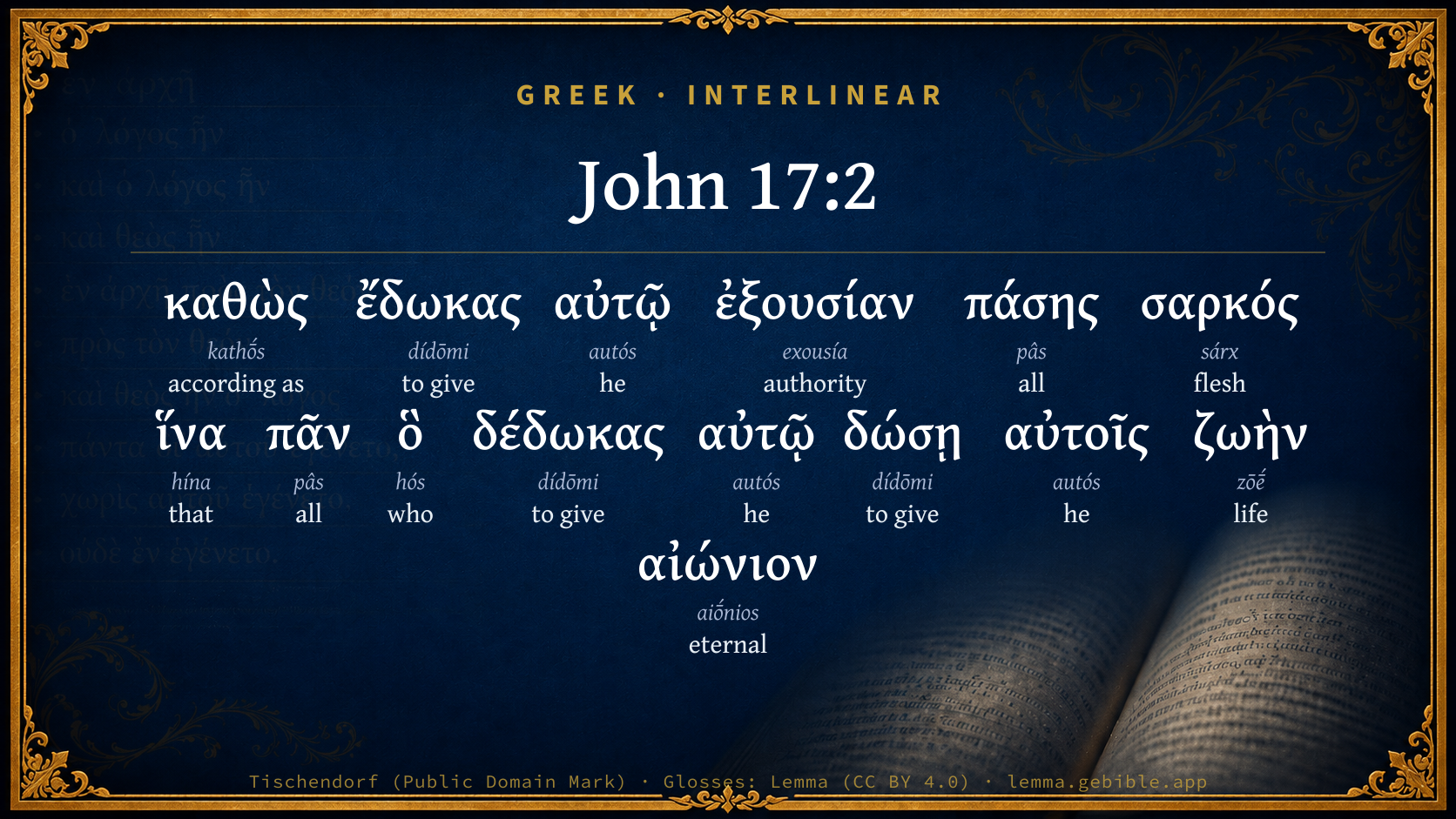
Greek (Tischendorf 8th ed.) John 17:2 appears in the Greek New Testament. The text above is from the Tischendorf 8th edition. Each word links to its Strong’s number and a concise gloss. Click any word for its full Thayer’s Greek Lexicon entry.
Download image
Cite this verse

John 17:2 (World English Bible). Public Domain. Lemma interlinear Bible study tool, https://lemma.gebible.app/v/john/17/2.

Show BibTeX & RIS
BibTeX
RIS
English Translation
even as you gave him authority over all flesh, he will give eternal life to all whom you have given him.
World English Bible · Public Domain
Download a study sheet

One document with this verse’s original text, its word-by-word gloss line, the meaning frame, cross-references with their text, attributed commentary, and full source and license credits — printable, and it pastes into notes with its structure intact.

This verse Autodidact and up

Study sheet (.html) Plain text (.txt)

A passage Seminary Student

Up to 50 verses in one chapter. A passage sheet keeps up to 6 commentary sources and 12 cross-references per verse, in the order this page ranks them, and says so on the sheet whenever that leaves anything out. Ask for a single verse and you get the Autodidact verse sheet above.

Everything on this page stays free to read, with no account — the sheet is a download of what is already on screen, not access to it.

Want to remove ads? Support Godless Engineer
Compare translations 3

The same verse in 3 English versions, stacked beneath the original-language interlinear above. Click any original word for its lexicon entry.

Each is an independent rendering of the whole verse — the interlinear is not word-aligned to these translations.

Highlighted words mark where these versions differ — a whole-verse word diff, not a word-by-word alignment.

  • World English Bible Public Domain
    even as you gave him authority over all flesh, he will give eternal life to all whom you have given him.
  • King James Version Public Domain
    As thou hast given him power over all flesh, that he should give eternal life to as many as thou hast given him.
  • unfoldingWord Literal Text CC BY-SA 4.0
    since you gave him authority all flesh so that everyone whom you have given him, he would give to them eternal life.

unfoldingWord Literal Text — © unfoldingWord, licensed CC BY-SA 4.0. Word-aligned USFM3 via Door43 (git.door43.org/unfoldingWord/en_ult).

Versions to compare (up to 4)

3 of 4 selected

Show all 19 translations

Every available English version of this verse, each an independent rendering of the whole verse.

  • World English Bible Public Domain
    even as you gave him authority over all flesh, he will give eternal life to all whom you have given him.
  • Berean Standard Bible Public Domain
    For You granted Him authority over all people, so that He may give eternal life to all those You have given Him.
  • Majority Standard Bible Public Domain
    For You granted Him authority over all people, so that He will give eternal life to all those You have given Him.
  • King James Version Public Domain
    As thou hast given him power over all flesh, that he should give eternal life to as many as thou hast given him.
  • American Standard Version (1901) Public Domain
    even as thou gavest him authority over all flesh, that to all whom thou hast given him, he should give eternal life.
  • Revised Version (1885) Public Domain
    even as thou gavest him authority over all flesh, that whatsoever thou hast given him, to them he should give eternal life.
  • Geneva Bible (1599) Public Domain
    As thou hast giuen him power ouer all flesh, that he shoulde giue eternall life to all them that thou hast giuen him.
  • Douay-Rheims (1899) Public Domain
    As thou hast given him power over all flesh, that he may give eternal life to all whom thou hast given him.
  • Young's Literal Translation Public Domain
    according as Thou didst give to him authority over all flesh, that -- all that Thou hast given to him -- he may give to them life age-during;
  • Literal Standard Version CC BY-SA 4.0
    according as You gave to Him authority over all flesh, that—all that You have given to Him—He may give to them continuous life;
  • Unlocked Literal Bible CC BY-SA 4.0
    just as you gave him authority over all flesh so that he would give eternal life to everyone whom you have given him.
  • unfoldingWord Literal Text CC BY-SA 4.0
    since you gave him authority all flesh so that everyone whom you have given him, he would give to them eternal life.
  • Darby Bible Public Domain
    as thou hast given him authority over all flesh, that [as to] all that thou hast given to him, he should give them life eternal.
  • World Messianic Bible Public Domain
    even as you gave him authority over all flesh, so he will give eternal life to all whom you have given him.
  • Webster's Bible Public Domain
    As thou hast given him power over all flesh, that he should give eternal life to as many as thou hast given him.
  • Free Bible Version CC BY-SA 4.0
    For you gave him authority over all people so that he might give eternal life to all those you have given to him.
  • Bible in Basic English Public Domain
    Even as you gave him authority over all flesh, to give eternal life to all those whom you have given to him.
  • Text-Critical English NT CC BY 4.0
    just as yoʋ have given him authority over all flesh, to give eternal life to everyone yoʋ have given him.
  • Tyndale New Testament (1534) Public Domain
    as thou hast geve him power over all fleshe that he shuld geve eternall lyfe to as many as thou hast geven him.

Literal Standard Version (2020), Covenant Press — licensed CC BY-SA 4.0. Text via the HelloAO Bible API (eBible.org). Unlocked Literal Bible (unfoldingWord) — licensed CC BY-SA 4.0. Text via the HelloAO Bible API (eBible.org). unfoldingWord Literal Text — © unfoldingWord, licensed CC BY-SA 4.0. Word-aligned USFM3 via Door43 (git.door43.org/unfoldingWord/en_ult). Free Bible Version, Dr. Jonathan Gallagher — licensed CC BY-SA 4.0. Text via the HelloAO Bible API (eBible.org).

Word by word

More ways to search: Search by grammar → Find every occurrence → Compare this word →

Practice this passage: Drill this verse → Learn its vocabulary →

αἰώνιον
aiṓnios
G166
“eternal”
Adjective, Accusative, Singular, Feminine
Part of Speech
Adjective
Case
Accusative
Number
Singular
Gender
Feminine
Full Thayer's Definition

Origin: from G165

TDNT: 04:28,3

1. without beginning and end, that which always has been and always will be 2. without beginning 3. without end, never to cease, everlasting
  1. καθὼς kathṓs G2531 “according as” Adverb
  2. ἔδωκας dídōmi G1325 “to give” Verb, Aorist, Active, Indicative, 2nd person, Singular
  3. αὐτῷ autós G846 “he” Personal pronoun, Dative, Singular, Masculine
  4. ἐξουσίαν exousía G1849 “authority” Noun, Accusative, Singular, Feminine
  5. πάσης pâs G3956 “all” Adjective, Genitive, Singular, Feminine
  6. σαρκός sárx G4561 “flesh” Noun, Genitive, Singular, Feminine
  7. ἵνα hína G2443 “that” Conjunction
  8. πᾶν pâs G3956 “all” Adjective, Accusative, Singular, Neuter
  9. ὃ hós G3739 “who” Relative pronoun, Accusative, Singular, Neuter
  10. δέδωκας dídōmi G1325 “to give” Verb, Perfect, Active, Indicative, 2nd person, Singular
  11. αὐτῷ autós G846 “he” Personal pronoun, Dative, Singular, Masculine
  12. δώσῃ dídōmi G1325 “to give” Verb, Aorist, Active, Subjunctive, 3rd person, Singular
  13. αὐτοῖς autós G846 “he” Personal pronoun, Dative, Plural, Masculine
  14. ζωὴν zōḗ G2222 “life” Noun, Accusative, Singular, Feminine

About this verse

These counts appear in no published source. They are computed here, from the morphology-tagged text and Lemma’s own curated glosses. What Lemma adds →

15
words
10
distinct lemmas
Gospels
section

Repetition

Words recur within this verse:

  • ἔδωκας to give G1325 ×3
  • πάσης all G3956 ×2
  • αὐτῷ he G846 ×3

Cross-references

30

Topical passages linked to John 17:2 in the Treasury of Scripture Knowledge — connected by theme and wording, ordered by reader-vote popularity; previews shown in the World English Bible.

  • John 10:28–29 I give eternal life to them. They will never perish, and no one will snatch them out of my hand.
  • John 6:39 This is the will of my Father who sent me, that of all he has given to me I should lose nothing, but should raise him up at the last day.
  • Daniel 7:14 There was given him dominion, and glory, and a kingdom, that all the peoples, nations, and languages should serve him: his dominion is an everlasting dominion, which shall not pass away, and his kingdom that which shall not be destroyed.
  • John 6:37 All those who the Father gives me will come to me. Him who comes to me I will in no way throw out.
  • Matthew 28:18 Jesus came to them and spoke to them, saying, "All authority has been given to me in heaven and on earth.
  • John 17:24 Father, I desire that they also whom you have given me be with me where I am, that they may see my glory, which you have given me, for you loved me before the foundation of the world.
  • John 17:9 I pray for them. I don't pray for the world, but for those whom you have given me, for they are yours.
  • Hebrews 2:8–9 You have put all things in subjection under his feet." For in that he subjected all things to him, he left nothing that is not subject to him. But now we don't see all things subjected to him, yet.
  • 1 John 5:20 We know that the Son of God has come, and has given us an understanding, that we know him who is true, and we are in him who is true, in his Son Jesus Christ. This is the true God, and eternal life.
  • Psalms 2:6–12 "Yet I have set my king on my holy hill of Zion."
  • John 4:14 but whoever drinks of the water that I will give him will never thirst again; but the water that I will give him will become in him a well of water springing up to eternal life."
  • John 3:35 The Father loves the Son, and has given all things into his hand.
  • John 17:6 I revealed your name to the people whom you have given me out of the world. They were yours, and you have given them to me. They have kept your word.
  • 1 Corinthians 15:25 For he must reign until he has put all his enemies under his feet.
  • Matthew 11:27 All things have been delivered to me by my Father. No one knows the Son, except the Father; neither does anyone know the Father, except the Son, and he to whom the Son desires to reveal him.
  • 1 John 2:25 This is the promise which he promised us, the eternal life.
  • John 11:25–26 Jesus said to her, "I am the resurrection and the life. He who believes in me, though he die, yet will he live.
  • Ephesians 1:20 which he worked in Christ, when he raised him from the dead, and made him to sit at his right hand in the heavenly places,
  • Hebrews 1:2 has at the end of these days spoken to us by his Son, whom he appointed heir of all things, through whom also he made the worlds.
  • 1 Peter 3:22 who is at the right hand of God, having gone into heaven, angels and authorities and powers being made subject to him.
  • Psalms 110:1 Yahweh says to my Lord, "Sit at my right hand, Until I make your enemies your footstool for your feet."
  • John 5:21–29 For as the Father raises the dead and gives them life, even so the Son also gives life to whom he desires.
  • Romans 6:23 For the wages of sin is death, but the free gift of God is eternal life in Christ Jesus our Lord.
  • Philippians 2:10 that at the name of Jesus every knee should bow, of those in heaven, those on earth, and those under the earth,
  • Colossians 3:3–4 For you died, and your life is hidden with Christ in God.
  • 1 Timothy 1:16 However, for this cause I obtained mercy, that in me first, Jesus Christ might display all his patience, for an example of those who were going to believe in him for eternal life.
  • 1 John 1:2 (and the life was revealed, and we have seen, and testify, and declare to you the life, the eternal life, which was with the Father, and was revealed to us);
  • Jude 1:21 Keep yourselves in the love of God, looking for the mercy of our Lord Jesus Christ to eternal life.
  • John 6:27 Don't work for the food which perishes, but for the food which remains to eternal life, which the Son of Man will give to you. For God the Father has sealed him."
  • John 6:54–57 He who eats my flesh and drinks my blood has eternal life, and I will raise him up at the last day.

Cross-references courtesy of OpenBible.info (CC BY 4.0).

Commentary

Notes on John 17:2 from classic Christian and Jewish commentators (each source and its license shown beneath its notes). The classic Christian expositions comment on the surrounding passage and are grouped to its opening verse, so a note may address several verses; the Jewish commentaries on the Tanakh (Rashi and others) are per-verse, so they appear only where the commentator wrote on this verse.

Lemma curates 59 commentaries, every one of them public domain or Creative Commons licensed, each selected and text-cleaned for this edition rather than reprinted as found. About our sources →

Scofield Reference Notes

C. I. Scofield

give eternal life

Christ’s gifts to those whom the Father gave Him: Eternal life Joh 17:2; the Father’s name (Joh 17:6; Joh 17:26; Joh 20:17), the Father’s words (Joh 17:8; Joh 17:14); His own joy (Joh 17:13); His own glory (Joh 17:22).

given him

Seven times Jesus speaks of believers as given to Him by the Father (Joh 17:2; Joh 17:6; Joh 17:9; Joh 17:11; Joh 17:12; Joh 17:24). Jesus Christ is God’s love-gift to the world (Joh 3:16), and believers are the Father’s love-gift to Jesus Christ. It is Christ who commits the believer to the Father for safe keeping, so that the believer’s security rests upon the Father’s faithfulness to His Son Jesus Christ.

The Scofield Reference Bible (1917 edition), notes by C. I. Scofield — public domain. Text from a community e-Sword module.

Tyndale Open Study Notes

Tyndale Open Resources

17:2 All authority has been placed in Jesus’ hands (3:35); he can give eternal life as only God can (3:15; 5:21, 25-26).

Tyndale Open Study Notes — © Tyndale Open Resources, licensed CC BY-SA 4.0. Text via the HelloAO Bible API.

Bengel's Gnomon

Johann Albrecht Bengel

Joh 17:2. Καθὼς, even as) This clause answers to the former member, glorify, etc.—ἐξουσίαν, power) against the enemy, who had brought into subjection all flesh. Col 1:13, “Who hath delivered us from the power of darkness and hath translated us into the kingdom of His dear Son.”—ἵνα πᾶν, that all, etc.) This clause answers to the former member, ἵνα, that Thy Son also may glorify Thee.—πᾶν—αὐτοῖς, all—to them) See note on ch. Joh 6:37, πᾶν ὃ δίδωσίν μοι ὁ Πατὴρ, all that the Father giveth Me shall come to Me [In the discourses of Jesus, what the Father gave to Him is called in the singular number and neuter gender πᾶν, all, everything: those who come to the Son Himself are described in the masculine or even in the plural, πᾶς, every one, or they. The Father gave the whole mass, as it were, in order that they all whom He gave should be one, ἕν, one whole: this whole the Son evolves in detail, and singly (one by one) in the execution. What some would call a solecism of construction in the Greek here, really contains beneath it a divine elegance of style, which would never seem harsh to Hebrews]. The collective singular πᾶν, all, everything, and the ἓν, one, one thing, Joh 17:11 (That they may be one) accord one with another.—δώσῃ) The Future Subjunctive, as θεωρήσωσι, ch. Joh 7:3, “Go into Judea that Thy disciples also may see.” For if it were not the Future, the Evangelist would probably have written θεωρῶσι, after the Present ὕπαγε. So we have θήσω, ἔσῃ, καυθήσωμαι, κερδηθήσωμαι used as Future Subjunctives. Comp. ἵνα ἔσται, in order that there may be to them. Others read δώσει.[369]

[369] So Δ. D reads ἔχῃ for δώσῃ αὐτοῖς, evidently to avoid the more difficult construction, Πᾶν—δώση αὐτοῖς. But Bengel’s canon holds good, “Priestat ardua lectio procliviori,” as being the least likely to be due to interpolation. ABabc Vulg. Hil. read δώσῃ.—E. and T.

Bengel's Gnomon of the New Testament — English translation (T&T Clark, Edinburgh, 1860) — public domain. Text from a community e-Sword module.

Expositor's Greek Testament

ed. W. Robertson Nicoll

Joh 17:2 . This is the object of Christ’s manifestation and reign. This glorification of the Son, which is now imminent, is in accordance with the purpose of the Father in giving the Son power over men: καθὼς ἔδωκας αὐτῷ ἐξουσίαν … αἰώνιον . Only by His being glorified could the Son give this eternal life, and so fulfil the commission with which He was entrusted ἐξουσίαν ἔδωκας is explained in Joh 12:27 and the verses preceding: Mat 11:27 ; Heb 1:2 . πάσης σαρκὸς represents כָּל־בָשָׂר , Gen 6:12 , Isa 40:6 , etc., and denotes the human race as possessed of a frail, terrestrial existence, lacking ζωὴν αἰώνιον . ἵνα πᾶν ὃ δέδωκας αὐτῷ , the neuter, as in Joh 6:39 , resolved into the individuals in αὐτοῖς ; and on the nominative absolute, see Buttmann’s N.T. Gram. , 379; and Kypke in loc .

The Expositor's Greek Testament, edited by W. Robertson Nicoll (1897–1910) — public domain. Text from a community e-Sword module.

Geneva Bible (1599)

Geneva Bible translators

Over all men.

Geneva Bible (1599) marginal notes — public domain. Text via Bolls.life.

Jamieson, Fausset & Brown

Robert Jamieson, A. R. Fausset & David Brown

given--gavest

him power over all flesh--(See on Mat 11:27; Mat 28:18-20).

give eternal life to as many as, &c.--literally, "to all that which thou hast given him." (See on Joh 6:37-40).

Jamieson, Fausset & Brown — Commentary Critical and Explanatory on the Whole Bible (1871) — public domain (CC PDM 1.0). Text via the HelloAO Bible API.

Adam Clarke's Commentary

Verse 2. As thou hast given him power] As the Messiah, Jesus Christ received from the Father universal dominion. All flesh, i.e. all the human race, was given unto him, that by one sacrifice of himself, he might reconcile them all to God; having by his grace tasted death for every man, Heb 2:9. And this was according to the promise of the universal inheritance made to Christ, Ps 2:8, which was to be made up of the heathen, and the uttermost parts of the land, all the Jewish people. So that he got all from God, that he might give his life a ransom for the whole. See 2Co 5:14-15; Ro 5:21; 1Ti 2:4; 1Ti 2:6.

That he should have eternal life, c.] As all were delivered into his power, and he poured out his blood to redeem all, then the design of God is that all should have eternal life, because all are given for this purpose to Christ and, that this end might be accomplished, he has become their sacrifice and atonement.

Adam Clarke's Commentary on the Bible (1810–1826) — public domain. Text from a community e-Sword/MySword module.

John Calvin's Commentaries

2. As thou hast given him. He again confirms the statement, that he asks nothing but what is agreeable to the will of the Father; as it is a constant rule o prayer not to ask more than God would freely bestow; for nothing is more contrary to reason, than to bring forward in the presence of God whatever we choose.

Power over all flesh means the authority which was given to Christ, when the Father appointed him to be King and Head; but we must observe the end, which is, to give eternal life to all his people. Christ receives authority, not so much for himself as for the sake of our salvation; and, therefore, we ought to submit to Christ, not only that we may obey God, but because nothing is more lovely than that subjection, since it brings to us eternal life.

To all whom thou hast given me. Christ does not say that he has been made Governor over the whole world, in order to bestow life on all without any distinction; but he limits this grace to those who have been given to him But how were they given to him? For the Father has subjected to him the reprobate. I reply, it is only the elect who belong to his peculiar flock, which he has undertaken to guard as a Shepherd. So then, the kingdom of Christ extends, no doubt, to all men; but it brings salvation to none but the elect, who with voluntary obedience follow the voice of the Shepherd; for the others are compelled by violence to obey him, till at length he utterly bruise them with his iron scepter.

John Calvin's Commentaries (1540-1563) — public domain. Text from the Calvin Translation Society English edition (1840s-50s) via the Christian Classics Ethereal Library (ccel.org). Calvin's coverage is partial (roughly two-thirds of the Bible); uncommented books and verses are honest gaps, never fabricated. The 19th-century editor's footnotes and remarks are omitted so the notes are faithfully Calvin's own voice.

Ellicott's Commentary for English Readers

(2) As thou hast given him power over all flesh.—Better, According as thou gavest Him . . . This is the ground on which the prayer in Joh_17:1 is based. (Comp. Joh_10:36; Joh_13:3.) The glory for which He asks is in accordance with the decree which appointed His Messianic work.

“All flesh” represents a Greek translation of a Hebrew phrase. It occurs again in Mat_24:22; Mar_13:20; Luk_3:6; Act_2:17; Rom_3:20; 1Co_1:29; 1Co_15:39; Gal_2:16; 1Pe_1:24. St. John uses it in this place only. Its especial signification is humanity as such, considered in its weakness and imperfection.

That he should give eternal life to as many as thou hast given him.—Literally, That all whom thou gavest Him, He may give to them eternal life. (Comp. Joh_17:6, and Note on Joh_6:37 et seq.) The word “all” is in the Greek a neuter singular, and signifies collectively the whole body of humanity given to Christ. The word for “to them” is masculine and plural, and signifies the individual reception on the part of those to whom eternal life is given. (Comp. Notes on Joh_6:39-40.)

A Bible Commentary for English Readers, edited by Charles John Ellicott (1878–1897) — public domain. Text from a community e-Sword module.

The Cambridge Bible for Schools and Colleges

gen. ed. J. J. S. Perowne

2. As thou hast given him power] Better, Even as Thou gavest Him authority. The authority was given once for all, and is the reason for the petition in Joh_17:1. Comp. Joh_5:27.

all flesh] A Hebraism not used elsewhere in this Gospel. Comp. Mat_24:22; Luk_3:6; Act_2:17; Rom_3:20, &c. Fallen man, man in his frailty, is specially meant; but the Second Adam has dominion also over ‘all sheep and oxen, yea, and the beasts of the field, the fowl of the air, and the fish of the sea.’ Psa_8:7-8. In the following texts ‘all flesh’ includes the brute creation; Gen_6:19; Gen_7:15-16; Gen_7:21; Gen_8:17; Gen_9:11; Gen_9:15-17; Psa_136:25; Jer_32:27; Jer_45:5. Once more, therefore, Jewish enclusiveness is condemned. The Messiah is King of ‘all flesh,’ not of the Jews only.

that he should give, &c.] Literally, in order that all that Thou hast given Him, He should give to them eternal life. ‘All that’ is neuter singular; ‘to them’ is masculine plural. Believers are given to Christ as a united whole; they earn eternal life as individuals. Comp. Joh_1:11, Joh_6:37.

The Cambridge Bible for Schools and Colleges (gen. ed. J. J. S. Perowne; Cambridge University Press, 1878–1918) — public domain. Text from a community e-Sword module.

John Gill's Exposition

As thou hast given him power over all flesh,.... All men, in distinction from angels; and these as fallen, as weak, frail, sinful, and mortal creatures; men of every nation, Jew or Gentile, and of every character, elect or non-elect: not but that he has also a power over angels; nor is his power over men limited to their "flesh" or bodies, but reaches to their spirits or souls also: which power is a governing, disposing, and judicial one; he rules them with a sceptre of righteousness, he disposes of them in providence as he pleases, and will judge them at the last day: and this is a power that is "given" him by his Father, and is not that original power over all things he has as God, and the Creator of them, which is natural, essential, and underived; but is a derived and delegated power, which he has as Mediator, as subservient to the ends and designs of his office: and as God glorified him as such, by giving him this power; so he glorifies him again, by acknowledging it, and by using it for the end for which it is given:

that he should give eternal life to as many as thou hast given him; eternal life is a gift, and not owing to the merits of men; indeed there is no merit in men's works, no, not in the best; for these are previously due to God, cannot be profitable to him, if done aright, are not done in the creature's strength, but through the grace of God, and bear no proportion to eternal life; which is in Christ's gift: not only the promise of it is in him, but that itself; it is put into his hands, and he came into this world, that his people might have it; he has procured it, and has removed what lay in the way of their enjoyment of it; he has a right to bestow it, and their right unto it comes by him, through his blood and righteousness: the persons on whom he confers this gift, are not all men, but such as the Father in the everlasting covenant has given to him, as his people and portion, his spouse and children, his jewels and his treasure, to be saved and enjoyed by him; whom he has chosen and preserved in him, and made his care and charge; to these, and every one of these, Christ gives this great blessing; nor shalt any of them come short of it; and it is for the sake of this, that all creatures and things, all power in heaven and in earth, are given to him.

John Gill's Exposition of the Whole Bible (1746–1763) — public domain (CC PDM 1.0). Text via the HelloAO Bible API.

Trapp's Complete Commentary

John Trapp

2 As thou hast given him power over all flesh, that he should give eternal life to as many as thou hast given him.

Ver. 2. That he should give eternal life] And what more free than gift? Note this against our merit mongers, who not only cry, with Novatus, Non habeo, Domine, quod mihi ignoscas, I have done nothing that thou shouldest forgive me; but with Vega, Vitam aeternam gratis non accipiam, I will not have heaven for nothing. How much better St Augustine, Homo agnoscat, saith he, ut Deus ignoscat. Man knows that God may forgive. And William Wickam, founder of New College, who though he did many good works, yet he professed that he trusted to Jesus Christ alone for salvation.

John Trapp, A Commentary or Exposition upon All the Books of the Old and New Testament (1647–1656) — public domain. Text from a community e-Sword module.

Albert Barnes' Notes on the Bible

As thou hast given him power - It was on the ground of this power given to Christ that the apostles were commanded to go and teach all nations. See the notes at Mat 28:18-19.

All flesh - All men, Mat 24:22; Luk 3:6.

That he should give eternal life - See the notes at Joh 5:24.

To as many as thou hast given him - See the notes at Joh 10:16; Joh 6:37. To all on whom the Father has purposed to bestow the blessings of redemption through his Son. God has a plan in all he does, extending to men as well as to other objects. One part of his plan was that the atonement of Christ should not be in vain. Hence he promised him that he should see of the travail of his soul and should be satisfied Isa 53:11; and hence the Saviour had the assurance that the Father had given him a portion of the human family, and would apply this great work to them. It is to be observed here that the Saviour in this prayer makes an important distinction between “all flesh” and those who were “given to him.” He has power over all. He can control, direct, restrain them. Wicked men are so far under his universal dominion, and so far restrained by his power, that they will not be able to prevent his bestowing redemption on those were given him that is, all who will believe on him. Long ago, if they had been able, they would have banished religion from the world; but they are under the power of Christ, and it is his purpose that there shall be “a seed to serve him,” and that “the gates of hell shall not prevail” against his church. Men who oppose the gospel should therefore feel that they cannot prevent the salvation of Christians, and should be alarmed lest they be found “fighting against God.”

Albert Barnes' Notes on the Bible (1834–1885) — public domain. Text from a community e-Sword/MySword module.

Haydock's Catholic Bible Commentary

Power over all flesh, that he may give life everlasting to all[1] whom thou hast given him. He speaks of himself, as made man, and the Redeemer of mankind. If we ask, who are they, who in this sense are said to be given to Christ: it is true, only the elect, or predestined, are given by a special and uncommon mercy. In this sense St. Augustine, (tract. 111. p. 779.) They are not said to be given, to whom he shall not give life everlasting. Yet not only the elect, but all believers, nay, all men whatsoever, may be said to be given to him, inasmuch as by his coming to redeem all, sufficient help and means are offered to all men, whereby they may be saved: and inasmuch as Christ came, suffered, died, and offered up his death for all men. See 2 Corinthians v. 15. (Witham) --- Thou hast given him power over all flesh: by this our Saviour shewed, that his preaching was directed, not to the Jews only, but to every nation of the earth. Are then all saved? Christ has done sufficient for the salvation of all, and if they are not saved, it is the fault, not of him that speaketh, but of those that receive not his word. (St. John Chrysostom, hom. lxxix. in Joan.)

===============================

[BIBLIOGRAPHY]

Ut omne quod dedisti ei, det eis vitam æternam, Greek: ina pan o dedokas outo, dose autios zoen aionion. That is, ut omnibus quos dedisti, &c.

George Leo Haydock (1774–1849), Haydock's Catholic Family Bible and Commentary, 1859 edition — public domain. Excludes Psalms (Douay-Rheims chapter numbering differs from Protestant) and Deuterocanonical books (Catholic canon only).

Matthew Poole's English Annotations

I see no reason for any to contend here, that by all flesh the elect only, who shall be eternally saved, are to be understood; Christ’s power undoubtedly extendeth further than to the elect, though to them only for salvation; he hath a power over reprobates and unbelievers to condemn them, as well as over his elect, to bring them to eternal life and salvation. The former part of the text speaketh of the more general power and authority, by which the Father had already made Christ glorious; putting all things under his feet, and causing all knees to bow down unto him; which are other phrases by which the same things are expressed, 1Co 15:27; Phi 2:10. This general power our Saviour executeth according to the counsels of God, with respect to their faith or unbelief. As to those given to Christ, that he should die in their stead, and with the price of his blood purchase eternal life for them; Christ executeth his power in giving them eternal life: under which notion (as appeareth from many other scriptures) is comprehended, not the end only, which is eternal life and happiness, but all the necessary means in order to that end; from whence we are to observe, that eternal life is a free gift, that the Son gives only to such as the Father hath given him by his eternal counsels; so that all shall not be saved; for the term

as many as, & c., is plainly restrictive, and limits the gift to a certain number. And to examine our right to it, we need not ascend up into heaven, to search the rolls of the eternal counsels; for all whom the Father hath given him shall come unto him, and not only receive him as their High Priest, but give up themselves to be ruled and guided by him, by the efficacious working of the Spirit of his grace. By such a receiving of Christ, and giving up of ourselves to his conduct and government, we shall know whether we be of the number of those that are given to Christ; and till we find this, we have no reason to conclude it, but to fear and suspect the contrary.

Matthew Poole's English Annotations on the Holy Bible (1683–1685) — public domain. Text from a community e-Sword/MySword module.

Whedon's Commentary on the Bible

Daniel D. Whedon

2. As—Inasmuch, as, or since. He asks the Father to glorify him, inasmuch as he possesses power to reciprocate that glory in gathering his glorified Church. Surely all this is language that creatures could never use with God. It stands on equal terms, and assumes merit. It claims, rather than supplicates; offering compensation, glory for glory.

Given him—Yet is the Father, even in this equality, source, giver, superior.

All flesh—All humanity. The power of his death is not partial but universal, embracing every child of Adam both before and after birth. We are born under atonement.

As many as thou hast given him—Given him, in the eternal purpose of redemption, as foreknown believers and persevering heirs of salvation; as it is expressed in Joh_17:20 : “Them also which shall [or rather will] believe on me;” and in Joh_17:8, even the apostles are those that “have believed.” And as that plan of redemption is conditional, saving in divine anticipation all who are foreknown as believers, so it presupposes no want of power for belief in others. It excludes none who do not exclude themselves. Hence this intercessory prayer covers all who please to place themselves beneath it.

Daniel D. Whedon (gen. ed.), Commentary on the Old and New Testaments (1874–1909) — public domain. Text from a community e-Sword module.

The Pulpit Commentary

Even as thou gavest him authority an indefeasible claim of influence and intimate organic relations with humanityover all flesh. This phrase answers to (col bosor) the Old Testament term for the whole of humanity, the entire race, and is one adopted by New Testament writers. (Mat_24:22 Luk_3:6 1Co_1:29 Gal_2:16) This authority was implied in his incarnation and sacrifice, and in the recapitulation of all things in him. St. Paul says, "Because he tasted death for every man, God has highly exalted him, and given him the Name that is above every name," etc. These opening words reveal the universality and world-wide aspects of the mission and authority and saving power of the Son of God. He holds the keys of the kingdom and city of God. The government is upon his shoulder. Through him all the nations on earth are to be blessed. But the dependence of "all flesh" upon a Divine gift of eternal life through him is no less conspicuous; hence the hopelessness of human nature as it is and apart from grace. The end of this glorification of the Son in the Father is that, in the exercise of this authority, he may give eternal life to all whom thou hast given him. The construction is unusual, and literally rendered would be, that with reference to the whole of that which thou hast given him, to them he should give eternal life. The clause, pan o dedwkav , may be a nominative or accusative absolute, which, by the defining autoiv , is subsequently resolved into individual elements. The redeemed humanity of all time has been given to the incarnate Son, and is undoubtedly different from the (pasa sarx) "all flesh" of the previous clause, but it is further explained to mean the individual men and women who receive from him eternal life. The bestowment of eternal life on those thus given to him is the method in which he will glorify the Father (see notes on Joh_6:37, where the Father is said to draw men to himself by means of the unveiling of his own true character in the Son, and where this drawing is seen to be another way of describing the Father"s gift to the Son). Those who are given to Christ are those who are drawn by the Father"s grace to see his perfect self-revelation in the face of Jesus Christ, of whom Jesus says, "I will by no means cast them out", (Joh_6:37) and concerning whom he avers, "No one cometh unto the Father but by me". (Joh_14:6) Zwh aiwniov , life eternal, is frequently described as his gift. From the first the evangelist has regarded xwh as the inherent and inalienable prerogative of the "Loges," and the source of all the "light" which has lighted men. This "life," which is "light," came into the world in his birth, and became the head of a new humanity. It is clearly more than, and profoundly different from, the principle of unending existence. Life is more than perpetuity of being, and eternity is not endlessness, nor is "eternal life" a mere prolongation of duration; it refers rather to state and quality than to one condition of that state; it is the negation of time rather than indefinite or infinite prolongation of time. That which Christ gives to those who believe in him, receive him, is the life of God himself. It is strongly urged by many that this eternal life is a present realizable possession, that he that hath the Son hath life, and that we are to disregard the future in the conscious enjoyment of this blessedness; but we must not forget that our Lord obviously refers the life eternal to the future in Mat_19:29 Mar_10:30 Luk_18:30 Mat_25:46. Nor are these statements, as some have said, incompatible with the representations of this Gospel. (see Joh_6:40, 54 11:25 12:25) The aionian blessedness may have a partial realization here and now, but not fill our vision is less clouded and our perils are less severe shall we fully apprehend it. Nor is this inconsistent with Ver. 3.

Christ"s consciousness of power.

The early discourses of our Lord show us that he commenced his ministry with the conviction that he was anointed and consecrated by the Father for the greatest work of all ages. And as his ministry drew to its close, he retained the same assurance. Even although he was aware of the approach of the awful end of his earthly career, of the apparent victory of his foes, his faith did not falter. He still anticipated the complete fulfillment of the purpose of his advent. In his prayer to the Father, this consciousness of power accounts for the confidence with which the results of his ministry and sacrifice are anticipated.

I CHRIST"S AUTHORITY OVER ALL. We may consider:

1. Its origin in the appointment of the Father.

2. Its realization in the incarnation and sacrifice of the Redeemer. The authority was native to our Lord Jesus; but it made itself recognized and secured its exercise by his earthly ministry.

3. Its range over all humanity independently of the character of individual men.

4. The new view which, by the aid of this glorious truth, we are able to take of the providential and mediatorial government of the world.

5. The rebuke thus administered to our fear and faithlessness.

II CHRIST"S GIFT TO SOME.

1. The mystery of the limitation. This lies in the counsels of the Divine wisdom, and attempts to explain it are usually of little value.

2. The priceless and glorious nature of what is bestowed. Nothing higher than lifei.e. the life of the spirit can possibly be conceived as coming into the possession of those otherwise dead in trespasses and sins. It is, however, of the very essence of this life that it is imperishable, and independent of all that is earthly and transitory. T.

The Pulpit Commentary (1880–1919), ed. H.D.M. Spence-Jones & Joseph S. Exell — public domain. Text from a community e-Sword module.

John Wesley's Explanatory Notes

As thou hast given him power over all flesh - This answers to glorify thy Son. That he may give eternal life, &c.-This answers to that thy Son may glorify thee. To all whom thou hast given him - To all believers. This is a clear proof that Christ designed his sacrifice should avail for all: yea, that all flesh, every man, should partake of everlasting life. For as the Father had given him power over all flesh, so he gave himself a ransom for all.

John Wesley, Explanatory Notes Upon the Whole Bible (1754–1765) — public domain. Text via the GEBible commentary corpus.

Burkitt's Expository Notes on the New Testament

William Burkitt

Observe here, 1. The dignity which Christ was invested with, power over all flesh: that is, authority to judge and sentence all mankind.

Observe, 2. How Christ came to be invested with this power; it was given him by his Father: Thou hast given him power over all flesh. Hence the Socinians would infer, that he was not God, because he received all from God; but the text speaks not of his divine power as God, but of his power as Mediator.

And the note is, that all mankind is under the power and authority of Jesus Christ as Mediator: he has a legislative power, or a power to give laws to all mankind; and a judiciary power, or a power to execute the laws that he hath given.

Observe, 3. The end for which Christ was invested with this power: That he might give eternal life to as many as God hath given him.

Here note, 1. That all believers, that is, all sincere and serious Christians, are given by God the Father unto Christ; they are given to him as his charge, to redeem, sanctify, and save; and as his reward, Isa 53:10.

2. All that are given to Christ, have life from him; a life of justification and sanctification on earth, and a life of glory in heaven.

3. The life which Christ gives to them that are given him, is eternal life.

4. That this eternal life is a free gift from Christ unto his people; though they do not work for wages, yet they shall not work for nothing: I give unto them eternal life.

William Burkitt's Expository Notes on the New Testament (1700–1703) — public domain. Text from a community e-Sword module.

The People's New Testament

B. W. Johnson

2. As thou hast given him power over all flesh. This shows how the Son is to be glorified. It is by “giving him all power in heaven and earth,” and “committing all things” to him, raising him from the dead so that “he should give eternal life.”

B. W. Johnson's The People's New Testament with Notes (1889–1891) — public domain. Electronic text from the Christian Classics Ethereal Library (CCEL) ThML edition.

Cambridge Greek Testament for Schools and Colleges

2. καθὼς ἔδωκας. Even as thou gavest (Joh 3:35) Him authority (Joh 1:12) over all flesh. The authority was given once for all (Joh 5:27), and is the reason for the petition in Joh 17:1. Πᾶσα σάρξ is a Hebraism not used elsewhere in this Gospel. Comp. Mat 24:22; Luk 3:6; Act 2:17; Rom 3:20, &c. Fallen man, man in his frailty, is specially meant; but the Second Adam has dominion also over ‘all sheep and oxen, yea, and the beasts of the field, the fowl of the air, and the fish of the sea.’ Psa 8:7-8. In the following texts ‘all flesh’ includes the brute creation; Gen 6:19; Gen 7:15-16; Gen 7:21; Gen 8:17; Gen 9:11; Gen 9:15-17; Psa 136:25; Jer 32:27; Jer 45:5. Once more, therefore, Jewish exclusiveness is condemned. The Messiah is King of ‘all flesh,’ not of the Jews only. For the casus pendens comp. Joh 6:39, Joh 7:38, Joh 15:2. Note the change from neut. sing. to masc. plur. in what follows: in order that all that Thou hast given Him, He should give to them eternal life. Believers are given to Christ as a united whole; they earn eternal life as individuals: comp. Joh 17:24, Joh 1:11, Joh 6:37.

Cambridge Greek Testament for Schools and Colleges (Cambridge University Press, 1896; 21 vols, various authors incl. Carr, Maclear, Plummer, Farrar, Lumby, Moule, M. R. James, Simcox) — public domain. Text from a community e-Sword module.

Alford’s Greek Testament

Henry Alford

2.] “The causal connexion expressed by καθώς is this, that the glorification, the end, must correspond to the beginning, to the sending, the preparation, and office of the Son.” (Lücke.) We must also bear in mind that the ‘giving of power’ in this verse is the ground, as well as the type, of the glorification, see Rom 1:28: 1Co 1:6: so Stier (v. 383, edn. 2).

πᾶσα σάρξ is not only ‘all mankind,’ but (see Gen 7:15, Gen 7:16, Gen 7:21) all that has life, all that is subject to death, all that is cursed on account of sin. But of this all, mankind is the head and crown, and in the full blessings of the Lordship of Christ mankind only can participate. πᾶσα σάρξ is given by the Father from before the foundation of the world to Christ; the whole creation is His to rule, His to judge, by virtue of His being, in the root of that human nature, to which sovereignty over the world was given, the second and righteous Adam.

But in this wide gift, there is a more special gift,—ὃ δέδωκας αὐτῷ in the stricter sense,—the chosen, they who believe on Him. And to them, and them only, He imparts the further and ineffable gift consequent on union with Him their God in the Spirit,—viz. eternal life (compare ch. 5:26, 27; also 6:37).

Henry Alford, The Greek Testament (1849–1861) — public domain. Text from a community e-Sword module.

International Critical Commentary

2. The constr. ἵνα … καθὼς … ἵνα, which we have here, appears also 13:34, 17:21, in each case the clause introduced by καθώς being parenthetical, and the second ἵνα being reiterative, the clause following it being identical in meaning with that introduced by the first ἵνα. Consequently ἵνα πᾶν ὃ δέδωκας αὐτῷ κτλ. in this verse is only another way of saying ἵνα ὁ υἱὸς δοξάσῃ σέ of v. 1.

καθὼς ἔδωκας αὐτῷ ἐξουσίαν κτλ. To the Son, the Father gave authority to determine the final destinies of mankind (see on 5:27). His ἐξουσία is over “all flesh” (although not fully acknowledged by the world), πᾶσα σάρξ being the rendering of the phrase בָּל־בָּשָׂד, very common in the O.T., representing all humanity in its weakness (see Hort on 1Pe 1:24), but infrequent in the N.T. except in quotations (cf. Mat 24:22, Rom 3:20, 1Co 1:29, Gal 2:16).

ἵνα πᾶν ὃ δέδωκας αὐτῷ κτλ. The meaning is “that He may give eternal life to all whom thou hast given to Him” (see on 6:37), the latter clause limiting the πᾶσα σάρξ which has preceded. This consummation of His redemptive work is the “glorification” of the Father by the Son.

πᾶν ὃ δέδωκας αὐτῷ. The constr. with a nom.-pendens is like πᾶν ὃ δέδωκέν μοι of 6:39, where see the note on the collective use of the neuter singular, which perhaps is here a forecast of ἵνα … ἓν ὦσιν of v. 21. πᾶν ὃ δέδωκας αὐτῲ is the Universal Church (cf. v. 24).

There are many variants for δώσῃ (אcAC). Westcott adopts δώσει (with BNΓΔΘ), but ἵνα with the future is infrequent in Jn. א* has δώσω, and D avoids all difficulty of construction by reading ἔχῃ, and omitting αὐτοῖς. See Abbott (Diat. 2422, 2690, 2740).

ἵνα … δώσῃ αὐτοῖς ζωὴν αἰώνιον. Cf. 10:28, 1Jn 2:25, Rom 6:23, and see on 6:39, 40; and for the conception of ζωὴ αἰωνίος, see on 4:14.

αὐτοῖς refers to all who are included in πᾶν ὃ δέδωκας αὐτῷ, with disregard of formal grammar. As Blass notes (Gram. p. 166), this is a usage with classical precedent.

International Critical Commentary — older volumes (1896–1929), various authors — public domain. Text from a community e-Sword module.

Vincent's Word Studies in the New Testament

Marvin R. Vincent

Power [εξουσιαν] . Rev., rightly, authority. See on 1 12.

All flesh. A Hebrew phrase, denoting the whole of humanity in its imperfection. See Gen 6:12; Psa 65:2; Isa 40:5, etc. That He should give eternal life to as many as Thou hast given Him [ινα παν ο δεδωκας αυτω, δωση αυτοις ζωην αιωνιον] . Literally, that all that Thou hast given Him, to them He should give eternal life. All [παν] , singular number, regards the body of Christian disciples collectively : to them, individually.

Marvin R. Vincent, Word Studies in the New Testament (1887–1900) — public domain. Text from a community e-Sword/MySword module.

Godet's Commentaries

Frédéric Louis Godet

Vv. 2 is an explanatory annex to Joh 17:1. Jesus reminds the Father of that which gives Him the right to say to Him: Glorify me! In praying thus, He acts only in conformity with the decree of God Himself: As thou hast given him power. This gift consists in the decree by which God conferred the sovereignty over the whole human race (all flesh) upon the Son, when He sent Him to fulfil here on earth His mission of Saviour (Joh 10:36); comp. Eph 1:10.

The work of salvation which He has to fulfil in the midst of mankind has indeed as its condition the position of Lord; comp. Mat 28:18 : “All power has been given to me,” a passage in which the sovereignty which has been gained serves as a basis for the command to teach and baptize all the nations—that is to say, to take possession of them. — The second clause: that he may give life, is parallel to the second clause of Joh 17:1 : that he may glorify thee. The true means of glorifying God is to communicate eternal life— that is to say, to associate men with the life of God. In presenting the aim of His petition under this new aspect, Jesus therefore gives the ground for it in a different way. His petition is equivalent to saying: “Grant me the Ascension, that I may be able to bring to pass the Pentecost.” For it is through the gift of the Holy Spirit that Jesus communicates life to believers (Joh 7:37-39). Weiss does not recognize this relation, which is so simple, between the life and the Spirit, and wishes to see here only the extension of the action of Jesus to the whole world.— Πᾶν, all, designates the future body of believers, that unity, that ἕν (of which Joh 7:33, Joh 11:52, Eph 2:14, speak) which God has eternally completed and given to the Son (Rom 8:28). The wordπᾶν is a nominative absolute; comp. Joh 6:39. Afterwards, the same idea is taken up again and placed in its regular case in the limiting word αὐτοῖς, to them. This plural pronoun individualizes the contents of the totality, which is the object of the gift. For if the gift made by God to Christ is a collective act including every one who believes, the communication of life by Christ to believers is an individual fact.

The term: that which thou hast given him, recalls the expressions of ch. 6: “those whom the Father teaches, draws, gives to the Son” (Joh 6:37; Joh 6:44-45; Joh 6:65); they are those whom the influence of the law and prophecy lead with eagerness for salvation to the feet of Jesus.

The form δώσῃ is not Greek; it recurs, however, in Rev 8:3; Rev 13:16 in some MSS. We must see in it either a future subjunctive, a later form of which some examples, it is thought, are found in the New Testament (Baumlein cites ὄψησθε, Luk 13:28; καυθήσωμαι, 1Co 13:3; κερδηθήσωνται, 1Pe 3:1; εὑρήσῃς, Rev 18:14); or may it be the subjunctive of an incorrect aorist ἔδωσα, instead of ἔδωκα? It would indeed have been difficult to say δώκῃ . But the true reading is perhaps δώσει (Vatic.), of which it was thought a subjunctive must be made because of the ἵνα (comp. the reading γινώσκωσι in Joh 17:3). The reading δώσω in the Sinaitic MS. is incompatible with the third person used throughout the whole passage. The reading αὐτῷ, to it (the πᾶν), in the same MS., is also an evident correction.

The meaning of the expression: all that which thou hast given him, is less extensive than that of the term all flesh; it refers only to believers. If Jesus has received power over every manliving, it is with reference to believers whom it is His mission to save. Comp. Eph 1:22 : “He has given Him to the Church as head over all things,” that is to say, as its head, who, at the same time, is on its behalf established over all things.

Frédéric Louis Godet — Commentaries on Luke, John, Romans, and 1 Corinthians — English translation (T&T Clark, Edinburgh, 1870s–1890s) — public domain. Text from a community e-Sword module.

Lesson kit

Teaching starters — assembled from the data on this page, not authored interpretation. Every prompt links to the verse data it draws on. Edit before teaching.

John, in the Gospels, opens this verse with 15 words (10 distinct Greek lemmas). Its most distinctive word is aiṓnios (“eternal”). A historical commentator’s framing appears above. Read the whole chapter for the surrounding context.

Discussion questions

  1. How does “eternal” (aiṓnios) shape what this verse is saying?
  2. How does John 10:28–29, which shares this passage’s theme, read alongside this verse?
  3. What does the repetition of “to give” (3× in this one verse) do in this verse?
  4. These translations render this verse differently. What is at stake in choosing one wording over another?
  5. Compare how Scofield Reference Notes and Tyndale Open Study Notes read this verse. Where do they agree or differ?

Things to notice

Reading settings

Reading text

Shown beneath each verse's original-language words.

Old Testament
Old Testament edition

Read the OT as the Masoretic Hebrew (MT) or the Greek Septuagint (LXX).

English shown for the Greek Septuagint (in the Hebrew ↔ Greek comparison).

Comparing translations? Open the Compare panel on any verse page to stack up to four side by side.