ος
who
Full lexicon entry — Thayer's Greek Lexicon
From Thayer's Greek Lexicon
Where this word appears
See every Accusative-case word in the Greek New Testament →
Grammar key — what these labels mean
Part of speech
- Relative pronoun
- Introduces a relative clause (“who,” “which,” “that”).
- Adverb
- A word that modifies a verb, adjective, or other adverb.
Case
- Nominative
- The case of the subject (and the predicate nominative).
- Accusative
- The case of the direct object and of extent.
- Genitive
- The case of source, possession, or “of” — answers “whose / from what.”
- Dative
- The case of the indirect object, means, or location — “to / for / with / in.”
Gender
- Masculine
- Grammatically masculine.
- Neuter
- Grammatically neuter.
- Feminine
- Grammatically feminine.
Number
- Singular
- One.
- Plural
- More than one.
Every verse where G3739 appears in the Book of Matthew — 97 distinct verses. Click any verse to open its interlinear word-by-word view. Verse text shown in the World English Bible for context — . Each verse’s Greek form is shown with its reference; the English is not keyword-highlighted, since the data carries no word-level English alignment. Use “Compare translations” on any verse to read it across multiple English versions. This concordance covers the Greek New Testament; Septuagint (Greek Old Testament) occurrences of this word are not indexed here.
Matthew
- Matthew 1:16 ἧς rel.pron gen sg fem Jacob became the father of Joseph, the husband of Mary, from whom was born Jesus, who is called Christ.
- Matthew 1:23 ὅ rel.pron nom sg neut "Behold, the virgin shall be with child, And shall bring forth a son. They shall call his name Immanuel;" Which is, being interpreted, "God with us."
- Matthew 1:25 οὗ rel.pron gen sg masc and didn't know her sexually until she had brought forth her firstborn son. He named him Jesus.
- Matthew 2:9 ὃν rel.pron acc sg masc They, having heard the king, went their way; and behold, the star, which they saw in the east, went before them, until it came and stood over where the young child was.
- Matthew 2:16 ὃν rel.pron acc sg masc Then Herod, when he saw that he was mocked by the wise men, was exceedingly angry, and sent out, and killed all the male children who were in Bethlehem and in all the surrounding countryside, from two years old and under, according to the exact time which he had learned from the wise men.
- Matthew 3:11 οὗ rel.pron gen sg masc I indeed baptize you in water for repentance, but he who comes after me is mightier than I, whose shoes I am not worthy to carry. He will baptize you in the Holy Spirit.
- Matthew 3:12 οὗ rel.pron gen sg masc His winnowing fork is in his hand, and he will thoroughly cleanse his threshing floor. He will gather his wheat into the barn, but the chaff he will burn up with unquenchable fire."
- Matthew 3:17 ᾧ rel.pron dat sg masc Behold, a voice out of the heavens said, "This is my beloved Son, with whom I am well pleased."
- Matthew 5:19 ὃς ὃς rel.pron nom sg masc rel.pron nom sg masc Whoever, therefore, shall break one of these least commandments, and teach others to do so, shall be called least in the Kingdom of Heaven; but whoever shall do and teach them shall be called great in the Kingdom of Heaven.
- Matthew 5:21 ὃς rel.pron nom sg masc "You have heard that it was said to the ancient ones, 'You shall not murder;' and 'Whoever shall murder shall be in danger of the judgment.'
- Matthew 5:22 ὃς ὃς rel.pron nom sg masc rel.pron nom sg masc But I tell you, that everyone who is angry with his brother without a cause shall be in danger of the judgment; and whoever shall say to his brother, 'Raca!' shall be in danger of the council; and whoever shall say, 'You fool!' shall be in danger of the fire of Gehenna.
- Matthew 5:31 ὃς rel.pron nom sg masc "It was also said, 'Whoever shall put away his wife, let him give her a writing of divorce,'
- Matthew 5:32 ὃς rel.pron nom sg masc but I tell you that whoever puts away his wife, except for the cause of sexual immorality, makes her an adulteress; and whoever marries her when she is put away commits adultery.
- Matthew 6:8 ὧν rel.pron gen pl neut Therefore don't be like them, for your Father knows what things you need, before you ask him.
- Matthew 7:2 ᾧ ᾧ rel.pron dat sg neut rel.pron dat sg neut For with whatever judgment you judge, you will be judged; and with whatever measure you measure, it will be measured to you.
- Matthew 7:9 ὃν rel.pron acc sg masc Or who is there among you, who, if his son asks him for bread, will give him a stone?
- Matthew 8:4 ὃ rel.pron acc sg neut Jesus said to him, "See that you tell nobody, but go, show yourself to the priest, and offer the gift that Moses commanded, as a testimony to them."
- Matthew 10:11 ἣν rel.pron acc sg fem Into whatever city or village you enter, find out who in it is worthy; and stay there until you go on.
- Matthew 10:14 ὃς rel.pron nom sg masc Whoever doesn't receive you, nor hear your words, as you go out of that house or that city, shake off the dust from your feet.
- Matthew 10:26 ὃ ὃ rel.pron nom sg neut rel.pron nom sg neut Therefore don't be afraid of them, for there is nothing covered that will not be revealed; and hidden that will not be known.
- Matthew 10:27 ὃ ὃ rel.pron acc sg neut rel.pron acc sg neut What I tell you in the darkness, speak in the light; and what you hear whispered in the ear, proclaim on the housetops.
- Matthew 10:38 ὃς rel.pron nom sg masc He who doesn't take his cross and follow after me, isn't worthy of me.
- Matthew 10:42 ὃς rel.pron nom sg masc Whoever gives one of these little ones just a cup of cold water to drink in the name of a disciple, most assuredly I tell you he will in no way lose his reward."
- Matthew 11:4 ἃ rel.pron acc pl neut Jesus answered them, "Go and tell John the things which you hear and see:
- Matthew 11:6 ὃς rel.pron nom sg masc Blessed is he who finds no occasion for stumbling in me."
- Matthew 11:10 οὗ ὃς rel.pron gen sg masc rel.pron nom sg masc For this is he, of whom it is written, 'Behold, I send my messenger before your face, who will prepare your way before you.'
- Matthew 11:16 ἃ rel.pron nom pl neut "But to what shall I compare this generation? It is like children sitting in the marketplaces, who call to their companions
- Matthew 11:20 αἷς rel.pron dat pl fem Then he began to denounce the cities in which most of his mighty works had been done, because they didn't repent.
- Matthew 11:27 ᾧ rel.pron dat sg masc All things have been delivered to me by my Father. No one knows the Son, except the Father; neither does anyone know the Father, except the Son, and he to whom the Son desires to reveal him.
- Matthew 12:2 ὃ rel.pron acc sg neut But the Pharisees, when they saw it, said to him, "Behold, your disciples do what is not lawful to do on the Sabbath."
- Matthew 12:4 ὃ rel.pron nom sg neut how he entered into the house of God, and ate the show bread, which was not lawful for him to eat, neither for those who were with him, but only for the priests?
- Matthew 12:11 ὃς rel.pron nom sg masc He said to them, "What man is there among you, who has one sheep, and if this one falls into a pit on the Sabbath day, won't he grab on to it, and lift it out?
- Matthew 12:18 ὃν ὃν rel.pron acc sg masc rel.pron acc sg masc "Behold, my servant whom I have chosen; My beloved in whom my soul is well pleased: I will put my Spirit on him. He will proclaim justice to the Gentiles.
- Matthew 12:32 ὃς ὃς rel.pron nom sg masc rel.pron nom sg masc Whoever speaks a word against the Son of Man, it will be forgiven him; but whoever speaks against the Holy Spirit, it will not be forgiven him, neither in this age, nor in that which is to come.
- Matthew 12:36 ὃ rel.pron acc sg neut I tell you that every idle word that men speak, they will give account of it in the day of judgment.
- Matthew 13:4 ἃ rel.pron nom pl neut As he sowed, some seeds fell by the roadside, and the birds came and devoured them.
- Matthew 13:8 ὃ ὃ ὃ rel.pron nom sg neut rel.pron nom sg neut rel.pron nom sg neut and others fell on good soil, and yielded fruit: some one hundred times as much, some sixty, and some thirty.
- Matthew 13:12 ὃ rel.pron acc sg neut For whoever has, to him will be given, and he will have abundance, but whoever doesn't have, from him will be taken away even that which he has.
- Matthew 13:17 ἃ ἃ rel.pron acc pl neut rel.pron acc pl neut For most assuredly I tell you that many prophets and righteous men desired to see the things which you see, and didn't see them; and to hear the things which you hear, and didn't hear them.
- Matthew 13:23 ὃς ὃ ὃ ὃ rel.pron nom sg masc rel.pron acc sg neut rel.pron acc sg neut rel.pron acc sg neut What was sown on the good ground, this is he who hears the word, and understands it, who most assuredly bears fruit, and brings forth, some one hundred times as much, some sixty, and some thirty."
- Matthew 13:31 ὃν rel.pron acc sg masc He set another parable before them, saying, "The Kingdom of Heaven is like a grain of mustard seed, which a man took, and sowed in his field;
- Matthew 13:32 ὃ rel.pron nom sg neut which indeed is smaller than all seeds. But when it is grown, it is greater than the herbs, and becomes a tree, so that the birds of the air come and lodge in its branches."
- Matthew 13:33 ἣν οὗ rel.pron acc sg fem rel.pron gen sg masc He spoke another parable to them. "The Kingdom of Heaven is like yeast, which a woman took, and hid in three measures of meal, until it was all leavened."
- Matthew 13:44 ὃν rel.pron acc sg masc "Again, the Kingdom of Heaven is like a treasure hidden in the field, which a man found, and hid. In his joy, he goes and sells all that he has, and buys that field.
- Matthew 13:48 ἣν rel.pron acc sg fem which, when it was filled, they drew up on the beach. They sat down, and gathered the good into containers, but the bad they threw away.
- Matthew 14:7 ὃ rel.pron acc sg neut Whereupon he promised with an oath to give her whatever she should ask.
- Matthew 14:22 οὗ rel.pron gen sg masc Immediately Jesus made the disciples get into the boat, and to go ahead of him to the other side, while he sent the multitudes away.
- Matthew 15:5 ὃς ὃ rel.pron nom sg masc rel.pron acc sg neut But you say, 'Whoever may tell his father or his mother, "Whatever help you might otherwise have gotten from me is a gift devoted to God,"
- Matthew 15:13 ἣν rel.pron acc sg fem But he answered, "Every plant which my heavenly Father didn't plant will be uprooted.
- Matthew 16:19 ὃ ὃ rel.pron acc sg neut rel.pron acc sg neut I will give to you the keys of the Kingdom of Heaven, and whatever you bind on earth will be bound in heaven; and whatever you release on earth will be released in heaven."
- Matthew 16:25 ὃς ὃς rel.pron nom sg masc rel.pron nom sg masc For whoever desires to save his life will lose it, and whoever will lose his life for my sake will find it.
- Matthew 17:5 ᾧ rel.pron dat sg masc While he was still speaking, behold, a bright cloud overshadowed them. Behold, a voice came out of the cloud, saying, "This is my beloved Son, in whom I am well pleased. Listen to him."
- Matthew 17:9 οὗ rel.pron gen sg masc As they were coming down from the mountain, Jesus commanded them, saying, "Don't tell anyone what you saw, until the Son of Man has risen from the dead."
- Matthew 18:5 ὃς rel.pron nom sg masc Whoever receives one such little child in my name receives me,
- Matthew 18:6 ὃς rel.pron nom sg masc but whoever causes one of these little ones who believe in me to stumble, it would be better for him that a huge millstone should be hung around his neck, and that he should be sunk in the depths of the sea.
- Matthew 18:7 οὗ rel.pron gen sg masc "Woe to the world because of occasions of stumbling! For it must be that the occasions come, but woe to that person through whom the occasion comes!
- Matthew 18:19 οὗ rel.pron gen sg neut Again, assuredly I tell you, that if two of you will agree on earth concerning anything that they will ask, it will be done for them by my Father who is in heaven.
- Matthew 18:23 ὃς rel.pron nom sg masc Therefore the Kingdom of Heaven is like a certain king, who wanted to reconcile accounts with his servants.
- Matthew 18:28 ὃς rel.pron nom sg masc "But that servant went out, and found one of his fellow servants, who owed him one hundred denarii, and he grabbed him, and took him by the throat, saying, 'Pay me what you owe!'
- Matthew 18:34 οὗ rel.pron gen sg masc His lord was angry, and delivered him to the tormentors, until he should pay all that was due to him.
- Matthew 19:6 ὃ rel.pron acc sg neut So that they are no more two, but one flesh. What therefore God has joined together, don't let man tear apart."
- Matthew 19:9 ὃς rel.pron nom sg masc I tell you that whoever divorces his wife, except for sexual immorality, and marries another, commits adultery; and he who marries her when she is divorced commits adultery."
- Matthew 19:11 οἷς rel.pron dat pl masc But he said to them, "Not all men can receive this saying, but those to whom it is given.
- Matthew 20:4 ὃ rel.pron acc sg neut To them he said, 'You also go into the vineyard, and whatever is right I will give you.' So they went their way.
- Matthew 20:15 ὃ rel.pron acc sg neut Isn't it lawful for me to do what I want to with what I own? Or is your eye evil, because I am good?'
- Matthew 20:22 ὃ rel.pron acc sg neut But Jesus answered, "You don't know what you are asking. Are you able to drink the cup that I am about to drink, and be baptized with the baptism that I am baptized with?" They said to him, "We are able."
- Matthew 20:23 οἷς rel.pron dat pl masc He said to them, "You will indeed drink my cup, and be baptized with the baptism that I am baptized with, but to sit on my right hand and on my left hand is not mine to give; but it is for whom it has been prepared by my Father."
- Matthew 20:26 ὃς rel.pron nom sg masc It shall not be so among you, but whoever desires to become great among you shall be your servant.
- Matthew 20:27 ὃς rel.pron nom sg masc Whoever desires to be first among you shall be your bondservant,
- Matthew 21:15 ἃ rel.pron acc pl neut But when the chief priests and the scribes saw the wonderful things that he did, and the children who were crying in the temple and saying, "Hosanna to the son of David!" they were indignant,
- Matthew 21:24 ὃν rel.pron acc sg masc Jesus answered them, "I also will ask you one question, which if you tell me, I likewise will tell you by what authority I do these things.
- Matthew 21:35 ὃν ὃν ὃν rel.pron acc sg masc rel.pron acc sg masc rel.pron acc sg masc The farmers took his servants, beat one, killed another, and stoned another.
- Matthew 21:42 ὃν rel.pron acc sg masc Jesus said to them, "Did you never read in the Scriptures, 'The stone which the builders rejected, The same was made the head of the corner. This was from the Lord. It is marvelous in our eyes?'
- Matthew 22:5 ὃς ὃς rel.pron nom sg masc rel.pron nom sg masc But they made light of it, and went their ways, one to his own farm, another to his merchandise,
- Matthew 23:16 ὃς ὃς rel.pron nom sg masc rel.pron nom sg masc "Woe to you, you blind guides, who say, 'Whoever swears by the temple, it is nothing; but whoever swears by the gold of the temple, he is obligated.'
- Matthew 23:18 ὃς ὃς rel.pron nom sg masc rel.pron nom sg masc 'Whoever swears by the altar, it is nothing; but whoever swears by the gift that is on it, he is obligated.'
- Matthew 23:35 ὃν rel.pron acc sg masc that on you may come all the righteous blood shed on the earth, from the blood of righteous Abel to the blood of Zachariah son of Barachiah, whom you killed between the sanctuary and the altar.
- Matthew 23:37 ὃν rel.pron acc sg masc "Jerusalem, Jerusalem, who kills the prophets, and stones those who are sent to her! How often would I have gathered your children together, even as a hen gathers her chickens under her wings, and you would not!
- Matthew 24:2 ὃς rel.pron nom sg masc But he answered them, "Don't you see all of these things? Most assuredly I tell you, there will not be left here one stone on another, that will not be thrown down."
- Matthew 24:38 ἧς rel.pron gen sg fem For as in those days which were before the flood they were eating and drinking, marrying and giving in marriage, until the day that Noah entered into the ark,
- Matthew 24:44 ᾗ rel.pron dat sg fem Therefore also be ready, for in an hour that you don't expect, the Son of Man will come.
- Matthew 24:45 ὃν rel.pron acc sg masc "Who then is the faithful and wise servant, whom his lord has set over his household, to give them their food in due season?
- Matthew 24:46 ὃν rel.pron acc sg masc Blessed is that servant whom his lord finds doing so when he comes.
- Matthew 24:50 ᾗ ᾗ rel.pron dat sg fem rel.pron dat sg fem the lord of that servant will come in a day when he doesn't expect it, and in an hour when he doesn't know it,
- Matthew 25:15 ᾧ ᾧ ᾧ rel.pron dat sg masc rel.pron dat sg masc rel.pron dat sg masc To one he gave five talents, to another two, to another one; to each according to his own ability. Then he went on his journey.
- Matthew 25:29 ὃ rel.pron acc sg neut For to everyone who has will be given, and he will have abundance, but from him who has not, even that which he has will be taken away.
- Matthew 26:13 ὃ rel.pron acc sg neut Most assuredly I tell you, wherever this Gospel is preached in the whole world, what this woman has done will also be spoken of as a memorial of her."
- Matthew 26:24 οὗ rel.pron gen sg masc The Son of Man goes, even as it is written of him, but woe to that man through whom the Son of Man is betrayed! It would be better for that man if he had not been born."
- Matthew 26:36 οὗ rel.pron gen sg masc Then Jesus came with them to a place called Gethsemane, and said to his disciples, "Sit here, while I go there and pray."
- Matthew 26:48 ὃν rel.pron acc sg masc Now he who betrayed him gave them a sign, saying, "Whoever I kiss, he is the one. Seize him."
- Matthew 26:50 ὃ rel.pron acc sg neut Jesus said to him, "Friend, why are you here?" Then they came and laid hands on Jesus, and took him.
- Matthew 27:9 ὃν rel.pron acc sg masc Then that which was spoken through Jeremiah the prophet was fulfilled, saying, "They took the thirty pieces of silver, The price of him upon whom a price had been set, Whom some of the children of Israel priced,
- Matthew 27:15 ὃν rel.pron acc sg masc Now at the feast the governor was accustomed to release to the multitude one prisoner, whom they desired.
- Matthew 27:33 ὅ rel.pron nom sg neut They came to a place called "Golgotha," that is to say, "The place of a skull."
- Matthew 27:56 αἷς rel.pron dat pl fem Among them were Mary Magdalene, Mary the mother of James and Joses, and the mother of the sons of Zebedee.
- Matthew 27:57 ὃς rel.pron nom sg masc When evening had come, a rich man from Arimathaea, named Joseph, who himself was also Jesus' disciple came.
- Matthew 27:60 ὃ rel.pron acc sg neut and laid it in his own new tomb, which he had hewn out in the rock, and he rolled a great stone to the door of the tomb, and departed.
About this entry
At a glance — auto-summarized from this page’s data, not written by a person. Every figure links to its source below. This summary describes the numbers; it doesn’t interpret them.
At its core, ος (hós) means “who.” Scripture first uses it in Matthew 1:16. It appears 1,225 verses across 27 books of the Greek New Testament, among its most common vocabulary. It clusters with ο, τανυν and οδε under a shared root. Dig into 1,225-verse concordance and the renderings breakdown below.
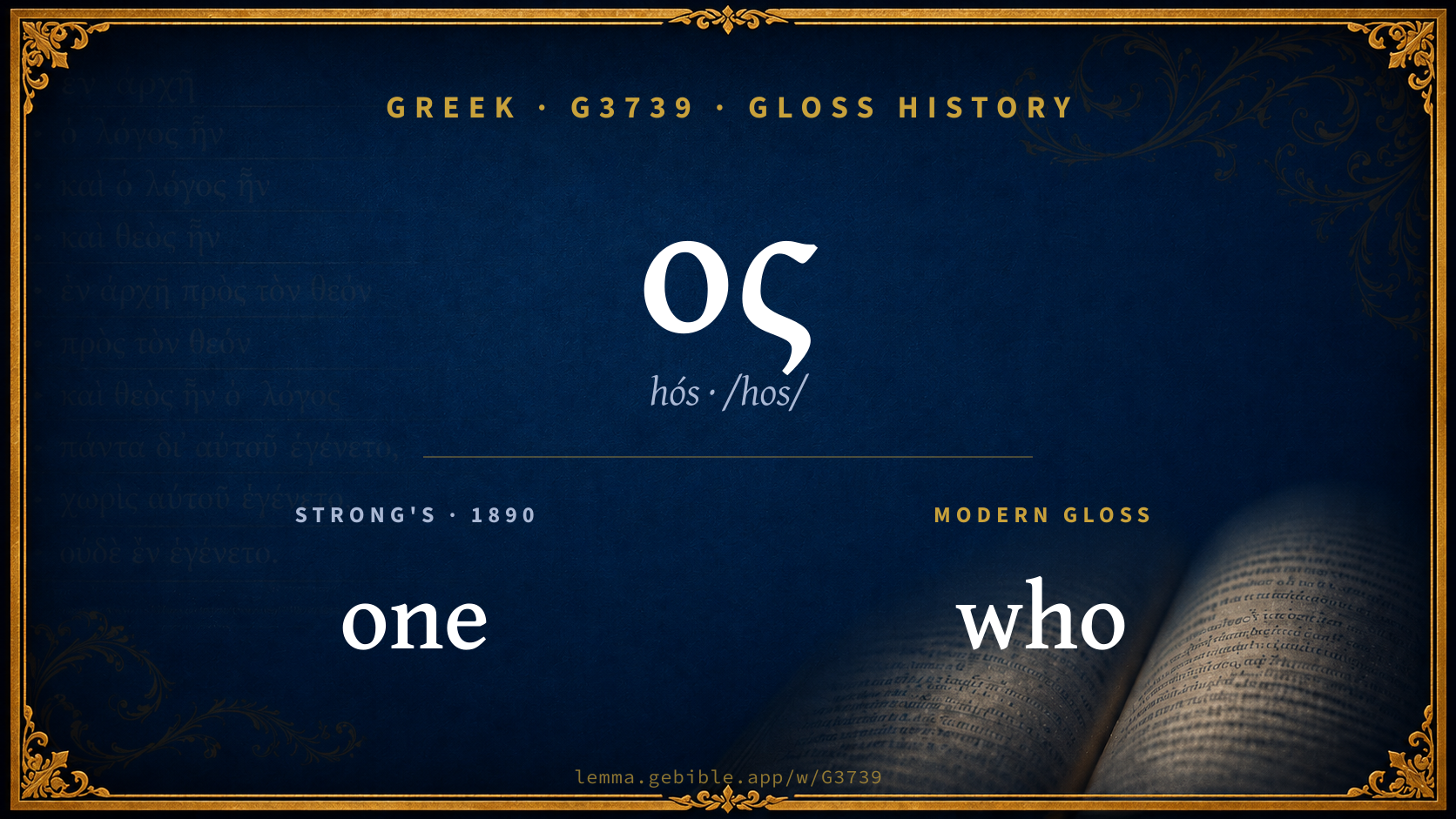
Gloss history
Strong's 1890 vs modern scholarship
About this word
Strong's G3739 catalogs a Greek word from the Greek New Testament.
These counts are not copied from any lexicon or concordance. They are computed here, from the morphology-tagged Greek New Testament. What Lemma adds →
- 1,225
- distinct verses
- The word appears in 1,225 distinct verses.
- 27 / 27
- NT books
- The word appears in 27 of 27 New Testament books.
- #12
- by frequency
- Top 25 most frequent Greek words (rank 12 of 5,347 Greek words by occurrence).
View all 1,225 occurrences in the concordance →
By section of the New Testament
By traditional corpus
Conventional, traditional groupings — biblical authorship is debated, so this is a traditional corpus grouping, not an authorship claim. Some books belong to more than one corpus (Luke is in both the Gospels and the Lukan corpus, and so on), so these shares overlap and need not total 100%. Each figure is a share of the word’s 1,225 distinct verses.
- Gospels 480 verses · 39%
- Lukan (Luke–Acts) 362 verses · 30%
- Pauline corpus 331 verses · 27%
- Johannine 235 verses · 19%
- General (Catholic) Epistles 81 verses · 7%
- Hebrews 69 verses · 6%
- Revelation 64 verses · 5%
How translations render this word
Counts come from each version’s own published word-to-Strong’s tagging or interlinear alignment — an approximate guide to how each version renders this word, not a word-level alignment the data otherwise carries. Because each total is that version’s own tagged count, the per-version totals vary from one another and need not match the appearance or distinct-verse counts above. These counts may also differ from a printed concordance because Lemma counts each distinctly tagged rendering and does not collapse phrase taggings into a single head-word total. This is a fixed set of word-tagged versions (KJV, ASV, BSB, ULT) and does not change with the reading translation you choose elsewhere. Each version’s license is shown beside its name below (and on Sources).
- King James Version: Which 394×, Whom 256×, That 126×
- American Standard Version: Which 325×, Whom 247×, That 139×
- Berean Standard Bible: Whom 124×, Which 116×, What 114×
- unfoldingWord Literal Text: Which 272×, Whom 262×, That 227×
King James Version Public Domain
Renders G3739 across 1,256 tagged occurrences — most commonly:
Plus other, less common renderings. Plus 47 renderings that appear only once — usually multi-word phrases or single function words the recovered tagging swept in, not distinct renderings. Not rendered by a distinct English word in 147 further occurrences.
American Standard Version Public Domain
Renders G3739 across 1,259 tagged occurrences — most commonly:
Plus other, less common renderings. Plus 91 renderings that appear only once — usually multi-word phrases or single function words the recovered tagging swept in, not distinct renderings. Not rendered by a distinct English word in 3 further occurrences.
Berean Standard Bible Public Domain
Renders G3739 across 866 tagged occurrences — most commonly:
Plus other, less common renderings. Plus 50 renderings that appear only once — usually multi-word phrases or single function words the recovered tagging swept in, not distinct renderings. Not rendered by a distinct English word in 496 further occurrences.
unfoldingWord Literal Text CC BY-SA 4.0
Renders G3739 across 1,431 tagged occurrences — most commonly:
Plus other, less common renderings. Plus 25 renderings that appear only once — usually multi-word phrases or single function words the recovered tagging swept in, not distinct renderings.
Senses in Thayer's
The 1 sense Thayer's distinguishes for this word, in lexicon order (not ranked by frequency or importance). The full entry — with sub-senses — is in the Lexicon Entry tab.
- who, which, what, that Wigram's count is 1309 not 1393.
Word origin
Derived from ο (ho) (G3588).
Forms in the corpus
The 25 distinct written forms G3739 takes in the Greek New Testament, most frequent first — each parse links to that case’s occurrences in the concordance.
Same root — word family
Other Thayer's entries built from the same root as G3739, grouped by Strong’s listed origin. These share a root / origin per the lexicon — not necessarily a shared meaning. Each links to that word’s own entry.
Derives from
Shares the same root
- τανυν tanŷn G3569 present
- οδε hóde G3592 this
- οιος hoîos G3634 what sort of
- ουτος hoûtos G3778 this
- σημερον sḗmeron G4594 this day
- ταυτα tautá G5024 thus
- τηλικουτος tēlikoûtos G5082 of such size
- τοι toí G5104 truly
- τοσουτος tosoûtos G5118 so great
- τοτε tóte G5119 then
- του toû G5120 his
- τουναντιον tounantíon G5121 on the contrary
- τουνομα toúnoma G5122 by name
Derived from this word
- ο εστι hó esti G3603 which is
- οθεν hóthen G3606 from which
- οποιος hopoîos G3697 what sort
- οποτε hopóte G3698 when
- οπου hópou G3699 where
- οπως hópōs G3704 how
- οσακις hosákis G3740 as often as
- οσος hósos G3745 how much
- οσπερ hósper G3746 whomever
- οστις hóstis G3748 whoever
- οτε hóte G3753 when
- ου hoû G3757 where
- ποσος pósos G4214 how much
- ως hōs G5613 as
Proper names from this root
People and places named from this root — a name, not an additional meaning of the word.
- θεος theós G2316 God
- ο ων και ο ην και ο ερχομενος ho ṑn kaí ho ēn kaí ho erchómenos G3801 He who is
Compare all same-root words → Showing 4 of 31 — not the complete family. 2 of the same-root words are proper names (people or places). They share a root, not necessarily a meaning.
Septuagint usage
The same Greek word ος appears 3,959 times in the Greek Old Testament (Septuagint), across 3,406 verses in 38 books.
- 3,959
- LXX occurrences
- Tagged occurrences of this Greek word in the Septuagint.
- 3,406
- verses
- Distinct Septuagint verses containing this word.
- 38 / 39
- OT books
- The word appears in 38 of the 39 Old Testament books.
Sample Septuagint occurrences
- Genesis 1:7 ὅς
- Exodus 1:8 ὅς
- Leviticus 2:8 ὅς
- Numbers 1:19 ὅς
- Deuteronomy 1:1 ὅς
- Joshua 1:2 ὅς
- Judges 1:12 ὅς
- Ruth 1:13 ὅς
- 1 Samuel 1:15 ὅς
- 2 Samuel 2:10 ὅς
- 1 Kings 1:9 ὅς
- 2 Kings 1:4 ὅς
Septuagint occurrences (same lexeme)
Every verse where the same Strong’s number (G3739) appears in the Greek Septuagint — showing the first 50 of 3,406. Verse text shown in the World English Bible for context; the Greek form is the matched word — the English is not keyword-highlighted.
- Genesis 1:7 ὅς God made the expanse, and divided the waters which were under the expanse from the waters which were above the expanse, and it was so.
- Genesis 1:11 ὅς God said, "Let the earth put forth grass, herbs yielding seed, and fruit trees bearing fruit after their kind, with its seed in it, on the earth," and it was so.
- Genesis 1:12 ὅς The earth brought forth grass, herbs yielding seed after their kind, and trees bearing fruit, with its seed in it, after their kind: and God saw that it was good.
- Genesis 1:21 ὅς God created the large sea creatures, and every living creature that moves, with which the waters swarmed, after their kind, and every winged bird after its kind. God saw that it was good.
- Genesis 1:29 ὅς God said, "Behold, I have given you every herb yielding seed, which is on the surface of all the earth, and every tree, which bears fruit yielding seed. It will be your food.
- Genesis 1:30 ὅς To every animal of the earth, and to every bird of the sky, and to everything that creeps on the earth, in which there is life, I have given every green herb for food." And it was so.
- Genesis 2:2 ὅς On the seventh day God finished his work which he had made; and he rested on the seventh day from all his work which he had made.
- Genesis 2:3 ὅς God blessed the seventh day, and made it holy, because he rested in it from all his work which he had created and made.
- Genesis 2:4 ὅς This is the history of the generations of the heavens and of the earth when they were created, in the day that Yahweh God made earth and the heavens.
- Genesis 2:8 ὅς Yahweh God planted a garden eastward, in Eden, and there he put the man whom he had formed.
- Genesis 2:11 ὅς The name of the first is Pishon: this is the one which flows through the whole land of Havilah, where there is gold;
- Genesis 2:15 ὅς Yahweh God took the man, and put him into the garden of Eden to dress it and to keep it.
- Genesis 2:17 ὅς but of the tree of the knowledge of good and evil, you shall not eat of it: for in the day that you eat of it you will surely die."
- Genesis 2:19 ὅς Out of the ground Yahweh God formed every animal of the field, and every bird of the sky, and brought them to the man to see what he would call them. Whatever the man called every living creature, that was its name.
- Genesis 2:22 ὅς He made the rib, which Yahweh God had taken from the man, into a woman, and brought her to the man.
- Genesis 2:25 ὅς They were both naked, the man and his wife, and were not ashamed.
- Genesis 3:1 ὅς Now the serpent was more subtle than any animal of the field which Yahweh God had made. He said to the woman, "Yes, has God said, 'You shall not eat of any tree of the garden?'"
- Genesis 3:3 ὅς but of the fruit of the tree which is in the midst of the garden, God has said, 'You shall not eat of it, neither shall you touch it, lest you die.'"
- Genesis 3:5 ὅς for God knows that in the day you eat it, your eyes will be opened, and you will be like God, knowing good and evil."
- Genesis 3:8 ὅς They heard the voice of Yahweh God walking in the garden in the cool of the day, and the man and his wife hid themselves from the presence of Yahweh God among the trees of the garden.
- Genesis 3:11 ὅς God said, "Who told you that you were naked? Have you eaten from the tree that I commanded you not to eat from?"
- Genesis 3:12 ὅς The man said, "The woman whom you gave to be with me, she gave me of the tree, and I ate."
- Genesis 3:17 ὅς To Adam he said, "Because you have listened to your wife's voice, and have eaten of the tree, of which I commanded you, saying, 'You shall not eat of it,' cursed is the ground for your sake. In toil you will eat of it all the days of your life.
- Genesis 3:19 ὅς By the sweat of your face will you eat bread until you return to the ground, for out of it you were taken. For you are dust, and to dust you shall return."
- Genesis 3:23 ὅς Therefore Yahweh God sent him forth from the garden of Eden, to till the ground from whence he was taken.
- Genesis 4:11 ὅς Now you are cursed because of the ground, which has opened its mouth to receive your brother's blood from your hand.
- Genesis 4:25 ὅς Adam knew his wife again. She gave birth to a son, and named him Seth. For, she said, "God has appointed me another child instead of Abel, for Cain killed him."
- Genesis 5:1 ὅς This is the book of the generations of Adam. In the day that God created man, he made him in God's likeness.
- Genesis 5:2 ὅς He created them male and female, and blessed them, and called their name Adam, in the day when they were created.
- Genesis 5:5 ὅς All the days that Adam lived were nine hundred thirty years, then he died.
- Genesis 5:27 ὅς All the days of Methuselah were nine hundred sixty-nine years, then he died.
- Genesis 5:29 ὅς and he named him Noah, saying, "This same will comfort us in our work and in the toil of our hands, because of the ground which Yahweh has cursed."
- Genesis 6:2 ὅς that God's sons saw that men's daughters were beautiful, and they took for themselves wives of all that they chose.
- Genesis 6:7 ὅς Yahweh said, "I will destroy man whom I have created from the surface of the ground; man, along with animals, creeping things, and birds of the sky; for I am sorry that I have made them."
- Genesis 6:17 ὅς I, even, I do bring the flood of waters on this earth, to destroy all flesh having the breath of life from under the sky. Everything that is in the earth will die.
- Genesis 6:21 ὅς Take with you of all food that is eaten, and gather it to you; and it will be for food for you, and for them."
- Genesis 7:4 ὅς In seven days, I will cause it to rain on the earth for forty days and forty nights. Every living thing that I have made, I will destroy from the surface of the ground."
- Genesis 7:15 ὅς They went to Noah into the ark, by pairs of all flesh with the breath of life in them.
- Genesis 7:19 ὅς The waters prevailed exceedingly on the earth. All the high mountains that were under the whole sky were covered.
- Genesis 7:22 ὅς All in whose nostrils was the breath of the spirit of life, of all that was on the dry land, died.
- Genesis 7:23 ὅς Every living thing was destroyed that was on the surface of the ground, including man, cattle, creeping things, and birds of the sky. They were destroyed from the earth. Only Noah was left, and those who were with him in the ark.
- Genesis 8:6 ὅς It happened at the end of forty days, that Noah opened the window of the ark which he had made,
- Genesis 8:13 ὅς It happened in the six hundred first year, in the first month, the first day of the month, the waters were dried up from off the earth. Noah removed the covering of the ark, and looked. He saw that the surface of the ground was dried.
- Genesis 9:3 ὅς Every moving thing that lives will be food for you. As the green herb, I have given everything to you.
- Genesis 9:12 ὅς God said, "This is the token of the covenant which I make between me and you and every living creature that is with you, for perpetual generations:
- Genesis 9:15 ὅς and I will remember my covenant, which is between me and you and every living creature of all flesh, and the waters will no more become a flood to destroy all flesh.
- Genesis 9:16 ὅς The rainbow will be in the cloud. I will look at it, that I may remember the everlasting covenant between God and every living creature of all flesh that is on the earth."
- Genesis 9:17 ὅς God said to Noah, "This is the token of the covenant which I have established between me and all flesh that is on the earth."
- Genesis 11:4 ὅς They said, "Come, let's build us a city, and a tower, whose top reaches to the sky, and let's make us a name; lest we be scattered abroad on the surface of the whole earth."
- Genesis 11:5 ὅς Yahweh came down to see the city and the tower, which the children of men built.
These are occurrences of the same Greek lexeme (G3739) in the Septuagint — not a translation of any one Hebrew word. The store carries no word-level Hebrew↔Greek alignment, so no Hebrew original is asserted here. Counts come from the recovered LXX Strong's tagging — high-frequency vocabulary is well covered, while rare or late forms may be untagged — so they reflect tagged occurrences and may slightly undercount.