Acts 12:23

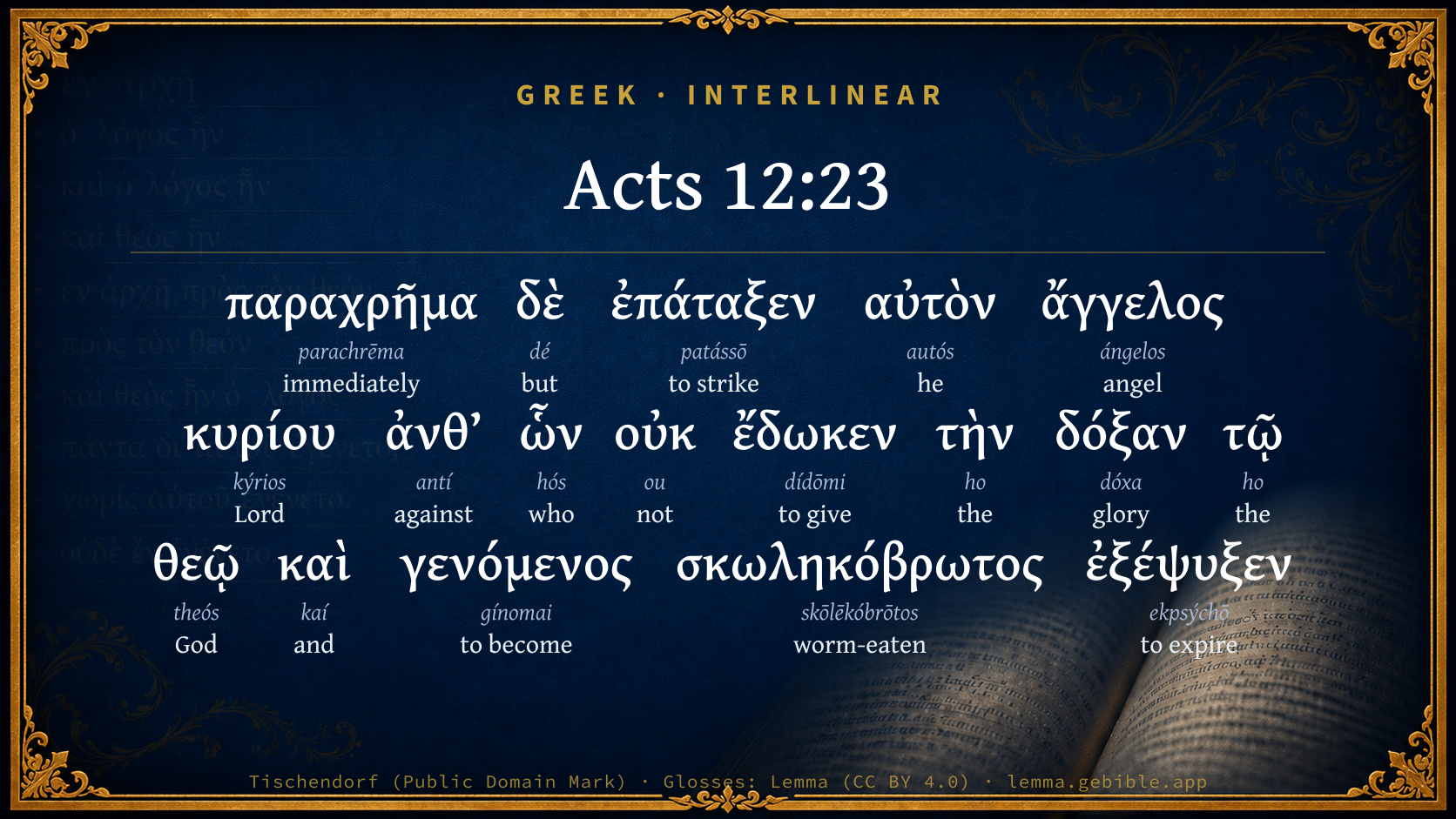
Greek (Tischendorf 8th ed.) Acts 12:23 appears in the Greek New Testament. The text above is from the Tischendorf 8th edition. Each word links to its Strong’s number and a concise gloss. Click any word for its full Thayer’s Greek Lexicon entry.
Download image
Cite this verse

Acts 12:23 (World English Bible). Public Domain. Lemma interlinear Bible study tool, https://lemma.gebible.app/v/acts/12/23.

Show BibTeX & RIS
BibTeX
RIS
English Translation
Immediately an angel of the Lord struck him, because he didn't give God the glory, and he was eaten by worms and died.
World English Bible · Public Domain
Highlights
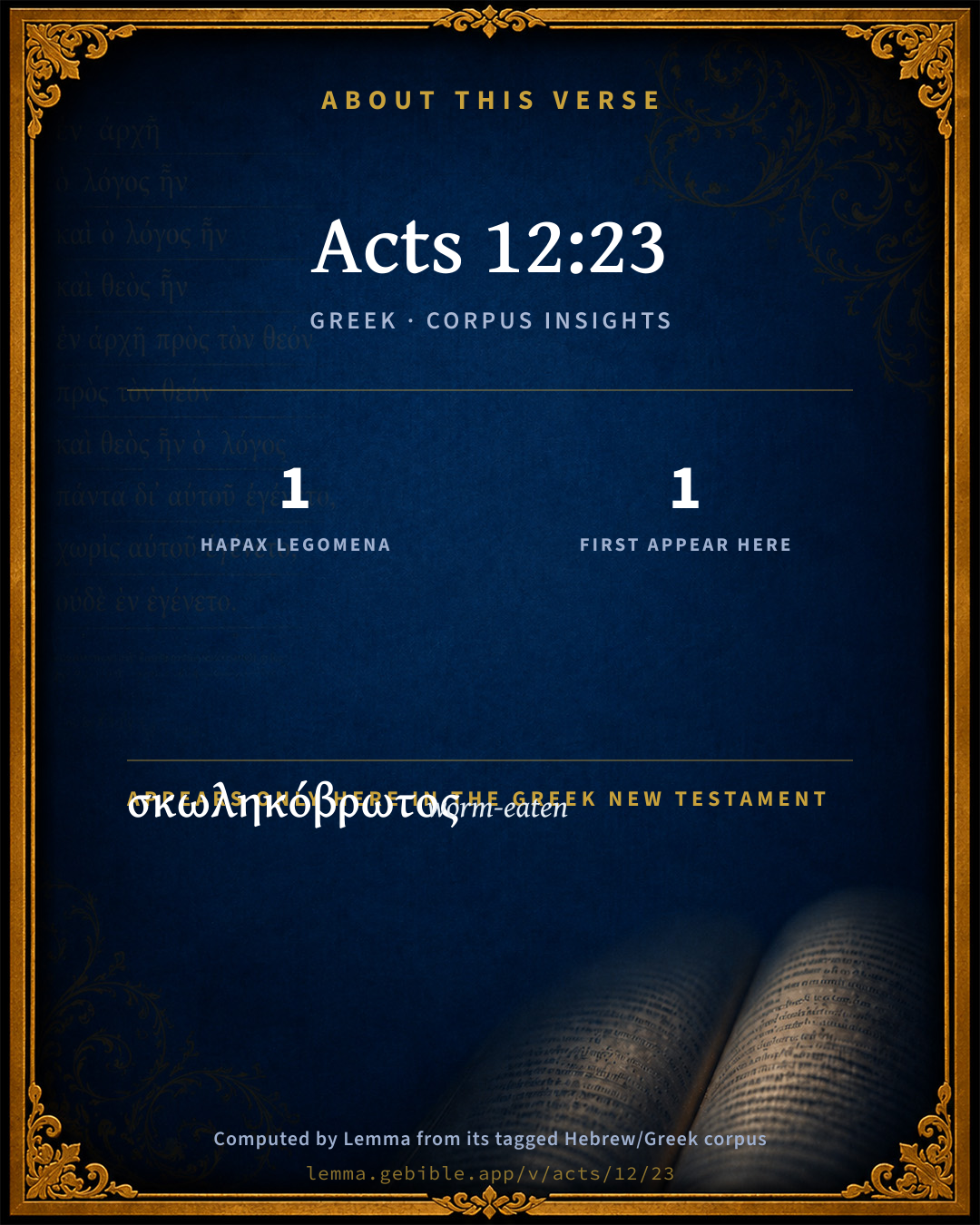
  • 1 hapax legomenon — only here in the Greek New Testament
  • 1 first appearance in the Greek New Testament
Full analysis ↓
Download a study sheet

One document with this verse’s original text, its word-by-word gloss line, the meaning frame, cross-references with their text, attributed commentary, and full source and license credits — printable, and it pastes into notes with its structure intact.

This verse Autodidact and up

Study sheet (.html) Plain text (.txt)

A passage Seminary Student

Up to 50 verses in one chapter. A passage sheet keeps up to 6 commentary sources and 12 cross-references per verse, in the order this page ranks them, and says so on the sheet whenever that leaves anything out. Ask for a single verse and you get the Autodidact verse sheet above.

Everything on this page stays free to read, with no account — the sheet is a download of what is already on screen, not access to it.

Want to remove ads? Support Godless Engineer
Compare translations 3

The same verse in 3 English versions, stacked beneath the original-language interlinear above. Click any original word for its lexicon entry.

Each is an independent rendering of the whole verse — the interlinear is not word-aligned to these translations.

Highlighted words mark where these versions differ — a whole-verse word diff, not a word-by-word alignment.

  • World English Bible Public Domain
    Immediately an angel of the Lord struck him, because he didn't give God the glory, and he was eaten by worms and died.
  • King James Version Public Domain
    And immediately the angel of the Lord smote him, because he gave not God the glory: and he was eaten of worms, and gave up the ghost.
  • unfoldingWord Literal Text CC BY-SA 4.0
    And immediately an angel of the Lord struck him because he did not give the glory to God, and having become worm-eaten, he died.

unfoldingWord Literal Text — © unfoldingWord, licensed CC BY-SA 4.0. Word-aligned USFM3 via Door43 (git.door43.org/unfoldingWord/en_ult).

Versions to compare (up to 4)

3 of 4 selected

Show all 19 translations

Every available English version of this verse, each an independent rendering of the whole verse.

  • World English Bible Public Domain
    Immediately an angel of the Lord struck him, because he didn't give God the glory, and he was eaten by worms and died.
  • Berean Standard Bible Public Domain
    Immediately, because Herod did not give glory to God, an angel of the Lord struck him down, and he was eaten by worms and died.
  • Majority Standard Bible Public Domain
    Immediately, because Herod did not give glory to God, an angel of the Lord struck him down, and he was eaten by worms and died.
  • King James Version Public Domain
    And immediately the angel of the Lord smote him, because he gave not God the glory: and he was eaten of worms, and gave up the ghost.
  • American Standard Version (1901) Public Domain
    And immediately an angel of the Lord smote him, because he gave not God the glory: and he was eaten of worms, and gave up the ghost.
  • Revised Version (1885) Public Domain
    And immediately an angel of the Lord smote him, because he gave not God the glory: and he was eaten of worms, and gave up the ghost.
  • Geneva Bible (1599) Public Domain
    But immediatly the Angel of the Lord smote him, because he gaue not glorie vnto God, so that he was eaten of wormes, and gaue vp the ghost.
  • Douay-Rheims (1899) Public Domain
    And forthwith an angel of the Lord struck him, because he had not given the honour to God: and being eaten up by worms, he gave up the ghost.
  • Young's Literal Translation Public Domain
    and presently there smote him a messenger of the Lord, because he did not give the glory to God, and having been eaten of worms, he expired.
  • Literal Standard Version CC BY-SA 4.0
    And immediately a messenger of the LORD struck him in return for that he did not give the glory to God, and having been eaten of worms, he expired.
  • Unlocked Literal Bible CC BY-SA 4.0
    Immediately an angel of the Lord struck him, because he did not give God the glory; he was eaten by worms and died.
  • unfoldingWord Literal Text CC BY-SA 4.0
    And immediately an angel of the Lord struck him because he did not give the glory to God, and having become worm-eaten, he died.
  • Darby Bible Public Domain
    And immediately an angel of [the] Lord smote him, because he did not give the glory to God, and he expired, eaten of worms.
  • World Messianic Bible Public Domain
    Immediately an angel of the Lord struck him, because he didn’t give God the glory. Then he was eaten by worms and died.
  • Webster's Bible Public Domain
    And immediately the angel of the Lord smote him, because he gave not God the glory: and he was eaten by worms, and died.
  • Free Bible Version CC BY-SA 4.0
    Immediately the angel of the Lord struck him down, because he did not give God the glory. He was consumed by worms and died.
  • Bible in Basic English Public Domain
    And straight away the angel of the Lord sent a disease on him, because he did not give the glory to God: and his flesh was wasted away by worms, and so he came to his end.
  • Text-Critical English NT CC BY 4.0
    Immediately an angel of the Lord struck Herod down because he did not give glory to God, and he was eaten by worms and breathed his last breath.
  • Tyndale New Testament (1534) Public Domain
    And immediatly the angell of the Lorde smote him because he gave not God the honoure and he was eatyn of wormes and gave vp the goost.

Literal Standard Version (2020), Covenant Press — licensed CC BY-SA 4.0. Text via the HelloAO Bible API (eBible.org). Unlocked Literal Bible (unfoldingWord) — licensed CC BY-SA 4.0. Text via the HelloAO Bible API (eBible.org). unfoldingWord Literal Text — © unfoldingWord, licensed CC BY-SA 4.0. Word-aligned USFM3 via Door43 (git.door43.org/unfoldingWord/en_ult). Free Bible Version, Dr. Jonathan Gallagher — licensed CC BY-SA 4.0. Text via the HelloAO Bible API (eBible.org).

Word by word

More ways to search: Search by grammar → Find every occurrence → Compare this word →

Practice this passage: Drill this verse → Learn its vocabulary →

σκωληκόβρωτος
skōlēkóbrōtos
G4662
“worm-eaten”
Adjective, Nominative, Singular, Masculine
Part of Speech
Adjective
Case
Nominative
Number
Singular
Gender
Masculine
Full Thayer's Definition

Origin: from G4663 and a derivative of G977

TDNT: 14:36,1

1. eaten of worms
  1. παραχρῆμα parachrēma G3916 “immediately” Adverb
  2. δὲ dé G1161 “but” Conjunction
  3. ἐπάταξεν patássō G3960 “to strike” Verb, Aorist, Active, Indicative, 3rd person, Singular
  4. αὐτὸν autós G846 “he” Personal pronoun, Accusative, Singular, Masculine
  5. ἄγγελος ángelos G32 “angel” Noun, Nominative, Singular, Masculine
  6. κυρίου kýrios G2962 “Lord” Noun, Genitive, Singular, Masculine
  7. ἀνθ’ antí G473 “against” Preposition
  8. ὧν hós G3739 “who” Relative pronoun, Genitive, Plural, Neuter
  9. οὐκ ou G3756 “not” Particle, Negative
  10. ἔδωκεν dídōmi G1325 “to give” Verb, Aorist, Active, Indicative, 3rd person, Singular
  11. τὴν ho G3588 “the” Article, Accusative, Singular, Feminine
  12. δόξαν dóxa G1391 “glory” Noun, Accusative, Singular, Feminine
  13. τῷ ho G3588 “the” Article, Dative, Singular, Masculine
  14. θεῷ theós G2316 “God” Noun, Dative, Singular, Masculine
  15. καὶ kaí G2532 “and” Conjunction
  16. γενόμενος gínomai G1096 “to become” Verb, Aorist, Middle deponent, Participle, Nominative, Singular, Masculine
  17. ἐξέψυξεν ekpsýchō G1634 “to expire” Verb, Aorist, Active, Indicative, 3rd person, Singular

About this verse

These counts appear in no published source. They are computed here, from the morphology-tagged text and Lemma’s own curated glosses. What Lemma adds →

18
words
17
distinct lemmas
Acts
section

Notable vocabulary

1 hapax legomenon — a word that appears only here in the entire Greek New Testament:

  • σκωληκόβρωτος worm-eaten G4662

First appearance in Scripture

This word makes its first canonical appearance in the Greek New Testament here:

  • σκωληκόβρωτος worm-eaten G4662

Shared distinctive vocabulary

ἐξέψυξεν to expire G1634 occurs in 3 verses of the Greek New Testament. Also found in:

Repetition

A word recurs within this verse:

Cross-references

27

Topical passages linked to Acts 12:23 in the Treasury of Scripture Knowledge — connected by theme and wording, ordered by reader-vote popularity; previews shown in the World English Bible.

  • Psalms 115:1 Not to us, Yahweh, not to us, But to your name give glory, For your loving kindness, and for your truth's sake.
  • Acts 10:25–26 When it happened that Peter entered, Cornelius met him, fell down at his feet, and worshiped him.
  • 2 Thessalonians 2:4 he who opposes and exalts himself against all that is called God or that is worshiped; so that he sits as God in the temple of God, setting himself up as God.
  • Acts 14:14–15 But when the apostles, Barnabas and Paul, heard of it, they tore their clothes, and sprang into the multitude, crying out,
  • 1 Samuel 25:38 It happened about ten days after, that Yahweh struck Nabal, so that he died.
  • Daniel 4:30–37 The king spoke and said, Is not this great Babylon, which I have built for the royal dwelling-place, by the might of my power and for the glory of my majesty?
  • Daniel 5:18–24 You king, the Most High God gave Nebuchadnezzar your father the kingdom, and greatness, and glory, and majesty:
  • Exodus 12:29 It happened at midnight, that Yahweh struck all the firstborn in the land of Egypt, from the firstborn of Pharaoh who sat on his throne to the firstborn of the captive who was in the dungeon; and all the firstborn of cattle.
  • 2 Samuel 24:16–17 When the angel stretched out his hand toward Jerusalem to destroy it, Yahweh repented him of the evil, and said to the angel who destroyed the people, It is enough; now stay your hand. The angel of Yahweh was by the threshing floor of Araunah the Jebusite.
  • Isaiah 37:23 Whom have you defied and blasphemed? and against whom have you exalted your voice and lifted up your eyes on high? [even] against the Holy One of Israel.
  • Isaiah 51:8 For the moth shall eat them up like a garment, and the worm shall eat them like wool; but my righteousness shall be forever, and my salvation to all generations.
  • Isaiah 66:24 They shall go forth, and look on the dead bodies of the men who have transgressed against me: for their worm shall not die, neither shall their fire be quenched; and they shall be an abhorring to all flesh.
  • Ezekiel 28:2 Son of man, tell the prince of Tyre, Thus says the Lord Yahweh: Because your heart is lifted up, and you have said, I am a god, I sit in the seat of God, in the midst of the seas; yet you are man, and not God, though you did set your heart as the heart of God;-
  • Exodus 9:17 as you still exalt yourself against my people, that you won't let them go.
  • Exodus 10:3 Moses and Aaron went in to Pharaoh, and said to him, "This is what Yahweh, the God of the Hebrews, says: 'How long will you refuse to humble yourself before me? Let my people go, that they may serve me.
  • Exodus 12:12 For I will go through the land of Egypt in that night, and will strike all the firstborn in the land of Egypt, both man and animal. Against all the gods of Egypt I will execute judgments: I am Yahweh.
  • Exodus 12:23 For Yahweh will pass through to strike the Egyptians; and when he sees the blood on the lintel, and on the two side-posts, Yahweh will pass over the door, and will not allow the destroyer to come in to your houses to strike you.
  • 2 Kings 19:35 It happened that night, that the angel of Yahweh went forth, and struck in the camp of the Assyrians one hundred eighty-five thousand: and when men arose early in the morning, behold, these were all dead bodies.
  • 1 Chronicles 21:14–18 So Yahweh sent a pestilence on Israel; and there fell of Israel seventy thousand men.
  • 2 Chronicles 21:18–19 After all this Yahweh struck him in his bowels with an incurable disease.
  • 2 Chronicles 32:21 Yahweh sent an angel, who cut off all the mighty men of valor, and the leaders and captains, in the camp of the king of Assyria. So he returned with shame of face to his own land. When he was come into the house of his god, those who came forth from his own bowels killed him there with the sword.
  • Job 7:5 My flesh is clothed with worms and clods of dust. My skin closes up, and breaks out afresh.
  • Job 19:26 After my skin is destroyed, Then in my flesh shall I see God,
  • Isaiah 14:11 Your pomp is brought down to Sheol, [and] the noise of your viols: the worm is spread under you, and worms cover you.
  • Ezekiel 28:9 Will you yet say before him who kills you, I am God? but you are man, and not God, in the hand of him who wounds you.
  • Mark 9:43–48 If your hand causes you to stumble, cut it off. It is better for you to enter into life maimed, rather than having your two hands to go into Gehenna, into the unquenchable fire,
  • Luke 12:47–48 That servant, who knew his lord's will, and didn't prepare, nor do what he wanted, will be beaten with many stripes,

Cross-references courtesy of OpenBible.info (CC BY 4.0).

Commentary

Notes on Acts 12:23 from classic Christian and Jewish commentators (each source and its license shown beneath its notes). The classic Christian expositions comment on the surrounding passage and are grouped to its opening verse, so a note may address several verses; the Jewish commentaries on the Tanakh (Rashi and others) are per-verse, so they appear only where the commentator wrote on this verse.

Lemma curates 59 commentaries, every one of them public domain or Creative Commons licensed, each selected and text-cleaned for this edition rather than reprinted as found. About our sources →

MacLaren's Expositions of Holy Scripture

Alexander MacLaren

Acts

THE ANGEL’S TOUCH

Act 12:7, Act 12:23.

The same heavenly agent performs the same action on Peter and on Herod. To the one, his touch brings freedom and the dropping off of his chains; to the other it brings gnawing agonies and a horrible death. These twofold effects of one cause open out wide and solemn thoughts, on which it is well to look.

I. The one touch has a twofold effect.

So it is always when God’s angels come, or God Himself lays His hand on men. Every manifestation of the divine power, every revelation of the divine presence, all our lives’ experiences, are charged with the solemn possibility of bringing us one or other of two directly opposite results. They all offer us an alternative, a solemn ‘either -or.’

The Gospel too comes charged with that double possibility, and is the intensest and most fateful example of the dual effect of all God’s messages and dealings. Just as the ark maimed Dagon and decimated the Philistine cities and slew Uzzah, but brought blessing and prosperity to the house of Obed-edom, just as the same pillar was light to Israel all the night long, but cloud and darkness to the Egyptians, so is Christ set ‘for the fall of’ some and ‘for the rising of’ others amidst the ‘many in Israel,’ and His Gospel is either ‘the savour of life unto life or of death unto death,’ but in both cases is in itself ‘unto God,’ one and the same ‘sweet savour in Christ.’

II. These twofold effects are parts of one plan and purpose.

Peter’s liberation and Herod’s death tended in the same direction-to strengthen and conserve the infant Church, and thus to prepare the way for the conquering march of the Gospel. And so it is in all God’s self-revelations and manifested energies, whatever may be their effects. They come from one source and one motive, they are fundamentally the operations of one changeless Agent, and, as they are one in origin and character, so they are one in purpose. We are not to separate them into distinct classes and ascribe them to different elements in the divine nature, setting down this as the work of Love and that as the outcome of Wrath, or regarding the acts of deliverance as due to one part of that great whole and the acts of destruction as due to another part of it. The angel was the same, and his celestial fingers were moved by the same calm, celestial will when he smote Peter into liberty and life, and Herod to death.

God changes His ways, but not His heart. He changes His acts, but not His purposes. Opposite methods conduce to one end, as winter storms and June sunshine equally tend to the yellowed harvest.

III. The character of the effects depends on the men who are touched.

As is the man, so is the effect of the angel’s touch. It could only bring blessing to the one who was the friend of the angel’s Lord, and it could bring only death to the other, who was His enemy. It could do nothing to the Apostle but cause his chains to drop from his wrists, nor anything to the vainglorious king but bring loathsome death.

This, too, is a universal truth. It is we ourselves who settle what God’s words and acts will be to us. The trite proverb, ‘One man’s meat is another man’s poison,’ is true in the highest regions. It is eminently, blessedly or tragically true in our relation to the Gospel, wherein all God’s self-revelation reaches its climax, wherein ‘the arm of the Lord’ is put forth in its most blessed energy, wherein is laid on each of us the touch, tender and more charged with blessing than that of the angel who smote the calmly sleeping Apostle. That Gospel may either be to us the means of freeing us from our chains, and leading us out of our prison-house into sunshine and security, or be the fatal occasion of condemnation and death. Which it shall be depends on ourselves. Which shall I make it for myself?

Alexander MacLaren, Expositions of Holy Scripture (1904–1910) — public domain. Text from a community e-Sword module.

Bengel's Gnomon

Johann Albrecht Bengel

Act 12:23. Παραχρῆμα, immediately) The disparagement (insult) to the Divine honour is most speedily counteracted (prevented): comp. ch. Act 14:14; also Rev 19:10.—ἄγγελος Κυρίου, the angel of the Lord) a good angel. As to this important circumstance Josephus has nothing, though he enters into many matters of less consequence. To such a decree do Divine and human histories differ. The angel of the Lord led forth Peter: the angel of the Lord struck Herod. That both acts were done by angels, mortals saw not: it was only known to the saints.—οὐκ ἔδωκς, he gave not) He is not blamed for his having been praised; but because he accepted the praise. This sacrilege earned a more speedy punishment than the murder of James and his other crimes. [When the stroke was inflicted, Herod confessed (according to the statement of Josephus), that he had contracted guilt thereby.—V. g.]—σκωληκόβρωτος, eaten of worms) What a change to him! Worms, to a man in the case of death, most natural, and least natural, according as they either follow or precede death. The deaths of persecutors have been striking. The Gospel overcomes and survives them: Act 12:24.

Bengel's Gnomon of the New Testament — English translation (T&T Clark, Edinburgh, 1860) — public domain. Text from a community e-Sword module.

Meyer's Critical & Exegetical Commentary

Heinrich August Wilhelm Meyer

Act_12:23. Ἐπάταξεν αὐτὸν ἄγγελος κυρίον] an angel of the Lord smote him. The paroxysm of disease suddenly setting in as a punishment of God, is in accordance with O. T. precedents (comp. 2Sa_24:17; 2Ki_19:35; Isa_37:36), apprehended as the effect of a stroke (invisibly) befalling him from an angel. The fate of Nebuchadnezzar (Dan_4:26-30) does not accord with this view (in opposition to Baumgarten). Josephus, l.c., relates that soon after that display of flattery, the king saw an owl sitting on a rope above his head, and he regarded this (according to a prophecy formerly received in Rome from a German) as a herald of death, whereupon severe abdominal pains immediately followed, under which he expired after five days (at the age of fifty-four years). That Luke has not adopted this fable,instead of which Eichhorn puts merely a sudden shivering,is a consequence of his Christian view, which gives instead from its own sphere and tradition the ἐπάταξεν … Θεῷ as an exhibition of the divine Nemesis; therefore Eusebius (H. E. ii. 10) ought not to have harmonized the accounts, and made out of the owl an angel of death. Bengel: Adeo differt historia divina et humana. See, besides, Heinichen, Exc. II. ad Euseb. III. p. 356 ff.

ἀνθ ̓ ὧν] as a requital for the fact, that. See on Luk_1:20.

οὐκ ἔδωκε τὴν δόξαν τῷ Θεῷ] he refused God the honour due to Him, inasmuch as he received that tribute of honour for himself, instead of declining it and directing the flatterers to the honour which belongs to God (nulli creaturae communicabilem, Erasmus); Isa_48:11. Comp. Joseph. l.c.: οὐκ ἐπέπληξε τούτοις (the flatterers) ὁ βασιλεὺς, οὐδὲ τὴν κολακείαν ἀσεβοῦσαν ἀπετρέψατο. How entirely different the conduct of Peter, Act_10:26, and of Paul and Barnabas, Act_14:14 f.!

γενόμενος σκωληκόβρ.] similarly with Antiochus Epiphanes, 2Ma_9:5; 2Ma_9:9.[279] This is not to be regarded as at variance with Josephus, who speaks generally only of pains in the bowels; but as a more precise statement, which is, indeed, referred by Baur to a Christian legend originating from the fate of Epiphanes, which has taken the abdominal pains that befell Herod as if they were already the gnawing worm which torments the condemned (Mar_9:44 f.; comp. Isa_46:4)! Kühn (ad Ael. V. H. iv. 28), Elsner, Morus, and others, entirely against the words, have converted the disease of worms destroying the intestines (Bartholinus, de morbis Bibl. c. 23; Mead. de morb. Bibl. c. 15; and see the analogous cases in Wetstein) into the disease of lice, φθειρίασις, as if ΦΘΕΙΡΌΒΡΩΤΟς (Hesych. Mil. 40) were used!

The word ΣΚΩΛΗΚΌΒΡ. is found in Theoph. c. pl. iii. 12. 8 (?), v. 9. 1.

ἐξέψυξεν] namely, after five days. Joseph. l.c. But did not Luke consider the γενόμ. σκωληκ. ἐξέψυχεν as having taken place on the spot? The whole brief, terse statement, the reference to a stroke of an angel, and the use of ἐξέψυξεν (comp. Act_5:5; Act_5:10), render this highly probable.

[279] Observe how much our simple narrativebecame eaten with wormsis distinguished from the overladen and extravagantly embellished description in 2Ma_9:9 (see Grimm in loc.). But there is no reason, with Gerlach, to explain σκωληκόβρ. figuratively (like the German wurmstichig): worn and shattered by pain.

Meyer — Critical and Exegetical Commentary on the New Testament — English translation by Peter Christie, edited by Frederick Crombie (T&T Clark, 1880) — public domain. Text from a community e-Sword module.

Expositor's Greek Testament

ed. W. Robertson Nicoll

Act 12:23 . παραχρῆμα , see above, p. 106. ἐπάταξεν , cf. Exod. 11:23, 2Sa 24:17 , 2Ki 19:35 , 1Ch 21:15 , Isa 37:36 , 1Ma 7:41 . See p. 188. On the confusion in the reading of Eusebius, H.E. , ii., 10, where for the owl whom Josephus describes as appearing to Herod as ἄγγελος κακῶν we have the reading “the angel” of the Acts, the unseen minister of the divine will, see B.D. 1 2 , p. 1345, and Eusebius , Schaff and Wace’s edition, in loco ; see also Bengel’s impressive note on this verse on the difference between human history and divine. ἀνθʼ ὧν = ἀντὶ τούτων ὅτι , cf. Luk 1:20 ; Luk 19:44 , see also Act 12:3 ; only once outside St. Luke’s writings in N.T., 2Th 2:10 ; see Simcox, Language of N. T. , p. 137; Plummer on Luk 1:20 ; Luk 12:3 ; quite classical and several times in LXX. ἔδωκε τὴν δ .: debitum honorem, cf. Isa 48:11 , Rev 19:7 ; article elsewhere omitted ( cf. Luk 17:18 ); a Hebrew phrase. How different the behaviour of St. Peter and of St. Paul, Act 10:26 , Act 14:14 . Josephus expressly says that the king did not rebuke the flatterers or reject their flattery. καὶ γενόμ . σκ .: see below. St. Luke does not say that Herod died on the spot, but simply marks the commencement of the disease, παραχρῆμα ; Josephus describes the death as occurring after five days. Wendt (1899 edition) admits that the kind of death described may well have been gradual, although in 1888 edition he held that the ἐξέψυξεν meant that he expired immediately; see also Zöckler and Hackett, as against Weiss. ἐξέψ ., see on Act 5:5 ; Act 5:10 . σκωλ .: only here in N.T.; no contradiction with Josephus, but a more precise description of the fatal disease, cf. 2Ma 9:5 ; 2Ma 9:9 , with which detailed and strange account the simple statement of the fact here stands in marked contrast. The word cannot be taken metaphorically, cf. Herod., iv., 205: and Jos., Ant. , xvii., 6, 5, of the death of Herod the Great. Such a death was regarded as a punishment for pride; so in 2 Macc. and Herod., Farrar, St. Paul. i. 318. The term itself was one which we might expect from a medical man, and St. Luke may easily have learnt the exact nature of the disease during his two years residence in Cæsarea (Belser). See Hobart, pp. 42, 43, Knabenbauer in loco . The word was used of a disease of plants, but Luke, no less than his contemporary Dioscorides, may well have been acquainted with botanical terms (Vogel). To think with Baur and Holtzmann of the gnawing worm of the damned is quite opposed to the whole context. If we place the two narratives, the account given by Josephus and that given by St Luke side by side, it is impossible not to see their general agreement, and none has admitted this more unreservedly than Schürer. On reasons for the silence of Josephus as to the death as a punishment of the king’s impiety in contrast with the clear statement of St. Luke; and also on the whole narrative as against the strictures of Spitta, see Belser, Theologische Quartalschrift , p. 252 ff., 2 e Heft, 1895; for a full examination; cf. also Nösgen to the same effect, Apostelgeschichte , p. 242, Zahn, Einleitung , ii., 417. Belser should also be consulted as against Krenkel, Josephus und Lucas , p. 203 ff. It should be noted that Krenkel does not affirm that Luke derived his material from Josephus in Act 12:1-23 , but only that he was influenced by the Jewish historian, and that with regard to the hapax-legomenon, σκωληκόβρωτος , he can only affirm that Josephus affords us an analogous expression, B. J. , vii., 8, 7.

The Expositor's Greek Testament, edited by W. Robertson Nicoll (1897–1910) — public domain. Text from a community e-Sword module.

Geneva Bible (1599)

Geneva Bible translators

God resisteth the proud.

Josephus recordeth, that this king did not repress those flatterers’ tongues, and therefore at his death he complained and cried out of their vanity.

Geneva Bible (1599) marginal notes — public domain. Text via Bolls.life.

Adam Clarke's Commentary

Verse 23. The angel of the Lord smote him] His death was most evidently a judgment from God.

Because he gave not God the glory] He did not rebuke his flatterers, but permitted them to give him that honour that was due to God alone. See Clarke on Ac 12:21.

And was eaten of worms] Whether this was the morbus pedicularis, or whether a violent inflammation of his bowels, terminating in putrefaction, did not actually produce worms, which, for several days, swarmed in his infected entrails, we cannot tell. It is most likely that this latter was the case; and this is at once more agreeable to the letter of the text, and to the circumstances of the case as related by Josephus.

And gave up the ghost.] That is, he died of the disorder by which he was then seized, after having lingered, in excruciating torments, for five days, as Josephus has stated. Antiochus Epiphanes and Herod the Great died of the same kind of disease. See the observations at the end of Ac 1:26 relative to the death of Judas.

Adam Clarke's Commentary on the Bible (1810–1826) — public domain. Text from a community e-Sword/MySword module.

John Calvin's Commentaries

23. Forthwith he smote him. As, before, the angel was a minister of God’s grace in the delivery of Peter, so now he taketh vengeance upon Herod. And God doth sometimes use the ministry of angels in heaven in punishing; but sometimes he maketh the devils as hangmen, by whose hand he executeth his judgments. And this doth he as well toward his faithful servants as toward the reprobate. Saul was troubled and vexed by Satan, (1 Samuel 16:14) but the same did also befall holy Job, (Job 1:12; 2:7.) In the Psalms, the punishments wherewith God doth chasten the wicked are attributed to the evil angels; yet we see how the angel which had the government of the safety of the Church smiteth the Egyptians in the first-begotten, (Exodus 12:29;) although the Scripture calleth the wicked spirits God’s spirits, because they are obedient to his commandment, though full sore against their will. But where the epithet evil is not added, as in this place, we must understand the angel which doth willingly obey God, and yet the shape of the owl, whereof Josephus maketh mention, did rather serve to figure the devil than an heavenly angel.

Furthermore, I dare not affirm for a surety what manner of disease that was. The word which Luke useth doth signify that he was eaten up of worms. Many conjecture that it was a lousy disease. This is certain, that even when he was yet alive he was corrupt with stink and rottenness, so that he was, as it were, a living carcass. So that he was not only vexed with cruel torments, but also made a laughing-stock to all men, and of all men reviled. For God intended to make choice of a kind of punishment wherewith he might repress the cruelty of a proud man with extreme ignominy. If he had been overcome of some great and valiant army, and had been brought to poverty, the judgment of God had not been so marked; and this had been an honest and princely chastisement; but forasmuch as he abhorreth lice and worms, and this filthiness cometh out of his body, which doth kill him by eating him up, he is handled according to his deserts.

In like sort Pharaoh, forasmuch as he did so oft exalt himself against God with untamed pride, he was not orderly assailed by some prince that did border upon him, but locusts and caterpillars were God’s warriors [soldiers] to make war against him, (Exodus 8:17, 24;) for the more proudly a man exalteth himself, the more doth he deserve to be cast doom of God into the lowest hell with shame and reproach. This is the reason why he set this reigned god Herod to be eaten up of worms, which he was at length enforced to grant, when he said, “Behold me, whom ye saluted as a god; I die miserable.” Such a manifest example of horrible vengeance in a king’s person ought to terrify us not a little from presuming to take to ourselves more than we ought; and that we do not suffer ourselves to be made drunk with the false commendation and flattery of men as with deadly poison.

Because he gave not the glory to God. He is condemned of sacrilege, not only because he suffered himself to be called God, but because, forgetting himself, he took to himself the honor due to God. We do not read that the king of Babylon was thus extolled; and yet the prophet upbraideth to him that he went about to make himself equal with God, (Isaiah 14:13, 14.) Therefore this sacrilege is a common fault in all proud men, because, by taking to themselves more than they ought, they darken the glory of God; and so, like giants, so much as ever they are able, they endeavor to pluck God out of his seat. Howsoever, they do not usurp the title of God, neither openly boast with their mouth that they are gods; yet because they take to themselves that which is proper to God, they desire to be, and to be accounted gods, having brought him under, furthermore, the prophet pointeth out the beginning of this evil in one word, when he bringeth in Nebuchadnezzar speaking on this wise, “I will go up,” (Isaiah 14:13.)

Wherefore there is but one remedy, if every one keep himself in that degree wherein he is placed. Let those who are base and castaways [in a humble station] not desire to climb higher; let kings, and those who are above others, remember that they are mortal, and let them modestly submit their highness to God. And we must note, that it is not enough if men give to God only half the honor which is due to him, who challengeth all that wholly which is his own; if they submit themselves but in part, whom he will have to be thoroughly humbled. Now, forasmuch as the Scripture despoileth us quite of all praise of wisdom, virtue, and righteousness, there is no one of us that can take to himself the least jot of glory without sacrilegious robbing of God. And it is a wonder that, seeing the Scripture pronounceth that all those make, as it were, open war against God which exalt themselves; and we do all grant that that cannot be done without our overthrow, [destruction;] the greatest part of men runneth, notwithstanding, headlong with furious boldness unto their own destruction; for there is scarce one of an hundred who, being mindful of his condition, doth leave to God his glory undiminished.

John Calvin's Commentaries (1540-1563) — public domain. Text from the Calvin Translation Society English edition (1840s-50s) via the Christian Classics Ethereal Library (ccel.org). Calvin's coverage is partial (roughly two-thirds of the Bible); uncommented books and verses are honest gaps, never fabricated. The 19th-century editor's footnotes and remarks are omitted so the notes are faithfully Calvin's own voice.

Ellicott's Commentary for English Readers

(23) The angel of the Lord smote him.—The intervention of the angel is obviously regarded by St. Luke as the only adequate explanation at once of the death of the persecutor and of the escape of his victim, and in the former he recognised not only what has been called the irony of history, or an instance of the law of Nemesis, bringing down the haughty in the very hour of their triumph, but a direct chastisement for an act of impiety.

Because he gave not God the glory.—The words probably mean something more than that he did not ascribe to God the praise which was due to Him, and Him only. To “give God the glory” was a phrase always connected with the confession of sin and weakness, as in Jos_7:19. (See Note on Joh_9:24.)

He was eaten of worms.—The specific form of the disease is not named by Josephus, and St. Luke’s precision in describing it may fairly be regarded as characteristic of his calling. The form of the disease, probably of the nature of phtheiriasis, or the morbus pedicularis, from its exceptionally loathsome character, had always been regarded as of the nature of a divine chastisement. The more memorable instances of it recorded in history are those of Pheretimo of Cyrene (Herod. iv. 205), Sylla, Antiochus the Great (2Ma_9:2), Herod the Great (Jos. Ant. xvii. 8), and Maximinus, among the persecutors of the Church (Euseb. viii. 16; ix. 10, 11; Lactant, De mort. Persecut. c. 33). The death of Agrippa took place A.D. 44, in the seventh year of his reign, and at the age of fifty-three.

A Bible Commentary for English Readers, edited by Charles John Ellicott (1878–1897) — public domain. Text from a community e-Sword module.

The Cambridge Bible for Schools and Colleges

gen. ed. J. J. S. Perowne

23. And immediately the (an) angel of the Lord smote him … and he was eaten of worms] Cp. the fate of Antiochus Epiphanes (2Ma_9:9), and Herod the Great’s death (Josephus, Ant. xvii. 6. 5). The passage in which Josephus describes these events is so important in its bearing on the N. Test. narrative that it deserves to be read in its entirety. He writes (Antiq. xix. 8. 2), “Now when Agrippa had reigned three years over all Judæa, he came to the city Cæsarea, which was formerly called Strato’s Tower, and there he exhibited shows in honour of Cæsar, upon his being informed that there was a certain festival celebrated to make vows for his safety. At which festival a great multitude was gotten together of the principal persons and such as were of dignity throughout his province. On the second day of which shows he put on a garment made wholly of silver and of a contexture truly wonderful, and came into the theatre early in the morning, at which time the silver of his garment being illuminated by the fresh reflexion of the sun’s rays upon it, shone out after a surprising manner, and was so resplendent as to spread a dread and shuddering over those that looked intently upon it, and presently his flatterers cried out, one from one place and another from another (though not for his good) that he was a god. And they added ‘Be thou merciful to us, for although we have hitherto reverenced thee only as a man yet shall we henceforth own thee as superior to mortal nature.’ Upon this the King did neither rebuke them nor reject their impious flattery. But as he presently afterwards looked up he saw an owl sitting upon a certain rope over his head, and immediately understood that this bird was the messenger of ill tidings, as it had once been the messenger of good tidings to him; and fell into the deepest sorrow. A violent pain also arose in his belly, having begun with great severity. He therefore looked upon his friends and said, ‘I whom you call a god, am commanded presently to depart this life, while Providence thus reproves the lying words you just now said to me; and I who was called by you immortal am immediately to be hurried away by death. But I am bound to accept what Providence allots as it pleases God, for we have by no means lived ill, but in a splendid and happy manner.’ When he had said this his pain became violent. Accordingly he was carried into the palace, and the rumour went abroad everywhere that he would certainly die in a little time … And when he had been quite worn out by the pain in his bowels for five days he departed this life.”

We can see from this extract that among the throng who flattered Herod, there were some who were suing for mercy to be shewn to them; that the day was a set day, that Herod was clad in royal robes, that the flattery consisted in calling him a god, that he did not rebuke them; that he was stricken immediately so that he had to be carried to his palace, that he acknowledged that the stroke came from God as a rebuke for accepting such flattery, and everybody expected him to die at once.

With reference to the latter portion in which Josephus speaks of a violent pain increasing in vehemence very rapidly, and the N. Test. says he was eaten of worms; it is noticeable that, in the account of the death of Antiochus, already alluded to, we have these two features of the same disease mentioned and that they are described separately. First, 2Ma_9:5, “The Lord Almighty, the God of Israel, smote him with an incurable and invisible plague, for as soon as he had spoken these words a pain of the bowels that was remediless came upon him and sore torments of the inner parts.” Then after a verse or two describing the pride of Antiochus we read, “So that the worms rose up out of the body of this wicked man.”

Josephus (by whom Herod, as one who favoured Jews, was regarded as of no bad character, and was moreover looked upon with an eye of admiration as having been raised to the highest pitch of power through Roman influence, to which Josephus himself was very ready to pay court) has merely described the form in which the malady made itself apparent at first, and has left out the more loathsome details from the death story of one who in his eyes was a great king; while Holy Writ has given the fuller account, because the object of the writer of the Acts was to emphasize in all its enormity the sin for which Josephus tells us that Herod himself felt that he was stricken. The points of accord in the two accounts are so many, and the difference so slight and so easy to be accounted for, that this extract from Josephus must always be regarded as a most weighty testimony to the historic accuracy and faithfulness of St Luke’s narrative. For other instances of death by this loathsome malady, see Herodotus iv. 205; Eusebius viii. 16; Tertullian ad Scapul. iii. A similar account is given of the death of Philip II. of Spain.

The Cambridge Bible for Schools and Colleges (gen. ed. J. J. S. Perowne; Cambridge University Press, 1878–1918) — public domain. Text from a community e-Sword module.

John Gill's Exposition

And immediately the angel of the Lord smote him,.... With a disease after mentioned; this angel, according to Josephus, appeared in the form of an owl; for he says, that a little after (the shout of the people) the king looked up, and saw an owl sitting upon a rope over his head; whom he immediately understood to be an angel, or messenger of evil things to him, as it had been before of good things; for it seems by the same historian (s), that when he was bound by the order of Caligula, he saw an owl sitting on that tree, on which he leaned; when a certain German predicted, that things would in a short time be changed with him, and he should be advanced to great honour; but remember, says he, whenever you see that bird again, you will die within five days. Eusebius (t), out of Josephus, makes no mention of the owl, but relates it thus; that a little after (the oration and the salutation of the people) the king looked up, and saw an angel sitting over his head, whom he immediately understood to be the cause of evil things to him, as he had formerly been of good: the reason of the angel's smiting him was,

because he gave not glory to God; or as the Jewish historian says, because he reproved not the flatterers, nor rejected their impious flattery, but tacitly took that to himself, which belonged to God:

and he was eaten of worms: Beza's most ancient copy adds, "while he was alive"; Josephus only makes mention of pains in his belly, but these were occasioned by the gnawing of the worms: this was accounted by the Jews a very accursed death; they say (u), that the spies which brought an ill report on the good land, died this death: their account is this, that

"their tongues swelled and fell upon their navels, and worms came out of their tongues and went into their navels, and out of their navels they went into their tongues,''

of this death died many tyrants, oppressors, and persecutors! as Antiochus,

"So that the worms rose up out of the body of this wicked man, and whiles he lived in sorrow and pain, his flesh fell away, and the filthiness of his smell was noisome to all his army.'' (2 Maccabees 9:9)

and Herod the great, the grandfather of this, according to Josephus (w); and Maximianus Galerius, according to Eusebius (x), and many others:

and gave up the ghost: not directly, but five days after, as Josephus relates, in the fifty fourth year of his age, and when he had reigned seven years; but before he died, and as soon as he was smitten, he turned to his friends and said, I your God am obliged to depart this life, and now fate reproves the lying words you have just now spoke of me; and I who was called immortal by you, am led away to die, with more, as related by Josephus: by such a token as this, a man was discovered to be a murderer with the Jews; for so they say (y), that

"out of the beheaded heifer went a vast number of worms, and went to the place where the murderer was, and ascended upon him, and then the sanhedrim laid hold on him and condemned him.''

(s) Ib. l. 18. c. 7. sect. 7. (t) Eccl. Hist. l. 2. c. 10. (u) T. Bab. Sota, fol. 35. 1. (w) Antiqu. l. 17. c. 6. sect. 5. (x) Hist. Eccl. l. 8. c. 16. (y) Targum Jon. in Deut. xxi. 8.

John Gill's Exposition of the Whole Bible (1746–1763) — public domain (CC PDM 1.0). Text via the HelloAO Bible API.

Trapp's Complete Commentary

John Trapp

23 And immediately the angel of the Lord smote him, because he gave not God the glory: and he was eaten of worms, and gave up the ghost.

Ver. 23. Because he gave not glory] Joseph is trusted with all Potiphar’s goods, not with his wife: Glory is God’s beloved Spouse; in the enjoying whereof he is a jealous God, admitting no co-rivul, in heaven or earth, Isa 42:8; to look upon it, and lust after it, is to commit spiritual adultery with it in our hearts.

And he was eaten of worms] σκωληκοβρωτος. Or with lice, as his grandfather Herod had been before him; as the tyrant Maximinus (who had set forth his proclamation engraven in brass, for the utter abolishing of Christ and his religion) was after him. {a} So was Philip II, king of Spain, who swore he had rather have no subjects than Lutheran subjects. And when he had very narrowly escaped drowning in a shipwreck, he said he was delivered by the singular providence of God to root out Lutheranism; which he presently began to do, &c. But God was even with him soon after. See Scriban. de Institut. Princip. xx. An evil end also befell Diagoras the atheist; who when he had made a famous oration against a deity, the people came applauding him, and said he had almost persuaded them, but only they thought that if any were God, he was for his eloquence’ sake; whereupon this wretch, like Herod, was content to be thought a god; which soon wrought his ruin. Good therefore is the counsel of the apostle, "Let us not be desirous of vain glory," of popular applause; which what is it else but a blast of stinking breath, a meteor that liveth in the air, a Magnum nihil, a glorious fancy, Gal 5:26; and if derogatory to God’s honour, as here, it proves pernicious and destructive.

And gave up the ghost] His death was precationis opus potius quam morbi, as it was said of Arius the heretic, who was brought to confusion by the prayers of Alexander the good bishop of Constantinople. (Socrat. lib. i. cap. 15.) Josephus saith, Herod at his death much complained of the people’s vanity in deifying him. But no man is flattered by another that hath not first flattered himself.

{a} Sic et Sulla pediculari morbo periit. Plutarch.

John Trapp, A Commentary or Exposition upon All the Books of the Old and New Testament (1647–1656) — public domain. Text from a community e-Sword module.

Albert Barnes' Notes on the Bible

And immediately the angel of the Lord - Diseases and death axe in the Scriptures often attributed to an angel. See 2Sa 24:16; 1Ch 21:12, 1Ch 21:15, 1Ch 21:20, 1Ch 21:27; 2Ch 32:21. It is not intended that there was a miracle in this case, but it certainly is intended by the sacred writer that his death was a divine judgment on him for his receiving homage as a god. Josephus says of him that he “did neither rebuke them the people nor reject their impious flattery. A severe pain arose in his belly, and began in a most violent manner. And when he was quite worn out by the pain in his belly for five days, he departed this life, in the 54th year of his age, and the 7th year of his reign.” Josephus does not mention that it was done by an angel, but says that when he looked up, he saw an owl sitting on a rope over his head, and judging it to be an evil omen, he immediately became melancholy, and was seized with the pain.

Because he gave not God the glory - Because he was willing to receive the worship due to God. It was the more sinful in him as he was a Jew, and was acquainted with the true God, and with the evils of idolatry. He was proud, and willing to be flattered, and even adored. He had sought their applause; he had arrayed himself in this splendid manner to excite admiration; and when they carried it even so far as to offer divine homage, he did not reject the impious flattery, but listened stir to their praises. Hence, he was judged; and God vindicated his own insulted honor by inflicting severe pains on him, and by a most awful death.

And he was eaten of worms - The word used here is not found elsewhere in the New Testament. A similar disease is recorded of Antiochus Epiphanes, in the Apocrypha, 2 Macc. 9:5, “But the Lord Almighty, the God of Israel, smote him with an invisible and incurable plague; for a pain in the bowels that was remediless came upon him, and sore torments of the inner parts Act 12:9, so that worms rose up out of the body of this wicked man,” etc. Probably this was the disease known as morbus pedicularis. It is loathsome, offensive, and most painful. See the death of Antiochus Epiphanes described in 2 Macc. 9. With this disease also Herod the Great, grandfather of Herod Agrippa, died (Josephus, Antiq., book 17, chapter 6, section 5). Such a death, so painful, so sudden, and so loathsome, was an appropriate judgment on the pride of Herod. We may here learn:

(1) That sudden and violent deaths are often acts of direct divine judgment on wicked people.

(2) That people, when they seek praise and flattery, expose themselves to the displeasure of God. His glory he will not give to another, Isa 42:8.

(3) That the most proud, and mighty, and magnificent princes have no security of their lives. God can in a moment - even when they are surrounded by their worshippers and flatterers - touch the seat of life, and turn them to loathsomeness and putrefaction. What a pitiable being is a man of pride receiving from his fellow-men that homage which is due to God alone! See Isa. 14.

(4) Pride and vanity, in any station of life, are hateful in the sight of God. Nothing is more inappropriate to our situation as lost, dying sinners, and nothing will more certainly meet the wrath of heaven.

(5) We have here a strong confirmation of the truth of the sacred narrative. In all essential particulars Luke coincides in his account of the death of Herod with Josephus. This is one of the many circumstances which show that the sacred Scriptures were written at the time when they professed to be, and that they accord with the truth. See Lardner’s Credibility, part 1, chapter 1, section 6.

Albert Barnes' Notes on the Bible (1834–1885) — public domain. Text from a community e-Sword/MySword module.

Haydock's Catholic Bible Commentary

Struck him. Josephus relates, that when Herod saw he must die, he replied to the flatteries of the people, "See, he whom you call a god, is snatched out of life, in spite of himself. The necessity of suffering death proves the falsity of your words; but we must submit to the will of God." (Jewish Antiquities, lib. xvii. chap. 9. and The Jewish War, lib. i. chap. 21.) --- Princes may take warning from this example, not to take delight in the praises and flatteries of their subjects, so as to forget themselves to be men, and the God of heaven to be the supreme Lord of all, to whose just tribunal princes and subjects are equally amenable. (Haydock) --- Eaten up by worms. A visible judgment of God, for his pride and vanity. (Witham)

George Leo Haydock (1774–1849), Haydock's Catholic Family Bible and Commentary, 1859 edition — public domain. Excludes Psalms (Douay-Rheims chapter numbering differs from Protestant) and Deuterocanonical books (Catholic canon only).

Matthew Poole's English Annotations

An angel had delivered Peter, and here an angel destroys Herod: all that heavenly host fullfil God’s will for the deliverance of his church, and the destruction of his enemies.

He gave not God the glory; priding himself in the acclamation the people had made, and not attributing his eloquence and glory to God, as the giver of them; or rather, not repressing or punishing their blasphemy; whereas Peter durst not accept of undue honour from Cornelius, Act 10:26, nor the angel from St. John, Rev 19:10; 22:9.

He was eaten of worms; either breeding in his bowels, or in his flesh, after a more unusual manner; as it is recorded of Herod the Great, that he was eaten up of lice. No creature so little or contemptible, but it can execute God’s judgments on whom he please.

Matthew Poole's English Annotations on the Holy Bible (1683–1685) — public domain. Text from a community e-Sword/MySword module.

Whedon's Commentary on the Bible

Daniel D. Whedon

23. The angel—Josephus gives the pagan form of the story. He says that at that moment Herod, looking up, beheld an owl, a bird of evil omen, perched upon a cord! “Herod,” says Josephus, “thought the owl to be the (αγγελος, angel) messenger of evil things as he had once been of good.” For some years before, when Herod was imprisoned by Tiberius preparatory to execution, an owl appeared to him, and a German soothsayer explained it as a sign of his release and future greatness, but warned him that when he should see the owl again he would expire in five days after. The appearance of an owl in so public a place in a great city, on a splendid morning, is very improbable as a natural event.

Gave not God the glory—Heathen princes often received divine titles. But for Herod, a Jew, whose instruction in the oracles of God taught him the great crime of such blasphemy, the indulgence of these Gentiles in such flattery was a heinous sin. It was the culmination of that same blasphemous vainglory which prompted him to the murder of the apostles to win the applause of the Jews, and so was really identical with his spirit of persecution.

Eaten of worms—A bowel complaint seized him; putrefaction, producing worms, and death in five days, ensued.

Daniel D. Whedon (gen. ed.), Commentary on the Old and New Testaments (1874–1909) — public domain. Text from a community e-Sword module.

The Pulpit Commentary

An angel for the angel, A.V. (Act_5:19, note)

The Pulpit Commentary (1880–1919), ed. H.D.M. Spence-Jones & Joseph S. Exell — public domain. Text from a community e-Sword module.

John Wesley's Explanatory Notes

And immediately - God does not delay to vindicate his injured honour; an angel of the Lord smote him - Of this other historians say nothing: so wide a difference there is between Divine and human history! An angel of the Lord brought out Peter; an angel smote Herod. Men did not see the instruments in either case. These were only known to the people of God. Because he gave not glory to God - He willingly received it to himself, and by this sacrilege filled up the measure of his iniquities. So then vengeance tarried not. And he was eaten by worms, or vermin - How changed! And on the fifth day expired in exquisite torture. Such was the event! The persecutor perished, and the Gospel grew and multiplied.

John Wesley, Explanatory Notes Upon the Whole Bible (1754–1765) — public domain. Text via the GEBible commentary corpus.

Godbey's Commentary on the New Testament

William B. Godbey

23. “Immediately the angel of the Lord struck him, because he did not give the glory to God, and, being eaten with worms, he gave up the ghost.”

Here you see the soul-sleeping heresy, i. e., that you have no soul separate from the body, is unanswerably refuted, as you see the soul of Herod left his body and went away to his account with God. The simple fact is, God turned on this wicked king the awful judgment of black leprosy, the terrible affliction of Job, in which the flesh turns black and immediately rots on the bones, spontaneously generating vermin, which utterly eat up the hopeless victim. Thus God took away that awful scourge, who doubtless would have persisted in killing the apostles and murdering the saints. No wonder the cause of God received a new impetus and prospered.

William B. Godbey, Commentary on the New Testament (1896–1900) — public domain. Text from a community e-Sword module.

McGarvey & Pendleton's Commentaries

J. W. McGarvey

See notes one verse 20

J. W. McGarvey (with Philip Y. Pendleton), Commentaries on the New Testament (The Fourfold Gospel, 1914; Acts; and the epistles) — public domain. Text from a community e-Sword/MySword module.

The People's New Testament

B. W. Johnson

23. The angel of the Lord smote him. Josephus says he lingered five days in great agony. This harmonizes with Luke's account. He was eaten of worms. Josephus says he was taken with abdominal pains; Luke explains the cause. The disease is by no means unknown. Many cases of death from the same cause are on record. Among others the Emperor Galerius, the predecessor of Constantine the Great, so died.

B. W. Johnson's The People's New Testament with Notes (1889–1891) — public domain. Electronic text from the Christian Classics Ethereal Library (CCEL) ThML edition.

Cambridge Greek Testament for Schools and Colleges

23. παραχρῆμα δὲ ἐπάταξεν αὐτὸν ἄγγελος κυρίου κ.τ.λ., and immediately an angel of the Lord smote him … and he was eaten of worms. Cf. the fate of Antiochus Epiphanes (2Ma 9:9), and Herod the Great’s death (Josephus, Ant. XVII. 6. 5). The passage in which Josephus describes these events is so important in its bearing on the N. Test. narrative that it deserves to be read in its entirety. He writes (Ant. XIX. 8. 2), “Now when Agrippa had reigned three years over all Judæa he came to the city Cæsarea, which was formerly called Strato’s Tower, and there he exhibited shows in honour of Cæsar, upon his being informed that there was a certain festival celebrated to make vows for his safety. At which festival a great multitude was gotten together of the principal persons and such as were of dignity throughout his province. On the second day of which shows he put on a garment made wholly of silver and of a contexture truly wonderful, and came into the theatre early in the morning, at which time the silver of his garment being illuminated by the fresh reflection of the sun’s rays upon it, shone out after a surprising manner, and was so resplendent as to spread a dread and shuddering over those that looked intently upon it, and presently his flatterers cried out, one from one place and another from another (though not for his good), that he was a god. And they added, ‘Be thou merciful to us, for although we have hitherto reverenced thee only as a man yet shall we henceforth own thee as superior to mortal nature.’ Upon this the King did neither rebuke them nor reject their impious flattery. But as he presently afterwards looked up he saw an owl sitting upon a certain rope over his head, and immediately understood that this bird was the messenger of ill tidings, as it had once been the messenger of good tidings to him, and fell into the deepest sorrow. A violent pain also arose in his belly, having begun with great severity. He therefore looked upon his friends and said, ‘I whom you call a god, am commanded presently to depart this life, while Providence thus reproves the lying words you just now said to me; and I who was called by you immortal, am immediately to be hurried away by death. But I am bound to accept what Providence allots as it pleases God, for we have by no means lived ill, but in a splendid and happy manner.’ When he had said this his pain became violent. Accordingly he was carried into the palace, and the rumour went abroad everywhere that he would certainly die in a little time.… And when he had been quite worn out by the pain in his bowels for five days he departed this life.”

We can see from this extract that among the throng who flattered Herod, there were some who were suing for mercy to be shewn to them; that the day was a set day, that Herod was clad in royal robes, that the flattery consisted in calling him a god, that he did not rebuke them; that he was stricken immediately so that he had to be carried to his palace, that he acknowledged that the stroke came from God as a rebuke for accepting such flattery, and everybody expected him to die at once.

With reference to the latter portion in which Josephus speaks of a violent pain increasing in vehemence very rapidly, and the N. Test, says he was eaten of worms, it is noticeable that, in the account of the death of Antiochus, already alluded to, we have these two features of the same disease mentioned and that they are described separately. First, 2Ma 9:5, ‘The Lord Almighty, the God of Israel, smote him with an incurable and invisible plague, for as soon as he had spoken these words a pain of the bowels that was remediless came upon him and sore torments of the inner parts.’ Then after a verse or two describing the pride of Antiochus we read, ‘So that the worms rose up out of the body of this wicked man.’

Josephus (by whom Herod, as one who favoured Jews, was regarded as of no bad character, and was moreover looked upon with an eye of admiration as having been raised to the highest pitch of power through Roman influence, to which Josephus himself was very ready to pay court) has merely described the form in which the malady made itself apparent at first, and has left out the more loathsome details from the death story of one who in his eyes was a great king: while Holy Writ has given the fuller account, because the object of the writer of the Acts was to emphasize in all its enormity the sin for which Josephus tells us that Herod himself felt that he was stricken. The points of accord in the two accounts are so many, and the difference so slight and so easy to be accounted for, that this extract from Josephus must always be regarded as a most weighty testimony to the historic accuracy and faithfulness of St Luke’s narrative. For other instances of death by this loathsome malady, see Herodotus IV. 205; Eusebius VIII. 16; Tertullian ad Scapul. III. A similar account is given of the death of Philip II. of Spain.

Cambridge Greek Testament for Schools and Colleges (Cambridge University Press, 1896; 21 vols, various authors incl. Carr, Maclear, Plummer, Farrar, Lumby, Moule, M. R. James, Simcox) — public domain. Text from a community e-Sword module.

Alford’s Greek Testament

Henry Alford

23.] The fact may be correctly related by Josephus (see above): but our narrative alleges the cause of what happened to have been the displeasure of God, and the stroke to have been inflicted by His angel. Compare 2Ki 19:35; 1Ch 21:15, 1Ch 21:16. But no appearance of an angel is implied: nor was I aware that such had ever been inferred; but I see in Valesius’s note on Euseb. ii. 10, “Quasi vero non utrumque fieri potuerit, ut et bubo supra caput Agrippæ, et ex alia parte angelus eidem appareret.”

σκωληκόβρωτος] Another additional particular: and one to be expected from a physician. In several cases of deaths by divine judgment we have accounts of this loathsome termination of the disease. So Herodotus, iv. 205, ἡ Φερετίμη … ζῶσα εὐλέων ἐξέζεσε: which he alleges as an instance that excessive indulgence of revenge, such as Pheretima had shewn against the Barcæans, is looked on with anger by the gods. See too the very similar account of the death of Antiochus Epiphanes, 2 Macc. 9:5-9. So also Jos. Antt. xvii. 6. 5, describing the disease of which Herod the Great died, mentions σῆψις σκώληκας ἐμποιοῦσα. So also Euseb. (viii. 16) of the death of Galerius. So also Tertullian, ad Scapulam, c. 3, vol. i. p. 702, Migne, “Claudius Lucius Herminianus in Cappadocia, cum indigne ferens uxorem suam ad hanc sectam transiisse, solusque in Prætorio suo vastatus peste vivus vermibus ebullisset, Nemo sciat, aiebat, ne gaudeant Christiani. Postea cognito errore suo, quod tormentis quosdam a proposito suo excidere fecisset, pæne Christianus decessit.”

Henry Alford, The Greek Testament (1849–1861) — public domain. Text from a community e-Sword module.

Vincent's Word Studies in the New Testament

Marvin R. Vincent

An angel of the Lord smote him. An interesting parallel is furnished by the story of Alp Arslan, a Turkish prince of the eleventh century. "The Turkish prince bequeathed a dying admonition to the pride of kings. 'In my youth, ' said Alp Arslan, 'I was advised by a sage to humble myself before God; to distrust my own strength; and never to despise the most contemptible foe. I have neglected these lessons, and my neglect has been deservedly punished. Yesterday, as from an eminence, I beheld the numbers, the discipline, and the spirit of my armies; the earth seemed to tremble under my feet, and I said in my heart, surely thou art the king of the world, the greatest and most invincible of warriors. These armies are no longer mine; and, in the confidence of my personal strength, I now fall by the hand of an assassin '" (Gibbon, " Decline and Fall ").

Eaten of worms [σκωληκοβρωτος] . Only here in New Testament. Of Pheretima, queen of Cyrene, distinguished for her cruelties, Herodotus says : "Nor did Pheretima herself end her days happily. For on her return to Egypt from Libya, directly after taking vengeance on the people of Barca, she was overtaken by a most horrid death. Her body swarmed with worms, which ate her flesh while she was still alive" (4, 205). The term, as applied to disease in the human body, does not occur in any of the medical writers extant. Theophrastus, however, uses it of a disease in plants. The word skwlhx is used by medical writers of intestinal worms. Compare the account of the death of Antiochus Epiphanes, the great persecutor of the Jews. "So that the worms rose up out of the body of this wicked man, and whiles he lived in sorrow and pain, his flesh fell away, and the filthiness of his smell was noisome to all his army" (2 Macc. 9 9). Sylla, the Roman dictator, is also said to have suffered from a similar disease. Gave up the ghost. See on ch Act 5:5.

Marvin R. Vincent, Word Studies in the New Testament (1887–1900) — public domain. Text from a community e-Sword/MySword module.

Lesson kit

Teaching starters — assembled from the data on this page, not authored interpretation. Every prompt links to the verse data it draws on. Edit before teaching.

Acts, in the Acts, opens this verse with 18 words (17 distinct Greek lemmas). Its most distinctive word is skōlēkóbrōtos (“worm-eaten”). A historical commentator’s framing appears above. Read the whole chapter for the surrounding context.

Discussion questions

  1. What does “worm-eaten” (skōlēkóbrōtos) contribute to the verse as a whole?
  2. 1 word here appears nowhere else in the Greek New Testament. Why might the author reach for such rare wording?
  3. This is the first place “worm-eaten” appears in Scripture (first appears here). What does its debut here establish?
  4. How does Acts 5:5, which shares the word «to expire», read alongside this verse?
  5. What does the repetition of “the” (2× in this one verse) do in this verse?
  6. The translations on this page render this verse differently — a whole-verse word diff, not a word-by-word alignment. What might account for the different wordings?
  7. Compare how MacLaren's Expositions of Holy Scripture and Bengel's Gnomon read this verse. Where do they agree or differ?

Things to notice

  • 1 word in this verse appears nowhere else in the Greek New Testament.
  • 1 word makes its first canonical appearance in Scripture here.
  • These translations choose different wording for 14 words in this verse.
  • “the” occurs 2× in this single verse.
  • 17 distinct Greek lemmas span 18 words in this verse.

Reading settings

Reading text

Shown beneath each verse's original-language words.

Old Testament
Old Testament edition

Read the OT as the Masoretic Hebrew (MT) or the Greek Septuagint (LXX).

English shown for the Greek Septuagint (in the Hebrew ↔ Greek comparison).

Comparing translations? Open the Compare panel on any verse page to stack up to four side by side.