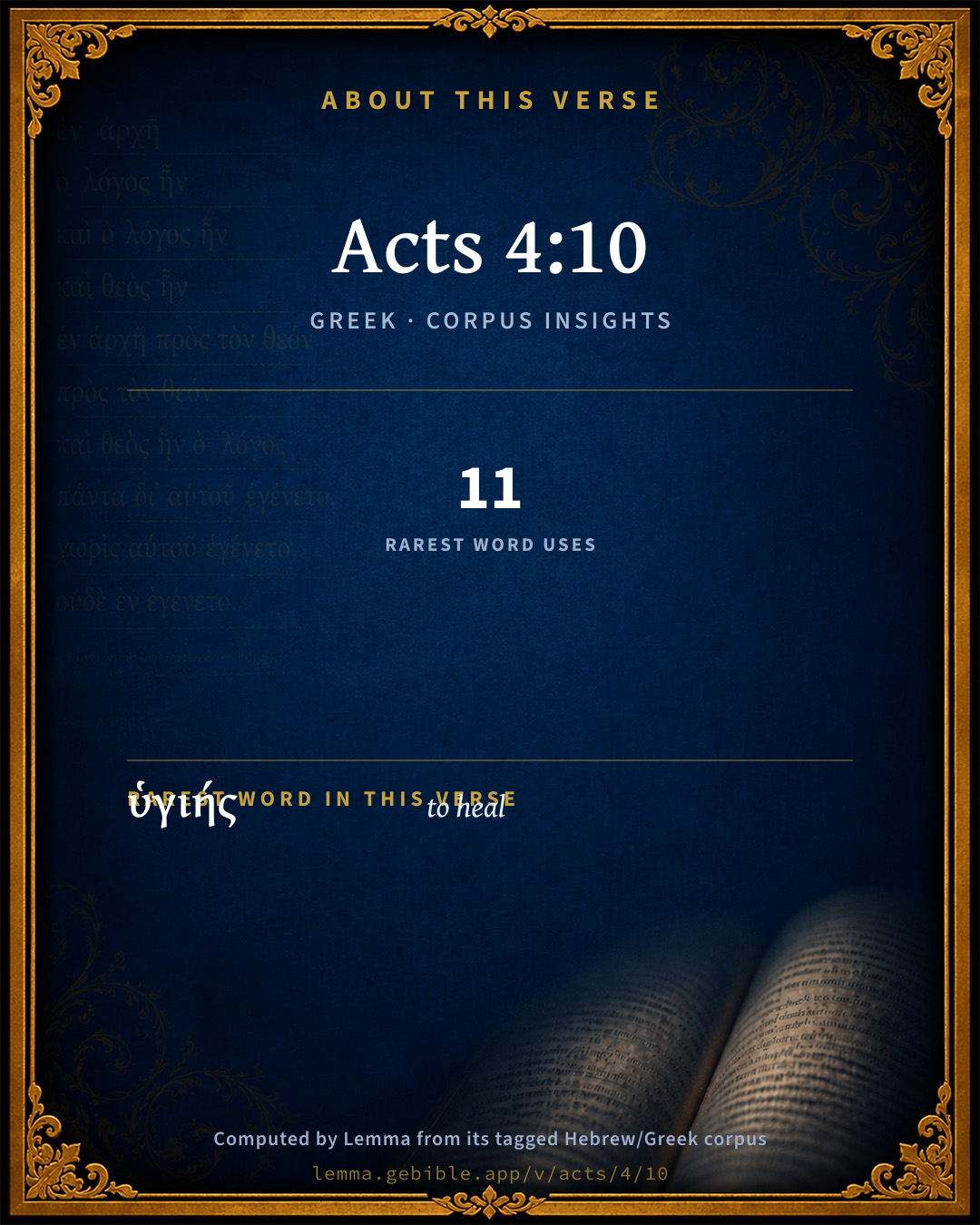
Acts 4:10

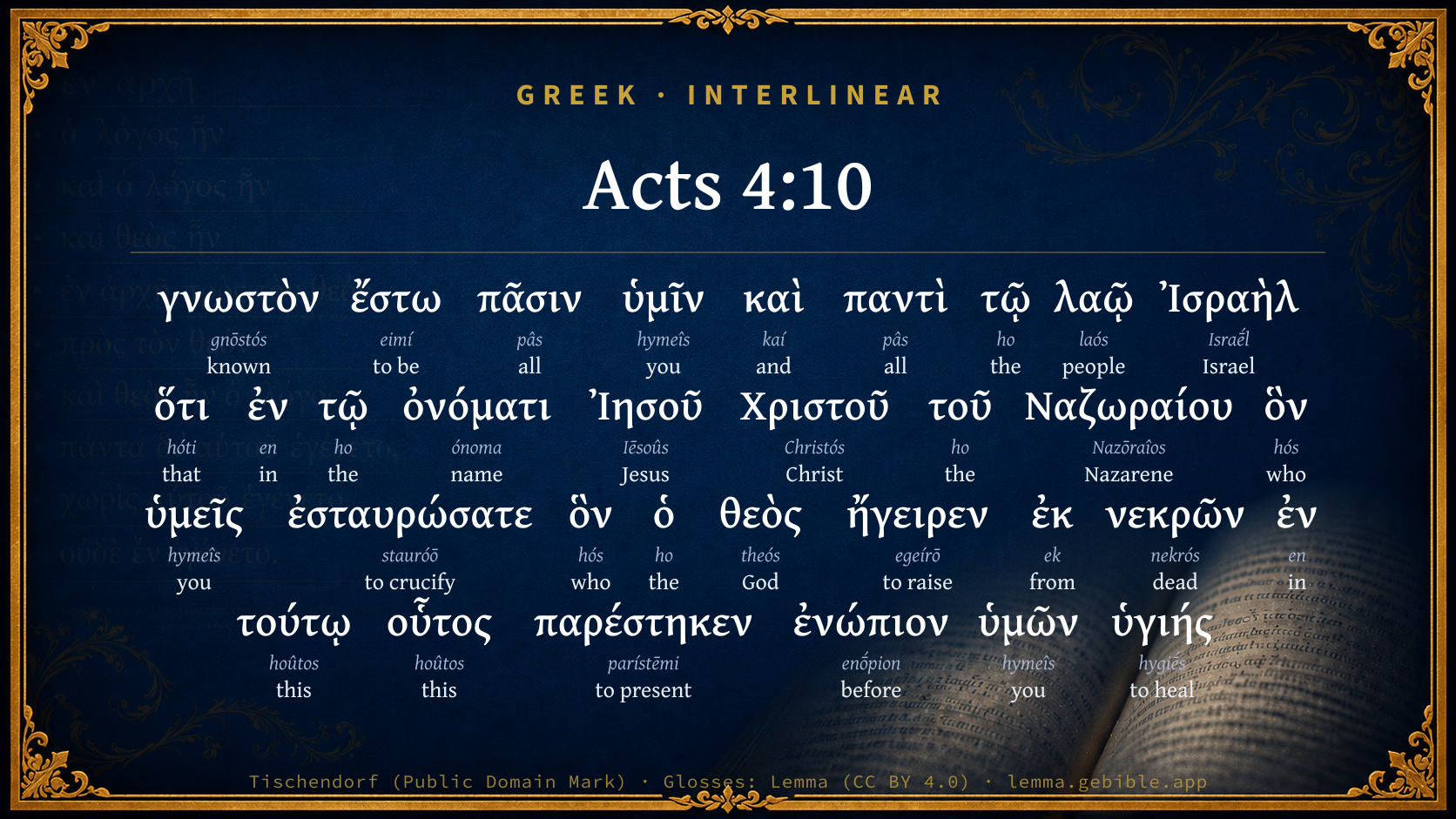
Greek (Tischendorf 8th ed.) Acts 4:10 appears in the Greek New Testament. The text above is from the Tischendorf 8th edition. Each word links to its Strong’s number and a concise gloss. Click any word for its full Thayer’s Greek Lexicon entry.
Download image
Cite this verse

Acts 4:10 (World English Bible). Public Domain. Lemma interlinear Bible study tool, https://lemma.gebible.app/v/acts/4/10.

Show BibTeX & RIS
BibTeX
RIS
English Translation
be it known to you all, and to all the people of Israel, that in the name of Jesus Christ of Nazareth, whom you crucified, whom God raised from the dead, in him does this man stand here before you whole.
World English Bible · Public Domain
Download a study sheet

One document with this verse’s original text, its word-by-word gloss line, the meaning frame, cross-references with their text, attributed commentary, and full source and license credits — printable, and it pastes into notes with its structure intact.

This verse Autodidact and up

Study sheet (.html) Plain text (.txt)

A passage Seminary Student

Up to 50 verses in one chapter. A passage sheet keeps up to 6 commentary sources and 12 cross-references per verse, in the order this page ranks them, and says so on the sheet whenever that leaves anything out. Ask for a single verse and you get the Autodidact verse sheet above.

Everything on this page stays free to read, with no account — the sheet is a download of what is already on screen, not access to it.

Want to remove ads? Support Godless Engineer
Compare translations 3

The same verse in 3 English versions, stacked beneath the original-language interlinear above. Click any original word for its lexicon entry.

Each is an independent rendering of the whole verse — the interlinear is not word-aligned to these translations.

Highlighted words mark where these versions differ — a whole-verse word diff, not a word-by-word alignment.

  • World English Bible Public Domain
    be it known to you all, and to all the people of Israel, that in the name of Jesus Christ of Nazareth, whom you crucified, whom God raised from the dead, in him does this man stand here before you whole.
  • King James Version Public Domain
    Be it known unto you all, and to all the people of Israel, that by the name of Jesus Christ of Nazareth, whom ye crucified, whom God raised from the dead, even by him doth this man stand here before you whole.
  • unfoldingWord Literal Text CC BY-SA 4.0
    let it be known to you all and to all the people of Israel that in the name of Jesus Christ the Nazarene, whom you crucified, whom God raised from the dead, by this one this stands before you healthy.

unfoldingWord Literal Text — © unfoldingWord, licensed CC BY-SA 4.0. Word-aligned USFM3 via Door43 (git.door43.org/unfoldingWord/en_ult).

Versions to compare (up to 4)

3 of 4 selected

Show all 19 translations

Every available English version of this verse, each an independent rendering of the whole verse.

  • World English Bible Public Domain
    be it known to you all, and to all the people of Israel, that in the name of Jesus Christ of Nazareth, whom you crucified, whom God raised from the dead, in him does this man stand here before you whole.
  • Berean Standard Bible Public Domain
    then let this be known to all of you and to all the people of Israel: It is by the name of Jesus Christ of Nazareth, whom you crucified but whom God raised from the dead, that this man stands before you healed.
  • Majority Standard Bible Public Domain
    then let this be known to all of you and to all the people of Israel: It is by the name of Jesus Christ of Nazareth, whom you crucified but whom God raised from the dead, that this man stands before you healed.
  • King James Version Public Domain
    Be it known unto you all, and to all the people of Israel, that by the name of Jesus Christ of Nazareth, whom ye crucified, whom God raised from the dead, even by him doth this man stand here before you whole.
  • American Standard Version (1901) Public Domain
    be it known unto you all, and to all the people of Israel, that in the name of Jesus Christ of Nazareth, whom ye crucified, whom God raised from the dead, `even' in him doth this man stand here before you whole.
  • Revised Version (1885) Public Domain
    be it known unto you all, and to all the people of Israel, that in the name of Jesus Christ of Nazareth, whom ye crucified, whom God raised from the dead, even in him doth this man stand here before you whole.
  • Geneva Bible (1599) Public Domain
    Be it knowen vnto you all, and to all the people of Israel, that by the Name of Jesus Christ of Nazareth, whom ye haue crucified, whome God raised againe from the dead, euen by him doth this man stand here before you, whole.
  • Douay-Rheims (1899) Public Domain
    Be it known to you all, and to all the people of Israel, that by the name of our Lord Jesus Christ of Nazareth, whom you crucified, whom God hath raised from the dead, even by him this man standeth here before you whole.
  • Young's Literal Translation Public Domain
    be it known to all of you, and to all the people of Israel, that in the name of Jesus Christ of Nazareth, whom ye did crucify, whom God did raise out of the dead, in him hath this one stood by before you whole.
  • Literal Standard Version CC BY-SA 4.0
    be it known to all of you, and to all the people of Israel, that in the Name of Jesus Christ of Nazareth, whom you crucified, whom God raised out of the dead, in Him has this one stood by before you whole.
  • Unlocked Literal Bible CC BY-SA 4.0
    May this be known to you all and to all the people of Israel, that in the name of Jesus Christ of Nazareth, whom you crucified, but whom God raised from the dead, that this man stands here before you healthy.
  • unfoldingWord Literal Text CC BY-SA 4.0
    let it be known to you all and to all the people of Israel that in the name of Jesus Christ the Nazarene, whom you crucified, whom God raised from the dead, by this one this stands before you healthy.
  • Darby Bible Public Domain
    be it known to you all, and to all the people of Israel, that in the name of Jesus Christ the Nazaraean, whom *ye* have crucified, whom God has raised from among [the] dead, by *him* this [man] stands here before you sound [in body].
  • World Messianic Bible Public Domain
    may it be known to you all, and to all the people of Israel, that in the name of Yeshua the Messiah of Nazareth, whom you crucified, whom God raised from the dead, this man stands here before you whole in him.
  • Webster's Bible Public Domain
    Be it known to you all, and to all the people of Israel, that by the name of Jesus Christ of Nazareth, whom ye crucified, whom God raised from the dead, even by him doth this man stand here before you sound.
  • Free Bible Version CC BY-SA 4.0
    If so, all of you should know, and all the people of Israel, that it was in the name of Jesus Christ of Nazareth, the one you killed on a cross and whom God raised from the dead—it's because of him that this man stands before you completely healed.
  • Bible in Basic English Public Domain
    Take note, all of you, and all the people of Israel, that in the name of Jesus Christ of Nazareth, whom you put to death on the cross, whom God gave back from the dead, even through him is this man now before you completely well.
  • Text-Critical English NT CC BY 4.0
    let it be known to you all, and to all the people of Israel, that this man is standing before you in good health by the name of Jesus Christ of Nazareth, whom you crucified and whom God raised from the dead.
  • Tyndale New Testament (1534) Public Domain
    be that knowen vnto you all and to the people of Israel that in the name of Iesus Christ of Nazareth whom ye crucified and whom God raysed agayne from deeth: even by him doth this man stonde here present before you whoale.

Literal Standard Version (2020), Covenant Press — licensed CC BY-SA 4.0. Text via the HelloAO Bible API (eBible.org). Unlocked Literal Bible (unfoldingWord) — licensed CC BY-SA 4.0. Text via the HelloAO Bible API (eBible.org). unfoldingWord Literal Text — © unfoldingWord, licensed CC BY-SA 4.0. Word-aligned USFM3 via Door43 (git.door43.org/unfoldingWord/en_ult). Free Bible Version, Dr. Jonathan Gallagher — licensed CC BY-SA 4.0. Text via the HelloAO Bible API (eBible.org).

Word by word

More ways to search: Search by grammar → Find every occurrence → Compare this word →

Practice this passage: Drill this verse → Learn its vocabulary →

ὑγιής
hygiḗs
G5199
“to heal”
Adjective, Nominative, Singular, Masculine
Part of Speech
Adjective
Case
Nominative
Number
Singular
Gender
Masculine
Full Thayer's Definition

Origin: from the base of G837

TDNT: 13:08,1

1. sound a. of a man who is sound in body 2. to make one whole i.e. restore him to health 3. metaph. teaching which does not deviate from the truth
  1. γνωστὸν gnōstós G1110 “known” Adjective, Nominative, Singular, Neuter
  2. ἔστω eimí G1510 “to be” Verb, Present, Active, Imperative, 3rd person, Singular
  3. πᾶσιν pâs G3956 “all” Adjective, Dative, Plural, Masculine
  4. ὑμῖν hymeîs G5210 “you” Personal pronoun, 2nd person, Dative, Plural
  5. καὶ kaí G2532 “and” Conjunction
  6. παντὶ pâs G3956 “all” Adjective, Dative, Singular, Masculine
  7. τῷ ho G3588 “the” Article, Dative, Singular, Masculine
  8. λαῷ laós G2992 “people” Noun, Dative, Singular, Masculine
  9. Ἰσραὴλ Israḗl G2474 “Israel” Noun, Proper, indeclinable
  10. ὅτι hóti G3754 “that” Conjunction
  11. ἐν en G1722 “in” Preposition
  12. τῷ ho G3588 “the” Article, Dative, Singular, Neuter
  13. ὀνόματι ónoma G3686 “name” Noun, Dative, Singular, Neuter
  14. Ἰησοῦ Iēsoûs G2424 “Jesus” Noun, Genitive, Singular, Masculine
  15. Χριστοῦ Christós G5547 “Christ” Noun, Genitive, Singular, Masculine
  16. τοῦ ho G3588 “the” Article, Genitive, Singular, Masculine
  17. Ναζωραίου Nazōraîos G3480 “Nazarene” Noun, Genitive, Singular, Masculine
  18. ὃν hós G3739 “who” Relative pronoun, Accusative, Singular, Masculine
  19. ὑμεῖς hymeîs G5210 “you” Personal pronoun, 2nd person, Nominative, Plural
  20. ἐσταυρώσατε stauróō G4717 “to crucify” Verb, Aorist, Active, Indicative, 2nd person, Plural
  21. ὃν hós G3739 “who” Relative pronoun, Accusative, Singular, Masculine
  22. ὁ ho G3588 “the” Article, Nominative, Singular, Masculine
  23. θεὸς theós G2316 “God” Noun, Nominative, Singular, Masculine
  24. ἤγειρεν egeírō G1453 “to raise” Verb, Aorist, Active, Indicative, 3rd person, Singular
  25. ἐκ ek G1537 “from” Preposition
  26. νεκρῶν nekrós G3498 “dead” Adjective, Genitive, Plural, Masculine
  27. ἐν en G1722 “in” Preposition
  28. τούτῳ hoûtos G3778 “this” Demonstrative pronoun, Dative, Singular, Neuter
  29. οὗτος hoûtos G3778 “this” Demonstrative pronoun, Nominative, Singular, Masculine
  30. παρέστηκεν parístēmi G3936 “to present” Verb, Perfect, Active, Indicative, 3rd person, Singular
  31. ἐνώπιον enṓpion G1799 “before” Adverb
  32. ὑμῶν hymeîs G5210 “you” Personal pronoun, 2nd person, Genitive, Plural

About this verse

These counts appear in no published source. They are computed here, from the morphology-tagged text and Lemma’s own curated glosses. What Lemma adds →

33
words
24
distinct lemmas
Acts
section

Notable vocabulary

The rarest word here is ὑγιής to heal G5199 — appearing just 11 times in the whole Greek New Testament.

Shared distinctive vocabulary

ὑγιής to heal G5199 occurs in 11 verses of the Greek New Testament. Also found in:

Repetition

Words recur within this verse:

Cross-references

13

Topical passages linked to Acts 4:10 in the Treasury of Scripture Knowledge — connected by theme and wording, ordered by reader-vote popularity; previews shown in the World English Bible.

  • Acts 3:6 But Peter said, "Silver and gold have I none, but what I have, that I give you. In the name of Jesus Christ of Nazareth, get up and walk!"
  • Acts 5:29–32 But Peter and the apostles answered, "We must obey God rather than men.
  • Acts 2:36 "Let all the house of Israel therefore know assuredly that God has made him both Lord and Christ, this Jesus whom you crucified."
  • Daniel 3:18 But if not, be it known to you, O king, that we will not serve your gods, nor worship the golden image which you have set up.
  • Matthew 27:63–66 saying, "Sir, we remember what that deceiver said while he was still alive: 'After three days I will rise again.'
  • Acts 2:22–24 "Men of Israel, hear these words! Jesus of Nazareth, a man approved by God to you by mighty works and wonders and signs which God did by him in the midst of you, even as you yourselves know,
  • Acts 3:13–16 The God of Abraham, Isaac, and Jacob, the God of our fathers, has glorified his Servant Jesus, whom you delivered up, and denied in the presence of Pilate, when he had determined to release him.
  • Acts 10:40–42 God raised him up the third day, and gave him to be revealed,
  • Acts 28:28 "Be it known therefore to you, that the salvation of God is sent to the Gentiles. They will also listen."
  • Jeremiah 42:19–20 Yahweh has spoken concerning you, remnant of Judah, Don't you go into Egypt: know certainly that I have testified to you this day.
  • Matthew 28:11–15 Now while they were going, behold, some of the guards came into the city, and told the chief priests all the things that had happened.
  • Acts 13:29–41 When they had fulfilled all things that were written about him, they took him down from the tree, and laid him in a tomb.
  • Romans 1:4 who was declared to be the Son of God with power, according to the Spirit of holiness, by the resurrection from the dead, Jesus Christ our Lord,

Cross-references courtesy of OpenBible.info (CC BY 4.0).

Commentary

Notes on Acts 4:10 from classic Christian and Jewish commentators (each source and its license shown beneath its notes). The classic Christian expositions comment on the surrounding passage and are grouped to its opening verse, so a note may address several verses; the Jewish commentaries on the Tanakh (Rashi and others) are per-verse, so they appear only where the commentator wrote on this verse.

Lemma curates 59 commentaries, every one of them public domain or Creative Commons licensed, each selected and text-cleaned for this edition rather than reprinted as found. About our sources →

Bengel's Gnomon

Johann Albrecht Bengel

Act 4:10. Γνωστὸν, known) This Peter, as a great herald (preacher), spoke with his voice raised. He expresses the whole in a brief compass.—ὑμῖν, unto you) rulers.

Bengel's Gnomon of the New Testament — English translation (T&T Clark, Edinburgh, 1860) — public domain. Text from a community e-Sword module.

Expositor's Greek Testament

ed. W. Robertson Nicoll

Act 4:10 . St. Peter does not hesitate to refer his judges to the same passage of Scripture which a few short weeks before Jesus of Nazareth had quoted to a deputation of the Sanhedrim. In that case too the question put to Jesus had been as to the authority by which He acted, Mat 21:42 , Mar 12:10 , Luk 21:17 . It is possible that the words from Psa 118:22 were already regarded as Messianic, from the fact that the people had welcomed Jesus at His public entry into Jerusalem with part of a verse of the same Psalm, Act 4:26 , Edersheim, Jesus the Messiah , ii., 368. Moreover, the passage, Isa 28:16 , which forms the connecting link between the Psalm and St. Peter’s words, both here and in his First Epistle (1Pe 2:7 , cf. Rom 9:33 ; Rom 10:11 ), was interpreted as Messianic, apparently by the Targums, and undoubtedly by Rashi in his Commentary, cf. also Wetstein on Mat 21:42 ; Edersheim, u. s. , ii., 725. In the original meaning of the Psalm Israel is the stone rejected by the builders, i.e. , by the heathen, the builders of this world’s empires, or the expression may refer to those in Israel who despised the small beginnings of a dawning new era (Delitzsch); but however this may be, in the N.T. the builders are the heads and representatives of Israel, as is evident from our Lord’s use of the verse, and also by St. Peter’s words here, “ you the builders ,” R.V. But that which the Psalmist had spoken of the second Temple, that which was a parable of the history of Israel, had its complete and ideal fulfilment in Him Who, despised and rejected of men, had become the chief corner-stone of a spiritual Temple, in whom both Jew and Gentile were made one (1Co 3:11 , Eph 2:20 ). ἐσταυρώσατε : mentioned not merely to remind them of their fault, cf. Act 2:36 , but perhaps also that they might understand how vain it was to fight against God (Calvin). ἐν τούτῳ : “in him,” or “in this name” R. V. margin. For the former Wendt decides, although in the previous verse he takes ἐν τίνι as neuter; so too Page and Holtzmann. On the other hand Rendall (so De Wette, Weiss) adopts the latter rendering, while admitting that the reference to Jesus Himself is quite possible, as in Act 4:12 . ἐνώπ . ὑμῶν : Hebraism, characteristic of St. Luke in his Gospel and in the Acts. The expression is never used in Matthew and Mark, and only once in John, Joh 20:30 , but thirty-one times in the Hebraistic Apocalypse frequent in LXX, but not found in classical or Hellenistic Greek, although τὰ ἐνώπια in Homer, Blass, in loco , and Grammatik des N. G. , p. 125. The word is also found on papyri twice, so Deissmann, Neue Bibelstudien , p. 40.

The Expositor's Greek Testament, edited by W. Robertson Nicoll (1897–1910) — public domain. Text from a community e-Sword module.

Geneva Bible (1599)

Geneva Bible translators

He is indeed a true Shepherd, that teacheth his sheep to hang upon Christ only, as upon one that is not dead, but hath conquered death, and hath all rule in his own hand.

Geneva Bible (1599) marginal notes — public domain. Text via Bolls.life.

Jamieson, Fausset & Brown

Robert Jamieson, A. R. Fausset & David Brown

Be it known unto you . . . and to all the people of Israel--as if emitting a formal judicial testimony to the entire nation through its rulers now convened.

by the name of Jesus, &c.--(See on Act 3:13, &c.).

even by him doth this man stand before you whole--for from Act 4:14 it appears that the healed man was at that moment before their eyes.

Jamieson, Fausset & Brown — Commentary Critical and Explanatory on the Whole Bible (1871) — public domain (CC PDM 1.0). Text via the HelloAO Bible API.

Adam Clarke's Commentary

Verse 10. By the name of Jesus Christ of Nazareth] This was a very bold declaration in the presence of such an assembly; but he felt he stood on good ground. The cure of the lame man the day before was notorious; his long infirmity was well known; his person could be easily identified; and he was now standing before them whole and sound: they themselves therefore could judge whether the miracle was true or false. But the reality of it was not questioned, nor was there any difficulty about the instruments that were employed; the only question is, How have ye done this? and in whose name? Peter immediately answers, We have done it in the name of Jesus of Nazareth whom ye crucified, and whom God hath raised from the dead.

Adam Clarke's Commentary on the Bible (1810–1826) — public domain. Text from a community e-Sword/MySword module.

John Calvin's Commentaries

10. Be it known unto you. Peter might (as I have already said) have turned aside unto many starting-holes, if he would not have entered the cause; but because the miracle was wrought, to this end, that the name of Christ might be glorified, he descendeth by and by unto this. For he knew that he was the minister of such excellent power of God, that he might have a seal to confirm his doctrine. In the meanwhile, the wicked, will they, nil they, are enforced to hear that which they would have had buried full deep. When they have done what they can, this is all; they cause Peter to avouch and object to their faces, that wherewith they were so grieved, when it was spoken to others. And, first he maketh Christ the author of the miracle. Secondly, because it seemed to be an absurd and incredible thing, that a dead man should be endued with divine power, he testifieth that Christ is alive, because God hath raised him up from the dead, howsoever they had crucified him. So that the miracle giveth him occasion to preach the resurrection of Christ. And by this testimony Peter meant to prove that he was the true Messias. He saith that they had crucified him, not only to the end he may upbraid this unto them, that they may acknowledge their fault; but also that they may understand that they have in vain striven against God; and so, consequently, cease to rage so unluckily and with such deadly success.

John Calvin's Commentaries (1540-1563) — public domain. Text from the Calvin Translation Society English edition (1840s-50s) via the Christian Classics Ethereal Library (ccel.org). Calvin's coverage is partial (roughly two-thirds of the Bible); uncommented books and verses are honest gaps, never fabricated. The 19th-century editor's footnotes and remarks are omitted so the notes are faithfully Calvin's own voice.

Ellicott's Commentary for English Readers

(10) By the name of Jesus Christ of Nazareth, whom ye crucified.—The boldness of the declaration was startling. He does not shrink now from confessing the Nazarene as the Messiah. He presses home the fact that, though Pilate had given the formal sentence, it was they who had crucified their King. He proclaims that He has been raised from the dead, and is still as a Power working to heal as when on earth.

A Bible Commentary for English Readers, edited by Charles John Ellicott (1878–1897) — public domain. Text from a community e-Sword module.

The Cambridge Bible for Schools and Colleges

gen. ed. J. J. S. Perowne

10. by the name of Jesus] Read in the name, as before.

whom ye crucified] i.e. by the Roman soldiers. So (2Sa_12:9) David is said to have killed Uriah, though it is added “by the sword of the children of Ammon.”

even by him] The Greek seems rather to refer back to the former clause of the verse, and to be better rendered even in this (name).

The Cambridge Bible for Schools and Colleges (gen. ed. J. J. S. Perowne; Cambridge University Press, 1878–1918) — public domain. Text from a community e-Sword module.

John Gill's Exposition

Be it known unto you all,.... The members of the sanhedrim:

and to all the people of Israel; who might hear of this affair; for the apostle was not ashamed of what he had done, nor of the person in whose name he had done it:

that by the name of Jesus Christ of Nazareth; by calling, on that name, and by making use of it, and by the power and authority of Jesus Christ, who by way of contempt was called the

Nazarene: whom ye crucified; for though Pilate delivered him to be crucified, and the Roman soldiers did crucify him, yet this was at the request and instigation of the chief priests, Scribes, and elders; and therefore it is ascribed to them, who were bent upon his death; and no other would satisfy them, but the shameful and painful death of the cross:

whom God raised from the dead; of which the apostles were witnesses, having seen him and conversed with him after his resurrection; and this was the doctrine they were sent to publish, and for which they were apprehended and detained in custody; but this did not deter them from preaching it, no, not before the sanhedrim; which was an instance of great courage and faithfulness: and this is the rather mentioned; to show, that it was not by the name of one that was dead, but of one that was alive, that this cure was performed; as well as to observe to them, that their efforts against Christ were vain and fruitless:

even by him doth this man stand here before you whole; from whence it appears, as well as from Act 4:18 that the man that was healed, was now present: and either he was laid hold on, and detained in custody with the apostles, in hope to discover fraud if they could; or hearing that the apostles were before the sanhedrim, and examining on his account, might come of himself, in order to attest and prove the matter of fact, and to vindicate them.

John Gill's Exposition of the Whole Bible (1746–1763) — public domain (CC PDM 1.0). Text via the HelloAO Bible API.

Trapp's Complete Commentary

John Trapp

10 Be it known unto you all, and to all the people of Israel, that by the name of Jesus Christ of Nazareth, whom ye crucified, whom God raised from the dead, even by him doth this man stand here before you whole.

Ver. 10. Be it known unto you all] Here was spiritual mettle, steeling the soul against whatsoever opposition. When a man’s strength would fall loose, the spirit hems him about, comprehends and keeps him together, Act 20:22, and makes him more than a man: as it did the apostles here, and afterwards Athanasius, Luther, others, and qui totius orbis impetum sustinuerunt, who stood out against a world of adversaries. (Tertul.)

John Trapp, A Commentary or Exposition upon All the Books of the Old and New Testament (1647–1656) — public domain. Text from a community e-Sword module.

Albert Barnes' Notes on the Bible

Be it known ... - Peter might have evaded the question, or he might have resorted to many excuses and subterfuges (Calvin), if he had been desirous of avoiding this inquiry. But it was a noble opportunity for vindicating the honor of his Lord and Master. It was a noble opportunity also for repairing the evil which he had done by his guilty denial of his Lord. Although, therefore, this frank and open avowal was attended with danger, and although it was in the presence of the great and the mighty, yet he chose to state fully and clearly his conviction of the truth. Never was there an instance of greater boldness, and never could there be a more striking illustration of the fitness of the name which the Lord Jesus gave him, that of a rock, Joh 1:42; Mat 16:17-18. The timid, trembling, yielding, and vacillating Simon; he who just before was terrified by a servant-girl, and who on the lake was afraid of sinking, is now transformed into the manly, decided, and firm Cephas, fearless before the Great Council of the nation, and in an unwavering tone asserting the authority of him whom he had just before denied, and whom they had just before put to death. It is not possible to account for this change except on the supposition that this religion is true. Peter had no worldly motive to actuate him. He had no prospect of wealth or fame by this. Even the hopes of honor and preferment which the apostles had cherished before the death of Jesus, and which might have been supposed to influence them then, were now abandoned by them. Their Master had died, and all their hopes of human honor and power had been buried in his grave. Nothing but the conviction of the truth could have made this change, and transformed this timid disciple to a bold and uncompromising apostle.

By the name - By the authority or power, Act 3:6.

Of Jesus Christ - The union of these two names would be particularly offensive to the Sanhedrin. They denied that Jesus was the Christ, or the Messiah; Peter, by the use of the word “Christ,” affirmed that he was. In the language then used, it would be, “By the name of Jesus, the Messiah.”

Of Nazareth - Lest there should be any mistake about his meaning, he specified that he referred to the despised Nazarene; to him who had just been put to death, as they supposed, covered with infamy. Christians little regard the epithets of opprobrium which may be affixed to themselves or to their religion.

Whom ye crucified - There is emphasis in all the expressions that Peter uses. He had before charged the people with the crime of having put him to death, Act 2:23; Act 3:14-15. But he now had the opportunity, contrary to all expectation, of urging the charge with still greater force on the rulers themselves, on the very council which had condemned him and delivered him to Pilate. It was a remarkable providence that an opportunity was thus afforded of urging this charge in the presence of the Sanhedrin, and of proclaiming to them the necessity of repentance. Little did they imagine, when they condemned the Lord Jesus, that this charge would be so soon urged. This is one of the instances in which God takes the wise in their own craftiness, Job 5:13. They had arraigned the apostles; they demanded their authority for what they had done; and thus they had directly opened the way, and invited them to the serious and solemn charge which Peter here urges against them.

Albert Barnes' Notes on the Bible (1834–1885) — public domain. Text from a community e-Sword/MySword module.

Haydock's Catholic Bible Commentary

Name of our Lord Jesus. From this, St. John Chrysostom takes occasion to make several pathetic exhortations against swearing and profaning this adorable name. What profit do you propose to yourselves by abusing this name? Is it to gain credit to your discourse? So you will tell me; but, believe me, you are mistaken: if people saw you respected oaths, and were afraid to make free with them, then they would believe you. Not when you give them to understand that you undervalue them, by your frequent abuse of them. Break then so profane a custom. It will cost you neither money nor labour to do so: you are not required to part with any gratification for this purpose. Use only at the beginning a little diligence, and you will easily overcome so idle a practice. Wish, and it is done. (St. John Chrysostom, super Act. sparsim.) (Haydock) --- Whom you crucified. St. Peter, without fear or apprehension, openly and boldly tells them of their heinous crime: that Christ is the head corner stone, which they had rejected, as Christ himself had told them, (Matthew xii. 10.) and that there is no name under heaven given to men to be saved by. (Witham)

George Leo Haydock (1774–1849), Haydock's Catholic Family Bible and Commentary, 1859 edition — public domain. Excludes Psalms (Douay-Rheims chapter numbering differs from Protestant) and Deuterocanonical books (Catholic canon only).

Matthew Poole's English Annotations

Be it known unto you all, and to all the people of Israel; the apostles are not dismayed, but make their boldness, spoken of Act 4:13, to appear; they preach Christ to all of them, and wish they could make him known to all others.

Jesus Christ of Nazareth: see Act 2:22.

Whom God raised; i.e. God the Father: our Surety was discharged by God himself, who had laid him in the prison of the grave for our debts.

This man stand here before you whole; the lame man that was made whole being present, and an ocular demonstration of the miracle wrought upon him.

Matthew Poole's English Annotations on the Holy Bible (1683–1685) — public domain. Text from a community e-Sword/MySword module.

Whedon's Commentary on the Bible

Daniel D. Whedon

10. You all, and all… Israel—The whole race, with its rulers at its head, is summoned to witness this new announcement.

By the name of—Not Solomon or Raphael, but of Jesus, Messiah, the Nazarene. (See note on Act_3:6.) Had Peter said, In the name of Jehovah, God of Israel, it might have been safer for himself; it would have been true; but they would have considered him as staying within the bounds of their own old Judaism. It was according to their law that miracles be performed in the name of Jehovah. But when Peter pronounced the name of Jesus they recognized apostasy from Jehovah; and when he styled him Christ=Messiah, he adopted an impostor; and when he added, Nazarene, whom ye crucified, he uttered a shame and a charge to arouse their wrath; a charge which the ages since have fearfully reechoed.

Whom ye crucified—Guilty of a good deed, these prisoners arraign their judges for a most bloody deed.

By him—Heroic reiteration.

This man—Like at once a monumental proof and a firm confessor, the lame-born stands with his benefactors in the semicircle of the court.

Stand—And so his legs speak though his tongue be silent.

Daniel D. Whedon (gen. ed.), Commentary on the Old and New Testaments (1874–1909) — public domain. Text from a community e-Sword module.

The Pulpit Commentary

In (the name) for by, A.V., and again, in (him) for by, A.V.; but if ejn tini is rightly rendered by what means, ejn tw ojnomati and ejn toutw ought to be rendered as in the A.V., by. Be it known unto you all, etc. St. Peter skillfully excuses himself from any presumption in preaching to the rulers by making his words the direct and necessary answer to their inquiry. Jesus Christ of Nazareth. (see Act_3:6, note) Whom ye crucified, whom God raised. With what wonderful conciseness and force are the great doctrines of the gospel condensed into a few words! The human nature, the mediatorial glory, the humiliating but atoning death, the glorious resurrection (a cardinal point in all the apostolic preaching), and the present might of Christ to save his people on earth, are all set out in hail a dozen pregnant words. Even in him. The apostle thus passes from the Name to him whose Name it was. Before you. How could they deny what was actually before their eyes?

The Pulpit Commentary (1880–1919), ed. H.D.M. Spence-Jones & Joseph S. Exell — public domain. Text from a community e-Sword module.

John Wesley's Explanatory Notes

Be it known to you all - Probably the herald of God proclaimed this with a loud voice. Whom God hath raised from the dead - They knew in their own consciences that it was so. And though they had hired the soldiers to tell a most senseless and incredible tale to the contrary, Matt. xxviii, 12, 15, yet it is observable, they did not, so far as we can learn, dare to plead it before Peter and John.

John Wesley, Explanatory Notes Upon the Whole Bible (1754–1765) — public domain. Text via the GEBible commentary corpus.

McGarvey & Pendleton's Commentaries

J. W. McGarvey

See notes on verse 8

J. W. McGarvey (with Philip Y. Pendleton), Commentaries on the New Testament (The Fourfold Gospel, 1914; Acts; and the epistles) — public domain. Text from a community e-Sword/MySword module.

The People's New Testament

B. W. Johnson

10. By the name of Jesus Christ. It was the power of that one whom that very court had condemned which had wrought the miracle. Whom ye crucified. Peter becomes the accuser. They, his accusers, have been guilty of crucifying the Messiah. They crucified him, but God raised him from the dead.

B. W. Johnson's The People's New Testament with Notes (1889–1891) — public domain. Electronic text from the Christian Classics Ethereal Library (CCEL) ThML edition.

Cambridge Greek Testament for Schools and Colleges

10. ἐν τῷ ὀνόματι, in the name, as before in Act 4:7.

ὑμεῖς ἐσταυρώσατε, ye crucified. For though the Roman soldiers were the actual agents in the crucifixion, it was the Jewish people and their rulers who set the Roman power in motion and urged it to the last extremity. The pronoun is therefore emphatically inserted.

ἐν τούτῳ. Refer back to the previous ἐν, and so render, in this name.

Cambridge Greek Testament for Schools and Colleges (Cambridge University Press, 1896; 21 vols, various authors incl. Carr, Maclear, Plummer, Farrar, Lumby, Moule, M. R. James, Simcox) — public domain. Text from a community e-Sword module.

Alford’s Greek Testament

Henry Alford

10.] ὃν … ὅν: the copula is omitted to make the contrast more striking.

παρέστηκεν, stands, as in E. V. He was there present.

Henry Alford, The Greek Testament (1849–1861) — public domain. Text from a community e-Sword module.

Lesson kit

Teaching starters — assembled from the data on this page, not authored interpretation. Every prompt links to the verse data it draws on. Edit before teaching.

Acts, in the Acts, opens this verse with 33 words (24 distinct Greek lemmas). Its most distinctive word is hygiḗs (“to heal”). A historical commentator’s framing appears above. Read the whole chapter for the surrounding context.

Discussion questions

  1. What does “to heal” (hygiḗs) contribute to the verse as a whole?
  2. Matthew 12:13 shares the word «to heal» with this verse. How do the two illuminate each other?
  3. “all” occurs 2× in this one verse. What is the effect of the repetition?
  4. These translations render this verse differently; the difference is in the English rendering, not the original. What questions does that raise?
  5. Reading how Bengel's Gnomon and Expositor's Greek Testament read this verse, where do the two commentators agree and where do they part?

Things to notice

Reading settings

Reading text

Shown beneath each verse's original-language words.

Old Testament
Old Testament edition

Read the OT as the Masoretic Hebrew (MT) or the Greek Septuagint (LXX).

English shown for the Greek Septuagint (in the Hebrew ↔ Greek comparison).

Comparing translations? Open the Compare panel on any verse page to stack up to four side by side.