Genesis 3:23

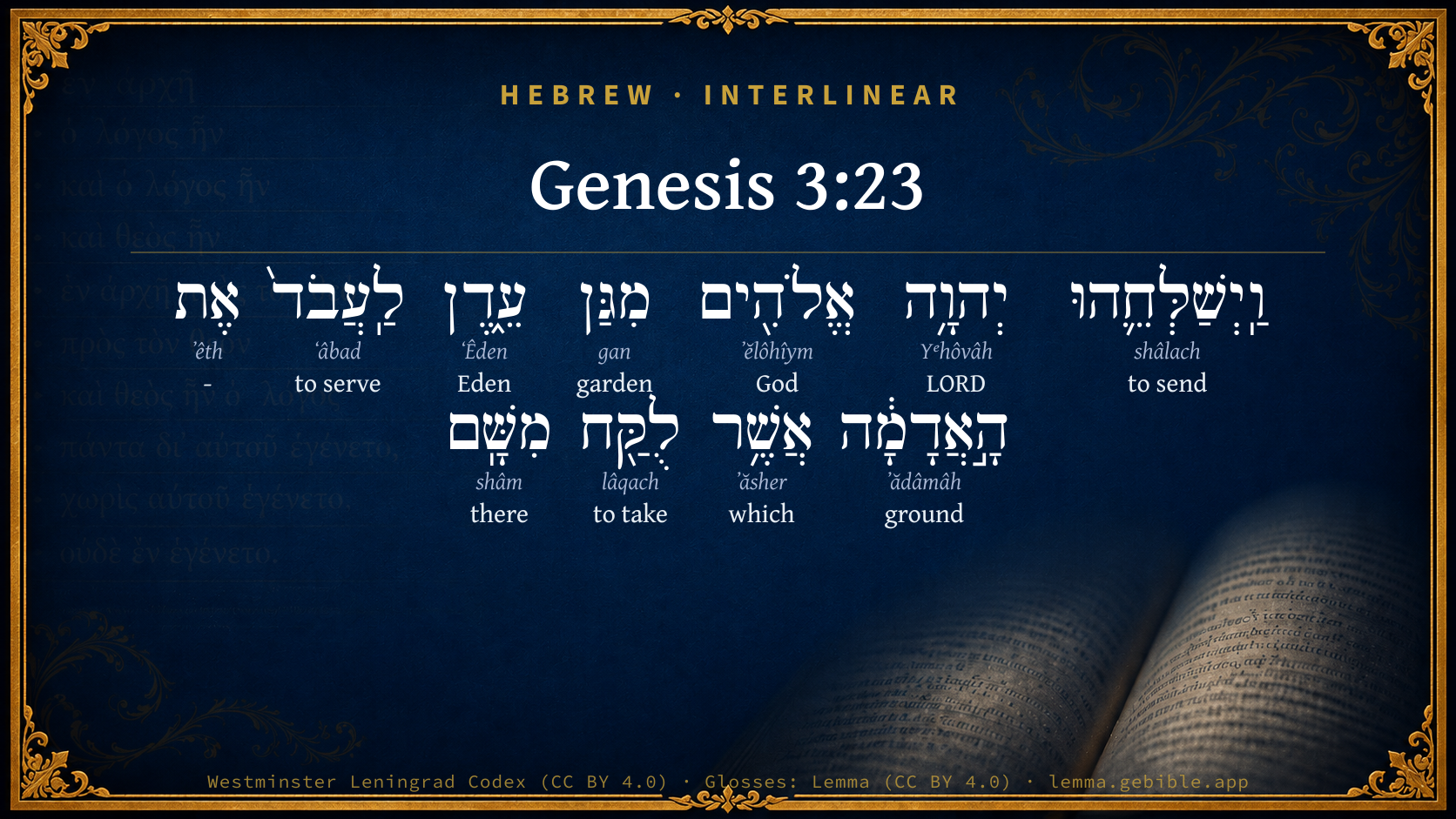
Hebrew (Westminster Leningrad Codex) Genesis 3:23 appears in the Hebrew Old Testament. The text above is from the Westminster Leningrad Codex. Each word links to its Strong’s number, a concise gloss, and parsing drawn from the Open Scriptures Hebrew Bible morphology. Click any word for its full Brown-Driver-Briggs (BDB) entry.
Download image
Cite this verse

Genesis 3:23 (World English Bible). Public Domain. Lemma interlinear Bible study tool, https://lemma.gebible.app/v/genesis/3/23.

Show BibTeX & RIS
BibTeX
RIS
English Translation
Therefore Yahweh God sent him forth from the garden of Eden, to till the ground from whence he was taken.
World English Bible · Public Domain
Download a study sheet

One document with this verse’s original text, its word-by-word gloss line, the meaning frame, cross-references with their text, attributed commentary, and full source and license credits — printable, and it pastes into notes with its structure intact.

This verse Autodidact and up

Study sheet (.html) Plain text (.txt)

A passage Seminary Student

Up to 50 verses in one chapter. A passage sheet keeps up to 6 commentary sources and 12 cross-references per verse, in the order this page ranks them, and says so on the sheet whenever that leaves anything out. Ask for a single verse and you get the Autodidact verse sheet above.

Everything on this page stays free to read, with no account — the sheet is a download of what is already on screen, not access to it.

Want to remove ads? Support Godless Engineer
Compare translations 3

The same verse in 3 English versions, stacked beneath the original-language interlinear above. Click any original word for its lexicon entry.

Each is an independent rendering of the whole verse — the interlinear is not word-aligned to these translations.

Highlighted words mark where these versions differ — a whole-verse word diff, not a word-by-word alignment.

  • World English Bible Public Domain
    Therefore Yahweh God sent him forth from the garden of Eden, to till the ground from whence he was taken.
  • King James Version Public Domain
    Therefore the LORD God sent him forth from the garden of Eden, to till the ground from whence he was taken.
  • unfoldingWord Literal Text CC BY-SA 4.0
    So Yahweh God sent him out of the Garden of Eden to work the ground which he had been taken from.

unfoldingWord Literal Text — © unfoldingWord, licensed CC BY-SA 4.0. Word-aligned USFM3 via Door43 (git.door43.org/unfoldingWord/en_ult).

Versions to compare (up to 4)

3 of 4 selected

Show all 18 translations

Every available English version of this verse, each an independent rendering of the whole verse.

  • World English Bible Public Domain
    Therefore Yahweh God sent him forth from the garden of Eden, to till the ground from whence he was taken.
  • Berean Standard Bible Public Domain
    Therefore the LORD God banished him from the Garden of Eden to work the ground from which he had been taken.
  • Majority Standard Bible Public Domain
    Therefore the LORD God banished him from the Garden of Eden to work the ground from which he had been taken.
  • King James Version Public Domain
    Therefore the LORD God sent him forth from the garden of Eden, to till the ground from whence he was taken.
  • American Standard Version (1901) Public Domain
    therefore Jehovah God sent him forth from the garden of Eden, to till the ground from whence he was taken.
  • Revised Version (1885) Public Domain
    therefore the LORD God sent him forth from the garden of Eden, to till the ground from whence he was taken.
  • Geneva Bible (1599) Public Domain
    Therefore the Lord God sent him foorth from the garden of Eden, to till ye earth, whence he was taken.
  • Douay-Rheims (1899) Public Domain
    And the Lord God sent him out of the paradise of pleasure, to till the earth from which he was taken.
  • Young's Literal Translation Public Domain
    Jehovah God sendeth him forth from the garden of Eden to serve the ground from which he hath been taken;
  • Literal Standard Version CC BY-SA 4.0
    YHWH God sends him forth from the Garden of Eden to serve the ground from which he has been taken;
  • Unlocked Literal Bible CC BY-SA 4.0
    Therefore Yahweh God sent him out from the garden of Eden, to cultivate the ground from which he had been taken.
  • unfoldingWord Literal Text CC BY-SA 4.0
    So Yahweh God sent him out of the Garden of Eden to work the ground which he had been taken from.
  • Darby Bible Public Domain
    Therefore Jehovah Elohim sent him forth from the garden of Eden, to till the ground from which he was taken.
  • World Messianic Bible Public Domain
    Therefore the LORD God sent him out from the garden of Eden, to till the ground from which he was taken.
  • Webster's Bible Public Domain
    Therefore the LORD God sent him forth from the garden of Eden, to till the ground from which he was taken.
  • Free Bible Version CC BY-SA 4.0
    So the Lord God expelled them from the Garden of Eden. He sent Adam to cultivate the ground from which he'd been made.
  • Bible in Basic English Public Domain
    So the Lord God sent him out of the garden of Eden to be a worker on the earth from which he was taken.
  • JPS Tanakh (1917) Public Domain
    Therefore the LORD God sent him forth from the garden of Eden, to till the ground from whence he was taken.

Literal Standard Version (2020), Covenant Press — licensed CC BY-SA 4.0. Text via the HelloAO Bible API (eBible.org). Unlocked Literal Bible (unfoldingWord) — licensed CC BY-SA 4.0. Text via the HelloAO Bible API (eBible.org). unfoldingWord Literal Text — © unfoldingWord, licensed CC BY-SA 4.0. Word-aligned USFM3 via Door43 (git.door43.org/unfoldingWord/en_ult). Free Bible Version, Dr. Jonathan Gallagher — licensed CC BY-SA 4.0. Text via the HelloAO Bible API (eBible.org).

Word by word

More ways to search: Search by grammar → Find every occurrence → Compare this word →

Practice this passage: Drill this verse → Learn its vocabulary →

עֵ֑דֶן
ʻÊden
H5731
“Eden”
Noun, Proper
Part of Speech
Noun
Type
Proper
Full BDB Definition

Origin: the same as H5730

TWOT: 1568

Eden = "pleasure" - the first habitat of man after the creation; site unknown (noun proper masculine locative) - a Gershonite Levite, son of Joah in the days of king Hezekiah of Judah (noun proper masculine)
  1. וַֽיְשַׁלְּחֵ֛הוּ shâlach H7971 “and · to send · him” Conjunction + Verb, Piel, Sequential Imperfect, 3rd Person, Masculine, Singular + Suffix, Personal, 3rd Person, Masculine, Singular
  2. יְהוָ֥ה Yᵉhôvâh H3068 “LORD” Noun, Proper
  3. אֱלֹהִ֖ים ʼĕlôhîym H430 “God(s)” Noun, Common, Masculine, Plural, Absolute
  4. מִגַּן gan H1588 “from · garden of” Preposition + Noun, Common, Both, Singular, Construct
  5. לַֽעֲבֹד֙ ʻâbad H5647 “to serve” Preposition + Verb, Qal, Infinitive Construct
  6. אֶת ʼêth H853 “-” Particle, Direct Object
  7. הָ֣אֲדָמָ֔ה ʼădâmâh H127 “the · ground” Particle, Definite Article + Noun, Common, Feminine, Singular, Absolute
  8. אֲשֶׁ֥ר ʼăsher H834 “which” Particle, Relative
  9. לֻקַּ֖ח lâqach H3947 “to take” Verb, Pual, Perfect, 3rd Person, Masculine, Singular
  10. מִשָּֽׁם shâm H8033 “from · there” Preposition + Adverb

About this verse

These counts appear in no published source. They are computed here, from the morphology-tagged text and Lemma’s own curated glosses. What Lemma adds →

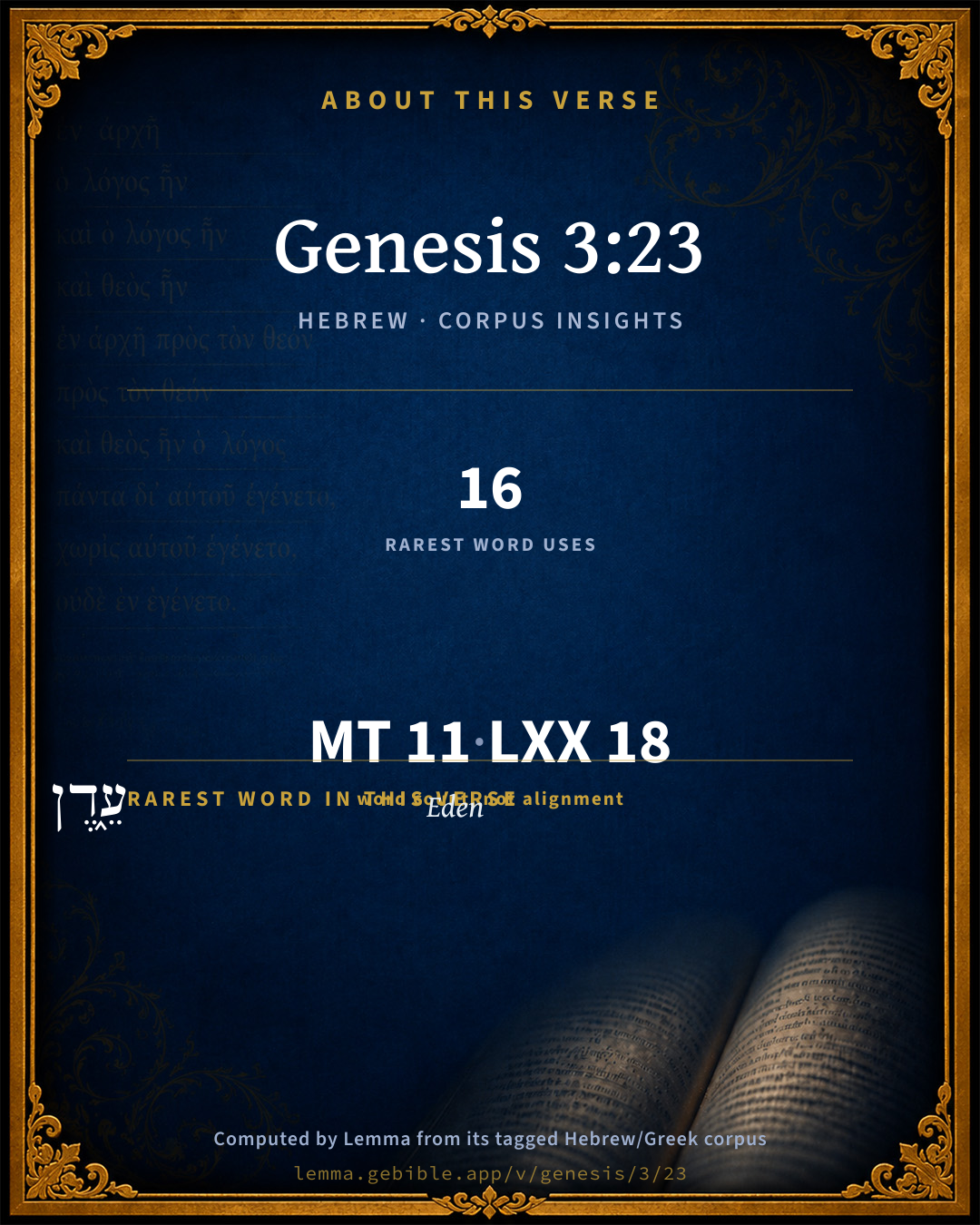
11
words
11
distinct lemmas
Pentateuch
section

Notable vocabulary

The rarest word here is עֵ֑דֶן Eden H5731 — appearing just 16 times in the whole Hebrew Bible.

Shared distinctive vocabulary

עֵ֑דֶן Eden H5731 occurs in 15 verses of the Hebrew Bible. Also found in:

Grammatical profile

  • 3 verbs
  • 5 nouns
  • 1 adverb
  • 2 particles

Verb forms

  • וַֽיְשַׁלְּחֵ֛הוּ Piel · Sequential Imperfect
  • לַֽעֲבֹד֙ Qal · Infinitive Construct
  • לֻקַּ֖ח Pual · Perfect

Hebrew & Septuagint length

In English translation the verse runs 20 words from the Hebrew and 23 from the Septuagint (LXX English) — closely comparable.

A rough comparison of the two English renderings, which tokenize alike — not a word-level alignment.

Word counts can differ between the Hebrew and the Greek without any difference in meaning — e.g. the Hebrew direct-object marker אֵת has no separate Greek word, and Greek often adds the article ὁ.

In the original languages it is 11 Hebrew tokens and 18 Greek tokens — but the two are counted differently (Hebrew bundles its prefixes and suffixes into one token; the Greek is in lemma form), so that isn’t a like-for-like length.

Cross-references

6

Topical passages linked to Genesis 3:23 in the Treasury of Scripture Knowledge — connected by theme and wording, ordered by reader-vote popularity; previews shown in the World English Bible.

  • Genesis 4:2 Again she gave birth, to Cain's brother Abel. Abel was a keeper of sheep, but Cain was a tiller of the ground.
  • Genesis 3:19 By the sweat of your face will you eat bread until you return to the ground, for out of it you were taken. For you are dust, and to dust you shall return."
  • Genesis 4:12 From now on, when you till the ground, it won't yield its strength to you. You shall be a fugitive and a wanderer in the earth."
  • Genesis 2:5 No plant of the field was yet in the earth, and no herb of the field had yet sprung up; for Yahweh God had not caused it to rain on the earth. There was not a man to till the ground,
  • Ecclesiastes 5:9 Moreover the profit of the earth is for all. The king profits from the field.
  • Genesis 9:20 Noah began to be a farmer, and planted a vineyard.

Cross-references courtesy of OpenBible.info (CC BY 4.0).

Hebrew and Greek witnesses Masoretic Hebrew ↔ Greek Septuagint

The same verse in the two great witnesses to the Old Testament, shown verse-for-verse.

These are two independent witnesses, not word-aligned to each other, and the Septuagint is shown in lemma (dictionary) form.

Hebrew Genesis 3:23 Masoretic · Westminster Leningrad Codex

וַֽיְשַׁלְּחֵ֛הוּ יְהוָ֥ה אֱלֹהִ֖ים מִגַּן עֵ֑דֶן לַֽעֲבֹד֙ אֶת הָ֣אֲדָמָ֔ה אֲשֶׁ֥ר לֻקַּ֖ח מִשָּֽׁם

Therefore Yahweh God sent him forth from the garden of Eden, to till the ground from whence he was taken.

World English Bible · Public Domain

Greek LXX Genesis 3:23 Septuagint · lemma form

καί ἐκ ἀποστέλλω αὐτός κύριος ὁ θεός ἐκ ὁ παράδεισος ὁ τρυφή ἐργάζομαι ὁ γῆ ἐκ ὅς λαμβάνω

So the Lord God sent him forth out of the garden of Delight to cultivate the ground out of which he was taken.

LXX2012 (modern English Septuagint) · Public Domain

On this verse, Trapp's Complete Commentary discusses the Septuagint’s reading. Read the note in Commentary ↓

Hebrew: Westminster Leningrad Codex (CC BY 4.0). Greek: Septuagint (public domain); English from LXX2012 (modern English Septuagint) (Public Domain). How the Septuagint differs from the Hebrew →

Targum (Aramaic paraphrase)

2

The Targum is the ancient Jewish Aramaic paraphrase of the Hebrew Scriptures — an interpretive translation, not the Hebrew text itself. Onkelos (literal) and Pseudo-Jonathan (expansive) render the Torah, and Jonathan the Prophets. Coverage is partial: where no permissively-licensed English translation exists for a verse, only the Aramaic is shown. This is verse-level text, not a word-by-word alignment to the Hebrew.

  1. Targum Onkelos Torah (Genesis–Deuteronomy)
    וְשַׁלְּחֵהּ יְיָ אֱלֹהִים מִגִּינְתָא דְעֵדֶן לְמִפְלַח יַת אַדְמְתָא דְּאִתְבְּרִי מִתַּמָּן

    (no public-domain English translation for this verse)

    Targum Onkelos — Aramaic: “Onkelos Genesis” (public domain); “Onkelos Exodus” (public domain); “Onkelos Leviticus” (public domain); “Onkelos Numbers” (public domain); “Onkelos Deuteronomy” (public domain). English: “Sefaria Community Translation” (CC0 1.0 (public-domain dedication)); “J.W. Etheridge. The Targums of Onkelos and Jonathan Ben Uzziel on the Pentateuch. London: Longmans, Green, 1862” (public domain). Text via Sefaria.

  2. Targum Pseudo-Jonathan Torah (Genesis–Deuteronomy)
    וְתַרְכֵיהּ יְיָ אֱלהִים מִגִנְתָא דְעֵדֶן וְאָזַל וְיָתִיב בְּטוּר מוֹרִיָה לְמִפְלַח יַת אַדְמָתָא דְאִתְבְּרִי מִתַּמָן

    And the Lord God removed him from the garden of Eden; and he went and dwelt on Mount Moriah, to cultivate the ground from which he had been created.

    Targum Pseudo-Jonathan — Aramaic: “Targum Jonathan on Genesis” (public domain); “Targum Jonathan on Exodus” (public domain); “Targum Jonathan on Leviticus” (public domain); “Targum Jonathan on Numbers” (public domain); “Targum Jonathan on Deuteronomy” (public domain). English: “The Targum of Jonathan ben Uzziel, trans. J. W. Etheridge, London, 1862” (public domain). Text via Sefaria.

Commentary

Notes on Genesis 3:23 from classic Christian and Jewish commentators (each source and its license shown beneath its notes). The classic Christian expositions comment on the surrounding passage and are grouped to its opening verse, so a note may address several verses; the Jewish commentaries on the Tanakh (Rashi and others) are per-verse, so they appear only where the commentator wrote on this verse.

Lemma curates 59 commentaries, every one of them public domain or Creative Commons licensed, each selected and text-cleaned for this edition rather than reprinted as found. About our sources →

Trapp's Complete Commentary

John Trapp

Gen 3:23 Therefore the LORD God sent him forth from the garden of Eden, to till the ground from whence he was taken.

Ver. 23. Therefore the Lord God sent him forth.] He gently dismissed him, as the word signifies; placed him over against Paradise, in the sight thereof (as Stella {a} observeth out of the Septuagint) that, by often beholding, the sorrow of his sin, might be increased, that his "eye might affect his heart" {b} {Lam 3:5} Yet, "lest he should be swallowed up of over-much sorrow," and so Satan get "an advantage of him" - for {2Co 2:7; 2Co 2:11} God is not ignorant of his devices - Christ, the promised Seed, was, by his voluntary banishment, to bring back all believers to their heavenly home; to bear them by his angels into Abraham’s bosom, and to "give them to eat of the tree of life, which is in the midst of the paradise of God." {Rev 2:7} Our whole life here is nothing else but a banishment. That we like it no worse, is because we never knew better. They that were born in hell, saith the proverb, think there’s no other heaven. The poor posterity of a banished prince take their mean condition well-aworth; Moses counts Egypt, where yet he was but a sojourner, his home; and in reference to it calls his son, born in Midian, Gershom, that is, a stranger there. Oh, how should we breathe after our heavenly home! groaning within ourselves, like those birds of paradise naturalists {c} speak of, stretching forth the neck, as the apostle’s word {d} importeth, "waiting for the adoption, even the redemption of our bodies," {Rom 8:23} glorifying God meanwhile with our spirits and bodies, devouring all difficulties, donec a spe ad speciem transeamus , till Christ, who is gone to prepare a place for us, return and say, "This day thou shalt be with me in Paradise."

{a} Stella in Luk 7:1-50.

{b} Iisdem, quibus videmus, oculis flemus.

{c} Avis Paradisi . - Gesner.

{d} αποκαρασοκια, Rom 8:19.

John Trapp, A Commentary or Exposition upon All the Books of the Old and New Testament (1647–1656) — public domain. Text from a community e-Sword module.

Tyndale Open Study Notes

Tyndale Open Resources

3:23 So the Lord God banished them from the Garden of Eden: Before the Fall, the garden was a sanctuary in which humans could move freely in God’s holy presence. Now their sin required expulsion from that environment. This same principle was behind the laws that restricted an Israelite’s access to God’s presence in the Tabernacle or Temple (e.g., Lev 16:1-2; Num 5:3).

Tyndale Open Study Notes — © Tyndale Open Resources, licensed CC BY-SA 4.0. Text via the HelloAO Bible API.

John Calvin's Commentaries

23. Therefore the Lord God sent him forth Here Moses partly prosecutes what he had said concerning the punishment inflicted on man, and partly celebrates the goodness of God, by which the rigour of his judgment was mitigated. God mercifully softens the exile of Adam, by still providing for him a remaining home on earth, and by assigning to him a livelihood from the culture — although the labourious culture — of the ground; for Adam thence infers that the Lord has some care for him, which is a proof of paternal love. Moses, however, again speaks of punishment, when he relates that man was expelled and that cherubim were opposed with the blade of a turning sword, which should prevent his entrance into the garden. Moses says that the cherubim were placed in the eastern region, on which side, indeed, access lay open to man, unless he had been prohibited. It is added, to produce terror, that the sword was turning or sharpened on both sides. Moses, however, uses a word derived from whiteness or heat Therefore, God having granted life to Adam, and having supplied him with food, yet restricts the benefit, by causing some tokens of Divine wrath to be always before his eyes, in order that he might frequently reflect that he must pass through innumerable miseries, through temporal exile, and through death itself, to the life from which he had fallen; for what we have said must be remembered, that Adam was not so dejected as to be left without hope of pardon. He was banished from that royal palace of which he had been the lord, but he obtained elsewhere a place in which he might dwell; he was bereft of his former delicacies, yet he was still supplied with some kind of food; he was excommunicated from the tree of life, but a new remedy was offered him in sacrifices. Some expound the ‘turning sword’ to mean one which does not always vibrate with its point directed against man, but which sometimes shows the side of the blade, for the purpose of giving place for repentance. But allegory is unseasonable, when it was the determination of God altogether to exclude man from the garden, that he might seek life elsewhere. As soon, however, as the happy fertility and pleasantness of the place was destroyed, the terror of the sword became superfluous. By cherubim, no doubt, Moses means angels and in this accommodates himself to the capacity of his own people. God had commanded two cherubim to be placed at the ark of the covenant, which should overshadow its covering, with their wings; therefore he is often said to sit between the cherubim. That he would have angels depicted in this form, was doubtless granted as an indulgence to the rudeness of that ancient people; for that age needed puerile instructions, as Paul teaches, (Galatians 4:3;) and Moses borrowed thence the name which he ascribed to angels, that he might accustom men to that kind of revelation which he had received from God, and faithfully handed down; for God designed, that what he knew would prove useful to the people, should be revealed in the sanctuary. And certainly this method is to be observed by us, in order that we, conscious of one own infirmity may not attempt, without assistance, to soar to heaven; for otherwise it will happen that, in the midst of our course, all our senses will fail. The ladders and vehicles, then, were the sanctuary, the ark of the covenants the altar, the table and its furniture. Moreover, I call them vehicles and ladders, because symbols of this kind were by no means ordained that the faithful might shut up God in a tabernacle as in a prison, or might attach him to earthly elements; but that, being assisted by congruous and apt means, they might themselves rise towards heaven. Thus David and Hezekiah, truly endued with spiritual intelligence, were far from entertaining those gross imaginations, which would fix God in a given place. Still they do not scruple to call upon God, who sitteth or dwelleth between the cherubim, in order that they may retain themselves and others under the authority of the law.

Finally, In this place angels are called cherubim, for the same reason that the name of the body of Christ is transferred to the sacred bread of the Lord’s Supper. With respect to the etymology, the Hebrews themselves are not agreed. The most generally received opinion is, that the first letter, כ(caf) is a servile letter, and a note of similitude, and, therefore, that the word cherub is of the same force as if it were said, ‘like a boy.’ But because Ezekiel, who applies the word in common to different figures, is opposed to this signification; they think more rightly, in my judgment, who declare it to be a general name. Nevertheless, that it is referred to angels is more than sufficiently known. Whence also Ezekiel (Ezekiel 28:14) signalizes the proud king of Tyre with this title, comparing him to a chief angel.

John Calvin's Commentaries (1540-1563) — public domain. Text from the Calvin Translation Society English edition (1840s-50s) via the Christian Classics Ethereal Library (ccel.org). Calvin's coverage is partial (roughly two-thirds of the Bible); uncommented books and verses are honest gaps, never fabricated. The 19th-century editor's footnotes and remarks are omitted so the notes are faithfully Calvin's own voice.

Ellicott's Commentary for English Readers

(23) To till the ground.—This is the same word as that rendered “dress” in Gen_2:15. Adam’s task is the same, but the conditions are altered.

A Bible Commentary for English Readers, edited by Charles John Ellicott (1878–1897) — public domain. Text from a community e-Sword module.

The Cambridge Bible for Schools and Colleges

gen. ed. J. J. S. Perowne

23. sent him forth, &c.] Man is dismissed from the garden with the duty imposed upon him to till the ground. Agriculture is here treated as the earliest human industry. See note on Gen_3:18.

The Cambridge Bible for Schools and Colleges (gen. ed. J. J. S. Perowne; Cambridge University Press, 1878–1918) — public domain. Text from a community e-Sword module.

John Gill's Exposition

Therefore the Lord God sent him forth from the garden of Eden,.... Gave him orders to depart immediately; sent or put him away as a man does his wife, when he divorces her; or as a prince banishes a rebellious subject: for how long Adam was in the garden see Gill on Psa 49:12, however, he did not send him to hell at once, as he did the apostate angels, but

to till the ground, from whence he was taken: either the earth in general, out of which he was made, and to which he must return, and in the mean while must labour hard, in digging and ploughing, in planting and sowing, that so he might get a livelihood; or that particular spot out of which he was formed, which is supposed from hence to have been without the garden of Eden, though very probably near unto it: some say it was a field near Damascus; the Targum of Jonathan is,"he went and dwelt in Mount Moriah, to till the ground out of which he was created;''and so other Jewish writers say (p), the gate of paradise was near Mount Moriah, and there Adam dwelt after he was cast out.

(p) Pirke Eliezer, c. 20. fol. 20. 2.

John Gill's Exposition of the Whole Bible (1746–1763) — public domain (CC PDM 1.0). Text via the HelloAO Bible API.

Matthew Poole's English Annotations

For prevention thereof, the Lord God sent him forth, or expelled him with shame and violence, and so as never to restore him thither; for it is the same word which is used concerning divorced wives.

To till, to wit, with toil and sweat, as was threatened, Gen 3:17, the ground without Paradise; for he was made without Paradise, and then put into it, as was noted before.

Matthew Poole's English Annotations on the Holy Bible (1683–1685) — public domain. Text from a community e-Sword/MySword module.

Whedon's Commentary on the Bible

Daniel D. Whedon

23. Therefore the Lord God sent him forth — The divine utterance in the previous verse was impressively left unfinished, a notable example of aposiopesis. The writer here passes abruptly to state what immediately followed the penal sentence, as if unwilling to express the awful words of the Judge.

To till the ground from whence he was taken — His toilsome labour in the dust is to be a constant reminder both of his bodily origin and of his future dissolution. Compare Gen_3:19.

Daniel D. Whedon (gen. ed.), Commentary on the Old and New Testaments (1874–1909) — public domain. Text from a community e-Sword module.

The Pulpit Commentary

Vers. 23, 24. Therefore (literally, and) the Lord God sent (or cast, shalach in the Piel conveying the ideas of force and displeasure; cf. (Deu_21:14; 1Ki_9:7) him forth from the garden of Eden to till the ground (i.e. the soil outside of paradise, which had been cursed for his sake) whence he was taken. Vide ver. 19. So (and) he drove out the man (along with his guilty partner); and he placed (literally, caused to dwell) at the east of the garden of Eden Cherubim.

1. Griffins, like those of Persian and Egyptian mythology, which protected gold-producing countries like Eden; from carav, to tear in pieces; Sanscrit, grivh; Persian, giriften; Greek, grup, gruf; German, grip, krip, greif (Eichhorn, Fib.st).

2. Divine steeds; by metathesis for rechubim, from rachab, to ride. (Psa_18:11; Gesenius, Lange)

3. "Beings who approach to God and minister to him," taking cerub karov, to come near, to serve (Hyde).

4. The engravings or carved figures; from carav (Syriac), to engrave (Taylor Lewis); from an Egyptian root (Cook, vide Speaker"s Commentary). Biblical notices describe them as living creatures (Eze_1:5; Rev_4:6) in the form of a man, (Eze_1:5) with four. (Eze_1:8 Eze_2:2-3 Eze_10:7, Eze_10:8-21) or with six wings, (Rev_4:8) and full of eyes (Eze_1:18 Eze_10:12; Rev_4:8) having each four faces, viz., of a man, of a lion, of an ox, of an eagle; (Eze_1:10 Eze_10:16) or with one face each of a man, of a lion, of a calf, and of an eagle respectively trey. 4:7). Representations of these chay ath LXX., zwa were by Divine directions placed upon the Capporeth (Exo_25:17) and curtains of the tabernacle, (Exo_26:1, 31 36:8, 35) and afterwards engraved upon the walls and doors of the temple. (1Ki_6:29, 1Ki_6:32, 1Ki_6:35) In the Apocalypse they are depicted as standing in the immediate neighborhood of the throne trey. 4:6; 5:6; 7:11), and as taking part in the acts of adoration and praise m which the heavenly hosts engage (ibid. 5:11), and that on the express ground of their redemption (ibid. 5:8, 9). Whence the opinion that most exactly answers all the facts of the case is, that these mysterious creatures were symbolic not of the fullness of the Deity (Bahr), nor of the sum of earthly life (Hengstenberg), nor of the angelic nature (Calvin), nor of the Divine manhood of Jesus Christ (Wordsworth), but of redeemed and glorified humanity (Jamieson, Fairbairn, Macdonald, Candlish). Combining with the intelligence of human nature the highest qualities of the animal world, as exhibited in the lion, the ox, and the eagle, they were emblematic of creature life in its most absolutely perfect form. As such they were caused to dwell at the gate of Eden to intimate that only when perfected and purified could fallen human nature return to paradise. Meantime man was utterly unfit to dwell within its fair abode. And a flaming sword, which turned every way. Literally, the flame of a sword turning itself; not brandished by the cherubim, but existing separately, and flashing out from among them (cf. Eze_1:4) An emblem of the Divine glory in its attitude towards sin (Macdonald). To keep (to watch over or guard; cf. Gen_2:15) the way of the tree of life. To keep the tree of life might imply that all access to it was to be precluded; but to keep the way signifies to keep the way open as well as to keep it shut" (Macdonald).

The Pulpit Commentary (1880–1919), ed. H.D.M. Spence-Jones & Joseph S. Exell — public domain. Text from a community e-Sword module.

John Wesley's Explanatory Notes

He sent him forth - Bid him go out, told him he should no longer occupy and enjoy that garden; but he was not willing to part with it.

John Wesley, Explanatory Notes Upon the Whole Bible (1754–1765) — public domain. Text via the GEBible commentary corpus.

Scofield Reference Notes

C. I. Scofield

Therefore the Lord God

The Second Dispensation: Conscience. By disobedience man came to a personal and experimental knowledge of good and evil--of good as obedience, of evil as disobedience to the known will of God. Through that knowledge conscience awoke. Expelled from Eden and placed under the second, or ADAMIC COVENANT, man was responsible to do all known good, to abstain from all known evil, and to approach God through sacrifice. The result of this second testing of man is stated in Gen 6:5 and the dispensation ended in the judgment of the Flood. Apparently "the east of the garden" Gen 3:24 where were the cherubims and the flame, remained the place of worship through this second dispensation. See for the other six dispensations:

INNOCENCE (See Scofield "Gen 1:28")

HUMAN GOVERNMENT (See Scofield "Gen 8:21")

PROMISE (See Scofield "Gen 12:1")

LAW (See Scofield "Exo 19:8")

GRACE (See Scofield "Joh 1:17")

KINGDOM (See Scofield "Eph 1:10")

The Scofield Reference Bible (1917 edition), notes by C. I. Scofield — public domain. Text from a community e-Sword module.

Radak

Rabbi David Kimhi (Radak)

וישלחהו, the expression here means “expelled.” It is also used in this sense in Jeremiah 16,6 שלח מעל פני, “expel from my presence.

לעבד את האדמה, seeing Adam had not been content with light duties in Gan Eden, while he lived from the fruit of the trees, something which was effortless, and he had preferred to violate G’d’s commandment, he would now have to leave the garden and perform hard work, as already indicated in verse 17. אשר לקח משם, to the same place he had been taken from by G;d when He had brought him to Gan Eden. Alternately, the meaning of these words could be in accordance with Onkelos, “the place from which he had been created;” a reference to the earthly part of him, not the divine part of him.

Radak on the Tanakh — English translations: “Sefaria Community Translation” (CC0 1.0 (public-domain dedication)); “Eliyahu Munk, HaChut Hameshulash” (CC BY 4.0); “Rabbi Mike Feuer, Jerusalem Anthology” (CC BY 4.0); and “R. David Kimhi on the first book of Psalms, Translated by R.G. Finch, London, 1919” (public domain). Text via Sefaria.

Lesson kit

Teaching starters — assembled from the data on this page, not authored interpretation. Every prompt links to the verse data it draws on. Edit before teaching.

Genesis, in the Pentateuch, opens this verse with 11 words (11 distinct Hebrew lemmas). Its most distinctive word is ʻÊden (“Eden”). A historical commentator’s framing appears above. Read the whole chapter for the surrounding context.

Discussion questions

  1. How does “Eden” (ʻÊden) shape what this verse is saying?
  2. Genesis 2:8 shares the word «Eden» with this verse. How do the two illuminate each other?
  3. These translations render this verse differently. What is at stake in choosing one wording over another?
  4. The verb «וַֽיְשַׁלְּחֵ֛הוּ» is Piel Sequential Imperfect. How does its form color the action?
  5. Reading how Trapp's Complete Commentary and Tyndale Open Study Notes read this verse, where do the two commentators agree and where do they part?

Things to notice

Reading settings

Reading text

Shown beneath each verse's original-language words.

Old Testament
Old Testament edition

Read the OT as the Masoretic Hebrew (MT) or the Greek Septuagint (LXX).

English shown for the Greek Septuagint (in the Hebrew ↔ Greek comparison).

Comparing translations? Open the Compare panel on any verse page to stack up to four side by side.