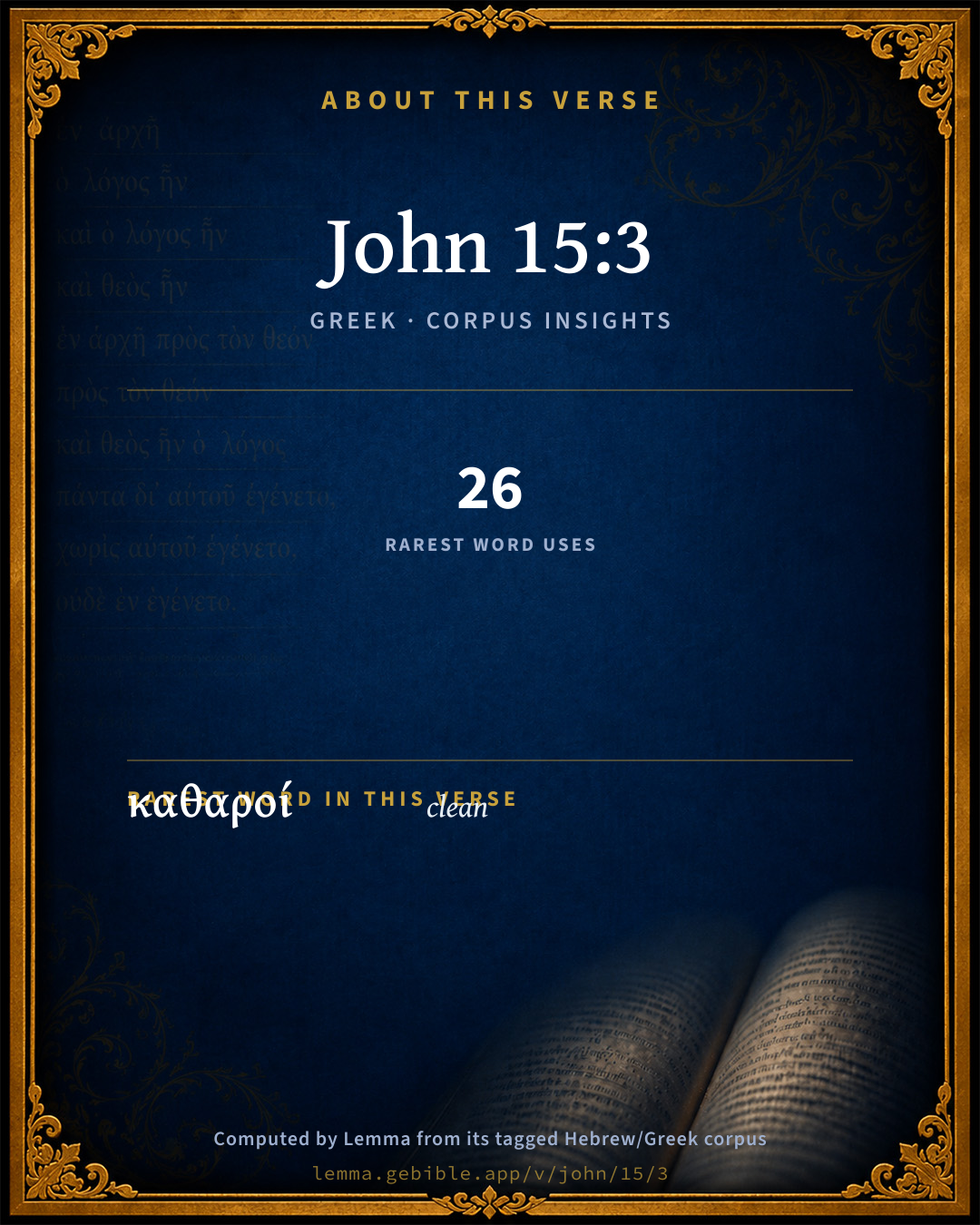
John 15:3

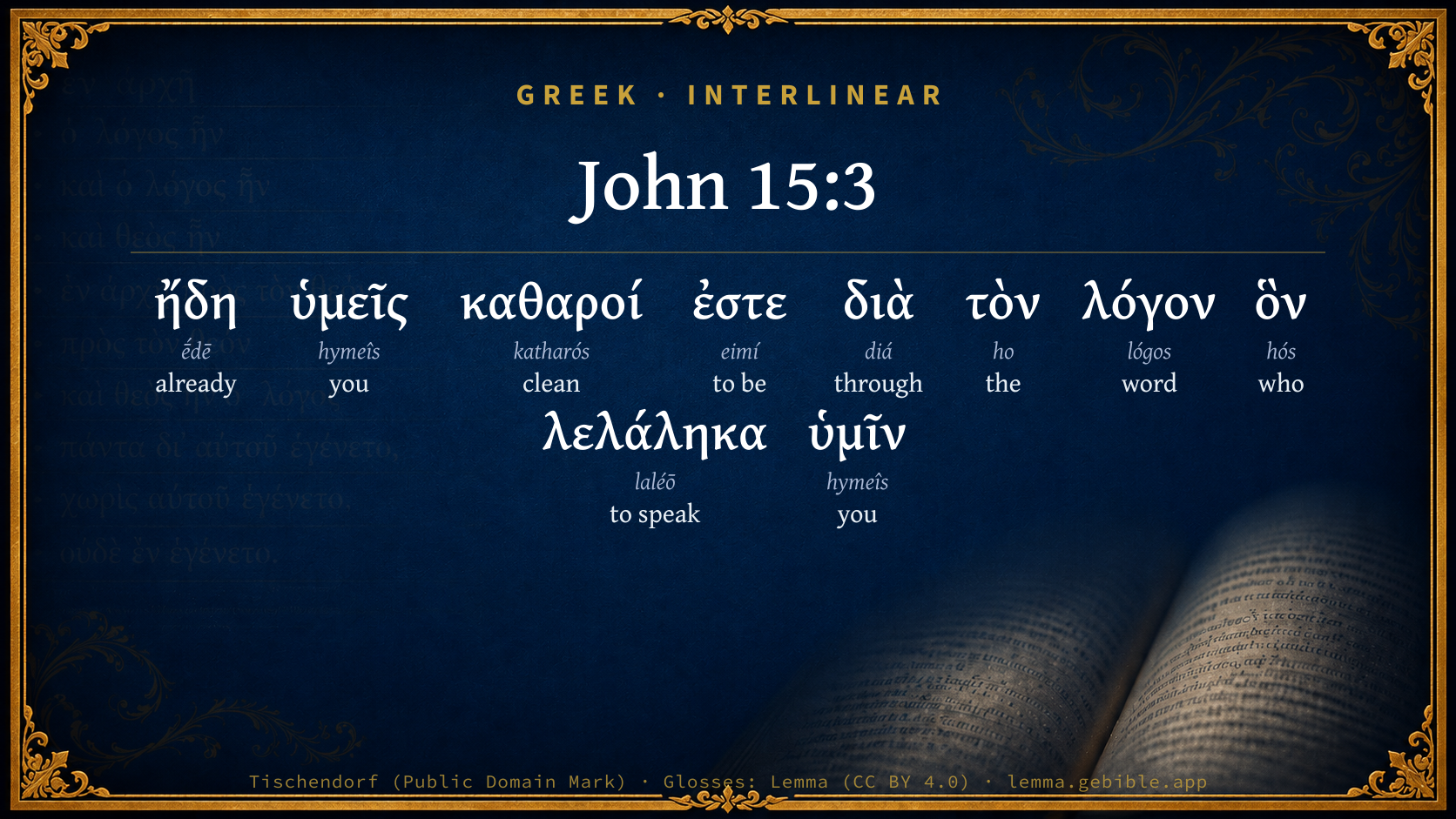
Greek (Tischendorf 8th ed.) John 15:3 appears in the Greek New Testament. The text above is from the Tischendorf 8th edition. Each word links to its Strong’s number and a concise gloss. Click any word for its full Thayer’s Greek Lexicon entry.
Download image
Cite this verse

John 15:3 (World English Bible). Public Domain. Lemma interlinear Bible study tool, https://lemma.gebible.app/v/john/15/3.

Show BibTeX & RIS
BibTeX
RIS
English Translation
You are already pruned clean because of the word which I have spoken to you.
World English Bible · Public Domain
Download a study sheet

One document with this verse’s original text, its word-by-word gloss line, the meaning frame, cross-references with their text, attributed commentary, and full source and license credits — printable, and it pastes into notes with its structure intact.

This verse Autodidact and up

Study sheet (.html) Plain text (.txt)

A passage Seminary Student

Up to 50 verses in one chapter. A passage sheet keeps up to 6 commentary sources and 12 cross-references per verse, in the order this page ranks them, and says so on the sheet whenever that leaves anything out. Ask for a single verse and you get the Autodidact verse sheet above.

Everything on this page stays free to read, with no account — the sheet is a download of what is already on screen, not access to it.

Want to remove ads? Support Godless Engineer
Compare translations 3

The same verse in 3 English versions, stacked beneath the original-language interlinear above. Click any original word for its lexicon entry.

Each is an independent rendering of the whole verse — the interlinear is not word-aligned to these translations.

Highlighted words mark where these versions differ — a whole-verse word diff, not a word-by-word alignment.

  • World English Bible Public Domain
    You are already pruned clean because of the word which I have spoken to you.
  • King James Version Public Domain
    Now ye are clean through the word which I have spoken unto you.
  • unfoldingWord Literal Text CC BY-SA 4.0
    You are already clean through the word that I have spoken to you.

unfoldingWord Literal Text — © unfoldingWord, licensed CC BY-SA 4.0. Word-aligned USFM3 via Door43 (git.door43.org/unfoldingWord/en_ult).

Versions to compare (up to 4)

3 of 4 selected

Show all 18 translations

Every available English version of this verse, each an independent rendering of the whole verse.

  • World English Bible Public Domain
    You are already pruned clean because of the word which I have spoken to you.
  • Berean Standard Bible Public Domain
    You are already clean because of the word I have spoken to you.
  • Majority Standard Bible Public Domain
    You are already clean because of the word I have spoken to you.
  • King James Version Public Domain
    Now ye are clean through the word which I have spoken unto you.
  • American Standard Version (1901) Public Domain
    Already ye are clean because of the word which I have spoken unto you.
  • Revised Version (1885) Public Domain
    Already ye are clean because of the word which I have spoken unto you.
  • Geneva Bible (1599) Public Domain
    Nowe are ye cleane through the worde, which I haue spoken vnto you.
  • Young's Literal Translation Public Domain
    already ye are clean, because of the word that I have spoken to you;
  • Literal Standard Version CC BY-SA 4.0
    you are already clean, because of the word that I have spoken to you;
  • Unlocked Literal Bible CC BY-SA 4.0
    You are already clean because of the message that I have spoken to you.
  • unfoldingWord Literal Text CC BY-SA 4.0
    You are already clean through the word that I have spoken to you.
  • Darby Bible Public Domain
    Ye are already clean by reason of the word which I have spoken to you.
  • World Messianic Bible Public Domain
    You are already pruned clean because of the word which I have spoken to you.
  • Webster's Bible Public Domain
    Now ye are clean through the word which I have spoken to you.
  • Free Bible Version CC BY-SA 4.0
    You are already pruned and made clean through what I've told you.
  • Bible in Basic English Public Domain
    You are clean, even now, through the teaching which I have given you.
  • Text-Critical English NT CC BY 4.0
    You have already been pruned by the word I have spoken to you.
  • Tyndale New Testament (1534) Public Domain
    Now are ye cleane thorow the wordes which I have spoke vnto you.

Literal Standard Version (2020), Covenant Press — licensed CC BY-SA 4.0. Text via the HelloAO Bible API (eBible.org). Unlocked Literal Bible (unfoldingWord) — licensed CC BY-SA 4.0. Text via the HelloAO Bible API (eBible.org). unfoldingWord Literal Text — © unfoldingWord, licensed CC BY-SA 4.0. Word-aligned USFM3 via Door43 (git.door43.org/unfoldingWord/en_ult). Free Bible Version, Dr. Jonathan Gallagher — licensed CC BY-SA 4.0. Text via the HelloAO Bible API (eBible.org).

Word by word

More ways to search: Search by grammar → Find every occurrence → Compare this word →

Practice this passage: Drill this verse → Learn its vocabulary →

καθαροί
katharós
G2513
“clean”
Adjective, Nominative, Plural, Masculine
Part of Speech
Adjective
Case
Nominative
Number
Plural
Gender
Masculine
Full Thayer's Definition

Origin: of uncertain affinity

TDNT: 09:53,4

1. clean, pure a. physically 1. purified by fire 2. in a similitude, like a vine cleansed by pruning and so fitted to bear fruit b. in a levitical sense 1. clean, the use of which is not forbidden, imparts no uncleanness c. ethically 1. free from corrupt desire, from sin and guilt 2. free from every admixture of what is false, sincere genuine 3. blameless, innocent 4. unstained with the guilt of anything
  1. ἤδη ḗdē G2235 “already” Adverb
  2. ὑμεῖς hymeîs G5210 “you” Personal pronoun, 2nd person, Nominative, Plural
  3. ἐστε eimí G1510 “to be” Verb, Present, Active, Indicative, 2nd person, Plural
  4. διὰ diá G1223 “through” Preposition
  5. τὸν ho G3588 “the” Article, Accusative, Singular, Masculine
  6. λόγον lógos G3056 “word” Noun, Accusative, Singular, Masculine
  7. ὃν hós G3739 “who” Relative pronoun, Accusative, Singular, Masculine
  8. λελάληκα laléō G2980 “to speak” Verb, Perfect, Active, Indicative, 1st person, Singular
  9. ὑμῖν hymeîs G5210 “you” Personal pronoun, 2nd person, Dative, Plural

About this verse

These counts appear in no published source. They are computed here, from the morphology-tagged text and Lemma’s own curated glosses. What Lemma adds →

10
words
9
distinct lemmas
Gospels
section

Shared distinctive vocabulary

καθαροί clean G2513 occurs in 22 verses of the Greek New Testament. Also found in:

Repetition

A word recurs within this verse:

  • ὑμεῖς you G5210 ×2

Cross-references

4

Topical passages linked to John 15:3 in the Treasury of Scripture Knowledge — connected by theme and wording, ordered by reader-vote popularity; previews shown in the World English Bible.

  • John 17:17 Sanctify them in your truth. Your word is truth.
  • Ephesians 5:26 that he might sanctify it, having cleansed it by the washing of water with the word,
  • 1 Peter 1:22 Seeing you have purified your souls in your obedience to the truth through the Spirit in sincere brotherly affection, love one another from the heart fervently:
  • John 13:10 Jesus said to him, "Someone who has bathed only needs to have his feet washed, but is completely clean. You are clean, but not all of you."

Cross-references courtesy of OpenBible.info (CC BY 4.0).

Commentary

Notes on John 15:3 from classic Christian and Jewish commentators (each source and its license shown beneath its notes). The classic Christian expositions comment on the surrounding passage and are grouped to its opening verse, so a note may address several verses; the Jewish commentaries on the Tanakh (Rashi and others) are per-verse, so they appear only where the commentator wrote on this verse.

Lemma curates 59 commentaries, every one of them public domain or Creative Commons licensed, each selected and text-cleaned for this edition rather than reprinted as found. About our sources →

The Cambridge Bible for Schools and Colleges

gen. ed. J. J. S. Perowne

3. Now ye are clean] Already are ye clean. ‘Ye’ is emphatic; many more will be made clean hereafter.

through the word] Better, on account of the word. This is a frequent error in our version, διά with the accusative being translated as if it had the genitive. Comp. Mat_15:3; Mat_15:6, where ‘by your tradition’ should be ‘for the sake of your tradition.’ ‘The word’ (Joh_16:23) here means the whole teaching of Christ, not any particular utterance; but there may be special reference to the present discourses, through which Peter, Thomas, Philip, and Judas Lebbaeus have been cleansed from self-confidence and ignorance.

The Cambridge Bible for Schools and Colleges (gen. ed. J. J. S. Perowne; Cambridge University Press, 1878–1918) — public domain. Text from a community e-Sword module.

The Biblical Illustrator

Joseph S. Exell

Joh_15:3

Now are ye clean through the Word which I have spoken unto you

Further cleansing necessary

Now are ye clean through the Word, and yet needing to be cleansed.

We have a hint here of the mystery of that double relation in which every believing man stands to God, of that double relation which is more fully and dogmatically stated in some of the Epistles; but which is yet distinctly anticipated here and at chap. 10:10. The faithful in Christ Jesus are clean, being by faith justified from all things, and having thus a standing ground before God; which yet is in some sort an ideal one--their actual state, although ever approximating to this, yet still failing to correspond to it--they therefore needing by the same faith to appropriate ever more and more of that sanctifying grace, those purifying influences, which continually stream forth from Him on all them that are His; and by aid of which He is bringing them to be all that, which for His sake His Father has been already willing to regard them, however the absolute identity of what they are and what they are counted to be, is reserved for another state of existence. (Archbishop Trench.)

The Christians present condition as compared with the past

At Munich the custom is said to prevail that every child found begging in the streets is arrested, and carried to a charitable establishment. The moment he enters, and before he is cleaned, and gets the new clothes intended for him, his portrait is painted in his ragged dress, and precisely as he was found begging. When his education is finished, this portrait is given him, and be promises by an oath to keep it all his life, that he may be reminded of the abject condition from which he has been rescued, and of the gratitude he owes the establishment which raised him from misery, and taught him how to avoid it for the future. Let the Christian often compare thus his former condition, as a sinner unsaved, with his state as a renewed believer, that his love and gratitude may be excited, and his affections drawn to Him who has wrought the change.

The Biblical Illustrator, edited by Joseph S. Exell (c. 1880s–1900s) — public domain. Text from a community e-Sword module.

Joseph Benson's Commentary

Joh 15:3-6. Now ye are clean — All of you, to whom I now speak, are made clean from the guilt and power of sin through the word which I have spoken unto you, whose sanctifying influence has operated on your hearts, and which, when applied by the Spirit, is the grand instrument of purifying the soul. Abide in me — By the continued exercise of humble faith and love, producing all holiness, by which alone you can continue to be in me; and I in you — And I will be in you by my Spirit, to nourish your piety and virtue, and supply you, as from a living root, with every necessary grace. As — In the natural world; the branch cannot bear fruit of itself — But must presently wither; except it abide in the vine — Continue in a state of union with it, and be nourished by sap from thence; no more can ye — Be able to produce the fruits of genuine and acceptable obedience; except ye abide in me — And have the life of grace maintained in you by a vital union with me. I am the vine — That is, the root and stock of the vine of which I speak; ye are only the branches — And cannot flourish or subsist, much less can you bear fruit, without me. Our Lord, in this whole passage, speaks of no branches but such as are, or, at least, were once, vitally united to him by living faith. He that abideth in me — By a real, internal, and spiritual union, begun and continued by faith; and I in him — By my word and Spirit, my truth and grace; the same bringeth forth much fruit — In holy dispositions, and righteous, benevolent actions, to the credit of his profession, the comfort of his own soul, and the edification of his fellow- creatures; for without me — Χωρις εμου, separate from me, and deprived of the influences of my word and Spirit, (alluding still to the vine and its branches;) ye can do nothing — Nothing truly and spiritually good; can bear no fruit that will be pleasing to God, or profitable to yourselves. Without the merit of Christ, we can do nothing toward our justification; and without the Spirit of Christ, nothing toward our sanctification. We have as necessary and constant a dependance upon the grace of the Mediator for the whole of the spiritual and the divine life, as we have upon the providence of the Creator for all the actions of the natural life: as to both, it is in and by the divine power that we live, and move, and have our being. If a man abide not in me — By living, loving, and obedient faith, as well as by church communion, by which last, separate from the former, he may abide in Christ all his life and be withered all the time, and cast into the fire at last; he is cast forth as a branch — He is separated from Christ, as a branch that is barren is cut off from the tree which it only encumbered; and is withered — They that abide not in Christ by a real and vital union, though they may flourish a while in a creditable and plausible profession, yet in a little time they wither and come to nothing. Their abilities and gifts wither, their zeal and devotion wither; as do also their credit and reputation, their hopes and comforts. For they that bear no fruit will soon bear no leaves. How soon was the fig-tree withered away which Christ cursed! And men gather them and cast them into the fire, &c. — The loppings of the vines, in those countries where they are cultivated, are carefully gathered up, and make a considerable part of their fuel; as if he had said, As men gather up withered branches, which have been cut off from the tree on which they once grew, and throw them into the fire, where they are burned as a worthless kind of wood, fit for nothing but fuel; so, in like manner, such will be the end of those unhappy creatures. Satan’s agents and emissaries will insnare and make an easy prey of them; for they that fall off from Christ soon fall in with sinners, are associated with them, and employed in the unfruitful works of darkness; so that they become fit fuel for the divine wrath, from which the profession they formerly made will not preserve them. And they are burned — This follows of course; but it is here added very emphatically, and makes the threatening very terrible. The original expression, και καιεται, is literally, and they are burning; for they will not be consumed in a moment, like thorns under a pot; but burning for ever in a fire, which not only cannot be quenched, but will never spend itself. Such, reader, is the consequence of apostatizing from Christ, or ceasing to live by faith in him; they draw back unto perdition, Heb 10:38-39. Some interpret men’s gathering them, of the ministry of angels in the last day, when they shall gather out of Christ’s kingdom all things that offend, and them which do iniquity, and shall cast them into a furnace of fire, as tares are gathered and bound in bundles to be burned.

Joseph Benson's Commentary on the Old and New Testaments (1811–1818) — public domain. Text from a community e-Sword module.

Bengel's Gnomon

Johann Albrecht Bengel

Joh 15:3. Καθαροὶ) This word is taken from καθαίρω, in Joh 15:2.—λόγον) the word, which is most ‘clean’ (pure, καθαρός). The Word is in itself altogether clean or pure: owing to this it imparts cleanness (purity), or holiness, to the disciples. Comp. the use of διὰ (σπλάγχνα ἐλέους Θεοῦ ἡμῶν, ‘through,’ i.e. “owing to the tender mercy of our God”), Luk 1:78.

Bengel's Gnomon of the New Testament — English translation (T&T Clark, Edinburgh, 1860) — public domain. Text from a community e-Sword module.

Meyer's Critical & Exegetical Commentary

Heinrich August Wilhelm Meyer

Joh_15:3. Application of the second half of Joh_15:2 to the disciples, in so far as they belong to the κλήματα; as a preparation for the exhortation in Joh_15:4. Already are ye clean (such purified κλήματα); already there has taken place in your case, that which I have just said. The ἤδη ὑμεῖς glances at the multitude of those who were yet to become καθαροί in the future. That their purity originally is intended, not excluding the necessary continuance and practical further development of the relation (comp. Joh_13:10), is understood as a matter of course, and see Joh_15:4. The mundi cease not to be mundandi.

διὰ τ. λόγον] διά, as Joh_6:57 of the ground; hence: on account of the word, i.e. because the word (provided it be received and apprehended in faith, Luther, comp. Act_15:9) is the power of God (Rom_1:16), in virtue of which it effects its καθαίρει, Joh_15:2; Jam_1:18; 1Pe_1:23. Comp. Fritzsche, ad Rom. II. p. 162, I. p. 197; Nägelsbach, z. Ilias, p. 39 f., ed. 3. The word, however, is the whole word, the entire doctrine which Jesus has delivered to them (comp. on Joh_8:43), not the utterance in Joh_13:10 (Hilgenfeld, Ebrard).

Meyer — Critical and Exegetical Commentary on the New Testament — English translation by Peter Christie, edited by Frederick Crombie (T&T Clark, 1880) — public domain. Text from a community e-Sword module.

Expositor's Greek Testament

ed. W. Robertson Nicoll

Joh 15:3 . ἤδη ὑμεῖς καθαροί ἐστε : “Already ye are clean”. καθαροί here means “in a condition fit to bear fruit”; in Joh 13:10-11 , it is suggested by the feet-washing, and means “free from inward stain”. It is similarly used even in classical writers. διὰ τὸν λόγον ὃν λελάληκα ὑμῖν , “on account of the word which I have spoken unto you”. For διά in this sense as indicating the source, see Joh 6:67 . The word which Jesus had spoken to them, i.e. , the whole revelation He had made, had brought spiritual life, and, therefore, cleansing. But this condition they must strive to maintain, μείνατε ἐν ἐμοί , κἀγω ἐν ὑμῖν . μενῶ must be understood after κἀγω . Maintain your belief in me, your attachment to me, your derivation of hope, aim, and motive from me: and I will abide in you, filling you with all the life you need to represent me on earth. All the divine energy you know to be in me will now pass through you.

The Expositor's Greek Testament, edited by W. Robertson Nicoll (1897–1910) — public domain. Text from a community e-Sword module.

Cambridge Greek Testament for Schools and Colleges

3. ἤδη ὑμεῖς κ. Already are ye clean because of the word. Distinguish διά with the accusative from διά with the genitive. A.V. confounds the two here and Mat 15:3; Mat 15:6. Ὁ λόγος is the whole teaching of Christ, not any particular discourse (Joh 14:23). Ἤδη assures the disciples that the chief part of their cleansing is accomplished: in the language of Joh 13:10, they are λελουμένοι. Ὑμεῖς is emphatic: many more will become καθαροί hereafter.

Cambridge Greek Testament for Schools and Colleges (Cambridge University Press, 1896; 21 vols, various authors incl. Carr, Maclear, Plummer, Farrar, Lumby, Moule, M. R. James, Simcox) — public domain. Text from a community e-Sword module.

Jamieson, Fausset & Brown

Robert Jamieson, A. R. Fausset & David Brown

Now--rather, "Already."

ye are clean through--by reason of.

the word I have spoken to you--already in a purified, fruitful condition, in consequence of the long action upon them of that searching "word" which was "as a refiner's fire" (Mal 3:2-3).

Jamieson, Fausset & Brown — Commentary Critical and Explanatory on the Whole Bible (1871) — public domain (CC PDM 1.0). Text via the HelloAO Bible API.

Adam Clarke's Commentary

Verse 3. Now ye are clean] καθαροι εστε, Ye are pruned. As our Lord has not changed the metaphor, it would be wrong to change the expression.

Through the word] δια τον λογος, Through that word-that doctrine of holiness which I have incessantly preached unto you, and which ye have received. Perhaps our Lord more immediately refers here to the words which he had spoken concerning Judas, Joh 13:21-30, in consequence of which Judas went out and finished his bargain with the chief priests; he being gone off, the body of the apostles vas purified; and thus he might say, Now ye are clean through the word which I have spoken unto you.

Adam Clarke's Commentary on the Bible (1810–1826) — public domain. Text from a community e-Sword/MySword module.

John Calvin's Commentaries

3. You are already clean, on account of the word. He reminds them that they have already experienced in themselves what he had said; that they have been planted in him, and have also been cleansed or pruned He points out the means of pruning, namely, doctrine; and there can be no doubt that he speaks of outward preaching, for he expressly mentions the word, which they had heard from his mouth. Not that the word proceeding from the mouth of a man has so great efficacy, but, so far as Christ works in the heart by the Spirit, the word itself is the instrument of cleansing Yet Christ does not mean that the apostles are pure from all sin, but he holds out to them their experience, that they may learn from it that the continuance of grace is absolutely necessary. Besides, he commends to them the doctrine of the gospel from the fruit which it produces, that they may be more powerfully excited to meditate on it continually, since it resembles the vine-dresser’s knife to take away what is useless.

John Calvin's Commentaries (1540-1563) — public domain. Text from the Calvin Translation Society English edition (1840s-50s) via the Christian Classics Ethereal Library (ccel.org). Calvin's coverage is partial (roughly two-thirds of the Bible); uncommented books and verses are honest gaps, never fabricated. The 19th-century editor's footnotes and remarks are omitted so the notes are faithfully Calvin's own voice.

Ellicott's Commentary for English Readers

(3) Now ye are clean.—Better, Already are ye clean. The pronoun is emphatic. “Already are ye, as distinct from others who will become clean in the future.” (Comp. Note on Joh_13:10.)

Through the word which I have spoken unto you.—Better, on account of the word which I have spoken unto you. The word was the revelation of God to them, and by reason of its moral power they had been cleansed. We are not to limit the reference to Joh_13:10, but are to understand it of our Lord’s whole teaching. (See Joh_5:24; Joh_8:31-32; Joh_12:48; Joh_17:10; and comp. Note on Eph_5:26.)

A Bible Commentary for English Readers, edited by Charles John Ellicott (1878–1897) — public domain. Text from a community e-Sword module.

John Gill's Exposition

Now ye are clean through the word which I have spoken unto you. These words being inserted in the discourse concerning the vine and branches, and the pruning and purging them to make them fruitful, are thought, by the learned Dr. Lightfoot, to be an allusion to the law in Lev 19:23; by which the fruit of trees, for the first three years, were accounted uncircumcised or unclean, and in the fourth year fit for use; concerning which the Talmudists have a whole tract, called "Orla"; the apostles having enjoyed the ministry of Christ, and been his disciples about such a time. Though the "now" seems to refer to the removal and taking away of that withered and unfruitful branch, Judas. Christ, in Joh 13:10, had told his disciples, that they "were clean, but not all", because the betrayer was among them; but he being discovered by Christ, and ordered by him to be gone, went out from among them about his wicked design; and now Christ could say of them all, that they were clean: which may be understood of their regeneration and sanctification, in which their hearts were sprinkled with clean water; were washed with the washing of regeneration; had their hearts purified by faith in the blood of Christ, and had pure principles of grace formed in their souls; of all which the Gospel of Christ was the instrumental means: or of their justification by the righteousness of Christ, by which they were justified from all sin; and were all fair, and without spot; which was through the Gospel of Christ revealing his righteousness to them, or through the sentence of justification he, by his Spirit, passed upon their consciences.

, had told his disciples, that they "were clean, but not all", because the betrayer was among them; but he being discovered by Christ, and ordered by him to be gone, went out from among them about his wicked design; and now Christ could say of them all, that they were clean: which may be understood of their regeneration and sanctification, in which their hearts were sprinkled with clean water; were washed with the washing of regeneration; had their hearts purified by faith in the blood of Christ, and had pure principles of grace formed in their souls; of all which the Gospel of Christ was the instrumental means: or of their justification by the righteousness of Christ, by which they were justified from all sin; and were all fair, and without spot; which was through the Gospel of Christ revealing his righteousness to them, or through the sentence of justification he, by his Spirit, passed upon their consciences.

John 15:4

joh 15:4

joh 15:4

joh 15:4Abide in me, and I in you,.... The former of these is an exhortation to continue in the exercise of faith and love upon Christ, holding to him the head, cleaving to him with full purpose of heart, and so deriving life, grace, strength, and nourishment from him; the latter is a promise encouraging to the former; for as Christ is formed in the hearts of his people, he continues there as the living principle of all grace. And so,

as the branch cannot bear fruit of itself, except it abide in the vine, no more can ye, except ye abide in me; which strongly expresses the necessity of abiding in Christ by fresh repeated acts of faith: and it is easy to observe, that when believers depart from Christ, though it be but partially, and for a time, for they cannot finally and totally depart from him, in what a poor, withered, fruitless condition they are, both in their frames and duties.

John Gill's Exposition of the Whole Bible (1746–1763) — public domain (CC PDM 1.0). Text via the HelloAO Bible API.

Trapp's Complete Commentary

John Trapp

3 Now ye are clean through the word which I have spoken unto you.

Ver. 3. Through the word, &c.] Which is the pruning knife, to lop off our luxuriances, rotten boughs, raw grapes, to pare off our gum of pride, moss of formality, Vinitoris cultellus ad sordes purgandas. (Col.) The word hid in the heart keeps from sin, as an amulet, Psa 119:11, and keeps youth from uncleanness, Joh 15:9; mixed with faith, it purgeth upon corruption, Act 15:9, and will not suffer men to rest in sin.

John Trapp, A Commentary or Exposition upon All the Books of the Old and New Testament (1647–1656) — public domain. Text from a community e-Sword module.

Albert Barnes' Notes on the Bible

Now ye are clean - Still keeping up the figure καθαροί katharoi. It does not mean that they were perfect, but that they had been under a process of purifying by his instructions all the time he had been with them. He had removed their erroneous notions of the Messiah; he had gradually reclaimed them from their fond and foolish views respecting earthly honors; he had taught them to be willing to forsake all things; and he had so trained and disciplined them that immediately after his death they would be ready to go and bear fruit among all nations to the honor of his name. In addition to this, Judas had been removed from their number, and they were now all true followers of the Saviour. See the notes at Joh 13:10.

Through the word - By means of the teachings of Jesus while he had been with them.

Albert Barnes' Notes on the Bible (1834–1885) — public domain. Text from a community e-Sword/MySword module.

Haydock's Catholic Bible Commentary

See John xiii. 10.

George Leo Haydock (1774–1849), Haydock's Catholic Family Bible and Commentary, 1859 edition — public domain. Excludes Psalms (Douay-Rheims chapter numbering differs from Protestant) and Deuterocanonical books (Catholic canon only).

Matthew Poole's English Annotations

Now that the traitor is gone out from you, ye are all clean; not by any works which you do, much less upon the account of any legal and ceremonial rites and purifyings; but through my word, your believing and obeying, Eph 5:26; 1Pe 1:22. Our cleansing is in holy writ attributed sometimes to the blood of Christ, sometimes to the Spirit, sometimes to the word. By the blood of Christ we are made clean as to justification, washed; but yet we had need wash our feet, contracting soil every day in a sinful world, from which we are cleansed by the purifying virtue of the Holy Spirit, working by and together with the word, which purgeth us of our dross, and maketh us obedient to the will of God.

Matthew Poole's English Annotations on the Holy Bible (1683–1685) — public domain. Text from a community e-Sword/MySword module.

Whedon's Commentary on the Bible

Daniel D. Whedon

3. Ye are clean—His apostles were cleansed, though imperfectly cleansed. Hence it is to them as true branches, as really in Christ, that all these warnings against final defection are addressed.

Through the word—They were cleansed not so much by the power of the Spirit, as by the power of Jesus’s word; that is, by the impressive teaching he had imparted, affecting their heart and controlling their life.

Daniel D. Whedon (gen. ed.), Commentary on the Old and New Testaments (1874–1909) — public domain. Text from a community e-Sword module.

The Pulpit Commentary

Now ye are clean pruned, purged, cleansed, of the Divine Ownerby reason of the word (logon) which I have spoken to you. The Father has been operating this cleansing process upon you by the whole of the rhmata (see Ver. 7), which are gathered together into one mighty, quick, and active Loges. As we find in Heb_4:12, the Word is sharper than a two-edged sword, and capable of dealing summarily with "thoughts and intents of the heart." Augustine, on this passage, admits that it is the Loges which gives all its value to the water of baptism. "This purifying, sanctifying process has been performed upon you," says Christ. Then since "he who sanctifieth, and they who are sanctified, are all of one," this continuance remains as the gracious possibility. The vital sap proceeds from Christ alone, and not from our corrupted nature, which must be grafted into his life and become part of him. Many may seem to be a part of Christ, to be sacramentally or outwardly united to him, and even to be drawing some real advantages from the contact, and yet their end is fruitlessness, rottenness, removal, fire. The branches which bear fruit never bring forth all they might produce, never realize their ideal. The pruning, cleansing process must pass over every soul, that it may more adequately fulfill its destiny. The cleansing, searching power of the Word will be freely exercised by the Divine Husbandman.

The Pulpit Commentary (1880–1919), ed. H.D.M. Spence-Jones & Joseph S. Exell — public domain. Text from a community e-Sword module.

John Wesley's Explanatory Notes

Ye are clean - All of you, to whom I now speak, are purged from the guilt and power of sin; by the word - Which, applied by the Spirit, is the grand instrument of purifying the soul.

John Wesley, Explanatory Notes Upon the Whole Bible (1754–1765) — public domain. Text via the GEBible commentary corpus.

Burkitt's Expository Notes on the New Testament

William Burkitt

Our Saviour having in the former verses distinguished his disciples into two sorts; some that were members of his body the church, and branches of him the true vine, by outward shew and visible profession only: others that are spiritually ingrafted into him, and do bring forth much fruit: now in this third verse Christ tells his disciples which number they were of: Now (saith he) ye are clean through the word which I have spoken unto you; that is, now that Judas, the traitor, that dead, rotten, fruitless branch, is cut off, and cast out, ye are all clean through the cleansing power and virtue of my word and doctrine.

Learn hence, 1. That such as are justified by the blood, and sanctified by the Spirit of Christ, are in Christ’s account clean, notwithstanding their many spots and manifold imperfections: Now are ye clean.

2. That as the blood of Christ is the meritorious, and the Spirit of Christ the efficacious, so the word of Christ is the instrumental, cause of a believer’s purification and cleansing; Now are ye clean through the word which I have spoken unto you. Abide in me, and I will abide in you; that is, abide in me, not only by an outward and visible profession, but by a real and fiducial adherence, and I will abide in you by the influences and operations of my Holy Spirit. The union and conjunction between Christ and his members is mutual; they abide in him by faith and dependance, and he abideth in them by the indwelling presence of his grace and spirit: Abide in me, and I will abide in you.

Observe farther, The reason which Christ gives why they should thus abide in him; because without union with him , without interest in him, without influences of grace derived from him, they could bring forth no fruit for him, nor do any thing that is truly acceptable and well-pleasing to him: As the branch cannot bear fruit of itself, except it abide in the vine, no more can ye, except ye abide in me, for without me ye can do nothing: That is, "As branches severed from the vine cannot live and bear fruit, so neither can Christians, separated from Christ, and without deriving virtue from him, do any thing spiritually good and well-pleasing in the sight of God."

Learn hence, That not only unregenerate men do labour under an impotency to that which is spiritually good, but even disciples themselves, wihtout daily dependance upon Christ, and without constant communications of grace from him, can do nothing in a lively and acceptable way and manner unto him: Without me ye can do nothing; you that are branches of me the true vine.

As Christians, without me, that is, without my Spirit, abiding in you, and uniting to me your head, you can do nothing acceptable, to me, or worthy of my gospel. Again: as apostles, it may denote, that without the gifts and powerful assistance of the Holy Spirit, they could do nothing to convert the world to Christianity: in both respects might Christ truly say, Without me ye can do nothing.

William Burkitt's Expository Notes on the New Testament (1700–1703) — public domain. Text from a community e-Sword module.

The People's New Testament

B. W. Johnson

3. Now ye are clean through the word which I have spoken unto you. The spoken word is the instrument appointed by God for the cleansing of the soul. The word tells us what to do in order that we may be cleansed from sin.

B. W. Johnson's The People's New Testament with Notes (1889–1891) — public domain. Electronic text from the Christian Classics Ethereal Library (CCEL) ThML edition.

unfoldingWord translationNotes

Door43 World Missions Community

You are already clean because of the message that I have spoken to you

The implied metaphor here is the "clean branches" that have already been "pruned." AT: "It is as if you have already been pruned and are clean branches because you have obeyed what I have taught you" (See: Metaphor)

you

The word "you" throughout this passage is plural and refers to the disciples of Jesus. (See: Forms of You)

Remain in me, and I in you

"If you remain joined to me, I will remain joined to you" or "Remain joined to me, and I will remain joined to you"

unless you remain in me

By remaining in Christ, those who belong to him depend on him for everything. AT: "unless you stay joined to me and depend upon me for everything"

translationWords

vine

fruit

unfoldingWord translationNotes — © Distant Shores Media and the Door43 World Missions Community, licensed CC BY-SA 4.0. Source: git.door43.org/Door43/en_tn.

Alford’s Greek Testament

Henry Alford

3. καθαροί] See ch. 13:10. In Eph 5:26, we have both the washing διὰ τὸν λόγον, and the word (ἐν ῥήματι), united. The word of Christ dwelling in them by Faith (see ver. 7) is the purifying principle (ch. 17:17). But the καθαροί here is not = κεκαθαρμένοι, pruned, in the sense of ver. 2. The ἤδη limits it to their present capacities and standing. There was more pruning at hand, when the sap should begin to flow,—when the Spirit should be shed abroad; and this future handling of the γεωργός is indicated by μείνατε ἐν ἐμοί.…

Henry Alford, The Greek Testament (1849–1861) — public domain. Text from a community e-Sword module.

International Critical Commentary

3. ἤδη ὑμεῖς καθαροί ἐστε. So Jesus had said before (13:10), the primary reference then being to bodily cleanness, although with an allusion to spiritual purity as well (see note in loc.). Here, the thought is carried on from v. 2, which spoke of the cleansing of the branches by the Great Husbandman (καθαίρειν). The disciples were not useless branches, presently to be cut off; they were in the way of bearing fruit, and already they had been “cleansed” διὰ τὸν λόγον ὃν λελάληκα ὑμῖν, “by the word which I have spoken to you.”

We have seen (on 6:57) that διά followed by an acc. is to be distinguished from διά with a gen. The text here is not διὰ τοῦ λόγου, which would suggest that the Word of Jesus is the instrument of cleansing; but διὰ τὸν λόγον signifies rather that it is because of the Word abiding in them (v. 7) that they are kept pure. The λόγος which had thus, in some measure, been assimilated by them (cf. 5:38, 8:43) was the whole message that Jesus had delivered during His training of the Twelve. In so far as this continued to “abide” in them (v. 7), in that degree were they “clean.” As it abides in them, so do they abide in the True Vine (1Jn 2:24).

The cleansing τοῦ ὕδατος ἐν ῥήματι of Eph 5:26 does not constitute a true parallel to the thought here.

International Critical Commentary — older volumes (1896–1929), various authors — public domain. Text from a community e-Sword module.

Vincent's Word Studies in the New Testament

Marvin R. Vincent

Clean [καθαιρει] . Etymologically akin to kaqairei, purgeth. The Rev. indicates this by rendering kaqairei, cleanseth.

Marvin R. Vincent, Word Studies in the New Testament (1887–1900) — public domain. Text from a community e-Sword/MySword module.

Lesson kit

Teaching starters — assembled from the data on this page, not authored interpretation. Every prompt links to the verse data it draws on. Edit before teaching.

John, in the Gospels, opens this verse with 10 words (9 distinct Greek lemmas). Its most distinctive word is katharós (“clean”). A historical commentator’s framing appears above. Read the whole chapter for the surrounding context.

Discussion questions

  1. How does “clean” (katharós) shape what this verse is saying?
  2. Matthew 5:8 shares the word «clean» with this verse. How do the two illuminate each other?
  3. “you” occurs 2× in this one verse. What is the effect of the repetition?
  4. These translations render this verse differently; the difference is in the English rendering, not the original. What questions does that raise?
  5. Reading how The Cambridge Bible for Schools and Colleges and The Biblical Illustrator read this verse, where do the two commentators agree and where do they part?

Things to notice

  • These translations choose different wording for 6 words in this verse.
  • “you” occurs 2× in this single verse.
  • 9 distinct Greek lemmas span 10 words in this verse.

Reading settings

Reading text

Shown beneath each verse's original-language words.

Old Testament
Old Testament edition

Read the OT as the Masoretic Hebrew (MT) or the Greek Septuagint (LXX).

English shown for the Greek Septuagint (in the Hebrew ↔ Greek comparison).

Comparing translations? Open the Compare panel on any verse page to stack up to four side by side.