

Acts 13:25
Greek (Tischendorf 8th ed.) Acts 13:25 appears in the Greek New Testament. The text above is from the Tischendorf 8th edition. Each word links to its Strong’s number and a concise gloss. Click any word for its full Thayer’s Greek Lexicon entry.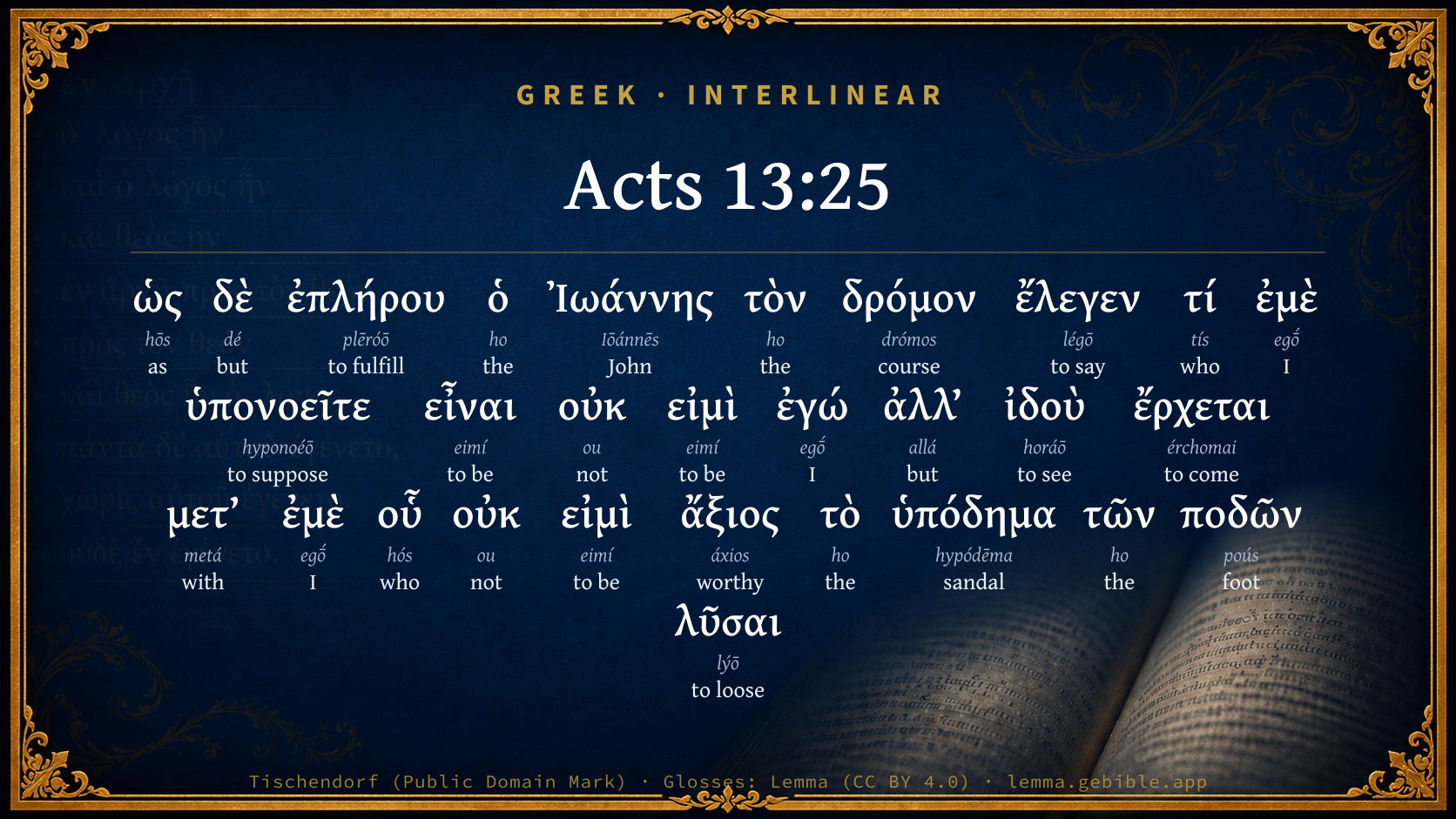
As John was fulfilling his course, he said, 'What do you suppose that I am? I am not he. But behold, one comes after me the sandals of whose feet I am not worthy to untie.'
Download a study sheet
One document with this verse’s original text, its word-by-word gloss line, the meaning frame, cross-references with their text, attributed commentary, and full source and license credits — printable, and it pastes into notes with its structure intact.
This verse Autodidact and up
A passage Seminary Student
Up to 50 verses in one chapter. A passage sheet keeps up to 6 commentary sources and 12 cross-references per verse, in the order this page ranks them, and says so on the sheet whenever that leaves anything out. Ask for a single verse and you get the Autodidact verse sheet above.
Everything on this page stays free to read, with no account — the sheet is a download of what is already on screen, not access to it.
Compare translations 3
The same verse in 3 English versions, stacked beneath the original-language interlinear above. Click any original word for its lexicon entry.
Each is an independent rendering of the whole verse — the interlinear is not word-aligned to these translations.
Highlighted words mark where these versions differ — a whole-verse word diff, not a word-by-word alignment.
-
World English Bible Public Domain
As John was fulfilling his course, he said, 'What do you suppose that I am? I am not he. But behold, one comes after me the sandals of whose feet I am not worthy to untie.'
-
King James Version Public Domain
And as John fulfilled his course, he said, Whom think ye that I am? I am not he. But, behold, there cometh one after me, whose shoes of his feet I am not worthy to loose.
-
unfoldingWord Literal Text CC BY-SA 4.0
And as John was completing course, he was saying, ‘Who do you think me to be? I am not he. But behold, one is coming after me, of whom the sandals of feet I am not worthy to untie.’
unfoldingWord Literal Text — © unfoldingWord, licensed CC BY-SA 4.0. Word-aligned USFM3 via Door43 (git.door43.org/unfoldingWord/en_ult).
Show all 19 translations
Every available English version of this verse, each an independent rendering of the whole verse.
-
World English Bible Public Domain
As John was fulfilling his course, he said, 'What do you suppose that I am? I am not he. But behold, one comes after me the sandals of whose feet I am not worthy to untie.'
-
Berean Standard Bible Public Domain
As John was completing his course, he said, ‘Who do you suppose I am? I am not that One. But He is coming after me whose sandals I am not worthy to untie.’
-
Majority Standard Bible Public Domain
As John was completing his course, he said, ‘Who do you suppose I am? I am not that One. But there is One coming after me whose sandals I am not worthy to untie.’
-
King James Version Public Domain
And as John fulfilled his course, he said, Whom think ye that I am? I am not he. But, behold, there cometh one after me, whose shoes of his feet I am not worthy to loose.
-
American Standard Version (1901) Public Domain
And as John was fulfilling his course, he said, What suppose ye that I am? I am not `he'. But behold, there cometh one after me the shoes of whose feet I am not worthy to unloose.
-
Revised Version (1885) Public Domain
And as John was fulfilling his course, he said, What suppose ye that I am? I am not he. But behold, there cometh one after me, the shoes of whose feet I am not worthy to unloose.
-
Geneva Bible (1599) Public Domain
And when Iohn had fulfilled his course, he saide, Whom ye thinke that I am, I am not he: but beholde, there commeth one after me, whose shooe of his feete I am not worthy to loose.
-
Douay-Rheims (1899) Public Domain
And when John was fulfilling his course, he said: I am not he, whom you think me to be: but behold, there cometh one after me, whose shoes of his feet I am not worthy to loose.
-
Young's Literal Translation Public Domain
and as John was fulfilling the course, he said, Whom me do ye suppose to be? I am not `he', but, lo, he doth come after me, of whom I am not worthy to loose the sandal of `his' feet.
-
Literal Standard Version CC BY-SA 4.0
and as John was fulfilling the course, he said, Whom do you suppose I am? I am not [He], but behold, He comes after me, of whom I am not worthy to loose the sandal of [His] feet.
-
Unlocked Literal Bible CC BY-SA 4.0
As John was finishing his work, he said, 'Who do you think I am? I am not the one. But listen, one is coming after me, the shoes of whose feet I am not worthy to untie.'
-
unfoldingWord Literal Text CC BY-SA 4.0
And as John was completing course, he was saying, ‘Who do you think me to be? I am not he. But behold, one is coming after me, of whom the sandals of feet I am not worthy to untie.’
-
Darby Bible Public Domain
And as John was fulfilling his course he said, Whom do ye suppose that I am? *I* am not [he]. But behold, there comes one after me, the sandal of whose feet I am not worthy to loose.
-
World Messianic Bible Public Domain
As Yochanan was fulfilling his course, he said, ‘What do you suppose that I am? I am not he. But behold, one comes after me, the sandals of whose feet I am not worthy to untie.’
-
Webster's Bible Public Domain
And as John fulfilled his course, he said, Whom think ye that I am? I am not he. But behold, there cometh one after me, whose shoes of his feet I am not worthy to loose.
-
Free Bible Version CC BY-SA 4.0
As John was completing his mission, he said, ‘Who do you think I am? I am not the one you're looking for. But after me one is coming whose sandals I'm not worthy to untie.’
-
Bible in Basic English Public Domain
And when John was completing his work, he said, What do I seem to you to be? I am not he; but one is coming after me, whose shoes I am not good enough to undo.
-
Text-Critical English NT CC BY 4.0
Now as John was completing his course, he said, ‘ Who do you suppose that I am? I am not he. But behold, one is coming after me, the sandals of whose feet I am not worthy to untie.’
-
Tyndale New Testament (1534) Public Domain
And when Iohn had fulfylled his course he sayde: whome ye thinke that I am the same am I not. But beholde ther cometh one after me whose shewes of his fete I am not worthy to lowse.
Literal Standard Version (2020), Covenant Press — licensed CC BY-SA 4.0. Text via the HelloAO Bible API (eBible.org). Unlocked Literal Bible (unfoldingWord) — licensed CC BY-SA 4.0. Text via the HelloAO Bible API (eBible.org). unfoldingWord Literal Text — © unfoldingWord, licensed CC BY-SA 4.0. Word-aligned USFM3 via Door43 (git.door43.org/unfoldingWord/en_ult). Free Bible Version, Dr. Jonathan Gallagher — licensed CC BY-SA 4.0. Text via the HelloAO Bible API (eBible.org).
Word by word
More ways to search: Search by grammar → Find every occurrence → Compare this word →
Practice this passage: Drill this verse → Learn its vocabulary →
- Appears 3× in the Greek New Testament
- First appears here
- Part of Speech
- Noun
- Case
- Accusative
- Number
- Singular
- Gender
- Masculine
Full Thayer's Definition
- ὡς hōs G5613 “as” Adverb
- δὲ dé G1161 “but” Conjunction
- ἐπλήρου plēróō G4137 “to fulfill” Verb, Imperfect, Active, Indicative, 3rd person, Singular
- ὁ ho G3588 “the” Article, Nominative, Singular, Masculine
- Ἰωάννης Iōánnēs G2491 “John” Noun, Nominative, Singular, Masculine
- τὸν ho G3588 “the” Article, Accusative, Singular, Masculine
- δρόμον drómos G1408 “course” Noun, Accusative, Singular, Masculine
- ἔλεγεν légō G3004 “to say” Verb, Imperfect, Active, Indicative, 3rd person, Singular
- τί tís G5101 “who” Interrogative pronoun, Accusative, Singular, Neuter
- ἐμὲ egṓ G1473 “I” Personal pronoun, 1st person, Accusative, Singular
- ὑπονοεῖτε hyponoéō G5282 “to suppose” Verb, Present, Active, Indicative, 2nd person, Plural
- εἶναι eimí G1510 “to be” Verb, Present, Active, Infinitive
- οὐκ ou G3756 “not” Particle, Negative
- εἰμὶ eimí G1510 “to be” Verb, Present, Active, Indicative, 1st person, Singular
- ἐγώ egṓ G1473 “I” Personal pronoun, 1st person, Nominative, Singular
- ἀλλ’ allá G235 “but” Conjunction
- ἰδοὺ horáō G3708 “to see” Verb, Aorist, Middle, Imperative, 2nd person, Singular
- ἔρχεται érchomai G2064 “to come” Verb, Present, Middle or Passive deponent, Indicative, 3rd person, Singular
- μετ’ metá G3326 “with” Preposition
- ἐμὲ egṓ G1473 “I” Personal pronoun, 1st person, Accusative, Singular
- οὗ hós G3739 “who” Relative pronoun, Genitive, Singular, Masculine
- οὐκ ou G3756 “not” Particle, Negative
- εἰμὶ eimí G1510 “to be” Verb, Present, Active, Indicative, 1st person, Singular
- ἄξιος áxios G514 “worthy” Adjective, Nominative, Singular, Masculine
- τὸ ho G3588 “the” Article, Accusative, Singular, Neuter
- ὑπόδημα hypódēma G5266 “sandal” Noun, Accusative, Singular, Neuter
- τῶν ho G3588 “the” Article, Genitive, Plural, Masculine
- ποδῶν poús G4228 “foot” Noun, Genitive, Plural, Masculine
- λῦσαι lýō G3089 “to loose” Verb, Aorist, Active, Infinitive
About this verse
These counts appear in no published source. They are computed here, from the morphology-tagged text and Lemma’s own curated glosses. What Lemma adds →
- 29
- words
- 21
- distinct lemmas
- Acts
- section
Notable vocabulary
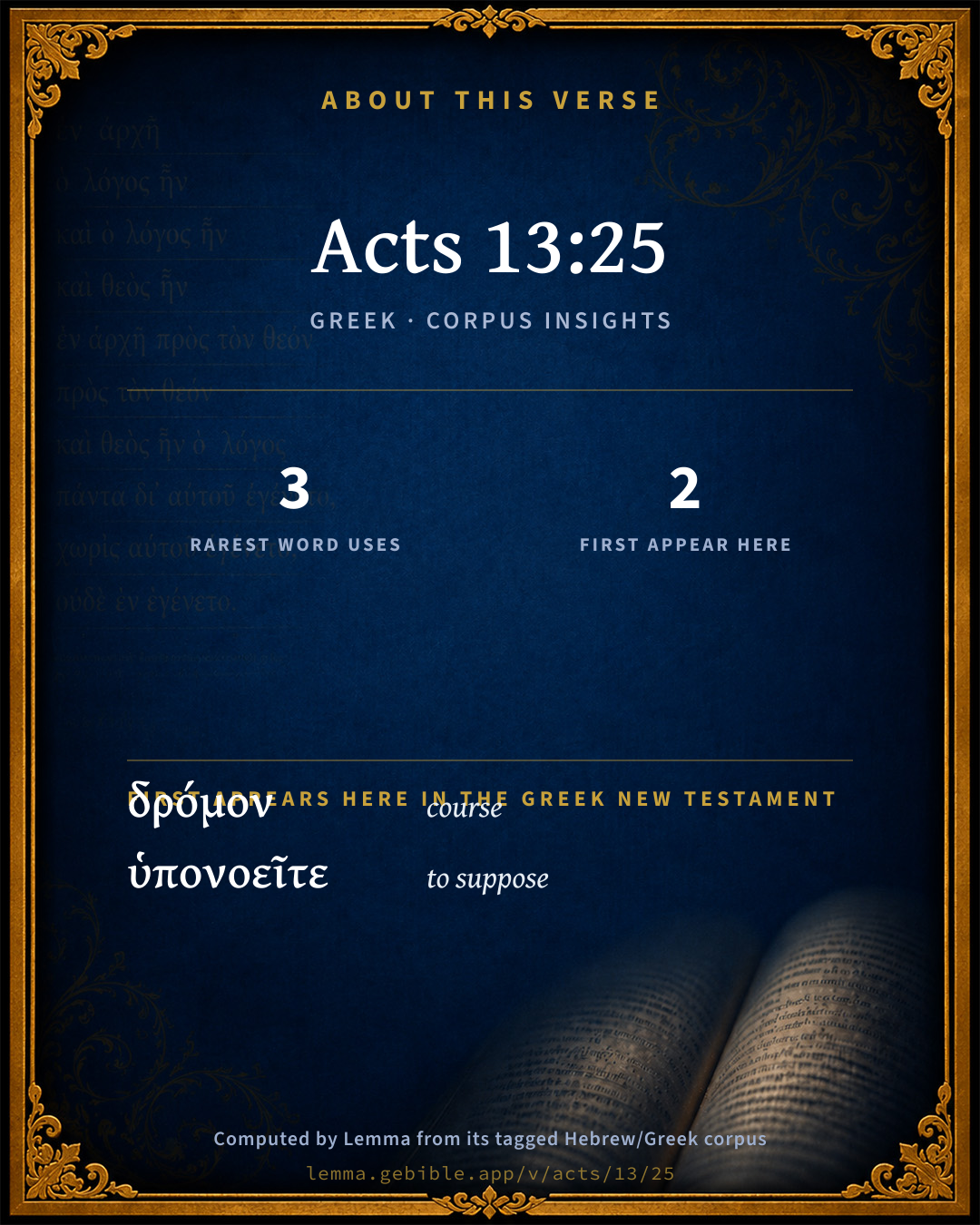
The rarest word here is δρόμον course G1408 — appearing just 3 times in the whole Greek New Testament.
First appearance in Scripture
These words make their first canonical appearance in the Greek New Testament here:
Shared distinctive vocabulary
δρόμον course G1408 occurs in 3 verses of the Greek New Testament. Also found in:
Cross-references
19Topical passages linked to Acts 13:25 in the Treasury of Scripture Knowledge — connected by theme and wording, ordered by reader-vote popularity; previews shown in the World English Bible.
- Matthew 3:11 I indeed baptize you in water for repentance, but he who comes after me is mightier than I, whose shoes I am not worthy to carry. He will baptize you in the Holy Spirit.
- Mark 1:7 He preached, saying, "After me comes he who is mightier than I, the thong of whose sandals I am not worthy to stoop down and loosen.
- John 1:26–27 John answered them, "I baptize in water, but among you stands one whom you don't know.
- Luke 3:15–16 As the people were in expectation, and all men reasoned in their hearts concerning John, whether perhaps he was the Christ,
- John 1:20–23 He confessed, and didn't deny, but he confessed, "I am not the Christ."
- Acts 20:24 But these things don't count; nor do I hold my life dear to myself, so that I may finish my race with joy, and the ministry which I received from the Lord Jesus, to fully testify to the Gospel of the grace of God.
- Mark 6:16–28 But Herod, when he heard this, said, "This is John, whom I beheaded. He has risen from the dead."
- John 1:29 The next day, he saw Jesus coming to him, and said, "Behold, the Lamb of God, who takes away the sin of the world!
- John 1:34 I have seen, and have testified that this is the Son of God."
- John 1:36 and he looked at Jesus as he walked, and said, "Behold, the Lamb of God!"
- John 3:27–29 John answered, "A man can receive nothing, unless it has been given him from heaven.
- John 4:34 Jesus said to them, "My food is to do the will of him who sent me, and to accomplish his work.
- John 7:18 He who speaks from himself seeks his own glory, but he who seeks the glory of him who sent him, the same is true, and no unrighteousness is in him.
- John 19:28–30 After this, Jesus, seeing that all things were now finished, that the Scripture might be fulfilled, said, "I am thirsty."
- Acts 13:36 For David, after he had in his own generation served the counsel of God, fell asleep, and was laid with his fathers, and saw decay.
- Acts 19:4 Paul said, "John indeed baptized with the baptism of repentance, saying to the people that they should believe in the one who would come after him, that is, in Jesus."
- 2 Corinthians 4:5 For we don't preach ourselves, but Christ Jesus as Lord, and ourselves as your servants for Jesus' sake;
- 2 Timothy 4:7 I have fought the good fight. I have finished the course. I have kept the faith.
- Revelation 11:7 When they have finished their testimony, the beast that comes up out of the abyss will make war with them, and overcome them, and kill them.
Cross-references courtesy of OpenBible.info (CC BY 4.0).
Lesson kit
Teaching starters — assembled from the data on this page, not authored interpretation. Every prompt links to the verse data it draws on. Edit before teaching.
Acts, in the Acts, opens this verse with 29 words (21 distinct Greek lemmas). Its most distinctive word is drómos (“course”). A historical commentator’s framing appears above. Read the whole chapter for the surrounding context.
Discussion questions
- How does “course” (drómos) shape what this verse is saying?
- 2 words here appear for the first time in Scripture. What is being introduced at this debut?
- Acts 20:24 shares the word «course» with this verse. How do the two illuminate each other?
- “to be” occurs 3× in this one verse. What is the effect of the repetition?
- These translations render this verse differently. What is at stake in choosing one wording over another?
- Reading how The Biblical Illustrator and Bengel's Gnomon read this verse, where do the two commentators agree and where do they part?
Things to notice
- 2 words make their first canonical appearance in Scripture here.
- These translations choose different wording for 21 words in this verse.
- “to be” occurs 3× in this single verse.
- 21 distinct Greek lemmas span 29 words in this verse.
Commentary
Notes on Acts 13:25 from classic Christian and Jewish commentators (each source and its license shown beneath its notes). The classic Christian expositions comment on the surrounding passage and are grouped to its opening verse, so a note may address several verses; the Jewish commentaries on the Tanakh (Rashi and others) are per-verse, so they appear only where the commentator wrote on this verse.
Lemma curates 59 commentaries, every one of them public domain or Creative Commons licensed, each selected and text-cleaned for this edition rather than reprinted as found. About our sources →
The Biblical Illustrator
Joseph S. Exell
The Biblical Illustrator, edited by Joseph S. Exell (c. 1880s–1900s) — public domain. Text from a community e-Sword module.
Bengel's Gnomon
Johann Albrecht Bengel
Bengel's Gnomon of the New Testament — English translation (T&T Clark, Edinburgh, 1860) — public domain. Text from a community e-Sword module.
Expositor's Greek Testament
ed. W. Robertson Nicoll
The Expositor's Greek Testament, edited by W. Robertson Nicoll (1897–1910) — public domain. Text from a community e-Sword module.
Adam Clarke's Commentary
Adam Clarke's Commentary on the Bible (1810–1826) — public domain. Text from a community e-Sword/MySword module.
John Calvin's Commentaries
John Calvin's Commentaries (1540-1563) — public domain. Text from the Calvin Translation Society English edition (1840s-50s) via the Christian Classics Ethereal Library (ccel.org). Calvin's coverage is partial (roughly two-thirds of the Bible); uncommented books and verses are honest gaps, never fabricated. The 19th-century editor's footnotes and remarks are omitted so the notes are faithfully Calvin's own voice.
Ellicott's Commentary for English Readers
A Bible Commentary for English Readers, edited by Charles John Ellicott (1878–1897) — public domain. Text from a community e-Sword module.
The Cambridge Bible for Schools and Colleges
gen. ed. J. J. S. Perowne
The Cambridge Bible for Schools and Colleges (gen. ed. J. J. S. Perowne; Cambridge University Press, 1878–1918) — public domain. Text from a community e-Sword module.
John Gill's Exposition
John Gill's Exposition of the Whole Bible (1746–1763) — public domain (CC PDM 1.0). Text via the HelloAO Bible API.
Trapp's Complete Commentary
John Trapp
John Trapp, A Commentary or Exposition upon All the Books of the Old and New Testament (1647–1656) — public domain. Text from a community e-Sword module.
Albert Barnes' Notes on the Bible
Albert Barnes' Notes on the Bible (1834–1885) — public domain. Text from a community e-Sword/MySword module.
Matthew Poole's English Annotations
Matthew Poole's English Annotations on the Holy Bible (1683–1685) — public domain. Text from a community e-Sword/MySword module.
Whedon's Commentary on the Bible
Daniel D. Whedon
Daniel D. Whedon (gen. ed.), Commentary on the Old and New Testaments (1874–1909) — public domain. Text from a community e-Sword module.
The Pulpit Commentary
The Pulpit Commentary (1880–1919), ed. H.D.M. Spence-Jones & Joseph S. Exell — public domain. Text from a community e-Sword module.
John Wesley's Explanatory Notes
John Wesley, Explanatory Notes Upon the Whole Bible (1754–1765) — public domain. Text via the GEBible commentary corpus.
McGarvey & Pendleton's Commentaries
J. W. McGarvey
J. W. McGarvey (with Philip Y. Pendleton), Commentaries on the New Testament (The Fourfold Gospel, 1914; Acts; and the epistles) — public domain. Text from a community e-Sword/MySword module.
Cambridge Greek Testament for Schools and Colleges
Cambridge Greek Testament for Schools and Colleges (Cambridge University Press, 1896; 21 vols, various authors incl. Carr, Maclear, Plummer, Farrar, Lumby, Moule, M. R. James, Simcox) — public domain. Text from a community e-Sword module.
Alford’s Greek Testament
Henry Alford
Henry Alford, The Greek Testament (1849–1861) — public domain. Text from a community e-Sword module.
Vincent's Word Studies in the New Testament
Marvin R. Vincent
Marvin R. Vincent, Word Studies in the New Testament (1887–1900) — public domain. Text from a community e-Sword/MySword module.