

John 13:5
Greek (Tischendorf 8th ed.) John 13:5 appears in the Greek New Testament. The text above is from the Tischendorf 8th edition. Each word links to its Strong’s number and a concise gloss. Click any word for its full Thayer’s Greek Lexicon entry.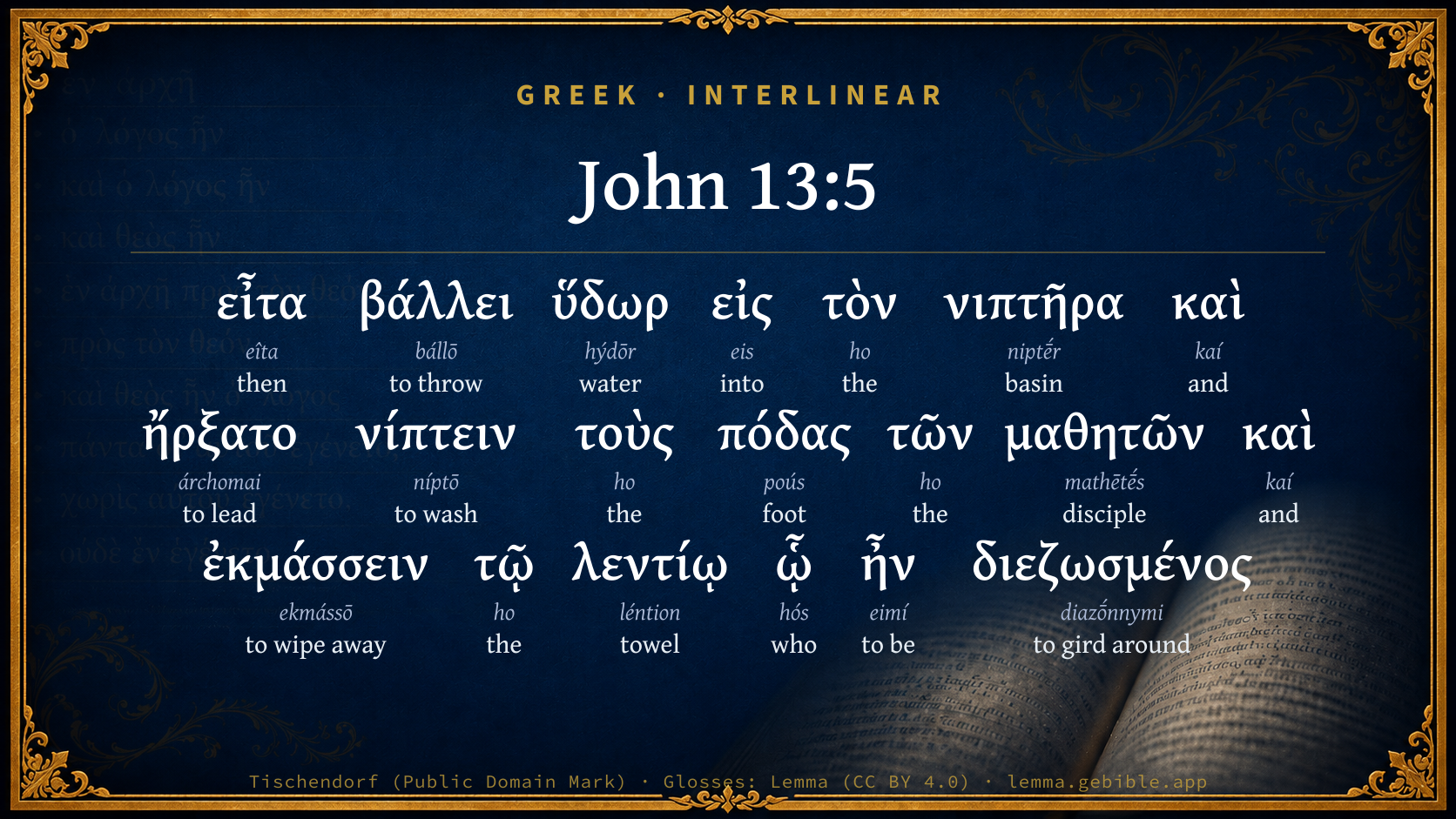
Then he poured water into the basin, and began to wash the disciples' feet, and to wipe them with the towel that was wrapped around him.
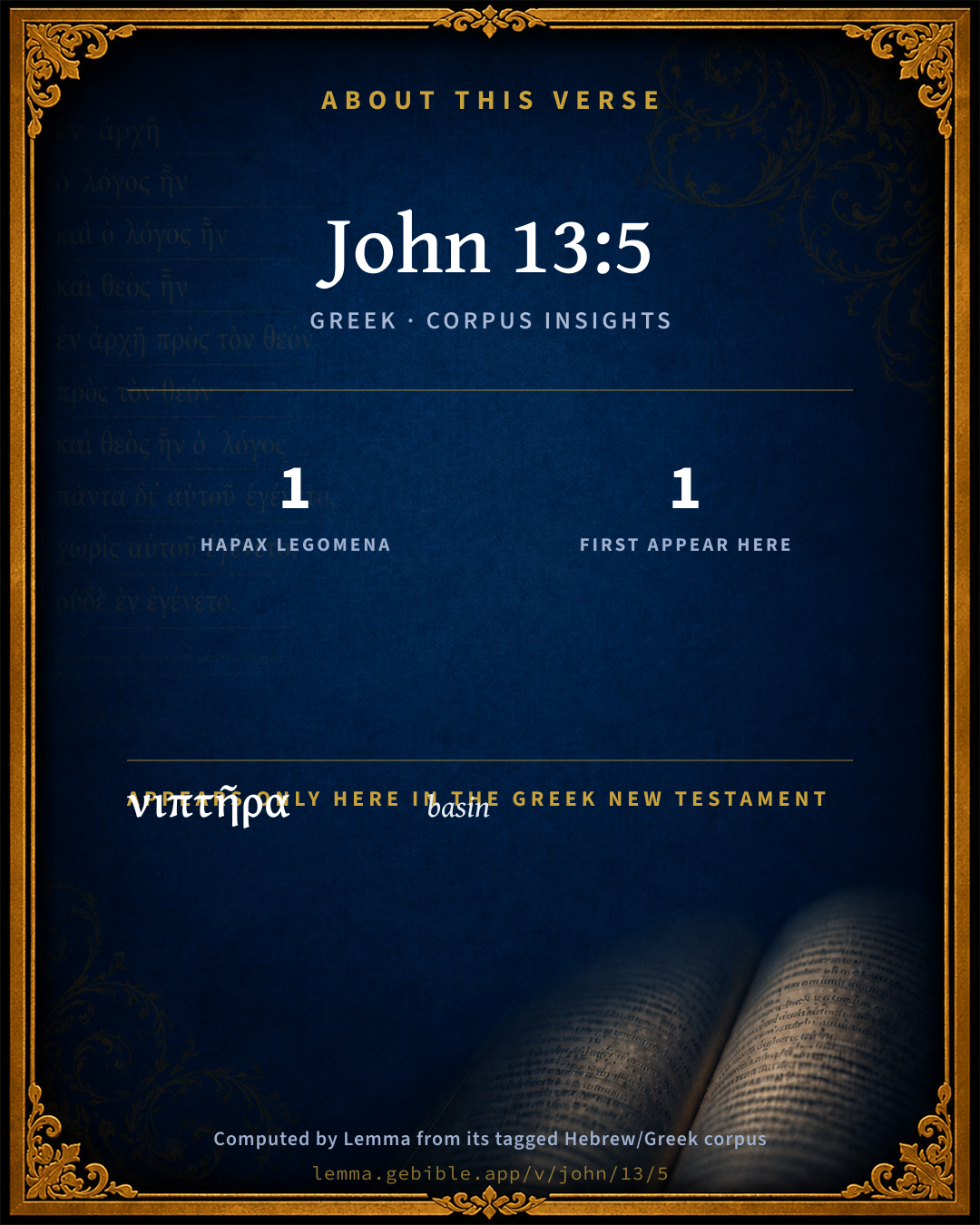
- 1 hapax legomenon — only here in the Greek New Testament
- 1 first appearance in the Greek New Testament
Download a study sheet
One document with this verse’s original text, its word-by-word gloss line, the meaning frame, cross-references with their text, attributed commentary, and full source and license credits — printable, and it pastes into notes with its structure intact.
This verse Autodidact and up
A passage Seminary Student
Up to 50 verses in one chapter. A passage sheet keeps up to 6 commentary sources and 12 cross-references per verse, in the order this page ranks them, and says so on the sheet whenever that leaves anything out. Ask for a single verse and you get the Autodidact verse sheet above.
Everything on this page stays free to read, with no account — the sheet is a download of what is already on screen, not access to it.
Compare translations 3
The same verse in 3 English versions, stacked beneath the original-language interlinear above. Click any original word for its lexicon entry.
Each is an independent rendering of the whole verse — the interlinear is not word-aligned to these translations.
Highlighted words mark where these versions differ — a whole-verse word diff, not a word-by-word alignment.
-
World English Bible Public Domain
Then he poured water into the basin, and began to wash the disciples' feet, and to wipe them with the towel that was wrapped around him.
-
King James Version Public Domain
After that he poureth water into a bason, and began to wash the disciples' feet, and to wipe them with the towel wherewith he was girded.
-
unfoldingWord Literal Text CC BY-SA 4.0
Then he pours water into a basin and began to wash the feet of the disciples and to dry them with the towel that was tied around himself.
unfoldingWord Literal Text — © unfoldingWord, licensed CC BY-SA 4.0. Word-aligned USFM3 via Door43 (git.door43.org/unfoldingWord/en_ult).
Show all 19 translations
Every available English version of this verse, each an independent rendering of the whole verse.
-
World English Bible Public Domain
Then he poured water into the basin, and began to wash the disciples' feet, and to wipe them with the towel that was wrapped around him.
-
Berean Standard Bible Public Domain
After that, He poured water into a basin and began to wash the disciples’ feet and dry them with the towel that was around Him.
-
Majority Standard Bible Public Domain
After that, He poured water into a basin and began to wash the disciples’ feet and dry them with the towel that was around Him.
-
King James Version Public Domain
After that he poureth water into a bason, and began to wash the disciples' feet, and to wipe them with the towel wherewith he was girded.
-
American Standard Version (1901) Public Domain
Then he poureth water into the basin, and began to wash the disciples' feet, and to wipe them with the towel wherewith he was girded.
-
Revised Version (1885) Public Domain
Then he poureth water into the bason, and began to wash the disciples’ feet, and to wipe them with the towel wherewith he was girded.
-
Geneva Bible (1599) Public Domain
After that, hee powred water into a basen, and began to wash the disciples feete, and to wipe them with the towell, wherewith he was girded.
-
Douay-Rheims (1899) Public Domain
After that, he putteth water into a basin, and began to wash the feet of the disciples, and to wipe them with the towel wherewith he was girded.
-
Young's Literal Translation Public Domain
afterward he putteth water into the basin, and began to wash the feet of his disciples, and to wipe with the towel with which he was being girded.
-
Literal Standard Version CC BY-SA 4.0
afterward He puts water into the basin, and began to wash the feet of His disciples, and to wipe with the towel with which He was being girded.
-
Unlocked Literal Bible CC BY-SA 4.0
Then he poured water into a basin and began to wash the feet of the disciples and dry them with the towel that he had put around himself.
-
unfoldingWord Literal Text CC BY-SA 4.0
Then he pours water into a basin and began to wash the feet of the disciples and to dry them with the towel that was tied around himself.
-
Darby Bible Public Domain
then he pours water into the washhand basin, and began to wash the feet of the disciples, and to wipe them with the linen towel with which he was girded.
-
World Messianic Bible Public Domain
Then he poured water into the basin, and began to wash the disciples’ feet and to wipe them with the towel that was wrapped around him.
-
Webster's Bible Public Domain
After that, he poured water into a basin, and began to wash the disciples feet, and to wipe them with the towel with which he was girded.
-
Free Bible Version CC BY-SA 4.0
He poured water into a basin and began to wash his disciples' feet, drying them with the towel he had wrapped around him.
-
Bible in Basic English Public Domain
Then he put water into a basin and was washing the feet of the disciples and drying them with the cloth which was round him.
-
Text-Critical English NT CC BY 4.0
After that, he put water into the washbasin and began to wash his disciples' feet and to wipe them with the towel that was wrapped around his waist.
-
Tyndale New Testament (1534) Public Domain
After that poured he water into a basyn and beganne to wash his disciples fete and to wype them with the towell wherwith he was gyrde.
Literal Standard Version (2020), Covenant Press — licensed CC BY-SA 4.0. Text via the HelloAO Bible API (eBible.org). Unlocked Literal Bible (unfoldingWord) — licensed CC BY-SA 4.0. Text via the HelloAO Bible API (eBible.org). unfoldingWord Literal Text — © unfoldingWord, licensed CC BY-SA 4.0. Word-aligned USFM3 via Door43 (git.door43.org/unfoldingWord/en_ult). Free Bible Version, Dr. Jonathan Gallagher — licensed CC BY-SA 4.0. Text via the HelloAO Bible API (eBible.org).
Word by word
More ways to search: Search by grammar → Find every occurrence → Compare this word →
Practice this passage: Drill this verse → Learn its vocabulary →
- Appears 1× in the Greek New Testament
- First appears here
- Part of Speech
- Noun
- Case
- Accusative
- Number
- Singular
- Gender
- Masculine
Full Thayer's Definition
- εἶτα eîta G1534 “then” Adverb
- βάλλει bállō G906 “to throw” Verb, Present, Active, Indicative, 3rd person, Singular
- ὕδωρ hýdōr G5204 “water” Noun, Accusative, Singular, Neuter
- εἰς eis G1519 “into” Preposition
- τὸν ho G3588 “the” Article, Accusative, Singular, Masculine
- νιπτῆρα niptḗr G3537 “basin” Noun, Accusative, Singular, Masculine
- καὶ kaí G2532 “and” Conjunction
- ἤρξατο árchomai G756 “to lead” Verb, Aorist, Middle deponent, Indicative, 3rd person, Singular
- νίπτειν níptō G3538 “to wash” Verb, Present, Active, Infinitive
- τοὺς ho G3588 “the” Article, Accusative, Plural, Masculine
- πόδας poús G4228 “foot” Noun, Accusative, Plural, Masculine
- τῶν ho G3588 “the” Article, Genitive, Plural, Masculine
- μαθητῶν mathētḗs G3101 “disciple” Noun, Genitive, Plural, Masculine
- καὶ kaí G2532 “and” Conjunction
- ἐκμάσσειν ekmássō G1591 “to wipe away” Verb, Present, Active, Infinitive
- τῷ ho G3588 “the” Article, Dative, Singular, Neuter
- λεντίῳ léntion G3012 “towel” Noun, Dative, Singular, Neuter
- ᾧ hós G3739 “who” Relative pronoun, Dative, Singular, Neuter
- ἦν eimí G1510 “to be” Verb, Imperfect, Active, Indicative, 3rd person, Singular
- διεζωσμένος diazṓnnymi G1241 “to gird around” Verb, Perfect, Passive, Participle, Nominative, Singular, Masculine
About this verse
These counts appear in no published source. They are computed here, from the morphology-tagged text and Lemma’s own curated glosses. What Lemma adds →
- 20
- words
- 16
- distinct lemmas
- Gospels
- section
Notable vocabulary
1 hapax legomenon — a word that appears only here in the entire Greek New Testament:
- νιπτῆρα basin G3537
First appearance in Scripture
This word makes its first canonical appearance in the Greek New Testament here:
- νιπτῆρα basin G3537
Shared distinctive vocabulary
λεντίῳ towel G3012 occurs in 2 verses of the Greek New Testament. Also found in:
Cross-references
27Topical passages linked to John 13:5 in the Treasury of Scripture Knowledge — connected by theme and wording, ordered by reader-vote popularity; previews shown in the World English Bible.
- Luke 7:44 Turning to the woman, he said to Simon, "Do you see this woman? I entered into your house, and you gave me no water for my feet, but she has wet my feet with her tears, and wiped them with the hair of her head.
- Psalms 51:2 Wash me thoroughly from my iniquity. Cleanse me from my sin.
- 1 Timothy 5:10 being approved by good works, if she has brought up children, if she has been hospitable to strangers, if she has washed the saints' feet, if she has relieved the afflicted, and if she has diligently followed every good work.
- Genesis 18:4 Now let a little water be fetched, wash your feet, and rest yourselves under the tree.
- Genesis 19:2 and he said, "See now, my lords, please turn aside into your servant's house, stay all night, wash your feet, and you will rise up early, and go on your way." They said, "No, but we will stay in the street all night."
- Leviticus 14:8 "He who is to be cleansed shall wash his clothes, and shave off all his hair, and bathe himself in water; and he shall be clean. After that he shall come into the camp, but shall dwell outside his tent seven days.
- 1 Samuel 25:41 She arose, and bowed herself with her face to the earth, and said, Behold, your handmaid is a servant to wash the feet of the servants of my lord.
- 2 Kings 3:11 But Jehoshaphat said, Isn't there here a prophet of Yahweh, that we may inquire of Yahweh by him? One of the king of Israel's servants answered, Elisha the son of Shaphat is here, who poured water on the hands of Elijah.
- Acts 22:16 Now why do you wait? Arise, be baptized, and wash away your sins, calling on the name of the Lord.'
- 1 Corinthians 6:11 Such were some of you, but you were washed. But you were sanctified. But you were justified in the name of the Lord Jesus, and in the Spirit of our God.
- Ephesians 5:26 that he might sanctify it, having cleansed it by the washing of water with the word,
- Titus 3:3–5 For we were also once foolish, disobedient, deceived, serving various lusts and pleasures, living in malice and envy, hateful, and hating one another.
- Hebrews 10:22 let's draw near with a true heart in fullness of faith, having our hearts sprinkled from an evil conscience, and having our body washed with pure water,
- Revelation 7:14 I told him, "My lord, you know." He said to me, "These are those who came out of the great tribulation. They washed their robes, and made them white in the Lamb's blood.
- 2 Kings 5:10–13 Elisha sent a messenger to him, saying, Go and wash in the Jordan seven times, and your flesh shall come again to you, and you shall be clean.
- Ezekiel 36:25 I will sprinkle clean water on you, and you shall be clean: from all your filthiness, and from all your idols, will I cleanse you.
- Zechariah 13:1 "In that day there will be a spring opened to the house of David and to the inhabitants of Jerusalem, for sin and for uncleanness.
- Luke 7:38 Standing behind at his feet weeping, she began to wet his feet with her tears, and she wiped them with the hair of her head, kissed his feet, and anointed them with the ointment.
- John 13:12–14 So when he had washed their feet, put his outer garment back on, and sat down again, he said to them, "Do you know what I have done to you?
- John 19:34 However one of the soldiers pierced his side with a spear, and immediately blood and water came out.
- 1 John 1:7 But if we walk in the light, as he is in the light, we have fellowship with one another, and the blood of Jesus Christ, his Son, cleanses us from all sin.
- 1 John 5:6 This is he who came by water and blood, Jesus Christ; not with the water only, but with the water and the blood. It is the Spirit who testifies, because the Spirit is the truth.
- Exodus 29:4 You shall bring Aaron and his sons to the door of the tent of meeting, and shall wash them with water.
- Isaiah 1:16 Wash yourselves, make yourself clean. Put away the evil of your doings from before my eyes; Cease to do evil.
- Revelation 1:5 and from Jesus Christ, the faithful witness, the firstborn of the dead, and the ruler of the kings of the earth. To him who loves us, and washed us from our sins by his blood;
- John 13:8 Peter said to him, "You will never wash my feet!" Jesus answered him, "If I don't wash you, you have no part with me."
- John 13:10 Jesus said to him, "Someone who has bathed only needs to have his feet washed, but is completely clean. You are clean, but not all of you."
Cross-references courtesy of OpenBible.info (CC BY 4.0).
Lesson kit
Teaching starters — assembled from the data on this page, not authored interpretation. Every prompt links to the verse data it draws on. Edit before teaching.
John, in the Gospels, opens this verse with 20 words (16 distinct Greek lemmas). Its most distinctive word is niptḗr (“basin”). A historical commentator’s framing appears above. Read the whole chapter for the surrounding context.
Discussion questions
- How does “basin” (niptḗr) shape what this verse is saying?
- This verse holds 1 word here found nowhere else in the Greek New Testament. What might the rare word draw attention to?
- The word “basin” first appears here in Scripture. What is being introduced at this debut?
- John 13:4 shares the word «towel» with this verse. How do the two illuminate each other?
- “the” occurs 4× in this one verse. What is the effect of the repetition?
- These translations render this verse differently. What is at stake in choosing one wording over another?
- Reading how Bengel's Gnomon and Expositor's Greek Testament read this verse, where do the two commentators agree and where do they part?
Things to notice
- 1 word in this verse appears nowhere else in the Greek New Testament.
- 1 word makes its first canonical appearance in Scripture here.
- These translations choose different wording for 15 words in this verse.
- “the” occurs 4× in this single verse.
- 16 distinct Greek lemmas span 20 words in this verse.
Commentary
Notes on John 13:5 from classic Christian and Jewish commentators (each source and its license shown beneath its notes). The classic Christian expositions comment on the surrounding passage and are grouped to its opening verse, so a note may address several verses; the Jewish commentaries on the Tanakh (Rashi and others) are per-verse, so they appear only where the commentator wrote on this verse.
Lemma curates 59 commentaries, every one of them public domain or Creative Commons licensed, each selected and text-cleaned for this edition rather than reprinted as found. About our sources →
Bengel's Gnomon
Johann Albrecht Bengel
Bengel's Gnomon of the New Testament — English translation (T&T Clark, Edinburgh, 1860) — public domain. Text from a community e-Sword module.
Expositor's Greek Testament
ed. W. Robertson Nicoll
The Expositor's Greek Testament, edited by W. Robertson Nicoll (1897–1910) — public domain. Text from a community e-Sword module.
Jamieson, Fausset & Brown
Robert Jamieson, A. R. Fausset & David Brown
Jamieson, Fausset & Brown — Commentary Critical and Explanatory on the Whole Bible (1871) — public domain (CC PDM 1.0). Text via the HelloAO Bible API.
Adam Clarke's Commentary
Adam Clarke's Commentary on the Bible (1810–1826) — public domain. Text from a community e-Sword/MySword module.
John Calvin's Commentaries
John Calvin's Commentaries (1540-1563) — public domain. Text from the Calvin Translation Society English edition (1840s-50s) via the Christian Classics Ethereal Library (ccel.org). Calvin's coverage is partial (roughly two-thirds of the Bible); uncommented books and verses are honest gaps, never fabricated. The 19th-century editor's footnotes and remarks are omitted so the notes are faithfully Calvin's own voice.
Ellicott's Commentary for English Readers
A Bible Commentary for English Readers, edited by Charles John Ellicott (1878–1897) — public domain. Text from a community e-Sword module.
The Cambridge Bible for Schools and Colleges
gen. ed. J. J. S. Perowne
The Cambridge Bible for Schools and Colleges (gen. ed. J. J. S. Perowne; Cambridge University Press, 1878–1918) — public domain. Text from a community e-Sword module.
John Gill's Exposition
John Gill's Exposition of the Whole Bible (1746–1763) — public domain (CC PDM 1.0). Text via the HelloAO Bible API.
Trapp's Complete Commentary
John Trapp
John Trapp, A Commentary or Exposition upon All the Books of the Old and New Testament (1647–1656) — public domain. Text from a community e-Sword module.
Albert Barnes' Notes on the Bible
Albert Barnes' Notes on the Bible (1834–1885) — public domain. Text from a community e-Sword/MySword module.
Haydock's Catholic Bible Commentary
George Leo Haydock (1774–1849), Haydock's Catholic Family Bible and Commentary, 1859 edition — public domain. Excludes Psalms (Douay-Rheims chapter numbering differs from Protestant) and Deuterocanonical books (Catholic canon only).
Matthew Poole's English Annotations
Matthew Poole's English Annotations on the Holy Bible (1683–1685) — public domain. Text from a community e-Sword/MySword module.
Whedon's Commentary on the Bible
Daniel D. Whedon
Daniel D. Whedon (gen. ed.), Commentary on the Old and New Testaments (1874–1909) — public domain. Text from a community e-Sword module.
John Wesley's Explanatory Notes
John Wesley, Explanatory Notes Upon the Whole Bible (1754–1765) — public domain. Text via the GEBible commentary corpus.
Cambridge Greek Testament for Schools and Colleges
Cambridge Greek Testament for Schools and Colleges (Cambridge University Press, 1896; 21 vols, various authors incl. Carr, Maclear, Plummer, Farrar, Lumby, Moule, M. R. James, Simcox) — public domain. Text from a community e-Sword module.
Alford’s Greek Testament
Henry Alford
Henry Alford, The Greek Testament (1849–1861) — public domain. Text from a community e-Sword module.
International Critical Commentary
International Critical Commentary — older volumes (1896–1929), various authors — public domain. Text from a community e-Sword module.
Vincent's Word Studies in the New Testament
Marvin R. Vincent
Marvin R. Vincent, Word Studies in the New Testament (1887–1900) — public domain. Text from a community e-Sword/MySword module.