Acts 15:29

Greek (Tischendorf 8th ed.) Acts 15:29 appears in the Greek New Testament. The text above is from the Tischendorf 8th edition. Each word links to its Strong’s number and a concise gloss. Click any word for its full Thayer’s Greek Lexicon entry.
Download image
Cite this verse

Acts 15:29 (World English Bible). Public Domain. Lemma interlinear Bible study tool, https://lemma.gebible.app/v/acts/15/29.

Show BibTeX & RIS
BibTeX
RIS
English Translation
that you abstain from things sacrificed to idols, from blood, from things strangled, and from sexual immorality, from which if you keep yourselves, it will be well with you. Farewell."
World English Bible · Public Domain
Highlights
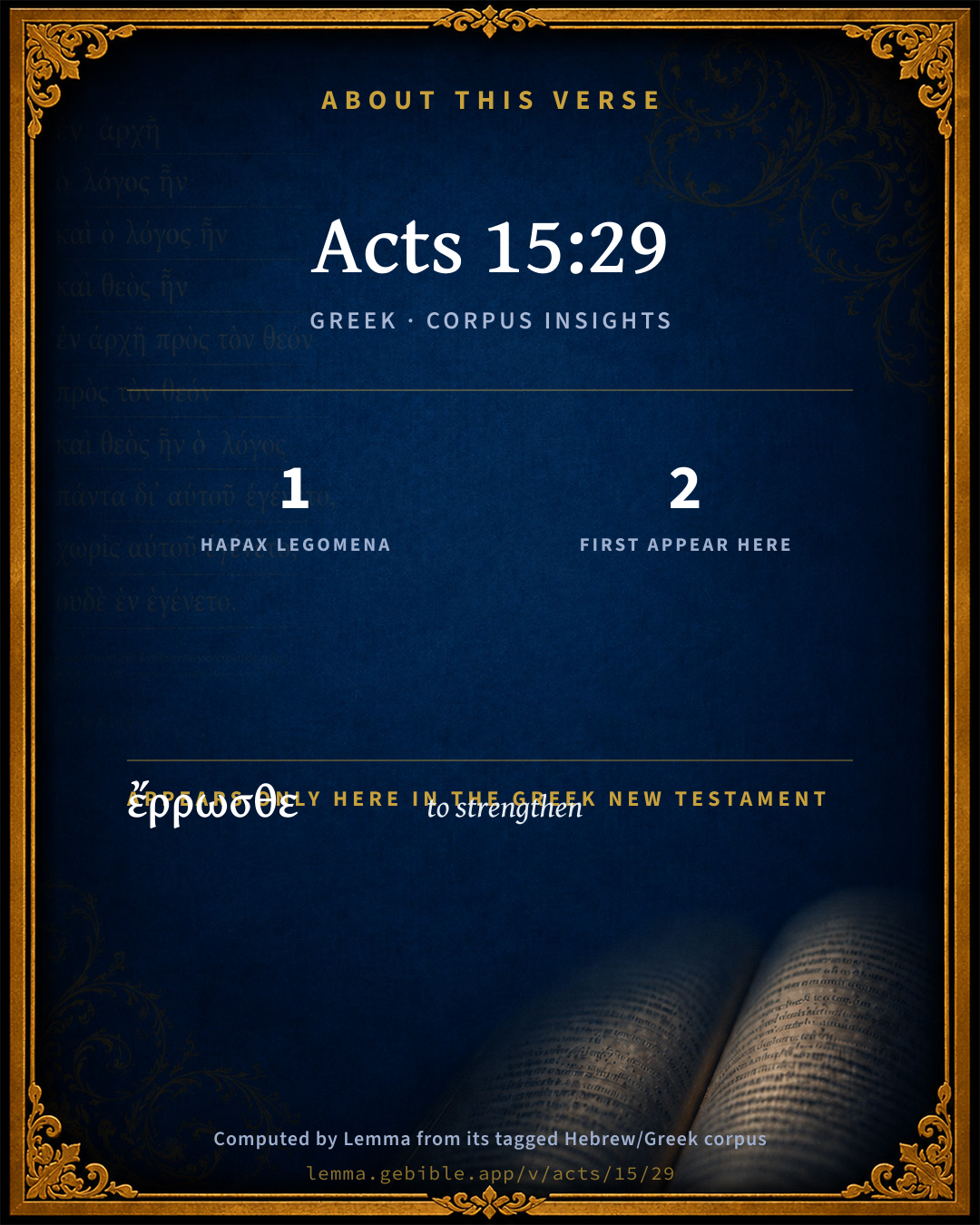
  • 1 hapax legomenon — only here in the Greek New Testament
  • 2 first appearances in the Greek New Testament
Full analysis ↓
Download a study sheet

One document with this verse’s original text, its word-by-word gloss line, the meaning frame, cross-references with their text, attributed commentary, and full source and license credits — printable, and it pastes into notes with its structure intact.

This verse Autodidact and up

Study sheet (.html) Plain text (.txt)

A passage Seminary Student

Up to 50 verses in one chapter. A passage sheet keeps up to 6 commentary sources and 12 cross-references per verse, in the order this page ranks them, and says so on the sheet whenever that leaves anything out. Ask for a single verse and you get the Autodidact verse sheet above.

Everything on this page stays free to read, with no account — the sheet is a download of what is already on screen, not access to it.

Want to remove ads? Support Godless Engineer
Compare translations 3

The same verse in 3 English versions, stacked beneath the original-language interlinear above. Click any original word for its lexicon entry.

Each is an independent rendering of the whole verse — the interlinear is not word-aligned to these translations.

Highlighted words mark where these versions differ — a whole-verse word diff, not a word-by-word alignment.

  • World English Bible Public Domain
    that you abstain from things sacrificed to idols, from blood, from things strangled, and from sexual immorality, from which if you keep yourselves, it will be well with you. Farewell."
  • King James Version Public Domain
    That ye abstain from meats offered to idols, and from blood, and from things strangled, and from fornication: from which if ye keep yourselves, ye shall do well. Fare ye well.
  • unfoldingWord Literal Text CC BY-SA 4.0
    to abstain from things sacrificed to idols and blood and the strangled and sexual immorality, from which keeping yourselves, you will do well. Farewell.”

unfoldingWord Literal Text — © unfoldingWord, licensed CC BY-SA 4.0. Word-aligned USFM3 via Door43 (git.door43.org/unfoldingWord/en_ult).

Versions to compare (up to 4)

3 of 4 selected

Show all 19 translations

Every available English version of this verse, each an independent rendering of the whole verse.

  • World English Bible Public Domain
    that you abstain from things sacrificed to idols, from blood, from things strangled, and from sexual immorality, from which if you keep yourselves, it will be well with you. Farewell."
  • Berean Standard Bible Public Domain
    You must abstain from food sacrificed to idols, from blood, from the meat of strangled animals, and from sexual immorality. You will do well to avoid these things. Farewell.
  • Majority Standard Bible Public Domain
    You must abstain from food sacrificed to idols, from blood, from the meat of strangled animals, and from sexual immorality. You will do well to avoid these things. Farewell.
  • King James Version Public Domain
    That ye abstain from meats offered to idols, and from blood, and from things strangled, and from fornication: from which if ye keep yourselves, ye shall do well. Fare ye well.
  • American Standard Version (1901) Public Domain
    that ye abstain from things sacrificed to idols, and from blood, and from things strangled, and from fornication; from which if ye keep yourselves, it shall be well with you. Fare ye well.
  • Revised Version (1885) Public Domain
    that ye abstain from things sacrificed to idols, and from blood, and from things strangled, and from fornication; from which if ye keep yourselves, it shall be well with you. Fare ye well.
  • Geneva Bible (1599) Public Domain
    That is, that ye abstaine from things offered to idoles, and blood, and that that is strangled, and from fornication: from which if ye keepe your selues, ye shall doe well. Fare ye well.
  • Douay-Rheims (1899) Public Domain
    That you abstain from things sacrificed to idols, and from blood, and from things strangled, and from fornication; from which things keeping yourselves, you shall do well. Fare ye well.
  • Young's Literal Translation Public Domain
    to abstain from things offered to idols, and blood, and a strangled thing, and whoredom; from which keeping yourselves, ye shall do well; be strong!'
  • Literal Standard Version CC BY-SA 4.0
    to abstain from things offered to idols, and blood, and a strangled thing, and whoredom; keeping yourselves from which, you will do well; be strong!”
  • Unlocked Literal Bible CC BY-SA 4.0
    that you abstain from things sacrificed to idols, blood, things strangled, and from sexual immorality. If you keep yourselves from these, it shall be well with you. Farewell.”
  • unfoldingWord Literal Text CC BY-SA 4.0
    to abstain from things sacrificed to idols and blood and the strangled and sexual immorality, from which keeping yourselves, you will do well. Farewell.”
  • Darby Bible Public Domain
    to abstain from things sacrificed to idols, and from blood, and from what is strangled, and from fornication; keeping yourselves from which ye will do well. Farewell.
  • World Messianic Bible Public Domain
    that you abstain from things sacrificed to idols, from blood, from things strangled, and from sexual immorality, from which if you keep yourselves, it will be well with you. Farewell.”
  • Webster's Bible Public Domain
    That ye abstain from things offered to idols, and from blood, and from things strangled, and from lewdness: from which if ye keep yourselves, ye will do well. Fare ye well.
  • Free Bible Version CC BY-SA 4.0
    You should avoid: anything sacrificed to idols; blood; meat from strangled animals; and sexual immorality. You will do well to observe these requirements. God bless you.”
  • Bible in Basic English Public Domain
    To keep from things offered to false gods, and from blood, and from things put to death in ways which are against the law, and from the evil desires of the body; if you keep yourselves from these, you will do well. May you be happy.
  • Text-Critical English NT CC BY 4.0
    You must abstain from what has been sacrificed to idols, from blood, from what has been strangled, and from fornication. If you keep yourselves from these things, you will do well. Farewell.”
  • Tyndale New Testament (1534) Public Domain
    that ye abstayne from thinges offered to ymages from bloud from strangled and fornicacion. From which yf ye kepe youre selves ye shall do well. So fare ye well.

Literal Standard Version (2020), Covenant Press — licensed CC BY-SA 4.0. Text via the HelloAO Bible API (eBible.org). Unlocked Literal Bible (unfoldingWord) — licensed CC BY-SA 4.0. Text via the HelloAO Bible API (eBible.org). unfoldingWord Literal Text — © unfoldingWord, licensed CC BY-SA 4.0. Word-aligned USFM3 via Door43 (git.door43.org/unfoldingWord/en_ult). Free Bible Version, Dr. Jonathan Gallagher — licensed CC BY-SA 4.0. Text via the HelloAO Bible API (eBible.org).

Word by word

More ways to search: Search by grammar → Find every occurrence → Compare this word →

Practice this passage: Drill this verse → Learn its vocabulary →

ἔρρωσθε
rhṓnnymi
G4517
“to strengthen”
Verb, Perfect, Passive, Imperative, 2nd person, Plural
Part of Speech
Verb
Tense
Perfect
Voice
Passive
Mood
Imperative
Person
2nd person
Number
Plural
Full Thayer's Definition

Origin: prolongation from rhoomai (to dart, probably akin to G4506 )

TDNT: None

1. to make strong, strengthen 2. to be strong, to thrive, prosper 3. in the usual formula in closing of a letter, farewell
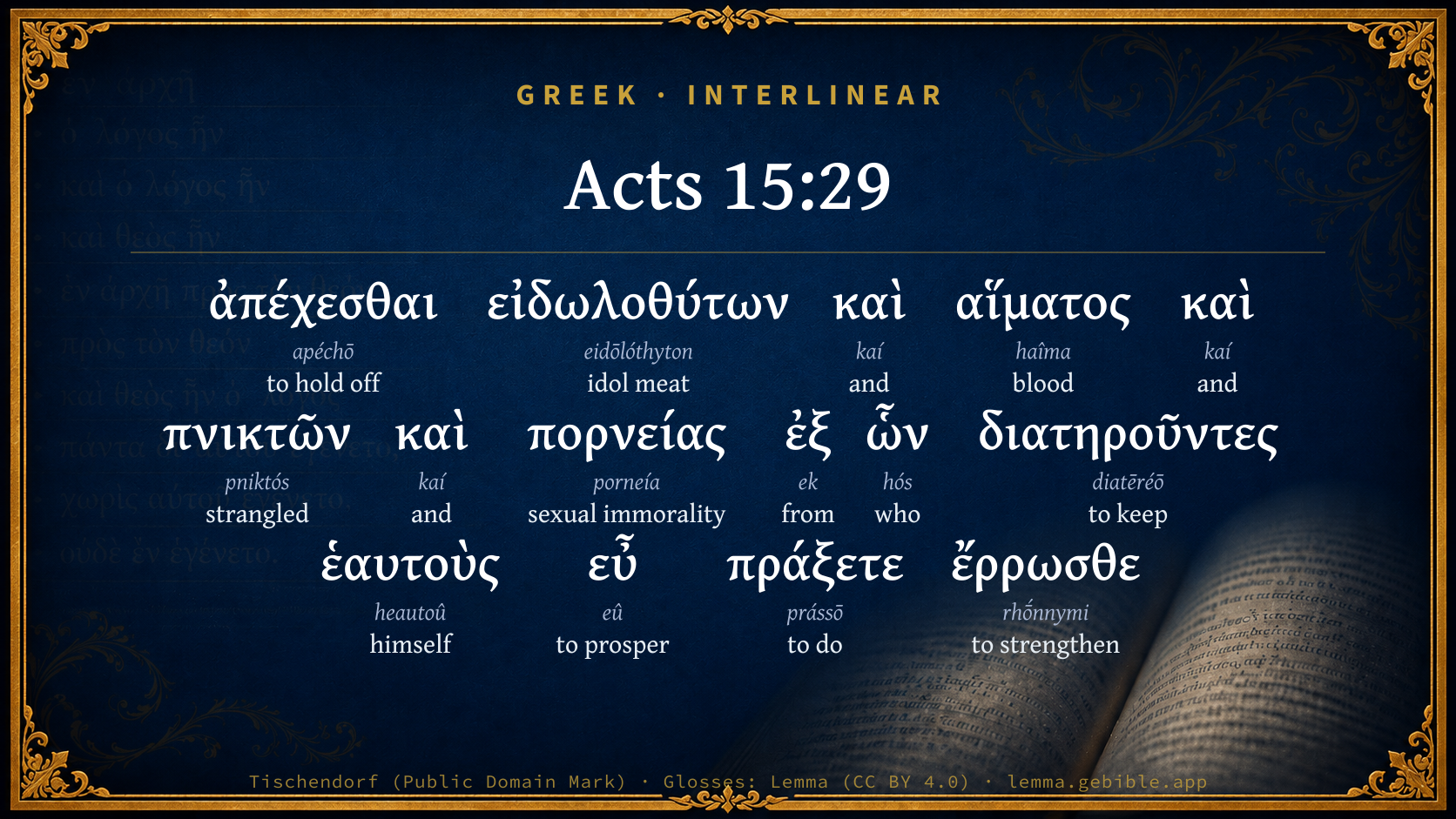
  1. ἀπέχεσθαι apéchō G568 “to hold off” Verb, Present, Middle, Infinitive
  2. εἰδωλοθύτων eidōlóthyton G1494 “idol meat” Adjective, Genitive, Plural, Neuter
  3. καὶ kaí G2532 “and” Conjunction
  4. αἵματος haîma G129 “blood” Noun, Genitive, Singular, Neuter
  5. καὶ kaí G2532 “and” Conjunction
  6. πνικτῶν pniktós G4156 “strangled” Adjective, Genitive, Plural, Neuter
  7. καὶ kaí G2532 “and” Conjunction
  8. πορνείας porneía G4202 “sexual immorality” Noun, Genitive, Singular, Feminine
  9. ἐξ ek G1537 “from” Preposition
  10. ὧν hós G3739 “who” Relative pronoun, Genitive, Plural, Neuter
  11. διατηροῦντες diatēréō G1301 “to keep” Verb, Present, Active, Participle, Nominative, Plural, Masculine
  12. ἑαυτοὺς heautoû G1438 “himself” Reflexive pronoun, 2nd person, Accusative, Plural, Masculine
  13. εὖ eû G2095 “to prosper” Adverb
  14. πράξετε prássō G4238 “to do” Verb, Future, Active, Indicative, 2nd person, Plural

About this verse

These counts appear in no published source. They are computed here, from the morphology-tagged text and Lemma’s own curated glosses. What Lemma adds →

15
words
13
distinct lemmas
Acts
section

Notable vocabulary

1 hapax legomenon — a word that appears only here in the entire Greek New Testament:

  • ἔρρωσθε to strengthen G4517

First appearance in Scripture

These words make their first canonical appearance in the Greek New Testament here:

  • εἰδωλοθύτων idol meat G1494
  • ἔρρωσθε to strengthen G4517

Shared distinctive vocabulary

διατηροῦντες to keep G1301 occurs in 2 verses of the Greek New Testament. Also found in:

Repetition

A word recurs within this verse:

Cross-references

17

Topical passages linked to Acts 15:29 in the Treasury of Scripture Knowledge — connected by theme and wording, ordered by reader-vote popularity; previews shown in the World English Bible.

  • Acts 15:20 but that we write to them that they abstain from the pollution of idols, from sexual immorality, from what is strangled, and from blood.
  • Acts 21:25 But concerning the Gentiles who believe, we have written our decision that they should observe no such thing, except that they should keep themselves from food offered to idols, from blood, from strangled things, and from sexual immorality."
  • Revelation 2:14 But I have a few things against you, because you have there some who hold the teaching of Balaam, who taught Balak to throw a stumbling block before the children of Israel, to eat things sacrificed to idols, and to commit sexual immorality.
  • Revelation 2:20 But I have this against you, that you tolerate your woman, Jezebel, who calls herself a prophetess. She teaches and seduces my servants to commit sexual immorality, and to eat things sacrificed to idols.
  • Leviticus 17:14 For as to the life of all flesh, its blood is with its life: therefore I said to the children of Israel, "You shall not eat the blood of any kind of flesh; for the life of all flesh is its blood. Whoever eats it shall be cut off."
  • Romans 14:20–21 Don't overthrow God's work for food's sake. All things indeed are clean, however it is evil for that man who creates a stumbling block by eating.
  • 1 Corinthians 10:18–20 Consider Israel after the flesh. Don't those who eat the sacrifices have communion with the altar?
  • 1 John 5:21 Little children, keep yourselves from idols.
  • Jude 1:24 Now to him who is able to keep them from stumbling, and to present you faultless before the presence of his glory in great joy,
  • Romans 14:14–15 I know, and am persuaded in the Lord Jesus, that nothing is unclean of itself; except that to him who considers anything to be unclean, to him it is unclean.
  • 1 Timothy 5:22 Lay hands hastily on no one, neither be a participant in other men's sins. Keep yourself pure.
  • James 1:27 Pure religion and undefiled before our God and Father is this: to visit the fatherless and widows in their affliction, and to keep oneself unstained by the world.
  • 2 Corinthians 11:9 When I was present with you and was in need, I wasn't a burden on anyone, for the brothers, when they came from Macedonia, supplied the measure of my need. In everything I kept myself from being burdensome to you, and I will continue to do so.
  • 2 Corinthians 13:11 Finally, brothers, rejoice. Be perfected, be comforted, be of the same mind, live in peace, and the God of love and peace will be with you.
  • Jude 1:20–21 But you, beloved, keep building up yourselves on your most holy faith, praying in the Holy Spirit.
  • Luke 9:61 Another also said, "I want to follow you, Lord, but first allow me to bid farewell to those who are at my house."
  • Acts 18:21 but taking his leave of them, and saying, "I must by all means keep this coming feast in Jerusalem, but I will return again to you if God wills," he set sail from Ephesus.

Cross-references courtesy of OpenBible.info (CC BY 4.0).

Commentary

Notes on Acts 15:29 from classic Christian and Jewish commentators (each source and its license shown beneath its notes). The classic Christian expositions comment on the surrounding passage and are grouped to its opening verse, so a note may address several verses; the Jewish commentaries on the Tanakh (Rashi and others) are per-verse, so they appear only where the commentator wrote on this verse.

Lemma curates 59 commentaries, every one of them public domain or Creative Commons licensed, each selected and text-cleaned for this edition rather than reprinted as found. About our sources →

Tyndale Open Study Notes

Tyndale Open Resources

15:29 Farewell: The letter to the churches includes this familiar Hellenistic greeting at the end of a letter, found only here in the New Testament. Paul often ended his letters on a more theological note (e.g., 1 Cor 16:23-24; 2 Cor 13:13; see Eph 6:23-24; Phil 4:23; Col 4:18; 1 Thes 5:23-28; 1 Tim 6:21).

Tyndale Open Study Notes — © Tyndale Open Resources, licensed CC BY-SA 4.0. Text via the HelloAO Bible API.

Bengel's Gnomon

Johann Albrecht Bengel

Act 15:29. Πορνείας, from fornication) Some MSS., and so also Irenæu[90], Cypria[91], and the Æthiopian version, add, ΚΑῚ ὍΣΑ ΜῊ ΘΈΛΕΤΕ ἙΑΥΤΟῖς ΓΊΝΕΣΘΑΙ, ἙΤΈΡΟΙς ΜῊ ΠΟΙΕῖΤΕ, “Whatsoever things ye wish that men should do to you, do ye also so to them: this is the law and the prophets:” Mat 7:12. See App. Crit., ed. ii., on this passage.[92] Therefore some formerly must have thought that this synodical letter could not be without this clause [viz. on account of the words just quoted from Matt.] They no doubt knew that the question also in the Synod was one concerning the moral law. At least the believers who were of the Pharisees upheld the false use of the moral law, as though righteousness and salvation were to be attained by it. The Synod removes this same false use of it, not the moral law itself, but the ceremonial law itself. Wherefore there was no need, that to abstinence from things sacrificed to idols, etc., there should be added the words, “Whatsoever things ye would not wish to be done to you, be unwilling to do to others.”—εὖ πράξετε, ye shall do well [prosper]) Nothing shall be wanting, no obstacle shall be in the way of your doing well (πρὸς τὸ εὖ πράττειν); as regards your Christian felicity, nothing will “trouble” you: Act 15:24. This too is intended for consolation: Act 15:31.

[90] renæus (of Lyons, in Gaul: born about 130 A.D., and died about the end of the second century). The Editio Renati Massueti, Parisinæ, a. 1710.

[91] yprian (in the beginning and middle of the third century: a Latin father). Ed. Steph. Baluzii, Paris. 1726.

[92] Dd supports the addition. But ABCEe Vulg. reject it.—E. and T.

Bengel's Gnomon of the New Testament — English translation (T&T Clark, Edinburgh, 1860) — public domain. Text from a community e-Sword module.

Meyer's Critical & Exegetical Commentary

Heinrich August Wilhelm Meyer

Act_15:29. The points mentioned in Act_15:20 are here arranged more accurately, so that the three which refer to food are placed together.

ἀπέχεσθαι] is in Act_15:20, as in 1Th_4:3; 1Th_5:22, Sir_28:8, and frequently in the LXX., joined with ἀπό; but here, as usually among Greek writers, only with the genitive. The two differ non quoad rem ipsam, sed modo cogitandi, ita ut in priori formula sejunctionis cogitatio ad rem, in posteriori autem ad nos ipsos referatur. Tittmann, Synon. N.T. p. 225.

ἐξ ὧν διατηροῦντες ἑαυτούς] from which (i.e. at a distance from, without fellowship with them) ye carefully keeping yourselves. Comp. Joh_17:5; Pro_21:23 : διατηρεῖ ἐκ θλίψεως τὴν ψυχὴν αὐτοῦ; also the corresponding connection with ἀπό, Psa_12:8; Jam_1:27.

εὖ πράξετε] not: ye shall do well (so usually; also de Wette, comp. Act_10:33), but, as also Hofmann interprets it according to the usus loquendi (see especially Plat. Alc. i. p. 116 B: ὅστις καλῶς πράττει, οὐχὶ καὶ εὖ πράττει, Prot. p. 333 D: εἰ εὖ πράττουσιν ἀδικοῦντες, Dem. 469. 14 : εἴ τις ἄλλος εὖ μὲν ἐποίησεν ὑμᾶς εὖ πράττων, Plat. Ephesians 3, p. 315 B; the opposite, κακῶς πράσσειν, comp. Ellendt, Lex. Soph. II. p. 629, and Grimm, s.v. εὖ), ye shall fare well, namely, by peace and unity in Christian fellowship. Quite incorrectly, Elsner, Wolf, Krebs, Kuinoel have understood the meaning as equivalent to σωθήσεσθε, which egregiously and injuriously mistakes the apostolic spirit, that had nothing in common with the οὐ δύνασθε σωθῆναι of the strict legalists.

ἔῤῥωσθε] the epistolary valete. Xen. Cyr. iv. 5. 33; Hipp. ep. p. 1275, 20; Artem. iii. 44; 2Ma_11:21; 2Ma_11:33; 2Ma_7:9. Comp. Dissen, ad Dem. de Cor. p. 323 f.

Meyer — Critical and Exegetical Commentary on the New Testament — English translation by Peter Christie, edited by Frederick Crombie (T&T Clark, 1880) — public domain. Text from a community e-Sword module.

Expositor's Greek Testament

ed. W. Robertson Nicoll

Act 15:29 . ἀπέχ .: preposition omitted as in Act 15:20 , W.H [289] ; so usually in classical Greek, but in N.T. ἀπέχ . ἀπό , 1Th 4:3 ; 1Th 5:22 ; so in LXX, Job 1:1 ; Job 1:8 ; Job 2:3 , etc. On the difference in meaning in the two constructions, see Alford and Wendt, in loco. εἰδωλοθύτων , see Act 15:20 . πνικτοῦ : omitted in Western text; see critical notes. διατηροῦντες ἑαυτοὺς : verb, only in Luke, cf. Luk 2:51 (in LXX with ἐκ or ἀπό , Psa 11:7 , Pro 21:23 ). In Jas 1:27 we have a somewhat striking similarity of expression ( cf. also Joh 17:15 ). εὖ πράξετε : “it shall be well with you,” R.V.; viz. , through the peace and concord established in the Christian community, cf. 2Ma 9:19 , so in classical Greek. The reading in A.V. is somewhat ambiguous, but the Greek signifies prosperity. For , see critical notes. ἔῤῥωσθε , see critical notes, 2Ma 11:21 ; 2Ma 11:33 , 3Ma 7:9 , etc., and often in classics; a natural conclusion of a letter addressed to Gentile Christians, see additional note (2) at end of chapter.

[289] Westcott and Hort’s The New Testament in Greek: Critical Text and Notes.

The Expositor's Greek Testament, edited by W. Robertson Nicoll (1897–1910) — public domain. Text from a community e-Sword module.

Geneva Bible (1599)

Geneva Bible translators

Charity is required even in things indifferent.

Geneva Bible (1599) marginal notes — public domain. Text via Bolls.life.

Adam Clarke's Commentary

Verse 29. Ye shall do well.] But, if they did not keep themselves from these things, they would do ill; that is, they would sin against God, whose Spirit had commanded them to keep from these things. And who can do any of these forbidden things, and keep either a guiltless or a tender conscience?

Fare-well.] An old English form of expressing good wishes and good will. It is compounded of [Anglo-Saxon] to go, and [A.S.], much, well, very much. Go well, go prosperously!-tantamount with good speed! may you succeed well! may God direct you! Like to that other form of sound words, God be with you! corrupted now into good by to ye! And of the same meaning with adieu! a Dieu, to God; that is, I commend you to God. All these terms savour not only of good will, or benevolence, but also of piety. Our pious ancestors believed that nothing was safe, nothing protected, nothing prosperous, over which the shield of God was not extended; and, therefore, in their familiar good wishes, they gave each other to God. The Greek word ερρωσθε, errhosthe, here used, from ρωννυμι, to strengthen, make strong, has nearly the same signification: be strong, courageous, active, be in health, and be prosperous! What a pity that such benevolent and pious wishes should degenerate into cool formalities, or unmeaning compliments!

Adam Clarke's Commentary on the Bible (1810–1826) — public domain. Text from a community e-Sword/MySword module.

Ellicott's Commentary for English Readers

(29) From meats offered to idols.—The specific term takes the place of the more general word which St. James had used. The change, if the two words were not used, as is possible, as altogether equivalent, may be thought of as favouring the Gentiles by narrowing the prohibition to a single point.

Fare ye well.—The closing salutation was, like the opening, a Greek and not a Hebrew one. It meets us again in Act_23:30. Both were naturally used in a letter addressed to Greeks, and intended to be read by them and by Hellenistic Jews. It does not occur, however, in any of the Epistles of the New Testament.

It is natural to ask, at the close of the great encyclical letter, in what relation it really stood to the life of the Apostolic Church. As a concordat between the contending parties it was framed, as has been said, with a sagacity that may well be looked on as inspired. But obviously it was not, and from the nature of the case could not be, more than that. The time had not come for proclaiming to the Church of Jerusalem the full width of St. Paul’s teaching (Gal_2:2), and accordingly, though something may be read between the lines, the decree seems to treat the precepts of Noah as perpetually binding, places moral and positive obligations on the same footing, and leaves the ground on which they are “necessary” an open question. St. Paul, who had accepted it as a satisfactory settlement of the matter in debate, never refers to it, even when he is discussing the chief point with which the decree dealt (1 Corinthians 8-10). In his narrative of what passed on this occasion (Gal_2:1-10) there is no mention of it. The private conference with the three great “pillars” of the Church was for him more than the decree of the synod, and he felt himself able to discuss the whole question again on different grounds, and with a more distinct reference to spiritual and ethical principles. It was wrong to eat things sacrificed to idols, not because the act of so eating in itself brought defilement, but because it might involve a participation in the sin of idolatry in the consciousness of the eater, or wound the conscience of the weaker brother who saw him eat. It was natural that those who lacked his largeness of view should become slaves to the letter of the rules long after the grounds on which they rested had ceased to exist, and so we find that the prohibition of blood was re-enforced in the so-called Apostolic Canons (c. 62), and in the fourth century by the Council of Gangra (c. 2), and in the seventh by that at Constantinople, known as in Trullo (c. 67), and continues to be the binding rule of the Greek Church still. In Africa and in Europe, however, truer views prevailed (August, cont. Faust. xxxii. 13), and not even the most devout believer in the inspiration of the Apostles, or in the authority of primitive antiquity. would venture to urge that the two last precepts of the four here enjoined were in any degree binding. Hooker (Eccl. Pol. iv., xi., § 5) rightly refers to this decree as a crucial instance proving that commands might be divine and yet given only for a season, binding as long as the conditions to which they applied continued, but no longer. It would almost seem, indeed, as if St. Paul felt that the terms of the decree had the effect of placing the sin of impurity on the same level with that of eating things sacrificed to idols, and things strangled, and blood, and so tended to keep men from seeing it in its true hatefulness. Those who claimed a right, which in the abstract St. Paul could not deny, to eat of things strangled or offered to idols, thought themselves free to fall back into the old license of the heathen world, and he needed far stronger motives than the canons of the council to restrain them (1Co_5:9-10; 1Co_6:15-20, and found those motives in the truths that they had been bought with a price, that the will of God was their sanctification, and that their bodies were His temple.

A Bible Commentary for English Readers, edited by Charles John Ellicott (1878–1897) — public domain. Text from a community e-Sword module.

The Cambridge Bible for Schools and Colleges

gen. ed. J. J. S. Perowne

29. ye shall do well] Not “ye shall be doing what is right,” but “it shall be well with you” (R.V.), “you shall be in a good state.”

Fare ye well] This termination and the greeting at the commencement of the letter are in the style of Western epistolary language. See above on Act_15:23.

The Cambridge Bible for Schools and Colleges (gen. ed. J. J. S. Perowne; Cambridge University Press, 1878–1918) — public domain. Text from a community e-Sword module.

John Gill's Exposition

That ye abstain from meats offered to idols,.... Which explains what is meant by pollutions of idols, Act 15:20

and from blood, and from things strangled, and from fornication. See Gill on Act 15:20.

In Beza's most ancient copy, and in three other manuscripts, and in the Complutensian edition, it follows, "and whatsoever ye would not have done to yourselves, that do ye not to another"; in like manner the Ethiopic version also reads, as in Act 15:20 "from which if ye keep yourselves ye shall do well"; it will be doing a good thing, and make for the peace of the churches; in Beza's most ancient copy it is added, "born", or "moved by the Holy Ghost": being influenced and assisted by him in this, and every good work:

fare ye well; the Syriac version adds, "in our Lord".

John Gill's Exposition of the Whole Bible (1746–1763) — public domain (CC PDM 1.0). Text via the HelloAO Bible API.

Trapp's Complete Commentary

John Trapp

29 That ye abstain from meats offered to idols, and from blood, and from things strangled, and from fornication: from which if ye keep yourselves, ye shall do well. Fare ye well.

Ver. 29. And from fornication] Some Greek copies add, "and whatsoever ye would not should be done to you, that ye do not the same to others;" which is a general rule, and a foundation of the former. As for fornication, it is here reckoned among things indifferent, because the Gentiles held it so; as the Papists now account it a very small sin; but so did not the council. See 1Co 10:8; Heb 13:4. {See Trapp on "1Co 10:8"} {See Trapp on "Heb 13:4"} A learned man telleth us, that that impostor Mahomet hath (in an apish imitation of this decree of the holy synod) forbidden his followers the self-same things, saving that he nameth swine’s flesh in the place of fornication. {See Trapp on "Act 15:20"}

John Trapp, A Commentary or Exposition upon All the Books of the Old and New Testament (1647–1656) — public domain. Text from a community e-Sword module.

Albert Barnes' Notes on the Bible

From meats offered to idols - This explains what is meant by “pollutions of idols,” Act 15:20.

Ye shall do well - You will do what ought to be done in regard to the subjects of dispute.

Albert Barnes' Notes on the Bible (1834–1885) — public domain. Text from a community e-Sword/MySword module.

Haydock's Catholic Bible Commentary

From blood, and from things strangled. The use of these things, though of their own nature indifferent, were here prohibited, to bring the Jews more easily to admit of the society of the Gentiles; and to exercise the latter in obedience. But this prohibition was but temporary, and has long since ceased to oblige; more especially in the western churches. (Challoner) --- See note on ver. 20, above.

George Leo Haydock (1774–1849), Haydock's Catholic Family Bible and Commentary, 1859 edition — public domain. Excludes Psalms (Douay-Rheims chapter numbering differs from Protestant) and Deuterocanonical books (Catholic canon only).

Matthew Poole's English Annotations

Of these see more largely, Act 15:20.

From meats offered to idols; they were wont to carry home and feast upon part of the sacrifices they had offered unto their false gods; nay, they did not, without reproach, eat of any greater beasts, (as oxen and sheep), but they always first offered some of them unto their idols. And it was accounted no small impiety to eat αθυτα ιερα, part of any beasts which they had not first offered up to some or other of their gods.

From blood; for this reason they might not eat of any thing that died of itself, as Deu 14:21, because the blood was not gone out of it.

From fornication; mentioned here, because so commonly practised amongst the Gentiles, and yet not esteemed a sin. Hence also, 1Th 4:3, the apostle lays a very great charge against it.

Fare ye well; the ordinary apprecation wherewith their letters were concluded, in which they wished health and strength to the party they wrote unto: instead of which word, some ancient copies read, φερομενοι εν πνευματι Αγιω; which is rendered, Walk in the Holy Ghost; or, the Holy Ghost carrying, or enabling of you: a wish or prayer becoming these holy men that made it. They who have found the necessity of the Spirit’s assistance, desire it above all things for such as they wish well unto.

Matthew Poole's English Annotations on the Holy Bible (1683–1685) — public domain. Text from a community e-Sword/MySword module.

Whedon's Commentary on the Bible

Daniel D. Whedon

29. Fare ye well—The ordinary close of a letter anciently, χαιρειν. Be ye in health and vigour.

Daniel D. Whedon (gen. ed.), Commentary on the Old and New Testaments (1874–1909) — public domain. Text from a community e-Sword module.

The Pulpit Commentary

Things sacrificed for meats offered, A.V.; it shall be well with you for ye shall do well, A.V. The phrase eu= prassein means to" prosper," to "fare well". (comp. Eph_6:21, "How I do

The Pulpit Commentary (1880–1919), ed. H.D.M. Spence-Jones & Joseph S. Exell — public domain. Text from a community e-Sword module.

John Wesley's Explanatory Notes

Blood - The eating which was never permitted the children of God from the beginning of the world. Nothing can be clearer than this. For,

1. From Adam to Noah no man ate flesh at all; consequently no man then ate blood.

2. When God allowed Noah and his posterity to eat flesh, he absolutely forbade them to eat blood; and accordingly this, with the other six precepts of Noah, was delivered down from Noah to Moses.

3. God renewed this prohibition by Moses, which was not repealed from the time of Moses till Christ came.

4. Neither after his coming did any presume to repeal this decree of the Holy Ghost, till it seemed good to the bishop of Rome so to do, about the middle of the eighth century.

5. From that time those Churches which acknowledged his authority held the eating of blood to be an indifferent thing. But,

6. In all those Churches which never did acknowledge the bishop of Rome's authority, it never was allowed to eat blood; nor is it allowed at this day. This is the plain fact; let men reason as plausibly as they please on one side or the other. From which keeping yourselves ye will do well - That is, ye will find a blessing. This gentle manner of concluding was worthy the apostolical wisdom and goodness. But how soon did succeeding councils of inferior authority change it into the style of anathemas! Forms which have proved an occasion of consecrating some of the most devilish passions under the most sacred names; and like some ill-adjusted weapons of war, are most likely to hurt the hand from which they are thrown.

John Wesley, Explanatory Notes Upon the Whole Bible (1754–1765) — public domain. Text via the GEBible commentary corpus.

McGarvey & Pendleton's Commentaries

J. W. McGarvey

See notes on verse 22

J. W. McGarvey (with Philip Y. Pendleton), Commentaries on the New Testament (The Fourfold Gospel, 1914; Acts; and the epistles) — public domain. Text from a community e-Sword/MySword module.

Cambridge Greek Testament for Schools and Colleges

29. εὖ πράξετε, ye shall do well, i.e. it shall be well with you.

ἔρρωσθε, fare ye well. This conclusion and the greeting at the commencement of the letter are in the style of Western, rather than Oriental, epistolary language. See above on Act 15:23.

Cambridge Greek Testament for Schools and Colleges (Cambridge University Press, 1896; 21 vols, various authors incl. Carr, Maclear, Plummer, Farrar, Lumby, Moule, M. R. James, Simcox) — public domain. Text from a community e-Sword module.

Alford’s Greek Testament

Henry Alford

29.] On the construction of ἀπέχεσθαι with ἀπό in ver. 20, and with a simple gen. here, Tittm., de Syn. N. T. p. 225, says well that the difference arises ‘non quoad rem ipsam, sed modo cogitandi, ita ut in priori formula sejunctionis cogitatio ad rem, in posteriori vero ad nos ipsos referatur.’ His following remarks are worth reading.

ἐξ ὧν, from which things; not, as Meyer, ‘according to which precepts;’ see Joh 17:15.

εὖ πράξ.] Not, ‘ye shall prosper:’ but as καλῶς ἐποίησας, ch. 10:33; 3Jn 1:6,—ye shall do well.

See the curious additions in var. readd.

ἔῤῥωσθε] The customary ‘valete’ of the conclusion of epistles.

Henry Alford, The Greek Testament (1849–1861) — public domain. Text from a community e-Sword module.

Vincent's Word Studies in the New Testament

Marvin R. Vincent

Blood. Because in the blood was the animal 's life, and it was the blood that was consecrated to make atonement. See Gen 9:6; Lev 17:10 - 14; Deu 12:23, 24. The Gentiles had no scruples about eating blood; on the contrary, it was a special delicacy. Thus Homer :

"At the fire Already lie the paunches of two goats, Preparing for our evening meal, and both Are filled with fat and blood. Whoever shows himself the better man in this affray, And conquers, he shall take the one of these He chooses."

Odyssey, 18, 44 sq.

The heathen were accustomed to drink blood mingled with wine at their sacrifices.

Farewell [ερρωσθε] . Lit., be strong, like the Latin valete. Compare the close of Claudius Lysias' letter to Festus (ch. 23 30).

Marvin R. Vincent, Word Studies in the New Testament (1887–1900) — public domain. Text from a community e-Sword/MySword module.

Lesson kit

Teaching starters — assembled from the data on this page, not authored interpretation. Every prompt links to the verse data it draws on. Edit before teaching.

Acts, in the Acts, opens this verse with 15 words (13 distinct Greek lemmas). Its most distinctive word is rhṓnnymi (“to strengthen”). A historical commentator’s framing appears above. Read the whole chapter for the surrounding context.

Discussion questions

  1. How does “to strengthen” (rhṓnnymi) shape what this verse is saying?
  2. This verse holds 1 word here found nowhere else in the Greek New Testament. What might the rare word draw attention to?
  3. 2 words here appear for the first time in Scripture. What is being introduced at this debut?
  4. Luke 2:51 shares the word «to keep» with this verse. How do the two illuminate each other?
  5. “and” occurs 3× in this one verse. What is the effect of the repetition?
  6. These translations render this verse differently; the difference is in the English rendering, not the original. What questions does that raise?
  7. Reading how Tyndale Open Study Notes and Bengel's Gnomon read this verse, where do the two commentators agree and where do they part?

Things to notice

  • 1 word in this verse appears nowhere else in the Greek New Testament.
  • 2 words make their first canonical appearance in Scripture here.
  • These translations choose different wording for 14 words in this verse.
  • “and” occurs 3× in this single verse.
  • 13 distinct Greek lemmas span 15 words in this verse.

Reading settings

Reading text

Shown beneath each verse's original-language words.

Old Testament
Old Testament edition

Read the OT as the Masoretic Hebrew (MT) or the Greek Septuagint (LXX).

English shown for the Greek Septuagint (in the Hebrew ↔ Greek comparison).

Comparing translations? Open the Compare panel on any verse page to stack up to four side by side.