Acts 13:22

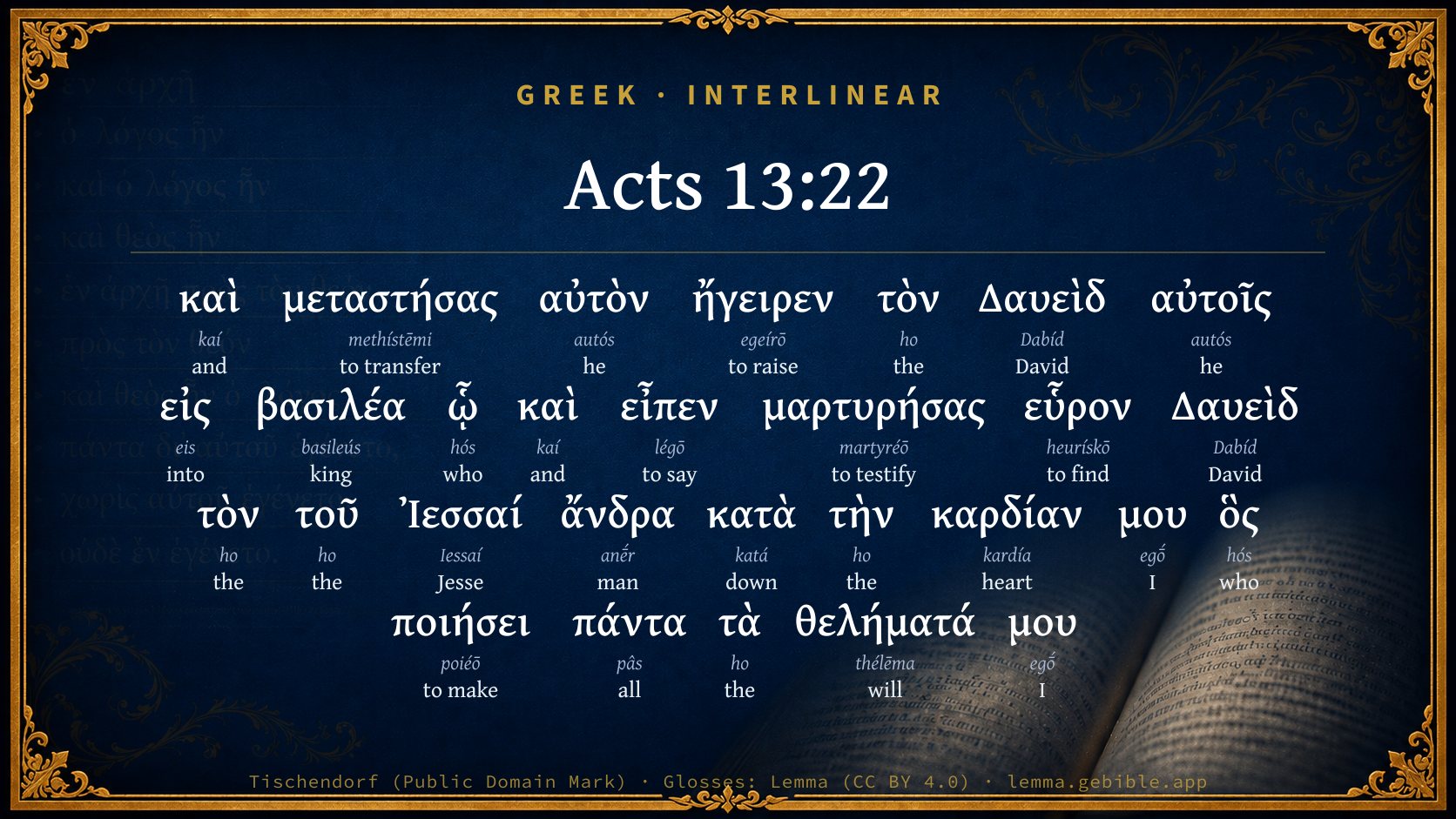
Greek (Tischendorf 8th ed.) Acts 13:22 appears in the Greek New Testament. The text above is from the Tischendorf 8th edition. Each word links to its Strong’s number and a concise gloss. Click any word for its full Thayer’s Greek Lexicon entry.
Download image
Cite this verse

Acts 13:22 (World English Bible). Public Domain. Lemma interlinear Bible study tool, https://lemma.gebible.app/v/acts/13/22.

Show BibTeX & RIS
BibTeX
RIS
English Translation
When he had removed him, he raised up David to be their king, to whom he also testified, 'I have found David the son of Jesse, a man after my heart, who will do all my will.'
World English Bible · Public Domain
Download a study sheet

One document with this verse’s original text, its word-by-word gloss line, the meaning frame, cross-references with their text, attributed commentary, and full source and license credits — printable, and it pastes into notes with its structure intact.

This verse Autodidact and up

Study sheet (.html) Plain text (.txt)

A passage Seminary Student

Up to 50 verses in one chapter. A passage sheet keeps up to 6 commentary sources and 12 cross-references per verse, in the order this page ranks them, and says so on the sheet whenever that leaves anything out. Ask for a single verse and you get the Autodidact verse sheet above.

Everything on this page stays free to read, with no account — the sheet is a download of what is already on screen, not access to it.

Want to remove ads? Support Godless Engineer
Compare translations 3

The same verse in 3 English versions, stacked beneath the original-language interlinear above. Click any original word for its lexicon entry.

Each is an independent rendering of the whole verse — the interlinear is not word-aligned to these translations.

Highlighted words mark where these versions differ — a whole-verse word diff, not a word-by-word alignment.

  • World English Bible Public Domain
    When he had removed him, he raised up David to be their king, to whom he also testified, 'I have found David the son of Jesse, a man after my heart, who will do all my will.'
  • King James Version Public Domain
    And when he had removed him, he raised up unto them David to be their king; to whom also he gave their testimony, and said, I have found David the son of Jesse, a man after mine own heart, which shall fulfil all my will.
  • unfoldingWord Literal Text CC BY-SA 4.0
    And having removed him, he raised up David for them for king, about whom also he said, testifying, ‘I have found David, of Jesse, a man according to my heart, who will do all my will.’

unfoldingWord Literal Text — © unfoldingWord, licensed CC BY-SA 4.0. Word-aligned USFM3 via Door43 (git.door43.org/unfoldingWord/en_ult).

Versions to compare (up to 4)

3 of 4 selected

Show all 19 translations

Every available English version of this verse, each an independent rendering of the whole verse.

  • World English Bible Public Domain
    When he had removed him, he raised up David to be their king, to whom he also testified, 'I have found David the son of Jesse, a man after my heart, who will do all my will.'
  • Berean Standard Bible Public Domain
    After removing Saul, He raised up David as their king and testified about him: ‘I have found David son of Jesse a man after My own heart; he will carry out My will in its entirety.’
  • Majority Standard Bible Public Domain
    After removing Saul, He raised up David as their king and testified about him: ‘I have found David son of Jesse a man after My own heart; he will carry out My will in its entirety.’
  • King James Version Public Domain
    And when he had removed him, he raised up unto them David to be their king; to whom also he gave their testimony, and said, I have found David the son of Jesse, a man after mine own heart, which shall fulfil all my will.
  • American Standard Version (1901) Public Domain
    And when he had removed him, he raised up David to be their king; to whom also he bare witness and said, I have found David the son of Jesse, a man after My heart, who shall do all My will.
  • Revised Version (1885) Public Domain
    And when he had removed him, he raised up David to be their king; to whom also he bare witness, and said, I have found David the son of Jesse, a man after my heart, who shall do all my will.
  • Geneva Bible (1599) Public Domain
    And after he had taken him away, he raised vp Dauid to be their King, of whom he witnessed, saying, I haue found Dauid the sonne of Iesse, a man after mine owne heart, which will doe all things that I will.
  • Douay-Rheims (1899) Public Domain
    And when he had removed him, he raised them up David to be king: to whom giving testimony, he said: I have found David, the son of Jesse, a man according to my own heart, who shall do all my wills.
  • Young's Literal Translation Public Domain
    and having removed him, He did raise up to them David for king, to whom also having testified, he said, I found David, the `son' of Jesse, a man according to My heart, who shall do all My will.
  • Literal Standard Version CC BY-SA 4.0
    and having removed him, He raised up to them David for king, to whom also having testified, He said, I found David, the [son] of Jesse, a man according to My heart, who will do all My will.
  • Unlocked Literal Bible CC BY-SA 4.0
    After God removed him from the kingship, he raised up David to be their king. It was about David that God said, 'I have found David son of Jesse to be a man after my heart, who does all I want him to do.'
  • unfoldingWord Literal Text CC BY-SA 4.0
    And having removed him, he raised up David for them for king, about whom also he said, testifying, ‘I have found David, of Jesse, a man according to my heart, who will do all my will.’
  • Darby Bible Public Domain
    And having removed him he raised up to them David for king, of whom also bearing witness he said, I have found David, the son of Jesse, a man after my heart, who shall do all my will.
  • World Messianic Bible Public Domain
    When he had removed him, he raised up David to be their king, to whom he also testified, ‘I have found David the son of Jesse, a man after my heart, who will do all my will.’
  • Webster's Bible Public Domain
    And when he had removed him, he raised up to them David to be their king: to whom also he gave testimony, and said, I have found David the son of Jesse, a man after my own heart, who shall fulfill all my will.
  • Free Bible Version CC BY-SA 4.0
    Then God removed Saul, and made David their king. God approved of David, saying ‘I found David the son of Jesse to be a man according to my own heart; he will do everything I intend.’
  • Bible in Basic English Public Domain
    And having put him on one side, he made David their king, to whom he gave witness, saying, I have taken David, the son of Jesse, a man dear to my heart, who will do all my pleasure.
  • Text-Critical English NT CC BY 4.0
    After removing Saul, God raised up David as their king, about whom he testified, ‘I have found David the son of Jesse to be a man after my own heart; he will do all that I want him to do.’
  • Tyndale New Testament (1534) Public Domain
    And after he had put him doune he set vp David to be their kynge of whome he reported sayinge: I have founde David the sonne of Iesse a man after myne awne hert he shall fulfill all my will.

Literal Standard Version (2020), Covenant Press — licensed CC BY-SA 4.0. Text via the HelloAO Bible API (eBible.org). Unlocked Literal Bible (unfoldingWord) — licensed CC BY-SA 4.0. Text via the HelloAO Bible API (eBible.org). unfoldingWord Literal Text — © unfoldingWord, licensed CC BY-SA 4.0. Word-aligned USFM3 via Door43 (git.door43.org/unfoldingWord/en_ult). Free Bible Version, Dr. Jonathan Gallagher — licensed CC BY-SA 4.0. Text via the HelloAO Bible API (eBible.org).

Word by word

More ways to search: Search by grammar → Find every occurrence → Compare this word →

Practice this passage: Drill this verse → Learn its vocabulary →

μεταστήσας
methístēmi
G3179
“to transfer”
Verb, Aorist, Active, Participle, Nominative, Singular, Masculine
Part of Speech
Verb
Tense
Aorist
Voice
Active
Mood
Participle
Case
Nominative
Number
Singular
Gender
Masculine
Full Thayer's Definition

Origin: from G3326 and G2476

TDNT: None

1. to transpose, transfer, remove from one place to another a. of change of situation or place b. to remove from the office of a steward c. to depart from life, to die
  1. καὶ kaí G2532 “and” Conjunction
  2. αὐτὸν autós G846 “he” Personal pronoun, Accusative, Singular, Masculine
  3. ἤγειρεν egeírō G1453 “to raise” Verb, Aorist, Active, Indicative, 3rd person, Singular
  4. τὸν ho G3588 “the” Article, Accusative, Singular, Masculine
  5. Δαυεὶδ Dabíd G1138 “David” Noun, Proper, indeclinable
  6. αὐτοῖς autós G846 “he” Personal pronoun, Dative, Plural, Masculine
  7. εἰς eis G1519 “into” Preposition
  8. βασιλέα basileús G935 “king” Noun, Accusative, Singular, Masculine
  9. ᾧ hós G3739 “who” Relative pronoun, Dative, Singular, Masculine
  10. καὶ kaí G2532 “and” Conjunction
  11. εἶπεν légō G3004 “to say” Verb, Aorist, Active, Indicative, 3rd person, Singular
  12. μαρτυρήσας martyréō G3140 “to testify” Verb, Aorist, Active, Participle, Nominative, Singular, Masculine
  13. εὗρον heurískō G2147 “to find” Verb, Aorist, Active, Indicative, 1st person, Singular
  14. Δαυεὶδ Dabíd G1138 “David” Noun, Proper, indeclinable
  15. τὸν ho G3588 “the” Article, Accusative, Singular, Masculine
  16. τοῦ ho G3588 “the” Article, Genitive, Singular, Masculine
  17. Ἰεσσαί Iessaí G2421 “Jesse” Noun, Proper, indeclinable
  18. ἄνδρα anḗr G435 “man” Noun, Accusative, Singular, Masculine
  19. κατὰ katá G2596 “down” Preposition
  20. τὴν ho G3588 “the” Article, Accusative, Singular, Feminine
  21. καρδίαν kardía G2588 “heart” Noun, Accusative, Singular, Feminine
  22. μου egṓ G1473 “I” Personal pronoun, 1st person, Genitive, Singular
  23. ὃς hós G3739 “who” Relative pronoun, Nominative, Singular, Masculine
  24. ποιήσει poiéō G4160 “to make” Verb, Future, Active, Indicative, 3rd person, Singular
  25. πάντα pâs G3956 “all” Adjective, Accusative, Plural, Neuter
  26. τὰ ho G3588 “the” Article, Accusative, Plural, Neuter
  27. θελήματά thélēma G2307 “will” Noun, Accusative, Plural, Neuter
  28. μου egṓ G1473 “I” Personal pronoun, 1st person, Genitive, Singular

About this verse

These counts appear in no published source. They are computed here, from the morphology-tagged text and Lemma’s own curated glosses. What Lemma adds →

29
words
20
distinct lemmas
Acts
section

Notable vocabulary

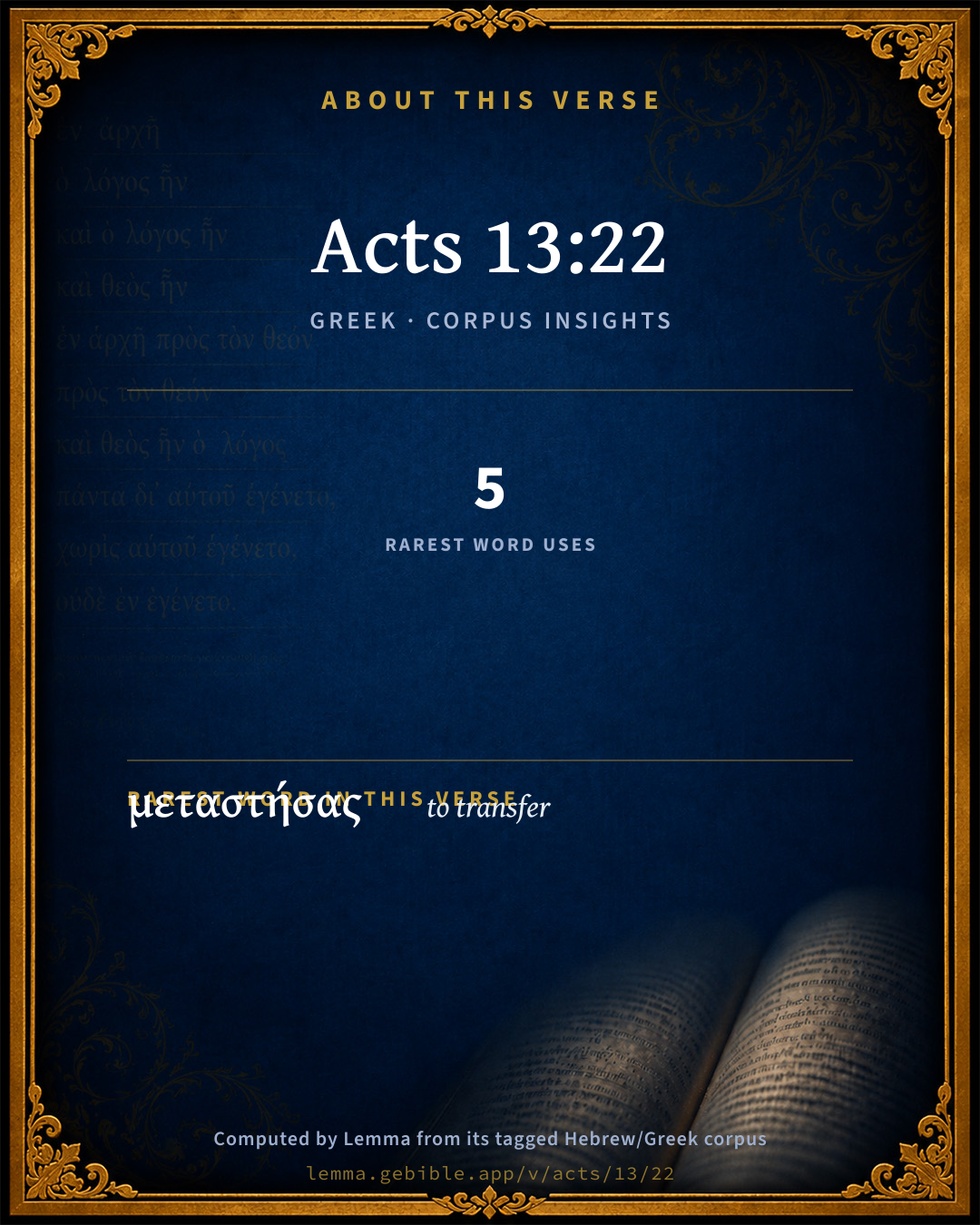
The rarest word here is μεταστήσας to transfer G3179 — appearing just 5 times in the whole Greek New Testament.

Shared distinctive vocabulary

μεταστήσας to transfer G3179 occurs in 5 verses of the Greek New Testament. Also found in:

Repetition

Words recur within this verse:

Cross-references

30

Topical passages linked to Acts 13:22 in the Treasury of Scripture Knowledge — connected by theme and wording, ordered by reader-vote popularity; previews shown in the World English Bible.

  • 1 Samuel 13:13–14 Samuel said to Saul, You have done foolishly; you have not kept the commandment of Yahweh your God, which he commanded you: for now would Yahweh have established your kingdom on Israel forever.
  • 1 Kings 15:5 because David did that which was right in the eyes of Yahweh, and didn't turn aside from anything that he commanded him all the days of his life, except only in the matter of Uriah the Hittite.
  • 1 Samuel 16:13 Then Samuel took the horn of oil, and anointed him in the midst of his brothers: and the Spirit of Yahweh came mightily on David from that day forward. So Samuel rose up, and went to Ramah.
  • Psalms 78:70–72 He also chose David his servant, And took him from the sheepfolds;
  • 1 Samuel 16:1 Yahweh said to Samuel, How long will you mourn for Saul, seeing I have rejected him from being king over Israel? fill your horn with oil, and go: I will send you to Jesse the Bethlehemite; for I have provided me a king among his sons.
  • 1 Samuel 15:26 Samuel said to Saul, I will not return with you; for you have rejected the word of Yahweh, and Yahweh has rejected you from being king over Israel.
  • 1 Samuel 15:28 Samuel said to him, Yahweh has torn the kingdom of Israel from you this day, and has given it to a neighbor of yours who is better than you.
  • Ezekiel 37:24–25 My servant David shall be king over them; and they all shall have one shepherd: they shall also walk in my ordinances, and observe my statutes, and do them.
  • Psalms 89:19–37 Then you spoke in vision to your saints, And said, "I have bestowed strength on the warrior. I have exalted a young man from the people.
  • Hosea 13:10–11 Where is your king now, that he may save you in all your cities? And your judges, of whom you said, 'Give me a king and princes?'
  • 1 Samuel 15:23 For rebellion is as the sin of witchcraft, and stubbornness is as idolatry and teraphim. Because you have rejected the word of Yahweh, he has also rejected you from being king.
  • 2 Samuel 2:4 The men of Judah came, and there they anointed David king over the house of Judah. They told David, saying, The men of Jabesh Gilead were those who buried Saul.
  • 2 Samuel 7:8 Now therefore thus shall you tell my servant David, Thus says Yahweh of Hosts, I took you from the sheep pen, from following the sheep, that you should be prince over my people, over Israel;
  • 1 Kings 15:3 He walked in all the sins of his father, which he had done before him; and his heart was not perfect with Yahweh his God, as the heart of David his father.
  • Acts 7:46 who found favor in the sight of God, and asked to find a habitation for the God of Jacob.
  • 2 Samuel 5:3–5 So all the elders of Israel came to the king to Hebron; and king David made a covenant with them in Hebron before Yahweh: and they anointed David king over Israel.
  • 1 Chronicles 10:13 So Saul died for his trespass which he committed against Yahweh, because of the word of Yahweh, which he didn't keep; and also because he asked counsel of one who had a familiar spirit, to inquire [thereby],
  • 1 Samuel 12:25 But if you shall still do wickedly, you shall be consumed, both you and your king."
  • 1 Samuel 15:11 It repents me that I have set up Saul to be king; for he is turned back from following me, and has not performed my commandments. Samuel was angry; and he cried to Yahweh all night.
  • 1 Samuel 31:6 So Saul died, and his three sons, and his armor bearer, and all his men, that same day together.
  • 2 Samuel 7:15 but my loving kindness shall not depart from him, as I took it from Saul, whom I put away before you.
  • 1 Chronicles 28:4–5 However Yahweh, the God of Israel, chose me out of all the house of my father to be king over Israel forever: for he has chosen Judah to be prince; and in the house of Judah, the house of my father; and among the sons of my father he took pleasure in me to make me king over all Israel;
  • Psalms 2:6 "Yet I have set my king on my holy hill of Zion."
  • Jeremiah 33:26 then will I also cast away the seed of Jacob, and of David my servant, so that I will not take of his seed to be rulers over the seed of Abraham, Isaac, and Jacob: for I will cause their captivity to return, and will have mercy on them.
  • Hosea 3:5 Afterward the children of Israel shall return, and seek Yahweh their God, and David their king, and shall come with trembling to Yahweh and to his blessings in the last days.
  • Acts 15:8 God, who knows the heart, testified about them, giving them the Holy Spirit, just like he did to us.
  • Hebrews 11:4–5 By faith, Abel offered to God a more excellent sacrifice than Cain, through which he had testimony given to him that he was righteous, God bearing witness with respect to his gifts; and through it he, being dead, still speaks.
  • Jeremiah 33:21 then may also my covenant be broken with David my servant, that he shall not have a son to reign on his throne; and with the Levites the priests, my ministers.
  • Ezekiel 34:23 I will set up one shepherd over them, and he shall feed them, even my servant David; he shall feed them, and he shall be their shepherd.
  • 1 Samuel 28:16 Samuel said, Why then do you ask of me, seeing Yahweh is departed from you, and is become your adversary?

Cross-references courtesy of OpenBible.info (CC BY 4.0).

Commentary

Notes on Acts 13:22 from classic Christian and Jewish commentators (each source and its license shown beneath its notes). The classic Christian expositions comment on the surrounding passage and are grouped to its opening verse, so a note may address several verses; the Jewish commentaries on the Tanakh (Rashi and others) are per-verse, so they appear only where the commentator wrote on this verse.

Lemma curates 59 commentaries, every one of them public domain or Creative Commons licensed, each selected and text-cleaned for this edition rather than reprinted as found. About our sources →

The Biblical Illustrator

Joseph S. Exell

Act_13:22-23

He raised up David.

David

David is one of the grandest men in the Bible, and his character is more fully portrayed than that of any other with one exception. The sweet singer of Israel was royally dowered with charms of the person, with gifts of the mind, and with susceptibilities of the heart; and, from a youth up, he was as one who is well beloved, and therefore rightly named. He was great in all the faculties of his soul, and has not been placed higher in the esteem of the Church than his virtues have warranted. It has been questioned how he could be called a man after Gods own heart, and his crimes have been sketched with nauseating fulness. But the Church no more defends them than he did or the Bible.

I. Why then are his sins so fully presented?

1. That we may see how full of infirmity are the best of men.

2. That we may see how efficacious grace is to overcome them.

3. That we may see how bitter is the sorrow of the truly penitent, and how wide is the door of mercy.

II. Why is he called a man after Gods own heart?

1. David was chosen by God.

2. As thus chosen he would more strictly observe the revealed will of God.

3. David was a man of fervent piety, of swift repentance, and of the deepest spiritual aspirations.

4. He was large-hearted, true as a friend, affectionate as a father, and ever ready to be reconciled with his foes--to forgive and forget. In these attributes of a fatherly heart he resembled God.

III. Three inferences from his history.

1. This life is not an encouragement to commit sin or to continue in sin, but an encouragement to those struggling to be delivered from their sins.

2. Any one may be called a man after Gods own heart, if his life is marked by the same religious fervour, by the same sincere penitence, and by the same deep longings after God by day and by night.

3. We must seek after likeness to God in our moral nature--in our likes and dislikes. (Homiletic Monthly.)

The ability to see the beautiful

How much easier it is to see defects than to see beauties, in anything at which we look. No art education is requisite to the perceiving of a broken arm or a nose, on an ancient Grecian statue, or of the weather stains on its marble surface; but it does require a trained eye and a cultivated taste to recognise the lines of beauty, and the tokens of power, in a discoloured and a battered fragment of a master work of art. And so it is in the reading of a book, or in the observing of a character: the ability to perceive that which is worthy, and that which is admirable, is higher and rarer than the ability to perceive errors and flaws. No teacher or scholar has been too stupid to see Davids faults. Only here and there has one been noble enough, and clear-eyed enough, to recognise the exceptional high qualities, and the transcendent attractions of character, which lift David above his fellows. And so, again, this truth is continually being illustrated. Let him who would have the credit of superior ability be careful not to criticise or to condemn too freely; for that is a sure mark of inferiority. The power to point out beauty and worth, where others would pass it by, is, in itself, a proof of excellence. Why can not all aim at that higher standard? (The Sunday School Times.)

A man after Mine own heart.--

The sins of the saints

1. We all know of the frequency with which testimony is given to Gods affection for David. Speaking of him to his successors, He always holds him up to their admiration (1Ki_9:4). And the writer of the Chronicles sums up the life of any monarch who had turned into devious ways in such words as those of 2Ch_28:1.

2. Now, God did not choose the Psalmist-warrior as we choose our friends, by a sort of self-blinding; discerning in them gifts and graces which to all other eyes they obviously lack. God will never prefer a man to hold such a position in His thoughts as David held, without some just cause of esteem. The assertion that God takes an unworthy man into His preeminent affection because He wills to do so tarries in it its own contradiction, God, like man, has to obey the law of His nature, and that law is that He can only choose what is right and good. Even the passage, Jacob have I loved and Esau have I hated, must not be interpreted to mean that He loved the less worthy and condemned the better. Otherwise we strip God of His noblest attributes, and make Him inferior to man in the moral equities of reason and conscience; and, in the words of Bacon, It were better to have no opinion of God at all, than such an opinion as is unworthy of Him, for the one is unbelief and the other is contumely. Plutarch saith well to this purpose: Surely, saith he, I had rather a great deal men should say there was no such man as Plutarch, than that they should say there was one Plutarch who would eat his children as soon as they were born, as the poets speak of the god Saturn.

3. Now, this representation of Gods preference for David seems not to be justified when you turn to his life. Of course in estimating the man we must take into account the morality of his age, his moral superiority to the contemporary sovereigns, and the temptations kings were subject to, and we ought not to judge him by the light of these later times, but by the light that was given to him. But our purpose is not to extenuate or minimize Davids sins, but to vindicate Gods joy in him. Doubtless there were in Davids life hours of nearness to God, times of serenest reliance, and trust, and joy in God, and faithful service, and prompt obedience. But there were also in this same mans life depths of infamy. What, then, was this something that dwarfed the glaring defects of the life? We shall understand this if we consider--

I. The proper way to estimate the sins of the saints. It is our custom to fix our eyes on any virtuous or vicious action we have found out in a mans life, not caring to inquire whether it is the expression of virtuous or vicious principle. Now, we ought to a great degree to overlook the outward details, be they blemishes or merits, and estimate the man by the principles on which he is deliberately endeavouring to mould his character--by the moral spinal column that in the main holds his life together. Neither Noahs act of drunkenness nor Moses murder of the Egyptian on the one hand, nor Balaams truthfulness nor Judas penitence or remorse on the other, should depreciate or exalt them in our eyes, as neither of these actions or mental states are traceable to vital principle. Now, Davids sins, gross and coarse though they were, were accidental; they belied the principle on which he was painfully endeavouring to mould his character; and so God, who looks upon such frailties with larger, other eyes than ours, making allowance for us all, forgave and overlooked the casual blemishes, the life in the main being faithful and true. His sins brought awful retribution upon him, for Gods forgiveness only cancels the alienation between the human and Divine mind. What he sowed, that he reaped; but, when the anguish of penitence filled his spirit, the enmity which the sin had established between his mind and Gods became a thing of the past, and David was restored to the grace and favour from which he had temporarily lapsed. For there was in this man a soul that, often plunged in the mire, refused to abide there, and ever strove to rise up and take its flight to a serener and purer atmosphere. If I do the sin I would not, the sin which is not in keeping with the moral habits I am faithfully endeavouring to acquire, then it is no more I that do it, but sin that dwelleth in me. And if I delight in the law of God after the inner man, and see another law in my members warring against this law in which I delight, and by which I aspire to live, and leading me into great and grievous sins, then, though with my flesh I serve sin, with my mind I serve God, and I claim to be judged to be what I am in my aspirations and hopes.

II. We shall understand Gods love and praise of David if we reflect that love and praise are due, not necessarily to the man who lives most virtuously, but to the man in whose life the moral struggle has been most faithfully maintained. There are many men virtuous because it is constitutionally easier for them to be virtuous than not. Purity that springs from a heart that keeps pure because it never warms, can lay no claim either to human or Divine admiration. There is nothing meritorious in automatic goodness. But there is something great and heroic in the life of the man who has had all his days to fight with moral infirmities and passions, and who, though often conquered and crushed, has risen again with resistance in his heart and defiance on his lips to renew the contest. This is what I find in Gods love for David, and in the way Scripture always refers to him. No more difficult life problem has been given to mere man than was given to him to solve. Look under what trying conditions he contrived to keep his heart subject to the fear of God. One day we find him a shepherd lad, the next the hero of Israel, and in rapid succession court musician, kings son-in-law, the freebooter of the wilderness, the leader of outlaws, the mercenary soldier, the monarch, the exile, and finally the monarch again. And this leads me to conclude with a question which has often perplexed us--the unequal distribution of moral natures, one man receiving from God a nature prone to goodness, another a nature prone to evil. We have men with constitutional infirmities saying, God has given me a nature that prevents me ever being a saint; why should God punish me for not being that which the rigorous necessities of the nature He has given me makes it impossible for me to be? I am not responsible for my nature. It is my fate. Yes; and Davids life was lived and is written to be your answer, and throw light upon your case. There is your nature: easy to be brought within the power of goodness or difficult, it is your work. Others with a milder task set before them may march from moral victory to moral victory. But if you have not left the evil within you to govern you, but have resolutely essayed to drive it out, and subject your lower nature to the sovereignty of your higher, God will pronounce His Well done upon you. Failure is no sin, faithlessness is; and, judged by this standard, there may be more of the grace of God, more of the divinest moral energy, more conscience, reason, and love admitted into the heart, and shaping the life of a man fighting, like David, against the infirmities of his flesh and the savage bias of his nature, though the fighting be unsuccessful, than in the heart and life of many a saint to whom goodness comes easy. (J. Forfar.)

Of this mans seed hath God … raised … Jesus.--

Christ, the Son of David, more than David

I. According to his spiritual disposition.

1. David a man according to Gods own heart to do all His will (verse 22).

2. Christ, Gods own Son, fulfilling in perfect obedience His Fathers work.

II. According to his career.

1. David ascended the throne through lowliness and hardships.

2. Christ humbled to death on the Cross, exalted to the Fathers right hand (verses 27-31).

III. according to the sphere of his work.

1. David as king over Israel, a shepherd of his people, and a terror to his enemies.

2. Christ as the Saviour of the world, an Eternal Prince of Peace to His people, and a terrible Judge to the despisers (verses 38-41). (K. Gerok.)

The Biblical Illustrator, edited by Joseph S. Exell (c. 1880s–1900s) — public domain. Text from a community e-Sword module.

Tyndale Open Study Notes

Tyndale Open Resources

13:22 David was a man after God’s own heart despite his sins (e.g., 2 Sam 11–12).

Tyndale Open Study Notes — © Tyndale Open Resources, licensed CC BY-SA 4.0. Text via the HelloAO Bible API.

Bengel's Gnomon

Johann Albrecht Bengel

Act 13:22. Μεταστήσας, when He had removed him) This is said appropriately (seasonably): for from this it might be understood that the economy of GOD admits of variation.—αὐτὸν, him) The kingdom (dynasty) of Saul presently after expired in the person of his son.—ἤγειρεν, hath raised up) This denotes more than gave; for it signifies firmness.—ᾧ, to whom) Construed with μαρτυρήσας, having testified.—μαρτυρήσας, having testified) as of a thing hidden deeply in the breast.—εὗρον Δαυὶὀ, I have found David) So the LXX., Psa 89:20: εὗρον, I have found, as something rare, and not forced.—τὸν τοῦ Ἰεσσαὶ, the son of Jesse) 1 Samuel 16—ἄνδρα κατὰ τὴν καρδίαν μου, ὃς ποιήσει πάντα τὰ θελήματά μου) 1Sa 13:14, in LXX., ζητήσει Κύριος ἐαυτῷ ἄνθρωπον κατὰ τὴν καρδίαν αὐτοῦ, καὶ ἐντελεῖται Κύριος αὐτῷ, κ.τ.λ.—κατὰ τὴν καρδίαν μου) according to Mine own heart) Dost thou wish to know what is right, and who is right? Examine the question according to the heart of GOD. We ought to refer all things for decision to the heart of GOD, but the heart of GOD we ought not to judge according to our heart.—ὅς, who) A type therein of Christ.—θελήματα) wishes, which are many, according to the variety of the matters in hand.

Bengel's Gnomon of the New Testament — English translation (T&T Clark, Edinburgh, 1860) — public domain. Text from a community e-Sword module.

Meyer's Critical & Exegetical Commentary

Heinrich August Wilhelm Meyer

Act_13:22. Μεταστ. αὐτόν] cannot be explained of the death of Saul (Grotius, de Wette, also my former interpretation), because there is no ἐκ τοῦ ζῆν (3Ma_6:12; Polyb. xxxii. 21. 3) or the like added, or at least directly suggested, from the context. The word is rather to be considered as selected and exactly corresponding to the known history of Saul, expressing the divine rejection recorded in 1Sa_15:16 ff., and deposition of this king from his office, according to the current usus loquendi; see Dan_2:21; 1Ma_8:13; Luk_16:4; also in Greek writers.

ᾧ καὶ εἶπε μαρτυρήσας] for whom He also bearing witness has said. ᾧ is governed by μαρτυρ.; and on εἶπε μαρτυρ, comp. Act_1:24 : προσευξάμενοι εἶπον.

εὗρον Δαυΐδ κ.τ.λ.] Psa_89:21 is here quite freely blended with 1Sa_13:14 in the inexact recollection of the moment, and formed into one saying of God, as indeed in Psa_89:21 God is the speaker, but not in Sam. Act_13:14.

εὗρον] God had sought for the kingdom of His people a (so rare) man like David.

κατὰ τὴν καρδίαν μου] i.e. as my heart desires him. This and the following ὅς … μου is to be left without any more precise limitation (Eckermann, after the older commentators, supposes that it applies to the government of the people; Heinrichs: to the establishment of the theocracy), as the text does not furnish such a limitation, and πάντα τὰ θελ. forbids it. On these last words Bengel correctly remarks: voluntates, multas, pro negotiorum varietate. Comp. Eph_6:6; Psa_102:7; 2Ma_1:3.

Meyer — Critical and Exegetical Commentary on the New Testament — English translation by Peter Christie, edited by Frederick Crombie (T&T Clark, 1880) — public domain. Text from a community e-Sword module.

Expositor's Greek Testament

ed. W. Robertson Nicoll

Act 13:22 . μεταστήσας , Luk 16:4 : refers here to Saul’s deposition from the throne, 1Sa 15:16 , cf. Dan 2:21 , 1Ma 8:13 , not as Bethge thinks to his removal from the presence of God, cf. 2Ki 17:23 , nor to his death, Mal 3:1Mal 3:1 ; 3Ma 6:12 . Saul therefore could not have been the bringer of the promised salvation. εὗρον κ . τ . λ .: a combination of two passages, Psa 89:20 and 1Sa 13:14 , and freely referred to as a saying pronounced by God Himself, but the latter part was pronounced by Samuel in God’s name. τὸν τοῦ Ἰεσσαί , but in LXX τὸν δοῦλόν μου . ἄνδρα to mark the dignity (Bethge). κατὰ τὴν καρδίαν , cf. Jer 3:15 . ὃς ποιήσει , cf. Isa 44:28 , Psa 40:8 . The fact that these quotations are thus left in their present shape with no attempt to correct them justifies the belief that we have here St. Paul’s own words. With the first part of the quotation cf. Clem. Rom., Cor [261] , xviii. 1, a striking agreement; see on the one hand as against its dependence on Acts, Wendt, p. 41 (1899), and on the other hand, Bethge, in loco , and Introd. , p. 37.

[261] Corinth, Corinthian or Corinthians.

The Expositor's Greek Testament, edited by W. Robertson Nicoll (1897–1910) — public domain. Text from a community e-Sword module.

Jamieson, Fausset & Brown

Robert Jamieson, A. R. Fausset & David Brown

I have found David, &c.--This quotation is the substance of Psa 89:20; Sa1 13:14; and perhaps also of Psa 78:70-72.

Jamieson, Fausset & Brown — Commentary Critical and Explanatory on the Whole Bible (1871) — public domain (CC PDM 1.0). Text via the HelloAO Bible API.

Adam Clarke's Commentary

Verse 22. David - a man after mine own heart] That is, a man who would rule the kingdom according to God's will. Dr. Benson's observation on this point is very judicious: "When it is said that David was a man after God's own heart, it should be understood, not of his private, but of his public, character. He was a man after God's own heart, because he ruled the people according to the Divine will. He did not allow of idolatry; he did not set up for absolute power. He was guided in the government of the nation by the law of Moses, as the standing rule of government, and by the prophet, or the Divine oracle, whereby God gave directions upon particular emergencies. Whatever Saul's private character was, he was not a good king in Israel. He did not follow the law, the oracle, and the prophet; but attempted to be absolute, and thereby to subvert the constitution of the kingdom. That this was the meaning of David's being a man after God's own heart will easily appear by comparing 1Sa 15:28; 1Sa 28:17-18; 1Ch 10:13-14; Ps 78:70, c. Ps 89:20, &c."

Adam Clarke's Commentary on the Bible (1810–1826) — public domain. Text from a community e-Sword/MySword module.

John Calvin's Commentaries

22. I have found David, my servant. This title was not so much cited in praise of the person, as that Paul might make the Jews more attentive to receive Christ. For the Lord doth testify that his mind was thoroughly set upon David for no light cause, but he commandeth in him some singular thing; and by extolling him so highly, his intent is to lift up the minds of the faithful unto Christ in his person. The place is taken out of the fourscore and ninth Psalm, (Psalm 89:20.) Only Paul putteth in that which is not there to be found, that David was the son of Isai, [Jesse,] which amplifieth the grace of God. For seeing that Isai [Jesse] was a breeder of cattle, it was a wonderful work of God to take the least of his sons from the sheepfolds, and to place him in the throne of the kingdom. By the word found, God meaneth that he had gotten such a man as he would. Not that David had brought to pass by his own travel and industry that he should meet God, being such a one, but the phrase is taken from the common custom of men.

But the question is, Seeing that David fell so grievously, how God giveth testimony of his continual obedience? We may answer two ways; for God had respect rather unto the continual course of his life, than unto every of his particular actions. Secondly, he did thus set him forth, not so much for his own merit as for his Christ’s sake. Assuredly he had deserved, by one wicked fact, eternal destruction for him and his, and, so much as in him lay, the way of the blessing of God was shut up, that there might nothing but vipers’ seed come of Bathsheba. But that so filthy a fact, in the death of Uriah, (2 Samuel 11:27) turneth to a contrary end by the wonderful counsel of God, because Solomon is born and cometh of that unlooked-for wedlock, which was full of treachery, and, finally, polluted with many spots. And though David sinned grievously, yet because he followed God all the course of his life, he is praised without exception, that he showed himself obedient to God in all things; though (as I have said before) the Spirit carrieth us into a farther thing; yea, the common calling of all the faithful in Christ, the head, is here depicted out to us.

John Calvin's Commentaries (1540-1563) — public domain. Text from the Calvin Translation Society English edition (1840s-50s) via the Christian Classics Ethereal Library (ccel.org). Calvin's coverage is partial (roughly two-thirds of the Bible); uncommented books and verses are honest gaps, never fabricated. The 19th-century editor's footnotes and remarks are omitted so the notes are faithfully Calvin's own voice.

Ellicott's Commentary for English Readers

(22) I have found David the son of Jesse.—The words that follow are a composite quotation, after the manner of the Rabbis, made up of Psa_89:20, and 1Sa_13:14. The obvious purpose of this opening was, as in the case of St. Stephen’s speech, to gain attention by showing that the speaker recognised all the traditional glories of the people. It is possible that we have, as it were, but the précis of a fuller statement.

A Bible Commentary for English Readers, edited by Charles John Ellicott (1878–1897) — public domain. Text from a community e-Sword module.

The Cambridge Bible for Schools and Colleges

gen. ed. J. J. S. Perowne

22. I have found David, &c.] This sentence is a combination and adaptation from two separate verses out of the O. Test. First, “I have found David my servant,” Psa_89:20, and “The Lord hath sought him a man after his own heart and the Lord hath commanded him to be captain over his people,” 1Sa_13:14.

The Cambridge Bible for Schools and Colleges (gen. ed. J. J. S. Perowne; Cambridge University Press, 1878–1918) — public domain. Text from a community e-Sword module.

John Gill's Exposition

Of this man's seed hath God, according to his promise,.... In Sa2 7:12 raised unto Israel a Saviour, Jesus; even Jesus of Nazareth, whose name signifies a Saviour, who is the son of David, according to the flesh; the word "Jesus" is left out in some copies, and so it is in the Syriac and Ethiopic versions, which only read, "salvation" or "redemption"; the Alexandrian copy, and the Vulgate Latin and Ethiopic versions, read, "he hath brought forth unto Israel", &c. the sense is, that as God had promised that the Messiah should spring out of David's loins, so in the fulness of time he had sent him, or caused him to come by the assumption of human nature, or by taking flesh of a virgin, who was of the house and lineage of David; and who was sent, and came first to the people of Israel, though they for the most part slighted and rejected him; however, he was raised up for the mystical Israel of God, all the elect, whether Jews or Gentiles; and that to be the Saviour of them, from sin, Satan, and the law, and every enemy, with a spiritual and eternal salvation, and that both of body and soul; and a very able, willing, and suitable Saviour he is, as well as a perfect and complete one. This Saviour, Jehovah, in his infinite wisdom, found, and in his purposes appointed him to be his salvation, and in his covenant provided and settled him as such; and in the prophecies of the Old Testament spoke of him as the Saviour and Redeemer of his people; and in the fulness of time sent him, and raised him up of David's seed, according to his promise to him. The first promise of a Saviour was made to our first parents, under the character of the seed of the woman; he was next promised to Abraham, that he should be of his seed; and then to Judah, that he should be of his tribe; and after that to David, that he should be of his family; and all this has been fulfilled in Jesus of Nazareth, the true Messiah, who is sometimes called David and David's son. Now it was for the sake of this, that the apostle begins with the choice of the Jewish fathers, and relates so many favours bestowed upon the people of Israel; his view was to lead on to observe this special mercy promised them, and now fulfilled, on which he intended to enlarge in his discourse, as follows.

raised unto Israel a Saviour, Jesus; even Jesus of Nazareth, whose name signifies a Saviour, who is the son of David, according to the flesh; the word "Jesus" is left out in some copies, and so it is in the Syriac and Ethiopic versions, which only read, "salvation" or "redemption"; the Alexandrian copy, and the Vulgate Latin and Ethiopic versions, read, "he hath brought forth unto Israel", &c. the sense is, that as God had promised that the Messiah should spring out of David's loins, so in the fulness of time he had sent him, or caused him to come by the assumption of human nature, or by taking flesh of a virgin, who was of the house and lineage of David; and who was sent, and came first to the people of Israel, though they for the most part slighted and rejected him; however, he was raised up for the mystical Israel of God, all the elect, whether Jews or Gentiles; and that to be the Saviour of them, from sin, Satan, and the law, and every enemy, with a spiritual and eternal salvation, and that both of body and soul; and a very able, willing, and suitable Saviour he is, as well as a perfect and complete one. This Saviour, Jehovah, in his infinite wisdom, found, and in his purposes appointed him to be his salvation, and in his covenant provided and settled him as such; and in the prophecies of the Old Testament spoke of him as the Saviour and Redeemer of his people; and in the fulness of time sent him, and raised him up of David's seed, according to his promise to him. The first promise of a Saviour was made to our first parents, under the character of the seed of the woman; he was next promised to Abraham, that he should be of his seed; and then to Judah, that he should be of his tribe; and after that to David, that he should be of his family; and all this has been fulfilled in Jesus of Nazareth, the true Messiah, who is sometimes called David and David's son. Now it was for the sake of this, that the apostle begins with the choice of the Jewish fathers, and relates so many favours bestowed upon the people of Israel; his view was to lead on to observe this special mercy promised them, and now fulfilled, on which he intended to enlarge in his discourse, as follows.

Acts 13:24

act 13:24

act 13:24

act 13:24When John had first preached before his coming,.... Or, "before the face of his entrance"; that is, on his public ministry; for John did not preach before the coming of Christ in the flesh, being born but half a year before him; but before he came forth and was manifest to Israel; before he entered upon his work and office, as a prophet and teacher of the people: and this points out the business of John the Baptist, who was the forerunner of Christ, and went before his face to prepare his way, who gave notice of his coming, and bore testimony to him; and whose testimony the apostle here produces, as being what the Jews could not well reject and deny, he being of so much probity and integrity, and so great a prophet, as he was accounted by all the people; and whom he prepared for the reception of the Messiah, by first preaching;

the baptism of repentance to all the people of Israel: he not only administered the ordinance of baptism, but he preached the doctrine of it, opened the nature and design of it, and required repentance and fruits meet for it, in those who came to have it administered to them: for which reason it is called the baptism of repentance; and this he did publicly before all the people, when the inhabitants of Jerusalem, and all Judea, and all the region round about Jordan, came unto him; see Mar 1:4.

John Gill's Exposition of the Whole Bible (1746–1763) — public domain (CC PDM 1.0). Text via the HelloAO Bible API.

Trapp's Complete Commentary

John Trapp

22 And when he had removed him, he raised up unto them David to be their king; to whom also he gave testimony, and said, I have found David the son of Jesse, a man after mine own heart, which shall fulfil all my will.

Ver. 22. Fulfil all my will] Gr. θεληματα "all my wills," to note the universality and sincerity of his obedience. We should therefore strive to do all the wills of God, because we have done heretofore all the wills of the flesh, Eph 2:2.

John Trapp, A Commentary or Exposition upon All the Books of the Old and New Testament (1647–1656) — public domain. Text from a community e-Sword module.

Albert Barnes' Notes on the Bible

And when he had removed him - This was done because he rebelled against God in sparing the sheep and oxen and valuable property of Amalek, together with Agag the king, when he was commanded to destroy all, 1 Sam. 15:8-23. He was put to death in a battle with the Philistines, 1Sa 31:1-6. The phrase “when he removed him” refers probably to his rejection as a king, and not to his death; for David was anointed king before the death of Saul, and almost immediately after the rejection of Saul on account of his rebellion in the business of Amalek. See 1Sa 16:12-13.

He gave testimony - He bore witness, 1Sa 13:14.

I have found David ... - This is not quoted literally, but contains the substance of what is expressed in various places. Compare 1Sa 13:14, with Psa 89:20, and 1Sa 16:1, 1Sa 16:12.

A man after mine own heart - This expression is found in 1Sa 13:14. The connection shows that it means simply a man who would not be rebellious and disobedient as Saul was, but would do the will of God and keep his commandments. This refers, doubtless, rather to the public than to the private character of David; to his character as a king. It means that he would make the will of God the great rule and law of his reign, in contradistinction from Saul, who, as a king, had disobeyed God. At the same time it is true that the prevailing character of David, as a pious, humble, devoted man, was that he was a man after God’s own heart, and was beloved by him as a holy man. He had faults; he committed sin; but who is free from it? He was guilty of great offences; but he also evinced, in a degree equally eminent, repentance (see Ps. 51); and not less in his private than his public character did he evince those traits which were prevailingly such as accorded with the heart, that is, the earnest desires, of God.

Which shall fulfill all my will - Saul had not done it. He had disobeyed God in a case where he had received an express command. The characteristic of David would be that he would obey the commands of God. That David did this - that he maintained the worship of God, opposed idolatry, and sought to promote universal obedience to God among the people is expressly recorded of him, 1Ki 14:8-9, “And thou Jeroboam hast not been as my servant David, who kept my commandments, and who followed me with all his heart, to do that only which was right in mine eyes,” etc., 1Ki 15:3, 1Ki 15:5.

Albert Barnes' Notes on the Bible (1834–1885) — public domain. Text from a community e-Sword/MySword module.

Matthew Poole's English Annotations

He had removed him; God had taken Saul away by death; for he would not suffer David to hasten it.

After mine own heart; favoured or beloved by me, and obedient to me; my servant, as God speaks of him, Psa 89:20.

Which shall fulfil all my will; and here, that he should fulfil all God’s will, to wit, in governing his people; for he hath a testimonial upon record in God’s word, Psa 78:72. He that is according to God’s heart, fulfils all the will of God, and does nothing by partiality; but if it be God’s will either for him to do or to suffer any thing, he is ready to set his fiat to it; as he daily prays (understandingly) that the will of the Lord may be done.

Matthew Poole's English Annotations on the Holy Bible (1683–1685) — public domain. Text from a community e-Sword/MySword module.

Whedon's Commentary on the Bible

Daniel D. Whedon

22. After mine own heart—Not as being absolutely conformed to the perfect heart of God, but, as compared with Saul, a king who would reign according to the law of Moses, and in obedience to the commands of God. Paul traces the history of Israel to its culmination in the person of David, the regal type and ancestor of the Messianic king, and then fastens Jesus the Saviour to him by the tie of hereditary and prophetic lineage.

Daniel D. Whedon (gen. ed.), Commentary on the Old and New Testaments (1874–1909) — public domain. Text from a community e-Sword module.

The Pulpit Commentary

Raised up for raised up unto them, A.V. and T.R.; bare witness for gave testimony, A.V.; my for mine own, A.V.; do for fulfill, A.V.; who for which, A.V. This is not an exact quotation, but the combined meaning of 1Sa_13:14 and Psa_89:21.

The character of David.

when he had removed him," etc. Divine testimony to the character as one of the most wonderful.

I All grew out of CONSECRATED GROUND. No evolution explains such a man. The grace of God from a child. Converse with nature in his shepherd life (see Wordsworth"s "Excursion"). Forgetfulness of self. Patience. Courage and fortitude. But all led up to Divine anointing.

II Fashioned by PROVIDENTIAL DEALINGS. Sufferings in the school of affliction. His discipline in conflict with Saul.

III A MINGLED CHARACTER. Great faults beside great virtues. Tempted by luxury. Yet illustrating in his recovery that same grace which had raised him to the height. Goodness and severity of God. Our David is perfect. R.

The Pulpit Commentary (1880–1919), ed. H.D.M. Spence-Jones & Joseph S. Exell — public domain. Text from a community e-Sword module.

John Wesley's Explanatory Notes

Having removed him - Hence they might understand that the dispensations of God admit of various changes. I have found David, a man after my own heart - This expression is to be taken in a limited sense. David was such at that time, but not at all times. And he was so, in that respect, as he performed all God's will, in the particulars there mentioned: But he was not a man after God's own heart, in other respects, wherein he performed his own will. In the matter of Uriah, for instance, he was as far from being a man after God's own heart as Saul himself was. It is therefore a very gross, as well as dangerous mistake, to suppose this is the character of David in every part of his behaviour. We must beware of this, unless we would recommend adultery and murder as things after God's own heart.

1 Sam. xvi, 12, 13.

John Wesley, Explanatory Notes Upon the Whole Bible (1754–1765) — public domain. Text via the GEBible commentary corpus.

Scofield Reference Notes

C. I. Scofield

said See, 1Sa 13:14; Psa 89:20.

See Kingdom note, Zec 12:8; 1Co 15:28; 2Sa 7:8-17.

(See Scofield "2Sa 7:16").

The Scofield Reference Bible (1917 edition), notes by C. I. Scofield — public domain. Text from a community e-Sword module.

Godbey's Commentary on the New Testament

William B. Godbey

22. “Having deposed him,” i. e., King Saul. Why did God depose Saul and cast him away? Because he spared Agag, the king of the Amalekites. Why was this? Because the Amalekites fought against Israel and did their utmost to keep them out of the promised land. See this grand symbolic truth. You must destroy everything that keeps you from sanctification. Agag typifies inbred sin, which must be utterly destroyed. Saul spared Agag and lost the kingdom and his soul, dying a suicide; so if you do not destroy inbred sin in entire sanctification, you will forfeit the kingdom of God, commit spiritual suicide and lose your soul. Why was David a man after God’s own heart? He was not infallible. He fell in case of Uriah, but God wonderfully restored him. “I have found David, the son of Jesse, a man after my own heart, who will do all of my wishes.” Would you be a man after God’s own heart? Then you must do the whole will of God. King David was an exception to all the kings of the earth, in the fact that he did not his own will, but the will of God. David’s throne was unearthly, focalizing in heaven. He was simply the executive of the divine administration, sitting on the throne of the theocracy, ruling as God’s vicegerent. Hence the risen Jesus was crowned David’s Successor (as He is his heir) in heaven when He ascended (Act 2:30), and will be crowned David’s Successor on earth when He comes again (Act 2:35).

William B. Godbey, Commentary on the New Testament (1896–1900) — public domain. Text from a community e-Sword module.

McGarvey & Pendleton's Commentaries

J. W. McGarvey

See notes one verse 17

J. W. McGarvey (with Philip Y. Pendleton), Commentaries on the New Testament (The Fourfold Gospel, 1914; Acts; and the epistles) — public domain. Text from a community e-Sword/MySword module.

The People's New Testament

B. W. Johnson

22. He raised up unto them David. The Lord called the young shepherd to the throne. A man after mine own heart. The language does not occur in this form in the Old Testament, but is implied in 1 Sam. 13:14. This does not imply that David was perfect, but that he sought to do the Lord's will, instead of showing stubborn disobedience, like Saul. He exhibited nobility of purpose, sought the welfare of the people, and aimed at a purer life.

B. W. Johnson's The People's New Testament with Notes (1889–1891) — public domain. Electronic text from the Christian Classics Ethereal Library (CCEL) ThML edition.

Cambridge Greek Testament for Schools and Colleges

22. εὗρον Δαυεὶδ κ.τ.λ., I have found David, &c. This sentence is a combination and adaptation from two separate verses out of the O. Test. (1) ‘I have found David my servant,’ Psa 89:20; (2) ‘The Lord hath sought Him a man after His own heart, and the Lord hath commanded him to be captain over His people,’ 1Sa 13:14.

Cambridge Greek Testament for Schools and Colleges (Cambridge University Press, 1896; 21 vols, various authors incl. Carr, Maclear, Plummer, Farrar, Lumby, Moule, M. R. James, Simcox) — public domain. Text from a community e-Sword module.

Alford’s Greek Testament

Henry Alford

22. μεταστήσας] having deposed him (reff.): in this case, by his death, for David was not made king till then. Or perhaps μεταστ. may refer to the sentence pronounced against Saul, 1Sa 13:14, or 15:23, 28, and ἤγειρεν to the whole process of the exaltation of David to be king. But I prefer the former.

ᾧ κ. εἶπεν μ.] The two passages, Psa_89: (88 LXX) 20, and 1Sa 13:14, are interwoven together: both were spoken of David, and both by prophetic inspiration. They are cited from memory, neither τὸν τοῦ Ἰεσσαί nor ὅς … μου being found in them. These latter words are spoken of Cyrus, see reff. That such citations are left in their present shape in our text, forms a strong presumption that we have the speeches of Paul verbatim as delivered by him, and no subsequent general statement of what he said, in which case the citations would have been corrected by the sacred text.

Henry Alford, The Greek Testament (1849–1861) — public domain. Text from a community e-Sword module.

Lesson kit

Teaching starters — assembled from the data on this page, not authored interpretation. Every prompt links to the verse data it draws on. Edit before teaching.

Acts, in the Acts, opens this verse with 29 words (20 distinct Greek lemmas). Its most distinctive word is methístēmi (“to transfer”). A historical commentator’s framing appears above. Read the whole chapter for the surrounding context.

Discussion questions

  1. How does “to transfer” (methístēmi) shape what this verse is saying?
  2. How does Luke 16:4, which shares the word «to transfer», read alongside this verse?
  3. What does the repetition of “David” (2× in this one verse) do in this verse?
  4. These translations render this verse differently. What is at stake in choosing one wording over another?
  5. Compare how The Biblical Illustrator and Tyndale Open Study Notes read this verse. Where do they agree or differ?

Things to notice

Reading settings

Reading text

Shown beneath each verse's original-language words.

Old Testament
Old Testament edition

Read the OT as the Masoretic Hebrew (MT) or the Greek Septuagint (LXX).

English shown for the Greek Septuagint (in the Hebrew ↔ Greek comparison).

Comparing translations? Open the Compare panel on any verse page to stack up to four side by side.