John 18:11

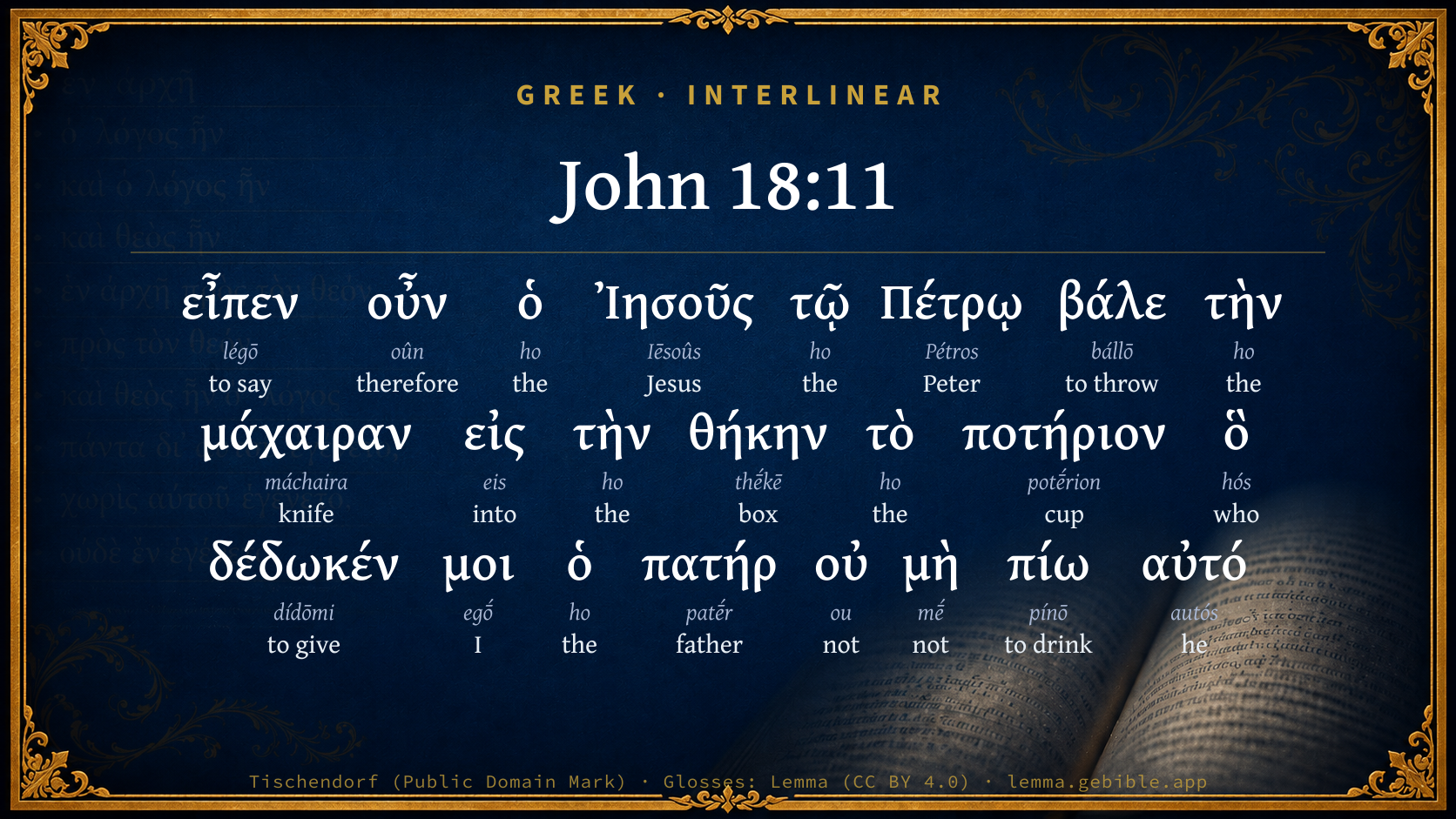
Greek (Tischendorf 8th ed.) John 18:11 appears in the Greek New Testament. The text above is from the Tischendorf 8th edition. Each word links to its Strong’s number and a concise gloss. Click any word for its full Thayer’s Greek Lexicon entry.
Download image
Cite this verse

John 18:11 (World English Bible). Public Domain. Lemma interlinear Bible study tool, https://lemma.gebible.app/v/john/18/11.

Show BibTeX & RIS
BibTeX
RIS
English Translation
Jesus therefore said to Peter, "Put the sword into its sheath. The cup which the Father has given me, shall I not surely drink it?"
World English Bible · Public Domain
Highlights
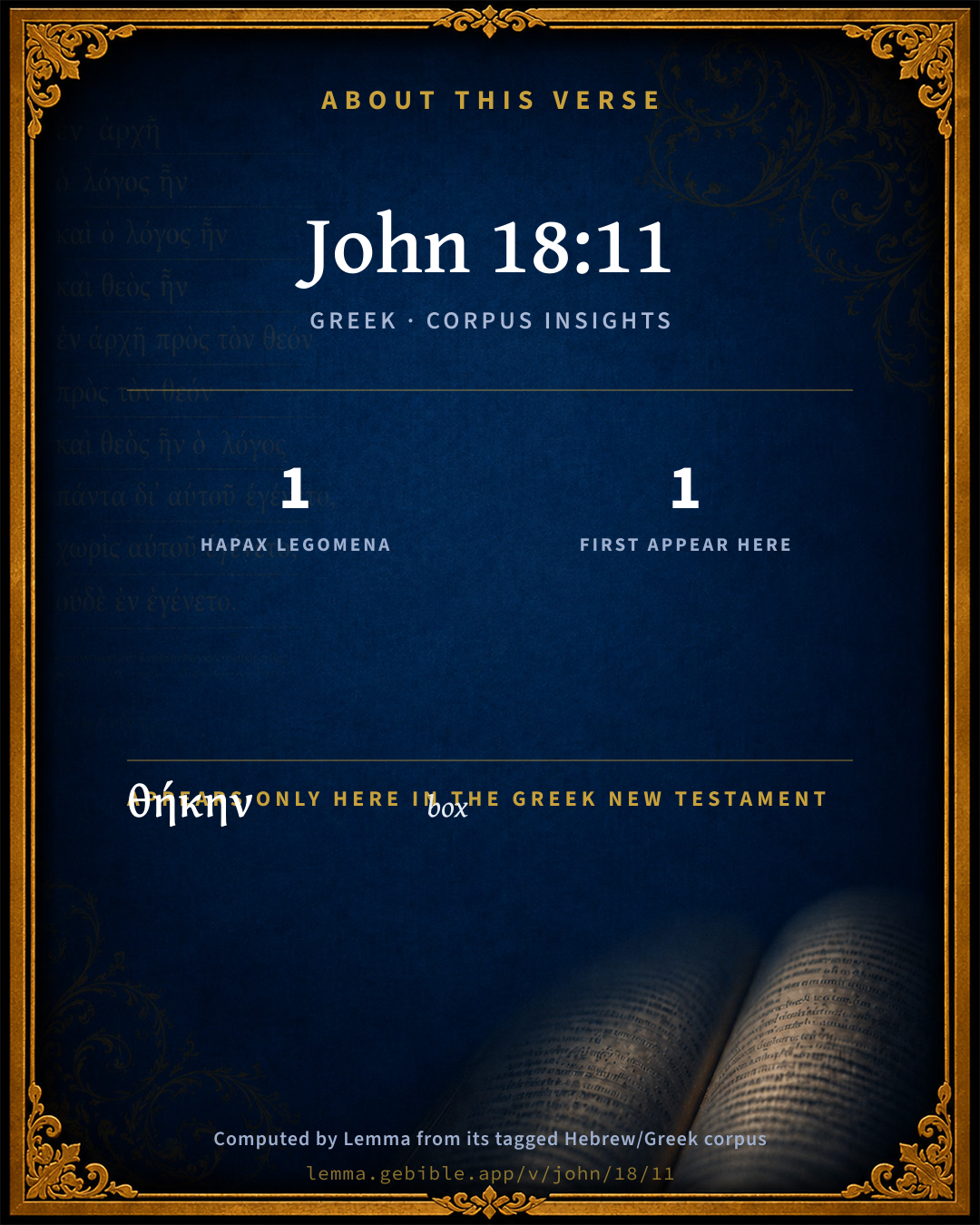
  • 1 hapax legomenon — only here in the Greek New Testament
  • 1 first appearance in the Greek New Testament
Full analysis ↓
Download a study sheet

One document with this verse’s original text, its word-by-word gloss line, the meaning frame, cross-references with their text, attributed commentary, and full source and license credits — printable, and it pastes into notes with its structure intact.

This verse Autodidact and up

Study sheet (.html) Plain text (.txt)

A passage Seminary Student

Up to 50 verses in one chapter. A passage sheet keeps up to 6 commentary sources and 12 cross-references per verse, in the order this page ranks them, and says so on the sheet whenever that leaves anything out. Ask for a single verse and you get the Autodidact verse sheet above.

Everything on this page stays free to read, with no account — the sheet is a download of what is already on screen, not access to it.

Want to remove ads? Support Godless Engineer
Compare translations 3

The same verse in 3 English versions, stacked beneath the original-language interlinear above. Click any original word for its lexicon entry.

Each is an independent rendering of the whole verse — the interlinear is not word-aligned to these translations.

Highlighted words mark where these versions differ — a whole-verse word diff, not a word-by-word alignment.

  • World English Bible Public Domain
    Jesus therefore said to Peter, "Put the sword into its sheath. The cup which the Father has given me, shall I not surely drink it?"
  • King James Version Public Domain
    Then said Jesus unto Peter, Put up thy sword into the sheath: the cup which my Father hath given me, shall I not drink it?
  • unfoldingWord Literal Text CC BY-SA 4.0
    Then Jesus said to Peter, “Put the sword into the sheath. The cup which the Father has given me, should I certainly not drink it?”

unfoldingWord Literal Text — © unfoldingWord, licensed CC BY-SA 4.0. Word-aligned USFM3 via Door43 (git.door43.org/unfoldingWord/en_ult).

Versions to compare (up to 4)

3 of 4 selected

Show all 19 translations

Every available English version of this verse, each an independent rendering of the whole verse.

  • World English Bible Public Domain
    Jesus therefore said to Peter, "Put the sword into its sheath. The cup which the Father has given me, shall I not surely drink it?"
  • Berean Standard Bible Public Domain
    “Put your sword back in its sheath!” Jesus said to Peter. “Shall I not drink the cup the Father has given Me?”
  • Majority Standard Bible Public Domain
    “Put your sword back in its sheath!” Jesus said to Peter. “Shall I not drink the cup the Father has given Me?”
  • King James Version Public Domain
    Then said Jesus unto Peter, Put up thy sword into the sheath: the cup which my Father hath given me, shall I not drink it?
  • American Standard Version (1901) Public Domain
    Jesus therefore said unto Peter, Put up the sword into the sheath: the cup which the Father hath given me, shall I not drink it?
  • Revised Version (1885) Public Domain
    Jesus therefore said unto Peter, Put up the sword into the sheath: the cup which the Father hath given me, shall I not drink it?
  • Geneva Bible (1599) Public Domain
    Then sayde Iesus vnto Peter, Put vp thy sworde into the sheath: shall I not drinke of the cuppe which my Father hath giuen me?
  • Douay-Rheims (1899) Public Domain
    Jesus therefore said to Peter: Put up thy sword into the scabbard. The chalice which my Father hath given me, shall I not drink it
  • Young's Literal Translation Public Domain
    Jesus, therefore, said to Peter, `Put the sword into the sheath; the cup that the Father hath given to me, may I not drink it?'
  • Literal Standard Version CC BY-SA 4.0
    Jesus, therefore, said to Peter, “Put the sword into the sheath; the cup that the Father has given to Me, may I not drink it?”
  • Unlocked Literal Bible CC BY-SA 4.0
    Jesus said to Peter, “Put the sword back into its sheath. Should I not drink the cup that the Father has given me?”
  • unfoldingWord Literal Text CC BY-SA 4.0
    Then Jesus said to Peter, “Put the sword into the sheath. The cup which the Father has given me, should I certainly not drink it?”
  • Darby Bible Public Domain
    Jesus therefore said to Peter, Put the sword into the sheath; the cup which the Father has given me, shall I not drink it?
  • World Messianic Bible Public Domain
    Yeshua therefore said to Peter, “Put the sword into its sheath. The cup which the Father has given me, shall I not surely drink it?”
  • Webster's Bible Public Domain
    Then said Jesus to Peter, Put up thy sword into the sheath: the cup which my Father hath given me, shall I not drink it?
  • Free Bible Version CC BY-SA 4.0
    Jesus told Peter, “Put the sword away! Do you think I shouldn't drink the cup the Father has given me?”
  • Bible in Basic English Public Domain
    Then Jesus said to Peter, Put back your sword: am I not to take the cup which my Father has given to me?
  • Text-Critical English NT CC BY 4.0
    But Jesus said to Peter, “Put yoʋr sword back in its sheath; shall I not drink the cup the Father has given me?”
  • Tyndale New Testament (1534) Public Domain
    Simon Peter had a swearde and drue it and smote the hye prestes servaunt and cut of his ryght eare. The servauntes name was Malchas.

Literal Standard Version (2020), Covenant Press — licensed CC BY-SA 4.0. Text via the HelloAO Bible API (eBible.org). Unlocked Literal Bible (unfoldingWord) — licensed CC BY-SA 4.0. Text via the HelloAO Bible API (eBible.org). unfoldingWord Literal Text — © unfoldingWord, licensed CC BY-SA 4.0. Word-aligned USFM3 via Door43 (git.door43.org/unfoldingWord/en_ult). Free Bible Version, Dr. Jonathan Gallagher — licensed CC BY-SA 4.0. Text via the HelloAO Bible API (eBible.org).

Word by word

More ways to search: Search by grammar → Find every occurrence → Compare this word →

Practice this passage: Drill this verse → Learn its vocabulary →

θήκην
thḗkē
G2336
“box”
Noun, Accusative, Singular, Feminine
Part of Speech
Noun
Case
Accusative
Number
Singular
Gender
Feminine
Full Thayer's Definition

Origin: from G5087

TDNT: None

1. that which a thing is put or laid away, a receptacle, repository, chest, box a. used of the sheath of a sword
  1. εἶπεν légō G3004 “to say” Verb, Aorist, Active, Indicative, 3rd person, Singular
  2. οὖν oûn G3767 “therefore” Conjunction
  3. ὁ ho G3588 “the” Article, Nominative, Singular, Masculine
  4. Ἰησοῦς Iēsoûs G2424 “Jesus” Noun, Nominative, Singular, Masculine
  5. τῷ ho G3588 “the” Article, Dative, Singular, Masculine
  6. Πέτρῳ Pétros G4074 “Peter” Noun, Dative, Singular, Masculine
  7. βάλε bállō G906 “to throw” Verb, Aorist, Active, Imperative, 2nd person, Singular
  8. τὴν ho G3588 “the” Article, Accusative, Singular, Feminine
  9. μάχαιραν máchaira G3162 “knife” Noun, Accusative, Singular, Feminine
  10. εἰς eis G1519 “into” Preposition
  11. τὴν ho G3588 “the” Article, Accusative, Singular, Feminine
  12. τὸ ho G3588 “the” Article, Accusative, Singular, Neuter
  13. ποτήριον potḗrion G4221 “cup” Noun, Accusative, Singular, Neuter
  14. ὃ hós G3739 “who” Relative pronoun, Accusative, Singular, Neuter
  15. δέδωκέν dídōmi G1325 “to give” Verb, Perfect, Active, Indicative, 3rd person, Singular
  16. μοι egṓ G1473 “I” Personal pronoun, 1st person, Dative, Singular
  17. ὁ ho G3588 “the” Article, Nominative, Singular, Masculine
  18. πατήρ patḗr G3962 “father” Noun, Nominative, Singular, Masculine
  19. οὐ ou G3756 “not” Particle, Negative
  20. μὴ mḗ G3361 “not” Particle, Negative
  21. πίω pínō G4095 “to drink” Verb, Aorist, Active, Subjunctive, 1st person, Singular
  22. αὐτό autós G846 “he” Personal pronoun, Accusative, Singular, Neuter

About this verse

These counts appear in no published source. They are computed here, from the morphology-tagged text and Lemma’s own curated glosses. What Lemma adds →

23
words
18
distinct lemmas
Gospels
section

Notable vocabulary

1 hapax legomenon — a word that appears only here in the entire Greek New Testament:

First appearance in Scripture

This word makes its first canonical appearance in the Greek New Testament here:

Shared distinctive vocabulary

μάχαιραν knife G3162 occurs in 26 verses of the Greek New Testament. Also found in:

Repetition

A word recurs within this verse:

Cross-references

21

Topical passages linked to John 18:11 in the Treasury of Scripture Knowledge — connected by theme and wording, ordered by reader-vote popularity; previews shown in the World English Bible.

  • Matthew 20:22 But Jesus answered, "You don't know what you are asking. Are you able to drink the cup that I am about to drink, and be baptized with the baptism that I am baptized with?" They said to him, "We are able."
  • Matthew 26:39 He went forward a little, fell on his face, and prayed, saying, "My Father, if it is possible, let this cup pass away from me; nevertheless, not what I desire, but what you desire."
  • John 20:17 Jesus said to her, "Don't touch me, for I haven't yet ascended to my Father; but go to my brothers, and tell them, 'I am ascending to my Father and your Father, to my God and your God.'"
  • John 12:27–28 "Now my soul is troubled. What shall I say? 'Father, save me from this time?' But for this cause I came to this time.
  • John 15:10 If you keep my commandments, you will remain in my love; even as I have kept my Father's commandments, and remain in his love.
  • Hebrews 12:2 looking to Jesus, the author and perfecter of faith, who for the joy that was set before him endured the cross, despising shame, and has sat down at the right hand of the throne of God.
  • Mark 10:38–39 But Jesus said to them, "You don't know what you are asking. Are you able to drink the cup that I drink, and to be baptized with the baptism that I am baptized with?"
  • Mark 14:35–36 He went forward a little, and fell on the ground, and prayed that, if it were possible, the hour might pass away from him.
  • Luke 22:42 saying, "Father, if you are willing, remove this cup from me. Nevertheless, not my will, but yours, be done."
  • 2 Corinthians 6:7 in the word of truth, in the power of God; by the armor of righteousness on the right hand and on the left,
  • 2 Corinthians 10:4 for the weapons of our warfare are not of the flesh, but mighty before God to the throwing down of strongholds,
  • Matthew 26:42 Again, a second time he went away, and prayed, saying, "My Father, if this cup can't pass away from me unless I drink it, your desire be done."
  • Psalms 75:8 For in the hand of Yahweh there is a cup, Full of foaming wine mixed with spices. He pours it out. Indeed the wicked of the earth drink and drink it to its very dregs.
  • Ezekiel 23:31 You have walked in the way of your sister; therefore will I give her cup into your hand.
  • Luke 12:30 For the nations of the world seek after all of these things, but your Father knows that you need these things.
  • John 11:41–42 So they took away the stone from the place where the dead man was lying. Jesus lifted up his eyes, and said, "Father, I thank you that you listened to me.
  • John 17:24 Father, I desire that they also whom you have given me be with me where I am, that they may see my glory, which you have given me, for you loved me before the foundation of the world.
  • Romans 8:15–18 For you didn't receive the spirit of bondage again to fear, but you received the Spirit of adoption, by whom we cry, "Abba! Father!"
  • Hebrews 12:5–10 and you have forgotten the exhortation which reasons with you as with children, "My son, don't take lightly the chastening of the Lord, Nor faint when you are reproved by him;
  • John 18:36 Jesus answered, "My Kingdom is not of this world. If my Kingdom were of this world, then my servants would fight, that I wouldn't be delivered to the Jews. But now my Kingdom is not from here."
  • Ephesians 6:11–17 Put on the whole armor of God, that you may be able to stand against the wiles of the devil.

Cross-references courtesy of OpenBible.info (CC BY 4.0).

Commentary

Notes on John 18:11 from classic Christian and Jewish commentators (each source and its license shown beneath its notes). The classic Christian expositions comment on the surrounding passage and are grouped to its opening verse, so a note may address several verses; the Jewish commentaries on the Tanakh (Rashi and others) are per-verse, so they appear only where the commentator wrote on this verse.

Lemma curates 59 commentaries, every one of them public domain or Creative Commons licensed, each selected and text-cleaned for this edition rather than reprinted as found. About our sources →

Bengel's Gnomon

Johann Albrecht Bengel

Joh 18:11. Τὸ ποτήριον, the cup) Jesus refers to those things which He had said in Mat 20:22; Mat 26:39.[379] Therefore John presupposes those particulars which Matthew wrote in the passages just quoted.—οὐ μὴ πίω; shall I not drink it?) It was at this (that He should not drink the cup) that the fighting of Peter was aiming.

[379] An undesigned coincidence between the two Evangelists; for John had not mentioned previously Jesus, prayer as to “the cup” passing from Him. But he now records the answer to that prayer in the Lord’s present full willingness to drink the cup.—E. and T.

Bengel's Gnomon of the New Testament — English translation (T&T Clark, Edinburgh, 1860) — public domain. Text from a community e-Sword module.

Expositor's Greek Testament

ed. W. Robertson Nicoll

Joh 18:11 . Peter’s action, however, was not commended. βάλε … θήκην . “Res evangelica non agitur ejusmodi praesidiis.” Erasmus. θήκη , a receptacle; sometimes ξιφοθήκη ; usually κολεός . τὸ ποτήριον … αὐτό . For the figure of the cup, see Eze 23:31-34 ; Mat 20:22 ; Mat 26:39 . Shall I refuse the lot appointed me by the Father?

The Expositor's Greek Testament, edited by W. Robertson Nicoll (1897–1910) — public domain. Text from a community e-Sword module.

Jamieson, Fausset & Brown

Robert Jamieson, A. R. Fausset & David Brown

Then said Jesus--"Suffer ye thus far" (Luk 22:51).

Put up thy sword into the sheath: the cup which my Father hath given me, shall I not drink it?--This expresses both the feelings which struggled in the Lord's breast during the Agony in the garden--aversion to the cup viewed in itself, but, in the light of the Father's will, perfect preparedness to drink it. (See on Luk 22:39-46). Matthew adds to the address to Peter the following:--"For all they that take the sword shall perish by the sword" (Mat 26:52) --that is, 'Those who take the sword must run all the risks of human warfare; but Mine is a warfare whose weapons, as they are not carnal, are attended with no such hazards, but carry certain victory.' "Thinkest thou that I cannot now"--even after things have proceeded so far--"pray to My Father, and He shall presently give Me"--rather, "place at My disposal"--"more than twelve legions of angels"; with allusion, possibly, to the one angel who had, in His agony, "appeared to Him from heaven strengthening Him" (Luk 22:43); and in the precise number, alluding to the twelve who needed the help, Himself and His eleven disciples. (The full complement of a legion of Roman soldiers was six thousand). "But how then shall the scripture be fulfilled that thus it must be?" (Mat 26:53-54). He could not suffer, according to the Scripture, if He allowed Himself to be delivered from the predicted death. "And He touched his ear and healed him" (Luk 22:51); for "the Son of man came not to destroy men's lives, but to save them" (Luk 9:56), and, even while they were destroying His, to save theirs.

Jamieson, Fausset & Brown — Commentary Critical and Explanatory on the Whole Bible (1871) — public domain (CC PDM 1.0). Text via the HelloAO Bible API.

Adam Clarke's Commentary

Verse 11. The cup which my Father hath given me] The cup signifies, sometimes the lot of life, whether prosperous or adverse: here it signifies the final sufferings of Christ.

Adam Clarke's Commentary on the Bible (1810–1826) — public domain. Text from a community e-Sword/MySword module.

John Calvin's Commentaries

11. Put up thy sword into the sheath. By this command Christ reproves Peter’s action. But we must attend to the reason, which is, that a private individual was not permitted to rise in opposition to those who had been invested with public authority; for this may be inferred from the other three Evangelists, who relate Christ’s general declaration,

He who strikes with the sword shall perish by the sword, (Matthew 26:52.)

We must also beware of repelling our enemies by force or violence, even when they unjustly provoke us, except so far as the institutions and laws of the community admit; for whoever goes beyond the limits of his calling, though he should gain the applause of the whole world, will never obtain for his conduct the approbation of God.

Shall I not drink the cup which my Father hath given to me? This appears to be a special reason why Christ ought to be silent, that he might be led as a lamb to be sacrificed, (Isaiah 53:7;) but it serves the purpose of an example, for the same patience is demanded from all of us. Scripture compares afflictions to medicinal draughts; for, as the master of a house distributes meat and drink to his children and servants, so God has this authority over us, that he has a right to treat every one as he thinks fit; and whether he cheers us by prosperity, or humbles us by adversity, he is said to administer a sweet or a bitter draught. The draught appointed for Christ was, to suffer the death of the cross for the reconciliation of the world. He says, therefore, that he must drink the cup which his Father measured out and delivered to him.

In the same manner we, too, ought to be prepared for enduring the cross. And yet we ought not to listen to fanatics, who tell us that we must not seek remedies for diseases and any other kind of distresses, lest we reject the cup which the Heavenly Father presents to us. Knowing that we must once die, (Hebrews 9:27,) we ought to be prepared for death; but the time of our death being unknown to us, the Lord permits us to defend our life by those aids which he has himself appointed. We must patiently endure diseases, however grievous they may be to our flesh; and though they do not yet appear to be mortal, we ought to seek alleviation of them; only we must be careful not to attempt any thing but what is permitted by the word of God. In short, provided that this remain always fixed in our hearts, Let the will of the Lord be done, (Acts 21:14,) when we seek deliveralice from the evils which press upon us, we do not fail to drink the cup which the Lord has given to us.

John Calvin's Commentaries (1540-1563) — public domain. Text from the Calvin Translation Society English edition (1840s-50s) via the Christian Classics Ethereal Library (ccel.org). Calvin's coverage is partial (roughly two-thirds of the Bible); uncommented books and verses are honest gaps, never fabricated. The 19th-century editor's footnotes and remarks are omitted so the notes are faithfully Calvin's own voice.

Ellicott's Commentary for English Readers

(11) Put up thy sword into the sheath.—Comp. Note on Mat_26:52. Here again St. John’s narrative is more vivid and exact. St. Matthew has “place” for “sheath.”

The cup which my Father hath given me, shall I not drink it?—Comp. Notes on Mat_20:22; Mat_26:39. This is the only instance of the occurrence of this familiar imagery in St. John. St. Peter’s act is one of opposition to what Jesus Himself knew to be the will of the Father. There is in the words a tender trustfulness which robs the cup of all its bitterness—“The cup which My Father hath given Me.” They are, as it were, an echo of the prayer in the Garden of Gethsemane, which is not recorded by St. John. It is the Father to whom He has prayed, and solemnly committed the disciples (John 17); the Father whose presence never leaves Him (Joh_16:32); the Father into whose hands He is about from the cross to commend His Spirit (Luk_23:46).

A Bible Commentary for English Readers, edited by Charles John Ellicott (1878–1897) — public domain. Text from a community e-Sword module.

The Cambridge Bible for Schools and Colleges

gen. ed. J. J. S. Perowne

11. Then said Jesus] Jesus therefore (Joh_18:3) said.

the cup] S. John alone gives these words. On the other hand, the Synoptists alone give Christ’s prayer in the garden (Mat_26:39, &c.) to which they obviously refer. Thus the two accounts confirm one another. See on Joh_2:19. For the metaphor comp. Psa_75:8; Psa_60:3; Job_21:20; Jer_25:15; Rev_14:10; Rev_16:19, &c. S. Matthew gives another reason for putting up the sword into its place; ‘all they that take the sword shall perish with the sword’ (Mat_26:52).

The Cambridge Bible for Schools and Colleges (gen. ed. J. J. S. Perowne; Cambridge University Press, 1878–1918) — public domain. Text from a community e-Sword module.

John Gill's Exposition

Then said Jesus unto Peter,.... By way of rebuke, and to prevent his repeating the blow, and that further mischief might not ensue; for such a bold imprudent action risked the lives of all the disciples, who, in all probability, would have fallen a sacrifice to the fury and resentment of these men, had not Christ interposed in this prudent manner; who, also, Luke says, touched the servant's ear and healed him, Luk 22:51, which no doubt tended greatly to conciliate their minds, and make them easy:

put up thy sword into the sheath: Peter was not a proper person to bear the sword, and use it; it was a very daring attack, and a dangerous one, and was very unnecessary; since Christ could have defended himself, had he thought fit, without Peter's drawing his sword; and besides, for a word speaking, he could have had of his Father more than twelve legions of angels; and it was also contrary to the nature of his kingdom, which was not of this world, nor to be supported and defended in any such manner; and was, moreover, as much as in Peter lay, an hinderance of his sufferings, and of the execution of his Father's will and decree; wherefore he adds,

the cup which my Father hath given me: by the cup is meant, the wrath of God, and punishment due to sin, endured by Christ in his sufferings, and is said to be given him by his Father; because he called him to these sufferings, they were appointed and determined by him; yea, he was even ordered, and commanded by his Father, to drink of this cup; justice mixed it up, and put it into his hands; and he took it as coming from his Father, who delighted in seeing him drink it up, as the stately of his people; and a dreadful one it was, a cup of trembling and astonishment, of curse, and not of blessing, of wrath and fury: the allusion seems to be to the master of the family, who appointed, and gave to everyone their cup:

shall I not drink it? which expresses his, willingness to do it, his eager desire after it, his delight in it, and displeasure at Peter's attempt to hinder him; he being now perfectly reconciled in his human nature to drink it, though it was so bitter a potion: he found it was impossible, considering the decree of God, his own agreement, and the salvation of his people, that it should be otherwise; and besides, it was his Father's will and pleasure, he considered it as coming from him; and therefore cheerfully accepted it, and was, resolved to drink it up, and that nothing should hinder him. The Persic version reads it, "I will not give it to another to drink"; Peter, by this rash action, seeming as if he would have the cup out of Christ's hands, and have drank it himself; which, as it could not be, nor would Christ suffer it, so if he had, it would have been of no advantage to the salvation of his people.

John Gill's Exposition of the Whole Bible (1746–1763) — public domain (CC PDM 1.0). Text via the HelloAO Bible API.

Trapp's Complete Commentary

John Trapp

11 Then said Jesus unto Peter, Put up thy sword into the sheath: the cup which my Father hath given me, shall I not drink it?

Ver. 11. Put up thy sword] Our Saviour checks him for his inordinate zeal; wherein to be overly carried, is easy and ordinary. The memorable story of William Gardiner, martyr in Portugal, who in the very presence of the king and his nobles could not forbear, but fell upon the cardinal, as he was acting a mass. See Acts and Monuments, fol. 1242. So William Flower, upon an Easter day at Westminster, seeing a priest ministering the sacrament of the altar to the people, struck and wounded him upon the head, and also upon his arm and hand, with a wood knife. In the which so doing, as indeed he did not well, nor evangelically; so being afterwards examined by Bishop Bonner, he did no less confess his not well doing in the same, submitting therefore himself willingly to punishment, when it should come. Howbeit, touching his belief in the sacrament and Popish ministration, he neither did nor would submit himself. But when he was tempted to turn, and also threatened, he answered, Do what ye will, I am at a point; for the heavens shall as soon fall, as I will forsake mine opinion, &c. At his execution, first his hand being held up against the stake, was stricken off. At the which, some that were present affirmed that he shrunk not, but once a little stirred his shoulders. (Acts and Mon.)

John Trapp, A Commentary or Exposition upon All the Books of the Old and New Testament (1647–1656) — public domain. Text from a community e-Sword module.

Matthew Poole's English Annotations

The other evangelists report this part of the history with many more circumstances; particularly our Saviour’s miraculous healing Malchus again; See Poole on "Mat 26:51", and following verses to Mat 26:54. See Poole on "Mar 14:47", and following verses to Mar 14:49. See Poole on "Luk 22:50-51". With what pretence some, both of the ancient and modern writers, think that Peter did not sin in this action, I do not understand, when our Saviour did not only (as John saith) command him to put up his sword again into its sheath, but also (as Matthew tells us, Mat 26:52) told him, that all they that take the sword, that is, without commission from God, shall perish with the sword. He used that argument, according to the other evangelists. This evangelist tells us of another,

The cup which my Father hath given me, shall I not drink it? That is, shall I not freely and cheerfully submit to the will of God in suffering what he willeth me to suffer? The term cup is often in Scripture used to signify people’s measure and proportion of affliction and suffering, which God allots them; (possibly the metaphor is taken from the custom of some nations, to put some kinds of malefactors to death by giving them a cup of poison); See Poole on "Mat 20:22", See Poole on "Mat 26:39". It is a good argument to quiet our spirits roiled by any afflictive providences: they are but a cup, and the cup our Father hath given us.

Matthew Poole's English Annotations on the Holy Bible (1683–1685) — public domain. Text from a community e-Sword/MySword module.

The Pulpit Commentary

In Christ"s reply there is no mention made of the miracle which followed, and yet the narrative is incomplete without it. Something must have restrained the baud and the high priest"s own temple-watch from at once arresting Peter, if not the entire group. The characteristic touch, descriptive of our Lord"s most Divine compassion, is in itself valuable, but it also accounts for the immunity of Peter. The solemn rebuke of Peter is full of Divine meaning, and is another link with the synoptic narrative of the agony. "Put up," or more literally, Cast the sword into its sheath (koleov is the classical word; yhkh more generally used of repository, receptacle, sepulcher, etc.); or into its hiding-place; bury it away (topov is used in Matthew). Matthew adds a memorable saying, but is silent as to the deep Divine reason of the submission of our Lord to his fate. The cup which the Father hath given me, shall I not drink it? This imagery recalls the Passion, through which we learn from the synoptists that our Lord had passed into a Divine patience and submission to the will of God. (Mat_20:22 Mat_26:39) The use of this most remarkable phraseology recalls that which John too had heard from his lips in the sweat of his agony, and of which he and Peter were the principal witnesses. The supplementary character of the Gospel, though by no means sufficient to account for all the omissions and additions of this narrative, yet does explain very much. "Jesus is now of his own accord at the disposal of his enemies; his words have put a stop to all further steps taken for his defense" (Moulton). (See Introduction, pp. 106, 107)

The sword and the cup.

To ordinary human nature work is easier than patience, and resistance than submission. Our Lord, in this crisis of his history, both adopted the more difficult course for himself, and commended it to his disciples.

I CHRIST"S DISAVOWAL OF THE SWORD.

1. The sword is the symbol of physical force, of resistance. Properly a weapon of attack, it may nevertheless be used for defense. The sword is in the hands of the soldier who withstands his foe; of the magistrate who maintains order and vindicates justice, and who bears it not in vain. It is the emblem of secular authority, of carnal power.

2. There was a sense in which the use of the sword had been sanctioned by Christ. When he had said, "I came, not to send peace, but a sword," Jesus had referred to the conflicts which should arise in society as a result of his mission to earth. But he had, almost immediately before the occurrence in connection with which the words of the text were spoken, expressly directed his disciples to arm themselves, telling them of the perils they should encounter, and bidding them even to sell their garments in order to procure the means of defense. Evidently there were some kinds of danger against which they were at liberty to arm.

3. The time of Christ"s sacrifice was not the time for resistance. Peter, indignant at his Lord"s betrayal, impulsive in his nature, and impetuous in his action, seeing his Master in danger, drew and used his sword. But Jesus forbade and disclaimed the use of carnal weapons in his cause. His kingdom was not of this world, and it would not have been consonant either with his gentle character or with the nature of his religion a spiritual religion relying on conviction and affection to sanction the promulgation of his doctrine, the extension of his Church, by means of the sword. Christ"s people were not prohibited from taking advantage of their privileges as citizens, from using lawful means to secure protection and safety, from defending themselves against lawless violence. But to resist civil authority by force, in the name of Christ and for the spread of Christianity, was certainly forbidden, both by the language and by the example of Jesus.

II CHRIST"S ACCEPTANCE OF THE CUP.

1. The nature of this cup is apparent from the context as well as from other parts of Scripture. By "the cup" we are to understand suffering and sorrow. This is its meaning in the question, "Can ye drink of the cup which I drink of?" and in the prayer, "If it be possible, let this cup pass from me." The bitter ingredients in Christ"s cup were the suffering and agony of body involved in crucifixion; the mental distress involved in his betrayal, denial, and forsaking by his disciples, in the apparent success of his enemies" plot, in the fickleness and ingratitude of his fellow-countrymen; the anguish of soul consequent upon his consciousness of the world"s sin, its estrangement from God, and ill desert, the heavy burden (to change the figure) of his sacrifice.

2. Christ"s shrinking from this cup was natural; for his bodily frame was sensitive, and his heart was tender. He would fain have avoided drinking the bitter draught. He even prayed to be relieved from the distressing experience, if such avoidance and relief were compatible with the Father"s will, and with his own purpose to redeem mankind.

3. The inducement to accept the sorrow was the highest and the most constraining possible; the CUP was "given" him by his Father. Apparently it was prepared and handed to him by his foes. But really, in a wonderful, mysterious sense, it was the appointment of the Father"s wisdom. This was not at the time understood by Peter or by the other disciples; Jesus alone comprehended the nature of this crisis in the moral history of mankind. The cup was not given as a sign of the Father"s displeasure, but as a means to a higher spiritual end, which was dear to the Father"s heart.

4. The resolve of the Son of man to drink the cup, when this was seen and felt to be the Father"s will, is very instructive. This was part of his perfect obedience, of obedience taking the form of submission. Thus was he made "perfect through suffering.

5. The results of this sacrifice have been most beneficial and precious to mankind. By drinking the cup of suffering our Savior has released us from drinking the cup of personal guilt and merited punishment.

PRACTICAL LESSONS.

1. Gratitude and faith towards a Savior so compassionate and self-sacrificing.

2. Patience and submission beneath the trials and sufferings of life. When seeking for motive and for strength to drink the bitter cup of pain and grief, let Christians recur with humility and with sympathy to the incomparable example of their suffering Lord. T.

The Pulpit Commentary (1880–1919), ed. H.D.M. Spence-Jones & Joseph S. Exell — public domain. Text from a community e-Sword module.

Cambridge Greek Testament for Schools and Colleges

11. βάλε. See on Joh 5:7. S. John alone gives the words about the cup: the Synoptists alone (Mat 26:39, &c.) give the prayer to which they obviously refer. Thus the two accounts confirm one another. Comp. Joh 2:19, Joh 12:8; and for the metaphor Psa 75:8; Psa 60:3; Job 21:20; Rev 14:10; Rev 16:19. S. Matthew gives another reason for sheathing; ‘all they that take the sword shall perish with the sword’ (Mat 26:52). “Any zeal is proper for religion but the zeal of the sword and the zeal of anger” (Jeremy Taylor). For οὐ μή interrogative comp. Rth 3:1; οὐ μὴ εὕρω σοι ἀνάπαυσιν; See on Joh 4:48.

Cambridge Greek Testament for Schools and Colleges (Cambridge University Press, 1896; 21 vols, various authors incl. Carr, Maclear, Plummer, Farrar, Lumby, Moule, M. R. James, Simcox) — public domain. Text from a community e-Sword module.

Alford’s Greek Testament

Henry Alford

11.] τὴν θήκ. = τὸν τόπ. αὐτῆς, Matt., where see notes.

τὸ ποτ.] A striking allusion to the prayer in Gethsemane; for the image does not elsewhere occur in our Evangelist. See Mat 20:22 and .

οὐ μὴ πίω] am I not to drink it? “non vis ut bibam?” Vulg. Sixt. “Huc enim tendebat pugna Petri.” Bengel.

Henry Alford, The Greek Testament (1849–1861) — public domain. Text from a community e-Sword module.

International Critical Commentary

11. Jesus forbids the use of arms in resisting His arrest. The Synoptists represent Him as expostulating against it, and especially against the violent way in which it was effected (Mar 14:48, Mat 26:55, Luk 22:52); but in Jn.’s narrative there is none of this. He moves voluntarily towards the predestined end.

Βάλε τὴν μάχαιραν εἰς τὴν θήκην, “put back the sword into the sheath.” Mt., alone of the Synoptists, tells of this saying, which he gives in a more diffuse form: ἀπόστρεψόν σου τὴν μάχαιραν εἰς τὸν τόπον αὐτῆς· πάντες γὰρ οἱ λαβόντες μάχαιραν ἐν μαχαίρᾳ ἀπολοῦνται (Mat 26:52), the latter clause suggesting the hand of an editor. According to Jn., Jesus gave no reason for the quiet command, “Put up your sword.” See on v. 36 below.

After μάχαιραν the rec. adds σου (from Mat 26:52), but om. אABCDLNWΘ.

θήκη does not occur again in the N.T.

τὸ ποτήριον ὃ δέδωκέν μοι ὁ πατήρ, οὐ μὴ πίω αὐτό; This recalls the prayer of Jesus at Gethsemane, as recorded by the Synoptists (Mar 14:36, Mat 26:39, Luk 22:42). See on v. 1 above and on 12:27.

οὐ μὴ πίω αὐτό is probably to be taken as an interrogative. Abbott, however (Diat. 934 f, 2232), prefers to take it as an exclamation, “I am, of course, not to drink it!” [sc. according to your desire], comparing οὐ μὴ πίω of Mar 14:25, Mat 26:29, Luk 22:18. See on 6:37.

Jesus is Bound and Brought to the House of Annas (vv. 12-14)

International Critical Commentary — older volumes (1896–1929), various authors — public domain. Text from a community e-Sword module.

Vincent's Word Studies in the New Testament

Marvin R. Vincent

Thy sword. Omit thy, and read, the sword.

Sheath [θηκην] . Only here in the New Testament. From tiqhmi, to put. That into which the sword is put.

The cup. Compare Mt 26:39; Mr 14:36; Luk 22:42. Peculiar to John.

Marvin R. Vincent, Word Studies in the New Testament (1887–1900) — public domain. Text from a community e-Sword/MySword module.

Lesson kit

Teaching starters — assembled from the data on this page, not authored interpretation. Every prompt links to the verse data it draws on. Edit before teaching.

John, in the Gospels, opens this verse with 23 words (18 distinct Greek lemmas). Its most distinctive word is thḗkē (“box”). A historical commentator’s framing appears above. Read the whole chapter for the surrounding context.

Discussion questions

  1. The word thḗkē carries the sense “box.” How does it shape the verse?
  2. This verse holds 1 word here found nowhere else in the Greek New Testament. What might the rare word draw attention to?
  3. The word “box” first appears here in Scripture. What is being introduced at this debut?
  4. Matthew 10:34 shares the word «knife» with this verse. How do the two illuminate each other?
  5. “the” occurs 6× in this one verse. What is the effect of the repetition?
  6. The translations on this page render this verse differently — a whole-verse word diff, not a word-by-word alignment. What might account for the different wordings?
  7. Reading how Bengel's Gnomon and Expositor's Greek Testament read this verse, where do the two commentators agree and where do they part?

Things to notice

  • 1 word in this verse appears nowhere else in the Greek New Testament.
  • 1 word makes its first canonical appearance in Scripture here.
  • These translations choose different wording for 7 words in this verse.
  • “the” occurs 6× in this single verse.
  • 18 distinct Greek lemmas span 23 words in this verse.

Reading settings

Reading text

Shown beneath each verse's original-language words.

Old Testament
Old Testament edition

Read the OT as the Masoretic Hebrew (MT) or the Greek Septuagint (LXX).

English shown for the Greek Septuagint (in the Hebrew ↔ Greek comparison).

Comparing translations? Open the Compare panel on any verse page to stack up to four side by side.