Matthew 11:4

Greek (Tischendorf 8th ed.) Matthew 11:4 appears in the Greek New Testament. The text above is from the Tischendorf 8th edition. Each word links to its Strong’s number and a concise gloss. Click any word for its full Thayer’s Greek Lexicon entry.
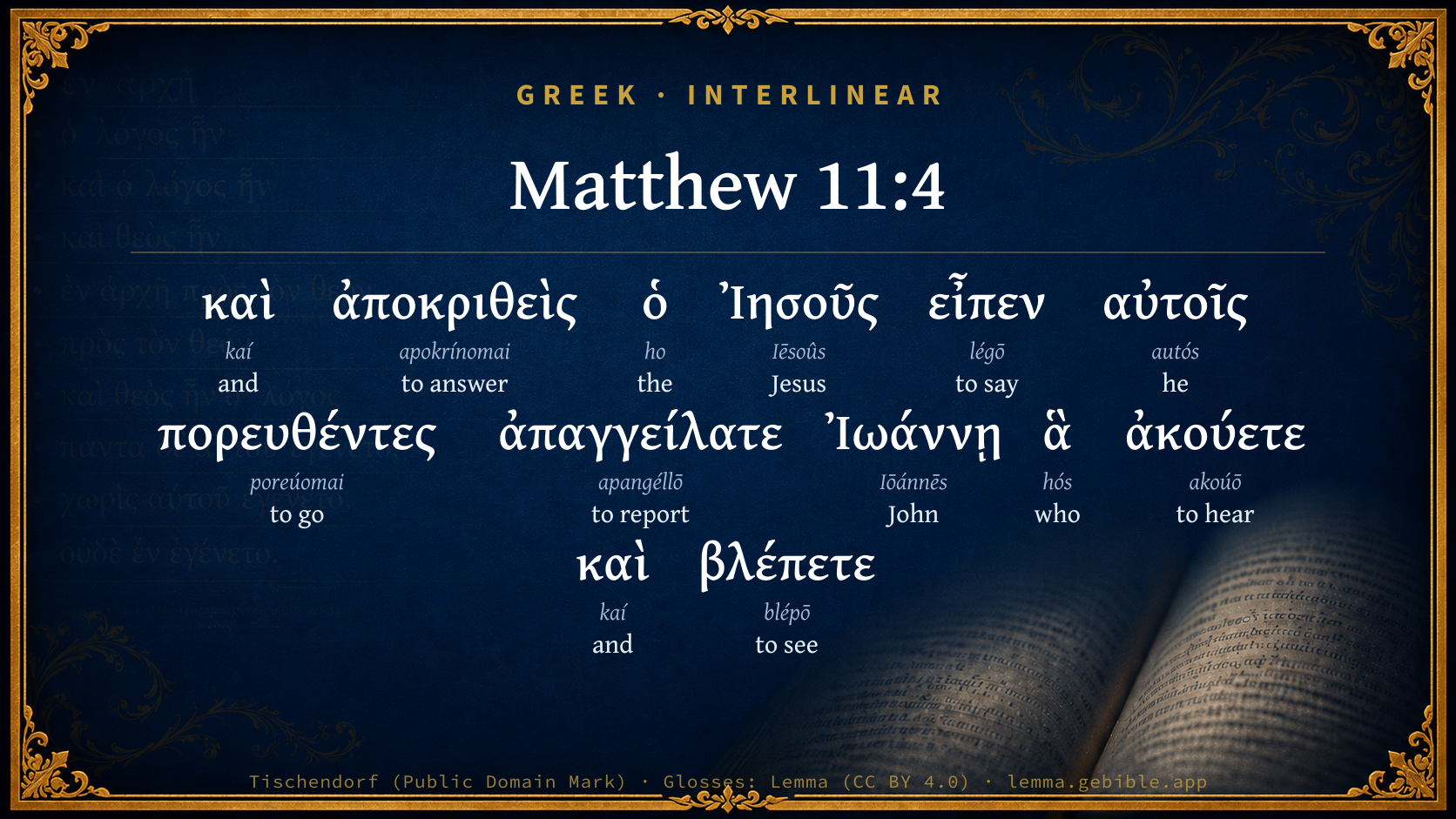
Download image
Cite this verse

Matthew 11:4 (World English Bible). Public Domain. Lemma interlinear Bible study tool, https://lemma.gebible.app/v/matthew/11/4.

Show BibTeX & RIS
BibTeX
RIS
English Translation
Jesus answered them, "Go and tell John the things which you hear and see:
World English Bible · Public Domain
Download a study sheet

One document with this verse’s original text, its word-by-word gloss line, the meaning frame, cross-references with their text, attributed commentary, and full source and license credits — printable, and it pastes into notes with its structure intact.

This verse Autodidact and up

Study sheet (.html) Plain text (.txt)

A passage Seminary Student

Up to 50 verses in one chapter. A passage sheet keeps up to 6 commentary sources and 12 cross-references per verse, in the order this page ranks them, and says so on the sheet whenever that leaves anything out. Ask for a single verse and you get the Autodidact verse sheet above.

Everything on this page stays free to read, with no account — the sheet is a download of what is already on screen, not access to it.

Want to remove ads? Support Godless Engineer
Compare translations 3

The same verse in 3 English versions, stacked beneath the original-language interlinear above. Click any original word for its lexicon entry.

Each is an independent rendering of the whole verse — the interlinear is not word-aligned to these translations.

Highlighted words mark where these versions differ — a whole-verse word diff, not a word-by-word alignment.

  • World English Bible Public Domain
    Jesus answered them, "Go and tell John the things which you hear and see:
  • King James Version Public Domain
    Jesus answered and said unto them, Go and shew John again those things which ye do hear and see:
  • unfoldingWord Literal Text CC BY-SA 4.0
    And answering, Jesus said to them, “Having gone, report to John what you hear and see.

unfoldingWord Literal Text — © unfoldingWord, licensed CC BY-SA 4.0. Word-aligned USFM3 via Door43 (git.door43.org/unfoldingWord/en_ult).

Versions to compare (up to 4)

3 of 4 selected

Show all 19 translations

Every available English version of this verse, each an independent rendering of the whole verse.

  • World English Bible Public Domain
    Jesus answered them, "Go and tell John the things which you hear and see:
  • Berean Standard Bible Public Domain
    Jesus replied, “Go back and report to John what you hear and see:
  • Majority Standard Bible Public Domain
    Jesus replied, “Go back and report to John what you hear and see:
  • King James Version Public Domain
    Jesus answered and said unto them, Go and shew John again those things which ye do hear and see:
  • American Standard Version (1901) Public Domain
    And Jesus answered and said unto them, Go and tell John the things which ye hear and see:
  • Revised Version (1885) Public Domain
    And Jesus answered and said unto them, Go your way and tell John the things which ye do hear and see:
  • Geneva Bible (1599) Public Domain
    And Iesus answering, said vnto them, Goe, and shewe Iohn, what things ye heare, and see.
  • Douay-Rheims (1899) Public Domain
    And Jesus making answer said to them: Go and relate to John what you have heard and seen.
  • Young's Literal Translation Public Domain
    And Jesus answering said to them, `Having gone, declare to John the things that ye hear and see,
  • Literal Standard Version CC BY-SA 4.0
    And Jesus answering said to them, “Having gone, declare to John the things that you hear and see,
  • Unlocked Literal Bible CC BY-SA 4.0
    Jesus answered and said to them, “Go and report to John what you see and hear.
  • unfoldingWord Literal Text CC BY-SA 4.0
    And answering, Jesus said to them, “Having gone, report to John what you hear and see.
  • Darby Bible Public Domain
    And Jesus answering said to them, Go, report to John what ye hear and see.
  • World Messianic Bible Public Domain
    Yeshua answered them, “Go and tell Yochanan the things which you hear and see:
  • Webster's Bible Public Domain
    Jesus answered and said to them, Go and show John again those things which ye hear and see:
  • Free Bible Version CC BY-SA 4.0
    Jesus answered them, “Go back and tell John what you hear and what you see.
  • Bible in Basic English Public Domain
    And Jesus, answering, said to them, Go and give news to John of the things which you are seeing and hearing:
  • Text-Critical English NT CC BY 4.0
    Jesus answered them, “Go tell John what you hear and see:
  • Tyndale New Testament (1534) Public Domain
    Iesus answered and sayde vnto them. Go and shewe Ihon what ye have hearde and sene.

Literal Standard Version (2020), Covenant Press — licensed CC BY-SA 4.0. Text via the HelloAO Bible API (eBible.org). Unlocked Literal Bible (unfoldingWord) — licensed CC BY-SA 4.0. Text via the HelloAO Bible API (eBible.org). unfoldingWord Literal Text — © unfoldingWord, licensed CC BY-SA 4.0. Word-aligned USFM3 via Door43 (git.door43.org/unfoldingWord/en_ult). Free Bible Version, Dr. Jonathan Gallagher — licensed CC BY-SA 4.0. Text via the HelloAO Bible API (eBible.org).

Word by word

More ways to search: Search by grammar → Find every occurrence → Compare this word →

Practice this passage: Drill this verse → Learn its vocabulary →

ἀπαγγείλατε
apangéllō
G518
“to report”
Verb, Aorist, Active, Imperative, 2nd person, Plural
Part of Speech
Verb
Tense
Aorist
Voice
Active
Mood
Imperative
Person
2nd person
Number
Plural
Full Thayer's Definition

Origin: from G575 and the base of G32

TDNT: 02:04,1

1. to bring tidings (from a person or a thing), bring word, report 2. to proclaim, to make known openly, declare
  1. καὶ kaí G2532 “and” Conjunction
  2. ἀποκριθεὶς apokrínomai G611 “to answer” Verb, Aorist, Passive deponent, Participle, Nominative, Singular, Masculine
  3. ὁ ho G3588 “the” Article, Nominative, Singular, Masculine
  4. Ἰησοῦς Iēsoûs G2424 “Jesus” Noun, Nominative, Singular, Masculine
  5. εἶπεν légō G3004 “to say” Verb, Aorist, Active, Indicative, 3rd person, Singular
  6. αὐτοῖς autós G846 “he” Personal pronoun, Dative, Plural, Masculine
  7. πορευθέντες poreúomai G4198 “to go” Verb, Aorist, Passive deponent, Participle, Nominative, Plural, Masculine
  8. Ἰωάννῃ Iōánnēs G2491 “John” Noun, Dative, Singular, Masculine
  9. ἃ hós G3739 “who” Relative pronoun, Accusative, Plural, Neuter
  10. ἀκούετε akoúō G191 “to hear” Verb, Present, Active, Indicative, 2nd person, Plural
  11. καὶ kaí G2532 “and” Conjunction
  12. βλέπετε blépō G991 “to see” Verb, Present, Active, Indicative, 2nd person, Plural

About this verse

These counts appear in no published source. They are computed here, from the morphology-tagged text and Lemma’s own curated glosses. What Lemma adds →

13
words
12
distinct lemmas
Gospels
section

Shared distinctive vocabulary

ἀπαγγείλατε to report G518 occurs in 47 verses of the Greek New Testament. Also found in:

Repetition

A word recurs within this verse:

Commentary

Notes on Matthew 11:4 from classic Christian and Jewish commentators (each source and its license shown beneath its notes). The classic Christian expositions comment on the surrounding passage and are grouped to its opening verse, so a note may address several verses; the Jewish commentaries on the Tanakh (Rashi and others) are per-verse, so they appear only where the commentator wrote on this verse.

Lemma curates 59 commentaries, every one of them public domain or Creative Commons licensed, each selected and text-cleaned for this edition rather than reprinted as found. About our sources →

Bengel's Gnomon

Johann Albrecht Bengel

Mat 11:4. Ἃ ἀκούετε καὶ βλέπετε, those things which ye do hear and see) The testimonies of facts of seven kinds, enumerated in Mat 11:5-6. The miracles which our Lord performed had been foretold; they were beneficent, many, and various.[511]

[511] Sight in other cases is wont to precede hearing; but the word of Christ [heard by them] answered more closely, as it were, to the desires of faith than the works of Christ [seen by them], Joh 14:11. Even in this place, Jesus speaks humbly, as in ch. Mat 12:17; Mat 12:41-42. He does not say, Those things which I speak and do.—V. g.

Bengel's Gnomon of the New Testament — English translation (T&T Clark, Edinburgh, 1860) — public domain. Text from a community e-Sword module.

Expositor's Greek Testament

ed. W. Robertson Nicoll

Mat 11:4-6 . Answer of Jesus .

Mat 11:4 . ἀπαγγείλατε Ι .: go back and report to John for his satisfaction. ἃ ἀκ . καὶ βλέπετε , what you are hearing and seeing, not so much at the moment, though Luke gives it that turn (Mat 7:21 ), but habitually. They were not to tell their master anything new, but just what they had told him before. The one new element is that the facts are stated in terms fitted to recall prophetic oracles (Isa 35:5 ; Isa 61:1 ), while, in part, a historic recital of recent miracles (Mat 8:9 ). Probably the precise words of Jesus are not exactly reproduced, but the sense is obvious. Tell John your story over again and remind him of those prophetic texts. Let him study the two together and draw his own conclusion. It was a virtual invitation to John to revise his Messianic idea, in hope he would discover that after all love was the chief Messianic charism.

The Expositor's Greek Testament, edited by W. Robertson Nicoll (1897–1910) — public domain. Text from a community e-Sword module.

Adam Clarke's Commentary

Verse 4. Go and show John the things - ye do hear and see] Christ would have men to judge only of him and of others by their works. This is the only safe way of judging. A man is not to be credited because he professes to know such and such things; but because he demonstrates by his conduct that his pretensions are not vain.

Adam Clarke's Commentary on the Bible (1810–1826) — public domain. Text from a community e-Sword/MySword module.

Ellicott's Commentary for English Readers

(4) Go and shew John again.—There is no Greek adverb answering to the last word. St. Luke (Luk_7:21) adds that “in that same hour Jesus cured many of their infirmities and plagues, and of evil spirits,” and they were therefore to carry back their report as eyewitnesses.

A Bible Commentary for English Readers, edited by Charles John Ellicott (1878–1897) — public domain. Text from a community e-Sword module.

John Gill's Exposition

Jesus answered and said unto them,.... Not by an express declaration, that he was the Messiah that was to come, and they were not to look for any other; but he bids them

go, and show John again, those things which ye do hear and see. Christ would have them go back to John in prison, and relate to him the doctrines which they had heard preached by him to the poor; and the miracles which they had seen with their own eyes, then wrought by him; as well as many others, which were attested to them by credible witnesses; for there were at that time about Christ, that had infirmities, plagues, and evil spirits, and that were blind, and he instantly cured them in their presence; see Luk 7:21.

John Gill's Exposition of the Whole Bible (1746–1763) — public domain (CC PDM 1.0). Text via the HelloAO Bible API.

Trapp's Complete Commentary

John Trapp

4 Jesus answered and said unto them, Go and shew John again those things which ye do hear and see:

Ver. 4. Jesus answered and said, &c.] Our Saviour rated them not, chased them not away from his presence, though zealously affecting their master, but not well, Joh 3:3-21, and envying for his sake, Gal 4:17. The man of God must not strive, but be gentle, apt to teach, patient; in meekness instructing those that oppose themselves, &c., 2Ti 2:24. Friar Alphonsus, a Spaniard, reasoning with Bradford, the martyr, was in a wonderful rage, and spake so high that the whole house rang again, chafing with om et cho, &c. So that if Bradford had been anything hot, one house could not have held them.

Go and show John what things, &c.] He gives them a real testimony, an ocular demonstration. This was the ready way to win upon them, who might have suspected a simple assertion, not seconded with such undeniable arguments. Let our lives as well as our lips witness for us: Vivite concionibus, concionamini moribus, saith one. Nos non eloquimur magna, sed vivintus, said the Church of old. This is the way to slaughter envy itself, and to reign in the hearts of the righteous.

John Trapp, A Commentary or Exposition upon All the Books of the Old and New Testament (1647–1656) — public domain. Text from a community e-Sword module.

Albert Barnes' Notes on the Bible

Go and show John again ... - Jesus referred them for an answer to these miracles. They were proof that he was the Messiah. Prophets had indeed performed miracles, but no prophet had performed so many, or any so important. Jesus, moreover, performed them “in his own name” and by his own power. Prophets had done it by the power of God. Jesus, therefore, performed the works which none but the Messiah could do, and John might easily infer that he was the Christ.

The poor have the gospel preached to them - It was predicted of the Messiah that he would preach good tidings to the meek Isa 61:1; or, as it is rendered in the New Testament, “He hath anointed me to preach the gospel to the poor,” Luk 4:18. By this, therefore, also, John might infer that he was truly the Messiah. It adds to the force of this testimony that the “poor” have always been overlooked by Pharisees and philosophers. No sect of philosophers had condescended to notice them before Christ, and no system of religion had attempted to instruct them before the Christian religion. In all other schemes the poor have been passed by as unworthy of notice.

Albert Barnes' Notes on the Bible (1834–1885) — public domain. Text from a community e-Sword/MySword module.

Haydock's Catholic Bible Commentary

Go and relate, &c. St. Luke here relates that Christ wrought more miracles when the disciple of St. John came than usual, by which he proved in a much stronger manner than he could have done by words, that he was the Messias. For the prophets only wrought miracles by invoking the name of God, whereas he did it by his own authority. (St. Cyril) --- The reason why our Saviour did not return a plain answer in words to St. John’s disciples is, because as the Jews expected the Messias to be a great and powerful king, had he acknowledged himself to be the Messias in the presence of the multitude, he might have given umbrage to the secular power, or afforded a pretext to the Scribes and Pharisees of calumniating him, and putting him to death before the time preordained for his passion. (Baradius)

George Leo Haydock (1774–1849), Haydock's Catholic Family Bible and Commentary, 1859 edition — public domain. Excludes Psalms (Douay-Rheims chapter numbering differs from Protestant) and Deuterocanonical books (Catholic canon only).

Matthew Poole's English Annotations

We must imagine these disciples of John to have stayed with Christ some time, and to have seen him work some of these miracles, and to have heard him preach, and seen the great success of his ministry, and then to have left him with this answer. Luke therefore addeth, Luk 7:21, And in the same hour he cured many of their infirmities and plagues, and of evil spirits; and unto many that were blind he gave sight. Then he repeateth the answer which we have here, in which our Saviour refereth unto his works as sufficiently testifying of him, Joh 5:36,37; 10:25,37,38. We read not that these disciples saw any dead person raised while they were with Christ, but it appeareth from Luk 7:18, &c. that the report of such a miracle was the occasion of their coming to Christ.

The question is, how the sight of these things done by our Saviour could be a sufficient argument to confirm to them that he was the Messias, especially considering that his apostles did the same things?

Answer: First, it was prophesied by Isaiah, Isa 35:4-6, that when God should come to save them, the eyes of the blind should be opened, and the ears of the deaf unstopped; then shall the lame man leap as an hart, and the tongue of the dumb sing: and Isa 61:1, that the Messiah should preach good tidings to the meek, that is, the poor, Luk 4:18, which Christ, Luk 4:21, applied to himself. So that the fulfilling of these promises argued that the Messias was come, and no other was to be looked for, whether these things were done by him or by his disciples.

Secondly, the disciples as yet had done no such things, so as his doing of them plainly evidenced his Divine power; the others did them but as his disciples, by his power and authority.

Thirdly, it is more than probable, that when the disciples did them, they used some such form as Peter used, Act 3:6, In the name of Jesus Christ of Nazareth rise up and walk. We find Peter, Act 3:12, very wary that the people should not mistake in thinking they did it by their own power or holiness.

And the poor have the gospel preached unto them. Gr. πτωχοι ευαγγελιζονται, which may be translated, the poor preach the gospel, in an active sense, as the word is used Luk 2:10; or, the poor are gospelized, taking the word in a passive sense, as Heb 4:2; 1Pe 1:25; 4:6. In the passive sense it may be understood either of a more external reception of the gospel upon preaching, or of a more internal reception of the gospel by faith. In all senses it was true of the times of the Messiah,

1. The poor preached the gospel; nor was this a mean evidence that the Messiah was come, to see a few poor fishermen at his call leaving their nets and their friends, and following one calling them to preach a new doctrine to the new world.

2. The poor had the gospel preached to them; nor was this a less evidence of Christ to be the Messiah, considering the prophecy, Isa 61:1, and the contempt of the poor amongst the Jews, Joh 7:49.

But that the poor, who commonly are the more ignorant and rude sort of people, should vouchsafe to hear the gospel, and be turned into the likeness of the gospel upon Christ’s preaching to them, this was yet a higher evidence. Many by poor understand the poor in spirit. The binding up of broken hearts, and bringing glad tidings to souls sadden on spiritual accounts is a great effect of the Divine power. It followeth, And blessed is he, whosoever shall not be offended in me. It is not improbable that our Saviour here reflects on the disciples of John, who out of a great honour for their master took many occasions to be offended at Christ. One while because he and his disciples did not first so often as they and the Pharisees, as Mat 9:14; another while because so many followed him, Joh 3:26. But the words spoken have a further reference than to John’s disciples. The Lord Jesus and his doctrine are to many a stone of stumbling and a rock of offence, according to the prophecy, Isa 8:14; Isa 28:16; Luk 2:34; Rom 9:33; 1Co 1:23; 1Pe 2:6. The Jews stumbled at the meanness of his person and parentage, and the meanness of his followers. The Gentiles, not at these things only, but his ignominious death. At this day many stumble at the sublimeness and strictness of his doctrine, &c. Christ speaks here with reference to all, and pronounces that man a blessed man, who shall so take offence at nothing, whether respecting his person, his life, or his death, his doctrine, or his followers, as to deter or discourage him from embracing him, and believing in him as the Saviour of lost sinners, that shall by faith receive him.

Matthew Poole's English Annotations on the Holy Bible (1683–1685) — public domain. Text from a community e-Sword/MySword module.

Whedon's Commentary on the Bible

Daniel D. Whedon

4. Show John again — The words plainly show that it is John, not his disciples, who is to be taught the truth. To John’s question Jesus gives no direct reply. To his “Art thou he?” the Saviour responds not, “I am he.” He holds a reserve, partly severe and partly modest, or rather self-respecting. He performs most noted miracles, as Luke informs us, before the face of the messengers, and sends them back to John with a quotation from the prophets, which declares that those very miracles belong to the Prince Messiah. Just so the doubts of his type, Elijah, were relieved (1 Kings xix) by a sign.

Daniel D. Whedon (gen. ed.), Commentary on the Old and New Testaments (1874–1909) — public domain. Text from a community e-Sword module.

The Pulpit Commentary

Jesus; and Jesus (Revised Version, with even the Received Text). Answered and said unto them. He makes no verbal self-defence, but appeals to the effects of his work. Observe that a similar appeal to effects of the same character as those mentioned here restoration to normal powers and bringing spiritual truths home to the poorest is still the great argument for the Messiahship of Jesus. Go; go your way (Revised Version); poreuyentev (cf. ver. 7). And show John again; and tell John (Revised Version); for apaggellw does not in itself contain the idea of bringing word in answer to an inquiry, but merely emphasizes the source or place from which the message comes. (Mat_8:33; cf. Bishop Westcott on 1Jn_1:2, 1Jn_1:5) Those (the, Revised Version) things which ye do hear and see. Observe that in Luke

(1) the order of the verbs is reversed;

(2) the tense is not the present, as here, but the aorist, the miracles being regarded from the point of time when the disciples had returned to John. The present tense in Matthew brings out what St. Luke had already indicated by his preceding explanatory verse that the messengers arrived when the Lord was actually performing miracles.

The Pulpit Commentary (1880–1919), ed. H.D.M. Spence-Jones & Joseph S. Exell — public domain. Text from a community e-Sword module.

John Wesley's Explanatory Notes

Go and tell John the things that ye hear and see - Which are a stronger proof of my being the Messiah, than any bare assertion can be.

John Wesley, Explanatory Notes Upon the Whole Bible (1754–1765) — public domain. Text via the GEBible commentary corpus.

Kretzmann's Popular Commentary

Paul E. Kretzmann

The reply of Jesus:

v. 4. Jesus answered and said unto them, Go and show John again those thing’s which ye do hear and see:

v. 5. The blind receive their sight, and the lame walk, the lepers are cleansed, and the deaf hear, the dead are raised up, and the poor have the Gospel preached to them.

v. 6. And blessed is he whosoever shall not be offended in Me.

Jesus shows a tactful kindness in dealing with the questioners: No sharp rebuke for their tardiness in acknowledging Him, no dogmatic reply to cause resentment. He appeals to their and their master’s knowledge of the Old Testament prophecy concerning the characteristic work of the Messiah. They could believe the evidence of their eyes and ears: The blind were receiving sight, the lame were cheerfully walking about, the deaf were enabled to hear, the dead were being awakened, the poor were being gospeled, were receiving the glad message of their salvation through the preaching of Jesus, Isa 35:4-6; Isa 61:1-2; Eze 36:1-38; Eze 37:1-28. This was literally true and was being demonstrated before the people from day to day. But it was true also in the spiritual sense, as becoming the spiritual kingdom of the Messiah: The blind were having the eyes of their understanding opened, Eph 1:18-19; the limping and halting were taking certain steps with their feet, Heb 12:12-13; those infected with the uncleanness of sin and every spiritual evil felt the healing power of the Gospel, Act 15:8; 1Jn 1:9; those whose ears had been stopped up by the traditions of men were being healed of this spiritual malady. Mat 13:16; the dead in trespasses and sins were realizing the fullness of life, Eph 2:1-5; Col 2:13. And all this is summarized in the last sentence. Note: The disciples of Christ are recruited mainly from the poor and weak and base in this world, 1Co 1:26-29. But their most indispensable quality is poverty of the soul, that they despair of all their own riches in spiritual matters and rely entirely upon the free grace and the unsearchable riches of Christ, Rev 3:17; Rev 2:9; Eph 3:8. "To the poor is proclaimed the divine promise of all grace and comfort, offered and brought forward in Christ and through Christ, that whosoever believes shall have all sins forgiven, the law fulfilled, his conscience delivered, and finally have eternal life donated to him. What happier news may a poor, wretched heart and afflicted conscience hear? How could a heart become more defiant and courageous than by such comforting, rich words and promises? Sin, death, hell, world, and devil, and all evil is despised when a poor heart receives and believes such comfort of divine promise; to make the blind see and to raise the dead is rather a simple thing beside preaching the Gospel to the poor, therefore He places it last, as the greatest and best of all these works. " There is a distinct warning in Christ’s final sentence, against taking offense in Him and His work, for him that expected a temporal kingdom as well as for him that was not satisfied with His patience, tolerance, gentleness, and sympathy, as shown in His words and deeds. "Natural man said: Should this be the Christ of whom the Scripture speaks? Should this be He whose shoes John did not think himself worthy to unlace, since I hardly deem Him worthy of wiping my shoes? Truly it is a great mercy not to take offense in Christ; and there is no other counsel nor help here but that one look upon the works and compare these with Scripture; otherwise it is impossible to hinder the offense. The form, the appearance, the behavior are all too lowly and contemptible."

Paul E. Kretzmann, Popular Commentary of the Bible (1921–1924) — public domain. Text from a community e-Sword module.

Burkitt's Expository Notes on the New Testament

William Burkitt

Observe here, 1. The way and means which our Saviour takes for the conviction and satisfaction of John’s disciples, that he was the true Messias; he appeals to the miracles wrought by himself, and submits the miracles wrought by him to the judgment of their senses; Go and shew John the miracles which you hear and see.

Observe, 2. The miracles themselves. The blind receive their sight, the lame walk, the deaf hear, &c. Christ was all this in a literal sense, and in a mystical sense also; he was an eye of understanding to the ignorant, a foot of power to the weak: he opened an ear in deaf hearts, to receive the word of life: and the poor are evangelized, that is, turned into the spirit and temper of it; the gospel; the rich hear the gospel, but the poor receives, that is, they feel the powerful impressions of it: as we say, such an one is Italianized, when his carriage is such as if he were a natural Italian. The passive verb enagzelizonrai denotes, non actum predicationis, sed effectum evangelii pradicati; the good effect which the gospel had upon the hearts and lives of the poor, transforming them into the likeness of itself.

Learn, It is a blessed thing, when the preaching of the gospel has such a powerful influence upon the minds of men, that the temper of their minds and the actions of their lives are a willing transcript of the spirit and temper of the holy Jesus.

Note, That as it was prophesied of the Messias, that he should preach the gospel to the poor, Isa 61:1. accordingly they were the poor whom Christ preached unto; for the Pharisees and Rabbies neglected them as the people of the earth, Joh 7:49. And Grotius says, that they had a proverb, That the Spirit of God never rests but upon a rich man. Besides the Pharisees and Rabbies doctrines, which they preached, were vain traditions, allegorical interpretations, and cabalistical deductions, which transcended the capacities of the vulgar, so that they could profit very little by repairing to their schools, and by hearing their interpretations of the law; and therefore our Saviour, in the close of this chapter, calls the people off from them to learn of him, Come unto me, &c. Mat 11:28

William Burkitt's Expository Notes on the New Testament (1700–1703) — public domain. Text from a community e-Sword module.

The People's New Testament

B. W. Johnson

4. Jesus answered and said. Luke states that at that same hour he cured many of their infirmities. After permitting the messengers to see his work, he pointed to it as his answer. Go and shew John again those things which ye do hear and see. To John's question Jesus gives no direct reply. There is something severe in the whole of our Lord's demeanor and language, as if reproving this shaking of John's higher faith in God.

B. W. Johnson's The People's New Testament with Notes (1889–1891) — public domain. Electronic text from the Christian Classics Ethereal Library (CCEL) ThML edition.

unfoldingWord translationNotes

Door43 World Missions Community

report to John

"tell John"

lepers are being cleansed

This can be stated in active form. AT: "I am healing lepers" (See: Active or Passive)

people who have died are being raised back to life

Here to raise up is an idiom for causing someone who has died to become alive again. This can be stated in active form. AT: "people who have died are being caused to live again" or "I am causing those who have died to become alive again" (See: Active or Passive) and Idiom)

needy people are being told

This can be stated in active form. AT: "I am telling needy people" (See: Active or Passive)

translationWords

Jesus

report

John (the Baptist)

leper

clean

raise

good news

bless

stumble

unfoldingWord translationNotes — © Distant Shores Media and the Door43 World Missions Community, licensed CC BY-SA 4.0. Source: git.door43.org/Door43/en_tn.

Alford’s Greek Testament

Henry Alford

4.] ἐν ἐκείνῃ τῇ ὥρᾳ ἐθεράπευσεν πολλοὺς ἀπὸ νόσων καὶ μαστίγων καὶ πνευμάτων πονηρῶν, καὶ τυφλοῖς πολλοῖς ἐχαρίσατο βλέπειν. Luke, ver. 21. From καὶ ἀποκριθεὶς … ἐν ἐμοί, is nearly verbatim in the two Gospels.

Henry Alford, The Greek Testament (1849–1861) — public domain. Text from a community e-Sword module.

International Critical Commentary

(L) 4-6. And Jesus answered and said to them, Go report to John what ye hear and see: blind men see, and lame men walk. Lepers are cleansed, and deaf men hear. And dead men are raised, and poor men are told good news. And blessed is he who shall not be made to stumble in Me.]—καθαρίζονται] See on 8:2.—εὐαγγελίζονται] The verb occurs only here in this Gospel. For the construction, cf: Heb 4:2, Heb 4:6.—σκανδαλισθῇ] See on 5:29.

Lk. agrees almost word for word. He omits ὁ Ἰησοῦς, has εἴδετε καὶ ἠκούσατε for ἀκούετε καὶ βλέπετε, omits καί before χωλοί, νεκροί, and πτωχοί, and has ἐάν for ἄν in the last clause.

International Critical Commentary — older volumes (1896–1929), various authors — public domain. Text from a community e-Sword module.

Lesson kit

Teaching starters — assembled from the data on this page, not authored interpretation. Every prompt links to the verse data it draws on. Edit before teaching.

Matthew, in the Gospels, opens this verse with 13 words (12 distinct Greek lemmas). Its most distinctive word is apangéllō (“to report”). A historical commentator’s framing appears above. Read the whole chapter for the surrounding context.

Discussion questions

  1. What does “to report” (apangéllō) contribute to the verse as a whole?
  2. Matthew 2:8 shares the word «to report» with this verse. How do the two illuminate each other?
  3. “and” occurs 2× in this one verse. What is the effect of the repetition?
  4. The translations on this page render this verse differently — a whole-verse word diff, not a word-by-word alignment. What might account for the different wordings?
  5. Reading how Bengel's Gnomon and Expositor's Greek Testament read this verse, where do the two commentators agree and where do they part?

Things to notice

Reading settings

Reading text

Shown beneath each verse's original-language words.

Old Testament
Old Testament edition

Read the OT as the Masoretic Hebrew (MT) or the Greek Septuagint (LXX).

English shown for the Greek Septuagint (in the Hebrew ↔ Greek comparison).

Comparing translations? Open the Compare panel on any verse page to stack up to four side by side.