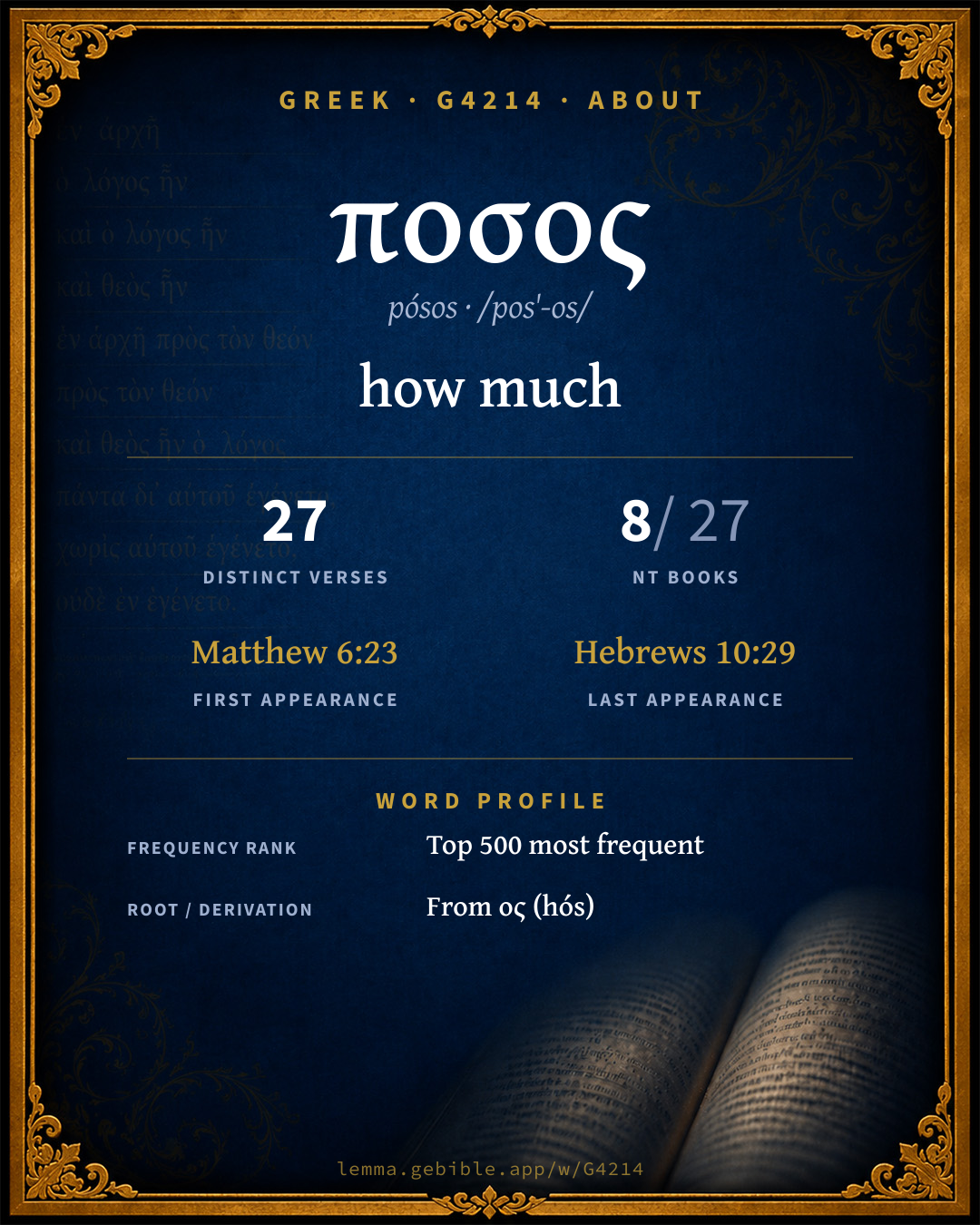
πόσος
how much
‘how much’ is one of 3 main senses fuller range ↓
Full lexicon entry — Thayer's Greek Lexicon
From Thayer's Greek Lexicon
Where this word appears
See every Accusative-case word in the Greek New Testament →
Grammar key — what these labels mean
Part of speech
- Correlative/interrogative pronoun
- Functions as either a correlative or an interrogative pronoun.
Case
- Dative
- The case of the indirect object, means, or location — “to / for / with / in.”
- Accusative
- The case of the direct object and of extent.
- Genitive
- The case of source, possession, or “of” — answers “whose / from what.”
- Nominative
- The case of the subject (and the predicate nominative).
Gender
- Neuter
- Grammatically neuter.
- Masculine
- Grammatically masculine.
- Feminine
- Grammatically feminine.
Number
- Singular
- One.
- Plural
- More than one.
Grammatical forms 11 distinct
- Correlative/interrogative pronoun, Dative, Singular, Neuter 11 times (41%)
- Correlative/interrogative pronoun, Accusative, Plural, Masculine 5 times (19%)
- Correlative/interrogative pronoun, Accusative, Plural, Neuter 2 times (7%)
- Correlative/interrogative pronoun, Accusative, Singular, Neuter 2 times (7%)
- Correlative/interrogative pronoun, Accusative, Plural, Feminine 1 time (4%)
- Correlative/interrogative pronoun, Accusative, Singular, Feminine 1 time (4%)
- Correlative/interrogative pronoun, Genitive, Plural, Neuter 1 time (4%)
- Correlative/interrogative pronoun, Nominative, Plural, Feminine 1 time (4%)
+3 more forms (3 occurrences)
Parsed forms decoded from the imported morphology (Robinson–Tischendorf, public domain), counted across 27 parsed occurrences — not distinct verses.
Every verse where G4214 appears — 27 distinct verses across 8 books. Click any verse to open its interlinear word-by-word view. Verse text shown in the World English Bible for context — . Each verse’s Greek form is shown with its reference; the English is not keyword-highlighted, since the data carries no word-level English alignment. Use “Compare translations” on any verse to read it across multiple English versions. This concordance covers the Greek New Testament; Septuagint (Greek Old Testament) occurrences of this word are not indexed here.
Matthew 8 verses
- Matthew 6:23 πόσον corr.pron nom sg neut But if your eye is evil, your whole body will be full of darkness. If therefore the light that is in you is darkness, how great is the darkness!
- Matthew 7:11 πόσῳ corr.pron dat sg neut If you then, being evil, know how to give good gifts to your children, how much more will your Father who is in heaven give good things to those who ask him!
- Matthew 10:25 πόσῳ corr.pron dat sg neut It is enough for the disciple that he be like his teacher, and the servant like his lord. If they have called the master of the house Beelzebul, how much more those of his household!
- Matthew 12:12 πόσῳ corr.pron dat sg neut Of how much more value then is a man than a sheep! Therefore it is lawful to do good on the Sabbath day."
- Matthew 15:34 πόσους corr.pron acc pl masc Jesus said to them, "How many loaves do you have?" They said, "Seven, and a few small fish."
- Matthew 16:9 πόσους corr.pron acc pl masc Don't you yet perceive, neither remember the five loaves for the five thousand, and how many baskets you took up?
- Matthew 16:10 πόσας corr.pron acc pl fem Nor the seven loaves for the four thousand, and how many baskets you took up?
- Matthew 27:13 πόσα corr.pron acc pl neut Then Pilate said to him, "Don't you hear how many things they testify against you?"
Mark 6 verses
- Mark 6:38 πόσους corr.pron acc pl masc He said to them, "How many loaves do you have? Go see." When they knew, they said, "Five, and two fish."
- Mark 8:5 πόσους corr.pron acc pl masc He asked them, "How many loaves do you have?" They said, "Seven."
- Mark 8:19 πόσους corr.pron acc pl masc When I broke the five loaves among the five thousand, how many baskets full of broken pieces did you take up?" They told him, "Twelve."
- Mark 8:20 πόσων corr.pron gen pl neut "When the seven loaves fed the four thousand, how many baskets full of broken pieces did you take up?" They told him, "Seven."
- Mark 9:21 πόσος corr.pron nom sg masc He asked his father, "How long has it been since this has come to him?" He said, "From childhood.
- Mark 15:4 πόσα corr.pron acc pl neut Pilate again asked him, "Have you no answer? See how many things they testify against you!"
Luke 6 verses
- Luke 11:13 πόσῳ corr.pron dat sg neut If you then, being evil, know how to give good gifts to your children, how much more will your heavenly Father give the Holy Spirit to those who ask him?"
- Luke 12:24 πόσῳ corr.pron dat sg neut Consider the ravens: they don't sow, they don't reap, they have no warehouse or barn, and God feeds them. How much more valuable are you than birds!
- Luke 12:28 πόσῳ corr.pron dat sg neut But if this is how God clothes the grass in the field, which today exists, and tomorrow is cast into the oven, how much more will he clothe you, O you of little faith?
- Luke 15:17 πόσοι corr.pron nom pl masc But when he came to himself he said, 'How many hired servants of my father's have bread enough to spare, and I'm dying with hunger!
- Luke 16:5 πόσον corr.pron acc sg neut Calling each one of his lord's debtors to him, he said to the first, 'How much do you owe to my lord?'
- Luke 16:7 πόσον corr.pron acc sg neut Then said he to another, 'How much do you owe?' He said, 'A hundred cors of wheat.' He said to him, 'Take your bill, and write eighty.'
Acts 1 verse
Romans 2 verses
- Romans 11:12 πόσῳ corr.pron dat sg neut Now if their fall is the riches of the world, and their loss the riches of the Gentiles; how much more their fullness?
- Romans 11:24 πόσῳ corr.pron dat sg neut For if you were cut out of that which is by nature a wild olive tree, and were grafted contrary to nature into a good olive tree, how much more will these, which are the natural branches, be grafted into their own olive tree?
2 Corinthians 1 verse
Philemon 1 verse
Hebrews 2 verses
- Hebrews 9:14 πόσῳ corr.pron dat sg neut how much more will the blood of Christ, who through the eternal Spirit offered himself without blemish to God, cleanse your conscience from dead works to serve the living God?
- Hebrews 10:29 πόσῳ corr.pron dat sg neut How much worse punishment, do you think, will he be judged worthy of, who has trodden under foot the Son of God, and has counted the blood of the covenant with which he was sanctified an unholy thing, and has insulted the Spirit of grace?
About this entry
At a glance — auto-summarized from this page’s data, not written by a person. Every figure links to its source below. This summary describes the numbers; it doesn’t interpret them.
The Greek word ποσος centers on the idea of “how much.” Its earliest occurrence is Matthew 6:23. It turns up in 27 verses across 8 books, a moderately common footprint. The word gravitates to Matthew (30%), then Mark and Luke. Thayer's distinguishes 3 senses for it. Dig into 27-verse concordance and the renderings breakdown below.
Gloss history
Strong's 1890 vs modern scholarship
About this word
Strong's G4214 catalogs a Greek word from the Greek New Testament.
These counts are not copied from any lexicon or concordance. They are computed here, from the morphology-tagged Greek New Testament. What Lemma adds →
- 27
- distinct verses
- The word appears in 27 distinct verses.
- 8 / 27
- NT books
- The word appears in 8 of 27 New Testament books.
- #500
- by frequency
- Top 500 most frequent Greek words (rank 500 of 5,347 Greek words by occurrence).
View all 27 occurrences in the concordance →
By section of the New Testament
By traditional corpus
Conventional, traditional groupings — biblical authorship is debated, so this is a traditional corpus grouping, not an authorship claim. Some books belong to more than one corpus (Luke is in both the Gospels and the Lukan corpus, and so on), so these shares overlap and need not total 100%. Each figure is a share of the word’s 27 distinct verses.
- Gospels 20 verses · 74%
- Lukan (Luke–Acts) 7 verses · 26%
- Pauline corpus 4 verses · 15%
- Hebrews 2 verses · 7%
How translations render this word
Counts come from each version’s own published word-to-Strong’s tagging or interlinear alignment — an approximate guide to how each version renders this word, not a word-level alignment the data otherwise carries. Because each total is that version’s own tagged count, the per-version totals vary from one another and need not match the appearance or distinct-verse counts above. These counts may also differ from a printed concordance because Lemma counts each distinctly tagged rendering and does not collapse phrase taggings into a single head-word total. This is a fixed set of word-tagged versions (KJV, ASV, BSB, ULT) and does not change with the reading translation you choose elsewhere. Each version’s license is shown beside its name below (and on Sources).
- King James Version: How much 12×, How many 9×, How many things 2×
- American Standard Version: How much 13×, How many 9×, How many things 2×
- Berean Standard Bible: How much 12×, How many 10×
- unfoldingWord Literal Text: How much 14×, How many 9×, How many things 2×
King James Version Public Domain
Renders G4214 across 27 tagged occurrences — most commonly:
Plus 4 renderings that appear only once — usually multi-word phrases or single function words the recovered tagging swept in, not distinct renderings.
American Standard Version Public Domain
Renders G4214 across 27 tagged occurrences — most commonly:
Plus 3 renderings that appear only once — usually multi-word phrases or single function words the recovered tagging swept in, not distinct renderings.
Berean Standard Bible Public Domain
Renders G4214 across 27 tagged occurrences — most commonly:
Plus 5 renderings that appear only once — usually multi-word phrases or single function words the recovered tagging swept in, not distinct renderings.
unfoldingWord Literal Text CC BY-SA 4.0
Renders G4214 across 28 tagged occurrences — most commonly:
Plus 3 renderings that appear only once — usually multi-word phrases or single function words the recovered tagging swept in, not distinct renderings.
Senses in Thayer's
The 3 senses Thayer's distinguishes for this word, in lexicon order (not ranked by frequency or importance). The full entry — with sub-senses — is in the Lexicon Entry tab.
- how great
- how much
- how many
Word origin
Derived from ος (hós) (G3739) — who.
From an obsolete pos ( who what ) and G3739 ; interrogitive pronoun (of amount) how much ( large long or [plural] many ): - how great (long many) what.
— Strong’s Exhaustive Concordance (1890), public domain.
Forms in the corpus
The 10 distinct written forms G4214 takes in the Greek New Testament, most frequent first — each parse links to that case’s occurrences in the concordance.
Same root — word family
Other Thayer's entries built from the same root as G4214, grouped by Strong’s listed origin. These share a root / origin per the lexicon — not necessarily a shared meaning. Each links to that word’s own entry.
Derives from
Shares the same root
- ο εστι hó esti G3603 which is
- οθεν hóthen G3606 from which
- οποιος hopoîos G3697 what sort
- οποτε hopóte G3698 when
- οπου hópou G3699 where
- οπως hópōs G3704 how
- οσακις hosákis G3740 as often as
- οσος hósos G3745 how much
- οσπερ hósper G3746 whomever
- οστις hóstis G3748 whoever
- οτε hóte G3753 when
- ου hoû G3757 where
- ως hōs G5613 as
Derived from this word
Compare all same-root words → Showing 4 of 17 — not the complete family. They share a root, not necessarily a meaning.
Septuagint usage
The same Greek word ποσος appears 6 times in the Greek Old Testament (Septuagint), across 6 verses in 5 books.
- 6
- LXX occurrences
- Tagged occurrences of this Greek word in the Septuagint.
- 6
- verses
- Distinct Septuagint verses containing this word.
- 5 / 39
- OT books
- The word appears in 5 of the 39 Old Testament books.
Sample Septuagint occurrences
- Genesis 47:8 πόσος
- 2 Samuel 19:35 πόσος
- Job 13:23 πόσος
- Psalms 118:84 πόσος
- Ezekiel 27:33 πόσος
Septuagint occurrences (same lexeme)
Every verse where the same Strong’s number (G4214) appears in the Greek Septuagint. Verse text shown in the World English Bible for context; the Greek form is the matched word — the English is not keyword-highlighted.
- Genesis 47:8 πόσος Pharaoh said to Jacob, "How many are the days of the years of your life?"
- 2 Samuel 19:35 πόσος I am this day eighty years old: can I discern between good and bad? can your servant taste what I eat or what I drink? can I hear any more the voice of singing men and singing women? why then should your servant be yet a burden to my lord the king?
- Job 13:23 πόσος How many are my iniquities and sins? Make me know my disobedience and my sin.
- Job 38:18 πόσος Have you comprehended the earth in its breadth? Declare, if you know it all.
- Psalms 118:84 πόσος
- Ezekiel 27:33 πόσος When your wares went forth out of the seas, you filled many peoples; you did enrich the kings of the earth with the multitude of your riches and of your merchandise.
These are occurrences of the same Greek lexeme (G4214) in the Septuagint — not a translation of any one Hebrew word. The store carries no word-level Hebrew↔Greek alignment, so no Hebrew original is asserted here. Counts come from the recovered LXX Strong's tagging — high-frequency vocabulary is well covered, while rare or late forms may be untagged — so they reflect tagged occurrences and may slightly undercount.