
Acts 8:32

Greek (Tischendorf 8th ed.) Acts 8:32 appears in the Greek New Testament. The text above is from the Tischendorf 8th edition. Each word links to its Strong’s number and a concise gloss. Click any word for its full Thayer’s Greek Lexicon entry.
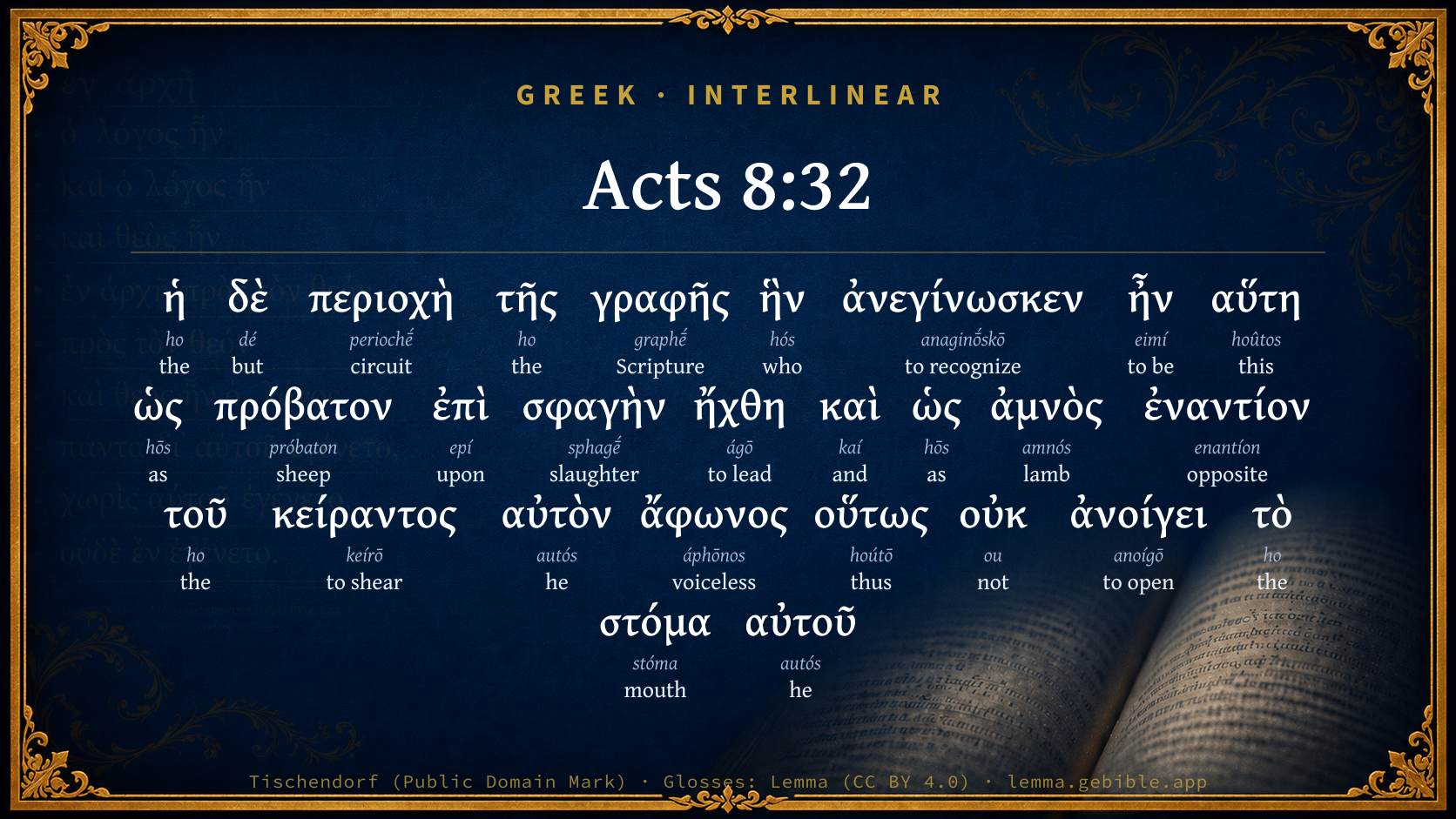
Download image
Cite this verse

Acts 8:32 (World English Bible). Public Domain. Lemma interlinear Bible study tool, https://lemma.gebible.app/v/acts/8/32.

Show BibTeX & RIS
BibTeX
RIS
English Translation
Now the passage of the Scripture which he was reading was this, "He was led as a sheep to the slaughter. As a lamb before his shearer is silent, So he doesn't open his mouth.
World English Bible · Public Domain
Highlights
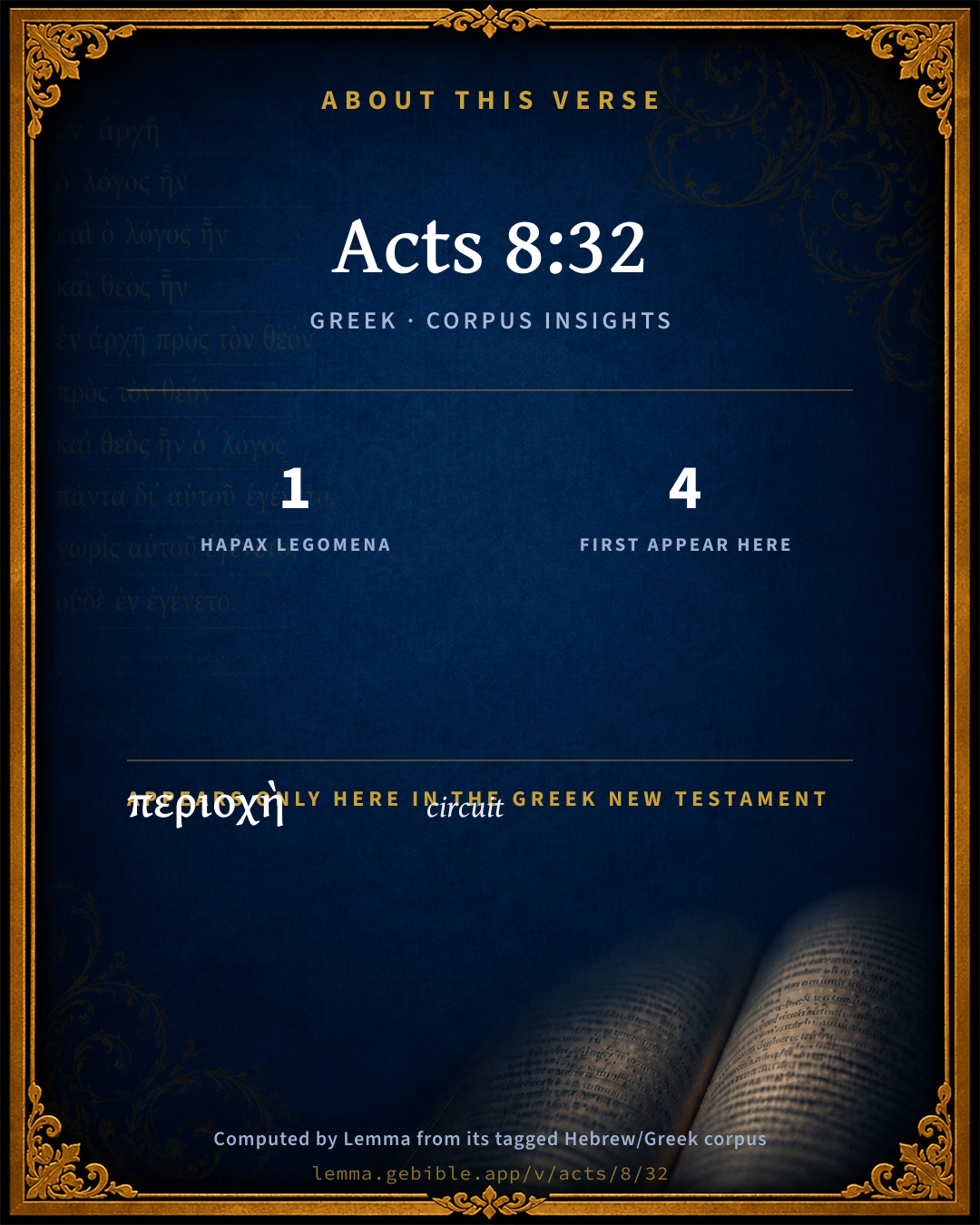
  • 1 hapax legomenon — only here in the Greek New Testament
  • 4 first appearances in the Greek New Testament
Full analysis ↓
Download a study sheet

One document with this verse’s original text, its word-by-word gloss line, the meaning frame, cross-references with their text, attributed commentary, and full source and license credits — printable, and it pastes into notes with its structure intact.

This verse Autodidact and up

Study sheet (.html) Plain text (.txt)

A passage Seminary Student

Up to 50 verses in one chapter. A passage sheet keeps up to 6 commentary sources and 12 cross-references per verse, in the order this page ranks them, and says so on the sheet whenever that leaves anything out. Ask for a single verse and you get the Autodidact verse sheet above.

Everything on this page stays free to read, with no account — the sheet is a download of what is already on screen, not access to it.

Want to remove ads? Support Godless Engineer
Compare translations 3

The same verse in 3 English versions, stacked beneath the original-language interlinear above. Click any original word for its lexicon entry.

Each is an independent rendering of the whole verse — the interlinear is not word-aligned to these translations.

Highlighted words mark where these versions differ — a whole-verse word diff, not a word-by-word alignment.

  • World English Bible Public Domain
    Now the passage of the Scripture which he was reading was this, "He was led as a sheep to the slaughter. As a lamb before his shearer is silent, So he doesn't open his mouth.
  • King James Version Public Domain
    The place of the scripture which he read was this, He was led as a sheep to the slaughter; and like a lamb dumb before his shearer, so opened he not his mouth:
  • unfoldingWord Literal Text CC BY-SA 4.0
    Now the passage of Scripture that he was reading was this: “He was led like a sheep to the slaughter, and like a lamb before its shearer silent, thus he does not open his mouth.

unfoldingWord Literal Text — © unfoldingWord, licensed CC BY-SA 4.0. Word-aligned USFM3 via Door43 (git.door43.org/unfoldingWord/en_ult).

Versions to compare (up to 4)

3 of 4 selected

Show all 19 translations

Every available English version of this verse, each an independent rendering of the whole verse.

  • World English Bible Public Domain
    Now the passage of the Scripture which he was reading was this, "He was led as a sheep to the slaughter. As a lamb before his shearer is silent, So he doesn't open his mouth.
  • Berean Standard Bible Public Domain
    The eunuch was reading this passage of Scripture: “He was led like a sheep to the slaughter, and as a lamb before the shearer is silent, so He did not open His mouth.
  • Majority Standard Bible Public Domain
    The eunuch was reading this passage of Scripture: “He was led like a sheep to the slaughter, and as a lamb before the shearer is silent, so He did not open His mouth.
  • King James Version Public Domain
    The place of the scripture which he read was this, He was led as a sheep to the slaughter; and like a lamb dumb before his shearer, so opened he not his mouth:
  • American Standard Version (1901) Public Domain
    Now the passage of the Scripture which he was reading was this, He was led as a sheep to the slaughter; And as a lamb before his shearer is dumb, So he openeth not his mouth:
  • Revised Version (1885) Public Domain
    Now the place of the scripture which he was reading was this, He was led as a sheep to the slaughter; And as a lamb before his shearer is dumb, So he openeth not his mouth:
  • Geneva Bible (1599) Public Domain
    Nowe the place of the Scripture which he read, was this, Hee was lead as a sheepe to the slaughter: and like a lambe domme before his shearer, so opened he not his mouth.
  • Douay-Rheims (1899) Public Domain
    And the place of the scripture which he was reading was this: He was led as a sheep to the slaughter; and like a lamb without voice before his shearer, so openeth he not his mouth.
  • Young's Literal Translation Public Domain
    And the contents of the Writing that he was reading was this: `As a sheep unto slaughter he was led, and as a lamb before his shearer dumb, so he doth not open his mouth;
  • Literal Standard Version CC BY-SA 4.0
    And the passage of the Writing that he was reading was this: “He was led as a sheep to slaughter, || And as a lamb before his shearer is silent, || So He does not open His mouth;
  • Unlocked Literal Bible CC BY-SA 4.0
    Now the passage of the scripture which the Ethiopian was reading was this, “He was led like a sheep to the slaughter, and like a lamb before his shearer is silent, so he did not open his mouth.
  • unfoldingWord Literal Text CC BY-SA 4.0
    Now the passage of Scripture that he was reading was this: “He was led like a sheep to the slaughter, and like a lamb before its shearer silent, thus he does not open his mouth.
  • Darby Bible Public Domain
    And the passage of the scripture which he read was this: He was led as a sheep to slaughter, and as a lamb is dumb in presence of him that shears him, thus he opens not his mouth.
  • World Messianic Bible Public Domain
    Now the passage of the Scripture which he was reading was this, “He was led as a sheep to the slaughter. As a lamb before his shearer is silent, so he doesn’t open his mouth.
  • Webster's Bible Public Domain
    The place of the scripture which he read was this, He was led as a sheep to the slaughter; and like a lamb dumb before his shearer, so he opened not his mouth:
  • Free Bible Version CC BY-SA 4.0
    The Scripture passage he was reading was this: “He was led like a sheep to be slaughtered. Like a lamb is silent in front of his shearer, he didn't say a word.
  • Bible in Basic English Public Domain
    Now the place in the book where he was reading was this: He was taken, like a sheep, to be put to death; and as a lamb is quiet when its wool is being cut, so he made no sound:
  • Text-Critical English NT CC BY 4.0
    This is the passage of Scripture that he was reading: “Like a sheep he was led to slaughter, and like a lamb is silent before its shearer, so he did not open his mouth.
  • Tyndale New Testament (1534) Public Domain
    The tenoure of the scripture which he redde was this. He was ledde as a shepe to be slayne: and lyke a lambe dome before his sherer so opened he not his mouth.

Literal Standard Version (2020), Covenant Press — licensed CC BY-SA 4.0. Text via the HelloAO Bible API (eBible.org). Unlocked Literal Bible (unfoldingWord) — licensed CC BY-SA 4.0. Text via the HelloAO Bible API (eBible.org). unfoldingWord Literal Text — © unfoldingWord, licensed CC BY-SA 4.0. Word-aligned USFM3 via Door43 (git.door43.org/unfoldingWord/en_ult). Free Bible Version, Dr. Jonathan Gallagher — licensed CC BY-SA 4.0. Text via the HelloAO Bible API (eBible.org).

Word by word

More ways to search: Search by grammar → Find every occurrence → Compare this word →

Practice this passage: Drill this verse → Learn its vocabulary →

περιοχὴ
periochḗ
G4042
“circuit”
Noun, Nominative, Singular, Feminine
Part of Speech
Noun
Case
Nominative
Number
Singular
Gender
Feminine
Full Thayer's Definition

Origin: from G4023

TDNT: None

1. an encompassing, compass, circuit 2. that which is contained a. the contents of any writing
  1. ἡ ho G3588 “the” Article, Nominative, Singular, Feminine
  2. δὲ dé G1161 “but” Conjunction
  3. τῆς ho G3588 “the” Article, Genitive, Singular, Feminine
  4. γραφῆς graphḗ G1124 “Scripture” Noun, Genitive, Singular, Feminine
  5. ἣν hós G3739 “who” Relative pronoun, Accusative, Singular, Feminine
  6. ἀνεγίνωσκεν anaginṓskō G314 “to recognize” Verb, Imperfect, Active, Indicative, 3rd person, Singular
  7. ἦν eimí G1510 “to be” Verb, Imperfect, Active, Indicative, 3rd person, Singular
  8. αὕτη hoûtos G3778 “this” Demonstrative pronoun, Nominative, Singular, Feminine
  9. ὡς hōs G5613 “as” Adverb
  10. πρόβατον próbaton G4263 “sheep” Noun, Nominative, Singular, Neuter
  11. ἐπὶ epí G1909 “upon” Preposition
  12. σφαγὴν sphagḗ G4967 “slaughter” Noun, Accusative, Singular, Feminine
  13. ἤχθη ágō G71 “to lead” Verb, Aorist, Passive, Indicative, 3rd person, Singular
  14. καὶ kaí G2532 “and” Conjunction
  15. ὡς hōs G5613 “as” Adverb
  16. ἀμνὸς amnós G286 “lamb” Noun, Nominative, Singular, Masculine
  17. ἐναντίον enantíon G1726 “opposite” Adverb
  18. τοῦ ho G3588 “the” Article, Genitive, Singular, Masculine
  19. κείραντος keírō G2751 “to shear” Verb, Aorist, Active, Participle, Genitive, Singular, Masculine
  20. αὐτὸν autós G846 “he” Personal pronoun, Accusative, Singular, Masculine
  21. ἄφωνος áphōnos G880 “voiceless” Adjective, Nominative, Singular, Masculine
  22. οὕτως hoútō G3779 “thus” Adverb
  23. οὐκ ou G3756 “not” Particle, Negative
  24. ἀνοίγει anoígō G455 “to open” Verb, Present, Active, Indicative, 3rd person, Singular
  25. τὸ ho G3588 “the” Article, Accusative, Singular, Neuter
  26. στόμα stóma G4750 “mouth” Noun, Accusative, Singular, Neuter
  27. αὐτοῦ autós G846 “he” Personal pronoun, Genitive, Singular, Masculine

About this verse

These counts appear in no published source. They are computed here, from the morphology-tagged text and Lemma’s own curated glosses. What Lemma adds →

28
words
23
distinct lemmas
Acts
section

Notable vocabulary

1 hapax legomenon — a word that appears only here in the entire Greek New Testament:

  • περιοχὴ circuit G4042

First appearance in Scripture

These words make their first canonical appearance in the Greek New Testament here:

  • περιοχὴ circuit G4042
  • σφαγὴν slaughter G4967
  • κείραντος to shear G2751
  • ἄφωνος voiceless G880

Shared distinctive vocabulary

σφαγὴν slaughter G4967 occurs in 3 verses of the Greek New Testament. Also found in:
Repetition

Words recur within this verse:

Cross-references

14

Topical passages linked to Acts 8:32 in the Treasury of Scripture Knowledge — connected by theme and wording, ordered by reader-vote popularity; previews shown in the World English Bible.

  • Isaiah 53:7–8 He was oppressed, yet when he was afflicted he didn't open his mouth; as a lamb that is led to the slaughter, and as a sheep that before its shearers is mute, so he didn't open his mouth.
  • 1 Peter 2:21–24 For to this you were called, because Christ also suffered for us, leaving you an example, that you should follow his steps,
  • Jeremiah 51:40 I will bring them down like lambs to the slaughter, like rams with male goats.
  • Jeremiah 11:19 But I was like a gentle lamb that is led to the slaughter; and I didn't know that they had devised devices against me, [saying], Let us destroy the tree with the fruit of it, and let us cut him off from the land of the living, that his name may be no more remembered.
  • Romans 8:36 Even as it is written, "For your sake we are killed all day long. We were accounted as sheep for the slaughter."
  • Psalms 44:11–12 You have made us like sheep for food, And have scattered us among the nations.
  • Psalms 39:9 I was mute. I didn't open my mouth, Because you did it.
  • Psalms 39:2 I was mute with silence. I held my peace, even from good. My sorrow was stirred.
  • John 1:29 The next day, he saw Jesus coming to him, and said, "Behold, the Lamb of God, who takes away the sin of the world!
  • Matthew 26:62–63 The high priest stood up, and said to him, "Have you no answer? What is this that these testify against you?"
  • Jeremiah 12:3 But you, Yahweh, know me; you see me, and try my heart toward you: pull them out like sheep for the slaughter, and prepare them for the day of slaughter.
  • 1 Peter 1:19 but with precious blood, as of a lamb without spot, the blood of Christ;
  • Luke 23:34 Jesus said, "Father, forgive them, for they don't know what they are doing." Dividing his garments among them, they cast lots.
  • John 18:9–11 that the word might be fulfilled which he spoke, "Of those whom you have given me, I have lost none."

Cross-references courtesy of OpenBible.info (CC BY 4.0).

Commentary

Notes on Acts 8:32 from classic Christian and Jewish commentators (each source and its license shown beneath its notes). The classic Christian expositions comment on the surrounding passage and are grouped to its opening verse, so a note may address several verses; the Jewish commentaries on the Tanakh (Rashi and others) are per-verse, so they appear only where the commentator wrote on this verse.

Lemma curates 59 commentaries, every one of them public domain or Creative Commons licensed, each selected and text-cleaned for this edition rather than reprinted as found. About our sources →

The Biblical Illustrator

Joseph S. Exell

Act_8:32-38

The place of the Scripture which he read was this, He was led as a sheep to the slaughter … Then Philip … began at the same Scripture and preached unto him Jesus.

Philips sermon

I. The text. He was led as a sheep to the slaughter, etc. Here is no difficulty, but there are two difficulties following which require explanation.

1. In His humiliation His judgment was taken away. He appeared in such a condition that Pilate, though convinced of His innocence, did not consider Him of importance enough to risk anything for His deliverance. Taking away His judgment means the denial of the rights of legal justice.

2. And who shall declare His generation? Some have referred this to His eternal generation from the Father; some to His being conceived by the Holy Ghost; others to His resurrection; others again to His spiritual seed. But there are only two probable meanings:

(1) Who shall declare the manner of His life? Before the execution of criminals, proclamation was made, Will any one testify anything in favour of the condemned? Sometimes they saw one hastening with a long white flag, and exclaiming, A witness is come. But there was no white flag on Calvary! They all forsook Him and fled.

(2) Who shall declare the generation of men in which He lived? Thus Luke says, He shall suffer many things, and be rejected of this generation. Therefore there was no one in this sense to declare His generation, the wickedness of the men in whose day He lived, suffered, and was slain.

II. The sermon.

1. It was unpremeditated. The apostles were admonished not to meditate beforehand, for it should be given them in that same hour, etc. And ministers should never be at a loss to say something about Christ. Our Saviour says Every scribe which is instructed unto the kingdom of heaven, is like unto an householder, etc. Ye would not deem him a good housekeeper who, if a friend calls suddenly, could not bring something to feed him. Sometimes a ministers best thoughts will be those produced by present circumstances and present feelings. Baxter was once preaching, when there occurred a tremendous storm which threw his audience into great consternation. He paused and exclaimed, My brethren, we are assembled this morning to prepare against that day when the heavens shall pass away with a great noise, and the elements melt with fervent heat; the earth and all the works that are therein shall be burnt up. This hushed and calmed the audience. When Peter was preaching, a multitude exclaimed, What shall we do? but Peter was not disconcerted.

2. Its subject was Jesus, as it was in Samaria. This was his constant practice, nor was it peculiar to him. Paul said to the Corinthians, I determined to know nothing among you save Jesus Christ and Him crucified. The Saviour, when He commissioned the apostles, instructed them to preach in His name. This is the subject which, though so old, is always so new; and not only a faithful saying, but worthy of all acceptation. In order to be useful to others we must preach the truth as it is in Jesus; for there is salvation in no other.

3. This sermon was very Scriptural: He began at the same Scripture, and this was a good beginning; but we must extend the thing. According to Christs own testimony there are things concerning Him in all the Scriptures. Search the Scriptures, for they are they that testify of Me. Divide them, arrange them as you please, and you will find that He is all in all. Wherever, therefore, you step on this holy ground, immediately a star is in motion, going before you till it stands over where the young child is; wherever you listen, you hear a voice saying, Behold the Lamb of God, which taketh away the sins of the world; wherever you open the leaves in this sacred book, His name is as ointment poured forth. (W. Jay.)

Philips sermon

I. The subject of Philips preaching.

1. The Scripture here referred to was one of the most striking prophecies concerning Christ. It is very minute, and seems to unite the most opposite extremes; so that this Jewish proselyte might well inquire, Of whom speaketh the prophet this?

(1) The mysterious person mentioned by the prophet was to be treated with hatred and scorn (Isa_53:2; Isa_53:8).

(2) He was to suffer from God as well as from His countrymen (verse 10).

(3) He was to be free from sin (verse 9).

(4) He was to be an example of perfect meekness and submission under all His sufferings (verse 7).

(5) He was to be subjected to a violent death, with which some peculiar circumstances were connected (verses 8, 9)

(6) He was to rise from the dead (verse 10).

(7) He was to have a progeny, be invested with great power, and to carry on a prosperous work in the earth, under the Divine approval, and to His own satisfaction (verses 10, 12). Here, then, we have a prophecy most comprehensive in its range, most minute and singular in its details, which alone, in all its particulars, is fulfilled in Jesus of Nazareth. To what conclusion are we then brought by a comparison of the prophecy with the events of our Lords history? First, that the prophet was inspired; for no human sagacity could foresee, at a distance of more than seven hundred years, the facts which he has described: and, secondly, that Jesus is the Son and the Christ of God. None but a Divine person could endure the sufferings He underwent, could redeem, and govern, and save mankind; and Jesus was anointed of God to accomplish these momentous objects. Philip therefore preached Jesus to the Ethiopian, and when this subject was presented to his candid mind conviction immediately flashed upon his understanding and conscience; and being inspired with a love of the truth, he received Christ Jesus the Lord.

2. In this prophecy several of the leading truths of Christianity are explicitly asserted.

(1) The universal sinfulness of mankind. All we like sheep have gone astray, etc., and it is assumed not only that we have infirmities and sorrows, but also sins, transgressions, iniquities.

(2) The fact of Christs substitution in the place of sinners. His soul was made an offering for sin; our iniquities were laid upon Him; He bare the sin of many, etc.

(3) The universality of Christs atonement. The remedy is as extensive as the evil. The Lord hath laid upon Him the iniquity of us all.

(4) The use which Christ makes of His atonement with regard to God. He made intercession for-the transgressors.

(5) The fruit of Christs atonement with regard to fallen man. The sufferings which He endured were the chastisement of our peace (Rom_3:24-25).

II. The manner in which the Ethiopian received the evangelical message.

1. With deep seriousness and attention. The man who had renounced idolatry, who had become a worshipper of God, who had taken a long and dangerous journey that he might render to Jehovah the homage He required, was not a man to treat any question of religion with indifference. His heart was evidently deeply impressed with the things of God. The relations in which men stand to their Maker, the obligations which He has laid upon them, the provision which He has made for their salvation, the final happiness of the just, and the perdition of ungodly men--these are subjects which none but either the grossly ignorant or wicked will ever treat with levity. Every wise man will perceive that, if Christianity is true, it is worse than madness to neglect it, and will make it his first and most anxious concern to inquire into its nature and claims; that he may not run the terrible risk of neglecting that mercy which, when it is once passed away, will never return.

2. With exemplary meekness and humility. He did not resent the inquiry of Philip, abrupt as it might seem. No feeling of self-importance, as a man of office and rank, induced him to turn away. With the utmost frankness he at once confessed his ignorance, invited Philip into the chariot, solicited instruction, and assumed the character and.attitude of a learner. This is precisely the spirit in which Divine light is received. The wrangling disputant has a thousand objections to offer before he can admit one single principle of evangelical truth, and when all those objections have been met his dark and vain mind is as far from true wisdom as it was when he began his idle toil. The philosopher, full of his own speculations, has almost everything to unlearn before he can receive the truth as the instrument of his salvation.

3. In faith. That he trusted in Christ as his Redeemer and Saviour we have ample proof in the subsequent part of the narrative.

4. In the spirit of submission and obedience. As the Ethiopian was swift to hear and to understand, so was he prompt to obey. When his understanding was enlightened, the assent of his will was gained. Being instructed in the doctrine of baptism, he waited not to be earnestly and repeatedly urged to a compliance with the Lords command. He was the first to propose the immediate administration of the ordinance; that he might at once practically declare his subjection to Christ, and receive the salvation which the gospel reveals as the fruit of His passion.

III. The happy result of his conversion--He went on his way rejoicing. He was miraculously deprived of his teacher, but he was left in possession of a treasure which filled him with sacred joy.

1. He doubtless rejoiced that he had found the truth. To be ignorant of God, and of the things belonging to our peace, is one of the greatest calamities.

2. As a believer in Jesus Christ he rejoiced in the favour of God. The favour of God is better than life, as His wrath is more terrible than death.

3. The approbation of his own conscience would be another ground of rejoicing. Conscience is a powerful instrument both of happiness and of misery.

4. He rejoiced to be the bearer of good tidings to others. A regenerated heart yearns over men who are dying in their sins, and at the same time it burns with desire to promote the honour of the Lord Jesus, and the extension of His kingdom. Under the impulse of these feelings a believer cannot be silent on the subject of his religion. He who had so unexpectedly found mercy could not be indifferent to the spiritual wants and claims of his own countrymen.

5. In common with all true believers he rejoiced in hope of eternal life.

Conclusion: The subject forcibly reminds us--

1. Of the great benefit connected with the public worship of God. Bad not this noble Ethiopian attended the temple at Jerusalem the probability is that he would have remained a stranger to the Christian salvation.

2. That the great object at which we should aim in the use of Gods ordinances is the knowledge of Christ as our Saviour. The Ethiopian, with all his sincerity, failed in this grand point, and an angel was employed in providing for him the requisite instruction so that he might believe to the saving of his soul.

3. Of the necessity of missions to the heathen. (T. Jackson.)

Jesus and the Scriptures

I. The unity of scripture. And that same Scripture, while so eminently illustrious, is only one of many innumerable scriptures at which Philip might have begun and by which he might have sustained his proclamation of the Jesus. Gather into your hands, as so many threads, all the same scriptures from which Philip might have pursued his theme, and delightedly gaze on the Pattern into which the New Testament fashions them. Can the charm of their unity be surpassed?

II. The end of scripture. To set forth Christ, to attract human thought and fix it on Him, is the steadfast aim to which everything is subordinated. Many are the voices of the prophets, but they swell into only one chorus of which He is the song.

III. In the intensity of the converse of Philip and the eunuch we see the interest of scripture commended. No fact grows more patent than the worlds need of all that the Scriptures assure us of Jesus. There is no light from heaven if it does not shine in Him, no bread from heaven if He does not supply it.

IV. In the issue of this converse we see the power of scripture manifested. He went on his way rejoicing. The fulness, variety, and harmony of Scripture; the compassion, wisdom, steadfastness of God through all the preparatory measures which led up to the advent of Jesus; the power, grace, and life brought by Him; rest of mind in this truth, and of heart in this mercy; the new creation into which the receiver of Jesus passes and rises--these were some of the glorious elements of this mans joy; and meditation, prayer, experience, would but deepen that joy, as he passed further and further away from the old things, and further and further into the new things prepared and ensured for ever to them that love Him. (G. B. Johnson.)

Preaching Jesus, not self

St. Bernard, preaching one day very scholastically, the learned thanked him, but not the godly; but another day he preached plainly, and the good people came blessing God for him, and gave him many thanks, which some scholars wondered at. Ah, said he, yesterday I preached Bernard, but to-day I preached Christ. Tis not learning, but teaching; not; the wisdom of words, but the evidence and demonstration of the Spirit that is welcome to saints. (R. Venning.)

Preaching to one

I remember, years ago, one Sunday that I had to preach at the Chapel Royal; and in those days the old duke used to attend service there, and when he was in town the congregation may have numbered generally some seven or eight persons, but when he Was out of town perhaps two or three. And on this occasion he was out of town. Well, the morning prayer was over, and the clergyman who had said it had to leave for duty elsewhere; and by the time I had mounted the pulpit the clerk had gone into the vestry to stir the fire. I was left alone with the congregation! Under the circumstances it would have been ridiculous to have preached the sermon, and I went down to the congregation and told him so. He said--it was a young man I knew--Oh! I have come a long way on purpose to hear you preach. I beg you will proceed. No! I said, I really cant. Besides, how personal you would find the sermon. But I will walk across the park with you, and give you the heads of my sermon as we walk along. Then I and Samuel Wilberforce, Esquire, walked across the park together. (Dean Hook.)

Preaching to one person

One very stormy Sunday Dr. Payson went to church more from habit than because he expected to find anybody there. Just after he had stepped inside the door an old negro came in, and asked if Dr. Payson was to preach there that day, explaining that he was a stranger in the town, and had been advised to go to his church. Upon that, said Dr. Payson, I made up my mind to preach my sermon if nobody else came. Nobody else did come, so the doctor preached to the choir and the negro. Some months afterward he happened to meet the negro, and stopping him, asked how he enjoyed the sermon that stormy Sunday. Enjoy dat sermon, replied the old man, I clare, doctor, I nebber heerd a better one. Yo see I had a seat pretty well up front, an whenebber youd say somethins pretty hard like gin de sins ob men Id jess look all roun ter see who yous a hittin, and I wouldnt see nobody ony jess me. An I says to mself, he must mean you, Pompey, yous sech a dretful sinner. Well, ductor, dat ar sermon set me a thinking what a big sinner I war, an I went an jined the Church down home. Ise a deacon now.

The Biblical Illustrator, edited by Joseph S. Exell (c. 1880s–1900s) — public domain. Text from a community e-Sword module.

Joseph Benson's Commentary

Act 8:32-33. The place — Η περιοχη, the portion, or paragraph, of the Scripture which he read was, He was led, &c. — These words were taken from Isa 53:8; where, that the prophet speaks of Christ, no Christian can reasonably doubt, there being scarce a verse in the whole chapter which is not by the Holy Ghost applied to Christ in the New Testament; the 1st verse, Joh 12:38; the 3d, Mar 9:12; the 4th, Mar 8:17; the 5th, Mar 15:28. And by reading this same chapter, many Jews, yea, and deists, have been converted. Some of them history records; but God knows them all. The passage here referred to is quoted according to the Septuagint version, which differs in some things from the original Hebrew. Grotius thinks the eunuch read it in Hebrew, having learned, from the many Jews that were in Ethiopia, both their religion and their language, and that Luke gives it to his readers in Greek, as being the language in which he wrote his history, and which he knew would be more generally understood. But, considering that the Septuagint version was made in Egypt, which was the country next adjoining to Ethiopia, and lay between it and Jerusalem, it is more probable that translation was most familiar to the eunuch, and therefore was now used by him. The greatest variation from the Hebrew here is, that what in it is, He was taken from prison and from judgment, or, as the margin has it, He was taken away by distress and judgment; that is, he was taken out of this life by oppression, violence, and a pretence of justice; is here read, In his humiliation his judgment was taken away — That is, he appeared so mean and despicable in the eyes of mankind, both Jews and Romans, that they denied him common justice, and, against all the rules of equity, condemned him, even while they declared him innocent. To take away a person’s judgment is a proverbial phrase for oppressing him. The sense therefore is nearly the same with that of the Hebrew. But see the notes on Isa 53:7-8; where the paragraph is explained at large.

Joseph Benson's Commentary on the Old and New Testaments (1811–1818) — public domain. Text from a community e-Sword module.

Tyndale Open Study Notes

Tyndale Open Resources

8:32-33 The passage of Scripture was Isa 53:7-8, one of the Servant Songs of Isaiah, a passage that speaks of the suffering servant of the Lord.

Tyndale Open Study Notes — © Tyndale Open Resources, licensed CC BY-SA 4.0. Text via the HelloAO Bible API.

Bengel's Gnomon

Johann Albrecht Bengel

Act 8:32. Ἡ δὲ περιοχὴ, but [now] the passage) By means of that 53d chapter of Isaiah, not only many Jews, but even Atheists, have been converted: history records the names of some of these; GOD knows them all.—ὡς πρόβατον—κείροντος αὐτὸν—ταπεινώσει αὐτοῦ—τὴν δὲ γενεὰν, κ.τ.λ.) So the LXX., Isa 53:7-8; except that they have not αὐτὸν, αὐτοῦ, and δέ.—ἤχθη) It suffered itself to be led, i.e. the sheep: ἤχθη is connected with πρόβατον, and ἄφωνος with ἀμνός. For the Apodosis begins at οὕτως, so. Comp the Hebrew accents, Ὡς is put for καθώς, even as: Rom 5:18, ὡς διʼ ἑιὸς,—οὕτως καὶ: 2Co 11:3. It is not a mere simile (icon), but a comparison.—ἄφωνος, dumb, without a voice) though it has a voice, using none, as though it had none.

Bengel's Gnomon of the New Testament — English translation (T&T Clark, Edinburgh, 1860) — public domain. Text from a community e-Sword module.

Meyer's Critical & Exegetical Commentary

Heinrich August Wilhelm Meyer

Act_8:32-33. But the contents of the passage of Scripture which he read was this. τῆς γραφῆς] is here restricted by ἣν ἀνεγίνωσκεν to the notion of a single passage, as also, Act_8:35, by ταύτης (comp. Act_1:16; Luk_4:21; and on Mar_12:10). Luther has given it correctly. But many others refer ἣν ἀνεγίνωσκ. to ἡ περιοχή locus autem scripturae, quem legebat, hic erat, Kuinoel, following the Vulgate. But it is not demonstrable that περιοχή signifies a section; even in the places cited to show this, Cic. ad Att. xiii. 25, and Stob. Ecl. Phys. p. 164 A, it is to be taken as here: what is contained in the passage (Hesych. Suid.: ὑπόθεσις), and this is then verbally quoted. Comp. the use of περιέχει, 1Pe_2:6, and Huther in loc.

ὡς πρόβατον κ.τ.λ.] Isa_53:7-8, with unimportant variation from the LXX.[230] The subject of the whole oracle is the צֶבֶד יְהֹוָה, i.e. according to the correct Messianic understanding of the apostolic church, the Messiah (Mat_8:17; Mar_15:28; Joh_12:38 ff; Joh_1:29; 1Pe_2:22 ff.). Comp. the ΠΑῖς ΤΟῦ ΘΕΟῦ, Act_3:13; Act_3:26, Act_4:27; Act_4:30. The prophetical words, as Luke gives them, are as follow: As a sheep He has been led to the slaughter; and as a lamb, which is dumb before its shearer, so He opens not His mouth. In His humiliation His judgment was taken away; i.e. when He had so humbled Himself to the bloody death (comp. Php_2:8), the judicial fate imposed on Him by God[231] was taken from Him, so that now therefore the culmination and crisis of His destiny set in (comp. Php_2:9). But His offspring who shall describe? i.e. how indescribably great is the multitude of those belonging to Him, of whom He will now be the family Head (comp. Php_2:10)! for (ground of the origin of this immeasurable progenies) His life is taken away from the earth, so that He enters upon His heavenly work relieved from the trammels of earth (comp. Joh_12:32; Rom_5:10; Rom_8:29; Rom_8:34; Rom_14:9). γενεά does not, any more than דוֹר, signify duration of life (Luther, Beza, Calvin, and others). The explanation, also, of the indescribably wicked race of the contemporaries of Christ, who proved their depravity by putting Him to death (ὍΤΙ ΑἼΡΕΤΑΙ Κ.Τ.Λ.), is inappropriate. Such is the view I have previously taken, with de Wette and older commentators. But in this way the prophecy would be diverted from the person of the Messiah, and that to something quite obvious of itself; whereas, according to the above explanation, the ΑἼΡΕΤΑΙ ἈΠῸ Τ. Γ. Ἡ ΖΩῊ ΑὐΤ. stands in thoughtful and significant correlation to Ἡ ΚΡΊΣΙς ΑὐΤΟῦ ἬΡΘΗ. In these correlates lies the ΔΙΚΑΙΟΣΎΝΗ of the Humbled one, Joh_16:10. The Fathers have explained γενεά in the interest of orthodoxy, but here irrelevantly, of the eternal generation of the Son. See Suicer, Thes. I. p. 744.

[230] Which, however, deviates considerably, and in part erroneously, from the original Hebrew.

[231] The designation of His destiny of suffering as ἡ κρίσις αὐτοῦ presupposes the idea of its vicarious and propitiatory character.

Meyer — Critical and Exegetical Commentary on the New Testament — English translation by Peter Christie, edited by Frederick Crombie (T&T Clark, 1880) — public domain. Text from a community e-Sword module.

Expositor's Greek Testament

ed. W. Robertson Nicoll

Act 8:32 . περιοχὴ τῆς γραφῆς “the contents of the passage of Scripture” i.e. , the one particular passage, Isa 53:7-8 (so Meyer-Wendt, Holtzmann, Hackett), cf. Act 1:16 , and 1Pe 2:6 : περιέχει ἐν τῇ γραφῇ and ταύτης in Act 8:35 below; περιοχή has been taken to mean a section , as in Cicero, Epist. ad Att. , xiii., 25 (so in Codex [220] , before the Gospel of St. Mark, its περιοχαί , i.e., sectiones , are prefixed), but in Cicero also Meyer-Wendt take the word to mean the contents of a passage, cf. notes, edit. 1888 and 1899; see also Felten and Plumptre, in loco. St. Chrysostom apparently takes γραφή here as = αἱ γραφαί , “totum corpus scripturae sacræ,” see Blass, in loco , but if so, the plural would be used as always; see above references and Light-foot on Gal. , Gal 3:22 . The fact that the eunuch was reading Isaiah is mentioned by St. Chrysostom as another indication of character, since he had in hand the prophet who is more sublime than all others, Hom. , xix.

[220] Codex Alexandrinus (sæc. v.), at the British Museum, published in photographic facsimile by Sir E. M. Thompson (1879).

The Expositor's Greek Testament, edited by W. Robertson Nicoll (1897–1910) — public domain. Text from a community e-Sword module.

Geneva Bible (1599)

Geneva Bible translators

Those things which seem most to come by chance or fortune (as men term it) are governed by the secret providence of God.

Geneva Bible (1599) marginal notes — public domain. Text via Bolls.life.

Jamieson, Fausset & Brown

Robert Jamieson, A. R. Fausset & David Brown

The place . . . was this, He was led as a sheep, &c.--One cannot but wonder that this, of all predictions of Messiah's sufferings in the Old Testament the most striking, should have been that which the eunuch was reading before Philip joined him. He could hardly miss to have heard at Jerusalem of the sufferings and death of Jesus, and of the existence of a continually increasing party who acknowledged Him to be the Messiah. But his question to Philip, whether the prophet in this passage meant himself or some other man, clearly shows that he had not the least idea of any connection between this prediction and those facts.

Jamieson, Fausset & Brown — Commentary Critical and Explanatory on the Whole Bible (1871) — public domain (CC PDM 1.0). Text via the HelloAO Bible API.

Adam Clarke's Commentary

Verse 32. The place of the scripture] περιοχη της γραφης, The section, or paragraph.

Adam Clarke's Commentary on the Bible (1810–1826) — public domain. Text from a community e-Sword/MySword module.

John Calvin's Commentaries

32. The sentence of Scripture. It is properly a text or period. Let us know that he lighted not upon this place by chance but that it came to pass by the wonderful providence of God, that Philip should have a proposition or principle from which the whole sum of Christianity might be set. Therefore, first, he hath matter of full instruction brought to his hand by the secret direction of the Spirit; secondly, the form is plainly applied to the ministry of man. This is an excellent prophecy of Christ, and above all others to be remembered; because Isaiah saith plainly there that such should be the manner of redeeming the Church, that the Son of God do by his death purchase life for men, that he offereth himself in sacrifice to purge men’s sins, that he be punished with the hand of God, and that he go down even unto the very hell, that he may exalt us unto heaven, having delivered us from destruction. In sum, this place teacheth plainly how men are reconciled to God, how they obtain righteousness, how they come to the kingdom of God, being delivered from the tyranny of Satan, and loosed from the yoke of sin; to be brief, whence they must fetch all parts of their salvation.

Notwithstanding, I will only expound those things which Luke here citeth, and there be, indeed, two members. In the former, he teacheth that Christ, to the end he may redeem the Church, must needs be so broken, that he appear like to a man which is cast down and past hope. Secondly, he affirmeth that his death shall give life, and that there shall a singular triumph issue out of great despair. Whereas he compareth Christ to a lamb, which suffereth itself to be led and slain, and to a sheep, which offereth herself meekly to be shorn; his meaning is, that the sacrifice of Christ shall be voluntary. And surely this was the way to appease God’s wrath, in that he showed himself obedient. He spake, indeed, before Pilate, (John 18:34, 36,) but not to save his life, but rather that he might willingly offer himself to die, as he was appointed by the Father, and so might bring that punishment upon himself which was prepared for us. Therefore the prophet teacheth both things, that Christ must needs have suffered that he might purchase life for us, and that he was to suffer death willingly, that he might blot out the stubbornness of men by his obedience. And hence must we gather an exhortation unto godliness, as Peter doth; but that doctrine of faith which I have already touched is former in order.

John Calvin's Commentaries (1540-1563) — public domain. Text from the Calvin Translation Society English edition (1840s-50s) via the Christian Classics Ethereal Library (ccel.org). Calvin's coverage is partial (roughly two-thirds of the Bible); uncommented books and verses are honest gaps, never fabricated. The 19th-century editor's footnotes and remarks are omitted so the notes are faithfully Calvin's own voice.

Ellicott's Commentary for English Readers

(32) The place of the scripture which he read.—The word for “place” is apparently used as an equivalent for the Hebrew Parashah, or Haphtarah, which were technically used for the sections of the Law and Prophets respectively appointed for use as lessons in the synagogue services. It was in common use among the Greek writers, and was adopted by Cicero (Ep. ad Att. xiii. 25).

He was led as a sheep to the slaughter.—We may venture, taking as our guide the statement in Act_8:35 that Philip “preached unto him Jesus,” to represent to ourselves the method of interpretation which would be given of each clause. In 1Pe_2:23 we find the outlines of such a method. The story of the Passion would be told; the silent patience of the Sufferer; His previous life and work; the proofs which both had given that He was none other than that which He claimed to be—the Christ, the Son of God.

A Bible Commentary for English Readers, edited by Charles John Ellicott (1878–1897) — public domain. Text from a community e-Sword module.

The Cambridge Bible for Schools and Colleges

gen. ed. J. J. S. Perowne

32. The place of the scripture] The A. V. omits the conjunction at the beginning of this verse. Read, Now the place, &c. The word rendered “place” signifies the whole context of the passage. The eunuch was studying the whole account of the sufferer whom the prophet here describes. The verses quoted here are Isa_53:7-8, and are given word for word from the LXX. which it is most probable that the eunuch was reading, as being made in Egypt that version was most likely to be circulated among those Jews with whom this man would be brought into communication. Philip also belonging to the Grecians (Act_6:5) would be most familiar with the Greek translation. It will be seen that the translation differs in some points from the original, but yet it is sufficiently close in sense to express the intention of the prophet or rather the “mind of the Spirit” in the prophecy, and on this translation therefore Philip founds his teaching.

The Cambridge Bible for Schools and Colleges (gen. ed. J. J. S. Perowne; Cambridge University Press, 1878–1918) — public domain. Text from a community e-Sword module.

John Gill's Exposition

In his humiliation his judgment was taken away,.... The humiliation, or low estate of Christ, lay in his assumption of human nature, with the weaknesses and imperfections of it; in the meanness of his parentage and education; in the sorrows he endured from his cradle to his cross; in his last conflict with Satan in the garden; in his being apprehended, bound, scourged, and condemned, both by the sanhedrim, and the Roman governor; and in being enclosed with the assembly of the wicked soldiers, who put on him their own clothes, and a crown of thorns on his head, and a reed in his hand, and then in a mock manner bowed to him as king of the Jews; and last of all in his obedience to death, even the death of the cross, and in his being laid in the grave. Now in this his low estate, "his judgment was taken away"; in the text in Isa 53:8 the words are, "he was taken from prison and from judgment"; which some understand of his sufferings, and render the words thus, "by an assembly, and by judgment he was taken away"; that is, by the Jewish sanhedrim, and by the judgment or sentence of Pontius Pilate, his life was taken away: and others interpret it of his resurrection from the dead, when he was taken or delivered from the prison of the grave, and could not be held any longer by the cords and pains of death; and from the judgment or condemnation under which he lay, being justified in the Spirit, when he was raised from the dead. The words, as here cited, differ from the original text; which have caused some to think, that there was a different reading of these words, which the Septuagint followed, and Luke after them. Dr. Pocock (u) has proposed a translation of the Hebrew text, as agreeable to this citation, without supposing a various reading, thus, "because of affliction, even from judgment he is taken; or when he was humbled, he was taken from judgment"; it being all one whether he was taken from judgment condemnation, and punishment, as at his resurrection, or whether his punishment was taken from him: though the sense of the words, as they are here cited, rather seems to be this; when he was taken and bound by the Jews, and detained by them a prisoner, and arraigned before the high priest, and at Pilate's bar, and false witnesses suborned, which was his time of humiliation and affliction; when he was reproached, blasphemed, buffeted, and spit, upon, justice was not done him, right did not take place, but was removed from him, and he was treated in a most unjust and unrighteous manner:

and who shall declare his generation? not his divine or human generation; nor the sorrows of his life; or the duration of his life since his resurrection; nor the numbers of his spiritual seed and offspring; senses put upon the words they will by no means bear; but the generation or age in which Christ lived, which for its wickedness among themselves, and their barbarity to him, and ill usage of him, cannot be sufficiently described and declared; and a great deal of it they themselves own; See Gill on Mat 10:36, Mat 12:39.

for his life is taken from the earth, not in a common, but in a judicial way; in the most cruel, barbarous, and unjust manner, in a violent way; though not without his Father's will, and his own consent; and though his life was taken from the earth, he now lives in heaven, and that for evermore.

(u) Not. Miscell. c. 4. p. 72.

John Gill's Exposition of the Whole Bible (1746–1763) — public domain (CC PDM 1.0). Text via the HelloAO Bible API.

Trapp's Complete Commentary

John Trapp

32 The place of the scripture which he read was this, He was led as a sheep to the slaughter; and like a lamb dumb before his shearer, so opened he not his mouth:

Ver. 32. The place of the Scripture] The parcel, saith the Syriac, פמוקא; the partition or section, say the Hebrews, הפטרה. Among us, Stephen Langton, Archbishop of Canterbury, first divided the Bible into chapters in such sort as we now account them; Robert Stephens into verses, imperitissime plerunque textum dissecans, saith Scultetus, not doing so well as he might.

John Trapp, A Commentary or Exposition upon All the Books of the Old and New Testament (1647–1656) — public domain. Text from a community e-Sword module.

Albert Barnes' Notes on the Bible

The place ... - Isa 53:7-8.

He was led ... - This quotation is taken literally from the Septuagint. It varies very little from the Hebrew. It has been almost universally understood that this place refers to the Messiah; and Philip expressly applies it to him. The word “was led” ἤχθη ēchthē implies that he was conducted by others; that he was led as a sheep is led to be killed. The general idea is that of “meekness” and “submission” when he was led to be put to death; a description that applies in a very striking manner to the Lord Jesus.

To the slaughter - To be killed. The characteristic here recorded is more remarkable in sheep than in any other animal.

And like a lamb dumb ... - Still, patient, unresisting.

So he opened not his mouth - He did not “complain” or “murmur”; he offered no resistance, but yielded patiently to what was done by others. Compare the notes on Isa. 53.

Albert Barnes' Notes on the Bible (1834–1885) — public domain. Text from a community e-Sword/MySword module.

Haydock's Catholic Bible Commentary

As a sheep, or a lamb, &c. The eunuch, by divine Providence, was now reading the 53d chap. of Isaias, which is of Christ, and his sufferings. --- In humility his judgment was taken away. The sense seems to be, that Christ having humbled himself, so as to undergo an unjust judgment, or condemnation to die on the cross, hath been again raised from the dead, and delivered from that judgment by his glorious resurrection and ascension. (Witham)

George Leo Haydock (1774–1849), Haydock's Catholic Family Bible and Commentary, 1859 edition — public domain. Excludes Psalms (Douay-Rheims chapter numbering differs from Protestant) and Deuterocanonical books (Catholic canon only).

Matthew Poole's English Annotations

God’s providence is remarkable, that the eunuch should be reading this very scripture, which contains such fundamental truths, and which he had most need for to be informed of. The words referred unto are in Isa 53:7. Whether read in the Hebrew tongue, which the eunuch might have learned of many Jews living in Ethiopia; or whether they were read out of the translation of the Seventy, which was then in common use, is not so necessary an inquiry; both being to the same intent and purpose. Christ was indeed as a sheep for his patience, not opening his mouth to defend his own case; but especially he was as a sheep in being a sacrifice for us, the true paschal Lamb that causeth the destroyer to pass from us; and yet he is our Shepherd too, to supply and preserve us, Psa 23:1.

Matthew Poole's English Annotations on the Holy Bible (1683–1685) — public domain. Text from a community e-Sword/MySword module.

The Pulpit Commentary

Now the place for the place, A.V; was reading for read, A.V.; as a lamb is dumb for like a lamb dumb, A.V; he openeth not for opened he not, A.V. As a lamb is dumb. The A.V. of this clause seems to me preferable as a rendering of the Greek, though the Hebrew has hmlan, "is dumb." But this may be rendered "which is dumb." As regards the word perioch, rendered place, and considered as the antecedent to which, the use of it by Cicero ("Ad Attic.," 13:25) for a whole paragraph, and the employment in the Syriac Version of this passage of the technical word which denotes a "section" or "paragraph," and the Vulgate rendering, Locus quem (Schleusner), as well as the etymology of the word, which means "a circuit," or "circumference," within which something is contained all strongly point to the rendering in the text. Meyer, however, and others make thv grafhv the antecedent to hn, and construe, "The contents of the Scripture which he was reading," and refer to 1Pe_2:6.

The Pulpit Commentary (1880–1919), ed. H.D.M. Spence-Jones & Joseph S. Exell — public domain. Text from a community e-Sword module.

John Wesley's Explanatory Notes

The portion of Scripture - By reading that very chapter, the fifty-third of Isaiah, many Jews, yea, and atheists, have been converted. Some of them history records. God knoweth them all. Isaiah liii, 7

John Wesley, Explanatory Notes Upon the Whole Bible (1754–1765) — public domain. Text via the GEBible commentary corpus.

Burkitt's Expository Notes on the New Testament

William Burkitt

Observe here, 1. The particular text of holy scripture which God directed the eunuch to read in order to his conversion; It was a prophecy of Christ the promised Messias, recorded in Isaiah 53 : he was led as a sheep to the slaughter, and as a lamb dumb before the shearer: Pointing out the innocency, the meekness and patience of the Lord Jesus Christ, in and under all his satisfactory sufferings for our sins: In the day of his humiliation, particularly in the day of his trial and sentence: His judgment was taken away: that is, his right was taken away by the unrighteous judgment of the Jewish Sanhedrin, and no right or justice done him; and who can declare sufficiently the wickedness of that generation, which cut off so innocent a person from the land of the living? This text, Philip informs the eunuch, was truly applicable to the Messias, who was certainly come into the world, and both did and suffered all that was prophesied of him.

Here note, How wonderfully the divine providence did work in a concurring tendency towards the eunuch’s conversion. God moves his heart to read, to read the scriptures, to read this scripture, which informed him of the sufferings of the Lord Jesus, and sends Philip out of his way to meet him, and he meets him just as he was regarding that portion of scripture which most concerned him: He wanted to be informed concerning Christ, and Philip is at his elbow at that very juncture, to instruct him in a most fundamental truth in order to his conversion and salvation.

O the wonderful love, and manifold wisdom of God, in finding out ways and methods for bringing home souls to himself! If his providence brings not them under the means, it will bring the means to them.

This eunuch wanted the ordinary means of knowledge; but being desirous of spiritual knowledge, God steps out of the ordinary road to meet him, though an Ethiopian, commanly esteemed the meanest of mankind; and thereby shews, that as there is no respect of persons, so no difference of nations with him; but whoever feareth God and worketh righteousness, is accepted of him.

In the close, Philip preaches a gospel sermon to him, displays Jesus Christ before him, and by the blessing of God upon the ordinance, saving faith was effectually wrought in the eunuch’s soul.

William Burkitt's Expository Notes on the New Testament (1700–1703) — public domain. Text from a community e-Sword module.

McGarvey & Pendleton's Commentaries

J. W. McGarvey

See notes on verse 31

J. W. McGarvey (with Philip Y. Pendleton), Commentaries on the New Testament (The Fourfold Gospel, 1914; Acts; and the epistles) — public domain. Text from a community e-Sword/MySword module.

The People's New Testament

B. W. Johnson

32, 33. The place of the scripture … was this. See Isa. 53:7, 8. The whole chapter is a wonderful delineation of the sufferings of Christ. Philip found Christ in the text, and from it he preached to him Jesus. Led as a sheep. Unresisting. Opened he not his mouth. Made no defence.

His judgment was taken away. Justice was trampled under foot. Who shall declare his generation? Meyer, De Wette, Robinson and Hackett all agree that this refers to portraying the wickedness of the generation which slew him. Others insist that it means Christ's spiritual posterity, his followers.

B. W. Johnson's The People's New Testament with Notes (1889–1891) — public domain. Electronic text from the Christian Classics Ethereal Library (CCEL) ThML edition.

unfoldingWord translationNotes

Door43 World Missions Community

General Information:

This a passage from the book of Isaiah.

General Information:

Here the words "he" and "his" refer to the Messiah.

like a lamb before his shearer is silent

A shearer is a person who cuts the wool off the sheep so that it may be used.

In his humiliation justice was taken away from him

This can be stated in active form. AT: "He was humiliated and they did not judge him fairly" or "he allowed himself to be humbled before his accusers and he suffered injustice" (See: Active or Passive)

Who can fully describe his descendants?

This question was used to emphasize the he will not have descendants. AT: "No one will be able to speak about his descendant, for there will not be any" (See: Rhetorical Question)

his life was taken from the earth

This referred to his death. It can be stated in active form. AT: "men killed him" or "men took his life from the earth" (See: Active or Passive)

translationWords

word of God

Ethiopia

ewe

slaughter

judge

generation

life

unfoldingWord translationNotes — © Distant Shores Media and the Door43 World Missions Community, licensed CC BY-SA 4.0. Source: git.door43.org/Door43/en_tn.

Cambridge Greek Testament for Schools and Colleges

32. ἡ δὲ περιοχή, now the place, &c. The word περιοχή is of rare occurrence in this sense, but Cicero uses it in Epist. ad Attic. XIII. 25. It means the section of a book, rather than a particular place. Compare the use of the verb in 1Pe 2:6, περιέχει ἐν τῇ γραφῇ, ‘it is contained in the Scripture.’ The eunuch was studying the whole description of the sufferer whom the prophet is describing.

αὕτη, this. The verses quoted here are Isa 53:7-8, and are given word for word from the LXX., which it is most probable that the eunuch was reading, as, being made in Egypt, that version was most likely to be circulated among those Jews with whom this man would be brought into communication. Philip also belonging to the Grecians (Act 6:5) would be most familiar with the Greek translation. It will be seen that the translation differs in some points from the original, but yet it is sufficiently close in sense to express the intention of the prophet or rather the ‘mind of the Spirit’ in the prophecy, and on this translation therefore Philip founds his teaching.

Cambridge Greek Testament for Schools and Colleges (Cambridge University Press, 1896; 21 vols, various authors incl. Carr, Maclear, Plummer, Farrar, Lumby, Moule, M. R. James, Simcox) — public domain. Text from a community e-Sword module.

Alford’s Greek Testament

Henry Alford

32.] Perhaps it is best to render, The contents of the (passage of) Scripture which he was reading were as follows: see περιέχει, 1Pe 2:6. Cicero indeed appears to use περιοχή in the sense of a ‘paragraph,’ or ‘chapter;’ ad Attic. iii. 25, ‘At ego ne Tironi quidem dictavi, qui totas περιοχάς persequi solet, sed Spintharo syllabatim.’ The citation is from the LXX-A, with only the variation of αὐτοῦ inserted after ταπεινώσει (and [δέ] before γενεάν).

Henry Alford, The Greek Testament (1849–1861) — public domain. Text from a community e-Sword module.

Vincent's Word Studies in the New Testament

Marvin R. Vincent

The place of the scripture [η περιοχη της γραφης] . Strictly, the contents of the passage. See on Mr 12:10; 1Pe 2:6.

He read. Rev., correctly, was reading; imperfect.

Marvin R. Vincent, Word Studies in the New Testament (1887–1900) — public domain. Text from a community e-Sword/MySword module.

Lesson kit

Teaching starters — assembled from the data on this page, not authored interpretation. Every prompt links to the verse data it draws on. Edit before teaching.

Acts, in the Acts, opens this verse with 28 words (23 distinct Greek lemmas). Its most distinctive word is periochḗ (“circuit”). A historical commentator’s framing appears above. Read the whole chapter for the surrounding context.

Discussion questions

  1. How does “circuit” (periochḗ) shape what this verse is saying?
  2. This verse holds 1 word here found nowhere else in the Greek New Testament. What might the rare word draw attention to?
  3. 4 words here appear for the first time in Scripture. What is being introduced at this debut?
  4. Romans 8:36 shares the word «slaughter» with this verse. How do the two illuminate each other?
  5. “the” occurs 4× in this one verse. What is the effect of the repetition?
  6. The translations on this page render this verse differently — a whole-verse word diff, not a word-by-word alignment. What might account for the different wordings?
  7. Reading how The Biblical Illustrator and Joseph Benson's Commentary read this verse, where do the two commentators agree and where do they part?

Things to notice

  • 1 word in this verse appears nowhere else in the Greek New Testament.
  • 4 words make their first canonical appearance in Scripture here.
  • These translations choose different wording for 14 words in this verse.
  • “the” occurs 4× in this single verse.
  • 23 distinct Greek lemmas span 28 words in this verse.

Reading settings

Reading text

Shown beneath each verse's original-language words.

Old Testament
Old Testament edition

Read the OT as the Masoretic Hebrew (MT) or the Greek Septuagint (LXX).

English shown for the Greek Septuagint (in the Hebrew ↔ Greek comparison).

Comparing translations? Open the Compare panel on any verse page to stack up to four side by side.