John 17:12

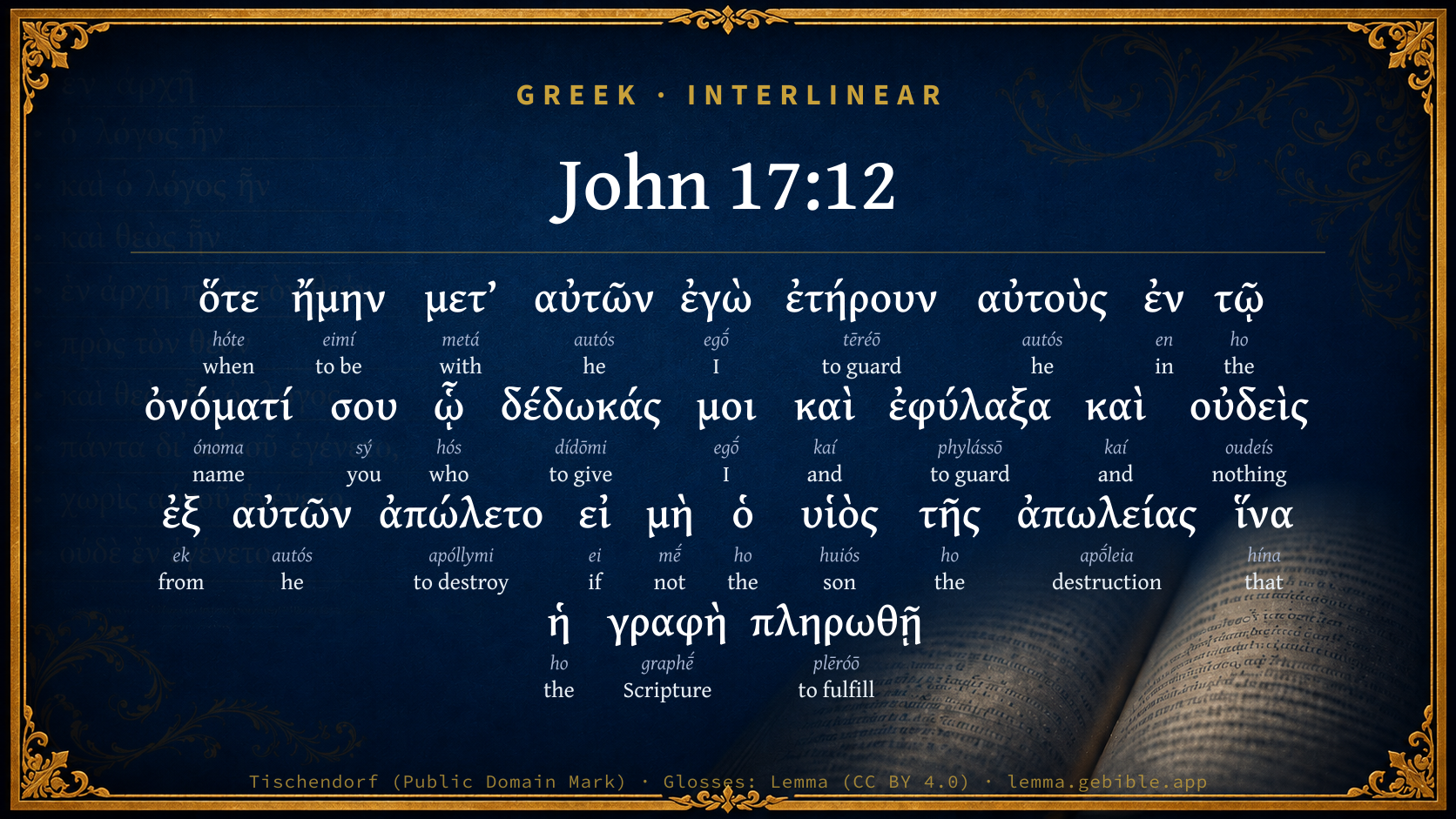
Greek (Tischendorf 8th ed.) John 17:12 appears in the Greek New Testament. The text above is from the Tischendorf 8th edition. Each word links to its Strong’s number and a concise gloss. Click any word for its full Thayer’s Greek Lexicon entry.
Download image
Cite this verse

John 17:12 (World English Bible). Public Domain. Lemma interlinear Bible study tool, https://lemma.gebible.app/v/john/17/12.

Show BibTeX & RIS
BibTeX
RIS
English Translation
While I was with them in the world, I kept them in your name. Those whom you have given me I have kept. None of them is lost, except the son of destruction, that the Scripture might be fulfilled.
World English Bible · Public Domain
Download a study sheet

One document with this verse’s original text, its word-by-word gloss line, the meaning frame, cross-references with their text, attributed commentary, and full source and license credits — printable, and it pastes into notes with its structure intact.

This verse Autodidact and up

Study sheet (.html) Plain text (.txt)

A passage Seminary Student

Up to 50 verses in one chapter. A passage sheet keeps up to 6 commentary sources and 12 cross-references per verse, in the order this page ranks them, and says so on the sheet whenever that leaves anything out. Ask for a single verse and you get the Autodidact verse sheet above.

Everything on this page stays free to read, with no account — the sheet is a download of what is already on screen, not access to it.

Want to remove ads? Support Godless Engineer
Compare translations 3

The same verse in 3 English versions, stacked beneath the original-language interlinear above. Click any original word for its lexicon entry.

Each is an independent rendering of the whole verse — the interlinear is not word-aligned to these translations.

Highlighted words mark where these versions differ — a whole-verse word diff, not a word-by-word alignment.

  • World English Bible Public Domain
    While I was with them in the world, I kept them in your name. Those whom you have given me I have kept. None of them is lost, except the son of destruction, that the Scripture might be fulfilled.
  • King James Version Public Domain
    While I was with them in the world, I kept them in thy name: those that thou gavest me I have kept, and none of them is lost, but the son of perdition; that the scripture might be fulfilled.
  • unfoldingWord Literal Text CC BY-SA 4.0
    While I was with them, I kept them in your name that you have given me. And I protected them, and not one of them perished, except for the son of destruction, so that the scripture would be fulfilled.

unfoldingWord Literal Text — © unfoldingWord, licensed CC BY-SA 4.0. Word-aligned USFM3 via Door43 (git.door43.org/unfoldingWord/en_ult).

Versions to compare (up to 4)

3 of 4 selected

Show all 19 translations

Every available English version of this verse, each an independent rendering of the whole verse.

  • World English Bible Public Domain
    While I was with them in the world, I kept them in your name. Those whom you have given me I have kept. None of them is lost, except the son of destruction, that the Scripture might be fulfilled.
  • Berean Standard Bible Public Domain
    While I was with them, I protected and preserved them by Your name, the name You gave Me. Not one of them has been lost, except the son of destruction, so that the Scripture would be fulfilled.
  • Majority Standard Bible Public Domain
    While I was with them in the world, I protected and preserved by Your name those You gave Me. Not one of them has been lost, except the son of destruction, so that the Scripture would be fulfilled.
  • King James Version Public Domain
    While I was with them in the world, I kept them in thy name: those that thou gavest me I have kept, and none of them is lost, but the son of perdition; that the scripture might be fulfilled.
  • American Standard Version (1901) Public Domain
    While I was with them, I kept them in thy name which thou hast given me: and I guarded them, and not one of them perished, but the son of perdition; that the scripture might be fulfilled.
  • Revised Version (1885) Public Domain
    While I was with them, I kept them in thy name which thou hast given me: and I guarded them, and not one of them perished, but the son of perdition; that the scripture might be fulfilled.
  • Geneva Bible (1599) Public Domain
    While I was with them in the worlde, I kept them in thy Name: those that thou gauest me, haue I kept, and none of them is lost, but the childe of perdition, that the Scripture might be fulfilled.
  • Douay-Rheims (1899) Public Domain
    While I was with them, I kept them in thy name. Those whom thou gavest me have I kept; and none of them is lost, but the son of perdition, that the scripture may be fulfilled.
  • Young's Literal Translation Public Domain
    when I was with them in the world, I was keeping them in Thy name; those whom Thou hast given to me I did guard, and none of them was destroyed, except the son of the destruction, that the Writing may be fulfilled.
  • Literal Standard Version CC BY-SA 4.0
    when I was with them in the world, I was keeping them in Your Name; I guarded those whom You have given to Me, and none of them were destroyed, except the son of the destruction, that the Writing may be fulfilled.
  • Unlocked Literal Bible CC BY-SA 4.0
    While I was with them, I kept them in your name, which you have given me. I protected them, and not one of them was destroyed, except for the son of destruction, so that the scriptures would be fulfilled.
  • unfoldingWord Literal Text CC BY-SA 4.0
    While I was with them, I kept them in your name that you have given me. And I protected them, and not one of them perished, except for the son of destruction, so that the scripture would be fulfilled.
  • Darby Bible Public Domain
    When I was with them I kept them in thy name; those thou hast given me I have guarded, and not one of them has perished, but the son of perdition, that the scripture might be fulfilled.
  • World Messianic Bible Public Domain
    While I was with them in the world, I kept them in your name. I have kept those whom you have given me. None of them is lost except the son of destruction, that the Scripture might be fulfilled.
  • Webster's Bible Public Domain
    While I was with them in the world, I kept them in thy name: those that thou gavest to me I have kept, and none of them is lost but the son of perdition; that the scripture might be fulfilled.
  • Free Bible Version CC BY-SA 4.0
    While I was with them, I protected them in your name that you gave to me. I watched over them so that no one was lost except the ‘son of the lost,’ so Scripture was fulfilled.
  • Bible in Basic English Public Domain
    While I was with them I kept them safe in your name which you have given to me: I took care of them and not one of them has come to destruction, but only the son of destruction, so that the Writings might come true.
  • Text-Critical English NT CC BY 4.0
    While I was with them in the world, I kept them safe by the power of yoʋr name. I have guarded those yoʋ have given me, and not one of them has perished except the son of destruction, so that the Scripture might be fulfilled.
  • Tyndale New Testament (1534) Public Domain
    Whyll I was with the in the worlde I kepte the in thy name. Those that thou gavest me have I kepte and none of the is lost but that lost chylde that the scripture myght be fulfilled.

Literal Standard Version (2020), Covenant Press — licensed CC BY-SA 4.0. Text via the HelloAO Bible API (eBible.org). Unlocked Literal Bible (unfoldingWord) — licensed CC BY-SA 4.0. Text via the HelloAO Bible API (eBible.org). unfoldingWord Literal Text — © unfoldingWord, licensed CC BY-SA 4.0. Word-aligned USFM3 via Door43 (git.door43.org/unfoldingWord/en_ult). Free Bible Version, Dr. Jonathan Gallagher — licensed CC BY-SA 4.0. Text via the HelloAO Bible API (eBible.org).

Word by word

More ways to search: Search by grammar → Find every occurrence → Compare this word →

Practice this passage: Drill this verse → Learn its vocabulary →

ἀπωλείας
apṓleia
G684
“destruction”
Noun, Genitive, Singular, Feminine
Part of Speech
Noun
Case
Genitive
Number
Singular
Gender
Feminine
Full Thayer's Definition

Origin: from a presumed derivative of G622

TDNT: 07:36,7

1. destroying, utter destruction a. of vessels 2. a perishing, ruin, destruction a. of money b. the destruction which consists of eternal misery in hell
  1. ὅτε hóte G3753 “when” Adverb
  2. ἤμην eimí G1510 “to be” Verb, Imperfect, Middle, Indicative, 1st person, Singular
  3. μετ’ metá G3326 “with” Preposition
  4. αὐτῶν autós G846 “he” Personal pronoun, Genitive, Plural, Masculine
  5. ἐγὼ egṓ G1473 “I” Personal pronoun, 1st person, Nominative, Singular
  6. ἐτήρουν tēréō G5083 “to guard” Verb, Imperfect, Active, Indicative, 1st person, Singular
  7. αὐτοὺς autós G846 “he” Personal pronoun, Accusative, Plural, Masculine
  8. ἐν en G1722 “in” Preposition
  9. τῷ ho G3588 “the” Article, Dative, Singular, Neuter
  10. ὀνόματί ónoma G3686 “name” Noun, Dative, Singular, Neuter
  11. σου sý G4771 “you” Personal pronoun, 2nd person, Genitive, Singular
  12. ᾧ hós G3739 “who” Relative pronoun, Dative, Singular, Neuter
  13. δέδωκάς dídōmi G1325 “to give” Verb, Perfect, Active, Indicative, 2nd person, Singular
  14. μοι egṓ G1473 “I” Personal pronoun, 1st person, Dative, Singular
  15. καὶ kaí G2532 “and” Conjunction
  16. ἐφύλαξα phylássō G5442 “to guard” Verb, Aorist, Active, Indicative, 1st person, Singular
  17. καὶ kaí G2532 “and” Conjunction
  18. οὐδεὶς oudeís G3762 “nothing” Adjective, Nominative, Singular, Masculine, Negative
  19. ἐξ ek G1537 “from” Preposition
  20. αὐτῶν autós G846 “he” Personal pronoun, Genitive, Plural, Masculine
  21. ἀπώλετο apóllymi G622 “to destroy” Verb, Aorist, Middle, Indicative, 3rd person, Singular
  22. εἰ ei G1487 “if” Conditional
  23. μὴ mḗ G3361 “not” Particle, Negative
  24. ὁ ho G3588 “the” Article, Nominative, Singular, Masculine
  25. υἱὸς huiós G5207 “son” Noun, Nominative, Singular, Masculine
  26. τῆς ho G3588 “the” Article, Genitive, Singular, Feminine
  27. ἵνα hína G2443 “that” Conjunction
  28. ἡ ho G3588 “the” Article, Nominative, Singular, Feminine
  29. γραφὴ graphḗ G1124 “Scripture” Noun, Nominative, Singular, Feminine
  30. πληρωθῇ plēróō G4137 “to fulfill” Verb, Aorist, Passive, Subjunctive, 3rd person, Singular

About this verse

These counts appear in no published source. They are computed here, from the morphology-tagged text and Lemma’s own curated glosses. What Lemma adds →

31
words
24
distinct lemmas
Gospels
section

Notable vocabulary

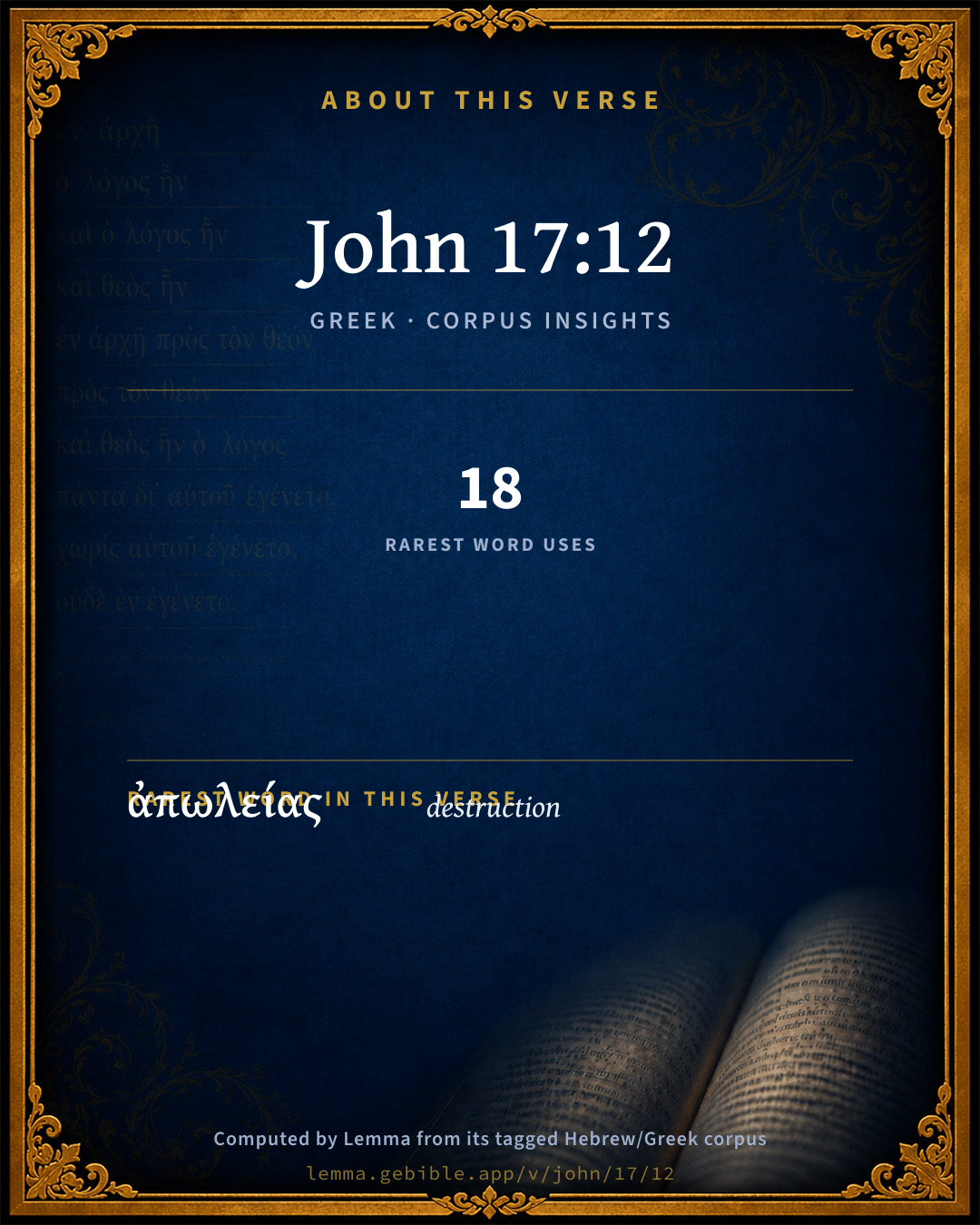
The rarest word here is ἀπωλείας destruction G684 — appearing just 18 times in the whole Greek New Testament.

Shared distinctive vocabulary

ἀπωλείας destruction G684 occurs in 17 verses of the Greek New Testament. Also found in:

Repetition

Words recur within this verse:

Cross-references

12

Topical passages linked to John 17:12 in the Treasury of Scripture Knowledge — connected by theme and wording, ordered by reader-vote popularity; previews shown in the World English Bible.

  • Psalms 109:6–19 Set a wicked man over him. Let an adversary stand at his right hand.
  • John 10:27–28 My sheep hear my voice, and I know them, and they follow me.
  • John 18:9 that the word might be fulfilled which he spoke, "Of those whom you have given me, I have lost none."
  • John 13:18 I don't speak concerning all of you. I know whom I have chosen. But that the Scripture may be fulfilled, 'He who eats bread with me has lifted up his heel against me.'
  • John 6:37 All those who the Father gives me will come to me. Him who comes to me I will in no way throw out.
  • Acts 1:16–20 "Brothers, it was necessary that this Scripture should be fulfilled, which the Holy Spirit spoke before by the mouth of David concerning Judas, who was guide to those who took Jesus.
  • John 6:39–40 This is the will of my Father who sent me, that of all he has given to me I should lose nothing, but should raise him up at the last day.
  • John 6:70–71 Jesus answered them, "Didn't I choose you, the twelve, and one of you is a devil?"
  • Acts 1:25 to take part in this ministry and apostleship from which Judas fell away, that he might go to his own place."
  • 1 John 2:19 They went out from us, but they didn't belong to us; for if they had belonged to us, they would have continued with us. But they left, that they might be revealed that none of them belong to us.
  • 2 Thessalonians 2:3 Let no one deceive you in any way. For it will not be, unless the departure comes first, and the man of sin is revealed, the son of destruction,
  • Hebrews 2:13 Again, "I will put my trust in him." Again, "Behold, here am I and the children whom God has given me."

Cross-references courtesy of OpenBible.info (CC BY 4.0).

Where the printed editions differ

2 variants

Places in this verse where the major printed Greek editions disagree on the wording in a way that affects the translation — a comparison of editions, not a manuscript-by-manuscript collation. The editions are the modern critical texts (Nestlé-Aland 28/27, SBL, Westcott-Hort, Tregelles, Tyndale House) and the traditional texts behind the KJV (the Textus Receptus and the Byzantine/Majority text). It is not a claim about which reading is original.

  1. Extra text
    ἐν τῷ κόσμῳ,

    “in <the> world”

    In TRByz Not in NA28NA27TynSBLWHTreg

    ἐν τῷ κόσμῳ, (en tō kosmō) 'in world' is only in traditional manuscripts (TR+Byz)

  2. Different wording
    ᾧ

    “which [name]”

    In NA28NA27TynSBLWHTreg Not in TRByz

    οὓς (hous) 'which [people]' occurs in traditional manuscripts (TR+Byz) instead of ᾧ (hō) 'which [name]' in older manuscripts (NA28+NA27+Tyn+SBL+WH+Treg)

Textual data: Translators Amalgamated Greek New Testament (STEPBible TAGNT) · CC BY 4.0.

Commentary

Notes on John 17:12 from classic Christian and Jewish commentators (each source and its license shown beneath its notes). The classic Christian expositions comment on the surrounding passage and are grouped to its opening verse, so a note may address several verses; the Jewish commentaries on the Tanakh (Rashi and others) are per-verse, so they appear only where the commentator wrote on this verse.

Lemma curates 59 commentaries, every one of them public domain or Creative Commons licensed, each selected and text-cleaned for this edition rather than reprinted as found. About our sources →

Tyndale Open Study Notes

Tyndale Open Resources

17:12-13 Until now, Jesus had guarded his followers. Now he was concerned for their strength and survival in his absence, because the world would be hostile toward them (15:18-27) and their mission of challenging the world by heralding the truth (16:8-11). After Jesus’ departure, the Spirit would protect them (15:26) and bring them joy.

Tyndale Open Study Notes — © Tyndale Open Resources, licensed CC BY-SA 4.0. Text via the HelloAO Bible API.

Bengel's Gnomon

Johann Albrecht Bengel

Joh 17:12. Ἐγῶ ἐτήρουν· ἐφύλαξε, I kept them all the time: I guarded them) Jesus settles accounts (as it were) with the Father: ἐτήρουν has respect to τήρησον, Joh 17:11, “Keep through Thine own name.” What I have heretofore done, saith He, do thou hereafter: ἐτήρουν, I was keeping, I kept the whole time, viz. by My power: ἐφύλαξα, I guarded, viz. by My watchfulness [The Engl. Vers. loses the distinction by translating both verbs, kept]. The same verbs occur in 1Jn 5:18; 1Jn 5:21, “He who is begotten of God keepeth (τηρεῖ) himself:” “Little children, guard (φύλαξατε) yourselves from (be on your guard against) idols.”—οὐδεὶς, none) This too has reference to the future; ch. Joh 18:9, [Jesus to those apprehending Him saith, “I am He, if therefore ye seek Me, let these go their way. That the saying might be fulfilled, ‘Of them which Thou gavest Me, have I lost none.’ ”]—εἰ μὴ, except) A sad exception.—ὁ υἱὸς τῆς ἀπωλείας) The article is strongly demonstrative, “that son of perdition;” he of whom the prediction has been given; who has destroyed himself. Act 1:25, “Judas by transgression fell, that he might go to his own place;” for whom it would have been good that he had not been born. He does not name Judas. Comp. Psa 16:4, “I will not take up their names into my lips.” We indeed shall have to render an account of the individuals whom we have suffered to be lost by our neglect.—[ἡ γραφὴ, the Scripture) Of such moment is the Scripture, that Christ Himself, even in His address to the Father, appeals to it.—V. g.]

Bengel's Gnomon of the New Testament — English translation (T&T Clark, Edinburgh, 1860) — public domain. Text from a community e-Sword module.

Meyer's Critical & Exegetical Commentary

Heinrich August Wilhelm Meyer

Joh_17:12-13. A more definite outflow of heart concerning Joh_17:11.

ὅτε ἤμην, κ.τ.λ.] As in Joh_17:11, οὐκέτι εἰμὶ ἐν τ. κόσμῳ, Jesus speaks as though He had already departed out of the world. Jam in exitu mundi pedem irrevocabilem posuerat, Ruperti on Joh_17:11.

ἐγώ] That which Thou mayest now do, Joh_17:11.

οὓς δέδωκ. μοι ἐφύλ., κ.τ.λ.] Not a parenthesis, but a further expression of the τήρησις just described, in which a sorrowful but telically clear and conscious mention of Judas obtrudes itself.

ἐφύλαξα] Through the φυλάσσειν (custodire) is the τηρεῖν (conservare) accomplished. Comp. Sap. Joh_10:5; Dem. 317. ult. The disciples were handed over to Him for protection and guardianship, ut eos salvos tueretur. This He has accomplished, and none of them has fallen into destruction (i.e. into eternal destruction through apostasy, which leads to the loss of ζωή), except him who belongs to destruction (Mat_23:15), i.e. who is destined to destruction. Comp. Joh_6:64; Joh_6:70. Jesus does not like to name Judas, who forms this tragical exception (εἰ μή is not equivalent to ἀλλά, as Scholten thinks), but his destructionand therein the purity of the consciousness of Jesus in the matter is expressedis nothing accidental, capable of being averted, but is prophesied as a divine destiny in the Scripture, and must take place in fulfilment thereof. On account of Joh_13:18, it is without warrant to think of another saying of Scripture than, with Luther, Lücke, and several others, of Psa_41:10 (Kuinoel: the prophecies of the death of Jesus generally are intended; Lange, L. J. II. p. 1412: Isa_57:12-13; Euth. Zigabenus, Calovius, and many, Psa_109:8, which passage, however, has its reference in Act_1:20). The designation of Antichrist by ὁ υἱὸς τ. ἀπωλ., 2Th_2:3, is parallel in point of form. In the Evang. Nikod. 20 (see Thilo on the passage, p. 708), the devil is so called.

Joh_17:13. But now I come to Thee, and since I can no longer guard them personally as hitherto, I speak this (this prayer for Thy protection, Joh_17:11) in the world (jam ante discessum meum, Bengel), that they, as witnesses and objects of this my intercession, knowing themselves assured of Thy protection, may bear my joy (as in Joh_15:11, not Joh_14:27) fulfilled in themselves. On this expression of prayer regarding the influence which the listening to prayer should have upon the listeners, comp. Joh_11:42. Luther well says: that they, through the word, apprehended by the ears, and retained in the heart, may be consoled, and be able cheerfully to presume thereon, and to say: See, this has my Lord Christ said, so affectionately and cordially has He prayed for me, etc.

Meyer — Critical and Exegetical Commentary on the New Testament — English translation by Peter Christie, edited by Frederick Crombie (T&T Clark, 1880) — public domain. Text from a community e-Sword module.

Expositor's Greek Testament

ed. W. Robertson Nicoll

Joh 17:12 . The protection now asked had been afforded by Christ so long as He was with the disciples. ὅτε ἤμην μετʼ αὐτῶν , ἐγὼ ἐτήρουν … “when I was with them, I kept them in Thy name which Thou hast given me: and I guarded them, and not one of them perished, but the son of perdition, that the Scripture might be fulfilled”. On the detail of educative care spent on the disciples, and covered by ἐτὴρουν , see Bernard, Central Teaching , p. 370. ὁ υἱὸς τῆς ἀπωλείας , cf. 2Th 2:3 , in accordance with the usual Hebrew usage, the person identified with perdition, closely associated with it. Cf. Isa 57:4 ; Isa 33:2 ; Mat 23:15 . Raphel quotes from Herodotus, viii., ὕβριος υἱόν , with the remark, “nee Graecis plane ignotus est hic loquendi modus”. The Scripture referred to is Psa 41:10 , as in Joh 18:18 .

The Expositor's Greek Testament, edited by W. Robertson Nicoll (1897–1910) — public domain. Text from a community e-Sword module.

Godet's Commentaries

Frédéric Louis Godet

Vv. 12, 13. “When I was with them, I kept them in thy name; those whom thou hast given me, I have watched over; and none of them is lost, except the son of perdition, that the Scripture might be fulfilled. 13. But now, I come to thee; and I say these things while I am in the world, that they may have my joy fulfilled in themselves.”

Joh 17:12-15 justify the petition: Keep them, by developing the ground of it, as it had been briefly indicated in Joh 17:11 a: They have need of thy protection.—“When I was with them,” resumes the idea of: I am no more ...(Joh 17:11). The words of the T. R.: in the world, are probably a gloss.

The ἐγώ, I, contrasts Him who has kept them hitherto with Him who is to do it for the future. The ἐτήρουν, I kept them, indicates the result obtained (conservabam); the ἐφύλαξα, I have guarded, relates to the action put forth for this end (custodivi).

The readingᾧ is still more inadmissible in this verse than in the preceding. It has only three Mjj. in its favor, instead of sixteen in Joh 17:11. The reading ὅ is also abandoned by the three Mjj. which supported it, and has here in its favor only the Egyptian Versions. It only remains to read οὕς (those whom), with the T. R. and the majority of the Mjj., which suits the meaning of Joh 17:11.

By the word son of perdition and the citation of the prophecy, Jesus discharges Himself from responsibility, without lessening that of Judas. As to the latter, he has freely yielded himself to play the part traced out beforehand by the prophecy.

We may compare here what is foretold concerning Antichrist. We know through prophecy that this person will exist, and yet this fact will not prevent the man who shall accept this part from freely doing so. Comp. p. 235, the remarks on the relation between the divine foreknowledge and human freedom. In the Hebraistic phrase son of the abstract complement indicates the moral principle which determines the tendency of the individual thus designated. The passage of which Jesus is thinking is Psa 41:10, cited in Joh 13:18. Must we conclude from the expression εἰ μή, if it is not, that Jesus counted Judas also in the number of those whom the Father had previously given Him? I do not think that this form of expression obliges us to draw this conclusion; comp. Mat 12:4, Luk 4:26-27, etc.

This remark was a parenthesis intended to justify, with regard to the loss of Judas, the watchfulness of the Lord. After this Jesus returns (Joh 17:13) to the idea of His approaching departure; this is the fact which gives the ground for His petition. And He adds that, if He utters aloud (this is the meaning of λαλῶ) these words in presence of His disciples, before leaving them, it is that He may associate them in the joy which He Himself enjoys. This joy is that which is inspired in Him by the certainty of the protection with which the Father shelters Him at all times, a certainty which is also to become theirs.

The need which they have of being kept is set forth in the following words in a still more pressing way than before. They are not only going to remain alone in the world, but as objects of itshatred.

Frédéric Louis Godet — Commentaries on Luke, John, Romans, and 1 Corinthians — English translation (T&T Clark, Edinburgh, 1870s–1890s) — public domain. Text from a community e-Sword module.

Jamieson, Fausset & Brown

Robert Jamieson, A. R. Fausset & David Brown

I kept--guarded.

them in thy name--acting as Thy Representative on earth.

none of them is lost, but the son of perdition--It is not implied here that the son of perdition was one of those whom the Father had given to the Son, but rather the contrary (Joh 13:18) [WEBSTER and WILKINSON]. It is just as in Luk 4:26-27, where we are not to suppose that the woman of Sarepta (in Sidon) was one of the widows of Israel, nor Naaman the Syrian one of the lepers in Israel, though the language--the same as here--might seem to express it.

son of perdition--doomed to it (Th2 2:3; Mar 14:21).

Jamieson, Fausset & Brown — Commentary Critical and Explanatory on the Whole Bible (1871) — public domain (CC PDM 1.0). Text via the HelloAO Bible API.

Adam Clarke's Commentary

Verse 12. I kept them in thy name] In thy doctrine and truth.

But the son of perdition] So we find that Judas, whom all account to have been lost, and whose case at best is extremely dubious, was first given by God to Christ? But why was he lost? Because, says St. Augustin, he would not be saved: and he farther adds, After the commission of his crime, he might have returned to God and have found mercy. Aug. Serm. 125; n. 5; Psa. cxlvi. n. 20; Ser. 352, n. 8; and in Psa. cviii. See Calmet, who remarks: Judas only became the son of perdition because of his wilful malice, his abuse of the grace and instructions of Christ, and was condemned through his own avarice, perfidy, insensibility, and despair. In behalf of the mere possibility of the salvation of Judas, see the observations at the end of Acts 1. See Clarke on Ac 1:26

Perdition or destruction is personified; and Judas is represented as being her son, i.e. one of the worst of men-one whose crime appears to have been an attempt to destroy, not only the Saviour of the world, but also the whole human race. And all this he was capable of through the love of money! How many of those who are termed creditable persons in the world have acted his crime over a thousand times! To Judas and to all his brethren, who sell God and their souls for money, and who frequently go out of this world by a violent voluntary death, we may apply those burning words of Mr. Blair, with very little alteration:

"O cursed lust of gold! when for thy sake

The wretch throws up his interest in both worlds,

First hanged in this, then damned in that to come."

That the scripture might be fulfilled.] Or, Thus the scripture is fulfilled: see Ps 41:9; Ps 109:8; compared with Ac 1:20. Thus the traitorous conduct of Judas has been represented and illustrated by that of Ahitophel, and the rebellion of Absalom against his father David. Thus what was spoken concerning them was also fulfilled in Judas: to him therefore these scriptures are properly applied, though they were originally spoken concerning other traitors. Hence we plainly see that the treachery of Judas was not the effect of the prediction, for that related to a different case; but, as his was of the same nature with that of the others, to it the same scriptures were applicable.

Adam Clarke's Commentary on the Bible (1810–1826) — public domain. Text from a community e-Sword/MySword module.

John Calvin's Commentaries

12. While I was with them in the world. Christ says that he hath kept them in the name of his Father; for he represents himself to be only a servant, who did nothing but by the power, and under the protection, of God. He means, therefore, that it were most unreasonable to suppose that they would now perish, as if by his departure the power of God had been extinguished or dead. But it may be thought very absurd that Christ surrenders to God the office of keeping them, as if, after having finished the course of his life, he ceased to be the guardian of his people. The reply is obvious. He speaks here of visible guardianship only which ended at the death of Christ; for, while he dwelt on earth, he needed not to borrow power from another, in order to keep his disciples; but all this relates to the person of the Mediator, who appeared, for a time, under the form of a servant. But now he bids the disciples, as soon as they have begun to be deprived of the external aid, to raise their eyes direct towards heaven. Hence we infer that Christ keeps believers in the present day not less than he formerly did, but in a different manner, because Divine majesty is openly displayed in him.

Whom thou hast given me. He again employs the same argument, that it would be highly unbecoming that the Father should reject those whom his Son, by his command, has kept to the very close of his ministry; as if he had said, “What thou didst commit to me I have faithfully executed, and I took care that nothing was lost in my hands; and when thou now receivest what thou hadst intrusted to me, it belongs to thee to see that it continue to be safe and sound.”

But the son of perdition. Judas is excepted, and not without reason; for, though he was not one of the elect and of the true flock of God, yet the dignity of his office gave him the appearance of it; and, indeed, no one would have formed a different opinion of him, so long as he held that exalted rank. Tried by the rules of grammar, the exception is incorrect; but if we examine the matter narrowly, it was necessary that Christ should speak thus, in accommodation to the ordinary opinion of men. But, that no one might think that the eternal election of God was overturned by the damnation of Judas, he immediately added, that he was the son of perdition By these words Christ means that his ruin, which took place suddenly before the eyes of men, had been known to God long before; for the son of perdition, according to the Hebrew idiom, denotes a man who is ruined, or devoted to destruction.

That the Scripture might be fulfilled. This relates to the former clause. Judas fell, that the Scripture might be fulfilled But it would be a most unfounded argument, if any one were to infer from this, that the revolt of Judas ought to be ascribed to God rather than to himself; because the prediction laid him under a nccesslty. For the course of events ought not to be ascribed to prophecies, because it was predicted in them; and, indeed, the prophets threaten nothing but what would have happened, though they had not spoken of it. It is not in the prophecies, therefore, that we must go to seek the cause of events. I acknowledge, indeed, that nothing happens but what has been appointed by God; but the only question now is, Do those things which it has foretold, or predicted, lay men under a necessity? which I have already demonstrated to be false.

Nor was it the design of Christ to transfer to Scripture the cause of the ruin of Judas, but he only intended to take away the occasion of stumbling, which might shake weak minds. Now the method of removing it is, by showing that the Spirit of God had long ago testified that such an event would happen; for we commonly startle at what is new and sudden. This is a highly useful admonition, and admits of extensive application. For how comes it that in our own day, the greater part of men give way on account of offences, but because they do not remember the testimonies of Scripture, by which God has abundantly fortified his people, having foretold early all the evils and distresses which would come before their eyes?

John Calvin's Commentaries (1540-1563) — public domain. Text from the Calvin Translation Society English edition (1840s-50s) via the Christian Classics Ethereal Library (ccel.org). Calvin's coverage is partial (roughly two-thirds of the Bible); uncommented books and verses are honest gaps, never fabricated. The 19th-century editor's footnotes and remarks are omitted so the notes are faithfully Calvin's own voice.

Ellicott's Commentary for English Readers

(12) While I was with them in the world.—Comp. the opening words of Joh_17:11. During His presence with them there was not this special need for commending them to the Father’s care. His relation to them now is as that of a parent blessing and praying for His children before He is taken away from them. (Comp. Joh_13:33.)

I kept them in thy name: those that thou gavest me I have kept.—Better (comp. previous verse), I kept them in Thy name which Thou gavest Me, and guarded them. The pronoun is emphatic. “While I was in the world I kept them. I am now praying that Thou wouldest keep them.” The words “kept” and “guarded” differ slightly in meaning, the former pointing to the preservation in the truth revealed to them, and the latter to the watchfulness by means of which this result was obtained. The former may be compared to the feeding of the flock, the latter to the care which protects from the wild beasts around. (Comp. Joh_10:28-30.)

And none of them is lost, but the son of perdition.—Better, None of them perished, except the son of perdition. The tense is the same as that of the word “guarded.” The Good Shepherd watched His flock, and such was His care that none perished but the “son of perdition.” Of him the words carefully state that “he perished.” He, then, was included in “them which Thou gavest Me.” For him there was the same preservation and the same guardianship as for those who remained in the fold. The sheep wandered from the flock, and was lost by his own act. (Comp. especially Notes on Joh_6:37-39; Joh_6:71. See also Joh_18:9.)

The term, “son of perdition,” is a well-known Hebrew idiom, by which the lack of qualitative adjectives is supplied by the use of the abstract substantives, which express that quality. A disobedient child is, e.g., “a son of disobedience;” other common instances are “children of light,” “children of darkness.” A “son of perdition” is one in whose nature there is the quality expressed by “perdition.” The phrase is used in Isa_57:4 to express the apostacy of the Israelites (in English version, “children of transgression”). It occurs once again in 2Th_2:3, of the “man of sin.” (Comp. Notes there.) It is used, in the Gospel of Nicodemus, of the devil. In the present passage it is difficult to express the meaning in English, because we have no verb of the same root as the abstract substantive “perdition,” and no abstract substantive of the same root as the verb “perish.” No exact translation can therefore give in English the point of our Lord’s words, “And none of them perished except him whose nature it was to perish.” Here, as often (comp. Note on Joh_10:16), the reader who can consult Luther’s German will find that he exactly hits the sense: “Und ist keiner von ihnen verloren ohne das verlorne Kind.”

That the scripture might be fulfilled.—Comp. Note on Joh_13:18, and Act_1:20.

A Bible Commentary for English Readers, edited by Charles John Ellicott (1878–1897) — public domain. Text from a community e-Sword module.

The Cambridge Bible for Schools and Colleges

gen. ed. J. J. S. Perowne

12. in the world] These words are omitted by the best authorities.

I kept] Literally, I was keeping: Christ’s continual watching over His disciples is expressed. ‘I’ is emphatic, implying ‘now that I am leaving them, do Thou keep them.’

I have kept] Rather, I guarded: both verb and tense are changed. This expresses the protection which is the result of the watching. Moreover the reading must be changed as in Joh_17:11; I kept them in Thy name which Thou hast given Me; and I guarded them.

none of them is lost] Better, not one of them perished.

the son of perdition] The phrase is used twice only in N.T.; here of Judas, in 2Th_2:3 of the ‘man of sin.’ Comp. ‘children of light,’ ‘children of darkness.’ Such expressions are common in Hebrew (see on Joh_12:36). ‘Children of perdition’ occurs Isa_57:4, ‘people of perdition’ Sir_16:9, and ‘son of death’ 2Sa_12:5. We cannot here preserve the full force of the original, in which ‘perish’ and ‘perdition’ are represented by cognate words; ‘none perished but the son of perishing.’

that the scripture] Psa_41:9 : see on Joh_10:35 and Joh_13:18 and comp. Joh_12:38.

The Cambridge Bible for Schools and Colleges (gen. ed. J. J. S. Perowne; Cambridge University Press, 1878–1918) — public domain. Text from a community e-Sword module.

John Gill's Exposition

While I was with them in the world,.... This does not imply that Christ was not in the world now, for he was; but signifies that he was just going out of it; and that his continuance in it was very short: nor that he was, and would be no longer with his disciples; for this is to be understood of his bodily, not of his spiritual presence; in which respect Christ is with his people whilst they are on earth, and they are with him when he is in heaven:

I kept them in thy name; by his Father's authority and power, in his doctrine:

those that thou gavest me I have kept; that is, those that were given him to be his apostles;

and none of them is lost; these he kept close to himself, and from the evil of the world, and from temporal and eternal ruin:

but the son of perdition; Judas, a child of Satan, whose name is Apollyon the destroyer, who was now about to betray his Lord and master; and was one that was appointed to eternal ruin and destruction, of which he was justly deserving; and which is no instance of the apostasy of saints, since though he was given to Christ as an apostle, yet not in eternal election, to be saved by him:

that the Scripture might be fulfilled; this respects either Christ's keeping of his people, and their final perseverance, whereby the Scriptures that speak of it are fulfilled; or rather the destruction of Judas, whereby such passages as speak of that, have their accomplishment, particularly Psa 109:8; Some have thought that this only refers to the general sense of the Scriptures, both the law and prophets; that some are chosen to everlasting life, and others are appointed to wrath; that some are saved, and others lost; some sons of God, and others sons of perdition; but it rather seems to regard some particular passage or passages of Scripture relating to Judas, his character, condition and end, and which are very manifestly pointed at, in the psalm referred to;

"As for the servants whom I have given thee, there shall not one of them perish; for I will require them from among thy number.'' (2 Esdras 2:26)

John Gill's Exposition of the Whole Bible (1746–1763) — public domain (CC PDM 1.0). Text via the HelloAO Bible API.

Trapp's Complete Commentary

John Trapp

12 While I was with them in the world, I kept them in thy name: those that thou gavest me I have kept, and none of them is lost, but the son of perdition; that the scripture might be fulfilled.

Ver. 12. But the son of perdition] This exception shows that Judas was never of Christ’s body, for can he be a Saviour of a son of perdition? But why is he then excepted? First, by reason of his office he seemed to be of his body. Secondly, our Saviour speaketh here in particular of the twelve; and to be an apostle was in itself but an outward calling.

John Trapp, A Commentary or Exposition upon All the Books of the Old and New Testament (1647–1656) — public domain. Text from a community e-Sword module.

Albert Barnes' Notes on the Bible

While I was with them in the world - While I was engaged with them among other men - surrounded by the people and the temptations of the world. Jesus had now finished his work among the men of the world, and was performing his last offices with his disciples.

I kept them - By my example, instructions, and miracles. I preserved them from apostasy.

In thy name - In the knowledge and worship of thee. See Joh 17:6-11.

Those that thou gavest me ... - The word “gavest” is evidently used by the Saviour to denote not only to give to him to be his real followers, but also as apostles. It is used here, probably, in the sense of giving as apostles. God had so ordered it by his providence that they had been given to him to be his apostles and followers; but the terms “thou gavest me” do not of necessity prove that they were true believers. Of Judas Jesus knew that he was a deceiver and a devil, Joh 6:70; “Have not I chosen you twelve, and one of you is a devil?” Judas is there represented as having been chosen by the Saviour to the apostleship, and this is equivalent to saying that he was given to him for this work; yet at the same time he knew his character, and understood that he had never been renewed.

None of them - None of those chosen to the apostolic office.

But the son of perdition - See the notes at Mat 1:1. The term son was given by the Hebrews to those who possessed the character described by the word or name following. Thus, sons of Belial - those who possessed his character; children of wisdom those who were wise, Mat 11:19. Thus Judas is called a son of perdition because he had the character of a destroyer. He was a traitor and a murderer. And this shows that he who knew the heart regarded his character as that of a wicked man one whose appropriate name was that of a son of perdition.

That the scripture ... - See the notes at Joh 13:18. Compare Psa 12:9.

Albert Barnes' Notes on the Bible (1834–1885) — public domain. Text from a community e-Sword/MySword module.

Haydock's Catholic Bible Commentary

While I was with them, I kept them in thy name.[5] He still speaks, says St. John Chrysostom, as man, and after a human manner, by mentioning the advantage they seemed to enjoy, as long as he conversed visibly with them on earth, not that his invisible presence should be less beneficial to them. --- And none of them hath perished, except the son of perdition, the wretched Judas, whose fall was foretold in the Scriptures. (Psalm cviii.) He hath perished, that is, now is about being lost, by his own fault, says St. John Chrysostom on this place. And St. Augustine on Psalm cxxxviii. How did the devil enter into the heart of Judas? he could not have entered, had not he given him place. (Witham) --- That the Scripture may be fulfilled: this does not any ways shew, that it was the will of God that Judas should be lost; but only that what happened to Judas was conformable to the prophecies, and not occasioned by them. Who will doubt, says St. Augustine, (lib. de Unit. Eccl. chap. ix.) but that Judas might, if he pleased, have abstained from betraying Christ. But God foretold it, because he foresaw clearly the future perversity of his disposition. (Calmet) ---See above, (xiii. 18.) one of the principal passages of Scripture relative to the treachery of Judas, in which the traitor’s crime had been predicted.

===============================

[BIBLIOGRAPHY]

Cum essem, cum eis, &c. He speaks, says St. John Chrysostom, as man, Greek: os anthropos dialegetai. (hom. Greek: pa. p. 480.) --- In the same place, nisi filius perditionis, Greek: ei me, &c. nisi, it is not, Greek: alla, sed. --- Non perdom, that is, says St. John Chrysostom in the same place, quantum in me erit, non perdam ... non me impellente, vel relinguente: quod si sponte resiliant, non ex necessitate traham. Greek: ei de aph eauton apodedosi, pros anagken ouch elko. St. Augustine, Quomodo diabolus intravit in cor Judæ, non intraret, nisi ille locum daret.

George Leo Haydock (1774–1849), Haydock's Catholic Family Bible and Commentary, 1859 edition — public domain. Excludes Psalms (Douay-Rheims chapter numbering differs from Protestant) and Deuterocanonical books (Catholic canon only).

Matthew Poole's English Annotations

Christ speaks here of himself as one who had already died, was risen, and ascended, though none of all these things were past, because they were so suddenly to come to pass. I have, (saith our Saviour), for all the time that I have abode in the world, and conversed with them,

kept them in thy name, i.e. in the steady owning and profession of thy truth; or (if we read it, through thy name) it signifieth through thy power, and the influence of thy grace. I have not so kept all that came to hear me, but all

those whom thou gavest me by the act of thy eternal counsel; or whom thou gavest me to be my apostles: and none of them is proved an apostate, but the son of perdition: none of them is lost whom thou gavest me by thy eternal gift, none of them whom thou gavest me to be my apostles, but one who, though he was my apostle, and in that sense given to me, yet was never given me by thy eternal gift, as one to be by me redeemed, and brought to eternal life and salvation; for he was a son of perdition: we have this term applied to antichrist, 2Th 2:3. As the son of death, 2Sa 12:5, signifies one appointed to die, or that deserveth to die; and the child of hell, Mat 23:15, signifieth one who deserveth hell; so the son of perdition may either signify one destined to perdition, or one that walketh in the high and right road to perdition, or rather both; one who being passed over in God’s eternal counsels, as to such as shall be saved, hath by his own wilful apostasy brought himself to eternal perdition, or into such a guilt as I know thou wilt destroy him. And by this the Holy Scripture is fulfilled, Psa 109:8, for that is the portion of Scripture here intended, as is apparent from Act 1:20, where the apostle applies that text to Judas, who is here spoken of. Other scriptures also were thus fulfilled, as Psa 41:9, compared with Joh 13:18.

Matthew Poole's English Annotations on the Holy Bible (1683–1685) — public domain. Text from a community e-Sword/MySword module.

Whedon's Commentary on the Bible

Daniel D. Whedon

12. While—In the five ensuing verses Jesus contemplates his apostles in relation to their earthly dangers, as by him faithfully kept, (albeit that one is lost,) in the midst of a hated world, from which they must not be withdrawn, though while in it they are not of it. While… in the world— Here, as throughout this intercession, his standpoint is beyond this world.

I kept them—Kept them, not like a purse of coin, locked in an iron safe, as a mere thing; nor as a prisoner, locked in a bolted cell, as an unfree agent, but as a child is kept in a loved home, from which he is able to escape by a power of his own. Such keeping of a true free agent is intended to be sure only when the kept one prefers to be kept. No divine guardianship throughout the Bible engages to secure a Christian from voluntary apostacy.

The son of perdition—Stier well remarks that wherever in the Holy Scriptures the figurative phrase child of an evil thing is used, it indicates the wilful, guilty, and fixed tendency of the being. So child of hell, Mat_23:15; children of disobedience, Eph_2:2; so also man of sin, 2Th_2:3. Son of perdition, therefore, indicates one who by his own wilful, guilty, personal tending, lands in final destruction. But it is plain, from the previous part of the verse, that this son of perdition was one of those whom thou gavest me, and was kept in thy name; and yet, in spite of that keeping, he was lost; and he became a final heir of perdition. Hence we have on this sacred record, presented in the very primal twelve, a type of genuine final apostacy in the Christian Church.

Scripture might be fulfilled—This is the final good educed by God from the darkest evil: that therein his foreknowledge is verified, and God’s plans for his own conduct, which are conditioned upon the foreknowledge, are left underanged. The dark human side was for pure evil; the divine side is, that the unneeded and condemned sin does of itself fit in to the production of God’s best results.

Daniel D. Whedon (gen. ed.), Commentary on the Old and New Testaments (1874–1909) — public domain. Text from a community e-Sword module.

The Pulpit Commentary

While I was with them (in the world). He speaks of the earthly ministry as completed, and reviews the whole of his influence over them. I kept them in thy Name which thou hast given me. The very process that I can no longer pursue, and the cessation of which becomes the ground of the plea for the Father"s thrhsiv . This an earthly father might say, without irreverence, of children whom he was about to leave, but the quality of the keeping is characterized by the Divine Name which was given him, and that manifested the Sonship which carried with it all the revelation of the Father. and I guarded (them) ethroun signifies watchful observation; efulaxa , guardianship as behind the walls of a fortressand not one perished went to destructionexcept that the son of perdition (has perished). Christ does not say that the son of perdition was given him by the Father and guarded from the evil one, and yet had gone to his own place; the exception refers simply to the "not one perished." Ei mh has occasionally a meaning not exactly equal to alla , but expresses an exception which does not cover the whole of the ideas involved in the previous clause. (see Mat_12:4 Luk_4:26, 27 Gal_1:19, etc.) This awful Hebraistic phrase is used by St. Paul (2Th_2:3; cf. 2Sa_12:5) for antichrist, and numerous phrases of the kind show how a genitive following uiov or teknon expresses the full characteristic or the chief feature of certain persons (thus cf. uionhv tekna fwtov katarav , etc.). This victim of perdition, this child of hell, has completed his course; even now he has laid his plans for my destruction and his own. He has so perished in order that the Scripture might be fulfilled. Even if the full telic force of ina is preserved here, he does not free the "son of perdition" from the responsibility of his own destruction. The Scripture portraiture of Messiah has been realized. Psa_41:9, which has already been quoted by our Lord in Joh_13:18, is probably still in his mind. (cf. also Isa_57:12, Isa_57:13) Some commentators Arch-deacon Watkins, Dean Alford press the fact that the "son of perdition" must have been among those who were given to Christ by the Father, who were watched, guarded, taught by God; but that Judas nevertheless took his own way and went to his own place. Thoma compares the lost disciple with the lost sheep of the synoptists, as though we had a reference to a true reprobate, a son of Belial, Apollyon, and the like. Moulton justly protests against any countenance being found here for the irrevocable decree. But if the interpretation of the ei mh given above is sound, there is no inclusion of the traitor among those who are "of the truth," etc.; but he was one who, notwithstanding boundless opportunity, went to his own place in the perversity of his own will.

Vers. 12, 13. Christ"s petition for his disciples supported by various considerations.

He looks back upon the work he had already done, and sees that it must henceforth be taken up by a different agency.

I THOSE WHO ARE TO RE SAVED ARE COMMITTED TO CHRIST"S KEEPING. "While I was with them in the world, I kept them myself in thy Name. I have watched over those whom thou hast given me.

1. Believers cannot keep themselves.

2. Christ takes them wholly in charge for safekeeping.

3. They are kept,

a. not from suffering,

b. nor from all sin,

c. but from perishing everlastingly. "Not one of them is lost.

d. Christ has an individual care of believers.

e. The loss of a single believer would be

f. a dishonor to Christ,

g. and would weaken the comfort and confidence of his people.

h. Christ keeps them "in the Name" of the Father, out of love and duty to him.

4. Judasthe son of perdition" prepares himself for his own foreseen ruin.

(1) He was not included among those whom the Father had given to the Son.

(2) Jesus discharges himself from all responsibility in relation to Judas.

(3) The fall of the traitor had its place in the scheme of Divine provision. (Joh_12:38 Psa_41:9) It was foretold in Scripture.

II THE OBJECT OF OUR LORD IN THIS PRAYER FOR THE DISCIPLES. "And now I come to thee; and these things I speak in the world, that they may have my joy fulfilled in themselves.

1. His prayer was offered up that their joy should not be diminished by his approaching departure, but rather increased by the coming of the Comforter.

(1) Christ is the Author of joy. "My joy.

(2) He dispenses it

(a) by gracious ordinances,

(b) by cheering promises,

(c) by the witness of the Comforter.

2. The importance and necessity of this joy.

(1) Christ gives it as a mark of his fellow-feeling as One who was himself "anointed with the oil of gladness above his fellows.

(2) To recompense them for the sorrows of life.

(3) To give them strength for duty and suffering. "The joy of the Lord shall be your strength."

The Pulpit Commentary (1880–1919), ed. H.D.M. Spence-Jones & Joseph S. Exell — public domain. Text from a community e-Sword module.

John Wesley's Explanatory Notes

Those whom thou hast given me I have guarded, and none of them is lost, but the son of perdition - So one even of them whom God had given him is lost. So far was even that decree from being unchangeable! That the Scripture might be fulfilled - That is, whereby the Scripture was fulfilled. The son of perdition signifies one that deservedly perishes; as a son of death, 2 Sam. xii, 5; children of hell, Matt. xxiii, 15, and children of wrath, Eph. ii, 3, signify persons justly obnoxious to death, hell, wrath. Psalm cix, 8.

John Wesley, Explanatory Notes Upon the Whole Bible (1754–1765) — public domain. Text via the GEBible commentary corpus.

Scofield Reference Notes

C. I. Scofield

world

kosmos = mankind. (See Scofield "Mat 4:8").

The Scofield Reference Bible (1917 edition), notes by C. I. Scofield — public domain. Text from a community e-Sword module.

Kretzmann's Popular Commentary

Paul E. Kretzmann

Keeping the believers in God’s name:

v. 12. While I was with them in the world, I kept them in Thy name; those that Thou gavest Me I have kept, and none of them is lost but the son of perdition, that the Scripture might be fulfilled.

v. 13. and now I come to Thee; and these things I speak in the world, that they might have My joy fulfilled in themselves.

As long as Jesus was present in the world, in the flesh, so long He personally tended to the keeping of His disciples in the faith. He taught, He admonished them day by day; He always revealed anew to them the name of the Father, in the Gospel which He proclaimed. And His Gospel-work had been most successful. He had kept all of the disciples whom the Father had given Him, His watchful guiding and warning had not been in vain but only in one single case, that of the son of perdition, of the traitor. In his case the Scripture had to be fulfilled. See Psa 69:4; Act 1:20. But now the sojourn of Christ on earth was drawing to a close; no more would He be present with His disciples in the terms of personal, visible contact to which they had become accustomed. Jesus was going to the Father, and therefore He was making this prayer in their presence, while He was yet in the world, that they might be convinced of His personal interest in them, of His unchanging solicitude for them. His urgent prayer for their preservation in the faith should give them the assurance, as it should to the believers of all times, that nothing is left undone which will assist them in the midst of all the perils of the world and their own flesh. That is a source of wonderful comfort to the believers, that gives them the fullness of joy. Theirs, then, is a joy in Christ; they are happy over the fact that they are Christians, that they are intimates of the Father. This joy must drive out every bit of doubt as to a person’s remaining in faith to the end, just as this entire section of Christ’s prayer contains nothing but comfort for every Christian. Where there is such intimacy as between God and Christ, on the one hand, and the believers, on the other, all fear and doubts must vanish. "Now if someone wants to know whether he is elected or in what relation he stands to God, let him but look upon the mouth of Jesus, that is, upon these and similar verses. For though a person cannot say of a certainty who will be elected in the future and remain to the end, yet this is certainly true, that whosoever is called and comes thereto, namely, to hear this revelation, that is, the Word of Christ, provided he accept it in all sincerity, that is, fully hold and believe that it is true, they are the ones that are given to Christ by the Father. But those that are given to Him He will surely keep, and insist that they do not perish."

Paul E. Kretzmann, Popular Commentary of the Bible (1921–1924) — public domain. Text from a community e-Sword module.

Burkitt's Expository Notes on the New Testament

William Burkitt

Observe, here, 1. That those which shall be saved, are given unto Christ, and committed to his care and trust.

2. That none of those that are given unto Christ, as his charge, and committed to his care and trust, shall be finally lost: Those that thou gavest me I have kept, and none of them is lost: it follows, but the Son of perdition.

A person may be said to be the son of perdition two ways; actively and passively.

Actively, he is so who makes it his work and business to destroy others.

Passively, he is a son of perdition, who for his wickedness in destroying others, is destroyed himself.

Judas was a son of perdition in both these senses; his heart was maliciously set upon destroying Christ, and willfully set upon his own destruction: his coveteousness and hypocrisy prompted him to betray our Saviour, his despair provoked him to destroy himself.

William Burkitt's Expository Notes on the New Testament (1700–1703) — public domain. Text from a community e-Sword module.

The People's New Testament

B. W. Johnson

12. None of them is lost, but the son of perdition. God had given him twelve; he had kept them in the name of the Father, and only one was lost, Judas, the traitor, the son of perdition, which the Scripture had predicted. See Psa. 41:9.

B. W. Johnson's The People's New Testament with Notes (1889–1891) — public domain. Electronic text from the Christian Classics Ethereal Library (CCEL) ThML edition.

unfoldingWord translationNotes

Door43 World Missions Community

I kept them in your name

Here "name" is a metonym that refers to the power and protection of God. AT: "I kept them with your protection" (See: Metonymy)

not one of them was destroyed, except for the son of destruction

"the only one among them who was destroyed is the son of destruction"

the son of destruction

This refers to Judas, who betrayed Jesus. AT: "the one whom you long ago decided you would destroy" (See: Assumed Knowledge and Implicit Information)

so that the scriptures would be fulfilled

You can translate this in an active form. AT: "to fulfill the prophecy about him in the scriptures" (See: Active or Passive)

in the world

Here "world" is a metonym for the people who live in the world. (See: Metonymy)

so that they will have my joy fulfilled in themselves

You can translate this in an active form. AT: "so that you might give them great joy" (See: Active or Passive)

I have given them your word

"I have spoken your message to them"

the world ... because they are not of the world ... I am not of the world

Here "the "world" is a metonym that refers to the people who oppose God. AT: "The people who oppose you have hated my followers because they do not belong to those who do not believe, just as I do not belong to them" (See: Metonymy)

translationWords

word of God

fulfill

world

joy

unfoldingWord translationNotes — © Distant Shores Media and the Door43 World Missions Community, licensed CC BY-SA 4.0. Source: git.door43.org/Door43/en_tn.

Cambridge Greek Testament for Schools and Colleges

12. ἐτήρουν. The imperfect expresses Christ’s continual watching. Ἐγώ is emphatic: ‘I kept them while I was with them; but now do Thou keep them.’ Mark the change to ἐφύλαξα, I guarded: this is the protection which is the result of the watching.

ὁ υἱὸς τ. ἀπωλείας. The phrase occurs twice in N.T.; here of Judas, and 2Th 2:3 of the man of sin.’ See on Joh 12:36 and comp. τέκνα ἀπολείας (Isa 52:4), υἱὸς θανάτου (2Sa 12:5). The connexion between ἀπώλετο and ἀπολείας cannot easily be shewn in English. Ἡ γραφή refers to Psa 41:9: see on Joh 10:35, Joh 13:18, Joh 12:38.

Cambridge Greek Testament for Schools and Colleges (Cambridge University Press, 1896; 21 vols, various authors incl. Carr, Maclear, Plummer, Farrar, Lumby, Moule, M. R. James, Simcox) — public domain. Text from a community e-Sword module.

Alford’s Greek Testament

Henry Alford

12. ἐφύλαξα] See ch. 10:28-30. The aor. should be adhered to again: I kept them. The Lord here, as Cyril remarks, compares His keeping of His own, to that by the Father,—in a way only accountable by both Persons being of equal Power and Dignity.

οὐδεὶς … εἰ μὴ …] So that Judas was of the number οὓς δέδωκάς μοι of ver. 9,—shewing us (1) the sense in which those words must be understood (see above); and (2) that of such persons it is true that there is for them no ‘gratia irresistibilis,’ no ‘keeping in God’s Name’ independently of their ‘keeping God’s word,’ ver. 6, which Judas did not do.

ὁ υἱ. τ. ἀπ.] See ref. 2 Thess. As the other disciples by true τήρησις of the divine ῥήματα given to them, rose from being natural men to be the children of God, so Judas, through want of the same, sunk from the state of the natural man to that of the lost—the children of the devil (Olsh. nearly).

Remark, it is not οὐδένα … ἀπώλεσα, εἰ μὴ τὸν υἱὸν τῆς ἀπ.: Christ did not lost him (compare ch. 18:9, where there is no exception), but he lost himself.

ἡ γραφή—in which this was indicated, viz. the passages alleged by Peter, Act 1:20: see ch. 13:18. Beware again of any evasion of the full telic sense of ἵνα.

Henry Alford, The Greek Testament (1849–1861) — public domain. Text from a community e-Sword module.

International Critical Commentary

12. After ὅτε ἤμην μετʼ αὐτῶν, the rec. with AC3NΓΔΘ inserts the explanatory gloss ἐν τῷ κόσμῳ, but om. אBC*DLW.

ἐγὼ ἐτήρουν αὐτούς κτλ., “I (ἐγώ being emphatic) used to keep them,” ἐτήρουν marking the continual training of disciples that was so great a feature of the ministry of Jesus.

ἐν τῷ ὀνόματί σου ᾧ δέδωκάς μοι, repeated from v. 11 (where see note) in the Johannine manner. It is “in the Name,” that is, in the sure protection of the Father’s providence and love, that Jesus guarded (and guards) His disciples.

καὶ ἐφύλαξα κτλ., “and I guarded them (sc. while I was with them in the flesh), and none perished.” For φυλάττειν, cf. 2Th 3:3, Jud 1:24; and see Wisd. 10:5, where τηρεῖν and φυλάττειν are both used of the Divine guardianship of Abraham.

The rec. text, as in v. 11, has οὕς for ᾧ, and omits καί before ἐφύλαξα, making the latter govern οὕς directly; אBC*LW ins. καί.

καὶ οὐδεὶς ἐξ αὐτῶν (cf. for constr. 7:19) ἀπώλετο κτλ., “and not one of them perished, except the son of perdition.” The falling away of Judas has already been described (13:27); ἀπολλύναι is used of the final “perishing,” as at 3:16 (where see note) 10:28. Jesus is represented as speaking of the fate of Judas as if it were already in the past (see 6:64, 70). Cf. 6:39, 10:28, where his exceptional case is not in view; and see note on 18:9, where is quoted this saying of Jesus that He lost none of those whom the Father had “given” to Him. It has often been discussed by theologians whether Judas had really been predestined to destruction, or whether his fall from faithfulness was of his free choice. Such questions are foreign to the philosophy of the first century. For Jn., all that happened to Judas was, indeed, predestined, but that this involves any difficulty as to his guilt does not suggest itself to the evangelist.

εἰ μὴ ὁ υἱὸς τῆς ἀπωλείας. The play on words ἀπώλετο … ἀπωλείας can hardly be reproduced in English. The constr. υἱός τινος (see on 12:36) is not exclusively Hebraic, but it is frequent in Eastern literature. Antichrist is called ὁ υἱὸς τῆς ἀπωλείας (2Th 2:3), the same expression being applied to those who perished in the Flood (Jubilees, x. 3), and to Satan (Evang. Nicodemi, xx.). It signifies one whose end will be perdition, not necessarily that this is inevitable but that it will be so because of his own acts. He is one of whom it may be said, “good were it for him if he had not been born” (Mar 14:21). Cf. υἱὸς γεένης (Mat 23:15), υἱὸς θανάτου (2Sa 12:5), and τέκνα ἀπωλείας (Isa 57:4). Judas was “the son of loss,” although Jesus came to save the lost. For him Jesus did not pray (cf. 1Jn 5:16).

ἀπώλεια is generally used in the N.T. for the final “loss” of a man (it does not occur again in Jn.); but at Mar 14:4 it is the word for the “waste” of the ointment, of which (as Jn. tells, 12:4) it was Judas that complained. It has been suggested that possibly this incident was in mind when Judas was called ὁ υἱὸς τῆς ἀπωλείας, “the son of loss,” the man who really wasted what was precious.1 But the ordinary interpretation is simpler and more probable.

ἵνα ἡ γραφὴ πληρωθῇ. It is not quite certain whether this is a comment of Jn. on the words of Jesus which he has just narrated, or whether he means to place it in the mouth of Jesus Himself.2 It is to be observed that in 18:9, where the words, “of those whom Thou hast given me, I lost not one,” are cited from the present passage, there is no appeal to the O.T., but Jn. applies ἵνα πληρωθῇ ὁ λόγος κτλ. to the saying of Jesus as carrying with it the certainty of its fulfilment. Probably here ἵνα ἡ γραφὴ πλ. is a reflective gloss or comment added by the evangelist or an early editor.

ἡ γραφή always refers in Jn. to a definite passage of the O.T. (see on 2:22), and the Scripture here indicated was probably Psa 41:9, which was cited before (13:18) as foreshadowing the treachery of Judas. Psa 69:25 and 109:8 are cited in Act 1:20 in reference to his miserable and execrated end, and his replacement by Matthias, but Psa 41:9 is more in place here.

International Critical Commentary — older volumes (1896–1929), various authors — public domain. Text from a community e-Sword module.

Vincent's Word Studies in the New Testament

Marvin R. Vincent

In the world. Omit.

I kept [ετηρουν] . Imperfect tense. I continued to keep. The I is emphatic : I kept them, now do Thou keep them.

I kept [ετηρουν] . Rev., rightly, I guarded. The A. V. overlooks the distinction between the two words for keeping. The former word means, I preserved them; the latter, I guarded them as a means to their preservation. See on reserved, 1Pe 1:4.

Is lost - perdition [απωλετο - απωλειας] . A play of words : "None of them perished, but the son of perishing" (Westcott).

The scripture [η γραφη] . See close of note on 5 47, and on Mr 12:10.

Marvin R. Vincent, Word Studies in the New Testament (1887–1900) — public domain. Text from a community e-Sword/MySword module.

Lesson kit

Teaching starters — assembled from the data on this page, not authored interpretation. Every prompt links to the verse data it draws on. Edit before teaching.

John, in the Gospels, opens this verse with 31 words (24 distinct Greek lemmas). Its most distinctive word is apṓleia (“destruction”). A historical commentator’s framing appears above. Read the whole chapter for the surrounding context.

Discussion questions

  1. What does “destruction” (apṓleia) contribute to the verse as a whole?
  2. Matthew 7:13 shares the word «destruction» with this verse. How do the two illuminate each other?
  3. “the” occurs 4× in this one verse. What is the effect of the repetition?
  4. These translations render this verse differently. What is at stake in choosing one wording over another?
  5. Reading how Tyndale Open Study Notes and Bengel's Gnomon read this verse, where do the two commentators agree and where do they part?

Things to notice

Reading settings

Reading text

Shown beneath each verse's original-language words.

Old Testament
Old Testament edition

Read the OT as the Masoretic Hebrew (MT) or the Greek Septuagint (LXX).

English shown for the Greek Septuagint (in the Hebrew ↔ Greek comparison).

Comparing translations? Open the Compare panel on any verse page to stack up to four side by side.