
Acts 5:36

Greek (Tischendorf 8th ed.) Acts 5:36 appears in the Greek New Testament. The text above is from the Tischendorf 8th edition. Each word links to its Strong’s number and a concise gloss. Click any word for its full Thayer’s Greek Lexicon entry.
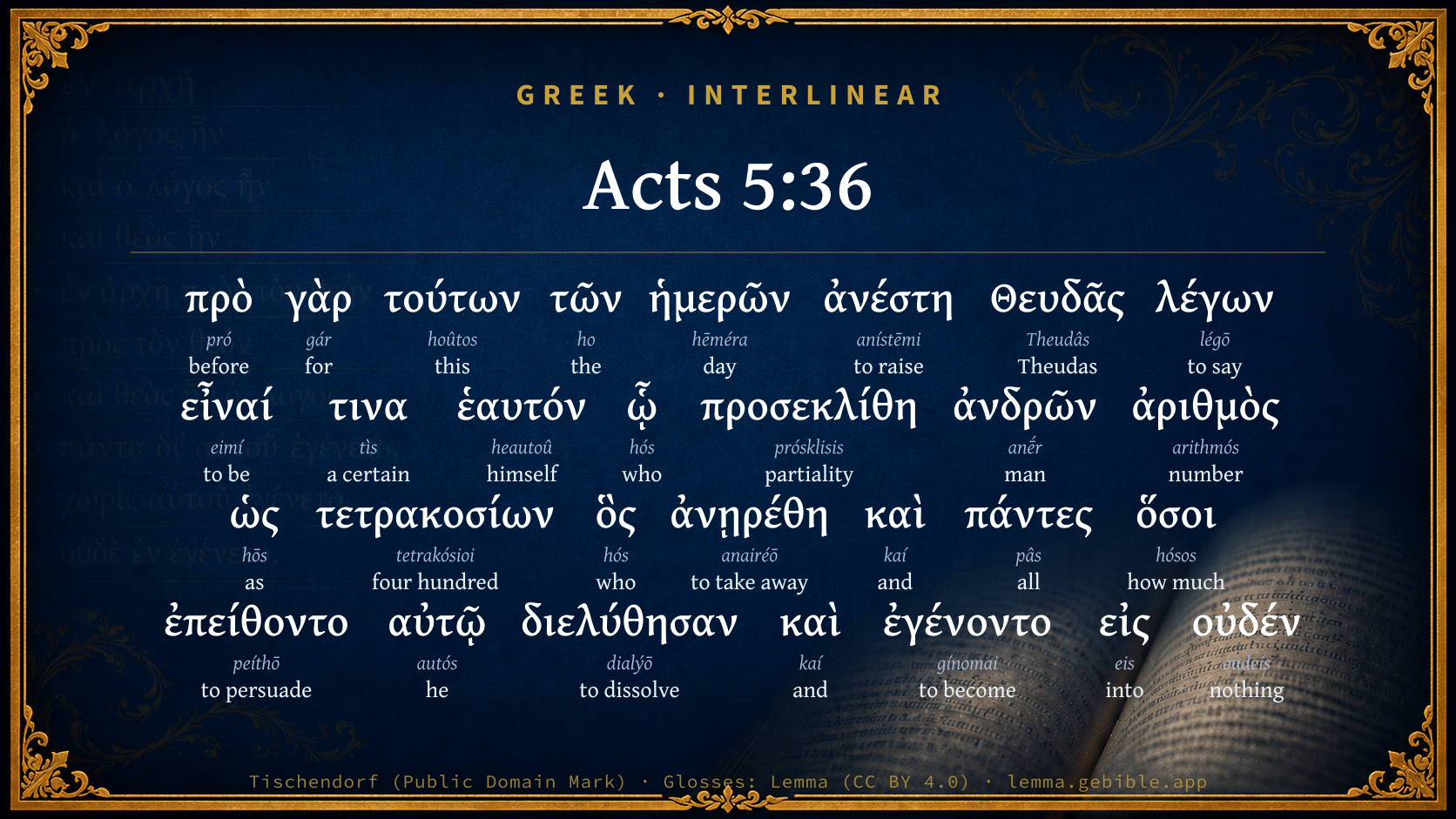
Download image
Cite this verse

Acts 5:36 (World English Bible). Public Domain. Lemma interlinear Bible study tool, https://lemma.gebible.app/v/acts/5/36.

Show BibTeX & RIS
BibTeX
RIS
English Translation
For before these days Theudas rose up, making himself out to be somebody; to whom a number of men, about four hundred, joined themselves: who was slain; and all, as many as obeyed him, were dispersed, and came to nothing.
World English Bible · Public Domain
Highlights
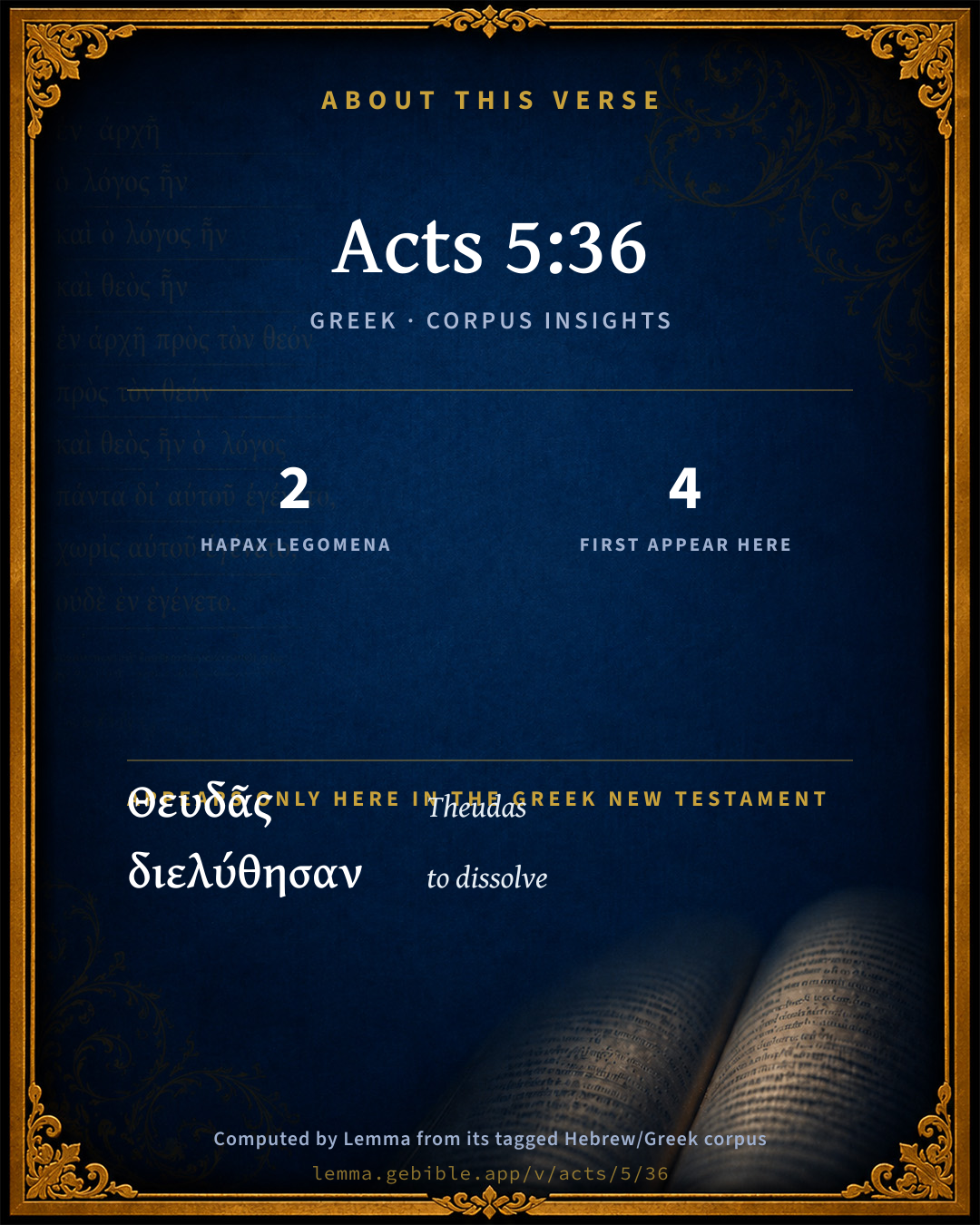
  • 2 hapax legomena — only here in the Greek New Testament
  • 4 first appearances in the Greek New Testament
Full analysis ↓
Download a study sheet

One document with this verse’s original text, its word-by-word gloss line, the meaning frame, cross-references with their text, attributed commentary, and full source and license credits — printable, and it pastes into notes with its structure intact.

This verse Autodidact and up

Study sheet (.html) Plain text (.txt)

A passage Seminary Student

Up to 50 verses in one chapter. A passage sheet keeps up to 6 commentary sources and 12 cross-references per verse, in the order this page ranks them, and says so on the sheet whenever that leaves anything out. Ask for a single verse and you get the Autodidact verse sheet above.

Everything on this page stays free to read, with no account — the sheet is a download of what is already on screen, not access to it.

Want to remove ads? Support Godless Engineer
Compare translations 3

The same verse in 3 English versions, stacked beneath the original-language interlinear above. Click any original word for its lexicon entry.

Each is an independent rendering of the whole verse — the interlinear is not word-aligned to these translations.

Highlighted words mark where these versions differ — a whole-verse word diff, not a word-by-word alignment.

  • World English Bible Public Domain
    For before these days Theudas rose up, making himself out to be somebody; to whom a number of men, about four hundred, joined themselves: who was slain; and all, as many as obeyed him, were dispersed, and came to nothing.
  • King James Version Public Domain
    For before these days rose up Theudas, boasting himself to be somebody; to whom a number of men, about four hundred, joined themselves: who was slain; and all, as many as obeyed him, were scattered, and brought to nought.
  • unfoldingWord Literal Text CC BY-SA 4.0
    For before these days, Theudas rose up, saying himself to be somebody, to whom was joined a number of men, about 400, who was killed, and all, as many as were persuaded by him, were dispersed, and they came to nothing.

unfoldingWord Literal Text — © unfoldingWord, licensed CC BY-SA 4.0. Word-aligned USFM3 via Door43 (git.door43.org/unfoldingWord/en_ult).

Versions to compare (up to 4)

3 of 4 selected

Show all 19 translations

Every available English version of this verse, each an independent rendering of the whole verse.

  • World English Bible Public Domain
    For before these days Theudas rose up, making himself out to be somebody; to whom a number of men, about four hundred, joined themselves: who was slain; and all, as many as obeyed him, were dispersed, and came to nothing.
  • Berean Standard Bible Public Domain
    Some time ago Theudas rose up, claiming to be somebody, and about four hundred men joined him. He was killed, all his followers were dispersed, and it all came to nothing.
  • Majority Standard Bible Public Domain
    Some time ago Theudas rose up, claiming to be somebody, and about four hundred men rallied to him. He was killed, all his followers were dispersed, and it all came to nothing.
  • King James Version Public Domain
    For before these days rose up Theudas, boasting himself to be somebody; to whom a number of men, about four hundred, joined themselves: who was slain; and all, as many as obeyed him, were scattered, and brought to nought.
  • American Standard Version (1901) Public Domain
    For before these days rose up Theudas, giving himself out to be somebody; to whom a number of men, about four hundred, joined themselves: who was slain; and all, as many as obeyed him, were dispersed, and came to nought.
  • Revised Version (1885) Public Domain
    For before these days rose up Theudas, giving himself out to be somebody; to whom a number of men, about four hundred, joined themselves: who was slain; and all, as many as obeyed him, were dispersed, and came to nought.
  • Geneva Bible (1599) Public Domain
    For before these times, rose vp Theudas boasting himselfe, to whom resorted a number of men, about a foure hundreth, who was slaine: and they all which obeyed him, were scattered, and brought to nought.
  • Douay-Rheims (1899) Public Domain
    For before these days rose up Theodas, affirming himself to be somebody, to whom a number of men, about four hundred, joined themselves: who was slain; and all that believed him were scattered, and brought to nothing.
  • Young's Literal Translation Public Domain
    for before these days rose up Theudas, saying, that himself was some one, to whom a number of men did join themselves, as it were four hundred, who was slain, and all, as many as were obeying him, were scattered, and came to nought.
  • Literal Standard Version CC BY-SA 4.0
    for before these days Theudas rose up, saying that he was someone, to whom a number of men joined themselves, as it were four hundred, who was slain, and all, as many as were obeying him, were scattered, and came to nothing.
  • Unlocked Literal Bible CC BY-SA 4.0
    For some time ago, Theudas rose up claiming to be somebody, and a number of men, about four hundred, joined him. He was killed, and all who had been obeying him were scattered and came to nothing.
  • unfoldingWord Literal Text CC BY-SA 4.0
    For before these days, Theudas rose up, saying himself to be somebody, to whom was joined a number of men, about 400, who was killed, and all, as many as were persuaded by him, were dispersed, and they came to nothing.
  • Darby Bible Public Domain
    for before these days Theudas rose up, alleging himself to be somebody, to whom a number of men, about four hundred, were joined; who was slain, and all, as many as obeyed him, were dispersed and came to nothing.
  • World Messianic Bible Public Domain
    For before these days Todah rose up, making himself out to be somebody; to whom a number of men, about four hundred, joined themselves. He was slain; and all, as many as obeyed him, were dispersed and came to nothing.
  • Webster's Bible Public Domain
    For before these days rose Theudas, boasting himself to be somebody; to whom a number of men, about four hundred, joined themselves: who was slain; and all, as many as obeyed him, were scattered, and brought to naught.
  • Free Bible Version CC BY-SA 4.0
    Some time ago Theudas tried to make a name for himself, and about four hundred men joined him. He was killed and all who followed him were scattered and it came to nothing.
  • Bible in Basic English Public Domain
    For before this there was Theudas, who said he was someone important, to whom about four hundred men gave their support: he was put to death, and his band was broken up and came to nothing.
  • Text-Critical English NT CC BY 4.0
    For before these days Theudas rose up, declaring himself to be somebody, and a number of men, about four hundred, responded to the call to join him. He was put to death, and all his followers were scattered and came to nothing.
  • Tyndale New Testament (1534) Public Domain
    Before these dayes rose vp one Theudas bostinge him selfe to whom resorted a nombre of men about a foure hondred which was slayn and they all which beleved him were scatred a broode and brought to nought.

Literal Standard Version (2020), Covenant Press — licensed CC BY-SA 4.0. Text via the HelloAO Bible API (eBible.org). Unlocked Literal Bible (unfoldingWord) — licensed CC BY-SA 4.0. Text via the HelloAO Bible API (eBible.org). unfoldingWord Literal Text — © unfoldingWord, licensed CC BY-SA 4.0. Word-aligned USFM3 via Door43 (git.door43.org/unfoldingWord/en_ult). Free Bible Version, Dr. Jonathan Gallagher — licensed CC BY-SA 4.0. Text via the HelloAO Bible API (eBible.org).

Word by word

More ways to search: Search by grammar → Find every occurrence → Compare this word →

Practice this passage: Drill this verse → Learn its vocabulary →

Θευδᾶς
Theudâs
G2333
“Theudas”
Noun, Nominative, Singular, Masculine
Part of Speech
Noun
Case
Nominative
Number
Singular
Gender
Masculine
Full Thayer's Definition

Origin: of uncertain origin

TDNT: None

Theudas = "God-given" 1. the name of an insurgent mentioned in Gamaliel's speech before the Jewish council, Acts 5:35-39 , at the time of the arraignment of the apostles. He appeared, according to Luke's account, at the head of about four hundred men. He was probably one of the insurrectionary chiefs or fanatics by whom the land was overrun in the last year of Herod's reign. Josephus speaks of a Theudas who played a similar part at the time of Claudius, about A.D. 44; but the Theudas mentioned by Luke must be a different person from the one spoken of by Josephus.
  1. πρὸ pró G4253 “before” Preposition
  2. γὰρ gár G1063 “for” Conjunction
  3. τούτων hoûtos G3778 “this” Demonstrative pronoun, Genitive, Plural, Feminine
  4. τῶν ho G3588 “the” Article, Genitive, Plural, Feminine
  5. ἡμερῶν hēméra G2250 “day” Noun, Genitive, Plural, Feminine
  6. ἀνέστη anístēmi G450 “to raise” Verb, Aorist, Active, Indicative, 3rd person, Singular
  7. λέγων légō G3004 “to say” Verb, Present, Active, Participle, Nominative, Singular, Masculine
  8. εἶναί eimí G1510 “to be” Verb, Present, Active, Infinitive
  9. τινα tìs G5100 “a certain” Indefinite pronoun, Accusative, Singular, Masculine
  10. ἑαυτόν heautoû G1438 “himself” Reflexive pronoun, 3rd person, Accusative, Singular, Masculine
  11. ᾧ hós G3739 “who” Relative pronoun, Dative, Singular, Masculine
  12. προσεκλίθη prósklisis G4346 “partiality” Verb, Aorist, Passive, Indicative, 3rd person, Singular
  13. ἀνδρῶν anḗr G435 “man” Noun, Genitive, Plural, Masculine
  14. ἀριθμὸς arithmós G706 “number” Noun, Nominative, Singular, Masculine
  15. ὡς hōs G5613 “as” Adverb
  16. τετρακοσίων tetrakósioi G5071 “four hundred” Adjective, Genitive, Plural, Masculine
  17. ὃς hós G3739 “who” Relative pronoun, Nominative, Singular, Masculine
  18. ἀνῃρέθη anairéō G337 “to take away” Verb, Aorist, Passive, Indicative, 3rd person, Singular
  19. καὶ kaí G2532 “and” Conjunction
  20. πάντες pâs G3956 “all” Adjective, Nominative, Plural, Masculine
  21. ὅσοι hósos G3745 “how much” Correlative pronoun, Nominative, Plural, Masculine
  22. ἐπείθοντο peíthō G3982 “to persuade” Verb, Imperfect, Passive, Indicative, 3rd person, Plural
  23. αὐτῷ autós G846 “he” Personal pronoun, Dative, Singular, Masculine
  24. διελύθησαν dialýō G1262 “to dissolve” Verb, Aorist, Passive, Indicative, 3rd person, Plural
  25. καὶ kaí G2532 “and” Conjunction
  26. ἐγένοντο gínomai G1096 “to become” Verb, Aorist, Middle deponent, Indicative, 3rd person, Plural
  27. εἰς eis G1519 “into” Preposition
  28. οὐδέν oudeís G3762 “nothing” Adjective, Accusative, Singular, Neuter, Negative

About this verse

These counts appear in no published source. They are computed here, from the morphology-tagged text and Lemma’s own curated glosses. What Lemma adds →

29
words
27
distinct lemmas
Acts
section

Notable vocabulary

2 hapax legomena — words that appear only here in the entire Greek New Testament:

  • Θευδᾶς Theudas G2333
  • διελύθησαν to dissolve G1262

First appearance in Scripture

These words make their first canonical appearance in the Greek New Testament here:

  • Θευδᾶς Theudas G2333
  • προσεκλίθη partiality G4346
  • τετρακοσίων four hundred G5071
  • διελύθησαν to dissolve G1262

Shared distinctive vocabulary

προσεκλίθη partiality G4346 occurs in 2 verses of the Greek New Testament. Also found in:
Repetition

Words recur within this verse:

Cross-references

12

Topical passages linked to Acts 5:36 in the Treasury of Scripture Knowledge — connected by theme and wording, ordered by reader-vote popularity; previews shown in the World English Bible.

  • Acts 8:9 But there was a certain man, Simon by name, who used to practice sorcery in the city, and amazed the people of Samaria, making himself out to be some great one,
  • 2 Peter 2:2 Many will follow their immoral ways, and as a result, the way of the truth will be maligned.
  • Matthew 24:24 For there will arise false christs, and false prophets, and they will show great signs and wonders, so as to lead astray, if possible, even the chosen ones.
  • Acts 21:38 Aren't you then the Egyptian, who before these days stirred up to sedition and led out into the wilderness the four thousand men of the Assassins?"
  • Galatians 2:6 But from those who were reputed to be important (whatever they were, it makes no difference to me; God doesn't show partiality to man)--they, I say, who were respected imparted nothing to me,
  • Galatians 6:3 For if a man thinks himself to be something when he is nothing, he deceives himself.
  • 2 Thessalonians 2:3–7 Let no one deceive you in any way. For it will not be, unless the departure comes first, and the man of sin is revealed, the son of destruction,
  • Jude 1:16 These are murmurers and complainers, walking after their lusts (and their mouth speaks proud things), showing respect of persons to gain advantage.
  • Revelation 17:3 He carried me away in the Spirit into a wilderness. I saw a woman sitting on a scarlet-colored animal, full of blasphemous names, having seven heads and ten horns.
  • Revelation 17:5 And on her forehead a name was written, "MYSTERY, BABYLON THE GREAT, THE MOTHER OF THE PROSTITUTES AND OF THE ABOMINATIONS OF THE EARTH."
  • Matthew 24:26 If therefore they tell you, 'Behold, he is in the wilderness,' don't go out; 'Behold, he is in the inner chambers,' don't believe it.
  • 2 Peter 2:18 For, uttering great swelling words of emptiness, they entice in the lusts of the flesh, by licentiousness, those who are indeed escaping from those who live in error;

Cross-references courtesy of OpenBible.info (CC BY 4.0).

Commentary

Notes on Acts 5:36 from classic Christian and Jewish commentators (each source and its license shown beneath its notes). The classic Christian expositions comment on the surrounding passage and are grouped to its opening verse, so a note may address several verses; the Jewish commentaries on the Tanakh (Rashi and others) are per-verse, so they appear only where the commentator wrote on this verse.

Lemma curates 59 commentaries, every one of them public domain or Creative Commons licensed, each selected and text-cleaned for this edition rather than reprinted as found. About our sources →

Albert Barnes' Notes on the Bible

For before those days - The “advice” of Gamaliel was to permit these men to go on. The “arguments” by which he enforced his advice were:

That there were cases or precedents in point Act 5:36-37; and, That if it should turn out to be truly of God, it would be a solemn affair to be involved in the consequences of opposing him. How long before “these days” this transaction occurred, cannot now be determined, as it is not certain to what case Gamaliel refers.

Rose up - That is, commenced or excited an insurrection.

Theudas - This was a name quite common among the Jews. Of this man nothing more is known than is here recorded. Josephus (Antiq., book 20, chapter 5) mentions one “Theudas,” in the time of “Fadus,” the procurator of Judea, in the reign of the Emperor Claudius (45 or 46 a.d.), who persuaded a great part of the people to take their effects with them and follow him to the river Jordan. He told them he was a prophet, and that he would divide the river and lead them over. Fadus, however, came suddenly upon them, and slew many of them. Theudas was taken alive and conveyed to Jerusalem, and there beheaded. But this occurred at least ten or fifteen years after this discourse of Gamaliel. Many efforts have been made to reconcile Luke and Josephus, on the supposition that they refer to the same man. Lightfoot supposed that Josephus had made an error in chronology. But there is no reason to suppose that there is reference to the same event; and the fact that Josephus has not recorded the insurrection referred to by Gamaliel does not militate at all against the account in the Acts . For:

Luke, for anything that appears to the contrary, is quite as credible an historian as Josephus.

(2)The name “Theudas” was a common name among the Jews; and there is no improbability that there were “two” leaders of an insurrection of this name. If it “is” improbable, the improbability would affect Josephus’ credit as much as that of Luke.

(3)It is altogether improbable that “Gamaliel” should refer to a case which was not well authenticated, and that Luke should record a speech of this kind unless it was delivered, when it would be so easy to detect the error.

Josephus has recorded many instances of insurrection and revolt. He has represented the country as in an unsettled state, and by no means professes to give an account of “all” that occurred. Thus, he says (Antiq., xvii. 10, section 4) that there were “at this time ten thousand other disorders in Judea”; and (section 8) that “Judea was full of robberies.” When this “Theudas” lived cannot be ascertained; but as Gamaliel mentions him before Judas of Galilee, it is probable that he lived not far from the time that our Saviour was born; at a time when many false prophets appeared, claiming to be the Messiah.

Boasting himself to be somebody - Claiming to be an eminent prophet probably, or the Messiah.

Obeyed him - The word used here is the one commonly used to denote “belief.” As many as believed on him, or gave credit to his pretensions.

Albert Barnes' Notes on the Bible (1834–1885) — public domain. Text from a community e-Sword/MySword module.

The Biblical Illustrator

Joseph S. Exell

Act_5:36-37

Before these days rose up Theudas.

Theudas: an ancient personage with modern lessons

Who Theudas was I do not know, and have carefully refrained from inquiring. Biographical details are of small importance when we are in search of substantial principles. The point of this passage lies in the fact that Theudas was a wholly insignificant person, just like a thousand other men who have made a noise in their day, drawn the gaze of the world for a few hours and then passed into silence and oblivion. The apostles are summoned before the council which has already resolved on their death. Then stands up Gamaliel--the teacher of Paul, a man had in reputation among all the people--and reads the excited Sanhedrin a lesson out of their own national history. He says in substance: This alarm, this hurrying to and fro, this calling for the scourge and the dungeon, this breathless haste, is all the result of narrow vision and small outlook. Our own time is not the first to witness startling movements. Before these days rose up Theudas, and drew four hundred men after him. Yet that uprising which seemed so terrible has been almost forgotten. Wider horizon would make us calm. Learn the lesson of your past. Gods great plan moves through the ages to its sure accomplishment. If this new teaching be not of Him, it will be like all the rest--a mere noise followed by a great silence. But if God is behind this teaching--beware lest haply ye be found to fight against God. These words may imply that Gamaliel was almost ready to embrace Christianity, or they may indicate only that he was a broad and tolerant Jew. In either case the application to our restless, eager, disputatious age is very clear. Old formulae are recast, until many souls more timid than wise, loving quiet more than truth, cry, Alas I what shall we do? The true answer cannot be given either by intense partisanship or by cynical indifference. The true answer is to be found in the unfaltering faith which sees God behind the shifting panorama of human thought and action, and knows that whatever lights may cross our firmament--whether glowing planet, shooting meteor, or steady star--He calleth them all by name in the greatness of His power.

I. Gods kingdom on earth is not a novelty. The first thing for us to remember is that the kingdom of God on earth is not a novelty, Christianity is not an experiment, and that before these days ten thousand similar dangers have been triumphantly surmounted. The man who is not in league with the past cannot face the future. We need to see things in large perspective, to stand off from our little immediate task, as the painter stands away from his canvas, that he may return to it with surer touch. Even in the common responsibilities of daily life some knowledge of history is quite as important as acquaintance with the multiplication table. Let the man who despairs of our political leaders to-day read the story of the attacks made on Washington in the darkest days of the Revolution. Let the man who is bewildered by the sudden influx of new knowledge, and cannot adjust himself at once to the fresh truth poured into his mind, remember the great shock given to humanity--a shock which seemed to dislocate all systems of science and all hymns of the faith--when Copernicus proclaimed that this earth, instead of being the centre of the universe, for the sake of which sun and stars were created, around which the ordered sky revolved, was but a mote floating in the boundless void, an insignificant star sending its tiny ray into the infinite darkness. The present generation is specially deficient in historical perspective. Our life has been so swift, so wholly modern, that we are intensely individual, delighting often in segregation from the past. Thus, having small background for present endeavour, we grow restless and are easily tossed by conflicting winds. History says, too, as Nature to Emerson: Why so hot, my little man? The history of the Christian Church is a splendid armoury for faith. The future of Christianity does not depend on what is won or lost this morning. The success of Gods kingdom in the earth is not staked on the success of my little scheme any more than the coming of spring depends on the success of the pansy bed in my garden. That kingdom was before we came into being, it will endure when we are gone--it is the work of Him who was, and is, and is to be, the Almighty. Behind all the men that come and go, the theories that rise and fall, stands God within the shadow, keeping watch above His own.

II. A background of triumphant history. We are writing now, but never before, 1892 on all our letters, notes, deeds. These figures are vastly more than a conventional argument. They are eloquent with strong assurance. They are like a flag brought home from battle, smoke-begrimed, blood-stained, bullet-torn, but bright with its original splendid colour, and vocal with great inspiring speech. We have no right to live as did the Church of the first century, when much was tentative and experimental. We have a background of triumphant history. Steadily is the kingdom of Christ spreading from the river unto the ends of the earth. Witty and keen have been the attacks on the faith--sometimes they have purged it from excrescences, oftener they have glanced off and rebounded. The opponents of Christianity are remembered because of the grandeur of what they attacked. In this Christian land we do not accept Christian faith to see whether it is true; we accept it as we accept the earth beneath our hurrying feet and the untroubled sky that overarches all. Hence we see the place and purpose of the Old Testament, whose peculiar function is to show us that God is behind and within human history, and that all history culminates in the revelation of Jesus Christ. Gods primary revelation is not through the speech, but through events. The Old Testament precedes the New to show us God behind and within the nations life, and when we once see and believe that, a historical Saviour becomes not only credible but inevitable.

III. Use of the historical in scripture. A noble Christian man recently told me that in his private reading of the Psalms he always used an expurgated edition, from which all imprecatory and otherwise objectionable passages had been expunged. Surely this is the acme of religious prudery, and the fastidiousness of one who is totally devoid of the historical sense. If we expurgate the Songs of David, why not expurgate his life also? Surely his deeds of vengeance are worse than his revengeful prayers. Then having struck out from his life all that offends our purism, and having made him the man he ought to have been but was not, we shall be ready to remodel the entire history of Israel--very much as Cibber proposed to remodel Shakespeare, making King Lear to be at last rewarded for his suffering, and making the tragedy of Hamlet to end with the death of the king and queen and the happiness of Ophelia. When we have been through the Bible and struck out the great black record of human sin, we shall have banished the shining story of redemption also. The imprecatory Psalms are as truly the expression of a certain stage in Israels life, and so part of the story of redemption, as the paintings of the early Byzantine school are part of the history of Christian art. What if the faces limned by those first Christian painters are hard and wooden? They are to us the priceless expression of a great endeavour which has made Iraphael and Da Vinci possible. To lift the Psalter to the level of the Sermon on the Mount is to spoil them both. But the most practical thing is still unsaid. When a man has attained the historical point of view, when his Bible is no longer a fiat surface like a Chinese picture, but a tong vista of historical persons and events, and the great story of Gods love for man is seen slowly unfolding through the millenniums, when a man keeps himself familiar with Gods working before these days, he will possess a spiritual poise and central peace which nothing can disturb. It is a great thing to believe in a God who watches over my life and cares for me. It is a grander thing to rest in a God whose purposes are larger and longer than any concerns of mine possibly can be. I could not admire the Hudson River if I thought its only purpose was to fill my drinking cup. I could not wonder greatly at the sun if I thought its only purpose was to shine in at my window. I need a God greater than my need. I want a Saviour far beyond my private personal lack. If I do not believe in a God who has some grander work to do than to make me happy, I shall soon cease to believe at all. I shall soon find that God does not always make me happy, and then I shall lose faith. Through all ages runs His purpose. From everlasting to everlasting His great thoughts realise themselves in the ceaseless unfolding of creation, and our highest glory is not to bend His purpose but to bend our lives into harmony with it. Has any man come here in a state of tumult and alarm, perplexed by the problems of the time, and confronted by movements he cannot fathom? I bid you think of the God who before these days has guided His Church and ever will guide. Is any man here saying: God has forgotten me; my plan does not prosper? Is your plan, then, the first thing in your desire, or Gods plan? Is it the building of your nest or the achievement of the worlds redemption? He is the Alpha and Omega--we are to fit in somewhere in His Divine alphabet and spell out His eternal thought. (W. H. P. Faunce, D. D.)

The false prophet and the true

I. The false.

1. Rises up of his own accord as Theudas and Judas.

2. Boasts himself to be somebody.

3. Draws away the people after him.

4. Falls from heaven as a wandering star. Theudas and Judas perished, and their followers were dispersed.

II. The true.

1. Is raised up by God.

2. Does not boast of himself, but gives glory to God.

3. Leads souls to the Lord.

4. Will shine as stars for ever and ever. (K. Gerok.)

The Biblical Illustrator, edited by Joseph S. Exell (c. 1880s–1900s) — public domain. Text from a community e-Sword module.

Tyndale Open Study Notes

Tyndale Open Resources

5:36-37 This Theudas is otherwise unknown, although Josephus mentions a different man by that name who raised a revolt some years later (see Josephus, Antiquities 20.5.1). Theudas was a common Jewish name. • Judas of Galilee appears in Josephus as a rebel who opposed giving tribute to Caesar about AD 6 or 7, following the census of Quirinius (see Josephus, Antiquities 20.5.2; cp. Luke 2:2). His resistance, too, was crushed.

Tyndale Open Study Notes — © Tyndale Open Resources, licensed CC BY-SA 4.0. Text via the HelloAO Bible API.

Bengel's Gnomon

Johann Albrecht Bengel

Act 5:36. Πρὸ, before) It is an excellent way to support counsels by examples. These Gamaliel prudently puts first, and then adds the consequence to be inferred from them.—ἑαυτὸν, himself) A characteristic of false teaching: ch. Act 8:9.—εἰς οὐδὲν, to nought) Not merely their counsels, but themselves came to nought. How many wretched men have been led on to destruction by false teachers!

Bengel's Gnomon of the New Testament — English translation (T&T Clark, Edinburgh, 1860) — public domain. Text from a community e-Sword module.

Meyer's Critical & Exegetical Commentary

Heinrich August Wilhelm Meyer

Act_5:36. Γάρ] gives the reason[173] for the warning contained in Act_5:35. In proof that they should not proceed rashly, Gamaliel reminds them of two instances from contemporary history (Act_5:36-37), when fanatical deceivers of the people (without any interference of the Sanhedrim) were overthrown by their own work. Therefore there should be no interference with the apostles (Act_5:38); for their work, if it should be of men, would not escape destruction; but if it should be of God, it would not be possible to overthrow it.

πρὸ τούτων τῶν ἡμερ.] i.e. not long ago. Οὐ λέγει παλαιὰ διηγήματα καίτοιγε ἔχων, ἀλλὰ νεώτερα, ἃ μάλιστα πρὸς πίστιν ἦσαν ἰσχυρά, Chrysostom. Comp. Act_21:38. Yet the expression, which here stands simply in contrast to ancient incidents (which do not lie within the experience of the generation), is not to be pressed; for Gamaliel goes back withal to the time before the census of Quirinus.

Θευδᾶς] Joseph. Antt. xx. 5.1, informs us that under the procurator Cuspius Fadus (not before A.D. 44; see Anger, de temp. rat. p. 44) an insurgent chief Theudas gave himself out to be a prophet, and obtained many adherents. But Fadus fell on the insurgents with his cavalry; they were either slain or taken prisoners, and Theudas himself was beheaded by the horsemen. This narrative suits our passage exactly as regards substance, but does not correspond as regards date. For the Theudas of Josephus lived under Claudius, and Tiberius Alexander succeeded Cuspius Fadus about A.D. 46; whereas Gamaliels speech occurred about ten years earlier, in the reign of Tiberius. Very many (Origen, c. Cels. i. 6, Scaliger, Casaubon, Beza, Grotius, Calovius, Hammond, Wolf, Bengel, Heumann, Krebs, Lardner, Morus, Rosenmüller, Heinrichs, Kuinoel, Guericke, Anger, Olshausen, Ebrard) therefore suppose that it is not the Theudas of Josephus who is here meant, but some other insurgent chief or robber-captain acting a religious part,[174] who has remained unknown to history, but who emerged in the turbulent times either of the later years of Herod the Great or soon after his death. This certainly removes all difficulties, but in what a violent manner! especially as the name was by no means so common as to make the supposition of two men of that name, with the same enterprise and the same fate, appear probable, or indeed, in the absence of more precise historical warrant, otherwise than rash, seeing that elsewhere historical mistakes occur in Luke (comp. Act_4:6; Luk_2:1-2). Besides, it is antecedently improbable that tradition should not have adduced an admonitory example thoroughly striking, from a historical point of view, such as was that of Judas the Galilean. But the attempts to discover in our Theudas one mentioned by Josephus under a different name (Wieseler, Synops. p. 103 ff., and Baumgarten, also Köhler in Herzogs Encykl. XVI. p. 40 f, holding it to refer to the scribe Matthias in Joseph. Bell. i. 33. 2, Antt. xvii. 6; Sonntag in the Stud. u. Krit. 1837, p. 638 ff., and Ewald, to the insurgent Simon in Joseph. Bell. ii. 4. 2, Antt. xvii. 10. 6; Zuschlag in the monograph Theudas, Anführer eines 750. in Paläst. erregten Aufstandes, Cassel 1849, taking it to be the Theudion of Joseph. Antt. xvii. 4, who took an active part in the Idumean rising after the death of Herod the Great), amount only to assumptions incapable of proof, and are nevertheless under the necessity of leaving the difference of names unaccounted for. But inasmuch as, if the Theudas in our passage is conceived as the same with the Theudas mentioned by Josephus, the error cannot be sought on the side of Josephus (Baronius, Reland, Michaelis, Jahn, Archäol. II. 2, § 127); as, on the contrary, the exactness of the narrative of Josephus secures at any rate the decision in its favour for chronological accuracy over against Luke; there thus remains nothing but to assume that Lukeor, in the first instance, his sourcehas, in the reproduction of the speech before us, put into the mouth of Gamaliel a proleptic mistake. This might occur the more easily, as the speech may have been given simply from tradition. And the tradition which had correctly preserved one event adduced by Gamaliel (the destruction of Judas the Galilean), was easily amplified by an anachronistic addition of another. If Luke himself composed the speech in accordance with tradition, the error is in his case the more easily explained, since he wrote the Acts so long after the insurrection of Theudas,in fact, after the destruction of the Jewish commonwealth,that the chronological error, easy in itself, may here occasion the less surprise, for he was not a Jew, and he had been for many years occupied with efforts of quite another kind than the keeping freshly in mind the chronological position of one of the many passing enthusiastic attempts at insurrection. It has been explained as a proleptic error by Valesius, ad Euseb. H. E. ii. 11, Lud. Cappellus, Wetstein, Ottius, Spicileg. p. 258, Eichhorn, Credner, de Wette, Neander, Bleek, Holtzmann, Keim,[175] as also by Baur and Zeller, who, however, urge this error as an argument against the historical truth of the entire speech. Olshausen considers himself prevented from assenting to the idea of a historical mistake, because Luke must have committed a double mistake,for, first, he would have made Gamaliel name a man who did not live till after him; and, secondly, he would have put Judas, who appeared under Augustus, as subsequent to Theudas, who lived under Claudius. But the whole mistake amounts to the simple error, that Luke conceived that Theudas had played his part already before the census of Quirinius, and accordingly he could not but place him before Judas.[176]

εἶναί τινα] giving out himself (ἑαυτόν, in which consists the arrogance, the self-exaltation; character falsae doctrinae, Bengel) for one of peculiar importance: προφήτης ἔλεγεν εἶναι, Joseph. Antt. xx. 5. 1. On τίς, eximius quidam (the opposite οὐδείς

Valckenaer, ad Herod. iii. 140), see Wetstein in loc.; Winer, p. 160 [E. T. 213]; Dissen, ad Pind. Pyth. viii. 95, p. 299.

ᾧ προσεκλίθη] to whom leaned, i.e. adhered, took his side: πολλοὺς ἠπάτησεν, Josephus, l.c. Comp. Polyb. iv. 51. 5; also πρόσκλισις, Polyb. vi. l0. 10, v. 51. 8.

ἐγένοντο εἰς οὐδέν] ad nihilum redacti sunt. See Schleusner, Thes. IV. p. 140. They were, according to Josephus, l.c., broken up (διελύθησαν) by the cavalry of Fadus, and partly killed, partly taken prisoners.

The two relative sentences ᾧ προσεκλ. and ὃς ἀνῃρέθη are designed to bring out emphatically the contrast. Comp. Act_4:10.

[173] Erasmus well paraphrases it Ex praeteritis sumite consilium, quid in futurum oporteat decernere.

[174] So also Gerlach, d. Rõmischen Statthalt. p. 70, not without a certain irritation towards me, which I regret, as it contributes nothing to the settlement of the question.

[175] According to Lange, Apost. Zeitalt. I. p. 94, the difficulty between Luke and Josephus remains somewhat in suspense. Yet he inclines to the assumption of an earlier Theudas, according to the hypothesis of Wieseler. According to this hypothesis, the Greek name (see Wetstein) Theudas (= θεοδᾶν = θεόδωρος), preserved still on coins in Mionnet, must be regarded as the Greek form of the name מַתִּיָה. But why should Gamaliel or Luke not have retained the name Matthias? Or what could induce Josephus to put Matthias instead of Theudas? especially as the name תודוס was not strange in Hebrew (Schoettg. p. 423), and Josephus himself mentions the later insurgent by no other name.

[176] Entirely mistaken is theeven in a linguistic point of view erroneousinterpretation of μετὰ τοῦτον (ver. 37) by Calvin, Wetstein, and others, that it denotes not temporis ordinem, but, generally, insuper or praeterea.

Meyer — Critical and Exegetical Commentary on the New Testament — English translation by Peter Christie, edited by Frederick Crombie (T&T Clark, 1880) — public domain. Text from a community e-Sword module.

Expositor's Greek Testament

ed. W. Robertson Nicoll

Act 5:36 . πρὸ γὰρ τούτων τῶν ἡμερῶν : Gamaliel appeals to the experience of the past the phrase is placed first with emphasis, cf. Act 21:38 ; on St. Luke’s fondness for phrases with ἡμέρα see above, and Friedrich, pp. 9, 89. But whilst Gamaliel appeals to the past, his appeal is not to a remote but to a near past which was still fresh in the memories of his generation, perhaps because, as St. Chrysostom urges, such recent examples μάλιστα πρὸς πίστιν ἦσαν ἰσχυρά . ἀνέστη , cf. Act 7:18 , like the Hebrew קוּם , and so constantly in LXX, Exo 1:8 , Deu 13:1 ; Deu 34:10 , Jdg 2:10 ; Jdg 4:9 ; Jdg 5:7 , etc. Θεῦδας : St. Luke evidently places Theudas before Judas. But a difficulty arises from the fact that the only Theudas of this period known to us is placed by Josephus in the reign of Claudius, about the year 44, 45. He gave himself out as a false prophet, gathered round him “a great part of the people,” and persuaded them to follow him to the Jordan with a promise that its waters should miraculously divide before him as in the days of Moses. But the Roman procurator, Cuspius Fadus, sent a troop of horse to meet him, some of his followers were slain, others taken captive, whilst he himself was made prisoner and beheaded, and his head sent to Jerusalem, Jos., Ant. , xxx., 5, 1. But a serious chronological discrepancy must be faced if the Theudas of Josephus is the Theudas of St. Luke. Gamaliel speaks of a Theudas who arose before the days of the enrolment, R.V., which marked the attempt of Judas, i.e. , about 6 7 A.D. But are they the same? As early as the days of Origen their identity was denied ( c. Cels. , i., 57), see “Acts,” B.D. 2 , Bishop Lightfoot, p. 40, and in comparing the two accounts in Josephus and Acts there is no close resemblance beyond the name, see Nösgen, in loco , and Belser, Theol. Quartalschrift , i., p. 70 (1896). St. Luke speaks definitely of 400 followers; Josephus evidently considers that the pretender was much more successful, so far as numbers were concerned, for he writes: πείθει τὸν πλεῖστον ὄχλον . These and similar discrepancies are also well insisted upon by Zahn in his recent Introduction , ii., 416, 417 (1899), and his own conclusion is that only such ordinary words are common to the two accounts as Luke, ἀνῃρέθη ; Jos., ἀνεῖλε ; Luke, ἐπείθοντο ; Jos., ἔπειθε ; and that we cannot get beyond the bounds of possibility that the two authors refer to the same fact (on Zahn’s criticism of Krenkel’s view of the dependence of Luke on Josephus in the narrative, see u. s. ). In referring to the appearance of the many false Messiahs, such as the Theudas of Josephus, Ant. , xx., 5, 1, Dr. Edersheim, Sketches of Jewish Social Life , p. 66, remarks: “Of course this could not have been the Theudas of Act 5:36-37 , but both the name and the movement were not solitary in Israel at the time”; see also Ramsay, Was Christ born in Bethlehem? p. 259. And no testimony could be stronger than that of Josephus himself to the fact that at the time of the Advent Judæa was full of tumults and seditions and pretenders of all kinds, Ant. , xvii., 10, 4, 8; B. J. , ii., 4, 1. The view has been maintained by many commentators that the Theudas of Josephus may reasonably be supposed to be one of the many false teachers and leaders mentioned by the Jewish historian and not always by name, who pandered to the feverish hopes of the people and gave themselves out as of kingly rank (so recently Belser, Felten, Page, Plumptre, Knabenbauer). The name Theudas contracted from Theodorus may not have been so common as that of Simon or Judas (although on the other hand, see Nösgen, Apostelgeschichte , p. 147) “Josephus describes four men bearing the name of Simon within forty years, and three that of Judas within ten years, all of whom were instigators of rebellion” but it was the Greek equivalent to several familiar Hebrew names, e.g. , Jonathan, Matthias; and Bishop Lightfoot allows that there is something to be said for Wieseler’s suggestion that on the ground of the name the Theudas here may be identified with Matthias, the son of Margalothus, an insurgent in the time of Herod, prominent in the pages of Josephus, Ant. , xvii., 6, 2 (see also Zöckler on the whole question, Apostelgeschichte , p. 197, 2nd edit.). We must admit the objection of Wendt that this and other identifications of names and persons cannot be proved (and some of them certainly are very precarious, as Alford pointed out), but we cannot suppose that St. Luke could have made the gross blunder attributed to him in the face of his usual accuracy (see Blass, Acta Apostolorum , p. 90), or endorse with Schürer what he calls “the slight authority of the Acts in such matters” ( Jewish People , div. i., vol. ii., p. 169). If it is hardly possible that Josephus can have been mistaken, although some writers have held that it is by no means impossible that even here he may have been ( cf. Alford, Rendall, Belser, and compare the remarks of Zahn, ubi supra ), we may at least claim the same probability of freedom from error for St. Luke, “temporum bene memorem se scriptor monstrat: quo minus est probabile eum de Theuda tam graviter errasse quam plerique putant” (Blass), and see the recent remarks of Ramsay, Was Christ born at Bethlehem ? p. 252 ff. It cannot be said that some recent attempts at a solution of the difficulty are very promising; for whilst H. Holtzmann severely blames Blass for maintaining that some Christian had interpolated the name Theudas in the text of Josephus (see Blass, in loco , and p. xvi., edit. min.), he himself is prepared to endorse the view recently maintained amongst others by Clemen that the writer of Acts in his mention of Theudas gives us a vague but yet recognisable recollection of Jos., Ant. , xx., 5, 1; see in loco and Theol. Literaturzeitung , 3, 1896, and 13, 1897. B. Weiss thinks that the notorious difficulty may easily be got rid of by supposing that the reviser inserted the example of Theudas in the wrong place, Einleitung in das N. T. , p. 574. λέγων εἶναί τινα ἑαυτόν : of consequence, really “somebody,” cf. Act 8:9 (and R.V.); “ein grosser Mann,” Blass, Grammatik des N. G. , p. 76; so we have its opposite, οὐδείς , cf. instances in Wetstein in classical Greek; so in Latin quidam, aliquis , Juvenal, i., 74; Cicero, ad Atticum , iii., 15; and cf. also 1Co 3:7 , Gal 2:6 ; Gal 6:3 ; Viteau, Le Grec du N. T. , p. 148 (1893). And yet the jealous eye of the Pharisees was blind to the difference between such a man as Theudas, whom Gamaliel so contemptuously described, and the Apostles who sought not their own honour (Nösgen); cf. Vulgate, “dicens se esse aliquem,” so Rhem. and Wycl., “saying that he was somebody”. προσεκολλήθη : better reading προσεκλίθη , a word not found elsewhere in N.T., cf. 2Ma 14:24 ; and so also in LXX, cf. Psa 39 (40):2, Symmachus; cf. Polyb., iv., 51, 5; so also πρόσκλισις ; for its further use see Clem. Rom., Cor [185] , xlvii., 4 ὡσεὶ ( ὡς ) τετρακοσίων , see above on “Theudas”. ἀνῃρέθη , see also on ἀναιρέω , Act 5:33 , often of violent death in Acts. The two clauses stand in sharp contrast the one emphasises the large number which joined Theudas, the other the fact that notwithstanding he was slain; cf. Act 4:10 . διελύθησαν κ . τ . λ .: nowhere else in N.T., but its use is quite classical, cf. Thuc., ii., 12; Xen., Cyr., v., 5, 43; Polyb., iv., 2. Blass remarks that the whole phrase “apte de secta quæ paullatim dilabitur, minus apte de multitudine per vim disjecta”. ἐγένοντο εἰς οὐδέν : phrase only here in N.T. ( cf. Act 19:27 ), but see in LXX, Job 24:25 , Isa 40:17 , Wis 3:17 ; Wisdom 20:16. γίνομαι εἰς in LXX and also in classics; in N.T. cf. Luk 13:19 ; Luk 20:17 , Act 4:11 , and cf. 1Th 3:5 . In the first passage it is Hebraistic; in the passage before us and in 1 Thess. the phrases are quite possibly Greek, cf. especially Simcox, Language of the N. T. , p. 143. The phrase is more frequent in St. Luke’s writings than in any other books of the N.T., except the Apocalypse.

[185] Corinth, Corinthian or Corinthians.

The Expositor's Greek Testament, edited by W. Robertson Nicoll (1897–1910) — public domain. Text from a community e-Sword module.

Geneva Bible (1599)

Geneva Bible translators

To be of some fame.

In matters of religion we must take good heed that we attempt nothing under a color of zeal, beside our vocation.

Geneva Bible (1599) marginal notes — public domain. Text via Bolls.life.

Adam Clarke's Commentary

Verse 36. Rose up Theudas] Josephus, Ant. lib. xx. cap. 4, sect. 1, mentions one named Theudas who was the author of an insurrection; about whom there has been much controversy whether he were the person spoken of here by Gamaliel. Every circumstance, as related by Josephus agrees well enough with what is referred to here, except the chronology; for the Theudas mentioned by Josephus made his insurrection when Fadus was governor of Judea; which was at least ten years after the time in which the apostles were brought before this council. Much labour has been thrown away in unsuccessful attempts to reconcile the historian and the evangelist, when it is very probable they speak of different transactions. Bp. Pearce thinks "the whole difficulty will disappear if we follow the opinion of Abp. Usher, who imagined that Luke's Theudas was the same with that Judas of whom Josephus gives this account, Ant. lib. xvii. cap. 12, sect. 5; and War, lib. ii. cap. 4, sect. 1: 'that a little after the death of Herod the Great, he raised an insurrection in Galilee, and aimed at getting the sovereignty of Judea,' and that he was defeated and put to death, as is implied in sect. 10, of the same chapter. That Theudas and Judas might be names for the same person, Bp. Pearce thinks probable from the consideration, that the same apostle who is called Judas in Joh 14:22, and Lu 6:16, and called Jude in Jude 1:1, is, in Mr 3:18, called Thaddeus; and, in Mt 10:3, is also called Lebbeus. This apostle having the names Judas and Thaddeus and Lebbeus given to him, two of these must have been the same; because no Jew had more than two names, unless when a patronymic name was given to him, as when Joseph surnamed Justus was called Barsabas, i.e. the son of Saba. It is no unreasonable thing to suppose that Thaddeus and Theudas are the same name; and that therefore the person called Theudas in Luke is probably the same whom Josephus, in the places above quoted, calls Judas."

Dr. Lightfoot thinks that "Josephus has made a slip in his chronology;" and rather concludes that the Theudas mentioned in the Ant. lib. xx. cap. 4, sect. 1, is the person referred to in the text. I confess the matter does not appear to me of so much consequence; it is mentioned by Gamaliel in a careless way, and St. Luke, as we have already seen, scrupulously gives the Lords of every speaker. The story was no doubt well known, and there were no doubts formed on it by the Jewish Council. We see plainly the end for which it was produced; and we see that it answered this end most amply; and certainly we have no farther concern with Gamaliel or his story.

Boasting himself to be somebody] λεγον ειναι τινα εαυτον, Saying that he was a great personage, i.e., according to the supposition of Bp. Pearce, setting himself up to be king of the Jews: see the preceding note. After εαυτον, himself, μαγαν, great one, is added by several very respectable MSS. and versions.

Adam Clarke's Commentary on the Bible (1810–1826) — public domain. Text from a community e-Sword/MySword module.

John Calvin's Commentaries

36. There arose one Theudas. If we credit Josephus, Gamaliel altereth in this place the true course of the history. For he reporteth that Judas Gaulanites, who was born in Gamala, at such time as Quirinius, or Cyrenius, was proconsul, did raise a tumult with his adherents, because they would not have their goods taxed; and that Theudas, at such time as Cuspius Fadus was procurator, did boast that he was a prophet of God. And Fadus was sent into Judea by Claudius Caesar. The former history is recorded in the Eighteenth Book of Antiquities; and the other in the Twentieth. But I think that when Luke saith, After him was there one Judas, he meant not to note the course of time, as if he were the latter; but forasmuch as Gamaliel brought in two like examples, he might put the one in place of the other, without having respect of time. Therefore the word post is as much as moreover, or besides.

Furthermore, even these examples wherewith Gamaliel confirmeth his opinion do not sufficiently agree with the present cause. For, because they did not by and by resist Judas, that sedition which he had raised was the occasion of many murders, and at length he was vanquished with hand and weapon. Theudas also had done far more hurt, unless he had been put to flight in time by Cuspius Fadus. But Gamaliel hath respect unto this alone, that men have unlucky success when as they advance themselves un-advisedly; and that cometh to pass by the just judgment of God. But because the priests refuse to hearken when God giveth them good counsel, they are worthy to be made amazed by man with frivolous reasons, wavering hither and thither through foolish perplexity. Furthermore, if we cast the time, we shall find that it was twelve years at least after the death of Christ before the apostles were beaten. For unto the five years which remained of the government of Tiberius, we must add three and a half which Caligula reigned. Fadus was not sent by Claudius into Judea before the second or third year of his reign. Gamaliel rehearsed not the act within a day or two after. Therefore that space of time is complete whereof I spake. Wherefore the constancy of the apostles was the more excellent, who, though they be so evil rewarded for those long pains which they had endured, yet are they not discouraged, neither do they cease to hold on as they had begun.

That he was some great man. Some books have, Saying that he was somebody; yet both carry one sense. For he boasted that he was such a prophet that he could dry up Jordan, that those which were with him might go over dry foot. Nevertheless, we see how far Gamaliel is from true knowledge, who compareth the holy ministers of Christ unto seducers and robbers; although he mitigateth his words afterward, and, inclining toward the better part, leaveth it indifferent whether they have taken this matter in hand, having God for their author or no. Yet he speaketh doubtfully, because he provideth only for quietness, all inquiry being set apart. This is only to be allowed in his speech, that he feareth [deterreth] the wicked from wicked boldness, because there is nothing more to be feared than to strive against God.

John Calvin's Commentaries (1540-1563) — public domain. Text from the Calvin Translation Society English edition (1840s-50s) via the Christian Classics Ethereal Library (ccel.org). Calvin's coverage is partial (roughly two-thirds of the Bible); uncommented books and verses are honest gaps, never fabricated. The 19th-century editor's footnotes and remarks are omitted so the notes are faithfully Calvin's own voice.

Ellicott's Commentary for English Readers

(36) Before these days rose up Theudas.—An insurrection, headed by a leader of this name, is mentioned by Josephus (Ant. xx. 5, § 1). He, however, places it, not “before the taxing”—i.e., circ. A.D. 6—but in the reign of Claudius, and under the procuratorship of Cuspius Fadus, A.D. 44, ten or twelve years after this speech of Gamaliel’s. The Theudas of whom he speaks claimed to be a prophet, and promised to lead his followers across the Jordan. Fadus sent a troop of horse against him, and he was taken and beheaded. It has accordingly been inferred by some critics that we have here a blunder so portentous as to prove that the speech was made up long years after its alleged date by a writer ignorant of history, that the whole narrative of this part of the Acts is accordingly untrustworthy, and that the book requires to be sifted throughout, with a suspicious caution. On the other side, it is urged (1) that the circumstances of the two cases are not the same, Josephus speaking of a “very great multitude” as following his Theudas, while Gamaliel distinctly fixes the number of adherents at “about four hundred”; (2) that the name Theudas, whether considered as a form of the Aramaic name Thaddœus (see Note on Mat_10:3), or the Greek Theodorus, was common enough to make it probable that there had been more than one rebel of that name; (3) that Josephus mentions no less than three insurrections of this type as occurring shortly after the death of Herod the Great (Ant. xvii. 10)—one headed by Judas (a name which appears from Mat_10:3, Luk_6:16, to have been interchangeable with Thaddaeus or Theudas), the head of a band of robbers who seized upon the fortress of Sepphoris; one by Simon, previously a slave of Herod’s, who proclaimed himself king and burnt Herod’s palaces at Jericho and elsewhere; one by Athronges and four brothers, each of whom ruled over a band, more or less numerous, of his own—and adds further, that besides these there were numerous pretenders to the name of king, who murdered and robbed at large, and that one of these may well have been identical with the Theudas of whom Gamaliel speaks; (4) that it is hardly conceivable that a writer of St. Luke’s culture and general accuracy, writing in the reign of Nero, could have been guilty of such inaccuracy as that imputed to him, still less that such a mistake should have been made by any author writing after Josephus’s history was in the hands of men. A writer in the reign of Henry VIII. would hardly have inverted the order of Wat Tyler and Jack Cade. The description given by Gamaliel, saying that he was some one—i.e., some great personage—agrees with the sufficiently vague account given by Josephus of the leaders of the revolts on the death of Herod, especially, perhaps, with that of Simon (who may have taken the name of Theudas as an alias to conceal his servile origin) of whom he says that “he thought himself more worthy than any other” of kingly power.

A Bible Commentary for English Readers, edited by Charles John Ellicott (1878–1897) — public domain. Text from a community e-Sword module.

The Cambridge Bible for Schools and Colleges

gen. ed. J. J. S. Perowne

36. For before these days rose up Theudas] Gamaliel proceeds to give illustrations that mere pretenders will come to naught. But about the mention of Theudas much discussion has been raised, because it is declared that the statements of Gamaliel contradict the facts recorded by Josephus, and therefore cannot be received as historic. In this way discredit would be thrown on all the rest of his speech.

It is true that Josephus mentions a Theudas (Antiq. xx. 5. 1) who rose up and professed himself a prophet, in the time when Fadus was procurator of Judæa, about a.d. 45 or 46, and persuaded a great part of the people to take their goods and follow him to the river Jordan, through which he promised he would afford them a miraculous passage. This man, who with many of his followers was destroyed, could clearly not be the leader of the revolt which took place before that raised by Judas of Galilee in the time of the taxing which took place some few years after our Lord was born. But when we turn to the history which Josephus gives of the events which preceded this rebellion of Judas we find him saying (Antiq. xvii. 10. 4), “At this time [i.e. in the days when Varus was president of Syria] there were ten thousand other disorders in Judæa, which were like tumults.” Of these innumerable disturbances he gives account of no more than four, but presently in the same chapter says: “Judæa was full of robberies, and whenever the several companies of the rebels could light upon any one to head them, he was created a king immediately.” Then in a brief space after (Antiq xviii. 1. 1) Josephus proceeds to mention Judas of Galilee, though he calls him sometimes (Antiq xviii. 1. 6; xx. 5. 2; B. J. ii. 8. 1, and 17. 8) a Galilean and sometimes a Gaulonite (xviii. 1. 1), and his rebellion in the days of the taxing. Now amid so many outbreaks, spoken of but not described, there is no violence in supposing that one may have been led by a Theudas, a name not very uncommon, and thus the order of events as stated by Gamaliel would be perfectly correct. The great multitude of the followers of the later Theudas indicates a far larger number than the four hundred of whom Gamaliel speaks. Moreover while Gamaliel’s Theudas was killed and his followers dispersed, Josephus says that many of the adherents of his Theudas were slain, and many taken prisoners. There seems, therefore, more reason to identify this Theudas of whom mention is made by Gamaliel with some of the ten thousand rebels whom Josephus speaks of before the time of the census, than to suppose that Gamaliel, who is correct in his account of Judas, has mentioned in the other case a rebel who did not rise till long after the time of which he is speaking.

That such false leaders were numerous and had caused a terror in the minds of the more thoughtful among the Jews we can see from the Jewish literature which has come down to us. Thus (T. B. Sanhedrin 97 b) Rabbi Shemuel bar Nachmani on the authority of Rabbi Jonathan, expounding Hab_2:3, says, “It means, may his spirit be blown away (perish) whosoever over-anxiously calculates about the ends. For people have said [in consequence of such calculations] when the end [so calculated] came, and he [Messiah] did not come, that he would never come at all. Yet wait anxiously for him, for it says if he tarry wait anxiously for him.” We have here the despairing echo of Gamaliel’s words, “Let them alone.”

boasting himself to be somebody] Literally, saying that he was, &c. Of course each one of these leaders professed himself to be the Messiah, for that was what the people in their distress were ever looking for.

The Cambridge Bible for Schools and Colleges (gen. ed. J. J. S. Perowne; Cambridge University Press, 1878–1918) — public domain. Text from a community e-Sword module.

John Gill's Exposition

After this man rose up, Judas of Galilee,.... Of whom Josephus thus says (k):

"there was a man of Galilee, by name Judas, who led his countrymen into rebellion, declaring it an evil, should they suffer tribute to be paid to the Romans, and introduce mortal rulers after God.''

And not unlike this is what another Jewish writer says (l) of Judas the Galilean, and his party:

"these were the cause of the Jews rebelling against the Romans, for they said, it was not fit that any should rule over men but God alone; and that no one should be called Lord, but the blessed God.''

And this insurrection was "in the days of the taxing"; which was made when Cyrenius was governor of Syria; and the reason of it was, because he and his party would not pay that tax, for the reasons suggested in the above citations: and this is what Josephus refers to, when he says (m),

"Cyrenius came to Syria, sent from Caesar as judge of the nation, and appraiser of their estates; upon which Judas, the Gaulonite, (the same with Judas of Galilee,) rebelled, and Saddochus with him; saying, that this appraisment brought nothing else but servitude upon them; and therefore exhorted the nation to vindicate their liberty.''

And his exhortations and arguments prevailed with the people: wherefore it follows here,

and drew away much people after him; perhaps a much larger number than Theudas did, since they are not expressly mentioned how many they were:

he also perished; being killed in the insurrection, or taken and put to death by the Romans. So Origen says (n), that he was punished, and his doctrine was destroyed, and remained only among a few contemptible persons:

and all, even as many as obeyed him, were dispersed; were forced to fly, some one way, and some another, and could make nothing of it: and as this instance was after the other before mentioned; and was so early as under the government of Cyrenius, and at the time of the taxing under him; it shows that Theudas could not be the Theudas of Josephus, unless the words should be rendered as see choose to do, "besides this man rose up Judas", &c. And others observe, that "after him", is the same as "before him"; and which, however, at first hearing, may seem very absurd, yet is justified by instances, as being a very proper way of speaking, seeing, when an account proceeds from the last as nearest, the first must be last, and the last first. Some, in order to reconcile this passage, think, that there is a transposition in the words of Luke, and that they should be read thus, "for before those days rose up Judas of Galilee", &c. and then, "after this man rose up Theudas", &c. so making Judas of Galilee more ancient than Theudas, as he must be, if he is the same Theudas Josephus speaks of: but still it is a difficulty how he could be the same, when that fact of his, the above historian speaks of, was seven, or eight, or ten, and, as some say, twelve years after this speech of Gamaliel's. To remove this, it is proposed, that what is said concerning Theudas is to be put into a parenthesis, and to be considered not as the words of Gamaliel saying them in the sanhedrim, but as the words of Luke the historian, who wrote after this fact was done; and because of the agreement of it with that of Judas, mentioned by Gamaliel, he inserts it; here, and joins it with it (o). And yet, after all, it looks as if it was another Theudas that is here spoken of, who was before Judas; and that he that Josephus speaks of, might be, as Dr. Lightfoot conjectures, one of his posterity, who was of, the same name, and trod in his steps, and. was guilty of sedition as his ancestor was, and as the sons of Judas were, mentioned by the same historian in the same place.

(k) De Bello Jud. l. 2. c. 8. sect. 1. (l) Juchasin, fol. 139. 1. (m) Antiqu. l. 18. c. 1. sect. 1. Vid. l. 20. c. 4. sect. 2. (n) L. 1. contr. Cels. p. 44. (o) Vid. Vales. Not. in Euseb. Eccl. Hist. l. 2. c. 11. & Capelli Spicileg. in loc.

John Gill's Exposition of the Whole Bible (1746–1763) — public domain (CC PDM 1.0). Text via the HelloAO Bible API.

Trapp's Complete Commentary

John Trapp

36 For before these days rose up Theudas, boasting himself to be somebody; to whom a number of men, about four hundred, joined themselves: who was slain; and all, as many as obeyed him, were scattered, and brought to nought.

Ver. 36. Rose up Theudas] See Joseph. Antiq. xviii. 20; xvii. 12.

John Trapp, A Commentary or Exposition upon All the Books of the Old and New Testament (1647–1656) — public domain. Text from a community e-Sword module.

Matthew Poole's English Annotations

Before these days; probably under the reign of Augustus, as he whom Josephus mentions was another under the reign of Claudius.

Theudas; some suppose it a contracted name of Theodorus, as Demas is thought to be of Demetrius; though others think it to be of a Hebrew original.

Matthew Poole's English Annotations on the Holy Bible (1683–1685) — public domain. Text from a community e-Sword/MySword module.

Whedon's Commentary on the Bible

Daniel D. Whedon

36. Theudas—Josephus relates an account of a Theudas which precisely agrees with this statement of Gamaliel, but which happened a number of years after this speech was made. Hence writers have charged a contradiction between the two. But surely Josephus’ statement that a Theudas of this sort existed after this speech does not contradict the assertion that a Theudas existed with similar fortunes a good while before. The fact that an Adams was American President in 1827 who was born in New England, was American minister in Europe before he was president, and, unlike the presidents of his times, served but a single term, being defeated by a Democratic successor, does not disprove that there was a President Adams in 1798 of whom precisely the same facts were true. Theudas was a very common name among the Jews, and the rise and destruction of small insurgents was a very common fact. Dr. Wordsworth says that there were two apostles named Judas and two James; and there were three eminent rabbies named Gamaliel. Josephus’ Theudas was very probably a descendant of an earlier Theudas, whose dispersed followers he rallied and sustained his ancestor’s fame. Inasmuch as the name Theudas, being a contraction of Theodorus, is the Greek translation of the Hebrew name Matthew. Dr. Beard, in Kitto’s “Cyclopaedia,” identifies Gamaliel’s Theudas with an insurgent Matthew who lived in the time of Herod. This Matthew rallied a host of soldiers in Jerusalem to oppose idolatry. Upon a false rumour of Herod’s death he attempted to remove certain Roman eagles placed by Herod over the great gate of the temple; but his followers were dispersed, and Matthew was burnt.

Daniel D. Whedon (gen. ed.), Commentary on the Old and New Testaments (1874–1909) — public domain. Text from a community e-Sword module.

The Pulpit Commentary

Giving himself out for boasting himself, A.V.; dispersed for scattered, A.V.; came for brought, A.V. Rose up Theudas. A very serious chronological difficulty arises hero. The only Theudas known to history is the one about whom Josephus writes, ("Ant. Jud:," 20:5) quoted in full by Eusebius ("Ecclesiastes Hist.,"2:11) as having pretended to be a prophet, having lured a number of people to follow him to the banks of the Jordan, by the assurance that he would part the waters of the river, and as having been pursued by order of Cuspius Fadus, the Procurator of Judaea, when numbers of his followers were slain and taken prisoners, and Theudas himself had his head cut off. But Fadus was procurator in the reign of Claudius Caesar, immediately after the death of King Agrippa, ten or twelve years after the time when Gamaliel was speaking, and about thirty years after the time at which Gamaliel places Theudas. Assuming St. Luke to be as accurate and correct here as he has been proved to be in other instances where his historical accuracy has been impugned, three ways present themselves of explaining the discrepancy. 1. Josephus may have misplaced the adventure of Theudas by some accidental error. Considering the vast number of Jewish insurrections from the death of Herod the Great to the destruction of Jerusalem, such a mistake is not very improbable. 2. There may have been two adventurers of the name of Theudas, one in the reign of Augustus Caesar, and the other in the reign of Claudius; and so both the historians may be right, and the apparent discrepancy may have no real existence (see Wordsworth, in loc.). 3. The person named Theudas by Gamaliel may be the same whom Josephus speaks of ("Bell. Jud.," it. 4:2) by the common name of Simon, as gathering a band of robbers around him, and making himself king at Herod"s death ("Sonntag," cited by Meyer, etc.). But he was killed by Gratus, and the insurrection suppressed. A variety in this last mode has also been suggested (Kitto"s "Cyclopaedia"), viz. to understand Theudas to be an Aramaic form of Theodotus, and the equivalent Hebrew form of Theodotus to be hy; ttim, Matthias, and so the person meant by Theudas to be a certain Matthias who with one Judas made an insurrection, when Herod the Great was dying, by tearing down the golden eagle which Herod had put over the great gate of the temple, and who was burnt alive with his companions, after defending his deed in a speech of great boldness and constancy ("Ant. Jud" 17:6). A consideration of these methods of explaining the apparent contradiction between the two historians shows that no certainty can without further light be arrived at. But it may be observed that it is quite impossible to suppose that any one so well informed and so accurate as St. Luke is could imagine that an event that he must have remembered perfectly, if it happened under the procuratorship of Fadus, had happened before the disturbances caused by Judas of Galilee, at least thirty years before. But it is most certain that Josephus"s account of Theudas agrees better with Gamaliel"s notice than that of either of the other persons suggested, irrespective of the identity of name. The first way of explaining the difficulty above proposed has, therefore, most probability in it. But some further corroboration of this explanation may be found in some of the details of Theudas"s proceedings given by Josephus. He tells us that Theudes persuaded a great number of people to "collect all their possessions" and follow him to the banks of the Jordan, where he promised, like a second Elijah, to part the waters for them to pass over; that they did so, but that Fadus sent a troop of horse after them, who slew numbers of them, and amongst them their leader.

Now, if this happened when the business of the census was beginning to be agitated, after the deposition of Archelaus (A.D. 6 or 7), all is plain. Theudas declaimed as a prophet against submitting to the census of their goods ordered by Augustus. The people were of the same mind. Theudas persuaded them that, if they brought all their goods to the banks of the Jordan, he would divide the stream and enable them to carry them over to the other side out of reach of the tax-gatherer. And so they made the attempt. But this was an act of rebellion against the Roman power, and a method of defeating the purpose of the census, which must be crushed at once. And so the people were pursued and slaughtered. But apart from the census of their goods, one sees no motive either for the attempt to carry away their property, or for the slaughter of an unarmed multitude by the Roman cavalry. So that the internal evidence is in favor of St. Luke"s collocation of the incident, at the same time that his authority as a contemporary historian is much higher than that of Josephus. Still, one desiderates some more satisfactory proof of the error of Josephus, and some account of how he fell into it.

The Pulpit Commentary (1880–1919), ed. H.D.M. Spence-Jones & Joseph S. Exell — public domain. Text from a community e-Sword module.

John Wesley's Explanatory Notes

Before these days - He prudently mentions the facts first, and then makes the inference.

John Wesley, Explanatory Notes Upon the Whole Bible (1754–1765) — public domain. Text via the GEBible commentary corpus.

McGarvey & Pendleton's Commentaries

J. W. McGarvey

See notes on verse 34

J. W. McGarvey (with Philip Y. Pendleton), Commentaries on the New Testament (The Fourfold Gospel, 1914; Acts; and the epistles) — public domain. Text from a community e-Sword/MySword module.

Cambridge Greek Testament for Schools and Colleges

36. ᾧ προσεκλίθη ἀνδρῶν ἀριθμὸς ὡς τετρακοσίων with אABC.

36. Θευδᾶς, Theudas. Gamaliel proceeds to give illustrations that mere pretenders will come to nought. But about the mention of Theudas much discussion has been raised, because it is declared that the statements of Gamaliel contradict the facts recorded by Josephus, and therefore cannot be received as historic. In this way discredit would be thrown on all the rest of his speech.

It is true that Josephus mentions a Theudas (Ant. xx. 5. 1) who rose up and professed himself a prophet, in the time when Fadus was procurator of Judæa, about A.D. 45 or 46, and persuaded a great part of the people to take their goods and follow him to the river Jordan, through which he promised he would afford them a miraculous passage. This man, who, with many of his followers, was destroyed, could clearly not be the leader of the revolt which took place before that raised by Judas of Galilee in the time of the taxing which took place some few years after our Lord was born. But when we turn to the history which Josephus gives of the events which preceded this rebellion of Judas we find him saying (Ant. XVII. 10. 4), ‘At this time [i.e. in the days when Varus was president of Syria] there were ten thousand other disorders in Judæa, which were like tumults.’ Of these innumerable disturbances he gives account of no more than four, but presently in the same chapter says: ‘Judæa was full of robberies, and whenever the several companies of the rebels could light upon any one to head them, he was created a king immediately.’ Then in a brief space after (Ant. XVIII. 1. 1) Josephus proceeds to mention Judas of Galilee, though he calls him sometimes (Ant. XVIII. 1. 6, xx. 5. 2; B. J. II. 8. 1, and 17. 8) a Galilean and sometimes a Gaulonite (XVIII. 1. 1.), and his rebellion in the days of the taxing. Now amid so many outbreaks, spoken of but not described, there is no violence in supposing that one may have been led by a Theudas, a name not very uncommon, and thus the order of events as stated by Gamaliel would be perfectly correct. The great multitude of the followers of the later Theudas indicates a far larger number than the four hundred of whom Gamaliel speaks. Moreover while Gamaliel’s Theudas was killed and his followers dispersed, Josephus says that many of the adherents of his Theudas were slain, and many taken prisoners. There seems, therefore, more reason to identify this Theudas of whom mention is made by Gamaliel with some of the ten thousand rebels whom Josephus speaks of before the time of the census, than to suppose that Gamaliel, who is correct in his account of Judas, has mentioned in the other case a rebel who did not rise till long after the time of which he is speaking.

That such false leaders were numerous and had caused a terror in the minds of the more thoughtful among the Jews we can see from the Jewish literature which has come down to us. Thus (T. B. Sanhedrin 97 b) Rabbi Shemuel bar Nachmani on the authority of Rabbi Jonathan, expounding Hab 2:3, says, ‘It means, may his spirit be blown away (perish) whosoever over-anxiously calculates about the ends. For people have said [in consequence of such calculations] when the end [so calculated] came, and he [Messiah] did not come, that He would never come at all. Yet wait anxiously for Him, for it says, if He tarry wait anxiously for Him.’ We have here the despairing echo of Gamaliel’s words, ‘Let them alone.’

λέγων εἶναί τινα, saying that he was somebody. Of course each one of these leaders professed himself to be the Messiah, for that was what the people in their distress were ever looking for.

προσεκλίθη. This reading is better supported than προσεκολλήθη. It is not easy to decide which the Vulgate represents by consensit. There is some little degree more of attachment implied in προσεκλίθη. Cf. its use 2Ma 14:24 ψυχικῶς τῷ ἀνδρὶ προσεκέκλιτο, ‘he loved the man from his heart.’

The passive voice is here used in the sense of the middle, ‘joined themselves.’

Cambridge Greek Testament for Schools and Colleges (Cambridge University Press, 1896; 21 vols, various authors incl. Carr, Maclear, Plummer, Farrar, Lumby, Moule, M. R. James, Simcox) — public domain. Text from a community e-Sword module.

Alford’s Greek Testament

Henry Alford

36.] A great chronological difficulty arises here. Josephus relates, Antt. xx. 5.1, Φάδου δὲ τῆς Ἰουδαίας ἐπιτροπεύοντος γόης τις ἀνὴρ Θευδᾶς ὀνόματι πείθει τὸν πλεῖστον ὄχλον ἀναλαβόντα τὰς κτήσεις· ἕπεσθαι πρὸς τὸν Ἰορδάνην ποταμὸν αὐτῷ· προφήτης γὰρ ἔλεγεν εἶναι, καὶ προστάγματι τὸν ποταμὸν σχίσας, δίοδον ἔφη παρέξειν αὐτοῖς ῥᾳδίαν. καὶ ταῦτα λέγων πολλοὺς ἠπάτησεν. οὐ μὴν εἴασεν αὐτοὺς τῆς ἀφροσύνης ὄνασθαι Φάδος, ἀλλʼ ἐξέπεμψεν ἴλην ἱππέων ἐπʼ αὐτούς, ἥτις ἀπροσδόκητος ἐπιπεσοῦσα πολλοὺς μὲν ἀνεῖλε, πολλοὺς δὲ ζῶντας ἔλαβεν· αὐτόν τε τὸν Θευδᾶν ζωγρήσαντες ἀποτέμνουσι τὴν κεφαλήν, καὶ κομίζουσιν εἰς Ἱεροσόλυμα. But this was in the reign of Claudius, not before the year a.d. 44; and consequently at least twelve years after this speech of Gamaliel’s. On this difficulty I will remark, that we are plainly in no position (setting all other considerations aside) to charge St. Luke with having put into the mouth of Gamaliel words which he could not have uttered. For Josephus himself, speaking of a time which would accord very well with that referred to by Gamaliel, viz. the time when Archelaus went to Rome to be confirmed in the kingdom, says, ἐν τούτῳ δὲ καὶ ἕτερα μυρία θορύβων ἐχόμενα τὴν Ἰουδαίαν κατελάμβανε, πολλῶν πολλαχόσε κατʼ οἰκείων ἐλπίδας κερδῶν καὶ Ἰουδαίων ἔχθρας ἐπὶ τὸ πολεμεῖν ὡρμημένων. And among these there may well have been an impostor of this name. But all attempts to identify Theudas with any other leader of outbreaks mentioned by Josephus have failed to convince any one except their propounders: e.g. that cited in Biscoe from Usher, Ann., p. 797, who supposes him the same as Judas the robber, son of Ezechias, Jos. Antt. xvii. 10. 5,—of Sonntag, who tries to identify him with Simon, mentioned Jos. Antt. xvii. 10. 6; B. J. ii. 4. 2,—and of Wieseler, who would have us believe him the same with Matthias ὁ Μαργαλώθου, Antt. xvii. 6. 2, 4. The assumption of Josephus having misplaced his Theudas is perhaps improbable; but by no means impossible, in a historian teeming with inaccuracies. (See this abundantly demonstrated in an article on ‘the Bible and Josephus,’ in the Journal of Sacred Literature for Oct. 1850.) All we can say is, that such impostors were too frequent, for any one to be able to say that there was not one of this name (a name by no means uncommon, see Cicero ad divers. vi. 10, and Grot. h. 1.) at the time specified. It is exceedingly improbable, considering the time and circumstances of the writing of the Acts, and the evident supervision of them by St. Paul, the pupil of Gamaliel, that a gross historical mistake should have been here put into his mouth.

The λέγων εἶναι of our text is curiously related to the ἔλεγεν εἶναι of Josephus.

ὡς τετρακοσίων hardly agrees with the τὸν πλεῖστον ὄχλον of Josephus above, and confirms the idea that different events are pointed at in the two accounts. But the Jewish historian speaks very widely about such matters: see note on ch. 21:38.

Henry Alford, The Greek Testament (1849–1861) — public domain. Text from a community e-Sword module.

Vincent's Word Studies in the New Testament

Marvin R. Vincent

Joined themselves [προσεκολληθη] . The best texts read prosekliqh, were inclined; i e., leaned to, or took sides with.

Marvin R. Vincent, Word Studies in the New Testament (1887–1900) — public domain. Text from a community e-Sword/MySword module.

Lesson kit

Teaching starters — assembled from the data on this page, not authored interpretation. Every prompt links to the verse data it draws on. Edit before teaching.

Acts, in the Acts, opens this verse with 29 words (27 distinct Greek lemmas). Its most distinctive word is Theudâs (“Theudas”). A historical commentator’s framing appears above. Read the whole chapter for the surrounding context.

Discussion questions

  1. The word Theudâs carries the sense “Theudas.” How does it shape the verse?
  2. 2 words here appear nowhere else in the Greek New Testament. Why might the author reach for such rare wording?
  3. 4 words make their first appearance in Scripture here. What does this debut establish?
  4. How does 1 Timothy 5:21, which shares the word «partiality», read alongside this verse?
  5. What does the repetition of “who” (2× in this one verse) do in this verse?
  6. The translations on this page render this verse differently — a whole-verse word diff, not a word-by-word alignment. What might account for the different wordings?
  7. Compare how Albert Barnes' Notes on the Bible and The Biblical Illustrator read this verse. Where do they agree or differ?

Things to notice

  • 2 words in this verse appear nowhere else in the Greek New Testament.
  • 4 words make their first canonical appearance in Scripture here.
  • These translations choose different wording for 18 words in this verse.
  • “who” occurs 2× in this single verse.
  • 27 distinct Greek lemmas span 29 words in this verse.

Reading settings

Reading text

Shown beneath each verse's original-language words.

Old Testament
Old Testament edition

Read the OT as the Masoretic Hebrew (MT) or the Greek Septuagint (LXX).

English shown for the Greek Septuagint (in the Hebrew ↔ Greek comparison).

Comparing translations? Open the Compare panel on any verse page to stack up to four side by side.