
Acts 3:15

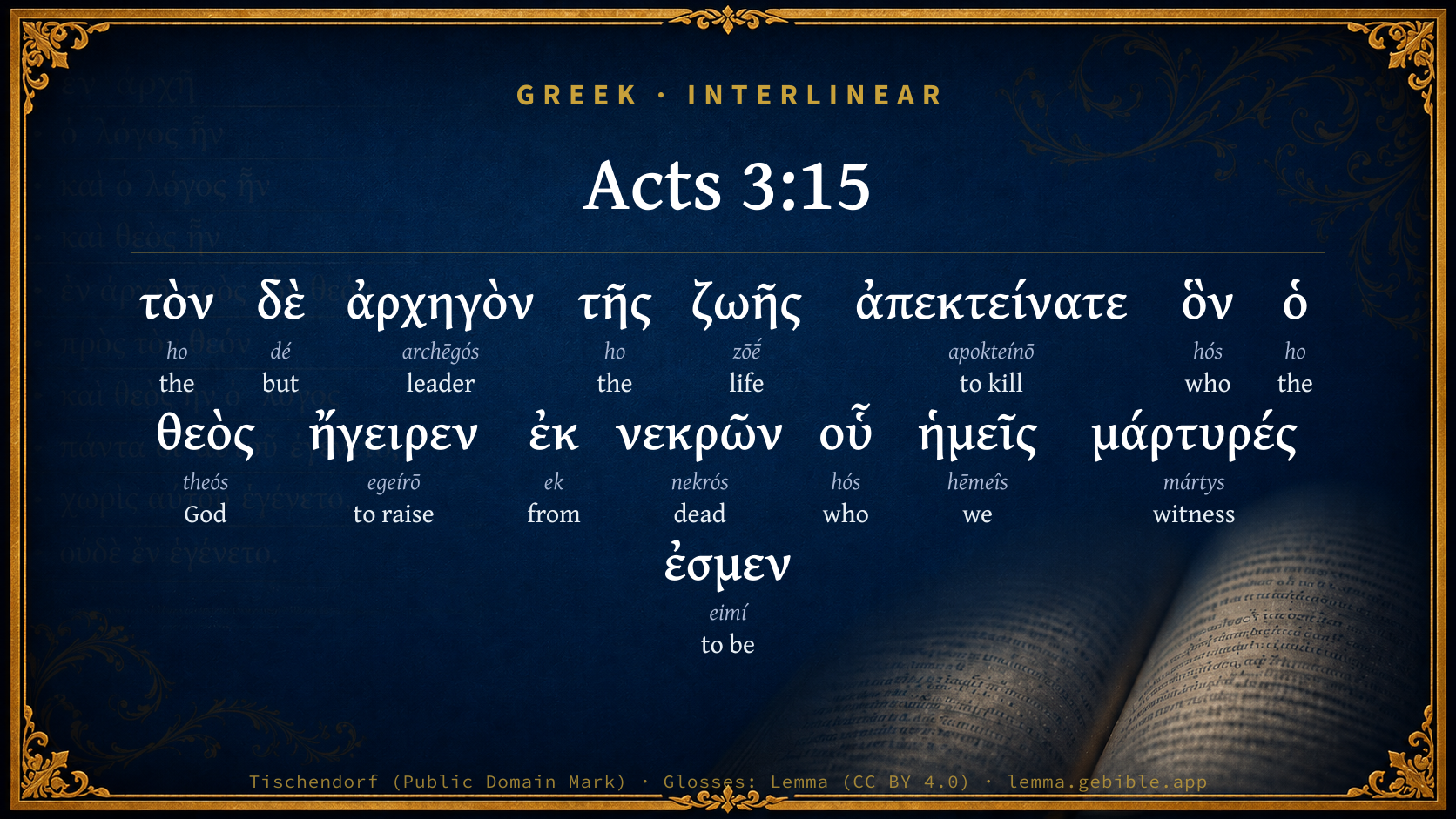
Greek (Tischendorf 8th ed.) Acts 3:15 appears in the Greek New Testament. The text above is from the Tischendorf 8th edition. Each word links to its Strong’s number and a concise gloss. Click any word for its full Thayer’s Greek Lexicon entry.
Download image
Cite this verse

Acts 3:15 (World English Bible). Public Domain. Lemma interlinear Bible study tool, https://lemma.gebible.app/v/acts/3/15.

Show BibTeX & RIS
BibTeX
RIS
English Translation
and killed the Prince of life, whom God raised from the dead, to which we are witnesses.
World English Bible · Public Domain
Highlights
  • 1 first appearance in the Greek New Testament
Full analysis ↓
Download a study sheet

One document with this verse’s original text, its word-by-word gloss line, the meaning frame, cross-references with their text, attributed commentary, and full source and license credits — printable, and it pastes into notes with its structure intact.

This verse Autodidact and up

Study sheet (.html) Plain text (.txt)

A passage Seminary Student

Up to 50 verses in one chapter. A passage sheet keeps up to 6 commentary sources and 12 cross-references per verse, in the order this page ranks them, and says so on the sheet whenever that leaves anything out. Ask for a single verse and you get the Autodidact verse sheet above.

Everything on this page stays free to read, with no account — the sheet is a download of what is already on screen, not access to it.

Want to remove ads? Support Godless Engineer
Compare translations 3

The same verse in 3 English versions, stacked beneath the original-language interlinear above. Click any original word for its lexicon entry.

Each is an independent rendering of the whole verse — the interlinear is not word-aligned to these translations.

Highlighted words mark where these versions differ — a whole-verse word diff, not a word-by-word alignment.

  • World English Bible Public Domain
    and killed the Prince of life, whom God raised from the dead, to which we are witnesses.
  • King James Version Public Domain
    And killed the Prince of life, whom God hath raised from the dead; whereof we are witnesses.
  • unfoldingWord Literal Text CC BY-SA 4.0
    and you killed the Originator of Life, whom God raised from the dead, of which we are witnesses.

unfoldingWord Literal Text — © unfoldingWord, licensed CC BY-SA 4.0. Word-aligned USFM3 via Door43 (git.door43.org/unfoldingWord/en_ult).

Versions to compare (up to 4)

3 of 4 selected

Show all 19 translations

Every available English version of this verse, each an independent rendering of the whole verse.

  • World English Bible Public Domain
    and killed the Prince of life, whom God raised from the dead, to which we are witnesses.
  • Berean Standard Bible Public Domain
    You killed the Author of life, but God raised Him from the dead, and we are witnesses of the fact.
  • Majority Standard Bible Public Domain
    You killed the Author of life, but God raised Him from the dead, and we are witnesses of this fact.
  • King James Version Public Domain
    And killed the Prince of life, whom God hath raised from the dead; whereof we are witnesses.
  • American Standard Version (1901) Public Domain
    and killed the Prince of life; whom God raised from the dead; whereof we are witnesses.
  • Revised Version (1885) Public Domain
    and killed the Prince of life; whom God raised from the dead; whereof we are witnesses.
  • Geneva Bible (1599) Public Domain
    And killed the Lord of life, whome God hath raised from the dead, whereof we are witnesses.
  • Douay-Rheims (1899) Public Domain
    But the author of life you killed, whom God hath raised from the dead, of which we are witnesses.
  • Young's Literal Translation Public Domain
    and the Prince of the life ye did kill, whom God did raise out of the dead, of which we are witnesses;
  • Literal Standard Version CC BY-SA 4.0
    and the Prince of life you killed, whom God raised out of the dead, of which we are witnesses;
  • Unlocked Literal Bible CC BY-SA 4.0
    You killed the Founder of life, whom God raised from the dead—and we are witnesses of this.
  • unfoldingWord Literal Text CC BY-SA 4.0
    and you killed the Originator of Life, whom God raised from the dead, of which we are witnesses.
  • Darby Bible Public Domain
    but the originator of life ye slew, whom God raised from among [the] dead, whereof *we* are witnesses.
  • World Messianic Bible Public Domain
    and killed the Prince of life, whom God raised from the dead, to which we are witnesses.
  • Webster's Bible Public Domain
    And killed the Prince of life, whom God hath raised from the dead; of which we are witnesses.
  • Free Bible Version CC BY-SA 4.0
    You killed the author of life, the one God raised from the dead—and we are witnesses to this.
  • Bible in Basic English Public Domain
    And put to death the Lord of life; whom God gave back from the dead; of which fact we are witnesses.
  • Text-Critical English NT CC BY 4.0
    You put to death the Author of life, whom God raised from the dead, of which we are witnesses.
  • Tyndale New Testament (1534) Public Domain
    and kylled the Lorde of lyfe whom God hath raysed from deeth of the which we are wytnesses.

Literal Standard Version (2020), Covenant Press — licensed CC BY-SA 4.0. Text via the HelloAO Bible API (eBible.org). Unlocked Literal Bible (unfoldingWord) — licensed CC BY-SA 4.0. Text via the HelloAO Bible API (eBible.org). unfoldingWord Literal Text — © unfoldingWord, licensed CC BY-SA 4.0. Word-aligned USFM3 via Door43 (git.door43.org/unfoldingWord/en_ult). Free Bible Version, Dr. Jonathan Gallagher — licensed CC BY-SA 4.0. Text via the HelloAO Bible API (eBible.org).

Word by word

More ways to search: Search by grammar → Find every occurrence → Compare this word →

Practice this passage: Drill this verse → Learn its vocabulary →

ἀρχηγὸν
archēgós
G747
“leader”
Noun, Accusative, Singular, Masculine
Part of Speech
Noun
Case
Accusative
Number
Singular
Gender
Masculine
Full Thayer's Definition

Origin: from G746 and G71

TDNT: 09:07,8

1. the chief leader, prince a. of Christ 2. one that takes the lead in any thing and thus affords an example, a predecessor in a matter, pioneer 3. the author
  1. τὸν ho G3588 “the” Article, Accusative, Singular, Masculine
  2. δὲ dé G1161 “but” Conjunction
  3. τῆς ho G3588 “the” Article, Genitive, Singular, Feminine
  4. ζωῆς zōḗ G2222 “life” Noun, Genitive, Singular, Feminine
  5. ἀπεκτείνατε apokteínō G615 “to kill” Verb, Aorist, Active, Indicative, 2nd person, Plural
  6. ὃν hós G3739 “who” Relative pronoun, Accusative, Singular, Masculine
  7. ὁ ho G3588 “the” Article, Nominative, Singular, Masculine
  8. θεὸς theós G2316 “God” Noun, Nominative, Singular, Masculine
  9. ἤγειρεν egeírō G1453 “to raise” Verb, Aorist, Active, Indicative, 3rd person, Singular
  10. ἐκ ek G1537 “from” Preposition
  11. νεκρῶν nekrós G3498 “dead” Adjective, Genitive, Plural, Masculine
  12. οὗ hós G3739 “who” Relative pronoun, Genitive, Singular, Masculine
  13. ἡμεῖς hēmeîs G2249 “we” Personal pronoun, 1st person, Nominative, Plural
  14. μάρτυρές mártys G3144 “witness” Noun, Nominative, Plural, Masculine
  15. ἐσμεν eimí G1510 “to be” Verb, Present, Active, Indicative, 1st person, Plural

About this verse

These counts appear in no published source. They are computed here, from the morphology-tagged text and Lemma’s own curated glosses. What Lemma adds →

16
words
13
distinct lemmas
Acts
section

Notable vocabulary

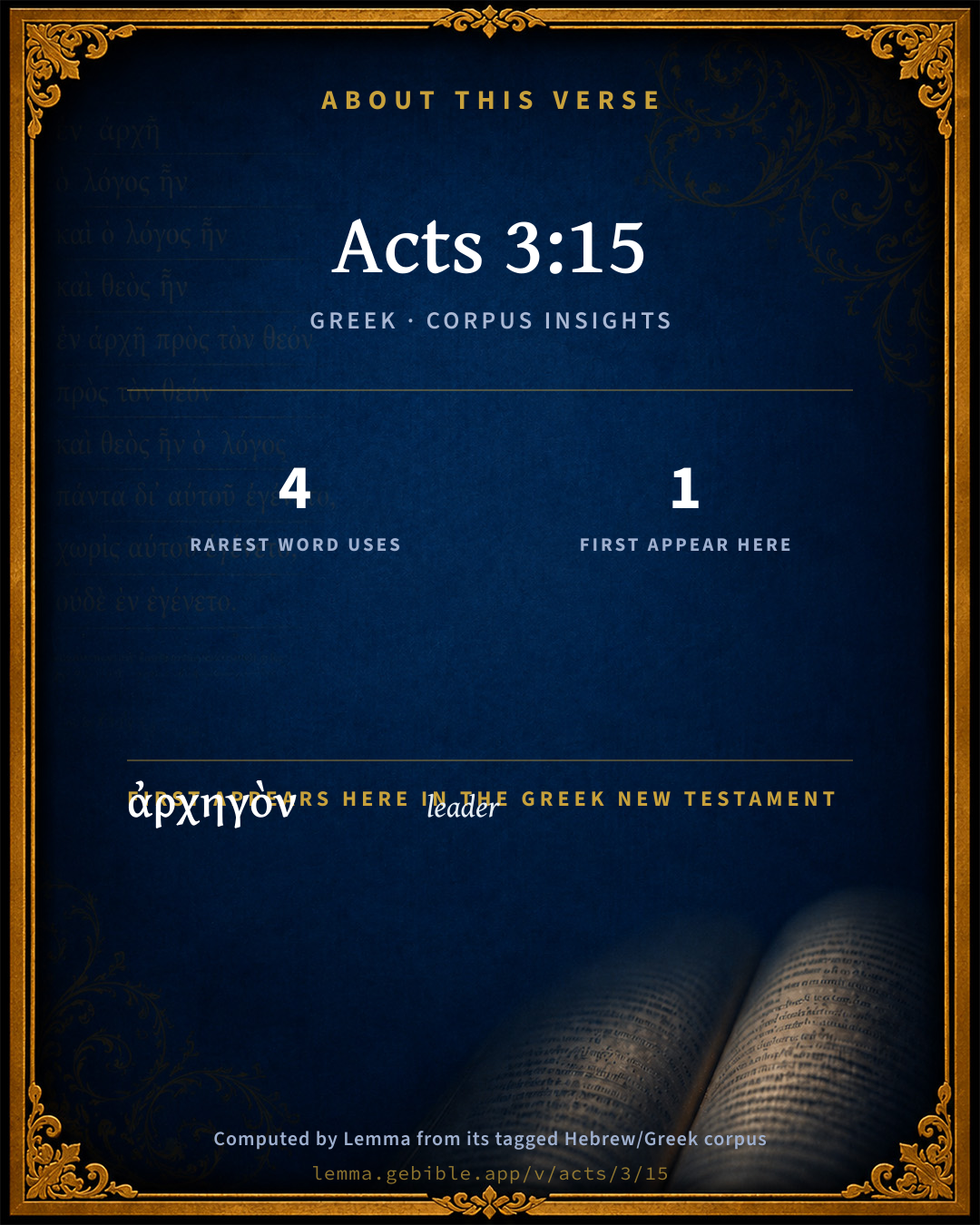
The rarest word here is ἀρχηγὸν leader G747 — appearing just 4 times in the whole Greek New Testament.

First appearance in Scripture

This word makes its first canonical appearance in the Greek New Testament here:

  • ἀρχηγὸν leader G747

Shared distinctive vocabulary

ἀρχηγὸν leader G747 occurs in 4 verses of the Greek New Testament. Also found in:
Repetition

Words recur within this verse:

Cross-references

26

Topical passages linked to Acts 3:15 in the Treasury of Scripture Knowledge — connected by theme and wording, ordered by reader-vote popularity; previews shown in the World English Bible.

  • Acts 2:24 whom God raised up, having freed him from the agony of death, because it was not possible that he should be held by it.
  • Acts 2:32 This Jesus God raised up, to which we all are witnesses.
  • Revelation 21:6 He said to me, "It is done! I am the Alpha and the Omega, the Beginning and the End. I will give freely to him who is thirsty from the spring of the water of life.
  • John 1:4 In him was life, and the life was the light of men.
  • John 5:26 For as the Father has life in himself, even so he gave to the Son also to have life in himself.
  • Acts 13:30–32 But God raised him from the dead,
  • 1 Corinthians 15:45 So also it is written, "The first man, Adam, became a living soul." The last Adam became a life-giving spirit.
  • Hebrews 2:10 For it became him, for whom are all things, and through whom are all things, in bringing many children to glory, to make the author of their salvation perfect through sufferings.
  • John 4:10 Jesus answered her, "If you knew the gift of God, and who it is who says to you, 'Give me a drink,' you would have asked him, and he would have given you living water."
  • John 4:14 but whoever drinks of the water that I will give him will never thirst again; but the water that I will give him will become in him a well of water springing up to eternal life."
  • John 11:25–26 Jesus said to her, "I am the resurrection and the life. He who believes in me, though he die, yet will he live.
  • John 14:6 Jesus said to him, "I am the way, the truth, and the life. No one comes to the Father, except through me.
  • John 17:2 even as you gave him authority over all flesh, he will give eternal life to all whom you have given him.
  • Hebrews 5:9 Having been made perfect, he became to all of those who obey him the author of eternal salvation,
  • 1 John 5:20 We know that the Son of God has come, and has given us an understanding, that we know him who is true, and we are in him who is true, in his Son Jesus Christ. This is the true God, and eternal life.
  • Revelation 22:17 The Spirit and the bride say, "Come!" He who hears, let him say, "Come!" He who is thirsty, let him come. He who desires, let him take the water of life freely.
  • Revelation 22:1 He showed me a river of water of life, clear as crystal, proceeding out of the throne of God and of the Lamb,
  • Matthew 28:2–5 Behold, there was a great earthquake, for an angel of the Lord descended from the sky, and came and rolled away the stone from the door, and sat on it.
  • John 10:28 I give eternal life to them. They will never perish, and no one will snatch them out of my hand.
  • Acts 10:40–41 God raised him up the third day, and gave him to be revealed,
  • Romans 8:1–2 There is therefore now no condemnation to those who are in Christ Jesus, who don't walk according to the flesh, but according to the Spirit.
  • Colossians 3:3–4 For you died, and your life is hidden with Christ in God.
  • 1 John 5:11–12 The testimony is this, that God gave to us eternal life, and this life is in his Son.
  • Acts 1:22 beginning from the baptism of John, to the day that he was received up from us, of these one must become a witness with us of his resurrection."
  • Acts 5:31 God exalted him with his right hand to be a Prince and a Savior, to give repentance to Israel, and remission of sins.
  • Ephesians 1:20 which he worked in Christ, when he raised him from the dead, and made him to sit at his right hand in the heavenly places,

Cross-references courtesy of OpenBible.info (CC BY 4.0).

Commentary

Notes on Acts 3:15 from classic Christian and Jewish commentators (each source and its license shown beneath its notes). The classic Christian expositions comment on the surrounding passage and are grouped to its opening verse, so a note may address several verses; the Jewish commentaries on the Tanakh (Rashi and others) are per-verse, so they appear only where the commentator wrote on this verse.

Lemma curates 59 commentaries, every one of them public domain or Creative Commons licensed, each selected and text-cleaned for this edition rather than reprinted as found. About our sources →

Tyndale Open Study Notes

Tyndale Open Resources

3:15 It was unfathomable to the Jewish mind that the author of life, God himself, could be killed. They did not recognize Jesus as Messiah (cp. 13:27; Luke 23:34), and they did not realize that the Messiah would be divine (see John 1:1-18; cp. Dan 7:13-14).

Tyndale Open Study Notes — © Tyndale Open Resources, licensed CC BY-SA 4.0. Text via the HelloAO Bible API.

Bengel's Gnomon

Johann Albrecht Bengel

Act 3:15. Οὗ, of whom) viz. God. See ch. Act 2:32, note.—μάρτυρες, witnesses) They had acted the part of witnesses, in Act 3:6, with which comp. Act 3:16.

Bengel's Gnomon of the New Testament — English translation (T&T Clark, Edinburgh, 1860) — public domain. Text from a community e-Sword module.

Expositor's Greek Testament

ed. W. Robertson Nicoll

Act 3:15 . τὸν δὲ ἀρχηγὸν τῆς ζωῆς : again the words stand in marked contrast not only to φονέα but also to ἀπεκτείνατε ; magnificum antitheton, Bengel. The word is rendered “Author” in the margin of R.V. (Vulgate, auctorem ) but “Prince” in the text and so in Act 5:31 (Vulg., principem ). In the two other passages in which the word occurs in the N.T., viz. , Heb 2:10 ; Heb 12:2 , R.V. renders “Author,” “the author of their salvation,” “the author and perfecter of our faith,” margin “captain” (Vulgate, auctorem ); see Westcott, Hebrews , pp. 49, 395. Christ is both the Prince of life and the Source ( auctor ) of life: “Vitam aliis dat Christus, opp [142] φονεύς qui adimit” (Blass). Grimm and others draw a distinction between the meaning attaching to the word here and in Act 5:31 . The use of the word in the LXX may help to justify such a distinction, for whilst it is found in the sense of a leader or a captain (Num 14:4 , Jdt 14:2 ), or the chief of a family or tribe (R.V. renders it “every one a prince” in Num 13:2 , but in the next verse “heads of the children of Israel”), it is also used to signify the author, or beginner, the source, cf. 1Ma 9:61 ; 1Ma 10:47 , Mic 1:13 (although it was never used for a prince or to describe kingly attributes); but in many respects the rendering “Prince” may be compared with the Latin princeps , which signifies the first person in order, a chief, a leader, an originator, the founder of a family (in the time of the emperors it was used of the heir to the throne). So in classical Greek the word was used for a leader, a founder, Latin auctor , for the first cause, author, so God τῶν πάντων , Plat., and also for a prince, a chief, and, especially in later Greek, of the person from whom anything good or bad first proceeds in which others have a share, e.g. , ἀρχηγὸς καὶ αἴτιος combined ( antesignanus et auctor ), Polyb., i., 66, 10; Hdian., ii., 6, 22, and as Alford points out in Heb 2:10 , this later usage throws a light upon its meaning in Act 3:15 , cf. Chrys. on Heb 2:10 , ἀρχηγὸν τῆς σωτηρίας τούτεστι τὸν αἴτιον τῆς σωτηρίας . Christ is the source of life, a life in which others share through Him; in this very place where St. Peter was speaking our Lord had spoken of Himself as the giver of eternal life, Joh 10:28 , although doubtless the expression may include the thought that in Him was life in its fullest and widest sense physical, intellectual, moral, spiritual. St. Chrysostom comments on the words “Prince of Life,” Hom. , xi.: “It follows that the life He had was not from another, the Prince or Author of Life must be He who has life from Himself”. Theophylact and Oecumenius see in the words a contrast to the φονέα , in that Christ gives life, while the murderer takes it away a contrast deepened by the words of St. Peter’s fellow-disciple whom he here associates with himself in his appeal to the people, cf. 1Jn 3:15 . In Joh 10:31 ἀρχ . in its rendering “Prince” of kingly dignity may be compared with the use of the word in Thuc., i., 132, Æsch., Agam. , 259. Rendall sees in the expression both here and Act 5:31 a reference to Jesus (the name used by St. Peter) as the second Joshua. As Joshua was the captain of Israel and led them across the Jordan into the land of promise, so Jesus was the Captain of the living army of the Resurrection; and for Saviour, Act 5:31 , he compares Mat 1:21 . Such associations may be included in St. Peter’s words, but they seem much more applicable to Act 5:31 . In modern Greek the word ἀρχηγός = leader, in the ordinary sense, Kennedy, Sources of N. T. Greek , p. 153; see Grimm, sub v . οὗ may refer to ὅν , cf. Act 1:8 , Act 13:31 , or to the fact of the Resurrection, cf. Act 2:32 , Act 5:32 , Act 10:39 . R.V. reads “of whom” in the margin.

[142] opposite, opposition.

The Expositor's Greek Testament, edited by W. Robertson Nicoll (1897–1910) — public domain. Text from a community e-Sword module.

Geneva Bible (1599)

Geneva Bible translators

Who hath life in himself, and giveth life to others.

Geneva Bible (1599) marginal notes — public domain. Text via Bolls.life.

Jamieson, Fausset & Brown

Robert Jamieson, A. R. Fausset & David Brown

killed the Prince of life--Glorious paradox, but how piercing to the conscience of the auditors.

Jamieson, Fausset & Brown — Commentary Critical and Explanatory on the Whole Bible (1871) — public domain (CC PDM 1.0). Text via the HelloAO Bible API.

Adam Clarke's Commentary

Verse 15. And killed the Prince of life] τον αρχηγον της ζωης, The author of this life: not only implying that all life proceeds from Jesus Christ as its source, but that the life-giving influence of that religion which they were now proclaiming came all through him. αρχηγος signifies a prime leader or author, a captain, from αρχη, the beginning, head, or chief; and αγω I lead. In Heb 2:10, Christ is called αρχηγος της σωτηριας, the Captain of salvation. He teaches the doctrine of life and salvation, leads the way in which men should walk, and has purchased the eternal life and glory which are to be enjoyed at the end of the way. So the Jews preferred a son of death, a destroyer of life, to the Author and Procurer of life and immortality!

Whereof we are witnesses.] They had now wrought a most striking miracle in the name of Christ, and immediately proposed themselves as witnesses of his resurrection from the dead; the miracle which they had thus wrought being an unimpeachable proof of this resurrection.

Adam Clarke's Commentary on the Bible (1810–1826) — public domain. Text from a community e-Sword/MySword module.

Ellicott's Commentary for English Readers

(15) And killed the Prince of life.—The word translated “Prince” is applied to Christ here and in Act_5:31. In Heb_2:10 we meet with it in “the Captain of their salvation;” in Heb_12:2, in “the Author and Finisher of our faith.” Its primary meaning, like that of prince (princeps), is one who takes the lead—who is the originator of that to which the title is attached. The “Prince of life,” the “Captain of salvation,” is accordingly He who is the source from which life and salvation flow. In the LXX. of the Old Testament it is used for the “chieftains” or “princes” of Moab and the like (Num_13:3; Num_24:17).

Whereof we are witnesses.—St. Peter falls back, as in Act_2:32 (where see Note), on this attestation to the one central fact.

A Bible Commentary for English Readers, edited by Charles John Ellicott (1878–1897) — public domain. Text from a community e-Sword module.

The Cambridge Bible for Schools and Colleges

gen. ed. J. J. S. Perowne

15. the Prince of life] The same word applied to Jesus (Heb_12:2) is rendered “author and finisher of our faith,” and in the same epistle (Act_2:10) “the captain of their salvation.” It is probably in the latter sense that St Peter, whose thoughts are on the Resurrection, uses the word here, thinking of Christ as the firstfruits of them that slept (1Co_15:20), but the other sense, that “in him was life” (Joh_1:4), is also embraced in the word.

whom God hath raised] Better, whom God raised, i.e. once for all.

whereof we are witnesses] The relative is here better referred to Christ, “of whom we are witnesses.” Not merely did they bear witness of the Resurrection, though that was a most important portion of their testimony, but of all Christ’s teaching and deeds. Cp. Act_1:22, where Matthias was chosen to be such a witness.

The Cambridge Bible for Schools and Colleges (gen. ed. J. J. S. Perowne; Cambridge University Press, 1878–1918) — public domain. Text from a community e-Sword module.

John Gill's Exposition

And killed the Prince of life,.... Or author of life, natural, spiritual, and eternal; who not only is the living God, and has life in himself; and as man, had such a power over his own life, as no man ever had; but he is the author of a spiritual resurrection from the death of sin, to a life of grace, and has procured eternal life for his people, and gives it to them. Now this Lord of life and glory they crucified. His death is laid to them because it was at their request, and through their instigation, and at their earnest solicitations, that Pilate condemned him, and delivered, him to his soldiers to crucify him.

Whom God hath raised from the dead; notwithstanding all their spite and malice; so that they had not their whole will, and all their end, not being able to retain him under the power of death, and under the shame and reproach of the cross; and this the apostle the rather mentions, as being the reason why such gifts, and such power were bestowed on them to do the miracles they did.

Whereof we are witnesses; either of Christ, for it may be rendered, "whose witnesses we are"; they testifying of his person, office, grace, and righteousness; or of the resurrection of Christ, of which they were eyewitnesses; and of which they had the fullest proof, and were capable of bearing a sufficient testimony, and for which they were chosen and appointed.

John Gill's Exposition of the Whole Bible (1746–1763) — public domain (CC PDM 1.0). Text via the HelloAO Bible API.

Trapp's Complete Commentary

John Trapp

15 And killed the Prince of life, whom God hath raised from the dead; whereof we are witnesses.

Ver. 15. And killed] Wherein they were but our workmen, Zec 12:10.

John Trapp, A Commentary or Exposition upon All the Books of the Old and New Testament (1647–1656) — public domain. Text from a community e-Sword module.

Albert Barnes' Notes on the Bible

And killed the Prince of life - The word rendered “prince” denotes properly “a military leader or commander.” Hence, in Heb 2:10, it is translated “captain:” “It became him ...to make the “Captain of their salvation” perfect through sufferings.” As a captain or commander leads on to victory and is said to obtain it, so the word comes to denote one who is the “cause,” the “author,” the “procurer,” etc. In this sense it is used, Act 5:31, “Him hath God exalted to be a Prince and a Saviour, for to give repentance to Israel,” etc. In Heb 12:2 it is properly rendered author, “Looking unto Jesus, the author and finisher of our faith.” The word “author,” or “giver,” would express the meaning of the word here. It also implies that he has dominion over life; an idea, indeed, which is essentially connected with that of his being the author of it. The word “life” here is used in a large sense, as denoting “all manner of life.” In this sense it is used in reference to Christ in Joh 1:4, “In him was life.” Compare Joh 5:26; 1Jo 5:11; 1Co 15:45. Jesus is here called the Prince of life in contrast with him whom the Jews demanded in his place, Barabbas. He was a murderer Luk 23:19; Mar 15:7, one who had destroyed life, and yet they demanded that he whose character it was to destroy life should be released, and the Author of life be put to death.

Whom God hath raised ... - Act 2:24, Act 2:32.

Albert Barnes' Notes on the Bible (1834–1885) — public domain. Text from a community e-Sword/MySword module.

Matthew Poole's English Annotations

The Prince of life; as God, he is the Author of our temporal life too, in whom we live, and move, &c., and in whose hand is our breath; but Christ, as Mediator, is the guide and way to eternal life, Joh 14:6. These are said to have killed our Saviour, though neither Herod, nor Pilate, nor probably many (if any) of them that nailed him to the cross, were present; but it was done for their sakes, and at their desires, and therefore by their means; and it is here charged upon them, as done by them.

Matthew Poole's English Annotations on the Holy Bible (1683–1685) — public domain. Text from a community e-Sword/MySword module.

Whedon's Commentary on the Bible

Daniel D. Whedon

15. Prince—Compounded of ‘Αρχη, beginning, or origin, and αγω, to lead; the word may signify prime author or original source. But as a military term it may signify prime leader or general. So Heb_2:10, “Captain of our salvation.” This last meaning designates Jesus as leading his followers in the way of life.

Witnesses—Notes on Act_2:32 and Luk_1:2. And the miracle just performed rendered its performers conclusive witnesses of the resurrection miracle; doubly so from the fact of Christ’s real authorship of the miracle, affirmed next verse.

Daniel D. Whedon (gen. ed.), Commentary on the Old and New Testaments (1874–1909) — public domain. Text from a community e-Sword module.

The Pulpit Commentary

Raised for bath raised, A.V.. The Prince of life; a remarkable title here given to our Lord, to bring out the contrast between him whom they preferred and him whom they rejected. Barabbas was a murderer, one who took away human life for his own base ends; the other was the Prince and Author of life, who was come into the world, not to destroy men"s lives, but to save them. This title, taken in connection with the preceding declaration, "God hath glorified his Servant Jesus," seems almost to be a reminiscence of our Savior"s prayer," Father, glorify thy Son, that thy Son also may glorify thee: as thou hast given him power over all flesh, that he should give eternal life to as many as thou hast given him". (Joh_17:1, Joh_17:2) Jesus himself in very many places dwells upon his own great prerogative of giving life: "I am come that they might have life, and.., have it more abundantly"; (Joh_10:10) "I am that Bread of life;" "I am the living Bread ... if any man cat of this bread, he shall live for ever;" "I give my flesh for the life of the world;" "Ye will not come unto me that ye might have life;" "They that hear shall live;" "As the Father hath life in himself, so hath he given to the Son to have life in himself;" "The Son of man be lifted up: that whosoever believeth in him should have eternal life;" "The water that I shall give him shall be in him a well of water springing up into everlasting life." The word ajrchgov applied to Christ is found also in Act_5:31, and in Heb_2:10 Heb_12:2, rendered the Author or Captain of their salvation," "of our faith." Whereof we are witnesses. (see Act_2:22, note) The marginal rendering of whom is equally literal, and may be defended by reference to Act_1:8 Act_13:31; but the rendering whereof is in accordance with the more frequent phrases. (Act_5:32 Act_10:39, etc.) The meaning is practically the same.

The Pulpit Commentary (1880–1919), ed. H.D.M. Spence-Jones & Joseph S. Exell — public domain. Text from a community e-Sword module.

Godbey's Commentary on the New Testament

William B. Godbey

15. “And you slew the Prince of Life.” Here is a beautiful allusion to our Savior’s royalty. He is not only our wonderful Savior and perfect Sanctifier, but our glorious coming King.

William B. Godbey, Commentary on the New Testament (1896–1900) — public domain. Text from a community e-Sword module.

McGarvey & Pendleton's Commentaries

J. W. McGarvey

See notes on verse 11

J. W. McGarvey (with Philip Y. Pendleton), Commentaries on the New Testament (The Fourfold Gospel, 1914; Acts; and the epistles) — public domain. Text from a community e-Sword/MySword module.

The People's New Testament

B. W. Johnson

15. We are witnesses. The Twelve, all of whom had seen the risen Lord. Observe how prominent in the early preaching is the resurrection and the apostolic witness to it.

B. W. Johnson's The People's New Testament with Notes (1889–1891) — public domain. Electronic text from the Christian Classics Ethereal Library (CCEL) ThML edition.

unfoldingWord translationNotes

Door43 World Missions Community

General Information:

Here the word "we" includes just Peter and John. (See: Exclusive and Inclusive "We")

Founder of life

This refers to Jesus. Possible meanings are 1) "the one who gives people eternal life" or 2) "the ruler of life" or 3) "the founder of life" or 4) "the one who leads people to life" (See: Metaphor)

whom God raised from the dead

This is an idiom. AT: "whom God caused to live again" (See: Idiom)

Now

This word, "Now," shifts the audiences' attention to the lame man.

by faith in his name

Here the word "name" refers to Jesus. Possible meanings are 1) "because this man believes in Jesus" or 2) "because John and I believe in Jesus" (See: Metonymy)

made him strong

"made him well"

translationWords

prince

life

raise

die

testimony

faith

Jesus

unfoldingWord translationNotes — © Distant Shores Media and the Door43 World Missions Community, licensed CC BY-SA 4.0. Source: git.door43.org/Door43/en_tn.

Cambridge Greek Testament for Schools and Colleges

15. ἀρχηγὸν τῆς ζωῆς, the prince of life. The same word applied to Jesus (Heb 12:2) is rendered ‘author and finisher of our faith,’ and in the same epistle (Act 2:10) ‘the captain of their salvation.’ It is probably in the latter sense that St Peter, whose thoughts are on the resurrection, uses the word here, thinking of Christ as the firstfruits of them that slept (1Co 15:20), but the other sense, that ‘in Him was life’ (Joh 1:4), is also embraced in the word.

ἤγειρεν, raised, i.e. once for all.

οὗ. This pronoun takes up the preceding ὅν, and refers to Jesus, ‘whose witnesses we are.’ Not merely of the Resurrection did the Apostles bear witness, but of all Christ’s teaching and deeds. Cf. Act 1:22, where Matthias was chosen to be such a witness.

Cambridge Greek Testament for Schools and Colleges (Cambridge University Press, 1896; 21 vols, various authors incl. Carr, Maclear, Plummer, Farrar, Lumby, Moule, M. R. James, Simcox) — public domain. Text from a community e-Sword module.

Vincent's Word Studies in the New Testament

Marvin R. Vincent

The Prince of life [αρχηγον της ζωης] . The Greek brings out by the position of these words what Bengel calls "the magnificent antithesis" between a murderer and the Prince of life. "Ye demanded a murderer, but the Prince of life ye killed." This is the only place where the phrase occurs. 'Archgov, though sometimes rendered prince, means, primarily, beginning, and thence originator, author. Better here as Rev., in margin, author, and so by Rev. at Heb 2:10; Heb 12:2.

Marvin R. Vincent, Word Studies in the New Testament (1887–1900) — public domain. Text from a community e-Sword/MySword module.

Lesson kit

Teaching starters — assembled from the data on this page, not authored interpretation. Every prompt links to the verse data it draws on. Edit before teaching.

Acts, in the Acts, opens this verse with 16 words (13 distinct Greek lemmas). Its most distinctive word is archēgós (“leader”). A historical commentator’s framing appears above. Read the whole chapter for the surrounding context.

Discussion questions

  1. The word archēgós carries the sense “leader.” How does it shape the verse?
  2. The word “leader” first appears here in Scripture. What is being introduced at this debut?
  3. Acts 5:31 shares the word «leader» with this verse. How do the two illuminate each other?
  4. “the” occurs 3× in this one verse. What is the effect of the repetition?
  5. These translations render this verse differently; the difference is in the English rendering, not the original. What questions does that raise?
  6. Reading how Tyndale Open Study Notes and Bengel's Gnomon read this verse, where do the two commentators agree and where do they part?

Things to notice

  • 1 word makes its first canonical appearance in Scripture here.
  • These translations choose different wording for 5 words in this verse.
  • “the” occurs 3× in this single verse.
  • 13 distinct Greek lemmas span 16 words in this verse.

Reading settings

Reading text

Shown beneath each verse's original-language words.

Old Testament
Old Testament edition

Read the OT as the Masoretic Hebrew (MT) or the Greek Septuagint (LXX).

English shown for the Greek Septuagint (in the Hebrew ↔ Greek comparison).

Comparing translations? Open the Compare panel on any verse page to stack up to four side by side.