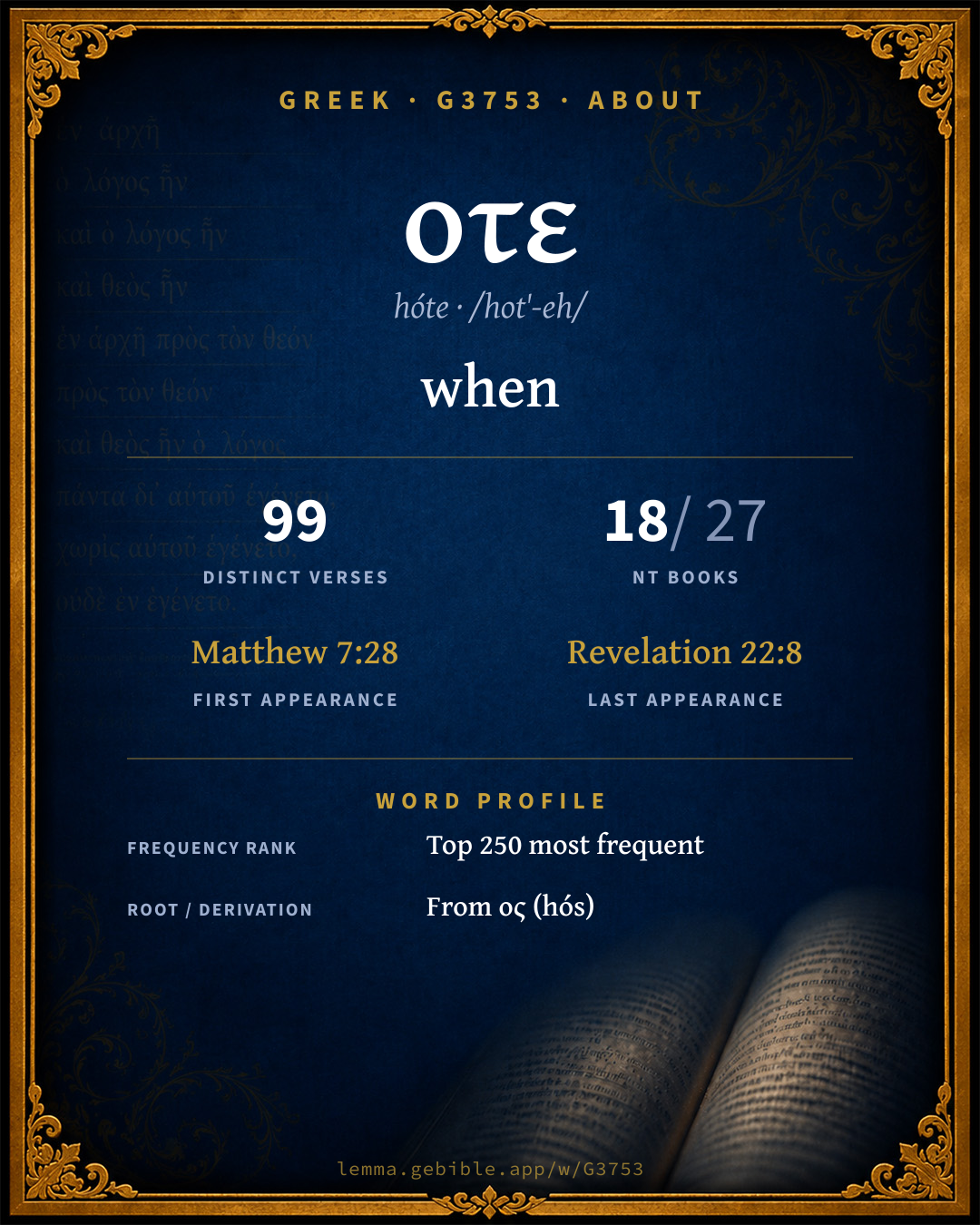
οτε
when
Full lexicon entry — Thayer's Greek Lexicon
From Thayer's Greek Lexicon
Where this word appears
Grammar key — what these labels mean
Part of speech
- Adverb
- A word that modifies a verb, adjective, or other adverb.
Every verse where G3753 appears — 99 distinct verses across 18 books. Click any verse to open its interlinear word-by-word view. Verse text shown in the World English Bible for context — . Each verse’s Greek form is shown with its reference; the English is not keyword-highlighted, since the data carries no word-level English alignment. Use “Compare translations” on any verse to read it across multiple English versions. This concordance covers the Greek New Testament; Septuagint (Greek Old Testament) occurrences of this word are not indexed here.
Matthew 12 verses
- Matthew 7:28 ὅτε adv It happened, when Jesus had finished saying these things, that the multitudes were astonished at his teaching,
- Matthew 9:25 ὅτε adv But when the crowd was put out, he entered in, took her by the hand, and the girl arose.
- Matthew 11:1 ὅτε adv It happened that when Jesus had finished directing his twelve disciples, he departed from there to teach and preach in their cities.
- Matthew 12:3 ὅτε adv But he said to them, "Haven't you read what David did, when he was hungry, and those who were with him;
- Matthew 13:26 ὅτε adv But when the blade sprang up and brought forth fruit, then the darnel appeared also.
- Matthew 13:48 ὅτε adv which, when it was filled, they drew up on the beach. They sat down, and gathered the good into containers, but the bad they threw away.
- Matthew 13:53 ὅτε adv It happened that when Jesus had finished these parables, he departed from there.
- Matthew 19:1 ὅτε adv It happened when Jesus had finished these words, he departed from Galilee, and came into the borders of Judea beyond the Jordan.
- Matthew 21:1 ὅτε adv When they drew near to Jerusalem, and came to Bethsphage, to the Mount of Olives, then Jesus sent two disciples,
- Matthew 21:34 ὅτε adv When the season for the fruit drew near, he sent his servants to the farmers, to receive his fruit.
- Matthew 26:1 ὅτε adv It happened, when Jesus had finished all these words, that he said to his disciples,
- Matthew 27:31 ὅτε adv When they had mocked him, they took the robe off of him, and put his clothes on him, and led him away to crucify him.
Mark 12 verses
- Mark 1:32 ὅτε adv At evening, when the sun had set, they brought to him all who were sick, and those who were possessed by demons.
- Mark 2:25 ὅτε adv He said to them, "Did you never read what David did, when he had need, and was hungry--he, and they who were with him?
- Mark 4:6 ὅτε adv When the sun had risen, it was scorched; and because it had no root, it withered away.
- Mark 4:10 ὅτε adv When he was alone, those who were around him with the twelve asked him about the parables.
- Mark 6:21 ὅτε adv Then a convenient day came, that Herod on his birthday made a supper for his nobles, the high officers, and the chief men of Galilee.
- Mark 7:17 ὅτε adv When he had entered into a house away from the multitude, his disciples asked him about the parable.
- Mark 8:19 ὅτε adv When I broke the five loaves among the five thousand, how many baskets full of broken pieces did you take up?" They told him, "Twelve."
- Mark 8:20 ὅτε adv "When the seven loaves fed the four thousand, how many baskets full of broken pieces did you take up?" They told him, "Seven."
- Mark 11:1 ὅτε adv When they drew near to Jerusalem, to Bethsphage and Bethany, at the Mount of Olives, he sent two of his disciples,
- Mark 14:12 ὅτε adv On the first day of unleavened bread, when they sacrificed the Passover, his disciples asked him, "Where do you want us to go and make ready that you may eat the Passover?"
- Mark 15:20 ὅτε adv When they had mocked him, they took the purple off of him, and put his own garments on him. They led him out to crucify him.
- Mark 15:41 ὅτε adv who, when he was in Galilee, followed him, and served him; and many other women who came up with him to Jerusalem.
Luke 11 verses
- Luke 2:21 ὅτε adv When eight days were fulfilled for the circumcision of the child, his name was called Jesus, which was given by the angel before he was conceived in the womb.
- Luke 2:22 ὅτε adv When the days of their purification according to the law of Moses were fulfilled, they brought him up to Jerusalem, to present him to the Lord
- Luke 2:42 ὅτε adv When he was twelve years old, they went up to Jerusalem according to the custom of the feast,
- Luke 4:25 ὅτε adv But truly I tell you, there were many widows in Israel in the days of Elijah, when the sky was shut up three years and six months, when a great famine came over all the land.
- Luke 6:13 ὅτε adv When it was day, he called his disciples, and from them he chose twelve, whom he also named apostles:
- Luke 13:35 ὅτε adv Behold, your house is left to you desolate. I tell you, you will not see me, until you say, 'Blessed is he who comes in the name of the Lord!'"
- Luke 15:30 ὅτε adv But when this, your son, came, who has devoured your living with prostitutes, you killed the fattened calf for him.'
- Luke 17:22 ὅτε adv He said to the disciples, "The days will come, when you will desire to see one of the days of the Son of Man, and you will not see it.
- Luke 22:14 ὅτε adv When the hour had come, he sat down with the twelve apostles.
- Luke 22:35 ὅτε adv He said to them, "When I sent you out without purse, and wallet, and shoes, did you lack anything?" They said, "Nothing."
- Luke 23:33 ὅτε adv When they came to the place that is called The Skull, they crucified him there with the criminals, one on the right and the other on the left.
John 19 verses
- John 1:19 ὅτε adv This is John's testimony, when the Jews sent priests and Levites from Jerusalem to ask him, "Who are you?"
- John 2:22 ὅτε adv When therefore he was raised from the dead, his disciples remembered that he said this, and they believed the Scripture, and the word which Jesus had said.
- John 4:21 ὅτε adv Jesus said to her, "Woman, believe me, the hour comes, when neither in this mountain, nor in Jerusalem, will you worship the Father.
- John 4:23 ὅτε adv But the hour comes, and now is, when the true worshippers will worship the Father in spirit and truth, for the Father seeks such to be his worshippers.
- John 5:25 ὅτε adv Most assuredly, I tell you, the hour comes, and now is, when the dead will hear the Son of God's voice; and those who hear will live.
- John 6:24 ὅτε adv When the multitude therefore saw that Jesus wasn't there, nor his disciples, they themselves got into the boats, and came to Capernaum, seeking Jesus.
- John 9:4 ὅτε adv I must work the works of him who sent me, while it is day. The night is coming, when no one can work.
- John 12:16 ὅτε adv His disciples didn't understand these things at first, but when Jesus was glorified, then they remembered that these things were written about him, and that they had done these things to him.
- John 13:12 Ὅτε adv So when he had washed their feet, put his outer garment back on, and sat down again, he said to them, "Do you know what I have done to you?
- John 13:31 Ὅτε adv When he had gone out, Jesus said, "Now the Son of Man has been glorified, and God has been glorified in him.
- John 16:25 ὅτε adv I have spoken these things to you in figures of speech. But the time is coming when I will no more speak to you in figures of speech, but will tell you plainly about the Father.
- John 17:12 ὅτε adv While I was with them in the world, I kept them in your name. Those whom you have given me I have kept. None of them is lost, except the son of destruction, that the Scripture might be fulfilled.
- John 19:6 ὅτε adv When therefore the chief priests and the officers saw him, they shouted, saying, "Crucify! Crucify!" Pilate said to them, "Take him yourselves, and crucify him, for I find no basis for a charge against him."
- John 19:8 Ὅτε adv When therefore Pilate heard this saying, he was more afraid.
- John 19:23 ὅτε adv Then the soldiers, when they had crucified Jesus, took his garments and made four parts, to every soldier a part; and also the coat. Now the coat was without seam, woven from the top throughout.
- John 19:30 ὅτε adv When Jesus therefore had received the vinegar, he said, "It is finished." He bowed his head, and gave up his spirit.
- John 20:24 ὅτε adv But Thomas, one of the twelve, called Didymus, wasn't with them when Jesus came.
- John 21:15 Ὅτε adv So when they had eaten their breakfast, Jesus said to Simon Peter, "Simon, son of Jonah, do you love me more than these?" He said to him, "Yes, Lord; you know that I have affection for you." He said to him, "Feed my lambs."
- John 21:18 ὅτε adv Most assuredly I tell you, when you were young, you dressed yourself, and walked where you wanted to. But when you are old, you will stretch out your hands, and another will dress you, and carry you where you don't want to go."
Acts 10 verses
- Acts 1:13 ὅτε adv When they had come in, they went up into the upper room, where they were staying; that is Peter, John, James, Andrew, Philip, Thomas, Bartholomew, Matthew, James the son of Alphaeus, Simon the Zealot, and Judas the son of James.
- Acts 8:12 ὅτε adv But when they believed Philip preaching good news concerning the Kingdom of God and the name of Jesus Christ, they were baptized, both men and women.
- Acts 8:39 ὅτε adv When they came up out of the water, the Spirit of the Lord caught Philip away, and the eunuch didn't see him any more, for he went on his way rejoicing.
- Acts 11:2 ὅτε adv When Peter had come up to Jerusalem, those who were of the circumcision contended with him,
- Acts 12:6 ὅτε adv The same night when Herod was about to bring him out, Peter was sleeping between two soldiers, bound with two chains. Guards in front of the door kept the prison.
- Acts 21:5 ὅτε adv When it happened that we had accomplished the days, we departed and went on our journey. They all, with wives and children, brought us on our way until we were out of the city. Kneeling down on the beach, we prayed.
- Acts 21:35 ὅτε adv When he came to the stairs, it happened that he was carried by the soldiers because of the violence of the crowd;
- Acts 22:20 ὅτε adv When the blood of Stephen, your witness, was shed, I also was standing by, and consenting to his death, and guarding the cloaks of those who killed him.'
- Acts 27:39 Ὅτε adv When it was day, they didn't recognize the land, but they noticed a certain bay with a beach, and they decided to try to drive the ship onto it.
- Acts 28:16 Ὅτε adv When we entered into Rome, the centurion delivered the prisoners to the captain of the guard, but Paul was allowed to stay by himself with the soldier who guarded him.
Romans 4 verses
- Romans 2:16 ὅτε adv in the day when God will judge the secrets of men, according to my Gospel, by Jesus Christ.
- Romans 6:20 ὅτε adv For when you were servants of sin, you were free in regard to righteousness.
- Romans 7:5 ὅτε adv For when we were in the flesh, the sinful passions which were through the law, worked in our members to bring forth fruit to death.
- Romans 13:11 ὅτε adv Do this, knowing the time, that it is already time for you to awaken out of sleep, for salvation is now nearer to us than when we first believed.
1 Corinthians 2 verses
- 1 Corinthians 12:2 ὅτε adv You know that when you were heathen, you were led away to those mute idols, however you might be led.
- 1 Corinthians 13:11 ὅτε ὅτε adv adv When I was a child, I spoke as a child, I felt as a child, I thought as a child. Now that I have become a man, I have put away childish things.
Galatians 6 verses
- Galatians 1:15 ὅτε adv But when it was the good pleasure of God, who separated me from my mother's womb, and called me through his grace,
- Galatians 2:11 Ὅτε adv But when Peter came to Antioch, I resisted him to the face, because he stood condemned.
- Galatians 2:12 ὅτε adv For before some people came from James, he ate with the Gentiles. But when they came, he drew back and separated himself, fearing those who were of the circumcision.
- Galatians 2:14 ὅτε adv But when I saw that they didn't walk uprightly according to the truth of the Gospel, I said to Peter before them all, "If you, being a Jew, live as the Gentiles do, and not as the Jews do, why do you compel the Gentiles to live as the Jews do?
- Galatians 4:3 ὅτε adv So we also, when we were children, were held in bondage under the elements of the world.
- Galatians 4:4 ὅτε adv But when the fullness of the time came, God sent out his Son, born to a woman, born under the law,
Philippians 1 verse
Colossians 1 verse
1 Thessalonians 1 verse
2 Thessalonians 1 verse
2 Timothy 1 verse
Titus 1 verse
Hebrews 2 verses
1 Peter 1 verse
Jude 1 verse
Revelation 13 verses
- Revelation 1:17 ὅτε adv When I saw him, I fell at his feet like a dead man. He laid his right hand on me, saying, "Don't be afraid. I am the first and the last,
- Revelation 5:8 ὅτε adv Now when he had taken the book, the four living creatures and the twenty-four elders fell down before the Lamb, each one having a harp, and golden bowls full of incense, which are the prayers of the saints.
- Revelation 6:1 ὅτε adv I saw that the Lamb opened one of the seven seals, and I heard one of the four living creatures saying, as with a voice of thunder, "Come and see!"
- Revelation 6:3 ὅτε adv When he opened the second seal, I heard the second living creature saying, "Come!"
- Revelation 6:5 ὅτε adv When he opened the third seal, I heard the third living creature saying, "Come and see!" And behold, a black horse, and he who sat on it had a balance in his hand.
- Revelation 6:7 ὅτε adv When he opened the fourth seal, I heard the fourth living creature saying, "Come and see!"
- Revelation 6:9 ὅτε adv When he opened the fifth seal, I saw underneath the altar the souls of those who had been killed for the Word of God, and for the testimony of the Lamb which they had.
- Revelation 6:12 ὅτε adv I saw when he opened the sixth seal, and there was a great earthquake. The sun became black as sackcloth made of hair, and the whole moon became as blood.
- Revelation 10:3 ὅτε adv He cried with a loud voice, as a lion roars. When he cried, the seven thunders uttered their voices.
- Revelation 10:4 ὅτε adv When the seven thunders sounded, I was about to write; but I heard a voice from the sky saying, "Seal up the things which the seven thunders said, and don't write them."
- Revelation 10:10 ὅτε adv I took the little book out of the angel's hand, and ate it up. It was as sweet as honey in my mouth. When I had eaten it, my stomach was made bitter.
- Revelation 12:13 ὅτε adv When the dragon saw that he was thrown down to the earth, he persecuted the woman who gave birth to the male child.
- Revelation 22:8 ὅτε adv Now I, John, am the one who heard and saw these things. When I heard and saw, I fell down to worship before the feet of the angel who had shown me these things.
About this entry
At a glance — auto-summarized from this page’s data, not written by a person. Every figure links to its source below. This summary describes the numbers; it doesn’t interpret them.
The Greek word οτε centers on the idea of “when.” Debuting at Matthew 7:28, it then recurs through the corpus. Spanning 99 verses in 18 books, it ranks among the moderately common words of the Greek New Testament. Sharing its root, it stands alongside ος, ο εστι and οθεν. For the data behind this summary, explore the sense tree and the renderings breakdown below.
Gloss history
Strong's 1890 vs modern scholarship

About this word
Strong's G3753 catalogs a Greek word from the Greek New Testament.
These counts are not copied from any lexicon or concordance. They are computed here, from the morphology-tagged Greek New Testament. What Lemma adds →
- 99
- distinct verses
- The word appears in 99 distinct verses.
- 18 / 27
- NT books
- The word appears in 18 of 27 New Testament books.
- #165
- by frequency
- Top 250 most frequent Greek words (rank 165 of 5,347 Greek words by occurrence).
View all 99 occurrences in the concordance →
Most concentrated in
- John 19 verses 19%
- Revelation 13 verses 13%
- Matthew 12 verses 12%
By section of the New Testament
By traditional corpus
Conventional, traditional groupings — biblical authorship is debated, so this is a traditional corpus grouping, not an authorship claim. Some books belong to more than one corpus (Luke is in both the Gospels and the Lukan corpus, and so on), so these shares overlap and need not total 100%. Each figure is a share of the word’s 99 distinct verses.
- Gospels 54 verses · 55%
- Johannine 32 verses · 32%
- Lukan (Luke–Acts) 21 verses · 21%
- Pauline corpus 18 verses · 18%
- Revelation 13 verses · 13%
- Hebrews 2 verses · 2%
- General (Catholic) Epistles 2 verses · 2%
How translations render this word
Counts come from each version’s own published word-to-Strong’s tagging or interlinear alignment — an approximate guide to how each version renders this word, not a word-level alignment the data otherwise carries. Because each total is that version’s own tagged count, the per-version totals vary from one another and need not match the appearance or distinct-verse counts above. These counts may also differ from a printed concordance because Lemma counts each distinctly tagged rendering and does not collapse phrase taggings into a single head-word total. This is a fixed set of word-tagged versions (KJV, ASV, BSB, ULT) and does not change with the reading translation you choose elsewhere. Each version’s license is shown beside its name below (and on Sources).
- King James Version: When 97×, After 3×, Soon as 2×
- American Standard Version: When 95×, While 2×
- Berean Standard Bible: When 82×, After 4×, While 4×
- unfoldingWord Literal Text: When 101×
King James Version Public Domain
Renders G3753 across 105 tagged occurrences — most commonly:
Plus 1 rendering that appears only once — usually multi-word phrases or single function words the recovered tagging swept in, not distinct renderings.
American Standard Version Public Domain
Renders G3753 across 102 tagged occurrences — most commonly:
Plus 5 renderings that appear only once — usually multi-word phrases or single function words the recovered tagging swept in, not distinct renderings.
Berean Standard Bible Public Domain
Renders G3753 across 94 tagged occurrences — most commonly:
Plus 1 rendering that appears only once — usually multi-word phrases or single function words the recovered tagging swept in, not distinct renderings. Not rendered by a distinct English word in 8 further occurrences.
unfoldingWord Literal Text CC BY-SA 4.0
Renders G3753 across 103 tagged occurrences — most commonly:
Plus 2 renderings that appear only once — usually multi-word phrases or single function words the recovered tagging swept in, not distinct renderings.
Senses in Thayer's
The 1 sense Thayer's distinguishes for this word, in lexicon order (not ranked by frequency or importance). The full entry — with sub-senses — is in the Lexicon Entry tab.
- when whenever, while, as long as
Word origin
Derived from ος (hós) (G3739) — who.
From G3739 and G5037 ; at which (thing) too that is when : - after (that) as soon as that when while. Second form also feminine third form also neuter and fourth form simply the article G3588 followed by G5037 ; so written (in some editions) to distinguish them from G3752 and G5119 .
— Strong’s Exhaustive Concordance (1890), public domain.
Forms in the corpus
The 2 distinct written forms G3753 takes in the Greek New Testament, most frequent first — each parse links to that case’s occurrences in the concordance.
| Form | Parsing | Example | Uses |
|---|---|---|---|
| ὅτε hóte | Adverb | Matthew 7:28 | 93 |
| Ὅτε Hóte | Adverb | John 13:12 | 7 |
Same root — word family
Other Thayer's entries built from the same root as G3753, grouped by Strong’s listed origin. These share a root / origin per the lexicon — not necessarily a shared meaning. Each links to that word’s own entry.
Derives from
Shares the same root
- ο εστι hó esti G3603 which is
- οθεν hóthen G3606 from which
- οποιος hopoîos G3697 what sort
- οποτε hopóte G3698 when
- οπου hópou G3699 where
- οπως hópōs G3704 how
- οσακις hosákis G3740 as often as
- οσος hósos G3745 how much
- οσπερ hósper G3746 whomever
- οστις hóstis G3748 whoever
- ου hoû G3757 where
- ποσος pósos G4214 how much
- ως hōs G5613 as
Derived from this word
Compare all same-root words → Showing 4 of 16 — not the complete family. They share a root, not necessarily a meaning.
Septuagint usage
The same Greek word οτε appears 92 times in the Greek Old Testament (Septuagint), across 88 verses in 24 books.
- 92
- LXX occurrences
- Tagged occurrences of this Greek word in the Septuagint.
- 88
- verses
- Distinct Septuagint verses containing this word.
- 24 / 39
- OT books
- The word appears in 24 of the 39 Old Testament books.
Sample Septuagint occurrences
- Genesis 2:4 ὅτε
- Exodus 5:13 ὅτε
- Leviticus 26:45 ὅτε
- Numbers 26:10 ὅτε
- Deuteronomy 4:10 ὅτε
- Joshua 2:10 ὅτε
- Judges 1:28 ὅτε
- 1 Samuel 1:12 ὅτε
- 2 Samuel 2:10 ὅτε
- 1 Kings 14:8 ὅτε
- 2 Kings 5:26 ὅτε
- 2 Chronicles 21:20 ὅτε
Septuagint occurrences (same lexeme)
Every verse where the same Strong’s number (G3753) appears in the Greek Septuagint — showing the first 50 of 88. Verse text shown in the World English Bible for context; the Greek form is the matched word — the English is not keyword-highlighted.
- Genesis 2:4 ὅτε This is the history of the generations of the heavens and of the earth when they were created, in the day that Yahweh God made earth and the heavens.
- Genesis 11:10 ὅτε This is the history of the generations of Shem. Shem was one hundred years old, and became the father of Arpachshad two years after the flood.
- Genesis 12:4 ὅτε So Abram went, as Yahweh had spoken to him. Lot went with him. Abram was seventy-five years old when he departed out of Haran.
- Genesis 24:30 ὅτε It happened, when he saw the ring, and the bracelets on his sister's hands, and when he heard the words of Rebekah his sister, saying, "This is what the man said to me," that he came to the man. Behold, he was standing by the camels at the spring.
- Genesis 25:20 ὅτε Isaac was forty years old when he took Rebekah, the daughter of Bethuel the Syrian of Paddan Aram, the sister of Laban the Syrian, to be his wife.
- Genesis 25:26 ὅτε After that, his brother came out, and his hand had hold on Esau's heel. He was named Jacob. Isaac was sixty years old when she bore them.
- Genesis 33:18 ὅτε Jacob came in peace to the city of Shechem, which is in the land of Canaan, when he came from Paddan Aram; and encamped before the city.
- Genesis 34:25 ὅτε It happened on the third day, when they were sore, that two of Jacob's sons, Simeon and Levi, Dinah's brothers, each took his sword, came upon the unsuspecting city, and killed all the males.
- Genesis 35:9 ὅτε God appeared to Jacob again, when he came from Paddan Aram, and blessed him.
- Genesis 36:24 ὅτε These are the children of Zibeon: Aiah and Anah. This is Anah who found the hot springs in the wilderness, as he fed the donkeys of Zibeon his father.
- Genesis 41:46 ὅτε Joseph was thirty years old when he stood before Pharaoh king of Egypt. Joseph went out from the presence of Pharaoh, and went throughout all the land of Egypt.
- Genesis 42:21 ὅτε They said one to another, "We are most assuredly guilty concerning our brother, in that we saw the distress of his soul, when he begged us, and we wouldn't listen. Therefore this distress has come on us."
- Exodus 5:13 ὅτε The taskmasters were urgent saying, "Fulfill your work quota daily, as when there was straw!"
- Leviticus 26:45 ὅτε but I will for their sake remember the covenant of their ancestors, whom I brought forth out of the land of Egypt in the sight of the nations, that I might be their God. I am Yahweh.'"
- Numbers 26:10 ὅτε and the earth opened its mouth, and swallowed them up together with Korah, when that company died; what time the fire devoured two hundred fifty men, and they became a sign.
- Numbers 32:8 ὅτε Thus did your fathers, when I sent them from Kadesh-barnea to see the land.
- Numbers 33:39 ὅτε Aaron was one hundred twenty-three years old when he died in Mount Hor.
- Numbers 33:40 ὅτε The Canaanite, the king of Arad, who lived in the South in the land of Canaan, heard of the coming of the children of Israel.
- Deuteronomy 4:10 ὅτε the day that you stood before Yahweh your God in Horeb, when Yahweh said to me, Assemble me the people, and I will make them hear my words, that they may learn to fear me all the days that they live on the earth, and that they may teach their children.
- Deuteronomy 9:23 ὅτε When Yahweh sent you from Kadesh-barnea, saying, Go up and possess the land which I have given you; then you rebelled against the commandment of Yahweh your God, and you didn't believe him, nor listen to his voice.
- Deuteronomy 29:24 ὅτε even all the nations shall say, Why has Yahweh done thus to this land? what means the heat of this great anger?
- Deuteronomy 32:8 ὅτε When the Most High gave to the nations their inheritance, When he separated the children of men, He set the bounds of the peoples According to the number of the children of Israel.
- Joshua 2:10 ὅτε For we have heard how Yahweh dried up the water of the Red Sea before you, when you came out of Egypt; and what you did to the two kings of the Amorites, who were beyond the Jordan, to Sihon and to Og, whom you utterly destroyed.
- Joshua 8:19 ὅτε The ambush arose quickly out of their place, and they ran as soon as he had stretched out his hand, and entered into the city, and took it; and they hurried and set the city on fire.
- Joshua 14:7 ὅτε Forty years old was I when Moses the servant of Yahweh sent me from Kadesh-barnea to spy out the land; and I brought him word again as it was in my heart.
- Joshua 14:11 ὅτε As yet I am as strong this day as I as in the day that Moses sent me: as my strength was then, even so is my strength now, for war, and to go out and to come in.
- Joshua 24:31 ὅτε Israel served Yahweh all the days of Joshua, and all the days of the elders who outlived Joshua, and had known all the work of Yahweh, that he had worked for Israel.
- Judges 1:28 ὅτε It happened, when Israel had grown strong, that they put the Canaanites to forced labor, and did not utterly drive them out.
- Judges 8:1 ὅτε The men of Ephraim said to him, Why have you served us thus, that you didn't call us, when you went to fight with Midian? They did chide with him sharply.
- Judges 14:11 ὅτε It happened, when they saw him, that they brought thirty companions to be with him.
- Judges 16:16 ὅτε It happened, when she pressed him daily with her words, and urged him, that his soul was vexed to death.
- Judges 16:25 ὅτε It happened, when their hearts were merry, that they said, Call for Samson, that he may make us sport. They called for Samson out of the prison-house; and he made sport before them. They set him between the pillars:
- 1 Samuel 1:12 ὅτε It happened, as she continued praying before Yahweh, that Eli marked her mouth.
- 1 Samuel 5:4 ὅτε When they arose early on the next day morning, behold, Dagon was fallen on his face to the ground before the ark of Yahweh; and the head of Dagon and both the palms of his hands [lay] cut off on the threshold; only [the stump of] Dagon was left to him.
- 1 Samuel 6:6 ὅτε Why then do you harden your hearts, as the Egyptians and Pharaoh hardened their hearts? When he had worked wonderfully among them, didn't they let the people go, and they departed?
- 2 Samuel 2:10 ὅτε Ish-bosheth, Saul's son, was forty years old when he began to reign over Israel, and he reigned two years. But the house of Judah followed David.
- 2 Samuel 7:1 ὅτε It happened, when the king lived in his house, and Yahweh had given him rest from all his enemies round about,
- 2 Samuel 19:26 ὅτε He answered, My lord, O king, my servant deceived me: for your servant said, I will saddle me a donkey, that I may ride thereon, and go with the king; because your servant is lame.
- 1 Kings 14:8 ὅτε and tore the kingdom away from the house of David, and gave it you; and yet you have not been as my servant David, who kept my commandments, and who followed me with all his heart, to do that only which was right in my eyes,
- 1 Kings 21:12 ὅτε They proclaimed a fast, and set Naboth on high among the people.
- 2 Kings 5:26 ὅτε He said to him, Didn't my heart go with you, when the man turned from his chariot to meet you? Is it a time to receive money, and to receive garments, and olive groves and vineyards, and sheep and oxen, and men-servants and maid-servants?
- 2 Kings 14:5 ὅτε It happened, as soon as the kingdom was established in his hand, that he killed his servants who had slain the king his father:
- 2 Chronicles 21:20 ὅτε Thirty-two years old was he when he began to reign, and he reigned in Jerusalem eight years: and he departed without being desired; and they buried him in the city of David, but not in the tombs of the kings.
- 2 Chronicles 24:6 ὅτε The king called for Jehoiada the chief, and said to him, Why haven't you required of the Levites to bring in out of Judah and out of Jerusalem the tax of Moses the servant of Yahweh, and of the assembly of Israel, for the tent of the testimony?
- Ezra 5:12 ὅτε But after that our fathers had provoked the God of heaven to wrath, he gave them into the hand of Nebuchadnezzar king of Babylon, the Chaldean, who destroyed this house, and carried the people away into Babylon.
- Esther 1:2 ὅτε that in those days, when the king Ahasuerus sat on the throne of his kingdom, which was in Shushan the palace,
- Esther 1:5 ὅτε When these days were fulfilled, the king made a feast to all the people who were present in Shushan the palace, both great and small, seven days, in the court of the garden of the king's palace.
- Esther 2:8 ὅτε So it happened, when the king's commandment and his decree was heard, and when many maidens were gathered together to Shushan the palace, to the custody of Hegai, that Esther was taken into the king's house, to the custody of Hegai, keeper of the women.
- Job 28:26 ὅτε When he made a decree for the rain, And a way for the lightning of the thunder;
- Job 29:3 ὅτε When his lamp shone on my head, And by his light I walked through darkness;
These are occurrences of the same Greek lexeme (G3753) in the Septuagint — not a translation of any one Hebrew word. The store carries no word-level Hebrew↔Greek alignment, so no Hebrew original is asserted here. Counts come from the recovered LXX Strong's tagging — high-frequency vocabulary is well covered, while rare or late forms may be untagged — so they reflect tagged occurrences and may slightly undercount.