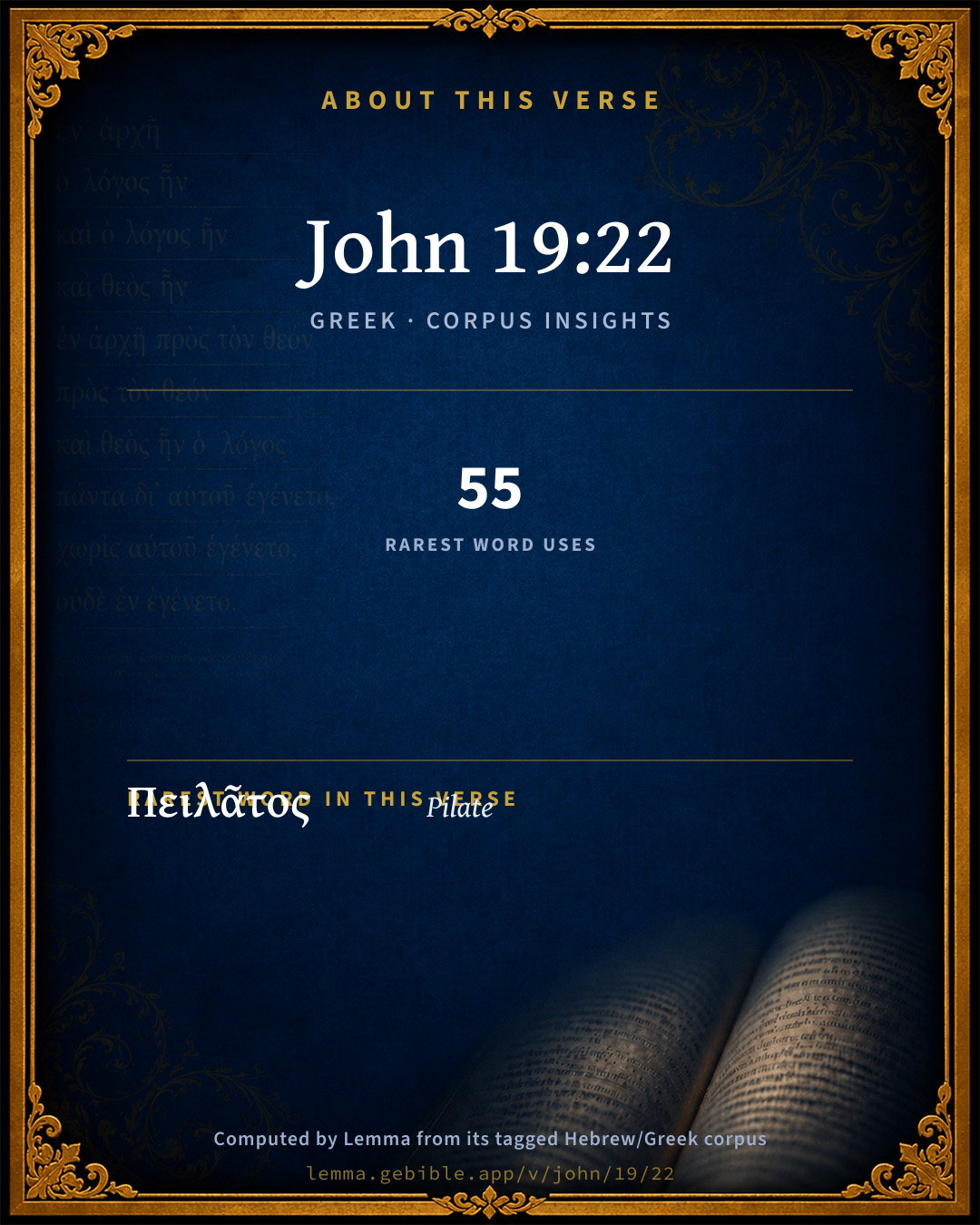
John 19:22

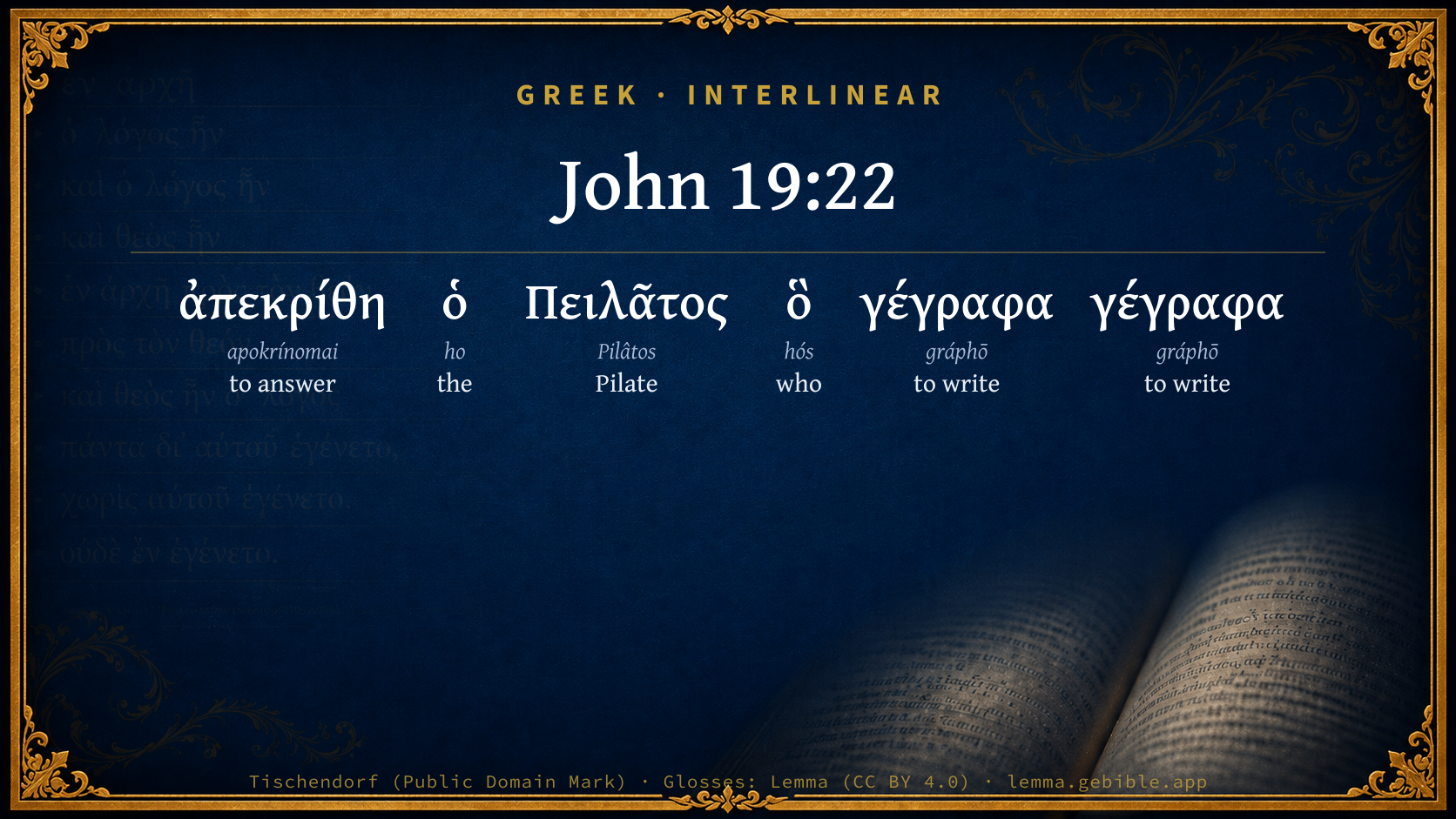
Greek (Tischendorf 8th ed.) John 19:22 appears in the Greek New Testament. The text above is from the Tischendorf 8th edition. Each word links to its Strong’s number and a concise gloss. Click any word for its full Thayer’s Greek Lexicon entry.
Download image
Cite this verse

John 19:22 (World English Bible). Public Domain. Lemma interlinear Bible study tool, https://lemma.gebible.app/v/john/19/22.

Show BibTeX & RIS
BibTeX
RIS
English Translation
Pilate answered, "What I have written, I have written."
World English Bible · Public Domain
Download a study sheet

One document with this verse’s original text, its word-by-word gloss line, the meaning frame, cross-references with their text, attributed commentary, and full source and license credits — printable, and it pastes into notes with its structure intact.

This verse Autodidact and up

Study sheet (.html) Plain text (.txt)

A passage Seminary Student

Up to 50 verses in one chapter. A passage sheet keeps up to 6 commentary sources and 12 cross-references per verse, in the order this page ranks them, and says so on the sheet whenever that leaves anything out. Ask for a single verse and you get the Autodidact verse sheet above.

Everything on this page stays free to read, with no account — the sheet is a download of what is already on screen, not access to it.

Want to remove ads? Support Godless Engineer
Compare translations 3

The same verse in 3 English versions, stacked beneath the original-language interlinear above. Click any original word for its lexicon entry.

Each is an independent rendering of the whole verse — the interlinear is not word-aligned to these translations.

Highlighted words mark where these versions differ — a whole-verse word diff, not a word-by-word alignment.

  • World English Bible Public Domain
    Pilate answered, "What I have written, I have written."
  • King James Version Public Domain
    Pilate answered, What I have written I have written.
  • unfoldingWord Literal Text CC BY-SA 4.0
    Pilate answered, “What I have written I have written.”

unfoldingWord Literal Text — © unfoldingWord, licensed CC BY-SA 4.0. Word-aligned USFM3 via Door43 (git.door43.org/unfoldingWord/en_ult).

Versions to compare (up to 4)

3 of 4 selected

Show all 19 translations

Every available English version of this verse, each an independent rendering of the whole verse.

  • World English Bible Public Domain
    Pilate answered, "What I have written, I have written."
  • Berean Standard Bible Public Domain
    Pilate answered, “What I have written, I have written.”
  • Majority Standard Bible Public Domain
    Pilate answered, “What I have written, I have written.”
  • King James Version Public Domain
    Pilate answered, What I have written I have written.
  • American Standard Version (1901) Public Domain
    Pilate answered, What I have written I have written.
  • Revised Version (1885) Public Domain
    Pilate answered, What I have written I have written.
  • Geneva Bible (1599) Public Domain
    Pilate answered, What I haue written, I haue written.
  • Douay-Rheims (1899) Public Domain
    Pilate answered: What I have written, I have written.
  • Young's Literal Translation Public Domain
    Pilate answered, `What I have written, I have written.'
  • Literal Standard Version CC BY-SA 4.0
    Pilate answered, “What I have written, I have written.”
  • Unlocked Literal Bible CC BY-SA 4.0
    Pilate answered, “What I have written I have written.”
  • unfoldingWord Literal Text CC BY-SA 4.0
    Pilate answered, “What I have written I have written.”
  • Darby Bible Public Domain
    Pilate answered, What I have written, I have written.
  • World Messianic Bible Public Domain
    Pilate answered, “What I have written, I have written.”
  • Webster's Bible Public Domain
    Pilate answered, What I have written, I have written.
  • Free Bible Version CC BY-SA 4.0
    Pilate replied, “What I have written I have written.”
  • Bible in Basic English Public Domain
    But Pilate made answer, What I have put in writing will not be changed.
  • Text-Critical English NT CC BY 4.0
    Pilate answered, “What I have written, I have written.”
  • Tyndale New Testament (1534) Public Domain
    Pylate answered: what I have written that have I written.

Literal Standard Version (2020), Covenant Press — licensed CC BY-SA 4.0. Text via the HelloAO Bible API (eBible.org). Unlocked Literal Bible (unfoldingWord) — licensed CC BY-SA 4.0. Text via the HelloAO Bible API (eBible.org). unfoldingWord Literal Text — © unfoldingWord, licensed CC BY-SA 4.0. Word-aligned USFM3 via Door43 (git.door43.org/unfoldingWord/en_ult). Free Bible Version, Dr. Jonathan Gallagher — licensed CC BY-SA 4.0. Text via the HelloAO Bible API (eBible.org).

Word by word

More ways to search: Search by grammar → Find every occurrence → Compare this word →

Practice this passage: Drill this verse → Learn its vocabulary →

About this verse

These counts appear in no published source. They are computed here, from the morphology-tagged text and Lemma’s own curated glosses. What Lemma adds →

6
words
5
distinct lemmas
Gospels
section

Shared distinctive vocabulary

Πειλᾶτος Pilate G4091 occurs in 53 verses of the Greek New Testament. Also found in:

Repetition

A word recurs within this verse:

  • γέγραφα to write G1125 ×2

Cross-references

6

Topical passages linked to John 19:22 in the Treasury of Scripture Knowledge — connected by theme and wording, ordered by reader-vote popularity; previews shown in the World English Bible.

  • Psalms 76:10 Surely the wrath of man praises you. The survivors of your wrath are restrained.
  • Genesis 43:14 May God Almighty give you mercy before the man, that he may release to you your other brother and Benjamin. If I am bereaved of my children, I am bereaved."
  • Esther 4:16 Go, gather together all the Jews who are present in Shushan, and fast you for me, and neither eat nor drink three days, night or day: I also and my maidens will fast in like manner; and so will I go in to the king, which is not according to the law: and if I perish, I perish.
  • Psalms 65:7 Who stills the roaring of the seas, The roaring of their waves, And the turmoil of the nations.
  • Proverbs 8:29 When he gave to the sea its boundary, That the waters should not violate his commandment, When he marked out the foundations of the earth;
  • John 19:12 At this, Pilate was seeking to release him, but the Jews cried out, saying, "If you release this man, you aren't Caesar's friend! Everyone who makes himself a king speaks against Caesar!"

Cross-references courtesy of OpenBible.info (CC BY 4.0).

Commentary

Notes on John 19:22 from classic Christian and Jewish commentators (each source and its license shown beneath its notes). The classic Christian expositions comment on the surrounding passage and are grouped to its opening verse, so a note may address several verses; the Jewish commentaries on the Tanakh (Rashi and others) are per-verse, so they appear only where the commentator wrote on this verse.

Lemma curates 59 commentaries, every one of them public domain or Creative Commons licensed, each selected and text-cleaned for this edition rather than reprinted as found. About our sources →

The Biblical Illustrator

Joseph S. Exell

Joh_19:22

Pilate answered, What I have written I have written

The ineffaceable record

Men often speak wiser than they know.

During Christs trial Pilate had made for himself a record of ineffaceable infamy. We, too, are making up a record irreversible, ineffaceable.

I. WE ARE WRITING UPON THE TABLETS OF OUR OWN SOULS. The fossiliferous rocks bear traces of rain-drops and foot-prints of birds made long ago, and destined to last to the end of time. More sensitive and susceptible is the human soul, upon which every thought, feeling, volition, action makes an impression, and the sum of these impressions makes character. The solemn thing about these impressions is that they are ineradicable. What we have written once we have written for ever. The impressions may have faded out in the long lapse of years, and yet little things--a name, a face, a strain of song--will bring up the buried past and make us live it over again. We never quite forget, and the severest torture of the damned will be that which comes from memory.

II. WE ARE WRITING, TOO, UPON THE TABLETS OF OTHER HUMAN SOULS. It may be on the tender susceptibility of a little child, every unkind act or reproach makes a wound which will leave an ugly scar that will be carried to the grave. The like is true of the tender tracery of love. An old preacher long ago had among his hearers a fair-haired boy whom he tenderly loved, and for whose salvation he longed. The preacher went to heaven; the boy found a home far away in this Western world. One day, with his hands on the plough, that boy, now a man of sixty years, paused in the furrow, and as he paused there came to him the echo of the voice of that preacher to whom he had listened in early youth. And so let the patient mother whose love seems lost upon her wayward boy, take heart and hope.

III. AND SO WE ARE WRITING ON THE TABLETS OF ETERNITY AS WELL. Every man is an author, and the book he is writing is his autobiography. Authors commonly have a chance to revise what they write; but of this life record there shall be no revision. And this is the book that shall be opened, and out of this the dead shall be judged. We come to-day (last day in the year) to the close of another chapter of this book. We cannot revise it, but we may review it. In the review it would possibly appear that it resembles many a copy-book whose opening lines give evidences of painstaking, but whose later writing is sadly blurred. Let us humbly hope that some deeds of love have been recorded and some words of cheer for struggling souls set opposite our names. Yet how little the record shows, we fear, of holy endeavour and heroic sacrifice. But not a sentence can we efface, for what we have written we have written. And yet there is a ray of hope and a voice of comfort for those who mourn over their miserable record. A poor wretch, burdened with a sense-of sin, dreamed that the demon of darkness held up before him all the long, black catalogue of his crimes, The devil thought to drive him to despair, but while he looked and trembled, lo! One appeared who was like unto the Son of Man, and he looked and saw that His hands were pierced, and from those precious hands some drops of blood were trickling. The hands were laid upon the dreadful page, and with His blood He wiped it out. This is our consolation and our hope. And, again, there is another hope. It is the Book of Life, and in it are recorded all the names of Gods saints. Let us humbly rejoice that our names are written there. (P. S. Henson, D. D.)

Life an inscription on a cross

I. MANS LIFE IS AN INSCRIPTION ON A CROSS.

1. It is evident that to Pilate the hour had come when he must reveal the spirit of his life by one great act of decision, and that decision was before the Cross. In that tremendous moment when Christ stood at his bar, the influences of two great worlds appealed to his soul--the everlasting world of Truth--Right--God; and the world of self-interest and wrong. He might crucify self or Christ; but whichever course he might adopt, he must announce his life-purpose for the world to read. By deciding for the worldly, he wrote the inscription, I crucify Christ--truth--conscience; and enthrone self and the world in my soul,

2. When a man chooses anything before Christ, he virtually crucifies Christ. To choose anything in preference to Christs truth is to crucify that truth. Christ asks for the absolute surrender of mans heart in the name of eternal love; to refuse this surrender is to trample on that love, and to scorn its appeals. There is no middle ground. He that is not with Me, is against Me. Therefore, whenever Christ is felt claiming man, and the claim is passed by, the man stands in the position of Pilate of old.

(1) The man of the world has his hour when, at the door of his heart, stands the Christ summoning him once more to yield. At the same moment comes the hissing voice of the tempter, Take thine ease a little longer; hear Christ to-morrow; and the soul, like Pilate, leaves the judgment-throne, and yields to the lying voice. Now, go within that mans heart: Do you not see a cross standing there in the gloom, while a pale hand is writing over it, in letters of the spirit-world, this title, This is Jesus--I crucify the King?

(2) There comes a day in the history of the young soul when he feels that he has left childhood behind, and is girding himself for the battle of life, then often the Man of Nazareth approaches that soul, saying, For thee I died; I will give thee glory if thou wilt take up thy cross and follow Me: and at the same moment come the three mocking spirits of the world--pleasure, wealth, fame--saying, Follow me. The choice is made, the struggle ended! Enter that soul, and gaze on the newly-erected cross, and read the letters of fire, I crucify Christ, the King of men; I will not crucify myself: and the inscription of life has begun.

II. THAT INSCRIPTION IS WRITTEN IRREVOCABLY: What I have written I have written. Pilate felt that the deed was done--Jesus crucified; his own struggle miserably ended, the past was beyond his recall. The inscription of mans life is written on two tablets.

1. The tablet of the eternal past.

(1) Every deed done is done for ever. When a man has written his life-title on the cross, he may weep oceans of tears, but no human tears can wash it away.

(2) The past, moreover, is a living power in the present, and it gradually forms the unchangeable character. Pilate found out that. It would have been immeasurably harder for him to change afterwards. You say the past has perished, but you forget that the present is filled with its living and active results. You see the snow covering the mountains; and you may feel that you are looking on the records of a dead past. There it lies cold--motionless. But the spring sun shines; and, in the form of a desolating avalanche, that dead past starts into a living power in the present. So in life, the sins of the past are not dead and gone; they have helped to make us what we are; and let the opportunity arise, let temptation come, and by our acts in the living present, they will terribly assert their power. Crucify self, and the cross becomes easier every day. Crucify truth, and every day you will find it harder to take the cross down.

2. The tablet of the immortal memory. We can forget nothing. Memory may sleep, but it cannot perish. Within the soul is the everlasting picture of all our life; and it only needs the light of conscience to waken it into awful brilliancy.

III. THAT INSCRIPTION IS READ BY GOD. (E. L. Hull, B. A.)

The Biblical Illustrator, edited by Joseph S. Exell (c. 1880s–1900s) — public domain. Text from a community e-Sword module.

MacLaren's Expositions of Holy Scripture

Alexander MacLaren

John

AN EYE-WITNESS’S ACCOUNT OF THE CRUCIFIXION

THE IRREVOCABLE PAST

Joh 19:22.

This was a mere piece of obstinacy. Pilate knew that he had prostituted his office in condemning Jesus, and he revenged himself for weak compliance by ill-timed mulishness. A cool-headed governor would have humoured his difficult subjects in such a trifle, as a just one would have been inflexible in a matter of life and death. But this man’s facile yielding and his stiff-necked obstinacy were both misplaced. ‘So I will, so I command. Let my will suffice for a reason,’ was what he meant. He had written his gibe, and not all the Jews in Jewry should make him change.

But his petulant answer to the rulers’ request for the removal of the offensive placard carried in it a deeper meaning, as the Title also did, and as the people’s fierce yell, ‘His blood be on us and on our children,’ did. Possibly the Evangelist had some thought of that sort in recording this saying; but, at all events, I venture to take a liberty with it which I should not do if it were a word of God’s, or if it were given for our instruction. So I take it now as expressing in a vivid way, and irrespective of Pilate’s intention, the thought of the irrevocable past.

I. Every man is perpetually writing a permanent record of himself.

It is almost impossible to get the average man to think of his life as a whole, or to realise that the fleeting present leaves indelible traces. They seem to fade away wholly. The record appears to be written in water. It is written in ink which is invisible, but as indelible as invisible. Grammarians define the perfect tense as that which expresses an action completed in the past and of which the consequences remain in the present. That is true of all our actions. Our characters, our circumstances, our remembrances, are all permanent. Every day we make entries in our diary.

II. That record, once written, is irrevocable.

We all know what it is to long that some one action should have been otherwise, to have taken some one step which perhaps has coloured years, and which we would give the world not to have taken. But it cannot be. Remorse cannot alter it. Wishes are vain. Repentance is vain. A new line of conduct is vain.

What an awful contrast in this respect between time future and time past! Think of the indefinite possibilities in the one, the rigid fixity of the other. Our present actions are like cements that dry quickly and set hard on exposure to the air-the dirt of the trowel abides on the soft brick for ever. Many cuneiform inscriptions were impressed with a piece of wood on clay, and are legible millenniums after.

We have to write currente calamo, and as soon as written, the MS. is printed and stereotyped, and no revising proofs nor erasures are possible. An action, once done, escapes from us wholly.

How needful, then, to have lofty principles ready at hand! The fresco painter must have a sure touch, and a quick hand, and a full mind.

What a boundless field the future offers us! How much it may be! How much, perhaps, we resolve it shall be! What a shrunken heap the harvest is! Are you satisfied with what you have written?

III. This record, written here, is read yonder.

Our actions carry eternal consequences. These will be read by ourselves. Character remains. Memory remains.

We shall read with all illusions stripped away.

Others will read-God and a universe.

‘We shall all be manifested before the judgment-seat of Christ.’

IV. This record may be blotted out by the blood of Christ.

It cannot be made not to have been, but God’s pardon will be given, and in respect to all personal consequences it is made non-existent. Circumstances may remain, but their pressure is different. Character may be renewed and sanctified, and even made loftier by the evil past. Our dead selves may become ‘stepping-stones to higher things.’

Memory may remain, but its sting is gone, and new hopes, and joys, and work may fill the pages of our record.

‘He took away the handwriting that was against us, nailing it to His Cross.’

Our lives and characters may become a palimpsest. ‘I will write upon him My new name.’ ‘Ye are an epistle of Christ ministered by us.’

Alexander MacLaren, Expositions of Holy Scripture (1904–1910) — public domain. Text from a community e-Sword module.

Bengel's Gnomon

Johann Albrecht Bengel

Joh 19:22. Ὃ γέγραφα, what I have written) Pilate’s thought was to consult for the honour of his own authority: he really hereby subserved the Divine authority. [In the person of the Procurator (Governor) himself something of a prophetical character was in this instance vouchsafed, as in the case of the High Priest, ch. Joh 11:51, Caiaphas: “One man should die for the people. This spake he not of himself; but being High Priest that year, he prophesied” etc.—V. g.]—γέγραφα, I have written) Ploce [The same word repeated: first used simply, then to express some attribute.—Append.] The second, I have written, is meant to express, I will not write otherwise.

Bengel's Gnomon of the New Testament — English translation (T&T Clark, Edinburgh, 1860) — public domain. Text from a community e-Sword module.

Expositor's Greek Testament

ed. W. Robertson Nicoll

Joh 19:22 . But Pilate, “by nature obstinate and stubborn” (Philo, ii. 589), peremptorily reiused to make any alteration. ὃ γέγραφα γέγραφα .

The Expositor's Greek Testament, edited by W. Robertson Nicoll (1897–1910) — public domain. Text from a community e-Sword module.

Adam Clarke's Commentary

Verse 22. What I have written, I have written.] That is, I will not alter what I have written. The Roman laws forbad the sentence to be altered when once pronounced; and as this inscription was considered as the sentence pronounced against our Lord, therefore, it could not be changed: but this form of speech is common in the Jewish writings, and means simply, what is done shall continue. Pilate seems to speak prophetically. This is the king of the Jews: they shall have no other Messiah for ever.

Adam Clarke's Commentary on the Bible (1810–1826) — public domain. Text from a community e-Sword/MySword module.

John Calvin's Commentaries

22. What I have written I have written. Pilate’s firmness must be ascribed to the providence of God; for there can be no doubt that they attempted, in various ways, to change his resolution. Let us know, therefore, that he was held by a Divine hand, so that he remained unmoved. Pilate did not yield to the prayers of the priests, and did not allow himself to be corrupted by them; but God testified, by his mouth, the firmness and stability of the kingdom of his Son. And if, in the writing of Pilate, the kingdom of Christ was shown to be so firm that it could not be shaken by all the attacks of its enemies, what value ought we to attach to the testimonies of the Prophets, whose tongues and hands God consecrated to his service?

The example of Pilate reminds us, also, that it is our duty to remain steady in defending the truth. A heathen refuses to retract what he has justly and properly written concerning Christ, though he did not understand or consider what he was doing. How great, then, will be our dishonor, if, terrified by threatenigs or dangers, we withdraw from the profession of his doctrine, which God hath sealed on our hearts by his Spirit! Besides, it ought to be observed how detestable is the tyranny of the Papists, which prohibits the reading of the Gospel, and of the whole of the Scripture, by the common people. Pilate, though he was a reprobate man, and, in other respects, an instrument of Satan, was nevertheless, by a secret guidance, appointed to be a herald of the Gospel, that he might publish a short summary of it in three languages. What rank, therefore, shall we assign to those who do all that they can to suppress the knowledge of it, since they show that they are worse than Pilate?

John Calvin's Commentaries (1540-1563) — public domain. Text from the Calvin Translation Society English edition (1840s-50s) via the Christian Classics Ethereal Library (ccel.org). Calvin's coverage is partial (roughly two-thirds of the Bible); uncommented books and verses are honest gaps, never fabricated. The 19th-century editor's footnotes and remarks are omitted so the notes are faithfully Calvin's own voice.

The Cambridge Bible for Schools and Colleges

gen. ed. J. J. S. Perowne

22. Pilate answered] His answer illustrates the mixture of obstinacy and relentlessness, which Philo says was characteristic of him. His own interests are not at stake, so he will have his way: where he had anything to fear or to gain he could be supple enough. A shrewd, practical man of the world, with all a Roman official’s contemptuous impartiality and severity, and all the disbelief in truth and disinterestedness which the age had taught him, he seems to have been one of the many whose self-interest is stronger than their convictions, and who can walk uprightly when to do so is easy, but fail in the presence of danger and difficulty.

The Cambridge Bible for Schools and Colleges (gen. ed. J. J. S. Perowne; Cambridge University Press, 1878–1918) — public domain. Text from a community e-Sword module.

John Gill's Exposition

Pilate answered, what I have written I have written,.... He seems to say this, as one angry and displeased with them; either because they would not consent to release Jesus, which he was desirous of, but pressed him so very hard to crucify him; or at their insolence, in directing him in what form to put the superscription, which he determines shall stand unaltered, as he had wrote it. This he said, either because he could not alter it after it was written, for it is said (w), that

"a proconsul's table is his sentence, which being once read, not one letter can either be increased or diminished; but as it is recited, so it is related in the instrument of the province;''

or if he could have altered it, he was not suffered by God to do it; but was so directed, and over ruled by divine providence, as to write, so to persist in, and abide by what he had wrote inviolably; which is the sense of his words. Dr. Lightfoot has given several instances out of the Talmud, showing that this is a common way of speaking with the Rabbins; and that words thus doubled signify that what is spoken of stands good, and is irrevocable: so a widow taking any of the moveable goods of her husband deceased for her maintenance, it is said (x), , "what she takes, she takes"; that is, she may lawfully do it, and retain it: it continues in her hands, and cannot be taken away from her; and so the gloss explains it, "they do not take it from her"; and in the same way Maimonides (y) interprets it: so of a man that binds himself to offer an oblation one way, and he offers it another way, , "what he has offered, he has offered (z)"; what he has offered is right, it stands good, and is not to be rejected: and again, among the rites used by a deceased brother's wife, towards him that refuses to marry her, if one thing is done before the other, it matters not, , "what is done, is done (a)"; and is not to be undone, or done over again in another way; it stands firm and good, and not to be objected to: and the same writer observes, that this is a sort of prophecy of Pilate, and which should continue, and for ever obtain, that the Jews should have no other King Messiah than Jesus of Nazareth; nor have they had any other; all that have risen up have proved false Messiahs; nor will they have any other; nor indeed any king, until they seek the Lord their God, and David their king, Hos 3:5 that is, the son of David, as they will do in the latter day; when they shall be converted, and when they shall own him as their king, their ancestors at this time were ashamed of.

(w) Apulei Florid. c. 9. (x) T. Bab. Cetubot, fol. 96. 1. (y) Hilchot Ishot, c. 18. sect. 10. (z) T. Bab. Menachot, fol. 3. 1. (a) T. Bab. Yebamot, fol. 106. 2.

John Gill's Exposition of the Whole Bible (1746–1763) — public domain (CC PDM 1.0). Text via the HelloAO Bible API.

Trapp's Complete Commentary

John Trapp

22 Pilate answered, What I have written I have written.

Ver. 22. What I have written, I have written] i.e. I am unchangeably resolved it shall stand. So God saith, I am that I am; that is, I am yesterday, and today, and the same for ever. Learn we may of Pilate to be constant to a good cause. {a} Marcellus the pope would not change his name, according to the custom, to show his immutability, that he was no changeling.

{a} Non retractat homo profanus, quod, vere licet, sine mente et consilio de Christo scripsit. Cal.

John Trapp, A Commentary or Exposition upon All the Books of the Old and New Testament (1647–1656) — public domain. Text from a community e-Sword module.

Matthew Poole's English Annotations

But Pilate refuseth to gratify them, and lets them know he would not be directed by them what to write, nor alter any thing of it.

Matthew Poole's English Annotations on the Holy Bible (1683–1685) — public domain. Text from a community e-Sword/MySword module.

Whedon's Commentary on the Bible

Daniel D. Whedon

22. I have written—In the true style of an imperious Roman. He at once displays his arbitrary authority, maintains an immovable record, and attains a complete triumph over these Jews. And in his declaration there is the force of a prophecy. Christ is King, and no earthly power can obliterate the truth of his eternal royalty.

The parting of his garments, and the lot, 23, 24. Compare Mat_27:35; Mar_15:24; Luk_23:33.

Daniel D. Whedon (gen. ed.), Commentary on the Old and New Testaments (1874–1909) — public domain. Text from a community e-Sword module.

The Pulpit Commentary

Pilate answered, What I have written I have written. And he curtly dismissed them. Pilate no longer dreaded their making his apparent favor to Jesus into a complaint to the emperor, and he gave way to the indomitable temper of which Philo accuses him. He found grim satisfaction in insulting and browbeating them for a moment, O gegrafa gegrafa . "I said it, and I meant it; I have crucified your King; yes, true King in his own sense, but not in yours. You have falsely charged him with rebelling against Caesar, and you know that you have lied to my face. Let be; he is your King, and so perish all your futile attempts to shatter the arm that holds you now in its grasp." That and more was condensed in this haughty and obstinate reply. While this was going on in the Praetorium, the tragedy was proceeding at Golgotha; and St. John now returns thither, and describes an event of intense interest which occurred, as all synoptists say, at the very time of the elevation of the cross. John, however, has further facts and symbolic detail to append which were omitted by them.

The Pulpit Commentary (1880–1919), ed. H.D.M. Spence-Jones & Joseph S. Exell — public domain. Text from a community e-Sword module.

John Wesley's Explanatory Notes

What I have written, I have written - That shall stand.

John Wesley, Explanatory Notes Upon the Whole Bible (1754–1765) — public domain. Text via the GEBible commentary corpus.

Cambridge Greek Testament for Schools and Colleges

22. Pilate’s answer illustrates the mixture of obstinacy and relentlessness, which Philo says was characteristic of him. His own interests are not at stake, so he will have his way: where he had anything to fear or to gain he could be supple enough. A shrewd, practical man of the world, with all a Roman official’s contemptuous impartiality and severity, and all the disbelief in truth and disinterestedness which the age had taught him, he seems to have been one of the many with whom self-interest is stronger than their convictions, and who can walk uprightly when to do so is easy, but fail in the presence of serious difficulty and danger.

Cambridge Greek Testament for Schools and Colleges (Cambridge University Press, 1896; 21 vols, various authors incl. Carr, Maclear, Plummer, Farrar, Lumby, Moule, M. R. James, Simcox) — public domain. Text from a community e-Sword module.

International Critical Commentary

22. ὃ γέγραφα γέγραφα. Pilate was a true Roman in his respect for an official document. He was himself responsible for the phrasing of the titulus; and, once written and affixed to the cross, it was the expression of a legal decision. From the legal point of view he was right in refusing to alter its terms. Litera scripta manet.

To the form of expression, “What I have written, I have written,” Lightfoot (Hor. Hebr. iii. 432) gives some Rabbinic parallels (cf. also Gen 43:14, Est 4:16); but they are hardly apposite, as Pilate was not a Jew. Cf., however, ὅσα ἐστήσαμεν πρὸς ὑμᾶς ἕστηκεν (1 Macc. 13:38). The perf. tense γέγραφα marks the permanence and abiding character of his act. Jn. uses the perfect as distinct from the aorist, with strict linguistic propriety.

The Distribution Among the Soldiers of Jesus’ Garments (vv. 23, 24)

International Critical Commentary — older volumes (1896–1929), various authors — public domain. Text from a community e-Sword module.

Lesson kit

Teaching starters — assembled from the data on this page, not authored interpretation. Every prompt links to the verse data it draws on. Edit before teaching.

John, in the Gospels, opens this verse with 6 words (5 distinct Greek lemmas). Its most distinctive word is Pilâtos (“Pilate”). A historical commentator’s framing appears above. Read the whole chapter for the surrounding context.

Discussion questions

  1. What does “Pilate” (Pilâtos) contribute to the verse as a whole?
  2. How does Matthew 27:2, which shares the word «Pilate», read alongside this verse?
  3. What does the repetition of “to write” (2× in this one verse) do in this verse?
  4. Compare how The Biblical Illustrator and MacLaren's Expositions of Holy Scripture read this verse. Where do they agree or differ?

Things to notice

Reading settings

Reading text

Shown beneath each verse's original-language words.

Old Testament
Old Testament edition

Read the OT as the Masoretic Hebrew (MT) or the Greek Septuagint (LXX).

English shown for the Greek Septuagint (in the Hebrew ↔ Greek comparison).

Comparing translations? Open the Compare panel on any verse page to stack up to four side by side.