
John 17:6

Greek (Tischendorf 8th ed.) John 17:6 appears in the Greek New Testament. The text above is from the Tischendorf 8th edition. Each word links to its Strong’s number and a concise gloss. Click any word for its full Thayer’s Greek Lexicon entry.
Download image
Cite this verse

John 17:6 (World English Bible). Public Domain. Lemma interlinear Bible study tool, https://lemma.gebible.app/v/john/17/6.

Show BibTeX & RIS
BibTeX
RIS
English Translation
I revealed your name to the people whom you have given me out of the world. They were yours, and you have given them to me. They have kept your word.
World English Bible · Public Domain
Download a study sheet

One document with this verse’s original text, its word-by-word gloss line, the meaning frame, cross-references with their text, attributed commentary, and full source and license credits — printable, and it pastes into notes with its structure intact.

This verse Autodidact and up

Study sheet (.html) Plain text (.txt)

A passage Seminary Student

Up to 50 verses in one chapter. A passage sheet keeps up to 6 commentary sources and 12 cross-references per verse, in the order this page ranks them, and says so on the sheet whenever that leaves anything out. Ask for a single verse and you get the Autodidact verse sheet above.

Everything on this page stays free to read, with no account — the sheet is a download of what is already on screen, not access to it.

Want to remove ads? Support Godless Engineer
Compare translations 3

The same verse in 3 English versions, stacked beneath the original-language interlinear above. Click any original word for its lexicon entry.

Each is an independent rendering of the whole verse — the interlinear is not word-aligned to these translations.

Highlighted words mark where these versions differ — a whole-verse word diff, not a word-by-word alignment.

  • World English Bible Public Domain
    I revealed your name to the people whom you have given me out of the world. They were yours, and you have given them to me. They have kept your word.
  • King James Version Public Domain
    I have manifested thy name unto the men which thou gavest me out of the world: thine they were, and thou gavest them me; and they have kept thy word.
  • unfoldingWord Literal Text CC BY-SA 4.0
    I revealed your name to the men whom you gave me from the world. They were yours, and you gave them to me, and they have kept your word.

unfoldingWord Literal Text — © unfoldingWord, licensed CC BY-SA 4.0. Word-aligned USFM3 via Door43 (git.door43.org/unfoldingWord/en_ult).

Versions to compare (up to 4)

3 of 4 selected

Show all 19 translations

Every available English version of this verse, each an independent rendering of the whole verse.

  • World English Bible Public Domain
    I revealed your name to the people whom you have given me out of the world. They were yours, and you have given them to me. They have kept your word.
  • Berean Standard Bible Public Domain
    I have revealed Your name to those You have given Me out of the world. They were Yours; You gave them to Me, and they have kept Your word.
  • Majority Standard Bible Public Domain
    I have revealed Your name to those You have given Me out of the world. They were Yours; You gave them to Me, and they have kept Your word.
  • King James Version Public Domain
    I have manifested thy name unto the men which thou gavest me out of the world: thine they were, and thou gavest them me; and they have kept thy word.
  • American Standard Version (1901) Public Domain
    I manifested thy name unto the men whom thou gavest me out of the world: thine they were, and thou gavest them to me; and they have kept thy word.
  • Revised Version (1885) Public Domain
    I manifested thy name unto the men whom thou gavest me out of the world: thine they were, and thou gavest them to me; and they have kept thy word.
  • Geneva Bible (1599) Public Domain
    I haue declared thy Name vnto the men which thou gauest me out of the world: thine they were, and thou gauest them me, and they haue kept thy worde.
  • Douay-Rheims (1899) Public Domain
    I have manifested thy name to the men whom thou hast given me out of the world. Thine they were, and to me thou gavest them; and they have kept thy word.
  • Young's Literal Translation Public Domain
    I did manifest Thy name to the men whom Thou hast given to me out of the world; Thine they were, and to me Thou hast given them, and Thy word they have kept;
  • Literal Standard Version CC BY-SA 4.0
    I revealed Your Name to the men whom You have given to Me out of the world; they were Yours, and You have given them to Me, and they have kept Your word;
  • Unlocked Literal Bible CC BY-SA 4.0
    I revealed your name to the people whom you gave me from the world. They were yours, and you gave them to me, and they have kept your word.
  • unfoldingWord Literal Text CC BY-SA 4.0
    I revealed your name to the men whom you gave me from the world. They were yours, and you gave them to me, and they have kept your word.
  • Darby Bible Public Domain
    I have manifested thy name to the men whom thou gavest me out of the world. They were thine, and thou gavest them me, and they have kept thy word.
  • World Messianic Bible Public Domain
    “I revealed your name to the people whom you have given me out of the world. They were yours, and you have given them to me. They have kept your word.
  • Webster's Bible Public Domain
    I have manifested thy name to the men whom thou gavest to me out of the world: thine they were, and thou gavest them to me; and they have kept thy word.
  • Free Bible Version CC BY-SA 4.0
    I have revealed your character to those you gave me out of the world. They belonged to you; you gave them to me; and they have done what you said.
  • Bible in Basic English Public Domain
    I have given knowledge of your name to the men whom you gave me out of the world: yours they were, and you gave them to me, and they have kept your words.
  • Text-Critical English NT CC BY 4.0
    “I have revealed yoʋr name to the people yoʋ have given me out of the world. They were yoʋrs; yoʋ gave them to me, and they have kept yoʋr word.
  • Tyndale New Testament (1534) Public Domain
    I have declared thy name vnto the men which thou gavest me out of the worlde. Thyne they were and thou gavest them me and they have kept thy sayinges.

Literal Standard Version (2020), Covenant Press — licensed CC BY-SA 4.0. Text via the HelloAO Bible API (eBible.org). Unlocked Literal Bible (unfoldingWord) — licensed CC BY-SA 4.0. Text via the HelloAO Bible API (eBible.org). unfoldingWord Literal Text — © unfoldingWord, licensed CC BY-SA 4.0. Word-aligned USFM3 via Door43 (git.door43.org/unfoldingWord/en_ult). Free Bible Version, Dr. Jonathan Gallagher — licensed CC BY-SA 4.0. Text via the HelloAO Bible API (eBible.org).

Word by word

More ways to search: Search by grammar → Find every occurrence → Compare this word →

Practice this passage: Drill this verse → Learn its vocabulary →

σοὶ
sós
G4674
“your”
Possessive pronoun, 2nd person, Nominative, Plural, Masculine
Part of Speech
Possessive pronoun
Person
2nd person
Case
Nominative
Number
Plural
Gender
Masculine
Full Thayer's Definition

Origin: from G4771

TDNT: None

1. thy, thine
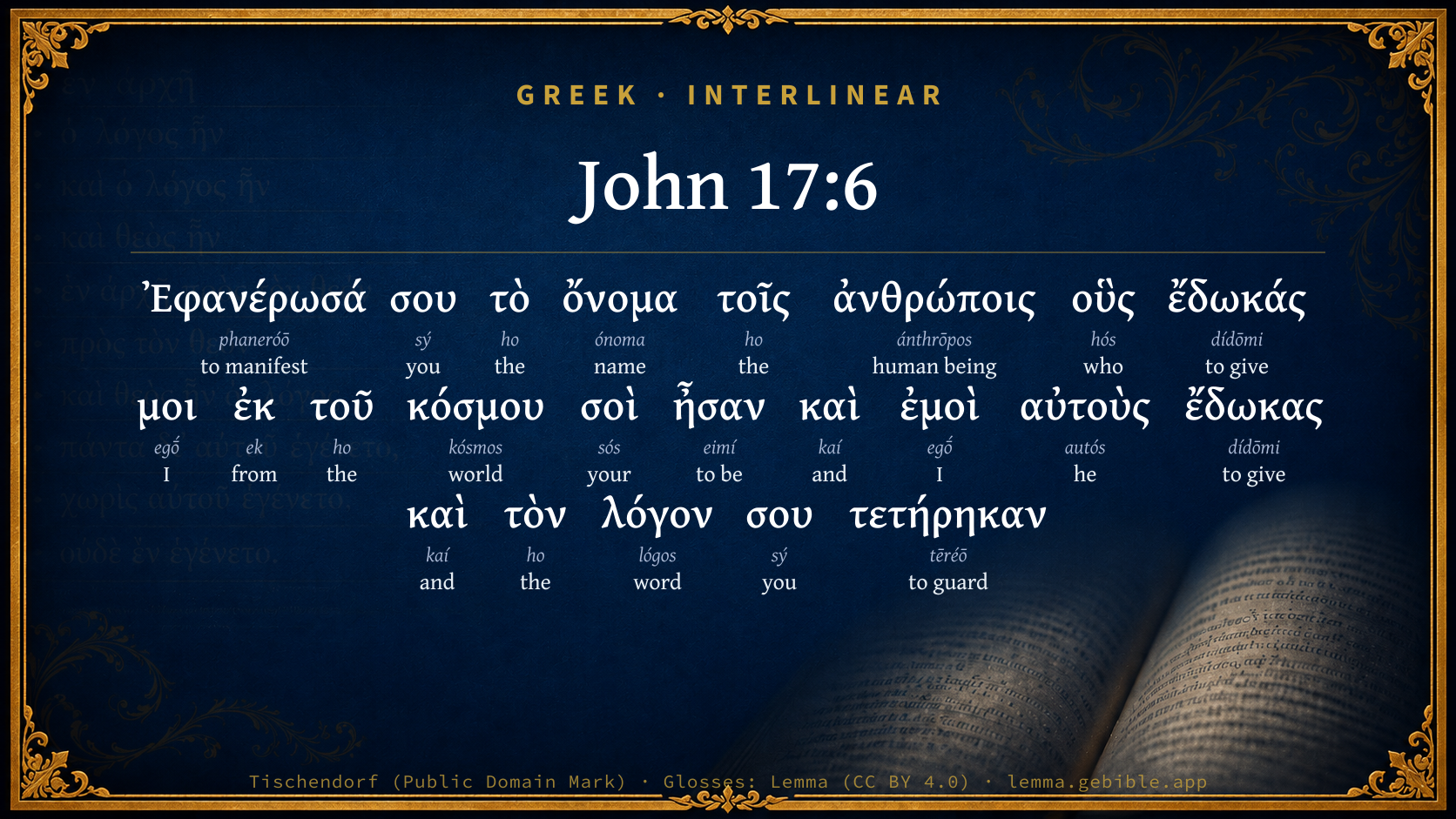
  1. Ἐφανέρωσά phaneróō G5319 “to manifest” Verb, Aorist, Active, Indicative, 1st person, Singular
  2. σου sý G4771 “you” Personal pronoun, 2nd person, Genitive, Singular
  3. τὸ ho G3588 “the” Article, Accusative, Singular, Neuter
  4. ὄνομα ónoma G3686 “name” Noun, Accusative, Singular, Neuter
  5. τοῖς ho G3588 “the” Article, Dative, Plural, Masculine
  6. ἀνθρώποις ánthrōpos G444 “human being” Noun, Dative, Plural, Masculine
  7. οὓς hós G3739 “who” Relative pronoun, Accusative, Plural, Masculine
  8. ἔδωκάς dídōmi G1325 “to give” Verb, Aorist, Active, Indicative, 2nd person, Singular
  9. μοι egṓ G1473 “I” Personal pronoun, 1st person, Dative, Singular
  10. ἐκ ek G1537 “from” Preposition
  11. τοῦ ho G3588 “the” Article, Genitive, Singular, Masculine
  12. κόσμου kósmos G2889 “world” Noun, Genitive, Singular, Masculine
  13. ἦσαν eimí G1510 “to be” Verb, Imperfect, Active, Indicative, 3rd person, Plural
  14. καὶ kaí G2532 “and” Conjunction
  15. ἐμοὶ egṓ G1473 “I” Personal pronoun, 1st person, Dative, Singular
  16. αὐτοὺς autós G846 “he” Personal pronoun, Accusative, Plural, Masculine
  17. ἔδωκας dídōmi G1325 “to give” Verb, Aorist, Active, Indicative, 2nd person, Singular
  18. καὶ kaí G2532 “and” Conjunction
  19. τὸν ho G3588 “the” Article, Accusative, Singular, Masculine
  20. λόγον lógos G3056 “word” Noun, Accusative, Singular, Masculine
  21. σου sý G4771 “you” Personal pronoun, 2nd person, Genitive, Singular
  22. τετήρηκαν tēréō G5083 “to guard” Verb, Perfect, Active, Indicative, 3rd person, Plural

About this verse

These counts appear in no published source. They are computed here, from the morphology-tagged text and Lemma’s own curated glosses. What Lemma adds →

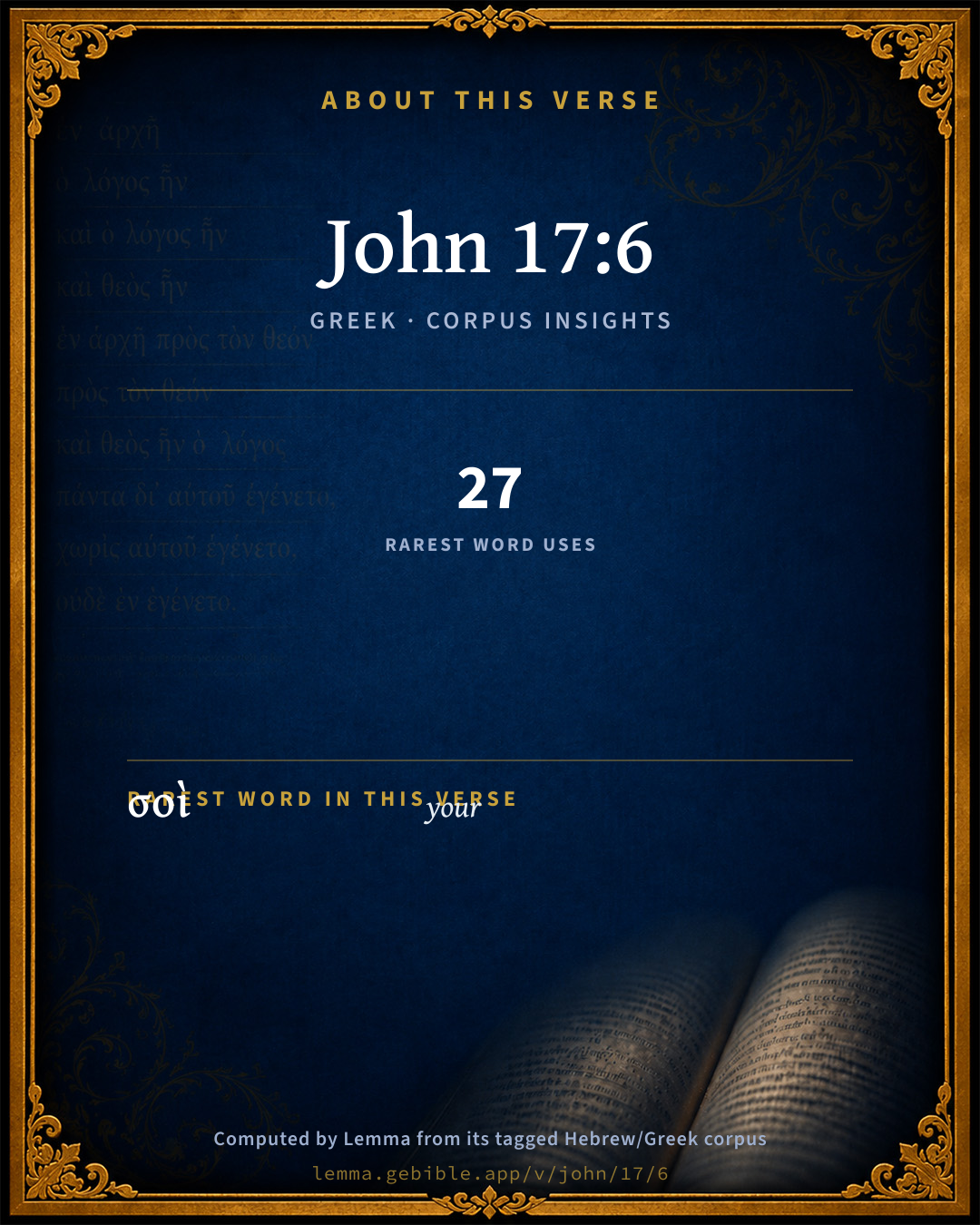
23
words
16
distinct lemmas
Gospels
section

Shared distinctive vocabulary

σοὶ your G4674 occurs in 24 verses of the Greek New Testament. Also found in:
Repetition

Words recur within this verse:

Cross-references

43

Topical passages linked to John 17:6 in the Treasury of Scripture Knowledge — connected by theme and wording, ordered by reader-vote popularity; previews shown in the World English Bible.

  • John 17:26 I made known to them your name, and will make it known; that the love with which you loved me may be in them, and I in them."
  • John 14:21–24 One who has my commandments, and keeps them, that person is one who loves me. One who loves me will be loved by my Father, and I will love him, and will reveal myself to him."
  • 1 John 5:20 We know that the Son of God has come, and has given us an understanding, that we know him who is true, and we are in him who is true, in his Son Jesus Christ. This is the true God, and eternal life.
  • John 10:27–29 My sheep hear my voice, and I know them, and they follow me.
  • John 17:24 Father, I desire that they also whom you have given me be with me where I am, that they may see my glory, which you have given me, for you loved me before the foundation of the world.
  • John 6:37 All those who the Father gives me will come to me. Him who comes to me I will in no way throw out.
  • Exodus 34:5–7 Yahweh descended in the cloud, and stood with him there, and proclaimed the name of Yahweh.
  • John 17:2 even as you gave him authority over all flesh, he will give eternal life to all whom you have given him.
  • Exodus 3:13–15 Moses said to God, "Behold, when I come to the children of Israel, and tell them, 'The God of your fathers has sent me to you;' and they ask me, 'What is his name?' What should I tell them?"
  • John 15:19 If you were of the world, the world would love its own. But because you are not of the world, since I chose you out of the world, therefore the world hates you.
  • Matthew 11:25–27 At that time, Jesus answered, "I thank you, Father, Lord of heaven and earth, that you hid these things from the wise and understanding, and revealed them to infants.
  • 2 Corinthians 4:6 seeing it is God who said, "Light will shine out of darkness," who has shone in our hearts, to give the light of the knowledge of the glory of God in the face of Jesus Christ.
  • Ephesians 1:4–11 even as he chose us in him before the foundation of the world, that we would be holy and without blemish before him in love;
  • 2 Thessalonians 2:13–14 But we are bound to always give thanks to God for you, brothers loved by the Lord, because God chose you from the beginning for salvation through sanctification of the Spirit and belief in the truth;
  • Exodus 9:16 but indeed for this cause I have made you stand: to show you my power, and that my name may be declared throughout all the earth;
  • Psalms 22:22 I will declare your name to my brothers. In the midst of the assembly, I will praise you.
  • Psalms 119:11 I have hidden your word in my heart, That I might not sin against you.
  • Proverbs 3:1–4 My son, don't forget my teaching; But let your heart keep my commandments:
  • Luke 10:21–22 In that same hour Jesus rejoiced in the Holy Spirit, and said, "I thank you, O Father, Lord of heaven and earth, that you have hidden these things from the wise and understanding, and revealed them to little children. Yes, Father, for so it was well-pleasing in your sight."
  • John 15:7 If you remain in me, and my words remain in you, you will ask whatever you desire, and it will be done for you.
  • Hebrews 3:6 but Christ is faithful as a Son over his house; whose house we are, if we hold fast our confidence and the glorying of our hope firm to the end.
  • Revelation 3:8 "I know your works (behold, I have set before you an open door, which no one can shut), that you have a little power, and kept my word, and didn't deny my name.
  • Psalms 71:17–19 God, you have taught me from my youth. Until now, I have declared your wondrous works.
  • Proverbs 2:1–5 My son, if you will receive my words, And store up my commandments within you;
  • Proverbs 2:10 For wisdom will enter into your heart. Knowledge will be pleasant to your soul.
  • Proverbs 23:23 Buy the truth, and don't sell it: Get wisdom, discipline, and understanding.
  • John 1:18 No one has seen God at any time. The one and only Son, who is in the bosom of the Father, he has declared him.
  • John 6:39 This is the will of my Father who sent me, that of all he has given to me I should lose nothing, but should raise him up at the last day.
  • John 8:31–32 Jesus therefore said to those Jews who had believed him, "If you remain in my word, then you are truly my disciples.
  • John 12:28 Father, glorify your name!" Then there came a voice out of the sky, saying, "I have both glorified it, and will glorify it again."
  • John 15:3 You are already pruned clean because of the word which I have spoken to you.
  • John 17:9–11 I pray for them. I don't pray for the world, but for those whom you have given me, for they are yours.
  • John 17:14 I have given them your word. The world hated them, because they are not of the world, even as I am not of the world.
  • John 17:16 They are not of the world even as I am not of the world.
  • John 18:9 that the word might be fulfilled which he spoke, "Of those whom you have given me, I have lost none."
  • Acts 13:48 As the Gentiles heard this, they were glad, and glorified the word of God. As many as were appointed to eternal life believed.
  • Romans 8:28–30 We know that all things work together for good for those who love God, to those who are called according to his purpose.
  • Romans 11:2 God didn't reject his people, which he foreknew. Or don't you know what the Scripture says about Elijah? How he pleads with God against Israel:
  • Colossians 3:16 Let the word of Christ dwell in you richly; in all wisdom teaching and admonishing one another with psalms, hymns, and spiritual songs, singing with grace in your heart to the Lord.
  • 2 Timothy 1:13 Hold the pattern of sound words which you have heard from me, in faith and love which is in Christ Jesus.
  • Hebrews 2:12 saying, "I will declare your name to my brothers. In the midst of the congregation I will sing your praise."
  • Revelation 2:13 "I know your works and where you dwell, where Satan's throne is. You hold firmly to my name, and didn't deny my faith in the days of Antipas my witness, my faithful one, who was killed among you, where Satan dwells.
  • 1 Peter 1:1 Peter, an apostle of Jesus Christ, to the chosen ones who are living as strangers in the Dispersion in Pontus, Galatia, Cappadocia, Asia, and Bithynia,

Cross-references courtesy of OpenBible.info (CC BY 4.0).

Commentary

Notes on John 17:6 from classic Christian and Jewish commentators (each source and its license shown beneath its notes). The classic Christian expositions comment on the surrounding passage and are grouped to its opening verse, so a note may address several verses; the Jewish commentaries on the Tanakh (Rashi and others) are per-verse, so they appear only where the commentator wrote on this verse.

Lemma curates 59 commentaries, every one of them public domain or Creative Commons licensed, each selected and text-cleaned for this edition rather than reprinted as found. About our sources →

Matthew Henry's Commentary

Christ, having prayed for himself, comes next to pray for those that are his, and he knew them by name, though he did not here name them. Now observe here,

I. Whom he did not pray for (Joh 17:9): I pray not for the world. Note, There is a world of people that Jesus Christ did not pray for. It is not meant of the world of mankind general (he prays for that here, Joh 17:21, That the world may believe that thou hast sent me); nor is it meant of the Gentiles, in distinction from the Jews; but the world is here opposed to the elect, who are given to Christ out of the world. Take the world for a heap of unwinnowed corn in the floor, and God loves it, Christ prays for it, and dies for it, for a blessing is in it; but, the Lord perfectly knowing those that are his, he eyes particularly those that were given him out of the world, extracts them; and then take the world for the remaining heap of rejected, worthless chaff, and Christ neither prays for it, nor dies for it, but abandons it, and the wind drives it away. These are called the world, because they are governed by the spirit of this world, and have their portion in it; for these Christ does not pray; not but that there are some things which he intercedes with God for on their behalf, as the dresser for the reprieve of the barren tree; but he does not pray for them in this prayer, that have not part nor lot in the blessings here prayed for. He does not say, I pray against the world, as Elias made intercession against Israel; but, I pray not for them, I pass them by, and leave them to themselves; they are not written in the Lamb's book of life, and therefore not in the breast-plate of the great high-priest. And miserable is the condition of such, as it was of those whom the prophet was forbidden to pray for, and more so, Jer 7:16. We that know not who are chosen, and who are passed by, must pray for all men, Ti1 2:1, Ti1 2:4. While there is life, there is hope, and room for prayer. See Sa1 12:23.

II. Whom he did pray for; not for angels, but for the children of men. 1. He prays for those that were given him, meaning primarily the disciples that had attended him in this regeneration; but it is doubtless to be extended further, to all who come under the same character, who receive and believe the words of Christ, Joh 17:6, Joh 17:8. 2. He prays for all that should believe on him (Joh 17:20), and it is not only the petitions that follow, but those also which went before, that must be construed to extend to all believers, in every place and every age; for he has a concern for them all, and calls things that are not as though they were.

III. What encouragement he had to pray for them, and what are the general pleas with which he introduces his petitions for them, and recommends them to his Father's favour; they are five: -

1. The charge he had received concerning them: Thine they were, and thou gavest them me (Joh 17:6), and again (Joh 17:9), Thou whom thou hast given me. "Father, those I am now praying for are such as thou hast entrusted me with, and what I have to say for them is in pursuance of the charge I have received concerning them." Now,

(1.) This is meant primarily of the disciples that then were, who were given to Christ as his pupils to be educated by him while he was on earth, and his agents to be employed for him when he went to heaven. They were given him to be the learners of his doctrine, the witnesses of his life and miracles, and the monuments of his grace and favour, in order to their being the publishers of his gospel and the planters of his church. When they left all to follow him, this was the secret spring of that strange resolution: they were given to him, else they had not given themselves to him. Note, The apostleship and ministry, which are Christ's gift to the church, were first the Father's gift to Jesus Christ. As under the law the Levites were given to Aaron (Num 3:9), to him (the great high priest of our profession) the Father gave the apostles first, and ministers in every age, to keep his charge, and the charge of the whole congregation, and to do the service of the tabernacle. See Eph 4:8, Eph 4:11; Psa 68:18. Christ received this gift for men, that he might give it to men. As this puts a great honour upon the ministry of the gospel, and magnifies that office, which is so much vilified; so it lays a mighty obligation upon the ministers of the gospel to devote themselves entirely to Christ's service, as being given to him,

(2.) But it is designed to extend to all the elect, for they are elsewhere said to be given to Christ (Joh 6:37, Joh 6:39), and he often laid a stress upon this, that those he was to save were given to him as his charge; to his care they were committed, from his hand they were expected, and concerning them he received commandments. He here shows,

[1.] That the Father had authority to give them: Thine they were. He did not give that which was none of his own, but covenanted that he had a good title. The elect, whom the Father gave to Christ, were his own in three ways: - First, they were creatures, and their lives and beings were derived from him. When they were given to Christ to be vessels of honour, they were in his hand, as clay in the hand of the potter, to be disposed of as God's wisdom saw most for God's glory. Secondly, They were criminals, and their lives and beings were forfeited to him. It was a remnant of fallen mankind that was given to Christ to be redeemed, that might have been made sacrifices to justice when they were pitched upon to be the monuments of mercy; might justly have been delivered to the tormentors when they were delivered to the Saviour. Thirdly, They were chosen, and their lives and beings were designed, for him; they were set apart for God, and were consigned to Christ as his agent. This he insists upon again (Joh 17:7): All things whatsoever thou hast given me are of thee, which, though it may take in all that appertained to his office as Mediator, yet seems especially to be meant of those that were given him. "They are of thee, their being is of thee as the God of nature, their well-being is of thee as the God of grace; they are all of thee, and therefore, Father, I bring them all to thee, that they may be all for thee."

[2.] That he did accordingly give them to the Son. Thou gavest them to me, as sheep to the shepherd, to be kept; as patients to the physician, to be cured; children to a tutor, to be educated; thus he will deliver up his charge (Heb 2:13), The children thou hast given me. They were delivered to Christ, First, That the election of grace might not be frustrated, that not one, no not of the little ones, might perish. That great concern must be lodged in some one good hand, able to give sufficient security, that the purpose of God according to election might stand. Secondly, That the undertaking of Christ might not be fruitless; they were given to him as his seed, in whom he should see of the travail of his soul and be satisfied (Isa 53:10, Isa 53:11), and might not spend his strength, and shed his blood, for nought, and in vain, Isa 49:4. We may plead, as Christ does, "Lord, keep my graces, keep my comforts, for thine they were, and thou gavest them to me."

2. The care he had taken of them to teach them (Joh 17:6): I have manifested thy name to them. I have given to them the words which thou gavest to me, Joh 17:8. Observe here,

(1.) The great design of Christ's doctrine, which was to manifest God's name, to declare him (Joh 1:18), to instruct the ignorant, and rectify the mistakes of a dark and foolish world concerning God, that he might be better loved and worshipped.

(2.) His faithful discharge of this undertaking: I have done it. His fidelity appears, [1.] In the truth of the doctrine. It agreed exactly with the instructions he received from his Father. He gave not only the things, but the very words, that were given him. Ministers, in wording their message, must have an eye to the words which the Holy Ghost teaches. [2.] In the tendency of his doctrine, which was to manifest God's name. He did not seek himself, but, in all he did and said, aimed to magnify his Father. Note, First, It is Christ's prerogative to manifest God's name to the souls of the children of men. No man knows the Father, but he to whom the Son will reveal him, Mat 11:27. He only has acquaintance with the Father, and so is able to open the truth; and he only has access to the spirits of men, and so is able to open the understanding. Ministers may publish the name of the Lord (as Moses, Deu 32:3), but Christ only can manifest that name. By the word of Christ God is revealed to us; by the Spirit of Christ God is revealed in us. Ministers may speak the words of God to us, but Christ can give us his words, can put them in us, as food, as treasure. Secondly, Sooner or later, Christ will manifest God's name to all that were given him, and will give them his word, to be the seed of their new birth, the support of their spiritual life, and the earnest of their everlasting bliss.

3. The good effect of the care he had taken of them, and the pains he had taken with them, (Joh 17:6): They have kept they word (Joh 17:7), they have known that all things are of thee (Joh 17:8); they have received thy words, and embraced them, have given their assent and consent to them, and have known surely that I came out from thee, and have believed that thou didst send me. Observe here,

(1.) What success the doctrine of Christ had among those that were given to him, in several particulars: -

[1.] "They have received the words which I gave them, as the ground receives the seed, and the earth drinks in the rain." They attended to the words of Christ, apprehended in some measure the meaning of them, and were affected with them: they received the impression of them. The word was to them an ingrafted word.

[2.] "They have kept thy word, have continued in it; they have conformed to it." Christ's commandment is then only kept when it is obeyed. Those that have to teach others the commands of Christ ought to be themselves observant of them. It was requisite that these should keep what was committed to them, for it was to be transmitted by them to every place for every age.

[3.] "They have understood the word, and have been sensible on what ground they went in receiving and keeping it. They have been aware that thou art the original author of that holy religion which I am come to institute, that all things whatsoever thou hast given me are of thee." All Christ's offices and powers, all the gifts of the Spirit, all his graces and comforts, which God gave without measure to him, were all from God, contrived by his wisdom, appointed by his will, and designed by his grace, for his own glory in man's salvation. Note, It is a great satisfaction to us, in our reliance upon Christ, that he, and all he is and has, all he said and did, all he is doing and will do, are of God, Co1 1:30. We may therefore venture our souls upon Christ's mediation, for it has a good bottom. If the righteousness be of God's appointing, we shall be justified; if the grace be of his dispensing, we shall be sanctified.

[4.] They have set their seal to it: They have known surely that I came out from God, Joh 17:8. See here, First, What it is to believe; it is to know surely, to know that it is so of a truth. The disciples were very weak and defective in knowledge; yet Christ, who knew them better than they knew themselves, passes his word for them that they did believe. Note, We may know surely that which we neither do nor can know fully; may know the certainty of the things which are not seen, though we cannot particularly describe the nature of them. We walk by faith, which knows surely, not yet by sight, which knows clearly. Secondly, What it is we are to believe: that Jesus Christ came out from God, as he is the Son of God, in his person the image of the invisible God, and that God did not send him; that in his undertaking he is the ambassador of the eternal king: so that the Christian religion stands upon the same footing, and is of equal authority, with natural religion; and therefore all the doctrines of Christ are to be received as divine truths, all his commands obeyed as divine laws, and all his promises depended upon as divine securities.

(2.) How Jesus Christ here speaks of this: he enlarges upon it, [1.] As pleased with it himself. Though the many instances of his disciples' dulness and weakness had grieved him, yet their constant adherence to him, their gradual improvements, and their great attainments at last, were his joy. Christ is a Master that delights in the proficiency of his scholars. He accepts the sincerity of their faith, and graciously passes by the infirmity of it. See how willing he is to make the best of us, and to say the best of us, thereby encouraging our faith in him, and teaching us charity to one another, [2.] As pleading it with the Father. He is praying for those that were given to him; and he pleads that they had given themselves to him. Note, The due improvement of grace received is a good plea, according to the tenour of the new covenant, for further grace; for so runs the promise. To him that hath shall be given. Those that keep Christ's word, and believe on him, let Christ alone to commend them, and, which is more, to recommend them to his Father.

4. He pleads the Father's own interest in them (Joh 17:9): I pray for them, for they are thine; and this by virtue of a joint and mutual interest, which he and the Father have in what pertained to each: All mine are thine, and thine are mine. Between the Father and Son there can be no dispute (as there is among the children of men) about meum and tuum - mine and thine, for the matter was settled from eternity; all mine are thine, and thine are mine. Here is,

(1.) The plea particularly urged for his disciples: They are thine. The consigning of the elect to Christ was so far from making them less the Father's that it was in order to making them the more so. Note, [1.] All that receive Christ's word, and believe in him, are taken into covenant-relation to the Father, and are looked upon as his; Christ presents them to him, and they, through Christ, present themselves to him. Christ has redeemed us, not to himself only, but to God, by his blood, Rev 5:9, Rev 5:10. They are first-fruits unto God, Rev 14:4. [2.] This is a good plea in prayer, Christ here pleads it, They are thine; we may plead it for ourselves, I am thine, save me; and for others (as Moses, Exo 32:11), "They are thy people. They are thine; wilt thou not provide for thine own? Wilt thou not secure them, that they may not be run down by the devil and the world? Wilt thou not secure thy interest in them, that they may not depart from thee? They are thine, own them as thine."

(2.) The foundation on which this plea is grounded: All mine are thine, and thine are mine. This bespeaks the Father and Son to be, [1.] One in essence. Every creature must say to God, All mine are thine; but none can say to him, All thine are mine, but he that is the same in substance with him and equal in power and glory. [2.] One in interest; no separate or divided interests between them. First, What the Father has as Creator is delivered over to the Son, to be used and disposed of in subserviency to his great undertaking. All things are delivered to him (Mat 11:27); the grant is so general that nothing is excepted but he that did put all things under him. Secondly, What the Son has as Redeemer is designed for the Father, and his kingdom shall shortly be delivered up to him. All the benefits of redemption, purchased by the Son, are intended for the Father's praise, and in his glory all the lines of his undertaking centre: All mine are thine. The Son owns none for his that are not devoted to the service of the Father; nor will any thing be accepted as a piece of service to the Christian religion which clashes with the dictates and laws of natural religion. In a limited sense, every true believer may say, All thine are mine; if God be ours in covenant, all he is and has is so far ours that it shall be engaged for our good; and in an unlimited sense every true believer does say, Lord, all mine are thine; all laid at his feet, to be serviceable to him. And what we have may be comfortably committed to God's care and blessing when it is cheerfuly submitted to his government and disposal: "Lord, take care of what I have, for it is all thine."

5. He pleads his own concern in them: I am glorified in them - dedoxasmai. (1.) I have been glorified in them. What little honour Christ had in this world was among his disciples; he had been glorified by their attendance on him and obedience to him, their preaching and working miracles in his name; and therefore I pray for them. Note, Those shall have an interest in Christ's intercession in and by whom he is glorified. (2.) "I am to be glorified in them when I am gone to heaven; they are to bear up my name." The apostles preached and wrought miracles in Christ's name; the Spirit in them glorified Christ (Joh 16:14): "I am glorified in them, and therefore," [1.] "I concern myself for them." What little interest Christ has in this degenerate world lies in his church; and therefore it and all its affairs lie near his heart, within the veil. [2.] "Therefore I commit them to the Father, who has engaged to glorify the Son, and, upon this account, will have a gracious eye to those in whom he is glorified." That in which God and Christ are glorified may, with humble confidence, be committed to God's special care.

Matthew Henry's Commentary on the Whole Bible (1708–1710) — public domain (CC PDM 1.0). Text via the HelloAO Bible API.

Adam Clarke's Commentary

II. Our Lord's prayer for his disciples, John 17:6-19.

Verse 6. I have manifested thy name] εφανερωσα, I have brought it into light, and caused it to shine in itself, and to illuminate others. A little of the Divine nature was known by the works of creation; a little more was known by the Mosaic revelation: but the full manifestation of God, his nature, and his attributes, came only through the revelation of Christ.

The men which thou gavest me] That is, the apostles, who, having received this knowledge from Christ, were, by their preaching and writings, to spread it through the whole world.

Out of the world] From among the Jewish people; for in this sense is the word κοσμος to be understood in various parts of our Lord's last discourses.

Thine they were] Objects of thy choice; and thou gavest them to me from among this very unbelieving people, that they might be my disciples and the heralds of my salvation.

And they have kept thy word.] Though their countrymen have rejected it; and they have received me as thy well beloved Son in whom thou delightest.

Adam Clarke's Commentary on the Bible (1810–1826) — public domain. Text from a community e-Sword/MySword module.

Ellicott's Commentary for English Readers

(6) I have manifested (better, I manifested) thy name unto the men which thou gavest me (better, Thou hast given Me) out of the world.—This manifestation of the name of God is the making Him known as the only true God, and the glorifying Him on earth of Joh_17:3-4. For the special form in which the thought is expressed (“Thy name”), comp. Note on Mat_6:9.

He thinks of the disciples as a body separated from the world (comp. Note on Joh_15:19), and as given to Him by the Father. (Comp. Note on Joh_6:37.)

Thine they were, and thou gavest (better, hast given) them me.—The meaning of these words is that they were morally prepared by the earlier manifestation of God for the fuller manifestation in Christ. They were God’s in more than name, and therefore when Christ was revealed to them, they recognised Him of whom Moses and the prophets did speak. (Comp. Joh_1:37 et seq., and especially Notes on Joh_5:46; Joh_6:37; Joh_8:47.)

And they have kept thy word.—Comp. Notes on Joh_8:51; Joh_14:23. He says here, “Thy word,” not “My word,” because the thought of these verses (Joh_17:6-8) is that they were originally and were still the Father’s. They had been given to the Son, but this was only the completion of the revelation of the Father to them. Christ’s word was that of the Father who sent Him. (Comp. Notes on Joh_7:16; Joh_12:48-49.)

A Bible Commentary for English Readers, edited by Charles John Ellicott (1878–1897) — public domain. Text from a community e-Sword module.

The Biblical Illustrator

Joseph S. Exell

Joh_17:6-8

I have manifested Thy Name unto the men which Thou gavest Me.

Christs work upon earth

I. ITS NATURE. The manifestation of the name of God. (Joh_17:6). In Himself invisible and incomprehensible (Joh_1:18; Joh_6:46; Job_11:7; Job_37:23; 1Ti_6:16), who and what He was must have remained a secret. Gen_32:29; Jdg_13:18), had not God been pleased to make some disclosure thereof. This He did in creation (Psa_8:1; Psa_19:1-3; Rom_1:20), and still does in Providence (Dan_4:34-35; Rom_11:36; Eph_1:11). A further revelation He furnished to the Jews; but never till Christ came, who was the Image of the invisible Col_1:15; Heb_1:2); and who could say, He that hath seen Me hath seen the Father (Joh_14:9), was God completely manifested. Besides publishing to men the fact of the Divine existence, Christ unfolded

1. The nearness of God to man, and conversely mans nearness to God, a thought so little understood that even the Jews with Psa_139:1-24, to guide them had no proper conception of God as a heavenly Friend.

2. The holiness of God--which, though dimly apprehended and vaguely believed in before the Advent, was never adequately comprehended until embodied in Christ (Heb_7:26).

3. The graciousness of God, which though referred to (Psa_103:13; Mal_2:10) was imperfectly realized until Christ taught men to say Our Father.

4. The helpfulness of God. No one who looked on Christ healing the sick, pardoning the guilty, &c., could doubt that, if He was Gods image, God could also relieve the needy.

5. The blessedness of God or, more correctly, the eternal life which is in 1Jn_1:1).

II. ITS SUBJECTS.

1. The world. Although throughout this prayer a distinction is drawn between the world and the Church (Joh_17:6), and the Saviours intercession is for the latter rather than for the former (Joh_17:9), yet Christs manifestation of the Fathers name has an outlook to the race no less than to believers. Of this perhaps a hint is furnished by the word men (Joh_17:6).

2. The Church. Christ describes those in whom His work took effect as persons who had been

(1) Separated from the race (Joh_17:6), i.e., in their characters as believers, while the world remained in unbelief (Joh_17:25, Joh_7:7; 1Jn_5:19), separated by grace, which alone made them to differ (1Co_4:7; 1Co_15:10), and separated unto the purposes of the gospel (Rom_1:1; Gal_1:15).

(2) Owned by the Father--Thine they were--as His creatures Eze_18:4), as being born of God (Joh_1:13), and so inwardly disposed to hear and obey Gods voice (Joh_8:47; Joh_18:37).

3. Given to Christ--Thou gavest them Me, (Eph_1:4-5; Joh_6:45).

III. ITS RESULTS.

1. The reception of Christs words (Joh_17:8). This world had rejected Christs words (Joh_12:48): the disciples had believed them (Joh_16:27). A gracious soul desirous of learning the Fathers name does not begin by criticising Christs teaching, but with docility receives it into his understanding and heart (1Sa_3:9; Psa_85:8; 1Pe_2:2; Jam_1:22).

2. The recognition of Christs words as the Fathers (Joh_17:7; cf Joh_7:17; 1Th_2:13).

3. The preservation of the Fathers words (Joh_17:6). To keep Gods word means more than to remember it--viz., to enshrine it in the spirit, to give it a chief place in the affections, to subject to it the entire being, intellect, heart, conscience, will.

Lessons:

1. Who would know God must study Him as revealed in Christ.

2. Who would be wise unto salvation must learn at Christs feet.

3. Who would reach eternal glory must keep the Fathers words. (T. Whitelaw, D. D.)

The Divine instruction

We now come to the second part of this prayer, the intercessory portion of it. But before offering any special petition Christ states several preliminary pleas. These pleas are contained in the text. We have here

I. THE SCHOLARS. The Lords words regarding them express a threefold relationship.

1. To the world. The men whom Thou gavest Me out of the world. Originally these disciples, as they came into the world, belonged to it, with tastes, desires, and modes of thinking, &c, like the men around them. But they had been given out of the world to Christ, so that their position in it and their relationship to it were alike changed. So it is with all the people of God; they are given to Christ out of the world, to be taught and trained for service here and glory hereafter. But, alas I what a commentary does the conduct of myriads supply on these words, when the world seems to bound their ambition and contain their all.

2. To God Thine they were. They were His by the law of their original creation, by the ties of providential preservation and blessing, and by all the bonds of moral obligation.

3. To Christ. Thou gavest them Me. By giving them to the Son, the Father did not part with His property or His pleasure in them, for they were given to Christ in pursuance of a gracious purpose, and by the arrangements of an all-wise providence. This was the first small instalment of the promise that Jesus as mediatorial King should have the heathen given Him as His inheritance, &c.

II. THE INSTRUCTION GIVEN. This, generally, was the manifestation of the Divine name. The name of God is often put for God Himself (Pr Exo_34:5; Exo_34:7). How often in aspects of attraction and grace is the name of God put before men in His Word. There he presents Himself as Jehovah-jireh, ever ready to provide for the wants of His people; as Jehovah-nissi, ever willing to defend them and lead them to victory; as Jehovah-tsidkenu, working out and bringing near to them an all-sufficient righteousness for their salvation; as Jehovah-shammah, blessing with His presence every spot to which His providence may bring them. But it was Jesus who manifested the Divine name in all its fulness of glory How did He do it?

1. By what He was. He came to be the representative amongst men of the infinite God. He was the brightness of His glory, &c. Every element of the Divine glory had its perfect and practical embodiment in Him, so that in His personal history we have a living map of the boundless expanse of the Divine perfections reduced to the scale which our humanity can contemplate and study.

2. By what He said. (Joh_17:8). Every considerable human teacher has some theme or some aspect of a subject with which he is more especially familiar to which his own taste inclines him, and on which he loves chiefly to dilate Christ Jesus was master of all truth, but especially did He dwell on the glory and excellence of the Fathers character.

3. By that which He did. He went about doing good. As His words were not His own, but His Fathers, so also were His works (Joh_10:37; Joh_5:17).

III. THE ATTAINMENTS MADE BY THEM.

1. They accepted Christs words. They have received them. If His words commanded the attention and admiration of His foes, much more might be expected of His disciples; they devoutly received His words. Attention was not enough, nor admiration, nor mere assent: the words of Jesus dropped into the souls of these disciples as Divine seeds of thought, germs of higher life and hope.

2. They had some apprehension of the Divine glory of Christ--They have known, &c. They recognised

(1) The Divinity of His doctrine. They felt that His words were the truth of God; for they had in them the glow and glory of Divinity.

(2) The Divinity of His person: That I came out from Thee. He that could teach such truth about God, and do such works, and produce such impressions, must have come out from the Father (Joh_6:69).

(3) The Divinity of His mission--That Thou didst send Me. They mistook, indeed, for a long time its true nature and glorious design; but they recognized its Divinity. This apprehension of the glory of Christ is the highest attainment for men on earth, even as the contemplation of it will be the blessedness of heaven. To discover Christ and trust in Him is the triumph and turning-point of any human life here.

3. They clung to Christ; they maintained adherence to His truth. They have kept Thy Word. Continuance was essential as it is still. To keep Gods word was to obey it, walk in it, and abide by it. They were neither stony-ground hearers nor wayside hearers. Christ will not acknowledge any as His disciples who do not keep His word and endure unto the end. Heb_3:14) (J. Spence, D. D.)

The Lord Jesus manifested the Fathers name

1. By what He was. He was the representative of God upon the earth.

2. The Lord Jesus manifested the Fathers name by what He spake. In His teaching He set forth the Father in His nature and character.

3. By what He did, the Lord Jesus manifested His Fathers name. As His words were not His own but His Fathers, so His works were the Fathers also. (T. Alexander, M. A.)

The apostolic community

Christ here states two facts concerning the school He had established for the diffusion of His doctrines and Spirit--one infinitely superior to those established by any philosopher of ancient or modern times.

I. THEY ARE GIVEN TO HIM BY THE FATHER. What does this mean?

1. Negatively

(1) Not that a certain number were given Him in the councils of Eternity, on the ground that He would become their substitute, and the rest passed by. This covenant is not found in the Bible, and seems derogatory to the Father, who is Love.

(2) Not that men are so given to Christ as to interfere with their freedom as responsible beings. This would reduce men to mere animated machines.

(3) Not that men are so given to Christ as to lessen Gods claim upon them; nor

(4) So as to render their salvation absolutely certain. If that were the case why does Christ pray for them? And why was Judas, who also was given Him, lost?

2. Positively. This means that Christ, as the Model of Piety, ascribes everything He has to His Father. The power of Pilate to condemn He regarded as the gift of God. The cup of suffering in Gethsemane was also the Fathers gift. So with all things--All power is given unto Me. So pastors are Gods gift to a Church, &c.

II. THEY ARE BELIEVERS IN THE FATHER THROUGH HIM. They believed the Father so as

1. To obey His will. They have kept Thy word.

2. To accept Christ as His Messenger. They were led to regard Christ as

(1) The Administrator of the Fathers blessings.

(2) The Revealer of the Fathers character. (D. Thomas, D. D.)

Disciples, Gods gift to Christ

Thou gavest them Me

1. As sheep to the shepherd to be kept.

2. As patients to the physician to be cured.

3. As children to a tutor to be educated. (M. Henry.)

The Fathers gift to the Son

I. ALL BELIEVERS ARE GIVEN TO CHRIST. As

1. His purchase and His charge.

2. His subjects.

3. The members of His body.

II. NONE ARE GIVEN TO CHRIST BUT THOSE WHO WERE FIRST THE FATHERS.

III. ALL THOSE WHO ARE GIVEN TO CHRIST KEEP HIS WORD. (W. Burkitt.)

Believers, the Fathers gift to Christ

The Son loved them as the Fathers choice, He loved them as the Fathers gift to Him. These are some of the bonds of the everlasting covenant which binds His people around the heart of His Son. They were beloved of His Father with an everlasting love. His Father chose them and set His heart upon them. He gave them to the Son as a gift of His love. Therefore the Son loved them. There are other, and strong, cords that bind Christ and His people together, but these are good and strong. How we love, how highly we prize a Fathers gift! (T. Alexander, M. A.)

Christian privilege and duty

Note

I. THAT CHRISTIANS BELONG TO GOD. Thine they were.

1. By creative right--as a man has a right to the products of his skill and industry.

2. By sovereign right--as a monarch has a right to the loyalty of his subjects.

3. By Fatherly right--as a parent has a right to the affection and obedience of his children If, then, we belong to God

(1) We belong to One who is wise to guide us, strong to defend us, authoritative to govern us, kind and wealthy to supply all our need.

(2) How safe we are!

(3) How happy and grateful we should be!

II. THAT THEY HAVE BEEN GIVEN BY GOD TO CHRIST.

1. In answer to prayer. Ask of Me and I shall give thee, &c., and as we are given to, so are we kept by Christ in response to prayer (Joh_17:11).

2. As the purchase of redemption. We were not redeemed with corruptible things, &c.

3. As the reward of conflict. Slaves of Satan are rescued and transformed into sons of God and joint heirs with Christ by the Saviours conquering might. Learn, then

(1) How precious we are to Christ. What so precious as a fathers gift, a costly purchase, a trophy of fierce conflict?

(2) How honoured we are by God! No higher dignity could be conferred upon us than to be given to Christ.

(3) How imperative are Gods claims! These are not relinquished, but emphasized. All Mine are Thine.

III. THAT CHRIST HAS MANIFESTED TO THEM GODS NAME.

1. Literally. The Fathers name was little more than a sublime guess and a devout hope before Christ came. But He taught His disciples to say Our Father.

2. Exemplarily. My name is in Him. He that hath seen Me hath seen the Father. All the perfections of the Divine character were embodied in Christ. The Fathers wisdom in His teaching; the Fathers power in His miracles; the Fathers love and justice in His death.

3. Experimentally. To as many as received Him, &c. (Rom_8:15 - Gal_4:4-31. This being so

(1) Study the revelation of the Father in Christs word and life.

(2) Live up to your privilege as children of God.

IV. THAT THEY KEEP GODS WORD. This is their distinguishing characteristic and their imperative duty. It covers everything in Christian practice. He keeps this word

1. In their minds by understanding and remembering it.

2. In their hearts by loving it.

3. In their lives by practising it. (J. W. Burn.)

I have given them the words which Thou gavest Me

The fountain of Christian theology

On the truth of this saying stands the whole fabric of creeds and doctrines. It is the ground of authority to the preacher, of assurance to the believer, of existence to the Church. It is the source from which the perpetual stream of Christian teaching flows. All our testimonies, instructions, exhortations derive their first origin and continuous power from the fact that the Father has given to the Son, the Son has given to His servants, the words of truth and life. (Canon T. D. Bernard.)

The Biblical Illustrator, edited by Joseph S. Exell (c. 1880s–1900s) — public domain. Text from a community e-Sword module.

Joseph Benson's Commentary

Joh 17:6-8. I have manifested thy name — All thy attributes; and in particular thy paternal relation to believers; to the men which thou gavest me out of the world — The apostles; and so Joh 17:12. Thine they were — By creation, by preservation, by descent from Abraham, and by being members of thy church, under the Mosaic dispensation; and thou gavest them me — By giving them faith in what I have spoken; and they have kept thy word — Have readily embraced, and hitherto have resolutely adhered to and obeyed thy gospel. Now they have known that all things — Which I have done and spoken, are of thee, and consequently are right and true. They are fully persuaded, “that the commission whereby I act, the doctrine of salvation which I teach, the miracles which I perform, and the authority with which I am clothed, are all really derived from thee.” In this, indeed, they have acted upon the surest evidence; for I have given unto them the words which thou gavest me — I have taught them no other doctrine but that which thou gavest me to teach. And they have received them — Being fully sensible that my doctrine is in all points agreeable to thy blessed nature and perfections, they have received it as such; and have known surely that I came out from thee — That I am no impostor, but a prophet, truly commissioned by thee to reveal thy will to mankind. And — While I have been rejected by an ungrateful world, they have regarded me as the true Messiah; and have believed that thou didst send me — On the great errand of man’s salvation.

Joseph Benson's Commentary on the Old and New Testaments (1811–1818) — public domain. Text from a community e-Sword module.

Whedon's Commentary on the Bible

Daniel D. Whedon

Christ’s representation of, and petitions for, his apostles, Joh_17:6-19.

First, the Saviour represents his apostles before God in their past relations with himself, closing with a petition for their gracious preservation, 6-11. Second, he represents their relations of danger to the world, closing with a petition for divine keeping, 12-16. Third, opening with a petition, he represents their mission to the world, 16-19.

6. The men—Part of the human race, selected for the good of the race.

Thou gavest me—Words which represent the divine side of the apostolic selection. For, being so chosen, they were in capacity, purpose, and susceptibility the proper men. Wisely were they chosen of Christ; graciously were they given by God. God always selects the most suitable instruments at hand for his purposes.

They have kept—The human side of the apostolic action. God had been gracious to keep: men had been faithful and kept.

Daniel D. Whedon (gen. ed.), Commentary on the Old and New Testaments (1874–1909) — public domain. Text from a community e-Sword module.

Tyndale Open Study Notes

Tyndale Open Resources

17:6 This verse summarizes Christ’s mission. He revealed the true person of God to the world, gathered up God’s people into his flock, and instructed them in obedience. The result of this work is the church.

Tyndale Open Study Notes — © Tyndale Open Resources, licensed CC BY-SA 4.0. Text via the HelloAO Bible API.

Bengel's Gnomon

Johann Albrecht Bengel

Joh 17:6. Ἐφανέρωσα, I have manifested) in a new and unprecedented manner; ch. Joh 1:18, “No man hath seen God at any time, the only-begotten Son who is in the bosom of the Father, He hath declared Him.”—ὄνομα.) Thy name, viz., that of Father: Joh 17:11, “Holy Father, keep through Thine own name those,” etc.—οὕς, whom) The apostles are meant, as in Joh 17:12 [Before choosing whom, Jesus had made preparation with especial prayer, Luk 6:12, “He went out into a mountain to pray, and continued all night in prayer to God.” After those prayers of His were finished, the Father gave them to Him. And these wry persons constitute as it were the basis of the whole multitude of believers, even to the end of the world.—V. g.]—σοὶ) Thine, as in Joh 17:9-10, “all Mine are Thine.” They were Thine by the faith of the Old Testament.—ἐμοὶ) Thou hast given them to Me, that they may be New Testament believers.—τετηρήκασι, they have kept) This is an honourable testimony to them [To this word refer τήρησον, τηρήσῃς, keep, that Thou shouldest keep, Joh 17:11; Joh 17:15.—V. g.]

Bengel's Gnomon of the New Testament — English translation (T&T Clark, Edinburgh, 1860) — public domain. Text from a community e-Sword module.

Meyer's Critical & Exegetical Commentary

Heinrich August Wilhelm Meyer

Joh_17:6-8. Hitherto Jesus has prayed on behalf of Himself. But now He introduces His intercession on behalf of His disciples, which begins with Joh_17:9, by representing them as worthy of this intercession.

σου] With emphasis, as opposed to τοῖς ἀνθρώπ., in the deep feeling of the holiness and greatness of the task discharged.

What the name of God comprises in itself and expresses (see on Mat_6:9), was previously made known to the disciples only in so far as it brought with it its O. T. imagery; but the specific disclosures respecting God and His counsel of salvation resting in Christ, and His entire redemptive relation to men, which Christ had given them by virtue of his prophetic office (the Christian contents, therefore, of the divine name), entitled Him to pray; ἐφανέρωσά σου τ. ὄν., κ.τ.λ. Comp. Col_1:26-27. A reference to the Jewish practice of keeping secret the name of Jehovah (Hilgenfeld) lies entirely remote from the meaning.

οὓς δέδωκ. μοι ἐκ τ. κόσμου] Necessary definition of τοῖς ἀνθρώποις (hence not to be connected with σοὶ ἦσαν); whom Thou hast given to me out of the world (separated from out of the unbelieving, Joh_15:19), that is, the disciples (see Joh_17:8; Joh_17:11), as objects of the divine counsel of salvation God has given them through attracting them by His grace; see on Joh_6:37.

σοί] Possessive pronoun, as in Joh_17:9; they belonged to Thee, were Thine, per fidem V. T., Bengel. Comp. Joh_1:37; Joh_1:42; Joh_1:46; Joh_1:48, and generally Joh_8:47, Joh_6:37; Joh_6:44. Therefore not in the sense of predestination (Beza, Calvin), but of motive, from which God, to whom they indeed already inwardly belonged, has drawn them to Christ. God knows His own. The non-ethical interpretation of property generally (Cyril.: ἴδια γὰρ πάντα θεῷ), or, as Thy creatures (Hengstenberg), yields no special statement of reason.

καὶ τὸν λόγον σου τετηρ.] and with what result gavest Thou them to me! On τ. λόγον σου, comp. Joh_7:16, Joh_12:48-49, and on τετηρ., they have kept Thy word (by faith and deed), Joh_8:51, Joh_14:23.

νῦν ἔγνωκαν, κ.τ.λ.] Progress in the representation of this result, which is now advanced so far, that they have recognised (and do recognise, perfect) all that the Father has communicated to Christ as that which it is, as proceeding from God. All which Thou hast given to me points not merely to the doctrine (De Wette), but to the entire activity of Jesus (Luthardt), for which He has received from the Father a commission, direction, power, result, etc. Comp. Joh_17:4; Joh_12:49; Joh_5:36. A more definite limitation is arbitrary, because not demanded by what follows, which rather establishes the general expression (Joh_17:7) by means of the particular (τὰ ῥήματα).

Joh_17:8 gives the causative demonstration (ὅτι, for), how they attained to the knowledge of Joh_17:7,[190] namely, (1) on the part of Jesus, in that He communicated to them the words given Him by God, i.e. that which He, as Interpreter of God, had to announce (nothing else); and (2) on their part (αὐτοί), in that they have adopted this,[191] and have actually known it (Joh_7:26). Thus with them that ἔγνωσαν in Joh_17:7 has come to completion.

καὶ αὐτοί] is only to be separated by a comma from what precedes, and, further, is connected with ὍΤΙ. The ΚΑῚ ἘΠΊΣΤΕΥΣΑΝ, Κ.Τ.Λ., parallel to ἜΓΝΩΣΑΝ ἈΛΗΘῶς, Κ.Τ.Λ., adding faith to knowledge (see on Joh_6:69), and the above ἐξῆλθον (comp. on Joh_8:42), leading back to the Fatherly behest, whereby it is accomplished, completes the expression of the happy result attained in the case of the disciples. Note, further, the historical aorists ἔλαβ. and ἘΠΊΣΤ. in their difference of sense from the perfects.

[190] Ewald begins with ὅτι (because), a protasis, the apodosis of which (I therefore beg) follows in ver. 9, in such a manner, however, that from οὐ περὶ τοῦ κόσμου to ἔρχομαι, ver. 11, a parenthesis is introduced, and then first with πάτηρ ἅγιε comes the supplication conveyed by ἐρωτῶ. But this complicated arrangement is neither necessary nor appropriate to the clear and peaceful flow of the language of this prayer as it stands.

[191] i.e. They have not rejected the ῥήματα, but have allowed them to influence themselves. This is the necessary pre-condition of knowledge and of faith. Comp. Weiss, Lehrbegr. p. 28.

Meyer — Critical and Exegetical Commentary on the New Testament — English translation by Peter Christie, edited by Frederick Crombie (T&T Clark, 1880) — public domain. Text from a community e-Sword module.

Expositor's Greek Testament

ed. W. Robertson Nicoll

Joh 17:6-19 . Prayer for the disciples .

Joh 17:6 . Ἑφανέρωσὰ σου … κόσμου . Joh 17:4 is resumed and explained. “I have glorified Thee and finished my work by manifesting ,” etc. To manifest the name here means to make God known as the holy and loving Father. This had been accomplished by Christ not in the case of all, but of those whom the Father had given Him; cf. Joh 6:37-44 . Out of the world some were separated by the Father and allotted to Christ as His disciples. σοὶ ἦσαν , “Thine they were,” before they attached themselves to Jesus they already belonged to God in a special sense; as, e.g. , Nath. i. 48. Holtzmann. καὶ τὸν λόγον σου τετηρήκασι , “and they have kept Thy word,” the revelation of God which has come to them through various channels; in contrast to those mentioned in Joh 5:38 .

The Expositor's Greek Testament, edited by W. Robertson Nicoll (1897–1910) — public domain. Text from a community e-Sword module.

Godet's Commentaries

Frédéric Louis Godet

Vv. 6-19: Jesus asks for the support of His apostles in faith and their full consecration to the divine work.

It seems to me that it is altogether wrong for Weiss, with Lucke, de Wette, etc., to connect the passage, Joh 17:6-8, with what precedes, as developing the work of Christ on the earth, and as still intended to give a ground for the first petition: glorify me. The question henceforth is rather of what the disciples have become through the work of Christ, to the end of giving a ground for the prayer on their behalf (Joh 17:9). As it is with a view to the work of God that He asks His own glory again, it is also in view of this work that He commends to His Father the instruments whom He has chosen and prepared for the purpose of continuing it. This prayer has first an altogether general character: I pray for them, Joh 17:9; then it is given, with precision and in form, in two distinct petitions: τήρησον, keep them (Joh 17:11), and ἁγίασον, sanctify them (Joh 17:17), which are the counterpart of the δόξασόν με, glorify me, for Jesus Himself. Joh 17:6-8 prepare the way for the first general petition, for which Joh 17:9-10 will finally give the grounds.

ADDITIONAL NOTES BY THE AMERICAN EDITOR.

Vv. 6-19.

1. Joh 17:6-8 are connected both with the preceding and with the following context. In relation to the preceding verses, they indicate, by the presentation of the case of those in whom the work had been accomplished in the highest degree, and through whom, as the human instruments, it was to be carried forward in the time to come, the proof of what is stated in Joh 17:4. On the other hand, these verses evidently prepare the way for the petition of Joh 17:9, giving a reason why these persons, and not the world, are commended to the care of the Father. In these verses there is, in reality, a summing up of what has been presented in the entire record of this Gospel as connected with the reception of the Divine life:—(a) The persons in question are those who have the susceptibility to the truth,Thine they were and Thou gavest them to me; (b) Jesus has made known to them the Father’s name—the name, here as elsewhere, standing as the representative of all that is involved in the revelation of God through Christ; (c) This revelation comes through the word which Jesus has spoken to them; and they have kept it in their heart and life; (d) In receiving and keeping the word, they have recognized fully the great truth which it involved—namely, that the origin of Christ’s teachings and mission is from the Father. The work which had been given Him to do is thus fulfilled in their case.

2. Joh 17:9-13. The prayer is for the disciples, and not for the world. The explanation of the exclusion of the world here is, not that those who belong to the world are excluded from the prayers of Christ, but that this prayer is, like the discourses of the preceding chapters, a prayer of the departing one who is leaving his friends behind him. At such an hour, the prayer for enemies does not have its proper place. The petition is for the friends only, with reference to the state of separation from Jesus which was just before them.

3. The particle ὅτι of Joh 17:9 is to be connected with σοί εἰσιν and δεδόξασμαι, the words from the first καί to the second ἐμά of Joh 17:10 being parenthetical in their character. The ground of the prayer which is here presented is thus, in substance, what has been already mentioned—that they belong to the Father, and that Jesus has been glorified in them. In Joh 17:11 the additional reason, relating to the future, is given—that they were to remain in the world bereft of His care.

4. The petition for the disciples is set forth in two forms: first, in the more general way in Joh 17:11, keep them in thy name, and, secondly, more particularly in Joh 17:15; Joh 17:17 -in Joh 17:15 on the negative side, keep them from the evil, and in Joh 17:17 on the positive side,sanctify them in the truth.

5. The explanation of Joh 17:13 given by Meyer seems to be the correct one: “But now I come to thee, and since I can no longer guard them personally as hitherto, I speak this (this prayer for thy protection, Joh 17:11) in the world (‘jam ante discessum meum,’ Bengel), that they, as witnesses and objects of this my intercession, knowing themselves assured of thy protection, may bear my joy (as in Joh 15:11, not Joh 14:27) fulfilled in themselves.”

6. Joh 17:14-19. Joh 17:14 is to be regarded as introductory to Joh 17:15, as Joh 17:16 is to Joh 17:17. In both cases, the fact that the disciples are not of the world, as Jesus Himself is not of the world—and thus (Joh 17:14) that they are objects of the hatred and enmity of the world—is made the ground of the special petition. The turn of thought, therefore, from the more general to the more particular request is made, not at Joh 17:15, but at Joh 17:14.

7. The wordsτοῦ πονηροῦ of Joh 17:15 may be neuter, or they may be masculine. This is the only instance in which the expression is found in this Gospel, but in the First Epistle of John there are five cases which may be compared with the one in this verse. In 1Jn 2:13-14 the masculine form is beyond doubt, you have overcome the evil one, τὸν πονηρόν . In 1Jn 3:12 -Cain was ἐκ τοῦ πονηροῦ —the connection of the verse with those which precede, in which the devil is spoken of, makes it substantially certain that the words are masculine and refer to the evil one. In 1Jn 5:18 the reference to the evil one is certain, for the words are ὁ πονηρός, and in 1Jn 5:19, where the dative ἐν τῷ πονηρῷis used, the contrast of the two closely united sentences is such as to give an overwhelming probability in favor of the same reference. So far, therefore, as the usage of the writer can be determined from these passages, the argument derived from it is altogether in favor of the same explanation of the phrase in the verse before us. The same explanation is favored by the fact that John’s Gospel seems distinctly to present the idea of two spheres or kingdoms, each presided over by a ruler. The use of τηρεῖν ἐκ in Rev 3:10 may be regarded as justifying the use here, if τ. πον. is taken as masculine. Godet, who holds that this genitive with ἀπό and ῥύεσθαι in Mat 6:13 refers to the evil one, thinks that the preposition ἐκ is more naturally referred to a domain, from which one is taken, than to a personal enemy. Of the most rrecent commentators on this Gospel, Weiss, Keil, Westcott, Milligan and Moulton, like R. V., regard the words as masculine.

8. Joh 17:17 gives the positive form of the request: Sanctify them in the truth. The word ἁγίασον refers, as we may believe because of its connection with the idea of τηρήσης κ.τ.λ., and also with the words of Joh 17:18, to that consecration of the disciples with reference to their future work, which would be accomplished for them by their being made holy in the sphere of the Divine truth. “The prayer,” says Westcott, “is that the consecration which is represented by admission into the Christian society may be completely realized in fact; that every faculty, offered once for all, may in due course be effectually rendered to God (Rom 12:1).”

9. The last sentence of Joh 17:17, Thy word is truth, is best understood, with Godet, DeWette and others, as denoting the means by which the sanctifying process is to be accomplished, or rather (since the ἐν of the first part of the verse is not the instrumental preposition, as Godet takes it, but means in the sphere of) as giving a more definite statement of what is referred to in the words the truth. Thy word is truth, hence when I pray for these disciples, says Jesus, I pray for their consecration in the sphere of the truth.

10. Joh 17:18 gives the special reason for making the prayer a prayer for their consecration—namely, that they have a mission like to His own, and Joh 17:19 adds the declaration that to this end He also consecrates Himself in offering Himself to death. This fact: that He thus devotes and consecrates Himself, is also, like the words of Joh 17:18, a reason for urging His petition (Joh 17:17).

Vv. 6-8. “I have manifested thy name to the men whom thou hast given me out of the world; thine they were, and thou hast given them to me; and they have kept thy word. 7. Now they have known that all that thou hast given me is from thee. 8. For the words which thou hast given me I have given them; and they have received them, and they have known truly that I came forth from thee, and they have believed that thou didst send me.”

The general idea expressed in these words is that of the worth which the apostles have acquired by the ministry of Jesus among them and by the success of this work. Thus is the way prepared for the prayer by which Jesus is about to commend them to the care of the Father. And first, what Jesus has done for them. The aorist ἐφανέρωσα, I have manifested, is connected with the similar aorists in Joh 17:4. The most important portion of the work which Jesus felicitates Himself in having accomplished (Joh 17:4) was precisely the preparation and education of these eleven persons.

The name of God, which He has revealed to them, designates the divine character fully manifested to the consciousness of Jesus Himself, and through Him to the disciples in proportion as the consciousness of their Master has become their own (Mat 11:25-26). It is by revealing Himself as Son, that Jesus has revealed God to them as the Father. This is the reason why He must necessarily testify of Himself, as He does in the Fourth Gospel; it was an essential element of His teaching respecting God.

After having recalled His labor on their behalf, Jesus recalls to the Father what He has Himself done for them. The apostles were His, and He has given them to Jesus. The question here is not of what they were as men and as Jews, but of the relation which they sustained to God through their inward disposition, as faithful Jews; comp. the expressions: to be of God (Joh 7:17, Joh 8:47), to be of the truth (Joh 18:37), to do the truth (Joh 3:21). These expressions designate the moral state of the Israelites or heathen who adhere to the light of the law or of conscience. These beings who belong to God, God has led to Jesus by the inward drawing or teaching of which He has spoken in Joh 6:37; Joh 6:44-45; Joh 6:65. And He possesses them now as gifts of the Father.

Then, to what God and Jesus have done for the disciples, Jesus adds what the disciples have themselves done. This gift of themselves, once accomplished, they have faithfully maintained. Notwithstanding all the temptations to unfaithfulness which have assailed them during these years (Luk 22:28), they have kept in their heart the teaching of Jesus. They have preserved intact and pure from all alloy this name of God imprinted by Him upon their consciousness. The words “thy word,” instead of “my word,” are explained in Joh 17:7 : the word of Jesus has been only a reproduction of that of the Father. Finally, Jesus sets before the Father all that which the disciples have become through this communication which He has made to them of His Word. They have discerned its divine origin, and they have received it in this character. There is at the first glance a tautology in the two expressions: which thou hast given me, and: is thine. But the first is derived from the consciousness of Jesus; the second is borrowed from that of the apostles: “They have recognized that all which I gave them from thee came really from thee.” It is, that in fact (Joh 17:8.) Jesus never added anything to it from His own resources.

Then, from the recognition of the absolutely divine character of His word, they are raised finally to the faith in the divine origin of His person (I came forth) and His mission (thou hast sent me). In these words there breathes also the feeling of inward joy and lively recognition which Jesus has just experienced a few moments before: for it is very recently that this result for which He blesses the Father at this moment has been obtained (Joh 16:29-31). The harvest seems scanty, no doubt: eleven Galilean artisans after three years of labor! But this is enough for Jesus: for in these eleven He beholds the pledge of the continuance of the divine work on the earth.

There is an advance in the three verbs of these two verses: “They have known:” on the authority of their consciousness; “they have received:” by submission to this testimony; “they have believed:” by the surrender of their whole being to Him who thus manifested to them His divine character. The forms ἐγνωκαν, τετήρηκαν, are Alexandrian, and the question to be determined is, as in so many other similar cases, whether the apostles themselves used them or whether they were introduced by the Alexandrian copyists.

After having thus prepared the way for His petition, Jesus utters it, and ends by giving the ground of it:

Frédéric Louis Godet — Commentaries on Luke, John, Romans, and 1 Corinthians — English translation (T&T Clark, Edinburgh, 1870s–1890s) — public domain. Text from a community e-Sword module.

Geneva Bible (1599)

Geneva Bible translators

He showeth hereby that everlasting election and choice, which was hidden in the good will and pleasure of God, which is the groundwork of our salvation.

He showeth how the everlasting and hidden purpose of God is declared in Christ, by whom we are justified and sanctified, if we lay hold of him by faith, that at length we may come to the glory of the election.

First of all he prayeth for those his disciples, by whom he would have the rest to be gathered together, commendeth them unto the Father, (having once rejected the whole company of the reprobate) because he received them of him into his custody, and for that they embracing his doctrine, shall have so many and so mighty enemies, that there is no way for them to be in safety, but by his help only.

Geneva Bible (1599) marginal notes — public domain. Text via Bolls.life.

Jamieson, Fausset & Brown

Robert Jamieson, A. R. Fausset & David Brown

From praying for Himself He now comes to pray for His disciples.

I have manifested--I manifested.

thy name--His whole character towards mankind.

to the men thou gavest me out of the world--(See on Joh 6:37-40).

Jamieson, Fausset & Brown — Commentary Critical and Explanatory on the Whole Bible (1871) — public domain (CC PDM 1.0). Text via the HelloAO Bible API.

John Calvin's Commentaries

6. I have manifested thy name. Here Christ begins to pray to the Father for his disciples, and, with the same warmth of love with which he was immediately to suffer death for them, he now pleads for their salvation. The first argument which he employs on their behalf is, that they have embraced the doctrine which makes men actually children of God. There was no want of faith or diligence on the part of Christ, to call all men to God, but among the elect only was his labor profitable and efficacious. His preaching, which manifested the name of God, was common to all, and he never ceased to maintain the glory of it even among the obstinate. Why then does he say that it was only to a small number of persons that he manifested the name of his Father, but because the elect alone profit by the grace of the Spirit, who teaches inwardly? Let us therefore infer that not all to whom the doctrine is exhibited are truly and efficaciously taught, but only those whose minds are enlightened. Christ ascribes the cause to the election of God; for he assigns no other difference as the reason why he manifested the name of the Father to some, passing by others, but because they were given to him. Hence it follows their faith flows from the outward predestination of God, and that therefore it is not given indiscriminately to all, because all do not belong to Christ.

Thine they were, and thou hast given them to me. By adding these words, he points out, first, the eternity of election; and, secondly, the manner in which we ought to consider it. Christ declares that the elect always belonged to God. God therefore distinguishes them from the reprobate, not by faith, or by any merit, but by pure grace; for, while they are alienated from him to the utmost, still he reckons them as his own in his secret purpose. The certainty of that election by free grace lies in this, that he commits to the guardianship of his son all whom he has elected, that they may not perish; and this is the point to which we should turn our eyes, that we may be fully certain that we belong to the rank of the children of God; for the predestination of God is in itself hidden, but it is manifested to us in Christ alone.

And they have kept thy word. This is the third step; for the first is, the election by free grace, and the second is, that gift by which we enter into the guardianship of Christ. Having been received by Christ, we are gathered by faith into the fold. The word of God flows out to the reprobate, but it takes root in the elect, and hence they are said to keep it.

John Calvin's Commentaries (1540-1563) — public domain. Text from the Calvin Translation Society English edition (1840s-50s) via the Christian Classics Ethereal Library (ccel.org). Calvin's coverage is partial (roughly two-thirds of the Bible); uncommented books and verses are honest gaps, never fabricated. The 19th-century editor's footnotes and remarks are omitted so the notes are faithfully Calvin's own voice.

The Cambridge Bible for Schools and Colleges

gen. ed. J. J. S. Perowne

6. I have manifested] Better, I manifested: see on Joh_17:4 and Joh_1:31.

which thou gavest] Better, whom Thou hast given: in the next clause ‘gavest’ is right. Sometimes the Father is said to ‘give’ or ‘draw’ men to Christ (Joh_17:24, Joh_6:37; Joh_6:44; Joh_6:65, Joh_10:29, Joh_18:9); sometimes Christ is said to ‘choose’ them (Joh_6:70, Joh_15:16): but it is always in their power to refuse; there is no compulsion (Joh_1:11-12, Joh_3:18-19, Joh_12:47-48).

kept thy word] S. John’s favourite phrase (see on Joh_8:51): the notion is that of intent watching. Christ’s revelation of Himself and of the Father is the Father’s word (Joh_7:16, Joh_12:49); His doctrine as a whole.

6–19. The Prayer for His Disciples

6–8. The basis of the intercession;—they have received the revelation given to them. The intercession itself begins Joh_17:9.

The Cambridge Bible for Schools and Colleges (gen. ed. J. J. S. Perowne; Cambridge University Press, 1878–1918) — public domain. Text from a community e-Sword module.

John Gill's Exposition

I have manifested thy name,.... Not the "Nomen Tetragrammaton", the name of four letters, the name "Jehovah", and which the Jews call "Shemhamphorash", and say is ineffable, and to be pronounced by Adonai; who also speak of other names, and say (i),

"truly the former wise men had holy names, which they received from the prophets, as the name of "seventy two" letters, and the name of "forty two" letters, and the name of "twelve" letters, and many other holy names; and by which they could do new signs and wonders in the world; but they did not make use of them, only in case of necessity, as in a time of persecution and distress.''

The name of twelve letters, Galatinus (k) pretends, is Father, Son, and Holy Ghost, the words for which in the Hebrew language consist of twelve letters; and that of forty two letters he makes to be this, the Father God, the Son God, the Holy Ghost God, yet there are not three Gods, but one God; or thus, the Father God, the Son God, the Holy Ghost God, three in one, one in three; the Hebrew words for which contain forty two letters; but the authorities by which he would support all this are insufficient. However, it is none of these names, nor any other scriptural ones, that are here meant; but either God himself, or the perfections of his nature, or his will of command, or rather his Gospel; unless Christ himself, or his name Jesus, God by the angel gave him, and in whose name there is salvation, and no other can be thought to be meant; and which, as it was manifested to his disciples, so it is to all whom God has chosen and given to Christ:

unto the men which thou gavest me out of the world; which is to be understood, not merely of their being given to him as apostles, nor of their being given and brought to him in the effectual calling only, but of an eternal act of God's in election, and in the covenant of grace; when these persons were given to Christ as his spouse, his spiritual seed and offspring, the sheep of his pasture, and his portion and inheritance, to be saved and preserved by him; which as it is an instance of love and care on God's part to give, and of grace and condescension on Christ's to receive, so of distinguishing goodness, to the persons given; since not all the world, but some of it, share in this favour:

thine they were, and thou gavest them me; the persons given were not the Father's merely by creation; for so others are his also; nor would they be peculiarly his, for they are the son's likewise in this sense; but they are his by electing grace, which is the peculiar act of the Father in Christ, and is unto salvation by him, through the sanctification of the Spirit; these are chosen to be his peculiar people, and given to Christ as such:

and they have kept thy word; the Gospel, not only in their memories, but in their hearts; and having publicly professed it, they defended it valiantly against the enemies of it, and kept it pure and incorrupt; this shows that the Gospel is meant by the name of God manifested to these persons.

(i) Shaare ora, fol. 1. 3. (k) De Arcan. Cathol. ver. l. 2. c. 11, 12.

John Gill's Exposition of the Whole Bible (1746–1763) — public domain (CC PDM 1.0). Text via the HelloAO Bible API.

Trapp's Complete Commentary

John Trapp

6 I have manifested thy name unto the men which thou gavest me out of the world: thine they were, and thou gavest them me; and they have kept thy word.

Ver. 6. I have manifested thy name] The Jews seek to detract from the glory of our Saviour’s miracles, by giving out, that he did them by I know not what superstitious or magical use of the name of Jehovah. (Bernard.) But that name of God that he is here said to manifest, is that nomen maiestativum, that holy and reverend name of God, set down Exo 34:6-7, a name that would fill our hearts with heaven, and answer all our doubts, had we but skill to spell out all the letters in it.

John Trapp, A Commentary or Exposition upon All the Books of the Old and New Testament (1647–1656) — public domain. Text from a community e-Sword module.

Albert Barnes' Notes on the Bible

Have manifested thy name - The word “name” here includes the attributes or character of God. Jesus had made known his character, his law, his will, his plan of mercy - or, in other words, he had revealed God to them. The word “name” is often used to designate the person, Joh 15:21; Mat 10:22; Rom 2:24; 1Ti 6:1.

Which thou gavest me - God gave them to him in his purpose. He gave them by his providence. He so ordered affairs that they heard him preach and saw his miracles; and he gave them by disposing them to follow him when he called them.

Thine they were - All men are God’s by creation and by preservation, and he has a right to do with them as seemeth good in his sight. These men he chose to designate to be the apostles of the Saviour; and he committed them to him to be taught, and then commissioned them to carry his gospel, though amid persecutions, to the ends of the world. God has a right to the services of all; and he has a right to appoint us to any labor, however humble, or hazardous, or wearisome, where we may promote his glory and honor his name.

Albert Barnes' Notes on the Bible (1834–1885) — public domain. Text from a community e-Sword/MySword module.

Haydock's Catholic Bible Commentary

To the men whom thou gavest me out of the world. By whom we may understand his apostles and disciples. They were thine, and also mine, as I am God. See ver. 10. --- and to me thou gavest them, inasmuch as I am become man, their Saviour, their Redeemer, &c. (Witham) --- Had then the Father any thing which the Son had not? By no means. But Christ, as Son of God, had from eternity what he had not as Son of man; because he had not yet taken flesh of his virgin mother. All that he had as God, he attributes to his Father. (St. Augustine, tract. 106. in Joan.)

George Leo Haydock (1774–1849), Haydock's Catholic Family Bible and Commentary, 1859 edition — public domain. Excludes Psalms (Douay-Rheims chapter numbering differs from Protestant) and Deuterocanonical books (Catholic canon only).

Matthew Poole's English Annotations

Here he openeth this former phrase, I have glorified thee on the earth: it was done by manifesting the Lord’s name, proclaiming his goodness and mercy, publishing his will, making famous all whereby God can be made known: this Christ did both by his words and by his works. This he had done (as he saith) to all those whom the Father had given him; whom the Father had given him by an act of his eternal counsel, and by inclining their hearts to own and receive him when he came into the world. He tells his Father, that his they were, his chosen ones; and he had given them unto Christ, that he should redeem them with his blood, and take the care of their salvation: and he saith, When I came and revealed thy will unto them, they have not stubbornly and obstinately, as the generality of the Jews, shut their eyes against the light, and rebelled against thy will revealed; but they have heard, received, embraced, and obeyed thy word.

Matthew Poole's English Annotations on the Holy Bible (1683–1685) — public domain. Text from a community e-Sword/MySword module.

The Pulpit Commentary

Vers. 6-19. (2) The prayer for his disciples.

Vers. 6-8. Here the Divine Intercessor turns from himself, and from the approaching glory of his own mediatorial Person and position, to meditate, for the advantage of his disciples, on what had already been done for them, in them, to them. He clothes these meditations in the form of a direct address to the eternal God, and makes the series of facts on which he dwells the groundwork of the prayer which follows for his disciples, as representative of all who, like them, have come into relations with the Father through him. I manifested thy Name. (efanerwsa here corresponds to edoxasa teleiwsav of Ver. 4. The force of fanerow is different from apokaluptw or emfanizw ; see on Joh_14:21) "I poured light upon, and thus made appreciable, apprehensible, thy Name." This Name was but partially and imperfectly understood before. The Name of God, the compendium of all his excellences, the essential features of his substantial Being which Christ has thus illuminated, is "the Father." "Whatsoever is made manifest is light." This light is the effulgence of the glory of the Father. By being and living on earth as Son of the Father, the Father was revealed. A full revelation of the Father involves and is involved in a manifestation of his own Sonship. The relation between the Father and the Son is one of infinite complacency and mutual affection, and the revelation of it demonstrates the fact of the eternal and essential love of the Divine Being. Thus the fact that "God is love" is manifested in the life of the Son of man, who was in himself a revelation of the Son the Son of God. "I manifested thy Name," said Jesus showing that he regarded his work of self-manifestation and God-revelation as virtually completeto the men whom thou gavestme. (cf. here Joh_6:44 and Joh_10:29) The Father"s "giving" of the sons of men to Christ refers primarily to the men that were made susceptible of his special grace and revelations, who in seeing, saw, in hearing, heard, who, being drawn by inward monitions and Divine grace, and verily taught of God, came to Christ. Thus the Father gave them to Christ. The first monitions, susceptibilities of soul for Christ, which are found throughout the world and the Church, are God"s way of giving men to Christ. The supremacy and monergy of grace is involved in the whole of this representation. Out of the world. They were in the world, but have been drawn out of it by the re-relation of the Father. Thine they were, and thou gavestthem me. So that the approach even to the Lord Jesus, the drawing to Christ and to the blessed revelation of the Father, was preceded by a previous condition they were." Before the process of giving and drawing was begun, there was a sense in which they bore this great designation. Their position as creatures, or as Israelites, or as believers in the Old Testament manifestation of the Name, seems to fall short of the solemn assertion, "Thine they were." There were in every case spiritual predispositions. They were "of God"; (Joh_8:47) "doers of the truth"; (Joh_3:21) "willing to do the will of God"; (Joh_7:17) they were of the truth. (Joh_18:37 Joh_6:37, Joh_6:44) All these expressions reveal an extraordinary relation of human souls to the Father, which is presupposed, and precedes the power over them and advantage to them of the grace of Christ. This may throw light on the work of grace in pre-Christian and non-Christian times and places. Thine they were, and thou gavest them me, and they have kept thy Logon the sum total of thy revelation or Word to them. They, these men, these special representative men, have been true to their light, and know of the doctrine whether it be of God. Their own quickened conscience has been strong enough to justify all my didach , my rhmata , as Divine assurances. To Christ"s eyes they have already come out of their fiery trial faithful and true. Now, at this point in their training, they have known, by a strong experience, by tasting, handling, seeing, trusting, by vivid flashes of light, by keen, clear intuition of the reality, that all things whatsoever which thou hast given me, are from thee. There is no tautology here; the wsa are the truths, the fresh revelations, the glorious communion of the Son of man with the Father, which he made known to the disciples truths which have a worldwide bearing, and also a direct bearing upon themselves are from thee (para sou , not para soi). This obscure utterance, in its mystic vagueness, is clearly expounded in the next sentence, which is the echo of the grand assertion of Joh_16:30, which drew from the breaking heart its loud and sublime note of triumph. Because the words, the various sayings, utterances of Divine reality, which thou gavest to me, I have given to them. This blessed recital and exposition of his previous ministry is followed by the record of the effect, without which the whole Christian dispensation would that very night have come to an abrupt end. They believed that all Christ"s words, works, energies, revelations, warnings, promises, like Christ himself, came from the eternal Father, therefore represented the supreme reality, more certain than demonstration, more vivid than intuition. They have rendered invincible assent to them as the Divine, absolute, unchangeable, irrevocable, eternal truth. In this overwhelming and satisfying conviction was laid the foundation of the Church of Christ. And they received them. This was a direct consequence of the Divine giving and of the Divine drawing. And they came to know discerned, i.e. by personal experienceand truly that I came out from thee, anti believed that thou didst send me. This knowledge and belief is the germ of the communication to others of the Divine manifestation; it is the Lord"s reward for all the toil and sacrifice and Divine humiliation of his earthly ministry. (Joh_16:30) The incarnate Word is recognized as such, the only begotten Son of the Father is known to be the Brightness of his glory. We see in this great utterance the true origin of the evangelist"s own words. (Joh_1:14-18 1Jn_1:1-5) This thought of Christ"s has now become their voluntary, spontaneous, assured conviction. The inward reason corresponds with the objective facts.

Vers. 6-11. Our Lord"s prayer for his disciples.

As he had prayed for himself, he next prays for his disciples.

I CHRIST"S MANIFESTATION OF THE FATHER TO HIS DISCIPLES. "I have manifested thy Name to the men which thou gavest me out of the world.

1. He only could make such a discovery of the Divine mind and will

a. by his appearance in the flesh;

b. by his Word;

c. by his Spirit.

2. Those who received the revelation were Gods. "Thine they were:

a. by creation;

b. by election;

c. by gift of the Father to the Son,

d. as his charge,

e. as his subjects,

f. as his apostles,

g. as his reward.

II THE APOSTLES" FAITHFUL RECEPTION OF THE FATHER"S WORD. "And they have kept thy Word." Now they have known that all things whatsoever thou hast given me are of thee.

1. Christ"s "Word is the Father"s Word.

2. The disciples kept it

a. in their memory as sacred treasure;

b. in their hearts by believing;

c. in their lives by a steadfast obedience.

3. The complete loyalty of the disciples to the revelation of Christ.

(1) "They have received them upon the authority of my testimony.

(2) "They have known surely that I came out from thee by their spiritual insight, rising from the reception of his Word to the recognition of the Divine origin of his Person.

(3) "And they have believed that thou didst send me by the absolute surrender of their being to his guidance.

III OUR LORD"S PRAYER FOR HIS DISCIPLES. "I pray for them: I pray not for the world, but for them whom thou hast given me; for they are thine.

1. Christ is our gracious Intercessor.

a. This fact should give us boldness in prayer;

b. support us under a sense of our imperfections;

c. assure us of the success of our petitions.

2. Christ at present prays only for his disciples, who were to continue his work. The world is only for the moment outside the sphere of his supplications. It will by-and-by be reached by those for whom he first prays.

(1) His prayer for the world will be for its conversion; his prayer for the disciples is for their sanctification and preservation.

(2) He will in a few hours pray for the world. "Father, forgive them: they know not what they do.

(3) There is an implicit prayer for the world implied in the prayer for Christian unity. "That the world may know that thou hast sent me.

3. The answer to his prayers for the disciples is guaranteed by a threefold claim.

(1) They were the Father"s; he could not, therefore, but provide for his own children.

(2) They were Christ"s, by gift of the Father; therefore the Father might be expected to watch over his own gift.

(3) Christ was glorified in his disciples. "I have been glorified in them,

(a) in their grace

(b) and in their glory.

IV THE DANGERS TO WHICH THE DISCIPLES WOULD BE EXPOSED. "And I am no longer in the world, but these are in the world, and I come to thee.

1. Christ thinks of his departure as all but already accomplished.

a. He had no more to do in this world but die.

b. His departure would leave the disciples without his personal support.

c. Yet he suggests that he has much to do in heaven:

d. by sending his Spirit;

e. by interceding for his people;

f. by preparing a place for them;

g. by triumphing over all his enemies.

2. The world is always a place of danger to the disciples.

a. By its open hostility;

b. by its threefold solicitations:

c. the lust of the flesh,

d. the lust of the eye,

e. and the pride of life.

V OUR LORD"S ENTREATY FOR THE PRESERVATION OF HIS DISCIPLES. "Holy Father, keep through thine own Name those whom thou hast given me, that they may be one, as we are.

1. The term of address suggests the thought of the petition. The name, Holy Father," suggests at once the filial relationship and the consecration which mark off our separation from the world.

2. It is the Father who will maintain this continued separation.

(1) The perseverance of the saints is the fruit of Christ"s prayer.

(2) It is effected through the Almighty power of the Father, guarding his saints and strengthening them against temptations.

(3) We are strong, therefore, not in ourselves, but in God.

(4) We ought, therefore, to have constant recourse to his "Name," which, as the revelation of the Divine character, is "the enclosing wall, as it were, of the sacred region in which they are kept.

3. The end of this Divine keeping is the unity of the disciples in estrangement from the world. "That they may be one, as we are.

(1) Christian unity is important

(a) for growth in grace,

(b) for comfort,

(c) for the furtherance of the gospel.

(2) It is hindered

(a) by carnal pride,

(b) by selfish interests,

(c) by intellectual restlessness,

(d) by the diversity of human temperaments.

(3) It ought to be an earnest subject of prayer to God

(a) that man may attain to a union like that between the Father and the Son;

(b) that God may be thus abundantly glorified;

(c) that the world may be thus attracted to Christ by the visible oneness and love of his disciples.

Vers. 6-10. The Advocate and the clients.

The High Priest now turns from himself to the special objects of his intercessory prayer.

I THE CALLING OF TEE CLIENTS.

1. They are separated from the world. Made a select and consecrated class, they are set apart from others in the prayer of the Lord.

2. They are the property of the Father.

3. They are the gift of the Father to his Son. The Father drew them with the bonds of love, and they became Christ"s.

II THE MARKS OF THE CLIENTS. It is not to be supposed that there is anything arbitrary in the calling of God. Those for whom the High Priest here pleads:

1. Recognize the Divinity of Christ"s works.

2. And the Divinity of his words. These they received, i.e. as from God through him who is "the Word.

3. And the Divinity of his mission. Christ came forth from God; God sent him. But this great fact, the greatest in the history of mankind, was by no means generally recognized. Its recognition became at once, and still remains, a "note" of Christ"s people. The just estimate of the words and of the works of Christ leads to a true appreciation of Christ himself.

III THE SECURITY AND DIGNITY OF THE CLIENTS.

1. All Christ"s are his Father"s, and all the Father"s are Christ"s; therefore the clients who have the Savior for their Patron and Protector are doubly secure and doubly blest.

2. Christ is glorified in his friends. Wonderful is the condescension here displayed. The Lord of glory allows those, who by nature are so feeble and so helpless as men are, to add by their adhesion and their praises even to the majesty and splendor which is his by right. This is so in a measure even now; how far more fully shall Christ"s ransomed clients glorify him when they are delivered from the infirmities of the body, and the sordid surroundings of time! T.

The Pulpit Commentary (1880–1919), ed. H.D.M. Spence-Jones & Joseph S. Exell — public domain. Text from a community e-Sword module.

John Wesley's Explanatory Notes

I have manifested thy name - All thy attributes; and in particular thy paternal relation to believers; to the men whom thou hast given me - The apostles, and so ver. 12. They were thine - By creation, and by descent from Abraham. And thou hast given them me - By giving them faith in what I have spoken. So ver. 9.

John Wesley, Explanatory Notes Upon the Whole Bible (1754–1765) — public domain. Text via the GEBible commentary corpus.

Scofield Reference Notes

C. I. Scofield

world

kosmos = mankind. (See Scofield "Mat 4:8").

The Scofield Reference Bible (1917 edition), notes by C. I. Scofield — public domain. Text from a community e-Sword module.

Kretzmann's Popular Commentary

Paul E. Kretzmann

Christ prays for the disciples as such that have kept the Word:

v. 6. I have manifested Thy name unto the men which Thou gavest Me out of the world; Thine they were, and Thou gavest them Me; and they have kept Thy Word.

v. 7. Now they have known that all things whatsoever Thou hast given Me are of Thee.

v. 8. For I have given unto them the words which Thou gavest Me; and they have received them, and have known surely that I came out from Thee, and they have believed that Thou didst send Me.

The prayer of the Lord now concerns His disciples, specifically His apostles. To them He has manifested, revealed, the name of the Father; the whole essence and glory of the Father Jesus has proclaimed and taught to those men whom the Father had given Him out of the world as His, own. He has shown them what the feeling and. intention of the Father is toward sinful men. By this preaching and the call which it included certain men were separated out of the world by the Father and allotted, given, to Christ. They were God’s own by His choice and selection; and the Father gave them to Christ in time, in order that the latter might give them the revelation and knowledge necessary for obtaining eternal life. This object was realized; the men accepted and kept the Word of the Gospel; the faith which was worked in their hearts clings to the promises of the Gospel. The disciples, first of all, had gained the understanding that Jesus was not acting in an independent capacity, apart from the will and counsel of God, but that all the gifts and powers and words which He displayed and taught were from the Father. Then also, when Jesus had delivered to them the words which He had received from His Father, they had accepted them in faith. By their acceptance of the words, of the teaching of Christ with this understanding, they have shown that they have true faith and correct knowledge. So the disciples have the true knowledge, the certainty of faith, that Christ really came from the Father, that He was the Messenger and Ambassador of the Father to mankind. To accept the Word of God, to cling to the promises and statements of the Gospel, that is the characteristic attitude and work of the believers. So much the ministry of Jesus and His testimony had effected in their case.

Paul E. Kretzmann, Popular Commentary of the Bible (1921–1924) — public domain. Text from a community e-Sword module.

Burkitt's Expository Notes on the New Testament

William Burkitt

By the name of God, we are here to understand his nature, his property, and attributes, his designs and counsels for the salvation of mankind. Christ, as the prophet of his church, made all these known unto his people.

Learn hence, that Jesus Christ has made a full and complete discovery of his Father’s mind and will unto his people: I have manifested thy name unto them which thou gavest me; thine they were, and thou gavest them me; and they have kept thy word.

Learn, 1. That all believers are given unto Christ, as his purchase, and as his charge: they are given him as his subjects, as his children; as the wife of his bosom, as the members of his body.

Learn, 2. That none are given to Christ but those that were first the Father’s: Thine they were, and thou gavest them me.

Learn, 3. That all those that are given unto Christ, do keep his word; they keep it in their understandings, they hide it in their hearts, they feel the force of it in their souls, they express the power of it in their lives: They have kept thy word.

William Burkitt's Expository Notes on the New Testament (1700–1703) — public domain. Text from a community e-Sword module.

The People's New Testament

B. W. Johnson

6. I have manifested thy name to the men which thou gavest me, etc. In the first five verses he had prayed for himself. Now he prays for his disciples. The apostles are especially meant.

B. W. Johnson's The People's New Testament with Notes (1889–1891) — public domain. Electronic text from the Christian Classics Ethereal Library (CCEL) ThML edition.

unfoldingWord translationNotes

Door43 World Missions Community

Connecting Statement:

Jesus begins to pray for his disciples.

I revealed your name

Here "name" is a metonym that refers to the person of God. AT: "I taught them who you really are and what you are like" (See: Metonymy)

from the world

Here "world" is a metonym that refers to the people of the world that oppose God. This means that God has separated the believers spiritually from the people who do not believe in him. (See: Metonymy)

kept your word

This is an idiom that means to obey. AT: "obeyed your teaching" (See: Idiom)

translationWords

reveal

believe

unfoldingWord translationNotes — © Distant Shores Media and the Door43 World Missions Community, licensed CC BY-SA 4.0. Source: git.door43.org/Door43/en_tn.

Cambridge Greek Testament for Schools and Colleges

6–19. THE PRAYER FOR HIS DISCIPLES

6–8. The basis of the intercession;—they have received the revelation given to them. The intercession itself begins Joh 17:9.

6. ἐφανέρωσα. see on Joh 1:31. The manifestation was not made indiscriminately, but to persons fitted to receive it. Sometimes the Father is said to ‘give’ or ‘draw’ men to Christ (Joh 5:24, Joh 6:37; Joh 6:44; Joh 6:65, Joh 10:29, Joh 18:9); sometimes Christ is said to ‘choose’ them (Joh 6:70, Joh 15:16): but it is always in their power to refuse; there is no compulsion (Joh 1:11-12, Joh 3:18-19, Joh 12:47-48). For τετήρηκαν see on Joh 8:51: the notion is that of intent watching. For τὸν λόγον and τὰ ῥήματα (Joh 17:8) see on Joh 3:34.

Cambridge Greek Testament for Schools and Colleges (Cambridge University Press, 1896; 21 vols, various authors incl. Carr, Maclear, Plummer, Farrar, Lumby, Moule, M. R. James, Simcox) — public domain. Text from a community e-Sword module.

Alford’s Greek Testament

Henry Alford

6-19.] He prays for His disciples.

6.] This verse particularizes ver. 4, and forms the transition to the intercessory prayer.

σου τὸ ὄνομα] Thy Name of Father, which was so constantly on the lips of our Lord;—and which derived its living meaning and power from His teaching: see Exo 23:21. No especial emphasis on σου: it carries on the strain of address, and points to the emphatic σοί which follows, and the equally emphatic παρὰ σοῦ in ver.

Henry Alford, The Greek Testament (1849–1861) — public domain. Text from a community e-Sword module.

International Critical Commentary

6. ἐφανέρωσά σου τὸ ὄνομα. This means the same thing as ἐγώ σε ἐδόξασα ἐπὶ τῆς γῆς of v. 4, and as ἐγνώρισα τὸ ὄνομά σου of v. 26, although different phrases are used to bring out the full meaning. For the “Name” of God as indicating His true nature, see on 12:28 and especially on v. 11 below.

For the verb φανεροῦν, see on 1:31.

One of the Messianic Psalms has the aspiration, διηγήσομαι τὸ ὄνομά σου τοῖς ἀδελφοῖς μου (Psa 22:22), and in the apostolic age the words were interpreted of Christ (Heb 2:12). As He looks back on His ministry, He can say that this has been accomplished: ἐφανέρωσά σου τὸ ὄνομα. Although the disciples had not appreciated all of His teaching, they had learnt, through Him, something more of the nature of God than any Jew had learnt before.

τοῖς ἀνθρώποις οὓς ἔδωκάς μοι ἐκ τοῦ κόσμου. See on 6:37 for the thought of disciples being “given” to the Son by the Father, which recurs throughout the Priestly Prayer of Jesus (vv. 2, 9, 12, 24).

σοὶ ἦσαν, “they were thine,” and σοί εἰσιν, “they are thine” (v. 9). This means more than that they were “Israelites indeed” (1:47); it is rather that they were among the men ἐκ τοῦ θεοῦ of whom He spoke before (8:47).

καὶ τὸν λόγον σου τετήρηκαν. This was some of the fruit of His ministry; the chosen disciples (except Judas) had “kept” the Divine word revealed to them through Jesus. Cf. 8:51, 14:23 for the phrase τὸν λόγον τηρεῖν, and see on 5:38.

ἔδωκας (אABDWΘ) is the true reading in this verse, in both places where it occurs, as against the rec. δέδωκας. The reference is to the definite “gift” of the faithful disciples chosen ἐκ τοῦ κόσμου. See on v. 4 above.

There is a passage in the Odes of Solomon (xxxi. 4, 5) which recalls the thought of this verse: “He offered to Him the sons that were in His hands. And His face was justified, for thus His holy Father had given to Him.” Cf. also v. 11.

International Critical Commentary — older volumes (1896–1929), various authors — public domain. Text from a community e-Sword module.

Lesson kit

Teaching starters — assembled from the data on this page, not authored interpretation. Every prompt links to the verse data it draws on. Edit before teaching.

John, in the Gospels, opens this verse with 23 words (16 distinct Greek lemmas). Its most distinctive word is sós (“your”). A historical commentator’s framing appears above. Read the whole chapter for the surrounding context.

Discussion questions

  1. How does “your” (sós) shape what this verse is saying?
  2. How does Matthew 7:3, which shares the word «your», read alongside this verse?
  3. What does the repetition of “to give” (2× in this one verse) do in this verse?
  4. These translations render this verse differently. What is at stake in choosing one wording over another?
  5. Compare how Matthew Henry's Commentary and Adam Clarke's Commentary read this verse. Where do they agree or differ?

Things to notice

Reading settings

Reading text

Shown beneath each verse's original-language words.

Old Testament
Old Testament edition

Read the OT as the Masoretic Hebrew (MT) or the Greek Septuagint (LXX).

English shown for the Greek Septuagint (in the Hebrew ↔ Greek comparison).

Comparing translations? Open the Compare panel on any verse page to stack up to four side by side.