John 15:16

Greek (Tischendorf 8th ed.) John 15:16 appears in the Greek New Testament. The text above is from the Tischendorf 8th edition. Each word links to its Strong’s number and a concise gloss. Click any word for its full Thayer’s Greek Lexicon entry.
Download image
Cite this verse

John 15:16 (World English Bible). Public Domain. Lemma interlinear Bible study tool, https://lemma.gebible.app/v/john/15/16.

Show BibTeX & RIS
BibTeX
RIS
English Translation
You didn't choose me, but I chose you, and appointed you, that you should go and bear fruit, and that your fruit should remain; that whatever you will ask of the Father in my name, he may give it to you.
World English Bible · Public Domain
Download a study sheet

One document with this verse’s original text, its word-by-word gloss line, the meaning frame, cross-references with their text, attributed commentary, and full source and license credits — printable, and it pastes into notes with its structure intact.

This verse Autodidact and up

Study sheet (.html) Plain text (.txt)

A passage Seminary Student

Up to 50 verses in one chapter. A passage sheet keeps up to 6 commentary sources and 12 cross-references per verse, in the order this page ranks them, and says so on the sheet whenever that leaves anything out. Ask for a single verse and you get the Autodidact verse sheet above.

Everything on this page stays free to read, with no account — the sheet is a download of what is already on screen, not access to it.

Want to remove ads? Support Godless Engineer
Compare translations 3

The same verse in 3 English versions, stacked beneath the original-language interlinear above. Click any original word for its lexicon entry.

Each is an independent rendering of the whole verse — the interlinear is not word-aligned to these translations.

Highlighted words mark where these versions differ — a whole-verse word diff, not a word-by-word alignment.

  • World English Bible Public Domain
    You didn't choose me, but I chose you, and appointed you, that you should go and bear fruit, and that your fruit should remain; that whatever you will ask of the Father in my name, he may give it to you.
  • King James Version Public Domain
    Ye have not chosen me, but I have chosen you, and ordained you, that ye should go and bring forth fruit, and that your fruit should remain: that whatsoever ye shall ask of the Father in my name, he may give it you.
  • unfoldingWord Literal Text CC BY-SA 4.0
    You did not choose me, but I chose you and appointed you so that you would go and would bear fruit, and your fruit would remain, so that whatever you would ask of the Father in my name, he would give it to you.

unfoldingWord Literal Text — © unfoldingWord, licensed CC BY-SA 4.0. Word-aligned USFM3 via Door43 (git.door43.org/unfoldingWord/en_ult).

Versions to compare (up to 4)

3 of 4 selected

Show all 19 translations

Every available English version of this verse, each an independent rendering of the whole verse.

  • World English Bible Public Domain
    You didn't choose me, but I chose you, and appointed you, that you should go and bear fruit, and that your fruit should remain; that whatever you will ask of the Father in my name, he may give it to you.
  • Berean Standard Bible Public Domain
    You did not choose Me, but I chose you. And I appointed you to go and bear fruit—fruit that will remain—so that whatever you ask the Father in My name, He will give you.
  • Majority Standard Bible Public Domain
    You did not choose Me, but I chose you. And I appointed you to go and bear fruit—fruit that will remain—so that whatever you ask the Father in My name, He will give you.
  • King James Version Public Domain
    Ye have not chosen me, but I have chosen you, and ordained you, that ye should go and bring forth fruit, and that your fruit should remain: that whatsoever ye shall ask of the Father in my name, he may give it you.
  • American Standard Version (1901) Public Domain
    Ye did not choose me, but I chose you, and appointed you, that ye should go and bear fruit, and `that' your fruit should abide: that whatsoever ye shall ask of the Father in my name, he may give it you.
  • Revised Version (1885) Public Domain
    Ye did not choose me, but I chose you, and appointed you, that ye should go and bear fruit, and that your fruit should abide: that whatsoever ye shall ask of the Father in my name, he may give it you.
  • Geneva Bible (1599) Public Domain
    Ye haue not chosen me, but I haue chosen you, and ordeined you, that ye goe and bring foorth fruite, and that your fruite remaine, that whatsoeuer ye shall aske of the Father in my Name, he may giue it you.
  • Douay-Rheims (1899) Public Domain
    You have not chosen me: but I have chosen you; and have appointed you, that you should go, and should bring forth fruit; and your fruit should remain: that whatsoever you shall ask of the Father in my name, he may give it you.
  • Young's Literal Translation Public Domain
    `Ye did not choose out me, but I chose out you, and did appoint you, that ye might go away, and might bear fruit, and your fruit might remain, that whatever ye may ask of the Father in my name, He may give you.
  • Literal Standard Version CC BY-SA 4.0
    You did not choose Me, but I chose you, and appointed you, that you might go away, and might bear fruit, and your fruit might remain, that whatever you may ask of the Father in My Name, He may give you.
  • Unlocked Literal Bible CC BY-SA 4.0
    You did not choose me, but I chose you and appointed you so that you would go and bear fruit, and that your fruit should remain. This is so that whatever you ask of the Father in my name, he will give it to you.
  • unfoldingWord Literal Text CC BY-SA 4.0
    You did not choose me, but I chose you and appointed you so that you would go and would bear fruit, and your fruit would remain, so that whatever you would ask of the Father in my name, he would give it to you.
  • Darby Bible Public Domain
    Ye have not chosen me, but I have chosen you, and have set you that ye should go and [that] ye should bear fruit, and [that] your fruit should abide, that whatsoever ye shall ask the Father in my name he may give you.
  • World Messianic Bible Public Domain
    You didn’t choose me, but I chose you and appointed you, that you should go and bear fruit, and that your fruit should remain; that whatever you will ask of the Father in my name, he may give it to you.
  • Webster's Bible Public Domain
    Ye have not chosen me, but I have chosen you, and ordained you, that ye should go and bring forth fruit, and that your fruit should remain: that whatever ye shall ask of the Father in my name, he may give it you.
  • Free Bible Version CC BY-SA 4.0
    You didn't choose me, I chose you. I have given you the responsibility to go and produce lasting fruit. So the Father will give you whatever you ask in my name.
  • Bible in Basic English Public Domain
    You did not take me for yourselves, but I took you for myself; and I gave you the work of going about and producing fruit which will be for ever; so that whatever request you make to the Father in my name he may give it to you.
  • Text-Critical English NT CC BY 4.0
    You did not choose me, but I chose you and appointed you that you should go and bear fruit, and that your fruit should abide, so that whatever you ask of the Father in my name he will give you.
  • Tyndale New Testament (1534) Public Domain
    Ye have not chosen me but I have chosen you and ordeyned you that ye go and bringe forthe frute and that youre frute remayne that whatsoever ye shall axe of the father in my name he shulde geve it you.

Literal Standard Version (2020), Covenant Press — licensed CC BY-SA 4.0. Text via the HelloAO Bible API (eBible.org). Unlocked Literal Bible (unfoldingWord) — licensed CC BY-SA 4.0. Text via the HelloAO Bible API (eBible.org). unfoldingWord Literal Text — © unfoldingWord, licensed CC BY-SA 4.0. Word-aligned USFM3 via Door43 (git.door43.org/unfoldingWord/en_ult). Free Bible Version, Dr. Jonathan Gallagher — licensed CC BY-SA 4.0. Text via the HelloAO Bible API (eBible.org).

Word by word

More ways to search: Search by grammar → Find every occurrence → Compare this word →

Practice this passage: Drill this verse → Learn its vocabulary →

ἐξελέξασθε
eklégomai
G1586
“to choose”
Verb, Aorist, Middle, Indicative, 2nd person, Plural
Part of Speech
Verb
Tense
Aorist
Voice
Middle
Mood
Indicative
Person
2nd person
Number
Plural
Full Thayer's Definition

Origin: middle voice from G1537 and G3004 (in its primary sense)

TDNT: 06:24,5

1. to pick out, choose, to pick or choose out for one's self a. choosing one out of many, i.e. Jesus choosing his disciples b. choosing one for an office c. of God choosing whom he judged fit to receive his favours and separated from the rest of mankind to be peculiarly his own and to be attended continually by his gracious oversight 1. i.e. the Israelites d. of God the Father choosing Christians, as those whom he set apart from the irreligious multitude as dear unto himself, and whom he has rendered, through faith in Christ, citizens in the Messianic kingdom: ( James 2:5 ) 2. so that the ground of the choice lies in Christ and his merits only
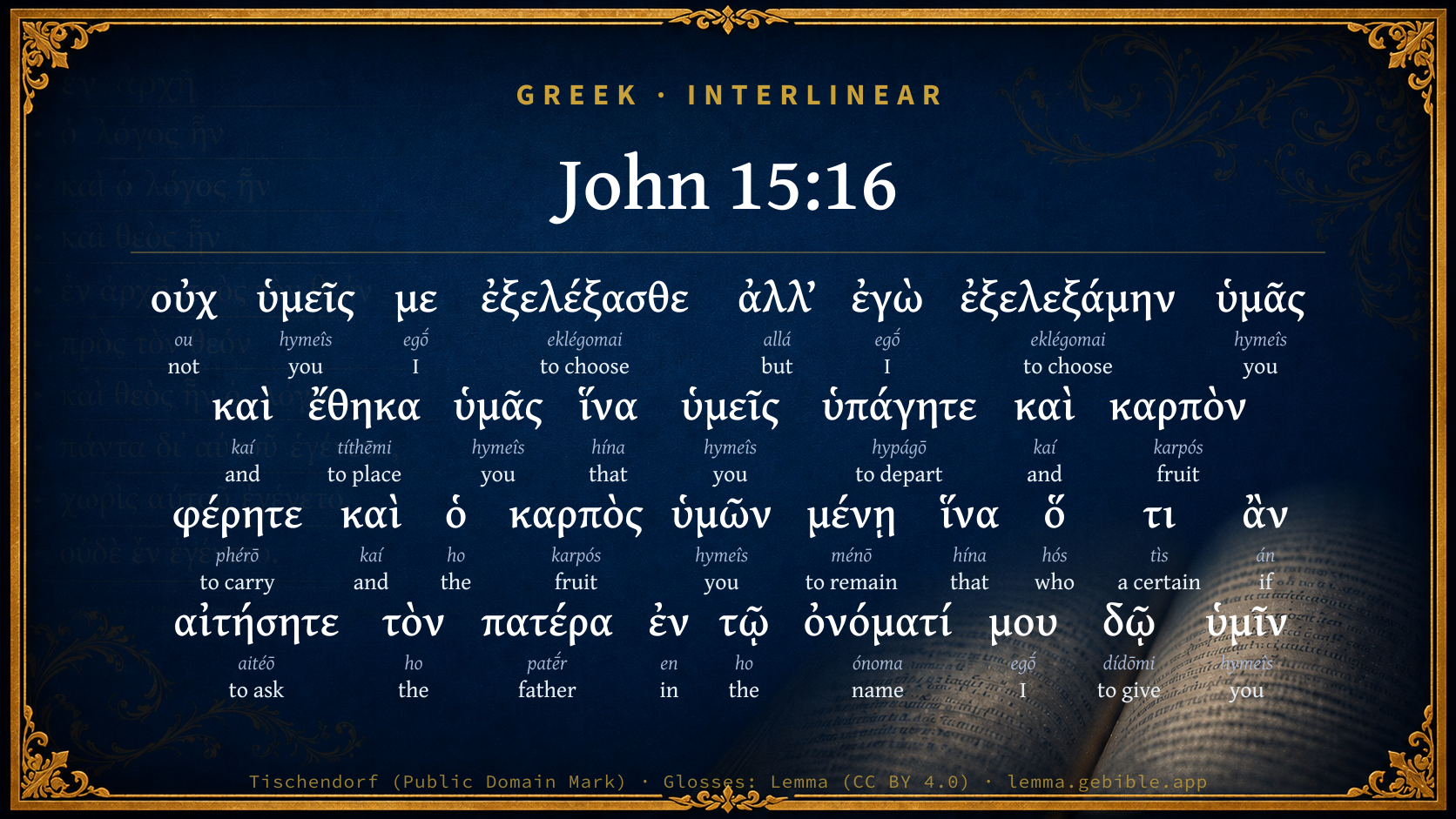
  1. οὐχ ou G3756 “not” Particle, Negative
  2. ὑμεῖς hymeîs G5210 “you” Personal pronoun, 2nd person, Nominative, Plural
  3. με egṓ G1473 “I” Personal pronoun, 1st person, Accusative, Singular
  4. ἀλλ’ allá G235 “but” Conjunction
  5. ἐγὼ egṓ G1473 “I” Personal pronoun, 1st person, Nominative, Singular
  6. ἐξελεξάμην eklégomai G1586 “to choose” Verb, Aorist, Middle, Indicative, 1st person, Singular
  7. ὑμᾶς hymeîs G5210 “you” Personal pronoun, 2nd person, Accusative, Plural
  8. καὶ kaí G2532 “and” Conjunction
  9. ἔθηκα títhēmi G5087 “to place” Verb, Aorist, Active, Indicative, 1st person, Singular
  10. ὑμᾶς hymeîs G5210 “you” Personal pronoun, 2nd person, Accusative, Plural
  11. ἵνα hína G2443 “that” Conjunction
  12. ὑμεῖς hymeîs G5210 “you” Personal pronoun, 2nd person, Nominative, Plural
  13. ὑπάγητε hypágō G5217 “to depart” Verb, Present, Active, Subjunctive, 2nd person, Plural
  14. καὶ kaí G2532 “and” Conjunction
  15. καρπὸν karpós G2590 “fruit” Noun, Accusative, Singular, Masculine
  16. φέρητε phérō G5342 “to carry” Verb, Present, Active, Subjunctive, 2nd person, Plural
  17. καὶ kaí G2532 “and” Conjunction
  18. ὁ ho G3588 “the” Article, Nominative, Singular, Masculine
  19. καρπὸς karpós G2590 “fruit” Noun, Nominative, Singular, Masculine
  20. ὑμῶν hymeîs G5210 “you” Personal pronoun, 2nd person, Genitive, Plural
  21. μένῃ ménō G3306 “to remain” Verb, Present, Active, Subjunctive, 3rd person, Singular
  22. ἵνα hína G2443 “that” Conjunction
  23. ὅ hós G3739 “who” Relative pronoun, Accusative, Singular, Neuter
  24. τι tìs G5100 “a certain” Indefinite pronoun, Accusative, Singular, Neuter
  25. ἂν án G302 “if” Particle
  26. αἰτήσητε aitéō G154 “to ask” Verb, Aorist, Active, Subjunctive, 2nd person, Plural
  27. τὸν ho G3588 “the” Article, Accusative, Singular, Masculine
  28. πατέρα patḗr G3962 “father” Noun, Accusative, Singular, Masculine
  29. ἐν en G1722 “in” Preposition
  30. τῷ ho G3588 “the” Article, Dative, Singular, Neuter
  31. ὀνόματί ónoma G3686 “name” Noun, Dative, Singular, Neuter
  32. μου egṓ G1473 “I” Personal pronoun, 1st person, Genitive, Singular
  33. δῷ dídōmi G1325 “to give” Verb, Aorist, Active, Subjunctive, 3rd person, Singular
  34. ὑμῖν hymeîs G5210 “you” Personal pronoun, 2nd person, Dative, Plural

About this verse

These counts appear in no published source. They are computed here, from the morphology-tagged text and Lemma’s own curated glosses. What Lemma adds →

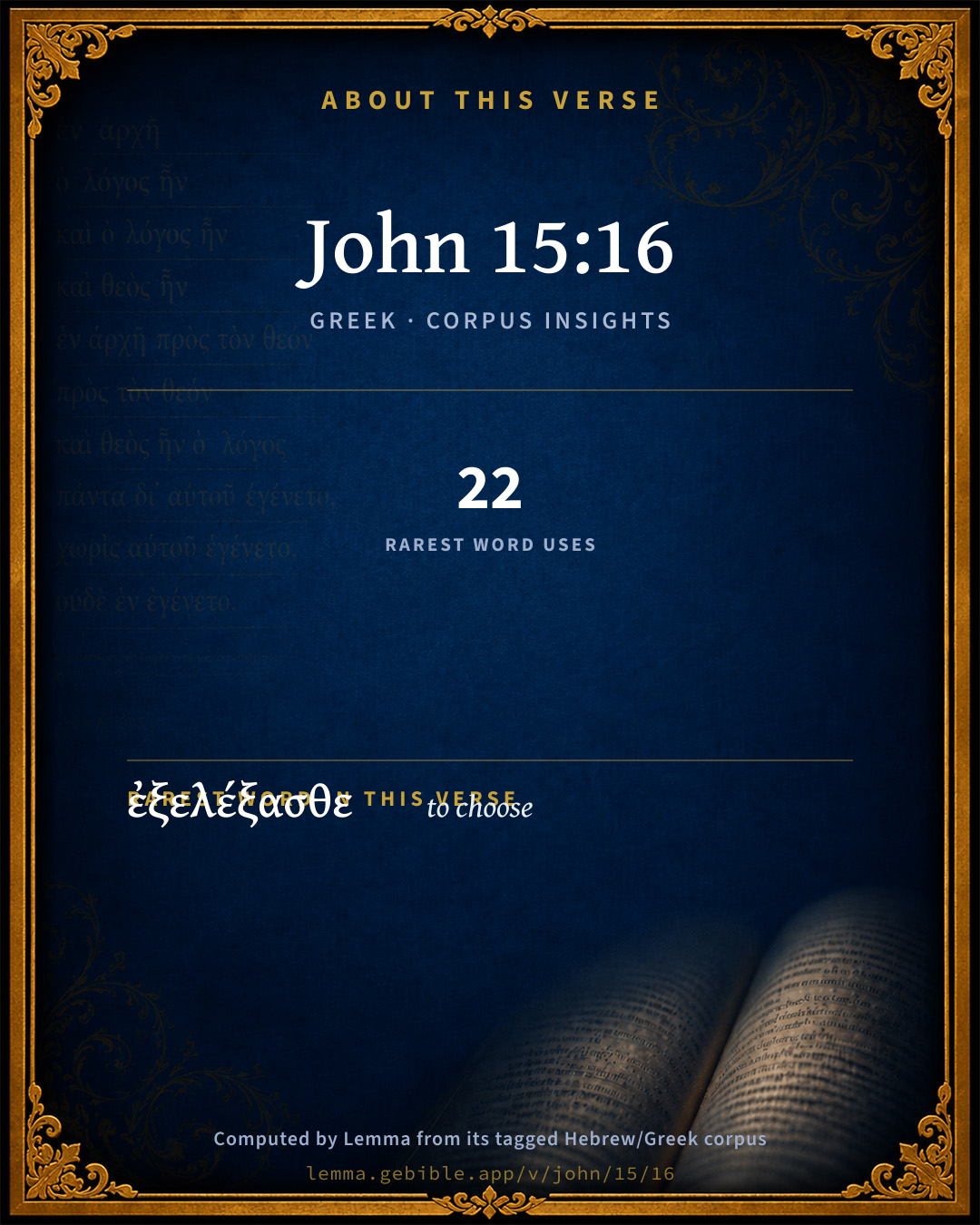
35
words
21
distinct lemmas
Gospels
section

Notable vocabulary

The rarest word here is ἐξελέξασθε to choose G1586 — appearing just 22 times in the whole Greek New Testament.

Shared distinctive vocabulary

ἐξελέξασθε to choose G1586 occurs in 20 verses of the Greek New Testament. Also found in:

Repetition

Words recur within this verse:

  • ἐξελέξασθε to choose G1586 ×2
  • καρπὸν fruit G2590 ×2
  • ὑμεῖς you G5210 ×6
  • με I G1473 ×3
  • καὶ and G2532 ×3
  • ὁ the G3588 ×3
  • ἵνα that G2443 ×2

Cross-references

55

Topical passages linked to John 15:16 in the Treasury of Scripture Knowledge — connected by theme and wording, ordered by reader-vote popularity; previews shown in the World English Bible.

  • Jeremiah 1:5–7 Before I formed you in the belly I knew you, and before you came forth out of the womb I sanctified you; I have appointed you a prophet to the nations.
  • John 15:19 If you were of the world, the world would love its own. But because you are not of the world, since I chose you out of the world, therefore the world hates you.
  • Ephesians 2:10 For we are his workmanship, created in Christ Jesus for good works, which God prepared before that we would walk in them.
  • 2 Timothy 3:15–17 From infancy, you have known the sacred writings which are able to make you wise for salvation through faith, which is in Christ Jesus.
  • 1 John 4:19 We love Him, because he first loved us.
  • Galatians 1:15 But when it was the good pleasure of God, who separated me from my mother's womb, and called me through his grace,
  • Luke 6:13 When it was day, he called his disciples, and from them he chose twelve, whom he also named apostles:
  • Acts 22:14 He said, 'The God of our fathers has appointed you to know his will, and to see the Righteous One, and to hear a voice from his mouth.
  • 1 Peter 1:14–21 as children of obedience, not conforming yourselves according to your former lusts as in your ignorance,
  • John 13:18 I don't speak concerning all of you. I know whom I have chosen. But that the Scripture may be fulfilled, 'He who eats bread with me has lifted up his heel against me.'
  • 2 Timothy 2:2 The things which you have heard from me among many witnesses, commit the same to faithful men, who will be able to teach others also.
  • John 6:70 Jesus answered them, "Didn't I choose you, the twelve, and one of you is a devil?"
  • 1 Peter 3:15 But sanctify the Lord God in your hearts; and always be ready to give an answer to everyone who asks you a reason concerning the hope that is in you, with humility and fear:
  • John 16:23–24 "In that day you will ask me no questions. Most assuredly I tell you, whatever you may ask of the Father in my name, he will give it to you.
  • Isaiah 49:1–3 Listen, isles, to me; and listen, you peoples, from far: Yahweh has called me from the womb; from the bowels of my mother has he made mention of my name:
  • Matthew 28:18–19 Jesus came to them and spoke to them, saying, "All authority has been given to me in heaven and on earth.
  • Psalms 71:18 Yes, even when I am old and gray-haired, God, don't forsake me, Until I have declared your strength to the next generation, Your might to everyone who is to come.
  • John 14:13–14 Whatever you will ask in my name, that will I do, that the Father may be glorified in the Son.
  • Proverbs 11:30 The fruit of the righteous is a tree of life. He who is wise wins souls.
  • Psalms 78:4–6 We will not hide them from their children, Telling to the generation to come the praises of Yahweh, His strength, and his wondrous works that he has done.
  • 1 Corinthians 9:16–18 For if I preach the Gospel, I have nothing to boast about; for necessity is laid on me; but woe is to me, if I don't preach the Gospel.
  • 1 John 4:10 In this is love, not that we loved God, but that he loved us, and sent his Son as the atoning sacrifice for our sins.
  • Mark 16:15–16 He said to them, "Go into all the world, and preach the Gospel to the whole creation.
  • John 15:7–8 If you remain in me, and my words remain in you, you will ask whatever you desire, and it will be done for you.
  • John 21:15–17 So when they had eaten their breakfast, Jesus said to Simon Peter, "Simon, son of Jonah, do you love me more than these?" He said to him, "Yes, Lord; you know that I have affection for you." He said to him, "Feed my lambs."
  • Acts 1:24 They prayed, and said, "You, Lord, who know the hearts of all men, show which one of these two you have chosen
  • Psalms 145:4 One generation will commend your works to another, And will declare your mighty acts.
  • Isaiah 27:6 In days to come shall Jacob take root; Israel shall blossom and bud; and they shall fill the surface of the world with fruit.
  • Isaiah 55:10–13 For as the rain comes down and the snow from the sky, and doesn't return there, but waters the earth, and makes it bring forth and bud, and gives seed to the sower and bread to the eater;
  • 1 Peter 3:2 seeing your pure behavior in fear.
  • Matthew 21:22 All things, whatever you ask in prayer, believing, you will receive."
  • Luke 24:47–49 and that repentance and remission of sins should be preached in his name to all the nations, beginning at Jerusalem.
  • John 20:21–23 Jesus therefore said to them again, "Peace be to you. As the Father has sent me, even so I send you."
  • Acts 9:15 But the Lord said to him, "Go your way, for he is my chosen vessel to bear my name before the nations and kings, and the children of Israel.
  • Romans 15:4 For whatever things were written before were written for our learning, that through patience and through encouragement of the Scriptures we might have hope.
  • Romans 9:21 Or hasn't the potter a right over the clay, from the same lump to make one part a vessel for honor, and another for dishonor?
  • 1 Corinthians 3:6–7 I planted. Apollos watered. But God gave the increase.
  • 1 Corinthians 10:11 Now all these things happened to them by way of example, and they were written for our admonition, on whom the ends of the ages have come.
  • Colossians 1:6 which has come to you; even as it is in all the world and is bearing fruit and growing, as it does in you also, since the day you heard and knew the grace of God in truth;
  • 2 Timothy 1:11 For this, I was appointed as a preacher, an apostle, and a teacher of the Gentiles.
  • Acts 10:41 not to all the people, but to witnesses who were chosen before by God, to us, who ate and drank with him after he rose from the dead.
  • Romans 1:5 through whom we received grace and apostleship, for obedience of faith among all the nations, for his name's sake;
  • Romans 9:11–16 For being not yet born, neither having done anything good or bad, that the purpose of God according to election might stand, not of works, but of him who calls,
  • Romans 15:15–19 But I write the more boldly to you in part, as reminding you, because of the grace that was given to me by God,
  • Titus 1:5 I left you in Crete for this reason, that you would set in order the things that were lacking, and appoint elders in every city, as I directed you;
  • Hebrews 11:4 By faith, Abel offered to God a more excellent sacrifice than Cain, through which he had testimony given to him that he was righteous, God bearing witness with respect to his gifts; and through it he, being dead, still speaks.
  • James 3:18 Now the fruit of righteousness is sown in peace by those who make peace.
  • Genesis 18:18 seeing that Abraham has surely become a great and mighty nation, and all the nations of the earth will be blessed in him?
  • Micah 5:7 The remnant of Jacob will be in the midst of many peoples, Like dew from Yahweh, Like showers on the grass, That don't wait for man, Nor wait for the sons of men.
  • Zechariah 1:4–6 Don't you be like your fathers, to whom the former prophets proclaimed, saying: Thus says Yahweh of hosts, 'Return now from your evil ways, and from your evil doings;' but they did not hear, nor listen to me, says Yahweh.
  • Acts 20:25–28 Now, behold, I know that you all, among whom I went about preaching the Kingdom of God, will see my face no more.
  • Colossians 1:23 if it is so that you continue in the faith, grounded and steadfast, and not moved away from the hope of the Gospel which you heard, which is being proclaimed in all creation under heaven; of which I, Paul, was made a servant.
  • 1 Timothy 2:7 to which I was appointed a preacher and an apostle (I am telling the truth in Christ, not lying), a teacher of the Gentiles in faith and truth.
  • Romans 1:13 Now I don't desire to have you unaware, brothers, that I often planned to come to you, and was hindered so far, that I might have some fruit among you also, even as among the rest of the Gentiles.
  • Acts 1:8 But you will receive power when the Holy Spirit has come upon you. You will be witnesses to me in Jerusalem, in all Judea and Samaria, and to the uttermost parts of the earth."

Cross-references courtesy of OpenBible.info (CC BY 4.0).

Commentary

Notes on John 15:16 from classic Christian and Jewish commentators (each source and its license shown beneath its notes). The classic Christian expositions comment on the surrounding passage and are grouped to its opening verse, so a note may address several verses; the Jewish commentaries on the Tanakh (Rashi and others) are per-verse, so they appear only where the commentator wrote on this verse.

Lemma curates 59 commentaries, every one of them public domain or Creative Commons licensed, each selected and text-cleaned for this edition rather than reprinted as found. About our sources →

The Biblical Illustrator

Joseph S. Exell

Joh_15:16

Ye have not chosen Me, but I have chosen you

Christian discipleship

I.

ITS ORIGIN.

1. Negatively. Ye have not chosen Me. This is true, both in regard to election unto salvation and election unto office. Christ no more chooses us because we have first chosen Him, than He loves us because we have first loved Him. He makes His universal offer of mercy; we close with it, and are elected. He says, Whom shall I send? We have to say, Here am I; send me. Choose ye this day whom ye will serve was addressed to the chosen people.

2. Positively. The Divine choice which originates our discipleship

(1) Is not arbitrary. Those are chosen for salvation who evince the qualifications for receiving salvation. Chosen … through belief of the truth. In regard to office, the apostles were the choice men of their race, as is seen in their after careers. Christ chose for His work Peter and Paul, rather than Caiaphas or Gamaliel, because they were immeasurably better men. Appearances and circumstances go for nothing, as is seen in Gods choice of David. So today Christ chooses with reference to fitness. There were more brilliant men at Oxford; but when God wanted a man for Africa He went to a factory and chose Livingstone.

2. May he frustrated. Judas was chosen, and the traitor had elements about him which would have made him a prince amongst the apostles. Election is not indelible in regard either to nations or individuals. Israel was chosen because of unique racial qualities, but was rejected because those qualities were abused. England has been chosen; may she be faithful. As for us, however distinguished the office we hold, let us not be high-minded, but fear. Let him that thinketh he standeth, etc.

II. ITS VALIDATION. Ordained you.

1. Designation for the work. This is a Divine prerogative. Sometimes it is voiced by the appointment of the Church. Sometimes, alas! not. No human authority, however august, can validate an appointment that has not been ratified in heaven. Let all Church officers note this. Often the clearest Divine designation is apparent where there has been no human sanction.

2. Qualification. Whom Christ ordains He qualifies. This may be independent of human qualifications, or it may include them. There are posts for which Christ ordains a man where they would be in the way.

There are others where they are imperative. In the latter case He works in us the desire to amass learning, eloquence, etc., and sanctifies these and other gifts to the accomplishment of His purposes.

III. ITS WORKS.

1. That ye should go and bring forth fruit in two senses.

(1) In the graces of personal character; because these are often the means of successful evangelism, and without them a man in the highest office is but a sounding brass, etc.

(2) In conversions to God. This is the grand outcome of all spiritual ministries.

2. That your fruit should remain.

(1) Of what value are the fruits of the Spirit unless permanent? Of what value is faith if tomorrow we are unbelieving? Of love if it alternates with hatred? Of joy if it is drowned in despondency? etc.

(2) Of what value to a Church are converts unless they remain? The curse of modern times is great ingatherings, followed by great failings away.

IV. ITS PRIVILEGE. Prayer

1. Keeps alive our sense of the Divine choice, and maintains our position as chosen ones.

2. Augments our personal and official qualifications. Without Me ye can do nothing. I can do all things through Christ, etc.

3. Ensures abiding success in our work. (J. W. Burn.)

That ye should go and bring forth fruit

The fruit

1. Fruitfulness is the great end of Gods ordinances in the vegetable kingdom. It is the focus into which all the various secondary purposes of nature are concentrated. And is it not so in the kingdom of grace? For the fruitfulness of those who love God the whole material system of the earth is upheld; and the whole spiritual world exists and revolves on its axis, that the harvest of spiritual life may be produced in the Church and in the believer.

2. But while fruitfulness is the great end of vegetable life, there are some plants in which this quality is of more importance than in others. It is necessary that every plant should bring forth fruit in order to propagate itself; but, besides this, some plants confer benefits upon the rest of creation by means of their fruit. Like the cow, which produces more milk than its progeny needs; and the bee, which stores a larger quantity of honey than it requires; the vine produces a fruit whose exceptional excess of nourishness is intended for the use of man. Fruit is not so important to the vine itself as it is to man. We grow some plans in order to produce seed; but we can perpetuate the vine by slips, and, therefore, we grow it solely to supply mans wants.

3. Apart from its fruit, the vine is, indeed, a beautiful plant; but this is subordinate to the one great purpose of producing grapes: and did it cease to produce fruit it would be condemned as a failure. It was for the sake of the fruit of salvation--the redemption of a fallen world--that God cultivated His own Son by the sufferings which He endured. And as with the Vine Himself, so with the branches. The Husbandman of souls grafts these branches in the Vine for the special purpose of producing spiritual fruit; and if this result does not follow, no mere natural beauty or grace will compensate. And so Christ speaks as if in the bringing forth of fruit was summed up all duty and privilege. Gods glory is the chief end of man; but Herein is My Father glorified that ye bear much fruit. God requires of us to believe in Christ; but faith is the root of fruitfulness. Faith and fruit are not distinct; but, on the contrary, the same thing at different periods of existence; just as the fruit of autumn is the seed of spring, and vice versa. God desires our highest happiness; but our highest happiness is indissolubly linked together with our fruitfulness. No man can have a continual feast of gladness who is barren and unfruitful. And here we come to the great outstanding question

I. WHAT IS THE REAL SIGNIFICANCE OF FRUIT?

1. The fruit of a plant is simply an arrested and metamorphosed branch. The bud of a plant which, under the ordinary laws of vegetation, would have elongated into a leafy branch, remains, in a special case, shortened, and develops finally, according to some regular law, blossom and fruit instead. Its further growth is thus stayed; it has attained the end of its existence; its life terminates with the ripe fruit that drops off to the ground. In producing blossom and fruit, therefore, a branch sacrifices itself, yields up its own individual vegetative life for the sake of another life that is to spring from it, and to perpetuate the species. Every annual plant dies when it has produced blossom and fruit every individual branch in a tree which corresponds with an annual plant also dies when it has blossomed and fruited. Fruit trees are the most short-lived of all trees; and cultivated fruit trees are less vigorous in growth, and do not last so long as the wild varieties. Producing larger and more abundant fruit than is natural, they necessarily so much the more exhaust their vital energies. Every blossom is a Passion flower. The sign of the cross, which superstitious eyes saw in one mystical flower, the enlightened eye sees in every blossom that opens to the summer sun. The great spiritual principle which every blossom shadows forth is--self-sacrifice. And is it not most instructive to notice that it is in this self-sacrifice of the plant that all its beauty comes out and culminates?

2. And is it not so in the kingdom of grace? Christian fruit is an arrestment and transformation of the branch in the True Vine. Instead of growing for its own ends, it produces the blossoms of holiness and the fruits of righteousness for the glory of God and the good of men. The Christian life begins in self-sacrifice. We can bring forth no fruit that is pleasing to God until, besought by His mercies, we yield ourselves a living sacrifice to Him. And in this self-sacrifice all the beauty of the Christian life comes out and culminates. The life that lives for another, in so doing bursts into flower, and shows its brightest hues, and yields its sweetest fragrance. All given to Christ is received back a hundredfold. Have we not seen the glory of self-sacrifice ennobling even the aspect of the countenance, the expression of the eye, the carriage of the form, making the plainest and homliest face beautiful and heroic?

II. IT IS FRUIT AND NOT WORKS THAT THE BELIEVER PRODUCES.

1. Work and fruit are contrasted in a very striking manner at the close of Gal_5:1-26;--the works of the flesh--the fruit of the Spirit. This contrast is very instructive. Works bear upon them the curse of Adam. They are wrought in the sweat of the brow and in the sweat of the soul. All that a natural man does comes under the category of works. And even in the case of believers, some things which they do are works, because they are the result of a legal and servile spirit. Such works are only like those of a manufacturer, which display his skill and power, but do not reveal character. You cannot tell what kind of a man he is who makes your furniture from his productions. You may be able to say that he is a clever workman, but not that he is a wise, a good, or an upright man. But fruit, on the other hand, is the spontaneous natural manifestation of the life within. The soul that has the life and the love of Christ in it cannot help producing fruit. Fruit is the free, unrestrained outpouring of a heart at peace with God, filled with the love of Christ, and stimulated by the presence, and power of the Holy Spirit. The curse is removed from it. It brings back the pure and innocent conditions of Eden. The whole man is displayed in it, as the whole life of the tree is gathered into and manifested in its fruit. By their fruit we know believers as well as trees.

2. It is fruit that Christ wants, not works; because it is the free will offering of a heart of love, not the constrained service of fear or of law, and because He studies the individual character and regulates His discipline according to individual requirements. If works were what He desired, He could order Christians in the mass to do them, caring nothing for any one of them in particular. But, in order to produce fruit, His sap must flow to, His personal influence must reach, the smallest twig, the humblest individual that yields it.

3. How significant in the light of this idea is the reward promised--a crown of life. It is not an arbitrary reward from without, but the fruit of their own efforts--a living crown, the crown of their own life. It is with us as it is with some mountains whose deepest or primary formations appear on the summit, which are not mere masses laid in dead weight upon the surface of the earth, but the protrusion of their own energies. So we are crowned with the deepest and most essential part of our own life. Our highest summit is our deepest foundation. Our crown of life is that which we ourselves have formed, and which passes through our own being. Heaven is the fruit of what we have sown, the living crown of the life that we have lived.

III. IT IS FRUIT AND NOT FRUITS, WHICH THE BRANCH IN THE TRUE VINE PRODUCES. The fruit of the Spirit is not so many apples growing on separate twigs and having no organic connection except as produced by the same tree. It is a bunch of grapes, all growing from one stalk and united to each other in the closest manner. Each grace is, as it were, a separate berry, connected with the others by organic ties, and forming a complete cluster. It should be the Christians endeavour, therefore, that the whole cluster should appear--each grape full formed and in due proportion to the rest.

IV. IT IS HEAVENLY, AND NOT EARTHLY, FRUIT THAT THE HUSBANDMAN DEMANDS.

1. The fruits of Egypt were melons and cucumbers, grown close to the earth; while its vegetables were leeks, onions, and garlic, which are not fruits at all, but roots. It is such low earth-born fruits that the natural man produces, and for which alone he has a relish. All his tendencies and labours are earthward. The cucumber and the melon are climbing plants by nature; they have tendrils to raise them up among the trees, but they are cultivated on the ground, and therefore their tendrils are useless. So every man has tendrils of hopes and aspirations that were meant to raise him above the world, but he perverts them from their proper purpose, and they run among earthly things utterly wasted. In marked contrast with the earth-borne fruits of Egypt were the fruits of the Holy Land. It is a mountainous country, on which everything is lifted above the world. The people went literally, as well as spiritually, up from Egypt to Palestine, up to Gods house. Its fruits were grown on trees, raised up from the ground and ripening in the pure air and bright sunshine of heaven. Believers are risen with Christ. They are not merely elevated a little, but are raised to being fruits in the sky.

V. THE FRUIT OF THE CHRISTIAN LIFE IS PERMANENT. That your fruit should remain.

1. In spring, when the blossoms have withered and fallen off, a large proportion of these blossoms leave behind young fruits that have actually set. These fruits grow fur a few weeks, acquire shape, become tinted with colour, cheat the eye with the hope of a rich harvest of ripe and full-formed fruit in autumn. But, alas! ere long, they wither and fall. And is it not so with the fruits which unsanctified man produces? They are beautiful in blossom; they minister to his self-glorification and enjoyment; they delude him with fair promises; but they never come to maturity and abide. They are fruits that set, but do not ripen. On every brow we see care planting his wrinkles--bare, wintry branches, whose stem is rooted in the heart, from which have fallen, one after another, the fairest fruits of life, and which, through future springs and summers, will bear no more leaves or fruit.

2. But in contrast with all the passing and perishing fruits of earth, we have the abiding fruits of righteousness. It is the glorious distinction of the fruit which Christ enables us to produce that it endures. How literally were these words fulfilled in the case of the disciples themselves! Of all the works of all the men who were living eighteen hundred years ago, what is remaining now? But twelve poor uneducated peasants went forth, and where is the fruit of their labours? Look around! And what is thus true of the glorious fruit of the disciples, is also true of the humblest fruit of the humblest Christian. What has been done for God cannot be lost or forgotten. As the Tree upon which the Christian is grafted as a branch is the Tree of Life, so the fruit that he brings forth when nourished by its sap is fruit unto holiness, and the end everlasting life.

VI. IN THE GRAPE THERE ARE TWO PARTS, THAT SERVE TWO PURPOSES--there is a fleshy, or succulent part, and there are the seeds embedded in the core, or interior.

1. The fleshy part is for nourishment; the seeds are intended to perpetuate the plant. And so every fruit of the Spirit contains these two parts--holiness and usefulness. Personal holiness is the succulent nourishing portion, delighting God and man; and embedded in it is the seed of usefulness. An earnest desire to extend the blessings of the gospel is an invariable result of their true enjoyment. What the soul has received it would communicate.

2. There are cases in nature in which the fruit swells and becomes, to all appearance, perfect, while no seeds are produced. Seedless oranges and grapes are often met with. And is there not good cause to fear that too much of what is called Christian fruit contains no seed with the embryo spark of life in it, although it may seem fair and perfectly formed? What should go to develop the seed of righteousness for others is diverted to the production of greater self-righteousness and self-indulgence. Many Christians are satisfied with enjoying themselves spiritual blessings which they ought to communicate to others. They are pampered in the selfish use of privileges and means of grace. Moreover, it is necessary that the fruit should have pulp as well as seed; that the perpetuating principle of righteousness should be imbedded in all that is lovely, and amiable, and of good report. The fruits of some Christians are harsh and hard as the wild hips on the hedges--all seed and no luscious pulp. They are zealous in recommending religion to others, while they do not exhibit the amenities of it themselves. (H. Macmillan, D. D.)

Fruit bearing

The wonder of fruit growing. What nature does, men and women and children are to do. Lives are to be fruitful lives. This what those of the apostles were. Results of their labours. The fruit remains. Different kinds of moral and spiritual fruit.

I. THOSE HARMFUL OR USELESS.

1. Crab apples and sour cherries, emblems of crabbed tempers, sour looks, and general disagreeableness. Cross temper. Sour temper. Sharp temper. Spiteful temper. Surly temper. Fretful temper.

2. Poison berries. Fair seeming, but death within. Selfishness. Hatred. Falsehood. Revenge. Hypocrisy. False friendship.

3. Hips and haws. Disorder. Idleness. Procrastination.

II. GOOD FRUITS. Dont grow by accident. Faith the root. Cultivated.

1. Loving obedience and goodness at home.

2. Kindness, brightness, cheerfulness.

3. Prayerfulness.

4. Consecration.

5. Attendance on means of grace.

6. Work for others. Such fruits remain in their effects, influence, and blessedness. Those that he planted in the house of the Lord, etc. (Preachers Monthly.)

Continuance the test of religious profession

1. There are few things which, as we grow older, impress us more deeply than the transitoriness of thoughts and feelings. Places and persons that we once thought we never could forget, as years go on are all but quite forgotten; and so with feelings. And there is no respect in which this is more sadly felt than in the case of pious feelings and holy resolutions. We often think sadly of those whose goodness was like the morning cloud and the early dew. We sometimes fear lest we have been deluding ourselves with the belief that we were better and safer than we ever have been, and mourn for the soul-refreshing views, the earnest purpose, the warm affections, of the days when we first believed in Christ.

2. No doubt, by the make of our being, as we grow older, we grow less capable of emotion. Religion in the soul, after all, is a matter of fixed choice and resolution, of principle rather than of feeling. And yet it remains a great and true principle, that in the matter of Christian faith and feelings, that which lasts longest is best. This, indeed, is true of most things. The worth of anything depends much upon its durability. It is not the gaudy annual we value most, but the stedfast forest tree. The slight triumphal arch, run up in a day, may flout the sober-looking buildings near it; but they remain after it is gone. The fairest profession, the most earnest labours, the most ardent affection for a time, will not suffice. That only is the true fruit of the Spirit, which does not wear out with advancing time. The text hints to us that it is even a harder thing to keep up a consistent Christian profession--year after year, through temptations, through troubles--than to make it, however fairly, at the first.

I. IT IS ONLY BY OUR FRUIT REMAINING THAT WE ARE WARRANTED IN BELIEVING THAT IT IS THE RIGHT FRUIT. The only satisfactory proof, either to ourselves or to others, that our Christian faith, and hope, and charity, are the true fruits of the Spirit is that they last. In religion, the fruit which remains is the only fruit. Anything else is a pretender. Herein is a point of difference between worldly and spiritual things. It would not be just to say that things which wear out have no value. Who shall say that the flower which blooms in the morning and withers before the sunset is not a fair and kind gift of the Creator? Who shall affirm that the summer sunset is not beautiful, though even while we gaze upon it its hues are fading? Who shall deny that there is something precious in the lightsome glee of childhood, even though in a little while that cheerful face is sure to be shadowed by the cares of manhood? Indeed, the beauty and value of many things in this world are increased by the shortness of the time for which they last. But it is not thus with Christian grace. If it be not a grace which will last forever, it is no grace at all. A man may show every appearance of being a true disciple; but if his zeal wanes and expires, if the throne of grace is deserted, the Bible neglected, and the little task of Christian philanthropy abandoned, how much reason there is then to fear lest the man was deceiving himself with a name to live while he was dead--that he was mistaking the transient warmth of mere human emotion for the gracious working of the Holy Spirit of God!

II. FRUIT WHICH REMAINS IS THE ONLY KIND OF CHRISTIAN PROFESSION WHICH WILL RECOMMEND RELIGION TO THOSE WHO ARE NOT CHRISTIANS. Men judge of religion by the conduct and character of its professors. And just as a humble, consistent believer is a letter of recommendation of Christianity to all who know him, just so is the inconsistent believers life a something to make them doubt whether religion be a real thing, and not a mere matter of profession and pretence. No one but God can tell how much harm is done by the Christian who, in his newborn zeal, disdains the quiet faith of old disciples who have long walked consistently, but whose zeal passes like the morning cloud and the early dew. Oh! far better the modest fruit of the Spirit, which makes little show at first, but which remains year after year. Conclusion: The same power which implanted the better life within must keep it alive day by day; the continual working of the Spirit must foster the fruits of the Spirit; and that Spirit is to be had for the asking in fervent, humble prayer. Let us watch against the first symptoms of declension in religion; remember that spiritual decline begins in the closet; guard against that worldly spirit which is always ready to creep over us; seek to walk by faith, and not by sight; be diligent in the use of all the appointed means of grace, and vigilant in guarding against every approach of temptation; and seek to have our loins girt and our lamps burning, as those who do not know how soon or suddenly the Bridegroom may come. (A. K. H. Boyd, D. D.)

Religious permanence

Think of the Speaker Himself! He is near unto His end. Will He indeed remain? Listen to the angry roar of the multitude, Away with Him! If an artist of that age had been asked to put on fresco the permanent, would he have chosen the Christ? He might have selected the emperor, or Jerusalems marble temple; but he would scarcely have selected the Saviour when He was led as a lamb to the slaughter. But our Lord Himself? Did He not know the secret of permanence? Full well we know His thoughts. I, if I be lifted up will draw all men unto Me. Heaven and earth shall pass away, but My words shall not pass away. The same spiritual permanence He would see in all His professed disciples. Let them but abide in Him, and then the branch would be as the vine I Fruit is to remain

I. IN PRINCIPLE. Religion is founded on the permanence of the moral nature. It lays hold on the eternally right and true within us. Religion without principle is but a Jonahs gourd. There may be beauty in our life, but there must be strength, or the beauty itself will be but the hectic flush of consumption. Think of a divine teacher who had to suit his thesis of virtue to education or country! No! His virtue was Sinai etherealized and glorified, but it was the same virtue. Christ has made morality living and real. His principles will live on in every age. None can displace them until men have denied the conscience within them. His words still are spirit, still are life. Thus, then, if we are Christians, we shall be firm and strong in moral principle. Ours will be no sentimental life.

II. IN INFLUENCE. We are so to live that others may gather fruit from our lives when we are gone. We say Milton lives, and Baxter, and Pascal. True. The lustre of noble words and beautiful deeds lingers on, yea, even brightens with time. But the humblest life also lives on in the future years. The permanent influence is not that of the mere orator, thinker, or theologian. Brilliant epochs do not make lives. It is easy to fulfil special tasks, to enter upon some memorable struggle with all eyes fixed upon us. It is difficult in daily life, amid the distraction of little things, to be faithful, patient, earnest unto the end.

III. IN FEELING. The emotional nature is not to be crushed, or even relegated to an inferior place. No life is beautiful that is a stranger to tenderness or tears. But unless the heart keeps alive affection, all else will suffer; for we were made to love, and our influence will cease if that dies out. Why should emotion be a transient thing, to be apologized for or treated with affected criticism as unmanly? Christ was moved with compassion. Feeling should be permanent. Why not? We need not exhaust it by stimulants, nor mortgage the emotion of tomorrow by drawing upon its exchequer today. Within us all there ought to be a nature which the Divine memories of the gospel always touch with tenderness.

IV. IN ACTIVE ENDEAVOUR. As flowers retire into themselves at eventide, so too often do men and women. There is lassitude or languor not born of physical weakness, but of mental ennui, which too often comes in the evening of life. It is a characteristic of a true Christian faith that it vivifies all eras of life. For there can be no preserved sanctities of service where there is no delight in the dear old ways, no true fountains of joy in God. When men lose interest, you cannot quicken their energy. Appeal will not do it, nor arguments, nor firmness of will. A regiment in which there are grey-headed soldiers is likely to have enduring men in it; and a Christian army in which the veterans do not tire is not only a beautiful spectacle, but constitutes a brave contingent for the war.

V. IMMORTALITY. (W. M. Statham.)

The Biblical Illustrator, edited by Joseph S. Exell (c. 1880s–1900s) — public domain. Text from a community e-Sword module.

Bengel's Gnomon

Johann Albrecht Bengel

Joh 15:16. Ἔθηκα, I have appointed [Engl. Vers. ordained]) Castellio elegantly renders it: destinavi, I have marked out, or assigned you your place, expressing (keeping up) the allegory concerning trees [placed down in their appointed spot].—ὑπάγητε, ye may go your way) So הלך, 2Sa 3:1, said of progress, not in reference to place, but to time and degree.—ὑμῶν your,—ὑμῖν, to you) It is for you that the seed is sown, for you that the harvest is reaped.

Bengel's Gnomon of the New Testament — English translation (T&T Clark, Edinburgh, 1860) — public domain. Text from a community e-Sword module.

Meyer's Critical & Exegetical Commentary

Heinrich August Wilhelm Meyer

Joh_15:16. Along with this dignity, however, of being Jesus friends, they were not to forget their dependence on Him, and their destiny therewith appointed.

ἐξελέξασθε … ἐξελεζάμην] as Master … as disciples, which is understood of itself from the historical relation, and is also to be gathered from the word chosen (Joh_6:70, Joh_13:18; Act_1:2). Each of them was a σκεῦος ἐκλογῆς of Christ (Act_9:15); in each the initiative of this peculiar relation lay not on his but on Christs side. Hence not to be taken merely in a general sense of the selection for the fellowship of love (Euth. Zigabenus, Luther, and several others, including Luthardt, Lange).

ἔθηκα ὑμᾶς] have appointed you, as my disciples, consequence of the ἐξελεξάμην. The dotation spirituelle (Godet) goes beyond the meaning of the word, although it was historically connected with it (Mar_3:14-15). Comp. on τιθέναι, instituere, appoint (not merely destine, as Ebrard thinks), 1Co_12:28; 1Ti_1:12; 2Ti_1:11; Heb_1:2; Act_20:28, et al.; Hom. Od. xv. 253, Il. vi. 300; Dem. 322. 11, et al. The rendering of Chrysostom, Theophylact, Euth. Zigabenus, is incorrect: I have planted you (Xen. Occ. xix. 7, 9). The figure of the vine has in truth been dropped, and finds only an echo in the καρπὸν φέρειν, which, however, must not be extended to ἔθηκα, since the disciples appear not as planted, but as branches, which have grown and remain on the vine. Quite arbitrarily, Bengel and Olshausen see here a new figure of a fruit-tree.

ἵνα ὑμεῖς ὑπάγ.] that you on your side may go away, etc., is by Chrysostom, Theophylact, Euth. Zigabenus, in consequence of their interpretation of ἔθηκα, erroneously explained by ἵνα ἐκτείνησθε αὐξανόμενοι. Nor does it merely denote independent and vital action (De Wette, Lücke, Baumgarten-Crusius, Luthardt, Godet; comp. Luther: that you sit not still without fruit or work), or continual movement (Hengstenberg), with which sufficient justice is not done to the peculiarity of this point, which, in truth, belonged in the most proper sense to the disciples calling. According to Ebrard, it is said to be simply an auxiliary verb, like ire with the supine. It signifies rather the execution of the ἀποστολή, in which they were to go away into all the world, etc. Comp. Luk_10:3; Mat_28:19.

μένῃ] comp. Joh_4:36. The results of their ministry are not again to decline and be brought to naught, but are to be continuous and enduring even into the αἰὼν μέλλων.

The second ἵνα is co-ordinated with the first. See on Joh_15:7-8. It is in truth precisely the granting of prayer here designated which brings about the fruit and its duration in all given cases. Comp. the prayers of Paul, as in Col_1:9 ff.; Eph_3:14 ff.

ἐν τῷ ὀνόμ. μ.] See on Joh_14:13.

Meyer — Critical and Exegetical Commentary on the New Testament — English translation by Peter Christie, edited by Frederick Crombie (T&T Clark, 1880) — public domain. Text from a community e-Sword module.

Expositor's Greek Testament

ed. W. Robertson Nicoll

Joh 15:16 . οὐχ ὑμεῖς … ὑμῖν . This is added to encourage them in taking up and prosecuting the work of Jesus. Euthymius says it is ἄλλο τεκμήριον τοῦ ἔχειν αὐτοὺς φίλους ἑαυτοῦ ; but it is more. They are invited to depend on His will, not on their own. They had not discovered Him, and attached themselves to Him, as likely to suit their purposes. “It is not ye who chose me.” But “I chose you,” as a king selects his officers, to fulfil my purposes. καὶ ἔθηκα ὑμᾶς , “and I set (or, appointed) you,” cf. 1Co 12:28 , Act 20:28 , etc., see Concordance. The purpose of the appointment is ἵνα ὑμεῖς ὑπάγητε , “that you may go away” from me on your various missions, and thus (resuming the original figure of the vine and branches) καρπὸν φέρητε , may bear fruit in my stead, and supplied by my life. Or to express this purpose in a manner which reveals the source of their power to bear fruit, ἵνα ὅ τι ἂν αἰτήσητε … δῷ ὑμῖν , see Joh 15:7 , and Joh 14:13 .

The Expositor's Greek Testament, edited by W. Robertson Nicoll (1897–1910) — public domain. Text from a community e-Sword module.

Cambridge Greek Testament for Schools and Colleges

16. οὐχ ὑμεῖς. Not ye chose Me, but I chose you. Ὑμεῖς and ἐγώ are emphatic. Ἐκλέγειν refers to their election to be Apostles (Joh 6:70, Joh 13:18; Act 1:2); therefore the aorist as referring to a definite act in the past should be preserved. So also ἔθηκα, I appointed you, i. e. assigned you to a definite post, as in 2Ti 1:11; Heb 1:2. This is better than ‘I ordained,’ as A. V. here and 1Ti 2:7, ‘ordain’ having become a technical term in ecclesiastical language. Comp. Act 13:47; Act 20:28; 1Co 12:28. The repetition of ὑμεῖς throughout the verse emphasizes the personal responsibility of the Apostles.

ὑπάγητε. see on Joh 1:7: that ye should go and bear fruit. Ὑπάγητε must not be insisted on too strongly as if it referred to the missionary journeys of the Apostles. On the other hand it is more than a mere auxiliary or expletive: it implies the active carrying out of the idea expressed by the verb with which it is coupled (comp. Luk 10:37; Mat 13:44; Mat 18:15; Mat 19:21), and perhaps also separation from their Master (Mat 20:4; Mat 20:7). The missionary work of gathering in souls is not specially indicated here: the ‘fruit’ is rather the holiness of their own lives and good works of all kinds. The second ἵνα is partly coordinate with, partly dependent on, the first: comp. the double ἵνα Joh 13:34 and see on Joh 15:7. Several ancient commentators take δῶ as the first person in harmony with Joh 14:13. The three passages, Joh 14:13, Joh 15:7; Joh 15:16 should be compared.

Cambridge Greek Testament for Schools and Colleges (Cambridge University Press, 1896; 21 vols, various authors incl. Carr, Maclear, Plummer, Farrar, Lumby, Moule, M. R. James, Simcox) — public domain. Text from a community e-Sword module.

Geneva Bible (1599)

Geneva Bible translators

This place teacheth us plainly, that our salvation cometh from the only favor and gracious goodness of the everlasting God towards us, and of nothing that we do or can deserve.

Christ is the author and preserver of the ministry of the Gospel, even to the world’s end, but the ministers have above all things need of prayer and brotherly love.

Geneva Bible (1599) marginal notes — public domain. Text via Bolls.life.

Jamieson, Fausset & Brown

Robert Jamieson, A. R. Fausset & David Brown

Ye have not chosen me, but I . . . you--a wholesale memento after the lofty things He had just said about their mutual indwelling, and the unreservedness of the friendship they had been admitted to.

ordained--appointed.

you, that ye should go and bring forth fruit--that is, give yourselves to it.

and that your fruit should remain--showing itself to be an imperishable and ever growing principle. (Compare Pro 4:18; Jo2 1:8).

that whatsoever ye shall ask, &c.--(See on Joh 15:7).

Jamieson, Fausset & Brown — Commentary Critical and Explanatory on the Whole Bible (1871) — public domain (CC PDM 1.0). Text via the HelloAO Bible API.

Adam Clarke's Commentary

Verse 16. Ye have not chosen me] Ye have not elected me as your Teacher: I have called you to be my disciples; witnesses and depositories of the truth. It was customary among the Jews for every person to choose his own teacher.

And ordained you] Rather, I have appointed you: the word is εθηκα, I have PUT or placed you, i.e. in the vine.

Theodorus Mopsuensis, as quoted by Wetstein, observes that εθηκα is here used for εφυτευσα; (I have planted;) "and, in saying this, our Lord still makes use of the metaphor of the vine; as if he had said: I have not only planted you, but I have given you the greatest benefits, causing your branches to extend every where through the habitable world."

The first ministers of the Gospel were the choice of Jesus Christ; no wonder, then, that they were so successful. Those whom men have since sent, without the appointment of God, have done no good. The choice should still continue with God, who, knowing the heart, knows best who is most proper for the Gospel ministry.

To be a genuine preacher of the Gospel, a man must -

1. Be chosen of God to the work.

2. He must be placed in the true vine-united to Christ by faith.

3. He must not think to lead an idle life, but labour.

4. He must not wait till work be brought to him, but he must go and seek it.

5. He must labour so as to bring forth fruit, i.e. to get souls converted to the Lord.

6. He must refer all his fruit to God, who gave him the power to labour, and blessed him in his work.

7. He must take care to water what he has planted, that his fruit may remain - that the souls whom he has gathered in be not scattered from the flock.

8. He must continue instant in prayer, that his labours may be accompanied with the presence and blessing of God - Whatsoever ye shall ASK.

9. He must consider Jesus Christ as the great Mediator between God and man, proclaim his salvation, and pray in his name. - Whatsoever ye shall ask of the Father in my name, &c. See Quesnel.

Adam Clarke's Commentary on the Bible (1810–1826) — public domain. Text from a community e-Sword/MySword module.

John Calvin's Commentaries

16. You have not chosen me. He declares still more clearly that it must not be ascribed to their own merit, but to his grace, that they have arrived at so great an honor; for when he says that he was not chosen by them, it is as if he had said, that whatever they have they did not obtain by their own skill or industry. Men commonly imagine some kind of concurrence to take place between the grace of God and the will of man; but that contrast, I chose you, I was not chosen by you, claims, exclusively, for Christ alone what is usually divided between Christ and man; as if he had said, that a man is not moved of his own accord to seek Christ, until he has been sought by him.

True, the subject now in hand is not the ordinary election of believers, by which they are adopted to be the children of God, but that special election, by which he set apart his disciples to the office of preaching the Gospel. But if it was by free gift, and not by their own merit, that they were chosen to the apostolic office, much more is it certain that the election, by which, from being the children of wrath and an accursed seed, we become the children of God, is of free grace. Besides, in this passage Christ magnifies his grace, by which they had been chosen to be Apostles, so as to join with it that former election by which they had been engrafted into the body of the Church; or rather, he includes in these words all the dignity and honor which he had conferred on them. Yet I acknowledge that Christ treats expressly of the apostleship; for his design is, to excite the disciples to execute their office diligently and faithfully.

He takes, as the ground of his exhortation, the undeserved favor which he had bestowed on them; for the greater our obligations to the Lord, the more earnest ought we to be in performing the duties which he demands from us; otherwise it will be impossible for us to avoid the charge of base ingratitude. Hence it appears that there is nothing which ought more powerfully to kindle in us the desire of a holy and religious life, than when we acknowledge that we owe every thing to God, and that we have nothing that is our own; that both the commencement of our salvation, and all the parts which follow from it, flow from his undeserved mercy. Besides, how true this statement of Christ is, may be clearly perceived from the fact, that Christ chose to be his apostles those who might have been thought to be the most unfit of all for the office; though in their person he intended to preserve an enduring monument of his grace. For, as Paul says, (1 Corinthians 2:16,) who among men shall be found fit for discharging the embassy by which God reconciles mankind to himself? Or rather, what mortal is able to represent the person of God? It is Christ alone who makes them fit by his election. Thus Paul ascribes his apostleship to grace, (Romans 1:5,) and again mentions that

he had been separated from his mother’s womb, (Galatians 1:15.)

Nay more, since we are altogether useless servants, those who appear to be the most excellent of all will not be fit for the smallest calling, till they have been chosen. Yet the higher the degree of honor to which any one has been raised, let him remember that he is under the deeper obligations to God.

And I have appointed you. The election is hidden till it is actually made known, when a man receives an office to which he had been appointed; as Paul, in the passage which I quoted a little ago, where he says that he had been separated from his mother’s womb, adds, that he was created an apostle, because it so pleased God His words are:

When it pleased God, who separated me from my mother’s womb, and called me by his grace, (Galatians 1:15.)

Thus also the Lord testifies that he knew Jeremiah before he was in his mother’s womb, (Jeremiah 1:5,) though he calls him to the prophetical office at the proper and appointed time. It may happen, no doubt, that one who is duly qualified enters into the office of teaching; or rather, it usually happens in the Church that no one is called till he be endued and furnished with the necessary qualifications. That Christ declares himself to be the Author of both is not wonderful; since it is only by him that God acts, and he acts along with the Father. So then, both election and ordination belong equally to both.

That you may go. He now points out the reason why he mentioned his grace. It was, to make them apply more earnestly to the work. The apostleship was not a place of honor without toil, but they had to contend with very great difficulties; and therefore Christ encourages them not to shrink from labors, and annoyances, and dangers. This argument is drawn from the end which they ought to have in view; but Christ reasons from the effect, when he says,

That you may bear fruit; for it is hardly possible that any one would devote himself earnestly and diligently to the work, if he did not expect that the labor would bring some advantage. Christ, therefore, declares that their efforts will not be useless or unsuccessful, provided that they are ready to obey and follow when he calls them. For he not only enjoins on the apostles what their calling involves and demands, but promises to them also prosperity and success, that they may not be cold or indifferent. It is hardly possible to tell how great is the value of this consolation against those numerous temptations which daily befall the ministers of Christ. Whenever, then, we see that we are losing our pains, let us call to remembrance that Christ will, at length, prevent our exertions from being vain or unproductive; for the chief accomplishment of this promise is at the very time when there is no appearance of fruit. Scorners, and those whom the world looks upon as wise men, ridicule our attempts as foolish, and tell us that it is in vain for us to attempt to mingle heaven and earth; because the fruit does not yet correspond to our wishes. But since Christ, on the contrary, has promised that the happy result, though concealed for a time, will follow, let us labor diligently in the discharge of our duty amidst the mockeries of the world.

And that your fruit may abide. A question now arises, why does Christ say that this fruit will be perpetual? As the doctrine of the Gospel obtains souls to Christ for eternal salvation, many think that this is the perpetuity of the fruit But I extend the statement much farther, as meaning that the Church will last to the very end of the world; for the labor of the apostles yields fruit even in the present day, and our preaching is not for a single age only, but will enlarge the Church, so that new fruit will be seen to spring up after our death.

When he says, your fruit, he speaks as if it had been obtained by their own industry, though Paul teaches that they who plant or water are nothing, (1 Corinthians 3:7.) And, indeed, the formation of the Church is so excellent a work of God, that the glory of it ought not to be ascribed to men. But as the Lord displays his power by the agency of men, that they may not labor in vain, he is wont to transfer to them even that which belongs peculiarly to himself. Yet let us remember that, when he so graciously commends his disciples, it is to encourage, and not to puff them up.

That your Father may give you all that you ask in my name. This clause was not added abruptly, as many might suppose; for, since the office of teaching far exceeds the power of men, there are added to it innumerable attacks of Satan, which never could be warded off but by the power of God. That the apostles may not be discouraged, Christ meets them with the most valuable aid; as if he had said, “If the work assigned to you be so great that you are unable to fulfill the duties of your office, my Father will not forsake you; for I have appointed you to be ministers of the Gospel on this condition, that my Father will have his hand stretched out to assist you, whenever you pray to him, in my name, to grant you assistance.” And, indeed, that the greater part of teachers either languish through indolence, or utterly give way through despair, arises from nothing else than that they are sluggish in the duty of prayer.

This promise of Christ, therefore, arouses us to call upon God; for whoever acknowledges that the success of his work depends on God alone, will offer his labor to him with fear and trembling. On the other hand, if any one, relying on his own industry, disregard the assistance of God, he will either throw away his spear and shield, when he comes to the trial, or he will be busily employed, but without any advantage. Now, we must here guard against two faults, pride and distrust; for, as the assistance of God is fearlessly disregarded by those who think that the matter is already in their own power, so many yield to difficulties, because they do not consider that they fight through the power and protection of God, under whose banner they go forth to war.

John Calvin's Commentaries (1540-1563) — public domain. Text from the Calvin Translation Society English edition (1840s-50s) via the Christian Classics Ethereal Library (ccel.org). Calvin's coverage is partial (roughly two-thirds of the Bible); uncommented books and verses are honest gaps, never fabricated. The 19th-century editor's footnotes and remarks are omitted so the notes are faithfully Calvin's own voice.

Ellicott's Commentary for English Readers

(16) Ye have not chosen me, but I have chosen you.—Comp. Luk_6:12 et seq., and in this Gospel Joh_6:70; Joh_13:18. The thought of His love for them, which had exalted them from the position of slaves to friends, from fishermen to Apostles, is made to remind them again (Joh_15:17) of the duty of love to each other. In Joh_15:20 he reminds them of the words which accompanied His own act of humility in washing their feet (Joh_13:15-16). The chiefest Apostle owed all to His gift and election, and should be ready to sacrifice all for his brethren, as He Himself was.

And ordained you.—The word “ordained” has acquired a special sense in modern English which is here misleading, and it will be better, therefore, to read appointed.

That ye should go and bring forth fruit.—Comp. Mat_13:44; Mat_18:15; Mat_19:21, for the idea of going away and doing something. It implies here the activity of the Apostles as distinct from that of Christ. Each one as a branch ever joined to Christ was to grow away from Him in the development of his own work, and was to bring forth his own fruit. The margin compares Mat_28:19, probably, with the thought of their fulfilling the Apostle’s missionary work. This view has been commonly adopted, but it gives to the word “go’” a fulness of meaning which is scarcely warranted.

And that your fruit should remain.—Comp. Note on Joh_4:36; and see 2Jn_1:8, and Rev_14:13.

That whatsoever ye shall ask of the Father.—Comp. Notes on Joh_15:7-8.

A Bible Commentary for English Readers, edited by Charles John Ellicott (1878–1897) — public domain. Text from a community e-Sword module.

The Cambridge Bible for Schools and Colleges

gen. ed. J. J. S. Perowne

16. Ye have not, &c.] Better, Ye chose Me not, but I chose you: ‘Ye’ and ‘I’ are emphatic; there is no emphasis on ‘Me.’ The reference is to their election to be Apostles, as the very word used seems to imply (comp. Joh_6:70, Joh_13:18; Act_1:2); therefore the aorist as referring to a definite act in the past should be preserved in translation.

ordained you] Better, appointed you (as 2Ti_1:11 and Heb_1:2), in order to avoid an unreal connexion with ordination in the ecclesiastical sense. The same word used in the same sense as here is rendered ‘set’ in Act_13:47 and 1Co_12:28, ‘ordained’ 1Ti_2:7, and ‘made’ Act_20:28.

go and bring forth fruit] ‘Go’ must not be insisted on too strongly as if it referred to the missionary journeys of the Apostles. On the other hand it is more than a mere auxiliary or expletive: it implies the active carrying out of the idea expressed by the verb with which it is coupled (comp. Luk_10:37; Mat_13:44; Mat_18:15; Mat_19:21), and perhaps also separation from their Master (Mat_20:4; Mat_20:7). The missionary work of gathering in souls is not specially indicated here: the ‘fruit’ is rather the holiness of their own lives and good works of all kinds. ‘Bring forth’ should be bear as in Joh_15:5.

should remain] Better, should abide (see on Joh_15:9). Comp. Joh_4:36.

whatsoever ye shall ask] See on Joh_15:7 and Joh_14:13.

he may give it] The Greek may also mean ‘I may give it’ (comp. Joh_14:13), the first and third persons being alike in this tense; and several ancient commentators take it as the first.

The Cambridge Bible for Schools and Colleges (gen. ed. J. J. S. Perowne; Cambridge University Press, 1878–1918) — public domain. Text from a community e-Sword module.

John Gill's Exposition

These things I command you,.... The doctrines which Christ spake, as one having authority, concerning the vine and branches; his love to his disciples, in laying down his life for them, and in accounting and using them as friends, and not servants; in choosing, ordaining, and sending them forth, for the ends above mentioned; these were delivered by him with this view, to promote brotherly love among them: that ye love one another; this lay much upon his heart, he often mentions it; this is the third time it is expressed by him, in these his last discourses; and indeed, since he had declared such strong love and affection for them, it was but right and proper they should love one another; nor does anything more tend to increase mutual love among the saints, than the consideration of their common interest in the unchangeable love of their Lord.

These things I command you,.... The doctrines which Christ spake, as one having authority, concerning the vine and branches; his love to his disciples, in laying down his life for them, and in accounting and using them as friends, and not servants; in choosing, ordaining, and sending them forth, for the ends above mentioned; these were delivered by him with this view, to promote brotherly love among them: that ye love one another; this lay much upon his heart, he often mentions it; this is the third time it is expressed by him, in these his last discourses; and indeed, since he had declared such strong love and affection for them, it was but right and proper they should love one another; nor does anything more tend to increase mutual love among the saints, than the consideration of their common interest in the unchangeable love of their Lord.

John 15:18

joh 15:18

joh 15:18

joh 15:18If the world hate you,.... After our Lord had signified how much he loved his disciples and what great things he had done for them, he faithfully acquaints them with the world's hatred of them, and what they must expect to meet with from that quarter, and says many things to fortify their minds against it; his words do not imply any doubt about it, but he rather takes it for granted, as a thing out of question; "if", or "seeing the world hate you"; they had had some experience of it already, and might look for more, when their master was gone from them: wherefore, he, in order to engage their patience under it, says,

ye know that it hated me before it hated you; which words are an appeal of Christ to his apostles, for the usage he had met with from the wicked and unbelieving world of the Jews; how they had expressed their hatred, not only by words, calling him a gluttonous man, and a winebibber, a sinner, a Samaritan, a madman, one that had a devil, yea, Beelzebub himself, but by deeds; taking up stones to stone him more than once, leading him to the brow of an hill, in order to cast him down headlong, consulting by various means to take away his life, as Herod did in his very infancy; which was done, before they showed so much hatred to his disciples; and perhaps reference may be had to the original enmity between the seed of the woman, and the seed of the serpent, mentioned Gen 3:15; as well as to these instances. Moreover, the words , rendered "before you", may be translated "the first" or "chief of you", your Lord and head; and denotes the dignity, excellency, and superiority of Christ; wherefore it is suggested, that if he, who was so much before them in personal worth and greatness, was hated by the world, they should not think it hard, or any strange thing, that this should be their case.

John Gill's Exposition of the Whole Bible (1746–1763) — public domain (CC PDM 1.0). Text via the HelloAO Bible API.

Trapp's Complete Commentary

John Trapp

16 Ye have not chosen me, but I have chosen you, and ordained you, that ye should go and bring forth fruit, and that your fruit should remain: that whatsoever ye shall ask of the Father in my name, he may give it you.

Ver. 16. And ordained you, that you should go, &c.] Not that ye should lord it over your brethren (as the pope ordained his caterpillars), and get up the best of the land for your private use and pleasure. The pope, when he maketh his cardinals, useth these words, Estote confratres nostri, et principes mundi. You shall be our brothers and leaders in the world. The archbishopric of Toledo is said to be worth a hundred thousand pounds a year: a greater revenue than some kings have.

That whatsoever ye shall ask, &c.] Bernard in his Meditations giveth various rules of strictness, of purging the heart, of being faithful and fruitful, et cum talis fueris (saith he) memento mei, intimating, that then they might have what they would of God, for themselves or others, that were so qualified.

John Trapp, A Commentary or Exposition upon All the Books of the Old and New Testament (1647–1656) — public domain. Text from a community e-Sword module.

Albert Barnes' Notes on the Bible

Ye have not chosen me - The word here translated “chosen” is that from which is derived the word “elect,” and means the same thing. It is frequently thus translated, Mar 13:20; Mat 24:22, Mat 24:24, Mat 24:31; Col 3:12. It refers here, doubtless, to his choosing or electing them to be apostles. He says that it was not because they had chosen him to be their teacher and guide, but because he had designated them to be his apostles. See Joh 6:70; also Mat 4:18-22. He thus shows them that his love for them was pure and disinterested; that it commenced when they had no affection for him; that it was not a matter of obligation on his part, and that therefore it placed them under more tender and sacred obligations to be entirely devoted to his service. The same may be said of all who are endowed with talents of any kind, or raised to any office in the church or the state. It is not that they have originated these talents, or laid God under obligation. What they have they owe to his sovereign goodness, and they are bound to devote all to his service. Equally true is this of all Christians. It was not that by nature they were more inclined than others to seek God, or that they had any native goodness to recommend them to him, but it was because he graciously inclined them by his Holy Spirit to seek him; because, in the language of the Episcopal and Methodist articles of religion, “The grace of Christ prevented them;” that is, went before them, commenced the work of their personal salvation, and thus God in sovereign mercy chose them as His own. Whatever Christians, then, possess, they owe to God, and by the most tender and sacred ties they are bound to be his followers.

I have chosen you - To be apostles. Yet all whom he now addressed were true disciples. Judas had left them; and when Jesus says he had chosen them to bear fruit, it may mean, also, that he had “chosen them to salvation, through sanctification of the Spirit and belief of the truth,” 2Th 2:13.

Ordained you - Literally, I have placed you, appointed you, set you apart. It does not mean that he had done this by any formal public act of the imposition of hands, as we now use the word, but that he had designated or appointed them to this work, Luk 6:13-16; Mat 10:2-5.

Bring forth fruit - That you should be rich in good works; faithful and successful in spreading my gospel. This was the great business to which they were set apart, and this they faithfully accomplished. It may be added that this is the great end for which Christians are chosen. It is not to be idle, or useless, or simply to seek enjoyment. It is to do good, and to spread as far as possible the rich temporal and spiritual blessings which the gospel is fitted to confer on mankind.

Your fruit should remain - This probably means,

1. That the effect of their labors would be permanent on mankind. Their efforts were not to be like those of false teachers. the result of whose labors soon vanish away Act 5:38-39, but their gospel was to spread - was to take a deep and permanent hold on people, and was ultimately to fill the world, Mat 16:18. The Saviour knew this, and never was a prediction more cheering for man or more certain in its fulfillment.

2. There is included, also, in this declaration the idea that their labors were to be unremitted. They were sent forth to be diligent in their work, and untiring in their efforts to spread the gospel, until the day of their death. Thus, their fruit, the continued product or growth of religion in their souls, was to remain, or to be continually produced, until God should call them from their work. The Christian, and especially the Christian minister, is devoted to the Saviour for life. He is to toil without intermission, and without being weary of his work, until God shall call him home. The Saviour never called a disciple to serve him merely for a part of his life, nor to feel himself at liberty to relax his endeavors, nor to suppose himself to be a Christian when his religion produced no fruit. He that enlists under the banners of the Son of God does it for life. He that expects or desires to grow weary and cease to serve him, has never yet put on the Christian armor, or known anything of the grace of God. See Luk 9:62.

That whatsoever ... - See Joh 15:7.

Albert Barnes' Notes on the Bible (1834–1885) — public domain. Text from a community e-Sword/MySword module.

Haydock's Catholic Bible Commentary

O ineffable grace! For what were we, before Christ chose us, but wretched and abandoned creatures? Such we were; but now we are chosen, in order that we may become good by the grace of Him that hath chosen us. (St. Augustine, tract. 86. in Joan.)

George Leo Haydock (1774–1849), Haydock's Catholic Family Bible and Commentary, 1859 edition — public domain. Excludes Psalms (Douay-Rheims chapter numbering differs from Protestant) and Deuterocanonical books (Catholic canon only).

Matthew Poole's English Annotations

Ye have not chosen me to be your Lord, Master, Saviour,

but I have chosen and ordained you; so we have it in our translation; but the Greek is, εθηκα, I have set you, or placed you in a station. What choosing Christ here speaks of is doubted amongst various divines. Some think that our Saviour here speaks of his choice of them to the apostleship, as Luk 6:13; Joh 6:70; those who thus understand it, understand by going and bringing forth fruit, the apostles’ going out, preaching, and baptizing all nations, bringing forth fruit amongst the Gentiles. But others understand it of election to eternal life, and the means necessary to it; for our Saviour brings this as an argument of his greatest love: Judas was in the first sense chosen, yet not beloved with any such love: and this seemeth to be favoured by Joh 13:18, I speak not of you all; I know whom I have chosen: and certain it is, Augustine and others of the ancients from hence proved the freedom of election and special grace. Both senses may be united, for the eleven (to whom Christ was now speaking) were chosen in both senses; they were chosen for this end, to bring forth fruit amongst the Gentiles, turning many to righteousness, and that they might bring forth the fruit of holiness, in obedience to the gospel of Christ. Yea, not only to bring forth fruit, but that they might persevere in bringing forth fruit; and that thus doing, they might have a freedom of access to the throne of grace, and obtain whatsoever they should ask of the Father, in the name, for the merits, and through the mediation of the Lord Jesus Christ. See Poole on "Joh 14:13-14".

Matthew Poole's English Annotations on the Holy Bible (1683–1685) — public domain. Text from a community e-Sword/MySword module.

Whedon's Commentary on the Bible

Daniel D. Whedon

16. Ye have not chosen me—Students of the law among the Jews select their own masters and teachers; but not so have you selected me from among many others.

I have chosen you—It is I who have chosen and raised you to the rank of friends, and not you me. I have ordained, and given you official position, in order to your production of permanent fruit, and in order to your attaining the privilege of the answer of prayer, in my name, from the Father.

Daniel D. Whedon (gen. ed.), Commentary on the Old and New Testaments (1874–1909) — public domain. Text from a community e-Sword module.

The Pulpit Commentary

From the thirteenth to the fifteenth verse, our Lord, in a brief digression, has justified a portion of the great commandment of mutual love. That love is to correspond with his love to the disciples, and to explain his self-sacrifice to them; tie proves to them that they are his "friends," and therefore the objects of his dying love. Then the appeal is still further clenched by showing the origin and purport of his friendship for them. Ye did not choose me (exelexasye ... exelexamhn are middle, "you chose... I chose... for yourselves or for myself"), but I chose you. I selected you as individuals, not excluding thereby a gracious choice of other souls; I destined you to accomplish work dear to me and essential to my kingdom. Christ has already told them that he must "go away" from" them to the Father, and that they "cannot follow him now, but afterwards;" and he has also convinced them that, though he go away, he will "come again, and abide with them," and also that "severed" from him they can "do nothing." Consequently when he adds, I appointed you (see 1Co_12:28 1Ti_1:12 Heb_1:2 Act_20:28, for similar use of tiyenai) as my apostles and representatives, to do work in my Name, there is no contradiction in his adding, that ye should go forth, depart into the world with my message and in my Name, as I am "departing" to the Father, to rule over you from a higher and more august position. And bear fruit. A passing reference to the imagery of the first part of the chapter, showing that their "going forth or away" upon this mission would not separate them from his Spirit, or divide the link without which they could bear no fruit at all. The "fruit" may here, in its issues, suggest another class of ideas. In the first case the "fruit" was the "fruit of the Spirit," but here it would seem to be the abiding consequence of the "greater works" which they would be called upon to do. This rich fruit includes all the victories they were to win over souls, and all the effects of their ministry. "Fruit" in either case is only valuable when it is utilized by the Husbandman and according to his purpose. "Fruit" is a Divine self-exhaustion of the living organism; it does no good to the branch nor to the stem; it is the sacred property of the husbandman, whether for his own joy or for fresh seed. In this case your fruit will abide for ever, not in the branch, but in the Father"s hands, that (ina) whatsoever ye shall ask of the Father in my Name, he may give it you. It now becomes a question whether the second ina introduces a clause which is co-ordinate with the former or one logically depending on the preceding. Meyer concludes the first, viz. that the granting of prayer brings about the fruit and its continuance (so De Wette, Lucke, Stier, Godet); and Olshausen maintains the second, viz. that by going and bringing forth fruit we enter into that relation with God from which proceeds the prayer in the name of the Son which the Father will grant, thus bringing the passage into close relation Joh_14:13 and Joh_16:23. Hengstenberg says, "By their fruit they would show themselves to be true disciples of Christ, and to such the Father can deny nothing." But Westcott and Lange endeavor to combine both ideas. The co-ordination of the two clauses requires the inversion of their order, or the introduction of kai before the second ina . Moreover, the thought that Christ chose and appointed them in order that whatsoever they should ask God would give, is out of harmony with "the conditions of acceptable prayer" elsewhere insisted on; while the bearing of fruit in both senses,

(a) that of Christian grace and

(b) Christian usefulness

completes the idea in a concrete form of abiding in Christ and having his words abiding in them. Surely the view that the second clause is conditioned by the first, is far from obscure, as Luthardt says, while he virtually accepts the same interpretation: "If they cause themselves to be found in the right service of Jesus, then will be granted to them what they ask in the name of Jesus." Moulton confirms the same interpretation. (On the clause, "in my Name," see Joh_16:24)

Jesus, the Decider and Provider.

We have here the statement of a plain historical fact. Jesus, from the general body of his disciples, did pick out a special company for special work. No doubt they also had to choose, but their choice simply amounted to recognition; they could not put any one else in the place which Jesus held. And he invites them here to a retrospect of the hour in which he had chosen them. They would have liked in most things, practically in all things, to get their own way; and this was just what they could not do. Jesus did not visit the world to fall in with the wishes of ignorant and short-sighted men. Underneath all our choices, and all the changes of our moods, there is the purpose, the choice, and the expectation of Jesus. We have

I JESUS DECIDING. It was all the doing of Jesus. These men were to be stamped with his sending. They were in his employment. The call of the Lord Jesus constituted their authority and their claim. And the essence of this choosing still remains. Every one trying to do work for the sake of Jesus and in the Name of Jesus must have something of this feeling that he has been chosen; that a constraining hand has been upon him, first of all arresting his footsteps in the old way, and then pointing them into a new one. In ranging ourselves under Jesus, we indeed cannot escape a great decision, but it will be made with a feeling that we could not help making it; and this feeling will only deepen as the years of service and devotion roll on. Christians never have any misgivings about the right of Jesus to grasp and direct. If any profess themselves never to have felt that Jesus wanted them, never said "Follow me," such must be asked whether the truth does not lie here, that they are fertile in the spirit of excuses. There will at least be an indubitable picking out, by-and-by, of the sheep from the goats. Effort and self-denial are required to find out what Jesus has a right to claim, and what he really wants. There is such a thing as having ears and yet not being able to hear.

II JESUS PROVIDING. As Jesus claims the right of deciding, so he also takes the responsibility of providing, lie has so situated and surrounded his servants, that they may bring forth fruit, and abiding fruit. Every branch in the vine has its own place, but all are provided for in a common life and a common growth. The decision and the provision go together. Jesus is not really Decider unless he is also allowed to be Provider. Each soldier of the army is not allowed to make provision for himself. If he had this to do, his fighting would be of little use. The king who sends the army out makes provision for the sustaining of the army. Christians have to be more than others, do more than others, and thus their resources must exceed those of others. How is the grape of the wilderness to become the grape of the vineyard, unless it is planted in the vineyard? Wild fruit, growing as it will, can never become like the fruit that is cultivated and watched.

III JESUS EXPECTING. The disciples were full of vexation because of hopes and imaginings overthrown; but Jesus knew what would come. Jesus is above all clouds that darken the present and prevent a right view of the future. These very men, so troubled now, would before long be joying and rejoicing abundantly that they were counted worthy to suffer for their Master. What great things may be expected, what usefulness and happiness are at the dawn, when once self gets an effectual crippling! The branches of this vine will be as the stars of the sky for multitude, and as the sand, by the sea-shore innumerable. Y.

The Pulpit Commentary (1880–1919), ed. H.D.M. Spence-Jones & Joseph S. Exell — public domain. Text from a community e-Sword module.

John Wesley's Explanatory Notes

Ye - My apostles, have not chosen me, but I have chosen you - As clearly appears from the sacred history: and appointed you, that ye may go and bear fruit - I have chosen and appointed you for this end, that ye may go and convert sinners: and that your fruit may remain - That the fruit of your labours may remain to the end of the world; yea, to eternity; that whatsoever ye shall ask - The consequence of your going and bearing fruit will be, that all your prayers will be heard.

John Wesley, Explanatory Notes Upon the Whole Bible (1754–1765) — public domain. Text via the GEBible commentary corpus.

Burkitt's Expository Notes on the New Testament

William Burkitt

Here our Saviour gives another instance and evidence of his love to his disciples; he tells them, that his mercy and free goodness had prevented them in their election to eternal salvation, and in their vocation unto the office of apostleship: Ye have not chosen me, to be your Master and Lord, but I have chosen you, to be my disciples, friends, and servants.

2. He acquaints them with the end, design, and intention, of his chusing of them; namely, that they should bring forth fruit, and persevere therein, even in all the fruits of holiness and obedience, which are the praise and glory of God by Jesus Christ: I have ordained you, that you should bring forth fruit, and that your fruit should remain.

3. He directs them, that in order to their being fruitful, they should have access to the Father through him for whatsoever they wanted and stood in need of: Whatever ye shall ask of the Father in my name, he will give it to you.

Learn hence, That all those whom God hath chosen, and called to the knowledge and service of Jesus Christ, ought to make it their care and endeavour to bring forth fruit, and to persevere therein to their lives end: I have chosen you, that you should bring forth fruit, and that your fruit should remain.

William Burkitt's Expository Notes on the New Testament (1700–1703) — public domain. Text from a community e-Sword module.

The People's New Testament

B. W. Johnson

16. Ye have not chosen me, but I have chosen you, and ordained you. Each one of the eleven apostles present had been chosen, called, by the Lord, from among his disciples. They did not choose him, but he them, in order that they might bring forth abundant fruit in the conversion of the world.

B. W. Johnson's The People's New Testament with Notes (1889–1891) — public domain. Electronic text from the Christian Classics Ethereal Library (CCEL) ThML edition.

unfoldingWord translationNotes

Door43 World Missions Community

You did not choose me

Jesus implies that his followers did not decide on their own to become his disciples. AT: "You did not decide to become my disciples" (See: Assumed Knowledge and Implicit Information)

go and bear fruit

Here "fruit" is a metaphor that represents a life that is pleasing to God. AT: "live lives that please God" (See: Metaphor)

that your fruit should remain

"that the results of what you do should last forever"

whatever you ask of the Father in my name, he will give it to you

Here "name" is a metonym that represents the authority of Jesus. AT: "Because you belong to me, whatever you ask of the Father, he will give it to you" (See: Metonymy)

the Father

This is an important title for God. (See: Translating Son and Father)

translationWords

appoint

fruit

God the Father

command

unfoldingWord translationNotes — © Distant Shores Media and the Door43 World Missions Community, licensed CC BY-SA 4.0. Source: git.door43.org/Door43/en_tn.

Alford’s Greek Testament

Henry Alford

16.] See 1Jn 4:10, 1Jn 4:19. Further proof of His love, in his choosing His, when they had not chosen Him.

ἔθηκα] appointed: see Act 13:47: 1Th 5:9, and reff. Euth., Chrys., Thl. explain it ἐφύτευσα, in the parabolic sense. But the parable seems to be no further returned to than in the allusion implied in καρπός. ‘Ordained,’ in E. V., is objectionable, as conveying a wrong idea.

ὑπάγ. κ. καρ. φέρ.] ὑπ. probably merely expresses (see ref. and Mat 18:15; Mat 19:21, and πορευόμενοι, Luk 8:14) the activity of living and developing principle; not the missionary journeys of the Apostles (Grot., Lampe, Meyer). The καρπός is not the Church, to be founded by the Apostles, and endure;—this is evident, for here the fruit is spoken of with reference to themselves, and their ripening into the full stature of Christ. Much of their fruit will be necessarily the winning of others to Christ: but that is not the prominent idea here.

μένῃ] See 2Jn 1:8: Rev 14:13.

ἵνα ὅ τι ἂν …] This ἵνα is parallel with the former one, not the result of it; the two, the bringing forth of fruit and the obtaining answer to prayer, being co-ordinate with each other; but (vv. 7, 8) the bearing fruit to God’s glory is of these the greater, being the result and aim of the other.

Henry Alford, The Greek Testament (1849–1861) — public domain. Text from a community e-Sword module.

International Critical Commentary

16. The apostles were henceforth His chosen friends, and herein was encouragement for them, who were so soon to take up their mission, in the absence of their Master. It would be a mission of difficulty, but their Call was their Power.

οὐχ ὑμεῖς με ἐξελέξασθε, ἀλλʼ ἐγὼ ἐξελεξάμην ὑμᾶς, “You did not choose me, but I chose you,” the personal pronouns being repeated for emphasis. See on 6:70, 13:18 and v. 19, where the aor. ἐξελεξάμην is used as here to mark the moment when the apostles were selected from the larger body of disciples. Each of them was a σκεῦος ἐκλογῆς (Act 9:15), and had been chosen by Jesus after a night of prayer (Luk 6:13). It is constantly taught in the Fourth Gospel that God’s love precedes the movement of man’s soul to Him (see on 3:16).

καὶ ἔθηκα ὑμᾶς,1 “and appointed you,” sc. to your special work; cf. for τίθημι used thus, Act 20:28, 1Ti 1:12.

ἵνα ὑμεῖς ὐπάγητε. ὑπάγειν is used at Luk 10:3 of the “going forth” of the Seventy on their mission. For ὑπάγειν in Jn., see on 7:33.

καὶ καρπὸν φέρητε, primarily the fruit of success in their apostolic labours, but also indicating the perfecting of personal character (cf. v. 4).

καὶ ὁ καρπὸς ὑμῶν μέῃ, “and your fruit may abide.” Jesus had said to a group of disciples on a former occasion, ὁ θερίζων … συνάγει καρπὸν εἰς ζωὴν αἰώνιον (4:36), and the thought is the same in this passage. Cf. Rev 14:13 and 1Co 15:58.

ἵνα ὅ τι ἂν αἰτήσητε (so אADNΘ, but BL have αἰτῆτε) τὸν πατέρα ἐν τῷ ὀνόματί μου δῷ ὑμῖν (cf. v. 7). This great promise occurs six times (with slight variations) in the Last Discourses (cf. 16:23, 24, 26, 14:13, 14); and in these passages the philosophy, so to speak, of Christian prayer is unfolded, as nowhere else in the N.T.

In the Sermon on the Mount we have the simple words αἰτεῖτε καὶ δοθήσεται ὑμῖν (Mat 7:7). But, when the Lord’s Prayer is prescribed for use, it is made plain that there are conditions which must be fulfilled, if prayer is to be acceptably offered, and one of these is Thy Will be done. Prayer that is not submissive to that condition has no promise of answer. Another condition is suggested Mat 18:19: “If two of you shall agree as touching anything that they shall ask, it shall be done for them by my Father.” Prayer may be selfish, so that the granting of one man’s petition may be the refusal of another’s. But if men agree, that barrier is removed. If all men agreed in asking the Eternal for the same thing, the prayer could be offered with entire confidence. And Jn. tells that Jesus expressed the supreme condition of Christian prayer by saying that it must be offered ἐν τῷ ὀνόματί μου, “in my Name.” For Christ embraces all men. He is the Man. A petition which is one that He could offer is one the fulfilment of which could hurt none and would benefit all (cf. 11:22). So, in Johannine language, the prayer which is of certain efficacy must be ἐν τῷ ὁνόματι αὐτοῦ, and that is enough. Jn. doe not speak of importunity in prayer, as Lk. does (Luk 11:8); but it is reiterated in the Fourth Gospel that the will of the man who prays must be in harmony with Christ’s will (cf. 1Jn 5:14). The man must be ἐν ἐμοί, a phrase used several times in these Last Discourses (14:20, 15:4, 7, 16:33; cf. 6:56, 1Jn 5:20), with which Paul’s ἐν Χριστῷ should be compared (Rom 12:5, Rom 12:16:7, 1Co 15:18, 2Co 5:17).1 This condition has been already expressed in different words at v. 7: “If ye abide in me, and my sayings abide in you, ask (αἰτήσασθε) what you will, and it shall be done to you.” To pray “in the Name” of Christ is not any magical invocation of the Name, nor is it enough to add per Jesum Christum Dominum nostrum, but it is to pray as one who is “in Christ.” Such are the prayers of the saints.

For the significance of “the Name,” see on 1:12; and for ἐν τῷ ὀνόματί μου in other contexts, cf. Luk 10:17, Joh 14:26, Joh 20:31, Eph 5:20.

The repeated ἵνα … ἵνα challenges attention. The final cause of the choice of the apostles was that they should “go forth and bear fruit,” in their own lives as well as in their missionary labours, so that at last they should become masters of effectual prayer.

International Critical Commentary — older volumes (1896–1929), various authors — public domain. Text from a community e-Sword module.

Vincent's Word Studies in the New Testament

Marvin R. Vincent

Ye - chosen. The pronoun is emphatic : "It was not ye that chose me."

Ordained [εθηκα] . Rev., appointed is better, because it divests the word of its conventional meaning. Ordain is from the Latin ordinare, and means to set in order. Thus, Robert of Gloucester's "Chronicle :" " He began to ordain his folk, "i e., set his people in order. Hakluyt," Voyages : "" He ordained a boat made of one tree." The Greek verb means to set, put, or place. Hence of appointing one to service. See 1Ti 1:12. Wyc., Mt 24:47 : "Upon all his goods he shall ordain him."

Should go [υπαγητε] . Withdraw from His personal society and go out into the world.

That whatsoever, etc. [ινα] . Coordinated with the preceding ina, that, as marking another result of their choice and appointment by Christ. He has appointed them that they should bring forth fruit, and that they should obtain such answers to their prayer as would make them fruitful.

Marvin R. Vincent, Word Studies in the New Testament (1887–1900) — public domain. Text from a community e-Sword/MySword module.

Godet's Commentaries

Frédéric Louis Godet

Ver. 16. “You have not chosen me; but I have chosen you and appointed you, that you should go and bear fruit, and that your fruit should remain; that, whatsoever you may ask the Father in my name, he may give it you.”

The very origin of the relation thus formed between them depends only on Him. Jesus has the consciousness of the greatness of the proof of love which He has given them by associating them of His own impulse in that work which constitutes the highest activity of which man can be judged worthy. By the term: I have chosen you, He alludes, as in Joh 6:70 and Joh 13:18, to the solemn act of their election to the apostleship, related in Luk 6:12 ff. The word ἔθηκα, have appointed, designates their gradual installation into this office, as well as their spiritual education, for which He had labored with so much perseverance.

The expression ὑπάγητε, that you should go, refers to their apostolic mission in the world, and sets forth the relative independence which they will enjoy as they take His place in this task.

The fruit designates here, more specially than in Joh 15:2, the communication to other men of the spiritual life which they themselves possess. This fruit does not perish, as that of earthly labor does: it remains.

The second ἵνα, in order that, cannot be dependent on the first, as Hengstenberg, Luthardt and Keil would have it, as if Jesus meant that they would go and bear fruit in order that, being thus in communion with the Father, they might be heard by Him. This thought is unnatural. The second in order that is simply co-ordinate with the preceding, as in Joh 13:34; comp. as to the substance and form, the two clauses dependent on ὅτι, Joh 14:12-13. Jesus reminds them that the very efficacy of their labor will be due to the revelation which He has given them of His person and the prayer which will result from it, the prayer in His name. Thus, through their dependence on the verb: I have appointed you, these words mean: “And you are now, through my name which you know, in the glorious position of gaining for yourselves directly from the Father whatsoever you will have to ask from Him.” All this as the fruit of the free initiative of His love towards them.

Frédéric Louis Godet — Commentaries on Luke, John, Romans, and 1 Corinthians — English translation (T&T Clark, Edinburgh, 1870s–1890s) — public domain. Text from a community e-Sword module.

Lesson kit

Teaching starters — assembled from the data on this page, not authored interpretation. Every prompt links to the verse data it draws on. Edit before teaching.

John, in the Gospels, opens this verse with 35 words (21 distinct Greek lemmas). Its most distinctive word is eklégomai (“to choose”). A historical commentator’s framing appears above. Read the whole chapter for the surrounding context.

Discussion questions

  1. The word eklégomai carries the sense “to choose.” How does it shape the verse?
  2. Mark 13:20 shares the word «to choose» with this verse. How do the two illuminate each other?
  3. “to choose” occurs 2× in this one verse. What is the effect of the repetition?
  4. These translations render this verse differently. What is at stake in choosing one wording over another?
  5. Reading how The Biblical Illustrator and Bengel's Gnomon read this verse, where do the two commentators agree and where do they part?

Things to notice

  • These translations choose different wording for 18 words in this verse.
  • “to choose” occurs 2× in this single verse.
  • 21 distinct Greek lemmas span 35 words in this verse.

Reading settings

Reading text

Shown beneath each verse's original-language words.

Old Testament
Old Testament edition

Read the OT as the Masoretic Hebrew (MT) or the Greek Septuagint (LXX).

English shown for the Greek Septuagint (in the Hebrew ↔ Greek comparison).

Comparing translations? Open the Compare panel on any verse page to stack up to four side by side.