Acts 10:36

Greek (Tischendorf 8th ed.) Acts 10:36 appears in the Greek New Testament. The text above is from the Tischendorf 8th edition. Each word links to its Strong’s number and a concise gloss. Click any word for its full Thayer’s Greek Lexicon entry.
Download image
Cite this verse

Acts 10:36 (World English Bible). Public Domain. Lemma interlinear Bible study tool, https://lemma.gebible.app/v/acts/10/36.

Show BibTeX & RIS
BibTeX
RIS
English Translation
The word which he sent to the children of Israel, preaching good news of peace by Jesus Christ--he is Lord of all--
World English Bible · Public Domain
Download a study sheet

One document with this verse’s original text, its word-by-word gloss line, the meaning frame, cross-references with their text, attributed commentary, and full source and license credits — printable, and it pastes into notes with its structure intact.

This verse Autodidact and up

Study sheet (.html) Plain text (.txt)

A passage Seminary Student

Up to 50 verses in one chapter. A passage sheet keeps up to 6 commentary sources and 12 cross-references per verse, in the order this page ranks them, and says so on the sheet whenever that leaves anything out. Ask for a single verse and you get the Autodidact verse sheet above.

Everything on this page stays free to read, with no account — the sheet is a download of what is already on screen, not access to it.

Want to remove ads? Support Godless Engineer
Compare translations 3

The same verse in 3 English versions, stacked beneath the original-language interlinear above. Click any original word for its lexicon entry.

Each is an independent rendering of the whole verse — the interlinear is not word-aligned to these translations.

Highlighted words mark where these versions differ — a whole-verse word diff, not a word-by-word alignment.

  • World English Bible Public Domain
    The word which he sent to the children of Israel, preaching good news of peace by Jesus Christ--he is Lord of all--
  • King James Version Public Domain
    The word which God sent unto the children of Israel, preaching peace by Jesus Christ: (he is Lord of all:)
  • unfoldingWord Literal Text CC BY-SA 4.0
    The word that he sent to the sons of Israel, proclaiming peace through Jesus Christ—he is the Lord of all—

unfoldingWord Literal Text — © unfoldingWord, licensed CC BY-SA 4.0. Word-aligned USFM3 via Door43 (git.door43.org/unfoldingWord/en_ult).

Versions to compare (up to 4)

3 of 4 selected

Show all 19 translations

Every available English version of this verse, each an independent rendering of the whole verse.

  • World English Bible Public Domain
    The word which he sent to the children of Israel, preaching good news of peace by Jesus Christ--he is Lord of all--
  • Berean Standard Bible Public Domain
    He has sent this message to the people of Israel, proclaiming the gospel of peace through Jesus Christ, who is Lord of all.
  • Majority Standard Bible Public Domain
    He has sent this message to the people of Israel, proclaiming the gospel of peace through Jesus Christ, who is Lord of all.
  • King James Version Public Domain
    The word which God sent unto the children of Israel, preaching peace by Jesus Christ: (he is Lord of all:)
  • American Standard Version (1901) Public Domain
    The word which he sent unto the children of Israel, preaching good tidings of peace by Jesus Christ (He is Lord of all.) --
  • Revised Version (1885) Public Domain
    The word which he sent unto the children of Israel, preaching good tidings of peace by Jesus Christ (he is Lord of all)—
  • Geneva Bible (1599) Public Domain
    Ye know the worde which God hath sent to the children of Israel, preaching peace by Iesus Christ, which is Lord of all:
  • Douay-Rheims (1899) Public Domain
    God sent the word to the children of Israel, preaching peace by Jesus Christ: (he is Lord of all.)
  • Young's Literal Translation Public Domain
    the word that he sent to the sons of Israel, proclaiming good news -- peace through Jesus Christ (this one is Lord of all,)
  • Literal Standard Version CC BY-SA 4.0
    the word that He sent to the sons of Israel, proclaiming good news—peace through Jesus Christ (this One is Lord of all),
  • Unlocked Literal Bible CC BY-SA 4.0
    You know the message that he sent to the people of Israel, when he announced good news about peace through Jesus Christ, who is Lord of all—
  • unfoldingWord Literal Text CC BY-SA 4.0
    The word that he sent to the sons of Israel, proclaiming peace through Jesus Christ—he is the Lord of all—
  • Darby Bible Public Domain
    The word which he sent to the sons of Israel, preaching peace by Jesus Christ, (*he* is Lord of all things,)
  • World Messianic Bible Public Domain
    The word which he sent to the children of Israel, proclaiming good news of peace by Yeshua the Messiah—he is Lord of all—
  • Webster's Bible Public Domain
    The word which God sent to the children of Israel, preaching peace by Jesus Christ: (he is Lord of all:)
  • Free Bible Version CC BY-SA 4.0
    You know the message he sent to Israel, sharing the good news of peace that comes from Jesus Christ, who is Lord of all.
  • Bible in Basic English Public Domain
    The word which he sent to the children of Israel, giving the good news of peace through Jesus Christ (who is Lord of all)--
  • Text-Critical English NT CC BY 4.0
    You yourselves know the message he sent to the sons of Israel, preaching the good news of peace through Jesus Christ, who is Lord of all,
  • Tyndale New Testament (1534) Public Domain
    Ye knowe the preachynge that God sent vnto the chyldren of Israel preachinge peace by Iesus Christe (which is Lorde over all thinges:

Literal Standard Version (2020), Covenant Press — licensed CC BY-SA 4.0. Text via the HelloAO Bible API (eBible.org). Unlocked Literal Bible (unfoldingWord) — licensed CC BY-SA 4.0. Text via the HelloAO Bible API (eBible.org). unfoldingWord Literal Text — © unfoldingWord, licensed CC BY-SA 4.0. Word-aligned USFM3 via Door43 (git.door43.org/unfoldingWord/en_ult). Free Bible Version, Dr. Jonathan Gallagher — licensed CC BY-SA 4.0. Text via the HelloAO Bible API (eBible.org).

Word by word

More ways to search: Search by grammar → Find every occurrence → Compare this word →

Practice this passage: Drill this verse → Learn its vocabulary →

εὐαγγελιζόμενος
euangelízō
G2097
“to evangelize”
Verb, Present, Middle, Participle, Nominative, Singular, Masculine
Part of Speech
Verb
Tense
Present
Voice
Middle
Mood
Participle
Case
Nominative
Number
Singular
Gender
Masculine
Full Thayer's Definition

Origin: from G2095 and G32

TDNT: 2:707,*

1. to bring good news, to announce glad tidings a. used in the OT of any kind of good news 1. of the joyful tidings of God's kindness, in particular, of the Messianic blessings b. in the NT used especially of the glad tidings of the coming kingdom of God, and of the salvation to be obtained in it through Christ, and of what relates to this salvation c. glad tidings are brought to one, one has glad tidings proclaimed to him d. to proclaim glad tidings 1. instruct (men) concerning the things that pertain to Christian salvation
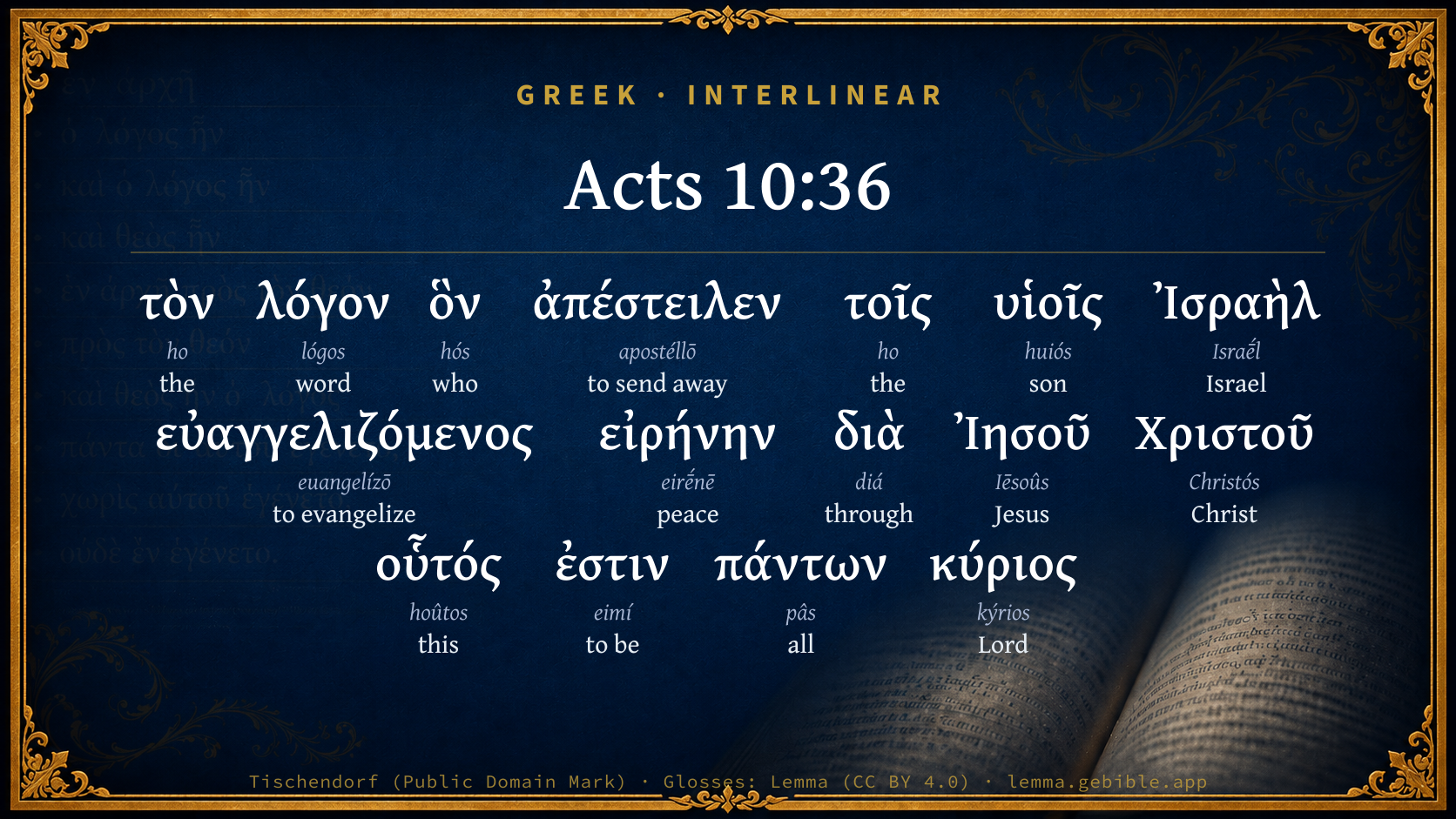
  1. τὸν ho G3588 “the” Article, Accusative, Singular, Masculine
  2. λόγον lógos G3056 “word” Noun, Accusative, Singular, Masculine
  3. ὃν hós G3739 “who” Relative pronoun, Accusative, Singular, Masculine
  4. ἀπέστειλεν apostéllō G649 “to send away” Verb, Aorist, Active, Indicative, 3rd person, Singular
  5. τοῖς ho G3588 “the” Article, Dative, Plural, Masculine
  6. υἱοῖς huiós G5207 “son” Noun, Dative, Plural, Masculine
  7. Ἰσραὴλ Israḗl G2474 “Israel” Noun, Proper, indeclinable
  8. εἰρήνην eirḗnē G1515 “peace” Noun, Accusative, Singular, Feminine
  9. διὰ diá G1223 “through” Preposition
  10. Ἰησοῦ Iēsoûs G2424 “Jesus” Noun, Genitive, Singular, Masculine
  11. Χριστοῦ Christós G5547 “Christ” Noun, Genitive, Singular, Masculine
  12. οὗτός hoûtos G3778 “this” Demonstrative pronoun, Nominative, Singular, Masculine
  13. ἐστιν eimí G1510 “to be” Verb, Present, Active, Indicative, 3rd person, Singular
  14. πάντων pâs G3956 “all” Adjective, Genitive, Plural, Masculine
  15. κύριος kýrios G2962 “Lord” Noun, Nominative, Singular, Masculine

About this verse

These counts appear in no published source. They are computed here, from the morphology-tagged text and Lemma’s own curated glosses. What Lemma adds →

16
words
15
distinct lemmas
Acts
section

Shared distinctive vocabulary

εὐαγγελιζόμενος to evangelize G2097 occurs in 52 verses of the Greek New Testament. Also found in:

Repetition

A word recurs within this verse:

Cross-references

54

Topical passages linked to Acts 10:36 in the Treasury of Scripture Knowledge — connected by theme and wording, ordered by reader-vote popularity; previews shown in the World English Bible.

  • Matthew 28:18 Jesus came to them and spoke to them, saying, "All authority has been given to me in heaven and on earth.
  • Acts 2:36 "Let all the house of Israel therefore know assuredly that God has made him both Lord and Christ, this Jesus whom you crucified."
  • Revelation 17:14 These will war against the Lamb, and the Lamb will overcome them, for he is Lord of lords, and King of kings. They also will overcome who are with him, called and chosen and faithful."
  • 1 Corinthians 15:27 For, "He put all things in subjection under his feet." But when he says, "All things are put in subjection," it is evident that he is excepted who subjected all things to him.
  • 1 Peter 3:22 who is at the right hand of God, having gone into heaven, angels and authorities and powers being made subject to him.
  • Revelation 1:18 and the Living one. I was dead, and behold, I am alive forevermore. Amen. I have the keys of Death and of Hades.
  • Psalms 2:6–8 "Yet I have set my king on my holy hill of Zion."
  • 2 Corinthians 5:18–21 But all things are of God, who reconciled us to himself through Jesus Christ, and gave to us the ministry of reconciliation;
  • Ephesians 1:20–23 which he worked in Christ, when he raised him from the dead, and made him to sit at his right hand in the heavenly places,
  • Ephesians 2:13–18 But now in Christ Jesus you who once were far off are made near in the blood of Christ.
  • Ephesians 4:5–12 one Lord, one faith, one baptism,
  • Philippians 2:11 and that every tongue should confess that Jesus Christ is Lord, to the glory of God the Father.
  • Hebrews 1:6–12 Again, when he brings in the firstborn into the world he says, "Let all the angels of God worship him."
  • Hebrews 7:2–3 to whom also Abraham divided a tenth part of all (being first, by interpretation, king of righteousness, and then also king of Salem, which is king of peace;
  • Hebrews 13:20 Now may the God of peace, who brought again from the dead the great shepherd of the sheep with the blood of an eternal covenant, our Lord Jesus,
  • Revelation 1:5 and from Jesus Christ, the faithful witness, the firstborn of the dead, and the ruler of the kings of the earth. To him who loves us, and washed us from our sins by his blood;
  • Revelation 19:16 He has on his garment and on his thigh a name written, "KING OF KINGS, AND LORD OF LORDS."
  • Psalms 24:7–10 Lift up your heads, you gates; Be lifted up, you everlasting doors: The King of glory will come in.
  • Psalms 45:6 Your throne, God, is forever and ever. A scepter of equity is the scepter of your kingdom.
  • Psalms 45:11 So the king will desire your beauty, Honor him, for he is your lord.
  • Psalms 72:1–3 God, give the king your justice; Your righteousness to the royal son.
  • Psalms 72:7 In his days, the righteous shall flourish, And abundance of peace, until the moon is no more.
  • Psalms 85:9–10 Surely his salvation is near those who fear him, That glory may dwell in our land.
  • Psalms 110:1–2 Yahweh says to my Lord, "Sit at my right hand, Until I make your enemies your footstool for your feet."
  • Isaiah 7:14 Therefore the Lord himself will give you a sign. Behold, the virgin will conceive, and bear a son, and shall call his name Immanuel.
  • Isaiah 9:6 For to us a child is born, to us a son is given; and the government shall be on his shoulder: and his name shall be called Wonderful, Counselor, Mighty God, Everlasting Father, Prince of Peace.
  • Isaiah 32:15–17 until the Spirit be poured on us from on high, and the wilderness become a fruitful field, and the fruitful field be esteemed as a forest.
  • Isaiah 45:21–25 Declare you, and bring [it] forth; yes, let them take counsel together: who has shown this from ancient time? who has declared it of old? Haven't I, Yahweh? and there is no God else besides me, a just God and a Savior; there is no one besides me.
  • Isaiah 55:12 For you shall go out with joy, and be led forth with peace: the mountains and the hills shall break forth before you into singing; and all the trees of the fields shall clap their hands.
  • Isaiah 57:19 I create the fruit of the lips: Peace, peace, to him who is far off and to him who is near, says Yahweh; and I will heal him.
  • Jeremiah 23:5–6 Behold, the days come, says Yahweh, that I will raise to David a righteous Branch, and he shall reign as king and deal wisely, and shall execute justice and righteousness in the land.
  • Daniel 7:13–14 I saw in the night-visions, and, behold, there came with the clouds of the sky one like a son of man, and he came even to the ancient of days, and they brought him near before him.
  • Hosea 1:7 But I will have mercy on the house of Judah, and will save them by Yahweh their God, and will not save them by bow, nor by sword, nor by battle, by horses, nor by horsemen."
  • Micah 5:2 But you, Bethlehem Ephrathah, Being small among the clans of Judah, Out of you one will come forth to me that is to be ruler in Israel; Whose goings forth are from of old, from everlasting.
  • Malachi 3:1 "Behold, I send my messenger, and he will prepare the way before me; and the Lord, whom you seek, will suddenly come to his temple; and the messenger of the covenant, whom you desire, behold, he comes!" says Yahweh of hosts.
  • Matthew 10:6 Rather, go to the lost sheep of the house of Israel.
  • Matthew 11:27 All things have been delivered to me by my Father. No one knows the Son, except the Father; neither does anyone know the Father, except the Son, and he to whom the Son desires to reveal him.
  • Matthew 22:44–46 'The Lord said to my Lord, Sit on my right hand, Until I make your enemies a footstool for your feet?'
  • Luke 2:10–14 The angel said to them, "Don't be afraid, for behold, I bring you good news of great joy which will be to all the people.
  • Luke 24:47 and that repentance and remission of sins should be preached in his name to all the nations, beginning at Jerusalem.
  • John 3:35–36 The Father loves the Son, and has given all things into his hand.
  • John 5:23–29 that all may honor the Son, even as they honor the Father. He who doesn't honor the Son doesn't honor the Father who sent him.
  • Acts 2:38–39 Peter said to them, "Repent, and be baptized, everyone of you, in the name of Jesus Christ for the forgiveness of sins, and you will receive the gift of the Holy Spirit.
  • Acts 3:25–26 You are the children of the prophets, and of the covenant which God made with our fathers, saying to Abraham, 'In your seed will all the families of the earth be blessed.'
  • Acts 5:31 God exalted him with his right hand to be a Prince and a Savior, to give repentance to Israel, and remission of sins.
  • Acts 11:19 They therefore who were scattered abroad by the oppression that arose about Stephen traveled as far as Phoenicia, Cyprus, and Antioch, speaking the word to no one except to Jews only.
  • Acts 13:32 We bring you good news of the promise made to the fathers,
  • Acts 13:46 Paul and Barnabas spoke out boldly, and said, "It was necessary that God's word should be spoken to you first. Since indeed you thrust it from you, and judge yourselves unworthy of eternal life, behold, we turn to the Gentiles.
  • Romans 10:11–13 For the Scripture says, "Whoever believes in him will not be disappointed."
  • Romans 14:9 For to this end Christ died, rose, and lived again, that he might be Lord of both the dead and the living.
  • 1 Corinthians 15:47 The first man is of the earth, made of dust. The second man is the Lord from heaven.
  • Colossians 1:15–18 who is the image of the invisible God, the firstborn of all creation.
  • Colossians 1:20 and through him to reconcile all things to himself, by him, whether things on the earth, or things in the heavens, having made peace through the blood of his cross.
  • Hebrews 1:2 has at the end of these days spoken to us by his Son, whom he appointed heir of all things, through whom also he made the worlds.

Cross-references courtesy of OpenBible.info (CC BY 4.0).

Commentary

Notes on Acts 10:36 from classic Christian and Jewish commentators (each source and its license shown beneath its notes). The classic Christian expositions comment on the surrounding passage and are grouped to its opening verse, so a note may address several verses; the Jewish commentaries on the Tanakh (Rashi and others) are per-verse, so they appear only where the commentator wrote on this verse.

Lemma curates 59 commentaries, every one of them public domain or Creative Commons licensed, each selected and text-cleaned for this edition rather than reprinted as found. About our sources →

Adam Clarke's Commentary

Verse 36. The word which God sent, c.] Few verses in the New Testament have perplexed critics and divines more than this. The ancient copyists seem also to have been puzzled with it as the great variety in the different MSS. sufficiently proves. A foreign critic makes a good sense by connecting this with the preceding verse, thus: In every nation he that feared him and worketh righteousness is accepted with him, according to that doctrine which God sent unto the children of Israel, by which he published peace (i.e. reconciliation between Jews and Gentiles) by Jesus Christ, who is Lord of all; and, because Lord of all, both of Jews and Gentiles, therefore he must be impartial; and, because impartial, or no respecter of persons, therefore, in every nation, whether Judea, Greece, or Italy, he that feareth God, and worketh righteousness, is accepted with him.

I believe τον λογου, the word, in this verse, should be translated, that doctrine; and probably ρημα, which we translate that word in Ac 10:37, should be omitted as it is in the Codex Bezae, and its Itala version; and if ον, which is in Ac 10:36, be even left out, as it is in ABC, Coptic and Vulgate, the whole may be literally read thus: As to the doctrine sent to the children of Israel, preaching the glad tidings of peace (ευαγγελιζομενος ειρηνην) by Jesus Christ, he is Lord of all, ye know what was done (το γενομενον) through all Judea, beginning after the baptism which John preached. Jesus, who was from Nazareth, whom God anointed with the Holy Ghost, and with mighty power (δυναμει) went about doing good, and healing all that were tyrannically oppressed (καταδυναστευομενους) by the devil, for God was with him. Critics have proposed a great variety of modes by which they suppose these verses may be rendered intelligible; and the learned reader may see many in Wolfius, Kypke, Rosenmuller, and others. Kypke contends that the word κυριος, Lord, is to be understood adjectively, and ought to be referred to λογος, and the 36th verse will then stand thus: The word which he sent to the children of Israel, preaching peace by Jesus Christ, that word has authority over all. This amounts nearly to the same sense with the expositions given above; and all proclaim this truth, which the apostle laboured to establish, namely, that God intended the salvation of all men by Jesus Christ; and therefore proclaimed reconciliation to all, by him who is Lord, maker, preserver, redeemer, and judge of all. And of this the apostle was now more convinced by the late vision; and his mission from him who is Lord of all to Cornelius, a heathen, was a full illustration of the heavenly truth; for the very meeting of Peter, once a prejudiced Jew, and Cornelius, once an unenlightened Gentile, was a sort of first fruits of this general reconciliation, and a proof that Jesus was LORD of ALL.

Adam Clarke's Commentary on the Bible (1810–1826) — public domain. Text from a community e-Sword/MySword module.

The Biblical Illustrator

Joseph S. Exell

Act_10:36-37

The Word which God sent unto the children of Israel, preaching peace by Jesus Christ.

St. Peter at Caesarea to a Gentile company

1. Christ gave to Peter the keys of the kingdom of heaven--not keys of heaven, not keys of the Church, militant or triumphant, but keys of the kingdom of heaven on earth. St. Peter used one at Jerusalem to open the kingdom of heaven to the Jews; a second at Samaria, to open it to the Samaritans; a third at Caesarea, to open it to the Gentiles. We know that the Lord designed Saul to be His apostle to the Gentiles, but there was obvious advantage in the employment of Peter to open the door. He was known to all as a strict Jew; and if he was satisfied of the extension of Gods grace to the Gentiles, that would go far to abate the prejudice of the Hebrew Christians.

2. At Caesarea Peter did not make the occasion for his speech. It was made for him by Jesus, who was now directing from heaven the activities of His servants in the foundation and extension of the Church.

3. At Jerusalem the apostle began by removing a misconception from the minds of those whom he addressed; at Caesarea he acknowledged the removal of a misconception from his own mind. The definiteness and decision which marked his address were admittedly suited to a military audience. He also showed both tact and fairness in putting his statements on ground which was common to all. At Jerusalem he had spoken to Jews, and therefore rested on the ground of the Old Testament. But at Caesarea, though Cornelius was doubtless acquainted with the Septuagint, the ancient Scriptures were not to Gentiles what they were to Jews. Such adaptation is in harmony with common sense, and must be practised if justice is to be done to religious truth. To missionaries it is indispensable. A missionary to the Jews must reason from Moses and the prophets. But to the Gentiles it is not of much consequence to learn how the gospel is related to Moses law. What they need is to hear of One who has come to destroy the works of the devil, and to transfer men from darkness into marvellous light. This principle of adaptation shows itself clearly in Peters train of thought. His speech was--

I. A rehearsal of facts of which the audience was already cognisant (Act_10:36-39). Though Jesus had never visited Caesarea, its inhabitants could not be unaware of the facts of His life and death. The fact that He had been accused before Pilate of high treason, and had been crucified as King of the Jews, must have attracted the notice of military men. St. Peter affirmed that this Jesus was no revolutionary agitator, but a preacher of good tidings of peace; though, as the apostle happily observed in a parenthesis, He was Lord, not of Israel only, but of all mankind. He did not touch the imperial rights of Caesar, and yet at the same time He was far above all the Caesars. The word and authority of Jesus had been attested by good deeds and works of healing; and these again were accounted for on this ground--that God, who had sent Him, was with Him, and anointed Him with the Holy Ghost and with power. If there was any hesitation to believe this, Simon Peter and his companions were ready with personal testimony; and although the speech was not interrupted by any question, we can well suppose that in the certain days which he spent at Caesarea, St. Peter told many an incident which his own eyes had seen in his Masters career. Such a Prophet, such a Healer, the Jews had slain. The fact was already known, but the apostle saw fit to lay emphasis on the entire innocence of Jesus. He did so in order to remove any impression which may have lurked in the minds of an Italian officer that One whom the Roman governor had sentenced must have in some measure deserved His fate.

II. The announcement of a new fact, which changed the whole aspect of the case (Act_10:40-41). God had raised up Jesus from the dead on the third day. No allusion to the 16th or 18th Psalm meets us here. Quotations from these were for a Jewish, not a Gentile, audience. What they cared for was sufficient proof; and the apostle adduced the proof with an exactness admirably suited to the occasion. He said, not that his Master was seen to rise, but that He was seen after He had risen; not that He was seen by as many as saw Him crucified--for the Christ-rejecting Jews were to see Him no more--but that He was Been by duly qualified witnesses, chosen by God. And in what way can any historical fact of an unusual nature be more sufficiently proved? If any allege that not even God can raise the dead, we have no argument with them here. But grant that the thing is possible with God, and then say what conditions of evidence would satisfy the mind. All mankind could not be present, so that it is a question of sufficient evidence. Now, in regard to Christs resurrection, note that--

1. The witnesses were sufficiently numerous--men and women, apostles and less prominent disciples; one at a time, then two, then eleven, then seven, then five hundred brethren at once.

2. They were of unblemished character. The rulers despised them as unlearned, but could never prove deceit. One of them, James, was honoured of all classes in Jerusalem as the Just.

3. They were Christs close companions, and could not have mistaken any other for Him.

4. They had ample opportunity to identify Him; for they not only saw and heard Him, but did eat and drink with Him after He rose from the dead.

5. They told the story from the beginning, and at the greatest possible risk to themselves. They laid on it at once the whole weight of the cause which they maintained; if it was a lie or an illusion, the Church would fail.

6. They adhered to it till their last breath; and not one of them could be induced to modify the statement that the Lord had risen.

III. A statement of the power and glory of the risen Jesus (verses 42, 43).

1. This is He who is ordained of God to be Judge of the living and the dead. St. Peter had touched on this at Jerusalem, when he spoke of the time of restitution of all things, addressing Jews, and confining himself to the sphere of Jewish expectation. But now he stated it in the way most suited to impress Gentiles. There was a special fitness in the first announcement of this to Gentiles being made to a Roman officer. The Romans were men of the sword, the sceptre, and the judgment seat. The Emperor was looked up to by the world as lord of all. And he, too, was judge of all, for appeals went up from all regions of the known world to the supreme throne of judgment at Rome. The apostle Peter had a startling statement to make to those men, which involved no treason against Caesar, and yet made the Emperors glory pale.

2. Through His name everyone that believeth on Him shall receive remission of sins. This came in well after the previous announcement. He who will be the Judge is now the Saviour. To this truth St. Peter said that all the prophets were bearing witness. Not the prophets of the Old Testament, which would have no significance for Roman soldiers, but prophets of the new age, as foretold in the ancient oracle of Joel (see Act_11:27; Act_13:1). As in music one does well to end on a full clear note, so the apostle did well to close with this abundant testimony to the blessing of forgiveness through Jesus Christ. Good news to the Gentiles! It was such an assurance as none of their prophets, priests, or philosophers could give. And then this blessing was to be obtained on so simple a plan as faith in His name. He had not time to call on them to believe, for he was gloriously interrupted in his address. Soon as the good tidings of pardon fell from his lips, the audience was suffused with spiritual tenderness--The Holy Ghost fell on all of them. Mark what power resides in one short, clear sermon on Jesus Christ, when God has prepared both preacher and congregation. A hearty, straightforward preacher, brethren with him who are in prayerful sympathy, and an audience penetrated by the feeling that they are all assembled before God--what may not such a combination secure! That day was the Pentecost of the Gentiles. It is inaccurate to pray for another Pentecost, because the dispensation of the Spirit cannot begin again. But it is a constant duty to pray that the Spirit may continue to demonstrate to the hearts of men that word of salvation which is preached. (D. Fraser, D. D.)

The Messiahship of Jesus

Peter places foremost--

I. The prophetic office of Christ. God has proclaimed peace by Him; hence the message of peace, the Word, the doctrine of Christ, comes into the foreground. Next come the works of Christ (verse 38)--the deeds harmonised with the Word. The Word proclaimed, the deeds effected, peace and salvation. The deeds corroborated the Word; and if Christ were now to cease to bestow salvation, freedom, peace on enslaved souls, His Word of the gospel would find no more belief.

II. The priestly office of Christ.

1. In His death (verse 39).

2. In His resurrection, by which the atonement was completed and accepted.

3. In His bestowment of the virtues of His atonement--remission of sins through faith.

III. The kingly office of Christ.

1. He is Lord of all (verse 36).

2. He is Judge of quick and dead (verse 42).

He is highly exalted, the Lord of all men, Jews and Gentiles, so that all are bound to honour and obey Him. The climax of this glory is that Christ is appointed Judge of the world, even of the dead; so that His kingly power embraces even the lower regions, and generations long since dead, as well as those who are still unborn. (G. V. Lechler, D. D.)

Peace

I. This peace, which was not only preached to the Jews by Christ, but was procured for all by His life and death, was--

1. Peace with God, through the blood of Christ offering atonement for guilt and removing the ground of enmity.

2. Peace within--the ceasing of the conflict of earthly passion through the subjugation of the will.

3. Peace between man and man, between Jew and Gentile, through the breaking down of the middle wall of partition.

II. As the gift was peace, so are the means by which this is assured to mankind.

1. The ministers of the gospel are messengers of peace. They were neither Roman centurions nor Roman legions, but Peter and Christian disciples.

2. The weapons by which this peace is procured are weapons of peace (Gal_5:22-23)--gentleness, goodness, meekness. In this the mildness of the gospel is contrasted with the stern punitive character of the Mosaic law.

III. This Preacher of peace is Lord of all. His sceptre is one of peace, for those who yield obedience to His law will not fear man (1Pe_3:13). His sceptre is an almighty sceptre, so that where He bears rule no enemies can hurt (Rom_8:31). (W. Denton, M. A.)

Negotiations for peace

I. Reasons why those are not reconciled to God should desire peace with Him.

1. It is not commendable to be at enmity with any of the wise and good; but when it comes to opposition to God, who in his right mind can do other than bewail it, and desire to see it ended by a gracious peace? Strife against evil, injustice, and tyranny is honourable, but no possible benefit can arise from a conflict in which we are on the wrong side. Acquaint thyself, then, with God, and be at peace, for thereby good shall come unto thee.

2. The war in which you are engaged is an unjust one. It never ought to have been begun; and what ought never to have been begun had better be dropped as soon as possible. Sin is war against right, love, happiness. To love evil is dishonourable, wrong, unfair, and the conscience of man tells him it is so. What evil hath our Creator done us that we should go to war against Him? Doth He not command His sun to rise upon the evil as well as the good? If He were a cruel tyrant, I could understand your warfare; but the Lord is full of mercy, and His name is love.

3. He who began it has been terribly defeated. Our first parents were the dupe of an older rebel. Apollyon, once an angel, would fain have become equal with his Maker, but he was banished from heaven, and then resorting to this lower region, seduced our race. Little has he gained, by this stratagem, overwhelming has been his defeat. Jesus has led captivity captive. He whose heel was bitten by the old dragon has broken the serpents head. Revolt, then, against him. What right has the devil to reign over you? He neither made, preserved, or blessed you; evil only, and that continually, will he do unto you. Strike for your freedom at once, and shake off his galling yoke. The wages of sin will be death; why continue in so unprofitable a service?

4. The force which is brought against you it is utterly impossible for you effectually to resist. It is well when we contemplate warfare to see whether we are equal to the combat. Who with one thousand can meet him that cometh with twenty thousand? Consider ye this, ye that forget God. Can your puny arm hope to rival the right hand of Jehovah? As well might you seek to dry up the Atlantic, or bid Niagara leap up the rock instead of down! Let not the wax contend with the fire, nor the stubble with the flame. A man stands in the way of a steam engine rushing on at express speed; he knows that according to the laws of nature its weight and velocity effectually prevent his staying its course. Do you call it courageous on his part that he stands on the track and defies the iron horse? It is madness, suicide. God will not alter His laws for you. They are just and right; wherefore should He change them? Fire will burn, and if a drunken madcap persists in thrusting his arm between the bars of a furnace, shall fire cease from its nature to secure him immunity from his folly? If a man expose himself to the rush of an avalanche, can he expect the rolling mass to suspend itself in mid air for him? If a mariner will go to sea in a vessel worm-eaten and unseaworthy, will the waves pity the barque? If a man will act contrary to natural laws, he must suffer for it; and it is just so with moral laws--certain results follow from sinful courses of action. Yield, then, to the Divine wisdom which has rightly ordained the consequences of sin. Do not necessitate your own destruction.

5. Any resistance which you may be able to offer will be carried on at a very fearful price. You will have to bear the expenses of the war which you foolishly prolong. Even if you should yield ultimately, you will regret rebellion as long as you live. Even when they are forgiven, your iniquities will be a source of danger; for though God heals the wounds, we shall carry the scars to our graves. And if you should not receive Gods saving mercy, these rebellions are noted against you; and when the Great Judge comes, you shall be made to feel the weight of His terrible hand.

6. Your total defeat is absolutely certain sooner or later. No man ever did set himself against God and prosper for long. Look at Pharaoh. O sinner, thy fate may not be to be drowned in the Red Sea, but worse than that--thou will be shut in forever where hope is shut out.

7. It will be altogether to thine advantage to be at peace with God. It will be for thy present happiness, and thy eternal welfare. Were there no hereafter, it is profitable to have God for our Friend; but when we think of the eternal future, the most superficial consideration suffices to convince us of the necessity of being reconciled to God.

II. The terms on which peace may be negotiated. Wouldst thou have peace? Then learn--

1. The great sine qua non is, that peace be made through an Ambassador nominated of God--namely, His Son. Preaching peace by Jesus Christ. There will be no peace between God and any man who despises Christ. Reject that name, and there is no other whereby you can be saved. This Jesus Christ is God, knowing the mind of God, and able to negotiate with Divine authority. But He is also man, and therefore fitted to deal graciously with man. He is fit to be a daysman, and arbitrator, since He has sympathy with thee and equality with God.

2. The great difficulty is put away which might have prevented peace, for the justice of God which thou hast provoked has been satisfied by Jesus Christ. The sacrifice of Jesus has made recompense for the injury done by human sin. God asks no price of thee. If thou hadst the wealth of the Indies, the Lord would despise such a bribe. He asks no suffering from thee. It would be no satisfaction to Him to see thee suffer, for He delights in happiness. Neither does He ask thee to achieve merits. Thou couldst not if He should demand it. God, therefore, graciously tells thee that He is full of mercy, delighting to forgive; and all He asks of thee is to trust unfeignedly in His only-begotten Son. Then down with thy weapons of rebellion; confess that thou hast erred. Now, is this hard? Nay, man, look to the Cross, and hate thy sin; for sin nailed the Well-beloved to the tree.

III. The claim which ought to be urged wherever the gospel is preached. He is Lord of all. This means--

1. That Jesus Christ, who died on Calvary, is Lord of all mankind. Because Christ has power over all flesh, we preach the gospel to all flesh. You are not ruled so much by the iron sceptre of an absolute God as by the silver sceptre of the Mediator. Kiss the Son lest He be angry, and ye perish from the way, when His wrath is kindled but a little.

2. If Christ be Lord of all, then I may with safety rely upon Him. Oh, then, trust Him, for all power is His. He is exalted on high to give repentance and remission of sins.

3. Because Jesus is Lord, I pray you to yield Him reverence and serve Him. He is your liege Lord and sovereign. History tells us that the Welsh could not bear the yoke of an English king, but wanted a native prince; and therefore their English conqueror brought before them his own son, born in their own principality, and they accepted him as Prince of Wales. God reigneth over us, but that we may love His reign He has anointed His own Son our own Elder Brother, King of kings and Lord of lords.

4. Be it also known that Jesus the Saviour must be received as Lord in the souls of those whom He redeems. You must obey Him, or your trust is hypocrisy. If we trust a physician we follow his prescriptions; if we trust a guide we follow his directions; and if we fully rely on Jesus, we obey His gracious commands. The faith which saves is a faith which produces a change of life, and subdues the soul to obedience to the Lord.

5. I do not put this to you as a matter of choice; I demand of you that you obey Him, and receive Him as the Christ of God. Do you refuse the summons that I give you now as His officer tonight? Then take heed what you do, for as the Lord liveth you shall answer for this in the great day of His appearing. (C. H. Spurgeon.)

Peace through Christ

When the Romans by conquest might have given law to the Grecians at Corinth, in the solemn time of the Isthmian games, their general by a herald unexpectedly proclaimed freedom to all the cities of Greece. The proclamation at first did so amaze the Grecians that they did not believe it to be true; but when it was proclaimed the second time they gave such a shout that the very birds flying in the air were astonished therewith, and fell dead to the ground. But if you will have a better story, take that of the Jews, who, when at first they heard of Cyruss proclamation, and that the Lord thereby had turned the captivity of Sion, they confess that, at the first hearing of it, they were like men that dreamed; but afterwards, their mouths were filled with laughter, and their tongues with singing. Now, the peace that the Grecians and the Jews had was but the peace of a people, or a nation, and a great blessing of God, too; but how much more reason is there that our affections should be strained to the highest pitch of joy and thanks, when we hear of the proclamation of the peace of conscience--that peace which is not of our bodies, but of our souls? (J. Spencer.)

He is Lord of all.--

Lord of all

I. By right, as the Creator.

II. By merit, as the Redeemer.

III. By sift, as the only-begotten of the Father. (St. Bernard.)

Lord of all

I. The claim here made.

1. This claim is made by the whole Bible; notably by Paul (Eph_1:21), by Peter (1Pe_3:21), by John (Rev_1:17-18; Rev_19:16).

2. Christ is Lord of all, and the telescope has not revealed a star, nor the microscope an atom, that is not subject to Him. The spirits of darkness cannot elude His Lordship, and the spirits of light glory in it. We too are subject to it, whether we will or no. But Christ wills to connect us with Himself by other ties than that of His irresistible control. He wants us to choose to be bound to Him by ties of faith and love, and then we shall delight to follow Him, and find the most perfect union with Him.

3. If you reject this claim, whom will you serve? Self? You cannot make a worse choice.

(1) Put the reins in the hands of your senses, and you know whither they will drive you.

(2) You will fare no better, though more respectably, if you bow your neck to covetousness--the ambition to be rich.

(3) The love of applause and honour is only less injurious; it may inspire in soldiers heroism, but it substitutes mans judgment for Gods law and conscience.

(4) The love of power is just as bad a master. See what it made of Alexander and Napoleon!

II. What yielding to this claim will do in and for you.

1. It will bring you to your knees in humble acknowledgment of your guilt, and in grateful recognition of Gods love in offering reconciliation. Christ does not come suing your heart and service as blameless. You are His own, but you have not acted as His own. He finds you in a state of rebellion, and the first word He speaks to you is Repent. It was by the way of the Cross that Jesus went to the throne, and you must go the same way.

2. It will place you under a law the most beneficent and pure; one which will make your heart and life unselfish. It will not make a man in any sense effeminate, but will inspire manliness with grace.

3. It will bring you aids and influences without which you will find yourselves unable to overcome the evil or attain the good. The road is a difficult and perilous one, and you have neither the wisdom nor the strength to avoid the dangers or to overcome the hardships. It should be good news that Christ gives both.

III. What have you to object to this claim?

1. You want to be left alone and not be troubled. Is this manly? Happily for you, you dont act on this principle elsewhere. When you are in want of a situation, you search for one till you find it. You go to work at the set hour, and keep at it till it is finished. How, then, can you suppose that it will be well with you in the higher concerns of your soul, if you fold your arms and commit yourselves to the care of chance? The ship, if left to itself, will founder; the soul, how can it escape destruction if left to drift where it may?

2. The rule of Christ is too exacting and too wide. But what would you think of a law which would make purity, truth, and honesty contingent on circumstances? Christ demands the whole of your being, that He may bless body and soul to all eternity, and prohibits all compromise with sin because sin is everlasting ruin. (J. Kennedy, D. D.)

Jesus Lord of all

I. What? Lord.

1. Jehovah, demanding our worship. Jesus claims Divine honours, and His servants gladly render them.

2. Sovereign, demanding our homage, loyalty to His throne, pride in His name; zeal, valour, and activity in the extension of His realm.

3. Master, demanding our service. A good subject has not only to defend his sovereigns dominions in war, but to build up their prosperity by persevering industry. Our work is to grow in grace and to promote that growth in our fellow Christians.

II. What of? All.

1. In the widest sense, of all creation, from the most colossal world down to the minutest molecule. All matter, and all the laws by which He permits matter to be influenced, are His, and He does with them according to the pleasure of His will.

2. In a narrower sense, of all created intelligences. He is Lord of angels, who obey Him willingly; of devils, who obey Him unwillingly; of men, who are divided into two classes--

(1) Those who disobey Him, but whose disobedience is overruled to serve His purposes.

(2) Those who gladly obey Him, and find in their obedience an exceeding great reward.

III. By what right?

1. An original right, as God. All souls are mine.

2. A filial right, as Son of God. Heir of all things. All power is given unto Me.

3. A redemptive right, as Saviour. Ye are not your own, ye are bought with a price.

4. A victorious right, as Conqueror.

5. A donative right, by the glad surrender of the will of those constrained by His love. (J. W. Burn.)

The Biblical Illustrator, edited by Joseph S. Exell (c. 1880s–1900s) — public domain. Text from a community e-Sword module.

Joseph Benson's Commentary

Act 10:36. The word — Message, or doctrine; which God sent unto the children of Israel — When he sent his Son into the world; preaching — Proclaiming by him, and his apostles and evangelists, peace — Between God and man, whether Jew or Gentile; by — Or through; Jesus Christ: he is Lord of all — Not of the Jews only, but of the Gentiles also, and under that character will manifest the riches of his mercy unto all that call upon him, Rom 3:29; Rom 10:12; That word you know — In some degree; you cannot be entirely ignorant of the facts attested by it, or of the doctrine built thereon; both which, however, I shall now more particularly explain and confirm to you: the facts and doctrine, I mean, published throughout all Judea, and begun from Galilee — Taking their first rise there; after the baptism which John preached — Who went before that extraordinary Person to prepare his way, by calling sinners to repentance and amendment of life, and admitting the penitent to the baptism of water; how God anointed Jesus — Particularly at his baptism, thereby inaugurating him into his office; with the Holy Ghost — With an extraordinary measure of his Holy Spirit; and with power — It is worthy of our remark, that frequently, when the Holy Ghost is mentioned, there is added a word particularly adapted to the present circumstance. So the deacons were to be persons full of the Holy Ghost and wisdom, Act 6:3. Barnabas was full of the Holy Ghost and faith, Act 11:24; the disciples were filled with joy and with the Holy Ghost, Act 13:52. And here, where his mighty works are mentioned, Christ himself is said to be anointed with the Holy Ghost and with power; for God was with him — He speaks sparingly here of the majesty of Christ, as considering the state of his hearers.

Joseph Benson's Commentary on the Old and New Testaments (1811–1818) — public domain. Text from a community e-Sword module.

Tyndale Open Study Notes

Tyndale Open Resources

10:36-43 Peter repeatedly underscores the importance of the apostolic witnesses to the message of Good News. The apostles ate and drank with Jesus (see Luke 24:41-43) and were eyewitnesses of his resurrection, so they could attest that he had conquered death (see Acts 3:15; 4:33; 13:30-31). The original apostles were chosen in advance to be his witnesses (see 1:12-26); gradually, others such as Paul and Barnabas carried on this powerful preaching and teaching in the name of Jesus Christ (9:15; 14:1-3; 26:16).

Tyndale Open Study Notes — © Tyndale Open Resources, licensed CC BY-SA 4.0. Text via the HelloAO Bible API.

Bengel's Gnomon

Johann Albrecht Bengel

Act 10:36. Τὸν λόγον ὃν ἀπέστειλε) A Hebraism, in accordance with which it is equivalent to את, this is, as in Hag 2:5 [“According to (understood) the word that I covenanted with you”], τὸν λόγον, ὃν διεθέμην ὑμῖν. Ed. Basil or Aldin. Ludovicus de Dieu adds the passages, Zec 7:7; Zec 8:17; 2Ki 9:25. Others, however, formerly wrote in Acts τὸν λόγον ἀπέστειλε (with which comp. Psa 107:20, LXX., ἀπέστειλε τὸν λόγον αὐτοῦ), so that τοῦτον should be understood[64]). Comp. Mat 19:22 (ΤῸΝ ΛΌΓΟΝ, sub. ΤΟῦΤΟΝ); Joh 7:40, etc. At all events, Peter seems to have had in his mind that expression of Isaiah, ch. Act 9:8, דבר שלח, “The Lord sent a word,” and to have referred it to what goes before in that passage, concerning the Prince of Peace and His government; so as to say, “That good thing which has been vouchsafed to Israel through the Messiah, that same I say is yours.” However, I understand both passages as to the word of doctrine. Comp. Act 13:26. It is not to be construed, ΤῸΝ ΛΌΓΟΝ ΟἼΔΑΤΕ (Act 10:37). These new hearers knew the history, concerning which presently he speaks: they did not as yet know also its inner bearings and principles (rationes), concerning which he treats in this verse.—ἈΠΈΣΤΕΙΛΕ, sent) God. The ellipsis confirms the connection of this verse with Act 10:34, out of which it is to be filled up. Moreover God sent, when His Son came: and “preached the Gospel of peace,” speaking through Him.—εὐαγγελιζόμενος εἰρήνην, preaching the Gospel of peace) peace between God and men, between Jews and Gentiles: Isa 57:19, “Peace to him that is far off, and to him that is near, saith the Lord.” Eph 2:17.—ΔΙᾺ, by) Construe with peace: as appears from the fact that he forthwith calls Christ Lord of all, even of the Gentiles. Comp Act 10:42-43. The one Lord comprehends all in peace.—πάντων, of all) Masculine. Christ is Lord of all: and God, in Christ, is God of all: Act 10:34; Eph 4:5-6.

[64] The Vers. Germ. agrees with this: although the margin of both Greek Editions has pronounced the omission of the word ὃν as less established.—E. B.

The ὃν is read by CDEe and Loth Syr. Versions: and so Tisch. AB (and, according to Lachm., but erroneously, C) Vulg. Memph. Theb. omit ὃν: and so Lachm.—E. and T.

Bengel's Gnomon of the New Testament — English translation (T&T Clark, Edinburgh, 1860) — public domain. Text from a community e-Sword module.

Meyer's Critical & Exegetical Commentary

Heinrich August Wilhelm Meyer

Act_10:36-38. The correct construction is, that we take the three accusatives: τὸν λόγον, Act_10:36, τὸ γενόμ. ῥῆμα, Act_10:37, and Ἰησοῦν τὸν ἀπὸ Ναζαρ., Act_10:38, as dependent on ὑμεῖς οἴδατε, Act_10:37, and treat οὗτός ἐστι πάντων κύριος as a parenthesis. Peter, namely, in the τὸν λόγον already has the ὑμεῖς οἴδατε in view; but he interrupts himself by the insertion οὗτός … κύριος, and now resumes the thought begun in Act_10:36, in order to carry it out more amply, and that in such a way that he now puts ὑμεῖς οἴδατε first, and then attaches the continuation in its extended and amplified form by Ἰησοῦν τὸν ἀπὸ Ναζ. by way of apposition. The message, which He (God, Act_10:35) sent to the Israelites (comp. Act_13:26), when He made known salvation through Jesus Christ (He is Lord of all!)ye know the word, which went forth through all Judaea, having begun from Galilee after the baptism which John preached

Jesus of Nazareth (ye know), how God anointed Him (consecrated Him to be the Messianic King, see on Act_4:27) with the Holy Spirit and with power, who went about doing good and healing, etc. This view is quite in keeping with the hurriedly aggregated and inartistic mode of expression of Peter, particularly at this urgent moment of extraordinary and profound emotion. Comp. on Eph_2:1; Winer, p. 525 [E. T. 706]. The most plausible objection to this construction is that of Bengel (comp. de Wette): Noverant auditores historiam, de qua mox, non item rationes interiors, de quibus hoc versu. But the contents of the λόγος is, in fact, stated by εἰρήνην διὰ Ἰ. Χ. so generally and, without its rationes interiors, so purely historically, that in that general shape it could not be anything strange to hearers, to whom that was known, which is said in Act_10:37-38. Erasmus, Er. Schmid, Homberg, Wolf, Heumann, Beck (Obss. crit. exeg., I. p. 13), Heinrichs, Kuinoel make the connection almost as we have given it; but they attach ὑμεῖς οἴδατε to τὸν λόγον, and take to τὸ γενόμενον ῥῆμα as apposition to τὸν λόγον,by which, however, οὗτός ἐστι πάντων κύριος makes its weight, in keeping with the connection, far less sensibly felt than according to our view, under which it by the very fact of its high significance as an element breaks off the construction. Others refer τὸν λόγον ὃν κ.τ.λ. to what precedes, in which case, however, it cannot be taken either as for ὃν λόγον (Beza, Grotius; comp. Bengel and others), or with Olshausen, after Calvin and others, for κατὰ τὸν λόγον ὃν κ.τ.λ.; but would have, with de Wette (comp. Baumgarten and Lange), to be made dependent on καταλαμβ., or to be regarded as an appositional addition (Buttm. neut. Gr. p. 134 [E. T. 153]), and consequently would be epexegetical of ὅτι οὐκ ἔστι … δεκτὸς αὐτῷ ἐστι. In this case εἰρήνη would have to be understood of peace between Jews and Gentiles. But even apart from this inadmissible explanation of εἰρήνην (see below), the λόγος of Act_10:36, so far as it proclaims this peace, is something very different from the doctrine indicated in Act_10:35, in which there is expressed only the universally requisite first step towards Christianity. Moreover, Peter could not yet at this time say that God had caused that peace to be proclaimed through Christ (for this he required a further development starting from his present experience), for which a reference to Act_1:8 and to the universalism of Lukes Gospel by no means suffices. Pfeiffer in the Stud. u. Krit. 1850, p. 401 ff., likewise attaching it to what precedes, explains thus: he is in so far acceptable to him, as he has the destination of receiving the message of salvation in Christ; so that thus εὐαγγελιζ. would be passive (Luk_7:22; Heb_4:2; Heb_4:6), and τὸν λόγον, as also εἰρήνην, would be the object to it. But this is linguistically incorrect, inasmuch as it would require at least the infinitive instead of εὐαγγελιζόμενος; and besides, εὐαγγελίζομαί τι, there is something proclaimed to me, is foreign to the N. T. usage. Weiss, Petr. Lehrbegr. p. 151 f., gives the meaning: Every one who fears God and does right, by him the gospel may be accepted; so that τὸν λόγον would stand by attraction for ὁ λόγος, which is impossible (in 1Pe_2:7 it is otherwise). According to Ewald, p. 248, τὸν λόγον κ.τ.λ. is intended to be nothing but an explanation to δικαιοσύνην. A view which is the more harsh, the further τ. λόγον stands removed from δικαιοσ., the less τὸν λόγον ὃν κ.τ.λ. coincides as regards the notion of it with δικαιοσ., and the more the expression ἐργάζεσθαι λόγον is foreign to the N. T.

εἰρήνην is explained by many (including Heinrichs, Seyler, de Wette) of peace between Jews and Gentiles (Eph_2:17), but very arbitrarily, since no more precise definition is annexed, although the Jews are just named as the receivers of the gospel. Nor is there in what follows any mention of that peace. Hence it is to be generally taken as = שָׁלוֹם, salvation, and the whole Messianic salvation is meant, which God has made known through Christ to the children of Israel; not specially peace with God (Rom_5:1, Calovius, and others), which yet is the basis of salvation. Comp. on Rom_10:15.

διὰ Ἰ. Χ. belongs to εὐαγγ., not to εἰρήνην (Bengel and others); for εὐαγγ. εἰρ. διὰ Ἰ. Χ. contains the more precise explanation of the τὸν λόγ. ὃν ἀπέστ., consequently must also designate Jesus as the sent of God, through whom the λόγος is brought.

πάντων] not neuter (Luther and others), but masculine. Christ is Lord of all, of Jews and Gentiles, like God Himself (Rom_3:29; Rom_10:12), whose σύνθρονος He is; comp. Rom_10:12; Rom_14:9; Eph_4:5 f. The aim of this emphatically added remark is to make the universal destination of the word primarily sent to the Jews to be felt by the Gentile hearers, who were not to regard themselves as excluded by ὃν ἀπέστ. τοῖς υἱοῖς Ἰσρ. Comp. Act_10:43.

ῥῆμα] word, not the things (de Wette and older expositors), which it does not mean even in Act_5:32; Luk_2:15. Comp. on Mat_4:4. It resumes the preceding τὸν λόγον. On γενόμ., comp. Luk_3:2. Concerning the order of the words (instead of τὸ καθʼ ὁλ. τ. Ἰουδ. γενόμ. ῥῆμα), see Kühner, ad Xen. Anab. iv. 2. 18.

In Act_10:38 the discourse now passes from the word, the announcement of which to the Jews was known to the hearers, to the announcer, of whose Messianic working they would likewise have knowledge.

ὡς ἔχρισεν αὐτόν] renders prominent the special divine Messianic element in the general Ἰησοῦν τὸν ἀπὸ Ναζ. (οἴδατε[259]). Comp. Luk_24:20. As to the idea of this ΧΡΊΕΙΝ, see on Act_4:27.

Ὃς ΔΙῆΛΘΕΝ] him (ΑὐΤΌΝ), who (after receiving this anointing) went through (Galilee and Judaea, Act_10:37) doing good, and in particular healing, etc.

In the compound verb καταδυναστ. is implied hostile domination, Jam_2:6; Wis_2:10; Wis_15:14; Sir_48:12; Xen. Symp. ii. 8; Strabo, vi. p. 270; Joseph. Antt. xii. 2. 3; Plut. de Is. et Osir. 41: καταδυναστεῦον ἢ καταβιαζόμενον. Comp. ΚΑΤΑΔΟΥΛΟῦΝ.

ΜΕΤʼ ΑὐΤΟῦ is not spoken according to a lower view (de Wette), against which, see on Act_2:36; but the metaphysical relation of Christ to the Father is not excluded by this general expression (comp. Joh_16:32), although in this circle of hearers it did not yet demand a specific prominence. Comp. Bengel: parcius loquitur pro auditorum captu de majestate Christi.

[259] On πν. ἁγίῳ κ. δυνάμει, Bengel correctly remarks: Spiritus sancti mentio saepe ita fit, ut addatur mentio ejus speciatim, quod convenit cum re praesenti. Comp. Act_6:3, Act_11:24, Act_13:52; also Luk_1:35.

Act_10:36-43. After this general declaration regarding the acceptableness for Christianity, Peter now prepares those present for its actual acceptance, by shortly explaining the characteristic dignity of Jesus, inasmuch as he (1) reminds them of His earthly work to His death on the cross (Act_10:36-39); (2) then points to His resurrection and to the apostolic commission which the disciples had received from the Risen One (Act_10:40-42); and finally, (3) mentions the prophetic prediction, which indicates Jesus as the universal Reconciler by means of faith on Him (Act_10:43). Comp. Seyler in the Stud. u. Krit. 1832, p. 55 f.

Meyer — Critical and Exegetical Commentary on the New Testament — English translation by Peter Christie, edited by Frederick Crombie (T&T Clark, 1880) — public domain. Text from a community e-Sword module.

Expositor's Greek Testament

ed. W. Robertson Nicoll

Act 10:36 . For readings see critical notes; translate: “the word he sent unto” R.V., cf. Psa 107:20 . λόγον , cf. for use of the word as a divine message Act 4:31 , Act 8:14 ; Act 8:25 , Act 13:26 , Act 14:3 , Act 16:32 ; here it may mean the Gospel message sent to Israel as distinct from the τὸ ῥῆμα , i.e. , the previous teaching of John the Baptist (see Rendall); but R.V. like A.V. regards ῥῆμα and Ἰ . τὸν ἀπὸ Ν . as in apposition to λόγον , but Rendall and Weiss place a full stop after Κύριος , and begin a new sentence with ὑμεῖς . εὐαγγελ . εἰρήνην with the accusative as signifying the contents of the glad tidings, cf. Act 5:42 . οὗτός ἐστι πάντων Κ .: the parenthetical turn given to the words seem to express the way in which the speaker would guard against the thought that Jesus of Nazareth was simply on a level with those who were spoken of as ἀπόστολοι , as the ἀπέστειλε might perhaps suggest to his hearers (see Nösgen). The words are simply the natural expression of the divine power and authority already assigned by St. Peter to our Lord, cf. Act 2:33 ; Act 2:36 ( cf. Rom 10:12 ); on their explanation by St. Athanasius and their place in the Arian controversy, see Four Discourses against the Arians , iv., 30, E.T. (Schaff and Wace edition). On Blass’s “brilliant suggestion” to omit Κ ., see Blass, in loco (he seems to think that κοινός is possible), and Page, Classical Review , p. 317, July, 1897.

The Expositor's Greek Testament, edited by W. Robertson Nicoll (1897–1910) — public domain. Text from a community e-Sword module.

Geneva Bible (1599)

Geneva Bible translators

God gave the Israelites to understand, that whosover liveth godly, is acceptable to God, of what nation soever he be, for he preached peace to men through Jesus Christ, who is Lord not of one nation only, that is, of the Jews, but of all.

Geneva Bible (1599) marginal notes — public domain. Text via Bolls.life.

Jamieson, Fausset & Brown

Robert Jamieson, A. R. Fausset & David Brown

the word . . . sent unto the children of Israel--for to them (he would have them distinctly know) the Gospel was first preached, even as the facts of it took place on the special theater of the ancient economy.

preaching peace by Jesus Christ--the glorious sum of all Gospel truth (Co1 1:20-22).

he is Lord of all--exalted to embrace under the canopy of His peace, Jew and Gentile alike, whom the blood of His Cross had cemented into one reconciled and accepted family of God (Eph 2:13-18).

Jamieson, Fausset & Brown — Commentary Critical and Explanatory on the Whole Bible (1871) — public domain (CC PDM 1.0). Text via the HelloAO Bible API.

John Calvin's Commentaries

36. Concerning the matter. Because the Greek text is abrupt, some think that the accusative case is put instead of the nominative; and that the sense is this, This is the word which God hath sent unto the children of Israel. Other some refer it unto the word ye know, which followeth afterward; and they think that there was another word added to make the sentence more pleasant. For Luke putteth λογον in the former place, and afterward ρημα. But forasmuch as it is common and familiar amongst the Grecians to understand the prepositions; this sense, which I have set down, seemeth to me more agreeable, though, if the harshness of the speech can be any better mitigated, I will willingly yield. Therefore I take this member to be a preface, which appertaineth unto this worthy work of God, which he showed amongst the children of Israel, preaching peace by Christ. That done, there is added a narration. At length, in the conclusion of his speech, Peter showeth to what end Christ was sent into the world. Furthermore, he beginneth with this commemoration not without cause, That God sent his word unto the children of Israel. And speech is put for thing in the Hebrew phrase. The eternal covenant which God had made with that people was at that time famous. There was nothing more commonly known among the Jews than that there was a Redeemer promised in times past to the fathers, who should restore things which were decayed unto a flourishing and blessed estate. This did those also know who were familiarly conversant with the Jews. Therefore, to the end Peter may purchase greater credit, he saith that he will speak of no new or unknown thing, but of the restoring of the Church, which did depend upon the eternal covenant of God, and which was now manifestly showed, and almost in every man’s mouth.

Preaching peace. Peter teacheth here what manner [of] rumor and thing that was which was spread abroad; to wit, such as that it did make peace. I take peace in this place for the reconciling of men and God, which, notwithstanding, hath in it the perfect salvation of the Church. For, as horrible confusion, and, as it were, a huge lump, do follow after that God is once estranged from us; so, so soon as his fatherly favor doth once appear, he gathereth his Church together, and true felicity ariseth. Therefore, this is Peter’s meaning, that God showed himself merciful to his people in Christ, and that he received into favor Abraham’s children again, (whom he seemed to have cast away for a time,) that he might establish among them a flourishing estate. And as he maketh God the author of this peace, so he placeth Christ in the midst as the pledge thereof, that it may be certain and holy. He coupleth peace and preaching expressly together, because this is one way whereby the fruit of the reconciliation, purchased by Christ, cometh unto us. In like sort, after that Paul had taught that Christ is our peace, he addeth immediately, that he came to preach peace unto those who were nigh at hand and far off, (Ephesians 2:17.)

John Calvin's Commentaries (1540-1563) — public domain. Text from the Calvin Translation Society English edition (1840s-50s) via the Christian Classics Ethereal Library (ccel.org). Calvin's coverage is partial (roughly two-thirds of the Bible); uncommented books and verses are honest gaps, never fabricated. The 19th-century editor's footnotes and remarks are omitted so the notes are faithfully Calvin's own voice.

Ellicott's Commentary for English Readers

(36) The word which God sent . . .—The structure of the sentence, beginning with the object and carried on though a series of clauses, is both in the Greek and English somewhat complicated, but it is characteristically like that of St. Peter’s speech in Act_2:22-24, whether the actual form in which both now appear is due to the speaker or the reporter. It is possible, though the construction is less natural, that “the word which God sent” may look backward to the verb “I perceive” and not to the “ye know” of Act_10:37.

Preaching peace.—Better, as reproducing with the Greek the thought and language of Isa_52:7, preaching glad tidings of peace.

He is Lord of all.—The parenthesis is significant as guarding against the thought which Cornelius might have entertained, that the Jesus of whom he heard as the Christ was only a Prophet and a Teacher. Peter, still holding the truth which had been revealed to him, not by flesh and blood, but by his Father in heaven (Mat_16:17), proclaims that He was none other than the “Lord of all,” of all men, and of all things.

A Bible Commentary for English Readers, edited by Charles John Ellicott (1878–1897) — public domain. Text from a community e-Sword module.

The Cambridge Bible for Schools and Colleges

gen. ed. J. J. S. Perowne

36. The word which God sent unto the children of Israel, preaching peace by Jesus Christ (he is Lord of all)] The construction and meaning of this and the two following verses are somewhat involved. The relative “which” is left out of this verse by the oldest MSS., and “God” is not represented in the Greek. So that the literal translation would be, “He (i.e. God, mentioned in the previous verse) sent the word unto the children of Israel, preaching the gospel of peace by Jesus Christ (he is Lord of all). The “word” in this verse is the message of the Messiah proclaimed by angels (Luk_2:14) as a message of glad tidings, and of peace on earth, through the birth of a Saviour which is Christ the Lord. This was first preached unto Israel as God’s chosen people, but now God is the giver of remission of sins to every one that believeth on Him (see Act_10:43). The message of peace now was not only to be between God and the chosen race, but between God and the Jew and Gentile alike.

The Cambridge Bible for Schools and Colleges (gen. ed. J. J. S. Perowne; Cambridge University Press, 1878–1918) — public domain. Text from a community e-Sword module.

John Gill's Exposition

The word which God sent unto the children of Israel,.... Now the apostle enters on his sermon or discourse, of which the above were only a preface, or an introduction; and his sense is, that the doctrine which he was now about to preach to them, was the doctrine of the Gospel; which it pleased God, of his infinite wisdom and rich grace, to send first to the people of the Jews, by the ministry of the apostles: this word is sometimes called the word of God, of which he is the author; and the word of Christ, of which he is the sum and substance; and the word of salvation, salvation by Christ alone being the principal part of it; and the word of righteousness, because therein is the righteousness of Christ revealed, from faith to faith; and the word of faith itself, because it is the means by which faith comes; and the word of truth, because it contains nothing but truth; and sometimes, the word of reconciliation, because it publishes peace and reconciliation by Christ, as is hereafter signified: this word God is said to send; which shows that it comes from him, and is of a divine original, and therefore ought to be received, not as the word of man, but as: the word of God; and it may be said to be "sent", because the apostles were sent with it by Christ; who ordained them, and sent them forth to preach it in the several cities of Judea; and which shows that Christ is God, who sent this word by them, and so the text is a proof of his deity; and this was sent to the children of Israel and to them only at first; the apostles were forbidden going in the way of the Gentiles, or entering into any of the cities of the Samaritans; and though their commission was now enlarged, and they might go to the Gentiles, as yet they had not done it, only published the Gospel to the Jews: the substance of which was,

preaching peace by Jesus Christ: that word preached, or the apostles in the ministry of it preached; or rather God, who sent the word by them, preached through them the doctrine of peace and reconciliation, by the blood of Christ; and this being so principal a doctrine of the Gospel, the whole is called from it, the Gospel of peace, and the word of reconciliation: by "peace" here is meant, not peace with the creatures of the earth, the beasts of the field, which, through the sin of men, are become troublesome to them; nor peace with men, which is desirable, and to be sought after, and to a good man the Lord makes his enemies to be at peace with him; nor peace with the saints, which ought by all means to be maintained, and which should rule in the hearts of God's people, and to which the Gospel calls them; but peace with God, which was broken by the sin of man, which filled his mind with enmity to God; and now he is incapable of restoring it, and reconciling himself to God; he has neither disposition, nor ability to perform it; but Christ is the sole author of it: a council of peace was held, in which the scheme of it was drawn; a covenant of peace was entered into, between the Father and the Son; Christ was provided, promised, and prophesied of, as the peace maker; he came into the world for this purpose; the chastisement of our peace was laid on him, and he procured it by his obedience, sufferings; and death: and this is what the Gospel publishes; not peace made by men, by their repentance, humiliation, and works of righteousness; but made by Christ, the Prince of peace, by his blood and sacrifice: and not as to be made by him, or any other, but as already made; being not only a plan drawn, but executed, a finished work; and that not conditionally, if men will repent, believe, and obey, but absolutely, as a thing done, and not dependent on any condition required of man; and a wonderful blessing this is, being made on honourable terms, and so lasting, and bringing with it a train of other blessings; and this being an article in the Gospel, makes that to be good news, and glad tidings indeed: and these doctrines of peace with God by the blood of Christ, and reconciliation for sin by his sacrifice, were to be preached to them that were afar off, and to them that are nigh, both to the Jews and Gentiles; to strengthen which observation, the following clause put into a parenthesis is added,

he is Lord of all: of the whole world, and all things in it; of all the nations of the world, Gentiles as well as Jews, and particularly of God's elect among them both; and therefore he will have the Gospel preached to one, as to another; Eph 2:17.

John Gill's Exposition of the Whole Bible (1746–1763) — public domain (CC PDM 1.0). Text via the HelloAO Bible API.

Trapp's Complete Commentary

John Trapp

36 The word which God sent unto the children of Israel, preaching peace by Jesus Christ: (he is Lord of all:)

Ver. 36. Preaching peace] For God speaks peace to his people; he creates the fruit of the lips to be peace; he, by his promises powerfully applied, lodgeth a blessed calm in the conscience, and saith to the distempered affections, Peace, and Be still, hushing all; for he is Lord of all.

John Trapp, A Commentary or Exposition upon All the Books of the Old and New Testament (1647–1656) — public domain. Text from a community e-Sword module.

Albert Barnes' Notes on the Bible

The word - That is, this is the Word, or “the doctrine.” Few passages in the New Testament have perplexed critics more than this. It has been difficult to ascertain to what the term “word” in the accusative case τὸν λόγον ton logon here refers. Our translation would lead us to suppose that it is synonymous with what is said in the following verse. But it should be remarked that the term used there, and translated “word,” as if it were a repetition of what is said here, is a different term. It is not λόγον logon, but ῥῆμα rēma - a word, a thing; not a doctrine. I understand the first term “word” to be an introduction of the doctrine which Peter set forth, and to be governed by a preposition understood. The whole passage may be thus expressed: Peter had been asked to teach Cornelius and his assembled friends. It was expected, of course, that he would instruct him in regard to the true doctrines of religion - the doctrine which had been communicated to the Jews. He commences, therefore, with a statement respecting the true doctrine of the Messiah, or the way of salvation which was now made known to the Jews. “In regard to the Word, or the doctrine which God sent to the children of Israel, proclaiming peace through Jesus Christ (who is Lord of all), you know already what was done, or the transactions which occurred throughout all Judea, from Galilee, where he commenced his ministry after John had preached, that this was by Jesus Christ, since God had anointed him,” etc. Peter here assumes that Cornelius had some knowledge of the principal events of the life of the Saviour, though it was obscure and imperfect; and his discourse professes only to state this more fully and clearly.

Unto the children of Israel - To the Jews. The Messiah was promised to them, and spent his life among them.

Preaching - That is, proclaiming, or announcing. God did this by Jesus Christ.

Peace - This word sometimes refers to the peace or union which was made between Jews and Gentiles, by breaking down the wall of division between them. But it is used here in a wider sense, to denote “peace or reconciliation with God.” He announced the way by which man might be reconciled to God, and might find peace.

He is Lord of all - That is, Jesus Christ. He is sovereign, or ruler of both Jews and Gentiles, and hence, Peter saw the propriety of preaching the gospel to one as to the other. See Joh 17:2; Mat 28:18; Eph 1:20-22. The word “Lord” used here does not necessarily imply divinity, but only that the Lord Jesus, as Mediator, had been constituted or appointed Lord or Ruler over all nations. It is true, however, that this is a power which we cannot conceive to have been delegated to one that was not divine. Compare Rom 9:5.

Albert Barnes' Notes on the Bible (1834–1885) — public domain. Text from a community e-Sword/MySword module.

Haydock's Catholic Bible Commentary

God sent the word.[3] By this word, some understand the eternal Word, the Son of God; but by the next verse, we may rather expound it of the word of the gospel preached. Jesus Christ ... he is Lord of all things. A proof of Christ’s divinity. (Witham)

===============================

[BIBLIOGRAPHY]

Greek: ton logon, verbum, but in the next verse for verbum, Greek: rema.

George Leo Haydock (1774–1849), Haydock's Catholic Family Bible and Commentary, 1859 edition — public domain. Excludes Psalms (Douay-Rheims chapter numbering differs from Protestant) and Deuterocanonical books (Catholic canon only).

Matthew Poole's English Annotations

The word; the word of reconciliation between God and man, not only between God and the Jews, but between him and the Gentiles also, he had

sent unto Israel by his prophets formerly. God is said to create peace to him that is afar off, the Gentile, as well as to him that is near, the Jew, Isa 57:19; and that salvation was not limited to the Jews only, Psa 72:7,8; Isa 49:6, might be known unto them by the examples of Melchizedck, Job, and Naaman, who did no ways belong unto them; but this was now more manifest: God preaching this peace between himself and all nations indifferently:

1. By Christ in his own person preaching this, Mat 8:11, and telling them that by his death he would draw all men unto him, Joh 12:32.

2. This peace is preached to be had by Christ, or only through Christ, by the angels themselves, Luk 2:14. And:

3. By all the apostles and ministers of the gospel. Speaking to the Gentiles, St. Paul says, Ye who were afar off are made nigh by the blood of Christ, Eph 2:13; and it was their constant doctrine, that there was no name under heaven by which men could be saved, but the name of Christ, Act 4:12; and that it was all one whether they were Greeks or Jews, &c., but Christ is all, and in all, Col 3:11; so that in this doctrine there is an exact harmony between the Old and New Testaments, the prophets and the apostles.

He is Lord of all; Christ is Lord, not of the Jews, or one people, only; but of the Gentiles, all nations, also, as Mat 28:19,20; Ro 3:29.

Matthew Poole's English Annotations on the Holy Bible (1683–1685) — public domain. Text from a community e-Sword/MySword module.

Whedon's Commentary on the Bible

Daniel D. Whedon

36-43. Peter now sees his way clear to preach Christ directly to these Gentiles, as follows: 1. He assumes that, the Gospel’s being preached to the Jews of Palestine, they knew, (36, 37;) 2. He rehearses that Gospel in its facts of Jesus’ life and death, (38-44;) and, 3. Proceeds to its announcement of Christ as final judge, and attested author of remission of sins on condition of faith.

36. The word—The term word (meaning the Christ-history) in this and the following verse is the object of know. They in Cesarea had heard of the propagation of that Gospel history to Israel by the preaching of Philip, the evangelist; but they had never heard as yet what they now hear, that it is a Gospel as free to Gentiles, as Gentiles, as it is to Jews.

Peace—It was a word of peace, equivalent to the remission of sins, Act_10:43.

Lord of all— Peter cannot name Christ here, for the first time, without stopping to pronounce his universal lordship, namely, over every man in every nation.

Daniel D. Whedon (gen. ed.), Commentary on the Old and New Testaments (1874–1909) — public domain. Text from a community e-Sword module.

The Pulpit Commentary

He for God, A.V.; preaching good tidings of peace for preaching peace, A.V.

The universal proclamation.

peace by Jesus Christ." Taking Cornelius as an example of a devout heathen, show that the world needed a new proclamation of peace, both to individuals and to nations. A personal name must be announced; for it must be preached, not by wars and worldly power, but by persuasion and appeal to the heart.

I THE MESSAGE PEACE.

1. Peace between man and God in atonement.

2. Peace rising up as a wellspring of new life in the heart.

3. Peace ordering the life.

II THE PREACHER JESUS CHRIST.

1. Not destroying the Law, but fulfilling it. The gospel preached from the first.

2. The power of the message is in the messenger. Personal power. Power of love. Power of Divine supremacy inviting confidence.

3. Jesus Christ preached in his people, by his Church, in the embodiment of the Word. Test of all doctrines claiming to uplift humanity Will they bear to be made the oasis of fellowship? Rationalism has never been able to form a Church. Jesus preached and preaches still a peaceful revolution which shall totally change the world.

III THE AUDIENCE.

1. None excluded. No other condition would harmonize with both the message and the preacher.

2. Christianity preaches peace in states and among the contending nations, not by substituting spiritual principles for laws, because it is not the preacher"s province to legislate, but by proclaiming the Word of Jesus Christ.

3. The mission of the Church to the homes of men, not the peace of blind submission, intellectual and moral death, but the peace of Jesus Christ, the life of God in the soul of man, flowing out into the surrounding world. Is it peace within, without? R.

The Pulpit Commentary (1880–1919), ed. H.D.M. Spence-Jones & Joseph S. Exell — public domain. Text from a community e-Sword module.

John Wesley's Explanatory Notes

This is the word which God sent - When he sent his Son into the world, preaching - Proclaiming by him-peace between God and man, whether Jew or Gentile, by the God-man. He is Lord of both; yea, Lord of and over all.

John Wesley, Explanatory Notes Upon the Whole Bible (1754–1765) — public domain. Text via the GEBible commentary corpus.

Burkitt's Expository Notes on the New Testament

William Burkitt

Observe here, 1. The antiquity of the gospel, or of the doctrine of reconciliation by Jesus Christ; it was preached to the patriarchs, and by the prophets to the ancient Israelites: The word, which God sent to the children of Israel, preaching peace by Jesus Christ.

Thence learn, That there is but one way to salvation, namely, reconciliation with God through the blood of Christ: and this was declared to the children of Israel, as well as unto us: to them more darkly to us more clearly. They went to heaven then the same way that believers do now, namely, by faith in the Lamb of God, who was to be slain; we by faith in him as already slain.

Observe, 2. The dignifying title given to Christ: He is Lord of all.

1. He is Lord of all, as God together with the Father and the Holy Ghost: The absolute and supreme Lord of the whole creation, and unto whom all creatures are subject.

2. He is Lord of all, as Mediator, Lord of all men, whether Jews or Gentiles: He is Lord of his church, Lord over saints and sinners. Hypocrites and sincere Christians, all are his subjects by obedience unto his commands.

Observe, 3. The argument by which the apostle proveth Christ to be Lord of all; As mediator, namely, from his divine unction, How God anointed Jesus of Nazareth with the Holy Ghost, and with power Act 10:38; that is, endued the human nature of Christ with the fulness of the graces of his Holy Spirit, and consecrated him to the work and office of a Mediator.

Observe, 4. How Christ faithfully executed this office which he was anointed to: He went about doing good, all the time he was on earth, healing diseases, and casting out devils: for God was with him in the fullness of the Deity, as he was his eternal Son; and in power, grace, and favour, as he was man, and Mediator.

Here note, 1. The great work and business of our Saviour’s life; it was to do good, namely, to the souls and the bodies of men, to promote the temporal happiness of the one, the spiritual and eternal happiness of the other.

Note, 2. Our Saviour’s diligence and indefatigable industry in this work of doing good; he made it the great business and constant employment of his life: He went about doing good; that is, seeking out all opportunities of being useful and beneficial to mankind.

Observe, 5. The evidence and testimony which the apostle produces for all that he affirmed concerning Christ; We are witnesses of all things which he did in the land of Judea and in Jerusalem.

Christ took the twelve apostles as if it were into his family, that by their familiar converse, and constant conversation with him, they might be enabled to testify of him:

1. Touching his death, that he was slain and hanged on a tree; dying an ignominious and shameful, as well as a dolorous and painful death.

2. Concerning his resurrection, that God raised him from the dead: though he was laid, he was not lost in the dust; God would not suffer the Beloved of his soul to rot in a grave, but raised him up, and shewed him openly.

And, 3. As to the final judgment, the apostles were commanded to preach and testify to the people, that Jesus Christ was ordained of God to be the Judge both of quick and dead; that is, of all that are in their graves, and of all that shall be found alive at his coming.

William Burkitt's Expository Notes on the New Testament (1700–1703) — public domain. Text from a community e-Sword module.

McGarvey & Pendleton's Commentaries

J. W. McGarvey

36-38. Cornelius has now related to Peter such an experience, as, we have seen above, would secure him recognition as a genuine convert to Christ among Protestant sects; but Peter was so far from regarding it in this light, that he proceeds to preach to them as he would to other sinners. We will consider his speech by the sections into which it naturally divides itself. (36) " You know the word which God sent to the children of Israel, preaching peace through Jesus Christ (he is Lord of all,) (37) the word which was published throughout all Judea, beginning from Galilee after the immersion which John preached, (38) concerning Jesus of Nazareth, how that God anointed him with the Holy Spirit and with power; who went about doing good and healing all who were oppressed by the devil, because God was with him. " From this it appears that Cornelius and his friends were familiar with the personal history of Jesus, and even with the message of peace which God has caused him to preach to the children of Israel. The information which they lacked, therefore, was only that which referred to their own interests in that message.

J. W. McGarvey (with Philip Y. Pendleton), Commentaries on the New Testament (The Fourfold Gospel, 1914; Acts; and the epistles) — public domain. Text from a community e-Sword/MySword module.

The People's New Testament

B. W. Johnson

36–38. The word which God sent to the children of Israel. The message of Christ.

That word … ye know. Have heard of, but not fully. After the baptism which John preached. Christ's ministry began from his baptism by John.

How God anointed Jesus of Nazareth. At his baptism, and made him the Anointed. He gives a condensed summary of the ministry of Jesus. Luke has only preserved the substance of what Peter said.

B. W. Johnson's The People's New Testament with Notes (1889–1891) — public domain. Electronic text from the Christian Classics Ethereal Library (CCEL) ThML edition.

unfoldingWord translationNotes

Door43 World Missions Community

Connecting Statement:

Peter continues to talk to Cornelius and his guests.

General Information:

The word "him" here refers to Jesus.

You know the message ... and with power

This long sentence can be shortened into several sentences as in the UDB.

who is Lord of all

Here "all" means "all people."

throughout all Judea

The word "all" is a generalization. AT: "throughout Judea" or "in many places in Judea" (See: Hyperbole and Generalization)

after the baptism that John announced

"after John preached to the people to repent and then baptized them"

God anointed him with the Holy Spirit and with power

The Holy Spirit and God's power are spoken of as if they are something that can be poured out onto a person. (See: Metaphor)

all who were oppressed by the devil

The word "all" is a generalization. AT: "those who were oppressed by the devil" or "many people who were oppressed by the devil" (See: Hyperbole and Generalization)

God was with him

The idiom "was with him" means "was helping him." (See: Idiom)

translationWords

Israel

Judea

Galilee

baptize

John (the Baptist)

Jesus

Nazareth

Holy Spirit

power

Satan

unfoldingWord translationNotes — © Distant Shores Media and the Door43 World Missions Community, licensed CC BY-SA 4.0. Source: git.door43.org/Door43/en_tn.

Cambridge Greek Testament for Schools and Colleges

36. τὸν λόγον ὃν ἀπέστειλεν κ.τ.λ. The construction in this verse and in the following is very involved. τὸν λόγον seems, in the intention of the speaker, to have been used first with reference to the language in the previous verse, and to have meant the message there recited, that whoever feareth God and worketh righteousness is accepted with Him. And the sentence begins thus: This message which God sent to the children of Israel when He published the good news of peace through Jesus Christ (He is Lord of all). Here the speaker should have introduced a verb like the οἴδατε which presently follows, but instead of doing so, he resumes the τὸν λόγον, by another expression τὸ ῥῆμα, and leaves the first sentence in suspense, continuing thus: That saying ye yourselves know which was published throughout all Judæa. Then he returns in thought to the word εὐαγγελιζόμενος, and makes his speech refer to the same subject, viz. to God who published the good news of peace, beginning (the publication by Jesus Christ) from Galilee after the baptism which John preached. In the next sentence the message and the saying of the previous clause find concrete expression, and are taken up with the name of Him in whom they centred: Jesus of Nazareth, how God anointed Him with the Holy Ghost and with power.

Cambridge Greek Testament for Schools and Colleges (Cambridge University Press, 1896; 21 vols, various authors incl. Carr, Maclear, Plummer, Farrar, Lumby, Moule, M. R. James, Simcox) — public domain. Text from a community e-Sword module.

Alford’s Greek Testament

Henry Alford

36. τὸν λόγον] The construction is very difficult. Several ways have been proposed of connecting and rendering this accusative. (1) Erasm., Wolf, Heinrichs, Kuin., &c., τὸν λόγον with οἴδατε, and understand τὸ γεν. ῥῆμ. κ.τ.λ. as in apposition with it. “The word which, &c., ye know, viz. the γεν. ῥ.” But this immediate connexion of λόγ. and οἴδ. is hardly consistent with the interruption of the sense by οὗτος … κύριος. (2) Meyer, and Winer, edn. 6, § 62. 3 end, adopt virtually the same construction, but understand ὑμ. οἴδ. to be a taking up of the sense which was broken by (in this case) the two parentheses εὐαγγ … χριστοῦ, and οὗτος … κύριος. This also is the rendering of E. V. But it does not sufficiently account for the two clauses parenthesized. Besides, it is an objection to both these, that the hearers did not know the λόγος—‘noverant auditores historiam de qua mox, non item rationes interiores, de quibus hoc versu.’ Bengel. (3) Rosenm. and others understand κατά, ‘secundum eam doctrinam quam Deus tradi jussit Israelitis,’ or (4) take it as an accusativus pendens, ‘ad sermonem filiis Israel missum quod attinet’.… But an accusative is never found thus standing alone, unless there be an anacoluthon, which (3) precludes, and which would, if assumed in (4), give us a construction of unexampled harshness. (5) Grot. and Beza take τὸν λόγον ὅν, for ὃν λόγον ‘quem nuncium,’ justifying it by Mat 21:42, and so nearly (6) Kypke, ‘verbum quod misit … illud in omnes habet potestatem,’ a rendering altogether out of all N. T. analogy, as is also (7) that of Heinsius, who understands λόγος as personal, ‘Verbum quod misit Deus, omnium est Dominus,’ a usage confined in the N. T. to the writings of St. John, and, even if admissible, most harsh and improbable here. (8) I agree in the main with De Wette, who joins τὸν λόγον with καταλαμβάνομαι,—and regards ver. 36 as exegetic of ὅτι … δεκτὸς αὐτῷ ἐστι. Of a truth I perceive, &c.… (and recognize this as) the word which God sent to the children of Israel, preaching peace (see reff.) through Jesus Christ: (then, for the first time, ἐπʼ ἀληθείας καταλαμβανόμενος this also, on the mention of Jesus Christ, he adds οὗτός ἐστιν πάντων κύριος,) He is Lord of all men; with a strong emphasis on πάντων. I the more incline to this, the simplest and most forcible rendering, from observing that so far from ὑμεῖς οἴδατε being (Meyer’s objection) a harsh beginning to a new sentence, it is the very form in which Peter began his address to them ver. 28, ὑμεῖς ἐπίστασθε, &c.: and, as there it answers to κἀμοί, so here also (ver. 39) to καὶ ἡμεῖς.

διὰ Ἰης. χρ. belongs to εὐαγγελ., not to εἰρήνην.

Henry Alford, The Greek Testament (1849–1861) — public domain. Text from a community e-Sword module.

Vincent's Word Studies in the New Testament

Marvin R. Vincent

The word [τον λογον] . The message.

Marvin R. Vincent, Word Studies in the New Testament (1887–1900) — public domain. Text from a community e-Sword/MySword module.

Lesson kit

Teaching starters — assembled from the data on this page, not authored interpretation. Every prompt links to the verse data it draws on. Edit before teaching.

Acts, in the Acts, opens this verse with 16 words (15 distinct Greek lemmas). Its most distinctive word is euangelízō (“to evangelize”). A historical commentator’s framing appears above. Read the whole chapter for the surrounding context.

Discussion questions

  1. What does “to evangelize” (euangelízō) contribute to the verse as a whole?
  2. How does Matthew 11:5, which shares the word «to evangelize», read alongside this verse?
  3. What does the repetition of “the” (2× in this one verse) do in this verse?
  4. These translations render this verse differently; the difference is in the English rendering, not the original. What questions does that raise?
  5. Compare how Adam Clarke's Commentary and The Biblical Illustrator read this verse. Where do they agree or differ?

Things to notice

Reading settings

Reading text

Shown beneath each verse's original-language words.

Old Testament
Old Testament edition

Read the OT as the Masoretic Hebrew (MT) or the Greek Septuagint (LXX).

English shown for the Greek Septuagint (in the Hebrew ↔ Greek comparison).

Comparing translations? Open the Compare panel on any verse page to stack up to four side by side.