Acts 10:15

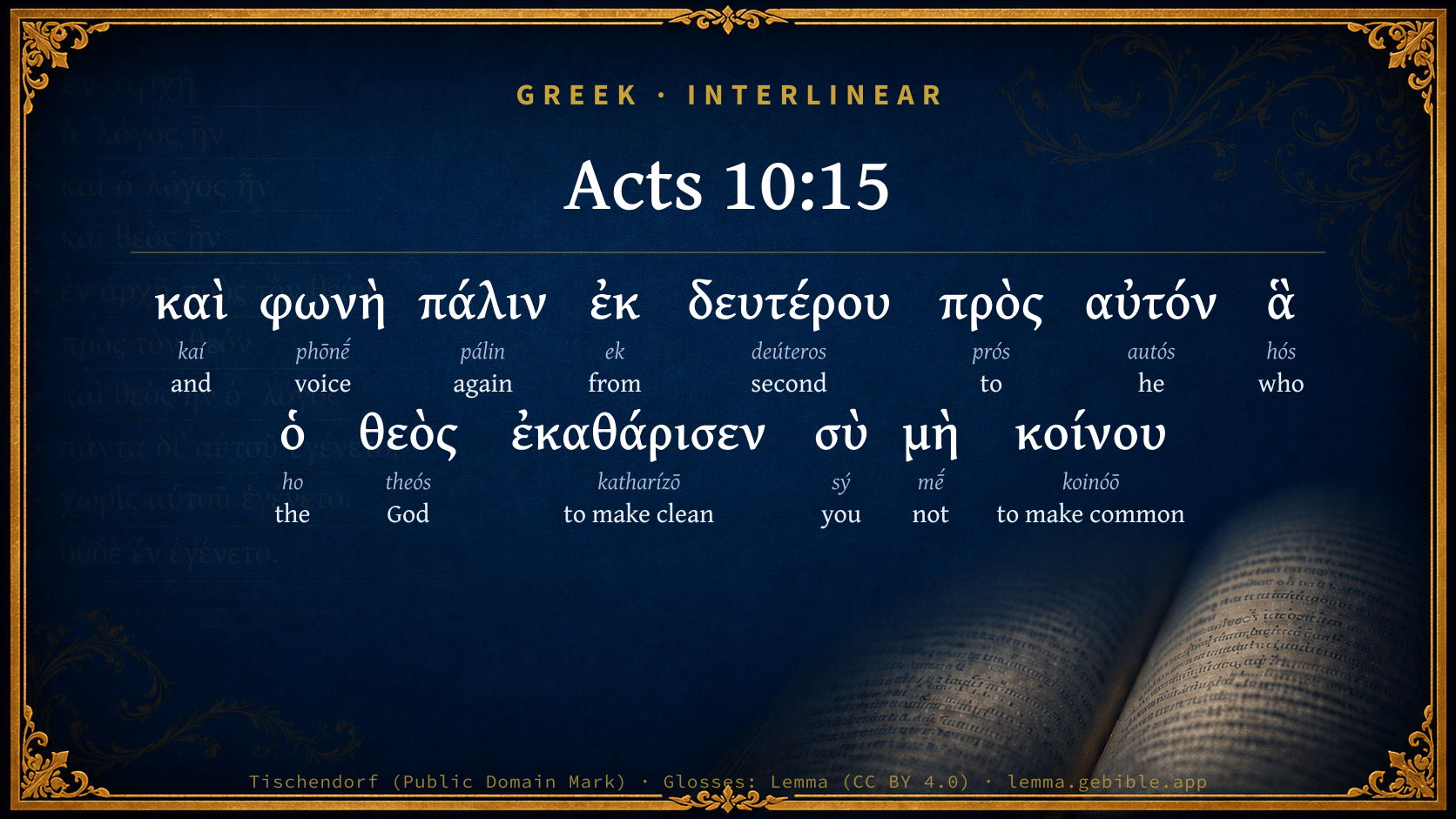
Greek (Tischendorf 8th ed.) Acts 10:15 appears in the Greek New Testament. The text above is from the Tischendorf 8th edition. Each word links to its Strong’s number and a concise gloss. Click any word for its full Thayer’s Greek Lexicon entry.
Download image
Cite this verse

Acts 10:15 (World English Bible). Public Domain. Lemma interlinear Bible study tool, https://lemma.gebible.app/v/acts/10/15.

Show BibTeX & RIS
BibTeX
RIS
English Translation
A voice came to him again the second time, "What God has cleansed, you must not call unclean."
World English Bible · Public Domain
Download a study sheet

One document with this verse’s original text, its word-by-word gloss line, the meaning frame, cross-references with their text, attributed commentary, and full source and license credits — printable, and it pastes into notes with its structure intact.

This verse Autodidact and up

Study sheet (.html) Plain text (.txt)

A passage Seminary Student

Up to 50 verses in one chapter. A passage sheet keeps up to 6 commentary sources and 12 cross-references per verse, in the order this page ranks them, and says so on the sheet whenever that leaves anything out. Ask for a single verse and you get the Autodidact verse sheet above.

Everything on this page stays free to read, with no account — the sheet is a download of what is already on screen, not access to it.

Want to remove ads? Support Godless Engineer
Compare translations 3

The same verse in 3 English versions, stacked beneath the original-language interlinear above. Click any original word for its lexicon entry.

Each is an independent rendering of the whole verse — the interlinear is not word-aligned to these translations.

Highlighted words mark where these versions differ — a whole-verse word diff, not a word-by-word alignment.

  • World English Bible Public Domain
    A voice came to him again the second time, "What God has cleansed, you must not call unclean."
  • King James Version Public Domain
    And the voice spake unto him again the second time, What God hath cleansed, that call not thou common.
  • unfoldingWord Literal Text CC BY-SA 4.0
    And the voice to him again, for a second: “What God has cleansed, you, do not make common.”

unfoldingWord Literal Text — © unfoldingWord, licensed CC BY-SA 4.0. Word-aligned USFM3 via Door43 (git.door43.org/unfoldingWord/en_ult).

Versions to compare (up to 4)

3 of 4 selected

Show all 19 translations

Every available English version of this verse, each an independent rendering of the whole verse.

  • World English Bible Public Domain
    A voice came to him again the second time, "What God has cleansed, you must not call unclean."
  • Berean Standard Bible Public Domain
    The voice spoke to him a second time: “Do not call anything impure that God has made clean.”
  • Majority Standard Bible Public Domain
    The voice spoke to him a second time: “Do not call anything impure that God has made clean.”
  • King James Version Public Domain
    And the voice spake unto him again the second time, What God hath cleansed, that call not thou common.
  • American Standard Version (1901) Public Domain
    And a voice `came' unto him again the second time, What God hath cleansed, make not thou common.
  • Revised Version (1885) Public Domain
    And a voice came unto him again the second time, What God hath cleansed, make not thou common.
  • Geneva Bible (1599) Public Domain
    And the voyce spake vnto him againe the second time, The things that God hath purified, pollute thou not.
  • Douay-Rheims (1899) Public Domain
    And the voice spoke to him again the second time: That which God hath cleansed, do not thou call common.
  • Young's Literal Translation Public Domain
    and `there is' a voice again a second time unto him: `What God did cleanse, thou, declare not thou common;'
  • Literal Standard Version CC BY-SA 4.0
    and [there is] a voice again a second time to him: “What God cleansed, you do not declare common”;
  • Unlocked Literal Bible CC BY-SA 4.0
    But the voice came to him again a second time: “What God has cleansed, do not call it defiled.”
  • unfoldingWord Literal Text CC BY-SA 4.0
    And the voice to him again, for a second: “What God has cleansed, you, do not make common.”
  • Darby Bible Public Domain
    And [there was] a voice again the second time to him, What God has cleansed, do not *thou* make common.
  • World Messianic Bible Public Domain
    A voice came to him again the second time, “What God has cleansed, you must not call unclean.”
  • Webster's Bible Public Domain
    And the voice spoke to him again the second time, What God hath cleansed, that call not thou common.
  • Free Bible Version CC BY-SA 4.0
    He heard the voice speak again, “Don't you call unclean what God has made clean!”
  • Bible in Basic English Public Domain
    And the voice came to him a second time, What God has made clean, do not you make common.
  • Text-Critical English NT CC BY 4.0
    The voice came to him again a second time: “Do not regard as defiled what God has made clean.”
  • Tyndale New Testament (1534) Public Domain
    And the voyce spake vnto him agayne the seconde tyme: what God hath clensed that make thou not comen.

Literal Standard Version (2020), Covenant Press — licensed CC BY-SA 4.0. Text via the HelloAO Bible API (eBible.org). Unlocked Literal Bible (unfoldingWord) — licensed CC BY-SA 4.0. Text via the HelloAO Bible API (eBible.org). unfoldingWord Literal Text — © unfoldingWord, licensed CC BY-SA 4.0. Word-aligned USFM3 via Door43 (git.door43.org/unfoldingWord/en_ult). Free Bible Version, Dr. Jonathan Gallagher — licensed CC BY-SA 4.0. Text via the HelloAO Bible API (eBible.org).

Word by word

More ways to search: Search by grammar → Find every occurrence → Compare this word →

Practice this passage: Drill this verse → Learn its vocabulary →

κοίνου
koinóō
G2840
“to make common”
Verb, Present, Active, Imperative, 2nd person, Singular
Part of Speech
Verb
Tense
Present
Voice
Active
Mood
Imperative
Person
2nd person
Number
Singular
Full Thayer's Definition

Origin: from G2839

TDNT: 16:29,4

1. to make common a. to make (Levitically) unclean, render unhallowed, defile, profane b. to declare or count unclean
  1. καὶ kaí G2532 “and” Conjunction
  2. φωνὴ phōnḗ G5456 “voice” Noun, Nominative, Singular, Feminine
  3. πάλιν pálin G3825 “again” Adverb
  4. ἐκ ek G1537 “from” Preposition
  5. δευτέρου deúteros G1208 “second” Adjective, Genitive, Singular, Neuter
  6. πρὸς prós G4314 “to” Preposition
  7. αὐτόν autós G846 “he” Personal pronoun, Accusative, Singular, Masculine
  8. ἃ hós G3739 “who” Relative pronoun, Accusative, Plural, Neuter
  9. ὁ ho G3588 “the” Article, Nominative, Singular, Masculine
  10. θεὸς theós G2316 “God” Noun, Nominative, Singular, Masculine
  11. ἐκαθάρισεν katharízō G2511 “to make clean” Verb, Aorist, Active, Indicative, 3rd person, Singular
  12. σὺ sý G4771 “you” Personal pronoun, 2nd person, Nominative, Singular
  13. μὴ mḗ G3361 “not” Particle, Negative

About this verse

These counts appear in no published source. They are computed here, from the morphology-tagged text and Lemma’s own curated glosses. What Lemma adds →

14
words
14
distinct lemmas
Acts
section

Notable vocabulary

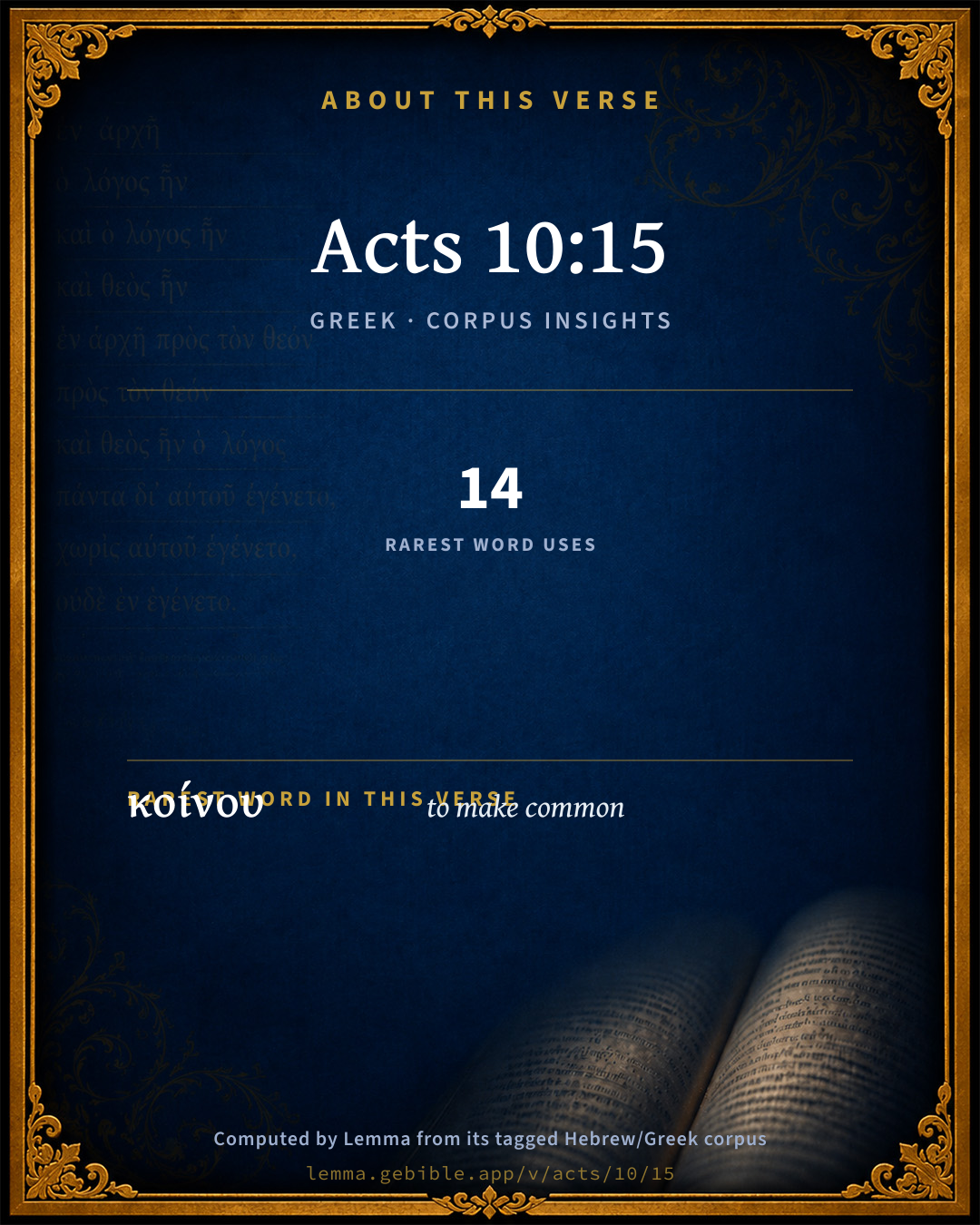
The rarest word here is κοίνου to make common G2840 — appearing just 14 times in the whole Greek New Testament.

Shared distinctive vocabulary

κοίνου to make common G2840 occurs in 11 verses of the Greek New Testament. Also found in:

Cross-references

16

Topical passages linked to Acts 10:15 in the Treasury of Scripture Knowledge — connected by theme and wording, ordered by reader-vote popularity; previews shown in the World English Bible.

  • 1 Corinthians 10:25 Whatever is sold in the butcher shop, eat, asking no question for the sake of conscience,
  • Matthew 15:11 That which enters into the mouth doesn't defile the man; but that which proceeds out of the mouth, this defiles the man."
  • Titus 1:15 To the pure, all things are pure; but to those who are defiled and unbelieving, nothing is pure; but both their mind and their conscience are defiled.
  • Mark 7:19 because it doesn't go into his heart, but into his stomach, then into the latrine, thus making all foods clean?"
  • Romans 14:14 I know, and am persuaded in the Lord Jesus, that nothing is unclean of itself; except that to him who considers anything to be unclean, to him it is unclean.
  • 1 Timothy 4:3–5 forbidding marriage and commanding to abstain from foods which God created to be received with thanksgiving by those who believe and know the truth.
  • Acts 10:28 He said to them, "You yourselves know how it is an unlawful thing for a man who is a Jew to join himself or come to one of another nation, but God has shown me that I shouldn't call any man unholy or unclean.
  • Acts 11:9 But a voice answered me the second time out of heaven, 'What God has cleansed, don't you call unclean.'
  • Acts 15:9 He made no distinction between us and them, cleansing their hearts by faith.
  • Acts 15:20 but that we write to them that they abstain from the pollution of idols, from sexual immorality, from what is strangled, and from blood.
  • Romans 14:20 Don't overthrow God's work for food's sake. All things indeed are clean, however it is evil for that man who creates a stumbling block by eating.
  • Galatians 2:12–13 For before some people came from James, he ate with the Gentiles. But when they came, he drew back and separated himself, fearing those who were of the circumcision.
  • Acts 15:29 that you abstain from things sacrificed to idols, from blood, from things strangled, and from sexual immorality, from which if you keep yourselves, it will be well with you. Farewell."
  • Hebrews 9:9–10 which is a symbol of the present age, where gifts and sacrifices are offered that are incapable, concerning the conscience, of making the worshipper perfect;
  • Revelation 14:14–17 I looked, and behold, a white cloud; and on the cloud one sitting like a son of man, having on his head a golden crown, and in his hand a sharp sickle.
  • Revelation 14:20 The winepress was trodden outside of the city, and blood came out from the winepress, even to the bridles of the horses, as far as one thousand six hundred stadia.

Cross-references courtesy of OpenBible.info (CC BY 4.0).

Commentary

Notes on Acts 10:15 from classic Christian and Jewish commentators (each source and its license shown beneath its notes). The classic Christian expositions comment on the surrounding passage and are grouped to its opening verse, so a note may address several verses; the Jewish commentaries on the Tanakh (Rashi and others) are per-verse, so they appear only where the commentator wrote on this verse.

Lemma curates 59 commentaries, every one of them public domain or Creative Commons licensed, each selected and text-cleaned for this edition rather than reprinted as found. About our sources →

Joseph Benson's Commentary

Act 10:15-16. And the voice spake the second time — When God commands a strange, or seemingly improper thing, the first objection frequently finds pardon. But it ought not to be repeated. This doubt and delay of Peter, however, had several good effects. Hereby the will of God, on this important point, was made more evident and incontestable. And Peter also, having been so slow of belief himself, could the more easily bear the doubting of his brethren, Act 11:2. What God hath cleansed — By such a declaration of his will, in commanding thee to eat them; that call not thou common — But readily submit thyself to his directions, acknowledging the power of the great Lawgiver to change his precepts as he shall see fit. This was done thrice — To make the deeper impression on Peter’s mind. That is, the sheet was drawn up a little way, and let down again a second time, and so the third time, with the same call to him, Kill and eat. But whether Peter’s refusal was repeated the second and third time is not certain; we may suppose it was not, since his objection had the first time received such a satisfactory answer.

Joseph Benson's Commentary on the Old and New Testaments (1811–1818) — public domain. Text from a community e-Sword module.

Bengel's Gnomon

Johann Albrecht Bengel

Act 10:15. Ἐκαθάρισε, hath cleansed) hath made and declared to be clean. For nothing save what is clean (pure) is let down from heaven. Peter continued to remember well this verb: ch. Act 15:9. Comp. as to Paul, ch. Act 13:2, note.—σὺ, thou) who art less than GOD: Act 10:26, ch. Act 11:17.—μὴ κοίνου, do not thou call common) There is no third or middle term between pure (clean) and common.

Bengel's Gnomon of the New Testament — English translation (T&T Clark, Edinburgh, 1860) — public domain. Text from a community e-Sword module.

Expositor's Greek Testament

ed. W. Robertson Nicoll

Act 10:15 . The last word of Act 10:14 carries us back to the thought of the teaching of his Master, which St. Peter had evidently not yet realised, cf. Mar 7:19 . Mark alone draws the inference, “ this He said , making all meats clean,” which, compared with this verse, makes another link of interest between St. Mark and St. Peter. ἐκ δευτ .… ἐτὶ τρίς (only here and in Act 11:10 , in classics εἰς τρίς ), to emphasise the command, cf. Gen 41:32 , “ad confirmationem valuit” Calvin. ἐκαθάρισε , declarative: “de coelo enim nil nisi purum demittitur” Bengel. κοίνου : “make not thou common,” R.V., “as though man by his harsh verdict actually created uncleanness where God had already bestowed His cleansing mercy in Christ” (Rendall). We cannot limit the words, as has been attempted, to the single case of Cornelius, or refer them only to the removal of the distinction between clean and unclean meats.

The Expositor's Greek Testament, edited by W. Robertson Nicoll (1897–1910) — public domain. Text from a community e-Sword module.

Geneva Bible (1599)

Geneva Bible translators

Do not thou hold them as unprofitable.

Geneva Bible (1599) marginal notes — public domain. Text via Bolls.life.

Jamieson, Fausset & Brown

Robert Jamieson, A. R. Fausset & David Brown

What God hath cleansed, that call not thou common--The ceremonial distinctions are at an end, and Gentiles, ceremonially separated from the chosen people (Act 10:28), and debarred from that access to God in the visible ordinances of His Church which they enjoyed, are now on a perfect equality with them.

Jamieson, Fausset & Brown — Commentary Critical and Explanatory on the Whole Bible (1871) — public domain (CC PDM 1.0). Text via the HelloAO Bible API.

Adam Clarke's Commentary

Verse 15. What God hath cleansed] God, who made at first the distinction between Jews and Gentiles, has a right to remove it, whenever and by whatever means he pleases: he, therefore, who made the distinction, for wise purposes, between the clean and the unclean, now pronounces all to be clean. He had authority to do the first; he has authority to do the last. God has purposed that the Gentiles shall have the Gospel preached to them: what he therefore has cleansed, "that call not thou common."

Adam Clarke's Commentary on the Bible (1810–1826) — public domain. Text from a community e-Sword/MySword module.

John Calvin's Commentaries

15. God hath made clean. He speaketh of meats; but this sentence must be extended unto all parts of the life. It is word for word, That which God hath made clean, do not thou make profane; but the sense is, It is not for us to allow or condemn any thing; but as we stand and fall by the judgment of God alone, so is he judge of all things, (Romans 14:4.) As touching meats, after the abrogating of the law, God pronounceth that they are all pure and clean. If, on the other side, there start up a mortal man, making a new difference, forbidding certain, he taketh unto himself the authority and power of God by sacrilegious boldness. Of this stamp were the old heretics, Montanus, Priscillianus, the Donatists, the Tatians, and all the Encratites. Afterwards the Pope, to the end he might bind all those sects in a bundle, made a law concerning meats. And there is no cause why the patrons of this impiety should babble that they do not imagine any uncleanness in meats, but that men are forbidden to eat flesh upon certain days, to tame the flesh. For seeing they eat such meats as are most fit, both for delicacy and also for riot, why do they abstain from eating bacon, as from some great offense, save only because they imagine that that is unclean and polluted which is forbidden by the law of their idol? With like pride doth the tyranny of the Pope rage in all parts of life; for there is nothing wherein he layeth not snares to entangle the miserable consciences of men. But let us trust to the heavenly oracle, and freely despise all his inhibitions. We must always ask the mouth of the Lord, that we may thereby be assured what we may lawfully do; forasmuch as it was not lawful even for Peter to make that profane which was lawful by the Word of God.

Furthermore, this is a place of great importance to beat down the frowardness of men, which they use too much in perverse judgments. There is no man almost which doth not grant liberty to himself to judge of other men’s doings. Now, as we are churlish and malicious, we lean more toward the worse part, so that we take from God that which is his. This voice alone ought to suffice to correct such boldness, That it is not lawful for us to make this or that unclean, but that this power belongeth to God alone. And also in these words is given us to understand, that the Jews were not therefore the holy people of the Lord, because they excelled through their own worthiness, but only by reason of God’s adoption. Now, after that God had received the Gentiles into the society of the covenant, they have all equal right.

John Calvin's Commentaries (1540-1563) — public domain. Text from the Calvin Translation Society English edition (1840s-50s) via the Christian Classics Ethereal Library (ccel.org). Calvin's coverage is partial (roughly two-thirds of the Bible); uncommented books and verses are honest gaps, never fabricated. The 19th-century editor's footnotes and remarks are omitted so the notes are faithfully Calvin's own voice.

Ellicott's Commentary for English Readers

(15) What God hath cleansed, that call not thou common.—In the framework of the vision, the clean and the unclean beasts stood on the same footing, were let down from heaven in the same sheet. That had purified them from whatever taint had adhered to them under the precepts of the Law. In the interpretation of the vision, all that belongs to humanity had been taken up into heaven; first, when man’s nature was assumed by the Eternal Word in the Incarnation (Joh_1:14), and, secondly, when that nature had been raised in the Ascension to the heaven of heavens, sitting on the right hand of God (Act_7:56; Mar_16:19).

A Bible Commentary for English Readers, edited by Charles John Ellicott (1878–1897) — public domain. Text from a community e-Sword module.

The Cambridge Bible for Schools and Colleges

gen. ed. J. J. S. Perowne

15. And the [a] voice spake unto him again the second time] coming from heaven as the first voice had come. There is no verb in the original, and it would perhaps be better to supply “came” rather than “spake.”

What God hath cleansed, that call [make] not thou common] The heaven-sent voice revokes what had been enjoined from heaven at the giving of the Law. The power which made the restriction can remove it. That it would be removed Christ had intimated (Mat_15:11), “Not that which goeth into the mouth defileth a man.” The old dispensation is now to give place to the new, and Peter is taught by the vision that men are not to make such distinctions and separations for themselves. “For meat destroy not the work of God” (Rom_14:20).

The Cambridge Bible for Schools and Colleges (gen. ed. J. J. S. Perowne; Cambridge University Press, 1878–1918) — public domain. Text from a community e-Sword module.

John Gill's Exposition

And the voice spake unto him again the second time,.... The following words,

what God hath cleansed; that is, hath pronounced clean and lawful to be used, as he now had all sorts of food, Mat 15:11.

that call not thou common; or pronounce it to be unholy or unclean, and unlawful to be used: and the same holds good of men, as well as things; for as hereby the Lord instructed Peter, that there was nothing of itself common, or unclean, and unfit for use; so that no man, not any Gentile, Barbarian, Scythian, or be he who he would, was common or unclean, and his company to be avoided as such. Distinctions both of men and meats were now to be laid aside; and the Jews themselves own, that what is now unclean, will be clean in the time to come, or the times of the Messiah; they say (f),

"every beast which is unclean in this world,

the holy blessed God ,

cleanses it, in the time to come, (the times of the Messiah,) as they were at first clean to the sons of Noah Gen 9:3, wherefore, as the herb was clean to all, and as the beasts were clean to the sons of Noah; so also in the time to come he will loose what he has bound, or forbidden.''

And particularly they observe, that a swine is call from "to return", because the Lord will return it unto Israel. (g).

(f) R. Moses Haddarsan in Galatin. l. 11. c. 12. & Bereshit Rabba in Pugio Fidei, c. 12. sect. 1. (g) Abarbinel Rosh Amana, c. 12. fol. 18. 2.

John Gill's Exposition of the Whole Bible (1746–1763) — public domain (CC PDM 1.0). Text via the HelloAO Bible API.

Trapp's Complete Commentary

John Trapp

15 And the voice spake unto him again the second time, What God hath cleansed, that call not thou common.

Ver. 15. That call not thou common] Or profane thou not, συ μη κοινου. {See Trapp on "Act 10:14"}

John Trapp, A Commentary or Exposition upon All the Books of the Old and New Testament (1647–1656) — public domain. Text from a community e-Sword module.

Albert Barnes' Notes on the Bible

What God hath cleansed - What God has pronounced or declared pure. If God has commanded you to do a thing, it is not impure or wrong. Perhaps Peter would suppose that the design of this vision was to instruct him that the distinction between clean and unclean food, as recognized by the Jews, was about to be abolished, Act 10:17. But the result showed that it had a higher and more important design. It was to show him that they who had been esteemed by the Jews as unclean or profane - the entire Gentile world - might now be admitted to similar privileges with the Jews. That barrier was robe broken down, and the whole world was to be admitted to the same fellowship and privileges in the gospel. See Eph 2:14; Gal 3:28. It was also true that the ceremonial laws of the Jews in regard to clean and unclean beasts was to pass away, though this was not directly taught in this vision. But when once the barrier was removed that separated the Jews and Gentiles, all the laws which were founded on such a distinction, and which were framed to keep up such a distinction, passed away of course. The ceremonial laws of the Jews were designed solely to keep up the distinction between them and other nations. When the distinction was abolished; when other nations were to be admitted to the same privileges, the laws which were made to keep up such a difference received their death-blow, and expired of course. For it is a maxim of all law, that when the reason why a law was made ceases to exist, the law becomes obsolete. Yet it was not easy to convince the Jews that their laws ceased to be binding. This point the apostles labored to establish; and from this point arose most of the difficulties between the Jewish and Gentile converts to Christianity. See Acts 15; and Rom. 14–15:

Albert Barnes' Notes on the Bible (1834–1885) — public domain. Text from a community e-Sword/MySword module.

Haydock's Catholic Bible Commentary

God hath purified. Not that the Almighty had already sanctified the Gentiles; but he had called them, that they might become so. He had thrown down the wall of separation, which had stood between Jew and Gentile; he had made one fold to contain all the sheep under one shepherd. Jesus Christ, by his blood, had generally reconciled all mankind to his Father. In this sense all were pure; that is, all had a right, as all were called, to partake of the merits of the Son of God. All had a right to communicate in the truths of the gospel, and in the sacraments, which were the appointed channels, through which the graces and merits of Jesus Christ were applied. (Calmet) --- Here, then, God first announced to Peter, that the time was come to preach to the Gentiles unto salvation, no less than to the Jews; with full freedom to eat all meats, without respect to the prohibition of some made in the old law. (Bristow)

George Leo Haydock (1774–1849), Haydock's Catholic Family Bible and Commentary, 1859 edition — public domain. Excludes Psalms (Douay-Rheims chapter numbering differs from Protestant) and Deuterocanonical books (Catholic canon only).

Matthew Poole's English Annotations

Do not make in thy esteem, or practice, as common, that is, polluted. The Jews did imagine, that by unclean creatures were meant the Gentiles, as by clean creatures they would have themselves to be understood; howsoever, they opposed common unto holy; indeed a holy man is (as they called him) a singular man: it was God that cleansed Cornelius, turning him from idolatry to the worship of the true God, from darkness unto light.

Matthew Poole's English Annotations on the Holy Bible (1683–1685) — public domain. Text from a community e-Sword/MySword module.

Whedon's Commentary on the Bible

Daniel D. Whedon

15. Call not thou common—In the expressive Greek the word for call common is a verb: What God has cleansed common thou not.

Daniel D. Whedon (gen. ed.), Commentary on the Old and New Testaments (1874–1909) — public domain. Text from a community e-Sword module.

The Pulpit Commentary

A voice for the voice, A.V.; came for spake, A.V.; make not for that call not, A.V What God hath cleansed, etc. "The Law was our schoolmaster "tutor," R.V. to bring us to Christ." But now, under the gospel of faith, we are no longer under a schoolmaster. There is neither Jew nor Greek. "Old things are passed away, and all things are become new."

The Pulpit Commentary (1880–1919), ed. H.D.M. Spence-Jones & Joseph S. Exell — public domain. Text from a community e-Sword module.

John Wesley's Explanatory Notes

What God hath purified - Hath made and declared clean. Nothing but what is clean can come down from heaven. St. Peter well remembered this saying in the council at Jerusalem, chap. xv, 9.

John Wesley, Explanatory Notes Upon the Whole Bible (1754–1765) — public domain. Text via the GEBible commentary corpus.

McGarvey & Pendleton's Commentaries

J. W. McGarvey

See notes on verse 9

J. W. McGarvey (with Philip Y. Pendleton), Commentaries on the New Testament (The Fourfold Gospel, 1914; Acts; and the epistles) — public domain. Text from a community e-Sword/MySword module.

Cambridge Greek Testament for Schools and Colleges

15. καὶ φωνὴ πάλιν κ.τ.λ., and a voice came again the second time. As there is no verb in the sentence, ἐγένετο, as in 13, must be supplied. ἐκ δευτέρου defines precisely what was not definite with πάλιν only.

ἃ ὁ θεὸς ἐκαθάρισεν σὺ μὴ κοίνου, what God hath cleansed that make not thou common. The heaven-sent voice revokes what had been enjoined from heaven at the giving of the Law. The power which made the restriction can remove it. That it would be removed Christ had intimated (Mat 15:11), ‘Not that which goeth into the month defileth a man.’ The old dispensation is now to give place to the new, and Peter is taught by the vision that men are not to make such distinctions and separations for themselves. ‘For meat destroy not the work of God’ (Rom 14:20). That the Christian religion was meant to abrogate these ceremonial regulations may be gathered also from Christ’s language (Mar 7:18-19) about that which goeth into a man not defiling him, which He is expressly stated to have spoken, καθαρίζων πάντα τὰ βρώματα, ‘making (or declaring) all meats pure.’

Cambridge Greek Testament for Schools and Colleges (Cambridge University Press, 1896; 21 vols, various authors incl. Carr, Maclear, Plummer, Farrar, Lumby, Moule, M. R. James, Simcox) — public domain. Text from a community e-Sword module.

Alford’s Greek Testament

Henry Alford

15.] These weighty words have more than one application. They reveal what was needed for the occasion, in a figure: God letting down from heaven clean and unclean alike, Jew and Gentile,—represented that He had made of one blood all nations to dwell on the face of all the earth: God having purified these, signified that the distinction was now abolished which was ‘added because of transgressions’ (Gal 3:19),—and all regarded in his eyes as pure for the sake of His dear Son. But the literal truth of the representation was also implied;—that the same distinctions between the animals intended for use as food were now done away, and free range allowed to men, as their lawful wants and desires invite them, over the whole creation of God: that creation itself having been purified and rendered clean for use by the satisfaction of Christ. The same truth which is asserted by the heavenly voice in Peter’s vision, is declared Eph 1:10; Col 1:20; 1Ti 4:4, 1Ti 4:5. Only we must be careful not to confound this restitution with the ἀποκατάστασις πάντων of ch. 3:21; see notes there.

Henry Alford, The Greek Testament (1849–1861) — public domain. Text from a community e-Sword module.

Vincent's Word Studies in the New Testament

Marvin R. Vincent

Call not thou common [συ μη κοινου] . The thought goes deeper than merely styling "common." Lit., do not thou defile. Do not profane it by regarding and calling it common. Rev., "make not thou common."

Marvin R. Vincent, Word Studies in the New Testament (1887–1900) — public domain. Text from a community e-Sword/MySword module.

Lesson kit

Teaching starters — assembled from the data on this page, not authored interpretation. Every prompt links to the verse data it draws on. Edit before teaching.

Acts, in the Acts, opens this verse with 14 words (14 distinct Greek lemmas). Its most distinctive word is koinóō (“to make common”). A historical commentator’s framing appears above. Read the whole chapter for the surrounding context.

Discussion questions

  1. What does “to make common” (koinóō) contribute to the verse as a whole?
  2. Matthew 15:11 shares the word «to make common» with this verse. How do the two illuminate each other?
  3. The translations on this page render this verse differently — a whole-verse word diff, not a word-by-word alignment. What might account for the different wordings?
  4. Reading how Joseph Benson's Commentary and Bengel's Gnomon read this verse, where do the two commentators agree and where do they part?

Things to notice

Reading settings

Reading text

Shown beneath each verse's original-language words.

Old Testament
Old Testament edition

Read the OT as the Masoretic Hebrew (MT) or the Greek Septuagint (LXX).

English shown for the Greek Septuagint (in the Hebrew ↔ Greek comparison).

Comparing translations? Open the Compare panel on any verse page to stack up to four side by side.