
Acts 3:16

Greek (Tischendorf 8th ed.) Acts 3:16 appears in the Greek New Testament. The text above is from the Tischendorf 8th edition. Each word links to its Strong’s number and a concise gloss. Click any word for its full Thayer’s Greek Lexicon entry.
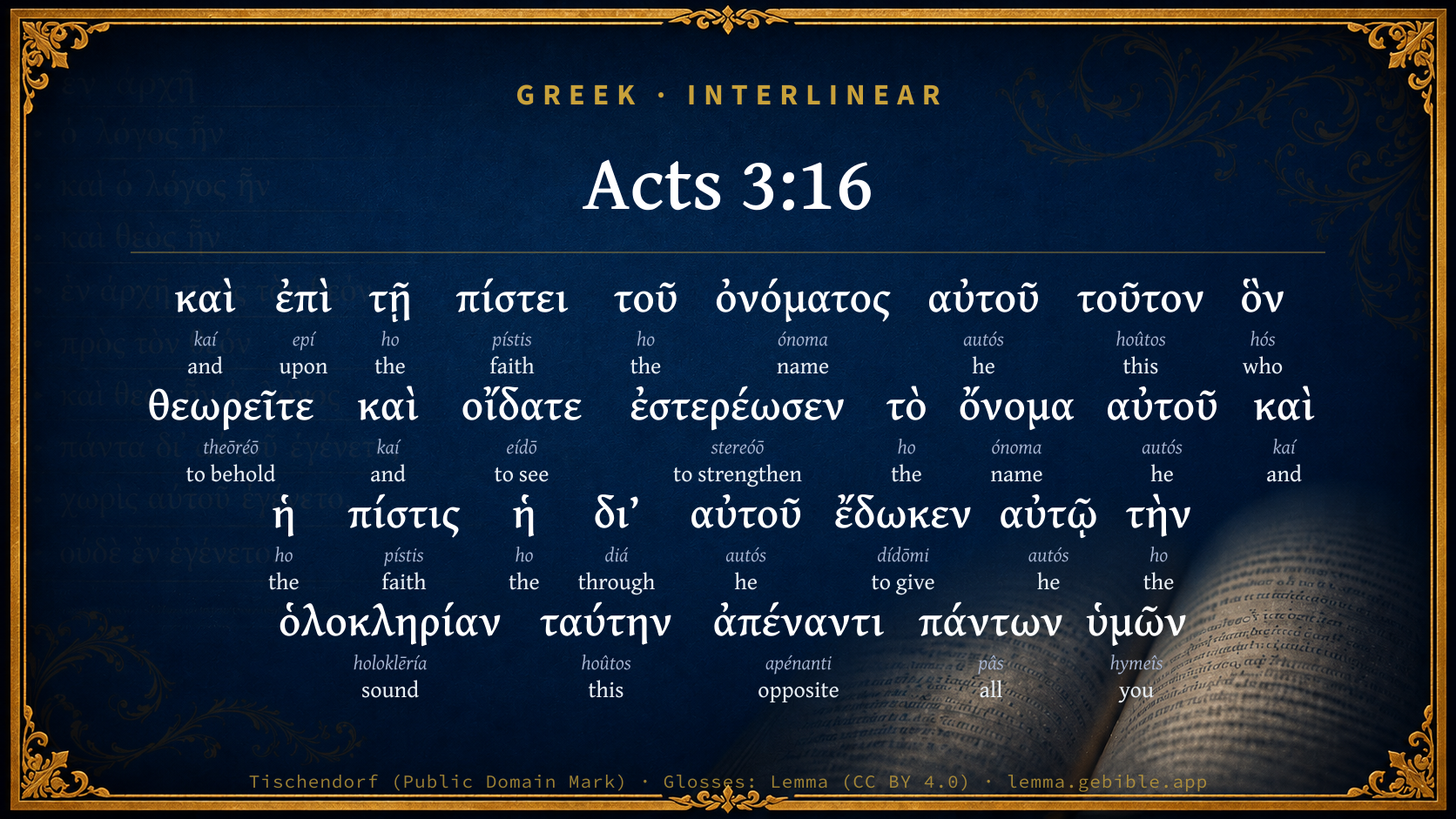
Download image
Cite this verse

Acts 3:16 (World English Bible). Public Domain. Lemma interlinear Bible study tool, https://lemma.gebible.app/v/acts/3/16.

Show BibTeX & RIS
BibTeX
RIS
English Translation
By faith in his name has his name made this man strong, whom you see and know. Yes, the faith which is through him has given him this perfect soundness in the presence of you all.
World English Bible · Public Domain
Highlights
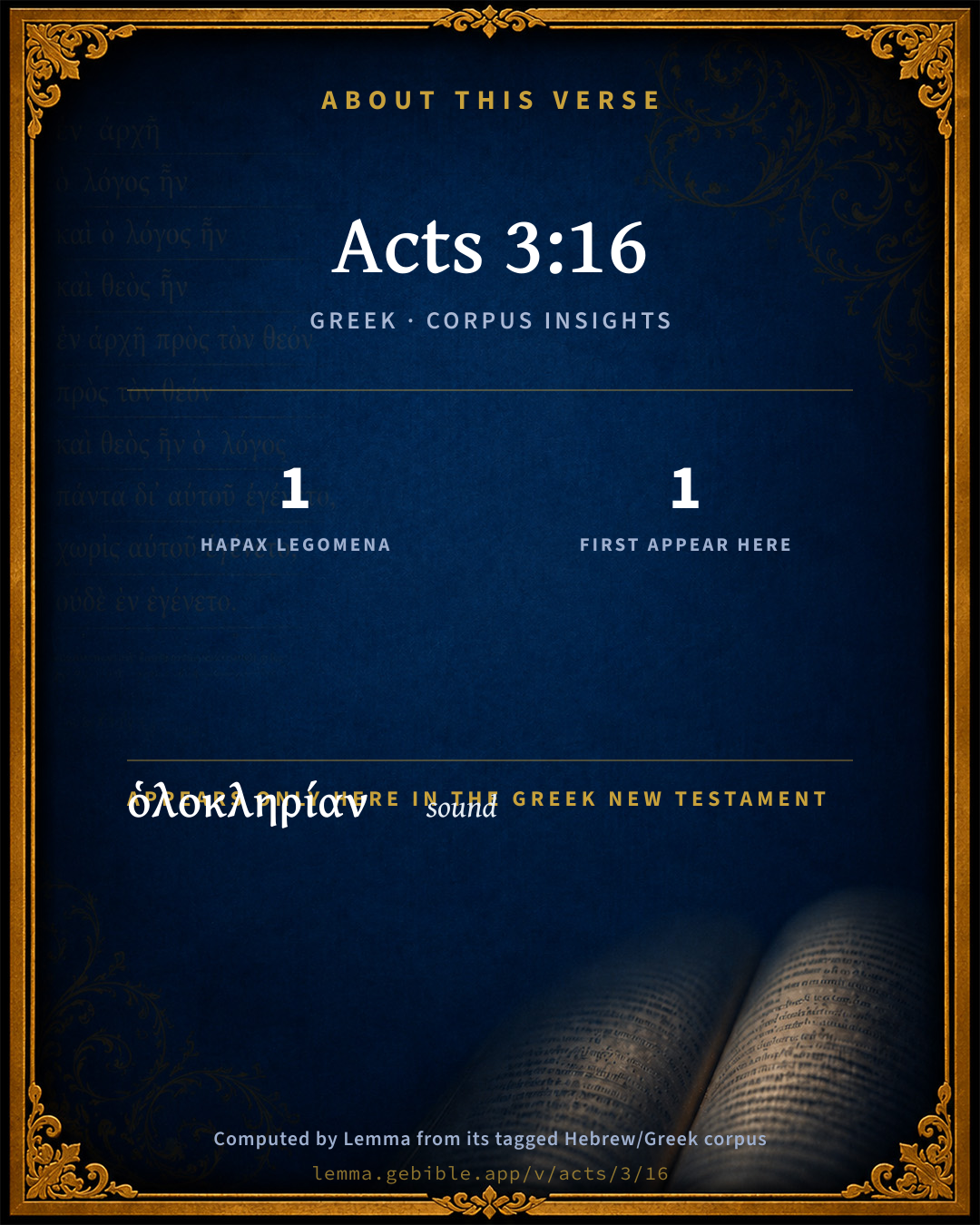
  • 1 hapax legomenon — only here in the Greek New Testament
  • 1 first appearance in the Greek New Testament
Full analysis ↓
Download a study sheet

One document with this verse’s original text, its word-by-word gloss line, the meaning frame, cross-references with their text, attributed commentary, and full source and license credits — printable, and it pastes into notes with its structure intact.

This verse Autodidact and up

Study sheet (.html) Plain text (.txt)

A passage Seminary Student

Up to 50 verses in one chapter. A passage sheet keeps up to 6 commentary sources and 12 cross-references per verse, in the order this page ranks them, and says so on the sheet whenever that leaves anything out. Ask for a single verse and you get the Autodidact verse sheet above.

Everything on this page stays free to read, with no account — the sheet is a download of what is already on screen, not access to it.

Want to remove ads? Support Godless Engineer
Compare translations 3

The same verse in 3 English versions, stacked beneath the original-language interlinear above. Click any original word for its lexicon entry.

Each is an independent rendering of the whole verse — the interlinear is not word-aligned to these translations.

Highlighted words mark where these versions differ — a whole-verse word diff, not a word-by-word alignment.

  • World English Bible Public Domain
    By faith in his name has his name made this man strong, whom you see and know. Yes, the faith which is through him has given him this perfect soundness in the presence of you all.
  • King James Version Public Domain
    And his name through faith in his name hath made this man strong, whom ye see and know: yea, the faith which is by him hath given him this perfect soundness in the presence of you all.
  • unfoldingWord Literal Text CC BY-SA 4.0
    And by faith in his name, this one whom you see and know, his name has made strong. And the faith that through him has given to him this complete health in the presence of all of you.

unfoldingWord Literal Text — © unfoldingWord, licensed CC BY-SA 4.0. Word-aligned USFM3 via Door43 (git.door43.org/unfoldingWord/en_ult).

Versions to compare (up to 4)

3 of 4 selected

Show all 19 translations

Every available English version of this verse, each an independent rendering of the whole verse.

  • World English Bible Public Domain
    By faith in his name has his name made this man strong, whom you see and know. Yes, the faith which is through him has given him this perfect soundness in the presence of you all.
  • Berean Standard Bible Public Domain
    By faith in the name of Jesus, this man whom you see and know has been made strong. It is Jesus’ name and the faith that comes through Him that has given him this complete healing in your presence.
  • Majority Standard Bible Public Domain
    By faith in the name of Jesus, this man whom you see and know has been made strong. It is Jesus’ name and the faith that comes through Him that has given him this complete healing in your presence.
  • King James Version Public Domain
    And his name through faith in his name hath made this man strong, whom ye see and know: yea, the faith which is by him hath given him this perfect soundness in the presence of you all.
  • American Standard Version (1901) Public Domain
    And by faith in his name hath his name made this man strong, whom ye behold and know: yea, the faith which is through him hath given him this perfect soundness in the presence of you all.
  • Revised Version (1885) Public Domain
    And by faith in his name hath his name made this man strong, whom ye behold and know: yea, the faith which is through him hath given him this perfect soundness in the presence of you all.
  • Geneva Bible (1599) Public Domain
    And his Name hath made this man sound, whom ye see, and know, through faith in his Name: and the faith which is by him, hath giuen to him this perfite health of his whole body in the presence of you all.
  • Douay-Rheims (1899) Public Domain
    And in the faith of his name, this man, whom you have seen and known, hath his name strengthened; and the faith which is by him, hath given this perfect soundness in the sight of you all.
  • Young's Literal Translation Public Domain
    and on the faith of his name, this one whom ye see and have known, his name made strong, even the faith that `is' through him did give to him this perfect soundness before you all.
  • Literal Standard Version CC BY-SA 4.0
    and on the faith of His Name, this one whom you see and have known, His Name made strong, even the faith that [is] through Him gave to him this perfect soundness before you all.
  • Unlocked Literal Bible CC BY-SA 4.0
    Now, by faith in his name—this man whom you see and know—this same name made him strong. The faith that is through Jesus gave to him this complete health in the presence of all of you.
  • unfoldingWord Literal Text CC BY-SA 4.0
    And by faith in his name, this one whom you see and know, his name has made strong. And the faith that through him has given to him this complete health in the presence of all of you.
  • Darby Bible Public Domain
    And, by faith in his name, his name has made this [man] strong whom ye behold and know; and the faith which is by him has given him this complete soundness in the presence of you all.
  • World Messianic Bible Public Domain
    By faith in his name, his name has made this man strong, whom you see and know. Yes, the faith which is through him has given him this perfect soundness in the presence of you all.
  • Webster's Bible Public Domain
    And his name, through faith in his name, hath made this man strong, whom ye see and know: yes, the faith which is by him, hath given him this perfect soundness in the presence of you all.
  • Free Bible Version CC BY-SA 4.0
    By trusting in Jesus' name this man was healed by him. You see this man here; you know him. Through trusting in Jesus this man has received complete healing right in front of all of you.
  • Bible in Basic English Public Domain
    And his name, through faith in his name, has made this man strong, whom you see and have knowledge of: yes, the faith which is through him has made him well, before you all.
  • Text-Critical English NT CC BY 4.0
    By faith in his name, his name has given strength to this man whom you see and know, and the faith that is through Jesus has given him this perfect health in the presence of you all.
  • Tyndale New Testament (1534) Public Domain
    And his name thorow the fayth of his name hath made this man sound whom ye se and knowe. And the fayth which is by him hath geven to him this health in the presence of you all.

Literal Standard Version (2020), Covenant Press — licensed CC BY-SA 4.0. Text via the HelloAO Bible API (eBible.org). Unlocked Literal Bible (unfoldingWord) — licensed CC BY-SA 4.0. Text via the HelloAO Bible API (eBible.org). unfoldingWord Literal Text — © unfoldingWord, licensed CC BY-SA 4.0. Word-aligned USFM3 via Door43 (git.door43.org/unfoldingWord/en_ult). Free Bible Version, Dr. Jonathan Gallagher — licensed CC BY-SA 4.0. Text via the HelloAO Bible API (eBible.org).

Word by word

More ways to search: Search by grammar → Find every occurrence → Compare this word →

Practice this passage: Drill this verse → Learn its vocabulary →

ὁλοκληρίαν
holoklēría
G3647
“sound”
Noun, Accusative, Singular, Feminine
Part of Speech
Noun
Case
Accusative
Number
Singular
Gender
Feminine
Full Thayer's Definition

Origin: from G3648

TDNT: 15:47,4

1. of an unimpaired condition of the body, in which all its members are healthy and fit for use a. good health
  1. καὶ kaí G2532 “and” Conjunction
  2. ἐπὶ epí G1909 “upon” Preposition
  3. τῇ ho G3588 “the” Article, Dative, Singular, Feminine
  4. πίστει pístis G4102 “faith” Noun, Dative, Singular, Feminine
  5. τοῦ ho G3588 “the” Article, Genitive, Singular, Neuter
  6. ὀνόματος ónoma G3686 “name” Noun, Genitive, Singular, Neuter
  7. αὐτοῦ autós G846 “he” Personal pronoun, Genitive, Singular, Masculine
  8. τοῦτον hoûtos G3778 “this” Demonstrative pronoun, Accusative, Singular, Masculine
  9. ὃν hós G3739 “who” Relative pronoun, Accusative, Singular, Masculine
  10. θεωρεῖτε theōréō G2334 “to behold” Verb, Present, Active, Indicative, 2nd person, Plural
  11. καὶ kaí G2532 “and” Conjunction
  12. οἴδατε eídō G1492 “to see” Verb, Perfect, Active, Indicative, 2nd person, Plural
  13. ἐστερέωσεν stereóō G4732 “to strengthen” Verb, Aorist, Active, Indicative, 3rd person, Singular
  14. τὸ ho G3588 “the” Article, Nominative, Singular, Neuter
  15. ὄνομα ónoma G3686 “name” Noun, Nominative, Singular, Neuter
  16. αὐτοῦ autós G846 “he” Personal pronoun, Genitive, Singular, Masculine
  17. καὶ kaí G2532 “and” Conjunction
  18. ἡ ho G3588 “the” Article, Nominative, Singular, Feminine
  19. πίστις pístis G4102 “faith” Noun, Nominative, Singular, Feminine
  20. ἡ ho G3588 “the” Article, Nominative, Singular, Feminine
  21. δι’ diá G1223 “through” Preposition
  22. αὐτοῦ autós G846 “he” Personal pronoun, Genitive, Singular, Masculine
  23. ἔδωκεν dídōmi G1325 “to give” Verb, Aorist, Active, Indicative, 3rd person, Singular
  24. αὐτῷ autós G846 “he” Personal pronoun, Dative, Singular, Masculine
  25. τὴν ho G3588 “the” Article, Accusative, Singular, Feminine
  26. ταύτην hoûtos G3778 “this” Demonstrative pronoun, Accusative, Singular, Feminine
  27. ἀπέναντι apénanti G561 “opposite” Adverb
  28. πάντων pâs G3956 “all” Adjective, Genitive, Plural, Masculine
  29. ὑμῶν hymeîs G5210 “you” Personal pronoun, 2nd person, Genitive, Plural

About this verse

These counts appear in no published source. They are computed here, from the morphology-tagged text and Lemma’s own curated glosses. What Lemma adds →

30
words
17
distinct lemmas
Acts
section

Notable vocabulary

1 hapax legomenon — a word that appears only here in the entire Greek New Testament:

  • ὁλοκληρίαν sound G3647

First appearance in Scripture

This word makes its first canonical appearance in the Greek New Testament here:

  • ὁλοκληρίαν sound G3647

Shared distinctive vocabulary

ἐστερέωσεν to strengthen G4732 occurs in 3 verses of the Greek New Testament. Also found in:
Repetition

Words recur within this verse:

  • πίστει faith G4102 ×2
  • ὀνόματος name G3686 ×2
  • τῇ the G3588 ×6
  • αὐτοῦ he G846 ×4
  • καὶ and G2532 ×3
  • τοῦτον this G3778 ×2

Cross-references

19

Topical passages linked to Acts 3:16 in the Treasury of Scripture Knowledge — connected by theme and wording, ordered by reader-vote popularity; previews shown in the World English Bible.

  • Matthew 21:21–22 Jesus answered them, "Most assuredly I tell you, if you have faith, and don't doubt, you will not only do what is done to the fig tree, but even if you told this mountain, 'Be taken up and cast into the sea,' it would be done.
  • Acts 3:6 But Peter said, "Silver and gold have I none, but what I have, that I give you. In the name of Jesus Christ of Nazareth, get up and walk!"
  • Acts 14:9 He was listening to Paul speaking, who, fastening eyes on him, and seeing that he had faith to be made whole,
  • Mark 16:17–18 These signs will accompany those who believe: in my name they will cast out demons; they will speak with new languages;
  • Luke 17:5–6 The apostles said to the Lord, "Increase our faith."
  • Acts 4:10 be it known to you all, and to all the people of Israel, that in the name of Jesus Christ of Nazareth, whom you crucified, whom God raised from the dead, in him does this man stand here before you whole.
  • Acts 16:18 She was doing this for many days. But Paul, becoming greatly annoyed, turned and said to the spirit, "I charge you in the name of Jesus Christ to come out of her!" It came out that very hour.
  • Matthew 9:22 But Jesus, turning around and seeing her, said, "Daughter, cheer up! Your faith has made you well." And the woman was made well from that hour.
  • Mark 11:22–23 Jesus answered them, "Have faith in God.
  • John 14:12 Most assuredly I tell you, he who believes in me, the works that I do, he will do also; and greater works than these will he do; because I am going to my Father.
  • 1 Corinthians 13:2 If I have the gift of prophecy, and know all mysteries and all knowledge; and if I have all faith, so as to remove mountains, but don't have love, I am nothing.
  • Deuteronomy 32:4 The Rock, his work is perfect; For all his ways are justice: A God of faithfulness and without iniquity, Just and right is he.
  • Acts 3:8 Leaping up, he stood, and began to walk. He entered with them into the temple, walking, leaping, and praising God.
  • Acts 4:7 When they had stood them in the middle of them, they inquired, "By what power, or in what name, have you done this?"
  • Acts 19:13–17 But some of the itinerant Jews, exorcists, took on themselves to name over those who had the evil spirits the name of the Lord Jesus, saying, "We adjure you by Jesus whom Paul preaches."
  • Matthew 17:19–20 Then the disciples came to Jesus privately, and said, "Why weren't we able to cast it out?"
  • John 7:23 If a boy receives circumcision on the Sabbath, that the law of Moses may not be broken, are you angry with me, because I made a man every bit whole on the Sabbath?
  • Acts 4:30 while you stretch out your hand to heal; and that signs and wonders may be done through the name of your holy Servant Jesus."
  • Acts 8:14–16 Now when the apostles who were at Jerusalem heard that Samaria had received the word of God, they sent Peter and John to them,

Cross-references courtesy of OpenBible.info (CC BY 4.0).

Commentary

Notes on Acts 3:16 from classic Christian and Jewish commentators (each source and its license shown beneath its notes). The classic Christian expositions comment on the surrounding passage and are grouped to its opening verse, so a note may address several verses; the Jewish commentaries on the Tanakh (Rashi and others) are per-verse, so they appear only where the commentator wrote on this verse.

Lemma curates 59 commentaries, every one of them public domain or Creative Commons licensed, each selected and text-cleaned for this edition rather than reprinted as found. About our sources →

The Biblical Illustrator

Joseph S. Exell

Act_3:16-17

And His name through faith in His name hath made this man strong.

The power of faith

Faith in the name of Jesus is faith in Himself. The result of its exercise here was a manifest continuance of what Jesus began to do in the way of healing, and on the same condition.

I. Faith moved Peter to seek the poor mans good. Faith had united the apostle to the Saviour, and brought him into sympathy with His benevolent designs. The love of Christ still constrains those who enjoy it by faith with like results.

II. Faith enabled peter to pronounce the mans cure. Peter believed the promise, The works that I do shall ye do also; that Jesus, though out of sight, was able and willing to cure the cripple; and, acting under a gracious impulse which that faith secured, he bade the man be whole. It was faith that made this conduct consistent; but without faith it would have been an act of presumption, and even of blasphemy. When God is taken at His word and fully trusted, there is exercised a confidence which enables its possessor to defy all adverse power. This is the faith which overcomes.

III. Faith furnished an evidence of Christianity which even its adversaries were obliged to admit. The cripple had been seen and known, and his cure had taken place in the presence of all. The faith exercised, being invisible, might have been talked of long without becoming the means of any ones full persuasion; but here was an outward and visible sign of the inward and spiritual grace. What could be said against such an evidence? And what can be said at this day against the evidence presented in conversions and holy lives? But to some even this evidence is as nothing. They love not the Lord; they have no sympathy with His gracious purposes; and they lack that spiritual discernment which can come only in connection with the faith which is the evidence of things not seen. (W. Hudson.)

Influence of the name of Christ

While infidelity is boastful, it is refreshing to note such facts as these: Eighty years ago, William Carey wrote from Bengal: The people here hate the very name of Christ, and will not listen when His name is mentioned. To-day the Rev. W. R. James writes from Serampore: By all means see to it that the name of Christ is plainly printed on the title-page of every book or tract that we print. We have now arrived at that point of time in the history of Christian missions in Bengal, when the name of Christ is more of a recommendation to a book than otherwise. Very often have I heard natives ask for a Life of Jesus Christ in preference to any other book.

The influence of faith

Two men are wandering over the mountains in Nevada. They find curious veins running through the rocks One of them studies these veins with the interest of a geologist, and chisels out a few specimens for his cabinet. The other, who is an expert in ores, believes that he has found a silver mine of great richness. When his companion has passed on with his specimens in his pocket, he returns and stakes out a claim. He perfects his title to that claim. He works it, and becomes a millionaire. Now was it the mine that enriched this man or his faith in the mine? Evidently his faith. And so it is the world over. It is not enough to know of a good thing and to be able to grasp it. We must believe in it and take possession of it. There is, of course, no value in faith, if what we believe is worthless, A lunatic, whom we knew years ago, imagined that he was a millionaire. He would take you into his little chamber, and after carefully locking the door, would open drawers full of bits of paper on which he had written figures for various amounts. He would say, Here are bills and bonds worth millions of dollars. When asked why he did not use them to buy what he needed, he would reply, No, no, they are too precious. That mans faith was great, but it was baseless. It was like the faith of worldly men in material things. They are heaping up riches that are as worthless for the soul as his bits of paper were for the wants of this life. Jesus;--The old Greek orators, when they saw their audiences inattentive and slumbering, had one word with which they would rouse them up to the greatest enthusiasm. In the midst of their orations they would stop and cry out, Marathon! and the peoples enthusiasm would be unbounded. My hearers, though you may have been borne down with sin, and though trouble, and trial, and temptation may have come upon you, and you feel hardly like looking up, methinks there is one grand, royal, imperial word that ought to rouse your soul to infinite rejoicing, and that word is Jesus.

Faith in a name

When John Howard wanted to visit the prisons of Russia he sought an interview with the Czar. He explained his object, and the Czar gave him permission to visit any prison in his empire. It was a long and weary journey; he knew how jealously the prisoners were guarded, and how averse the gaolers were to permit any one to visit them. But he set out in perfect confidence. When he arrived at a prison he would make his application, and was prepared for the refusal which invariably came. Then he produced the Czars mandate, and the prison doors were immediately opened to him. He had faith in that name, and it was justified by the results.

But now, brethren, I wot that through ignorance ye did it.--

Apostolic reassurance for the desponding

The apostle seems to say, Ye have rejected Christ, and this is a great evil; ye know not the privilege of faith in Him, and therefore your loss is great; but still do not despair. In order to reassure his hearers he--

I. Reminded them of the Divine origin of the prophecies of the Old Testament. God had shown what the prophets had set forth; the prophets as with one mouth had declared the mind of God; and of every part of revealed truth it was to be remembered that the mouth of the Lord had spoken it. This, in the judgment of a Jew, was a firm, foundation, and this foundation remains to this day. But what was now to be built upon it?

II. Indicated the key-note to which all the prophetic harmonies had been tuned. It was that Christ should suffer. Then it would become evident that salvation through the death of Jesus was not a new doctrine invented by His disciples. One who began to apprehend this would quickly discern new meaning in the leading events of the last few months.

III. Affirmed that God had accomplished His own word in regard to Jesus by unconscious agents. They bad ignorantly pursued Him to the Cross. This was some mitigation of their guilt, though not an excuse for their sin. But in all their error and evil conduct God was bringing His own purpose to pass. The Captain of our salvation was made perfect through suffering, and His death and resurrection made and declared the way of life open to all who should repent and believe. Wicked men had not meant to accomplish this, but God had wrought His sovereign will. Peters hearers must now feel that God had been infinitely better to them than they had been to themselves.

IV. Tenderly hinted that those who, while doing wickedly, had unconsciously fulfilled the will of God were still objects of benevolent concern. Being of the stock of Abraham, they were the children of the covenant. Peters endearing word brethren contained the suggestion of great blessing. There are still those who need encouragement, and this can best be obtained from the Word of God, which sets forth the Saviour of men accessible to all penitent, inquirers. (W. Hudson.)

The guilt of unbelief

1. An act of cruelty excites both compassion for the sufferer and indignation at the actor, and perhaps the latter feeling is the stronger. Your sympathy with the martyr is almost lost in your anger at the persecutor, because, perhaps, you do not make sufficient allowance for him. He may have been acting under a mistaken sense of duty. Whosoever, says our Lord, killeth you shall think he doeth God service. Much, too, may have to be attributed to the temper of the times. Many a man who now only argues against heresy would have been for the stake when the rights of conscience were less understood. Men are apt to condemn the Jews--and very justly--for their crimes, but Jesus said, Father, forgive them, for they know not what they do, and here St. Peter corroborates this. He did not hesitate to charge on them the crime of having killed the Prince of Life, but, as though he feared driving them to despair, he used words which seem in a measure to extenuate their crime. But we shall find that this plea of ignorance does not apply to modern unbelief.

2. What right had Peter to make this allowance? He must be understood to mean that the Jews were not acquainted with the character and dignity of Christ. They did not crucify Him as the Messiah, the Son of God, but as a blasphemous pretender. But were they innocent in that their ignorance was involuntary and unavoidable, arising from the insufficiency of the evidence, or from feebleness of understanding? St. Peter did not imply this, otherwise he had impeached the whole of Christs ministry, and represented His miracles as defective credentials. Undoubtedly the ignorance was blameworthy. They might and ought to have known that Jesus was the Christ, and ignorance is only excusable when we do not wilfully neglect the means of obtaining information or cherish prejudices which bar out the truth. Yet it is probable that we use the Jews too harshly in respect of the crucifixion. It was not in that, but in rejecting the final evidence afforded by the descent and miracles of the Holy Spirit, that they committed the unpardonable sin.

3. It may be strange to us that, though He did so many mighty works, Jesus was rejected by His countrymen. But we do not sufficiently consider their powerful prejudice in favour of a Messiah attended with all the pomp of earthly dominion. It is true they were to blame for cherishing this prejudice, since due search into prophecy would have dispersed it; but it is also true that it was contracted not through shutting their eyes altogether against prophecy, but through fixing them so intently on one part that they overlooked all others. They associated with Christs first coming the characteristics of the second. So, then, the Jew had not sinned against all the evidence that Christ meant to afford--he had sinned against a suffering Redeemer, but not against a triumphant; and so the sin was something that admitted of extenuation--a sin against evidence as yet incomplete. The ignorance was not excusable; it was only not unpardonable.

4. Here comes in the case of modern ignorance and unbelief--the sin of those who, by rejecting Christ, crucify the Son of God afresh. Can the plea of Peter be urged in favour of modern infidels and of those who nominally believe in Christ without the consent of the heart? Remember that the Jew had not the whole of the evidence before him; but we have the whole before us. The Jew crucified Christ whilst His appearance was that of an ordinary man; we crucify Him afresh now that He has assumed His Divine glory. Christ had not then given the most touching proof of His love, nor was it understood even by the apostles that His death was a propitiation; but now the whole plan of redemption is set forth, and we who reject Him crucify afresh a loving Saviour, and one who sends down His Spirit to persuade us to be reconciled. What did the Jew in comparison with this? And how absurd to plead an extenuating ignorance! How can anything be known if this is not? Or, if the ignorance be not impossible--besotted as men are by the cares of the world, or the pleasures of sin--men might, if they would, know what they do. Ignorant they may be, but unavoidably and innocently ignorant they cannot be. Therefore he that believeth not shall be damned. (H. Melvill, B. D.)

In His name

In the New Testament special potency is attributed to the utterance of a name, especially the name of Jesus. Some of these I will enumerate. Jesus promises that He will be with every two or three who assemble in His name (Mat_18:20). He promises to help those who pray in His name (Joh_14:13-14; Joh_15:16; Joh_16:23-24; Joh_16:26). It appears, also, that devils were cast out by the use of the name of Christ. This, at first sight, seems like magic. For magic is essentially this, a power obtained over the supernatural world by the use of charms and talismans. In the story of the Forty Thieves, the door of the cave opened by enchantment to whoever used the right word, and said, Open Sesame, whether it was said by the robbers or by the good man. If, therefore, we believe that by merely putting the word Christ at the beginning or end of our prayer, we shall obtain some blessing from God which He would not otherwise bestow, we degrade Christianity to the level of a magical process and demoralise it. Now, I think it quite clear that the whole spirit of Christianity and teaching of Jesus is utterly opposed to any such magical notions. According to Jesus, men were saved, not by the use of His name as an outward formula, but by obeying His precepts and doing good actions. In the Sermon on the Mount He distinctly rejects any such merely outward use of His name (Mat_7:22-23). Elsewhere He says, Many deceivers shall come in My name. Not every one that saith unto Me, Lord, Lord! shall enter, etc. What, then, does He mean when He says that God will hear us and help us if we pray in His name? To answer this question we must understand the peculiar way in which the Jews regarded the name of any person. A name with us is an arbitrary appendage, having no relation to a mans character. But to the Jew a name carried a mysterious power, expressive of what was deepest in the parents heart, and capable of influencing the childs destiny. If the man or woman appeared to develop new qualities, the name was changed. So Jesus added to Simons name that of Peter--a rock: and Sauls name, which meant a destroyer, was changed to Paul, which means a worker. Thus it happened that to come in the name of any one meant to come in his spirit. So John the Baptist was said by Jesus to be the Elijah that was to come, because he came in the spirit and power of Elijah. When the Lord said to Moses, Thou hast found grace in My sight, and I know thee by name, it means that the Lord knew his character, and that it was equal to his work. Whenever trust in Gods name is spoken of, it means trust in His wisdom, or His love, or His providence. When it is said that a good name is better than riches, it means a good character. When Jesus says that he who receives a prophet in the name of a prophet shall receive a prophets reward, it signifies that he who is in sympathy with the spirit of the prophet, and helps the prophet on that account, shall have the reward of being himself filled with the same prophetic spirit. And so when He tells them to pray in His name, He means to tell them to pray in His Spirit; to cast out devils in His name is to cast them out by the power of a Christian spirit. There are a great many devils in the world--devils of pride, of vanity, of lust, of dishonesty, of falsehood, of cruelty. Now, if we attack these devils in the name of the devil we can do nothing If we meet pride with pride, falsehood with cunning, selfishness with self-will--if we try to put down evil with evil, we shall never succeed. We must cast out devils in the name of Christ--that is, overcome evil with good. There is a wonderful power which belongs to him who allies himself to truth and right. When we overcome evil by good, then only do we cast out devils in the name of Christ. And so, to pray in the name of Christ does not mean to put the name of Christ at the end of our prayer, and say, We ask this through Jesus Christ our Lord; but it means when we pray to be in Christs Spirit; to forget our vanity, selfishness, egotism; to desire the good of others; the coming of Gods kingdom of love. If we pray thus, we may ask what we will and it shall be done unto us, for we shall ask only what God wills. To meet together in the name of Christ means to meet for the purpose of doing good and getting good. Where the spirit of Christianity is there is the coming of Christ. Therefore, when Peter said to the lame man, In the name of Jesus of Nazareth, rise and walk, he did not utter these words as a charm. But he thus openly avowed his faith in the Master he had denied a few weeks before, and the man was healed, not by the magic of words, but by the wonderful power which attends a sincere faith in God. Not the word of Jesus, but the faith in Jesus cured him. Not the word, but the thing, makes the power of Christianity. When I see a man walking the road of duty, faithful to every obligation; true and just, when those around him are false; when I see him hold his principles of honesty, though the world grows dishonest, standing by his purity, no matter what comes; then I say that this man is casting out devils in Christs name. And when I see a youth, beset by temptations from without and within, making a brave struggle to be true to his mothers counsels and his fathers honour, and saying to the Satan who tempts him to go astray, Get thee behind me, I say that this boy also is fighting devils in Christs name. And when I see a young girl in the midst of a happy home, surrounded by love, called to leave life and all its hopes, and go to meet the great mystery, and going tranquilly, peacefully, trustingly, comforting all around her with the comfort wherewith she herself has been comforted by God, I say that she is going to heaven in the strength of Christs name. The name of Christ stands for immortality, for He is the Resurrection and the Life. The name of Jesus Christ means Saviour and King. Jesus means Saviour, Christ means King, and the whole means that He who saves men is the King of men. It means that love is to conquer hatred, that truth is mightier than falsehood, life than death, eternity than time. (J. Freeman Clarke.)

The Biblical Illustrator, edited by Joseph S. Exell (c. 1880s–1900s) — public domain. Text from a community e-Sword module.

MacLaren's Expositions of Holy Scripture

Alexander MacLaren

Acts

‘THEN SHALL THE LAME MAN LEAP AS AN HART’

THE HEALING POWER OF THE NAME

Act 3:16.

Peter said, ‘Why look ye so earnestly on us, as though by our own power or holiness we had made this man to walk?’ eagerly disclaiming being anything else than a medium through which Another’s power operated. Jesus Christ said, ‘That ye may know that the Son of Man hath power on earth to forgive sins, I say unto thee, Arise, take up thy bed, and walk’-unmistakably claiming to be a great deal more than a medium. Why the difference? Jesus Christ did habitually in His miracles adopt the tone on which Moses once ventured when he smote the rock and said, ‘Ye rebels! must we bring the water for you?’ and he was punished for it by exclusion from the Promised Land. Why the difference? Moses was ‘in all his house as a servant, but Christ as a Son over His own house’; and what was arrogance in the servant was natural and reasonable in the Son.

The gist of this verse is a reference to Jesus Christ as a source of miraculous power, not merely because He wrought miracles when on earth, but because from heaven He gave the power of which Peter was but the channel. Now it seems to me that in these emphatic and singularly reduplicated words of the Apostle there are two or three very important lessons which I offer for your consideration.

I. The first is the power of the Name.

Now the Name of which Peter is speaking is not the collocation of syllables which are sounded ‘Jesus Christ.’ His hearers were familiar with the ancient and Eastern method of regarding names as very much more than distinguishing labels. They are, in the view of the Old Testament, attempts at a summary description of things by their prominent characteristics. They are condensed definitions. And so the Old Testament uses the expression, the ‘Name’ of God, as equivalent to ‘that which God is manifested to be.’ Hence, in later days-and there are some tendencies thither even in Scripture-in Jewish literature ‘the Name’ came to be a reverential synonym for God Himself. And there are traces that this peculiar usage with regard to the divine Name was beginning to shape itself in the Church with reference to the name of Jesus, even at that period in which my text was spoken. For instance, in the fifth chapter we read that the Apostles ‘departed from the council rejoicing that they were counted worthy to suffer shame for the Name,’ and we find at a much later date that missionaries of the Gospel are described by the Apostle John as going forth ‘for the sake of the Name.’

The name of Christ, then, is the representation or embodiment of that which Christ is declared to be for us men, and it is that Name, the totality of what He is manifested to be, in which lies all power for healing and for strengthening. The Name, that is, the whole Christ, in His nature, His offices, His work, His Incarnation, His Life, His Death, Resurrection, Session at the right hand of God-it is this Christ whose Name made that man strong, and will make us strong. Brethren, let us remember that, while fragments of the Name will have fragmentary power, as the curative virtue that resides in any substance belongs to the smallest grain of it, if detached from the mass-whilst fragments of the Name of Christ have power, thanks be to Him! so that no man can have even a very imperfect and rudimentary view of what Jesus Christ is and does, without getting strength and healing in proportion to the completeness of his conception, yet in order to realise all that He can be and do, a man must take the whole Christ as He is revealed.

The Early Church had a symbol for Jesus Christ, a fish, to which they were led because the Greek word for a fish is made up of the initials of the words which they conceived to be the Name. And what was it? ‘Jesus Christ, God’s Son, Saviour’; Jesus, humanity; Christ, the apex of Revelation, the fulfilment of prophecy, the Anointed Prophet, Priest, and King; Son of God, the divine nature: and all these, the humanity, the Messiahship, the divinity, found their sphere of activity in the last name, which, without them, would in its fulness have been impossible-Saviour. He is not such a Saviour as He may be to each of us, unless our conception of the Name grasps these three truths: His humanity, His Messiahship, His divinity. ‘His Name has made this man strong.’

II. Notice how the power of the Name comes to operate.

Now, if you will observe the language of my text, you will note that Peter says, as it would appear, the same thing twice over: ‘His Name, through faith in His Name, hath made this man strong.’ And then, as if he were saying something else, he adds what seems to be the same thing: ‘Yea! the faith which is by Him hath given him this perfect soundness.’

Now, note that in the first of these two statements nothing appears except the ‘man,’ the ‘Name,’ and ‘faith’ I take it, though of course it may be questionable, that that clause refers to the man’s faith, and that we have in it the intentional exclusion of the human workers, and are presented with the only two parties really concerned-at the one end the Name, at the other end ‘this man made strong.’ And the link of connection between the two in this clause is faith-that is, the man’s trust. But then, if we come to the next clause, we find that although Peter has just previously disclaimed all merit in the cure, yet there is a sense in which some one’s faith, working as from without, gave to the man ‘this perfect soundness.’ And it seems very natural to me to understand that here, where human faith is represented as being, in some subordinate sense, the bestower of the healing which really the Name had bestowed, it is the faith of the human miracle-worker or medium which is referred to. Peter’s faith did give, but Peter only gave what he had received through faith. And so let all the praise be given to the water, and none to the cup.

Whether that be a fair interpretation of the words of my text, with their singular and apparently meaningless tautology or no, at all events the principle which is involved in the explanation is one that I wish to dwell upon briefly now; and that is, that in order for the Name, charged and supercharged with healing and strengthening power as it is, to come into operation, there must be a twofold trust.

The healer, the medium of healing, must have faith in the Name. Yes! of course. In all regions the first requisite, the one indispensable condition, of a successful propagandist, is enthusiastic confidence in what he promulgates. ‘That man will go far,’ said a cynical politician about one of his rivals; ‘he believes every word he says.’ And that is the condition always of getting other people to believe us. Faith is contagious; men catch from other people’s tongues the accent of conviction. If one wants to enforce any opinion upon others, the first condition is that he shall be utterly sel-oblivious; and when he is manifestly saying, as the Apostles in this context did, ‘Do not fix your eyes on us, as though we were doing anything,’ then hearts will bow before him, as the trees of the wood are bowed by the wind.

If that is true in all regions, it is eminently true in regard to religion. For what we need there most is not to be instructed, but to be impressed. Most of us have, lying dormant in the bedchamber and infirmary of our brains, convictions which only need to be awakened to revolutionise our lives. Now one of the most powerful ways of waking them is contact with any man in whom they are awake. So all successful teachers and messengers of Jesus Christ have had this characteristic in common, however unlike each other they have been. The divergences of temperament, of moods, of point of view, of method of working which prevailed even in the little group of Apostles, and broadly distinguished Paul from Peter, Peter from James, and Paul and Peter and James from John, are only types of what has been repeated ever since. Get together the great missionaries of the Cross, and you would have the most extraordinary collection of miscellaneous idiosyncrasies that the world ever saw, and they would not understand each other, as some of them wofully misunderstood each other when here together. But there was one characteristic in them all, a flaming earnestness of belief in the power of the Name. And so it did not matter much, if at all, what their divergences were. Each of them was fitted for the Master’s use.

And so, brethren, here is the reason-I do not say the only reason, but the main one, and that which most affects us-for the slow progress, and even apparent failure, of Christianity. It has fallen into the hands of a Church that does not half believe its own Gospel. By reason of formality and ceremonial and sacerdotalism and a lazy kind of expectation that, somehow or other, the benefits of Christ’s love can come to men apart from their own personal faith in Him, the Church has largely ceased to anticipate that great things can be done by its utterance of the Name. And if you have, I do not say ministers, or teachers, or official proclaimers, or Sunday-school teachers, or the like, but I say if you have a Church, that is honeycombed with doubt, and from which the strength and flood-tide of faith have in many cases ebbed away, why, it may go on uttering its formal proclamations of the Name till the Day of Judgment, and all that will come of it will be-’The man in whom the devils were, leaped upon them, and overcame them, and said’-as he had a good right to say-’Jesus I know, and Paul I know, but who are ye?’ You cannot kindle a fire with snowballs. If the town crier goes into a quiet corner of the marketplace and rings his bell apologetically, and gives out his message in a whisper, it is small wonder if nobody listens. And that is the way in which too many so-called Christian teachers and communities hold forth the Name, as if begging pardon of the world for being so narrow and old-fashioned as to believe in it still.

And no less necessary is faith on the other side. The recipient must exercise trust. This lame man, no doubt, like the other that Paul looked at in a similar case, had faith to be healed. That was the length of his tether. He believed that he was going to have his legs made strong, and they were made strong accordingly. If he had believed more, he would have got more. Let us hope that he did get more, because he believed more, at a later day. But in the meantime the Apostles’ faith was not enough to cure him; and it is not enough for you that Jesus Christ should be standing with all His power at your elbow, and that, earnestly and enthusiastically, some of Christ’s messengers may press upon you the acceptance of Him as a Saviour. He is of no good in the world to you, and never will be, unless you have the personal faith that knits you to Him.

It cannot be otherwise. Depend upon it, if Jesus Christ could save every one without terms and conditions at all, He would be only too glad to do it. But it cannot be done. The nature of His work, and the sort of blessings that He brings by His work, are such as that it is an impossibility that any man should receive them unless he has that trust which, beginning with the acceptance by the understanding of Christ as Saviour, passes on to the assent of the will, and the outgoing of the heart, and the yielding of the whole nature to Him. How can a truth do any good to any one who does not believe in it? How is it possible that, if you do not take a medicine, it will work? How can you expect to see, unless you open your eyes? How do you propose to have your blood purified, if you do not fill your lungs with air? Is it of any use to have gas-fittings in your house, if they are not connected with the main? Will a water tap run in your sculleries, if there is no pipe that joins it with the source of supply? My dear friend, these rough illustrations are only approximations to the absolute impossibility that Christ can help, heal, or save any man without the man’s personal faith. ‘Whosoever believeth’ is no arbitrary limitation, but is inseparable from the very nature of the salvation given.

III. And now, lastly, note the effects of the power of the Name.

The Apostle puts in two separate clauses what, in the case in hand, was really one thing-’hath made this man strong,’ and ‘hath given him perfect soundness.’ Ah! we can part the two, cannot we? There is the disease, the disease of an alienated heart, of a perverted will, of a swollen self, all of which we need to have cured and checked before we can do right. And there is weakness, the impotence to do what is good, ‘how to perform I find not,’ and we need to be strengthened as well as cured. There is only one thing that will do these two, and that is that Christ’s power, ay, and Christ’s own life, should pass, as it will pass if we trust Him, into our foulness and precipitate all the impurity-into our weakness and infuse strength. ‘A reed shaken with the wind,’ and without substance or solidity to resist, may be placed in what is called a petrifying well, and, by the infiltration of stony substance into its structure, may be turned into a rigid mass, like a little bar of iron. So, if Christ comes into my poor, weak, tremulous nature, there will be an infiltration into the very substance of my being of a present power which will make me strong.

My brother, you and I need, first and foremost, the healing, and then the strength-giving power, which we never find in its completeness anywhere but in Christ, and which we shall always find in Him.

And now notice, Jesus Christ does not make half cures-’this perfect soundness.’ If any man, in contact with Him, is but half delivered from his infirmities and purged from his sins, it is not because Christ’s power is inadequate, but because his own faith is defective.

Christ’s cures should be visible to all around. A man’s own testimony is not the most satisfactory. Peter appeals to the bystanders. ‘You have seen him lying here for years, a motionless lump of mendicancy, at the Temple gate. Now you see him walking and leaping and praising God. Is it a cure, or is it not?’ You professing Christians, would you like to stand that test, to empanel a jury of people that have no sympathy with your religion, in order that they might decide whether you were healed and strengthened or not? It is a good thing for us when the world bears witness that Jesus Christ’s power has come into us, and made us what we are.

And so, dear friends, I lay all these thoughts on your hearts. Christ’s gift is amply sufficient to deliver us from all evils of weakness, sickness, incapacity: to endue us with all gifts of spiritual and immortal strength. But, while the limit of what Christ gives is His boundless wealth, the limit of what you possess is your faith. The rainfall comes down in the same copiousness on rock and furrow, but it runs off the one, having stimulated no growth and left no blessing, and it sinks into the other and quickens every dormant germ into life which will one day blossom into beauty. We are all of us either rock or soil, and which we are depends on the reality, the firmness, and the force of our faith in Christ. He Himself has laid down the principle on which He bestows His gifts when He says, ‘According to thy faith be it unto thee!’

Alexander MacLaren, Expositions of Holy Scripture (1904–1910) — public domain. Text from a community e-Sword module.

Bengel's Gnomon

Johann Albrecht Bengel

Act 3:16. Ἐπὶ τῇ πίστει, [on account of, or] upon the faith) The faith (i.e. faithfulness) of the name of Jesus is an expression drawn from the fact, that this name is a name πιστὸν, faithful, and sure (to be firmly relied on): and to this faith (or faithfulness) corresponds, presently after, the faith which is through (by) Him, viz. the faith which was in Peter, and began to be in the lame man. The correlatives are, the name of Christ, and the faith of the saints.—θεωρεῖτε καὶ οἴδατε) ye see at the present time, ye know as to the past.—τὸ ὄνομα αὐτοῦ, His name) The nominative, instead of the pronoun that, which would have reference to the preceding ὀνόματος, of His name. A similar construction occurs, 2Ch 28:9, “In the wrath of the Lord God of your fathers upon Judah, (the Lord) hath given them into your hand;” 1Sa 24:5, “The heart of David smote him (viz. David);” Deu 9:4, “On account of the wickedness of those nations, God doth destroy them.” By an elegant retrogression [see Append, on Regressus], Peter concludes from the effect to the cause, and with great force mentions (names) name so often.—ἡ διʼ αὐτοῦ, which is by (through) Him) Peter sets down not only the act, but even faith itself, to the account of Christ and His name. Through Christ, our faith is of GOD, and tends to GOD. 1Pe 1:21, “Who by Him do believe in God. etc., that your faith and hope might be in God.”

Bengel's Gnomon of the New Testament — English translation (T&T Clark, Edinburgh, 1860) — public domain. Text from a community e-Sword module.

Meyer's Critical & Exegetical Commentary

Heinrich August Wilhelm Meyer

Act_3:16. Ἐπὶ τῇ πίστει τοῦ ὀνόμ. αὐτοῦ] on account of faith in His name (which we acknowledge as that of the Messiah), i.e. because we believe in His Messiahship. On ἐπί, of the cause on which the fact rests, on the ground, of, see Bernhardy, p. 250; as to the genitive of the object with πίστις, see on Rom_3:22. Othersparticularly Rosenmüller, Heinrichs, and Olshausenunderstand ἐπί of the aim (Lobeck, ad Phryn. p. 475): in order that faith in Jesus may be excited in you (and at the same time in the healed man himself, according to Olshausen). But the very connection of thought is in favour of the first explanation. For καὶ ἐπὶ τῇ πίστει κ.τ.λ. attaches itself closely to the preceding οὗ ἡμεῖς μάρτυρές ἐσμεν; so that Peter, immediately after mentioning the testimony, brings forward the extraordinary efficacy of the faith on which this apostolic testimony is based. Still more decisive is the parallelism of the second clause of the verse, in which the thought of the first clause is repeated emphatically, and with yet more precise definition.

τὸ ὄνομα αὐτοῦ] so far, namely, as the cure was effected by means of His name pronounced, Act_3:6. Observe the weighty repetition and position at the end.

ἡ πίστις ἡ διʼ αὐτοῦ] the faith wrought (in us) through Him. Through Christ was the faith (namely, in Him as the Messiah) wrought in Peter and John (and in the apostles generally), partly by means of His whole manifestation and ministry during His life (Mat_16:16; Joh_1:14), partly by means of the resurrection and effusion of the Spirit. The view which takes πίστις of trust in God brought about through Christ (comp. 1Pe_1:21; Weiss, Petr. Lehrbegr. p. 324; bibl. Theol. p. 139, after de Wette), is not in keeping with the first half of the verse, which has already specifically determined the object of πίστις.

ταύτην] δεικτικῶς. For the bodily soundness of the man, who was present (Act_3:11), was apparent to their eyes. On ὁλοκληρ., comp. Plut. Mor. p.1063 F; Plat. Tim. p. 44 C: ὁλόκληρος ὑγιής τε παντελῶς.

ἀπέναντι πάντ. ὑμ.] corresponds to ὃν θεωρεῖτε in the first clause of the verse. The faith, etc., gave to him this restoration in the presence of you all; so that no other way of its coming to pass was at all to be thought of.

Meyer — Critical and Exegetical Commentary on the New Testament — English translation by Peter Christie, edited by Frederick Crombie (T&T Clark, 1880) — public domain. Text from a community e-Sword module.

Expositor's Greek Testament

ed. W. Robertson Nicoll

Act 3:16 . ἐπὶ : so T.R., and so Weiss and Wendt: “on the ground of faith in His name,” R.V. margin; cf. Luk 5:5 (not expressing the aim as if it meant with a view to faith in His name). But the name is no mere formula of incantation, see Act 19:13 , nor is it used as, in Jewish tradition, the name of God, inscribed on the rod of Moses, was said to have given him power to work his miracles in Egypt and the wilderness, see above on Act 3:5 . On the use of ὄνομα in formulæ of incantation, see Deissmann, Bibelstudien , pp. 25 54. ἡ πίστις ἡ διʼ αὐτοῦ : “the faith which is through Him,” not by it, i.e. , the name not only the healing power is through Christ, but also the faith of the Apostles as of the man who was healed, cf. , especially, 1Pe 1:21 . τοὺς διʼ αὐτοῦ πιστοὺς εἰς Θεόν , i.e. , his converts who through Christ are believers in God: He is the object and the author of our faith, Cf. also Nestle, Expository Times , Feb., 1899, p. 238, and the connection of this phrase with Codex [143] , Act 18:8 , and Act 20:21 (see Blass, l. c. ). ὁλοκληρίαν : only here in N.T., integram sanitatem , Vulgate, but the adjective ὁλόκληρος in an ethical sense, 1Th 5:23 , Jas 1:4 . The noun is only used once in the LXX, and there in a physical sense, Isa 1:6 . The adjective is used by Josephus of a sacrifice complete in all its parts ( integer ), Ant. , iii., 12, 2, cf. its use in Philo., but in LXX, Zach. Act 11:16 , its use in a physical sense is a very doubtful rendering of the Hebrew, see further Trench, N. T. Synonyms , i., 85, and Mayor’s St. James , p. 34. Cf. Plato, Tim. , 44. ὁλόκληρος ὑγιής τε παντελῶς . In Plutarch the noun is joined with ὑγίεια , and also with τοῦ σώματος (Grimm), but whilst the noun does not seem to be used by the strictly medical writers, ὁλόκληρος is frequently used of complete soundness of body (Hobart, Zahn).

[143] Codex Claromontanus (sæc. vi.), a Græco-Latin MS. at Paris, edited by Tischendorf in 1852.

The Expositor's Greek Testament, edited by W. Robertson Nicoll (1897–1910) — public domain. Text from a community e-Sword module.

Geneva Bible (1599)

Geneva Bible translators

Because he believed on him being raised from the dead, whose Name he heard of by us.

Geneva Bible (1599) marginal notes — public domain. Text via Bolls.life.

Jamieson, Fausset & Brown

Robert Jamieson, A. R. Fausset & David Brown

his name, through faith in his name, hath made this man strong, &c.--With what skill does the apostle use the miracle both to glorify his ascended Lord and bring the guilt of His blood more resistlessly home to his audience!

Jamieson, Fausset & Brown — Commentary Critical and Explanatory on the Whole Bible (1871) — public domain (CC PDM 1.0). Text via the HelloAO Bible API.

Adam Clarke's Commentary

Verse 16. And his name] JESUS, the Saviour: through faith in his name, as the Saviour, and author of life, and all its concomitant blessings, such as health, c. It is not quite clear whether the apostles refer to their own faith in Jesus, or to the faith of the lame man. It is true Christ had promised that they should perform miracles in his name, Mar 16:17, Mar 16:18. And that whatsoever they asked of the Father in his name, he would grant it, Joh 16:23. And they might have been led at this time to make request unto God to be enabled to work this miracle and the faith they had in his unlimited power and unchangeable truth might have induced them to make this request. Or, the faith might have been that of the lame man; the apostles, in the time they desired him to look on them, might have taught him the necessity of believing in Christ in order to his healing; and the man's mind might have been prepared for this by the miracle of the gift of tongues, of which he must have heard; and heard that this mighty effusion of the Spirit had come in the name and through the power of Christ. However the faith may be understood, it was only the means to receive the blessing, which the apostles most positively attribute, not to their power or holiness, but to Jesus Christ alone. Faith always receives; never gives.

Adam Clarke's Commentary on the Bible (1810–1826) — public domain. Text from a community e-Sword/MySword module.

John Calvin's Commentaries

16. And in the faith of his name. When as he saith in the faith of his name, and his name; and again, the faith which is by him; this repetition is a token of a fervent affection, for because he was wholly given to set forth the glory of Christ, he beateth in [inculcateth] the same thing oftentimes. Moreover, we see that when Paul is occupied about the showing and setting forth of the grace of Christ, he thinketh that he hath never spoken enough touching the same; and surely such is the wicked nature of men, that Christ cannot be so highly extolled, and so preached, that his honor can remain sound unto him. Let us, therefore, remember that Peter did use such variety and plenty of words, to the end he might stay us in Christ. As touching the phrase, when as he saith, his name in the faith of his name hath strengthened, he showeth both the cause and the manner; the power of Christ had healed the cripple but by faith. When as he saith, the faith which is by him, by this word he signifieth unto us that our faith cannot arise up unto God unless it be grounded in Christ, and se, consequently, that this our faith doth look unto Christ and stay itself upon him, and so he showeth that there cat be no right faith in God when we pass over this mean.

Furthermore, as he said before, that he and the other apostles were witnesses of Christ’s life, so he doth now declare that this life was manifestly proved unto the Jews by a sign or effect, because they see the cripple healed, in whom they had an excellent and evident token of the Divine power of Christ. And when as in this last member he maketh faith the cause of this soundness, he layeth unthankfulness to their charge by the way, unless they give faith her due praise; and although faith may be referred as well unto the man that was healed as unto the apostles, yet we need not to stand much about this manner, because the power of the gospel is set forth by synecdoche.

John Calvin's Commentaries (1540-1563) — public domain. Text from the Calvin Translation Society English edition (1840s-50s) via the Christian Classics Ethereal Library (ccel.org). Calvin's coverage is partial (roughly two-thirds of the Bible); uncommented books and verses are honest gaps, never fabricated. The 19th-century editor's footnotes and remarks are omitted so the notes are faithfully Calvin's own voice.

Ellicott's Commentary for English Readers

(16) His name through faith in his name.—We have, in technical language, the efficient cause distinguished from the indispensable condition of its action. The Name did not work as a formula of incantation; it required, on the part both of the worker and the receiver, faith in that which the Name represented, the manifestation of the Father through the Son.

Hath made this man strong.—The verb is the same as that which had been used in Act_3:7 of the “feet and ankle-bones.” It was Jesus who had given them that new firmness.

The faith which is by him.—The causation of the miracle is carried yet another step backward. The faith which was alike in the healer and in the man healed was itself wrought in each by the power of Christ. The man was first a willing recipient of that faith spiritually, and then was in a state that made him worthy to be a recipient also of the bodily restoration.

This perfect soundness.—Literally, this completeness. This is the only passage in the New Testament in which the word occurs. The cognate adjective is found in the “whole” of 1Th_5:23; the “complete” of Jas_1:4.

A Bible Commentary for English Readers, edited by Charles John Ellicott (1878–1897) — public domain. Text from a community e-Sword module.

The Cambridge Bible for Schools and Colleges

gen. ed. J. J. S. Perowne

16. And his name, &c.] There is more force in retaining the order of the Greek, And through faith in his name, his name hath made strong this man whom ye see and know. This use of name = power, and even as an absolute equivalent for God, is very Jewish; cp. Act_4:12. The usage grew out of such passages as Psa_106:8, “He saved them for His name’s sake.” In the literature of the Jews great power was attributed to the name of God even when only inscribed, e.g. as it was said in tradition to have been on the rod of Moses. By this power he is reported to have wrought the miracles in Egypt and in the wilderness. But St Peter’s language here explains that it is no such power of which he is now speaking, for the name of Jesus does not work the miracle per se but only because of the faith of the believer.

the faith which is by him] St Peter uses the like expression (1Pe_1:21), “You who by Him do believe in God.” Christ is “the author and finisher of our faith.”

The Cambridge Bible for Schools and Colleges (gen. ed. J. J. S. Perowne; Cambridge University Press, 1878–1918) — public domain. Text from a community e-Sword module.

John Gill's Exposition

And his name, through faith in his name,.... That is, the name of Christ, or the power of Christ, through the faith of the apostles in him, while they made use of his name, and said, "in the name of Jesus Christ of Nazareth", &c. Act 3:6 or Christ, through the faith of the lame man in him; and when his name was used in this manner by the apostles; not that either their faith, or his, had any causal influence on the cure, but was the way and means in which they, glorifying Christ, he was pleased to effect this cure:

hath made this man strong; who was before exceeding weak; strengthened the parts that were infirm, his feet and ankles, and consolidated them, so that he could use them, and walk with them:

whom ye see and know; they knew him before, when he was lame, and now knew him to be the same man, and whom they saw now perfectly well; so that they could be appealed to that there was no fraud or imposture in the case:

yea, the faith which is by him; by Christ, of which he is the object, and the author, and finisher: this is repeated out of affection to Christ, and a passionate concern for the glory of his name; or because that faith, in one clause, may regard the faith of the apostles, and in the other, the faith of the man that was cured:

hath given him this perfect soundness in the presence of you all: he had perfect soundness both in body and mind; though the former may chiefly be designed, it being that which was only visible to these persons; and which was done, not in a corner, but publicly, before them all, at the gate of the temple, where the multitude passed to and fro.

John Gill's Exposition of the Whole Bible (1746–1763) — public domain (CC PDM 1.0). Text via the HelloAO Bible API.

Trapp's Complete Commentary

John Trapp

16 And his name through faith in his name hath made this man strong, whom ye see and know: yea, the faith which is by him hath given him this perfect soundness in the presence of you all.

Ver. 16. And his name] That is, Christ himself, as God’s name is often put for God’s self.

John Trapp, A Commentary or Exposition upon All the Books of the Old and New Testament (1647–1656) — public domain. Text from a community e-Sword module.

Albert Barnes' Notes on the Bible

And his name - The “name” of Jesus is here put for Jesus himself, and it is the same as saying “and he,” etc. In this way the word name is often used by the Hebrews, especially when speaking of God, Act 1:15; Act 4:12; Eph 1:21; Rev 3:4. It does not mean that there was any efficacy in the mere name of Jesus that would heal the man, but that it was done by his authority and power.

Through faith in his name - By means of faith in him; that is, by the faith which Peter and John had in Jesus. It does not refer to any faith that the man had himself, for there is no evidence that he believed in him. But it was by means of the faith which the apostles exercised in him that the miracle was performed, and was thus a fulfillment of the declaration in Mat 17:20, “If ye have faith ...ye shall to this mountain, remove hence,” etc. This truth Peter repeats two or three times in the verse to impress it more distinctly on the minds of his hearers.

Whom ye see and know - There could therefore, be no mistake. He was well known to them. There was no doubt about the truth of the miracle Act 4:16, and the only inquiry was in what way it had been done. This Peter affirms to have been accomplished only by the power of the Lord Jesus.

Perfect soundness - ὁλοκληρίαν holoklērian. This word is not used elsewhere in the New Testament. It denotes “integrity of parts, freedom from any defect”; and it here means that the cure was perfect and entire, or that he was completely restored to the use of his limbs.

In the presence of you all - You are all witnesses of it, and can judge for yourselves. This shows how confident the apostles were that a real miracle had been performed. They were willing that it should be examined; and this is conclusive proof that there was no attempt at imposture. A deceiver, or one who pretended to work miracles, would have been cautious of exposing the subject to the danger of detection.

Albert Barnes' Notes on the Bible (1834–1885) — public domain. Text from a community e-Sword/MySword module.

Matthew Poole's English Annotations

His name; his power; for by it he is known, as men or things are by their several names; or the name of Christ is put for Christ himself, as the name of God is put for God commonly.

Through faith in his name; calling by faith on the name of Christ, being thoroughly persuaded that he could and would heal this cripple.

The faith which is by him; not only faith, as on Christ as its object, but by and from Christ as its author; faith being twice made mention of in this cure, there being required faith in Peter to heal, and in the lame man to be healed.

Matthew Poole's English Annotations on the Holy Bible (1683–1685) — public domain. Text from a community e-Sword/MySword module.

Whedon's Commentary on the Bible

Daniel D. Whedon

16. Name—His name as uttered by us was the mediate cause; his divine self, called by that humble name, is the primal, real cause. Jesus was therefore present in the deed and in this assembly.

Through faith—The connecting link between this deed and its divine Author is our faith. The faith of these witnesses renders them receptive of the divine power, and becomes the avenue through which the divine energy streams into them.

By him—Or through him. This faith, though exercised by us, is truly through his beneficence made possible to us.

Presence of you all—Visible to your own eyes is the demonstration of the divine power which we affirm! If this man is sound, Jesus is the risen Messiah! And if Jesus is Messiah, then your Messiah have you murdered!

Daniel D. Whedon (gen. ed.), Commentary on the Old and New Testaments (1874–1909) — public domain. Text from a community e-Sword module.

The Pulpit Commentary

By faith in his Name hath this for his Name through faith in his Name, A.V: the order of the words is changed from that of the A.V, to bring it into accordance with the order of the Greek, but with a great loss of force in English; behold for see, A.V.; through for by, A.V. Yea, the faith; rather, and the faith. The two propositions are not the same. The first affirms that it is the Name of Jesus which has given him strength, objectively; the second that the faith (subjective) which is through or by him hath given him perfect soundness. There is some obscurity in the exact meaning of hJ pistiv hJ di aujtou. Some (see Alford, 1:1) compare 1Pe_1:21, and make God the object of the faith of his witnesses, Peter and John. Others (Meyer) understand that the faith in the Name of Christ was wrought in Peter and John by or through Christ"s ministry and resurrection. But it is much more consonant with other passages (Act_14:9 Act_16:31, etc.; Mat_15:28, etc.) to understand the faith to be that of the man who was healed; and then the phrase, "which is through him," will denote naturally that it was through Jesus Christ that the man"s faith brought him into contact, so to speak, with God who healed him. In the same spirit we read that the lame man "praised God" (vers. 8, 9) for the cure effected through the Name of Jesus Christ; and Peter says (ver. 15), "Whom God raised from the dead. " The interpretation of the phrase hJ di aujtou depends upon whether we supply an active or a passive word. The faith which acts, or works, or moves through him is one way of understanding it; the faith which is wrought or produced through him is the other. The first is preferable. This perfect soundness; pointing to what they saw with their own eyes while the man was leaping and dancing before them (oJloklhria, perfect soundness, used only here in the New Testament; it is a medical term).

The power of faith.

"And his Name," etc.

I THE NAME OF CHRIST THE SOURCE OF THE POWER.

1. His personal merit as Redeemer. He himself worked miracles; not as a mere instrument in the hands of God, but as Divine. When he left the world, he appointed his apostles to be his representatives, giving them all power in heaven and earth in his Name. He ascended to the right hand of God as an accepted Savior, and from thence sends down the gifts.

2. His royalty as Head of the Divine kingdom. The sufferings of the world belong to its state of ruin, though not caused by the sin of the individual. The kingdom of Christ is set up in the midst of the fallen race to bring about "the restitution of all things." The heavens are opened. The light comes down into the darkness.

3. His Name as an object of faith. The spiritual draws up the lower world into itself. To believe is to lay hold of the hand which exalts us. As Peter laid hold of the lame man by the right hand and raised him up, so the representatives of Christ lay hold of a dying world; and whosoever believeth in him shall not perish, but rise with him into a new life.

II THE POWER OF FAITH PUT FORTH.

1. From the Church upon the world. By listening to the world"s cries, and directing the souls of men to the true Help. By taking the sufferers by the hand and calling down upon them the blessing of God. By proclaiming everywhere the gospel of "perfect soundness," in lieu of the world"s false gospels of imperfect remedies, and as a free gift of God to man.

2. From the individual soul upon the life. The apostles represent faith; the lame man, the ruined state of our nature. The living principle implanted by grace works an entire healing of the whole of humanity. Show that all the evils which belong to our life are in some way traceable to the want of faith; that is, of harmony with God. Vital, practical religion lifts up one part of the nature after another. The Christian is the highest style of man. The gospel of the Resurrection preaches a renovation which begins on this side of the grave. The power of the risen Christ works through the whole man; at last gives him perfect soundness. The blessed effect of the Name of Jesus in our heart, in our circumstances, in our family, in our prospects of the future. We cannot receive the special gifts poured out on the early Church, which, in the form they then had, were intended to serve a temporary purpose, but we can receive that "most excellent gift of faith." The Church should not rest satisfied while there is little manifestation of the power of faith in the works accomplished. Why are we content to go to and fro to the temple, and see the wretchedness of fellow-creatures, without attempting to remove it? Why is any enterprise reckoned impossible? No limits to the successes of the Church when she is filled with faith. We want to lead the world "leaping and praising God" into the temple of his truth. We shall do it, not by argument, not by ritual, not by excitement, but by the putting forth of the power of the Holy Ghost. R.

The Pulpit Commentary (1880–1919), ed. H.D.M. Spence-Jones & Joseph S. Exell — public domain. Text from a community e-Sword module.

John Wesley's Explanatory Notes

His name - Himself: his power and love. The faith which is by him - Of which he is the giver, as well as the object.

John Wesley, Explanatory Notes Upon the Whole Bible (1754–1765) — public domain. Text via the GEBible commentary corpus.

Kretzmann's Popular Commentary

Paul E. Kretzmann

The basis of the present facts in prophecy:

v. 16. And His name, through faith in His name, hath made this man strong whom ye see and know; yea, the faith which is by Him hath given him this perfect soundness in the presence of you all.

v. 17. And now, brethren, I wot that through ignorance ye did it, as did also your rulers.

v. 18. But those things which God before had showed by the mouth of all His prophets, that Christ should suffer, He hath so fulfilled.

Peter had preached the Law to the assembled Jews; he had shown them the heinousness of their transgression against their Lord and Savior; he had forced upon them the conviction that they were most seriously guilty in the sight of God. So far as the miracle was now concerned, over which they were so astounded, the explanation was very simple. It had been performed in the name of Jesus, through His power. On the basis of faith in Jesus, by faith in Jesus, His Word and His promise, Mar 16:17-18; Joh 16:23, the name of Christ and the power which is contained in His name had strengthened this cripple whom they saw and knew; that was as far as the participation of the apostles in the miracle was concerned. And as for the lame man, the faith which is through Christ, which is given by Him, had granted to the unfortunate man full and perfect health and strength in the presence of this audience, before their very eyes. The explanation then, briefly, was this: The power, the majesty, of the exalted Christ had worked through the apostles, and the sick man had accepted the gift of health by faith.

So much having been established, Peter now brings the consolation of the Gospel to the sinners. He addresses the people present as brethren. He concedes that their horrible crime was committed because of ignorance, and that their rulers may be excused on the same plea. Their guilt was still there but it was less than if they had committed the crime with full knowledge and deliberate intent. And the counsel and plan of God was thereby carried out. What He had proclaimed in advance through the mouth of all the prophets, namely, that Christ, God’s Christ, must suffer in this manner, had been fulfilled in the Passion of Jesus as it had taken place. In this way only was it possible to deliver Israel and the entire sinful world from all sin and guilt. The blood and death of Jesus is actually the ransom for the sins of the whole world. For since He is the Prince, the Source, the Author of life, it is God’s martyrdom, God’s blood, God’s death which is placed in the balance. And God the Father has accepted the sacrifice, He is reconciled to sinners. This fact He has unmistakably confirmed by raising Jesus from the dead and by glorifying and exalting Him to the right hand of His majesty. All this is heavenly comfort for poor sinners.

Paul E. Kretzmann, Popular Commentary of the Bible (1921–1924) — public domain. Text from a community e-Sword module.

Godbey's Commentary on the New Testament

William B. Godbey

FAITH

16. “And upon the faith of his name, his name hath restored this one whom ye see and know, and faith through him hath given him this soundness in presence of you all.” From this verse it is very clear that the healed cripple was well acquainted with Jesus. He was a mature man in life’s meridian when Jesus began to visit Jerusalem, preach and do His mighty works, as it was His custom to preach all day in the streets of Jerusalem, and go away to Mount Olivet, where from His own testimony He doubtless lodged on the bosom of the earth which He had created, holding secret communion with His Father. In His constant peregrinations hither and thither, from the temple to Mount Olivet and back to the metropolis, He passed through the Beautiful Gate, turning many a loving smile, accompanied by words of truth and wisdom, on the poor beggar. Hence, when Peter commanded him in the name of Jesus of Nazareth to arise and walk, instantaneously his faith took hold on the loving Sympathizer he had so often seen and heard, spiritually apprehending Him as the Omnipotent Healer of that decrepitude which had all his life utterly disqualified him to stand on his feet. Hence, pursuant to his faith in Jesus of Nazareth as the Omnipotent Healer, he leaps instantaneously into perfect restoration. We see from this verse that he was healed by faith in Jesus, who said, “As your faith is, so be it unto you.” This wonderful proclamation, on which hangs the world’s redemption, is as true of the body as the soul. Sure as the infallibility of our Jesus, we receive just what we have faith for, whether involving body or soul. Though the beggar had seen Jesus passing by, day by day, during the three years of his ministry, his healing was reserved for this salient epoch, when it was so much needed to boom the popular faith in the Christhood of the risen Jesus. At the same time we recognize in the flash radiating from the countenances of Peter and John, replete with buoyant faith, and the stentorian voice roaring in his ears, and the herculean grip of Peter’s hand, a potent inspiration to the faith of the cripple, which, responsive to these collateral incentives, leaped at once into electrical activity, apprehending in the humble Nazarene, about whom he had thought so much, the actual Omnipotent Shiloh of prophecy, Christ of God, Redeemer of the world and Healer of the body. Hence, pursuant to his faith, he leaps, skips and runs for the first time in a life of more than forty years.

William B. Godbey, Commentary on the New Testament (1896–1900) — public domain. Text from a community e-Sword module.

McGarvey & Pendleton's Commentaries

J. W. McGarvey

16. But Peter does not stop short with this climax, terminating in the resurrection from the dead. He proceeds to prove his present power and glory by the facts which were then filling them with amazement. (16) " And his name, through faith in his name, has made this man strong, whom ye see and know. Even the faith which is through him, has given him this perfect soundness in the presence of you all. " In this verse, there is one of those repetitions common with extemporaneous speakers, and designed to express more guardedly a thought already uttered. Perhaps the formula employed by Peter in the act of healing, " In the name of Jesus of Nazareth, rise up and walk," suggested to him the phraseology, "his name, through faith in his name, has made this man strong." But lest the superstitious audience might imagine that there was some charm in the mere name of Jesus, a mistake which was afterwards made by certain Jews in Ephesus, he adds, "The faith which is through him has given him this perfect soundness." The faith was not that of the cripple; for it is clear, from the description, that he had no faith. When Peter said to him, "Look on us," the man looked up, expecting to receive alms. And even when Peter told him, in the name of Jesus, to rise up and walk, he did not attempt to move till Peter "took him by the right hand, and lifted him up." He exhibited no faith, either in Jesus, or in Peter's healing power, till after he found himself able to stand and walk. We must locate the faith, therefore, in the apostles; and in this we are sustained by the fact that the exercise of miraculous power, by those in possession of spiritual gifts, was always dependent upon their faith; Peter was empowered to walk upon water; but, when his faith wavered, he began to sink, and Jesus said, "O thou of little faith, wherefore didst thou doubt?" Nine of the apostles, once, having failed to cast out a demon, asked Jesus, "Why could we not cast him out?" He replied, "Because of your unbelief." In answer to their prayers, also, many miracles were wrought, but it was only "the prayer of faith " which could heal the sick.

It must be here observed that faith was necessary to the exercise of spiritual gifts, already imparted, and that no faith, however strong, ever enabled the uninspired to work miracles. The notion, therefore, which has existed in some minds, from time to time, ever since the apostolic period, that if our faith were strong enough, we, too, could work miracles, has as little foundation in scripture as it has in experiment.

J. W. McGarvey (with Philip Y. Pendleton), Commentaries on the New Testament (The Fourfold Gospel, 1914; Acts; and the epistles) — public domain. Text from a community e-Sword/MySword module.

The People's New Testament

B. W. Johnson

16. His name. Not Peter's power, but Christ's name, had done all. Through faith in his name. Not only the faith of Peter and John, but the faith created in the lame man. In an act of faith he was made strong. “The faith alike is in the healer and the healed.”—Plumptree.

B. W. Johnson's The People's New Testament with Notes (1889–1891) — public domain. Electronic text from the Christian Classics Ethereal Library (CCEL) ThML edition.

Cambridge Greek Testament for Schools and Colleges

16. καὶ ἐπὶ τῇ πίστει κ.τ.λ., and on the ground of faith in His name, His name hath made strong this man whom ye see and know. This use of name = power, and even as an absolute equivalent for God, is very Jewish; cf. Act 4:12. The usage grew out of such passages as Psa 106:8, ‘He saved them for His name’s sake.’ In the literature of the Jews great power was attributed to the name of God even when only inscribed, e.g. as it was said in tradition to have been on the rod of Moses. By this power he is reported to have wrought the miracles in Egypt and in the wilderness. But St Peter’s language here explains that it is no such power of which he is now speaking, for the name of Jesus does not work the miracle per se, but only because of the faith of the believer.

For ἐπί = on account of, cf. Luk 5:5, ἐπὶ τῷ ῥήματί σου χαλάσω τὸ δίκτυον = on account of thy bidding. See Winer-Moulton, p. 491, who explains it as = ‘induced by.’

ἡ πίστις ἡ δι’ αὐτοῦ. Cf. the same Apostle’s words (1Pe 1:21), τοὺς δι’ αὐτοῦ πιστοὺς, ‘you who through Him are believers.’ Christ is ‘the author and finisher of our faith.’

ὁλοκληρίαν, complete soundness. The word occurs in the LXX. Isa 1:6, οὐκ ἕστιν ἐν αὐτῷ ὁλοκληρία. Also in later Greek writers, as Plutarch.

Cambridge Greek Testament for Schools and Colleges (Cambridge University Press, 1896; 21 vols, various authors incl. Carr, Maclear, Plummer, Farrar, Lumby, Moule, M. R. James, Simcox) — public domain. Text from a community e-Sword module.

Alford’s Greek Testament

Henry Alford

16.] ἐπὶ τ. πίστει …—The E. V. is right; through, or better, on account of faith in His name. The meaning, for the sake of (i.e. of awakening, in you, and in the lame man himself) faith in his name (Rosenm., Heinrichs, Olsh., Stier), though grammatically justified, seems against the connexion with the μάρτυρές ἐσμεν just before. It is evident to my mind that the πίστις τοῦ ὀν. αὐτ. is the faith of these μάρτυρες. His name (the efficient cause), by means of, or on account of (our) faith in His name (the medium operandi), &c.

ἐστερ. and ἔδωκ. again are historic aorists,—confirmed and gave; better than ‘hath confirmed’ and ‘hath given.’

κ. ἡ πίστις ἡ διʼ αὐτοῦ—and that faith which is wrought by Him—not ‘faith in Him;’ which is an inadmissible rendering. Peter’s own words (ref. 1 Pet.) are remarkably parallel with, and the best interpreters of, this expression: ὑμᾶς τοὺς διʼ αὐτοῦ πιστοὺς εἰς θεόν, τὸν ἐγείραντα αὐτὸν ἐκ νεκρῶν καὶ δόξαν αὐτῷ δόντα, ὥστε τὴν πίστιν ὑμῶν καὶ ἐλπίδα εἶναι εἰς θεόν. Some of the Commentators are anxious to bring in the faith of the lame man himself in this verse. Certainly it is according to analogy to suppose that he had such faith, from and after the words of Peter:—but, as certainly, there is no allusion to it in this verse, and the thread of Peter’s discourse would be broken by any such. It is the firm belief in His name on the part of us His witnesses, of which he is here speaking, as the medium whereby His name (= the Power of the great dignity to which He has been exalted, the ἀρχηγία τῆς ζωῆς) had in this case worked.

Henry Alford, The Greek Testament (1849–1861) — public domain. Text from a community e-Sword module.

Vincent's Word Studies in the New Testament

Marvin R. Vincent

Through faith [επι τη πιστει] Note the article : the faith which we had; not the cripple 's faith, which was not demanded as a condition of his cure. Through faith [επι] is rather on account of, or on the basis of. Rev., by. Compare ch. 2 38; and see on Mt 28:19.

Made strong [εστερεωσε] . See on ver. 7.

Ye see [θεωρειτε] . See on Luk 10:18.

Perfect soundness [ολοκληριαν] . Only here in New Testament. From olov, entire, and klhrov, a lot. Denoting, therefore, the condition of one who has his entire allotment.

Marvin R. Vincent, Word Studies in the New Testament (1887–1900) — public domain. Text from a community e-Sword/MySword module.

Lesson kit

Teaching starters — assembled from the data on this page, not authored interpretation. Every prompt links to the verse data it draws on. Edit before teaching.

Acts, in the Acts, opens this verse with 30 words (17 distinct Greek lemmas). Its most distinctive word is holoklēría (“sound”). A historical commentator’s framing appears above. Read the whole chapter for the surrounding context.

Discussion questions

  1. The word holoklēría carries the sense “sound.” How does it shape the verse?
  2. 1 word here appears nowhere else in the Greek New Testament. Why might the author reach for such rare wording?
  3. This is the first place “sound” appears in Scripture (first appears here). What does its debut here establish?
  4. How does Acts 3:7, which shares the word «to strengthen», read alongside this verse?
  5. What does the repetition of “faith” (2× in this one verse) do in this verse?
  6. The translations on this page render this verse differently — a whole-verse word diff, not a word-by-word alignment. What might account for the different wordings?
  7. Compare how The Biblical Illustrator and MacLaren's Expositions of Holy Scripture read this verse. Where do they agree or differ?

Things to notice

  • 1 word in this verse appears nowhere else in the Greek New Testament.
  • 1 word makes its first canonical appearance in Scripture here.
  • These translations choose different wording for 10 words in this verse.
  • “faith” occurs 2× in this single verse.
  • 17 distinct Greek lemmas span 30 words in this verse.

Reading settings

Reading text

Shown beneath each verse's original-language words.

Old Testament
Old Testament edition

Read the OT as the Masoretic Hebrew (MT) or the Greek Septuagint (LXX).

English shown for the Greek Septuagint (in the Hebrew ↔ Greek comparison).

Comparing translations? Open the Compare panel on any verse page to stack up to four side by side.