
Luke 15:16

Greek (Tischendorf 8th ed.) Luke 15:16 appears in the Greek New Testament. The text above is from the Tischendorf 8th edition. Each word links to its Strong’s number and a concise gloss. Click any word for its full Thayer’s Greek Lexicon entry.
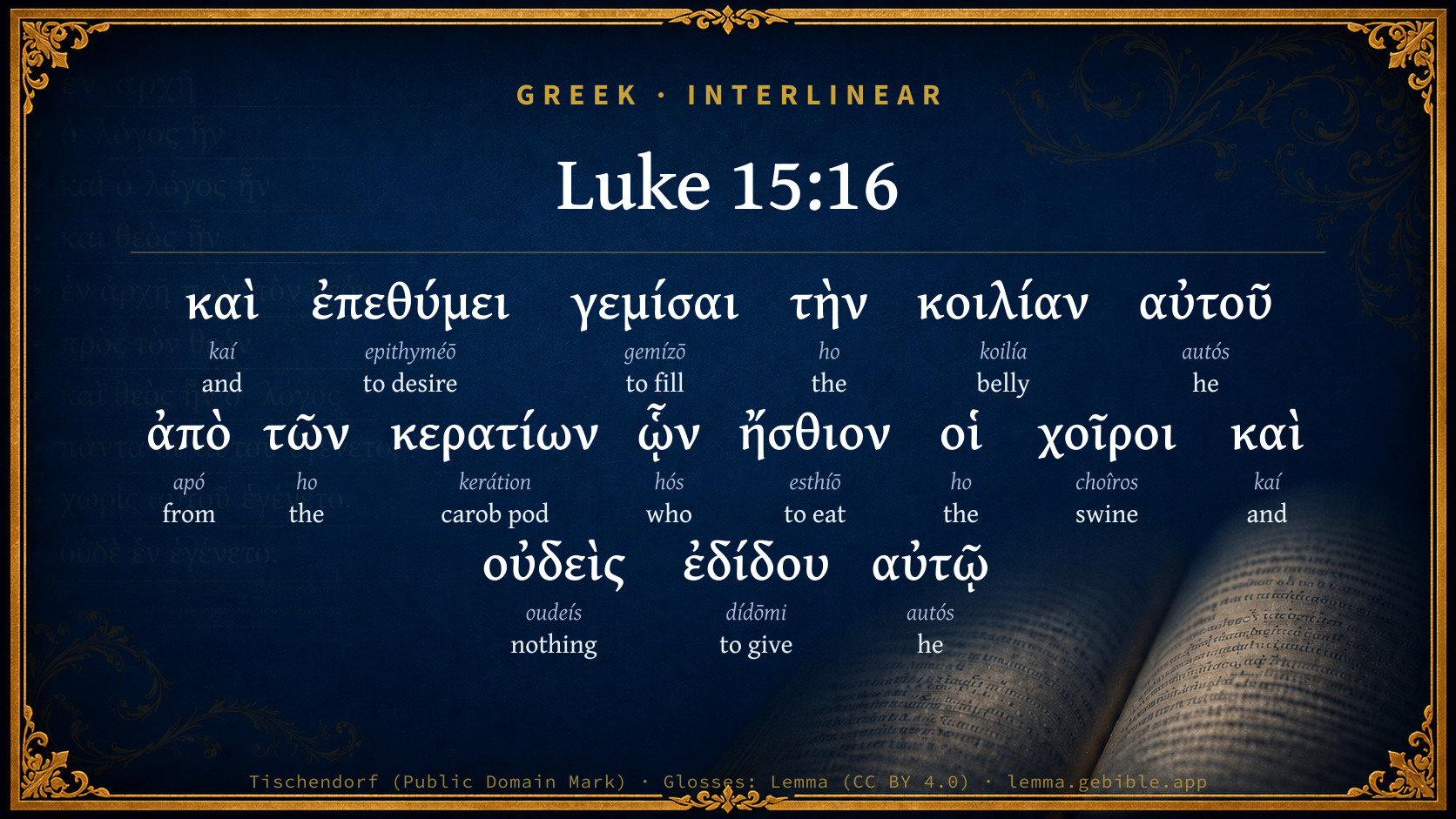
Download image
Cite this verse

Luke 15:16 (World English Bible). Public Domain. Lemma interlinear Bible study tool, https://lemma.gebible.app/v/luke/15/16.

Show BibTeX & RIS
BibTeX
RIS
English Translation
He wanted to fill his belly with the husks that the pigs ate, but no one gave him any.
World English Bible · Public Domain
Highlights
  • 1 hapax legomenon — only here in the Greek New Testament
  • 1 first appearance in the Greek New Testament
Full analysis ↓
Download a study sheet

One document with this verse’s original text, its word-by-word gloss line, the meaning frame, cross-references with their text, attributed commentary, and full source and license credits — printable, and it pastes into notes with its structure intact.

This verse Autodidact and up

Study sheet (.html) Plain text (.txt)

A passage Seminary Student

Up to 50 verses in one chapter. A passage sheet keeps up to 6 commentary sources and 12 cross-references per verse, in the order this page ranks them, and says so on the sheet whenever that leaves anything out. Ask for a single verse and you get the Autodidact verse sheet above.

Everything on this page stays free to read, with no account — the sheet is a download of what is already on screen, not access to it.

Want to remove ads? Support Godless Engineer
Compare translations 3

The same verse in 3 English versions, stacked beneath the original-language interlinear above. Click any original word for its lexicon entry.

Each is an independent rendering of the whole verse — the interlinear is not word-aligned to these translations.

Highlighted words mark where these versions differ — a whole-verse word diff, not a word-by-word alignment.

  • World English Bible Public Domain
    He wanted to fill his belly with the husks that the pigs ate, but no one gave him any.
  • King James Version Public Domain
    And he would fain have filled his belly with the husks that the swine did eat: and no man gave unto him.
  • unfoldingWord Literal Text CC BY-SA 4.0
    And he was longing to be satisfied from the carob pods that the pigs were eating, and no one gave to him.

unfoldingWord Literal Text — © unfoldingWord, licensed CC BY-SA 4.0. Word-aligned USFM3 via Door43 (git.door43.org/unfoldingWord/en_ult).

Versions to compare (up to 4)

3 of 4 selected

Show all 19 translations

Every available English version of this verse, each an independent rendering of the whole verse.

  • World English Bible Public Domain
    He wanted to fill his belly with the husks that the pigs ate, but no one gave him any.
  • Berean Standard Bible Public Domain
    He longed to fill his belly with the pods the pigs were eating, but no one would give him a thing.
  • Majority Standard Bible Public Domain
    He longed to fill his belly with the pods the pigs were eating, but no one would give him a thing.
  • King James Version Public Domain
    And he would fain have filled his belly with the husks that the swine did eat: and no man gave unto him.
  • American Standard Version (1901) Public Domain
    And he would fain have filled his belly with the husks that the swine did eat: and no man gave unto him.
  • Revised Version (1885) Public Domain
    And he would fain have been filled with the husks that the swine did eat: and no man gave unto him.
  • Geneva Bible (1599) Public Domain
    And hee would faine haue filled his bellie with the huskes, that the swine ate: but no man gaue them him.
  • Douay-Rheims (1899) Public Domain
    And he would fain have filled his belly with the husks the swine did eat; and no man gave unto him.
  • Young's Literal Translation Public Domain
    and he was desirous to fill his belly from the husks that the swine were eating, and no one was giving to him.
  • Literal Standard Version CC BY-SA 4.0
    and he was desirous to fill his belly from the husks that the pigs were eating, and no one was giving to him.
  • Unlocked Literal Bible CC BY-SA 4.0
    He would gladly have eaten the carob pods that the pigs ate, because no one gave him anything.
  • unfoldingWord Literal Text CC BY-SA 4.0
    And he was longing to be satisfied from the carob pods that the pigs were eating, and no one gave to him.
  • Darby Bible Public Domain
    And he longed to fill his belly with the husks which the swine were eating; and no one gave to him.
  • World Messianic Bible Public Domain
    He wanted to fill his belly with the pods that the pigs ate, but no one gave him any.
  • Webster's Bible Public Domain
    And he would fain have filled his belly with the husks that the swine did eat; and no man gave to him.
  • Free Bible Version CC BY-SA 4.0
    He was so hungry that he would have eaten even the pig food, but no one gave him anything.
  • Bible in Basic English Public Domain
    And so great was his need that he would have been glad to take the pigs' food, and no one gave him anything.
  • Text-Critical English NT CC BY 4.0
    The young man longed to fill his belly with the carob pods the pigs were eating, but no one gave him anything.
  • Tyndale New Testament (1534) Public Domain
    And he wold fayne have filled his bely with the coddes that the swyne ate: and noo man gave him.

Literal Standard Version (2020), Covenant Press — licensed CC BY-SA 4.0. Text via the HelloAO Bible API (eBible.org). Unlocked Literal Bible (unfoldingWord) — licensed CC BY-SA 4.0. Text via the HelloAO Bible API (eBible.org). unfoldingWord Literal Text — © unfoldingWord, licensed CC BY-SA 4.0. Word-aligned USFM3 via Door43 (git.door43.org/unfoldingWord/en_ult). Free Bible Version, Dr. Jonathan Gallagher — licensed CC BY-SA 4.0. Text via the HelloAO Bible API (eBible.org).

Word by word

More ways to search: Search by grammar → Find every occurrence → Compare this word →

Practice this passage: Drill this verse → Learn its vocabulary →

κερατίων
kerátion
G2769
“carob pod”
Noun, Genitive, Plural, Neuter
Part of Speech
Noun
Case
Genitive
Number
Plural
Gender
Neuter
Full Thayer's Definition

Origin: from a presumed derivative of G2768

TDNT: None

1. a little horn 2. the name of the fruit, Ceratonia silqua or carobtree (called also John's Bread [from the notion that its pods, which resemble those of the "locust", constituted the food of the Baptist]. This fruit was shaped like a horn and has a sweet taste; it was and is used not only for fattening swine, but as an article of food by the lower classes.
  1. καὶ kaí G2532 “and” Conjunction
  2. ἐπεθύμει epithyméō G1937 “to desire” Verb, Imperfect, Active, Indicative, 3rd person, Singular
  3. γεμίσαι gemízō G1072 “to fill” Verb, Aorist, Active, Infinitive
  4. τὴν ho G3588 “the” Article, Accusative, Singular, Feminine
  5. κοιλίαν koilía G2836 “belly” Noun, Accusative, Singular, Feminine
  6. αὐτοῦ autós G846 “he” Personal pronoun, Genitive, Singular, Masculine
  7. ἀπὸ apó G575 “from” Preposition
  8. τῶν ho G3588 “the” Article, Genitive, Plural, Neuter
  9. ᾧν hós G3739 “who” Relative pronoun, Genitive, Plural, Neuter
  10. ἤσθιον esthíō G2068 “to eat” Verb, Imperfect, Active, Indicative, 3rd person, Plural
  11. οἱ ho G3588 “the” Article, Nominative, Plural, Masculine
  12. χοῖροι choîros G5519 “swine” Noun, Nominative, Plural, Masculine
  13. καὶ kaí G2532 “and” Conjunction
  14. οὐδεὶς oudeís G3762 “nothing” Adjective, Nominative, Singular, Masculine, Negative
  15. ἐδίδου dídōmi G1325 “to give” Verb, Imperfect, Active, Indicative, 3rd person, Singular
  16. αὐτῷ autós G846 “he” Personal pronoun, Dative, Singular, Masculine

About this verse

These counts appear in no published source. They are computed here, from the morphology-tagged text and Lemma’s own curated glosses. What Lemma adds →

17
words
13
distinct lemmas
Gospels
section

Notable vocabulary

1 hapax legomenon — a word that appears only here in the entire Greek New Testament:

  • κερατίων carob pod G2769

First appearance in Scripture

This word makes its first canonical appearance in the Greek New Testament here:

  • κερατίων carob pod G2769

Shared distinctive vocabulary

γεμίσαι to fill G1072 occurs in 8 verses of the Greek New Testament. Also found in:
Repetition

Words recur within this verse:

  • τὴν the G3588 ×3
  • καὶ and G2532 ×2
  • αὐτοῦ he G846 ×2

Cross-references

9

Topical passages linked to Luke 15:16 in the Treasury of Scripture Knowledge — connected by theme and wording, ordered by reader-vote popularity; previews shown in the World English Bible.

  • Romans 6:19–21 I speak in human terms because of the weakness of your flesh, for as you presented your members as servants to uncleanness and to wickedness upon wickedness, even so now present your members as servants to righteousness for sanctification.
  • Hosea 12:1 Ephraim feeds on wind, And chases the east wind. He continually multiplies lies and desolation. They make a covenant with Assyria, And oil is carried into Egypt.
  • Psalms 73:22 I was so senseless and ignorant. I was a brute beast before you.
  • Psalms 142:4 Look on my right, and see; For there is no one who is concerned for me. Refuge has fled from me. No one cares for my soul.
  • Isaiah 44:20 He feeds on ashes; a deceived heart has turned him aside; and he can't deliver his soul, nor say, Is there not a lie in my right hand?
  • Isaiah 55:2 Why do you spend money for that which is not bread? and your labor for that which doesn't satisfy? listen diligently to me, and eat you that which is good, and let your soul delight itself in fatness.
  • Isaiah 57:3 But draw near here, you sons of the sorceress, the seed of the adulterer and the prostitute.
  • Lamentations 4:5 Those who did feed delicately are desolate in the streets: Those who were brought up in scarlet embrace dunghills.
  • Jonah 2:2–8 He said, "I called because of my affliction to Yahweh. He answered me. Out of the belly of Sheol I cried. You heard my voice.

Cross-references courtesy of OpenBible.info (CC BY 4.0).

Where the printed editions differ

1 variant

Places in this verse where the major printed Greek editions disagree on the wording in a way that affects the translation — a comparison of editions, not a manuscript-by-manuscript collation. The editions are the modern critical texts (Nestlé-Aland 28/27, SBL, Westcott-Hort, Tregelles, Tyndale House) and the traditional texts behind the KJV (the Textus Receptus and the Byzantine/Majority text). It is not a claim about which reading is original.

  1. Extra text
    κοιλίαν αὐτοῦ

    “stomach of him”

    In SBLTregTRByz Not in NA28NA27TynWH

    κοιλίαν αὐτοῦ (koilian autou) 'stomach of him' is only in traditional manuscripts (SBL+Treg+TR+Byz)

Textual data: Translators Amalgamated Greek New Testament (STEPBible TAGNT) · CC BY 4.0.

Commentary

Notes on Luke 15:16 from classic Christian and Jewish commentators (each source and its license shown beneath its notes). The classic Christian expositions comment on the surrounding passage and are grouped to its opening verse, so a note may address several verses; the Jewish commentaries on the Tanakh (Rashi and others) are per-verse, so they appear only where the commentator wrote on this verse.

Lemma curates 59 commentaries, every one of them public domain or Creative Commons licensed, each selected and text-cleaned for this edition rather than reprinted as found. About our sources →

Whedon's Commentary on the Bible

Daniel D. Whedon

16. Filled his belly—For it is only his animal nature that man in his lost depravity is able to think of feeding or sustaining.

Husks—Rather pods. These were not, as the American reader is apt to imagine, the husks of maize, that is, of Indian corn. They are the fruit of the carob tree, and are from their shape called in the Greek little horns. From the popular notion that they were the food of John the Baptist, they are called St. John’s bread. Dr. Thomson describes them as “fleshy pods somewhat like those of the honey locust tree, from six to ten inches long and one broad, lined inside with a gelatinous substance, not wholly unpleasant to the taste when thoroughly ripe. I have seen large orchards of this Kharub in Cyprus, where it is still the food which the swine do eat. In Syria, where we have no swine, or next to none, the pods are ground up and a species of molasses is made, which is much used in making certain kinds of sweetmeats. In Cyprus, Asia Minor, and the Grecian islands, you will see full grown trees bending under half a ton of green pods.”

The carob fruit is more properly a human food than husks. During famines, such as the prodigal suffered, in countries where the tree grows, it is a sort of support for the people. Unripe, it is slightly astringent to the taste; ripened on the tree, it has a disagreeable odor; but dried on hurdles, it becomes an eatable but not very agreeable article. It is generally abandoned by men to swine and cattle.

No man gave—The question is asked by commentators, why did he not take and eat a share of the pods; inasmuch as he was feeding the swine with them? Some have answered, that he only drove the swine into the fields to feed on grass and herbage, while they were fed on pods at home under the master’s eye. But even then it may be replied that, being on hire, he would be fed at least as well as the swine he tended. To obviate all these difficulties other commentators have supplied anything after gave, and this would make the last clause signify that no man bestowed upon him any relief. But, first, it seems most natural to supply husks as the proper grammatical object of gave; and second, this interpretation still imputes to our Lord the very forced supposition, that the man should not be fed as well as the swine he was hired to herd.

We suggest that the vain desire for the unobtainable pods (including all of Luk_15:16) was a later stage of his history, and after he had been turned out from his swineherdship. It was bad enough to be a swineherd; but while he was a swineherd he could, at any rate, feed with the swine on carobs. It was worse to lose his place, and hunger for the pods he once dispensed to, and shared with, the lowest of animals. Even to feed swine is better than to be vainly ravenous for swine’s fare.

And such are the steps by which vice descends into the depths of degradation and misery. In his father’s house, the prodigal’s heart, soul, and spirit were fed with their high nourishment; with his harlots he descended to the sensual gratification of palate and lust; with the citizen he sunk to sustaining his animal nature with bestial husks; with himself, finally, he arrived at complete starvation. Happily, when the bottom was reached the ascent commenced. Such is not always the case; for beneath this lowest deep there is a lower deep, which has no bottom and admits no ascent.

Daniel D. Whedon (gen. ed.), Commentary on the Old and New Testaments (1874–1909) — public domain. Text from a community e-Sword module.

Bengel's Gnomon

Johann Albrecht Bengel

Luk 15:16. Γεμίσαι, fill) The greater was his emptiness, the greater in proportion was his appetite.—τῶν κερατίων) The Syriac Version has חרובא, from which the opinion seems in part to have originated, and in part is confirmed, namely, that of those who understand the word not of the husks of leguminous plants (pulse, beans, etc.), but of the fruit of the carob tree (“St John’s bread”), called καῤῥουβία (from which comes the French word carrouges), which was the food used by the poorest of men and by swine: as is the view of Maldonatus, Bochart, Drusius, Simonius, and before them, some one or other in the Greek Lexicon brought out by ten writers at Basle, 1584. Add Buxt. Lexicon Talm., who, col. 821, shows that חרוב is a species of tree. No doubt all κεράτια are siliquæ, leguminous plants; whether all siliquæ are to be called by the name, κεράτια, I know not.[162]

[162] i.e. All κεράτια are ‘siliquæ’ no doubt; but the carob is a ‘siliqua’ of a particular species, “Siliqua Græca.” Therefore it is not certain that this particular siliqua was called κεράτια.—E. and T.

Bengel's Gnomon of the New Testament — English translation (T&T Clark, Edinburgh, 1860) — public domain. Text from a community e-Sword module.

Expositor's Greek Testament

ed. W. Robertson Nicoll

Luk 15:16 . ἐπεθύμει , etc., he was fain to fill his belly with the horn-shaped pods of the carob-tree. The point is that he was so poorly fed by his new master (who felt the pinch of hard times, and on whom he had small claim) that to get a good meal of anything, even swine’s food, was a treat. γεμίσαι τ . κ ., though realistic, is redeemed from vulgarity by the dire distress of the quondam voluptuary. Anything to fill the aching void within! οὐδεὶς ἐδίδου , no one was giving him: this his experience from day to day and week to week. Giving what? Not the pods, as many think, these he would take without leave, but anything better. His master gave him little famine rations, and no other kind soul made up for the lack. Neither food nor love abounded in that country. So there was nothing for it but swine’s food or semi-starvation or home!

The Expositor's Greek Testament, edited by W. Robertson Nicoll (1897–1910) — public domain. Text from a community e-Sword module.

Jamieson, Fausset & Brown

Robert Jamieson, A. R. Fausset & David Brown

would fain have filled--rather, "was fain to fill," ate greedily of the only food he could get.

the husks--"the hulls of a leguminous plant which in the East is the food of cattle and swine, and often the nourishment of the poorest in times of distress" [STIER].

no man gave . . . him--not this food, for that he had, but anything better (Jer 30:14). This was his lowest depth--perishing unpitied, alone in the world, and ready to disappear from it unmissed! But this is just the blessed turning-point; midnight before dawn of day (Ch2 12:8; Ch2 33:11-13; Jer 2:19).

Jamieson, Fausset & Brown — Commentary Critical and Explanatory on the Whole Bible (1871) — public domain (CC PDM 1.0). Text via the HelloAO Bible API.

Adam Clarke's Commentary

Verse 16. With the husks] κερατιων. Bochart, I think, has proved that κερατια does not mean husks: to signify which the Greek botanical writers use the word λοβοι; several examples of which he gives from Theophrastus. He shows, also, that the original word means the fruit of the ceratonia or charub tree, which grows plentifully in Syria. This kind of pulse, Columella observes, was made use of to feed swine. See BOCHART, Hieroz. lib. ii. cap. lvi. col. 707-10.

Adam Clarke's Commentary on the Bible (1810–1826) — public domain. Text from a community e-Sword/MySword module.

Ellicott's Commentary for English Readers

(16) He would fain have filled his belly.—It is singular that very many of the best MSS. give the simpler reading, “desired to be filled or satisfied.” It is open to suppose either that they shrank from the reading in the text as too coarse, or that the later MSS. introduced “filled his belly” as more vivid and colloquial; or, as seems probable, that there may have been a variation of phrase even in the original autograph MSS. of St. Luke.

The husks that the swine did eat.—The word is generic, but it is commonly identified with the long bean-like pods of the carob-tree, or Ceratonia siliqua, or St. John’s bread, in which some have seen the “locusts” of Mat_3:4. They contain a good deal of saccharine matter, and are commonly used as food for swine in Syria and Egypt. Spiritually, they answer to the sensual pleasures in which men who are as the swine, identified with brute appetites, find adequate sustenance. The soul that was born to a higher inheritance cannot so satisfy itself. It seeks to be “like a beast with lower pleasures,” but it is part of the Father’s discipline that that baser satisfaction is beyond its reach.

A Bible Commentary for English Readers, edited by Charles John Ellicott (1878–1897) — public domain. Text from a community e-Sword module.

The Cambridge Bible for Schools and Colleges

gen. ed. J. J. S. Perowne

16. he would fain] Literally, “he was longing.”

filled his belly with] The plain expression—purposely adopted to add the last touch to the youth’s degradation—gave offence to some copyists, who substituted for it the verb ‘to be fed.’ The reading adopted in our text is, however, certainly the true one, and perhaps implies that from such food nothing could be hoped for but to allay the pangs of famine. He only hopes to ‘fill his belly,’ not to sate his hunger. Even the world’s utmost gorgeousness and most unchecked sensuality could not avail to raise the soul of men or of nations out of utter misery.

the husks that the swine did eat] Literally, “the carob-pods of which the swine were eating.” The word rendered ‘husks’ means ‘little horns,’ i.e. the long, coarse, sweetish, bean-shaped pods of the carob tree (ceratonia siliqua, St John’s bread tree), which were only used by the poorest of the population. Some (incorrectly) give the same meaning to the ἀκρίδες (‘locusts’) which formed the food of St John the Baptist.

and no man gave unto him] No one ‘was giving,’ or ‘chose to give’ him either the husks or anything else. Satan has no desire for, and no interest in, even the smallest alleviation of the anguish and degradation of his victims. Even the vile earthly gifts, and base sensual pleasures, are withheld or become impossible. “Who follozvs pleasure, pleasure slays.”

The Cambridge Bible for Schools and Colleges (gen. ed. J. J. S. Perowne; Cambridge University Press, 1878–1918) — public domain. Text from a community e-Sword module.

John Gill's Exposition

And he would fain have filled his belly with the husks,.... the fruit of the "Charub" tree, as the Syriac version interprets it; and which the Jews (y) say is , "the food of beasts": though, according to what is elsewhere said of it, it should be the food of men also. It is said (z) of R. Simeon ben Jochai, and his son, that they hid themselves in a cave for fear of the king, and a miracle was wrought for them, , a "Charub" tree was created for them, and a fountain of water; the one, as the gloss observes, was to eat the fruit of, and the other to drink of: but be they what they will, by them are meant, not worldly riches and honours, and carnal lusts and pleasures; though these are the principal things of the far country, of this world, or an unregenerate estate; and are greatly desired by carnal minds, and are but swine's meat, very mean food, yea, pernicious, empty, unsatisfying, and perishing; but these were the things this man had been desirous of, and lived upon before, and had ran through them, and had spent all his substance in the pursuit and enjoyment of them; and now he felt the gripes of a natural conscience for them, and found himself in want of something else: wherefore by these "husks" are meant works of righteousness done by men; which are like husks, external things, done only before men; empty things that have nothing within them; mere trash, and not food; and which can give no satisfaction; mere sordid food, fit only to be cast to dogs or swine; of an ill savour, hard to eat, and difficult digestion, and which affords no real nourishment; these this man greatly desired to fill his belly with: he found himself empty, and in want; as yet he had no thought of, at least not any desire after the bread in his father's house; but would fain have satisfied himself with his own doings, and have quieted his mind and conscience with a few external performances, a negative holiness, a legal repentance, and outward reformation: he laboured hard to make his own righteousness do; which was but striving to fill his belly with the east wind; and is what can never satisfy, because it is not answerable to the law and justice of God; and was no other than

that the swine did eat, self-righteous persons, like himself; for such an one was now the publican and sinner become, though he did not continue so. Christ's lambs and sheep do not eat such food, nor will, nor can they, only swinish, selfish persons; this is suitable to their nature, they eat it, and live upon it; which shows them to be unrenewed, and that their taste is not changed.

And no man gave unto him: not the husks, though this is the sense of the Arabic version, which renders it, "neither did he obtain them"; and so it seems to be ours and others: but these were at hand, which he might have taken himself, and did; nor is it reasonable to think he should wait to have them given him by another; or that he should be restrained from them; but it is to be understood of bread, or proper food, and that no man gave that unto him: and the words, as Calvin observes, may be read causally, "for no man gave to him"; and so are a reason why he craved husks, because no man gave him any bread: the citizen, or legal preacher, to whom he joined himself, gave him none; nor the swine, the self-righteous persons, to whom he was sent, and with whom he conversed, gave him none; he had nothing under the ministry, nor in conversation, that was proper food to him; there were nothing but these husks that presented, and he tried to satisfy himself with them; and indeed none but Christ can give the true bread, the bread of life, to those that are hungry, and in want.

(y) T. Hieros. Maascrot, fol. 50. 2. (z) T. Bab. Sabbat, fol. 33. 2.

John Gill's Exposition of the Whole Bible (1746–1763) — public domain (CC PDM 1.0). Text via the HelloAO Bible API.

Trapp's Complete Commentary

John Trapp

16 And he would fain have filled his belly with the husks that the swine did eat: and no man gave unto him.

Ver. 16. And he would fain have filled his belly] The stomach of man is a monster (saith one), which, being contained in so little a bulk as his body, is able to consume and devour all things.

And no man gave him] A swinish life he had led, and now would have been glad of swine’s meat.

John Trapp, A Commentary or Exposition upon All the Books of the Old and New Testament (1647–1656) — public domain. Text from a community e-Sword module.

Albert Barnes' Notes on the Bible

He would fain - He would gladly. He desired to do it.

The husks - The word “husks” with us denotes the outward covering of grain. In this there is little nourishment, and it is evident that this is not intended here; but the word used here denotes not only “husks,” but also leguminous plants, as beans, etc. It is also used to denote the fruit of a tree called the “carob or kharub-tree,” which is common in Ionia, Syria, and Rhodes. The tree is more bushy and thick set than the apple tree, and the leaves are larger and of a much darker green. The following is Dr. Thomson’s description of the fruit of this tree (“The Land and the Book,” vol. i. p. 22): “The ‘husks’ - a mistranslation - are fleshy pods, somewhat like those of the locust-tree, from six to ten inches long and one broad, laid inside with a gelatinous substance, not wholly unpleasant to the taste when thoroughly ripe. I have seen large orchards of this kharub in Cyprus, where it is still the food which the swine do eat. The kharub is often called John’s Bread, and also Locust-tree, from a mistaken idea about the food of the Baptist in the wilderness.” The cut will give an idea of these “pods,” or “husks,” as they are called in our translation.

No man gave unto him - Some have understood this as meaning “no one gave him anything - any bread or provisions;” but the connection requires us to understand it of the “husks.” He did not go a begging - his master was bound to provide for his wants; but the provision which he made for him was so poor that he would have preferred the food of the swine. He desired a portion of “their food,” but that was not given him. A certain quantity was measured out for “them,” and “he” was not at liberty to eat it himself. Nothing could more strikingly show the evil of his condition, or the deep degradation, and pollution, and wretchedness of sin.

Albert Barnes' Notes on the Bible (1834–1885) — public domain. Text from a community e-Sword/MySword module.

Haydock's Catholic Bible Commentary

Husks. This expresses the extreme misery of his condition. There is no need of seeking any other mystery in this word. Horace, by a kind of hyperbole, (B. ii, Ep. 1.) represents the miser as living upon husks to be able to save more. Vivit siliquis et pane secundo.

--- And no man gave unto him; i.e. gave him bread, mentioned before; for as for the husks, he could take what he pleased. (Witham)

George Leo Haydock (1774–1849), Haydock's Catholic Family Bible and Commentary, 1859 edition — public domain. Excludes Psalms (Douay-Rheims chapter numbering differs from Protestant) and Deuterocanonical books (Catholic canon only).

The Pulpit Commentary

And he would fain have filled his belly with the husks that the swine did eat: and no man gave unto him. So low was this poor lost man reduced, that in his bitter hunger he even came to long for the coarse but nutritious bean with which the herd was fed. These swine were of some value when fattened for the market; but he, the swineherd, was valueless he might starve. The husks in question were the long bean-shaped pods of the carob tree (Caratonia siliqua), commonly used for fattening swine in Syria and Egypt. They contain a proportion of sugar. The very poorest of the population occasionally use them as food.

The Pulpit Commentary (1880–1919), ed. H.D.M. Spence-Jones & Joseph S. Exell — public domain. Text from a community e-Sword module.

John Wesley's Explanatory Notes

He would fain have filled his belly with the husks - He would fain have satisfied himself with worldly comforts. Vain, fruitless endeavour!

John Wesley, Explanatory Notes Upon the Whole Bible (1754–1765) — public domain. Text via the GEBible commentary corpus.

Cambridge Greek Testament for Schools and Colleges

16. γεμίσαι τὴν κοιλίαν αὐτοῦ ἀπό. אBDL, &c. Other MSS. have softened it into χορτασθῆναι ἐκ. See note.

16. ἐπεθύμει. “He was longing.”

γεμίσαι τὴν κοιλίαν αὐτοῦ ἀπὸ … Vulg[291] cupiebat implere ventrem suum. The plain expression—purposely adopted to add the last touch to the youth’s degradation—gave offence to some copyists, who substituted for it the verb ‘to be fed.’ The reading adopted in our text is, however, certainly the true one, and perhaps implies that from such food nothing could be hoped for but to allay the pangs of famine. He only hopes to ‘fill his belly,’ not to sate his hunger. Even the world’s utmost gorgeousness and most unchecked sensuality could not avail to raise the soul of men or of nations out of utter misery.

[291] Vulg. Vulgate.

τῶν κερατίων ὧν ἤσθιον οἱ χοῖροι. “The carob-pods of which the swine were eating.” κεράτια (whence our carat) means ‘little horns,’ i.e. the long, coarse, sweetish, bean-shaped pods of the carob tree (ceratonia siliqua, St John’s bread-tree), which were only used by the poorest of the population. Some (incorrectly) give the same meaning to the ἀκρίδες (‘locusts’) which formed the food of St John the Baptist.

καὶ οὐδεὶς ἐδίδου αὐτῷ. No one ‘was giving,’ or ‘chose to give’ him either the husks or anything else. Satan has no desire for, and no interest in, even the smallest alleviation of the anguish and degradation of his victims. Even the vile earthly gifts, and base sensual pleasures, are withheld or become impossible. “Who follows pleasure, pleasure slays.” When Augustine, Ambrose, Jerome, &c. explain the ‘husks’ to mean ‘secular doctrines’; ‘the famine lack of the word of truth’; the swine ‘demons’ &c., they vulgarise the whole parable, and evaporate its exquisite poetry to leave no residuum but the dull “after-thoughts of theology.”

Cambridge Greek Testament for Schools and Colleges (Cambridge University Press, 1896; 21 vols, various authors incl. Carr, Maclear, Plummer, Farrar, Lumby, Moule, M. R. James, Simcox) — public domain. Text from a community e-Sword module.

Alford’s Greek Testament

Henry Alford

16.] ἐπεθύμει—not merely he desired, see ch. 16:21, where the fact is surely implied that Lazarus did eat of the crumbs. The mistake has arisen from supplying a wrong object to ἐδίδου, and that from misunderstanding κεράτια. ‘These are not the husks or pods of some other fruit, as of peas or beans, but themselves a fruit, that of the carob (or caruba, found not only in the East, but in sough Europe, e.g. in abundance on the Riviera between Nice and Genoa. H. A.) tree (κερατωνία).… They are in shape something like a bean-pod, though larger and more curved, thence called κεράτιον or little horn, … they have a hard dark outside and a dull sweet taste … the shell or pod alone is eaten.’ Trench, Par. in loc. His appetite even drove him to these for food;—for—καί (implying his state of destitution)—no man gave (aught) to him. Meyer, De Wette, Greswell, and others supply κεράτια after ἐδίδου, but wrongly, I think; the absolute use of δίδωμι being very frequent, and the other construction harsh and unusual.

We see him now in the depth of his misery,—the sinner reaping the consequences of his sin in utter shame and extremity of need.

Henry Alford, The Greek Testament (1849–1861) — public domain. Text from a community e-Sword module.

International Critical Commentary

16. ἐπεθύμει χορτασθῆναι. Exactly as in 16:21, of the pangs of hunger. See on 6:21. There is no doubt that χορτασθῆναι (א B D L R) is not a euphemism for γεμίσαι τὴν κοιλίαν αὐτοῦ (A P Q X Γ Δ), but the true reading: cupiebat aturari (d f), con cupiscebat saturari (e). Syr-Sin. supports A.

ἐκ τῶν κερατίων ὧν ἤσθιον οἱ χοῖροι. The pods of the “carob tree,” or “locust tree,” or “John the Baptist’s tree,” or “S. John’s Bread”; so called from the erroneous notion that its pods were the locusts which were the Baptist’s food. The carob tree, ceratonia siliqua, is still common in Palestine and round the Mediterranean. It is sometimes called Siliqua Grœca. But it is rash to assume that the siliquæ of Hor. Ep. ii. 1-123; Pers. iii. 55; Juv. xi. 58, are carob pods (D. B.2 i. p. 1412).1 For the attraction in ὧν see on 3:19.

οὐδεὶς ἐδίδου αὐτῷ. “No one used to give him” even this miserable food, so that the quantity which he got was small. The neighbours cared nothing about this half-starved foreigner, who even in this vile employment could not earn enough to eat.

International Critical Commentary — older volumes (1896–1929), various authors — public domain. Text from a community e-Sword module.

Vincent's Word Studies in the New Testament

Marvin R. Vincent

He would fain [επεθυμει] . Longing desire. Imperfect tense, he was longing, all the while he was tending the swine.

Filled his belly [γεμισαι την κοιλιαν] . The texts vary. The Rev. follows the reading cortasqhnai, "He would fain have been filled," using the same word which is employed by filling those who hunger and thirst after righteousness (Mt 5:6, see note), and of the five thousand (Mt 14:20). He had wanted the wrong thing all along, and it was no better now. All he wanted was to fill his belly.

Husks [κερατιων] . Carob - pods. The word is a diminutive of kerav, a horn, and means, literally, a little horn, from the shape of the pod. The tree is sometimes called in German Bockshornbaum, Goat 's - horn - tree. "The fleshy pods are from six to ten inches long, and one broad, lined inside with a gelatinous substance, not wholly unpleasant to the taste when thoroughly ripe" (Thomson, "Land and Book "). The shell or pod alone is eaten. It grows in Southern Italy and Spain, and it is said that during the Peninsular War the horses of the British cavalry were often fed upon the pods. It is also called Saint John's bread, from a tradition that the Baptist fed upon its fruit in the wilderness. Edersheim quotes a Jewish saying," When Israel is reduced to the carob - tree, they become repentant. "

Marvin R. Vincent, Word Studies in the New Testament (1887–1900) — public domain. Text from a community e-Sword/MySword module.

Lesson kit

Teaching starters — assembled from the data on this page, not authored interpretation. Every prompt links to the verse data it draws on. Edit before teaching.

Luke, in the Gospels, opens this verse with 17 words (13 distinct Greek lemmas). Its most distinctive word is kerátion (“carob pod”). A historical commentator’s framing appears above. Read the whole chapter for the surrounding context.

Discussion questions

  1. How does “carob pod” (kerátion) shape what this verse is saying?
  2. This verse holds 1 word here found nowhere else in the Greek New Testament. What might the rare word draw attention to?
  3. The word “carob pod” first appears here in Scripture. What is being introduced at this debut?
  4. Mark 4:37 shares the word «to fill» with this verse. How do the two illuminate each other?
  5. “the” occurs 3× in this one verse. What is the effect of the repetition?
  6. These translations render this verse differently; the difference is in the English rendering, not the original. What questions does that raise?
  7. Reading how Whedon's Commentary on the Bible and Bengel's Gnomon read this verse, where do the two commentators agree and where do they part?

Things to notice

  • 1 word in this verse appears nowhere else in the Greek New Testament.
  • 1 word makes its first canonical appearance in Scripture here.
  • These translations choose different wording for 21 words in this verse.
  • “the” occurs 3× in this single verse.
  • 13 distinct Greek lemmas span 17 words in this verse.

Reading settings

Reading text

Shown beneath each verse's original-language words.

Old Testament
Old Testament edition

Read the OT as the Masoretic Hebrew (MT) or the Greek Septuagint (LXX).

English shown for the Greek Septuagint (in the Hebrew ↔ Greek comparison).

Comparing translations? Open the Compare panel on any verse page to stack up to four side by side.