Acts 10:37

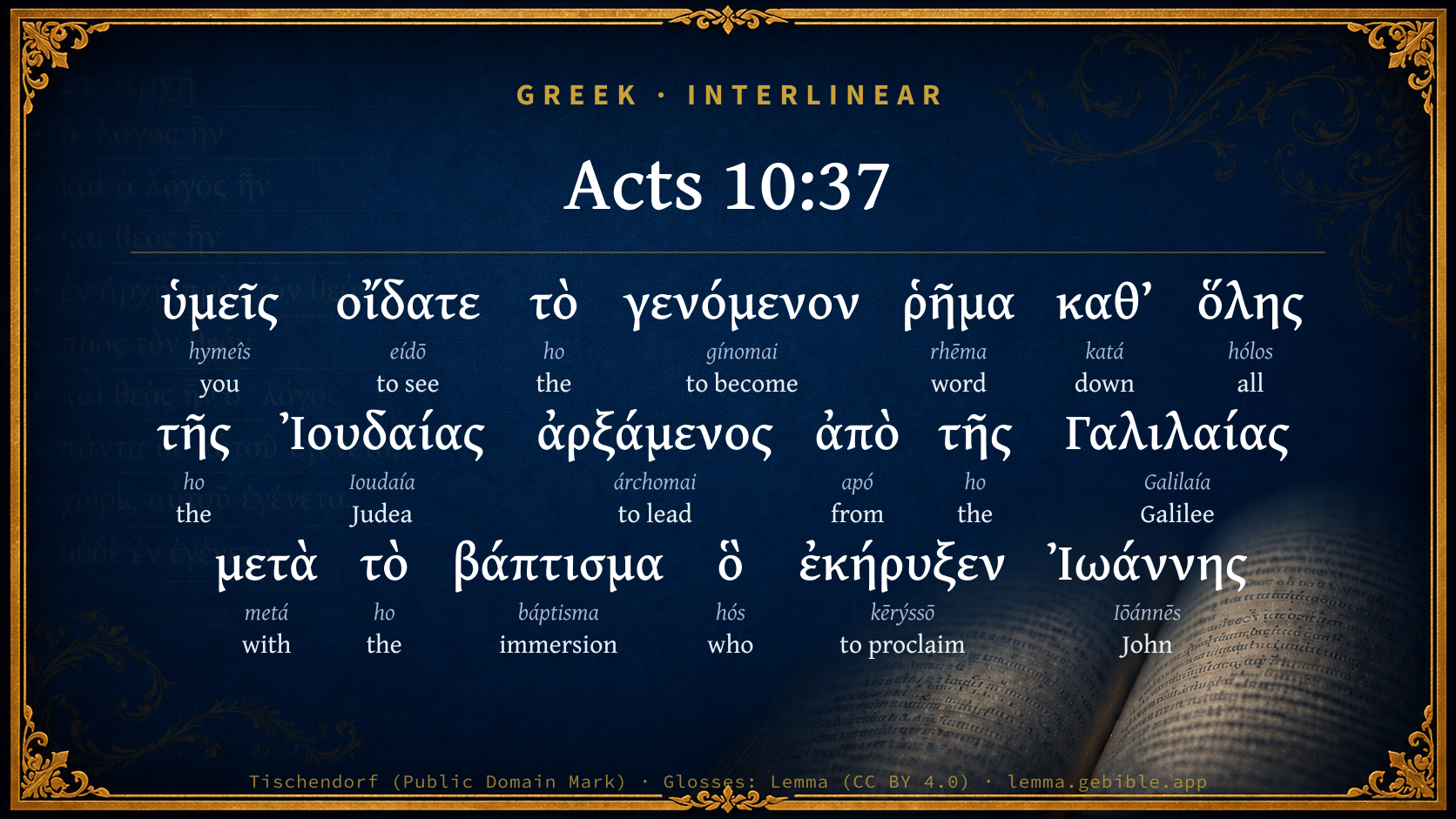
Greek (Tischendorf 8th ed.) Acts 10:37 appears in the Greek New Testament. The text above is from the Tischendorf 8th edition. Each word links to its Strong’s number and a concise gloss. Click any word for its full Thayer’s Greek Lexicon entry.
Download image
Cite this verse

Acts 10:37 (World English Bible). Public Domain. Lemma interlinear Bible study tool, https://lemma.gebible.app/v/acts/10/37.

Show BibTeX & RIS
BibTeX
RIS
English Translation
that spoken word you yourselves know, which was proclaimed throughout all Judea, beginning from Galilee, after the baptism which John preached;
World English Bible · Public Domain
Download a study sheet

One document with this verse’s original text, its word-by-word gloss line, the meaning frame, cross-references with their text, attributed commentary, and full source and license credits — printable, and it pastes into notes with its structure intact.

This verse Autodidact and up

Study sheet (.html) Plain text (.txt)

A passage Seminary Student

Up to 50 verses in one chapter. A passage sheet keeps up to 6 commentary sources and 12 cross-references per verse, in the order this page ranks them, and says so on the sheet whenever that leaves anything out. Ask for a single verse and you get the Autodidact verse sheet above.

Everything on this page stays free to read, with no account — the sheet is a download of what is already on screen, not access to it.

Want to remove ads? Support Godless Engineer
Compare translations 3

The same verse in 3 English versions, stacked beneath the original-language interlinear above. Click any original word for its lexicon entry.

Each is an independent rendering of the whole verse — the interlinear is not word-aligned to these translations.

Highlighted words mark where these versions differ — a whole-verse word diff, not a word-by-word alignment.

  • World English Bible Public Domain
    that spoken word you yourselves know, which was proclaimed throughout all Judea, beginning from Galilee, after the baptism which John preached;
  • King James Version Public Domain
    That word, I say, ye know, which was published throughout all Judaea, and began from Galilee, after the baptism which John preached;
  • unfoldingWord Literal Text CC BY-SA 4.0
    you know the word having happened throughout all Judea, beginning from Galilee, after the baptism that John announced;

unfoldingWord Literal Text — © unfoldingWord, licensed CC BY-SA 4.0. Word-aligned USFM3 via Door43 (git.door43.org/unfoldingWord/en_ult).

Versions to compare (up to 4)

3 of 4 selected

Show all 19 translations

Every available English version of this verse, each an independent rendering of the whole verse.

  • World English Bible Public Domain
    that spoken word you yourselves know, which was proclaimed throughout all Judea, beginning from Galilee, after the baptism which John preached;
  • Berean Standard Bible Public Domain
    You yourselves know what has happened throughout Judea, beginning in Galilee with the baptism that John proclaimed:
  • Majority Standard Bible Public Domain
    You yourselves know what has happened throughout Judea, beginning in Galilee with the baptism that John proclaimed:
  • King James Version Public Domain
    That word, I say, ye know, which was published throughout all Judaea, and began from Galilee, after the baptism which John preached;
  • American Standard Version (1901) Public Domain
    that saying ye yourselves know, which was published throughout all Judaea, beginning from Galilee, after the baptism which John preached;
  • Revised Version (1885) Public Domain
    that saying ye yourselves know, which was published throughout all Judaea, beginning from Galilee, after the baptism which John preached;
  • Geneva Bible (1599) Public Domain
    Euen the worde which came through all Iudea, beginning in Galile, after the baptisme which Iohn preached.
  • Douay-Rheims (1899) Public Domain
    You know the word which hath been published through all Judea: for it began from Galilee, after the baptism which John preached,
  • Young's Literal Translation Public Domain
    ye -- ye have known; -- the word that came throughout all Judea, having begun from Galilee, after the baptism that John preached;
  • Literal Standard Version CC BY-SA 4.0
    you have known the word that came throughout all Judea, having begun from Galilee, after the immersion that John preached;
  • Unlocked Literal Bible CC BY-SA 4.0
    you yourselves know the events that took place, which occurred throughout all Judea, beginning in Galilee, after the baptism that John announced;
  • unfoldingWord Literal Text CC BY-SA 4.0
    you know the word having happened throughout all Judea, beginning from Galilee, after the baptism that John announced;
  • Darby Bible Public Domain
    *ye* know; the testimony which has spread through the whole of Judaea, beginning from Galilee after the baptism which John preached --
  • World Messianic Bible Public Domain
    you yourselves know what happened, which was proclaimed throughout all Judea, beginning from Galilee, after the immersion which Yochanan preached;
  • Webster's Bible Public Domain
    That word, I say, ye know, which was published throughout all Judea, and began from Galilee, after the baptism which John preached;
  • Free Bible Version CC BY-SA 4.0
    You know that this good news spread throughout Judea, beginning in Galilee, following John's call to baptism.
  • Bible in Basic English Public Domain
    That word you yourselves have knowledge of, which was made public through all Judaea, starting from Galilee, after the baptism of which John was the preacher,
  • Text-Critical English NT CC BY 4.0
    the message that spread throughout all Judea, beginning from Galilee after the baptism that John preached:
  • Tyndale New Testament (1534) Public Domain
    Which preachinge was published thorow oute all Iewrye and begane in Galile after the baptyme which Iohn preached

Literal Standard Version (2020), Covenant Press — licensed CC BY-SA 4.0. Text via the HelloAO Bible API (eBible.org). Unlocked Literal Bible (unfoldingWord) — licensed CC BY-SA 4.0. Text via the HelloAO Bible API (eBible.org). unfoldingWord Literal Text — © unfoldingWord, licensed CC BY-SA 4.0. Word-aligned USFM3 via Door43 (git.door43.org/unfoldingWord/en_ult). Free Bible Version, Dr. Jonathan Gallagher — licensed CC BY-SA 4.0. Text via the HelloAO Bible API (eBible.org).

Word by word

More ways to search: Search by grammar → Find every occurrence → Compare this word →

Practice this passage: Drill this verse → Learn its vocabulary →

βάπτισμα
báptisma
G908
“immersion”
Noun, Accusative, Singular, Neuter
Part of Speech
Noun
Case
Accusative
Number
Singular
Gender
Neuter
Full Thayer's Definition

Origin: from G907

TDNT: 10:05,9

1. immersion, submersion a. of calamities and afflictions with which one is quite overwhelmed b. of John's baptism, that purification rite by which men on confessing their sins were bound to spiritual reformation, obtained the pardon of their past sins and became qualified for the benefits of the Messiah's kingdom soon to be set up. This was valid Christian baptism, as this was the only baptism the apostles received and it is not recorded anywhere that they were ever rebaptised after Pentecost. c. of Christian baptism; a rite of immersion in water as commanded by Christ, by which one after confessing his sins and professing his faith in Christ, having been born again by the Holy Spirit unto a new life, identifies publicly with the fellowship of Christ and the church. In Rom. 6:3 Paul states we are "baptised unto death" meaning that weare not only dead to our former ways, but they are buried. To returnto them is as unthinkable for a Christian as for one to dig up a deadcorpse! In Moslem countries a new believer has little trouble withMoslems until he is publicly baptised. It is then, that the Moslems'know he means business, and then the persecution starts. See alsodiscussion of baptism under No. 907.
  1. ὑμεῖς hymeîs G5210 “you” Personal pronoun, 2nd person, Nominative, Plural
  2. οἴδατε eídō G1492 “to see” Verb, Perfect, Active, Indicative, 2nd person, Plural
  3. τὸ ho G3588 “the” Article, Accusative, Singular, Neuter
  4. γενόμενον gínomai G1096 “to become” Verb, Aorist, Middle deponent, Participle, Accusative, Singular, Neuter
  5. ῥῆμα rhēma G4487 “word” Noun, Accusative, Singular, Neuter
  6. καθ’ katá G2596 “down” Preposition
  7. ὅλης hólos G3650 “all” Adjective, Genitive, Singular, Feminine
  8. τῆς ho G3588 “the” Article, Genitive, Singular, Feminine
  9. Ἰουδαίας Ioudaía G2449 “Judea” Noun, Genitive, Singular, Feminine
  10. ἀρξάμενος árchomai G756 “to lead” Verb, Aorist, Middle, Participle, Nominative, Singular, Masculine
  11. ἀπὸ apó G575 “from” Preposition
  12. τῆς ho G3588 “the” Article, Genitive, Singular, Feminine
  13. Γαλιλαίας Galilaía G1056 “Galilee” Noun, Genitive, Singular, Feminine
  14. μετὰ metá G3326 “with” Preposition
  15. τὸ ho G3588 “the” Article, Accusative, Singular, Neuter
  16. ὃ hós G3739 “who” Relative pronoun, Accusative, Singular, Neuter
  17. ἐκήρυξεν kērýssō G2784 “to proclaim” Verb, Aorist, Active, Indicative, 3rd person, Singular
  18. Ἰωάννης Iōánnēs G2491 “John” Noun, Nominative, Singular, Masculine

About this verse

These counts appear in no published source. They are computed here, from the morphology-tagged text and Lemma’s own curated glosses. What Lemma adds →

19
words
16
distinct lemmas
Acts
section

Notable vocabulary

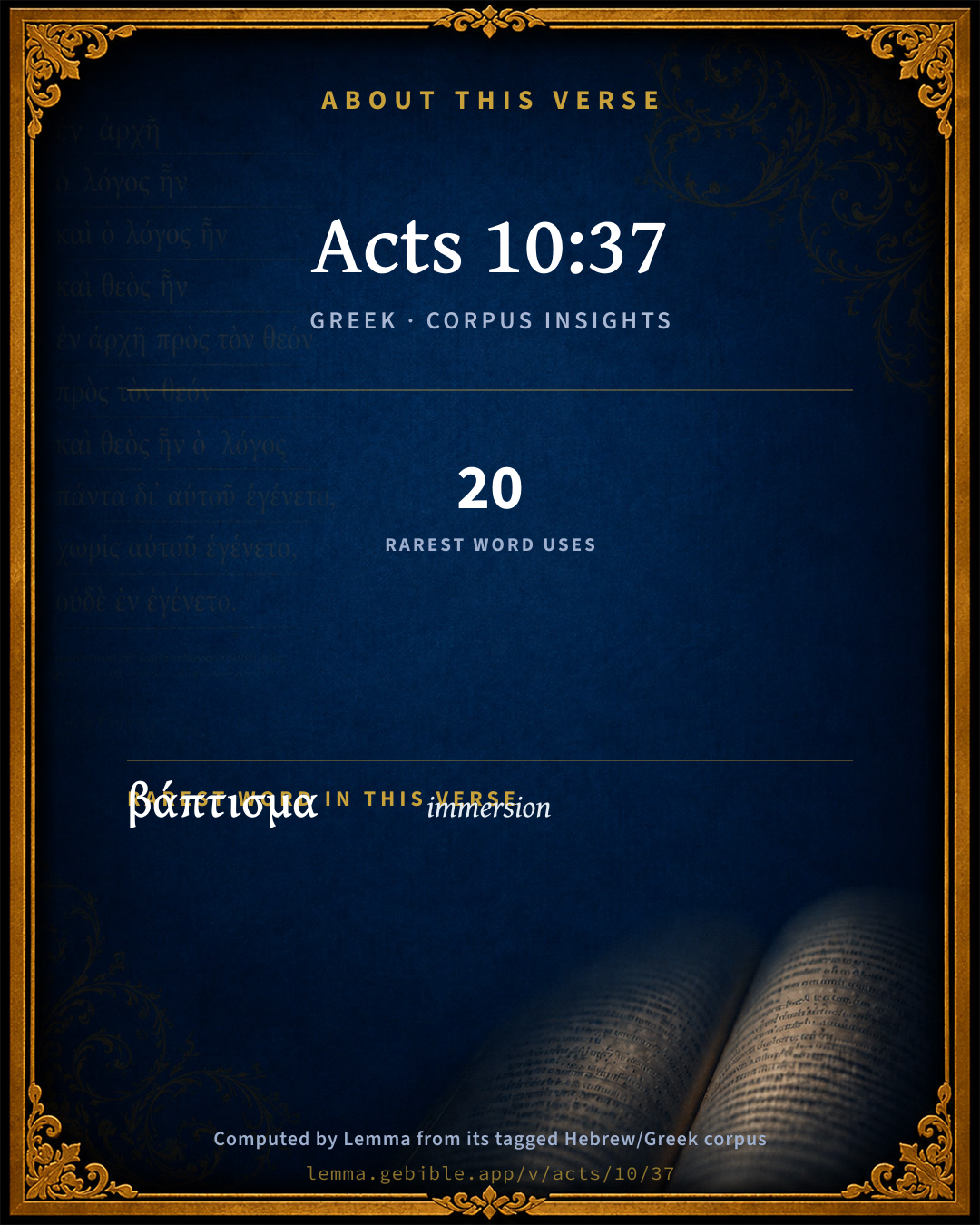
The rarest word here is βάπτισμα immersion G908 — appearing just 20 times in the whole Greek New Testament.

Shared distinctive vocabulary

βάπτισμα immersion G908 occurs in 20 verses of the Greek New Testament. Also found in:

Repetition

A word recurs within this verse:

Cross-references

12

Topical passages linked to Acts 10:37 in the Treasury of Scripture Knowledge — connected by theme and wording, ordered by reader-vote popularity; previews shown in the World English Bible.

  • Luke 4:14 Jesus returned in the power of the Spirit into Galilee, and news about him spread through all the surrounding area.
  • Acts 2:22 "Men of Israel, hear these words! Jesus of Nazareth, a man approved by God to you by mighty works and wonders and signs which God did by him in the midst of you, even as you yourselves know,
  • Acts 28:22 But we desire to hear from you what you think. For, as concerning this sect, it is known to us that everywhere it is spoken against."
  • Matthew 3:1–3 In those days, John the Baptizer came, preaching in the wilderness of Judea, saying,
  • Matthew 4:12–17 Now when Jesus heard that John was delivered up, he withdrew into Galilee.
  • Mark 1:1–5 The beginning of the Gospel of Jesus Christ, the Son of God.
  • Mark 1:14–15 Now after John was taken into custody, Jesus came into Galilee, preaching the Gospel of the Kingdom of God,
  • Luke 23:5 But they insisted, saying, "He stirs up the people, teaching throughout all Judea, beginning from Galilee even to this place."
  • John 4:1–3 Therefore when the Lord knew that the Pharisees had heard that Jesus was making and baptizing more disciples than John
  • Acts 1:22 beginning from the baptism of John, to the day that he was received up from us, of these one must become a witness with us of his resurrection."
  • Acts 13:24–25 before his coming, when John had first preached the baptism of repentance to Israel.
  • Acts 26:26 For the king knows of these things, to whom also I speak freely. For I am persuaded that none of these things is hidden from him, for this has not been done in a corner.

Cross-references courtesy of OpenBible.info (CC BY 4.0).

Commentary

Notes on Acts 10:37 from classic Christian and Jewish commentators (each source and its license shown beneath its notes). The classic Christian expositions comment on the surrounding passage and are grouped to its opening verse, so a note may address several verses; the Jewish commentaries on the Tanakh (Rashi and others) are per-verse, so they appear only where the commentator wrote on this verse.

Lemma curates 59 commentaries, every one of them public domain or Creative Commons licensed, each selected and text-cleaned for this edition rather than reprinted as found. About our sources →

Bengel's Gnomon

Johann Albrecht Bengel

Act 10:37. Ὑμεῖς οἴδατε, ye know) from proofs more ancient than my coming. [Therefore they had no need of a fuller relation of these events.—V. g.]—ἀρξάμενον) The participle either by itself, or used as an adverb: with which comp. Luk 24:47, ἀρξάμενον ἀπὸ Ἱερουσαλήμ. It is employed absolutely by a frequent and elegant Græcism.—ἀπὸ τῆς Γαλιλαίας, from Galilee) Joh 1:43; Joh 2:1 (Cana). Cæsarea was tolerably near to that region, but somewhat remote from Jerusalem: Act 10:39.—μετὰ, after) John constitutes the boundary between the Old and New Testament.—τὸ βάπτισμα, the baptism) that most celebrated ordinance.

Bengel's Gnomon of the New Testament — English translation (T&T Clark, Edinburgh, 1860) — public domain. Text from a community e-Sword module.

Expositor's Greek Testament

ed. W. Robertson Nicoll

Act 10:37 . τὸ ῥῆμα : so far Peter has referred to a message which would be unknown to Cornelius, the message of peace through Christ, but he now turns to what Cornelius probably did know by report at all events; τὸ ῥ . not the λόγος of Act 10:36 , but only the “report”. καθʼ ὅλης τῆς Ἰ ., i.e. , all Palestine including Galilee, cf. Act 2:9 , Act 11:1 ; Act 11:29 , Luk 1:5 (Luk 4:44 ), Act 7:17 , Act 23:5 , see on Act 9:31 ; Act 9:42 above. ἀρξάμενον , see critical notes; cf. Act 1:22 and Luk 23:5 . If we read the accusative it agrees with ῥῆμα (see above); if the nominative, cf. for a similar construction Luk 24:47 , and see Blass, Gram. , p. 81. The abruptness of the construction is quite in accordance with that elsewhere marked in St. Peter’s speeches, cf. Act 2:22-24 , Act 3:14 ff.

The Expositor's Greek Testament, edited by W. Robertson Nicoll (1897–1910) — public domain. Text from a community e-Sword module.

Geneva Bible (1599)

Geneva Bible translators

The sum of the Gospel (which shall be made manifest at the latter day when Christ himself shall sit as judge both of the quick and the dead) is this, that Christ promised to the Fathers, and exhibited in his time with the mighty power of God, (which was by all means showed) and at length crucified to reconcile us to God, did rise again the third day, that whosoever believeth in him should be saved through the remission of sins.

Geneva Bible (1599) marginal notes — public domain. Text via Bolls.life.

Jamieson, Fausset & Brown

Robert Jamieson, A. R. Fausset & David Brown

That word . . . ye how--The facts, it seems, were too notorious and extraordinary to be unknown to those who mixed so much with Jews, and took so tender an interest in all Jewish matters as they did; though, like the eunuch, they knew not the significance of them.

which was published throughout all Judea, and began from Galilee--(See Luk 4:14, Luk 4:37, Luk 4:44; Luk 7:17; Luk 9:6; Luk 23:5).

after the baptism which John preached--(See on Act 1:22).

Jamieson, Fausset & Brown — Commentary Critical and Explanatory on the Whole Bible (1871) — public domain (CC PDM 1.0). Text via the HelloAO Bible API.

Adam Clarke's Commentary

Verse 37. That word - ye know] This account of Jesus of Nazareth ye cannot be unacquainted with; because it has been proclaimed throughout all Judea and Galilee, from the time that John began to preach. Ye have heard how he was anointed with the Holy Ghost, and of the miracles which he performed; how he went about doing good, and healing all kinds of demoniacs and, by these mighty and beneficent acts, giving the fullest proof that God was with him. This was the exordium of Peter's discourse; and thus he begins, from what they knew, to teach them what they did not know.

St. Peter does not intimate that any miracle was wrought by Christ previously to his being baptized by John. Beginning at Galilee. Let us review the mode of Christ's manifestation.

1. After he had been baptized by John, he went into the desert, and remained there forty days.

2. He then returned to the Baptist, who was exercising his ministry at that time at Bethany or Bethabara; and there he made certain disciples, viz., Andrew, Bartholomew, Peter, and Philip.

3. Thence he went to the marriage at Cana, in Galilee, where he wrought his first miracle.

4. And afterwards he went to Capernaum in the same country, by the sea of Galilee, where he wrought many others. This was the manner in which Christ manifested himself; and these are the facts of which Peter presumes they had a perfect knowledge, because they had been for a long time notorious through all the land.

Adam Clarke's Commentary on the Bible (1810–1826) — public domain. Text from a community e-Sword/MySword module.

John Calvin's Commentaries

37. Ye know how the word. This sermon of Peter consisteth upon [of] two members principally; for in the former he reciteth an history; secondly, he descendeth unto the fruit of the history). For seeing that the coming of Christ into the world, his death and resurrection, are the matter of our salvation, Christ cannot otherwise be set before us to salvation, than if we first know that he hath put on our flesh; that he was in such sort conversant amongst men; that he proved himself, by certain testimonies, to be the Son of God; that he was at length nailed upon the cross, and raised up from the dead by the power of God. Again, lest the knowledge of the history be unprofitable and cold, we must also show the end why he came down from his heavenly glory into the world, why he suffered such a death so reproachful amongst men, and accursed by the mouth of God. The cause of his resurrection must be showed, whence the effect and fruit of all these things is gathered; to wit, that Christ was humbled, that he might restore us unto perfect blessedness who were quite lost; and also that he put on brotherly love together with our flesh; that by taking upon him our infirmities, he unburdened us thereof; that he made satisfaction for our sins, by the sacrifice of his death, that he might purchase the Father’s favor for us; that when as he had gotten the victory of death, he purchased for us eternal life; that he set heaven open for us by his entrance into the same; that all the power of the Spirit was poured out upon him, that he might enrich us with his abundance, (Isaiah 61:1.)

This order of teaching doth Peter observe when he beginneth with the history of the gospel; and afterward showeth what we have by Christ’s descending into the earth, by his death and resurrection. First, he saith, that Jesus of Nazareth came abroad after John’s baptism. For because John was appointed to this end, by the counsel of God, that he might lift up the minds of the people to wait for Christ, it was not meet that this point should be omitted. He was counted an excellent prophet of God; therefore his authority was of great importance to make Christ to be believed, especially amongst the ignorant and those which were but novices. We must note the phrase, that John preached baptism. For Luke comprehendeth, indeed, under the word baptism, all the whole ministry of John; nevertheless he showeth that it was no dumb sign, and void of doctrine. And assuredly this is the chiefest thing in all sacraments, that the Word of God may appear engraven there, and that the clear voice may sound. For which cause, that wicked profanation which is seen in Papistry is so much the more to be detested, because, burying preaching, they do only charm the sacraments with magical enchantment,

John Calvin's Commentaries (1540-1563) — public domain. Text from the Calvin Translation Society English edition (1840s-50s) via the Christian Classics Ethereal Library (ccel.org). Calvin's coverage is partial (roughly two-thirds of the Bible); uncommented books and verses are honest gaps, never fabricated. The 19th-century editor's footnotes and remarks are omitted so the notes are faithfully Calvin's own voice.

Ellicott's Commentary for English Readers

(37) That word, I say, ye know.—The Greek for “word” differs from that in Act_10:36, as including more distinctly the subject-matter of the message. In the words “ye know” we may trace the result of the conversation held before the more formal conference. The main facts of the life and ministry of the Christ were already known, either through that conversation, or through the previous opportunities which it had disclosed. The question at issue was the relation in which they stood to those who were now listening.

A Bible Commentary for English Readers, edited by Charles John Ellicott (1878–1897) — public domain. Text from a community e-Sword module.

The Cambridge Bible for Schools and Colleges

gen. ed. J. J. S. Perowne

37. that word, I say, you know] Better, “ye know the tidings.” The Greek rendered “word” here is not the same which is so translated in the previous verse. The former refers to the whole message of salvation through Christ, the latter to the tidings about Jesus which had gone abroad after the preaching of John the Baptist. These tidings Peter either assumes Cornelius and his friends to know because of the teaching which had already extended as far as Cæsarea (Act_8:40), or else he has learnt that they have this knowledge about the facts of the life of Jesus from the conversation which he held with the centurion at his first arrival. Hence he says “ye know of the history of Jesus.”

began from Galilee] where Christ’s ministerial life commenced. See Mat_4:12; Mar_1:14.

The Cambridge Bible for Schools and Colleges (gen. ed. J. J. S. Perowne; Cambridge University Press, 1878–1918) — public domain. Text from a community e-Sword module.

John Gill's Exposition

The word I say you know,.... By common fame and report, which had for some years past been published by John, Christ, and his apostles, in Judea and Galilee; especially some parts of it, or points in it, such as the apostle hereafter mentions must have reached their ears:

Which was published throughout all Judea; by Christ, his twelve apostles, and seventy disciples; who were sent out by him into all places, where he himself would come:

and began from Galilee, after the baptism which John preached; that is, after John had began to preach the ordinance of water baptism, and to administer it; which were done, to set the Jews inquiring after the Messiah, and to make him manifest in Israel; upon which the word of the Gospel quickly began to be preached by Christ and his apostles, and that in Galilee; for here Christ began to preach himself, and here he called his apostles, and sent them forth to preach it.

John Gill's Exposition of the Whole Bible (1746–1763) — public domain (CC PDM 1.0). Text via the HelloAO Bible API.

Trapp's Complete Commentary

John Trapp

37 That word, I say, ye know, which was published throughout all Judaea, and began from Galilee, after the baptism which John preached;

Ver. 37. After the baptism] See how orderly Peter preacheth (like as Luke writeth, καθεξης, sigillatim), giving his hearers a distinct and punctual narrative of the life and death of Jesus Christ, of his offices and efficacies. To speak clearly and coherently, to cast his matter into a good mould and method, as it is not every man’s happiness, so it is no small commendation to him that can skill of it; and must be endeavoured by all that would win upon their people’s affections, and draw them to duty, as the Athenian orators, who were there hence called Δημαγωγοι, people leaders.

John Trapp, A Commentary or Exposition upon All the Books of the Old and New Testament (1647–1656) — public domain. Text from a community e-Sword module.

Albert Barnes' Notes on the Bible

That word - Greek: ῥῆμα rēma - a different word from that in the previous verse. It may be translated “thing” as well as “word.”

Which was published - Greek: which was done. “You know, though it may be imperfectly, what was done or accomplished in Judea,” etc.

Throughout all Judea - The miracles of Christ were not confined to any place, but were performed in every part of the land. For an account of the divisions of Palestine, see the notes on Mat 2:22.

And began ... - Greek: having been begun in Galilee. Galilee was not far from Caesarea. There was, therefore, the more probability that Cornelius had heard of what had occurred there. Indeed, the gospels themselves furnish the highest evidence that the fame of the miracles of Christ spread into all the surrounding regions.

Albert Barnes' Notes on the Bible (1834–1885) — public domain. Text from a community e-Sword/MySword module.

Haydock's Catholic Bible Commentary

For it began, or its beginning was, &c.

George Leo Haydock (1774–1849), Haydock's Catholic Family Bible and Commentary, 1859 edition — public domain. Excludes Psalms (Douay-Rheims chapter numbering differs from Protestant) and Deuterocanonical books (Catholic canon only).

Matthew Poole's English Annotations

They had heard of the doctrine of the gospel by common fame and report, which could not but spread abroad; all might know that Christ and his apostles did preach, though these might be ignorant of the particular doctrines which they taught, and which Peter was now sent to instruct them in: or by the word (in a usual Hebraism) the matter of the gospel may be meant, as the life, death, and resurrection of our blessed Saviour, which they could not but have heard several reports of.

After the baptism which John preached; who, as the Elijah who was promised, Mal 4:5, was the forerunner of the Lord.

Matthew Poole's English Annotations on the Holy Bible (1683–1685) — public domain. Text from a community e-Sword/MySword module.

Whedon's Commentary on the Bible

Daniel D. Whedon

37. Judea… Galilee… John—Peter recites the facts of his history backwards. Rightly, for he thus begins with the latest and best known facts, and runs his narrative into the earlier and less known facts. And this having brought him to the beginning, he in the next verses runs down from the beginning to the present.

Daniel D. Whedon (gen. ed.), Commentary on the Old and New Testaments (1874–1909) — public domain. Text from a community e-Sword module.

The Pulpit Commentary

That saying ye yourselves know for that word, I say, ye know, A.V.; beginning for and began, A.V. The construction of vers. 36, 37, and 38, is somewhat difficult, but by far the easiest and most natural way, both as regards grammar and sense, is to make uJmeiv oidate govern togon directly: You, Gentiles, well know the word which God sent to the Israelites, when he caused the gospel of peace to be preached to them, the word, namely, which came tomenon rJhma comp. especially (Luk_3:2) throughout all Judaea," etc. (ver. 38), "about Jesus of Nazareth, how that God anointed him," etc. In the above sentence, tomenon rJhma is in apposition with togon, but amplifies and explains it; and again jIhsoun ton ajpo Nazaret, with all that follows down to the end of ver. 39, is a still further explanation of the rJhgma, and a summary of that gospel which, as Cornelius already knew, had been preached to the Jews by Jesus himself. The parenthesis, "He is Lord of all," is most opportunely inserted, that his hearers might know that Jesus of Nazareth was Lord of the Gentiles as well as of the Jews. The words logov and rJhma are synonymous, as in ver. 44 and in 1Pe_1:23, 1Pe_1:25; Luk_3:2; Eph_6:17 and are better both expressed by the English word, as in the A.V., than by word and saying, as in the R.V.

Vers. 37-43. The gospel for the heathen.

Under the Divine inspiration, St. Peter preached the gospel to this company of devout Gentiles; and we can find both

(1) what is the essence of the gospel message, and

(2) what are the points of it specially suitable for presentation to the heathen mind, by a careful study of St. Peter"s speech on this occasion. As the points are very simple, and the illustration of them very abundant and familiar, we need only briefly state the several headings. The gospel is the declaration to men of the personal Savior, the Lord Jesus Christ, and the demand of instant acceptance of him and yielding the will and heart and life to him. It must deal fully and efficiently with

I THE CHRIST WHO LIVED. "God anointed Jesus of Nazareth with the Holy Ghost and with power, who went about doing good.

II THE CHRIST WHO DIED. "Whom they slew and hanged on a tree.

III THE CHRIST WHO LAWS. "Him God raised up the third day, and showed him openly.

IV THE CHRIST WHO CAN SAVE FROM SIN NOW. "Whosoever believeth in him shall receive remission of sins." Upon this gospel, believingly declared to men, even to the heathen, we may still be assured that the power of the Holy Ghost shall rest, and it shall prove, as to the company in the house of Cornelius, a word of "eternal life. R.T.

The Pulpit Commentary (1880–1919), ed. H.D.M. Spence-Jones & Joseph S. Exell — public domain. Text from a community e-Sword module.

John Wesley's Explanatory Notes

Ye know the word which was published - You know the facts in general, the meaning of which I shall now more particularly explain and confirm to you. The baptism which John preached - To which he invited them by his preaching, in token of their repentance. This began in Galilee, which is near Cesarea.

John Wesley, Explanatory Notes Upon the Whole Bible (1754–1765) — public domain. Text via the GEBible commentary corpus.

McGarvey & Pendleton's Commentaries

J. W. McGarvey

See notes on verse 36

J. W. McGarvey (with Philip Y. Pendleton), Commentaries on the New Testament (The Fourfold Gospel, 1914; Acts; and the epistles) — public domain. Text from a community e-Sword/MySword module.

Cambridge Greek Testament for Schools and Colleges

37. ὑμεῖς οἴδατε τὸ γενόμενον ῥῆμα. The ῥῆμα is the teaching about Jesus which went forth when John the Baptist began to preach, and seems to be more restricted in sense than the λόγος which refers to the whole message of salvation through Christ. About the Baptist and his preaching, Peter either assumes Cornelius and his friends to have heard, as so many must have done during Christ’s ministerial life, or he speaks from what he had gathered in his previous conversation with Cornelius. Hence he says, ‘Ye know of the history of Jesus.’

καθ’ ὅλης τῆς … See on Act 9:31.

Cambridge Greek Testament for Schools and Colleges (Cambridge University Press, 1896; 21 vols, various authors incl. Carr, Maclear, Plummer, Farrar, Lumby, Moule, M. R. James, Simcox) — public domain. Text from a community e-Sword module.

Alford’s Greek Testament

Henry Alford

37. τὸ ῥῆμα] the matter: not the thing, here or any where else: but the thing said, the ‘materies’ of the proclamation, in this case perhaps best ‘the history.’

γενόμενον] Not ‘which took place,’ but, which was spoken, ‘published,’ as E. V. See reff. This meaning, which ῥῆμα itself renders necessary, is further supported by καθʼ ὅλης τ. Ἰουδ., which can only be properly said, and is used by Luke (only, see reff.) of a publication, or spreading of a rumour, not of the happening of an event or series of events relating to one person.

ἀρξ. ἀπ. τ. Γαλ.] It was from Galilee first that the fame of Jesus went abroad, as Luke himself relates, Luk 4:14, Luk 4:37 (44 v. r.); 7:17; 9:6 (23:5). Galilee also was the nearest to Cæsarea, and may have been for this reason expressly mentioned. ἀρξάμενος is an unexpected transference of the case and gender into that of the prime agent, a construction common enough in the Apocalypse (4:1 reff.), but surprising in St. Luke.

μετὰ τὸ βάπτ.] So also Peter dates the ministry of our Lord in ch. 1:22. (See note there.)

Henry Alford, The Greek Testament (1849–1861) — public domain. Text from a community e-Sword module.

Vincent's Word Studies in the New Testament

Marvin R. Vincent

That word [ρημα] . The contents of the message : the report or history which it proclaimed.

Marvin R. Vincent, Word Studies in the New Testament (1887–1900) — public domain. Text from a community e-Sword/MySword module.

Lesson kit

Teaching starters — assembled from the data on this page, not authored interpretation. Every prompt links to the verse data it draws on. Edit before teaching.

Acts, in the Acts, opens this verse with 19 words (16 distinct Greek lemmas). Its most distinctive word is báptisma (“immersion”). A historical commentator’s framing appears above. Read the whole chapter for the surrounding context.

Discussion questions

  1. What does “immersion” (báptisma) contribute to the verse as a whole?
  2. Matthew 3:7 shares the word «immersion» with this verse. How do the two illuminate each other?
  3. “the” occurs 4× in this one verse. What is the effect of the repetition?
  4. The translations on this page render this verse differently — a whole-verse word diff, not a word-by-word alignment. What might account for the different wordings?
  5. Reading how Bengel's Gnomon and Expositor's Greek Testament read this verse, where do the two commentators agree and where do they part?

Things to notice

Reading settings

Reading text

Shown beneath each verse's original-language words.

Old Testament
Old Testament edition

Read the OT as the Masoretic Hebrew (MT) or the Greek Septuagint (LXX).

English shown for the Greek Septuagint (in the Hebrew ↔ Greek comparison).

Comparing translations? Open the Compare panel on any verse page to stack up to four side by side.