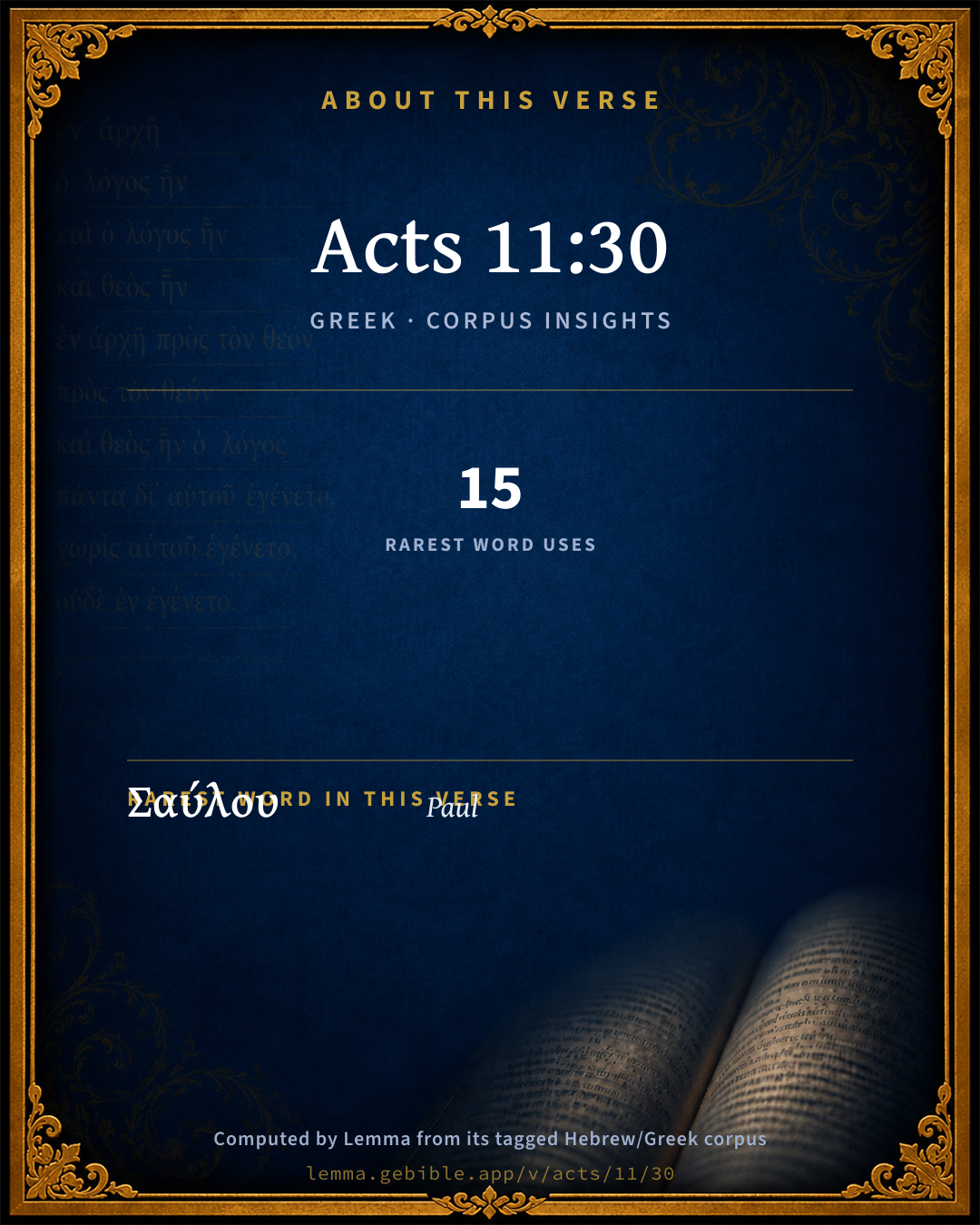
Acts 11:30

Greek (Tischendorf 8th ed.) Acts 11:30 appears in the Greek New Testament. The text above is from the Tischendorf 8th edition. Each word links to its Strong’s number and a concise gloss. Click any word for its full Thayer’s Greek Lexicon entry.

Download image
Cite this verse

Acts 11:30 (World English Bible). Public Domain. Lemma interlinear Bible study tool, https://lemma.gebible.app/v/acts/11/30.

Show BibTeX & RIS
BibTeX
RIS
English Translation
which they also did, sending it to the elders by the hands of Barnabas and Saul.
World English Bible · Public Domain
Download a study sheet

One document with this verse’s original text, its word-by-word gloss line, the meaning frame, cross-references with their text, attributed commentary, and full source and license credits — printable, and it pastes into notes with its structure intact.

This verse Autodidact and up

Study sheet (.html) Plain text (.txt)

A passage Seminary Student

Up to 50 verses in one chapter. A passage sheet keeps up to 6 commentary sources and 12 cross-references per verse, in the order this page ranks them, and says so on the sheet whenever that leaves anything out. Ask for a single verse and you get the Autodidact verse sheet above.

Everything on this page stays free to read, with no account — the sheet is a download of what is already on screen, not access to it.

Want to remove ads? Support Godless Engineer
Compare translations 3

The same verse in 3 English versions, stacked beneath the original-language interlinear above. Click any original word for its lexicon entry.

Each is an independent rendering of the whole verse — the interlinear is not word-aligned to these translations.

Highlighted words mark where these versions differ — a whole-verse word diff, not a word-by-word alignment.

  • World English Bible Public Domain
    which they also did, sending it to the elders by the hands of Barnabas and Saul.
  • King James Version Public Domain
    Which also they did, and sent it to the elders by the hands of Barnabas and Saul.
  • unfoldingWord Literal Text CC BY-SA 4.0
    which indeed they did, sending it to the elders by the hand of Barnabas and Saul.

unfoldingWord Literal Text — © unfoldingWord, licensed CC BY-SA 4.0. Word-aligned USFM3 via Door43 (git.door43.org/unfoldingWord/en_ult).

Versions to compare (up to 4)

3 of 4 selected

Show all 19 translations

Every available English version of this verse, each an independent rendering of the whole verse.

  • World English Bible Public Domain
    which they also did, sending it to the elders by the hands of Barnabas and Saul.
  • Berean Standard Bible Public Domain
    This they did, sending their gifts to the elders with Barnabas and Saul.
  • Majority Standard Bible Public Domain
    This they did, sending their gifts to the elders with Barnabas and Saul.
  • King James Version Public Domain
    Which also they did, and sent it to the elders by the hands of Barnabas and Saul.
  • American Standard Version (1901) Public Domain
    which also they did, sending it to the elders by the hand of Barnabas and Saul.
  • Revised Version (1885) Public Domain
    which also they did, sending it to the elders by the hand of Barnabas and Saul.
  • Geneva Bible (1599) Public Domain
    Which thing they also did, and sent it to the Elders, by the hand of Barnabas and Saul.
  • Douay-Rheims (1899) Public Domain
    Which also they did, sending it to the ancients, by the hands of Barnabas and Saul.
  • Young's Literal Translation Public Domain
    which also they did, having sent unto the elders by the hand of Barnabas and Saul.
  • Literal Standard Version CC BY-SA 4.0
    which also they did, having sent to the elders by the hand of Barnabas and Saul.
  • Unlocked Literal Bible CC BY-SA 4.0
    They did this; they sent money to the elders by the hand of Barnabas and Saul.
  • unfoldingWord Literal Text CC BY-SA 4.0
    which indeed they did, sending it to the elders by the hand of Barnabas and Saul.
  • Darby Bible Public Domain
    which also they did, sending it to the elders by the hand of Barnabas and Saul.
  • World Messianic Bible Public Domain
    which they also did, sending it to the elders by the hands of Barnabas and Saul.
  • Webster's Bible Public Domain
    Which also they did, and sent it to the elders by the hands of Barnabas and Saul.
  • Free Bible Version CC BY-SA 4.0
    So they did this and sent the money with Barnabas and Saul to the church leaders there.
  • Bible in Basic English Public Domain
    Which they did, sending it to the rulers of the church by the hand of Barnabas and Saul.
  • Text-Critical English NT CC BY 4.0
    This they did, sending it to the elders by the hands of Barnabas and Saul.
  • Tyndale New Testament (1534) Public Domain
    Which thinge they also dyd and sent it to the elders by the hondes of Barnabas and Saul.

Literal Standard Version (2020), Covenant Press — licensed CC BY-SA 4.0. Text via the HelloAO Bible API (eBible.org). Unlocked Literal Bible (unfoldingWord) — licensed CC BY-SA 4.0. Text via the HelloAO Bible API (eBible.org). unfoldingWord Literal Text — © unfoldingWord, licensed CC BY-SA 4.0. Word-aligned USFM3 via Door43 (git.door43.org/unfoldingWord/en_ult). Free Bible Version, Dr. Jonathan Gallagher — licensed CC BY-SA 4.0. Text via the HelloAO Bible API (eBible.org).

Word by word

More ways to search: Search by grammar → Find every occurrence → Compare this word →

Practice this passage: Drill this verse → Learn its vocabulary →

About this verse

These counts appear in no published source. They are computed here, from the morphology-tagged text and Lemma’s own curated glosses. What Lemma adds →

12
words
11
distinct lemmas
Acts
section

Notable vocabulary

The rarest word here is Σαύλου Paul G4569 — appearing just 15 times in the whole Greek New Testament.

Shared distinctive vocabulary

Σαύλου Paul G4569 occurs in 15 verses of the Greek New Testament. Also found in:

Repetition

A word recurs within this verse:

Cross-references

17

Topical passages linked to Acts 11:30 in the Treasury of Scripture Knowledge — connected by theme and wording, ordered by reader-vote popularity; previews shown in the World English Bible.

  • Acts 12:25 Barnabas and Saul returned to Jerusalem, when they had fulfilled their service, also taking with them John whose surname was Mark.
  • Acts 14:23 When they had appointed elders for them in every assembly, and had prayed with fasting, they commended them to the Lord, on whom they had believed.
  • Acts 15:4 When they had come to Jerusalem, they were received by the assembly and the apostles and the elders, and they reported all things that God had done with them.
  • Acts 15:6 The apostles and the elders were gathered together to see about this matter.
  • Acts 16:4 As they went on their way through the cities, they delivered the decrees to them to keep which had been ordained by the apostles and elders who were at Jerusalem.
  • Acts 20:17 From Miletus he sent to Ephesus, and called to himself the elders of the assembly.
  • 1 Timothy 5:17 Let the elders who rule well be counted worthy of double honor, especially those who labor in the word and in teaching.
  • Titus 1:5 I left you in Crete for this reason, that you would set in order the things that were lacking, and appoint elders in every city, as I directed you;
  • James 5:14 Is any among you sick? Let him call for the elders of the assembly, and let them pray over him, anointing him with oil in the name of the Lord,
  • 1 Peter 5:1 I exhort the elders among you, as a fellow elder, and a witness of the sufferings of Christ, and who will also share in the glory that will be revealed.
  • Acts 15:2 Therefore when Paul and Barnabas had no small discord and discussion with them, they appointed Paul and Barnabas, and some others of them, to go up to Jerusalem to the apostles and elders about this question.
  • Acts 15:23 They wrote these things by their hand: "The apostles, the elders, and the brothers, to the brothers who are of the Gentiles in Antioch, Syria, and Cilicia: greetings.
  • Acts 21:18 The day following, Paul went in with us to James; and all the elders were present.
  • 1 Corinthians 16:3–4 When I arrive, I will send whoever you approve with letters to carry your gracious gift to Jerusalem.
  • 2 Corinthians 8:17–21 For he indeed accepted our exhortation, but being himself very earnest, he went out to you of his own accord.
  • 1 Timothy 5:19 Don't receive an accusation against an elder, except at the word of two or three witnesses.
  • 2 John 1:1 The elder, to the chosen lady and her children, whom I love in truth; and not I only, but also all those who know the truth;

Cross-references courtesy of OpenBible.info (CC BY 4.0).

Commentary

Notes on Acts 11:30 from classic Christian and Jewish commentators (each source and its license shown beneath its notes). The classic Christian expositions comment on the surrounding passage and are grouped to its opening verse, so a note may address several verses; the Jewish commentaries on the Tanakh (Rashi and others) are per-verse, so they appear only where the commentator wrote on this verse.

Lemma curates 59 commentaries, every one of them public domain or Creative Commons licensed, each selected and text-cleaned for this edition rather than reprinted as found. About our sources →

Tyndale Open Study Notes

Tyndale Open Resources

11:30 This is the first reference in Acts to elders as officers of the Christian church (see also 14:23; 15:2-23; 16:4; 20:17-35; 21:18; cp. 1 Tim 3:1-7; Titus 1:5-9).

Tyndale Open Study Notes — © Tyndale Open Resources, licensed CC BY-SA 4.0. Text via the HelloAO Bible API.

Bengel's Gnomon

Johann Albrecht Bengel

Act 11:30. Πρὸς τοὺς πρεσβυτέρους, to the elders) [through whose agency it should be distributed to the brethren.—V. g.] Therefore the office of the seven deacons, and the community of goods, no longer now were on the same footing as at the beginning: but they were not, however, on the same footing as in our day.—Βαρνάβα καὶ Σαύλου, of Barnabas and Saul) “Here thou seest how they regard as a weighty and serious business this collection for the poor saints: otherwise they would not employ so great personages, and these moreover leaders in the ministry of the word, Paul and Barnabas. So above, in ch. 6, we heard of most influential and spiritual men having been appointed Deacons. So, in 2 Corinthians 8, Paul says that he did not employ in this business any persons except such as were of approved faith. And yet we in our day think it sufficient to commit this so great a business to any persons whatever, from whatever quarter they may present themselves to us.”—Justus Jonas.

Bengel's Gnomon of the New Testament — English translation (T&T Clark, Edinburgh, 1860) — public domain. Text from a community e-Sword module.

Expositor's Greek Testament

ed. W. Robertson Nicoll

Act 11:30 . ὃ καὶ ἐποίησαν κ . τ . λ .: a question arises as to whether this took place during, or at a later date than, Herod’s persecution in 44 A.D. the year of his death. Bishop Lightfoot (with whom Dr. Sanday and Dr. Hort substantially agree) maintains that Barnabas and Saul went up to Jerusalem in the early months of 44, during Herod’s persecution, deposited their διακονία with the elders, and returned without delay. If we ask why “elders” are mentioned, and not Apostles, the probability is suggested that the Apostles had fled from Jerusalem and were in hiding. Against this view Ramsay strongly protests, not only on account of the part assigned to the leading Apostles, but also because of the meaning which he attaches to the διακονία of Barnabas and Saul (see on Act 12:25 ). The elders, not Apostles, are mentioned because the embassy was of a purely business kind, and it was not fit that the Apostles should serve tables. Moreover, Ramsay places the visit of Barnabas and Saul to Jerusalem in 45, or preferably in 46, at the commencement of the great famine in Judæa not in 44, but in 45. Still, as Dr. Sanday urges, the entire omission of any reference to the Apostles is strange ( cf. Blass on Act 11:30 , Act 12:17 , who holds that the Apostles had fled), especially as elsewhere Apostles and elders are constantly bracketed together as a single body (Act 15:2 ; Act 15:4 ; Act 15:6 ; Act 15:22-23 , Act 16:4 , cf. Act 21:18 ). Nor does it follow that because James, presumably “the brother of the Lord,” is mentioned as remaining in Jerusalem during the persecution (but see Lightfoot, Gal. , p. 127, note), which his reputation for sanctity amongst his countrymen might have enabled him to do, that the other Apostles could have done so with equal safety. But Ramsay at all events relieves us from the difficulty involved in the entrance of Paul into Jerusalem at a time of persecution, and the more so in view of the previous plots against his life, a difficulty which is quite unsatisfactorily met by supposing that Paul did not enter the city at all for some unknown reasons, or more unsatisfactorily still by attributing to the author of Acts a mistake in asserting that any visit of Paul to Jerusalem was made at this time. On the chronological order involved in accordance with the two views mentioned, see Ramsay, St. Paul , pp. 48 ff., 68, 69; Lightfoot, Gal. , p. 124, note; and, as space forbids more, for the whole question Expositor for February and March, 1896; Lightfoot, Gal. , p. 123 ff.; Hort, Judaistic Christianity , p. 61, and Ecclesia , p. 62; Wendt, p. 265 (1888) and p. 218 (1899). τοὺς πρεσβυτέρους , see previous verse. It is also noticeable that St. Luke gives no account of the appointment of the elders; he takes it for granted. These Christian elders are therefore in all probability no new kind of officers, but a continuation in the Christian Church of the office of the זְקֵנִים , πρεσβύτεροι , to whom probably the government of the Synagogue was assigned hence we may account for St. Luke’s silence (Moberly, Ministerial Priesthood , p. 141; Hort, Ecclesia , p. 62; Lightfoot, Phil. , pp. 191 193; “Bishop” (Gwatkin), Hastings’ B.D.). In the Christian συναγωγή (Jas 2:2 ) there would naturally be elders occupying a position of trust and authority. There is certainly no reason to regard them as the Seven under another name (so Zeller, Ritschl), although it is quite conceivable that if the Seven represented the Hellenists, the elders may have been already in existence as representing the Hebrew part of the Church. But there is need to guard against the exaggeration of the Jewish nature of the office in question. In the N.T. we find mention of elders, not merely so on account of age, not merely as administrative and disciplinary officers (Hatch, Bampton Lectures , pp. 58, 61), as in a Jewish synagogue, but as officers of the Christian Church with spiritual functions, cf. Jas 5:14 , 1Pe 5:2 , Act 20:17 , Tit 1:5 , and also 1Th 5:12-14 , Heb 13:7 (see Mayor, St. James , p. cxxviii; Gore, Church and the Ministry , pp. 253, 263, and note ). At the same time there is nothing to surprise us in the fact that the administration of alms should be connected in loco with the office of elders. If they were representing the Apostles at the time in Jerusalem, it is what we should expect, since the organisation of almsgiving remained part of the Apostolic office, Gal 2:10 , 2Co 8 , etc.; and if in a passage from Polycarp (quoted by Dr. Hatch) we find the two connected the presbyterate and what looks like the administration of alms, Polycarp, Phil. , vi., xi. this again need not surprise us, since not only in the N.T., but from the passage referred to in Polycarp, it is evident that the elders, whilst they exercised judicial and administrative functions, exercised also spiritual gifts, and discharged the office of teachers, functions to which there was nothing analogous in the Jewish presbyters (see Gore, u. s. , note , and Gwatkin, u. s. , p. 302). To turn back the sheep that are gone astray ( ἐπιστρέφοντες τὰ ἀποπεπλανημένα ) is one of the first commands laid by Polycarp in his Epistle upon the Christian Presbyters (vi., quoted by Hatch), and from this alone it would appear that a familiar title in the Jewish Church passed into the Church of Christ, gaining therein a new and spiritual power. See further on Act 20:17 , and for the use of the word in inscriptions, Deissmann, Bibelstudien , p. 153, and Neue Bibelstudien , p. 160.

The Expositor's Greek Testament, edited by W. Robertson Nicoll (1897–1910) — public domain. Text from a community e-Sword module.

Jamieson, Fausset & Brown

Robert Jamieson, A. R. Fausset & David Brown

sent it to the elders--an office well known to be borrowed from the synagogue; after the model of which, and not at all of the temple, the Christian Churches were constituted by the apostles.

by the hands of Barnabas and Saul--This was Saul's SECOND VISIT TO JERUSALEM after his conversion.

Next: Acts Chapter 12

Jamieson, Fausset & Brown — Commentary Critical and Explanatory on the Whole Bible (1871) — public domain (CC PDM 1.0). Text via the HelloAO Bible API.

Adam Clarke's Commentary

Verse 30. And sent it to the elders] These probably mean those who first believed on Christ crucified, either of the seventy disciples mentioned Luke, Lu 10:1, or the one hundred and twenty mentioned, Ac 1:15, or the seven deacons, Ac 6:5. Some have divided the primitive disciples into three classes:

1. The αυτοπται, those who were eye witnesses.

2. The απαρχαι, those who were the first fruits, or converts of the apostles' preaching.

3. The διαδοχοι, those who were the successors of the preceding from whom they had received the doctrines of the Gospel. It is likely the deacons are meant, whose office it was to take care of the poor. See Ac 6:1, c.

1. AMONG many highly interesting subjects which have come under review in the preceding chapter, we must have particularly noticed, 1. The care the Church of Christ took to have young converts confirmed in the truths they had received, and built up on their most holy faith, Ac 11:22. It was indispensably necessary that a foundation should be laid and it was not less so that a proper superstructure should be raised. For this work, it was requisite that different gifts and talents should be employed, and Barnabas and Saul must be sent to confirm in the faith those whom the disciples, who had been scattered by the persecution raised about Stephen, had converted to Christ, Ac 11:19-22. It is a great thing to have souls converted to the Lord; it is greater to have them built up on their most holy faith; and few persons, even among the ministers of Christ, have talents for both. Even when PAUL planted, it required APOLLOS to water. A frequent interchange of godly ministers in the Church of Christ is of the utmost consequence to its stability and increase.

2. It appears that CHRISTIANS was the first general appellative of the followers of our blessed Lord; and there is presumptive evidence, as we have seen, that this appellative came by Divine appointment. How very few of those who profess this religion are satisfied with this title! That very Church that arrogates all to itself has totally abandoned this title, and its members call themselves Roman Catholics, which is absurd; because the adjective and substantive include opposite ideas: catholic signifies universal; and Roman signifies of or belonging to Rome. If it be merely Roman, it cannot be catholic; if it be catholic, it cannot be confined to Rome; but it is not catholic nor universal, in any sense of the word, for it contains but a small part of the people who profess Christianity. The term Protestant has more common sense in it; but not much more piety. Almost all sects and parties proceed in the same line; but Christian is a title seldom heard of, and the spirit and practice of Christianity but rarely occur. When all return to the spirit of the Gospel, they will probably resume the appellative of Christians.

3. An early fruit of Christianity was mercy to the poor; and especially to the poor followers of Christ. He has left the poor ever with us, as his representatives, to exercise our bowels of commiseration, and thus teach us to feel and practice mercy. To every man professing Christianity, the religion of Jesus Christ says most authoritatively, With every man who is pinched by poverty, share what the providence of God has not made absolutely necessary for thy own support. What God has given us more than we need is entrusted to us for the benefit of those that are in poverty and affliction. He who can, and does not, help the poor, is a disgrace to Christianity; and he who does not lend his hand for the support of the cause of God is a worthless member of the Church of Christ. He who shows no mercy shall have judgment without mercy. And he who spends in pampering the flesh what should be given to the poor shall have a fearful account to give in the day of the Lord.

Adam Clarke's Commentary on the Bible (1810–1826) — public domain. Text from a community e-Sword/MySword module.

John Calvin's Commentaries

30. Sending it unto the elders, [presbyters.] We must note two things in this place, that the men of Antioch did choose faithful men, and of known honesty, to carry their blessing; secondly, that they sent it unto the elders, that they might wisely bestow the same. For if alms be thrown into the midst of the common people, or be set in the midst where every one may take what he will, every man will by and by take it to himself as if it were some common prey; and so he that is most bold will defraud the needy; yea, through his greediness he will cut the throats of the hungry. Therefore, let us mark these places, which teach that we must not only deal uprightly and faithfully, but that there is also an order and wisdom required as well in making choice as in all our administration. Those are called elders in whose hands the government of the Church was, among whom the apostles were chief; the men of Antioch refer the holy money (which they had appointed for the poor) to their discretion. If any man object that this was the office of the deacons, forasmuch as the apostles did deny that they could both serve tables and attend upon doctrine, answer is easy, that the deacons were appointed over tables, in such sort, that yet, notwithstanding, they were under the elders, [presbyters,] neither did they any thing but at their appointment.

John Calvin's Commentaries (1540-1563) — public domain. Text from the Calvin Translation Society English edition (1840s-50s) via the Christian Classics Ethereal Library (ccel.org). Calvin's coverage is partial (roughly two-thirds of the Bible); uncommented books and verses are honest gaps, never fabricated. The 19th-century editor's footnotes and remarks are omitted so the notes are faithfully Calvin's own voice.

Ellicott's Commentary for English Readers

(30) And sent it to the elders by the hands of Barnabas and Saul.—The elders of the Church are here named for the first time, and appear henceforth as a permanent element of its organisation, which in this respect followed the arrangements of the Synagogue. Officers filling like functions were known in the Gentile churches as Episcopi = Bishops, or Superintendents, and where Jews and Gentiles were mingled, the two names were interchangeable, as in Act_20:17-18; Tit_1:5; Tit_1:7. See also Notes on Php_1:1; 1Pe_5:1-2. In St. James’s Epistle (Jas_5:14), written probably about this time, the “elders” are mentioned as visiting the sick, and anointing them with oil as a means of healing.

It may be noted that this visit to Jerusalem has been identified by some writers with that of which the Apostle speaks in Gal_2:1. It will be shown, however, in the Notes on Acts 15 that it is far more likely that he speaks of the journey there narrated. St. Luke would hardly have passed over the facts to which St. Paul refers, had they occurred on this occasion; nor are there any signs that the Pharisaic party had at this time felt strong enough to insist on the circumcision of the Gentile converts. It is probable that the journey would be timed so as to coincide with one of the Jewish festivals, and judging by the analogy of St. Paul’s other visits, we may think of this as coinciding with that of Pentecost. (See Notes on Act_18:21; Act_20:16.)

A Bible Commentary for English Readers, edited by Charles John Ellicott (1878–1897) — public domain. Text from a community e-Sword module.

The Cambridge Bible for Schools and Colleges

gen. ed. J. J. S. Perowne

30. to the elders] The Greek word = presbyters. This is the first time we come upon the term in the Christian history. In Act_20:17 they are again mentioned and there called “presbyters,” though in the same narrative (Act_11:28) they are termed “overseers,” episcopoi, i.e. bishops. No doubt at first the office of elder or presbyter comprised, beside the work of teaching, the general oversight of one, or it may be more, Churches. As the Church increased in numbers these duties were separated and the general superintendence and control assigned to one who was called overseer or bishop.

by the hands of Barnabas and Saul] The character and labours of these had marked them out as the most fit men to be bearers of this help, and it was from Jerusalem that Barnabas had been sent at first to Antioch.

The Cambridge Bible for Schools and Colleges (gen. ed. J. J. S. Perowne; Cambridge University Press, 1878–1918) — public domain. Text from a community e-Sword module.

Trapp's Complete Commentary

John Trapp

30 Which also they did, and sent it to the elders by the hands of Barnabas and Saul.

Ver. 30. Which also they did] Nos non eloquimur magna, sed vivimus, said the primitive Christians. This age aboundeth with mouth mercy (Go, and be fed, warmed, &c., Jas 2:14-26), which is good cheap. But a little handful were better than a great many such mouthfuls.

By the hands of Barnabas and Saul] Paul prays hard that this their service might be accepted by the saints, Rom 15:31, though one would think they should be very welcome, coming on such an errand.

John Trapp, A Commentary or Exposition upon All the Books of the Old and New Testament (1647–1656) — public domain. Text from a community e-Sword module.

Albert Barnes' Notes on the Bible

Sent it to the elders - Greek: to the presbyters. This is the first mention which we have in the New Testament of elders, or presbyters, in the Christian church. The word literally denotes “aged men,” but in the Jewish synagogue it was merely a name of office. It is clear, however, I think, that the elders of the Jewish synagogue here are not included, for the relief Was intended for the “brethren” (Act 11:29); that is, the Christians who were at Jerusalem, and it is not probable that a charity like. this would have been entrusted to the hands of Jewish elders. The connection here does not enable us to determine anything about the sense in which the word was used. I think it probable that it does not refer to officers in the church, but that it means simply that the charity was entrusted to the aged, prudent, and experienced men in the church, for distribution among the members. Calvin supposes that the apostles were particularly intended. But this is not probable. It is possible that the deacons, who were probably aged men, may be here particularly referred to, but it seems more probable that the charity was sent to the aged members of the church without respect to their office, to be distributed according to their discretion.

Albert Barnes' Notes on the Bible (1834–1885) — public domain. Text from a community e-Sword/MySword module.

Haydock's Catholic Bible Commentary

Sending it to the ancients;[2] elders, &c. In this and diverse other places, are not to be understood such as were elder in age, but such as had offices and dignities, and by divine authority, and who with a due subordination were to govern the Church: so that by this word, were signified apostles, bishops, and priests. But of this more hereafter. (Witham) --- The ancients or priests, seniors, Greek: presbuterous. This is the first place in the New Testament, where priests are mentioned. Some interpreters think, that by this word, ancients, are meant the apostles; but this is not likely. The apostles must at that time have been dispersed over all the world. Others think it was some of the older deacons, who had charge of the alms. We like the opinion of those who think it means priests, subordinate to the apostles, who had the charge of governing the faithful, in their absence. Thus the Christian Church will appear modelled after the form of the synagogue. First, the bishop, who presides, corresponding to the head of the synagogue; the priests, to the ancients, who sat on the right and left of the chief; and the deacons, to the disciples of the Scribes, who studied the law. It must be allowed that many passages occur in Scripture, which it seems necessary to explain of priests of the second rank. St. Paul, (1 Timothy v. 1. 17. 19.) St. James (v. 14) orders the priests to be called to anoint the sick man, which cannot be explained of bishops, as there was only one in each town. It must nevertheless be observed, that this same word ancient, or priest, is often used in Scripture, and primitive writings, to designate a bishop. (Calmet)

===============================

[BIBLIOGRAPHY]

Ad seniores, Greek: pros tous presbuterous. This Greek word presbuterous, in our Latin Vulgate is sometimes translated presbyter, sometimes senior, sometimes major natu, and is commonly put to signify bishops, or priests, as shall be seen hereafter.

====================

George Leo Haydock (1774–1849), Haydock's Catholic Family Bible and Commentary, 1859 edition — public domain. Excludes Psalms (Douay-Rheims chapter numbering differs from Protestant) and Deuterocanonical books (Catholic canon only).

Matthew Poole's English Annotations

To the elders; to the apostles; or if they (as it is probable) were gone out of Jerusalem, to the governors or chief of the churches; for the famine being to come over all Judea, it is most probable that the other churches, besides that in Jerusalem, did partake of this bounty.

Matthew Poole's English Annotations on the Holy Bible (1683–1685) — public domain. Text from a community e-Sword/MySword module.

Whedon's Commentary on the Bible

Daniel D. Whedon

30. To the elders—The first mention of elders in this history, as of Church in Act_7:1, and of something not quite called deacons in Act_6:1-8. The very incidental way in which they are introduced indicates, 1. That Luke did not consider the history of Church organization intrinsically important, and, 2. That the form of Church polity arose spontaneously, created and shaped by immediate convenience and expediency. The apostolic Church adopted not the temple for its model, and so has no priesthood. A Christian community or assemblage resembled a synagogue assembly, and so adopted similar forms. But the synagogue was not modeled to any divine pattern. It had risen humanly under Providence. And so at its own convenience, and by its own reason and will, under Providence, the Christian Church adopted the arrangements customarily before its eyes. There is nothing in the New Testament to show that any Church of any age possesses not the same liberty of adopting such form as shall enable it to produce the most efficient ministry, the most edifying sacraments, and the most widespread holiness of life.

Apostolic sanction was given to any form of Church government that worked well. It seems probable that before the apostle John died the episcopal form was generally prevalent, and probably with his sanction.

But it is not clear either that the episcopal form was ever divinely enjoined, or prescribed as indispensable to a legitimate Church; or that an absolutely unbroken successorship was required for all ages, except so far as such regular succession was, in the given case, most conducive to the Church’s well-being. The absoluteness of the succession is governed by the best Christian expediency, and not the best expediency by the absoluteness of the succession. Higher reasons than the succession itself may often require that the succession be not maintained: and then it may be wrong to maintain it.

Hands… Saul—This token of love from the uncircumcised by the hands of the apostle to the circumcised must have touched the hearts of the circumcision of all parties in the Jerusalem Church. It may have been a help in need in more than one sense. For if it came after that Church had lost Peter, the apostle, some influence may have been needed to check the growth of ultra-Judaism.

That the donations of money were delivered to the elders indicates that the apostles were no more in Jerusalem. Their twelve years’ limitation to Jerusalem (see note on Act_8:1) had expired, and this Herodian persecution had probably dismissed the last apostle from its precincts. For, doubtless, as the return of the two is mentioned, (Act_12:25,) they arrived at Jerusalem during the events of chapter 12.

It is a question much discussed, Is this Paul’s visit mentioned in Gal_2:1, as having occurred fourteen years after his conversion? For, it is said, Paul’s argument requires that there should be no visit between the two. And as fourteen years could not now have passed since Paul’s conversion, a contradiction is found between Paul and Luke. But with Paul in Galatians, the question is not how many times he had been in Jerusalem, but how much intercourse he had with the apostles. Had his opponent objected that he had visited the city within less than fourteen years, his reply would conclusively have been that the apostles at that time were notoriously absent from the city, their twelve years’ sojourn having been closed by the Herodian persecution. We may, therefore, safely identify the visit mentioned in Galatians with that in Acts 15.

Daniel D. Whedon (gen. ed.), Commentary on the Old and New Testaments (1874–1909) — public domain. Text from a community e-Sword module.

The Pulpit Commentary

Sending for and sent, A.V.; hand for hands, A.V. Sending (ajposteilantev). Those by whom they sent were ajpostoloi, (2Co_8:23) messengers, or apostles, To the elders. This is the first mention of presbyters, or elders, in the Church at Jerusalem, which was now fully organized. James the Less was the resident apostle(?) and bishop; with him were the presbyters; (Act_21:18) and under them again the seven deacons. (Act_6:5, Act_6:6) The presbyters of the Church of Jerusalem are mentioned again in Act_15:2, Act_15:4, Act_15:6, Act_15:22, 23 16:4 21:18; Jam_5:13, where, however, the elders of other Churches in Judaea may possibly be included. A difficulty arises with regard to Saul"s mission to Jerusalem with Barnabas, as to how to reconcile it with Gal_2:1, which speaks of St. Paul"s second visit to Jerusalem as taking place fourteen years after his first, whereas this visit could not be above four or five years after. But there are three hypotheses about the visit to Jerusalem referred to in Ga 2.

1. The first identifies it with the visit hero recorded.

2. The second identifies it with that related in Act_15:2, etc., which is supported by most of the best authorities ancient and modern (see note on Ac 15).

3. The third, which is advocated by Lewin ("Life of St. Paul," vol. 1:302, etc.), identifies it with the visit recorded in Act_18:22. As regards the first, with which we are now concerned, though at first sight you would have ex-peered St. Paul"s next visit to Jerusalem after his conversion to be the one alluded to in Galatians it., yet the following circumstances make this impossible.

(1) The date of the visit named in Galatians it, which is distinctly stated to be fourteen years after that recorded inpeita Act_9:26. (e diarwn ejtwn palin ajnebhn k.t.l.)

(2) When St. Paul went to Jerusalem on the occasion adverted to in Galatians it.," he laid before them the gospel which he preached among the Gentiles." But at the time of this visit he had not yet begun his labors among the Gentiles (ejn toiv eqnesi), to which he was only called after his return. (Act_13:2)

(3) On the occasion spoken of in Galatians it, Paul and Barnabas were received by the chief apostles, and must have passed a considerable time at Jerusalem, with many consultations and meetings, public and private. But on this occasion, as far as appears, their visit was a very hasty one, and they saw no one but the presbyters, and returned as soon as they had handed over the collection to them. (Act_12:25) The conclusion, therefore, seems quite certain that this is not the visit referred to in Galatians it. And the hasty nature of this visit explains at once why St. Paul made no count of it in his statement to the Galatians. It had no bearing upon the course of his argument. It was not a visit to Jerusalem in the sense in which he was speaking, and he saw none of the apostles. The state of the Church at the time, James the son of Zebedee killed, Peter in prison or lately escaped "to another place", (Act_12:17) the other apostles very likely dispersed, made it impossible. He therefore took no count of it in his statement to the Galatians. This seems quite a sufficient explanation (see the note of Bishop Ellicott on Gal_2:1, and Bishop Lightfoot"s convincing remarks at p. 113 of his "Epistle to the Galatians"). There is no occasion to resort to the violent expedient of Renan, and say that Saul did not go with Barnabas at this time.

The Pulpit Commentary (1880–1919), ed. H.D.M. Spence-Jones & Joseph S. Exell — public domain. Text from a community e-Sword module.

John Wesley's Explanatory Notes

Sending it to the elders - Who gave it to the deacons, to be distributed by them, as every one had need.

John Wesley, Explanatory Notes Upon the Whole Bible (1754–1765) — public domain. Text via the GEBible commentary corpus.

McGarvey & Pendleton's Commentaries

J. W. McGarvey

See notes one verse 27

J. W. McGarvey (with Philip Y. Pendleton), Commentaries on the New Testament (The Fourfold Gospel, 1914; Acts; and the epistles) — public domain. Text from a community e-Sword/MySword module.

Cambridge Greek Testament for Schools and Colleges

30. πρὸς τοὺς πρεσβυτέρους, to the elders. This is the first time we come upon the πρεσβύτεροι in the Christian history. In Act 20:17 they are again mentioned, and shortly afterwards (Act 11:28) in the same narrative they are named ἐπίσκοποι = overseers, bishops. No doubt at first the office of elder or presbyter comprised, beside the work of teaching, the general oversight of one, or it may be more Churches. Cf. Php 1:1 where the two orders of the ministry are described as ‘bishops (= presbyters) and deacons.’ As the Church increased in numbers these duties were separated, and the general superintendence and control assigned to one who was called overseer or bishop.

διὰ χειρὸς Βαρνάβα καὶ Σαύλου, by the hand of Barnabas and Saul. The character and labours of these two had marked them out as the most fit men to be bearers of this help, and it was from Jerusalem that Barnabas had been sent at first to Antioch.

Cambridge Greek Testament for Schools and Colleges (Cambridge University Press, 1896; 21 vols, various authors incl. Carr, Maclear, Plummer, Farrar, Lumby, Moule, M. R. James, Simcox) — public domain. Text from a community e-Sword module.

Alford’s Greek Testament

Henry Alford

30. πρεσβυτέρους] These were the overseers or presidents of the congregation,—an office borrowed from the synagogues, and established by the Apostles in the churches generally, see ch. 14:23. They are in the N. T. identical with ἐπίσκοποι, see ch. 20:17, 28; Tit 1:5, Tit 1:7; 1Pe 5:1, 1Pe 5:2. So Theodoret on Php 1:1, ἐπισκόπους τοὺς πρεσβυτέρους καλεῖ· ἀμφότερα γὰρ εἶχον κατʼ ἐκεῖνον τὸν καιρὸν τὰ ὀνόματα. The title ἐπίσκοπος, as applied to one person superior to the πρεσβύτεροι, and answering to our ‘bishop,’ appears to have been unknown in the apostolic times. Respecting the chronology of this journey to Jerusalem, see note on ch. 12:25, and the table in the Prolegomena.

Henry Alford, The Greek Testament (1849–1861) — public domain. Text from a community e-Sword module.

Lesson kit

Teaching starters — assembled from the data on this page, not authored interpretation. Every prompt links to the verse data it draws on. Edit before teaching.

Acts, in the Acts, opens this verse with 12 words (11 distinct Greek lemmas). Its most distinctive word is Saûlos (“Paul”). A historical commentator’s framing appears above. Read the whole chapter for the surrounding context.

Discussion questions

  1. The word Saûlos carries the sense “Paul.” How does it shape the verse?
  2. Acts 7:58 shares the word «Paul» with this verse. How do the two illuminate each other?
  3. “and” occurs 2× in this one verse. What is the effect of the repetition?
  4. These translations render this verse differently; the difference is in the English rendering, not the original. What questions does that raise?
  5. Reading how Tyndale Open Study Notes and Bengel's Gnomon read this verse, where do the two commentators agree and where do they part?

Things to notice

Reading settings

Reading text

Shown beneath each verse's original-language words.

Old Testament
Old Testament edition

Read the OT as the Masoretic Hebrew (MT) or the Greek Septuagint (LXX).

English shown for the Greek Septuagint (in the Hebrew ↔ Greek comparison).

Comparing translations? Open the Compare panel on any verse page to stack up to four side by side.