Acts 6:3

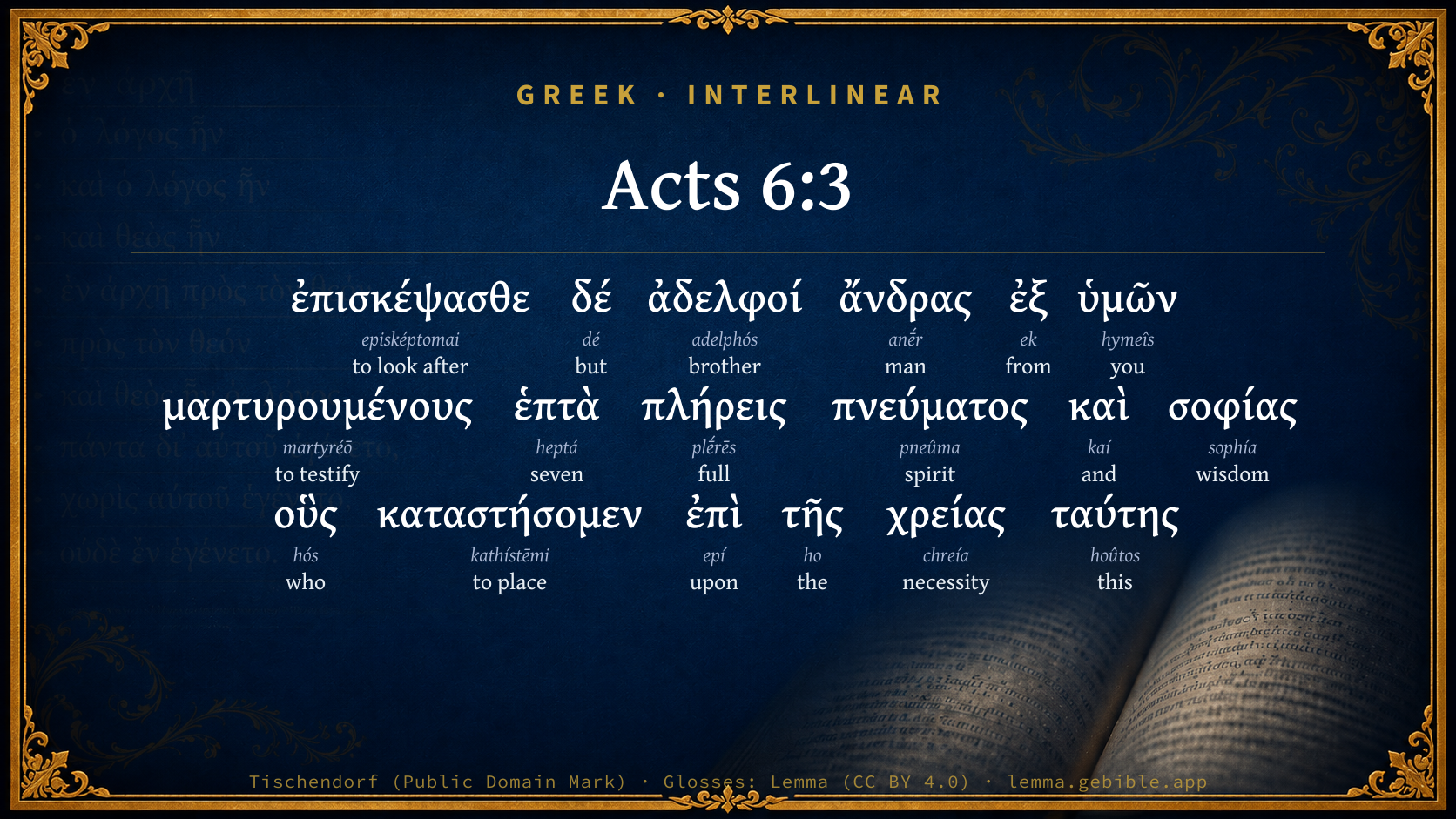
Greek (Tischendorf 8th ed.) Acts 6:3 appears in the Greek New Testament. The text above is from the Tischendorf 8th edition. Each word links to its Strong’s number and a concise gloss. Click any word for its full Thayer’s Greek Lexicon entry.
Download image
Cite this verse

Acts 6:3 (World English Bible). Public Domain. Lemma interlinear Bible study tool, https://lemma.gebible.app/v/acts/6/3.

Show BibTeX & RIS
BibTeX
RIS
English Translation
Therefore select from among you, brothers, seven men of good report, full of the Holy Spirit and of wisdom, whom we may appoint over this business.
World English Bible · Public Domain
Download a study sheet

One document with this verse’s original text, its word-by-word gloss line, the meaning frame, cross-references with their text, attributed commentary, and full source and license credits — printable, and it pastes into notes with its structure intact.

This verse Autodidact and up

Study sheet (.html) Plain text (.txt)

A passage Seminary Student

Up to 50 verses in one chapter. A passage sheet keeps up to 6 commentary sources and 12 cross-references per verse, in the order this page ranks them, and says so on the sheet whenever that leaves anything out. Ask for a single verse and you get the Autodidact verse sheet above.

Everything on this page stays free to read, with no account — the sheet is a download of what is already on screen, not access to it.

Want to remove ads? Support Godless Engineer
Compare translations 3

The same verse in 3 English versions, stacked beneath the original-language interlinear above. Click any original word for its lexicon entry.

Each is an independent rendering of the whole verse — the interlinear is not word-aligned to these translations.

Highlighted words mark where these versions differ — a whole-verse word diff, not a word-by-word alignment.

  • World English Bible Public Domain
    Therefore select from among you, brothers, seven men of good report, full of the Holy Spirit and of wisdom, whom we may appoint over this business.
  • King James Version Public Domain
    Wherefore, brethren, look ye out among you seven men of honest report, full of the Holy Ghost and wisdom, whom we may appoint over this business.
  • unfoldingWord Literal Text CC BY-SA 4.0
    So brothers, choose from among yourselves seven men of good reputation, full of the Spirit and of wisdom, whom we may appoint over this task.

unfoldingWord Literal Text — © unfoldingWord, licensed CC BY-SA 4.0. Word-aligned USFM3 via Door43 (git.door43.org/unfoldingWord/en_ult).

Versions to compare (up to 4)

3 of 4 selected

Show all 19 translations

Every available English version of this verse, each an independent rendering of the whole verse.

  • World English Bible Public Domain
    Therefore select from among you, brothers, seven men of good report, full of the Holy Spirit and of wisdom, whom we may appoint over this business.
  • Berean Standard Bible Public Domain
    Therefore, brothers, select from among you seven men confirmed to be full of the Spirit and wisdom. We will appoint this responsibility to them
  • Majority Standard Bible Public Domain
    Therefore, brothers, select from among you seven men confirmed to be full of the Holy Spirit and wisdom. We will assign this responsibility to them
  • King James Version Public Domain
    Wherefore, brethren, look ye out among you seven men of honest report, full of the Holy Ghost and wisdom, whom we may appoint over this business.
  • American Standard Version (1901) Public Domain
    Look ye out therefore, brethren, from among you seven men of good report, full of the Spirit and of wisdom, whom we may appoint over this business.
  • Revised Version (1885) Public Domain
    Look ye out therefore, brethren, from among you seven men of good report, full of the Spirit and of wisdom, whom we may appoint over this business.
  • Geneva Bible (1599) Public Domain
    Wherefore brethren, looke ye out among you seuen men of honest report, and full of the holy Ghost, and of wisedome, which we may appoint to this busines.
  • Douay-Rheims (1899) Public Domain
    Wherefore, brethren, look ye out among you seven men of good reputation, full of the Holy Ghost and wisdom, whom we may appoint over this business.
  • Young's Literal Translation Public Domain
    look out, therefore, brethren, seven men of you who are well testified of, full of the Holy Spirit and wisdom, whom we may set over this necessity,
  • Literal Standard Version CC BY-SA 4.0
    look out, therefore, brothers, seven men of you who are testified well of, full of the Holy Spirit and wisdom, whom we may set over this necessity,
  • Unlocked Literal Bible CC BY-SA 4.0
    You should therefore choose, brothers, seven men from among yourselves, men of good reputation, full of the Spirit and of wisdom, whom we may appoint over this business.
  • unfoldingWord Literal Text CC BY-SA 4.0
    So brothers, choose from among yourselves seven men of good reputation, full of the Spirit and of wisdom, whom we may appoint over this task.
  • Darby Bible Public Domain
    Look out therefore, brethren, from among yourselves seven men, well reported of, full of [the] [Holy] Spirit and wisdom, whom we will establish over this business:
  • World Messianic Bible Public Domain
    Therefore, select from among you, brothers, seven men of good report, full of the Holy Spirit and of wisdom, whom we may appoint over this business.
  • Webster's Bible Public Domain
    Wherefore, brethren, look ye out among you seven men of honest report, full of the Holy Spirit and wisdom, whom we may appoint over this business.
  • Free Bible Version CC BY-SA 4.0
    Brothers, choose from among you seven trustworthy men full of the Spirit and wisdom. We will hand this responsibility over to them.
  • Bible in Basic English Public Domain
    Take then from among you seven men of good name, full of the Spirit and of wisdom, to whom we may give control of this business.
  • Text-Critical English NT CC BY 4.0
    Therefore, brothers, look for seven men among you who have a good reputation and are full of the Holy Spirit and wisdom, whom we can appoint for this need.
  • Tyndale New Testament (1534) Public Domain
    Wherfore brethren loke ye out amonge you seven men of honest reporte and full of the holy goost and wysdome which we maye apoynte to this nedfull busynes.

Literal Standard Version (2020), Covenant Press — licensed CC BY-SA 4.0. Text via the HelloAO Bible API (eBible.org). Unlocked Literal Bible (unfoldingWord) — licensed CC BY-SA 4.0. Text via the HelloAO Bible API (eBible.org). unfoldingWord Literal Text — © unfoldingWord, licensed CC BY-SA 4.0. Word-aligned USFM3 via Door43 (git.door43.org/unfoldingWord/en_ult). Free Bible Version, Dr. Jonathan Gallagher — licensed CC BY-SA 4.0. Text via the HelloAO Bible API (eBible.org).

Word by word

More ways to search: Search by grammar → Find every occurrence → Compare this word →

Practice this passage: Drill this verse → Learn its vocabulary →

ἐπισκέψασθε
episképtomai
G1980
“to look after”
Verb, Aorist, Middle deponent, Imperative, 2nd person, Plural
Part of Speech
Verb
Tense
Aorist
Voice
Middle deponent
Mood
Imperative
Person
2nd person
Number
Plural
Full Thayer's Definition

Origin: middle voice from G1909 and the base of G4649

TDNT: 11:59,2

1. to look upon or after, to inspect, examine with the eyes a. in order to see how he is, i.e. to visit, go to see one 1. the poor and afflicted, the sick b. to look upon in order to help or to benefit 1. to look after, have care for, provide for: of God c. to look (about) for, look out (one to choose, employ, etc.)
  1. δέ dé G1161 “but” Conjunction
  2. ἀδελφοί adelphós G80 “brother” Noun, Vocative, Plural, Masculine
  3. ἄνδρας anḗr G435 “man” Noun, Accusative, Plural, Masculine
  4. ἐξ ek G1537 “from” Preposition
  5. ὑμῶν hymeîs G5210 “you” Personal pronoun, 2nd person, Genitive, Plural
  6. μαρτυρουμένους martyréō G3140 “to testify” Verb, Present, Passive, Participle, Accusative, Plural, Masculine
  7. ἑπτὰ heptá G2033 “seven” Adjective, Numeral (indeclinable)
  8. πλήρεις plḗrēs G4134 “full” Adjective, Accusative, Plural, Masculine
  9. πνεύματος pneûma G4151 “spirit” Noun, Genitive, Singular, Neuter
  10. καὶ kaí G2532 “and” Conjunction
  11. σοφίας sophía G4678 “wisdom” Noun, Genitive, Singular, Feminine
  12. οὓς hós G3739 “who” Relative pronoun, Accusative, Plural, Masculine
  13. καταστήσομεν kathístēmi G2525 “to place” Verb, Future, Active, Indicative, 1st person, Plural
  14. ἐπὶ epí G1909 “upon” Preposition
  15. τῆς ho G3588 “the” Article, Genitive, Singular, Feminine
  16. χρείας chreía G5532 “necessity” Noun, Genitive, Singular, Feminine
  17. ταύτης hoûtos G3778 “this” Demonstrative pronoun, Genitive, Singular, Feminine

About this verse

These counts appear in no published source. They are computed here, from the morphology-tagged text and Lemma’s own curated glosses. What Lemma adds →

18
words
18
distinct lemmas
Acts
section

Notable vocabulary

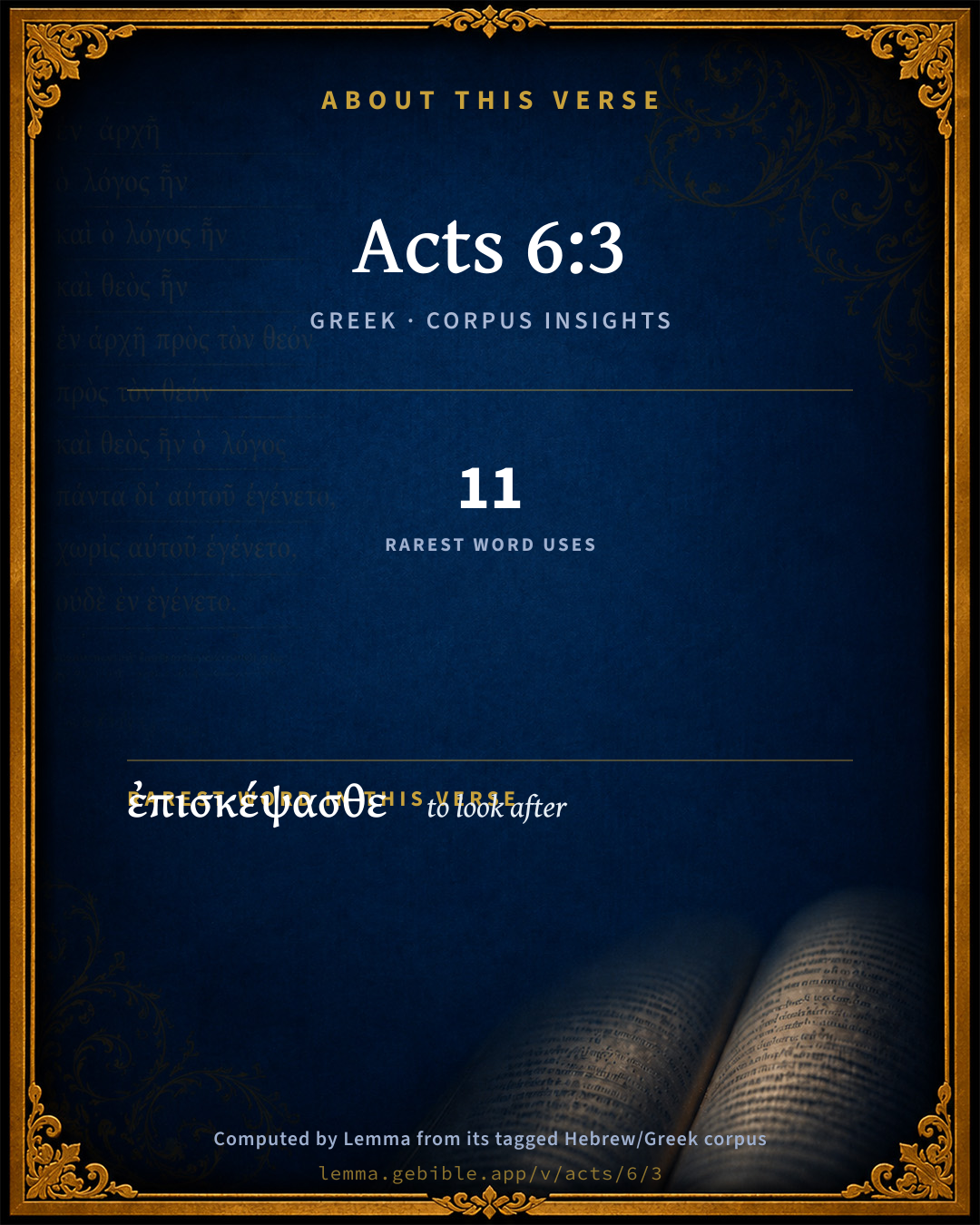
The rarest word here is ἐπισκέψασθε to look after G1980 — appearing just 11 times in the whole Greek New Testament.

Shared distinctive vocabulary

ἐπισκέψασθε to look after G1980 occurs in 11 verses of the Greek New Testament. Also found in:

Cross-references

28

Topical passages linked to Acts 6:3 in the Treasury of Scripture Knowledge — connected by theme and wording, ordered by reader-vote popularity; previews shown in the World English Bible.

  • 1 Timothy 3:7–15 Moreover he must have good testimony from those who are outside, to avoid falling into reproach and the snare of the devil.
  • Deuteronomy 1:13 Take wise men of understanding and well known according to your tribes, and I will make them heads over you.
  • James 3:17–18 But the wisdom that is from above is first pure, then peaceful, gentle, reasonable, full of mercy and good fruits, without partiality, and without hypocrisy.
  • Numbers 27:18–19 Yahweh said to Moses, Take Joshua the son of Nun, a man in whom is the Spirit, and lay your hand on him;
  • 1 Timothy 5:10 being approved by good works, if she has brought up children, if she has been hospitable to strangers, if she has washed the saints' feet, if she has relieved the afflicted, and if she has diligently followed every good work.
  • Acts 13:2–3 As they served the Lord and fasted, the Holy Spirit said, "Separate Barnabas and Saul for me, for the work to which I have called them."
  • Genesis 41:38–39 Pharaoh said to his servants, "Can we find such a one as this, a man in whom is the Spirit of God?"
  • Numbers 11:16–25 Yahweh said to Moses, Gather to me seventy men of the elders of Israel, whom you know to be the elders of the people, and officers over them; and bring them to the tent of meeting, that they may stand there with you.
  • 3 John 1:12 Demetrius has the testimony of all, and of the truth itself; yes, we also testify, and you know that our testimony is true.
  • Job 32:7–8 I said, 'Days should speak, And multitude of years should teach wisdom.'
  • Isaiah 11:2–5 The Spirit of Yahweh shall rest on him, the spirit of wisdom and understanding, the spirit of counsel and might, the spirit of knowledge and of the fear of Yahweh.
  • Isaiah 28:6 and a spirit of justice to him who sits in judgment, and strength to those who turn back the battle at the gate.
  • Isaiah 28:26 For his God does instruct him aright, [and] does teach him.
  • Matthew 23:8 But don't you be called 'Rabbi,' for one is your teacher, the Christ, and all of you are brothers.
  • Acts 1:21 Of the men therefore who have accompanied us all the time that the Lord Jesus went in and out among us,
  • Acts 2:4 They were all filled with the Holy Spirit, and began to speak with other languages, as the Spirit gave them the ability to speak.
  • Acts 6:6 whom they set before the apostles. When they had prayed, they laid their hands on them.
  • Acts 10:22 They said, "Cornelius, a centurion, a righteous man and one who fears God, and well spoken of by all the nation of the Jews, was directed by a holy angel to invite you to his house, and to listen to what you say."
  • Acts 22:12 One Ananias, a devout man according to the law, well reported of by all the Jews who lived in Damascus,
  • 1 Corinthians 16:3 When I arrive, I will send whoever you approve with letters to carry your gracious gift to Jerusalem.
  • 2 Corinthians 8:19–21 Not only so, but who was also appointed by the assemblies to travel with us in this grace, which is served by us to the glory of the Lord himself, and to show our readiness.
  • Ephesians 5:18 Don't be drunken with wine, in which is dissipation, but be filled with the Spirit,
  • James 1:17 Every good gift and every perfect gift is from above, coming down from the Father of lights, with whom can be no variation, nor turning shadow.
  • 1 John 3:14–16 We know that we have passed out of death into life, because we love the brothers. He who doesn't love his brother remains in death.
  • 1 Corinthians 12:8 For to one is given through the Spirit the word of wisdom, and to another the word of knowledge, according to the same Spirit;
  • Acts 9:30 When the brothers knew it, they brought him down to Caesarea, and sent him off to Tarsus.
  • Acts 15:23 They wrote these things by their hand: "The apostles, the elders, and the brothers, to the brothers who are of the Gentiles in Antioch, Syria, and Cilicia: greetings.
  • Acts 16:2 The brothers who were at Lystra and Iconium gave a good testimony about him.

Cross-references courtesy of OpenBible.info (CC BY 4.0).

Where the printed editions differ

1 variant

Places in this verse where the major printed Greek editions disagree on the wording in a way that affects the translation — a comparison of editions, not a manuscript-by-manuscript collation. The editions are the modern critical texts (Nestlé-Aland 28/27, SBL, Westcott-Hort, Tregelles, Tyndale House) and the traditional texts behind the KJV (the Textus Receptus and the Byzantine/Majority text). It is not a claim about which reading is original.

  1. Extra text
    ἁγίου

    “Holy”

    In TRByz Not in NA28NA27TynSBLWHTreg

    ἁγίου (hagiou) 'Holy' is only in traditional manuscripts (TR+Byz)

Textual data: Translators Amalgamated Greek New Testament (STEPBible TAGNT) · CC BY 4.0.

Commentary

Notes on Acts 6:3 from classic Christian and Jewish commentators (each source and its license shown beneath its notes). The classic Christian expositions comment on the surrounding passage and are grouped to its opening verse, so a note may address several verses; the Jewish commentaries on the Tanakh (Rashi and others) are per-verse, so they appear only where the commentator wrote on this verse.

Lemma curates 59 commentaries, every one of them public domain or Creative Commons licensed, each selected and text-cleaned for this edition rather than reprinted as found. About our sources →

The Biblical Illustrator

Joseph S. Exell

Act_6:3-6

Wherefore, brethren, look ye out among you seven men.

The work of the Spirit in the deaconship of the Christian Church

I. The reasons assigned.

1. That the apostles might be relieved of secular duties. This did not arise out of any idea of superiority. They were the servants of all, ready to be, do, or suffer anything that might be for the glory of God and the good of men. Nor did it arise from any low estimate of the temporal interests of the Church. They were no ascetics. Temporalities were important in themselves, and in their influence on spiritual concerns. It arose out of their higher office and its absorbing claims. With these nothing must be allowed to interfere. However valuable the bodies of men, their souls were more so. What reproof is here administered to modern ministers and laymen! How many ministers are serving tables! And the offence is aggravated when this is the result of lay neglect. Both are sufferers--the minister whose mind is secularised, and the people who are less effectually instructed.

2. That the apostles might give themselves wholly to their proper duties. This is reason. The duty of a minister is to aim at the conversion of sinners, and to employ all means to secure that. And the danger is lest his mind should be brought under any influence that would disincline or disqualify it. These ends are only to be gained by an entire devotion to the sacred calling. Paul says to Timothy, Give thyself wholly to them. The philosophy is as sound as the sentiment is heavenly. The physician who would be successful in his profession must be devoted to it. So must the merchant and the labourer. The apostles were to give themselves to prayer in secret, and the Word in public. Without prayer there will be no heart for the Word--no success in it. Without the Word prayer will be a pretence and a mockery. Together they are omnipotent through grace. Let all the arrangements of the Church be such as to cherish and encourage their union. Let its temporalities be so managed by the members that the ministry may be relieved.

II. The manner. Church officers in the apostolic age were chosen by Church members. Matthias was so chosen. The voice of the Church is essential to the validity of the ministry. Members have an interest in the minister they have chosen which they can never have in one placed over them without their approval At the same time guards are necessary.

1. The purity of the Church. Its membership must not be a promiscuous community. Men of the world are incompetent to elect a Christian minister.

2. The sanction of the existing ministry. As these deacons were elected by the people, they were appointed by the apostles. Both had their rights and their duties. Either might refuse consent. And thus the one was a wholesome restraint on the other. What a consummate knowledge of human nature was manifested in the organisation of the Church! Its Author truly knew what was in man.

III. The qualifications (Act_6:3; Act_6:8). Note that these are the qualifications required for the management of temporal concerns. It must not be supposed, then, that mere business men can manage such. They have a sacred bearing; they must be conducted on holy principles, and be directed to holy ends. The meanest duties may be elevated by high motives. The deacons were to be--

1. Men of honest report. Their conduct must be such as to command respect. The public seldom err in their judgment of men. They may dislike their piety and persecute them, but secretly they will honour them, especially if they are, as they ought to be, useful and amiable as well.

2. Full of the Holy Ghost. Not only should they be men of piety, but eminently so.

3. Men of wisdom. Piety, although the first requisite, is not the only one. There are men of whose godliness we may be persuaded, but in whose ability for the direction of affairs we have not confidence.

4. Full of faith.

5. As a result of all this there will be power--mighty influence for good.

IV. The appointment.

1. The disciples set the elected deacons before the apostles.

2. The apostles prayed over them. Without God it was felt that the whole procedure was vain. We must do nothing in the Church on which we may not ask His blessing.

3. Then they laid their hands upon them. The Spirit was sought for men who already had the Spirit, and this was to be a token of the increase of His gifts and graces for their new duties.

V. The effects.

1. Many evils were prevented of which no mention is made.

(1) The discontent was silenced, for the cause was removed.

(2) The apostles were not hindered or distracted by misunderstandings in the Church.

2. Better than this, much good was done.

(1) The Word of God increased. It was preached more generally and powerfully, and a greater blessing rested on the preachers.

(2) The most prejudiced, the priests, were persuaded. The bitterest enemies were won to friendship, and so far the greatest barrier to the gospel was thrown down. When a mans ways please the Lord, He maketh his enemies to be at peace with him. Conclusion: Note the connection between a right ecclesiastical polity and a successful ministration of the Word. Of course God can bless His Word under any polity; but there is a polity that hinders and a polity that promotes the truth. (J. Morgan, D. D.)

Suitable men to be sought out by the Church

A radical mistake has been committed in supposing it is necessary in all cases for the desire after the sacred office to rise up first of all and spontaneously in the breast of the aspirant. In consequence of this, many have thrust themselves forward who were altogether unfit for the work; while many, as eminently qualified for it, have been kept back by modesty. Does it not seem to be the work of the pastors and the churches to call out from among themselves the most gifted and pious of their members for this object? Should this matter be left to the inflations of self-conceit, the promptings of vanity, or the impulses, it may be of a sincere, but at the same time of an unenlightened zeal? Nothing can be more erroneous than that this call of the Church would be an officious intermeddling with the work of the Spirit in calling the ministry--for it may surely be conceived to be quite as rational a notion to suppose that the Spirit calls a person through the medium of the Church and its pastor, as to imagine that the commission from above comes direct to the heart of an individual--especially as the Church and the pastor, or at any rate the latter, is usually applied to, as a judge of the candidates fitness for the work; and thus, after all, the power and the right of pronouncing a judgment upon the alleged call of this Divine agent are vested with the pastor and the Church. To affirm that an individual cannot be supposed to have a very great fitness for the office, unless his love of souls has been strong enough to prompt him to desire the work of the ministry, and that he is not likely to be very earnest in it, if he be thus sent, instead of his going of his own accord, is assuming too much; for on the plan here recommended, it is supposed that the individual who attracts the attention of the pastor is one who, in addition to true piety and competent abilities, has manifested an active zeal in the way of doing good. It is only on such an one that his eye would light, or to whom he would venture to make the suggestion. In nil the official appointments recorded in the New Testament, from an apostle down to a deacon, the people were requested to look out for suitable men, and not to wait till they presented themselves. (J. A. James.)

Why seven deacons

Some have asserted that it was so determined because seven was a sacred number, others because there were now seven congregations in Jerusalem, or seven thousand converts. Perhaps, however, the true reason was simply that seven is a very convenient practical number. In case of a difference of opinion a majority can always be secured on one side or other, and all blocks avoided. The number seven was long maintained in connection with the order of deacons, in imitation of the apostolic institution. A council at Neo-Caesarea, a.d. 814, ordained that the number of seven deacons should never be exceeded in any city, while in the Church of Rome the same limitation prevailed from the second to the twelfth century, so that the Roman cardinals, who were the parochial clergy of Rome, numbered among them merely seven deacons down to that late period. The seven chosen by the primitive Church were to be men of good report because they were to be public functionaries, whose decisions were to allay commotions and murmurings; and therefore they must be men of weight, in whom the public had confidence. But, further, they must be men full of the Spirit and of wisdom. Piety was not the only qualification; they must be wise, prudent, sound in judgment as well. (G. T. Stokes, D. D.)

We will give ourselves continually to prayer, and to the ministry of the Word.--

Prayer and preaching

Alternate or simultaneous, are the right and left side of a living ministry. The preaching work may be laboriously and conscientiously performed without comfort or success if the other side be from any cause paralysed. I watched once the operations of a brick-maker in a field of clay. There was great agility in his movements. He wrought by piece, and the more he turned out the higher was his pay. His body moved like a machine. His task for a time was simply to raise a quantity of clay from a lower to a higher level by means of a spade, lie threw up one spadeful, and then he dipped his tool in a pail of water that stood by. After every spadeful of clay there was a dip in the water. The operation of dipping occupied as much time as raising. My first thought was, if he should dispense with these apparently useless baptisms, he might perform almost double the amount of work. My second thought was wiser: on reflection, I saw that if he should continue to work without these alternate washings, the clay would have stuck to the spade, and progress would have been altogether arrested. I said to myself, Go thou and do likewise. Prayer is the baptism which makes progress quick. (W. Arnot, D. D.)

Ministers should give themselves to prayer

I was lately in company of one of our older ministers, said a young minister the other day; one who has laboured long and with much success in some of the most difficult fields of the Church. The object of my interview was to learn from him the secret of success with which it had pleased God to crown his ministry in positions and places where others had failed. Instead, however, of directly giving me the information I desired, he told me with great sorrow the reason why he had accomplished so little, and said with unaffected sadness, My young friend, the mistake of my life has been that I have not prayed more. I fell into the error of most ministers--I studied and preached. I worked and worried too much, and I prayed too little. Could I live my life over again, I would be more with God and less with men. I see it all now--what wasted years of unrest I have passed, how much of my life was my own doing, and how little of God has been in my active ministry! I can now, in the evening of my days, only ask God to forgive my shortcomings, and to aid me in spending my few remaining years differently from the imperfect way in which I have served my Master.

Prayer and power

A friend who knew Mr. Spurgeon many years ago, and who heard him preach on many occasions, says that he once heard him preach in one of our large towns in the afternoon and evening on a certain day; and that at the close of the afternoon service Mr. Spurgeon spoke of the consciousness that the service had not been what it should have been. His friend (then a student) admitted that he thought the preacher had not been himself in the preaching. Mr. Spurgeon, with a remark to the effect that it would never do to repeat the failure in the evening, went out into the woods to pray. Indeed, he spent the whole interval between the afternoon and evening services in prayer. The latter meeting was one of great power, and different in all respects from that of the afternoon. Many preachers of to-day might imitate Mr. Spurgeons example with great advantage to themselves and their congregations.

Prayer and ministerial success

A minister observing a poor man by the roadside breaking stones with a hammer, and kneeling to get at his work the better, said to him, Ah, John, I wish I could break the stony hearts of my hearers as easily as you are breaking these stones! The man replied, Perhaps, master, you dont work on your knees?

They laid their hands on them.--

Imposition of hands

This action was of frequent use among the ancient Jews. The apostles must have remembered that it was employed in the designation of Joshua as leader of Israel in place of Moses (Num_27:18-23; cf. Deu_34:9), that it was used even in the synagogue in the appointment of Jewish rabbis, and had been sanctioned by our Lords practice. They naturally, therefore, used this symbol upon the solemn appointment of the first deacons, and the same ceremonial was repeated upon similar occasions (see Act_13:3; 2Ti_1:6; Heb_6:2). This ceremony was also employed by the apostles as the rite which filled up and perfected the baptism which had been administered by others (Act_8:17). The ceremony of imposition of hands was so essential and distinguishing a point, that Simon Magus selects it as the one he desires above all others effectually to purchase, so that the outward symbol might be followed by the inward grace (Act_8:19). Again in chap. 19. we find St. Paul using the same visible ceremony in the case of St. Johns disciples, who were first baptized with Christian baptism, and then endued by St. Paul with the gift of the Spirit. Imposition of hands in the case of ordination is a natural symbol, indicative of the transmission of function and authority. It fitly indicates and notifies to the whole Church the persons who have been ordained, and therefore has ever been regarded as a necessary part of ordination. (G. T. Stokes, D. D.)

A man full of faith and of the Holy Ghost.--

Stephens faith and its source

I. Stephens faith. From the speech he made in defence we may gather some of the leading features of his faith.

1. Stephen believed that Gods hand was discernible in history. He gives a rapid survey of the Scripture story from the call of Abraham to the death of Jesus, and shows how all had been overruled by God. The common notion is that kings and statesmen make history. Stephen believed that God made it. To him the value of history was not merely that it told succeeding generations the things that had happened to their fathers, and the deeds their fathers had done, but that it revealed God, made known His character, principles, and relationship to man. The life and soul of history is God. It is noticeable that Stephens speech is far from exact in its statements. Dean Stanley points out no less than twelve differences from the Mosaic history. But mere precision of record was not his aim. He desired to show the purposes of God. There may be the most minute exactitude of delineation, and yet no life. The true artist will sacrifice the rectitude of a line that he may express the soul of his subject.

2. Stephen believed that the most noticeable way-mark of the universal march had just been passed. It was the Cross of Jesus. So far the race had been journeying on and on to Calvary.

3. Stephen believed that Jesus, after His Cross and passion, had risen from the dead, and ascended to the right hand of the Father.

4. Stephen believed that the exalted Jesus still cared for, and could help His servants in all their labour and suffering upon earth. He beheld Jesus standing on the right hand of God, as if ready to assist him, and he prayed to Jesus.

II. Stephens possession of the Holy Spirit.

1. It was this that gave life to his faith. It is not the correctness of the creed that makes a man a Christian, in the highest sense, but the quickening power of the Holy Spirit.

2. If we would be useful as servants of God among men we must be baptized in the Holy Ghost.

3. Nay, we cannot live aright without this.

4. The most important question we can be asked is, Have ye received the Holy Ghost? (J. Kirk Pike.)

The character of Stephen

I. The spiritual endowments by which he was distinguished. Full of faith and of the Holy Ghost.

1. The high and honourable office to which he was elected would demand the continual exercise of a simple affiance in the power, the faithfulness, the love of Jesus Christ--in the stability of that religion to which he was self-devoted--in the fulfilment of that promise (Mat_28:20).

2. Stephen was also full of the Holy Ghost. As the Shekinah, the bright emblem of the Divine presence, descended from heaven and filled the holy of holies, so did a sacred influence from above fill the heart of Stephen, and make his body the temple of the Holy Ghost.

II. The earnestness of his labour in the cause of Christ. He who is full of faith and of the Holy Ghost, proves the power of religion as a practical principle by abounding in every good word and work. His obligations to the Fountain of Mercy are so great, his deliverance so gracious, his hope so animating, his responsibilities so awful, that one master-feeling will occupy his mind--a desire to walk worthy of God, who hath called him to His kingdom and glory.

III. To these qualifications of St. Stephen must be added his boldness in confessing Christ. A. Christian should indeed charge it upon his conscience to abstain, as much as in him lieth, from religious controversy. Unnecessary disputes, and oppositions of theological science, are most unfriendly to the love and power of Divine truth in his heart. But when his faith is assailed; when the foundation of every hope on which the soul rests is attacked by the daring impiety of the blasphemer, or the more covert insinuation of the secret infidel, let him remember that silence and indifference are treason against the Saviour who bought him with His blood.

IV. Considering the closing events of St. Stephens life in the order of the sacred narrative, we next remark his support in the hour of trial. He had such a view of his risen Redeemers power and glory as strengthened him to abide unshrinkingly the fate before him; and such a foretaste of the bliss which awaited him as made him desirous to depart, and to be with Christ.

V. The charity with which St. Stephen prayed for his murderers: Lord, lay not this sin to their charge. In this spirit of charity we must live and die if we hope for heaven. Never let us address God with a prayer for our own pardon, if we cannot unfeignedly pardon others their wrongs against us.

VI. The confidence with which St. Stephen resigned his soul into the hand of Christ. (R. P. Buddicom, M. A.)

The Christian full of faith and of the Holy Ghost

Here is an example. How simply is the character sketched! and how distinctly is it stated whence it was that this man was what he was! Happy is that Church which has many such among its laity, men full of the Holy Ghost and of wisdom. How shall we know such? What is it that we are to seek when we wish to be such?

I. Who and what is that man who is full of faith and of the Holy Ghost? Faith which believes the promise respecting the gift of the Holy Ghost, which relies upon His presence and help, which looks to Him continually, leans on His assistance confidently, is necessary to an individuals being full of the Holy Ghost: full of faith and full of the Holy Ghost are inseparably united: they twine together, they grow up each into their fulness together. The Holy Ghost is the author of faith: it is by His gift and operation that the faith of believers groweth exceedingly. He reveals the truth from faith to faith. And faith opens wider and wider the door of the heart for His reception; and faith, acting upon the promises, draws a larger and a larger indwelling of that blessed visitant. It is almost needless to say that the expression being full of the Holy Ghost must mean being under the influence of the Holy Ghost--His influence exerted over the whole man, in all his powers, under all circumstances, at all times. It is by the Holy Ghost that he is guided. He is continually under the Spirits teaching. That blessed Spirit is acting, with all his trials, by them to sanctify him. The influence of the Holy Ghost is upon the man in all that he thinks or does: this is the being full of the Holy Ghost. Hence Christians are said to walk in the Spirit, to pray in the Spirit, to live in the Spirit. We go on now to the effects produced--those which others see visible in our disposition and conduct. The indwelling of the Spirit must be manifest to ourselves. In true Christians--for it is of them that we are now especially speaking--one of the chief and most evident of the operations of the Holy Ghost, where His influence is richly imparted, is the shedding abroad a love to God and a love to all real Christians. In close connection with love is hope, a confiding trust in God. And, because ye are sons, God hath sent forth the Spirit of His Son into your hearts, crying, Abba, Father (Gal_4:6). With these, and perhaps springing out of these in a measure, love and hope, are conjoined joy and peace, the work of the Holy Ghost. The fruit of the Spirit is love, joy, peace (Gal_5:22), says the apostle: joy of the Holy Ghost (2Th_1:6), he says again. There are also exhibitions of Christian excellence--these come from the Spirit: there are works done by Christians--these are originated by the Spirit. Scripture is very clear and definite in its language. We must observe it where it is so marked and positive in its expression: it does not speak of goodness, charity, temperance, etc., as our own virtues, which we are to follow; but it calls them fruits of the Spirit. But the fruit of the Spirit, says St. Paul, is love, joy, peace, longsuffering, gentleness, goodness, faith, meekness, temperance. These, if really Christian graces, come from the Spirits operation. He commences them; He nurtures them; He gives them their growth; He will bring them out to their full completion in another world. I would observe, too, that all these fruits of the Spirit must be sought by the Christian. Our Saviour denounces the breaking one of His least commandments. These graces of the Holy Ghost differ, in many respects, from those excellencies which the unchanged heart of man can exhibit. We may notice one of these graces in St. Stephen, that man full of faith and of the Holy Ghost. Christian graces have their opposites, but both appear. Where the Spirit of God works it will be so. See in St. Stephen the lion and the lamb united: he is the lion in courage, as he meets his persecutors, as he stands up valiant for the truth: he is the lamb in meekness, as he kneels down and prays for his murderers, Lord, lay not this sin to their charge.

II. Our sinfulness in coming short of this, or it may be even, solemn and painful as is the thought, in some instances, the not possessing it at all. Think how often His good influences have been quenched, His work upon the soul interfered with, and more or less marred! Be humbled on account of these things. Endeavour to see them rightly. Confess them. This is the only way to obtain blessing from God.

III. The encouragements to our seeking this character, and, in dependence upon God, making it our object to be men full of faith and of the Holy Ghost. (J. E. Dalton, B. D.)

.

The Biblical Illustrator, edited by Joseph S. Exell (c. 1880s–1900s) — public domain. Text from a community e-Sword module.

MacLaren's Expositions of Holy Scripture

Alexander MacLaren

Acts

FILLED WITH THE SPIRIT

Act 6:3, Act 6:5, Act 6:8.

I have taken the liberty of wrenching these three fragments from their context, because of their remarkable parallelism, which is evidently intended to set us thinking of the connection of the various characteristics which they set forth. The first of them is a description, given by the Apostles, of the sort of man whom they conceived to be fit to look after the very homely matter of stifling the discontent of some members of the Church, who thought that their poor people did not get their fair share of the daily ministration. The second and third of them are parts of the description of the foremost of these seven men, the martyr Stephen. In regard to the first and second of our three fragmentary texts, you will observe that the cause is put first and the effect second. The ‘deacons’ were to be men ‘full of the Holy Ghost,’ and that would make them ‘full of wisdom.’ Stephen was ‘full of faith,’ and that made him ‘full of the Holy Ghost.’ Probably the same relation subsists in the third of our texts, of which the true reading is not, as it appears in our Authorised Version, ‘full of faith and power,’ but as it is given in the Revised Version, ‘full of grace and power.’ He was filled with grace-by which apparently is here meant the sum of the divine spiritual gifts-and therefore he was full of power. Whether that is so or not, if we link these three passages together, as I have taken the liberty of doing, we get a point of view appropriate for such a day [Footnote: Preached on Whit Sunday.] as this, when all that calls itself Christendom is commemorating the descent of the Holy Spirit, and His abiding influence upon the Church. So I simply wish to gather together the principles that come out of these three verses thus concatenated.

I. We may all, if we will, be full of the Holy Spirit.

If there is a God at all, there is nothing more reasonable than to suppose that He can come into direct contact with the spirits of the men whom He has made. And if that Almighty God is not an Almighty indifference, or a pure devil-if He is love-then there is nothing more certain than that, if He can touch and influence men’s hearts towards goodness and His own likeness, He most certainly will.

The probability, which all religion recognises, and in often crude forms tries to set forth, and by superstitious acts to secure, is raised to an absolute certainty, if we believe that Jesus Christ, the Incarnate Truth, speaks truth to us about this matter. For there is nothing more certain than that the characteristic which distinguishes Him from all other teachers, is to be found not only in the fact that He did something for us on the Cross, as well as taught us by His word; but that in His teaching He puts in the forefront, not the prescriptions of our duty, but the promise of God’s gift; and ever says to us, ‘Open your hearts and the divine influences will flow in and fill you and fit you for all goodness.’ The Spirit of God fills the human spirit, as the mysterious influence which we call life permeates and animates the whole body, or as water lies in a cup.

Consider how that metaphor is caught up, and from a different point of view is confirmed, in regard to the completeness which it predicates, by other metaphors of Scripture. What is the meaning of the Baptist’s saying, ‘He shall baptise you in the Holy Ghost and fire’? Does that not mean a complete immersion in, and submersion under, the cleansing flood? What is the meaning of the Master’s own saying, ‘Tarry ye. . . till ye be clothed with power from on high’? Does not that mean complete investiture of our nakedness with that heavenly-woven robe? Do not all these emblems declare to us the possibility of a human spirit being charged to the limits of its capacity with a divine influence?

We do not here discuss questions which separate good Christian people from one another in regard of this matter. My object now is not to lay down theological propositions, but to urge upon Christian men the acquirement of an experience which is possible for them. And so, without caring to enter by argument on controversial matters, I desire simply to lay emphasis upon the plain implication of that word, ‘filled with the Holy Ghost.’ Does it mean less than the complete subjugation of a man’s spirit by the influence of God’s Spirit brooding upon him, as the prophet laid himself on the dead child, lip to lip, face to face, beating heart to still heart, limb to limb, and so diffused a supernatural life into the dead? That is an emblem of what all you Christian people may have if you like, and if you will adopt the discipline and observe the conditions which God has plainly laid down.

That fulness will be a growing fulness, for our spirits are capable, if not of infinite, at any rate of indefinite, expansion, and there is no limit known to us, and no limit, I suppose, which will ever be reached, so that we can go no further-to the possible growth of a created spirit that is in touch with God, and is having itself enlarged and elevated and ennobled by that contact. The vessel is elastic, the walls of the cup of our spirit, into which the new wine of the divine Spirit is poured, widen out as the draught is poured into them. The more a man possesses and uses of the life of God, the more is he capable of possessing and the more he will receive. So a continuous expansion in capacity, and a continuous increase in the amount of the divine life possessed, are held out as the happy prerogative and possibility of a Christian soul.

This Stephen had but a very small amount of the clear Christian knowledge that you and I have, but he was leagues ahead of most Christian people in regard to this, that he was ‘filled with the Holy Spirit.’ Brethren, you can have as much of that Spirit as you want. It is my own fault if my Christian life is not what the Christian lives of some of us, I doubt not, are. ‘Filled with the Holy Spirit’! rather a little drop in the bottom of the cup, and all the rest gaping emptiness; rather the fire died down, Pentecostal fire though it be, until there is scarcely anything but a heap of black cinders and grey ashes in your grate, and a little sandwich of flickering flame in one corner; rather the rushing mighty wind died down into all but a dead calm, like that which afflicts sailing-ships in the equatorial regions, when the thick air is deadly still, and the empty sails have not strength even to flap upon the masts; rather the ‘river of the water of life’ that pours ‘out of the throne of God, and of the Lamb,’ dried up into a driblet.

That is the condition of many Christian people. I say not of which of us. Let each man settle for himself how that may be. At all events here is the possibility, which may be realised with increasing completeness all through a Christian man’s life. We may be filled with the Holy Spirit.

II. If we are ‘full of faith’ we shall be filled with the Spirit.

That is the condition as suggested by one of our texts-’a man full of faith,’ and therefore ‘of the Holy Ghost.’ Now, of course, I believe, as I suppose all people who have made any experience of their own hearts must believe, that before a soul exercises confidence in Jesus Christ, and passes into the household of faith, there have been playing upon it the influences of that divine Comforter whose first mission is to ‘convince the world of sin.’ But between such operations as these, which I believe are universally diffused, wheresoever the Word of God and the message of salvation are proclaimed-between such operations as these, and those to which I now refer, whereby the divine Spirit not only operates upon, but dwells in, a man’s heart, and not only brings conviction to the world of sin, there is a wide gulf fixed; and for all the hallowing, sanctifying, illuminating and strength-giving operations of that divine Spirit, the pre-requisite condition is our trust. Jesus Christ taught us so, in more than one utterance, and His Apostle, in commenting on one of the most remarkable of His sayings on this subject, says, ‘This spake He concerning the Holy Spirit which they that believed in Him were to receive.’ Faith is the condition of receiving that divine influence. But what kind of faith? Well, let us put away theological words. If you do not believe that there is any such influence to be got, you will not get it. If you do not want it, you will not get it. If you do not expect it, you will not get it. If professing to believe it, and to wish it, and to look for it, you are behaving yourself in such a way as to show that you do not really desire it, you will never get it. It is all very well to talk about faith as the condition of receiving that divine Spirit. Do not let us lose ourselves in the word, but try to translate the somewhat threadbare expression, which by reason of its familiarity produces little effect upon some of us, and to turn it into non-theological English. It just comes to this,-if we are simply trusting ourselves to Jesus Christ our Lord, and if in that trust we do believe in the possibility of even our being filled with the divine Spirit, and if that possibility lights up a leaping flame of desire in our hearts which aspires towards the possession of such a gift, and if belief that our reception of that gift is possible because we trust ourselves to Jesus Christ, and longing that we may receive it, combine to produce the confident expectation that we shall, and if all of these combine to produce conduct which neither quenches nor grieves that divine Guest, then, and only then, shall we indeed be filled with the Spirit.

I know of no other way by which a man can receive God into his heart than by opening his heart for God to come in. I know of no other way by which a man can woo-if I may so say-the Divine Lover to enter into his spirit than by longing that He would come, waiting for His coming, expecting it, and being supremely blessed in the thought that such a union is possible. Faith, that is trust, with its appropriate and necessary sequels of desire and expectation and obedience, is the completing of the electric circuit, and after it the spark is sure to come. It is the opening of the windows, after which sunshine cannot but flood the chamber. It is the stretching out of the hand, and no man that ever, with love and longing, lifted an empty hand to God, dropped it still empty. And no man who, with penitence for his own act, and trust in the divine act, lifted blood-stained and foul hands to God, ever held them up there without the gory patches melting away, and becoming white as snow. Not ‘all the perfumes of Araby’ can sweeten those bloody hands. Lift them up to God, and they become pure. Whosoever wishes that he may, and believes that he shall, receive from Christ the fulness of the Spirit, will not be disappointed. Brethren, ‘Ye have not because ye ask not.’ ‘If ye, being evil, know how to give good gifts to your children,’ shall not ‘your Heavenly Father give the Holy Spirit to them that ask Him?’

III. Lastly, if we are filled with the Spirit we shall be ‘full of wisdom, grace, and power.’

The Apostles seemed to think that it was a very important business to look after a handful of poor widows, and see that they had their fair share in the dispensing of the modest charity of the half-pauper Jerusalem church, when they said that for such a purely secular thing as that a man would need to be ‘full of the Holy Ghost and wisdom.’ Surely, something a little less august might have served their turn to qualify men for such a task! ‘Wisdom’ here, I suppose, means practical sagacity, common sense, the power of picking out an impostor when she came whining for a dole. Very commonplace virtues! -but the Apostles evidently thought that such everyday operations of the understanding as these were not too secular and commonplace to owe their origin to the communication to men of the fulness of the Holy Spirit.

May we not take a lesson from that, that God’s great influences, when they come into a man, do not concern themselves only with great intellectual problems and the like, but that they will operate to make him more fit to do the most secular and the most trivial things that can be put into his hand to do? The Holy Ghost had to fill Stephen before he could hand out loaves and money to the widows in Jerusalem.

And do you not think that your day’s work, and your business perplexities, come under the same category? Perhaps the best way to secure understanding of what we ought to do, in regard to very small and secular matters, is to keep ourselves very near to God, with the windows of our hearts opened towards Jerusalem, that all the guidance and light that can come from Him may come into us. Depend upon it, unless we have God’s guidance in the trivialities of life, ninety per cent., ay! and more, of our lives will be without God’s guidance; because trivialities make up life. And unless my Father in heaven can guide me about what we, very mistakenly, call ‘secular’ things, and what we very vulgarly call trivial things, His guidance is not worth much. The Holy Ghost will give you wisdom for to-morrow, and all its little cares, as well as for the higher things, of which I am not going to speak now, because they do not come within my text.

‘Full of grace,’-that is a wide word, as I take it. If, by our faith, we have brought into our hearts that divine influence, the Spirit of God does not come empty-handed, but He communicates to us whatsoever things are lovely and of good report, whatsoever things are fair and honourable, whatsoever things in the eyes of men are worthy to be praised, and by the tongues of men have been called virtue. These things will all be given to us step by step, not without our own diligent co-operation, by that divine Giver. Effort without faith, and faith without effort, are equally incomplete, and the co-operation of the two is that which is blessed by God.

Then the things which are ‘gracious,’ that is to say, given by His love, and also gracious in the sense of partaking of the celestial beauty which belongs to all virtue, and to all likeness in character to God, these things will give us a strange, supernatural power amongst men. The word is employed in my third text, I presume, in its narrow sense of miracle-working power, but we may fairly widen it to something much more than that. Our Lord once said, when He was speaking about the gift of the Holy Spirit, that there were two stages in its operation. In the first, it availed for the refreshment and the satisfying of the desires of the individual; in the second it became, by the ministration of that individual, a source of blessing to others. He said, ‘If any man thirst, let him come to Me and drink,’ and then, immediately, ‘He that believeth on Me, out of his belly shall flow rivers of living water.’ That is to say, whoever lives in touch with God, having that divine Spirit in his heart, will walk amongst men the wielder of an unmistakable power, and will be able to bear witness to God, and move men’s hearts, and draw them to goodness and truth. The only power for Christian service is the power that comes from being clothed with God’s Spirit. The only power for self-government is the power that comes from being clothed with God’s Spirit. The only power which will keep us in the way that leads to life, and will bring us at last to the rest and the reward, is the power that comes from being clothed with God’s Spirit.

I am charged to all who hear me now with this message. Here is a gift offered to you. You cannot pare and batter at your own characters so as to make them what will satisfy your own consciences, still less what will satisfy the just judgment of God; but you can put yourself under the moulding influences of Christ’s love. Dear brethren, the one hope for dead humanity, the bones very many and very dry, is that from the four winds there should come the breath of God, and breathe in them, and they shall live, ‘an exceeding great army.’ Forget all else that I have been saying now, if you like, but take these two sentences to your hearts, and do not rest till they express your own personal experience; If I am to be good I must have God’s Spirit within me. If I am to have God’s Spirit within me, I must be ‘full of faith.’

Alexander MacLaren, Expositions of Holy Scripture (1904–1910) — public domain. Text from a community e-Sword module.

Bengel's Gnomon

Johann Albrecht Bengel

Act 6:3. Μαρτυρουμένους, testified of as to character) Against whom no suspicion of wrongful dealing militated, although there was no need of an oath, a giving of security, or written bond, etc. Comp. 2Ki 12:15; 2Ki 22:7. After the example given in Ananias, who was so severely punished in a case affecting his own property, no one would be so (very) ready to break faith in the case of the property of another.—ἑπτὰ, seven) These were appointed, not at the beginning, but after the apostles, and by the apostles. In the government of the Church, GOD has left many things to be settled according as the successive occasions (times) may require; but the Church ought to establish nothing without God. There had been about five thousand men; ch. Act 4:4; now, with the additions that were made in the meantime, such a number was made up, as that there should be a deacon apiece for the care of the several thousands [viz. seven.].—πλήρεις, full) It is no unimportant matter to dispense the property of the Church. Even in a quæstor (one in charge of the public revenues) and in a deacon, as such, there ought to be administrative and sanctifying gifts. [To wit, ecclesiastical goods are not to be regarded as a spoil, but are to be administered in a spiritual manner, and in such a way as those seven, or as even the apostles themselves, if they were still alive, would use them. God Himself will at some time require an account.—V. g.]—καταστήσομεν) The Indicative, as in 1Co 6:5; Eph 6:16,[44] etc.; Php 2:20.

[44] δυνήσεσθε, for ye may be able. Often, from the objective character of the Greek mind, that is stated positively in the Indic., which more strictly should be stated dependently in the Subjunctive. So in the Greek Testament, in the case of command, or exhortation, or assertion. Here the apostles, speaking authoritatively, use καταστήσομεν for καταστήσωμεν. The latter would have made their act too much dependent on the initiative act of the brethren.—E. and T.

Bengel's Gnomon of the New Testament — English translation (T&T Clark, Edinburgh, 1860) — public domain. Text from a community e-Sword module.

Meyer's Critical & Exegetical Commentary

Heinrich August Wilhelm Meyer

Act_6:3. Accordingly (οὖν), as we, the apostles, can no longer undertake this business of distribution, look ye out, i.e. direct your attention to test and select, etc.

ἑπτά] the sacred number.

σοφίας] quite in the usual practical sense: wisdom, which determines the right agency in conformity with the recognised divine aim. With a view to this required condition of fulness of the Spirit and of wisdom, the men to be selected from the midst of the church were to be attested, i.e. were to have the corresponding testimony of the church in their favour. Comp. Act_16:2 and on Luk_4:22; Dion. Hal. Ant. ii. 26.

οὓς καταστήσομεν ἐπὶ τῆς χρείας ταύτης] whom we (the apostles) will appoint[177] (when they are chosen) over the business in question (on ἐπί with the genitive, in the sense of official appointment over something, see Lobeck, ad Phryn. p. 474; Kühner, ad Xen. Mem. iii. 3. 2). This officium, ministration (see Wetstein and Schweighäuser, Lex. Polyb. p. 665), is just that, of which the distributing to the widows was an essential and indeed the chief part, namely, the care of the poor in the church, not merely as to its Hellenistic portion (Vitringa, de Synag. ii. 2. 5, Mosheim, Heinrichs, Kuinoel). The limitation to the latter would presuppose the existence of a special management of the poor already established for the Hebrew portion, without any indication of it in the text; nor is it supported by the Hellenic names of the persons chosen (Act_6:5), as such names at that time were very common also among the Hebrews. Consequently the hypothesis, that pure Hellenists were appointed by the impartiality of the Hebrews (Rothe, de Wette, Thiersch, Kirche im apost. Zeitalt. p. 75), is entirely arbitrary; as also is the supposition of Gieseler (Kirchengesch. I. sec. 25, note 7), that three Hebrews and three Hellenists (and one proselyte) were appointed; although the chosen were doubtless partly Hebrews and partly Hellenists.

Observe, moreover, how the right to elect was regarded by the apostles as vested in the church, and the election itself was performed by the church, but the appointment and consecration were completed by the apostles; the requisite qualifications, moreover, of those to be elected are defined by the apostles.[178] From this first regular overseership of alms, the mode of appointment to which could not but regulate analogically the practice of the church, was gradually developed the diaconate, which subsequently underwent further elaboration (Php_1:1).[179] It remains an open question whether the overseers corresponded to the גַבַּאִים of the synagogue[180] (Vitringa; on the other side Rhenfeld, see Wolf, Curae).

τῇ διακονίᾳ τοῦ λόγου] correlate contrasting with the διακονεῖν τραπέζαις in Act_6:2.[181] The apostolic working was to be separated from the office of overseer; while, on the other hand, the latter was by no means to exclude other Christian work in the measure of existing gifts, as the very example of Stephen (Act_6:8-10) shows; comp. on Act_8:5.

[177] The opposite of καταστήσ. ἐπὶ τῆς χρ. (comp. 1Ma_10:37) is: μεταστήσασθαι ἀπὸ τῆς χρ., Polyb. iv. 87. 9; 1Ma_11:63.

[178] Comp. Holtzm. Judenth. u. Christenth. p. 613 f.

[179] But the assumption that the institution of the so-called deacons was originally one and the same with the presbyterate, and that only at a later period it ramified into the distinction between the presbyterate in the narrower sense and the diaconate(Lange, apost. Zeitalt. II. p. 75, after J. H. Böhmer; comp. also Lechler, p. 306), is not to be proved by Act_11:30. See in loc. Ritschl, altkathol. K. p. 355 ff., thinks it very probable that the authority of the Seven was the first shape of the office of presbyter afterwards emerging in Jerusalem. So also Holtzmann, l.c. p. 616. Similarly Weiss, bibl. Theol. p. 142, according to whom the presbyters stepped into the place of the Seven and took upon them their duties. But the office of presbyter was still at that time vested in the apostles themselves; accordingly, the essential and necessary difference of the two functions was from the very first the regulative point of view. The presbyterate retained the oversight and guidance of the diaconate (Php_1:1); comp. also Act_11:30; but the latter sprang, by reason of the emerging exigency, from the former, not the converse.

[180] As Leyrer, in Herzogs Encykl. XV. p. 313, thinks. The ecclesiastical over-seership arose out of the higher need and interest of the new present, but the synagogal office might serve as a model that offered itself historically. The requirements for the latter office pointed merely to well-known trustworthy men.

[181] Observe, however, that it is not said: τῇ διαχονίᾳ τῆς προσευχῆς καὶ τοῦ λόγου, and therefore it is not to be inferred from our passage, with Ahrens (Amt d. Schlüssel, p. 37 f.), that by τῇ προσευχῇ a part of the office of the keys is meant. See, in opposition to this, Düsterdieck in the Stud. u. Krit. 1865, p. 762 f.

Meyer — Critical and Exegetical Commentary on the New Testament — English translation by Peter Christie, edited by Frederick Crombie (T&T Clark, 1880) — public domain. Text from a community e-Sword module.

Expositor's Greek Testament

ed. W. Robertson Nicoll

Act 6:3 . ἐπισκέψασθε οὖν : the verb, though frequently used by St. Luke in both his writings, is not elsewhere used in the sense of this verse, “look ye out,” cf. σκέπτεσθαι in Gen 41:33 . μαρτυρουμένους , cf. Heb 11:2 ; Heb 11:39 ; Hebrews cf.4, 5, and 1Ti 5:10 , Act 10:22 ; Act 22:12 , also Act 16:2 ; cf. its use also in Clem. Rom., Cor [193] , Act 17:1 ; Act 18:1 , etc.; Ignat., Phil. , xi., 1; Ephes. , xii. 2. See also the interesting parallels in Deissmann, Neue Bibelstudien , p. 93. In Jos., Ant. , iii., 2, 5, and xv., 10, 5, it is used as here, but of hostile testimony in Mat 23:31 , Joh 18:23 . ἑπτὰ : why was the number chosen? Various answers have been given to the question: (1) that the number was fixed upon because of the seven gifts of the Spirit, Isa 11:2 , Rev 1:4 ; (2) that the number was appointed with regard to the different elements of the Church: three Hellenists, three Hebrews, one Proselyte; (3) that the number was regulated by the fact that the Jerusalem of that day may have been divided into seven districts; (4) that the number was suggested by the Hebrew sacred number seven; (5) Zöckler thinks that there is no hypothesis so probable as that the small Jerusalem ἐκκλησίαι κατʼ οἶκον were seven in number, each with its special worship, and its special business connected with alms-giving and distribution alms-giving closely related to the Eucharist or to the Love-Feasts; (6) the derivation of the number from Roman usage on the analogy of the septemviri epulones advocated by Dean Plumptre, officials no doubt well known to the Libertini (see also B.D. 2 “Deacon,” and the remarks of Ramsay, St. Paul , p. 375, on Roman organisation and its value). This is far more probable than that there should be any connection between the appointment of the Seven and the two heathen inscriptions quoted by Dr. Hatch ( Bampton Lectures , p. 50, note 56), in which the word διάκονος is used of the assistants in the ritual of sacrificial and temple feasts at Anactorium in Acarnania and Metropolis in Lydia (see on the other hand, Hort, Ecclesia , p. 210), for in the incident before us the word διάκονος is not used at all, and later in the history, Act 21:8 , Philip is described not by that title but as one of the Seven. Nor is there any real likeness to be found between the office assigned to the Seven and that of the Chazzan or officer of the Jewish synagogue ( ὑπηρέτης , Luk 4:20 ), who corresponded rather to our parish-clerk or verger, and whose duties were confined to the synagogue; a nearer Jewish parallel is to be found in the צְדָקָה גִּבָּאֵי , collectors of alms, but these officers would rather present a parallel to the tax-gatherers than to those who ministered to the poor (see “Deacon” in Hastings, B.D.). Whilst, however, these analogies in Jewish offices fail us, we stand on much higher ground if we may suppose that as our Lord’s choice of the Twelve was practically the choice of a number sacred in its associations for every Israelite, so the number Seven may have been adopted from its sacredness in Jewish eyes, and thus side by side with the sacred Apostolic College there existed at this period another College, that of the Seven. What was the nature of the office? Was it the Diaconate in the modern sense of the term? But, as we have noted above, the Seven are never called Deacons, and therefore it has been thought that we have here a special office to meet a special need, and that the Seven were rather the prototypes of the later archdeacons, or corresponded to the elders who are mentioned in Act 11:30 and Act 14:23 . On the other hand St. Luke, from the prominence given to the narrative, may fairly be regarded as viewing the institution of the office as establishing a new departure, and not as an isolated incident, and the emphasis is characteristic of an historian who was fond of recording “beginnings” of movements. The earliest Church tradition speaks of Stephen and Nicolas as ordained to the diaconate, Iren., Adv. Haer. , i., 26; iv., 15, and the same writer speaks of Stephen as “the first deacon,” Act 3:12 ; cf. also the testimony of St. Cyprian, Epist. , 3, 3, and the fact that for centuries the Roman Church continued to restrict the number of deacons to seven (Cornelius, ap. Euseb. H. E. , vi., 43). It is quite true that the first mention of διάκονοι in the N.T. (although both διακονία and διακονεῖν are used in the passage before us) is not found until Phi 1:1 , but already a deaconess had been mentioned in writing to the Church at Rome (Act 16:1 , where Phœbe is called διάκονος ), in the Church at Philippi the office had evidently become established and familiar, and it is reasonable to assume that the institution of the Seven at Jerusalem would have been well known to St. Paul and to others outside Palestine, “and that analogous wants might well lead to analogous institutions” (Hort, and to the same effect, Gore, The Church and its Ministry , p. 403). But if the Seven were thus the prototypes of the deacons, we must remember that as the former office though primarily ordained for helping the Apostles in distribution of alms and in works of mercy was by no means confined to such duties, but that from the very first the Seven were occupied in essentially spiritual work, so the later diaconate was engaged in something far different from mere charity organisation; there were doubtless qualifications demanded such as might be found in good business men of tact and discretion, but there were also moral and spiritual qualities which to a great extent were required of the διάκονοι no less than of the πρεσβύτεροι and ἐπίσκοποι : there was the holding the mystery of the faith in a pure conscience, there was the moral and spiritual courage which would enable the διάκονοι to gain even in the pursuit of their διακονία “great boldness in the faith which is in Christ Jesus,” 1Ti 3:13 (Moberly, Ministerial Priesthood , p. 138 ff.); see also on the whole subject, Felten, Apostelgeschichte , p. 139 ff.; Zöckler, Apostelgeschichte , p. 206 ff.; Lightfoot, Philippians , “Dissertation on the Christian Ministry,” and Real-Encyclopädie für protest. Theol. und Kirche (Hauck), “Diakonen” (Heft 38, 1898). σοφίας : practical wisdom, prudentia, cf. 1Co 6:5 (Blass, so Grimm); in Act 6:10 the use of the word is different, but in both places σοφία is referred to the Spirit, “it is not simply spiritual men, but full of the Spirit and of wisdom … for what profits it that the dispenser of alms speak not, if nevertheless he wastes all, or be harsh and easily provoked?” Chrys., Hom. , xiv. οὒς καταστήσομεν (on the reading whom ye , which was exhibited in some few editions of A.V., see Speaker’s Commentary, in loco ): the appointment, the consecration, and the qualifications for it, depend upon the Apostles the verb implies at all events an exercise of authority if it has no technical force, cf. Tit 1:5 . The same shade of meaning is found in classical writers and in the LXX in the use of the verb with the genitive, with ἐπί , sometimes with a dative, sometimes with an accusative: Gen 39:4 ; Gen 41:41 , Exo 2:14 ; Exo 18:21 , Num 3:10 , Neh 12:44 , Dan 2:48-49 , 1Ma 6:14 ; cf. its use in Luk 12:14 ; Luk 12:42 ; Luk 12:44 . The opposite is expressed by μεταστήσασθαι ἀπὸ τῆς χρ ., Polyb., iv., 87, 9; 1Ma 11:63 (Wendt). χρείας : the word might mean need in the sense of necessity, Latin opus , want, 2Ch 2:16 , Wis 13:16 , 1Ma 3:28 , or it might mean business, Latin negotium, officium . In the LXX it seems to be employed in both senses, as also in classical writers, but here both A. and R.V. render “business” (so in Polybius), cf. Jdt 12:10 [194] [195] ., 1Ma 10:37 ; 1Ma 11:63 ; 1Ma 12:45 ( χρεία is found no less than eight times in 1 Macc., seven times in 2 Macc., once in 3 Macc.); see Wetstein for uses of the word in Philo and Josephus.

[193] Corinth, Corinthian or Corinthians.

[194] Codex Alexandrinus (sæc. v.), at the British Museum, published in photographic facsimile by Sir E. M. Thompson (1879).

[195] Codex Vaticanus (sæc. iv.), published in photographic facsimile in 1889 under the care of the Abbate Cozza-Luzi.

The Expositor's Greek Testament, edited by W. Robertson Nicoll (1897–1910) — public domain. Text from a community e-Sword module.

Geneva Bible (1599)

Geneva Bible translators

In choosing of Deacons (and much more of Ministers) there must be examination both of their learning and manners of life.

Geneva Bible (1599) marginal notes — public domain. Text via Bolls.life.

Jamieson, Fausset & Brown

Robert Jamieson, A. R. Fausset & David Brown

look ye out among you--that is, ye, "the multitude," from among yourselves.

seven men of honest report--good reputation (Act 10:22; Ti1 3:7).

full of the Holy Ghost--not full of miraculous gifts, which would have been no qualification for the duties required, but spiritually gifted (although on two of them miraculous power did rest).

and wisdom--discretion, aptitude for practical business.

whom we may appoint--for while the election was vested in the Christian people, the appointment lay with the apostles, as spiritual rulers.

Jamieson, Fausset & Brown — Commentary Critical and Explanatory on the Whole Bible (1871) — public domain (CC PDM 1.0). Text via the HelloAO Bible API.

Adam Clarke's Commentary

Verse 3. Wherefore - look ye out among you seven men] Choose persons in whom ye can all confide, who will distribute the provisions impartially, and in due time; and let these persons be the objects of the choice both of the Hebrews and Hellenists, that all cause of murmuring and discontent may be done away. Though seven was a sacred number among the Jews, yet there does not appear to be any mystery intended here. Probably the seven men were to take each his day of service; and then there would be a superintendent for these widows, c., for each day of the week.

Of honest report] μαρτυρουμενους Persons to whose character there is authentic testimony, well known and accredited.

Full of the Holy Ghost] Saved into the spirit of the Gospel dispensation and made partakers of that Holy Ghost by which the soul is sanctified, and endued with those graces which constitute the mind that was in Christ.

And wisdom] Prudence, discretion, and economy; for mere piety and uprightness could not be sufficient, where so many must be pleased, and where frugality, impartiality, and liberality, must ever walk hand in hand.

Whom we may appoint] Instead of καταστησωμεν, we may appoint, καταστησομεν, we shall appoint, is the reading of ABCDE, and several others. It makes, however, very little difference in the sense.

Adam Clarke's Commentary on the Bible (1810–1826) — public domain. Text from a community e-Sword/MySword module.

John Calvin's Commentaries

3. Therefore, brethren, look out. Now we see to what end deacons were made. The word itself is indeed general, yet is it properly taken for those which are stewards for the poor. Whereby it appeareth how licentiously the Papists do mock God and men, who assign unto their deacons no other office but this, to have the charge of the paten and chalice. Surely we need no disputation to prove that they agree in no point with the apostles. But if the readers be desirous to see any more concerning this point, they may repair unto our Institution, chapter 8. As touching this present place, the Church is permitted to choose. For it is tyrannous if any one man appoint or make ministers at his pleasure. Therefore, this is the (most) lawful way, that those be chosen by common voices who are to take upon them any public function in the Church. And the apostles prescribe what manner [of] persons ought to be chosen, to wit, men of tried honesty and credit, men endued with wisdom and other gifts of the Spirit. And this is the mean between tyranny and confused liberty, that nothing be done without the consent and approbation of the people, yet so that the pastors moderate and govern (this action, ) that their authority may be as a bridle to keep under the people, lest they pass their bounds too much. In the mean season, this is worth the noting, that the apostles prescribe an order unto the faithful, lest they appoint any save those which are fit. For we do God no small injury if we take all that come to hand to govern his house. Therefore, we must use great circumspection that we choose none unto the holy function of the Church unless we have some trial of him first. The number of seven is applied unto the present necessity, lest any man should think that there is some mystery comprehended under the same. Whereas Luke saith, full of the Spirit and wisdom, I do interpret it thus, that it is requisite that they be furnished both with other gifts of the Spirit, and also with wisdom, without which that function cannot be exercised well, both that they may beware of the leger-demain of those men, who being too much given unto begging, require that which is necessary for the poverty of the brethren, and also of their slanders, who cease not to backbite, though they have none occasion given them. For that function is not only painful, but also subject to many ungodly murmurings.

John Calvin's Commentaries (1540-1563) — public domain. Text from the Calvin Translation Society English edition (1840s-50s) via the Christian Classics Ethereal Library (ccel.org). Calvin's coverage is partial (roughly two-thirds of the Bible); uncommented books and verses are honest gaps, never fabricated. The 19th-century editor's footnotes and remarks are omitted so the notes are faithfully Calvin's own voice.

Ellicott's Commentary for English Readers

(3) Seven men of honest report.—The number may have had its origin in the general reverence for the number Seven among the Jews. Possibly, however, the suggestion may have come from the Libertini, or Hellenistæ of Rome, where there was a distinct guild, or Collegium, known as the Septemviri Epulones, or Seven Stewards (Lucan. i. 602), whose business it was to arrange for the banquets held in honour of the gods, which were more or less analogous to the Christian agapœ, on certain set days. (See Smith’s Dict. of Greek and Roman Antiquities, Art. “Epulones.” It is an interesting coincidence that they, too, had been appointed to relieve the Pontifices from a duty which they found too heavy. This view falls in with the inference as to the Roman origin of Stephen which will be found in the Notes on Act_6:5.

Full of the Holy Ghost and wisdom.—The Apostles, it is clear, did not limit their thoughts of the Spirit’s working to prophecy and the gift of tongues. Wherever wisdom, and charity, and kindness were requisite, there was need of a supernatural grace, raising men above prejudice and passion. Of these qualities, no less than of the good report, the whole body of believers were to be, in the first instance, the judges, the Apostles reserving to themselves the right of final appointment, and therefore, if necessary, of a veto. It is significant that the word “wisdom” only appears in the Acts in connection with Stephen (here and in Act_6:10, and in the report of his speech Act_7:10; Act_7:22). We may, perhaps, think of James, the brother of the Lord, as led by what he now saw and heard to that prayerful seeking after wisdom which is so prominent in his Epistle (Jas_1:5; Jas_3:13-17).

A Bible Commentary for English Readers, edited by Charles John Ellicott (1878–1897) — public domain. Text from a community e-Sword module.

The Cambridge Bible for Schools and Colleges

gen. ed. J. J. S. Perowne

3. Wherefore, brethren, look ye out among you] The word wherefore should according to the best MSS. be but, and the end of the sentence should be “from among you.”

seven men of honest report] Lit. attested, i.e. well reported of (as 1Ti_5:10). It is rendered “of good report” below (Act_10:22).

The number seven was no doubt fixed on because that was the number of persons chosen to manage public business in Jewish towns. See Mishna Megillah iii. 1, “The men of the city who dispose of city marketplaces may buy with the price thereof a synagogue, or if they sell a synagogue, they may buy an ark (to keep the Law in), or if they sell an ark, they may buy wrappers (the ornamental and costly covers in which the Law was rolled) for the Law, and if they sell these wrappers they may buy books (i.e. the Prophets and the Hagiographa), and if they sell books they may buy a copy of the Torah, but if they have sold a Torah they may not buy books,” and so on in the contrary order.

On this ordinance it is said, T. B. Megillah 26 a, “Raba says, This is only applicable when the seven good men of the city sell anything in the presence of the men of the city.”

full of the Holy Ghost and wisdom] The best MSS. omit holy. Read, “full of the Spirit, &c.” They were to be approved both by God and man. Men could judge of their wisdom, and God had in these days shed forth the Spirit on many.

whom we may appoint over this business] While leaving to the assembled brethren the selection of the men, the Apostles keep some control still with themselves. They certainly would judge best concerning the spiritual fitness of the chosen seven.

The Cambridge Bible for Schools and Colleges (gen. ed. J. J. S. Perowne; Cambridge University Press, 1878–1918) — public domain. Text from a community e-Sword module.

John Gill's Exposition

Wherefore brethren look ye out among you,.... Or "choose out among you", as the Syriac version adds, and as the Arabic and Ethiopic versions render it; which shows that this sort of officers, deacons, must be members of the church, and of the same church to which they are ordained deacons; and that they must be chosen to that office by the whole community, or by the common suffrages and votes of the people. So the (b) Jews

"did not appoint (which may be rendered) "an overseer of the poor", in a congregation, without consulting the congregation;''

which officer seems pretty much to answer to a deacon.

Seven men, of honest report; why the number seven is fixed upon, perhaps no other solid reason is to be given, but that that number was judged sufficient for the care of the poor in that church, and at that time; nor is it obligatory on other churches to have just so many, neither more nor fewer; for such officers are to be chosen as the church requires: perhaps some regard might be had to "the seven good men of the (c) city" among the Jews, who had great authority in their synagogues, and who had power to sell them, when old and useless; and who seem, according to Maimonides (d), to be the elders of the people. It is necessary that this sort of officers in the church should be men "of honest report"; that have a good testimony both from within the church and without, of their honesty and fidelity; since they are intrusted with the church's stock, and have the care of many devolved upon them: so the collectors of alms among the Jews were to be men , "known and faithful" (e); men of known probity and integrity: and, besides this good and honest report they were to have from others, they were also to be men

full of the Holy Ghost, of wisdom; they were to be men, not only that had the Spirit of God in them, but who were eminent for their rich experiences of grace; and who had superior gifts of the Spirit, whereby they were capable both of defending the truth against opposers, and of speaking a word of exhortation to duty, or of comfort under distress, or of reproof to members, as circumstances required; and it may be at this time when the church consisted of some of all nations, as seems from Act 2:9 it might be necessary that they should have the extraordinary gifts of the Spirit, especially that of speaking with divers tongues, that they might be able to converse with persons of different languages: and "wisdom" is highly requisite in them, that they may be good economists of the church's stock, and dispose of it in the most prudent manner: and conduct themselves agreeably to the different tempers and spirits of men they have to do with, and especially in composing differences among members.

Whom we may appoint over this business; assign or make over that part of their office to them, which hitherto they had exercised, and install them into it, and invest them with it.

(b) T. Bab. Beracot, fol. 55. 1. (c) T. Bab. Megilla, fol. 26. 2. & 27. 1. (d) In Misu. Megilla, c. 3. sect. 2. (e) Maimon. Hilchot Mattanot Anayim, c. 9. sect. 1.

John Gill's Exposition of the Whole Bible (1746–1763) — public domain (CC PDM 1.0). Text via the HelloAO Bible API.

Trapp's Complete Commentary

John Trapp

3 Wherefore, brethren, look ye out among you seven men of honest report, full of the Holy Ghost and wisdom, whom we may appoint over this business.

Ver. 3. Full of the Holy Ghost and wisdom] i.e. Civil wisdom to manage the public stock, and to put all to the best for the relief of the necessitous saints. "I wisdom dwell with prudence, and find out knowledge of witty inventions," Pro 8:12.

John Trapp, A Commentary or Exposition upon All the Books of the Old and New Testament (1647–1656) — public domain. Text from a community e-Sword module.

Albert Barnes' Notes on the Bible

Look ye out - Select, or choose. As this was a matter pertaining to their own pecuniary affairs, it was proper that “they” should be permitted to choose such men as they could confide in. By this means the apostles would be free from all suspicions. It could not be pretended that “they” were partial, nor could it ever be charged on them that they wished to embezzle the funds by managing them themselves, or by entrusting them to men of their own selection. It follows from this, also, that the right of selecting “deacons” resides “in” the church, and does not pertain to the ministry. It is evidently proper that men who are to be entrusted with the alms of the church should be selected by the church itself.

Among you - That is, from among the Grecians and Hebrews, that there may be justice done, and no further cause of complaint.

Seven men - Seven was a sacred number among the Hebrews, but there does not appear to have been any “mystery” in choosing this number. It was a convenient number, sufficiently large to secure the faithful performance of the duty, and not so large as to cause confusion and embarrassment. It does not follow, however, that the same number is now to be chosen as deacons in a church, for the precise number is not commanded.

Of honest report - Of fair reputation; regarded as men of integrity. Greek: “testified of,” or “bear witness to”; that is, whose characters were well known and fair.

Full of the Holy Ghost - This evidently does not mean endowed with miraculous gifts, or the power of speaking foreign languages, for such gifts were not necessary to the discharge of their office, but it means people who were eminently under the influence of the Holy Spirit, or who were of distinguished piety. This was all that was necessary in the case, and this is all that the words fairly imply.

And wisdom - Prudence, or skill, to make a wise and equable distribution. The qualifications of deacons are still further stated and illustrated in 1Ti 3:8-10. In this place it is seen that they must be people of eminent piety and fair character, and that they must possess “prudence,” or wisdom, to manage the affairs connected with their office. These qualifications are indispensable to a faithful discharge of the duty entrusted to the officers of the church.

Whom we may appoint - Whom we may “constitute,” or set over this business. The way in which this was done was by prayer and the imposition of hands, Act 6:6. Though they were “selected” by the church, yet the power of ordaining them, or setting them apart, was retained by the apostles. Thus, the rights of “both” were preserved - the right of the church to designate those who should serve them in the office of deacon, and the right of the apostles to organize and establish the church with its appropriate officers; on the one hand, a due regard to the liberty and privileges of the Christian community, and, on the other, the security of proper respect for the office as being of apostolic appointment and authority.

Over this business - That is, over the distribution of the alms of the church - not to preach, or to govern the church, but solely to take care of the sacred funds of charity, and distribute them to supply the needs of the poor. The office is distinguished from that of “preaching” the gospel. To that the apostles were to attend. The deacons were expressly set apart to a different work, and to that work they should be confined. In this account of their original appointment, there is not the slightest intimation that they were to “preach,” but the contrary is supposed in the whole transaction. Nor is there here the slightest intimation that they were regarded as an order of “clergy,” or as in any way connected with the clerical office. In the ancient synagogues of the Jews there were three men to whom was entrusted the care of the poor. They were called by the Hebrews “parnasin” or “pastors” (Lightfoot, Hor. Heb. et Talin.; Mat 4:23). From these officers the apostles took the idea probably of appointing deacons in the Christian church, and doubtless intended that their duties should be the same.

Albert Barnes' Notes on the Bible (1834–1885) — public domain. Text from a community e-Sword/MySword module.

Haydock's Catholic Bible Commentary

Look ye out among you seven men, and men of a good repute and character, full of the Holy Ghost. (Witham) --- Diverse circumstances prove, that they were chosen to be about the altar also. They were to be full of the Holy Ghost and wisdom: they received the imposition of the apostles’ hands, and in them St. Paul requireth, in a manner, the same conditions as in bishops; all which would not have been necessary for any secular stewardship. See Acts xiii. 3. Immediately after their ordination, they preached, baptized, disputed, as we see in St. Stephen, &c. &c. Hence St. Ignatius: "it is ours to please by all means the deacons, who are for the ministry of Jesus Christ; for they are not servitors of meat and drink, but ministers of the Church of God. For what are deacons but imitators or followers of Christ, ministering to bishops, as Christ to his Father, and working unto him a clean and immaculate work, even as St. Stephen to St. James? (Ep. ad Tral.)

George Leo Haydock (1774–1849), Haydock's Catholic Family Bible and Commentary, 1859 edition — public domain. Excludes Psalms (Douay-Rheims chapter numbering differs from Protestant) and Deuterocanonical books (Catholic canon only).

Matthew Poole's English Annotations

Look ye out among you seven men; as carefully and circumspectly as ye would in any cases of your own concerns.

Of honest report; a good direction, that obliges to this day, in all elections of any for the service of God and his church.

Full of the Holy Ghost; of the gifts and graces of the Holy Ghost, which were not bestowed on the apostles only.

And wisdom; or prudence, and skill in the word of God, which only is able to make a man wise unto salvation, 2Ti 3:15.

Matthew Poole's English Annotations on the Holy Bible (1683–1685) — public domain. Text from a community e-Sword/MySword module.

Whedon's Commentary on the Bible

Daniel D. Whedon

3. Look ye out—The laity were to look the seven men out, and the laity concurred (the saying pleased them) and chose the men. It is thus the business of the Church in all ages to provide for itself a ministry. Though the ministry does at first call, and so in a sense create the Church, yet normally in turn the Church creates its ministry. It must search, find, bring out, and perform its part in choosing them.

We may appoint— Κατατησομεν, may make-stand, may station or establish. The electing by the laity did not make the officer without the appointing by the apostles. Both must, and, animated by one spirit, would spontaneously concur.

Seven—Doubtless this number, like that of the twelve, had a symbolic character, as we have illustrated in our notes on the Sacred Numbers in our second volume. So the Jews, according to Maimonides as quoted by Dr. Gill, had seven good men of the city as a kind of trustees of the synagogues. Some suppose, without much reason, that the Jerusalem Church was divided into sections worshipping in seven different houses, with a deacon to each. Dr. Clarke supposes, with more reasonable probability, that one deacon served in turn on each of the seven days of the week. A symbolical and a real reason could easily coincide in a given case. It is a curious instance of the service of the letter that the Church in Rome scrupulously limited its deacons to seven even while its elders amounted to forty.

Honest report—Honourable reputation.

Holy Ghost… wisdom— The high qualifications of the deacons implied that even they were not to be limited to a mere manual service. To feed the poor and tend the sick in a Christian way require service to the soul as well as body. In point of fact we find that of two of the seven preaching was largely the providential duty. For this their official character was an authorization.

Daniel D. Whedon (gen. ed.), Commentary on the Old and New Testaments (1874–1909) — public domain. Text from a community e-Sword module.

The Pulpit Commentary

Look ye out therefore, brethren, from for wherefore, brethren, look ye out, A.V. good for honest, A.V.; Spirit for Holy Ghost, A.V. and T.R.; of wisdom for wisdom, A.V. Good report; literally, borne witness to; i.e. well spoken of. So in Heb_11:5 it is said of Enoch that "he had witness borne to him that he pleased God," and in Heb_11:4 of Abel that "he had witness borne to him that he was righteous;" and so in Act_10:22 Cornelius is said to be a man "well reported of by all the nation of the Jews." in Act_16:2 Timothy is said to be "well reported of (ejmartureito) by the brethren." The Spirit. The number seven was, perhaps, fixed upon with reference to the exigencies of the service, some think because there were seven tables to be supplied; and partly perhaps from seven being the sacred number, the number of completeness seven Churches, seven spirits, seven stars, seven children, (1Sa_2:5) seven times. (Psa_119:164) From seven having been the number of the first deacons arose the custom in some Churches of always having seven deacons, which continued some centuries in the Church of Rome. One of the Canons of the Council of Neo-caesarea (An). 314) enacted that "there ought to be but seven deacons in any city," and St. Mark is said to have ordained seven deacons at Alexandria (see Bingham, "Christ. Antia" vol. 1. p. 232). But the needs of the Churches gradually superseded all such restrictions. Whom we may appoint. The multitude elect, the apostles appoint. The apostolate appears as the sole ministry of the Church at first. From the apostolate is evolved first the diaconate, afterwards the presbyterate, as the need for each arose. (Act_14:23)

The true fitness for Church offices.

Much interest properly attaches to the first instance of election to Church office, and according to educational or ecclesiastical bias prominence is given to one or other of the leading features narrated. It may be going too far to assert that here is given an absolute model of all Church elections. The details of Church management may well be left to the guidance of Christian wisdom and prudence, and need not be made matters of faith. The apostles acted upon their best judgment in the difficult circumstances that arose, but in later times we find that their experience led them to adopt other modes in filling Church offices. In this case the multitude exercise the right of selection, and the apostles retain the right of ratifying the choice. The democratical element prevailed, but from the first it was put under wise limitations and restraints. "So long as the Christian spirit continued to display itself vigorously in the Church, the public voice might well be consulted; but when this spirit afterwards disappeared, it would have been ruinous to the Church if the plurality of voices had been allowed to decide. A glance at the rudeness of the masses in the Middle Ages may convince us of the necessity of their being guided by those above them" (Olshausen). We turn from the controversial aspect of the subject to observe what the apostles regarded as constituting true fitness for any place of service in Christ"s Church. Here we may find principles that will be of permanent application and interest.

I PERSONAL CHARACTER. The men selected must be of "honest report;" "good report;" "good repute;" held in general esteem; attested; well reported of. Their private character must be such as to win confidence and respect. Their integrity must be unquestioned. The importance of personal character may be urged in view of the trusts that would be committed to them trusts of money, trusts of impartial dealing, trusts of just decisions in cases of difficulty, etc. Christian officials must be beyond suspicion of interested motives, unfaithfulness, or time-serving. Guarantee of fair and honorable dealing is found in established and acknowledged integrity. This is still the first requirement for all who would serve Christ in the lesser and material, as well as in the higher and spiritual, offices of the Church. In public esteem they must be blameless.

II ACTIVE PIETY. The persons selected are to be" full of the Holy Ghost," or "full of the Spirit." The Church, to be enabled to judge who had such a baptism, must observe some things which were recognized signs of a fullness of the Divine indwelling and sealing. They would be two:

1. A high fervor of religious feeling, seen in rapidly developed Christian experience, advanced Christian knowledge, and unusual prayerfulness.

2. Active and energetic and self-denying labors for the welfare of the fellow-Christians and for the spread of the gospel. Men of the self-indulgent type are mischievous in Church offices; men of the retiring and monastic type are unfitted for Church offices; men of characteristic energy and business activity, if these are combined with warmth and fervor of devotion, are the men "full of the Holy Ghost," who still may nobly serve the Church and the Master.

III PRACTICAL FITNESS. The persons selected are also to be "full of wisdom;" i.e. of practical sagacity and skill for the management of the particular work to which they are called. The Church must seek fitness. Each man must be set in his right place, and given his right work. Each can serve best in the sphere for which natural disposition and Divine endowment have fitted him. Such men have always been provided in the Church, but they usually need to be sought out. The best men are very seldom found forward to press themselves into office, but when their fitness is made plain to others, and leads to their selection and appointment, it is no true humility on their part to refuse the service. Impress that counted worthy to serve is the Christian"s supreme honor. R.T.

The Pulpit Commentary (1880–1919), ed. H.D.M. Spence-Jones & Joseph S. Exell — public domain. Text from a community e-Sword module.

John Wesley's Explanatory Notes

Of good report - That there may be no room to suspect them of partiality or injustice. Full of the Holy Ghost and wisdom - For it is not a light matter to dispense even the temporal goods of the Church. To do even this well, a large measure both of the gifts and grace of God is requisite. Whom we will set over this business - It would have been happy for the Church, had its ordinary ministers in every age taken the same care to act in concert with the people committed to their charge, which the apostles themselves, extraordinary as their office was, did on this and other occasions.

John Wesley, Explanatory Notes Upon the Whole Bible (1754–1765) — public domain. Text via the GEBible commentary corpus.

McGarvey & Pendleton's Commentaries

J. W. McGarvey

See notes on verse 2

J. W. McGarvey (with Philip Y. Pendleton), Commentaries on the New Testament (The Fourfold Gospel, 1914; Acts; and the epistles) — public domain. Text from a community e-Sword/MySword module.

The People's New Testament

B. W. Johnson

3. Look ye out. Be it noted that the church was called upon to choose these men. The apostles did not assume the right. There is no warrant here for pope or bishops assuming the right. The apostles guide the choice by describing the kind of men that must be chosen. Seven men. Why seven is only a matter of conjecture. Of honest report. Men whose reputation was a guarantee that they would handle the trust faithfully. Full of the Holy Ghost. Whose lives indicated the fruit of the Spirit. Of wisdom. Prudence and judgment would be essential. Whom we may appoint. Ordain. The people selected under apostolic direction; the apostle inaugurated into office.

B. W. Johnson's The People's New Testament with Notes (1889–1891) — public domain. Electronic text from the Christian Classics Ethereal Library (CCEL) ThML edition.

Cambridge Greek Testament for Schools and Colleges

3. ἁγίου omitted after πνεύματος with אBCD. Vulg. ‘sancto.’

3. ἐπισκέψασθε οὖν κ.τ.λ., but look ye out from among you. If the selection were committed to the whole body there could hardly fail to be an end put to the oversight and so to the murmuring.

ἀδελφοί, brethren. One of the earliest names employed in addressing the members of the Church, and particularly suitable to this occasion.

μαρτυρουμένους. Literally, attested, well reported of, as in 1Ti 5:10. The same word is rendered of good report afterwards in Act 10:22.

ἑπτά. The number seven was probably fixed on because that was the number of persons chosen to manage public business in Jewish towns. See Mishna Megillah III. 1, ‘The men of the city who dispose of city market-places may buy with the price thereof a synagogue, or if they sell a synagogue, they may buy an ark (to keep the Law in), or if they sell an ark, they may buy wrappers (the ornamental and costly covers in which the Law was rolled) for the Law, and if they sell these wrappers they may buy books (i.e. the Prophets and the Hagiographa), and if they sell books they may buy a copy of the Torah, but if they have sold a Torah they may not buy books,’ and so on in the contrary order.

On this ordinance it is said, T. B. Megillah 26 a, ‘Raba says, This is only applicable when the seven good men of the city sell anything in the presence of the men of the city.’

πλήρεις πνεύματος καὶ σοφίας, full of the Spirit and of wisdom. They were to be approved both by God and man. Men could judge of their wisdom, and God had in these days shed forth the Spirit on many.

καταστήσομεν, we will appoint. Some authorities read καταστήσωμεν, and that appears to be represented by constituamus of the Vulgate. While leaving to the assembled brethren the selection of the men, the Apostles keep some control still with themselves. They certainly would judge best concerning the spiritual fitness of the chosen seven.

τῇ προσευχῇ καὶ τῇ διακονίᾳ τοῦ λόγου, to prayer and to the ministry of the word, which explains what is meant by ‘to forsake the word of God’ in Act 6:2. Here again we have the word διακονία to describe the Apostle’s duty of preaching and teaching. Each office was, if duly performed, a part of the service which was laid upon the whole Church. Cp. Milton, Sonnet XIV., ‘They also serve who only stand and wait.’

Cambridge Greek Testament for Schools and Colleges (Cambridge University Press, 1896; 21 vols, various authors incl. Carr, Maclear, Plummer, Farrar, Lumby, Moule, M. R. James, Simcox) — public domain. Text from a community e-Sword module.

Alford’s Greek Testament

Henry Alford

3. ἐπισκ. οὖν] The similarity to ref. Gen. seems to shew that the look ye out of the E. V. is the right rendering.

μαρτυρουμένους] For this use of the pass. not found in the Gospp., compare besides reff., Jos. Antt. iii. 2. 5, τὸν στρατηγὸν Ἰησοῦν ἐνεγκωμίαζε, μαρτυρούμενον ἐφʼ οἶς ἔπραξεν ὑπὸ παντὸς τοῦ στρατοῦ—and Antonin. vii. 62, συνεχῶς ἐφιστάναι, τίνες εἰσὶν οὗτοι, ὑφʼ ὧν μαρτυρεῖσθαι θέλεις.

ἑπτά] Some have supposed a reference to the number of nations of which the Hellenistic Jews would perhaps be composed: some, to 7000, to which number the believers would by this time amount (Bengel): some, to the mystic number seven, so common in Jewish writings (Meyer, De Wette):—but the best remark is Lightfoot’s:—‘quare septem eligendi, dicat cui est audacia.’

Some present consideration of convenience probably regulated the number.

ἐπὶ τ. χρείας τ.] ‘super hoc opus,’ Vulg.:—‘ad hunc usum, Grot.:—‘over this requirement (desideratum),’ Meyer:—but the occurrence of the very same expression 1 Macc. 10:37, ἐκ τούτων κατασταθήσεται ἐπὶ χρειῶν τῆς βασιλείας τῶν οὐσῶν εἰς πἰστιν, seems to make the sense business (as E. V.), duty, more probable. The duty (see above) was, not that of ministering to the Hellenistic Jews only, but that of superintending the whole distribution.

Henry Alford, The Greek Testament (1849–1861) — public domain. Text from a community e-Sword module.

Vincent's Word Studies in the New Testament

Marvin R. Vincent

Of good report [μαρτυρουμενους] . Lit., attested, having witness born them.

Marvin R. Vincent, Word Studies in the New Testament (1887–1900) — public domain. Text from a community e-Sword/MySword module.

Lesson kit

Teaching starters — assembled from the data on this page, not authored interpretation. Every prompt links to the verse data it draws on. Edit before teaching.

Acts, in the Acts, opens this verse with 18 words (18 distinct Greek lemmas). Its most distinctive word is episképtomai (“to look after”). A historical commentator’s framing appears above. Read the whole chapter for the surrounding context.

Discussion questions

  1. What does “to look after” (episképtomai) contribute to the verse as a whole?
  2. Matthew 25:36 shares the word «to look after» with this verse. How do the two illuminate each other?
  3. The translations on this page render this verse differently — a whole-verse word diff, not a word-by-word alignment. What might account for the different wordings?
  4. Reading how The Biblical Illustrator and MacLaren's Expositions of Holy Scripture read this verse, where do the two commentators agree and where do they part?

Things to notice

Reading settings

Reading text

Shown beneath each verse's original-language words.

Old Testament
Old Testament edition

Read the OT as the Masoretic Hebrew (MT) or the Greek Septuagint (LXX).

English shown for the Greek Septuagint (in the Hebrew ↔ Greek comparison).

Comparing translations? Open the Compare panel on any verse page to stack up to four side by side.