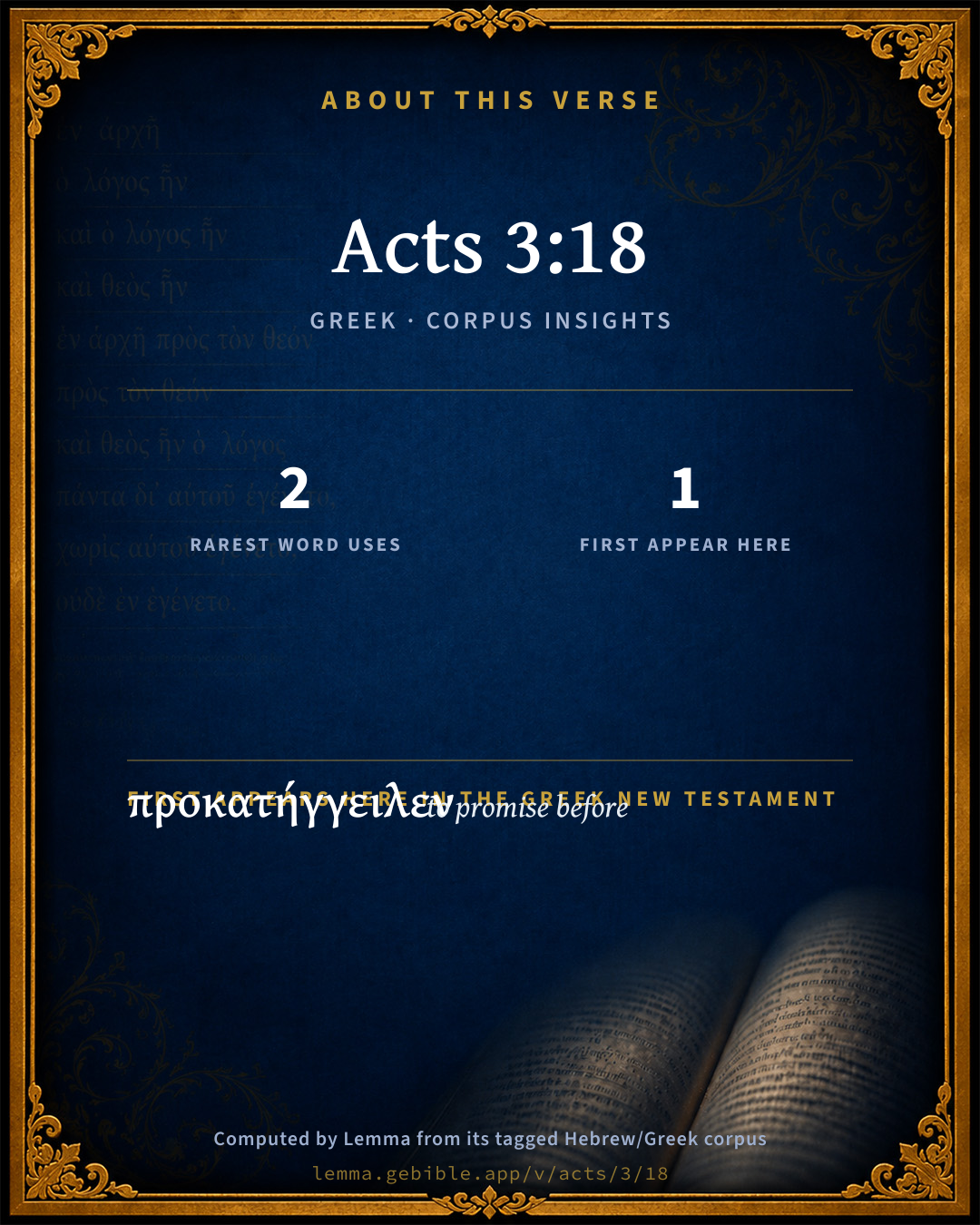
Acts 3:18

Greek (Tischendorf 8th ed.) Acts 3:18 appears in the Greek New Testament. The text above is from the Tischendorf 8th edition. Each word links to its Strong’s number and a concise gloss. Click any word for its full Thayer’s Greek Lexicon entry.
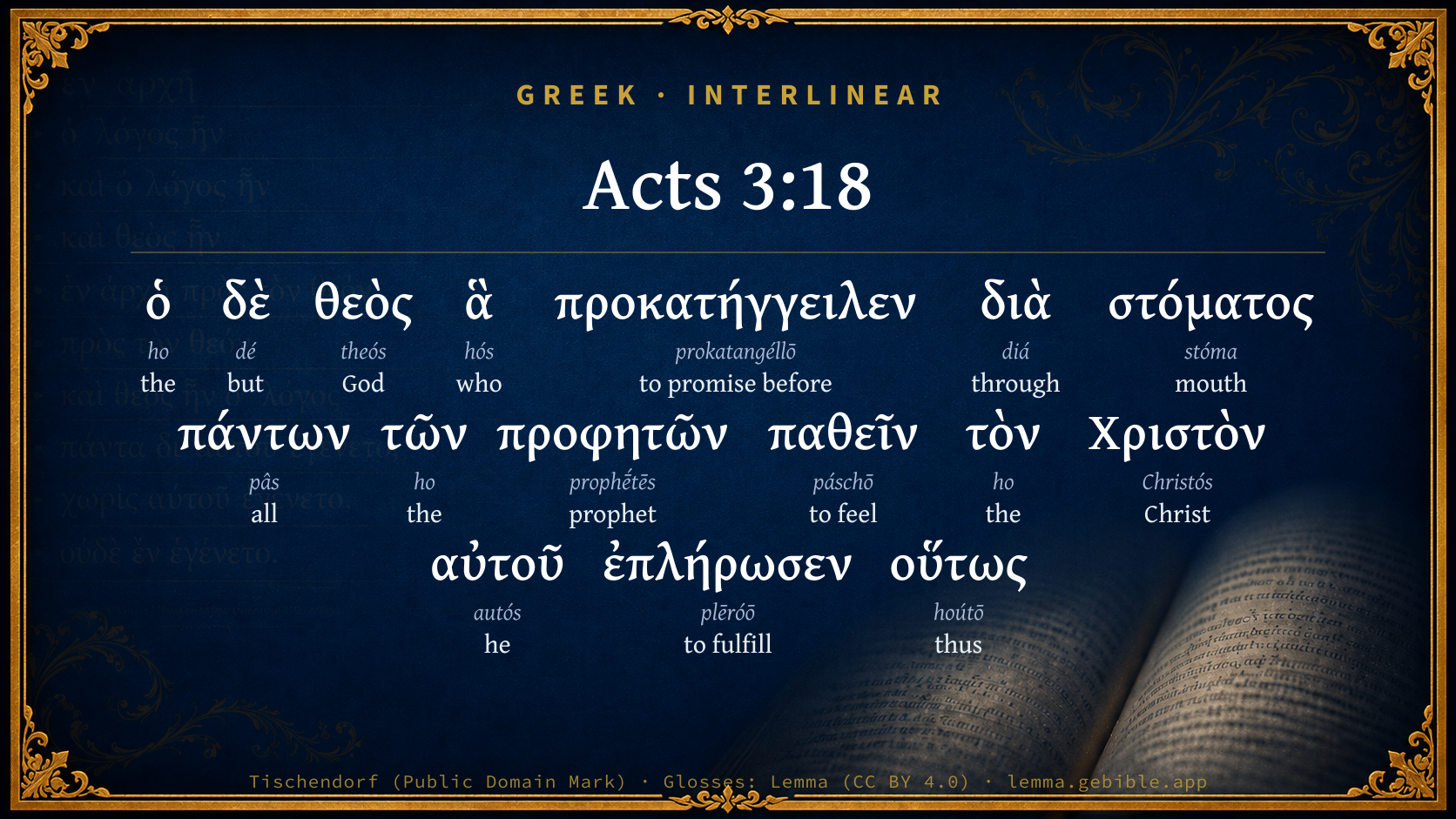
Download image
Cite this verse

Acts 3:18 (World English Bible). Public Domain. Lemma interlinear Bible study tool, https://lemma.gebible.app/v/acts/3/18.

Show BibTeX & RIS
BibTeX
RIS
English Translation
But the things which God announced by the mouth of all his prophets, that Christ should suffer, he thus fulfilled.
World English Bible · Public Domain
Highlights
  • 1 first appearance in the Greek New Testament
Full analysis ↓
Download a study sheet

One document with this verse’s original text, its word-by-word gloss line, the meaning frame, cross-references with their text, attributed commentary, and full source and license credits — printable, and it pastes into notes with its structure intact.

This verse Autodidact and up

Study sheet (.html) Plain text (.txt)

A passage Seminary Student

Up to 50 verses in one chapter. A passage sheet keeps up to 6 commentary sources and 12 cross-references per verse, in the order this page ranks them, and says so on the sheet whenever that leaves anything out. Ask for a single verse and you get the Autodidact verse sheet above.

Everything on this page stays free to read, with no account — the sheet is a download of what is already on screen, not access to it.

Want to remove ads? Support Godless Engineer
Compare translations 3

The same verse in 3 English versions, stacked beneath the original-language interlinear above. Click any original word for its lexicon entry.

Each is an independent rendering of the whole verse — the interlinear is not word-aligned to these translations.

Highlighted words mark where these versions differ — a whole-verse word diff, not a word-by-word alignment.

  • World English Bible Public Domain
    But the things which God announced by the mouth of all his prophets, that Christ should suffer, he thus fulfilled.
  • King James Version Public Domain
    But those things, which God before had shewed by the mouth of all his prophets, that Christ should suffer, he hath so fulfilled.
  • unfoldingWord Literal Text CC BY-SA 4.0
    But what God foretold through the mouth of all the prophets, that his Christ would suffer, he has fulfilled thus.

unfoldingWord Literal Text — © unfoldingWord, licensed CC BY-SA 4.0. Word-aligned USFM3 via Door43 (git.door43.org/unfoldingWord/en_ult).

Versions to compare (up to 4)

3 of 4 selected

Show all 19 translations

Every available English version of this verse, each an independent rendering of the whole verse.

  • World English Bible Public Domain
    But the things which God announced by the mouth of all his prophets, that Christ should suffer, he thus fulfilled.
  • Berean Standard Bible Public Domain
    But in this way God has fulfilled what He foretold through all the prophets, saying that His Christ would suffer.
  • Majority Standard Bible Public Domain
    But in this way God has fulfilled what He foretold through all His prophets, saying that the Christ would suffer.
  • King James Version Public Domain
    But those things, which God before had shewed by the mouth of all his prophets, that Christ should suffer, he hath so fulfilled.
  • American Standard Version (1901) Public Domain
    But the things which God foreshowed by the mouth of all the prophets, that his Christ should suffer, he thus fulfilled.
  • Revised Version (1885) Public Domain
    But the things which God foreshewed by the mouth of all the prophets, that his Christ should suffer, he thus fulfilled.
  • Geneva Bible (1599) Public Domain
    But those thinges which God before had shewed by the mouth of all his Prophets, that Christ should suffer, he hath thus fulfilled.
  • Douay-Rheims (1899) Public Domain
    But those things which God before had shewed by the mouth of all the prophets, that his Christ should suffer, he hath so fulfilled.
  • Young's Literal Translation Public Domain
    and God, what things before He had declared through the mouth of all His prophets, that the Christ should suffer, He did thus fulfil;
  • Literal Standard Version CC BY-SA 4.0
    and God, what things He had declared before through the mouth of all His prophets, that the Christ should suffer, He thus fulfilled;
  • Unlocked Literal Bible CC BY-SA 4.0
    But the things which God foretold by the mouth of all the prophets, that his Christ should suffer, he has now fulfilled.
  • unfoldingWord Literal Text CC BY-SA 4.0
    But what God foretold through the mouth of all the prophets, that his Christ would suffer, he has fulfilled thus.
  • Darby Bible Public Domain
    but God has thus fulfilled what he had announced beforehand by the mouth of all the prophets, that his Christ should suffer.
  • World Messianic Bible Public Domain
    But the things which God announced by the mouth of all his prophets, that Messiah should suffer, he thus fulfilled.
  • Webster's Bible Public Domain
    But those things which God before had shown by the mouth of all his prophets, that Christ should suffer, he hath so fulfilled.
  • Free Bible Version CC BY-SA 4.0
    But God fulfilled what he had prophesied through all the prophets: that his Messiah would suffer.
  • Bible in Basic English Public Domain
    But the things which God had made clear before, by the mouth of all the prophets, that the Christ would have to undergo, he has put into effect in this way.
  • Text-Critical English NT CC BY 4.0
    But in this way God fulfilled what he had foretold through the mouths of all his prophets, that the Christ would suffer.
  • Tyndale New Testament (1534) Public Domain
    But those thinges which God before had shewed by the mouth of all his Prophetes how that Christ shuld suffre he hath thus wyse fulfilled.

Literal Standard Version (2020), Covenant Press — licensed CC BY-SA 4.0. Text via the HelloAO Bible API (eBible.org). Unlocked Literal Bible (unfoldingWord) — licensed CC BY-SA 4.0. Text via the HelloAO Bible API (eBible.org). unfoldingWord Literal Text — © unfoldingWord, licensed CC BY-SA 4.0. Word-aligned USFM3 via Door43 (git.door43.org/unfoldingWord/en_ult). Free Bible Version, Dr. Jonathan Gallagher — licensed CC BY-SA 4.0. Text via the HelloAO Bible API (eBible.org).

Word by word

More ways to search: Search by grammar → Find every occurrence → Compare this word →

Practice this passage: Drill this verse → Learn its vocabulary →

προκατήγγειλεν
prokatangéllō
G4293
“to promise before”
Verb, Aorist, Active, Indicative, 3rd person, Singular
Part of Speech
Verb
Tense
Aorist
Voice
Active
Mood
Indicative
Person
3rd person
Number
Singular
Full Thayer's Definition

Origin: from G4253 and G2605

TDNT: 02:10,1

1. to announce beforehand (that a thing will be) a. of prophecies 2. to preannounce in the sense of to promise
  1. ὁ ho G3588 “the” Article, Nominative, Singular, Masculine
  2. δὲ dé G1161 “but” Conjunction
  3. θεὸς theós G2316 “God” Noun, Nominative, Singular, Masculine
  4. ἃ hós G3739 “who” Relative pronoun, Accusative, Plural, Neuter
  5. διὰ diá G1223 “through” Preposition
  6. στόματος stóma G4750 “mouth” Noun, Genitive, Singular, Neuter
  7. πάντων pâs G3956 “all” Adjective, Genitive, Plural, Masculine
  8. τῶν ho G3588 “the” Article, Genitive, Plural, Masculine
  9. προφητῶν prophḗtēs G4396 “prophet” Noun, Genitive, Plural, Masculine
  10. παθεῖν páschō G3958 “to feel” Verb, Aorist, Active, Infinitive
  11. τὸν ho G3588 “the” Article, Accusative, Singular, Masculine
  12. Χριστὸν Christós G5547 “Christ” Noun, Accusative, Singular, Masculine
  13. αὐτοῦ autós G846 “he” Personal pronoun, Genitive, Singular, Masculine
  14. ἐπλήρωσεν plēróō G4137 “to fulfill” Verb, Aorist, Active, Indicative, 3rd person, Singular
  15. οὕτως hoútō G3779 “thus” Adverb

About this verse

These counts appear in no published source. They are computed here, from the morphology-tagged text and Lemma’s own curated glosses. What Lemma adds →

16
words
14
distinct lemmas
Acts
section

Notable vocabulary

The rarest word here is προκατήγγειλεν to promise before G4293 — appearing just 2 times in the whole Greek New Testament.

First appearance in Scripture

This word makes its first canonical appearance in the Greek New Testament here:

  • προκατήγγειλεν to promise before G4293

Shared distinctive vocabulary

προκατήγγειλεν to promise before G4293 occurs in 2 verses of the Greek New Testament. Also found in:

Repetition

A word recurs within this verse:

Cross-references

16

Topical passages linked to Acts 3:18 in the Treasury of Scripture Knowledge — connected by theme and wording, ordered by reader-vote popularity; previews shown in the World English Bible.

  • Isaiah 53:1–12 Who has believed our message? and to whom has the arm of Yahweh been revealed?
  • Acts 2:23 him, being delivered up by the determined counsel and foreknowledge of God, you have taken by the hand of lawless men, crucified and killed;
  • Acts 26:22–23 Having therefore obtained the help that is from God, I stand to this day testifying both to small and great, saying nothing but what the prophets and Moses said would happen,
  • Zechariah 12:10 I will pour on the house of David, and on the inhabitants of Jerusalem, the spirit of grace and of supplication; and they will look to me whom they have pierced; and they shall mourn for him, as one mourns for his only son, and will grieve bitterly for him, as one grieves for his firstborn.
  • Luke 24:26–27 Didn't the Christ have to suffer these things and to enter into his glory?"
  • Isaiah 50:6 I gave my back to the strikers, and my cheeks to those who plucked off the hair; I didn't hide my face from shame and spitting.
  • Luke 24:44 He said to them, "This is what I told you, while I was still with you, that all things which are written in the law of Moses, the prophets, and the psalms, concerning me must be fulfilled."
  • Acts 17:2–3 Paul, as was his custom, went in to them, and for three Sabbath days reasoned with them from the Scriptures,
  • 1 Corinthians 15:3–4 For I delivered to you first of all that which I also received: that Christ died for our sins according to the Scriptures,
  • 1 Peter 1:10–11 Concerning this salvation, the prophets sought and searched diligently, who prophesied of the grace that would come to you,
  • Acts 28:23 When they had appointed him a day, many people came to him at his lodging. He explained to them, testifying about the Kingdom of God, and persuading them concerning Jesus, both from the law of Moses and from the prophets, from morning until evening.
  • Daniel 9:26 After the sixty-two weeks the Anointed One shall be cut off, and shall have nothing: and the people of the prince who shall come shall destroy the city and the sanctuary; and the end of it shall be with a flood, and even to the end shall be war; desolations are determined.
  • Zechariah 13:7 "Awake, sword, against my shepherd, And against the man who is close to me," says Yahweh of Hosts. Strike the shepherd, and the sheep will be scattered; And I will turn my hand against the little ones.
  • Revelation 19:10 I fell down before his feet to worship him. He said to me, "Look! Don't do it! I am a fellow bondservant with you and with your brothers who hold the testimony of Jesus. Worship God, for the testimony of Jesus is the Spirit of Prophecy."
  • Psalms 22:1–30 My God, my God, why have you forsaken me? Why are you so far from helping me, and from the words of my groaning?
  • Psalms 69:1–36 Save me, God, For the waters have come up to my neck!

Cross-references courtesy of OpenBible.info (CC BY 4.0).

Commentary

Notes on Acts 3:18 from classic Christian and Jewish commentators (each source and its license shown beneath its notes). The classic Christian expositions comment on the surrounding passage and are grouped to its opening verse, so a note may address several verses; the Jewish commentaries on the Tanakh (Rashi and others) are per-verse, so they appear only where the commentator wrote on this verse.

Lemma curates 59 commentaries, every one of them public domain or Creative Commons licensed, each selected and text-cleaned for this edition rather than reprinted as found. About our sources →

Bengel's Gnomon

Johann Albrecht Bengel

Act 3:18. Δὲ, but) In the case of anything badly done by us. this too is to be considered, what good GOD hath done under it.—ἃ προκατήγγειλε, which God announced before) This is opposed to the ignorance (Act 3:17) of the Jews.—πάντων, of all) This imparts great force to his language.—παθεῖν τὸν Χριστὸν αὐτοῦ) So the Greek MSS. of adequate authority, as also Irenæu[29] and the Syr[30] Version. That is to say, that His Anointed should suffer.[31] And this altogether accords with ch. Act 4:26, “Against His Christ.” Others have written αὐτοῦ, His, afterwards the words by the mouth of all the prophets, as we find in Luk 1:70.—οὓτω, so) in this way.

[29] renæus (of Lyons, in Gaul: born about 130 A.D., and died about the end of the second century). The Editio Renati Massueti, Parisinæ, a. 1710.

[30] yr. the Peschito Syriac Version: second cent.: publ. and corrected by Cureton, from MS. of fifth cent.

[31] BCDEde Vulg., both Syr. Versions, and Iren. read αὐτοῦ after Χριστὸν. A puts αὐτοῦ after προφητῶν, omitting παθεῖν τὀν Χριστόν. Rec. Text and Memph. read αὐτοῦ προφητῶν παθ. τ. Χριστόν.—E. and T.

Bengel's Gnomon of the New Testament — English translation (T&T Clark, Edinburgh, 1860) — public domain. Text from a community e-Sword module.

Expositor's Greek Testament

ed. W. Robertson Nicoll

Act 3:18 . δὲ : a further mitigation; whilst they were acting in their ignorance, God was working out His unerring counsel and will. πάντων τῶν προφητῶν : not to be explained by simply calling it hyperbolic. The prophets are spoken of collectively, because the Messianic redemption to which they all looked forward was to be accomplished through the death of Christ, cf. Act 10:43 . The view here taken by St. Peter is in striking harmony with his first Epistle, 1Pe 1:11 , and 1Pe 2:22-25 . παθεῖν τὸν Χ . αὐτοῦ , R.V., “his Christ,” cf. Luk 17:25 ; Luk 24:26 . The phrase, which (W.H [144] ) is undoubtedly correct, is found in Psa 2:2 , from which St. Peter quotes in Act 4:26 , and the same expression is used twice in the Apocalypse, but nowhere else, in the N.T.; Rev 11:15 ; Rev 12:10 ( cf. also Luk 2:26 ; Luk 9:20 ). See also the striking passage in Psalms of Solomon , Act 18:6 (and Act 3:8 ), ἐν ἀνάξει Χριστοῦ αὐτοῦ , and Ryle and James on Psalm 17:36. The paradox that the suffering Messiah was also the Messiah of Jehovah, His Anointed, which the Jews could not understand (hence their ἄγνοια ), was solved for St. Peter in the Passion, Death, and Resurrection of Jesus. On the suffering Messiah, see note Act 26:23 . ἐπλήρωσεν οὕτω : “He thus fulfilled,” i.e. , in the way described, Act 3:14-15 . On πληρόω , see Act 1:16 . “In the gardens of the Carthusian Convent … near Dijon … is a beautiful monument.… It consists of a group of Prophets and Kings from the O.T., each holding in his hand a scroll of mourning from his writings each with his own individual costume and gesture and look, each distinguished from each by the most marked peculiarities of age and character, absorbed in the thoughts of his own time and country. But above these figures is a circle of angels, as like each to each as the human figures are unlike. They, too, as each overhangs and overlooks the Prophet below him, are saddened with grief. But their expression of sorrow is far deeper and more intense than that of the Prophets, whose words they read. They see something in the Prophetic sorrow which the Prophets themselves see not: they are lost in the contemplation of the Divine Passion, of which the ancient saints below them are but the unconscious and indirect exponents:” Stanley’s Jewish Church , pref. to vol. ii.

[144] Westcott and Hort’s The New Testament in Greek: Critical Text and Notes.

The Expositor's Greek Testament, edited by W. Robertson Nicoll (1897–1910) — public domain. Text from a community e-Sword module.

Geneva Bible (1599)

Geneva Bible translators

Though there were many Prophets, yet he speaketh but of one mouth, to show unto us the consent and agreement of the Prophets.

Geneva Bible (1599) marginal notes — public domain. Text via Bolls.life.

Jamieson, Fausset & Brown

Robert Jamieson, A. R. Fausset & David Brown

that Christ--The best manuscripts read, "that His Christ."

should suffer--The doctrine of a SUFFERING MESSIAH was totally at variance with the current views of the Jewish Church, and hard to digest even by the Twelve, up to the day of their Lord's resurrection. Our preacher himself revolted at it, and protested against it, when first nakedly announced, for which he received a terrible rebuke. Here he affirms it to be the fundamental truth of ancient prophecy realized unwittingly by the Jews themselves, yet by a glorious divine ordination. How great a change had the Pentecostal illumination wrought upon his views!

Jamieson, Fausset & Brown — Commentary Critical and Explanatory on the Whole Bible (1871) — public domain (CC PDM 1.0). Text via the HelloAO Bible API.

Adam Clarke's Commentary

Verse 18. But those things - he hath so fulfilled.] Your ignorance and malice have been overruled by the sovereign wisdom and power of God, and have become the instruments of fulfilling the Divine purpose, that Christ must suffer, in order to make an atonement for the sin of the world. All the prophets had declared this; some of them in express terms, others indirectly and by symbols; but, as the whole Mosaic dispensation referred to Christ, all that prophesied or ministered under it must have referred to him also.

Adam Clarke's Commentary on the Bible (1810–1826) — public domain. Text from a community e-Sword/MySword module.

John Calvin's Commentaries

18. And God Hereby it appeareth more plainly to what end he made mention of ignorance; for when he telleth them that God hath accomplished those things which he had foretold, he doth so touch their offense in the death of Christ, that it turneth to their salvation. Ignorance, saith he, hath made you guilty, yet God hath brought that to pass which he had determined, that Christ should redeem you by his death. This is a most notable consideration, when as we ponder and consider with ourselves, that through the wonderful counsel of God our evils are turned to another end to us, yet this doth no whir excuse us, for so much as in us lieth we cast away ourselves by sinning; but that conversion whereof I have spoken is a notable work of God’s mercy, whereof we must speak, and which we must extol with humility. The Jews did what they could to extinguish all hope of life in the person of Christ; and yet, nevertheless, that death gave life as well to them as to the whole world. We must also remember that which we saw elsewhere, lest there should any false and absurd opinion creep in, that Christ was laid open to the lust of the wicked, that God is made the chief author by whose will his only Son did suffer.

John Calvin's Commentaries (1540-1563) — public domain. Text from the Calvin Translation Society English edition (1840s-50s) via the Christian Classics Ethereal Library (ccel.org). Calvin's coverage is partial (roughly two-thirds of the Bible); uncommented books and verses are honest gaps, never fabricated. The 19th-century editor's footnotes and remarks are omitted so the notes are faithfully Calvin's own voice.

Ellicott's Commentary for English Readers

(18) Those things, which God before had shewed.—As in Act_1:16; Act_2:23, we have again an echo of the method of prophetic interpretation which the Apostles had learnt from their Lord.

A Bible Commentary for English Readers, edited by Charles John Ellicott (1878–1897) — public domain. Text from a community e-Sword module.

The Cambridge Bible for Schools and Colleges

gen. ed. J. J. S. Perowne

18. by the mouth of all his prophets, &c.] The best MSS. connect the pronoun his with the next clause. Read, by the mouth of all the prophets that his Christ should suffer. The purpose of the whole of the Scripture is to set forth the redemption of men through the suffering of Christ. So that from the first mention of the bruising of the heel of the seed of the woman (Gen_3:15), there had been a constant chain of testimony that the Christ should suffer.

he hath so fulfilled] Turning your evil deed to a purpose of salvation.

The Cambridge Bible for Schools and Colleges (gen. ed. J. J. S. Perowne; Cambridge University Press, 1878–1918) — public domain. Text from a community e-Sword module.

John Gill's Exposition

But those things which God before had showed,.... In the Scriptures of the Old Testament, concerning the betraying of the Messiah, and his sufferings and death, with the various causes, concomitants, and circumstances of them:

by the mouths of all his prophets; which were since the world began; some pointing out one thing or circumstance, and some another:

that Christ should suffer. The Vulgate Latin and Syriac versions read, "that his Christ should suffer"; but then they leave out the word "his" in the preceding clause, which they put into this; and this entire clause is omitted in the Alexandrian copy:

he hath so fulfilled; in the manner he has, so exactly, so perfectly agreeable to the predictions of them, and yet were unknown to the persons by whom they were fulfilled. So wisely and surprisingly are things ordered and overruled by the wise providence of God, who is a God of knowledge, and by whom all actions are weighed.

John Gill's Exposition of the Whole Bible (1746–1763) — public domain (CC PDM 1.0). Text via the HelloAO Bible API.

Trapp's Complete Commentary

John Trapp

18 But those things, which God before had shewed by the mouth of all his prophets, that Christ should suffer, he hath so fulfilled.

Ver. 18. By the mouth of all his prophets] All the prophets spake but with one mouth; such a sweet consent and happy harmony there is in all their writings, as if done by one only.

John Trapp, A Commentary or Exposition upon All the Books of the Old and New Testament (1647–1656) — public domain. Text from a community e-Sword module.

Albert Barnes' Notes on the Bible

But those things - To wit, those things that did actually occur, pertaining to the life and death of the Messiah.

Had showed - Had announced, or foretold.

By the mouth of all his prophets - That is, by the prophets in general, without affirming that each individual prophet had uttered a distinct prediction respecting this. The prophets “taken together,” or the prophecies “as a whole,” had declared this. The word “all” is not infrequently used in this somewhat limited sense, Mar 1:37; Joh 3:26. In regard to the prophecies respecting Christ, see the notes on Luk 24:27.

Hath so fulfilled - He has caused to be fulfilled in this manner; that is, by the rejection, the denial, and the wickedness of the rulers. It has turned out to be in strict accordance with the prophecy. This fact Peter uses in exhorting them to repentance; but it is not to be regarded as an excuse for their sins. The mere fact that all this was foretold; that it was in accordance with the purposes and predictions of God, does not take away the quilt of it, or constitute an excuse for it. In regard to this, we may remark:

The prediction did not change the nature of the act. The mere fact that it was foretold, or foreknown, did not change its character. See notes on Act 1:23. Peter still regarded them as guilty. He did not urge the fact that this was foreknown as an excuse for their sin, but to show them that since all this happened according to the prediction and the purpose of God, they might hope in his mercy. The plan was that the Messiah should die to make a way for pardon, and, therefore, they might hope in his mercy.

(3)This was a signal instance of the power and mercy of God in overruling the wicked conduct of people to further his own purposes and plans.

(4)All the other sins of people may thus be overruled, and thus the wrath of man may be made to praise him. But,

This will constitute no excuse for the sinner. It is no part of his intention to honor God, or to advance his purposes; and there is no direct tendency in his crimes to advance his glory. The direct tendency of his deeds is counteracted and overruled, and God brings good out of the evil. But this surely constitutes no excuse for the sinner.

If it be asked why Peter insisted on this if he did not mean that it should be regarded as an excuse for their sin, I reply, that it was his design to prove “that Jesus was the Messiah,” and having proved this, he could assure them that there was mercy. Not that they had not been guilty; not that they deserved favor; but that tire fact that the Messiah had come was an argument which proved that any sinners might obtain mercy, as he immediately proceeds to show them.

Albert Barnes' Notes on the Bible (1834–1885) — public domain. Text from a community e-Sword/MySword module.

Matthew Poole's English Annotations

The prophets did all speak the same things, as if they had spoken out of one mouth, as they did speak by one Spirit. God used the ignorance of some, and the malice of others, for his own holy ends: and that it was prophesied

that Christ should suffer, is very plain, Isa 1:5-7.

Matthew Poole's English Annotations on the Holy Bible (1683–1685) — public domain. Text from a community e-Sword/MySword module.

Whedon's Commentary on the Bible

Daniel D. Whedon

18. All—A suggestive term of universality. The whole Old Testament is a one prophet to Christ. All the special prophecies of old Scripture, about lesser persons and objects, are but subsidiary and supporting to the prophecies of Christ. The passages that pre-delineate him are the keystone of the whole prophetic arch. That

Christ should suffer—That the Messiah should be a suffering Messiah. Peter’s words glance at the objection ready to rise to every Jewish mouth, “Jesus the Messiah! Why he was put to death by law, and our Messiah is to be glorious king of Israel.” Aye, but the prophets all agree that he “should suffer.” Your slaying him proves not that he is not Messiah. He…

fulfilled—Not by directly obliging the deed; not by decreeing it; but by admitting others’ foreseen wicked deeds into accomplishing his great and wonderful purpose.

Daniel D. Whedon (gen. ed.), Commentary on the Old and New Testaments (1874–1909) — public domain. Text from a community e-Sword module.

The Pulpit Commentary

The things for those things, A.V. ; foreshowed or before had showed, A.V.; the prophets for his prophets, A.V. and T.R.; his Christ for Christ, A.V. and T.R. ; he thus fulfilled for he hath so fulfilled, A.V. He even excuses their ignorance by showing how the determinate counsel and foreknowledge of God was brought about through it. (comp. Gen_45:5, and see above, Act_1:23)

The Pulpit Commentary (1880–1919), ed. H.D.M. Spence-Jones & Joseph S. Exell — public domain. Text from a community e-Sword module.

John Wesley's Explanatory Notes

But God - Who was not ignorant, permitted this which he had foretold, to bring good out of it.

John Wesley, Explanatory Notes Upon the Whole Bible (1754–1765) — public domain. Text via the GEBible commentary corpus.

Godbey's Commentary on the New Testament

William B. Godbey

18. “But those things which he proclaimed through the mouth of all his prophets that his Christ should suffer, he thus fulfilled.” We see from this verse how the Jews and the Romans in their condemnation and crucifixion of Christ were literally fulfilling prophecies so obviously that it is astonishing that they could not recognize it. The very men who stood at the head of the church, having studied the prophecies at the feet of their great theologians, and preached on them all their lives, were so blinded by Satan that they could not see them; but in the black darkness of their wicked unbelief, these great preachers went right ahead, fulfilling the prophecies to their own condemnation. Oh! how history repeats itself! Visit in the great ecclesiastical assemblies of the present day. You find the mighty men of talent and scholarship standing at the head of the popular churches, all counseling together, even different denominations, like Pilate and Herod in the crucifixion of Christ, waiving their old animosities and uniting their wisdom and power to crush out the Holiness Movement [which is simply the Holy Ghost religion in contradistinction to the devil’s counterfeit, i. e., dead churchism]. They all unite their forces, take up every sanctified preacher, carry him away and set him down in a region of icebergs, sending in his place a theological refrigerator to freeze out all the holy fire. What is this but the literal fulfillment of Daniel’s prophecy,

“When they shall have accomplished to scatter the power of the holy people, then shall the end come.”

The holiness people are doing their best to spread Scriptural holiness throughout the world. But it is hard to tell which party is actually doing the more to scatter the holy fire — our friends or our enemies. When the latter, with the malignant rage which rankled in the carnal hearts of the great preachers who nailed Jesus to the cross, martyred Stephen and did their utmost to crush out the Nazarenes in blood, now violently interpose, reach forth the strong hand of ecclesiastical tyranny, pick up the holiness preachers, send them to the north pole and supply their places with the worst anti-holiness preachers they can command, what is the result? I am an eye-witness to what I write — have seen it verified repeatedly. They simply give the sanctified preacher a new, fresh field upon untrodden virgin soil — the very opportunity he needs to do a mighty work for God, preaching entire sanctification and instrumental in saving and sanctifying multitudes. Meanwhile the fire in his former field is too hot for the devil’s ice carried in by the plughatted D. D. The accumulated fire of God’s red-hot cranks melts all of his ice. It is a well-known fact in chemistry that a sufficient intensity of heat will not only melt ice, but decompose the water into its constituent elements, oxygen and hydrogen, the latter the most combustible in the world, and the former the great supporter of combustion. Hence all the ice imported by the new preacher is simply a supply of fuel to augment the flame. The result is he gets gloriously sanctified; the revival which they sought to freeze out takes new fire, and sweeps over the land like a cyclone. If you will read the prophecies and open your eyes to the ecclesiastical phenomena of the present day, you will be astounded at the wonderful fulfillment of prophecies. As the preachers standing at the head of a church in Jerusalem, blinded by Satan, rejected and killed the Son of God and did their utmost to exterminate His followers, we see the same tragedy at the present day going on throughout Christendom. Jesus was simply the incarnation of holiness. His disciples were nothing but simple-hearted, humble holiness people. Grace, as well as sin, is uniform and identical in all ages. Hence, at the present day, the proud, autocratic, carnal clergy in the leadership of popular religion are doing their utmost to antagonize the Holy Ghost and Spirit-filled people, thus literally fulfilling the prophecies as in the days of Christ.

William B. Godbey, Commentary on the New Testament (1896–1900) — public domain. Text from a community e-Sword module.

McGarvey & Pendleton's Commentaries

J. W. McGarvey

See notes on verse 17

J. W. McGarvey (with Philip Y. Pendleton), Commentaries on the New Testament (The Fourfold Gospel, 1914; Acts; and the epistles) — public domain. Text from a community e-Sword/MySword module.

Cambridge Greek Testament for Schools and Colleges

18. αὐτοῦ after Χριστὸν with אABCDE. Vulg. ‘Christum suum.’

18. τὸν Χριστὸν αὐτοῦ. Render, by the mouth of all the prophets that His Christ should suffer. The purpose of the whole of the Scripture is to set forth the redemption of men through the suffering of Christ. So that from the first mention of the bruising of the heel of the seed of the woman (Gen 3:15), there had been a constant chain of testimony that the Christ should suffer. The ignorance of the Jews was manifested in this, that they would only see what spake of the sovereignty of the Messiah, and so rejected Him who came to give His life as a ransom for men.

οὕτως. Emphatic. By turning your evil deed to a purpose of salvation. So Chrysostom, ὅρα πόση τοῦ θεοῦ ἡ σοφία, ὅτ’ ἂγ ταῖς ἑτέρων πονηρίαις εἰς τὸ δέον ᾖ κατακεχρημένη.

Cambridge Greek Testament for Schools and Colleges (Cambridge University Press, 1896; 21 vols, various authors incl. Carr, Maclear, Plummer, Farrar, Lumby, Moule, M. R. James, Simcox) — public domain. Text from a community e-Sword module.

Alford’s Greek Testament

Henry Alford

18.] πάντων, see Luk 24:27 and note. There is no hyperbole (Kuinoel) nor adaptation (Meyer) to Jewish exegetical views. ‘Omnes prophetæ in universum non prophetarunt nisi de diebus Messiæ’ (Sanhedr. 99. 1), was not merely a Jewish view, but the real truth.

The prophets are here regarded as one body, actuated by one Spirit; and the sum of God’s purpose, shewn by their testimony, is, that His Christ should suffer.

Notice the inf. aor. παθεῖν, as in ch. 1:3, of a definite single act.

Henry Alford, The Greek Testament (1849–1861) — public domain. Text from a community e-Sword module.

Lesson kit

Teaching starters — assembled from the data on this page, not authored interpretation. Every prompt links to the verse data it draws on. Edit before teaching.

Acts, in the Acts, opens this verse with 16 words (14 distinct Greek lemmas). Its most distinctive word is prokatangéllō (“to promise before”). A historical commentator’s framing appears above. Read the whole chapter for the surrounding context.

Discussion questions

  1. What does “to promise before” (prokatangéllō) contribute to the verse as a whole?
  2. This is the first place “to promise before” appears in Scripture (first appears here). What does its debut here establish?
  3. How does Acts 7:52, which shares the word «to promise before», read alongside this verse?
  4. What does the repetition of “the” (3× in this one verse) do in this verse?
  5. These translations render this verse differently. What is at stake in choosing one wording over another?
  6. Compare how Bengel's Gnomon and Expositor's Greek Testament read this verse. Where do they agree or differ?

Things to notice

  • 1 word makes its first canonical appearance in Scripture here.
  • These translations choose different wording for 13 words in this verse.
  • “the” occurs 3× in this single verse.
  • 14 distinct Greek lemmas span 16 words in this verse.

Reading settings

Reading text

Shown beneath each verse's original-language words.

Old Testament
Old Testament edition

Read the OT as the Masoretic Hebrew (MT) or the Greek Septuagint (LXX).

English shown for the Greek Septuagint (in the Hebrew ↔ Greek comparison).

Comparing translations? Open the Compare panel on any verse page to stack up to four side by side.