
Acts 13:41

Greek (Tischendorf 8th ed.) Acts 13:41 appears in the Greek New Testament. The text above is from the Tischendorf 8th edition. Each word links to its Strong’s number and a concise gloss. Click any word for its full Thayer’s Greek Lexicon entry.
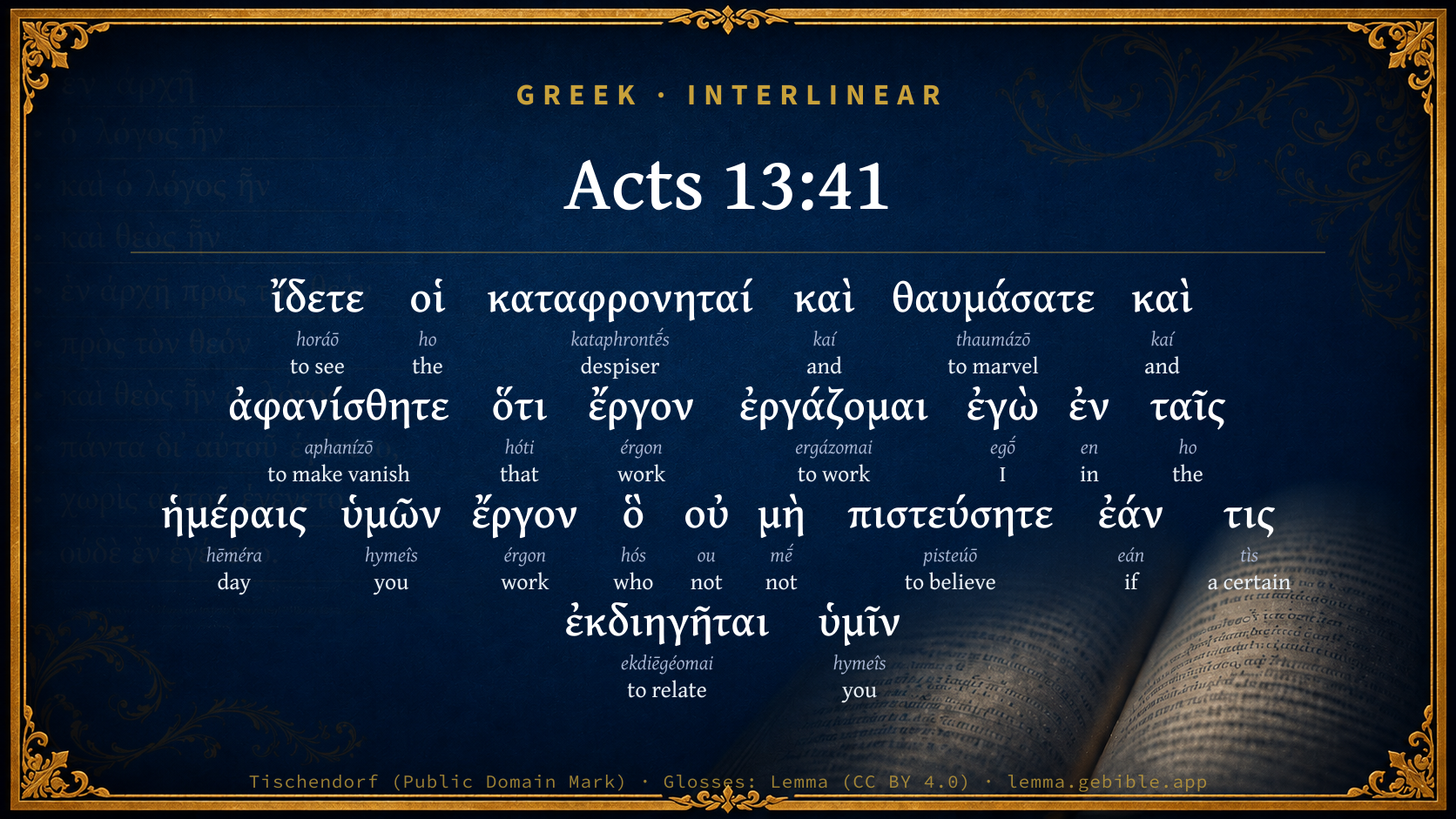
Download image
Cite this verse

Acts 13:41 (World English Bible). Public Domain. Lemma interlinear Bible study tool, https://lemma.gebible.app/v/acts/13/41.

Show BibTeX & RIS
BibTeX
RIS
English Translation
'Behold, you scoffers, and wonder, and perish; For I work a work in your days, A work which you will in no way believe, if one declares it to you.'"
World English Bible · Public Domain
Highlights
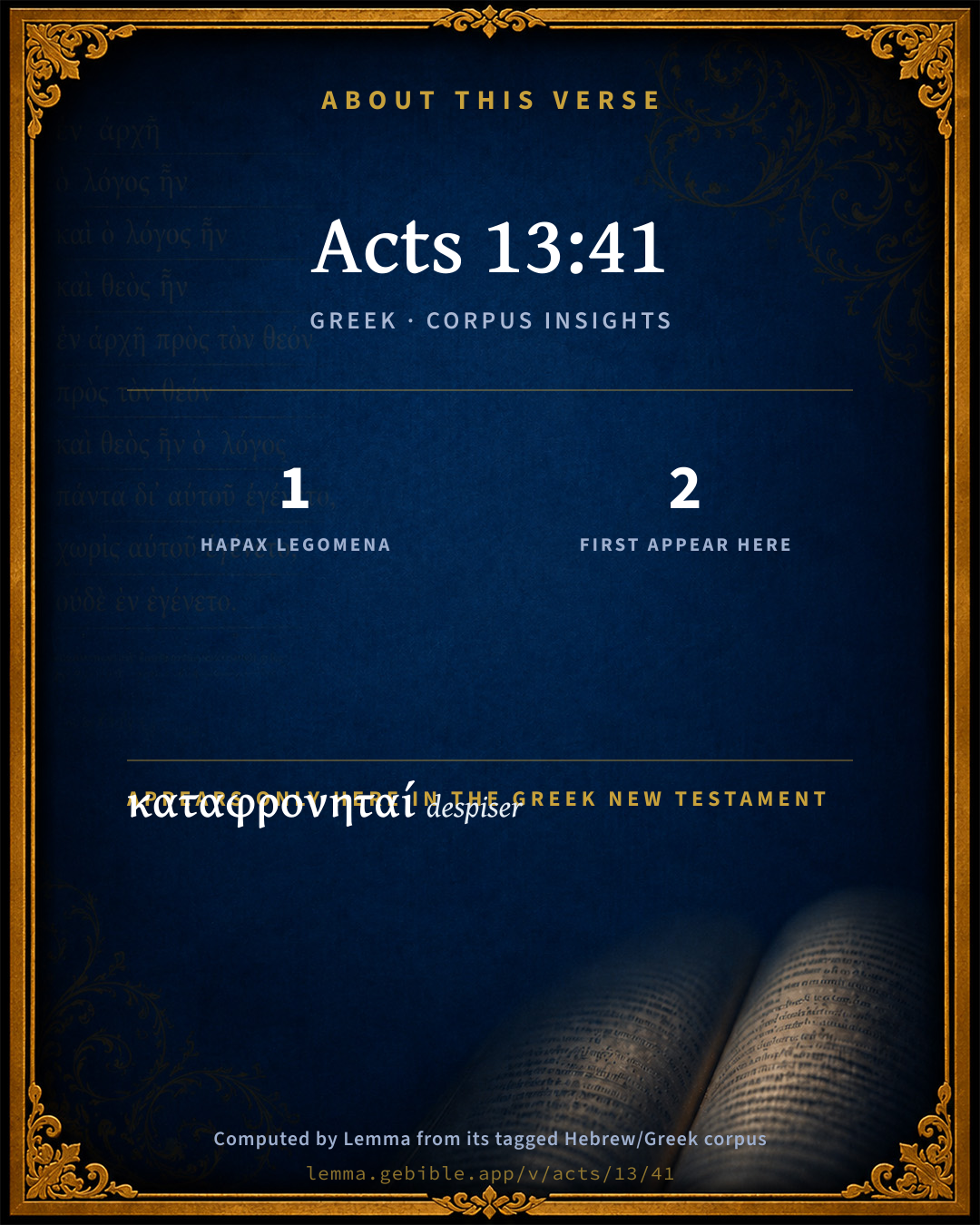
  • 1 hapax legomenon — only here in the Greek New Testament
  • 2 first appearances in the Greek New Testament
Full analysis ↓
Download a study sheet

One document with this verse’s original text, its word-by-word gloss line, the meaning frame, cross-references with their text, attributed commentary, and full source and license credits — printable, and it pastes into notes with its structure intact.

This verse Autodidact and up

Study sheet (.html) Plain text (.txt)

A passage Seminary Student

Up to 50 verses in one chapter. A passage sheet keeps up to 6 commentary sources and 12 cross-references per verse, in the order this page ranks them, and says so on the sheet whenever that leaves anything out. Ask for a single verse and you get the Autodidact verse sheet above.

Everything on this page stays free to read, with no account — the sheet is a download of what is already on screen, not access to it.

Want to remove ads? Support Godless Engineer
Compare translations 3

The same verse in 3 English versions, stacked beneath the original-language interlinear above. Click any original word for its lexicon entry.

Each is an independent rendering of the whole verse — the interlinear is not word-aligned to these translations.

Highlighted words mark where these versions differ — a whole-verse word diff, not a word-by-word alignment.

  • World English Bible Public Domain
    'Behold, you scoffers, and wonder, and perish; For I work a work in your days, A work which you will in no way believe, if one declares it to you.'"
  • King James Version Public Domain
    Behold, ye despisers, and wonder, and perish: for I work a work in your days, a work which ye shall in no wise believe, though a man declare it unto you.
  • unfoldingWord Literal Text CC BY-SA 4.0
    ‘Look, you despisers, and marvel and be destroyed! For I am doing a work in your days, a work that you would not believe at all, even if someone announced it to you.’”

unfoldingWord Literal Text — © unfoldingWord, licensed CC BY-SA 4.0. Word-aligned USFM3 via Door43 (git.door43.org/unfoldingWord/en_ult).

Versions to compare (up to 4)

3 of 4 selected

Show all 19 translations

Every available English version of this verse, each an independent rendering of the whole verse.

  • World English Bible Public Domain
    'Behold, you scoffers, and wonder, and perish; For I work a work in your days, A work which you will in no way believe, if one declares it to you.'"
  • Berean Standard Bible Public Domain
    ‘Look, you scoffers, wonder and perish! For I am doing a work in your days that you would never believe, even if someone told you.’”
  • Majority Standard Bible Public Domain
    ‘Look, you scoffers, wonder and perish! For I am doing a work in your days that you would never believe, even if someone told you.’”
  • King James Version Public Domain
    Behold, ye despisers, and wonder, and perish: for I work a work in your days, a work which ye shall in no wise believe, though a man declare it unto you.
  • American Standard Version (1901) Public Domain
    Behold, ye despisers, and wonder, and perish; For I work a work in your days, A work which ye shall in no wise believe, if one declare it unto you.
  • Revised Version (1885) Public Domain
    Behold, ye despisers, and wonder, and perish; For I work a work in your days, A work which ye shall in no wise believe, if one declare it unto you.
  • Geneva Bible (1599) Public Domain
    Behold, ye despisers, and wonder, and vanish away: for I woorke a woorke in your daies, a woorke which yee shall not beleeue, if a man would declare it you.
  • Douay-Rheims (1899) Public Domain
    Behold, ye despisers, and wonder, and perish: for I work a work in your days, a work which you will not believe, if any man shall tell it you.
  • Young's Literal Translation Public Domain
    See, ye despisers, and wonder, and perish, because a work I -- I do work in your days, a work in which ye may not believe, though any one may declare `it' to you.'
  • Literal Standard Version CC BY-SA 4.0
    See, you despisers, and wonder, and perish, because I work a work in your days, a work in which you may not believe, though anyone may declare [it] to you.”
  • Unlocked Literal Bible CC BY-SA 4.0
    'Look, you despisers, and be astonished and then perish; For I am doing a work in your days, A work that you shall never believe, even if someone announces it to you.'”
  • unfoldingWord Literal Text CC BY-SA 4.0
    ‘Look, you despisers, and marvel and be destroyed! For I am doing a work in your days, a work that you would not believe at all, even if someone announced it to you.’”
  • Darby Bible Public Domain
    Behold, ye despisers, and wonder and perish; for *I* work a work in your days, a work which ye will in no wise believe if one declare it to you.
  • World Messianic Bible Public Domain
    ‘Behold, you scoffers! Wonder and perish, for I work a work in your days, a work which you will in no way believe, if one declares it to you.’”
  • Webster's Bible Public Domain
    Behold, ye despisers, and wonder, and perish: for I work a work in your days, a work which ye will in no wise believe, though a man declare it to you.
  • Free Bible Version CC BY-SA 4.0
    ‘You who are scornful, look in amazement, and die! For what I'm doing in your lifetime is something that you could never believe, even if someone told you!’”
  • Bible in Basic English Public Domain
    See, you doubters, have wonder and come to your end; for I will do a thing in your days to which you will not give belief, even if it is made clear to you.
  • Text-Critical English NT CC BY 4.0
    ‘Behold, you scoffers, be amazed and perish, for I am doing a work in your days that you will certainly not believe, even if someone tells you about it.’ ”
  • Tyndale New Testament (1534) Public Domain
    Beholde ye despisers and wonder and perishe ye: for I do aworke in youre dayes which ye shall not beleve yf a man wolde declare it you.

Literal Standard Version (2020), Covenant Press — licensed CC BY-SA 4.0. Text via the HelloAO Bible API (eBible.org). Unlocked Literal Bible (unfoldingWord) — licensed CC BY-SA 4.0. Text via the HelloAO Bible API (eBible.org). unfoldingWord Literal Text — © unfoldingWord, licensed CC BY-SA 4.0. Word-aligned USFM3 via Door43 (git.door43.org/unfoldingWord/en_ult). Free Bible Version, Dr. Jonathan Gallagher — licensed CC BY-SA 4.0. Text via the HelloAO Bible API (eBible.org).

Word by word

More ways to search: Search by grammar → Find every occurrence → Compare this word →

Practice this passage: Drill this verse → Learn its vocabulary →

καταφρονηταί
kataphrontḗs
G2707
“despiser”
Noun, Nominative, Plural, Masculine
Part of Speech
Noun
Case
Nominative
Number
Plural
Gender
Masculine
Full Thayer's Definition

Origin: from G2706

TDNT: 13:32,4

1. despiser
  1. ἴδετε horáō G3708 “to see” Verb, Aorist, Active, Imperative, 2nd person, Plural
  2. οἱ ho G3588 “the” Article, Nominative, Plural, Masculine
  3. καὶ kaí G2532 “and” Conjunction
  4. θαυμάσατε thaumázō G2296 “to marvel” Verb, Aorist, Active, Imperative, 2nd person, Plural
  5. καὶ kaí G2532 “and” Conjunction
  6. ἀφανίσθητε aphanízō G853 “to make vanish” Verb, Aorist, Passive, Imperative, 2nd person, Plural
  7. ὅτι hóti G3754 “that” Conjunction
  8. ἔργον érgon G2041 “work” Noun, Accusative, Singular, Neuter
  9. ἐργάζομαι ergázomai G2038 “to work” Verb, Present, Middle or Passive deponent, Indicative, 1st person, Singular
  10. ἐγὼ egṓ G1473 “I” Personal pronoun, 1st person, Nominative, Singular
  11. ἐν en G1722 “in” Preposition
  12. ταῖς ho G3588 “the” Article, Dative, Plural, Feminine
  13. ἡμέραις hēméra G2250 “day” Noun, Dative, Plural, Feminine
  14. ὑμῶν hymeîs G5210 “you” Personal pronoun, 2nd person, Genitive, Plural
  15. ἔργον érgon G2041 “work” Noun, Accusative, Singular, Neuter
  16. ὃ hós G3739 “who” Relative pronoun, Accusative, Singular, Neuter
  17. οὐ ou G3756 “not” Particle, Negative
  18. μὴ mḗ G3361 “not” Particle, Negative
  19. πιστεύσητε pisteúō G4100 “to believe” Verb, Aorist, Active, Subjunctive, 2nd person, Plural
  20. ἐάν eán G1437 “if” Conditional
  21. τις tìs G5100 “a certain” Indefinite pronoun, Nominative, Singular, Masculine
  22. ἐκδιηγῆται ekdiēgéomai G1555 “to relate” Verb, Present, Middle or Passive deponent, Subjunctive, 3rd person, Singular
  23. ὑμῖν hymeîs G5210 “you” Personal pronoun, 2nd person, Dative, Plural

About this verse

These counts appear in no published source. They are computed here, from the morphology-tagged text and Lemma’s own curated glosses. What Lemma adds →

24
words
20
distinct lemmas
Acts
section

Notable vocabulary

1 hapax legomenon — a word that appears only here in the entire Greek New Testament:

  • καταφρονηταί despiser G2707

First appearance in Scripture

These words make their first canonical appearance in the Greek New Testament here:

  • καταφρονηταί despiser G2707
  • ἐκδιηγῆται to relate G1555

Shared distinctive vocabulary

ἐκδιηγῆται to relate G1555 occurs in 2 verses of the Greek New Testament. Also found in:
Repetition

Words recur within this verse:

Cross-references

22

Topical passages linked to Acts 13:41 in the Treasury of Scripture Knowledge — connected by theme and wording, ordered by reader-vote popularity; previews shown in the World English Bible.

  • Habakkuk 1:5 "Look among the nations, watch, and wonder marvelously; for I am working a work in your days, which you will not believe though it is told you.
  • 1 Peter 4:17 For the time has come for judgment to begin at the house of God. If it begins first with us, what will happen to those who don't obey the Gospel of God?
  • Romans 11:7–14 What then? That which Israel seeks for, that he didn't obtain, but the chosen ones obtained it, and the rest were hardened.
  • Isaiah 28:14–22 Why hear the word of Yahweh, you scoffers, that rule this people that is in Jerusalem:
  • Colossians 1:26–27 the mystery which has been hidden for ages and generations. But now it has been revealed to his saints,
  • Proverbs 5:12 And say, "How I have hated instruction, And my heart despised reproof;
  • Matthew 22:7–10 When the king heard that, he was angry, and he sent his armies, destroyed those murderers, and burned their city.
  • Matthew 21:41–44 They told him, "He will miserably destroy those miserable men, and will lease out the vineyard to other farmers, who will give him the fruit in its season."
  • Matthew 23:34–38 Therefore, behold, I send to you prophets, wise men, and scribes. Some of them you will kill and crucify; and some of them you will scourge in your synagogues, and persecute from city to city;
  • Luke 21:20–26 "But when you see Jerusalem surrounded by armies, then know that its desolation is at hand.
  • Acts 13:47 For so has the Lord commanded us, saying, 'I have set you as a light for the Gentiles, That you should bring salvation to the uttermost parts of the earth.'"
  • Ephesians 3:3–8 how that by revelation the mystery was made known to me, as I wrote before in few words,
  • 1 Thessalonians 2:16 forbidding us to speak to the Gentiles that they may be saved; to fill up their sins always. But wrath has come on them to the uttermost.
  • Hebrews 10:28–30 A man who disregards Moses' law dies without compassion on the word of two or three witnesses.
  • Proverbs 1:24–32 Because I have called, and you have refused; I have stretched out my hand, and no one has paid attention;
  • Isaiah 5:24 Therefore as the tongue of fire devours the stubble, And as the dry grass sinks down in the flame, So their root shall be as rottenness, And their blossom shall go up as dust; Because they have rejected the law of Yahweh of Hosts, And despised the word of the Holy One of Israel.
  • Isaiah 65:15 You shall leave your name for a curse to my chosen; and the Lord Yahweh will kill you; and he will call his servants by another name:
  • Daniel 9:26–27 After the sixty-two weeks the Anointed One shall be cut off, and shall have nothing: and the people of the prince who shall come shall destroy the city and the sanctuary; and the end of it shall be with a flood, and even to the end shall be war; desolations are determined.
  • Matthew 8:10–11 When Jesus heard it, he marveled, and said to those who followed, "Most assuredly I tell you, I haven't found so great a faith, not even in Israel.
  • Luke 16:14 The Pharisees, who were lovers of money, also heard all these things, and they scoffed at him.
  • Acts 6:14 For we have heard him say that this Jesus of Nazareth will destroy this place, and will change the customs which Moses delivered to us."
  • Acts 22:21 "He said to me, 'Depart, for I will send you out far from here to the Gentiles.'"

Cross-references courtesy of OpenBible.info (CC BY 4.0).

Commentary

Notes on Acts 13:41 from classic Christian and Jewish commentators (each source and its license shown beneath its notes). The classic Christian expositions comment on the surrounding passage and are grouped to its opening verse, so a note may address several verses; the Jewish commentaries on the Tanakh (Rashi and others) are per-verse, so they appear only where the commentator wrote on this verse.

Lemma curates 59 commentaries, every one of them public domain or Creative Commons licensed, each selected and text-cleaned for this edition rather than reprinted as found. About our sources →

Bengel's Gnomon

Johann Albrecht Bengel

Act 13:41. Ἴδετε οἱ καταφρονηταὶ) So the LXX. for the Hebrew ראו בגוים, Behold ye among the heathen. There may seem to have been read בגדים, ye violent or perfidious, as also by the Syr[81] translator, who has transgressors. They derive it from the Arabic בגא, he bore himself in an elated manner, inflicting injury. See Gebhard, on the Twelve Lesser Prophets, p. 1017, from Pocock.—καταφρονηταὶ despisers) The sum and source of destruction is slothfulness [which leads men to despise Christ].—καὶ θαυμάσατε) LXX. have καὶ ἐπιβλέψατε, καὶ θαυμάσατε θαυμάσια.—ἀφανίσθητε, lose your colour) the colour of your countenance; through excess of wonder, which in the Hebrew והתמהו תמהו is signified either by the verb or by the doubled termination of the verb. The imperative has this force, that the despisers should be left to their own astounded surprise.—ὍΤΙ) The LXX. ΔΙΌΤΙ.—ἜΡΓΟΝ) The LXX. have only Ὅ.—Ὃ, which) There is hereby expressed in general terms the judgment on the Jews: then in Act 13:46 it is most openly indicated.—οὐ μὴ πιστεύσητε, ye shall in no wise believe) “Habakkuk 1 was written in opposition to the incredulity of those, who did not credit the word which promised deliverance out of the power of the Chaldeans. Those words of the prophet were undoubtedly then used among the pious as a general proverb against all unbelievers, whoever they might be.”—Justus Jonas.—ὙΜῖΝ) The LXX. have not this word.

[81] yr. the Peschito Syriac Version: second cent.: publ. and corrected by Cureton, from MS. of fifth cent.

Bengel's Gnomon of the New Testament — English translation (T&T Clark, Edinburgh, 1860) — public domain. Text from a community e-Sword module.

Expositor's Greek Testament

ed. W. Robertson Nicoll

Act 13:41 .Hab 1:5 , but here slightly different from the Hebrew “behold, ye among the nations,” in LXX through the possible mistake of reading the Hebrew noun as if = deceitful ones (with the idea perhaps of impudence, shamelessness). On βλέπ . μὴ ἐπέλ . see Burton, pp. 85, 89; Viteau, p. 83 (1893). ἀφανίσθητε : added by LXX to the “wonder marvellously” of Heb. and LXX: “perish,” “vanish away,” R.V. margin, an idea involved in Heb. though not expressed: verb frequent in LXX, in N.T. three times, in Mat 6 , and nowhere else except Jas 4:14 , see Mayor’s note, in loco. The Apostle here transfers the prophecies of the temporal judgments following on the Chaldean invasion to the judgment of the nation by the Romans, or to the punishment which would fall upon the Jews by the election of the Gentiles into their place. Perhaps the latter is more probable before his present audience. The πᾶς ὁ πιστ . naturally leads him to the warning for those who disbelieved ( ἔργον ᾧ οὐ μὴ πιστεύσητε ). It is tempting to regard the words with Ramsay ( Expositor , December, 1898), as insisting upon the marvellous and mysterious nature of God’s action in the sending forth of His Son, but the context ( cf. ἐπέλθῃ ) here, and the O.T. prophecy, both point to the imminence of judgment and penalty. ἐργάζομαι : the present (so in LXX), because the result was so certain that it was regarded as actually in process. With true rhetorical force St. Paul concludes his speech, as at Athens, by an appeal to awaken all consciences, cf. St. Peter’s closing words, Act 2:36 , Act 3:26 possibly, as at the close perhaps of St. Stephen’s speech, signs of impatience had begun to manifest themselves in his audience (Plumptre).

The Expositor's Greek Testament, edited by W. Robertson Nicoll (1897–1910) — public domain. Text from a community e-Sword module.

Jamieson, Fausset & Brown

Robert Jamieson, A. R. Fausset & David Brown

ye will not believe though a man declare it unto you--that is, even on unexceptionable testimony. The words, from Hab 1:5, were originally a merciful but fruitless warning against the approaching destruction of Jerusalem by the Chaldeans and the Babylonish captivity. As such nothing could more fitly describe the more awful calamity impending over the generation which the apostle addressed.

Jamieson, Fausset & Brown — Commentary Critical and Explanatory on the Whole Bible (1871) — public domain (CC PDM 1.0). Text via the HelloAO Bible API.

Adam Clarke's Commentary

Verse 41. Behold, ye despisers] There is a remarkable difference here between the Hebrew text in Habakkuk, and that in the Septuagint, which is a little abridged here by St. Paul. I shall exhibit the three texts. Heb:-

ראו בגוים והביטו והתמהו תמהו כי פעל פעל בימיכם לא תאמינו כי יספר

Reu bagoyim vehabitu vehitammehu; temehu; ki poal poel bimeycem, lo teaminu hi yesupar.

Behold, ye among the heathen, (nations,) and regard, and be astonished; be astonished, for I am working a work in your days, which; when it shall be told, ye will not credit. See Houbigant.

Sept. Ιδετε οἱ καταφρονηται, και επιβλεψατε, και θαυμασατε θαυμασια, και αφανισθητε· διοτι εργον εγω εργαζομαι εν ταις ἡμεραις ὑμων, ὁ ου μη πιστευσητε, εαν τις εκδιηγηται ὑμιν.

See, ye despisers, and look attentively, and be astonished, (or hide yourselves,) for I work a work in your days, which, if any one will tell to you, ye will not believe.

St. Luke. Ιδετε οἱ καταφρονηται, [και επιβλεψατε], και θαυμασατε, [θαυμασια], και αφανισθητε· ὁτι εργον εγω εργαζομαι εν ταις ἡμεραις ὑμων, εργον ᾡ ου μη πιστευσητε, εαν τις εκδιηγηται ὑμιν.

Behold, ye despisers, and wonder, and be astonished, (or hide yourselves,) for I work a work in your days, which, if any one will tell unto you, ye will not believe.

I have taken Luke's quotation from the best MSS., and I have quoted the Septuagint according to the Codex Alerandrinus; and the quotations are exactly the same, not only in words, but almost in letters, with the exception of επιβλεψατε and θαυμασια which the evangelist omits, and which I have included in crotchets in the text of St. Luke, merely that the place of the omission may be the better seen. It may now be necessary to inquire how St. Luke and the Septuagint should substitute ye despisers, for ye among the heathen, in the Hebrew text?

Without troubling myself or my readers with laborious criticisms on these words, with which many learned men have loaded the text, I will simply state my opinion, that the prophet, instead of בגוים bagoyim, among the heathen, wrote בגדים bogadim, despisers, or transgressors: a word which differs only in a single letter, ד daleth, for ו vau; the latter of which might easily be mistaken by a transcriber for the other, especially if the horizontal stroke of the ד daleth happened to be a little faint towards the left; as, in that case, it would wear the appearance of a ו vau; and this is not unfrequently the case, not only in MSS., but even in printed books. It seems as evident as it can well be that this gives the word which the Septuagint found in the copy from which they translated: their evidence, and that of the apostle, joined to the consideration that the interchange of the two letters mentioned above might have been easily made, is quite sufficient to legitimate the reading for which I contend. Houbigant and several others are of the same mind.

The word αφανισθητε, which we translate perish, signifies more properly disappear, or hide yourselves; as people, astonished and alarmed at some coming evil, betake themselves to flight, and hide themselves in order to avoid it.

Adam Clarke's Commentary on the Bible (1810–1826) — public domain. Text from a community e-Sword/MySword module.

John Calvin's Commentaries

41. And yet he doth not recite word for word the words of Habakkuk, which go thus, “Behold, ye Gentiles, and see and wonder, and be astonished; because a work shall be done in your days which no man shall believe when it shall be told him.” Paul saith, “Behold, ye despisers,” that the Jews may know that the vengeance which was once brought upon their fathers is common to the despisers of the word; as if he should say, God doth at this day make no less account of his word, the contempt whereof he did once punish so sharply. Therefore, the prophet’s denunciation doth appertain unto all ages, so that the despisers cannot hope that they can escape that vengeance now whereof others have tasted. They boasted of the temple; they vaunted that they were the people of God; being puffed up with wicked pride, they despised all threatenings. Therefore Paul putteth them in mind of that which God by his prophets doth threaten to the despisers.

A work in your days. The sense is, Those who refuse to believe the word of God shall feel his hand, that being at length with plagues convicted, they may know that he spake in earnest. It is a common proverb, that experience is the mistress of fools. So the Lord doth indeed punish the wicked, that being tamed with miseries, they may begin to confess his power. And what manner [of] punishment doth he denounce? Because you (saith he) do not believe my word, I will show an example among you which no man will believe; by which words he meaneth, that he will punish them, so that the world shall be afraid to see it. For as rebellion against God is a detestable monster, so it is no marvel if of itself it beget monsters of punishments. Therefore, we must beware, lest, if we cease to give credence to God’s word, we feel his hand more mighty than all our senses do comprehend, and even unto the astonying [astonishment] of all the whole world; and lest even we be made astounded through fear. Habakkuk prophesieth of the destruction brought upon them by the Chaldeans; but the punishment whereby God revenged the contempt of his gospel was more cruel, [severe.] Therefore, let us accustom ourselves to fear God and reverently embrace his word, lest some such things befall us.

John Calvin's Commentaries (1540-1563) — public domain. Text from the Calvin Translation Society English edition (1840s-50s) via the Christian Classics Ethereal Library (ccel.org). Calvin's coverage is partial (roughly two-thirds of the Bible); uncommented books and verses are honest gaps, never fabricated. The 19th-century editor's footnotes and remarks are omitted so the notes are faithfully Calvin's own voice.

Ellicott's Commentary for English Readers

(41) Behold, ye despisers.—The quotation is from the LXX. version, the Hebrew giving “Behold, ye among the heathen.” So, in the next clause, “wonder, and perish” takes the place of “wonder marvellously.” The fact that St. Paul quotes from the prophet (Hab_1:5) whose teaching (Hab_2:4) that “the just by faith shall live” becomes henceforth the axiom of his life, is not without a special interest. The “work” of which the prophet spoke was defined in the following verse as the raising up the Chaldeans, “that bitter and hasty nation,” to execute God’s judgment. St. Paul may have had in his thoughts the like judgment about to be executed by the Romans, and already known as foretold by Christ (Mat_24:2-28), or may have thus dimly indicated that which was so closely connected with it—the rejection of Israel, because they, as a nation, had rejected Christ. The sharp tone of warning, as in St. Stephen’s speech (see Note on Act_7:51), suggests the thought that signs of anger and impatience had already begun to show themselves.

A Bible Commentary for English Readers, edited by Charles John Ellicott (1878–1897) — public domain. Text from a community e-Sword module.

The Cambridge Bible for Schools and Colleges

gen. ed. J. J. S. Perowne

41. Behold ye despisers] This is the rendering of the LXX. and some other versions. The Hebrew text gives, as A. V., “Behold, ye among the heathen.” The LXX. either had, or thought they had, a different text.

a work which you shall in no wise believe] It is the result of long-continued evil-doing that those who live in it grow incredulous and proof against all warnings. Their hearts are allowed to wax gross and their ears to become dull of hearing.

The Cambridge Bible for Schools and Colleges (gen. ed. J. J. S. Perowne; Cambridge University Press, 1878–1918) — public domain. Text from a community e-Sword module.

John Gill's Exposition

And the next sabbath day,.... The same which is before called the "sabbath between", which was between the first and tenth of Tisri, or between the beginning of the year, and the day of atonement:

came almost the whole city together. The Syriac and Ethiopic versions leave out the word "almost", and read, the whole city came together; some out of curiosity, having heard much said of these men and their doctrines, others to cavil and quarrel, and others from a true affection to the Gospel, and an earnest desire of knowing more of it, and of receiving more advantage from it: though the end in all was,

to hear the word of God; or "of the Lord", as the Alexandrian copy; that is, the doctrine of the Gospel, which comes from God, and, concerns the Lord Jesus Christ, his person, offices, grace, and righteousness.

John Gill's Exposition of the Whole Bible (1746–1763) — public domain (CC PDM 1.0). Text via the HelloAO Bible API.

Trapp's Complete Commentary

John Trapp

41 Behold, ye despisers, and wonder, and perish: for I work a work in your days, a work which ye shall in no wise believe, though a man declare it unto you.

Ver. 41. Behold, ye despisers] These the Scripture makes to be the worst sort of men; those that jeer when they should fear, and despise what they should give greatest regard unto; hell even gapes for such, though they will not be persuaded so, till it be all too late; as Pliny saith of moles, that they begin not to see till pangs of death are upon them. He that despiseth his way shall perish, saith Solomon.

John Trapp, A Commentary or Exposition upon All the Books of the Old and New Testament (1647–1656) — public domain. Text from a community e-Sword module.

Albert Barnes' Notes on the Bible

Behold, ye despisers - Hebrew, “Behold, ye among the pagan.” The change from this expression to “ye despisers” was made by the Septuagint translators by a very slight alteration in the Hebrew word - probably from a variation in the copy which they used. It arose from reading בּוגדים bowgadiym instead of בגּוים bagowyim. The Syriac, the Arabic, as well as the Septuagint, follow this reading.

And wonder - Hebrew, “And regard, and wonder marvelously.”

And perish - Thin is not in the Hebrew, but is in the Septuagint and the Arabic. The word means literally “to be removed from the sight; to disappear; and then to corrupt, defile, destroy,” Mat 6:16, Mat 6:19. The word, however, may mean “to be suffused with shame; to be overwhelmed and confounded” (Schleusner); and it may perhaps have this meaning here, corresponding to the Hebrew. The word used here is not what is commonly employed to denote “eternal perdition,” though Paul seems to use it with reference to their destruction for rejecting the gospel.

For I work a work - I do a thing. The thing to which the prophet Habakkuk referred was, that God would bring upon them the Chaldeans, that would destroy the temple and nation. In like manner Paul says that God in that time might bring upon the nation similar calamities. By rejecting the Messiah and his gospel, and by persevering in wickedness, they would bring upon themselves the destruction of the temple, the city, and the nation. It was this threatened destruction doubtless to which the apostle referred.

Which ye shall in no wise believe - Which you will not believe. So remarkable, so unusual, so surpassing anything which had occurred. The original reference in Habakkuk is to the destruction of the temple by the Chaldeans; a thing which the Jews would not suppose could happen. The temple was so splendid; it had been so manifestly built by the direction of God; it had been so long under his protection, that they would suppose that it could not be given into the hands of their enemies to be demolished; and even though it were predicted by a prophet of God, still they would not believe it. The same feelings the Jews would have respecting the temple and city in the time of Paul. Though it was foretold by the Messiah, yet they were so confident that it was protected by God, that they would not believe that it could possibly be destroyed. The same infatuation seems to have possessed them during the siege of the city by the Romans.

Though a man ... - Though it be plainly predicted. We may learn:

(1) That people may be greatly amazed and impressed by the doings or works of God, and yet be destroyed.

(2) There may be a prejudice so obstinate that even a divine revelation will not remove it.

(3) The fancied security of sinners will not save them.

(4) There are people who will not believe in the possibility of their being lost, though it be declared by prophets, by apostles, by the Saviour, and by God. They will still remain in fancied security, and suffer nothing to alarm or rouse them. But,

(5) As the fancied security of the Jew furnished no safety against the Babylonians or the Romans, so it is true that the indifference and unconcern of sinners will not furnish any security against the dreadful wrath of God. Yet there are multitudes who live amidst the displays of God’s power and mercy in the redemption of sinners, and who witness the effects of his goodness and truth in revivals of religion, who live to despise it all; who are amazed and confounded by it; and who perish.

Albert Barnes' Notes on the Bible (1834–1885) — public domain. Text from a community e-Sword/MySword module.

Haydock's Catholic Bible Commentary

Ye despisers[2] of the favours offered you, behold, wonder, &c. This citation is out of Habacuc, (chap. i. ver. 5.) according to the Septuagint. The prophet, by these words, foretold to the Jews in his time the evils that would come upon them in their captivity in Chaldea, but St. Paul here applies them at least to the miseries that the incredulous Jews would incur, if they obstinately refused to believe in Christ. (Witham)

===============================

[BIBLIOGRAPHY]

Habacuc i. 5. In the Latin text, and according to the Hebrew, aspicite in Gentibus: but in the Septuagint and Greek here, Greek: idete kataphronetai.

George Leo Haydock (1774–1849), Haydock's Catholic Family Bible and Commentary, 1859 edition — public domain. Excludes Psalms (Douay-Rheims chapter numbering differs from Protestant) and Deuterocanonical books (Catholic canon only).

Matthew Poole's English Annotations

These words are cited from that place in Habakkuk, according to the reading of the Septuagint, St. Paul not being willing to alter the words, the Jews that were dispersed being so, used to that translation, especially the sense being the same with the original Hebrew. This quotation of the apostle might also be taken from Isa 28:14,16.

Ye despisers; for which cause, in that place of Habakkuk they are commanded to consider the heathen, and are sent to school unto them they contemned so much, who had had God for their teacher, had they not despised his word.

And wonder; grow pale for shame and fear.

And perish; ye shall be destroyed by the Romans your enemies, as your ancestors were by their enemies.

A work in your days; this work was a work of God’s just revenge on them then, by the Chaldeans; but threatened to come on these (without repentance) by the Romans.

Which ye shall in no wise believe, though a man declare it unto you; which destruction should be so great, that it was incredible to them now, though it should have been told them.

Matthew Poole's English Annotations on the Holy Bible (1683–1685) — public domain. Text from a community e-Sword/MySword module.

Whedon's Commentary on the Bible

Daniel D. Whedon

41. Behold—The words are quoted from Hab_1:5, Septuagint version.

Ye despisers—In the Hebrew text, Ye among the heathen; which, however, the Septuagint, apparently from a different Hebrew text, translated as here quoted by Paul. The work in Habakkuk refers to God’s judgment in bringing upon Israel an invasion by the Chaldeans. It here, perhaps, dimly foreshadows the overthrow of the State by the Romans.

Perish—The original word signifies to disappear from recognised existence, to perish.

Though a man—Authorized to reveal the truth.

Declare it—Make clear and announce it.

Daniel D. Whedon (gen. ed.), Commentary on the Old and New Testaments (1874–1909) — public domain. Text from a community e-Sword module.

The Pulpit Commentary

If one for though a man, A.V. "Though" best expresses the ejan and the yK of the Hebrew. The passage is quoted nearly verbatim from the LXX of gBo, Heb_1:5. The difference from the Hebrew arises from the LXX having read in their copy proud, arrogant men (katafronhtai), for the heathen, as is clear from their rendering the Hebrew dgewOb, in Hab_1:13 and Hab_2:5, by the same word (katafronountav and katafronhthv). The rendering kaisqhte, and perish, for the Hebrew WhmT (another form of the preceding verb WhmThi, which in the A.V is construed with it, and the two together rendered "wonder marvelously"), is not so easily explained. The two best explanations seem to be

(1) that the LXX read WhmThw WhmT instead of the present order of the words, and so rendered the first word qaumasate, wonder, and, taking the next word from another root, rendered it ajfanisqhte, perish;

(2) that, reading the words in the same order in which they now stand in the Hebrew text, they rendered the first qaumasate, or, with the intensive addition, qaumasia, and took the second in the sense it has in Arabic, "to be altered" or "changed for the worse," and expressed it by ajfanisqhte, meaning" change countenance from fear and astonishment." And in favor of this explanation the use of ajfanizousi taswpa in Mat_6:16 ("they disfigure their faces") is quoted. (see Rosenmuller on Hab_1:5) St. Paul took the LXX as he found it. Perhaps he saw signs in some of that unbelief and perverse opposition which afterwards broke out (ver. 45), and so was led to close his sermon with words of awful warning.

The Pulpit Commentary (1880–1919), ed. H.D.M. Spence-Jones & Joseph S. Exell — public domain. Text from a community e-Sword module.

John Wesley's Explanatory Notes

I work a work which ye will in nowise believe - This was originally spoken to those, who would not believe that God would ever deliver them from the power of the Chaldeans. But it is applicable to any who will not believe the promises, or the works of God. Hab. i, 5.

John Wesley, Explanatory Notes Upon the Whole Bible (1754–1765) — public domain. Text via the GEBible commentary corpus.

Scofield Reference Notes

C. I. Scofield

work

See, Hab 1:5.

The Scofield Reference Bible (1917 edition), notes by C. I. Scofield — public domain. Text from a community e-Sword module.

McGarvey & Pendleton's Commentaries

J. W. McGarvey

See notes one verse 40

J. W. McGarvey (with Philip Y. Pendleton), Commentaries on the New Testament (The Fourfold Gospel, 1914; Acts; and the epistles) — public domain. Text from a community e-Sword/MySword module.

Cambridge Greek Testament for Schools and Colleges

41. ἴδετε, οἱ καταφρονηταί, behold, ye despisers. This the rendering of the LXX. and of some other versions. The Hebrew text gives, as A.V., ‘Behold, ye among the heathen.’ The LXX. either had, or thought they had, a different text.

ἔργον ὃ οὐ μὴ πιστεύσητε, a work which ye shall in no wise believe. It is the result of long-continued evil-doing that those who live in it grow incredulous and proof against all warnings. Their hearts are allowed to wax gross and their ears to become dull of hearing.

Cambridge Greek Testament for Schools and Colleges (Cambridge University Press, 1896; 21 vols, various authors incl. Carr, Maclear, Plummer, Farrar, Lumby, Moule, M. R. James, Simcox) — public domain. Text from a community e-Sword module.

Alford’s Greek Testament

Henry Alford

41. καταφρονηταί] So the LXX for בַּגּוֹיִם, ‘among the heathen,’ for which they seem to have read בּוֹגְדִים. So the Arabic, ‘videte arrogantes:’ and the Syriac, ‘videte transgressores.’ (Kuinoel.)

The prophecy was spoken of the judgment to be inflicted by means of the Chaldæans: but neither this nor any other prophecy is confined in its application to the occasion of which it was once spoken, but gathers up under it all analogous procedures of God’s providence: such repeated fulfilments increasing in weight, and approaching nearer and nearer to that last and great fulfilment of all the promises of grace and all the threats of wrath, by which every prophetic word shall be exhausted.

Henry Alford, The Greek Testament (1849–1861) — public domain. Text from a community e-Sword module.

Vincent's Word Studies in the New Testament

Marvin R. Vincent

Perish [αφανισθητε] . Lit., vanish.

Declare [εκδιηγηται] . Only here and ch. 14 3. See on shew, Luk 8:39. The word is a very strong expression for the fullest and clearest declaration : declare throughout.

Marvin R. Vincent, Word Studies in the New Testament (1887–1900) — public domain. Text from a community e-Sword/MySword module.

Lesson kit

Teaching starters — assembled from the data on this page, not authored interpretation. Every prompt links to the verse data it draws on. Edit before teaching.

Acts, in the Acts, opens this verse with 24 words (20 distinct Greek lemmas). Its most distinctive word is kataphrontḗs (“despiser”). A historical commentator’s framing appears above. Read the whole chapter for the surrounding context.

Discussion questions

  1. What does “despiser” (kataphrontḗs) contribute to the verse as a whole?
  2. This verse holds 1 word here found nowhere else in the Greek New Testament. What might the rare word draw attention to?
  3. 2 words here appear for the first time in Scripture. What is being introduced at this debut?
  4. Acts 15:3 shares the word «to relate» with this verse. How do the two illuminate each other?
  5. “work” occurs 2× in this one verse. What is the effect of the repetition?
  6. These translations render this verse differently. What is at stake in choosing one wording over another?
  7. Reading how Bengel's Gnomon and Expositor's Greek Testament read this verse, where do the two commentators agree and where do they part?

Things to notice

  • 1 word in this verse appears nowhere else in the Greek New Testament.
  • 2 words make their first canonical appearance in Scripture here.
  • These translations choose different wording for 25 words in this verse.
  • “work” occurs 2× in this single verse.
  • 20 distinct Greek lemmas span 24 words in this verse.

Reading settings

Reading text

Shown beneath each verse's original-language words.

Old Testament
Old Testament edition

Read the OT as the Masoretic Hebrew (MT) or the Greek Septuagint (LXX).

English shown for the Greek Septuagint (in the Hebrew ↔ Greek comparison).

Comparing translations? Open the Compare panel on any verse page to stack up to four side by side.