John 19:41

Greek (Tischendorf 8th ed.) John 19:41 appears in the Greek New Testament. The text above is from the Tischendorf 8th edition. Each word links to its Strong’s number and a concise gloss. Click any word for its full Thayer’s Greek Lexicon entry.
Download image
Cite this verse

John 19:41 (World English Bible). Public Domain. Lemma interlinear Bible study tool, https://lemma.gebible.app/v/john/19/41.

Show BibTeX & RIS
BibTeX
RIS
English Translation
Now in the place where he was crucified there was a garden. In the garden a new tomb in which no man had ever yet been laid.
World English Bible · Public Domain
Download a study sheet

One document with this verse’s original text, its word-by-word gloss line, the meaning frame, cross-references with their text, attributed commentary, and full source and license credits — printable, and it pastes into notes with its structure intact.

This verse Autodidact and up

Study sheet (.html) Plain text (.txt)

A passage Seminary Student

Up to 50 verses in one chapter. A passage sheet keeps up to 6 commentary sources and 12 cross-references per verse, in the order this page ranks them, and says so on the sheet whenever that leaves anything out. Ask for a single verse and you get the Autodidact verse sheet above.

Everything on this page stays free to read, with no account — the sheet is a download of what is already on screen, not access to it.

Want to remove ads? Support Godless Engineer
Compare translations 3

The same verse in 3 English versions, stacked beneath the original-language interlinear above. Click any original word for its lexicon entry.

Each is an independent rendering of the whole verse — the interlinear is not word-aligned to these translations.

Highlighted words mark where these versions differ — a whole-verse word diff, not a word-by-word alignment.

  • World English Bible Public Domain
    Now in the place where he was crucified there was a garden. In the garden a new tomb in which no man had ever yet been laid.
  • King James Version Public Domain
    Now in the place where he was crucified there was a garden; and in the garden a new sepulchre, wherein was never man yet laid.
  • unfoldingWord Literal Text CC BY-SA 4.0
    Now in the place where he was crucified there was a garden, and in the garden, a new tomb in which no one had yet been buried.

unfoldingWord Literal Text — © unfoldingWord, licensed CC BY-SA 4.0. Word-aligned USFM3 via Door43 (git.door43.org/unfoldingWord/en_ult).

Versions to compare (up to 4)

3 of 4 selected

Show all 19 translations

Every available English version of this verse, each an independent rendering of the whole verse.

  • World English Bible Public Domain
    Now in the place where he was crucified there was a garden. In the garden a new tomb in which no man had ever yet been laid.
  • Berean Standard Bible Public Domain
    Now there was a garden in the place where Jesus was crucified, and in the garden a new tomb in which no one had yet been laid.
  • Majority Standard Bible Public Domain
    Now there was a garden in the place where Jesus was crucified, and in the garden a new tomb in which no one had yet been laid.
  • King James Version Public Domain
    Now in the place where he was crucified there was a garden; and in the garden a new sepulchre, wherein was never man yet laid.
  • American Standard Version (1901) Public Domain
    Now in the place where he was crucified there was a garden; and in the garden a new tomb wherein was never man yet laid.
  • Revised Version (1885) Public Domain
    Now in the place where he was crucified there was a garden; and in the garden a new tomb wherein was never man yet laid.
  • Geneva Bible (1599) Public Domain
    And in that place where Iesus was crucified, was a garden, and in the garden a newe sepulchre, wherein was neuer man yet laid.
  • Douay-Rheims (1899) Public Domain
    Now there was in the place where he was crucified, a garden; and in the garden a new sepulchre, wherein no man yet had been laid.
  • Young's Literal Translation Public Domain
    and there was in the place where he was crucified a garden, and in the garden a new tomb, in which no one was yet laid;
  • Literal Standard Version CC BY-SA 4.0
    and there was a garden in the place where He was crucified, and a new tomb in the garden, in which no one was yet laid;
  • Unlocked Literal Bible CC BY-SA 4.0
    Now in the place where he was crucified there was a garden; and in the garden was a new tomb in which no person had yet been buried.
  • unfoldingWord Literal Text CC BY-SA 4.0
    Now in the place where he was crucified there was a garden, and in the garden, a new tomb in which no one had yet been buried.
  • Darby Bible Public Domain
    But there was in the place where he had been crucified a garden, and in the garden a new tomb in which no one had ever been laid.
  • World Messianic Bible Public Domain
    Now in the place where he was crucified there was a garden. In the garden was a new tomb in which no man had ever yet been laid.
  • Webster's Bible Public Domain
    Now in the place where he was crucified, there was a garden; and in the garden a new sepulcher, in which was never man yet laid.
  • Free Bible Version CC BY-SA 4.0
    There was a garden near where Jesus was crucified; and in the garden was a new, unused tomb.
  • Bible in Basic English Public Domain
    Now there was a garden near the cross, and in the garden a new place for the dead in which no man had ever been put.
  • Text-Critical English NT CC BY 4.0
    Near the place where Jesus was crucified there was a garden, and in the garden there was a new tomb in which no one had ever been laid.
  • Tyndale New Testament (1534) Public Domain
    And in the place where Iesus was crucified was a garden and in the garden a newe sepulchre wherin was never man layd.

Literal Standard Version (2020), Covenant Press — licensed CC BY-SA 4.0. Text via the HelloAO Bible API (eBible.org). Unlocked Literal Bible (unfoldingWord) — licensed CC BY-SA 4.0. Text via the HelloAO Bible API (eBible.org). unfoldingWord Literal Text — © unfoldingWord, licensed CC BY-SA 4.0. Word-aligned USFM3 via Door43 (git.door43.org/unfoldingWord/en_ult). Free Bible Version, Dr. Jonathan Gallagher — licensed CC BY-SA 4.0. Text via the HelloAO Bible API (eBible.org).

Word by word

More ways to search: Search by grammar → Find every occurrence → Compare this word →

Practice this passage: Drill this verse → Learn its vocabulary →

κῆπος
kēpos
G2779
“garden”
Noun, Nominative, Singular, Masculine
Part of Speech
Noun
Case
Nominative
Number
Singular
Gender
Masculine
Full Thayer's Definition

Origin: of uncertain affinity

TDNT: None

1. a garden
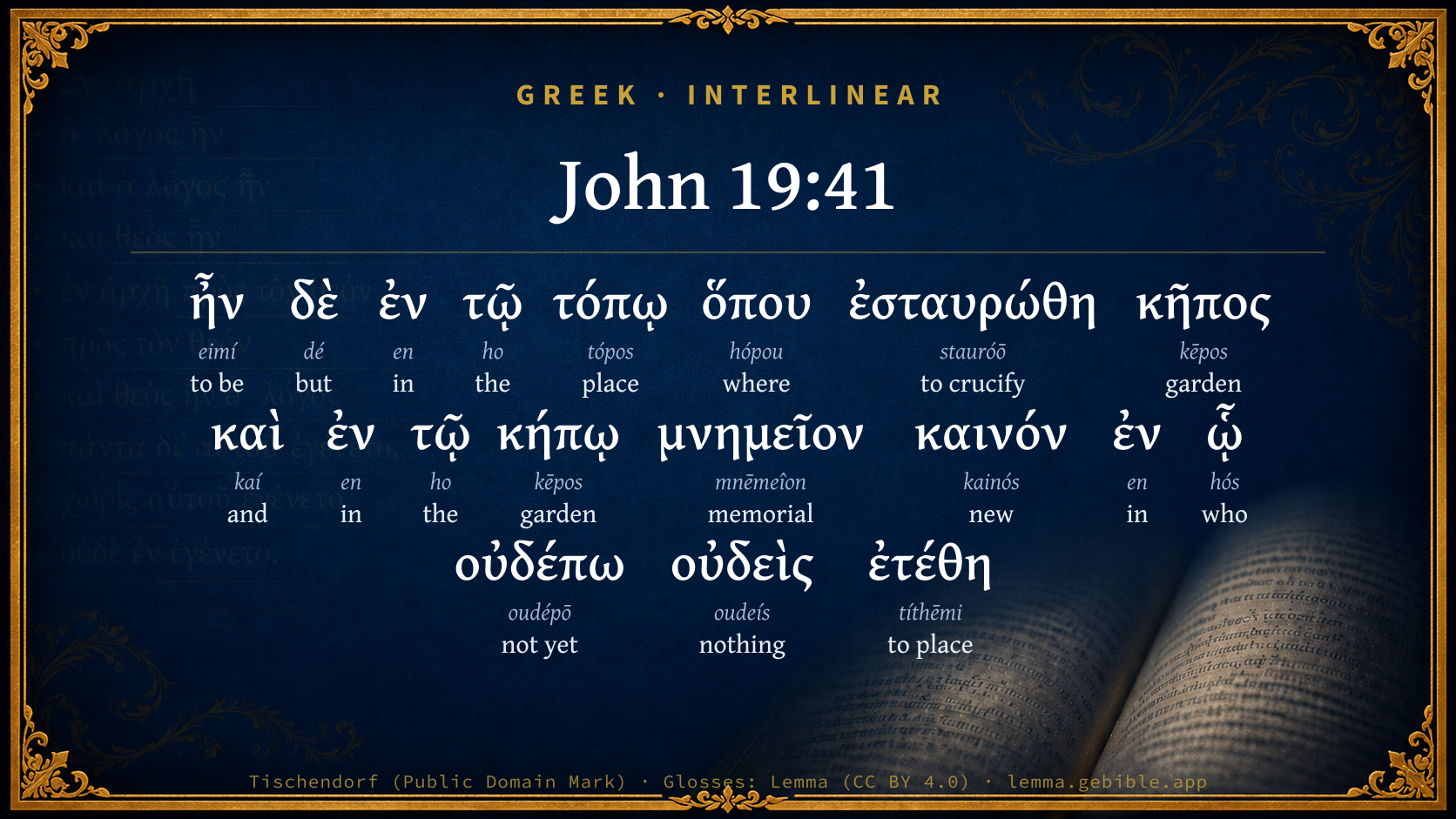
  1. ἦν eimí G1510 “to be” Verb, Imperfect, Active, Indicative, 3rd person, Singular
  2. δὲ dé G1161 “but” Conjunction
  3. ἐν en G1722 “in” Preposition
  4. τῷ ho G3588 “the” Article, Dative, Singular, Masculine
  5. τόπῳ tópos G5117 “place” Noun, Dative, Singular, Masculine
  6. ὅπου hópou G3699 “where” Adverb
  7. ἐσταυρώθη stauróō G4717 “to crucify” Verb, Aorist, Passive, Indicative, 3rd person, Singular
  8. καὶ kaí G2532 “and” Conjunction
  9. ἐν en G1722 “in” Preposition
  10. τῷ ho G3588 “the” Article, Dative, Singular, Masculine
  11. κήπῳ kēpos G2779 “garden” Noun, Dative, Singular, Masculine
  12. μνημεῖον mnēmeîon G3419 “memorial” Noun, Nominative, Singular, Neuter
  13. καινόν kainós G2537 “new” Adjective, Nominative, Singular, Neuter
  14. ἐν en G1722 “in” Preposition
  15. ᾧ hós G3739 “who” Relative pronoun, Dative, Singular, Neuter
  16. οὐδέπω oudépō G3764 “not yet” Adverb, Negative
  17. οὐδεὶς oudeís G3762 “nothing” Adjective, Nominative, Singular, Masculine, Negative
  18. ἐτέθη títhēmi G5087 “to place” Verb, Aorist, Passive, Indicative, 3rd person, Singular

About this verse

These counts appear in no published source. They are computed here, from the morphology-tagged text and Lemma’s own curated glosses. What Lemma adds →

19
words
15
distinct lemmas
Gospels
section

Notable vocabulary

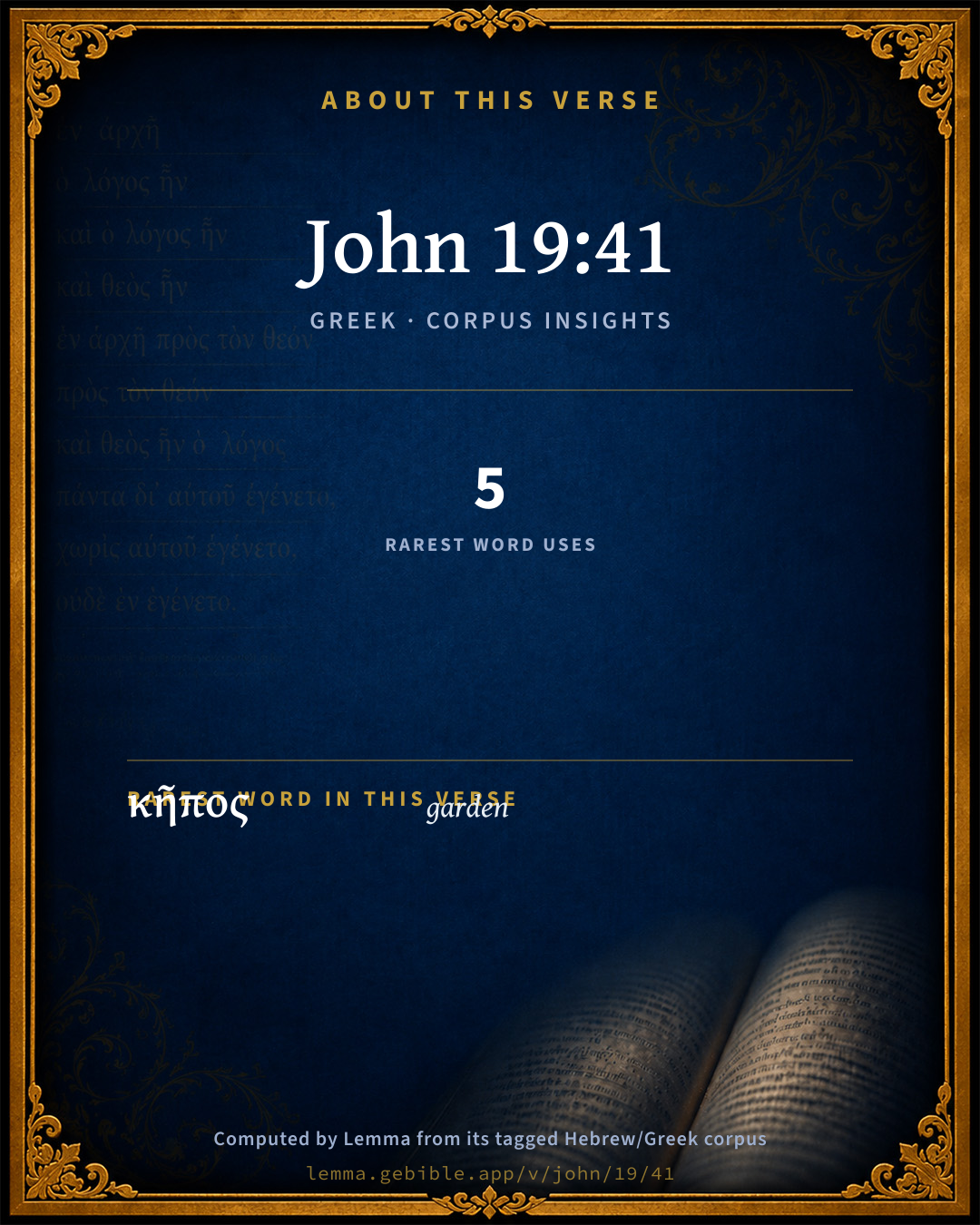
The rarest word here is κῆπος garden G2779 — appearing just 5 times in the whole Greek New Testament.

Shared distinctive vocabulary

κῆπος garden G2779 occurs in 4 verses of the Greek New Testament. Also found in:

Repetition

Words recur within this verse:

Cross-references

6

Topical passages linked to John 19:41 in the Treasury of Scripture Knowledge — connected by theme and wording, ordered by reader-vote popularity; previews shown in the World English Bible.

  • Matthew 27:60 and laid it in his own new tomb, which he had hewn out in the rock, and he rolled a great stone to the door of the tomb, and departed.
  • Luke 23:53 He took it down, and wrapped it in a linen cloth, and laid him in a tomb that was cut in stone, where no one had ever been laid.
  • Isaiah 22:16 "What are you doing here? and who has you here, that you have hewed out a tomb here? Cutting him out a tomb on high, chiseling a habitation for himself in the rock!"
  • John 20:15 Jesus said to her, "Woman, why are you weeping? Who are you looking for?" She, supposing him to be the gardener, said to him, "Sir, if you have carried him away, tell me where you have laid him, and I will take him away."
  • 2 Kings 23:30 His servants carried him in a chariot dead from Megiddo, and brought him to Jerusalem, and buried him in his own tomb. The people of the land took Jehoahaz the son of Josiah, and anointed him, and made him king in his father's place.
  • Matthew 27:64–66 Command therefore that the tomb be made secure until the third day, lest perhaps his disciples come at night and steal him away, and tell the people, 'He is risen from the dead;' and the last deception will be worse than the first."

Cross-references courtesy of OpenBible.info (CC BY 4.0).

Commentary

Notes on John 19:41 from classic Christian and Jewish commentators (each source and its license shown beneath its notes). The classic Christian expositions comment on the surrounding passage and are grouped to its opening verse, so a note may address several verses; the Jewish commentaries on the Tanakh (Rashi and others) are per-verse, so they appear only where the commentator wrote on this verse.

Lemma curates 59 commentaries, every one of them public domain or Creative Commons licensed, each selected and text-cleaned for this edition rather than reprinted as found. About our sources →

Jamieson, Fausset & Brown

Robert Jamieson, A. R. Fausset & David Brown

Now in the place where he was crucified there was a garden, and in the garden a new sepulchre--The choice of this tomb was, on their part, dictated by the double circumstance that it was so near at hand, and by its belonging to a friend of the Lord; and as there was need of haste, even they would be struck with the providence which thus supplied it. "There laid they Jesus therefore, because of the Jew's preparation day, for the sepulchre was nigh at hand." But there was one recommendation of it which probably would not strike them; but God had it in view. Not its being "hewn out of a rock" (Mar 15:46), accessible only at the entrance, which doubtless would impress them with its security and suitableness. But it was "a new sepulchre" (Joh 19:41), "wherein never man before was laid" (Luk 23:53): and Matthew (Mat 27:60) says that Joseph laid Him "in his own new tomb, which he had hewn out in the rock"--doubtless for his own use, though the Lord had higher use for it. Thus as He rode into Jerusalem on an ass "whereon never man before had sat" (Mar 11:2), so now He shall lie in a tomb wherein never man before had lain, that from these specimens it may be seen that in all things He was "SEPARATE FROM SINNERS" (Heb 7:26).

Next: John Chapter 20

Jamieson, Fausset & Brown — Commentary Critical and Explanatory on the Whole Bible (1871) — public domain (CC PDM 1.0). Text via the HelloAO Bible API.

The Biblical Illustrator

Joseph S. Exell

Joh_19:41-42

Now in the place where He was crucified there was a garden

The sepulchre in the garden

I. THE PLACE WHERE HE WAS CRUCIFIED. He has conferred honour upon every place where He has been. The place where He was born. There belonged no distinction to Bethlehem Ephratah before, she was little among the thousands of Judah; too little to be represented in the Sanhedrim. But the fact that He was born there has conferred upon Bethlehem undying fame.

1. It was in this place that was manifested the greatest love towards God, on one side, and the greatest love towards men, the enemies of God, on the other side. We do not say that it was here that He loved God and men most; but it was here that He manifested His love most. His love towards the Father was always like the sun, but it was here that it reached the meridian. His love towards mankind was like the sea, but it was here that it attained its spring-tide. The wave will never lift itself higher than it did at Calvary.

2. It was in this place that Jesus suffered most from those to whom He manifested His love most.

3. It was in this place that the holiness of Christ shone brightest of all places, and yet it was in this place that He was treated most like a sinner. I do not say that it was here that He was most holy. The Holy and Righteous was He in all places. That holy thing He was when coming into the world. But it was here that His holiness shone brightest.

4. It was in this place, of all others, that He was most completely given over to the hands of His enemies, and yet it was in this place that He realized the completest victory over them. There was some intervening shelter throughout the journey that prevented His enemies attacking Him.

5. It was in this place that He was treated as the most unworthy--and yet it was here that He won the highest title to worthiness that He possesses.

II. IN THE PLACE WHERE HE WAS CRUCIFIED THERE WAS A GARDEN. We invite you to visit the garden with us.

1. It belonged to an honourable councillor. Jerusalem was surrounded by gardens as well as by hills. The night before, we have Jesus in a garden in another direction from this.

2. It was a garden in sight of Calvary. The last thing that was impressed on the retina of His eyes was a garden. He saw many sad sights while He was here, but He closes His eyes upon our earth in view of a garden. Almost would we say, Blessed art thou, O garden amongst gardens; thou hast been privileged to shed thy fragrance so as to counteract the offensive odours of the place of skulls, and to fan with thy sweet perfumes the Saviour of the world in the agonies of His death. Was it not something like a picture of what He would ultimately make the moral world to be? Since I have come to this place a garden there must be now; I will convert the world into a garden. The thorns and briars must yield to the fir and the myrtle

3. A garden with a grave in it! We scarcely expect to find a grave in a garden. But a grave is appropriate in every place in our world. There are some of you who are permitted to pursue their life journey amidst roses; I count no path too smooth for you; tread upon flowers, let perfumes be diffused with every step you take; but will you be pleased to remember one thing? There is a grave at the end of the walk. But when we consider it, a garden and a grave seem, after all, to be quite in harmony with each other. What is the garden in the time of winter but a burial-place. Where is there more life buried than there is in the garden? But yet she does not refuse to be comforted, because they are not. That great Sun will come like an archangel, with his trumpet, and with a loud call will say, Awake, and sing, ye that dwell in the dust, and then there will be a resurrection in power and in glory. In consequence of the garden and the grave in the text, every grave has been in a garden ever since. Before that, it was in some waste howling wilderness that the grave was, with no verdure around it, nor anything betokening life near to it. The burial of the dead is henceforward a sowing. The cemetery is a garden, and beyond the grave there awaits for us the everlasting spring. The Great Sun of Righteousness will come to shed His beams above the burial-places of the earth so that they shall be turned into gardens.

III. THE NEW GRAVE IN THE GARDEN. It is worth our while to look at this grave. There was never one like it. There have been angels in this grave. Yes, here, the life lay sleeping on the knees of Death.

1. There was great regard paid to this grave: the eye of the Eternal Purpose was upon it. The honourable owner intended it for himself. Neither he nor the workmen who prepared it had any intention but to have it ready as speedily as it was possible. But every detail was under the control of the

Eternal Purpose, It was necessary to have it ready against the Passover. The substance of the Passover was to spend the Passover in it.

2. It was a borrowed grave that Jesus had. This is the only One who was in our world who had no grave. Sin has conferred on us a charter to a grave. In going to the grave He can only say, With a great sum obtained I this freedom; while the sinner can say, But I was free born. We sinners are free among the dead. Through our sin we have received the freedom of the city in the Necropolis.

3. He gave the grave back, and paid for the use of it. It was Jesus habit to return everything that He had borrowed better than He had found it. I believe that the upper room which He borrowed to eat the Passover in with His disciples was a better room after that supper, and that the boat which He borrowed for a pulpit was a better boat after that service. And, indeed, He gave back his grave to Joseph a better grave, though second-hand, than when it was new.

4. Oh, wonderful grave! It was in this grave that the bottom of the grave was knocked out. This grave became a womb to give birth to the Heir of the resurrection of the dead. It is off this grave that we gather the flowers with which to adorn our mourning garment after our dead. This is a grave which reconciles us to our own graves.

(1) There is another grave in sight of Calvary--a grave in which to bury sin. Neither Justice nor Law would have consented to its being buried anywhere else. Oh that we had this burial now!

(2) That grave is in the place. I know not what distance there is from here to the graves in which these bodies of ours shall rest; perhaps there is a much shorter distance than many think. But however near these graves are, the grave for burying sin is nearer; it is in the place. May our sins be buried so as never to be seen any more! (David Roberts.)

The garden by the cross

I. THE DARKEST ACT IN THE TRAGEDY OF LIFE.

1. The Crucifixion does not stand alone. It is but the culmination of all that good has suffered at the hands of evil. Christ was the Man of Sorrows, but He was also the Head of the great brotherhood of sorrow. There has never been an age in which the men whom God sent into the world to serve and save it, have not been pierced with its shafts and crowned with thorns.

2. It is a dark tragedy which is played out here, and the bud of it is inevitably a death. Sin has entered into the world and death by sin. There could be in such a world as this no other fate for the Son of Man but a crucifixion.

3. But there is something deeper than mere human suffering in our Lords passion. It was emphatically the hour of the prince of darkness--his last. His victory broke his power for ever.

4. The nature of sin was never fully known till then when it slew the Lord. Then the Father gave full expression of His mind about transgression, and gave to all intelligent beings the measure to His abhorrence of it.

II. BUT IN THE PLACE WHERE HE WAS CRUCIFIED THERE WAS A GARDEN. It is a startling contrast.

1. Very dear to Him during His lonely life-course were the flowers that bloomed round His feet. None of the beauty of the world He had made was hidden from Him as He passed along its pathways.

2. It is a question of deep and curious interest how far the modern intense delight in the beauty of nature was shared by the ancients, and how far it is the gift of the advent of the Lord of nature to His world. I believe that that advent has placed the whole sphere of nature in a new and closer relation to man. Here and there are exquisite passages in the classics, which reveal a delicate and cultured observation. And yet it is hardly for its own sake that nature is delighted in. The Hindoos probably come nearest to the moderns, but always there is a strong tinge of melancholy dashing the delight of the heathen heart. The Christian observation of nature is set in a new and higher key. Through Christ, Christian peoples have a delight in their world, which before Christ was hardly known to the elect spirits of our race. The Jews had much of the Christian enjoyment of natural beauty, and for the same reason: they knew the mind and heart of their King. Davids psalms complete the chord struck in Deu_8:7-9;

11:12.

3. Men will come to see one day that it is the Fathers counsel which they are searching out when they fathom the depths of creation; it is the benignity of a Fathers smile that they are taking in when they bask in the sunlight, when they watch the shadows play in the upper air upon the snow peaks, or catch at even the last rosy kiss of the daylight, as it falls down the mountain slopes on a weary world. It was right that the flowers should bloom their bravest around Calvary.

4. But still the contrast stands out sharply, and we will gather some of its suggestions.

(1) Consider the impassive serenity of nature through all the struggle and anguish of life. There are times when this serenity becomes dreadful. It seems terrible that flowers should bloom when the Lord who made and rules the universe was dying the death of a slave; yet the flowers never lifted their heads more gaily in the sun than on that day. And it is ever thus. A mother who has watched night long the death struggles of her darling who in the morning has gone home, looks bitter reproach at the sun rising so calmly on her agony. The east flushes into rosy splendour, the birds carol their gayest strains, the air is musical with the hum of life, while her heart is breaking, and the night has settled over her inner world. We may blow thousands of earths best and bravest into fragments in the storm of battle; Nature buries them calmly, and next year she reaps her richest harvests from their graves.

(2) Let us thank God that it is so. The garden blooms on, the cross has vanished, while the tradition of it has become the most sacred and blessed possession of mankind. Pain and storm, strife and anguish, birth and death are for time: order, beauty, life are for eternity. The sun shines gaily on the morrow of our anguish, and we writhe under it; but the sun shines on, and we come to delight in it and to bless the constancy which brings it forth morning by morning to prophesy to us of the world where sunlight is eternal. And nature is right. She will not bewail our calamities as though they were irreparable. There is infinite solace in Christ for the most burdened sufferers. Our light affliction, &c. Why should nature weep and moan, and stay her benign and beautiful process when she knows that the stroke which we think is crushing us is a benediction.

(3) Consider of how much that garden around the cross was symbolic in relation to man and to the Lord. He was delivered into the hands of men. Alas! that this should mean to wounds and death. The first crime was one with the last--fratricide. His brethren they were who were raging around Him; but around and above, all was calm, nay, triumphant. The harps of heaven were swept to a more exulting strain. The great ones of the past put on their glorious forms, and pressed through the veil to meet Him. The very dead beneath the cross stirred as His footsteps pressed them, and bursting from their tombs prepared to join the train which He would lead up on high. There was joy, an awful joy, throughout the universe when that Cross was uplifted--I, if I be lifted up, &c. Should the flowers then droop? No. In the place … there was a garden; and it spread forth all its brightness as the Lord made it His pathway to His throne. And it blooms still, and will bloom on till the death day of creation and paradise is restored. (J. Baldwin Brown, B. A.)

And in the garden a new sepulchre

The sepulchre in the garden

The steps of a good man are ordered by the Lord. Every event of our life, however minute and trivial, contains a purpose of Gods. Then we may surely assume that every fact in the life of the Perfect Man has its significance. The circumstances of our birth exert an immense influence over us: they are ordered of God; they were yet more manifestly ordered for His beloved Son. All the circumstances of our death, which is our second birth, have their influence on us, and speak eloquently to those who come after us; and these are ordered for us, and yet more manifestly for the Son. Think you it was a matter of indifference where Christs body was laid? We have a right then to look here for Divine thoughts, and there is one in particular. The first Adam fell from the garden into the wilderness; the Second Adam rose from the wilderness to the garden. Christ began where Adam ended, and ended where Adam began. Adam armed death with his sting; Christ has taken away the sting of death. Adam hewed the sepulchre, Christ consecrated it. Note

I. EVERYWHERE DEATH LURKS BENEATH THE BEAUTIFUL. In other words, every garden has its sepulchre.

1. The garden is the most express type of beauty. Children love flowers, as do all who retain the childlike heart. Flowers are the traditions of Paradise, and speak to us of a more perfect world and a higher blessedness. Mans career commenced and is to close in a garden. It is natural, then, for man to love the garden.

2. But in every garden there is a sepulchre. The brightest flower soonest fades.

(1) The whole world seems a huge tomb adorned outwardly with manifold forms of beauty. The rocks die slowly, crumbling through the ages to give life to herb and tree. Tree and herb feed animals, and animals man, and man is the prey of corruption.

(2) Death, moreover, has a refined taste. Loveliness has a fatal attraction. What is more lovely than light? And yet when it is fairest and fullest, it slays men with a stroke. What is more glorious in beauty than the sea? Yet its bed is lined with bleached bones. The beautiful birds are infested with murderous parasites. And have we not known one in every circle whose very loveliness of body and mind, like the gorgeous colouring of the fallen leaf, was the symbol of swift decay?

II. EVERY-THING, EVEN DEATH ITSELF, HAS BEEN MADE BEAUTIFUL BY CHRIST. Every sepulchre is in a garden--not in an untended desert. The grave still stands; but it stands in the open sunlight, and is adorned with flowers. The sting, the ugliness, the terror of death is sin; and this Christ has taken away. Christ has invested it with beauty in that He has taught us that it means

1. Sacrifice. The dying of the Lord Jesus has brought to light the vacarious element of death. The power and beauty of His death sprang from the fact that it was His submission to His Fathers will. So, in a lesser degree, with death everywhere. We see mountains tending to decay, herbs and grasses consumed by beasts, &c., and till we know the meaning of Christs death, the sight brings grief and fear. But looking from the cross we can trace this vicarious law through every province of creation and see beauty. The rocks decay, but it is that herbs may live; herbs are consumed--a sacrifice to the higher life of sheep and oxen. These also die that manmay live. Earthly homes are broken up that the mansions of the Fathers houses may be occupied. Civilization has its myriad victims that subsequentages may rise to purer life. The kingdoms of the world decay that the kingdom of Christ may come. All things tend to a better time. No suffering is superfluous. Eternal wisdom marshals the progress; infinite love appoints to each its place.

2. Glorification. Christ died to live. He could not be holden by the power of the grave. He rose into a higher region. Apply this to the general phenomena of death, and mark the beauty with which it invests them. The rocks crumble away into soil; but that is taken up into the higher vegetable kingdom, &c. In every case the soul of these several kingdoms passes through death into higher spheres. Mark, then, the perfect sympathy between the creation and the Christ whose it is and whom it serves. As His spirit returned to glorify His earthly frame, in the end the whole framework of creation will be restored and glorified; and those who are in Christ partake of the power of His death and Resurrection. Conclusion: We need not mourn that death is everywhere. We need not weep by the sepulchre as those who have no hope; it stands in a garden. To die is no more to venture on a lonely path; Christ has trod it before us, and will tread it with us. If the sepulchre still speaks of corruption, the garden speaks of the resurrection. Nor when those whom we love are summoned to depart should we indulge in hopeless sorrow. They have gone into the garden. Their flesh rests in hope; their spirits are in Paradise. (S. Cox, D. D.)

The sepulchre in the garden

I. SIN OBTRUDES ITSELF INTO THE FAIREST SCENES. You see around a cross a multitude come together to perform the foulest act ever perpetrated. The object of their hatred has never wronged them; but, on the contrary, has even blessed them. His character presented an assemblage of graces such as the world had never witnessed. And now He hangs on a cross in a garden I What a place for the perpetration of such a crime! A garden! where nature seems best fitted to exert a soothing influence on the angry passions! Surely nature cannot have her sanctuary violated by such an outrage. Thus the text contains a most emphatic refutation of the fancy that by giving them access to natural beauty you may restrain the wickedness, if not transform the character, of men. True, there is nothing in what is beautiful, whether in nature or art, unfavourable to religion--but very much by which religions feeling may be induced and fostered. And, certainly, they are not the worst Christians who have the most extensive and loving acquaintance with natures works. But nevertheless the influence which these things exert depends entirely on the state of mind with which they are surveyed. They may foster and strengthen feelings which already exist; they have no power to produce feelings which are not there. They have no power to change the heart, so as to make bad men good. One of the loveliest scenes in the world is the site of Pompeii, but it would seem that God has preserved her ruins that she might testify to the nineteenth century that she resembled Sodom in the depth of her wickedness before she resembled her in the terribleness of her overthrow. Man fell in Eden--angels sinned in heaven. In the place where He was crucified there was a garden.

II. SORROW MINGLES WITH ALL EARTHLY ENJOYMENT. In the garden a sepulchre. How emblematical of human life--in which every joy is marred by some sorrow, and the presence or the memory or the prospect of death casts its shadow over all. There is some fitness in the choice. A garden is the scene of beautiful life, where everything is fitted to minister pleasure. And to erect in such a scene the receptacle of death, might, without destroying the pleasure which the place afforded, serve as a useful monitor to remind men of the sorrows which lie so near and mingle with our joys, and of the termination which death brings to all earthly pursuits. It is a good thing, as moderating our present expectations and leading us to seek after a better inheritance, to be reminded that there is no such thing here as pleasure without drawback or alloy. Most people have a sepulchre in their garden; for have not they suffered loss here and disappointment there? But others whom they see--what sepulchre have they? Their life is all garden. It has neither desert bounding it nor sepulchre within its walls. But depend upon it you see not all. The heart knoweth its own bitterness. Could you look beneath the surface, you would see even in that lot which seems so enviable, not a little which might excite your pity or surprise. Of Naaman the Syrian, it is said, that he was captain of the host, &c.; but he was a leper. Of Haman we read how he told his wife and friends of his good fortune, and then add yet--yet all this availeth me nothing so long as I see Mordecai, &c. And so there is some but or yet to the most favoured condition, no rose without its thorn, in every garden a sepulchre.

III. THE PRESENCE OF CHRIST CONVERTS DEATH INTO LIFE, AND SORROW INTO JOY. It was meet that the sepulchre should be placed in a garden

1. Seeing it was to contain the body of our Lord. His presence there gave to the grave a significance which it had never possessed before. And it is meet also in the case of all who are His. I like the change from the crowded unattractive churchyard to the garden-like cemetery. I like, too, to see flowers growing around, or strewn upon the grave of the loved ones. The tomb in which Christ lies, in the person of His members, is a seed-plot of immortality, from which radiant and glorious forms shall spring; for that which thou sowest is not quickened except it die.

2. Because of the change which the Saviours death is to produce in the aspect of the world. Reduced by sin to a desert, physically and morally, it shall yet be covered with garden-like beauty and fertility because Christ has died. It is a sufficient pledge of its renovation that it has contained His sepulchre. Men are said to take possession of a country when they have buried their dead in it. So the Saviour will never regard with indifference the world which contains His tomb. He will return living and glorious to the place where once He lay dead and dishonoured, and the same scene which witnessed the commencement shall witness the completion of His triumph over sin and hell--over death and the grave.

3. As symbolical of how the presence of Jesus tends to change our sorrow into joy. Christ in the sepulchre transforms the receptacle of death into the source of higher life. And therefore have no sepulchre without a Saviour in it--no trouble in which you do not seek to have the presence of your Lord. A life all pleasure would neither be so desirable nor so profitable as a life whose sorrows are sanctified by fellowship with Christ. Nor should you seek, as is sometimes done, to have the sepulchre of your own fashioning, saying, If I had only such-and-such trials, I could bear them well: I should not complain if I were only like so-and-so. No man ever yet had to choose his own trials. He who gives the garden gives the sepulchre with it; and determines at once its position and its form. All that you need is to have Christ in it. (W. Landells, D. D.)

Christ in a borrowed grave

I take it not to dishonour Christ, but to show that, as His sins were borrowed sins, so His burial was in a borrowed grave. Christ had no transgressions of His own; He took ours upon His head. He never committed a wrong, but He took all my sins, and all yours, if ye are believers. Concerning all His people, it is true He bore their griefs and carried their sorrows in His own body on the tree; therefore, as they were others sins, so He rested in anothers grave; as they were sins imputed, so that grave was only imputedly His. It was not His sepulchre; it was the tomb of Joseph. (C. H. Spurgeon.)

The sepulchre in the garden

I. EACH MAN HAS A GARDEN. It may not be that where the outward sense is regaled with fruits and flowers and odorous airs, but a sacred enclosure of the heart. As on bleak hill-sides of splintered rock, green things and flowers here and there spring up, so there is something still bright where poverty and care exist. Very beautiful are some of these gardens, with dear friendships, the engaging interests of home, noble plans for self-culture and benevolence, generous trusts, and holy endearments, and the music and sunshine of dreams. All have their garden; BUT, guard and prize it as they may, it shall be the scene of tragedy; IT CONTAINS A SEPULCHRE.

1. The generous and aspiring youth seems to stand on the border of a land that will never lose its morning freshness; but this radiant landscape contains a tomb; the grave of glorious hopes that withered in the hot glare of an unsympathizing world.

2. In practical life there is no garden without a grave, and not merely in the case of the man who has fallen from prosperity to penury. There are tombs in the gardens of the rich, the gifted, and the great. Baffled purposes, alienated friendships, exhausted energy, the corpse of many a brave endeavour, the lost inspiration of eager manhood when the path to victorious light seemed garlanded with light--all this, and more, speaks of death.

3. But sadder still is the tomb in the garden of the affections. If anything on earth is sacred, it is home; yet the sepulchre is here; and it will not be empty long. There is a vacant place by the hearthstone. That home may be pleasant still, and the casual visitor may not think that it contains a place of burial. Yet, though the spot is sealed, it is not forgotten. The great world goes on as before. But bereaved hearts know it is there. In the garden is the sepulchre.

4. And it is well that it should be so; well that we learn our frailty, our ignorance, our sin, and be disciplined for our eternal home. For with mans sinful nature and tendencies, how fearful might be his career in transgression, and how reckless his presumption upon the forbearance of God, did he never suffer from the evil within and without him!

II. THE GRAVE IN THE GARDEN IS NOT A PLACE OF EVERLASTING STILLNESS AND DECAY. The stone shall be rolled away. If you have died unto sin, anti are buried with Christ in His death, you shall rejoice in the final resurrection of all that can contribute to the bliss of the soul in the eternal kingdom. There shall be no death there. There none shall bear the cross of secret trial. But how dark is your prospect if you do not believe upon His name, nor love His appearing! The sepulchre in the garden of your life is then the symbol of the death which awakens to no celestial fruition. (H. N. Powers.)

A sepulchre in every garden

You climb an eminence, and look on the underlying scene. The river flows gently through yellowing fields and woods that teem with life. The birds fill the air with song and gladness. The fish sport and leap in the waters. Cattle roam or recline in the meadows. Man goeth forth to labour with a cheerful heart. Unawares, you bless the earth and the great Giver of its goodliness. The eye fills with happy tears as you pronounce it a garden which the Lord hath blessed. And then the cold shadow comes creeping on; reflection stills the song of the heart; the trace of the spoiler, for a moment forgotten, stands once more revealed. You see or remember that the insects sporting in the air are the prey of birds; the birds flutter and scream beneath the pursuing hawk; the splash in the river tells of some eager little life swallowed up quick; the flowers close and wither as you gather them; the woodcutters axe fills the air with its resounding strokes; the sheep and oxen are led away to the slaughter; the funeral train winds along the white road, flecking it with blackness, while the passing bell reminds you that another of your flesh has seen corruption. The Skeleton Shadow broods over the entire scene, obscuring its brightness. The air grows stifling; and you feel as if suddenly immerged in the gloom of some monstrous grave. And yet you have but discovered the open secret--that death is the shadow of beauty: you have but passed through the garden into the sepulchre. So, too, with the varied human world. You think of the kindnesses and charities of home--the nobilities and patriotisms of national unity; the discoveries, utilities, refinements of civilization, and you bless God that you are a man of this clime and age. Again you are wakened from your pleasant dream. The veil is lifted from the home; you find mean anxieties, wearing toils, heartburnings, jealousies, despotisms; or where love abides, you find as its attendants sorrow and solicitude; Death has driven its chariot, armed with scythes, through the family array, leaving cruel gaps and innumerable wounds. The veil is lifted from the age, and beneath its high civilization you discern want, misery, vice, disease, war, with their kin--a terrible brotherhood, the offspring of death, doing the works of their father--preying on the foundations on which the social fabric is upreared. (S. Cox, D. D.)

The cemetery a garden--Christ the Gardener

(Text, and Joh_20:15):

I. THE SEED.

1. All seed does not germinate, and seeds, in themselves, are worthless unless they are fecundated. Cut open a seed-bearing flower, and in its axis you will find a seed-pod, from which grows an elongated stem called the pistil. On the end of this pistil is a little tongue, or stigma. This, of all the parts of the flower or plant, alone has no skin. About the pistil are the stamens, on the top of which are the anthers, or pollen-bearing organs of the flower. This pollen must fall upon the stigma which thus receives the fecundating principle, and transmits it to the seeds; and so they are quickened into life. In many trees this pollen is produced not on themselves, but on other trees belonging to the same species, and it is carried to the stigma of the blossoms to be fecundated by the wind or the bees.

2. The same principle, the Gardener tells us, prevails among His plants; there must be an extra-human quality imparted to every one of His seeds before they are planted or they cannot bloom immortally. That quality was produced by that which was planted in the dust of the earth in Josephs garden and became the first fruits from the dead. The reason why he Son of God was incarnated, died, was buried and rose again was that He might produce this Divine--pollen (may I term it?), so that His seeds might receive that fecundating principle which quickens to an immortal life. It is scattered like the natural pollen--broadcast on the breezes, so that all who will may receive it and live again; or it is carried about by the busyness of Christian workers.

3. But you cannot be planted, with a hope of the glorious resurrection, unless you have received this fecundating principle from Christ; otherwise you must there remain, sterile and dried, unable to rise in a new life. This is one of the fixed laws of nature. Why should we not expect the same in grace? He that believeth in Me, though he were dead yet shall he live. But believing is only receiving this Divine quality from Christ, as the stigma of the seed-pod receives the pollen, to quicken and give it life.

II. THE SOWING. For in the Lords garden what we call burying is only planting; for the Apostle says, If we be planted in the likeness of His death, &c.

III. THE BLOOMING.

1. Are we to be different? Hear the Apostle, It is sown in corruption; it is raised in incorruption; it is, &c. Our God doeth great things which we cannot comprehend. Who can understand the change wrought under ground which gives us a plant for our seed.

(1) Here we are, dried and shriveled. Sin has stripped us, yet is there great latent power for beauty, &c.

(2) Here there is no sweetness about us. Such is the wonderful alchemy of nature that the seed that rots sends up a flower rich in fragrance. More wonderful is the alchemy of grace, &c.

(3) Here there is no beauty about us, we are frost-marked. The Lord will not do half-work. He will not repair, but recreate, &c. It doth not yet appear what we shall be, &c. Who can guess by looking at the shriveled seed what the flower will be?

2. Shall we, then, fear to be planted in His garden, if we shall so soon rise to such life and beauty and sweetness? Conclusion: Let us walk with the Gardener while He points out to us some of His rarer plants. He points to this bed and says, There rests a precious seed, oh, how lovely will its blooming be! On earth it was called Bleeding Heart. It grew in great tribulation. And what lies here in this bed, Gardener? You would call that, in earths botany, a Heliotrope--the flower that ever turns toward the sun. And there lies the Lily of the Valley, &c. And there the Calla, whose roots had to be submerged in water, &c. But, we ask, Gardener, canst Thou care for all these? Will there be no confusion or neglect? Thy flowerbeds are so many, is there no possibility that some will be overlooked? Oh, no, He answers; their names are all graven on the palms of My hands, and are written also in the Book of Life. Oh blessed truth! What flowers shall spring up from these grassy mounds! (P. E.Kipp.)

The decorated grave

Mark well this tomb.

I. It is THE MOST CELEBRATED TOMB IN ALL THE AGES. Catacombs of Egypt, tomb of Napoleon, Mahal Taj of India, nothing compared with it. At the door of that mausoleum a fight took place which decides the question for all graveyards and cemeteries. Sword of lightning against sword of steel. Angel against military. That day the grave received such a shattering it can never be rebuilt. The King of Terrors retiring before the King of Grace. The Lord is risen.

II. See here POST-MORTEM HONOURS IN CONTRAST WITH ANTE-MORTEM INGNOMINIES. If they could have afforded Christ such a costly sepulchre, why could not they have given Him an earthly residence? He asked bread; they gave Him a stone. Christ, like most of the worlds benefactors, was appreciated better after He was dead. Poets Corner, in Westminster Abbey, attempts to pay for the sufferings of Grub Street. Go through that corner. There is Handel Think of the discords with which his fellow-musicians tried to destroy him. There John Dryden, who, at seventy, wrote a thousand verses at sixpence a line. There is Samuel Butler, who died in a garret. There the old blind schoolmaster, John Milton, whom Waller said, has just issued a tedious poem on the fall of man. If the length of it be no virtue, it has none. There is poor Sheridan. If he could have only discounted that monument for a mutton-chop! Oh! do justice to the living. All the justice you do them, you must do this side of the necropolis. Gentlemans mausoleum in the suburbs of Jerusalem cannot pay for Bethlehem manger, and Calvarian cross.

III. FLORAL DECORATIONS ARE APPROPRIATE FOR THE PLACE OF THE DEAD. Put them on the brow--it will suggest coronation; in their hand, it will mean victory. Christ was buried in a garden. Flowers mean resurrection. Death is sad enough anyhow. Let conservatory and arboretum contribute to its alleviation. The harebell will ring the victory. The passion-flower will express the sympathy. The daffodil will kindle its lamp and illume the darkness. The cluster of asters will be the constellation. Your little child loved flowers when she was living. Put them in her hand now that she can go forth no more to pluck them for herself. On sunshiny days take a fresh garland and put it over the still heart. Brooklyn has no grander glory than its Greenwood; but what shall we say of those country graveyards, with the vines broken down and the slabs aslant, and the mound caved in, and the grass the pasture-ground for the sextons cattle? Were your father and mother of so little worth that you cannot afford to take care of their ashes? Some day you will want to lie down to your last slumber. You cannot expect any respect for your bones if you have no deference for the bones of your ancestry.

IV. THE DIGNITY OF PRIVATE AND UNPRETENDING OBSEQUIES. Joseph was mourner, sexton, liveryman; had entire charge of every thing. Only four people at the burial of the King of the universe. Oh! let this be consolatory to those who through lack of means, or large acquaintance, have but little demonstration of grief at the graves of their loved ones. Not recognizing this idea, how many small properties are scattered, and widowhood and orphanage go forth into cold charity. That went for crape which ought to have gone for bread.

V. YOU CANNOT KEEP THE DEAD DOWN. Seal of Sanhedrim, regiment of soldiers, door of rock, cannot keep Christ in the crypts. Come out and come up He must. First-fruit of them that slept. Though all the granite of the mountains were piled on us we will rise. (T. de Witt Talmage, D. D.)

.

The Biblical Illustrator, edited by Joseph S. Exell (c. 1880s–1900s) — public domain. Text from a community e-Sword module.

Joseph Benson's Commentary

Joh 19:41-42. Now in the place where he was crucified — In the same tract of land; there was a garden — But the cross did not stand in the garden; and in the garden a sepulchre — Which happened very commodiously for his immediate interment. By the circumstance of the sepulchre’s being “nigh to the place where Jesus was crucified, and consequently nigh to Jerusalem, all the cavils are prevented, which might otherwise have been occasioned, in case the body had been removed farther off. Moreover, it is observed that the sepulchre was a new one, wherein never any man had been laid. This plainly proves that it could be no other than Jesus who arose; and cuts off all suspicion that he was raised by touching the bones of some prophet who had been buried there, as happened to the corpse which touched the bones of Elisha, 2Ki 13:21. Further, the evangelists take notice that it was a sepulchre hewn out of a rock, to show that there was no passage by which the disciples could get into it, but the one at which the guards were placed, Mat 27:60; and, consequently, that it was not in their power to steal away the body, while the guards remained there performing their duty.” — Macknight. There laid they Jesus, because of the Jews’ preparation — That is, they chose the rather to lay him in that sepulchre, which was nigh, because it was the day before the sabbath, which also was drawing to an end, so they had no time to carry him far. “The boldness of Joseph, and even of Nicodemus himself, deserves our notice on such an occasion. They are not ashamed of the infamy of the cross, but come with all holy reverence and affection to take down those sacred remains of Jesus; nor did they think the finest linen or the choicest spices too valuable on such an occasion. But who can describe their consternation and distress, when they saw him who they trusted should have delivered Israel, a cold and bloody corpse in their arms; and left him in the sepulchre of Joseph, whom they expected to have seen on the throne of David. We leave, for the present, his enemies in triumph, and his friends in tears, till his resurrection; which soon confounded the rage of the former, and revived the hopes of the latter; — hopes which must otherwise have been for ever entombed under that stone with which they now covered him. But happy and comfortable is the thought, that this his transient visit to the grave has (as it were) left a perfume in the bed of dust, and reconciled the believer to dwelling a while in the place where the Lord lay.” — Doddridge.

Joseph Benson's Commentary on the Old and New Testaments (1811–1818) — public domain. Text from a community e-Sword module.

MacLaren's Expositions of Holy Scripture

Alexander MacLaren

John

THE GRAVE IN A GARDEN

Joh 19:41.

This is possibly no more than a topographical note introduced merely for the sake of accuracy. But it is quite in John’s manner to attach importance to these apparent trifles and to give no express statement that he is doing so. There are several other instances in the Gospel where similar details are given which appear to have had in his eyes a symbolical meaning-e.g. ‘And it was night.’ There may have been such a thought in his mind, for all men in high excitement love and seize symbols, and I can scarcely doubt that the reason which induced Joseph to make his grave in a garden was the reason which induced John to mention so particularly its situation, and that they both discerned in that garden round the sepulchre, the expression of what was to the one a dim desire, to the other ‘a lively hope by the resurrection of Jesus Christ from the dead’-that they who are laid to rest in the grave shall come forth again in new and fairer life, as ‘the garden causeth the things that are sown in it to bud.’

To us at all events on Easter morning, with nature rising on every hand from her winter death, and ‘life re-orient out of dust,’ that new sepulchre in the garden may well serve for the starting-point of the familiar but ever-precious lessons of the day.

I. A symbol of death and decay as interwoven with all nature and every joy.

We think of Eden and the first coming of death.

The grave was fittingly in the garden, because nature too is subject to the law of decay and death. The flowers fade and men die. Meditative souls have ever gathered lessons of mortality there, and invested death with an alien softness by likening it to falling leaves and withered blooms. But the contrast is greater than the resemblance, and painless dropping of petals is not a parallel to the rending of soul and body.

The garden’s careless wealth of beauty and joy continues unconcerned whatever befalls us. ‘One generation cometh and another goeth, but the earth abideth for ever.’

The grave is in the garden because all our joys and works have sooner or later death associated with them.

Every relationship.

Every occupation.

Every joy.

The grave in the garden bids us bring the wholesome contemplation of death into all life.

It may be a harm and weakening to think of it, but should be a strength.

II. The dim hopes with which men have fought against death.

To lay the dead amid blooming nature and fair flowers has been and is natural to men. The symbolism is most natural, deep, and beautiful, expressing the possibility of life and even of advance in the life after apparent decay. There is something very pathetic in so eager a grasping after some stay for hope.

All these natural symbols are insufficient. They are not proofs, they are only pretty analogies. But they are all that men have on which to build their hopes as to a future life apart from Christ. That future was vague, a region for hopes and wishes or fears, not for certainty, a region for poetic fancies. The thoughts of it were very faintly operative. Men asked, Shall we live again? Conscience seemed to answer, Yes! The instinct of immortality in men’s souls grasped at these things as proofs of what it believed without them, but there was no clear light.

III. The clear light of certain hope which Christ’s resurrection brings.

The grave in the garden reversed Adam’s bringing of death into Eden.

Christ’s resurrection as a fact bears on the belief in a future state as nothing else can.

It changes hope into certainty. It shows by actual example that death has nothing to do with the soul; that life is independent of the body; that a man after death is the same as before it. The risen Lord was the same in His relations to His disciples, the same in His love, in His memory, and in all else.

It changes shadowy hopes of continuous life into a solid certainty of resurrection life. The former is vague and powerless. It is impossible to conceive of the future with vividness unless as a bodily life. And this is the strength of the Christian conception of the future life, that corporeity is the end and goal of the redeemed man.

It changes terror and awe into joy, and opens up a future in which He is.

We shall be with Him.

We shall be like Him.

Now we can go back to all these incomplete analogies and use them confidently. Our faith does not rest upon them but upon what has actually been done on this earth.

Christ is ‘the First fruits of them that slept.’ What will the harvest be!

As the single little seed is poor and small by the side of the gorgeous flower that comes from it; so will be the change. ‘God giveth it a body as it hath pleased Him.’

How then to think of death for ourselves and for those who are gone? Thankfully and hopefully.

Alexander MacLaren, Expositions of Holy Scripture (1904–1910) — public domain. Text from a community e-Sword module.

Tyndale Open Study Notes

Tyndale Open Resources

19:41 a new tomb: More than 900 first-century burial tombs have been discovered in Judea, carved into the limestone hills.

Tyndale Open Study Notes — © Tyndale Open Resources, licensed CC BY-SA 4.0. Text via the HelloAO Bible API.

Bengel's Gnomon

Johann Albrecht Bengel

Joh 19:41. Ἐν τῷ τόπῳ, in the place) The cross itself was not in the garden.

Bengel's Gnomon of the New Testament — English translation (T&T Clark, Edinburgh, 1860) — public domain. Text from a community e-Sword module.

Expositor's Greek Testament

ed. W. Robertson Nicoll

Joh 19:41 . ἐνταφιάζειν , see Gen 50:1-3 . ἦν ἐν τῷ τόπῳ , “There was in the place,” i.e. , in that neighbourhood, κῆπος , a garden, which, according to Mat 27:60 , must have belonged to Joseph. μνημεῖον καινόν , a tomb, rock-hewn according to Synoptists, which had hitherto been unused, and which was therefore fresh and clean.

The Expositor's Greek Testament, edited by W. Robertson Nicoll (1897–1910) — public domain. Text from a community e-Sword module.

Geneva Bible (1599)

Geneva Bible translators

That no man might cavil at his resurrection, as though some other that had been buried there, had risen, Theophylact.

Geneva Bible (1599) marginal notes — public domain. Text via Bolls.life.

Adam Clarke's Commentary

Verse 41. There was a garden] It was an ancient custom for particular families to have burying places in their gardens. See 2Kg 21:18; 2Kg 21:26.

New sepulchre] See Clarke on Mt 27:60.

Adam Clarke's Commentary on the Bible (1810–1826) — public domain. Text from a community e-Sword/MySword module.

John Calvin's Commentaries

41. Now, in the place where he was crucified there was a garden. This is the third point, as I have said, which ought to be observed in the history of the burial. It is related by the Evangelist for various reasons. In the first place, it did not happen by accident, but by an undoubted providence of God, that the body of Christ was buried in a new sepulchre; for although he died as all other men die, still, as he was to be the first-born from the dead, (Colossians 1:18,) and the first-fruits of them that rise, (1 Corinthians 15:20) he had a new sepulcher, in which no person had ever been laid True, Nicodemus and Joseph had a different object in view; for, in consequence of the short time that now remained till sunset, which was the commencement of the Sabbath, they looked to the convenience of the place, but, contrary to their intention God provided for his own Son a sepulchre which had not yet been used. The good men are merely gratified by the place being near at hand, that they might not violate the Sabbath; but God offers them what they did not seek, that the burial of his Son might have some token to distinguish him from the rank of other men. The local situation served also to prove the truth of his resurrection, and to throw no small light on the narrative which is contained in the following chapter.

John Calvin's Commentaries (1540-1563) — public domain. Text from the Calvin Translation Society English edition (1840s-50s) via the Christian Classics Ethereal Library (ccel.org). Calvin's coverage is partial (roughly two-thirds of the Bible); uncommented books and verses are honest gaps, never fabricated. The 19th-century editor's footnotes and remarks are omitted so the notes are faithfully Calvin's own voice.

Ellicott's Commentary for English Readers

(41) Now in the place where he was crucified there was a garden.—Comp. Joh_18:1. St. John’s account makes the choice of the sepulchre depend on its nearness to the place of crucifixion; the account in the earlier Gospels makes it depend on the fact that the sepulchre belonged to Joseph. The one account implies the other; and the burial, under the circumstances, required both that the sepulchre should be at hand, and that its owner should be willing that the body should be placed in it.

A new sepulchre, wherein was never man yet laid.—An emphatic combination of the two statements made in Mat_27:60 and Luk_23:53.

A Bible Commentary for English Readers, edited by Charles John Ellicott (1878–1897) — public domain. Text from a community e-Sword module.

The Cambridge Bible for Schools and Colleges

gen. ed. J. J. S. Perowne

41. there was a garden] Contrast Joh_18:1. S. John alone tells of the garden, which probably belonged to Joseph, for S. Matthew tells us that the sepulchre was his.

a new sepulcher] S. Matthew also states that it was new, and S. Luke that no one had ever yet been laid in it. S. John states this fact in both ways with great emphasis. Not even in its contact with the grave did ‘His flesh see corruption.’

S. John omits what all the others note, that the sepulchre was hewn in the rock.

The Cambridge Bible for Schools and Colleges (gen. ed. J. J. S. Perowne; Cambridge University Press, 1878–1918) — public domain. Text from a community e-Sword module.

John Gill's Exposition

Now in the place where he was crucified,.... Which takes in all that spot of ground that lay on that side of the city where he was crucified; or near to the place of his crucifixion, for it was not a garden in which he was crucified:

there was a garden; all gardens, except rose gardens, were without the city, as has been observed; see Gill on Joh 18:1. This, it seems, belonged to Joseph: rich men used to have their gardens without the city for their convenience and pleasure:

and in the garden a new sepulchre; they might not bury within the city. Some chose to make their sepulchres in their gardens, to put them in mind of their mortality, when they took their walks there; so R. Dustai, R. Janhal, and R. Nehurai, were buried, "in a garden", or orchard (f); and so were Manasseh and Amon, kings of Judah, Kg2 21:18. Here Joseph had one, hewn out in a rock, for himself and family, and was newly made. The Jews distinguish between an old, and a new sepulchre; they say (g),

, "a new sepulchre" may be measured and sold, and divided, but an old one might not be measured, nor sold, nor divided.''

Wherein was never man yet laid; this is not improperly, nor impertinently added, though the evangelist had before said, that it was a new sepulchre; for that it might be, and yet bodies have been lain in it; for according to the Jewish canons (h),

"there is as a new sepulchre, which is an old one; and there is an old one, which is as a new one; an old sepulchre, in which lie ten dead bodies, which are not in the power of the owners, , "lo, this is as a new sepulchre".''

Now Christ was laid in such an one, where no man had been laid, that it might appear certainly that it was he, and not another, that was risen from the dead.

(f) Jechus haabot, p. 43. Ed. Hottinger. (g) Massech. Sernacot, c. 24. fol. 16. 3. (h) Ib.

John Gill's Exposition of the Whole Bible (1746–1763) — public domain (CC PDM 1.0). Text via the HelloAO Bible API.

Trapp's Complete Commentary

John Trapp

41 Now in the place where he was crucified there was a garden; and in the garden a new sepulchre, wherein was never man yet laid.

Ver. 41. A new sepulchre] Fit for him that was the "first-born from the dead, the firstfruits of them that sleep." Besides else it might have been said, that some other had risen, and not he (saith Theodoret), as Mahomet saith that Christ was not crucified, but another for him. ινα μη συκοφαντισθη η αναστασις, ως αλλου ανασταντος..

John Trapp, A Commentary or Exposition upon All the Books of the Old and New Testament (1647–1656) — public domain. Text from a community e-Sword module.

Haydock's Catholic Bible Commentary

This is added, lest it should be said, that it was not Christ, but some other, that rose from the dead; or at least, that he rose by the virtue of some other person reposing there. (Calmet).

George Leo Haydock (1774–1849), Haydock's Catholic Family Bible and Commentary, 1859 edition — public domain. Excludes Psalms (Douay-Rheims chapter numbering differs from Protestant) and Deuterocanonical books (Catholic canon only).

Matthew Poole's English Annotations

As all their gardens were out of the city, so also their burial places, which usually were vaults, or caves within the earth.

Matthew Poole's English Annotations on the Holy Bible (1683–1685) — public domain. Text from a community e-Sword/MySword module.

Whedon's Commentary on the Bible

Daniel D. Whedon

41. In the garden a new sepulchre—John’s account here, had we no other, would appear not a little mysterious. By what right do the friends of this supposed malefactor take possession of the nearest new sepulchre? But from Matthew we learn (Mat_27:60) that it is Joseph’s own new tomb. We have thus one of those happy but undesigned coincidences which show that truth is the basis of the account. As the next verse shows, the time required haste, and the body was deposited in this sepulchre temporarily, in order, after the sabbath was passed, to give it an honourable tomb in the proper burial ground.

Daniel D. Whedon (gen. ed.), Commentary on the Old and New Testaments (1874–1909) — public domain. Text from a community e-Sword module.

The Pulpit Commentary

Now there was in the place where he was crucified, close at hand to the very cross, a garden, and in the garden a new sepulcher, wherein as yet no man was laid (on site, see ver. 17, notes). John alone tells us of the "garden;" and he clearly saw the significance of the resemblance to the "garden" where Christ agonized unto death, and was betrayed with a kiss, and also to the garden where the first Adam fell from the high estate of posse non peccare. We are not told, however, by him that this sepulcher was Joseph"s own (Matthew gives this explanation), nor that it was cut out of a rock, nor the nature or quality of it. Matthew, Luke, and John remark that it was kainon , not simply neon , recently made, but new in the sense of being as yet unused, thus preventing the possibility of any confusion, or any subordinate miracle, such as happened at the grave of Elisha, (2Ki_13:21) and so our Lord"s sacred body came into no contact with corruption. Thus from the hour of death, in which the love of God in Christ is seen at its most dazzling moral luster, and the glorification of Christ in his Passion reaches its climax, death itself beaus to put on new unexpected forms and charms:

(1) the symbolic effusion of water and blood;

(2) the costly unguent spices and honorable burial lavished on One who had been put under ban, and had died the doom of the slave;

(3) the garden and the watchers.

The Pulpit Commentary (1880–1919), ed. H.D.M. Spence-Jones & Joseph S. Exell — public domain. Text from a community e-Sword module.

John Wesley's Explanatory Notes

In the place where he was crucified - There was a garden in the same tract of land: but the cross did not stand in the garden.

John Wesley, Explanatory Notes Upon the Whole Bible (1754–1765) — public domain. Text via the GEBible commentary corpus.

Cambridge Greek Testament for Schools and Colleges

41. κῆπος. S. John alone mentions it, as he alone mentions the other garden (Joh 18:1). It probably belonged to Joseph, for the tomb was his (Mat 27:60). This shews that Joseph, though of Arimathaea, had settled in Jerusalem. For καινόν see on Joh 13:34. S. Matthew also says that it was new, S. Luke that never man had yet lain in it. S. John states the fact both ways with great emphasis. It is another royal honour. Not even in its contact with the grave did ‘His flesh see corruption.’ Comp. the colt, whereon no man ever yet sat (Luk 19:30).

Cambridge Greek Testament for Schools and Colleges (Cambridge University Press, 1896; 21 vols, various authors incl. Carr, Maclear, Plummer, Farrar, Lumby, Moule, M. R. James, Simcox) — public domain. Text from a community e-Sword module.

Alford’s Greek Testament

Henry Alford

41.] See note on Matt. ver. 60. The words ἐν τῷ τόπῳ ὅπου ἐσταυρώθη are so far in favour of the traditional site of the Holy Sepulchre, that Calvary and the Sepulchre are close together, under the roof of the same church. And those who have found an objection in that circumstance have forgotten this testimony of John.

καινὸν …, and therefore given for the purpose—so that the additional particular not here mentioned, that it belonged to Joseph, is almost implied. The newness of the tomb was important, that it should be seen “neminem præter Jesum, neque Jesum alterius virtute, ut olim circa sepulchrum Elisæi acciderat, resurrexisse” (Lampe): so that (Luthardt) no room might be left for the evasions of unbelief.

Henry Alford, The Greek Testament (1849–1861) — public domain. Text from a community e-Sword module.

International Critical Commentary

41. ἦν δὲ ἐν τῷ τόπῷ ὅπου ἐσταυρώθη κῆπος. None of the Synoptists mention a garden (see for κῆπος on 18:1) as the place of burial. This, with the detail that it was “in” the place of Crucifixion, is peculiar to Jn. (For the use of the impf. ἦν, see on 11:18.) There was no time to lose, and this garden was near Golgotha. Mat 27:60 adds that the tomb in the garden belonged to Joseph of Arimathæa, but this is not in Mk., Lk., or Jn., although it may have been the case. Pseudo-Peter explicitly says that the garden bore the name κῆπος Ἰωσήφ. Two instances of royal tombs in gardens are given 2Ki 21:18, 2Ki 21:26, and the LXX of Neh 3:16 makes mention of κήπος τάφου Δαυείδ. Milligan (s.v.) cites κηποτάφιον “a tomb in a garden,” from a papyrus of 5 b.c.

ἐν τῷ κηπῷ μνημεῖον καινόν (DsuppN 69 give κενόν), ἐν ᾧ οὐδέπω οὐδεὶς ἦν τεθειμένος. Mar 15:46 has “a tomb which had been hewn out of a rock,” which Mat 27:60 follows: adding (as Jn. does) that the tomb was καινόν. Lk. also says (23:53) that the tomb was λαξευτόν, adding οὗ οὐκ ἦν οὐδεὶς οὔπω κείμενος. Thus Jn. agrees with Lk. in saying that the tomb had not been used before, and he uses almost the same words, substituting οὐδέπω for οὔπω (cf. 20:9).

International Critical Commentary — older volumes (1896–1929), various authors — public domain. Text from a community e-Sword module.

Vincent's Word Studies in the New Testament

Marvin R. Vincent

A garden. Mentioned by John only.

New [καινον] . See on Mt 26:29. John omits the detail of the tomb being hewn in the rock, which is common to all the Synoptists. ===Joh20

CHAPTER XX

1, 2. Compare Mt 28:1; Mr 16:2 - 4; Luk 24:1 - 3.

1 First day of the week [τη μια των σαββαατον] . The Hebrew idiom, day one of the week. See on Luk 4:31; Act 20:7.

Dark. Matthew says, as it began to dawn; Mark, when the sun was risen; Luke, very early in the morning, or at deep dawn; see on Luk 24:1. Taken away [ηρμενον εκ] . Lifted out of. All the Synoptists have rolled.

Marvin R. Vincent, Word Studies in the New Testament (1887–1900) — public domain. Text from a community e-Sword/MySword module.

Godet's Commentaries

Frédéric Louis Godet

Vv. 41, 42. “Now there was in the place where he was crucified a garden, and in the garden a new sepulchre wherein no one had ever yet been laid. 42. It was there that they laid Jesus, because of the Preparation of the Jews; for the sepulchre was near.”

According to Matthew, the sepulchre belonged to Joseph himself, and this was the reason of the use which was made of it. According to John, this sepulchre was chosen because of its proximity to Golgotha, since the Sabbath was about to begin. These two reasons, far from contradicting, complete each other. What purpose would the proximity of the sepulchre have served, if it had not belonged to one of the Lord’s friends? And it was certainly the circumstance that Joseph owned this sepulchre near the place of crucifixion, which suggested to him the idea of asking for the body of Jesus.

John and Luke (Luk 23:53) remark that the sepulchre was new. Comp. Luk 19:30 : “You shall find a colt tied whereon yet never man sat.” These are providential facts, which belong to the royal glory of Jesus. When a king is received, objects which have not yet been used are consecrated to his service.

The expression . the Preparation of the Jews, signifies, according to those who hold that the death of Jesus took place, not on the 14th, but on the 15th: the Friday of the Jews. But what would be the object of so singular an expression? It was designed, answers Rotermund, to give us to understand how it happened that the day following a Sabbatic day (the 15th) was again a Sabbath (Saturday). By this means the first Sabbath became, as it were, the preparation for the second. But if the first of the two days was Sabbatic, like the following one, the carrying away of the body, which they did not wish to do on the next day, could not any more have been done on this day. The quite simple meaning is that it was the hour when the Jews (thus is the complement the Jews explained) prepared their great national and religious feast by sacrificing the lamb. They were obliged to hasten because, with the setting of the sun, this day of preparation, the 14th, a non-Sabbatic day, came to its close, and because the following day, the 15th, was in that year a doubly Sabbatic day (Joh 19:31); comp. Luk 23:56.

On the Day of Jesus’ Death.

Respecting the day of the week on which the death of Jesus took place, the agreement of the four evangelists is manifest; it was a Friday (Mat 27:62, Mar 15:42, Luk 23:54, Joh 19:31). But they appear to differ as to the question whether this Friday was the 14th or the 15th of the month Nisan—an apparently insignificant difference, but yet one which implies a more considerable one. For on this depends the question whether Jesus had celebrated on the preceding evening the Paschal supper with all the rest of the Jewish people,—in that case Jesus would have died on the 15th,—or whether the people were to celebrate this supper later, on the evening of the day of His death,—in this case the day of His death was the 14th. For the Paschal supper was celebrated on the evening which formed the transition from the 14th to the 15th.

I. The View of John.

According to Joh 13:1, Jesus celebrated His last supper before the feast of the Passover. Rotermund (in the article which is cited above) affirms, no doubt, with Langen, that the Passover feast began only on the 15th, and that, as a consequence, this supper, which took place before the feast, must be placed on the evening of the 14th, and must therefore be identified with the Paschal supper. But see on Joh 13:1. John would not have designated this supper simply by the words: “A supper,” or even, if one will have it so, “the supper.” For the benefit of his Greek readers, he could not have refrained from designating this supper as that of the Passover.

The passage Joh 18:28, notwithstanding all the efforts of some scholars (comp. also Kirchner, Die judische Passahfeier, 1870), plainly declares that the Jewish Paschal supper was not yet celebrated on the morning when Jesus was condemned, and consequently that Jesus was put to death on the 14th, and not on the 15th.— The passages Joh 19:14; Joh 19:31; Joh 19:42 lead to the same result. Neither Kirchner nor Rotermund has succeeded in proving that expressions such as these: the Passover Friday, the Friday of the Jews, are natural. That it was a Friday is certain; that the word παρασκευή (preparation) may designate Friday, as the preparation for the Sabbath, is unquestionable. But that in John’s context this term paraskeue8, preparation, can have the technical sense of Friday, is inadmissible.

After the observations ofKirchner and Luthardt, I give up alleging Joh 13:19 as decisive, although one still asks oneself how a purchase could have been made during the Passover night, all families, whether rich or poor, being at that time gathered around the Paschal table, and all the shops being consequently closed.

II. The Apparent View of the Synoptics.

This view seems to follow evidently from the three parallels, Mat 26:17 : “The first day of unleavened bread (the 14th of Nisan), the disciples of Jesus came to him saying, Where wilt thou that we prepare for thee the Passover supper?” Mar 14:12 : “And on the first day of unleavened bread, when they sacrificed the Passover, the disciples said to him;” Luk 22:7 : “The day of unleavened bread came, when the Passover must be sacrificed, and he sent Peter and John.” It seems altogether natural to place this question of the disciples, or (according to Luke) this commission which Jesus gives to two of them, on the morning of the 14th, when the preparations of the Paschal supper were made for the evening. And from this fact precisely it is that the apparent contradiction to the narrative of John arises; for, if Jesus gave this order on the 14th in the morning, the supper which the disciples were to prepare for the evening could only be the Paschal supper, from which it would follow that His last supper coincided with the Paschal supper of that year.

Now, according to John, as we have just proved, the Jewish Paschal supper must have taken place only on the evening which followed that of the last supper of Jesus, on the evening of the day of His death.

Here is one of the greatest differences between the Synoptics and John. Since the earliest times it has attracted the notice of all those who have closely studied the Scriptures. And already in the second century, as we shall see, we encounter numerous traces of the discussions which it has raised.

III. The Attempts at Solution.

From the time of St. Jerome, the view of the Synoptic narrative became prevalent in the Church; it continued so even until the Reformation: Jesus had celebrated the Passover with the whole people before He died. But at that epoch the revival of Biblical studies caused the need to be felt of giving a more exact account of the Gospel narratives; their apparent disagreement was obvious, and the attempt was made to resolve it. Calvin and Theodore Beza, then Scaliger and Casaubon, brought out the idea, already expressed by Eusebius and Chrysostom (seeTholuck, p. 41), that the Jews, in order that they might not have to celebrate two successive Sabbatic days (Friday, the 15th of Nisan, as the first day of the feast, and the next day, the 16th, which fell in this year on Saturday), had exceptionally delayed by one day the great day of the feast, while Jesus had, for Himself, kept the legal day. Thus would the fact be explained that He, at this time, celebrated the Passover a day sooner than the rest of the people. It appears that, at the present day also, when the 15th of Nisan falls on a Friday, the Jews transfer the feast from this day to Saturday. This solution is very simple and natural. Only we do not find either in the New Testament, or in Josephus, or in the Talmud, any trace of such a transposition, which would constitute a grave derogation from the law. Other reasons have been sought which might lead Jesus in this circumstance to deviate from the generally-received usage. Stier has thought that He attached Himself to the mode of action of some sects, like that of the Karaites, who had the custom of celebrating the Paschal supper, not on the evening of the 14th-15th, but on that of the 13th-14th.— Ebrard has supposed that because of the great number of lambs to be slain in the temple (sometimes more than 250,000, according to Josephus) from three to six o’clock in the afternoon, the Galileans had been authorized to sacrifice and eat the lamb on the 13th instead of the 14th.— Serno applies the same supposition to all the Jews of the dispersion. But these hypotheses have no historical basis, and are, in any case, much less probable than that of the Reformers.— Rauch has affirmed that the Israelites in general celebrated the Paschal supper, legally and habitually, on the evening of the 13th-14th, and not that of the 14th-15th. But this opinion, which, even if adopted, would yet not resolve the difficulty, strikes against all the known Biblical and historical data.

Lutteroth, in his pamphlet, Le jour de la preparation, 1855, and in his Essai d’ interpretation de l’ Evangile de saint Matthieu, 1876, places the day of the conversation of Jesus with His disciples much earlier, on the 10th of Nisan, when the Jews set apart the lamb which was to be sacrificed on the 14th. It was, according to him, on the same 10th day that Jesus was crucified; He remained in the tomb on the 11th, 12th, and 13th; the 14th was the day of

His resurrection. This entirely new chronology is shattered by the first word of the conversation. How is it possible that the 10th of Nisan should be called by the evangelists the first day of unleavened bread, especially when this determination of the time is made still more precise, as it is in Mark, by the words: “when the Passover is sacrificed.” It is true that Lutteroth tries to make this when refer only to the idea of unleavened bread: “the unleavened bread which is to be eaten when the Passover is sacrificed” (!). The words of Luk 22:7 : “The day of unleavened bread came, when the Passover must be sacrificed,” are still more rudely handled: it is not an historical fact which Luke relates, it is a moral reflection by means of which the evangelist announces at the beginning that the Passion will have an end (!) (Essai, pp. 410, 411).— After all these fruitless attempts, one can understand how a large number of critics limit themselves at the present day to establishing the disagreement and declaring it insoluble; this is what is done by Lucke, Neander, Bleek, de Wette, Steitz, J. Muller, Weiss, de Pressense, etc.

IV. The Truth of John’s Narrative.

But if the contradiction exists, it remains to determine which of the two narratives deserves the preference. Then it must be explained how so grave a difference can have arisen in the Gospel narrative.

The critics of the Tubingen school— Baur, Hilgenfeld, Keim —are not embarrassed: it is the Synoptics that have preserved the true historical tradition. As to John’s narrative, it is a deliberate alteration of the real history, intended, on the one hand, to make the death of Jesus, as the true Paschal lamb, coincide with the time of the sacrificing of the lamb in the temple, and, on the other hand, to throw into the shade the Jewish Paschal supper by making the last supper of Jesus a simple farewell meal. But neither the one nor the other of these ends required a means so compromising as that which is thus ascribed to pseudo-John. Such a disagreement with the first three Gospels, which were already received throughout the whole Church, and with the apostolic tradition, of which these writings were known to be the depositaries, exposed the work of the fourth evangelist to the danger of being greatly suspected, and that in a very useless way for him. For to present Jesus as the true Paschal lamb, there was no need of such a desperate expedient as that of misplacing the well-known day of His death; it was enough that this event should be placed in the Paschal week; there was, therefore, nothing to be changed in the tradition of the Church; comp. the words of Paul in 1Co 5:7 : “Christ, our Passover, has been sacrificed for us;” those of Peter, 1Pe 1:19, and all the passages of the Apocalypse where Christ is called the Lamb. As to the Jewish Passover, there was no need in the second century to depreciate it; it was already replaced everywhere, both in the Church and in the sects, by the Christian supper (Schurer, pp. 29-34).

A second class of critics, as we have seen, try to interpret the texts of John so as to put them in accord with what they think to be the meaning of the Synoptic narrative. They are, for example, Lightfoot, Tholuck, Olshausen, Hengstenberg, Wieseler, Luthardt, Wichelhaus, Hofmann, Lichtenstein, Lange, Riggenbach, Ebrard, Baumlein, Langen, Keil. But all their efforts have been unsuccessful in bringing out from John’s text a sense contrary to that which is obvious on reading it.

As to the third class, which concedes a real difference between our Gospel narratives, the greater part give the preference to that of John; thus, among the moderns, Weiss, Pressense (see note on p. 400), Reuss himself (Theol . joh. pp. 59, 60). And, in fact, if the conflict is real, the choice cannot be doubtful. The witnesses in favor of the historical exactness of John’s narrative are the following:

1. The Synoptics themselves.—These writings contain a series of facts, and a certain number of words, which are in complete accord with John’s narrative and in no less evident disagreement with the view which is attributed to them. If there was an hour sacred to the Jewish conscience, it was that of the Paschal supper; and yet it was at this hour that a multitude of officers and servants of the chief priests and elders had left their houses and their families, assembled around the Passover table, to go and arrest Jesus in Gethsemane! Still more, we know that everything which was reprehensible on the Sabbath, as, e.g., to climb a tree, to ride on horseback, to hold a session of a court, was also prohibited on the festival day (Traite Beza, 5.2); and yet there were held, on that Sabbatic night of the 14th-15th, at least two sessions of the court, in one of which the sentence of death for Jesus was pronounced; and then all those long negotiations with Pilate, as well as the sending to Herod, took place; all this, notwithstanding the festival and Sabbatic character of the 15th of Nisan! It is answered that a session of the court was nermitted on the festival day, provided that the sentence was not put in writing, and that, in general, the rule of the festival days was less rigorous than that of the Sabbaths properly so called. But, at the foundation, all the difference between these two kinds of days is limited to the authorization to prepare the necessary articles of food on the festival day, if even we are allowed to draw a general conclusion from Exo 12:16. Now would so slight a difference be sufficient to justify the use of such a day which is here implied?

That Simon of Cyrene, who is returning from the fields (Mat 27:32); that Joseph of Arimathea, who is going to purchase a linen cloth (Mar 15:46); those women who give up embalming the body, because the Sabbath is drawing near (Luk 23:56)—is all this explicable on the supposition that the day when these things happened thus was itself a Sabbatic day, the 15th of Nisan? No doubt it is answered that Simon was returning from a simple walk in the country, or that he was a countryman who was going to the city; then, that purchases might be made on a festival day, provided they were not paid for on the same day. It is nevertheless true that the impression made by the narrative of the Synoptics is that the day of Jesus’ death was aworking day, entirely different from the Sabbatic day which was to follow; that it was, consequently, the 14th, and not the 15th of Nisan.

This is what appears also from a certain number of expressions scattered throughout the Synoptic narrative. Thus Mat 26:18 : “My time is at hand; let me keep the Passover at thy house with my disciples.” What is the logical connection which unites the two propositions of this message? The only satisfactory relation to be established between them is this: “It is necessary for me to hasten; for to-morrow it will be too late; I shall be no longer here; act, then, so that I may be able to eat the Passover at thy house immediately with my disciples (ποιῶ, the present).”

Mat 27:62 : The evangelist calls the Saturday during which the body of Jesus reposed in the tomb: “the morrow which is after the preparation.” In this phrase it is impossible that the word preparation should have the sense of Friday, as if Matthew had meant to say that the Sabbath during which Jesus was in the tomb was the next day after a Friday! We do not designate the more solemn day by that which is less so, but the reverse. If the day of the 15th is designated here from its relation to the less solemn day of the preparation which had preceded it, it is because this day of preparation had become much more important, as the day of Jesus’ death. From this singular phrase, therefore, it follows that Jesus was crucified on the 14th.

The same conclusion must be drawn from Mar 15:42 : “Seeing it was the Preparation, that is, the day before the Sabbath.” It is of the day of Jesus’ death that Mark thus speaks. Now, it is impossible that Mark, a Jew by birth, should have characterized a day like the 15th of Nisan as a simple Friday, preceding the Sabbath (Saturday), this 15th day being itself a Sabbath of the first rank. And if the expression: preparation, that is, the day before the Sabbath, can in the ordinary usage designate a Friday, this technical sense is inapplicable in a context where the reason is explained why a work was allowed which could not be done on the following day. The term preparationhas here its general sense according to which it is applied to any day of the week preceding a Sabbath. Mark explains thereby the act of Joseph of Arimathea in burying Jesus, after having bought a linen cloth. “All this was possible,” he says, “because it was the preparation, the day before the Sabbath and not the Sabbath. This is what the expression in Luk 23:54 also signifies: “That day was the preparation, and the Sabbath was about to dawn.”

All these facts and words, no doubt, do not imply that the redactors of the Synoptic narratives fully understood the conclusion to be drawn from them as to the day of Jesus’ death. But they are indications, which are so much the more significant since they seem to be unconscious, of the real tradition relative to the day of this death and of the complete conformity of this tradition with the narrative of John.

2. The Talmud. —Some passages of this monument of the Jewish memorials and usages declare expressly that Jesus was suspended on the cross on the evening of the Passover (beerev happesach), that is to say, in the Jewish language, the evening before the Passover. The erroneous details which are sometimes mingled in these passages with this fundamental statement do not at all diminish the value of the latter, because it is reproduced several times and identically—a fact which indicates an established tradition. If it is objected that the Jewish scholars derived this statement, not from their own tradition, but from our Gospels, this is to acknowledge that they understood the latter as we ourselves understand them.

3. St. Paul.—Keim cites this apostle as a convincing witness in favor of the Synoptic view. We recognize, he says, in the institution of the Holy Supper (1 Corinthians 11), all the forms of the Jewish Paschal supper—a fact which can be explained only if this last supper of Jesus coincided with the Passover, and if it consequently took place on the evening of the 14th-15th, and not on the evening of the 13th-14th. But Jesus may very well have used the forms of the Paschal supper on an evening before that on which that supper was celebrated; for, as He says Himself, “his time was at hand,” and He was forced to anticipate. From the expression of Paul in 1Co 11:23 : “The Lord Jesus in the night in which he was betrayed,” it follows rather that that night was not the night of the Paschal supper; otherwise Paul would have characterized it in another way than by the betrayal of Judas.

All the witnesses whom we are able to consult, even the Synoptics, who are set in opposition to John, do homage, therefore, to the accuracy of his narrative.

V. The real Meaning of the Synoptic Narrative.

But, I would ask, is it indeed certain that the Synoptics really say what they are made to say? They say expressly that “the first day of unleavened bread” (Matt., Mark, Luke), “when the Passover was sacrificed” (Mark), “came” (Luke), and that “the disciples asked Jesus” (Matt., Mark), or that Jesus Himself, taking the initiative, sent John and Peter from Bethany to Jerusalem (Luke), with a view to seeking a place for celebrating the Passover. This conversation is unhesitatingly placed on the morning of the 14th of Nisan for the very simple reason that the days are reckoned, as we ourselves reckon them, making the official day coincide with the natural day. But, in calculating thus, it is forgotten that among the Jews the official day began at six o’clock in the evening, and that thus, when it is said: “The day of unleavened bread came,” this indication, properly understood, places us, not in the morning of the 14th, but in the evening of the 13th-14th. Taking the Synoptics literally, we are obliged to hold that the conversation between Jesus and the disciples of which they tell us took place, not on the 14th in the morning, but late in the afternoon of the 13th, between the two evenings, according to the customary expression—that is, between the moment when the sun sinks to the horizon and that when it disappears, a moment which is the transition point between the civil day and the day following.

Rotermund asserts, no doubt, that, notwithstanding this official way of reckoning the days, it was always the beginning and the end of the natural day which determined the popular language. But the contrary follows from Luk 23:54, which designates the last moment of Friday evening by the words: “It was the preparation, and the Sabbathwas about to dawn,” as well as from the phrase which was customary among the Jews, according to which erev haschabbath, evening of the Sabbath, denotes the evening, not of Saturday, but of Friday. Moreover, we can cite a telling fact taken from Jewish life at the time of Jesus. On the 16th of Nisan, in the morning, the sacred sheaf was offered as the first-fruits of the entire harvest of the year. This sheaf was cut in a field near to Jerusalem, on the preceding day at evening, or, as we should say, on the 15th at evening. The messengers of the Sanhedrim arrived in the field followed by the people: “Has the sun set?” they asked.—“It has,” answered the people.—“Am I to cut?”—“Yes, cut.”—“With this sickle?”— “Yes.”—“Into this basket?”—“Yes.”—And why all these formalities? Because the 15th was a Sabbatic day, and because manual labor, like that of the reaper, must not be done until after it was established that the 15th was ended, and until the 16th, a working day, had begun. We see from this how deeply the way of reckoning days, which we attribute here to the Synoptics (from evening to evening, and not from morning to morning), had penetrated into the Jewish social life. There is also a circumstance which comes to the support of what we are here saying.

It was already alleged by Clement of Alexandria, and its importance has been acknowledged by Strauss. The crowd of pilgrims was so great in Jerusalem at the Passover feast, that no one waited until the morning of the 14th to secure for himself the place where he might celebrate the Paschal supper with his family in the evening. It was on the 13th that this search for a place was attended to. So Clement of Alexandria calls the 13th the προετοιμασία, thepro-preparation; for the preparation itself was the day of the 14th. It was certainly, therefore, on the day of the 13th, and not that of the 14th, that the disciples spoke to the Lord, or He to them, with the purpose of procuring the place which they needed for the next day at evening. The conversation reported by the Synoptics must have taken place, therefore, at the latest, about five or six o’clock in the afternoon of the 13th, according to our mode of reckoning the days. Jesus, at that time, sent to Jerusalem the two disciples in whom He felt most confidence, charging them to secure a room. In the thought of all the disciples, it was for the next day at evening; but Jesus gives His two messengers to understand that it was for that same evening. This is what the terms of the message imply which He intrusted to them for the host whom He had in view: “My time is at hand: I must hasten.” And why this course of action, which was full of mystery? The reason for it is simple. Judas must not know in advance the house where Jesus would spend this last evening with His disciples.

From six to eight or nine o’clock, the disciples would have time enough for preparing the supper, even for killing and preparing the lamb, which was already set apart since the 10th of Nisan. Undoubtedly they did not sacrifice it in the temple. But could they have done this, even on the official day and at the official hour—they who must have been excommunicated as adherents of Jesus (Joh 9:22)? However this may be, according to the primitive institution of the Passover (Exo 12:6-7), it belonged to every Israelite to sacrifice his lamb in his own house; the sacrificing in the temple was a matter of human tradition. And at that time, when the Israelitish Passover was about to come to an end, to be replaced by the sacramental supper of the new covenant, it was altogether natural to return to the simplicity of the starting point. The priestly sacrificing was useless when the typical lamb had no longer any other part to fill than that of serving as the inauguration of the new supper which was to replace the old. It has been objected (Keim, Luthardt) that Jesus did not have the right to change the legal day of the Passover. But if He was the Lord of the Sabbath, the corner-stone of the whole ceremonial law (Mar 2:28), He was certainly the same also with respect to the Passover. The legal Paschal supper was no longer for Him, at that moment, anything but the calyx, withered henceforth, from the bosom of which the commemorative supper of the perfect Redemption was about to blossom.

Let us also observe an interesting coincidence between the well-known Jewish usages and the narrative of the Synoptics, as we have just explained it. On the evening of the 13th, about six o’clock, the lamps were lighted in order to search the most obscure corners of the houses and to remove every particle of leaven. Then, before the stars appeared, a man went from every house to draw the pure water with which the unleavened bread must be kneaded. Does not this usage very naturally explain the sign given to Peter and John when Jesus said to them: “On entering the city, you will meet a man bearing a pitcher of water; follow him into the house where he shall enter” (Luk 22:10)?

The solution which we here present is not new; it is at the foundation the same which was already set forth in the second century by the two writers who were especially occupied with this question at the time when it seems to have deeply engaged the attention of the Church, Apollinaris of Hierapolis and Clement of Alexandria. The first expresses himself thus: “The day of the 14th is the true Passover of the Lord, the great sacrifice, in which the Son of God, put in the place of the lamb, was delivered up to be crucified.” The second says, with still more precision: “In the preceding years, Jesus had celebrated the feast by eating the Paschal lamb according as [on the day when] the Jews sacrificed it. But on the 13th, the day on which the disciples interrogated Him, He taught them the mystery [of the type of the lamb]....It was on this day (the 13th) that the consecration of the unleavened bread and the pro-preparation of the Passover took place;...and our Saviour suffered on the day following (the 14th): for He was Himself the true Passover....And this is the reason why the chief priests and scribes, when leading Him to Pilate, did not enter into the Praetorium, that they might not be defiled and might eat the Passover in the evening without any hindrance.”

In reality, therefore, we have only reproduced Clement’s solution in the most violent of the Paschal disputes of the second century, of which we shall soon speak. Weiss, who rejects every solution, yet acknowledges that, strictly speaking, Mar 14:12 is the only passage which is opposed to what we have just set forth. What seems to him incompatible with it is the remark: “The first day of unleavened bread, when the Passover was sacrificed.” But why could not these last words be applied to the evening of the 13th, if this evening, according to the Jewish manner of reckoning, belonged already to the 14th, on the afternoon of which the lamb was sacrificed? Weiss cannot himself refrain from adding that, in any case, the question of the disciples, if placed in the morning of the 14th, is improbable, for the people did not ever expect to occupy themselves at that time with the place of the supper. De Pressense has nothing else to object except the words of Mat 26:20 : “And when the evening was come, he reclined at table with the Twelve,” which implies, he says, that the preparations for the supper were made, not a few moments earlier in the evening, but during the course of the day. This remark would perhaps be well founded if the evangelist had had in view, in writing these lines, the question which occupies us. But Matthew does not seem, any more than the other two Synoptics, to have accounted for the problem which is raised by the traditional account; he simply meant to say that this last supper of Jesus took place, not in the daytime, but in the evening.

It is probable that two circumstances contributed to the want of clearness which prevails in the Synoptical narration: first, the very easy confounding of the civil and natural day, and then the fact that the institution of the Holy Supper had impressed on this last supper a character very similar to that of the Paschal feast.

Finally, let us recall to memory the lights which exegesis has asked from astronomy with respect to this question. The question being to determine whether, in the year of Jesus’ death, the great Sabbatic day of the 15th of Nisan fell on Friday, as the Synoptic narrative, or on Saturday, as the narrative of John implies, the calculation of the lunar phases might serve, it was thought, to decide the question. Two astronomers set themselves to the work,Wurm, of Gottingen (Bengel’s Archiv., 1816, II.), and Oudemann, Professor at Utrecht (Revue de theologie, 1863, p. 221).

But it is necessary to begin by determining the year of Jesus’ death, and scholars still differ on this point. Ideler and Zumpt place it in 29;Winer, Wieseler, Lichtens’ein, Caspari, Pressense, etc., in 30; Ewald, Renan, in 33; Keim, in 35; Hitzig, in 36. In this state of things, the two astronomers have extended their calculation to the whole series of years 29-36 of our era. The result, as to the year 30, which we think, with most of the critics, to be the year of the death, is the following: In this year, the 15th of Nisan fell on a Friday. This result would condemn our explanation; but Caspari, taking up anew the calculation of Wurm, starting from the same data as this astronomer, has arrived at the opposite result. According to him, in the year 30 the 15th of Nisan was Saturday, as it must be according to our explanation. The fact is, that we find ourselves here face to face with the incalculable uncertainties and subtleties of the Jewish calendar. Wurm himself declares that one can speak here only of probabilities, that there will ever remain an uncertainty of one or two days. Now, everything depends on a single day (Keim, III., p. 490-500). It is safer to work upon positive texts than upon such unsettled foundations. And as for ourselves, everything being carefully weighed, we think that the most probable date of Jesus’ death may be stated thus: Friday, the 14 th of Nisan (7 th of April), in the year 30.

We are happy to agree, on the question of the relation between John and the Synoptics, with some modern scholars: Krummel, Darmstadt Litteraturblatt, Feb., 1858; Baggesen, Der Apostel Johannes, 1869; Andreae, in the Beweis des Glaubens, Der Todestag Jesu, July to September, 1870.— On the consequences of the historical superiority of John’s narrative, with reference to the authenticity of the Fourth Gospel, see Introd., Vol. I., pp. 77-79.

VI. Glance at the History of the Paschal Controversies.

The fact which lies at the foundation of that long disagreement between the primitive churches is the following: The churches of Asia Minor celebrated the Paschal feast by fasting during the whole of the 14th of Nisan and by communicating on the evening of this day, at the time when the Jews were eating the lamb. The other churches of Christendom, Rome at their head, fasted, on the contrary, during the days which preceded the Passover Sunday, which was always the Sunday that followed the 14th; then they received the sacrament in the morning of this Passover Sunday.—In both cases the communion terminated the fast.

First phase of the discussion. About 155, Polycarp, in a visit which he makes to Rome, has a conversation on this subject with Anicetus, the bishop of Rome. Each defends the rite of his own church in the name of an apostolic tradition of which it claimed to be the depositary (originating at Ephesus from John and Philip, at Rome from Paul and Peter). There is no proof that on this occasion they entered within the exegetical and dogmatic domain of the question. The ecclesiastical peace remained undisturbed. “The diversity in the rite served rather,” as Irenaeus says, “to establish agreement in faith.”

Second phase. Fifteen years later, in 170, there breaks out in the midst even of the churches of Asia, at Laodicea, a disagreement on the subject of the Passover. There are persons there—who are they? we shall have to examine this point—who, like the Asiatics, celebrate the 14th in the evening, but resting upon this fact: that it was on the 14th in the evening that Jesus instituted the Supper, in conformity with the time prescribed by the law for the Paschal supper, and they rest upon the narrative of Matthew, according to which the Lord was crucified on the 15th. We see that from the domain of tradition the question is carried to that of exegesis. Melito is the first who writes on this subject, with what view we do not know. Then, on occasion (ἐξ αἰτίας) of his book—not against him, as Schurer still claims— Apollinaris and Clement of Alexandria also take up the pen. Both, according to the fragments quoted in the Chronicon Paschale, prove that Jesus celebrated His last supper on the 13th, and that He died on the 14th. They specially allege John’s narrative in favor of this view.

But who are the Laodicean adversaries whom these two writers oppose? Baur, Hilgenfeld, Schurer, Luthardt, answer: They are the churches of Asia themselves, with their celebration of the 14th. Apollinaris was even in Asia the adversary of the Asiatic rite. It is difficult to believe this. For, 1. Eusebius presents the churches of Asia before us as unanimous: “The churches of the whole of Asia thought, according to an ancient tradition, that they must observe the 14th by the celebration of the Holy Supper.” If this consensus of all the churches of Asia had been broken by so considerable a bishop and doctor as Apollinaris of Hierapolis, Eusebius, the pronounced adversary of the Asiatic rite, would not have failed to notice it. Baur alleges that a little later Polycrates, when enumerating in his letter to Victor, a bishop of Rome, all the illustrious personages who practised the Asiatic rite, does not mention Apollinaris. But he names only the dead. Apollinaris might also be found among the numerous bishops of whom Polycrates speaks without naming them, who surrounded him at the time when he was writing his letter, and who gave their assent to it. 2. If Apollinaris had made a division as related to his colleagues in Asia, the dispute would, no doubt, have broken out in his home, at Hierapolis, rather than at Laodicea. 3. The polemic of Apollinaris by no means implies opposition to the Asiatic rite and adhesion to the occidental rite. The adversaries justified their observance of the 14th by resting upon the fact that this was the evening on which Jesus had instituted the Supper. Apollinaris remarks that this view puts the first three Gospels in contradiction to that of John. But this does not prevent him from celebrating the 14th also— only for another reason. In any case, it is impossible to understand how this view of Apollinaris, according to which Jesus died on the 14th, not the 15th, could have favored the Roman observance, according to which the Holy Passover Supper was celebrated on the following Sunday. 4. Schurer is embarrassed here by a manifest contradiction: According to him, the Asiatic rite did not rest on any fact of the Gospel history, neither on the time of the institution of the Supper nor on the day of Jesus’ death. It arose only from the fact that the 14th was the day of the Jewish Paschal supper, which had been simply transformed, in Asia, into the Christian Supper. But, on the other hand, in the presence of the polemics of Apollinaris, he is forced to acknowledge that his adversaries fixed the Supper on the 14th, in remembrance of the day of the institution of the Supper. These two grounds of the same observance not coinciding, he ought not to maintain that the Laodiceans combated by Apollinaris are no others than the churches of Asia in general.

It is with reason, therefore, that Weitzel and Steitz, with whom are associated Ritschl, Meyer, Reville, etc., have been led to see in the Laodiceans, contended against by Apollinaris, a Judaizing party which arose in the Church of Asia, and which had as its aim to preserve for the Holy Supper the character of a complete Jewish Passover supper, as they imagined that the Lord also had celebrated that supper before He died. Then the polemic of Apollinaris and Clement takes effect. These people said: “We wish to do as the Lord did [celebrate the Paschal supper on the 14th], and this by eating the Paschal lamb as He did.” The two Fathers answer: “The Lord did not do this. He carried back the Paschal supper of the 14th to the 13th in the evening, and this by instituting the Supper.” This opinion evidently did not prevent Apollinaris from remaining faithful to the rite of his Church, since, as Schurer himself acknowledges, if the churches of Asia celebrated the 14th, as did the Laodiceans, it was not as having been the day of the institution of the Supper.

I would differ in opinion from Weitzel and Steitz only on two points: 1. The Laodicean adversaries, against whom Apollinaris contends, do not seem to me to have been an Ebionite sect properly so called, but only a branch of the Church of Asia, with a more pronounced Judaizing tendency. 2. The rite of the churches of Asia did not arise, probably, as these scholars think, from the fact that, in their view, Jesus died on the 14th, but quite simply from the fact that in these churches the day of the Israelitish Paschal supper was maintained. This is what results from the following words of Eusebius: “The churches of Asia thought they must celebrate the 14th, the day on which the Jews were commanded to sacrifice the lamb;” then more clearly still from those of Polycrates: “And all my relatives (bishops before me) celebrated the day when the people removed the leaven.” The Asiatic rite is expressly placed in connection with the day of Christ’s death only in two passages of the fourth and fifth centuries—one in Epiphanius, the other in Theodoret (see Schurer, pp. 57, 58)—a fact which shows clearly that this point of view was not the prevailing one at the beginning of the discussion.

Third phase. Between 180 and 190 a certain Blastus (comp. the Adv. Haer. of the pseudo-Tertullian, c. 22) attempted to transplant the Asiatic rite to Rome. It was probably this circumstance which reawakened the dispute between the Churches of Rome and Asia, represented at this epoch, the one by Victor, the other by Polycrates. The latter, in his letter to Victor, no longer defends his cause by the traditional arguments, as Polycarp had done thirty years before. “He went through all the Holy Scriptures before writing (πᾶσαν ἁγίαν γραφὴν διεληλυθώς).” And he declares that “his predecessors also observed the 14th according to the Gospel (κατὰ τὸ εὐαγγέλιον).” These words give rise to reflection. It has been sought to get rid of them by means of subtleties (see the embarrassment ofSchurer, p. 35).

They evidently prove, as do those which precede, that Polycrates and the bishops of Asia had succeeded in establishing an agreement between the Gospels, by means of which these writings not only did not contradict one another (τὸ εὐαγγέλιον, the one Gospel in the four), but also were in accord with the law itself (all the Scriptures). Such expressions imply that Polycrates and his bishops had found the Asiatic rite confirmed first by the law (the question is of the Paschal institution, Exodus 12, fixing the Paschal supper on the 14th), then by the unanimity of the canonical Gospels, which has no meaning unless Polycrates harmonized the Synoptics with John by interpreting them as we ourselves have done. There is, therefore, a perfect equivalency between these words of Polycrates and that which Apollinaris had maintained against the Laodiceans, when he said: “Not only is their opinion contrary to the law, which requires that the lamb should be sacrificed on the 14th (and consequently that Christ also should die on the 14th), but also there would be [according to the opinion which they defend] disagreement between the Gospels [since, according to them, Matthew fixed the death of Christ on the 15th, while John places it on the 14th].” This dispute was quieted by the efforts of Irenaeus and many others, who interposed with Victor and arrested him as he was proceeding to violent measures.

Fourth phase. It is marked by the decision of the Council of Nice, in 325, which enjoined upon the Orientals to fall in with the Occidental rite, which was now generally adopted. “At the end of the matter,” says Eusebius (in his περὶ τῆς τοῦ πάσχα ἑορτῆς, Schurer, p. 40), “the Orientals yielded;” “and thus,” adds the same historian, “they broke finally with the murderers of the Lord, and united with their co-religionists (ὁμοδόξοις).” In fact, the practical consequence of the Asiatic rite was that the Christians of Asia found themselves to be celebrating the Holy Paschal Supper at the same time as the Jews were celebrating their Passover supper, thus separating themselves from all the other Christians who celebrated the Supper on the following Sunday. This rite became in the view of the other Churches, as it were, the sign of a secret sympathy for the unbelieving Jews. This was what determined its defeat. There were, nevertheless, Christians who, like the Judaizers of Laodicea, persisted in the observance of the 14th for the reason that Jesus had instituted the Supper on that day at evening. They figure under the names of Audians, Quarto-decimans, in the lists of later heresies. Athanasius frankly confesses that they are not easily to be refuted when they allege these words of the Synoptics: “On the first day of unleavened bread, the disciples came to Jesus” (Schurer, p. 45). We here come upon the first symptom of the preponderance which the Synoptical narrative finally gained in the Church over that of John, and which it maintained through the middle ages and even to modern times. The Synoptics, more popular than John and apparently more clear, forming besides a group of three against one, and especially no longer encountering in the way of counterpoise the fear of a mingling of the Christian Supper and the Jewish Passover, carried the day in the general feeling. Jerome is the one of the Fathers who contributed most to this victory.

But how are we to explain the origin of the two observances—the Asiatic and the Roman —in the second century?—Paul had no fear of bringing into the Church the celebration of the Jewish Passover feast (Act 20:6; comp. 1Co 5:7-8 with Joh 16:8). He transformed and spiritualized its rites—this is beyond doubt; the Holy Supper was substituted for the Paschal supper of the lamb and unleavened bread; but the time of the celebration was the same; this seems to follow from Act 20:6. John certainly did not do otherwise; it was thus that the celebration of the Holy Supper on the evening of the 14th of Nisan was quite naturally introduced into Asia.

But the churches of the West, more estranged from Judaism, felt a certain repugnance to this unity in point of time which was established between the Jewish and the Christian feast, and to the kind of dependence in which the simultaneousness placed the second with relation to the first. They therefore threw off the yoke; and, instead of celebrating the Holy Passover Supper on the 14th at evening, as they already had the institution of the weekly Sunday, distinct from that of the Jewish Sabbath, they fixed this ceremony for the morning of the Sunday which in each year followed the 14th of Nisan, or, to speak more properly, the full moon of March. Thus, no doubt, the occidental observance grew up, which finally carried the day over the primitive observance. The Church is free in these matters.

The result of this long and complicated history, so far as relates to the subject which occupies our attention, seems to us to be this: From the time when the Church occupied itself with the exegetical side of the question, it attached itself to the Johannean narrative. It made use of it, on the one hand, to refute by the pen of Apollinaris the exegetical basis on which the Laodicean party rested the observance of the 14th (by making that day, according to Matthew, the day of the institution of the Supper); on the other hand, to defend against Rome, by the pen of Polycrates, the Asiatic celebration of the 14th, by presenting the Supper as the Jewish Passover spiritualized—that is to say, as the feast of the Christian redemption, the counterpart of the deliverance from Egypt.

The matter in question, therefore, for the Church of Asia, was not that of celebrating the 14th of Nisan as the day of the institution of the Supper, nor even, properly speaking, as the day of Jesus’ death (against Steitz). It simply Christianized the Jewish Passover. The Asiatic observance, therefore, does not furnish, as Baur has claimed, an argument against the Johannean origin of the Fourth Gospel; quite the contrary, the polemic of Apollinaris against the Laodiceans, and that of Polycrates against Victor, are a striking testimony given to the narrative of the Fourth Gospel.

To sum up, the difference between John and the Synoptics may be stated and explained as follows:

In drawing up the oral tradition, the Synoptical writers contented themselves, as he did, with placing the last supper of Christ on the 14th of Nisan, the first day of unleavened bread, without expressly distinguishing between the first and the second evening of that day. Now, as Jesus had given to this last supper, celebrated on the evening of the 13th-14th, the forms of the Paschal supper, which took place on the evening of the 14th-15th, in order to substitute the Holy Supper for the Paschal feast for the future, a misunderstanding might easily arise; it might be imagined that this supper was itself the Paschal feast of the 14th, which necessarily had the effect of carrying over the day of the death of Jesus to the 15th. John (as he had done so many times in his work) desired to dissipate the sort of obscurity which prevailed in the Synoptics, and to rectify the misunderstanding to which their narrative might easily lead. He therefore intentionally and clearly re- established the real course of things to which, moreover, the Synoptic narrative bore testimony at all points.

Frédéric Louis Godet — Commentaries on Luke, John, Romans, and 1 Corinthians — English translation (T&T Clark, Edinburgh, 1870s–1890s) — public domain. Text from a community e-Sword module.

Lesson kit

Teaching starters — assembled from the data on this page, not authored interpretation. Every prompt links to the verse data it draws on. Edit before teaching.

John, in the Gospels, opens this verse with 19 words (15 distinct Greek lemmas). Its most distinctive word is kēpos (“garden”). A historical commentator’s framing appears above. Read the whole chapter for the surrounding context.

Discussion questions

  1. The word kēpos carries the sense “garden.” How does it shape the verse?
  2. Luke 13:19 shares the word «garden» with this verse. How do the two illuminate each other?
  3. “garden” occurs 2× in this one verse. What is the effect of the repetition?
  4. These translations render this verse differently. What is at stake in choosing one wording over another?
  5. Reading how Jamieson, Fausset & Brown and The Biblical Illustrator read this verse, where do the two commentators agree and where do they part?

Things to notice

Reading settings

Reading text

Shown beneath each verse's original-language words.

Old Testament
Old Testament edition

Read the OT as the Masoretic Hebrew (MT) or the Greek Septuagint (LXX).

English shown for the Greek Septuagint (in the Hebrew ↔ Greek comparison).

Comparing translations? Open the Compare panel on any verse page to stack up to four side by side.