Acts 1:22

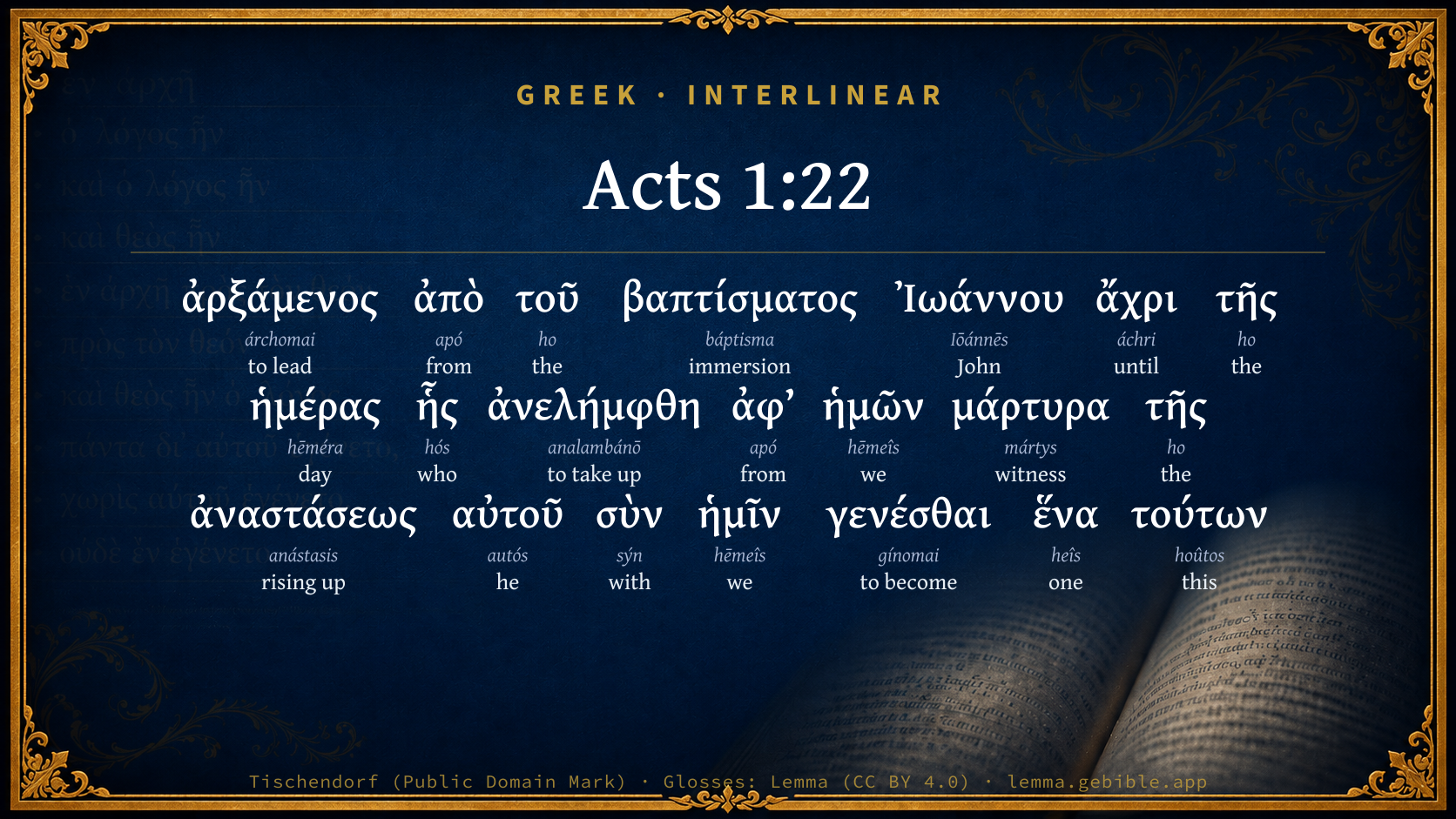
Greek (Tischendorf 8th ed.) Acts 1:22 appears in the Greek New Testament. The text above is from the Tischendorf 8th edition. Each word links to its Strong’s number and a concise gloss. Click any word for its full Thayer’s Greek Lexicon entry.
Download image
Cite this verse

Acts 1:22 (World English Bible). Public Domain. Lemma interlinear Bible study tool, https://lemma.gebible.app/v/acts/1/22.

Show BibTeX & RIS
BibTeX
RIS
English Translation
beginning from the baptism of John, to the day that he was received up from us, of these one must become a witness with us of his resurrection."
World English Bible · Public Domain
Download a study sheet

One document with this verse’s original text, its word-by-word gloss line, the meaning frame, cross-references with their text, attributed commentary, and full source and license credits — printable, and it pastes into notes with its structure intact.

This verse Autodidact and up

Study sheet (.html) Plain text (.txt)

A passage Seminary Student

Up to 50 verses in one chapter. A passage sheet keeps up to 6 commentary sources and 12 cross-references per verse, in the order this page ranks them, and says so on the sheet whenever that leaves anything out. Ask for a single verse and you get the Autodidact verse sheet above.

Everything on this page stays free to read, with no account — the sheet is a download of what is already on screen, not access to it.

Want to remove ads? Support Godless Engineer
Compare translations 3

The same verse in 3 English versions, stacked beneath the original-language interlinear above. Click any original word for its lexicon entry.

Each is an independent rendering of the whole verse — the interlinear is not word-aligned to these translations.

Highlighted words mark where these versions differ — a whole-verse word diff, not a word-by-word alignment.

  • World English Bible Public Domain
    beginning from the baptism of John, to the day that he was received up from us, of these one must become a witness with us of his resurrection."
  • King James Version Public Domain
    Beginning from the baptism of John, unto that same day that he was taken up from us, must one be ordained to be a witness with us of his resurrection.
  • unfoldingWord Literal Text CC BY-SA 4.0
    beginning from the baptism of John until the day on which he was taken up from us—one of these to become a witness with us of his resurrection.”

unfoldingWord Literal Text — © unfoldingWord, licensed CC BY-SA 4.0. Word-aligned USFM3 via Door43 (git.door43.org/unfoldingWord/en_ult).

Versions to compare (up to 4)

3 of 4 selected

Show all 19 translations

Every available English version of this verse, each an independent rendering of the whole verse.

  • World English Bible Public Domain
    beginning from the baptism of John, to the day that he was received up from us, of these one must become a witness with us of his resurrection."
  • Berean Standard Bible Public Domain
    beginning from John’s baptism until the day Jesus was taken up from us. For one of these must become a witness with us of His resurrection.”
  • Majority Standard Bible Public Domain
    beginning from John’s baptism until the day Jesus was taken up from us. For one of these must become a witness with us of His resurrection.”
  • King James Version Public Domain
    Beginning from the baptism of John, unto that same day that he was taken up from us, must one be ordained to be a witness with us of his resurrection.
  • American Standard Version (1901) Public Domain
    beginning from the baptism of John, unto the day that he was received up from us, of these must one become a witness with us of his resurrection.
  • Revised Version (1885) Public Domain
    beginning from the baptism of John, unto the day that he was received up from us, of these must one become a witness with us of his resurrection.
  • Geneva Bible (1599) Public Domain
    Beginning from the baptisme of Iohn vnto the day that hee was taken vp from vs, must one of them bee made a witnesse with vs of his resurrection.
  • Douay-Rheims (1899) Public Domain
    Beginning from the baptism of John, until the day wherein he was taken up from us, one of these must be made a witness with us of his resurrection.
  • Young's Literal Translation Public Domain
    beginning from the baptism of John, unto the day in which he was received up from us, one of these to become with us a witness of his rising again.'
  • Literal Standard Version CC BY-SA 4.0
    beginning from the immersion of John, to the day in which He was received up from us, one of these to become with us a witness of His resurrection.”
  • Unlocked Literal Bible CC BY-SA 4.0
    beginning from the baptism of John to the day that he was taken up from us, must be a witness with us of his resurrection.”
  • unfoldingWord Literal Text CC BY-SA 4.0
    beginning from the baptism of John until the day on which he was taken up from us—one of these to become a witness with us of his resurrection.”
  • Darby Bible Public Domain
    beginning from the baptism of John until the day in which he was taken up from us, one of these should be a witness with us of his resurrection.
  • World Messianic Bible Public Domain
    beginning from the immersion of Yochanan to the day that he was received up from us, of these one must become a witness with us of his resurrection.”
  • Webster's Bible Public Domain
    Beginning from the baptism of John, to that same day that he was taken up from us, must one be ordained to be a witness with us of his resurrection.
  • Free Bible Version CC BY-SA 4.0
    from the time John was baptizing up until the day Jesus was taken up to heaven from us. One of these must be chosen to join together with us as we witness, giving evidence of Jesus' resurrection.”
  • Bible in Basic English Public Domain
    Starting from the baptism of John till he went up from us, one will have to be a witness with us of his coming back from death.
  • Text-Critical English NT CC BY 4.0
    beginning from the baptism of John up to the day when Jesus was taken up from us, must become a witness with us of his resurrection.”
  • Tyndale New Testament (1534) Public Domain
    begynninge at the baptyme of Iohn vnto that same daye that he was taken vp from vs must one be ordeyned to be are witnes with vs of his resurreccion.

Literal Standard Version (2020), Covenant Press — licensed CC BY-SA 4.0. Text via the HelloAO Bible API (eBible.org). Unlocked Literal Bible (unfoldingWord) — licensed CC BY-SA 4.0. Text via the HelloAO Bible API (eBible.org). unfoldingWord Literal Text — © unfoldingWord, licensed CC BY-SA 4.0. Word-aligned USFM3 via Door43 (git.door43.org/unfoldingWord/en_ult). Free Bible Version, Dr. Jonathan Gallagher — licensed CC BY-SA 4.0. Text via the HelloAO Bible API (eBible.org).

Word by word

More ways to search: Search by grammar → Find every occurrence → Compare this word →

Practice this passage: Drill this verse → Learn its vocabulary →

ἀνελήμφθη
analambánō
G353
“to take up”
Verb, Aorist, Passive, Indicative, 3rd person, Singular
Part of Speech
Verb
Tense
Aorist
Voice
Passive
Mood
Indicative
Person
3rd person
Number
Singular
Full Thayer's Definition

Origin: from G303 and G2983

TDNT: 04:07,5

1. to take up, raise 2. to take up (a thing in order to carry or use it)
  1. ἀρξάμενος árchomai G756 “to lead” Verb, Aorist, Middle, Participle, Nominative, Singular, Masculine
  2. ἀπὸ apó G575 “from” Preposition
  3. τοῦ ho G3588 “the” Article, Genitive, Singular, Neuter
  4. βαπτίσματος báptisma G908 “immersion” Noun, Genitive, Singular, Neuter
  5. Ἰωάννου Iōánnēs G2491 “John” Noun, Genitive, Singular, Masculine
  6. ἄχρι áchri G891 “until” Adverb
  7. τῆς ho G3588 “the” Article, Genitive, Singular, Feminine
  8. ἡμέρας hēméra G2250 “day” Noun, Genitive, Singular, Feminine
  9. ἧς hós G3739 “who” Relative pronoun, Genitive, Singular, Feminine
  10. ἀφ’ apó G575 “from” Preposition
  11. ἡμῶν hēmeîs G2249 “we” Personal pronoun, 1st person, Genitive, Plural
  12. μάρτυρα mártys G3144 “witness” Noun, Accusative, Singular, Masculine
  13. τῆς ho G3588 “the” Article, Genitive, Singular, Feminine
  14. ἀναστάσεως anástasis G386 “rising up” Noun, Genitive, Singular, Feminine
  15. αὐτοῦ autós G846 “he” Personal pronoun, Genitive, Singular, Masculine
  16. σὺν sýn G4862 “with” Preposition
  17. ἡμῖν hēmeîs G2249 “we” Personal pronoun, 1st person, Dative, Plural
  18. γενέσθαι gínomai G1096 “to become” Verb, Aorist, Middle deponent, Infinitive
  19. ἕνα heîs G1520 “one” Adjective, Accusative, Singular, Masculine
  20. τούτων hoûtos G3778 “this” Demonstrative pronoun, Genitive, Plural, Masculine

About this verse

These counts appear in no published source. They are computed here, from the morphology-tagged text and Lemma’s own curated glosses. What Lemma adds →

21
words
17
distinct lemmas
Acts
section

Notable vocabulary

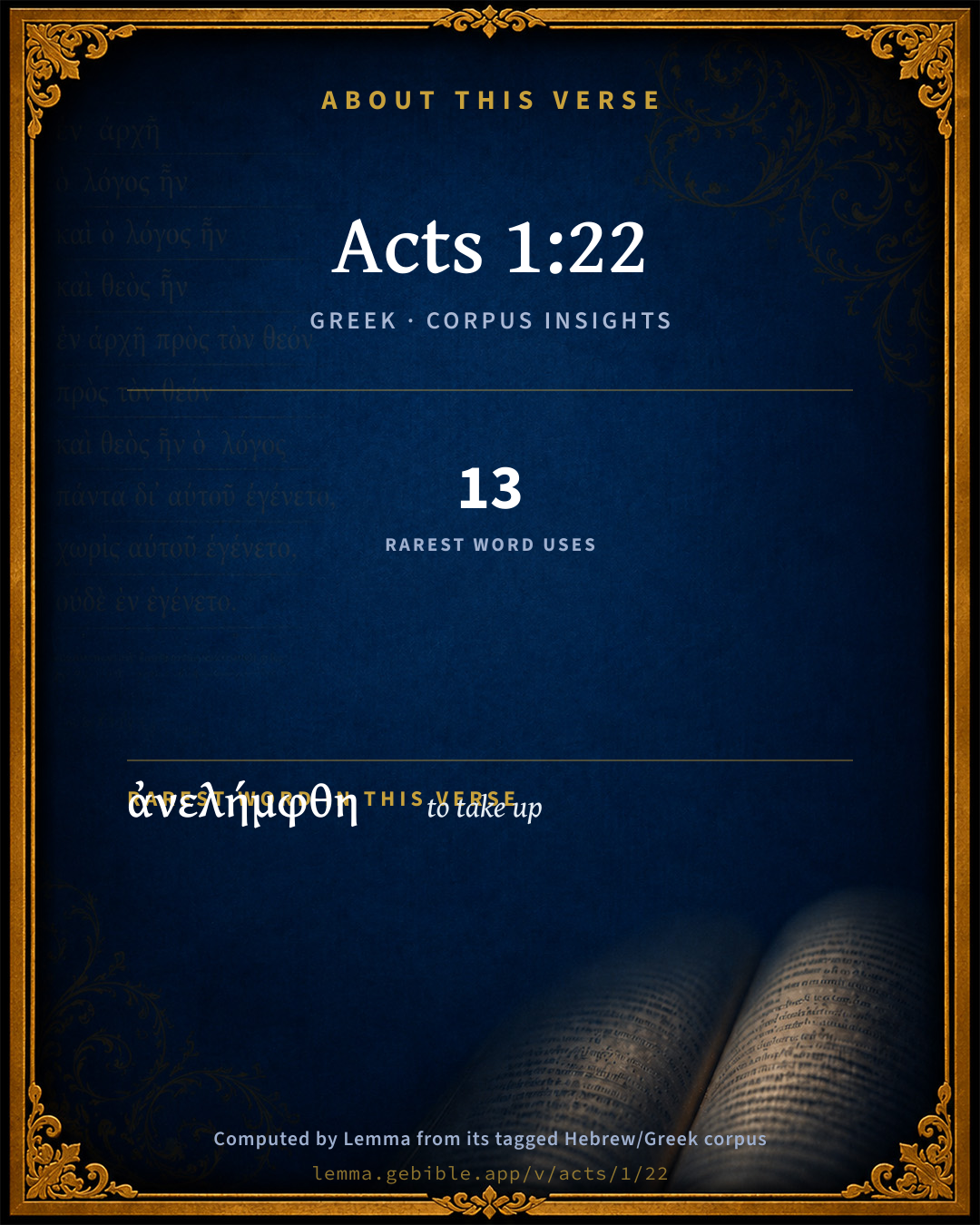
The rarest word here is ἀνελήμφθη to take up G353 — appearing just 13 times in the whole Greek New Testament.

Shared distinctive vocabulary

ἀνελήμφθη to take up G353 occurs in 13 verses of the Greek New Testament. Also found in:

Repetition

Words recur within this verse:

  • τοῦ the G3588 ×3
  • ἀπὸ from G575 ×2
  • ἡμῶν we G2249 ×2

Cross-references

10

Topical passages linked to Acts 1:22 in the Treasury of Scripture Knowledge — connected by theme and wording, ordered by reader-vote popularity; previews shown in the World English Bible.

  • Acts 1:2 until the day in which he was received up, after he had given commandment through the Holy Spirit to the apostles whom he had chosen.
  • Mark 1:1–8 The beginning of the Gospel of Jesus Christ, the Son of God.
  • Acts 1:8–9 But you will receive power when the Holy Spirit has come upon you. You will be witnesses to me in Jerusalem, in all Judea and Samaria, and to the uttermost parts of the earth."
  • Acts 4:33 With great power, the apostles gave their testimony of the resurrection of the Lord Jesus. Great grace was on them all.
  • Matthew 3:1–17 In those days, John the Baptizer came, preaching in the wilderness of Judea, saying,
  • Luke 3:1–18 Now in the fifteenth year of the reign of Tiberius Caesar, Pontius Pilate being governor of Judea, and Herod being tetrarch of Galilee, and his brother Philip tetrarch of the region of Ituraea and Trachonitis, and Lysanias tetrarch of Abilene,
  • John 1:28–51 These things were done in Bethany beyond the Jordan, where John was baptizing.
  • John 15:27 You will also testify, because you have been with me from the beginning.
  • Acts 13:24–25 before his coming, when John had first preached the baptism of repentance to Israel.
  • Hebrews 2:3 how will we escape if we neglect so great a salvation-- which at the first having been spoken through the Lord, was confirmed to us by those who heard;

Cross-references courtesy of OpenBible.info (CC BY 4.0).

Commentary

Notes on Acts 1:22 from classic Christian and Jewish commentators (each source and its license shown beneath its notes). The classic Christian expositions comment on the surrounding passage and are grouped to its opening verse, so a note may address several verses; the Jewish commentaries on the Tanakh (Rashi and others) are per-verse, so they appear only where the commentator wrote on this verse.

Lemma curates 59 commentaries, every one of them public domain or Creative Commons licensed, each selected and text-cleaned for this edition rather than reprinted as found. About our sources →

Bengel's Gnomon

Johann Albrecht Bengel

Act 1:22. Ἀπὸ τοῦ βαπτίσματος Ἰωάννου, from the baptism of John) It is with this point that the history of Jesus Christ in Mark has its actual Beginning. The other evangelists briefly explain the preceding events.—ἓως, up to) The testimony of the Twelve Apostles concerning the Lord Jesus and His resurrection, extend up to the day of His Ascension.—τῆς ἀναστάσεως αὐτοῦ, of His resurrection) He who believes in the resurrection of Christ, believes in all which went before and which followed. As to the resurrection of Christ, there is frequent mention of it in the Sermons and in the first Epistle of Peter. As an apostle is a witness of the resurrection of Christ, so he is a Christian who believes in it. At that time there was just as much need of grace (Divine power), to enable one to believe that the act had been accomplished, as there was to believe that there is salvation in that act so accomplished. Accordingly, they who believed in the former received the whole faith. In our days, whilst no one in the Church calls in question the accomplishment of the act, many stop short at that point, and, notwithstanding their belief in the certainty of the fact, do not thereby attain to the whole faith.—ἓνα, one) For there ought not to be more than Twelve, and therefore both were not to be taken into the apostleship together.

Bengel's Gnomon of the New Testament — English translation (T&T Clark, Edinburgh, 1860) — public domain. Text from a community e-Sword module.

Expositor's Greek Testament

ed. W. Robertson Nicoll

Act 1:22 . ἀρξάμενος , cf. note on Act 1:1 . The word need not be restricted to our Lord’s own baptism, but would include the time of the baptism preached by John, as his baptism and preaching were the announcement of, and a preparation for, the Christ. If St. Mark’s Gospel, as there is every reason to believe, was closely connected with St. Peter, its opening verses give us a similar date for the commencement of the Apostolic testimony; cf. Schmid, Biblische Theologie des N. T. , p. 436. ἕως τῆς ἡμέρας ἧς : according to Wendt and Weiss, the relative is not attracted for ᾗ , but is to be regarded as a genitive of time, but cf. Lev 23:15 , Hag 2:18 , Bar 1:15 ; Winer-Schmiedel, p. 226; Blass, ubi supra , p. 170. μάρτυρα τῆς ἀναστάσεως . It has been noted as remarkable that St. Peter here lays down experience of matters of fact, not eminence in any subjective grace or quality, as one of the conditions of Apostleship, but it is evident that from the first the testimony of the Apostles was not merely to the facts, but to their spiritual bearing, cf. chap. Act 5:32 : “On the one side there is the historical witness to the facts, on the other, the internal testimony of personal experience” (Westcott’s St. John , Joh 15:27 ), and the appeal to Him “Who knew the hearts,” showed that something more was needed than intellectual competency. Spitta and Jüngst (so Weiss) regard the whole clause ἐν παντὶ χρόνῳ … ἀφʼ ἡμῶν as introduced by a reviser, but on the other hand Hilgenfeld considers the words to be in their right place. He also rebukes Weiss for maintaining that the whole passage, Act 1:15-26 , could not have been composed by the author of the book, who gives no intimation of the number of the Apostles, with whom the Twelve as such play no part, and who finds his hero outside their number. But Hilgenfeld points out that the Twelve have for his “author to Theophilus” a very important place; cf. Act 2:14 ; Act 2:22 , Act 4:33 , Act 5:12 ; Act 5:40 , Act 8:1 ; Act 8:14 , Act 9:27 .

The Expositor's Greek Testament, edited by W. Robertson Nicoll (1897–1910) — public domain. Text from a community e-Sword module.

Geneva Bible (1599)

Geneva Bible translators

From our company.

Geneva Bible (1599) marginal notes — public domain. Text via Bolls.life.

Jamieson, Fausset & Brown

Robert Jamieson, A. R. Fausset & David Brown

Beginning from the baptism of John--by whom our Lord was not only Himself baptized, but first officially announced and introduced to his own disciples.

unto that same day when he was taken up from us, must one be ordained to be a witness with us of his resurrection--How clearly is the primary office of the apostles here expressed: (1) to testify, from personal observation, to the one great fact of "the resurrection of the Lord Jesus"; (2) to show how this glorified His whole previous life, of which they were constant observers, and established His divine claims.

Jamieson, Fausset & Brown — Commentary Critical and Explanatory on the Whole Bible (1871) — public domain (CC PDM 1.0). Text via the HelloAO Bible API.

Adam Clarke's Commentary

Verse 22. Beginning from the baptism of John] From the time that Christ was baptized by John in Jordan; for it was at that time that his public ministry properly began.

Must one be ordained] This translation misleads every reader who cannot examine the original text. There is no term for ordained in the Greek: γενεσθαι, to be, is the only word in the verse to which this interpretation can be applied. The New Testament printed at London, by Robert Barker, the king's printer, in 1615, renders this and the preceding verse more faithfully and more clearly than our common version: Wherefore of these men who have companied with us, all the time that the Lord Jesus was conversant among us, beginning from the baptism of John, unto the day he was taken up from us, must one of them BE MADE a witness with us of his resurrection. The word ordained would naturally lead most readers to suppose that some ecclesiastical rite was used on the occasion, such as imposition of hands, &c., although nothing of the kind appears to have been employed.

Adam Clarke's Commentary on the Bible (1810–1826) — public domain. Text from a community e-Sword/MySword module.

The Cambridge Bible for Schools and Colleges

gen. ed. J. J. S. Perowne

22. to be a witness with us of his resurrection] The Resurrection was the central truth, but to bear testimony that it was truly Jesus who had risen, the witness must have known Him well before His crucifixion.

It is quite in accordance with the character of St Luke’s narrative that although he is careful to relate how the number of the Apostles was made complete, and the Church thus furnished with that same number of leaders which Jesus had chosen from the first, yet when Matthias has been chosen, he tells us no word about his special actions. These were no doubt of the same character as those of the eleven, but the writer’s purpose is only to give typical instances of the Apostolic labours, and to shew how the Gospel was spread abroad exactly as Christ had foretold.

The Cambridge Bible for Schools and Colleges (gen. ed. J. J. S. Perowne; Cambridge University Press, 1878–1918) — public domain. Text from a community e-Sword module.

John Gill's Exposition

Beginning from the baptism of John,.... Not from the time trial John first administered the ordinance of baptism; for Christ was not so soon made known, or had followers; but from the time of the administration of it by John, to Christ, when he was made known to Israel; and quickly upon this, he called his disciples, and entered on his public ministry: now Peter moves, that one who had been so early a follower of Christ, who had heard his excellent discourses, and seen his miracles, and who had steadfastly and constantly adhered to him, might be chosen in the room of Judas; one whose faith in Christ, love to him, and firmness of mind to abide by him, had been sufficiently tried and proved; who had continued with Christ and his apostles, from the beginning of his ministry, to that time: or as Peter adds,

unto the same day that he was taken up from us; by angels, and received by a cloud, and carried up to heaven; or "he ascended from us", as the Ethiopic version renders it; or "lifted up himself from us", as the Arabic version; for as he raised himself from the dead by his own power, by the same he could raise himself up from earth to heaven; the sense is, to the time of his ascension to heaven, whether by himself, or by the ministry of angels:

must one be ordained; there was a necessity of this, partly on the account of the above prophecy, and partly to keep up the number of the twelve apostles, Christ had thought fit to pitch upon; answering to the twelve tribes of Israel, and to the twelve gates, and twelve foundations of the new Jerusalem: and this choice or ordination was moved to be made, and was made, not by the other eleven apostles, but by the whole company of an hundred and twenty; for these are the persons addressed by the apostle, and to whom he said, as the Arabic version renders it, "one of these men ye must choose": and if the choice and ordination of such an extraordinary officer was made by the whole community, then much more ought the choice and ordination of inferior officers be by them: the end of this choice was,

to be a witness with us of his resurrection; the resurrection of Christ from the dead, which supposes his incarnation and life, and so his obedience, ministry, and miracles in it; and also his sufferings and death, with all the benefits and advantages thereof; and is particularly mentioned, because it not only supposes and includes the above things, but is the principal article, basis, and foundation of the Christian religion; and the sign which Christ gave to the Jews, of the truth of his being the Messiah; and was what the disciples were chosen to be witnesses of; and a principal part of their ministry was to testify it to men: and since this was their work and business, it was necessary that one should be chosen, and joined with them, who had been with them, and with Jesus, from the beginning, to the time of his ascension; and who was an eyewitness of his resurrection, that he might join with the apostles in their testimony.

John Gill's Exposition of the Whole Bible (1746–1763) — public domain (CC PDM 1.0). Text via the HelloAO Bible API.

Trapp's Complete Commentary

John Trapp

22 Beginning from the baptism of John, unto that same day that he was taken up from us, must one be ordained to be a witness with us of his resurrection.

Ver. 22. Must one be ordained] To answer the ancient types.

John Trapp, A Commentary or Exposition upon All the Books of the Old and New Testament (1647–1656) — public domain. Text from a community e-Sword module.

Albert Barnes' Notes on the Bible

Beginning from the baptism of John - The words “beginning from” in the original refer to the Lord Jesus. The meaning may be thus expressed, “during all the time in which the Lord Jesus, beginning (his ministry) at the time when he was baptized by John, went in and out among us, until the time when he was taken up,” etc. From those who had during that time been the constant companions of the Lord Jesus must one be taken, who would thus be a witness of his whole ministry.

Must one be ordained - It is fit or proper that one should be ordained. The reason of this was, that Jesus had originally chosen the number twelve for this work, and as one of them had fallen, it was proper that the vacancy should be filled by some person equally qualified for the office. The reason why it was proper that he should be taken from the seventy disciples was, that they had been particularly distinguished by Jesus himself, and had been witnesses of most of his public life, Luke 10:1-16. The word “ordained” with us has a fixed and definite signification. It means to set apart to a sacred office with proper forms and solemnities, commonly by the imposition of hands. But this is not, of necessity, the meaning of this passage. The Greek word usually denoting “ordination” is not used here. The expression is literally, “must one be, or become, γενέσθαι genesthai, a witness with us of his resurrection.” The expression does not imply that he must be set apart in any particular manner, but simply that one should be designated or appointed for this specific purpose, to be a witness of the resurrection of Christ.

Albert Barnes' Notes on the Bible (1834–1885) — public domain. Text from a community e-Sword/MySword module.

Matthew Poole's English Annotations

Beginning from the baptism of John; when Christ was baptized by him, and by that consecration began the ministry, and publishing of the gospel (which the history of his immaculate conception did preface to).

A witness with us of his resurrection; all other things being consummated in that, it being the most difficult to be believed; and therefore God was pleased to attest it by so many eye witnesses.

Matthew Poole's English Annotations on the Holy Bible (1683–1685) — public domain. Text from a community e-Sword/MySword module.

Whedon's Commentary on the Bible

Daniel D. Whedon

22. Witness—See note on Luk_1:2. And this description of the proper requisites for an apostle implies, externally, complete knowledge of facts and truths; and, internally, a firmness and faithfulness of adherence to Christ.

Daniel D. Whedon (gen. ed.), Commentary on the Old and New Testaments (1874–1909) — public domain. Text from a community e-Sword module.

The Pulpit Commentary

The day for that same day, A.V.; received for taken, A.V.; of these must one become for must one be ordained to be, A.V. Beginning belongs to the Lord Jesus. He began to go in and out among his apostles from the time that John baptized, and continued to do so till his ascension, the day that he was received up ("taken up" A.V.), as in ver. 11. This definition of the time of our Lord"s public ministry exactly agrees with Mat_4:12-25 Mr 1 Lu 3 Lu 4; Joh_1:29-51. Must one become a witness, etc. The resurrection of Christ from the dead thus appears to be a cardinal doctrine of the gospel. The whole truth of Christ"s mission, the acceptance of his sacrifice, the consequent forgiveness of sins, and all man"s hopes of eternal life, turn upon it. All the sermons of the apostles recorded in the Acts and the Epistles also agree with this (see Ac 2 Ac 3 Ac 4 Act_5:31, 32 10:39-41 13:30, etc.; Rom_1:4; 1Co_15:4; 2Co_1:9, etc.; 1Pe_1:3 1Pe_3:21, 1Pe_3:22; Rev_1:5, etc) The great care taken to secure competent witnesses is very remarkable. A disciple who had recently joined the company might be mistaken; one who had been the daily companion of Jesus Christ for three years and a half, and knew every gesture and every feature of the Master with perfect certainty, could not be mistaken.

The Pulpit Commentary (1880–1919), ed. H.D.M. Spence-Jones & Joseph S. Exell — public domain. Text from a community e-Sword module.

John Wesley's Explanatory Notes

To be a witness with us of his resurrection - And of the circumstances which preceded and followed it.

John Wesley, Explanatory Notes Upon the Whole Bible (1754–1765) — public domain. Text via the GEBible commentary corpus.

McGarvey & Pendleton's Commentaries

J. W. McGarvey

See notes on verse 21

J. W. McGarvey (with Philip Y. Pendleton), Commentaries on the New Testament (The Fourfold Gospel, 1914; Acts; and the epistles) — public domain. Text from a community e-Sword/MySword module.

Cambridge Greek Testament for Schools and Colleges

22. ἀρξάμενος. For it could not be long after His baptism that Jesus began to gather followers around Him, and some of these had been beforetime disciples of John, had perhaps been witnesses of the baptism of Jesus, and certainly had heard the frequent testimony borne to Him by the Baptist.

ἧς. This is perhaps not to be regarded as. an attraction of the relative like that in Act 1:1, for the genitive of the time when is common in Greek, and this may be taken as an example of it. Cf. LXX. Lev 23:15, ἀπὸ τῆς ἡμέρας ἧς ἂν προσενέγκητε τὸ δράγμα. So too Deu 4:32; Bar 1:19. The form ἀπὸ τῆς ἡμέρας ᾖ κ.τ.λ. occurs Num 15:21; Jos 9:12, &c.

τῆς ἀναστάσεως. This, as the central point of the Christian faith, must be attested, and they would be the most cogent witnesses thereto who had known most of Jesus before His crucifixion. Cf. the language of Chrysostom on this as the chief subject of the Acts: καὶ γὰρ τοῦτο μάλιστά ἐστι τὸ βιβλίον, ἀπόδειξις ἀναστάσεως.

τούτων. Resuming the construction of the συνελθόντων at the beginning of the verse.

Cambridge Greek Testament for Schools and Colleges (Cambridge University Press, 1896; 21 vols, various authors incl. Carr, Maclear, Plummer, Farrar, Lumby, Moule, M. R. James, Simcox) — public domain. Text from a community e-Sword module.

Alford’s Greek Testament

Henry Alford

22. βαπτ. Ἰωάν.] Not ‘His being baptized by John’ (as Wolf, Kuin., &c.); but the baptism of John, as a well-known date, including of course the opening event of our Lord’s ministry, His own baptism. That John continued to baptize for some time after that, can be no possible objection to the assignment of ‘John’s baptism’ generally, as the date of the commencement of the apostolic testimony (against De Wette). We may notice, that from this point the testimony of the Evangelists themselves in their Gospels properly begins, Mat 3:1, Mar 1:1, Luk 3:1, Joh 1:6.

μάρτ. τῆς ἀναστ.] This one event was the passage-point between the Lord’s life of humiliation and His life of glory,—the completion of His work below and beginning of His work above. And to ‘give witness with power’ of the Resurrection (ch. 4:33), would be to discourse of it as being all this; in order to which, the whole ministry of Jesus must be within the cycle of the Apostle’s experience.

It is remarkable that Peter here lays down experience of matters of fact, not eminence in any subjective grace or quality, as the condition of Apostleship. Still, the testimony was not to be mere ordinary allegation of matters of fact: any who had seen the Lord since His resurrection were equal to this;—but belonged to a distinct office (see Joh 14:26: also ch. 5:31, note), requiring the especial selection and grace of God.

Henry Alford, The Greek Testament (1849–1861) — public domain. Text from a community e-Sword module.

Vincent's Word Studies in the New Testament

Marvin R. Vincent

Witness [μαρτυρα] . One who shall bear testimony : not a spectator, a mistake often made on Heb 12:1. Compare Act 2:32.

Marvin R. Vincent, Word Studies in the New Testament (1887–1900) — public domain. Text from a community e-Sword/MySword module.

Lesson kit

Teaching starters — assembled from the data on this page, not authored interpretation. Every prompt links to the verse data it draws on. Edit before teaching.

Acts, in the Acts, opens this verse with 21 words (17 distinct Greek lemmas). Its most distinctive word is analambánō (“to take up”). A historical commentator’s framing appears above. Read the whole chapter for the surrounding context.

Discussion questions

  1. What does “to take up” (analambánō) contribute to the verse as a whole?
  2. Mark 16:19 shares the word «to take up» with this verse. How do the two illuminate each other?
  3. “the” occurs 3× in this one verse. What is the effect of the repetition?
  4. These translations render this verse differently. What is at stake in choosing one wording over another?
  5. Reading how Bengel's Gnomon and Expositor's Greek Testament read this verse, where do the two commentators agree and where do they part?

Things to notice

Reading settings

Reading text

Shown beneath each verse's original-language words.

Old Testament
Old Testament edition

Read the OT as the Masoretic Hebrew (MT) or the Greek Septuagint (LXX).

English shown for the Greek Septuagint (in the Hebrew ↔ Greek comparison).

Comparing translations? Open the Compare panel on any verse page to stack up to four side by side.