Colossians 2:17

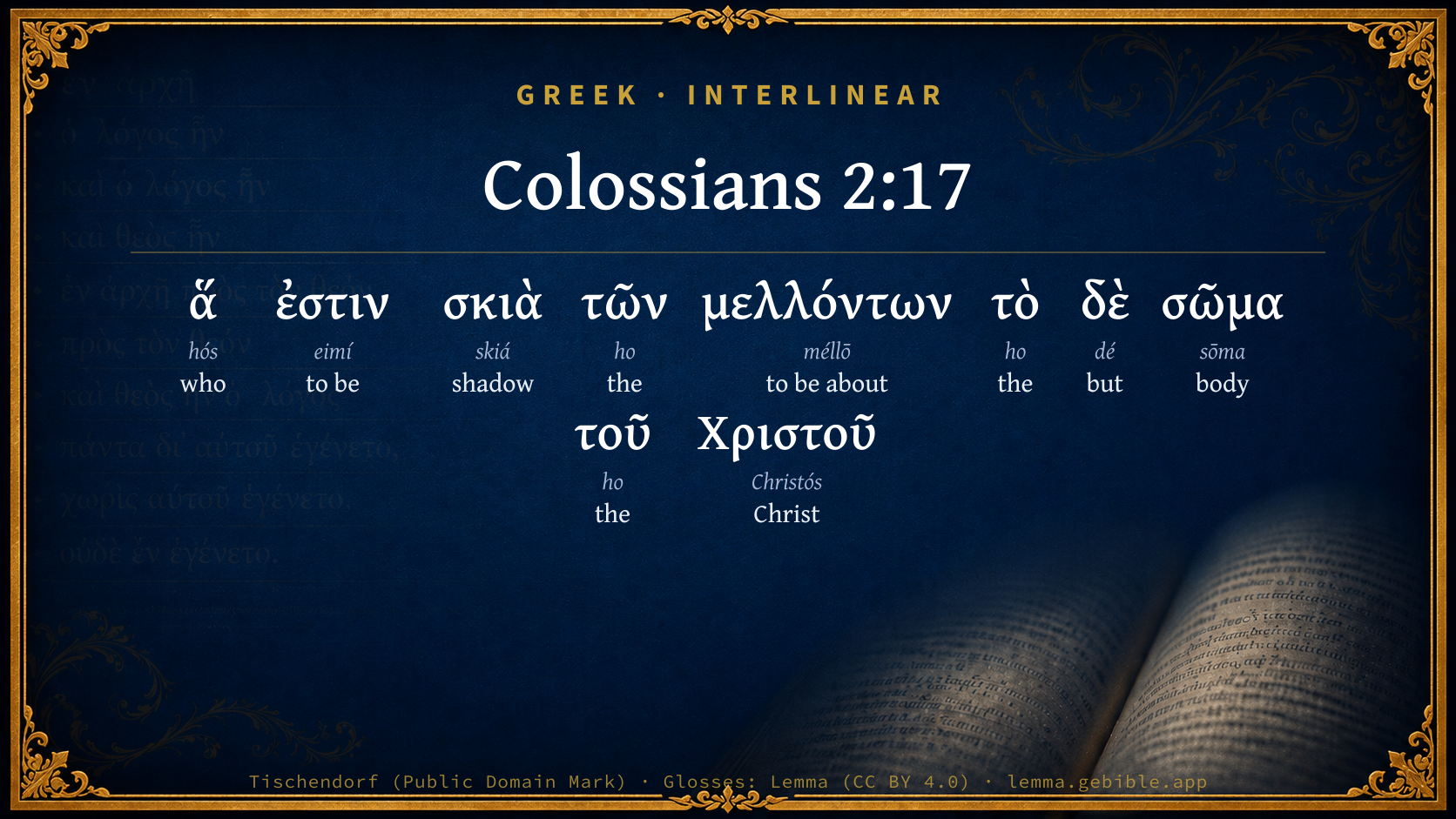
Greek (Tischendorf 8th ed.) Colossians 2:17 appears in the Greek New Testament. The text above is from the Tischendorf 8th edition. Each word links to its Strong’s number and a concise gloss. Click any word for its full Thayer’s Greek Lexicon entry.
Download image
Cite this verse

Colossians 2:17 (World English Bible). Public Domain. Lemma interlinear Bible study tool, https://lemma.gebible.app/v/colossians/2/17.

Show BibTeX & RIS
BibTeX
RIS
English Translation
which are a shadow of the things to come; but the body is Christ's.
World English Bible · Public Domain
Download a study sheet

One document with this verse’s original text, its word-by-word gloss line, the meaning frame, cross-references with their text, attributed commentary, and full source and license credits — printable, and it pastes into notes with its structure intact.

This verse Autodidact and up

Study sheet (.html) Plain text (.txt)

A passage Seminary Student

Up to 50 verses in one chapter. A passage sheet keeps up to 6 commentary sources and 12 cross-references per verse, in the order this page ranks them, and says so on the sheet whenever that leaves anything out. Ask for a single verse and you get the Autodidact verse sheet above.

Everything on this page stays free to read, with no account — the sheet is a download of what is already on screen, not access to it.

Want to remove ads? Support Godless Engineer
Compare translations 3

The same verse in 3 English versions, stacked beneath the original-language interlinear above. Click any original word for its lexicon entry.

Each is an independent rendering of the whole verse — the interlinear is not word-aligned to these translations.

Highlighted words mark where these versions differ — a whole-verse word diff, not a word-by-word alignment.

  • World English Bible Public Domain
    which are a shadow of the things to come; but the body is Christ's.
  • King James Version Public Domain
    Which are a shadow of things to come; but the body is of Christ.
  • unfoldingWord Literal Text CC BY-SA 4.0
    which are a shadow of the things coming, but the body of Christ.

unfoldingWord Literal Text — © unfoldingWord, licensed CC BY-SA 4.0. Word-aligned USFM3 via Door43 (git.door43.org/unfoldingWord/en_ult).

Versions to compare (up to 4)

3 of 4 selected

Show all 19 translations

Every available English version of this verse, each an independent rendering of the whole verse.

  • World English Bible Public Domain
    which are a shadow of the things to come; but the body is Christ's.
  • Berean Standard Bible Public Domain
    These are a shadow of the things to come, but the body that casts it belongs to Christ.
  • Majority Standard Bible Public Domain
    These are a shadow of the things to come, but the body that casts it belongs to Christ.
  • King James Version Public Domain
    Which are a shadow of things to come; but the body is of Christ.
  • American Standard Version (1901) Public Domain
    which are a shadow of the things to come; but the body is Christ's.
  • Revised Version (1885) Public Domain
    which are a shadow of the things to come; but the body is Christ’s.
  • Geneva Bible (1599) Public Domain
    Which are but a shadowe of thinges to come: but the body is in Christ.
  • Douay-Rheims (1899) Public Domain
    Which are a shadow of things to come, but the body is of Christ.
  • Young's Literal Translation Public Domain
    which are a shadow of the coming things, and the body `is' of the Christ;
  • Literal Standard Version CC BY-SA 4.0
    which are a shadow of the coming things, but the body [is] of the Christ;
  • Unlocked Literal Bible CC BY-SA 4.0
    These are a shadow of the things to come, but the substance is Christ.
  • unfoldingWord Literal Text CC BY-SA 4.0
    which are a shadow of the things coming, but the body of Christ.
  • Darby Bible Public Domain
    which are a shadow of things to come; but the body [is] of Christ.
  • World Messianic Bible Public Domain
    which are a shadow of the things to come; but the body is Messiah’s.
  • Webster's Bible Public Domain
    Which are a shadow of things to come; but the body is of Christ.
  • Free Bible Version CC BY-SA 4.0
    These are just a shadow of what was to come, for the physical reality is Christ.
  • Bible in Basic English Public Domain
    For these are an image of the things which are to come; but the body is Christ's.
  • Text-Critical English NT CC BY 4.0
    These are a shadow of the things to come, but the substance is Christ.
  • Tyndale New Testament (1534) Public Domain
    which are nothinge but shaddowes of thynges to come: but the body is in Christ.

Literal Standard Version (2020), Covenant Press — licensed CC BY-SA 4.0. Text via the HelloAO Bible API (eBible.org). Unlocked Literal Bible (unfoldingWord) — licensed CC BY-SA 4.0. Text via the HelloAO Bible API (eBible.org). unfoldingWord Literal Text — © unfoldingWord, licensed CC BY-SA 4.0. Word-aligned USFM3 via Door43 (git.door43.org/unfoldingWord/en_ult). Free Bible Version, Dr. Jonathan Gallagher — licensed CC BY-SA 4.0. Text via the HelloAO Bible API (eBible.org).

Word by word

More ways to search: Search by grammar → Find every occurrence → Compare this word →

Practice this passage: Drill this verse → Learn its vocabulary →

About this verse

These counts appear in no published source. They are computed here, from the morphology-tagged text and Lemma’s own curated glosses. What Lemma adds →

10
words
8
distinct lemmas
Pauline Epistles
section

Notable vocabulary

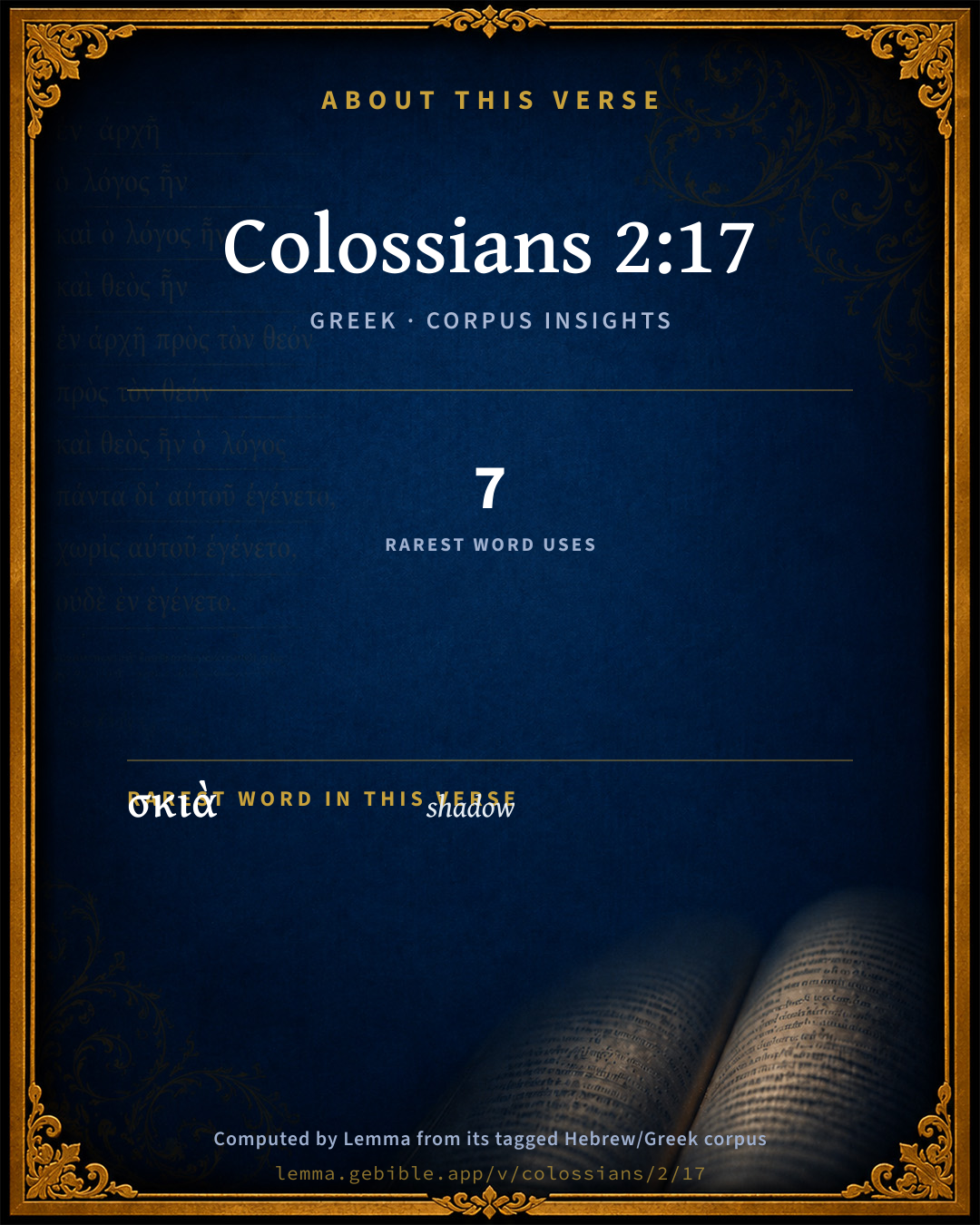
The rarest word here is σκιὰ shadow G4639 — appearing just 7 times in the whole Greek New Testament.

Shared distinctive vocabulary

σκιὰ shadow G4639 occurs in 7 verses of the Greek New Testament. Also found in:

Repetition

A word recurs within this verse:

Cross-references

6

Topical passages linked to Colossians 2:17 in the Treasury of Scripture Knowledge — connected by theme and wording, ordered by reader-vote popularity; previews shown in the World English Bible.

  • Hebrews 10:1 For the law, having a shadow of the good to come, not the very image of the things, can never with the same sacrifices year by year, which they offer continually, make perfect those who draw near.
  • Hebrews 8:5 who serve a copy and shadow of the heavenly things, even as Moses was warned by God when he was about to make the tabernacle, for he said, "See, you shall make everything according to the pattern that was shown to you on the mountain."
  • John 1:17 For the law was given through Moses. Grace and truth came through Jesus Christ.
  • Hebrews 9:9 which is a symbol of the present age, where gifts and sacrifices are offered that are incapable, concerning the conscience, of making the worshipper perfect;
  • Hebrews 4:1–11 Let us fear therefore, lest perhaps a promise being left of entering into his rest, anyone of you should seem to have come short of it.
  • Matthew 11:28–29 "Come to me, all you who labor and are heavily burdened, and I will give you rest.

Cross-references courtesy of OpenBible.info (CC BY 4.0).

Commentary

Notes on Colossians 2:17 from classic Christian and Jewish commentators (each source and its license shown beneath its notes). The classic Christian expositions comment on the surrounding passage and are grouped to its opening verse, so a note may address several verses; the Jewish commentaries on the Tanakh (Rashi and others) are per-verse, so they appear only where the commentator wrote on this verse.

Lemma curates 59 commentaries, every one of them public domain or Creative Commons licensed, each selected and text-cleaned for this edition rather than reprinted as found. About our sources →

Tyndale Open Study Notes

Tyndale Open Resources

2:17 The reality of Christ was anticipated by the Old Testament rituals, which Paul calls shadows (see also Heb 10:1).

Tyndale Open Study Notes — © Tyndale Open Resources, licensed CC BY-SA 4.0. Text via the HelloAO Bible API.

Bengel's Gnomon

Johann Albrecht Bengel

Col 2:17. Σκιὰ, a shadow) Heb 8:5; Heb 10:1. A shadow, without life.—σῶμα, the body) the very truth shadowed forth by the old ceremonies. The body, as well as the shadow, to which it is opposed, is the predicate; and therefore it may be thus resolved: meat, drink, etc., are the shadow of things to come; but the body of Christ is the body [the substantial thing], or, in other words, that which belongs to Christ is the body. Allusion is made to the very body of Christ, but Christianity is understood; τὸ τοῦ Χριστοῦ ἐστὶ σῶμα. If you suppose that ‘body’ is to be supplied in the subject, it will be a Ploce.[15]

[15] See App. A word put twice, once in the meaning of the simple word, then to express an attribute of it. The body of Christ is the body, i.e. the substance, the essential thing.—ED.

Bengel's Gnomon of the New Testament — English translation (T&T Clark, Edinburgh, 1860) — public domain. Text from a community e-Sword module.

Meyer's Critical & Exegetical Commentary

Heinrich August Wilhelm Meyer

Col_2:17.[116] An epexegetical relative sentence, assigning the ground for what has just been said.

ὅ, which (see the critical remarks), is not to be arbitrarily referred merely to the observance of feasts and days (Flatt and Hofmann), but to the things of the law mentioned in Col_2:16 generally, all of which it embraces.

σκιά] not an outline (σκιαγραφία, σκιαγράφημα), as in the case of painters, who non exprimunt primo ductu imaginem vivis coloribus et εἰκονικῶς, sed rudes et obscuras lineas primum ex carbone ducunt, Calvin (so also Clericus, Huther, Baumgarten-Crusius, and others), which σκιά does not mean even in Heb_8:5; Heb_10:1, and which is forbidden by the contrast of τὸ σῶμα, since it would rather be the perfect picture that would be put in opposition to the outline. It means nothing else than shadow. Paul is illustrating, namely, the relation of the legal ordinances, such as are adduced in Col_2:16, to that which is future, i.e. to those relations of the Messianic kingdom, which are to be manifested in the αἰὼν μέλλων (neither ἀγαθῶν from Heb_10:1, nor anything else, is to be supplied with τῶν μελλόντων), and in doing so he follows the figurative conception, that the μέλλοντα, which therefore, locally considered, are in front, have cast their shadow behind, which shadow is the Mosaic ritual constitution,a conception which admirably accords with the typical character of the latter (Heb_8:5; Heb_10:1), of which the constitution of the Messianic kingdom is the antitype. It is to be noted further: (1) The emphasis of confirmation lies not on τῶν μελλόντων (Beza), but on σκιά, in contrast to τὸ σῶμα. If, namely, the things in question are only the shadow of the Messianic, and do not belong to the reality thereof, they arein accordance with this relatively non-essential, because merely typical nature of theirsnot of such a kind that salvation may be made dependent on their observance or non-observance, and adjudged or withheld accordingly. (2) The passage is not to be explained as if ἦν stood in the place of ἐστί, so that τὰ μέλλοντα would denote the Christian relations already then existing, the καινὴ διαθήκη, the Christian plan of salvation, the Christian life, etc. (so usually since Chrysostom); but, on the contrary, that which is spoken of is shadow, not, indeed, as divinely appointed in the law (Hofmann)for of this aspect of the elements in question the text contains nothingbut in so far as Paul sees it in its actual condition still at that time present. The μέλλοντα have not yet been manifested at all, and belong altogether (not merely as regards their completion, as de Wette thinks, comp. also Hofmann) to the αἰὼν μέλλων, which will begin with the coming again of Christ to set up His kingdoma coming, however, which was expected as very near at hand. The μέλλοντα could only be viewed as having already set in either in whole or in part, if ἦν and not ἐστί were used previously, and thereby the notion of futurity were to be taken relatively, in reference to a state of things then already past (comp. Gal_3:23; 1Ti_1:16), or if ἐστί were meant to be said from the standpoint of the divine arrangement of those things (Hofmann), or if this present tense expressed the logical present merely by way of enabling the mind to picture them (Rom_5:14), which, however, is inadmissible here, since the elements indicated by σκιά still continued at this time, long after Christs earthly appearance, and were present really, and not merely in legal precepts or in theory. (3) The characteristic quality, in which the things concerned are meant to be presented by the figurative σκιά, is determined solely by the contrast of τὸ σῶμα, namely, as unsubstantiality in a Messianic aspect: shadow of the future, standing in relation to it, therefore doubtless as typically presignificant, but destitute and void of its reality. The reference to transitoriness (Spencer, de legit, rit. p. 214 f., Baumgarten-Crusius, and others) is purely imported.

τὸ δὲ σῶμα] scil. τῶν μελλόντων, but the body of the future.[117] Inasmuch as the legal state of things in Col_2:16 stands to the future Messianic state in no other relation than that of the shadow to the living body itself, which casts the shadow, Paul thus, remaining faithful to his figure, designates as the body of the future that which is real and essential in it, which, according to the context, can be nothing else than just the μέλλοντα themselves, their concrete reality as contrasted with the shadowy form which preceded them. Accordingly, he might have conveyed the idea of the verse, but without its figurative garb, in this way: ὅ ἐστι τύπος τῶν μελλόντων, αὐτὰ δὲ τὰ μέλλοντα Χριστοῦ.

Χριστοῦ] scil. ἐστί, belongs to Christ. The μέλλοντα, namely, viewed under the figurative aspect of the σῶμα which casts the shadow referred to, must stand in the same relation to Christ, as the body stands in to the Head (Col_2:19); as the body now adumbrating itself, they must belong to Christ the Head of the body, in so far, namely, as He is Lord and ruler of all the relations of the future Messianic constitution, i.e. of the Messianic kingdom, of the βασιλεία τοῦ Χριστοῦ (Col_1:13; Eph_5:5). Whosoever, therefore, holds to the shadow of the future, to the things of the law (as the false teachers do and require), and does not strive after the μέλλοντα themselves, after the body which has cast that shadow, does not hold to Christ, to whom as Head the σῶμα (τῆς σκιᾶς) belongs as His own. This view, which is far removed from distorting the thought (as Hofmann objects), is required by the natural and obvious correlation of the conception of the body and its head, as also by Col_2:19. There is much inaccuracy and irrelevancy in the views of expositors, because they have not taken τὰ μέλλοντα in the sense, or not purely in the sense, of the relations of the αἰὼν μέλλων, but in that of the then existing Christian relations, which in fact still belonged to the αἰὼν οὗτος, and because, in connection therewith, they do not take up with clearness and precision the contextually necessary relation of the genitive Χριστοῦ as denoting Him, whose the σῶμα is, but resolve it into what they please, as e.g. Grotius (so also Bleek): ad Christum pertinet, ab eo solo petenda est; Huther: the substance itself, to which those shadowy figures point, has appeared in Christ; Ewald: so far as there is anything really solid, essential, and eternal in the O. T., it belongs to Christ and to His Spirit; Hofmann: the body of the future is there, where Christ is, present and given with Him (consequently as if ἐν Χριστῷ were used).

On τὸ σῶμα in contrast to σκιά, comp. Josephus, Bell. ii. 2. 5: σκιὰν αἰτησόμενος βασιλείας, ἧς ἥρπασεν ἑαυτῷ τὸ σῶμα. Philo, de conf. ling. p. 434: τὰ μὲν ῥητὰ τῶν χρησμῶν σκιάς τινας ὡσανεὶ σωμάτων εἶναι· τὰς δʼ ἐμφαινομένας δυνάμεις τὰ ὑφεστῶτα ἀληθείᾳ πράγματα. Lucian, Hermot. 29. Observe, however, that σῶμα invariably retains its strict literal sense of body, as a sensuous expression for the substantially real, in contrast to the unsubstantial shadow of it.

[116] Holtzmann, without assigning his reasons, regards the entire verse as an extract from the Epistle to the Hebrews (Heb_9:6; Heb_9:9 f., 25, Heb_10:1; Heb_10:11, Heb_8:5); he thinks that the whole polemic of Col_2:16-23 was intended to introduce the more developed features of later heresy into the picture of the apostolic age. But the difficulty of Col_2:18 (which Holtzmann considers utterly unintelligible) and Col_2:22 f., as well as the alleged un-Pauline character of some expressions in Col_2:19, does not furnish a sufficient basis for such an opinion. Comp. on Col_2:18-19; Col_2:22-23.

[117] The explanation of Hilgenfeld, 1873, p.199: the mere σῶμα Χριστοῦ, a purely somatic Christianity, is at variance with the antithetical correlation of σκιά and σῶμα, as well as with the apostles cherished conception of the σῶμα of Christ, which is contained immediately in ver. 19.

Meyer — Critical and Exegetical Commentary on the New Testament — English translation by Peter Christie, edited by Frederick Crombie (T&T Clark, 1880) — public domain. Text from a community e-Sword module.

Expositor's Greek Testament

ed. W. Robertson Nicoll

Col 2:17 . This verse contains a hint of the fundamental argument of the Epistle to the Hebrews ( cf. esp. Heb 8:5 ; Heb 10:1 ). ὅ ἐστιν σκιὰ τῶν μελλόντων . Whether ὅ or ἅ be read, the reference is to the whole of the ceremonial ordinances just mentioned. σκιὰ is “shadow,” not “sketch” (as Calvin and others). It is cast by the body, and therefore implies that there is a body, and while it resembles the body it is itself insubstantial. τ . μελλ . means the Christian dispensation, not (as Mey.) the still future Messianic kingdom, for, if so, the substance would still lie in the future, and the shadow would not be out of date. It is future from the point of view of Judaism. τὸ δὲ σῶμα τοῦ Χριστοῦ : “but the body belongs to Christ”. σῶμα is that which casts the shadow, therefore it existed contemporaneously with its manifestation, and, of course, according to the Jewish view, in heaven. It practically means what we should call “the substance,” and is chosen as the counterpart to σκιὰ , and with no reference to the Church or the glorified body of Christ. Since the substance belonged to Christ, it was foolish for Christians to hanker after the shadow. All that the most sanguine hoped to attain by asceticism and ceremonialism was possessed immediately in the possession of Christ.

The Expositor's Greek Testament, edited by W. Robertson Nicoll (1897–1910) — public domain. Text from a community e-Sword module.

Geneva Bible (1599)

Geneva Bible translators

The body as a thing of substance and pith, he setteth against shadows.

Geneva Bible (1599) marginal notes — public domain. Text via Bolls.life.

Jamieson, Fausset & Brown

Robert Jamieson, A. R. Fausset & David Brown

things to come--the blessings of the Christian covenant, the substance of which Jewish ordinances were but the type. Compare "ages to come," that is, the Gospel dispensation (Eph 2:7). Heb 2:5, "the world to come."

the body is of Christ--The real substance (of the blessings typified by the law) belongs to Christ (Heb 8:5; Heb 10:1).

Jamieson, Fausset & Brown — Commentary Critical and Explanatory on the Whole Bible (1871) — public domain (CC PDM 1.0). Text via the HelloAO Bible API.

Adam Clarke's Commentary

Verse 17. Which are a shadow] All these things were types, and must continue in force till the Christ, whom they represented, came; the apostle therefore says that the body - the substance or design of them was of Christ - pointed him out, and the excellent blessings which he has procured. The word σκια, shadow, is often used to express any thing imperfect or unsubstantial; while the term σωμα, body, was used in the opposite sense, and expressed any thing substantial, solid, and firm. The law was but the shadow or representation of good things to come; none should rest in it; all that it pointed out is to be sought and obtained in Christ.

Adam Clarke's Commentary on the Bible (1810–1826) — public domain. Text from a community e-Sword/MySword module.

John Calvin's Commentaries

17. Which are a shadow of things to come. The reason why he frees Christians from the observance of them is, that they were shadows at a time when Christ was still, in a manner, absent. For he contrasts shadows with revelation, and absence with manifestation. Those, therefore, who still adhere to those shadows, act like one who should judge of a man’s appearance from his shadow, while in the mean time he had himself personally before his eyes. For Christ is now manifested to us, and hence we enjoy him as being present. The body, says he, is of Christ, that is, IN Christ. For the substance of those things which the ceremonies anciently prefigured is now presented before our eyes in Christ, inasmuch as he contains in himself everything that they marked out as future. Hence, the man that calls back the ceremonies into use, either buries the manifestation of Christ, or robs Christ of his excellence, and makes him in a manner void. Accordingly, should any one of mortals assume to himself in this matter the office of judge, let us not submit to him, inasmuch as Christ, the only competent Judge, sets us free. For when he says, Let no man judge you, he does not address the false apostles, but prohibits the Colossians from yielding their neck to unreasonable requirements. To abstain, it is true, from swine’s flesh, is in itself harmless, but the binding to do it is pernicious, because it makes void the grace of Christ.

Should any one ask, “What view, then, is to be taken of our sacraments? Do they not also represent Christ to us as absent?” I answer, that they differ widely from the ancient ceremonies. For as painters do not in the first draught bring out a likeness in vivid colors, and (εἰκονικῶς) expressively, but in the first instance draw rude and obscure lines with charcoal, so the representation of Christ under the law was unpolished, and was, as it were, a first sketch, but in our sacraments it is seen drawn out to the life. Paul, however, had something farther in view, for he contrasts the bare aspect of the shadow with the solidity of the body, and admonishes them, that it is the part of a madman to take hold of empty shadows, when it is in his power to handle the solid substance. Farther, while our sacraments represent Christ as absent as to view and distance of place, it is in such a manner as to testify that he has been once manifested, and they now also present him to us to be enjoyed. They are not, therefore, bare shadows, but on the contrary symbols of Christ’s presence, for they contain that Yea and Amen of all the promises of God, (2 Corinthians 1:20,) which has been once manifested to us in Christ.

John Calvin's Commentaries (1540-1563) — public domain. Text from the Calvin Translation Society English edition (1840s-50s) via the Christian Classics Ethereal Library (ccel.org). Calvin's coverage is partial (roughly two-thirds of the Bible); uncommented books and verses are honest gaps, never fabricated. The 19th-century editor's footnotes and remarks are omitted so the notes are faithfully Calvin's own voice.

Ellicott's Commentary for English Readers

(17) Which are a shadow . . . but the body (the substance) is of Christ.—The spirit of the passage is precisely that of the argument which runs through the Epistle to the Hebrews. “The Law had a shadow of good things to come, not the very image (or, substance) of the things” (Heb_10:1). When St. Paul deals with the legal and coercive aspect of the Law, he calls it “the schoolmaster to bring us to Christ.” (See Gal_3:24, and Note there.) When he turns to its ritual aspect, he describes it as simply foreshadowing or typifying the substance; and therefore useful before the revelation of the substance, useless or (if trusted in) worse than useless, after it. In every way “Christ is the end of the Law” (Rom_10:4).

A Bible Commentary for English Readers, edited by Charles John Ellicott (1878–1897) — public domain. Text from a community e-Sword module.

The Cambridge Bible for Schools and Colleges

gen. ed. J. J. S. Perowne

17. a shadow] Cp. Heb_8:5; Heb_10:1. The word suggests the idea of “an image cast by an object and representing its form.” (Grimm’s N.T. Lexicon, ed. Thayer.)

things to come] from the point of view of the Old Dispensation. The Epistle to the Hebrews is a large apostolic expansion, so to speak, of this sentence; giving us at full length the assurances that the Mosaic ordinances were adjusted with a Divine prescience, to the future of the Gospel; and that the fulfilment of their true import in Christ abrogates their observance.—Render exactly, the things to come.

the body is of Christ] The Fulfilment, the shadow-casting Substance, is “of Christ,” is “Christ’s,” because it consists of Him in His redeeming Work. His atoning Sacrifice, His Gift of the Spirit, His Rest, are the realities to which the old institutions pointed.

The Cambridge Bible for Schools and Colleges (gen. ed. J. J. S. Perowne; Cambridge University Press, 1878–1918) — public domain. Text from a community e-Sword module.

John Gill's Exposition

Which are a shadow of things to come,.... By Christ, and under the Gospel dispensation; that is, they were types, figures, and representations of spiritual and evangelical things: the different "meats and drinks", clean and unclean, allowed or forbidden by the law, were emblems of the two people, the Jews and Gentiles, the one clean, the other unclean; but since these are become one in Christ, the distinction of meats is ceased, these shadows are gone; and also of the different food of regenerate and unregenerate souls, the latter feeding on impure food, the ashes and husks of sensual lusts, or their own works, the former on the milk and meat in the Gospel, the wholesome words of Christ; and likewise the clean meat was a shadow of Christ himself, whose flesh is meat indeed, and whose blood is drink indeed. The "holy days", or "feasts" of the Jews, the feasts of tabernacles, of the passover and Pentecost, were types of Christ; the feast of tabernacles, though it was in remembrance of the Israelites dwelling in tents and booths when they came out of Egypt, yet was also a representation of the people of God dwelling in the earthly houses of their tabernacles here on earth; and particularly of Christ's dwelling, or tabernacling in human nature, and who likewise was born at the time of this feast; See Gill on . The passover, as it was a commemoration of the deliverance of the Israelites out of Egypt, and of God's passing over their houses when he smote the firstborn of the Egyptians, so it was a type of Christ our passover sacrificed for us, and was kept by Moses in the faith of him, Heb 11:28; there is a very great resemblance, in many particulars, between Christ and the paschal lamb; See Gill on Co1 5:7. The feast of Pentecost, or the feast of harvest and firstfruits, was a shadow of the firstfruits of the Spirit, which Christ having received, gave to his disciples on that day; and of the harvest of souls to be gathered under the Gospel dispensation, of which the conversion of the three thousand on the day of Pentecost was an earnest and pledge. The "new moon" was typical of the church, which is fair as the moon, and receives all her light from Christ the sun of righteousness; and of the renewed state of the church under the Gospel dispensation, when the old things of the law are passed away, and all things relating to church order, ordinances, and discipline, are become new. The "sabbaths" were also shadows of future things; the grand sabbatical year, or the fiftieth year sabbath, or jubilee, in which liberty was proclaimed throughout the land, a general release of debts, and restoration of inheritances, prefigured the liberty we have by Christ from sin, Satan, and the law, the payment of all our debts by Christ, and the right we have through him to the heavenly and incorruptible inheritance. The seventh year sabbath, in which there was no tilling of the land, no ploughing, sowing, nor reaping, was an emblem of salvation through Christ by free grace, and not by the works of men; and the seventh day sabbath was a type of that spiritual rest we have in Christ now, and of that eternal rest we shall have with him in heaven hereafter: now these were but shadows, not real things; or did not contain the truth and substance of the things themselves, of which they were shadows; and though they were representations of divine and spiritual things, yet dark ones, they had not so much as the very image of the things; they were but shadows, and like them fleeting and passing away, and now are gone:

but the body is of Christ: or, as the Syriac version reads it, "the body is Christ"; that is, the body, or sum and substance of these shadows, is Christ; he gave rise unto them, he existed before them, as the body is before the shadow; not only as God, as the Son of God, but as Mediator, whom these shadows regarded as such, and as such he cast them; and he is the end of them, the fulfilling end of them; they have all their accomplishment in him: and he is the body of spiritual and heavenly things; the substantial things and doctrines of the Gospel are all of Christ, they all come by him; all the truths, blessings, and promises of grace; are from him and by him, and he himself the sum of them all. The allusion seems to be to a way of speaking among the Jews, who were wont to call the root, foundation, substance, and essence of a thing, "the body of it" (n): so they say (o),

"the constitutions concerning the sanctification of the offerings and the tithes, are, both the one and the other, , "the bodies", or substantial parts of the law:

and again (p), that "the constitutions or rules about the sabbath, the festivals and prevarications, they are as mountains that hang by an hair; for the Scripture is small, and the constitutions are many; the judgments and the services, the purifications and uncleannesses, and the incests, they have, upon which they can support themselves, and these, and these, are , "the bodies of the law":

they say (q) of a small section, or paragraph, that all the bodies of the law depend upon it: once more (r),

"the sabbaths, and the good days (the feasts or holy days) are "the bodies" of the sign;

which the phylacteries or frontlets were for; but our apostle says, that Christ is the body and substance of all these shadows, in opposition to these sayings and notions of the Jews: some connect this last clause with the former part of the following verse, rendering it as the Arabic version thus, "because of the communion of the body of Christ, let no man condemn you"; and the Ethiopic version thus, "and let no man account you fools, because of the body of Christ", but there is nothing in the text to support these versions,

(n) Vid. Misn. Abot, c. 3. sect. 18. & Bartenora in ib. & Halicot Olam, par. 2. c. 1. p. 48. (o) T. Bab. Sabbat, fol. 32. 1. (p) Misn. Chagiga, c. 1. sect. 8. T. Bab. Chagiga, fol. 11. 2. (q) T. Bab. Beracot, fol. 63. 1. (r) T. Bab. Menachot, fol. 36. 2. Vid. T. Bab. Ceritot, fol. 5. 1.

John Gill's Exposition of the Whole Bible (1746–1763) — public domain (CC PDM 1.0). Text via the HelloAO Bible API.

Trapp's Complete Commentary

John Trapp

17 Which are a shadow of things to come; but the body is of Christ.

Ver. 17. Which are a shadow] And so a sign of Christ, obscurely and imperfectly representing him to the old Church, and now abolished by his coming in the flesh. In the twelfth year of our Saviour’s age (the same year wherein he taught in the Temple, Luk 2:42) the sanctuary was polluted by the casting about the bones of dead men through every part and porch thereof, at the very feast of the Passover, in the night time. This Josephus saith was done by the Samaritans, out of hatred to the Jewish services. But God had surely a special hand in it, to show that people that those shadows were to vanish, now that Christ the body was come and showed himself.

John Trapp, A Commentary or Exposition upon All the Books of the Old and New Testament (1647–1656) — public domain. Text from a community e-Sword module.

Albert Barnes' Notes on the Bible

Which are a shadow of things to come - See the notes at Heb 8:5; Heb 10:1, note. They were only a dim outline of future things, not the reality.

But the body is of Christ - The reality, the substance. All that they signified is of or in Christ. Between those things themselves which are in Christ, and those which only represented or prefigured them, there is as much difference as there is between a body and a shadow; a solid substance and a mere outline. Having now, therefore, the thing itself the shadow can be to us of no value; and that having come which was prefigured, that which was designed merely to represent it, is no longer binding.

Albert Barnes' Notes on the Bible (1834–1885) — public domain. Text from a community e-Sword/MySword module.

Matthew Poole's English Annotations

Which are a shadow of things to come; which, as they were but obscurer representations or shadowy resemblances of future benefits procured by Christ, Heb 8:5; 9:11; 10:1, whatever temporary glory they had from the former institution, till the time of reformation, Heb 9:10, yet that was done away, and they now had none, in respect of the glory that excelleth and remaineth, 2Co 3:10,11. So that this doth no way gainsay the sacraments now of Christ’s own institution, which may be called figures and shadows, not of things future, of Christ not yet come, but as already exhibited, whom they manifest to the mind and faith to be present, to those who rightly partake of them: we cannot say he condemns all distinctions of meats and drinks, viz. bread and wine in the Lord’s supper; or of days; only the decrees and ordinances of Moses, or any other which the false teachers cried up, that were not after Christ.

But the body is of Christ; who is really the substance and antitype of all the Old Testament shadows, which have completion or accomplishment in him, Joh 1:17; Rom 10:4; Gal 4:10-12; as all the promises were in him yea and Amen, Dan 9:24; 2Co 1:20; all was consummated in him, Joh 19:30, who came in the place of all the shadows. He is Lord of the sabbath, Mat 12:8, and therefore, having broken the devil’s head-plot by his propitiatory sacrifice, and entered into his rest, ceasing from his own works of redemption by price, as God did from his of creation, Heb 4:10, he did away {2Co 3:7,11} all that was typical and ceremonial of the old sabbath, (as other types of himself); keeping only that which was substantial, for a holy rest of one day in seven, and appointing that in commemoration of the Father’s work and his to be, from his resurrection, observed on the first day of the week, for the edification of his church; which he honoured by his appearance amongst his apostles on that day, and that day seven-night after, which proceeded originally from his instituting of that day (to prevent dissension) for public worship in Christian assemblies. Some have observed that the Jewish doctors did foresay: That the Divine Majesty would be to Israel in a jubilee, freedom, redemption, and finisher of sabbaths: and that four sabbaths did meet together and succeed each other at the death and the resurrection of Christ, viz.

1. The sabbatical year of jubilee, Luk 4:19.

2. The high sabbath, Joh 19:31.

3. The seventh-day sabbath, when his body rested in the grave.

4. The first day of the week, when he rose a victorious conqueror of the devil, and had all put in subjection to him, unto whom all the rest did refer, and therefore they were to disappear, upon his estating his people in a rest which the law could not; whereupon his people are obliged in public adoration and praise to commemorate him on the first day of the week, or the Lord’s day, to the end of the world, 1Co 16:1; 2Ki 1:10.

Matthew Poole's English Annotations on the Holy Bible (1683–1685) — public domain. Text from a community e-Sword/MySword module.

Whedon's Commentary on the Bible

Daniel D. Whedon

17. Things to come—Not future when Paul wrote, but when the law was given. They all pointed to Christ; all their virtue was derived from him, and they who are united to him realize all the good which they foreshadowed.

Daniel D. Whedon (gen. ed.), Commentary on the Old and New Testaments (1874–1909) — public domain. Text from a community e-Sword module.

The Pulpit Commentary

Which are a shadow of the things to come, but the body is of Christ (Gal_3:23-25 Gal_4:4; 2Co_3:11, 2Co_3:13; Heb_7:18, 19 9:11-14 10:1-4) The apostle"s opponents, we imagine, taught in Platonic fashion that these things were shadows of ideal truth and of the invisible world, (comp. Heb_8:5) forms necessary to our apprehension of spiritual things. With St. Paul, they shadow forth prophetically the concrete facts of the Christian revelation, and therefore are displaced by its advent. The singular verb (literally, is) quite grammatically combines the particulars of ver. 16 under their common idea of a foreshadowing of the things of Christ; and the present tense affirms here a general truth, not a mere historical fact. How this was true of the "sabbath," e.g., appears in Heb_4:1-11; comp. Joh_19:36, for the Christian import of the Passover feast. The figurative antithesis of "shadow" and "body" is sufficiently obvious; it occurs in Philo and in Josephus: to refer to ver. 19 and Col_1:18 for the sense of body, is misleading. For "the things to come" (the things of Christ and of the new, Christian era, now commencing), comp. Rom_4:24 Rom_5:14; Gal_3:23; Heb_2:5 Heb_10:1. This substance of the new, abiding revelation (2Co_3:11) is "Christ"s," inasmuch as it centres in and is pervaded and governed by Christ (Col_1:18 Col_3:11; Rom_10:4; 2Co_3:14) Nothing is said here to discountenance positive Christian institutions, or the observance of the Lord"s day in particular, unless enforced in a Judaistic spirit. The apostle is protecting Gentile Christians from the re-imposition of Jewish institutions as such, as impairing their faith in Christ (comp., Gal_5:2-9) and as, in the case of the Colossians, involving a deference to the authority of angels which limited his sovereignty and sufficiency (vers. 8-10, 18, 19). This verse contains in germ much of the thought of the Epistle to the Hebrews.

The Pulpit Commentary (1880–1919), ed. H.D.M. Spence-Jones & Joseph S. Exell — public domain. Text from a community e-Sword module.

John Wesley's Explanatory Notes

Which are but a lifeless shadow; but the body, the substance, is of Christ.

John Wesley, Explanatory Notes Upon the Whole Bible (1754–1765) — public domain. Text via the GEBible commentary corpus.

The People's New Testament

B. W. Johnson

17. Which are a shadow of things to come. The body, or substance, which casts the shadow is Christ. We are to pay no attention to the shadows since Christ has come, but to observe what we find in him and the gospel.

B. W. Johnson's The People's New Testament with Notes (1889–1891) — public domain. Electronic text from the Christian Classics Ethereal Library (CCEL) ThML edition.

Cambridge Greek Testament for Schools and Colleges

17. A reason why these things should not be objects of scrupulous anxiety on the part of the Colossians.

ἅ. The plural most naturally refers to the five points in Col 2:16 considered singly, for even the dietary laws served as a preparation for higher things, and thus may be fairly included under σκιά.

The singular would consider the five points as one whole.

ἐστιν. Not temporal (Meyer) but expressing the abstract nature of the things. ἦν would have implied that they had absolutely ceased as facts, which of course they had not. Similarly Rom 5:14, Ἀδάμ, ὄς ἐστι τύπος τοῦ μέλλοντος.

σκιὰ. Meyer says rightly “not an outline (σκιαγραφία, σκιαγράφημα), as in the case of painters, who ‘non exprimunt primo ductu imaginem vivis coloribus et εἰκονικῶς, sed rudes et obscuras lineas primum ex carbone ducunt,’ Calvin.” For the contrast to a sketch would be at least εἰκών (cf. Heb 10:1) not σῶμα. It is properly a shadow, which indeed gives a certain representation but has in and by itself no independent existence, nothing real and substantial. The term thus indicates (a) the futility of these five things considered in and for themselves, and yet also (b) the reality of something which is represented by them. Thus the suggestion is that if the Colossians have scruples about these five things they are grasping at the shadow and forgetting, and therefore losing, the substance.

For a probably similar use of σκιά cf. Heb 10:1; Heb 8:5.

τῶν μελλόντων, “of the things to come,” i.e. from the point of time when the five things were enjoined. The things that were “future from the standpoint of the Law.” So also in Rom 5:14; Heb 10:1; Heb 6:5; cf. also Heb 9:8-9.

Observe (1) possibly St Paul intended to represent τὰ μέλλοντα as throwing a shadow in front of them, so that naturally when they came up the shadow would pass away. But this is probably an over-refinement of his metaphor. (2) To understand τῶν μελλόντων of things still future to Christian times, i.e. of the perfected Messianic Kingdom, is not only against the general usage of the phrase, but would apparently nullify St Paul’s argument, for the σκιά has confessedly been useful, and there is then nothing to show that its utility is over. Hence the Colossians may as well observe it. But St Paul’s argument is that they ought not to do so, or at least that they cannot be criticised for not doing so.

τὸ δὲ σῶμα. In contrast to σκιά, σῶμα is the substance, the reality. Cf. Jos. B. J. II. ii. 5, where Antipater accuses Archelaus at Rome of having come thither to ask for the kingdom only after having in fact exercised royal authority, but νῦν ἥκει παρὰ τοῦ δεσπότου σκιὰν αἰτησόμενος βασιλείας, ἦς ἥρπασεν ἑαυτῷ τὸ σῶμα, καὶ ποιῶν οὐ τῶν πραγμάτων ἀλλὰ τῶν ὀνομάτων κύριον Καίσαρα.

So guph, lit. body, is often used in post-Biblical Hebrew as = substance, essential part, e.g. Talm. Jer. Ber. I. 8 (p. 3c middle), “The ten commandments are the essential part of the Shema (guphah shel shma‛).” Compare Mishna Pesachim, X. 3 in contrast to the Talmudic and present custom of only bringing symbols at the Passover Feast “in the sanctuary they used to bring before him (the person eating) the very substance of the Passover,” i.e. the actual lamb itself (ובמקדש היו מביאים לּפניו גופו של פסח)

There appears to be here no thought whatever of σῶμα as a body, either as being the organised sum of τῶν μελλόντων, or as referring in any way to the Church (Col 1:18). Through insisting on this last reference persons mentioned by Chrysostom, without disapproval, took τὸ δὲ σῶμα τοῦ χριστοῦ in apposition to ὑμᾶς in the following verse, explaining it evidently as Augustine himself explains it (without any hint that he finds more difficulty in it than in the rest of the chapter), Corpus autem Christi nemo vos convincat: turpe est, inquit, et nimis incongruum, et a generositate vestrae libertatis alienum, ut cum sitis corpus Christi, seducamini umbris, et convinci videamini veluti peccantes, si haec observare negligitis (Ep. 149 § 27, Migne II. p. 641). The same division is found in ABP aethiop., but it is utterly improbable.

τοῦ χριστοῦ. (1) The genitive is hardly of apposition (e.g. Rom 4:11). If so it would mean that the reality to which the O.T. pointed is Christ, Christ in His various aspects according to each type. But ὁ χριστός would have been more natural.

(2) It is probably possessive. The reality has to do with Christ, coming from Him and belonging to Him. Each type points to something brought about by Christ. “The passover typifies the atoning sacrifice; the unleavened bread, the purity and sincerity of the true believer; the pentecostal feast, the ingathering of the first fruits; the sabbath, the rest of God’s people, etc.” (Lightfoot).

Thus the Christian man, as such, receives from Christ, and not from any other, the reality of which those five points (Col 2:16) were but a shadow.

Cambridge Greek Testament for Schools and Colleges (Cambridge University Press, 1896; 21 vols, various authors incl. Carr, Maclear, Plummer, Farrar, Lumby, Moule, M. R. James, Simcox) — public domain. Text from a community e-Sword module.

Alford’s Greek Testament

Henry Alford

17.] which (if the sing. be read, the relative may refer either to the aggregate of the observances mentioned, or to the last mentioned, i.e. the Sabbath. Or it may be singular by attraction, and refer to all, just as if it were plural, see Mat 12:4) is (or as in rec. are: not, ‘was,’ or were: he speaks of them in their nature, abstractedly) a shadow (not, a sketch, σκιαγραφία or -φημα, which meaning is precluded by the term opposed being σῶμα, not the finished picture,—but literally the shadow: see below) of things to come (the blessings of the Christian covenant: these are the substance, and the Jewish ordinances the mere type or resemblance, as the shadow is of the living man. But we must not, as Mey., press the figure so far as to imagine the shadow to be cast back by the τὰ μέλλοντα going before (cf. also Thdrt., somewhat differently, προλαμβάνει δὲ ἡ σκιὰ τὸ σῶμα ἀνίσχοντος τοῦ φωτός· ὡς εἶναι σκιὰν μὲν τὸν νόμον, σῶμα δὲ τὴν χάριν, φῶς δὲ τὸν δεσπότην χριστόν): nor with the same Commentator, interpret τῶν μελλ. of the yet future blessings of the state following the παρουσία,—for which ἐστιν (see above) gives no ground. Nor again must we imagine that the obscurity (Suicer, al.) of the Jewish dispensation is alluded to, there being no subjective comparison instituted between the two,—only their objective relation stated); but the body (the substance, of which the other is the shadow) belongs to Christ (i.e. the substantial blessings, which those legal observances typified, are attached to, brought in by, found in union with, Christ: see on the whole figure Heb 8:5; Heb 10:1). We may observe, that if the ordinance of the Sabbath had been, in any form, of lasting obligation on the Christian Church, it would have been quite impossible for the Apostle to have spoken thus. The fact of an obligatory rest of one day, whether the seventh or the first, would have been directly in the teeth of his assertion here: the holding of such would have been still to retain the shadow, while we possess the substance. And no answer can be given to this by the transparent special-pleading, that he is speaking only of that which was Jewish in such observances; the whole argument being general, and the axiom of ver. 17 universally applicable.

I cannot see that Ellicott in loc. has at all invalidated this. To hold, as he does, that the sabbath was a σκιά of the Lord’s day, is surely to fall into the same error as we find in the title of 1Co_10 in our authorized bibles,—‘The Jewish Sacraments were types of ours.’ The antitype is not to be found in another and a higher type, but in the eternal verity which both shadow forth. An extraordinary punctuation of this verse was proposed by some mentioned by Chrys.: οἱ μὲν οὖν τοῦτο στίζουσι, τὸ δὲ σῶμα, χριστοῦ. ἡ δὲ ἀλήθεια ἐπὶ χριστοῦ γέγονεν· οἱ δὲ, τὸ δὲ σῶμα χριστοῦ μηδεὶς ὑμᾶς καταβραβευέτω· and Aug. ep. 149 (59). 27, vol. ii. p. 841 f., has ‘corpus autem Christi nemo vos convincat. Turpe est, inquit … ut cum sitis corpus Christi, seducamini umbris.’ No wonder that the same father should confess of the passage, ‘nec ego sine caligine intelligo.’

Henry Alford, The Greek Testament (1849–1861) — public domain. Text from a community e-Sword module.

International Critical Commentary

17. ἅ ἐστιν σκιὰ τῶν μελλόντων, τὸ δὲ σῶμα Χριστοῦ. σκιά does not mean an outline or sketch (as understood by Calvin and many others), which would be σκιαγραφία or σκιαγράφημα, and is excluded by the antithesis of σῶμα. A sketch would be contrasted with the complete picture. It is simply “shadow,” having in itself no substance, but indicating the existence of a body which casts the shadow. σῶμα accordingly retains its proper signification “body,” not “substance.” Compare Philo, De Conf. Ling. p. 434, τὰ μὲν ῥητὰ τῶν χρησμῶν σκιάς τινας ὡσανεὶ σωμάτων εἶναι: opposed to τὰ ὑφεστῶτα ἀληθεῖᾳ πράγματα. Josephus, Bell. Jud. ii. 2. 5, σκιὰν αἰτησόμενος βασιλείας, ἧς ἥρπασεν ἑαυτῷ τὸ σῶμα. Compare also Heb 10:1, σκιὰν ἔχων ὁ νόμος τῶν μελλόντων ἀγαθῶν, οὐκ αὐτὴν τὴν εἰκόνα τῶν πραγμάτων: ib. 8:5, σκιᾷ λατρεύουσι τῶν ἐπουρανίων. The figure expresses both the unsubstantiality and the supersession of the Mosaic ritual. But the thought found in it by some Greek commentators, and adopted by Meyer and Lightfoot, that the shadow comes before the substance (ἡ σκιὰ προτρέχει τοῦ σώματος), is not contained in the text; for it is no part of the idea of a shadow that it goes before the body, or is seen before it. Theodoret presses the figure still further: προλαμβάνει ἡ σκιὰ τὸ σῶμα ἀνίσχοντος τοῦ φωτός· ὡς εἶναι σκιὰν μὲν τὸν νόμον σῶμα δὲ τὴν χάριν, φῶς δὲ τὸν δεσπότην Χριστόν.

Meyer again presses the tense of ἐστι so far as to infer that τὰ μέλλοντα are not the already then existing Christian relations, the καινὴ διαθήκη (rather τὰ τῆς καινῆς διαθηκής), but belong “wholly” to the αἰὼν μέλλων. The present, however, is sufficiently explained by the remark of Davenant (apud Ellicott), “loquitur de illis ut considerantur in suâ naturâ, abstractae a circumstantiis temporis.” Yet it may be used in its temporal sense quite as well as the presents in Heb 10:1. sqq. For the observance of these times and seasons had not ceased, although that of which they were the shadow had come. Meyer’s interpretation would vitiate the apostle’s reasoning, for if τὰ μέλλοντα were still wholly future, the σκιά would not be superseded, and the observances referred to would retain their importance.

V Soden regards σῶμα as denoting τὰ μέλλοντα in their concrete organisation, i.e. the Church (cf. ver. 19).

τοῦ χριστοῦ, i.e. belongs to Christ; the blessings typified by these observances are found in Him. The article is prefixed in א* A C P 17 al., Oec.; omitted in אc D G K L most MSS., Chrys., etc. Chrysostom mentions a strange punctuation: οἱ μὲν οὖν τοῦτο στίζουσι· τὸ δὲ σῶμα, Χριστοῦ, ἡ δὲ ἀληθεία ἐπὶ Χριστοῦ γέγονεν· οἱ δὲ, τὸ δὲ σῶμα Χριστοῦ μηδεὶς ὑμᾶς καταβραβευέτω, τούτεστιν, ἐπηρεαζέτω. So Augustine, Ep. 59, “Corpus autem Christi nemo vos convincat,” confessing that he does not understand it. This connexion is also supported by A B P (apparently א also) al., Eth.

International Critical Commentary — older volumes (1896–1929), various authors — public domain. Text from a community e-Sword module.

Vincent's Word Studies in the New Testament

Marvin R. Vincent

Which are. Explanatory. Seeing they are. Referring to all the particulars of ver. 16.

Shadow of things to come. Shadow, not sketch or outline, as is shown by body following. The Mosaic ritual system was to the great verities of the Gospel what the shadow is to the man, a mere general type or resemblance.

The body is Christ 's. The substance belongs to the Christian economy. It is derived from Christ, and can be realized only through union with Him.

Marvin R. Vincent, Word Studies in the New Testament (1887–1900) — public domain. Text from a community e-Sword/MySword module.

Lightfoot's Colossians and Philemon

J. B. Lightfoot

ἐν μέρει] ‘in the matter of,’ etc.; comp. 2 Cor. iii. 10, ix. 3 ἐν τῷ μέρει τούτῳ. The expression seems originally to mean ‘in the division or category’, and in classical writers most commonly occurs in connexion with such words as τιθέναι, ποιεῖσθαι, ἀριθμεῖν, etc.: comp. Demosth. c. Aristocr. § 148 ὅσα ... στρατίωτης ὢν ἐν σφενδονήτου καὶ ψιλοῦ μέρει ... ἐστράτευται, i.e. ‘in the capacity of.’ Hence it gets to signify more widely, as here, ‘with respect to’, ‘by reason of’: comp. Philo Quod det. pot. ins. § 2 (I. p. 192) ἐν μέρει λόγου τοῦ προκόπτοντος κατὰ τὸν πάτερα κοσμοῦνται, in Flacc. 20 (II. p. 542) ὅσα ἐν μέρει χάριτος καὶ δωρεᾶς ἔλαβον. But Ælian V. H. viii. 3 κρίνοντες ἕκαστον ἐν τῷ μέρει φόνου, quoted by the commentators, is a false parallel: for φόνου is there governed by κρίνοντες and ἐν τῷ μέρει means ‘in his turn’.

ἑορτῆς κ.τ.λ.] The same three words occur together, as an exhaustive enumeration of the sacred times among the Jews, in 1 Chron. xxiii. 31, 2 Chron. ii. 4, xxxi. 3, Ezek. xlv. 17, Hos. ii. 11, Justin Dial. 8, p. 226; comp. Is. i. 13, 14. See also Gal. iv. 10 ἡμέρας παρατηρεῖσθε καὶ μῆνας καὶ καιροὺς καὶ ἐνιαυτούς, where the first three words correspond to the three words used here, though the order is reversed. The ἑορτή here, like the καιροί there, refers chiefly to the annual festivals, the passover, pentecost, etc. The νεομηνία here describes more precisely the monthly festival, which is there designated more vaguely as μῆνες. The σάββατα here gives by name the weekly holy-day, which is there indicated more generally by ἡμέραι.

νεομηνίας] See Num. xxviii. 11 sq. The forms νεομηνία and νουμηνία seem to be used indifferently in the common dialect, though the latter is more common. In the Attic νουμηνία alone was held to be correct; see Lobeck Phryn. p. 148. On the whole the preference should perhaps be given to νεομηνίας here, as supported by some authorities which are generally trustworthy in matters of orthography, and as being the less usual form in itself.

σαββάτων] ‘a sabbath-day’, not, as the A.V., ‘sabbath days’; for the coordinated words ἑορτῆς, νεομηνίας, are in the singular. The word σάββατα is derived from the Aramaic (as distinguished from the Hebrew) form שבתא, and accordingly preserves the Aramaic termination in α. Hence it was naturally declined as a plural noun, σάββατα, σαββάτων. The general use of σάββατα, when a single sabbath-day was meant, will appear from such passages as Jos. Ant. i. 1. 1 ἄγομεν τὴν ἡμέραν, προσαγορεύοντες αὐτὴν σάββατα, ib. iii. 10. 1 ἑβδόμην ἡμέραν ἥτις σάββατα καλεῖται, Plut. Mor. 169 C Ἰουδαῖοι σαββάτων ὄντων ἐν ἀγνάμπτοις καθεζόμενοι, ib. 671 F οἶμαι δὲ καὶ τὴν τῶν σαββάτων ἑορτὴν μὴ παντάπασιν ἀπροσδίονυσον εἶναι, Hor. Sat. i. 9. 69 ‘hodie tricesima sabbata’. In the New Testament σάββατα is only once used distinctly of more than a single day, and there the plurality of meaning is brought out by the attached numeral; Acts xvii. 2 ἐπὶ σάββατα τρία.

On the observance of days and seasons see again Gal. iv. 10, Rom. xiv. 5, 6. A strong anti-Judaic view on the subject is expressed in the Epist. ad Diogn. § 4. Origen c. Cels. viii. 21, 22, after referring to Thucyd. i. 70 μήτε ἑορτὴν ἄλλο τι ἡγεῖσθαι ἢ τὸ τὰ δέοντα πρᾶξαι, says ὁ τέλειος, ἀεὶ ἐν τοῖς λόγοις ὢν καὶ τοῖς ἔργοις καὶ τοῖς διανοήμασι τοῦ τῇ φύσει κυρίου λόγου Θεοῦ, ἀεί ἐστιν αὐτοῦ ἐν ταῖς ἡμέραις καὶ ἀεὶ ἄγει κυριακὰς ἡμέρας, and he then goes on to explain what is the παρασκευή, the πάσχα, the πεντεκοστή, of such a man. The observance of sacred times was an integral part of the old dispensation. Under the new they have ceased to have any value, except as a means to an end. The great principle that ‘the sabbath was made for man and not man for the sabbath’, though underlying the Mosaic ordinances, was first distinctly pronounced by our Lord. The setting apart of special days for the service of God is a confession of our imperfect state, an avowal that we cannot or do not devote our whole time to Him. Sabbaths will then ultimately be superseded, when our life becomes one eternal sabbath. Meanwhile the Apostle’s rebuke warns us against attributing to any holy days whatever a meaning and an importance which is alien to the spirit of the New Covenant. Bengel on the text writes, ‘Sabbatum non laudatur, non imperatur; dominica memoratur, non præcipitur. Qui profundius in mundi negotiis hærent, his utilis et necessarius est dies definitus: qui semper sabbatizant, majori libertate gaudent’. Yes: but these last are just they who will most scrupulously restrict their liberty, so as ἀπρόσκοποι γίνεσθαι.

17. Two ideas are prominent in this image. (1) The contrast between the ordinances of the Law and the teaching of the Gospel, as the shadow and the substance respectively; Philo de Conf. ling. 37 (I. p. 434) νομίσαντας τὰ μὲν ῤητὰ τῶν χρησμῶν σκιάς τινας ὡσανεὶ σωμάτων εἶναι, Joseph. B.J. ii. 2. 5 σκιὰν αἰτησόμενος βασιλείας ἧς ἥρπασεν ἑαυτῷ τὸ σῶμα; comp. Philo in Flacc. 19 (II. p. 541) σκιὰ πραγμάτων ἄρ’ ἦσαν, οὐ πράγματα. (2) The conception of the shadow as thrown before the substance (ἡ δὲ σκιὰ προτρέχει τοῦ σώματος, says a Greek commentator), so that the Law was a type and presage of the Gospel; Heb. x. 1 σκιὰν ἔχων ὁ νόμος τῶν μελλόντων ἀγαθῶν (comp. viii. 5). Thus it implies both the unsubstantiality and the supersession of the Mosaic ritual.

ἅ] ‘which things’, whether distinctions of meats or observances of times. If the other reading ὅ be taken, it will refer to the preceding sentence generally, as if the antecedent were ‘the whole system of ordinances’.

J. B. Lightfoot, St Paul's Epistles to the Colossians and Philemon: a revised text with introductions, notes and dissertations (London: Macmillan, 1875) — public domain. Electronic text from Project Gutenberg (ebook #50857). Covers Colossians and Philemon only (the verse-by-verse notes; introductions and dissertations are omitted); Lightfoot's companion Galatians and Philippians volumes are not included, as the available public-domain scans carry garbled Greek that cannot be faithfully reproduced.

Lesson kit

Teaching starters — assembled from the data on this page, not authored interpretation. Every prompt links to the verse data it draws on. Edit before teaching.

Colossians, in the Pauline Epistles, opens this verse with 10 words (8 distinct Greek lemmas). Its most distinctive word is skiá (“shadow”). A historical commentator’s framing appears above. Read the whole chapter for the surrounding context.

Discussion questions

  1. What does “shadow” (skiá) contribute to the verse as a whole?
  2. Matthew 4:16 shares the word «shadow» with this verse. How do the two illuminate each other?
  3. “the” occurs 3× in this one verse. What is the effect of the repetition?
  4. These translations render this verse differently; the difference is in the English rendering, not the original. What questions does that raise?
  5. Reading how Tyndale Open Study Notes and Bengel's Gnomon read this verse, where do the two commentators agree and where do they part?

Things to notice

  • These translations choose different wording for 4 words in this verse.
  • “the” occurs 3× in this single verse.
  • 8 distinct Greek lemmas span 10 words in this verse.

Reading settings

Reading text

Shown beneath each verse's original-language words.

Old Testament
Old Testament edition

Read the OT as the Masoretic Hebrew (MT) or the Greek Septuagint (LXX).

English shown for the Greek Septuagint (in the Hebrew ↔ Greek comparison).

Comparing translations? Open the Compare panel on any verse page to stack up to four side by side.