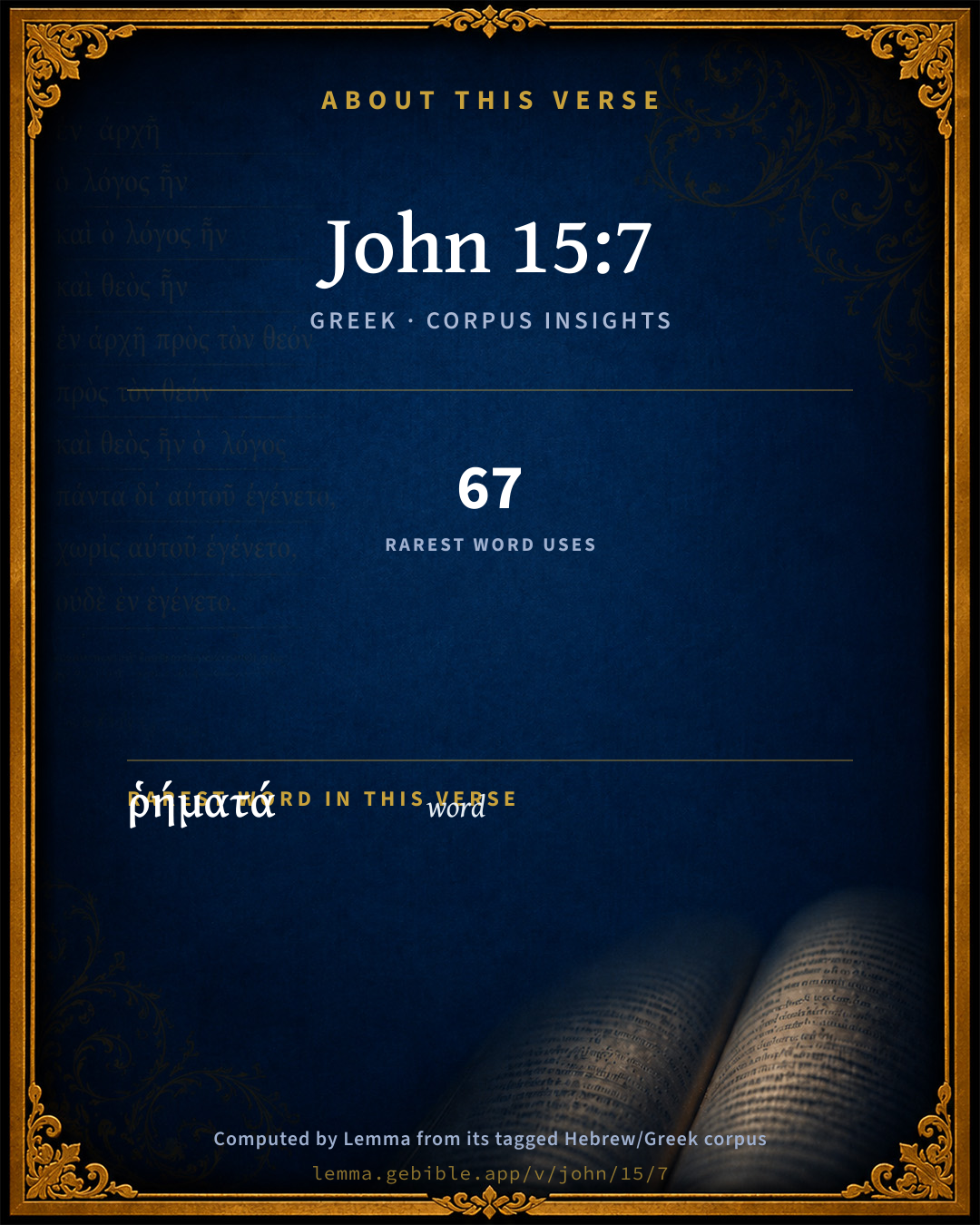
John 15:7

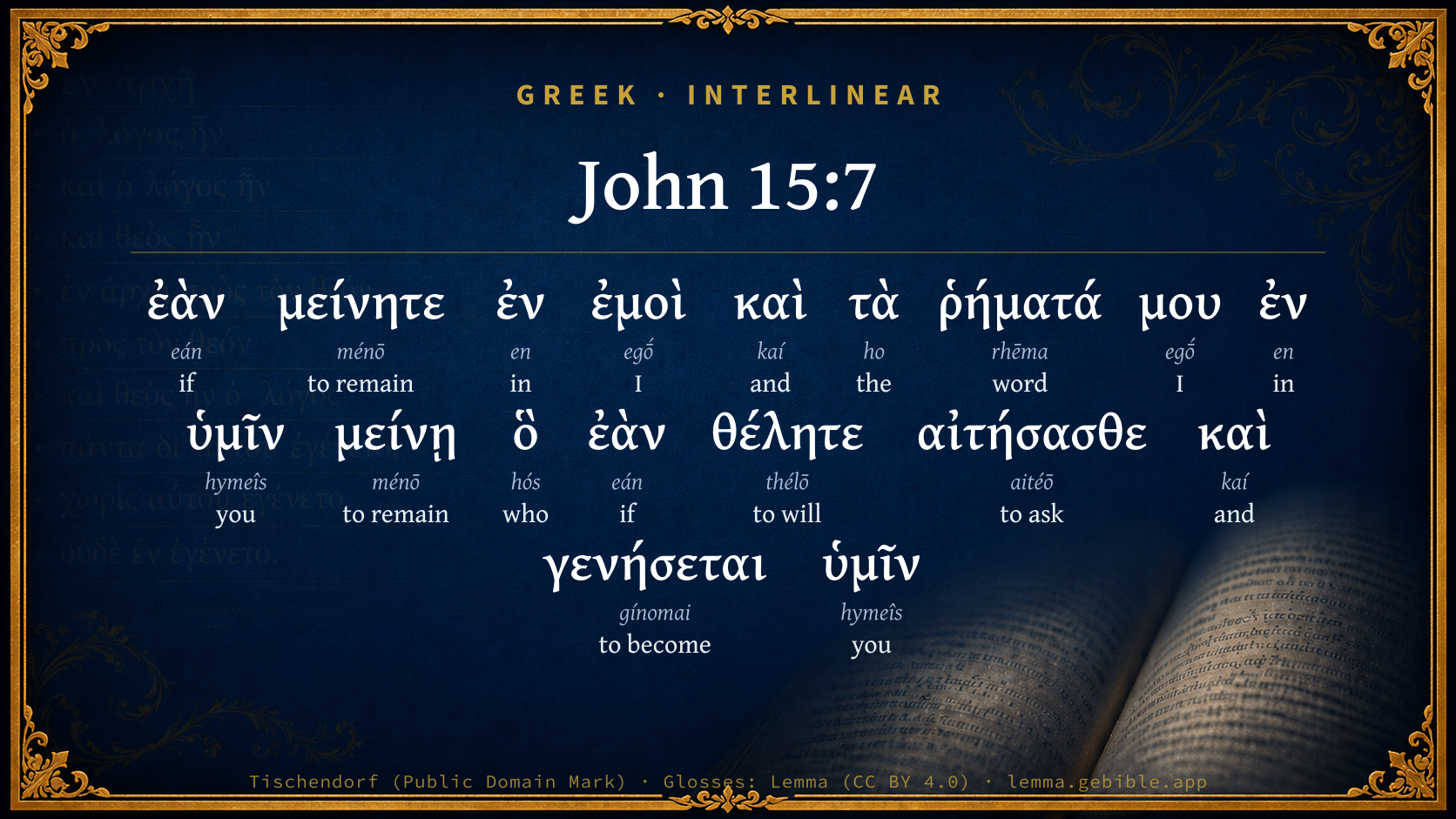
Greek (Tischendorf 8th ed.) John 15:7 appears in the Greek New Testament. The text above is from the Tischendorf 8th edition. Each word links to its Strong’s number and a concise gloss. Click any word for its full Thayer’s Greek Lexicon entry.
Download image
Cite this verse

John 15:7 (World English Bible). Public Domain. Lemma interlinear Bible study tool, https://lemma.gebible.app/v/john/15/7.

Show BibTeX & RIS
BibTeX
RIS
English Translation
If you remain in me, and my words remain in you, you will ask whatever you desire, and it will be done for you.
World English Bible · Public Domain
Download a study sheet

One document with this verse’s original text, its word-by-word gloss line, the meaning frame, cross-references with their text, attributed commentary, and full source and license credits — printable, and it pastes into notes with its structure intact.

This verse Autodidact and up

Study sheet (.html) Plain text (.txt)

A passage Seminary Student

Up to 50 verses in one chapter. A passage sheet keeps up to 6 commentary sources and 12 cross-references per verse, in the order this page ranks them, and says so on the sheet whenever that leaves anything out. Ask for a single verse and you get the Autodidact verse sheet above.

Everything on this page stays free to read, with no account — the sheet is a download of what is already on screen, not access to it.

Want to remove ads? Support Godless Engineer
Compare translations 3

The same verse in 3 English versions, stacked beneath the original-language interlinear above. Click any original word for its lexicon entry.

Each is an independent rendering of the whole verse — the interlinear is not word-aligned to these translations.

Highlighted words mark where these versions differ — a whole-verse word diff, not a word-by-word alignment.

  • World English Bible Public Domain
    If you remain in me, and my words remain in you, you will ask whatever you desire, and it will be done for you.
  • King James Version Public Domain
    If ye abide in me, and my words abide in you, ye shall ask what ye will, and it shall be done unto you.
  • unfoldingWord Literal Text CC BY-SA 4.0
    If you remain in me, and my words remain in you, ask whatever you desire, and it will be done for you.

unfoldingWord Literal Text — © unfoldingWord, licensed CC BY-SA 4.0. Word-aligned USFM3 via Door43 (git.door43.org/unfoldingWord/en_ult).

Versions to compare (up to 4)

3 of 4 selected

Show all 18 translations

Every available English version of this verse, each an independent rendering of the whole verse.

  • World English Bible Public Domain
    If you remain in me, and my words remain in you, you will ask whatever you desire, and it will be done for you.
  • Berean Standard Bible Public Domain
    If you remain in Me and My words remain in you, ask whatever you wish, and it will be done for you.
  • Majority Standard Bible Public Domain
    If you remain in Me and My words remain in you, then you will ask whatever you wish, and it will be done for you.
  • King James Version Public Domain
    If ye abide in me, and my words abide in you, ye shall ask what ye will, and it shall be done unto you.
  • American Standard Version (1901) Public Domain
    If ye abide in me, and my words abide in you, ask whatsoever ye will, and it shall be done unto you.
  • Revised Version (1885) Public Domain
    If ye abide in me, and my words abide in you, ask whatsoever ye will, and it shall be done unto you.
  • Geneva Bible (1599) Public Domain
    If ye abide in me, and my wordes abide in you, aske what ye wil, and it shalbe done to you.
  • Young's Literal Translation Public Domain
    if ye may remain in me, and my sayings in you may remain, whatever ye may wish ye shall ask, and it shall be done to you.
  • Literal Standard Version CC BY-SA 4.0
    if you may remain in Me, and My sayings may remain in you, whatever you may wish you will ask, and it will be done to you.
  • Unlocked Literal Bible CC BY-SA 4.0
    If you remain in me, and if my words remain in you, ask whatever you wish, and it will be done for you.
  • unfoldingWord Literal Text CC BY-SA 4.0
    If you remain in me, and my words remain in you, ask whatever you desire, and it will be done for you.
  • Darby Bible Public Domain
    If ye abide in me, and my words abide in you, ye shall ask what ye will and it shall come to pass to you.
  • World Messianic Bible Public Domain
    If you remain in me, and my words remain in you, you will ask whatever you desire, and it will be done for you.
  • Webster's Bible Public Domain
    If ye abide in me, and my words abide in you, ye may ask what ye will, and it shall be done to you.
  • Free Bible Version CC BY-SA 4.0
    If you remain in me, and my words remain in you, then you can ask for whatever you want, and it will be given you.
  • Bible in Basic English Public Domain
    If you are in me at all times, and my words are in you, then anything for which you make a request will be done for you.
  • Text-Critical English NT CC BY 4.0
    If you abide in me and my words abide in you, you will ask for whatever you wish, and it will be done for you.
  • Tyndale New Testament (1534) Public Domain
    Yf ye byde in me and my wordes also byde in you: axe what ye will and it shalbe done to you.

Literal Standard Version (2020), Covenant Press — licensed CC BY-SA 4.0. Text via the HelloAO Bible API (eBible.org). Unlocked Literal Bible (unfoldingWord) — licensed CC BY-SA 4.0. Text via the HelloAO Bible API (eBible.org). unfoldingWord Literal Text — © unfoldingWord, licensed CC BY-SA 4.0. Word-aligned USFM3 via Door43 (git.door43.org/unfoldingWord/en_ult). Free Bible Version, Dr. Jonathan Gallagher — licensed CC BY-SA 4.0. Text via the HelloAO Bible API (eBible.org).

Word by word

More ways to search: Search by grammar → Find every occurrence → Compare this word →

Practice this passage: Drill this verse → Learn its vocabulary →

ῥήματά
rhēma
G4487
“word”
Noun, Nominative, Plural, Neuter
Part of Speech
Noun
Case
Nominative
Number
Plural
Gender
Neuter
Full Thayer's Definition

Origin: from G4483

TDNT: 05:09,5

1. that which is or has been uttered by the living voice, thing spoken, word a. any sound produced by the voice and having definite meaning b. speech, discourse 1. what one has said c. a series of words joined together into a sentence (a declaration of one's mind made in words) 1. an utterance 2. a saying of any sort as a message, a narrative 1c d. concerning some occurrence 2. subject matter of speech, thing spoken of a. so far forth as it is a matter of narration b. so far as it is a matter of command c. a matter of dispute, case at law
  1. ἐὰν eán G1437 “if” Conditional
  2. μείνητε ménō G3306 “to remain” Verb, Aorist, Active, Subjunctive, 2nd person, Plural
  3. ἐν en G1722 “in” Preposition
  4. ἐμοὶ egṓ G1473 “I” Personal pronoun, 1st person, Dative, Singular
  5. καὶ kaí G2532 “and” Conjunction
  6. τὰ ho G3588 “the” Article, Nominative, Plural, Neuter
  7. μου egṓ G1473 “I” Personal pronoun, 1st person, Genitive, Singular
  8. ἐν en G1722 “in” Preposition
  9. ὑμῖν hymeîs G5210 “you” Personal pronoun, 2nd person, Dative, Plural
  10. μείνῃ ménō G3306 “to remain” Verb, Aorist, Active, Subjunctive, 3rd person, Singular
  11. ὃ hós G3739 “who” Relative pronoun, Accusative, Singular, Neuter
  12. ἐὰν eán G1437 “if” Conditional
  13. θέλητε thélō G2309 “to will” Verb, Present, Active, Subjunctive, 2nd person, Plural
  14. αἰτήσασθε aitéō G154 “to ask” Verb, Aorist, Middle, Imperative, 2nd person, Plural
  15. καὶ kaí G2532 “and” Conjunction
  16. γενήσεται gínomai G1096 “to become” Verb, Future, Middle deponent, Indicative, 3rd person, Singular
  17. ὑμῖν hymeîs G5210 “you” Personal pronoun, 2nd person, Dative, Plural

About this verse

These counts appear in no published source. They are computed here, from the morphology-tagged text and Lemma’s own curated glosses. What Lemma adds →

18
words
12
distinct lemmas
Gospels
section

Repetition

Words recur within this verse:

Cross-references

22

Topical passages linked to John 15:7 in the Treasury of Scripture Knowledge — connected by theme and wording, ordered by reader-vote popularity; previews shown in the World English Bible.

  • Psalms 37:4 Also delight yourself in Yahweh, And he will give you the desires of your heart.
  • 1 John 5:14 This is the boldness which we have toward him, that, if we ask anything according to his will, he listens to us.
  • John 14:13 Whatever you will ask in my name, that will I do, that the Father may be glorified in the Son.
  • 1 John 3:22 and whatever we ask, we receive from him, because we keep his commandments and do the things that are pleasing in his sight.
  • John 15:16 You didn't choose me, but I chose you, and appointed you, that you should go and bear fruit, and that your fruit should remain; that whatever you will ask of the Father in my name, he may give it to you.
  • Matthew 7:7 "Ask, and it will be given you. Seek, and you will find. Knock, and it will be opened for you.
  • John 16:23 "In that day you will ask me no questions. Most assuredly I tell you, whatever you may ask of the Father in my name, he will give it to you.
  • Galatians 5:16 But I say, walk by the Spirit, and you won't fulfill the lust of the flesh.
  • 1 John 2:27 As for you, the anointing which you received from him remains in you, and you don't need for anyone to teach you. But as his anointing teaches you concerning all things, and is true, and is no lie, and even as it taught you, you will remain in him.
  • Jeremiah 15:16 Your words were found, and I ate them; and your words were to me a joy and the rejoicing of my heart: for I am called by your name, Yahweh, God of hosts.
  • Proverbs 10:24 What the wicked fear, will overtake them, But the desire of the righteous will be granted.
  • Psalms 119:11 I have hidden your word in my heart, That I might not sin against you.
  • Deuteronomy 6:6 These words, which I command you this day, shall be on your heart;
  • Isaiah 58:8 Then shall your light break forth as the morning, and your healing shall spring forth speedily; and your righteousness shall go before you; the glory of Yahweh shall by your rearward.
  • Colossians 3:16 Let the word of Christ dwell in you richly; in all wisdom teaching and admonishing one another with psalms, hymns, and spiritual songs, singing with grace in your heart to the Lord.
  • 1 John 2:14 I have written to you, fathers, because you know him who is from the beginning. I have written to you, young men, because you are strong, and the word of God remains in you, and you have overcome the evil one.
  • Job 22:26 For then shall you delight yourself in the Almighty, And shall lift up your face to God.
  • Proverbs 4:4 He taught me, and said to me: "Let your heart retain my words. Keep my commandments, and live.
  • Job 23:12 I haven't gone back from the commandment of his lips. I have treasured up the words of his mouth more than my necessary food.
  • John 8:37 I know that you are Abraham's seed, yet you seek to kill me, because my word finds no place in you.
  • 2 John 1:1–2 The elder, to the chosen lady and her children, whom I love in truth; and not I only, but also all those who know the truth;
  • Galatians 4:2 but is under guardians and stewards until the day appointed by the father.

Cross-references courtesy of OpenBible.info (CC BY 4.0).

Commentary

Notes on John 15:7 from classic Christian and Jewish commentators (each source and its license shown beneath its notes). The classic Christian expositions comment on the surrounding passage and are grouped to its opening verse, so a note may address several verses; the Jewish commentaries on the Tanakh (Rashi and others) are per-verse, so they appear only where the commentator wrote on this verse.

Lemma curates 59 commentaries, every one of them public domain or Creative Commons licensed, each selected and text-cleaned for this edition rather than reprinted as found. About our sources →

The Biblical Illustrator

Joseph S. Exell

Joh_15:7

If ye abide in Me, and My words abide in you

The conditions of prevailing prayer

I.

WHAT IS REQUIRED OR SUPPOSED.

1. What is meant by our abiding in Him? This is called partaking of Him Heb_3:14), and implies in it our

(1) Being in Him (Rom_8:1; 2Co_5:17).

(a) By faith (Php_3:8-9).

(b) Obedience (Gal_5:24).

(c) Being members of His mystical body (Col_1:18; Eph_5:30).

(2) Continuing in Him as a branch in the vine (verses 1-6). Continuing in the profession of His doctrine (Joh_8:31), and hearty endeavours after perfection (Col_1:28).

2. What is meant by His words abiding in us?

(1) His words are that doctrine that He came to deliver in His Fathers Joh_7:16; Joh_12:49; Joh_17:8; Mar_1:22; Luk_4:23).

(2) These words abide in us by our

(a) Knowing them (chap 10:4, 5).

(b) Believing them (Joh_8:45; Joh_13:19; Joh_17:8; Mat_24:35; Rom_10:10; Heb_4:2).

(c) Remembering them (verse 20).

(d) Persevering in the observance of them (Mar_13:13; Lu Rev_2:26).

(3) The effect of their abiding in us.

(a) They purify us (Joh_15:3; Joh_17:17; 2Co_5:17).

(b) They bring forth fruit in us (Mat_13:23; Joh_15:5).

II. WHAT IS PROMISED (Mat_7:7). Such as abide in Christ shall be sure not to meet with disappointment, because

1. They will only according to Gods will (1Sa_3:18); herein following the example of their blessed Lord (Mat_26:39; Mat_26:42); submitting with those in Act_21:14; and praying as our Lord directs Mat_6:10).

2. They ask according to His will, and so are sure to be heard upon this account (1Jn_5:14-15). Particularly, they ask

(1) Nothing but what is lawful (Mat_7:11); avoiding the folly mentioned in Psa_50:21-22.

(2) And only to a good end (Jam_4:3).

3. They take a right method in asking: praying

(1) In faith (Mat_21:22; Jam_1:5-7).

(2) With fervency and devotion (Rom_1:9; 1Co_6:20).

(3) In humility (Luk_18:9, etc.; Psa_138:6).

(4) From a clean heart (Isa_1:11; Isa_1:16-18; 1Ti_2:8).

(5) With constancy and perseverance (Luk_18:1; Luk_11:8-10; Eph_6:8).

(6) In the name and through the merits of Christ (Joh_14:13-14). (Bp. Beveridge.)

I. THE NATURE OF THE CONDITIONS LAID DOWN.

The secret of prevailing prayer

1. If ye abide in Me, as the branches abide in the vine: union with and reception of the whole Christ by faith, as Saviour, Teacher, Example. If we accept Him in one aspect and not in another, we fail to fulfil the condition.

2. If My words abide in you.

(1) Christs words are His whole teaching, not the part of it which we most like.

(2) These words are to abide in us--not merely in our memories as words, nor in our understandings as facts, nor in our reasons as truths, nor in our feelings as sentiments; but pervading our whole spiritual being as principles of life and action, just as we assimilate food, which does not profit unless changed into blood, bone, sinew, etc. If we have Christs words thus abiding in us, we shall have Christ Himself, and that being so we shall breathe His Spirit and be transformed into His likeness.

II. THE CERTAINTY, IN THE FULFILMENT OF SUCH CONDITIONS, THAT ALL OUR PETITIONS WILL BE GRANTED. If we fulfil such conditions in the very fulfilment all our best desires are already granted. What more can we have than to be in Christ and to have Christ in us? The branch is already most fruitful if it is actually the branch of the most fruitful vine. But note the grounds on which this certainty rests.

1. God honours simplicity of trust. For what is this trust? It is to feel that truth cannot lie, that faithfulness cannot deceive, that wisdom cannot err, that power cannot fail, that holiness cannot blight the hope that perfect love has inspired. On the contrary, unbelief is absurd. Think of casting a shadow of doubt on infinite excellence, omnipotence, and wisdom. Let a man doubt that there is not enough light in the sun to enable him to see, or enough water in the sea to float his vessel. Besides, trust has naturally a drawing power on the heart of love.

2. Only such blessings will be sought for as are within the range of Gods promise. All the Christians hopes and yearnings are bounded by this. What lies beyond? Unholy honours, pleasures, etc.; but the Christian does not want these, he has done with these trifling or injurious toys. What lies within? Whatever is calculated to make us wiser, holier, happier, and more useful.

3. There is purity of desire in supplicating spiritual blessings. Prayer for other things necessarily arises from mixed motives.

4. We have further in this state of soul complete submissiveness to the Divine will. (J. M. Charlten, M. A.)

Ask great things from God

Sir Walter Raleigh one day asking a favour from Queen Elizabeth, the latter said to him, Raleigh, when will you leave off begging? To which he answered, When your Majesty leaves off giving. Ask great things of God. Expect great things from God. Let His past goodness make us instant in prayer. (W. Baxendale.)

Christs work for us the secret of successful prayer

All the promises in the Bible are so many bills of exchange drawn by God the Father in heaven upon His Son Jesus Christ, and payable to every pious bearer,--to everyone that comes to the mercy seat, and offers the promise or bill for acceptance, and pleads in the way of obedient faith and prayer. Jesus, the High Treasurer of heaven, knows every letter of His Fathers handwriting, and can never be imposed upon by any forged note. He will ever honour His Fathers bills: He accepts them all. It is for His Fathers honour that His bills never fail of acceptance and payment. (J. Beaumont, M. D.)

The necessity of specific prayer

In order to be prevailing our prayers must be pointed and personal. The old woman who interrupted an eloquent supplication, in which the attributes of God were being stated at great length, by saying, Ask Him for something, may teach us a much-needed lesson. (S. Pearson, M. A.)

The Biblical Illustrator, edited by Joseph S. Exell (c. 1880s–1900s) — public domain. Text from a community e-Sword module.

Joseph Benson's Commentary

Joh 15:7. If ye abide in me, &c. — Our Lord having laid before his disciples the awful consequences of falling from grace, now proceeds to point out some of the peculiar advantages which should accrue from a contrary spirit and conduct; the first of which is that all their prayers should be heard and answered. If ye abide in me — Through a faith working by love; and my words abide in you — Practically and experimentally; if you adhere steadfastly to the doctrine which I have taught you, firmly believing my declarations, conscientiously obeying my precepts, and affectionately embracing and relying on my promises; ye shall ask what ye will, and it shall be done unto you — Two things are implied in this promise: 1st, That the true disciples of Christ, who abide in him, and in whom his word abides, as above explained, will not ask any thing but what is proper to be done for them, and according to the will of God, 1Jn 5:14-15. They will, especially, ask spiritual blessings, which they know it is his will they should ask and receive; and will ask them in the way which he hath prescribed, namely, sincerely, earnestly, importunately, and perseveringly; and in the way of repentance, faith, and new obedience; and, in the name of Christ, relying for the success of their petitions on the mediation of Christ, and the mercy and promise of God through him. And, with respect to temporal blessings, they will ask them conditionally, and with entire resignation, desiring to receive them only so far as God foresees will be for their good and his glory. 2d, That they shall always have such an interest in Christ’s sacrifice and intercession, and in God’s favour through him, that all their prayers shall be accepted, and their petitions granted in the degree, time, and manner in which they themselves desire they should be granted, namely, when and as far as God sees will be for their good: which is all they desire; for they would not wish their requests to be granted to their own hurt, the hurt of others, or God’s dishonour. Thus the desire of the righteous shall be granted, and God will fulfil the desire of them that truly and consistently fear him: he also will hear their prayer, and will save them, Pro 10:24; Psa 145:19. To this purpose this apostle speaks, 1Jn 5:14-15, If we ask any thing according to his will he heareth us, and we have the petitions that we desired of him, and whatsoever we ask we receive of him, because we keep his commandments, and do those things that are pleasing in his sight. Dr. Macknight, however, and many other commentators, suppose that whatever encouragement this promise of our Lord may give to pious Christians, of all nations and ages, to believe that their sincere prayer shall be granted, yet, that it was primarily addressed to the apostles; and that our Lord, having in the preceding verses exhorted the twelve, as disciples or private Christians, proceeds now to give them directions as apostles or preachers, commissioned by him to teach his religion to the rest of mankind. They accordingly paraphrase the passage thus; If ye abide in me, in the sincere profession and practice of my religion; and my words abide in you, if ye faithfully teach mankind my doctrines and precepts, notwithstanding the difficulties you may meet with in this work; ye shall ask what ye will, &c., ye may ask any miracle you please, in confirmation of your authority, and it shall be granted unto you.

Joseph Benson's Commentary on the Old and New Testaments (1811–1818) — public domain. Text from a community e-Sword module.

Tyndale Open Study Notes

Tyndale Open Resources

15:7 Those whose lives are in harmony with Jesus may ask for anything because their prayers are controlled by his word. Their prayers will be answered and bring glory to God (14:10-13).

Tyndale Open Study Notes — © Tyndale Open Resources, licensed CC BY-SA 4.0. Text via the HelloAO Bible API.

Bengel's Gnomon

Johann Albrecht Bengel

Joh 15:7. Τὰ ῥήματά μου) My words, which impart cleanness; “and if I Myself abide in you” [comp. Joh 15:4]. The correlatives are, the words of Jesus which are obeyed, and the prayers of the believing which are hearkened to.—αἰτήσεσθε) ye shall ask: ye shall be able and also shall have the will to ask. Prayer itself is a fruit, and increases our fruit.

Bengel's Gnomon of the New Testament — English translation (T&T Clark, Edinburgh, 1860) — public domain. Text from a community e-Sword module.

Meyer's Critical & Exegetical Commentary

Heinrich August Wilhelm Meyer

Joh_15:7. After thus deterring from non-abiding, in Joh_15:6, now again an inducement to abiding. But the figure now ceases, and leaves in what follows some further scarcely accordant notes (Joh_15:8; Joh_15:16) behind.

ἐὰν μείν. ἐν ἐμοί] Still in the sense of the figure, as the branches on the vine; but with καὶ τὰ ῥήμ. μ. ἐν ὑμῖν (in animis vestris), expressing the necessary consequence of a mans abiding on Jesus, the language at once becomes proper, no longer figurative.

ὃ ἐὰν θέλ.] stands first with emphasis; but such an one wills and prays simply and solely in the name of Jesus (Joh_14:13-14), and cannot do otherwise.

Meyer — Critical and Exegetical Commentary on the New Testament — English translation by Peter Christie, edited by Frederick Crombie (T&T Clark, 1880) — public domain. Text from a community e-Sword module.

Expositor's Greek Testament

ed. W. Robertson Nicoll

Joh 15:7 . From the fate of those who do not abide in Him, Jesus turns to the results of faithful adherence ἐὰν μείνητε … ὑμῖν . The expression is altered from that of Joh 15:3 ; Joh 15:5 , instead of “and I in you,” we now have “and my words abide in you”; it is by means of His teaching and His commandments that Christ abides in His people, and by His word they are fitted for fruit-bearing, Joh 15:3 . Not that His words are a substitute for His personal presence, but its medium. But His presence is not to energise in them as if they were machines; they are to consider the exigencies that arise, and, giving play to judgment and conscience, are to ask for appropriate manifestations of grace: ὃ ἐὰν θέλητε αἰτήσασθε , “ask what ye will”. Petitions thus prompted by the indwelling word of Christ will necessarily be answered: καὶ γενήσεται ὑμῖν .

The Expositor's Greek Testament, edited by W. Robertson Nicoll (1897–1910) — public domain. Text from a community e-Sword module.

Godet's Commentaries

Frédéric Louis Godet

Vv. 7, 8. “If you abide in me and my words abide in you, ask what you will, and it shall be done for you. 8.Herein is my Father glorified, that you bear much fruit, and so you shall become my disciples.”

The parallelism between the two conditions indicated, Joh 15:7, would lead us to expect as the form of the second the words: “And Iabide in you” rather than: “And my words abide in you.” Jesus wishes to make known to His own by this change of expression, that it is the constant remembrance of and habitual meditation upon His words, which is the condition on which He will be able continually to make His strength dwell in them and act through them. In this relation, the disciple will not begin by acting, but simply by asking. For he knows that it is the divine strength thus obtained which must do everything. The words of Jesus, meditatively considered, become in the believer the food for holy thoughts and pious purposes, heavenly aspirations, and thereby the source of true prayers. While meditating on them, he comprehends the work of God; he measures its depth and height, its length and breadth, and fervently asks for the advancement of that work in the definite form which answers to the present needs. A prayer thus formed is the child of heaven; it is the promise of God (the word of Jesus) transformed into supplication; in this condition the hearing of it is certain and the promise which is so absolute: It shall be done for you, has no longer anything that surprises us.

The Alexandrian authorities read the imperative ask, the others the future you shall ask. The first has more liveliness.

The result of this fruitfulness of the disciples will be the glorification of the Father (Joh 15:8). What is there that honors the vine-dresser more than the extraordinary productiveness of the vine to which he has with partiality given his care? Now, the vine-dresser is the Father (Joh 15:1). The ἐν τούτῳ, herein, refers evidently to the ἵνα, in order that or that, which follows; this conjunction here takes the place of ὅτι, because the idea of bearing fruit presents itself to the mind as an end to be attained.

The aorist ἐδοξάσθη, properly has been glorified, characterizes this result as immediately gained at the moment when the condition, the production of fruit, is realized. Winer and others prefer to see in this aorist an anticipation of the final result.

While contemplating with filial satisfaction the glory of His Father, which will result from time to time from the activity of the disciples, Jesus seems to press to His heart these precious beings with a redoubled affection. They will thus continue the work of their Master, who has only thought of glorifying the Father, and will deserve more and more the title of His disciples. Καί: and thus. Instead of the future and you shall become, the Alexandrian authorities read the subjunctive: and that you may become (γένησθε, dependent on ἵνα).

Tischendorf himself rejects this reading, which is only a correction after φέρητε .

The dative ἐμοί is more pressing and more tender than the genitive ἐμοῦ would be: “You will belong to me more closely as my disciples.” One must always become a disciple; one is not such once for all.

As the vine does not itself bear any cluster, and offers its fruits to the world only through the medium of the branches, so Jesus will diffuse spiritual life here on earth only through the instrumentality of those who shall have received it from Him. In forming a Church, He creates for Himself a body for the pouring forth of His life and for the glorification of God on the earth. The vine keeps itself in the background in this great work, that it may only allow the branches to appear; it is for them, in their turn, to put themselves in the background, that they may render homage to the vine for all which they effect. The epistles to the Ephesians and the Colossians set forth, in a completely original form, this same relation between Christ and believers. The figures of the head and body correspond absolutely, in these letters, to those of the vine and the branch in this passage. When Paul says of the glorified Christ “that all the fulness of the Deity dwells bodily in him,” and “that we have all fulness in him,” he only formulates the meaning of the parable of the vine and the branch, as it has just presented itself to us. And this also explains why the propagation of the spiritual life advances so slowly in humanity. The vine effects nothing except through the branches; and these too often paralyze the action of the vine, instead of propagating it!

The condition for abiding in Christ is to remain under the action of His word (Joh 15:7) in the enjoyment of His love, and this latter depends on obedience to His commandments, and especially to that of brotherly love: Joh 15:9-17.

Frédéric Louis Godet — Commentaries on Luke, John, Romans, and 1 Corinthians — English translation (T&T Clark, Edinburgh, 1870s–1890s) — public domain. Text from a community e-Sword module.

Geneva Bible (1599)

Geneva Bible translators

He abideth in Christ, which resteth in his doctrine, and therefore bringeth forth good fruit: And the Father will deny such an one nothing.

Geneva Bible (1599) marginal notes — public domain. Text via Bolls.life.

Jamieson, Fausset & Brown

Robert Jamieson, A. R. Fausset & David Brown

If ye abide in me, and my words . . . in you--Mark the change from the inhabitation of Himself to that of His words, paving the way for the subsequent exhortations (Joh 15:9-10).

ask what ye will, and it shall be done unto you--because this indwelling of His words in them would secure the harmony of their askings with the divine will.

Jamieson, Fausset & Brown — Commentary Critical and Explanatory on the Whole Bible (1871) — public domain (CC PDM 1.0). Text via the HelloAO Bible API.

Adam Clarke's Commentary

Verse 7. If ye abide in me, &c.] "Those," says Creeshna, "whose understandings are in him, (God,) whose souls are in him, whose confidence is in him, whose asylum is in him, are by the inspired wisdom purified from all their offenses, and go from whence they shall never return." Geeta, p. 59.

Observe, in order to have influence with God, we must -

1. Be united to Christ - if ye abide in me.

2. That in order to be preserved in this union, we must have our lives regulated by the doctrine of Christ-and my words abide in you.

3. That to profit by this union and doctrine, we must pray - ye shall ask.

4. That every heavenly blessing shall be given to those who continue in this union, with a loving, obedient, praying spirit: - ye shall ask what ye will, &c.

Adam Clarke's Commentary on the Bible (1810–1826) — public domain. Text from a community e-Sword/MySword module.

John Calvin's Commentaries

7. If you abide in me. Believers often feel that they are starved, and are very far from that rich fatness which is necessary for yielding abundant fruit. For this reason it is expressly added, whatever those who are in Christ may need, there is a remedy provided for their poverty, as soon as they ask it from God. This is a very useful admonition; for the Lord often suffers us to hunger, in order to train us to earnestness in prayer. But if we fly to him, we shall never want what we ask, but, out of his inexhaustible abundance, he will supply us with every thing that we need, (1 Corinthians 1:5.)

If my words abide in you. He means that we take root in him by faith; for as soon as we have departed from the doctrine of the Gospel, we seek Christ separately from himself. When he promises that he will grant whatever we wish, he does not give us leave to form wishes according to our own fancy. God would do what was ill fitted to promote our welfare, if he were so indulgent and so ready to yield to us; for we know well that men often indulge in foolish and extravagant desires. But here he limits the wishes of his people to the rule of praying in a right manner, and that rule subjects, to the good pleasure of God, all our affections. This is confirmed by the connection in which the words stand; for he means that his people will or desire not riches, or honors, or any thing of that nature, which the flesh foolishly desires, but the vital sap of the Holy Spirit, Which enables them to bear fruit.

John Calvin's Commentaries (1540-1563) — public domain. Text from the Calvin Translation Society English edition (1840s-50s) via the Christian Classics Ethereal Library (ccel.org). Calvin's coverage is partial (roughly two-thirds of the Bible); uncommented books and verses are honest gaps, never fabricated. The 19th-century editor's footnotes and remarks are omitted so the notes are faithfully Calvin's own voice.

Ellicott's Commentary for English Readers

(7) If ye abide in me, and my words abide in you . . .—He is now passing from the figure, which recurs again only in Joh_15:8; Joh_15:16. We should have expected here, “and I abide in you” (Joh_15:4); but His abiding in them necessarily accompanies their abiding in Him. The abiding of His words in them is the means by which, and the proof that they do abide in Him. (Comp. Joh_14:15; Joh_14:23-24.)

Ye shall ask what ye will, and it shall be done unto you.—The reading is not certain, but the first verb should probably be imperative, “Ask what ye will . . .” The promise in all its width is the same as that in Joh_14:13-14 (see Note there), and it is attended by the same condition, for they who abide in Christ, and in whom Christ’s words abide, cannot pray otherwise than in His name.

A Bible Commentary for English Readers, edited by Charles John Ellicott (1878–1897) — public domain. Text from a community e-Sword module.

The Cambridge Bible for Schools and Colleges

gen. ed. J. J. S. Perowne

7. my words] Better, My sayings: see on Joh_15:3 and Joh_5:47.

ye shall ask what ye will] The better reading gives, ask whatsoever ye will, in the imperative. The promise is similar to that in Joh_14:13-14 both in its comprehensiveness and in its limitation. One who abides in Christ and has His words abiding in him cannot ask amiss.

The Cambridge Bible for Schools and Colleges (gen. ed. J. J. S. Perowne; Cambridge University Press, 1878–1918) — public domain. Text from a community e-Sword module.

John Gill's Exposition

Herein is my Father glorified,.... This does not so much refer to what goes before, concerning the disciples abiding in Christ, and he and his words abiding in them, and doing for them whatever they ask, though by all this God is glorified; as to what follows, the fruitfulness of the disciples:

that ye bear much fruit; of doctrine, grace, and good works, which show them to be trees of righteousness, the planting of the Lord, and the work of his hands; wherein the glory of his power, grace, and mercy, is greatly displayed. All the fruits of righteousness, with which they were filled by Christ, were by him to the praise and glory of God; yea, by the fruitfulness of grace, and of life and conversation, by the lively exercise of grace, and conscientious discharge of duty, as well by light of doctrine, and usefulness in the ministration of the Gospel, the disciples and servants of Christ not only glorify God themselves, but are the means of others glorifying him. It follows,

so shall ye be my disciples; or "disciples to me"; to my honour and glory also, as well as to my Father's; not that their fruitfulness made them the disciples of Christ, but made them appear to be so, or made them honourable ones. Just as good fruit does not make the tree good; the tree is first good, and therefore it brings forth good fruit; but shows it to be good: as by continuing in his word, abiding by his Gospel they appeared to be "disciples indeed", Joh 8:31, really and truly such; and as by loving one another, so by other fruits of righteousness, other men, all men know that they are the disciples of Christ.

John Gill's Exposition of the Whole Bible (1746–1763) — public domain (CC PDM 1.0). Text via the HelloAO Bible API.

Trapp's Complete Commentary

John Trapp

7 If ye abide in me, and my words abide in you, ye shall ask what ye will, and it shall be done unto you.

Ver. 7. Ask what ye will, and it, &c.] Either in money or money’s worth. If ye ask and miss it is because ye ask amiss. One was wont to say of Luther that he could have from God what he would; Vir iste potuit quod voluit. And being one time very earnest with God for the recovery of a godly useful man, he cried out, Fiat voluntas mea, Let thy will be done; and then he falls off sweetly, My will, Lord, because thy will; Mea voluntas, Domine, quia tua.

John Trapp, A Commentary or Exposition upon All the Books of the Old and New Testament (1647–1656) — public domain. Text from a community e-Sword module.

Albert Barnes' Notes on the Bible

My words - My doctrine; my commandments.

Abide in you - Not only are remembered, but are suffered to remain in you as a living principle, to regulate your affections and life.

Ye shall ask ... - See Joh 14:13. This promise had particular reference to the apostles. It is applicable to other Christians only so far as they are in circumstances similar to the apostles, and only so far as they possess their spirit. We learn from it that it is only when we keep the commandments of Christ - only when we live by faith in him, and his words are suffered to control our conduct and affections, that our prayers will be heard. Were we perfect in all things, he would always hear us, and we should be kept from making an improper petition; but just so far as men regard iniquity in their heart, the Lord will not hear them, Psa 66:18.

Albert Barnes' Notes on the Bible (1834–1885) — public domain. Text from a community e-Sword/MySword module.

Haydock's Catholic Bible Commentary

On account of our being in this world, we sometimes ask for that, which is not expedient for us. But these things will not be granted us, if we remain in Christ, who never grants us any thing, unless it be profitable to us. (St. Augustine, tract. 81. in Joan.) --- If we abide in Christ, by a lively faith, and his words abide in us by a lively, ardent charity, which can make us produce the fruits of good works, all that we ask, will be granted us. (Bible de Vence) --- These conditional expressions, if you remain in the vine, if you keep my commandments, &c. give us to understand, that our perseverance and salvation are upon conditions, to be fulfilled by us. --- (St. Augustine, de cor. & gra. chap. 13.)

George Leo Haydock (1774–1849), Haydock's Catholic Family Bible and Commentary, 1859 edition — public domain. Excludes Psalms (Douay-Rheims chapter numbering differs from Protestant) and Deuterocanonical books (Catholic canon only).

Matthew Poole's English Annotations

Here our Lord expounds what he meaneth by that abiding in him which he before mentioned by another phrase,

and my words abide in you, my precepts and promises; so its you by faith embrace the promises, and by obedience live up to the precepts which I have given you: for without these, though the words of Christ may come unto men in the preaching of the gospel, their ears may receive the sound of them, yet the word doth not dwell and abide in the soul: but if the word abides in the souls of men and women, then they may in prayer ask of God what they will, keeping to the conditions and limitations elsewhere required in holy writ, according to God’s will, 1Jo 5:14, believing, Mat 21:22, in the name of Christ, Joh 14:13,14, for the honour and glory of God, (to which end all our actions must be directed), and they shall be granted to them.

Matthew Poole's English Annotations on the Holy Bible (1683–1685) — public domain. Text from a community e-Sword/MySword module.

Whedon's Commentary on the Bible

Daniel D. Whedon

7. If ye abide… ask what ye will—The full abiding in Christ, with Christ abiding in us, secures the privilege of answer to prayer. What we will in accordance with the Spirit of such a union as before explained (Joh_14:13) shall be granted unto us.

Daniel D. Whedon (gen. ed.), Commentary on the Old and New Testaments (1874–1909) — public domain. Text from a community e-Sword module.

The Pulpit Commentary

In this verse he returns once more on the principle of union with himself, and of what will come out of it. The disciples may be sorely distressed at this possible doom, for whatever may be the lot of those who do not obey the gospel and are ignorant of the Law of God, the curse here uttered fails heavily upon those who have been once enlightened, etc., and have apostatized. (Heb_6:4-6) The anxiety of the apostles]s grievous, and they desire deliverance from this doom. And our Lord next unfolds the principle of prayer which laid such hold on the mind of the Apostle John: If ye abide in me (and then, instead of adding, "And I abide in you," he says); and my words abide in you; i.e. if my teaching so abide with you as to control your thoughts and ideas, remain in you as your guide and inspiration, then askwhatsoever ye will, and it shall be done to you. A timid interpretation of this promise limits the "whatsoever" to deeds of service in the kingdom of God, and fears, with Augustine, to trust the sanctified will of the believer. But in such harmony with Christ as these words supply, all the conditions of acceptable prayer are present. The believer in Christ, full of his words, evermore consciously realizing union with Christ, charged with the thoughts, burning with the purposes, filled with words of Jesus, will have no will that is not in harmony with the Divine will. Then faith is possible in the fulfillment of his own desire, and prayer becomes a prophecy and pledge of the answer. The apostle, after many years of pondering and of putting these principles into practice, confirms the truth of them. (1Jn_5:14-16) This is the true philosophy of prayer. The psalmist had gone a long way in the same direction. (Psa_37:4, "Delight thyself in the Lord; and he shall give thee thy heart"s desire

The Pulpit Commentary (1880–1919), ed. H.D.M. Spence-Jones & Joseph S. Exell — public domain. Text from a community e-Sword module.

John Wesley's Explanatory Notes

If ye abide in me, ye shall ask - Prayers themselves are a fruit of faith, and they produce more fruit.

John Wesley, Explanatory Notes Upon the Whole Bible (1754–1765) — public domain. Text via the GEBible commentary corpus.

Burkitt's Expository Notes on the New Testament

William Burkitt

Observe here, 1. A glorious privilege declared: Ask what ye will, and it shall be done unto you. Not that we are hereby warranted to ask what we please at God’s hand, but our will must be limited by the word and will of God; we must pray in faith, and in the name and mediation of Jesus Christ, and with a single eye at the glory of God.

Observe, 2. The condition upon which this privilege is attainable: If ye abide in me, and my words abide in you; that is, practically and experimentally. If my doctrine and commands abide in your hearts, and dispose you to an holy fruitfulness in your lives, then shall all your just requests be granted.

Learn, that such as by faith embrace the promises, and by obedience live up to the precepts, of the gospel, may in prayer humbly ask of God what they will, with a due submission to the wisdom and will of God.

William Burkitt's Expository Notes on the New Testament (1700–1703) — public domain. Text from a community e-Sword module.

The People's New Testament

B. W. Johnson

7, 8. Ask what ye will, and it shall be done unto you. The condition of this blessed promise is that we abide in the Vine, by having Christ's words abide in us.

Herein is my Father glorified, that ye bear much fruit. The best comment on this is the Savior's injunction, “Let your light shine before men, that they, seeing your good works, shall glorify your Father who is in heaven.”

B. W. Johnson's The People's New Testament with Notes (1889–1891) — public domain. Electronic text from the Christian Classics Ethereal Library (CCEL) ThML edition.

Cambridge Greek Testament for Schools and Colleges

7. αἰτήσασθε for αἰτήσεσθε (influenced by γενήσεται).

7. ὃ ἐάν θέλ. αἰτ. Ask whatsoever ye will. Both in its comprehensiveness and in its limitation the promise is similar to that in Joh 14:13-14. One who abides in Christ and has His sayings (Joh 3:34) abiding in him cannot ask amiss: His words inspire and guide prayer.

Cambridge Greek Testament for Schools and Colleges (Cambridge University Press, 1896; 21 vols, various authors incl. Carr, Maclear, Plummer, Farrar, Lumby, Moule, M. R. James, Simcox) — public domain. Text from a community e-Sword module.

Alford’s Greek Testament

Henry Alford

7.] All bringing forth fruit is the result of answered prayer for the assisting grace of God: and therefore the answer of all prayer is here promised to those who abide in Christ and have His word (Heb 6:5) abiding in them.

αἰτήσασθε is the imperative used proleptically of the future time. This not having been seen, it has probably been altered to αἰτήσεσθε: see ch. 14:13.

ὃ ἐὰν θέλητε, in the supposed case, is necessarily in the way of God’s will, and as tending to πολὺν καρπὸν φέρειν.

Henry Alford, The Greek Testament (1849–1861) — public domain. Text from a community e-Sword module.

International Critical Commentary

7. The figure of the tree and its branches is left aside for the moment; and the consequence of abiding in Christ is declared to be not only the capacity for “bearing fruit,” but the acquisition of the power of efficacious prayer. This is the secret of the saints.

ἐὰν μείνητε ἐν ἐμοὶ (cf. v. 4 and 8:31) καὶ τὰ ῥήματά μου (sc. the “sayings” which make up the λόγος of v. 3) ἐν ὑμῖν μείνῃ κτλ. The man of whom this is true is a master of prayer, and his petitions will be answered. In the Synoptists faith is the prerequisite for efficacious prayer: πάντα ὅσα προσεύχεσθε καὶ αἰτεῖσθε, πιστεύετε ὅτι ἐλάβετε καὶ ἔσται ὑμῖν (Mar 11:24); “if you had faith you would say to this tree, Be uprooted and planted in the sea, and it would obey you” (Luk 17:6; cf. Mat 17:20). πάντα δυνατὰ τῷ πιστεύοντι (Mar 9:23) is true of the life of prayer. But in Jn. faith in Christ is more than belief in His message, or fitful attraction to His Person; it is a continual abiding “in Him.” See further on v. 16 below; and cf. 6:29.

ὃ ἐὰν θέλητε αἰτήσασθε. For ὃ ἐάν (ADLΘ), B has ὃ ἄν, and א has ὅσα ἐάν. ABDL support the imperative αἰτήσασθε, while אΘ have αἰτήσεσθε.

ὃ ἐὰν θέλητε κτλ., “whatever you will, etc.”; petitions prompted by the indwelling words of Jesus cannot fail to be in harmony with the Divine Will. A petitioner who “abides in Christ” asks habitually “in His Name”; i.e. he asks as Christ would ask, and so his satisfaction is sure. See 14:13 and the note there; cf. also v. 16 below, and 16:23.

γενήσεται ὑμῖν, “it shall come to pass for you,” not as a boon granted arbitrarily, but as the inevitable sequence of the prayer.

International Critical Commentary — older volumes (1896–1929), various authors — public domain. Text from a community e-Sword module.

Vincent's Word Studies in the New Testament

Marvin R. Vincent

Ye shall ask [αιτησεσθε] . The best texts read the imperative, aijthsasqe, ask.

Shall be done unto you [γενησεται υμιν] . Literally, it shall come to pass for you.

Marvin R. Vincent, Word Studies in the New Testament (1887–1900) — public domain. Text from a community e-Sword/MySword module.

Lesson kit

Teaching starters — assembled from the data on this page, not authored interpretation. Every prompt links to the verse data it draws on. Edit before teaching.

John, in the Gospels, opens this verse with 18 words (12 distinct Greek lemmas). Its most distinctive word is rhēma (“word”). A historical commentator’s framing appears above. Read the whole chapter for the surrounding context.

Discussion questions

  1. How does “word” (rhēma) shape what this verse is saying?
  2. Psalms 37:4 shares this passage’s theme. How do the two illuminate each other?
  3. “to remain” occurs 2× in this one verse. What is the effect of the repetition?
  4. The translations on this page render this verse differently — a whole-verse word diff, not a word-by-word alignment. What might account for the different wordings?
  5. Reading how The Biblical Illustrator and Joseph Benson's Commentary read this verse, where do the two commentators agree and where do they part?

Things to notice

  • These translations choose different wording for 6 words in this verse.
  • “to remain” occurs 2× in this single verse.
  • 12 distinct Greek lemmas span 18 words in this verse.

Reading settings

Reading text

Shown beneath each verse's original-language words.

Old Testament
Old Testament edition

Read the OT as the Masoretic Hebrew (MT) or the Greek Septuagint (LXX).

English shown for the Greek Septuagint (in the Hebrew ↔ Greek comparison).

Comparing translations? Open the Compare panel on any verse page to stack up to four side by side.