
Acts 13:39

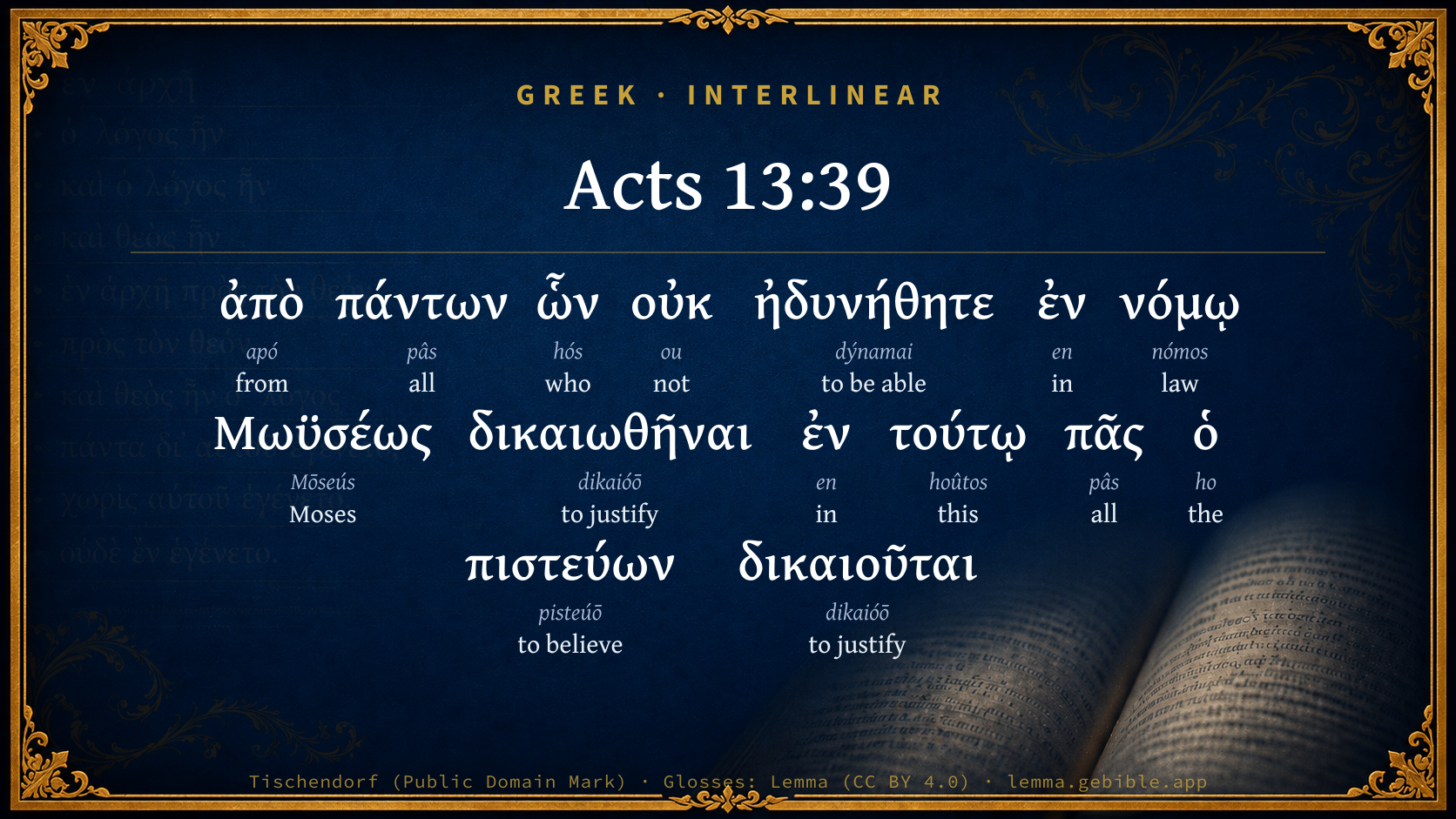
Greek (Tischendorf 8th ed.) Acts 13:39 appears in the Greek New Testament. The text above is from the Tischendorf 8th edition. Each word links to its Strong’s number and a concise gloss. Click any word for its full Thayer’s Greek Lexicon entry.
Download image
Cite this verse

Acts 13:39 (World English Bible). Public Domain. Lemma interlinear Bible study tool, https://lemma.gebible.app/v/acts/13/39.

Show BibTeX & RIS
BibTeX
RIS
English Translation
and by him everyone who believes is justified from all things, from which you could not be justified by the law of Moses.
World English Bible · Public Domain
Download a study sheet

One document with this verse’s original text, its word-by-word gloss line, the meaning frame, cross-references with their text, attributed commentary, and full source and license credits — printable, and it pastes into notes with its structure intact.

This verse Autodidact and up

Study sheet (.html) Plain text (.txt)

A passage Seminary Student

Up to 50 verses in one chapter. A passage sheet keeps up to 6 commentary sources and 12 cross-references per verse, in the order this page ranks them, and says so on the sheet whenever that leaves anything out. Ask for a single verse and you get the Autodidact verse sheet above.

Everything on this page stays free to read, with no account — the sheet is a download of what is already on screen, not access to it.

Want to remove ads? Support Godless Engineer
Compare translations 3

The same verse in 3 English versions, stacked beneath the original-language interlinear above. Click any original word for its lexicon entry.

Each is an independent rendering of the whole verse — the interlinear is not word-aligned to these translations.

Highlighted words mark where these versions differ — a whole-verse word diff, not a word-by-word alignment.

  • World English Bible Public Domain
    and by him everyone who believes is justified from all things, from which you could not be justified by the law of Moses.
  • King James Version Public Domain
    And by him all that believe are justified from all things, from which ye could not be justified by the law of Moses.
  • unfoldingWord Literal Text CC BY-SA 4.0
    In this one, everyone believing is justified.

unfoldingWord Literal Text — © unfoldingWord, licensed CC BY-SA 4.0. Word-aligned USFM3 via Door43 (git.door43.org/unfoldingWord/en_ult).

Versions to compare (up to 4)

3 of 4 selected

Show all 19 translations

Every available English version of this verse, each an independent rendering of the whole verse.

  • World English Bible Public Domain
    and by him everyone who believes is justified from all things, from which you could not be justified by the law of Moses.
  • Berean Standard Bible Public Domain
    Through Him everyone who believes is justified from everything you could not be justified from by the law of Moses.
  • Majority Standard Bible Public Domain
    Through Him everyone who believes is justified from everything from which you could not be justified by the law of Moses.
  • King James Version Public Domain
    And by him all that believe are justified from all things, from which ye could not be justified by the law of Moses.
  • American Standard Version (1901) Public Domain
    and by him every one that believeth is justified from all things, from which ye could not be justified by the law of Moses.
  • Revised Version (1885) Public Domain
    and by him every one that believeth is justified from all things, from which ye could not be justified by the law of Moses.
  • Geneva Bible (1599) Public Domain
    And from al things, from which ye could not be iustified by the Law of Moses, by him euery one that beleeueth, is iustified.
  • Douay-Rheims (1899) Public Domain
    In him every one that believeth, is justified.
  • Young's Literal Translation Public Domain
    and from all things from which ye were not able in the law of Moses to be declared righteous, in this one every one who is believing is declared righteous;
  • Literal Standard Version CC BY-SA 4.0
    and from all things in the Law of Moses from which you were not able to be declared righteous, everyone who is believing in this One is declared righteous;
  • Unlocked Literal Bible CC BY-SA 4.0
    By him every one who believes is justified from all the things which the law of Moses could not justify you.
  • unfoldingWord Literal Text CC BY-SA 4.0
    In this one, everyone believing is justified.
  • Darby Bible Public Domain
    and from all things from which ye could not be justified in the law of Moses, in him every one that believes is justified.
  • World Messianic Bible Public Domain
    and by him everyone who believes is justified from all things, from which you could not be justified by the Torah of Moses.
  • Webster's Bible Public Domain
    And by him all that believe are justified from all things, from which ye could not be justified by the law of Moses.
  • Free Bible Version CC BY-SA 4.0
    Through him everyone who trusts in him is made morally right from all that is wrong—in a way that you could never be set right by the law of Moses.
  • Bible in Basic English Public Domain
    And through him everyone who has faith is made free from all those things, from which the law of Moses was not able to make you free.
  • Text-Critical English NT CC BY 4.0
    and by this man everyone who believes is set free from everything from which you could not be set free by the law of Moses.
  • Tyndale New Testament (1534) Public Domain
    and that by him are all that beleve iustified from all thinges from the which ye coulde not be iustified by the lawe of Moses.

Literal Standard Version (2020), Covenant Press — licensed CC BY-SA 4.0. Text via the HelloAO Bible API (eBible.org). Unlocked Literal Bible (unfoldingWord) — licensed CC BY-SA 4.0. Text via the HelloAO Bible API (eBible.org). unfoldingWord Literal Text — © unfoldingWord, licensed CC BY-SA 4.0. Word-aligned USFM3 via Door43 (git.door43.org/unfoldingWord/en_ult). Free Bible Version, Dr. Jonathan Gallagher — licensed CC BY-SA 4.0. Text via the HelloAO Bible API (eBible.org).

Word by word

More ways to search: Search by grammar → Find every occurrence → Compare this word →

Practice this passage: Drill this verse → Learn its vocabulary →

δικαιωθῆναι
dikaióō
G1344
“to justify”
Verb, Aorist, Passive, Infinitive
Part of Speech
Verb
Tense
Aorist
Voice
Passive
Mood
Infinitive
Full Thayer's Definition

Origin: from G1342

TDNT: 05:31,2

1. to render righteous or such he ought to be 2. to show, exhibit, evince, one to be righteous, such as he is and wishes himself to be considered 3. to declare, pronounce, one to be just, righteous, or such as he ought to be
  1. ἀπὸ apó G575 “from” Preposition
  2. πάντων pâs G3956 “all” Adjective, Genitive, Plural, Neuter
  3. ὧν hós G3739 “who” Relative pronoun, Genitive, Plural, Neuter
  4. οὐκ ou G3756 “not” Particle, Negative
  5. ἠδυνήθητε dýnamai G1410 “to be able” Verb, Aorist, Passive deponent, Indicative, 2nd person, Plural, Attic form
  6. ἐν en G1722 “in” Preposition
  7. νόμῳ nómos G3551 “law” Noun, Dative, Singular, Masculine
  8. Μωϋσέως Mōseús G3475 “Moses” Noun, Genitive, Singular, Masculine
  9. ἐν en G1722 “in” Preposition
  10. τούτῳ hoûtos G3778 “this” Demonstrative pronoun, Dative, Singular, Masculine
  11. πᾶς pâs G3956 “all” Adjective, Nominative, Singular, Masculine
  12. ὁ ho G3588 “the” Article, Nominative, Singular, Masculine
  13. πιστεύων pisteúō G4100 “to believe” Verb, Present, Active, Participle, Nominative, Singular, Masculine
  14. δικαιοῦται dikaióō G1344 “to justify” Verb, Present, Passive, Indicative, 3rd person, Singular

About this verse

These counts appear in no published source. They are computed here, from the morphology-tagged text and Lemma’s own curated glosses. What Lemma adds →

15
words
12
distinct lemmas
Acts
section

Shared distinctive vocabulary

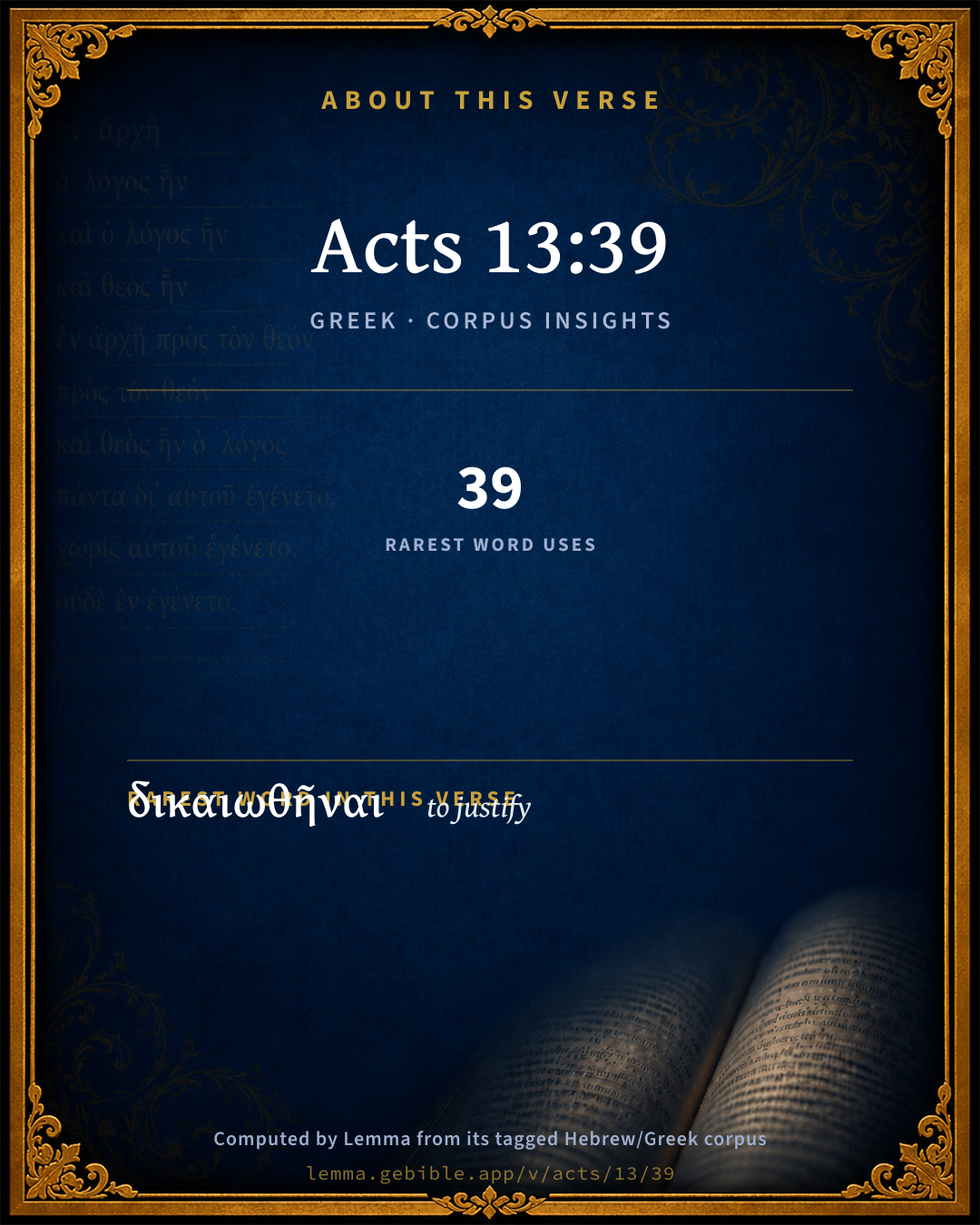
δικαιωθῆναι to justify G1344 occurs in 35 verses of the Greek New Testament. Also found in:
Repetition

Words recur within this verse:

  • πάντων all G3956 ×2
  • δικαιωθῆναι to justify G1344 ×2
  • ἐν in G1722 ×2

Cross-references

39

Topical passages linked to Acts 13:39 in the Treasury of Scripture Knowledge — connected by theme and wording, ordered by reader-vote popularity; previews shown in the World English Bible.

  • Romans 10:4 For Christ is the fulfillment of the law for righteousness to everyone who believes.
  • Galatians 2:16 yet knowing that a man is not justified by the works of the law but through the faith of Jesus Christ, even we believed in Christ Jesus, that we might be justified by faith in Christ, and not by the works of the law, because no flesh will be justified by the works of the law.
  • Romans 8:3 For what the law couldn't do, in that it was weak through the flesh, God did, sending his own Son in the likeness of sinful flesh and for sin, he condemned sin in the flesh;
  • Hebrews 7:19 (for the law made nothing perfect), and a bringing in thereupon of a better hope, through which we draw near to God.
  • Romans 10:10 For with the heart, one believes unto righteousness; and with the mouth confession is made unto salvation.
  • Romans 8:1 There is therefore now no condemnation to those who are in Christ Jesus, who don't walk according to the flesh, but according to the Spirit.
  • Romans 3:19 Now we know that whatever things the law says, it speaks to those who are under the law, that every mouth may be closed, and all the world may be brought under the judgment of God.
  • Romans 4:15 For the law works wrath, for where there is no law, neither is there disobedience.
  • Romans 4:5–8 But to him who doesn't work, but believes in him who justifies the ungodly, his faith is accounted for righteousness.
  • John 1:17 For the law was given through Moses. Grace and truth came through Jesus Christ.
  • Romans 5:9 Much more then, being now justified by his blood, we will be saved from God's wrath through him.
  • Galatians 3:21–25 Is the law then against the promises of God? Certainly not! For if there had been a law given which could make alive, most assuredly righteousness would have been of the law.
  • Romans 5:20 The law came in besides, that the trespass might abound; but where sin abounded, grace did abound more exceedingly;
  • Hebrews 10:11 Every priest indeed stands day by day ministering and often offering the same sacrifices, which can never take away sins,
  • Job 9:20 Though I am righteous, my own mouth shall condemn me. Though I am blameless, it shall prove me perverse.
  • Job 25:4 How then can man be just with God? Or how can he who is born of a woman be clean?
  • Psalms 143:2 Don't enter into judgment with your servant, For in your sight no man living is righteous.
  • Acts 10:43 All the prophets testify about him, that through his name everyone who believes in him will receive remission of sins."
  • Romans 3:24–30 being justified freely by his grace through the redemption that is in Christ Jesus;
  • Romans 4:24 but for our sake also, to whom it will be accounted, who believe in him who raised Jesus, our Lord, from the dead,
  • Romans 5:1 Being therefore justified by faith, we have peace with God through our Lord Jesus Christ;
  • Romans 7:9–11 I was alive apart from the law once, but when the commandment came, sin revived, and I died.
  • Philippians 3:6–9 concerning zeal, persecuting the assembly; concerning the righteousness which is in the law, found blameless.
  • Hebrews 10:4 For it is impossible that the blood of bulls and goats should take away sins.
  • Luke 10:28 He said to him, "You have answered correctly. Do this, and you will live."
  • Luke 18:14 I tell you, this man went down to his house justified rather than the other; for everyone who exalts himself will be humbled, but he who humbles himself will be exalted."
  • John 5:24 "Most assuredly I tell you, he who hears my word, and believes him who sent me, has eternal life, and doesn't come into judgment, but has passed out of death into life.
  • Romans 8:30–34 Whom he predestined, those he also called. Whom he called, those he also justified. Whom he justified, those he also glorified.
  • Romans 9:31 but Israel, following after a law of righteousness, didn't arrive at the law of righteousness.
  • 1 Corinthians 6:11 Such were some of you, but you were washed. But you were sanctified. But you were justified in the name of the Lord Jesus, and in the Spirit of our God.
  • Galatians 2:19 For I, through the law, died to the law, that I might live to God.
  • Galatians 3:8 The Scripture, foreseeing that God would justify the Gentiles by faith, preached the Gospel beforehand to Abraham, saying, "In you all the nations will be blessed."
  • Galatians 3:10–12 For as many as are of the works of the law are under a curse. For it is written, "Cursed is everyone who doesn't continue in all things that are written in the book of the law, to do them."
  • Galatians 5:3 Yes, I testify again to every man who receives circumcision, that he is a debtor to do the whole law.
  • Hebrews 9:9–10 which is a symbol of the present age, where gifts and sacrifices are offered that are incapable, concerning the conscience, of making the worshipper perfect;
  • Isaiah 53:11 He shall see of the travail of his soul, [and] shall be satisfied: by the knowledge of himself shall my righteous servant justify many; and he shall bear their iniquities.
  • Jeremiah 31:32 not according to the covenant that I made with their fathers in the day that I took them by the hand to bring them out of the land of Egypt; which my covenant they broke, although I was a husband to them, says Yahweh.
  • Habakkuk 2:4 Behold, his soul is puffed up. It is not upright in him, but the righteous will live by his faith.
  • Luke 10:25 Behold, a certain lawyer stood up and tested him, saying, "Teacher, what shall I do to inherit eternal life?"

Cross-references courtesy of OpenBible.info (CC BY 4.0).

Commentary

Notes on Acts 13:39 from classic Christian and Jewish commentators (each source and its license shown beneath its notes). The classic Christian expositions comment on the surrounding passage and are grouped to its opening verse, so a note may address several verses; the Jewish commentaries on the Tanakh (Rashi and others) are per-verse, so they appear only where the commentator wrote on this verse.

Lemma curates 59 commentaries, every one of them public domain or Creative Commons licensed, each selected and text-cleaned for this edition rather than reprinted as found. About our sources →

Tyndale Open Study Notes

Tyndale Open Resources

13:39 Faith is prerequisite to being made right in God’s sight; this was not provided for in the law of Moses (Ps 14:1-3; see Rom 3:9-20).

Tyndale Open Study Notes — © Tyndale Open Resources, licensed CC BY-SA 4.0. Text via the HelloAO Bible API.

Bengel's Gnomon

Johann Albrecht Bengel

Act 13:39. Ὧι) ἀπὸ is to be repeated from what immediately goes before.—οὐκ ἠδυνήθητε, ye could not) Not merely, ye cannot, but ye never could, although ye tried it.—νόμῳ) by the law, which ye so revere: ver.15. We ought not to suppose that the division of the law into the moral and ceremonial was as familiar to the Jews as it is to us in the present day, since at that time both flourished together. Wherefore this passage treats of the whole law. Moses is Moses, whether he enjoins concerning rites or concerning morals: and on the other hand, Christ is Christ.—ἐν τούτῳ, in Him) In antithesis to the law of Moses.—πᾶς, every one) whether having, or not having the law: whether Jew or Gentile; for some of the latter were present: Act 13:42.

Bengel's Gnomon of the New Testament — English translation (T&T Clark, Edinburgh, 1860) — public domain. Text from a community e-Sword module.

Expositor's Greek Testament

ed. W. Robertson Nicoll

Act 13:39 . So far the words represent the entire harmony between the preaching of St. Peter and St. Paul, and there is no reason to attribute this verse, as also Act 10:43 , with Jüngst, to any reviser; δικαιοῦσθαι ἀπό only elsewhere in Rom 6:7 . But if St. Paul’s next words seem to imply that within certain limits, i.e. , so far as it was obeyed, the law of Moses brought justification, they affirm at the same time the utter inefficacy of all legal obedience, since one thing was certain, that the law exacted much more than Israel could obey; complete justification must be found, if anywhere, elsewhere. Can we doubt that St. Paul is here giving us what was really his own experience? (See Briggs, Messiah of the Apostles , p. 76.) In spite of all his efforts to fulfil the law, there was still the feeling that these efforts were hopelessly deficient; there was an area of transgression in which the law, so far from justifying, condemned. But in the Messiah, the Holy One of God, he saw a realisation of that perfect holiness to which in the weakness of the flesh he could not attain, and in Him, Who died, and rose again, for us that Righteous One, Whom he saw, not only on the road to Damascus, but ever on his right hand by the eye of faith he found complete and full justification. That this forgiveness of sins is not connected specially with the Death of Christ, but with His Resurrection, or rather with His whole Messianic character, to which the Resurrection put the final seal, is certainly not to be regarded as an indication of a non-Pauline view, cf. Rom 4:25 ; Rom 8:34 , 2Co 5:15 . Moreover, if we consider the connection of the whole address, the Resurrection is not regarded apart from the Death of Christ: Act 13:26-29 show us that the Message of Salvation starts from the Death of Christ, and is based upon that, cf. Bethge, Die Paulinischen Reden , p. 54. It is unreasonable to complain that St. Paul’s conception of justification in this address falls below his characteristic and controlling idea of it (McGiffert, p. 186). We could not justly expect that the Apostle’s utterances, thus summarised by St. Luke, would contain as full and complete a doctrinal exposition as his Galatian and Roman Epistles. To the former Epistle McGiffert points as giving us what Paul actually taught in Galatia; but there is no contradiction between the teaching given us in St. Luke’s account of the address in Pisidian Antioch and St. Paul’s account of his teaching to his converts in his letter “the coincidences between the two are so striking as to make each the best commentary on the other … and there is no such close resemblance between the Epistle and any other of Paul’s addresses reported in Acts,” Ramsay, Expositor , December, 1898. “Historical Commentary on Gal.” see below, and also Lightfoot, on Gal 3:11 . St. Paul’s teaching is essentially the same in the synagogue at Antioch as when he is writing to his Galatian converts: only in Christ is justification, and in the law as such there is no forgiveness of sins. He does not say in so many words that there was no sin from which men could be freed under the law of Moses, but it is evident that the most solemn warning with which the Apostle follows up his declaration could only be justified on the ground that some essential principle was involved in the acceptance or rejection of the work of Christ. On δικαιόω in classical literature, in LXX, and in N.T., see Kennedy, Sources of N. T. Greek , pp. 104, 105, and Sanday and Headlam, Romans , pp. 30, 31.

The Expositor's Greek Testament, edited by W. Robertson Nicoll (1897–1910) — public domain. Text from a community e-Sword module.

Geneva Bible (1599)

Geneva Bible translators

Whereas the ceremonies of the Law could not absolve you from your sins, this man doth absolve you, if you lay hold on him by faith.

Geneva Bible (1599) marginal notes — public domain. Text via Bolls.life.

Jamieson, Fausset & Brown

Robert Jamieson, A. R. Fausset & David Brown

by him all that believe are justified from all things--The sense requires that a pause in the sentence be made here: "By him the believer is absolved from all charges of the law." What follows,

from which ye could not be justified by the law of Moses--is not an exceptional but an explanatory clause. The meaning is not, "Though the law justifies from many things, it cannot justify from all things, but Christ makes up all deficiencies"; but the meaning is, "By Christ the believer is justified from all things, whereas the law justifies from nothing." (Note.--The deeper sense of justification, the positive side of it, is reserved for the Epistles, addressed to the justified themselves: and whereas it is the resurrection of Christ here, and throughout the Acts chiefly, which is dwelt on, because the first thing in order to bring peace to the guilty through Christ was to establish His Messiahship by His resurrection, in the Epistles to believers His death as the way of reconciliation is fully unfolded).

Jamieson, Fausset & Brown — Commentary Critical and Explanatory on the Whole Bible (1871) — public domain (CC PDM 1.0). Text via the HelloAO Bible API.

Adam Clarke's Commentary

Verse 39. And by him] On his account, and through him, all that believe in his Divine mission, and the end for which he has been manifested, namely, to put away sin by the sacrifice of himself, are justified from all things, from the guilt of all transgressions committed against God; from which ye could not be justified by the law of Moses; because it is impossible that the blood of bulls and goats, and the ashes of a heifer sprinkling the unclean, or any other rite or service of this kind, could take away sin from the soul, cancel its guilt in the conscience, or make an atonement to the Divine justice; but this is the sacrifice which God has required; this is every way suited to the end for which it has been instituted; and this is the sacrifice alone which God can accept. Your law says, "Do this, and ye shall live;" and, "Cursed is every one that continueth not in all things that are written in the book of the law to do them." Ye have not done these things required; ye have not continued in any good thing; ye have not only not done all things commanded, but ye have done none, none as they ought to be done; and therefore ye are under the curse. The Gospel says, Believe on the Lord Jesus; credit his Divine mission; consider his death an atonement for sin; believe in his resurrection, as a proof that the atonement is made, believe that he suffered, died, and rose again for your justification; and that for his sake God, though he be infinitely just, can be the justifier of all who believe in him. By the law of Moses there is neither justification nor salvation: in Jesus Christ there are both, and all the sure mercies of David. Therefore, believe on the Lord Jesus Christ, and ye shall be justified from all things, from which ye could not be justified by the law of Moses.

Adam Clarke's Commentary on the Bible (1810–1826) — public domain. Text from a community e-Sword/MySword module.

John Calvin's Commentaries

39. Every one that believeth. Paul showeth how men obtain the righteousness of Christ; to wit, when they receive it by faith; and that which faith doth obtain is not obtained by any merits of works. Wherefore, Paul’s opinion is plain, that we are justified by faith alone, which, notwithstanding the Papists oppugn [oppose] and strive against no less obstinately than bitterly, nevertheless, it is requisite that we know what the word believe doth import, which is made unsavory to the Papists through ignorance. There be also other benefits of Christ which we reap by faith; for when he regenerateth us by his Spirit, he restoreth in us the image of God; and after that the old man is crucified he fashioneth us unto newness of life. But it was enough for Luke to express this one thing, how men return into favor with God, from whom they be estranged by sin, because we may easily pass thence unto the residue.

John Calvin's Commentaries (1540-1563) — public domain. Text from the Calvin Translation Society English edition (1840s-50s) via the Christian Classics Ethereal Library (ccel.org). Calvin's coverage is partial (roughly two-thirds of the Bible); uncommented books and verses are honest gaps, never fabricated. The 19th-century editor's footnotes and remarks are omitted so the notes are faithfully Calvin's own voice.

Ellicott's Commentary for English Readers

(39) And by him.—Literally, in Him, as the sphere in which forgiveness was found, rather than as the instrument through whom it came.

All that believe are justified.—Literally, with a more individualising touch, every one that believeth is justified. The latter verb is not found elsewhere in the Acts. It is interesting to note in this, the first recorded example of St. Paul’s teaching, the occurrence of the word which, as time passed on, came to be almost identified with him and with his work. It is clearly used, as interpreted by the “forgiveness of sins” in the context, in its forensic sense, as meaning “acquitted,” “declared not guilty.” (Comp. Note on Mat_12:37.)

From which ye could not be justified by the law of Moses.—The words are full of meaning, as the germ of all that was most characteristic in St. Paul’s later teaching. The Law, with its high standard of righteousness (Rom_7:12), its demand of entire obedience, its sacrifices which bore witness to the burden of sin, yet had no power to liberate conscience from its thraldom (Heb_8:1-3), had taught him that its function in the spiritual life of man was to work out the knowledge of sin (Rom_7:7), not to emancipate men from it. The sense of freedom from guilt, and therefore of a true life, was to be found, as he had learnt by his own experience, through faith in Christ. “The just by faith shall live” (Hab_2:4; Rom_1:17; Gal_3:11).

A Bible Commentary for English Readers, edited by Charles John Ellicott (1878–1897) — public domain. Text from a community e-Sword module.

John Gill's Exposition

And when the Jews were gone out of the synagogue,.... The time of worship there being over; or being offended at the apostle's discourse concerning Jesus: the words will bear to be rendered, "when they were gone out of the synagogue of the Jews"; and the sense be, when Paul and Barnabas were come out from thence, Paul having finished his discourse: the word "Jews", and the phrase, "out of the synagogue", are left out in Beza's ancient copy, and in the Alexandrian copy, and in the Vulgate Latin, and Syriac versions; and so may be interpreted either of the Jews, or of Paul and Barnabas; the Ethiopic version leaves out the whole clause: "the Gentiles besought that these words might be spoken unto them the next sabbath"; that is, the proselytes from among the Gentiles, who attended on the synagogue of the Jews, and who stayed behind when the Jews were gone out, being exceedingly delighted with the apostle's doctrine, most earnestly entreated that the same subject might be insisted upon the next sabbath: or, as Dr. Lightfoot observes, the words may be rendered, "they besought the Gentiles"; that is, the apostles, when they saw the Jews go out, being offended, addressed the Gentiles, and entreated them to come the next sabbath day, and patiently hear these doctrines: though in the above copies and versions there is no mention made of the Gentiles, any more than of the Jews; so that this may be understood either of the rulers of the synagogue, who first invited them to speak a word of exhortation to the people, or of the whole body, Jews and proselytes, who, when they were departing, entreated they might hear them again the next sabbath; about which "next sabbath", there is some difficulty; the words may be rendered, "between the sabbath", and so may regard what we call weekdays, or working days; and which the Jews call , "the intermediate days", or the days between one sabbath and another (s); and on some one of these days it was desired that the apostles would give them another discourse on the same subject; and it may be particularly, that either Monday or Thursday, the second or fifth day of the week, might be pitched upon; since on these days the Jews met together in the synagogue, and read the law, according to the order of Ezra, that they might not be three days without the law (t); and these were the days on which they fasted, Luk 18:12. Others choose to render the words, "on the sabbath day after"; and so the Syriac version renders it, "on the other sabbath"; and the Ethiopic version, "the sabbath following"; and so the Vulgate Latin, with which ours, and others agree; and to this reading and sense, Act 13:44 greatly inclines; though they might meet together on one of the days between, when being so delighted with what they heard, and of which they so much talked, that the next sabbath almost the whole city came together to hear: but what pleases me best, and which, I think, has never been observed by any, is, that there was one sabbath in the year which was called ; which may be rendered by , "the sabbath between", or the intermediate sabbath; and this sabbath was on one of the ten days before the day of atonement; and was so called, because it was between the first of Tisri, which answers to part of our September, and was the beginning of the year, and the tenth of the same month, which was the day of atonement; and was a sabbath very much taken notice of by the Jews (u): and now this might be the sabbath following, and so all agrees; and a reason may be given for the different phrases in this verse, and Act 13:44 and if so, this also points out the time of the year that Paul and Barnabas were at Antioch in Pisidia, and when that remarkable period began, that the apostles turned from the Jews, and preached to the Gentiles.

(s) T. Hieros. Gittin, fol. 49. 1. & Bab. Ceritot, fol. 16. 1, 2. & 17. 1. (t) T. Hieros. Megilla, fol. 75. 1. & Bab. Bava Kama, fol. 32. 1. (u) Tzeror Hammor, fol. 85. 4. & 86. 1, 2.

John Gill's Exposition of the Whole Bible (1746–1763) — public domain (CC PDM 1.0). Text via the HelloAO Bible API.

Trapp's Complete Commentary

John Trapp

39 And by him all that believe are justified from all things, from which ye could not be justified by the law of Moses.

Ver. 39. And by him all that believe are justified] This saying of St Paul is the more to be heeded, saith an interpreter, because it is the very basis, foundation, and state of Christian religion, whereby it is distinguished from all other religions whatsoever. Jews, Turks, Pagans, and Papists explode an imputed righteousness; as if we could not be justified by the righteousness of Christ apprehended by faith. The Papists (as Saul) forbid us to eat of this honey, this precious comfort in Christ (viz. justification by faith alone), as if hereby we should be hindered in our pursuit against sin; whereas indeed it is the only strength and help against it. Hold fast therefore the faithful word; and transmit this doctrine safe and sound to posterity. It was Luther’s great fear, that when he was dead it would be lost again out of the world.

John Trapp, A Commentary or Exposition upon All the Books of the Old and New Testament (1647–1656) — public domain. Text from a community e-Sword module.

Albert Barnes' Notes on the Bible

And by him - By means of him; by his sufferings and death.

All that believe - See the notes on Mar 16:16.

Are justified - Are regarded and treated as if they were righteous. They are pardoned, and admitted to the favor of God, and treated as if they had not offended. See this point explained in the notes on Rom 1:17; Rom 3:24-25; Rom 4:1-8.

From all things - From the guilt of all offences.

From which ye could not ... - The Law of Moses commanded what was to be done. It appointed sacrifices and offerings as typical of a greater sacrifice. But those sacrifices could not take away sin. See the notes on Heb 9:7-14; Heb 10:1-4, Heb 10:11. The design of the Law was not to reveal a way of pardon. That was reserved to be the unique purpose of the gospel.

The law of Moses - The commands and institutions which he, under the direction of God, established.

Albert Barnes' Notes on the Bible (1834–1885) — public domain. Text from a community e-Sword/MySword module.

Haydock's Catholic Bible Commentary

The law of Moses was then imperfect. I shew you its completion, by preaching to you Christ, whom it foretold. You would violate the law of Moses by opposing the new law, to which he leads you. (Tirinus)

George Leo Haydock (1774–1849), Haydock's Catholic Family Bible and Commentary, 1859 edition — public domain. Excludes Psalms (Douay-Rheims chapter numbering differs from Protestant) and Deuterocanonical books (Catholic canon only).

Matthew Poole's English Annotations

Are justified; it is a forensic word, opposed to condemned; all that believe in Christ with the heart, by his merit and mediation shall be absolved, and shall not come into condemnation: and thus this agrees with the former words, and shows us whence remission of sins is to be had. If any will take this word as signifying also to be purged from sin; yet it is evident, that the law can bring neither of these benefits unto us. The law declares what is sin, and what the curse is that is due unto sin, but not how to be delivered from them; it shows the spot, but not how to wash it off; and the sore, but not how to heal it; but, on the other side, we are bidden to glory in the Lord, ( Jesus), who of God is made unto us wisdom, righteousness, sanctification, and redemption, 1Co 1:30,31.

From all things, from which ye could not be justified by the law of Moses; to which may be added, that there were some sins which by the ceremonial law there was no sacrifice appointed for; and for such sins which a sacrifice was appointed for, it was not possible that the blood of bulls and goats should take them away, Heb 10:4; which may make us more to admire the grace of the gospel, by which we are sanctified through the offering of the body of Jesus Christ once for all, Heb 10:10.

Matthew Poole's English Annotations on the Holy Bible (1683–1685) — public domain. Text from a community e-Sword/MySword module.

Whedon's Commentary on the Bible

Daniel D. Whedon

39. Justified—Paul’s favourite term, borrowed from the Roman law, being the key-word to the doctrine here indicated, but more fully expanded in his epistles. While thus introductorily preaching to unconverted Jews and Gentiles, the resurrection is the prominent topic; but in writing his epistles to his converts, he unfolds the consequent doctrines of faith and the atonement.

Daniel D. Whedon (gen. ed.), Commentary on the Old and New Testaments (1874–1909) — public domain. Text from a community e-Sword module.

The Pulpit Commentary

Every one that believeth is for all that believe are, A.V. Here, then, is the great gospel message of grace, "the gospel of the grace of God," as St. Paul speaks in Act_20:24; the proclamation, consequent upon the death and resurrection of the Lord Jesus, of a free and full forgiveness of sins to all that repent and believe the gospel; (Act_20:21) see Act_2:38 Act_3:19 Act_4:12 Act_5:31; Col_1:14, etc., and Mat_1:21; Luk_1:77. Note, too, how adroitly the apostle points out the superiority of the gospel which he was preaching to them over the Law, and the pre-eminence of Christ over Moses.

The Pulpit Commentary (1880–1919), ed. H.D.M. Spence-Jones & Joseph S. Exell — public domain. Text from a community e-Sword module.

John Wesley's Explanatory Notes

Everyone that believeth is justified from all things - Has the actual forgiveness of all his sins, at the very time of his believing; from which ye could not be justified - Not only ye cannot now; but ye never could. For it afforded no expiation for presumptuous sins. By the law of Moses - The whole Mosaic institution! The division of the law into moral and ceremonial was not so common among the Jews, as it is among us. Nor does the apostle here consider it at all: but Moses and Christ are opposed to each other.

John Wesley, Explanatory Notes Upon the Whole Bible (1754–1765) — public domain. Text via the GEBible commentary corpus.

Scofield Reference Notes

C. I. Scofield

all things

(See Scofield "Rom 1:16").

The Scofield Reference Bible (1917 edition), notes by C. I. Scofield — public domain. Text from a community e-Sword module.

Godbey's Commentary on the New Testament

William B. Godbey

39. “In him, every one believing is justified from all things from which you are not able to be justified by the law of Moses.” Paul enforces the fact that there never was justification in any other name. All the bleeding birds and beasts on Jewish altars slain, since the world began, never could wash away a solitary sin. They could only point earth’s guilty millions to the “Lamb of God that taketh away the sins of the world.” The first four thousand years were prospective, faith looking forward through types and symbols to the coming Christ. Paul assures them their own Christ of prophecy, whom the patriarchs and prophets trusted to save them, has already come; and, of course, it is the best news they ever heard.

William B. Godbey, Commentary on the New Testament (1896–1900) — public domain. Text from a community e-Sword module.

McGarvey & Pendleton's Commentaries

J. W. McGarvey

See notes one verse 38

J. W. McGarvey (with Philip Y. Pendleton), Commentaries on the New Testament (The Fourfold Gospel, 1914; Acts; and the epistles) — public domain. Text from a community e-Sword/MySword module.

Cambridge Greek Testament for Schools and Colleges

39. ἀπὸ πάντων ὦν, from all things from which. On the non-repetition of a preposition before the relative when it precedes the antecedent, see note above on Act 13:2.

Cambridge Greek Testament for Schools and Colleges (Cambridge University Press, 1896; 21 vols, various authors incl. Carr, Maclear, Plummer, Farrar, Lumby, Moule, M. R. James, Simcox) — public domain. Text from a community e-Sword module.

Alford’s Greek Testament

Henry Alford

39.] [And] from all things, from which ye could not in (under) the law of Moses be justified, in Him (as ἐν χριστῷ, ἐν κυρίῳ passim) every believer is (habitual pres.) justified. ἀπὸ πάντων (ἀφʼ) ὧν, from all things (sins), from which.… but not implying that in the law of Moses there might be justification from some sins;—under the law there is no justification (ἐν νόμῳ οὐδεὶς δικαιοῦται παρὰ τῷ θεῷ, Gal 3:11):—but = Christ shall do for you all that the law could not do: leaving it for inference, or for further teaching, that this was absolutely all: that the law could do nothing. The same thought is expanded Rom 8:3, Rom 8:4, τὸ γὰρ ἀδύνατον τοῦ νόμου, ἐν ᾧ ἠσθένει διὰ τῆς σαρκός, ὁ θεὸς κ.τ.λ.… ἵνα τὸ δικαίωμα τ. νόμου πληρωθῇ ἐν ἡμῖν. This interpretation will be the more clearly established, when we remember that δικαιοῦν ἀπὸ ἁμαρτίας was not in any sense, and could not be, the office of the law, by which came the knowledge of sin. The expression δικαιοῦν ἀπὸ is only once used again by Paul (ref.), and that where he is arguing against the continuing in sin. ὁ πιστεύων is not to be joined with ἐν τούτῳ, which (see above) is contrasted with ἐν νόμῳ Μ. It is quite in Paul’s manner to use πᾶς ὁ πιστεύων thus absolutely: see Rom 1:16; Rom 3:22; Rom 10:4 (Gal 3:22). Still less, with Luther, can we take as far as δικαιωθῆναι with ver. 38, and make ἐν τούτῳ.… δικαιοῦται a separate sentence.

Henry Alford, The Greek Testament (1849–1861) — public domain. Text from a community e-Sword module.

Lesson kit

Teaching starters — assembled from the data on this page, not authored interpretation. Every prompt links to the verse data it draws on. Edit before teaching.

Acts, in the Acts, opens this verse with 15 words (12 distinct Greek lemmas). Its most distinctive word is dikaióō (“to justify”). A historical commentator’s framing appears above. Read the whole chapter for the surrounding context.

Discussion questions

  1. The word dikaióō carries the sense “to justify.” How does it shape the verse?
  2. How does Matthew 11:19, which shares the word «to justify», read alongside this verse?
  3. What does the repetition of “all” (2× in this one verse) do in this verse?
  4. The translations on this page render this verse differently — a whole-verse word diff, not a word-by-word alignment. What might account for the different wordings?
  5. Compare how Tyndale Open Study Notes and Bengel's Gnomon read this verse. Where do they agree or differ?

Things to notice

Reading settings

Reading text

Shown beneath each verse's original-language words.

Old Testament
Old Testament edition

Read the OT as the Masoretic Hebrew (MT) or the Greek Septuagint (LXX).

English shown for the Greek Septuagint (in the Hebrew ↔ Greek comparison).

Comparing translations? Open the Compare panel on any verse page to stack up to four side by side.