
Acts 1:19

Greek (Tischendorf 8th ed.) Acts 1:19 appears in the Greek New Testament. The text above is from the Tischendorf 8th edition. Each word links to its Strong’s number and a concise gloss. Click any word for its full Thayer’s Greek Lexicon entry.
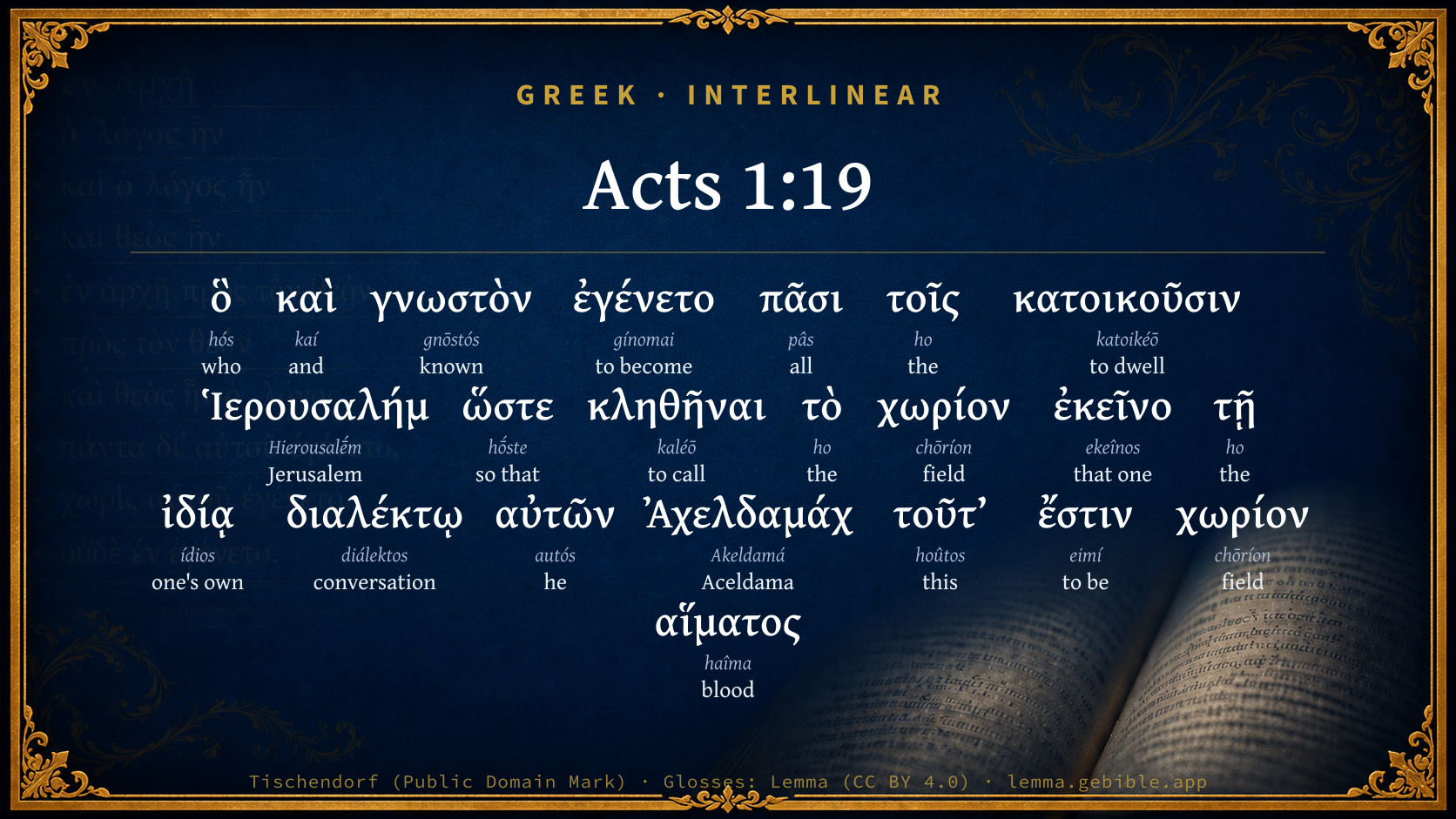
Download image
Cite this verse

Acts 1:19 (World English Bible). Public Domain. Lemma interlinear Bible study tool, https://lemma.gebible.app/v/acts/1/19.

Show BibTeX & RIS
BibTeX
RIS
English Translation
It became known to everyone who lived in Jerusalem that in their language that field was called 'Akeldama,' that is, 'The field of blood.'
World English Bible · Public Domain
Highlights
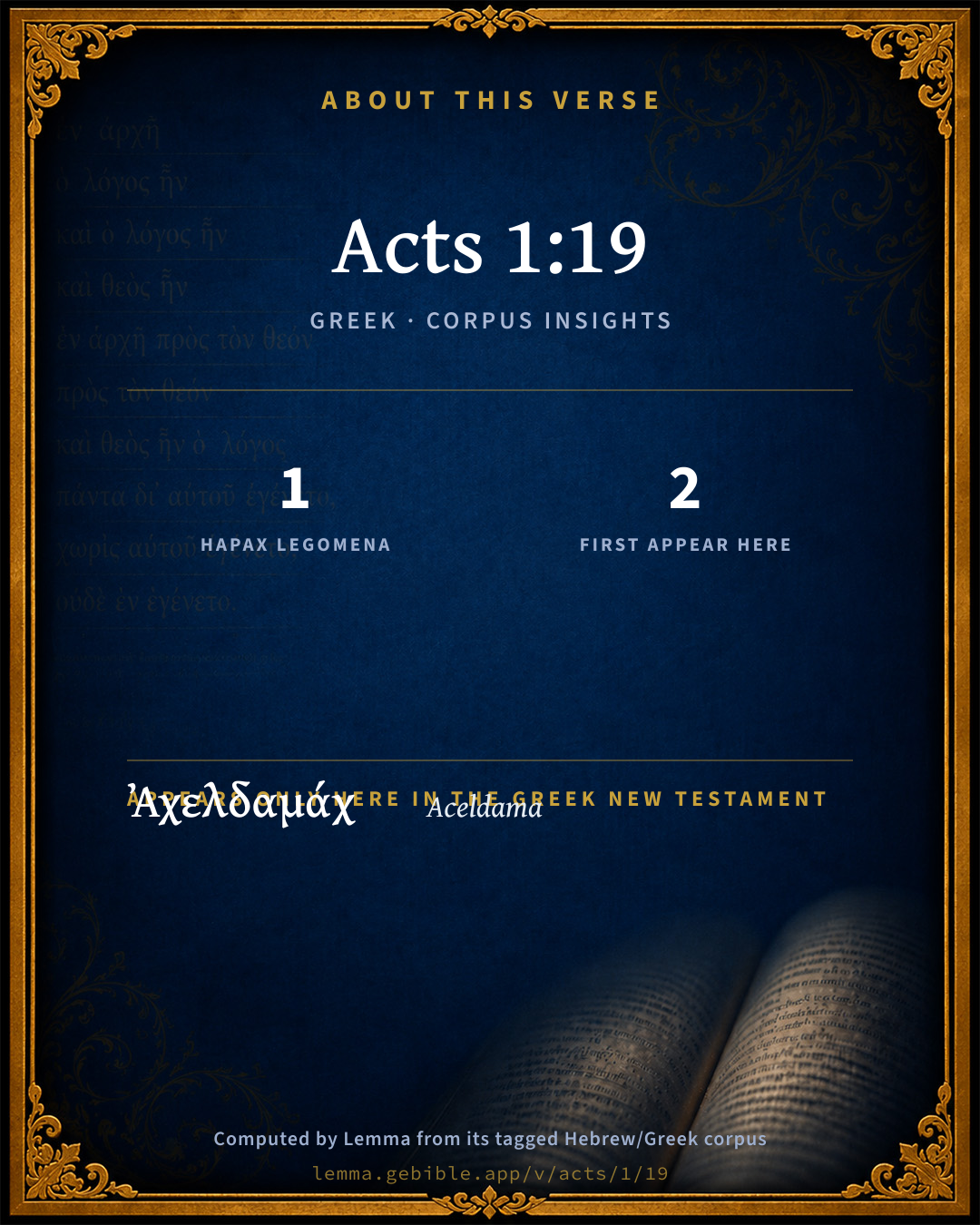
  • 1 hapax legomenon — only here in the Greek New Testament
  • 2 first appearances in the Greek New Testament
Full analysis ↓
Download a study sheet

One document with this verse’s original text, its word-by-word gloss line, the meaning frame, cross-references with their text, attributed commentary, and full source and license credits — printable, and it pastes into notes with its structure intact.

This verse Autodidact and up

Study sheet (.html) Plain text (.txt)

A passage Seminary Student

Up to 50 verses in one chapter. A passage sheet keeps up to 6 commentary sources and 12 cross-references per verse, in the order this page ranks them, and says so on the sheet whenever that leaves anything out. Ask for a single verse and you get the Autodidact verse sheet above.

Everything on this page stays free to read, with no account — the sheet is a download of what is already on screen, not access to it.

Want to remove ads? Support Godless Engineer
Compare translations 3

The same verse in 3 English versions, stacked beneath the original-language interlinear above. Click any original word for its lexicon entry.

Each is an independent rendering of the whole verse — the interlinear is not word-aligned to these translations.

Highlighted words mark where these versions differ — a whole-verse word diff, not a word-by-word alignment.

  • World English Bible Public Domain
    It became known to everyone who lived in Jerusalem that in their language that field was called 'Akeldama,' that is, 'The field of blood.'
  • King James Version Public Domain
    And it was known unto all the dwellers at Jerusalem; insomuch as that field is called in their proper tongue, Aceldama, that is to say, The field of blood.
  • unfoldingWord Literal Text CC BY-SA 4.0
    And it became known to all those living in Jerusalem. Therefore that field was called in their own language Akeldama, that is, Field of Blood.)

unfoldingWord Literal Text — © unfoldingWord, licensed CC BY-SA 4.0. Word-aligned USFM3 via Door43 (git.door43.org/unfoldingWord/en_ult).

Versions to compare (up to 4)

3 of 4 selected

Show all 19 translations

Every available English version of this verse, each an independent rendering of the whole verse.

  • World English Bible Public Domain
    It became known to everyone who lived in Jerusalem that in their language that field was called 'Akeldama,' that is, 'The field of blood.'
  • Berean Standard Bible Public Domain
    This became known to all who lived in Jerusalem, so they called that field in their own language Akeldama, that is, Field of Blood.)
  • Majority Standard Bible Public Domain
    This became known to all who lived in Jerusalem, so they called that field in their own language Akeldama, that is, Field of Blood.)
  • King James Version Public Domain
    And it was known unto all the dwellers at Jerusalem; insomuch as that field is called in their proper tongue, Aceldama, that is to say, The field of blood.
  • American Standard Version (1901) Public Domain
    And it became known to all the dwellers at Jerusalem; insomuch that in their language that field was called Akeldama, that is, The field of blood.)
  • Revised Version (1885) Public Domain
    And it became known to all the dwellers at Jerusalem; insomuch that in their language that field was called Akeldama, that is, The field of blood.)
  • Geneva Bible (1599) Public Domain
    And it is knowen vnto all the inhabitants of Hierusalem, in so much, that that field is called in their owne language, Aceldama, That is, the field of blood.
  • Douay-Rheims (1899) Public Domain
    And it became known to all the inhabitants of Jerusalem: so that the same field was called in their tongue, Haceldama, that is to say, The field of blood.
  • Young's Literal Translation Public Domain
    and it became known to all those dwelling in Jerusalem, insomuch that that place is called, in their proper dialect, Aceldama, that is, field of blood,
  • Literal Standard Version CC BY-SA 4.0
    and it became known to all those dwelling in Jerusalem, insomuch that this place is called, in their proper dialect, Aceldama, that is, Field of Blood.)
  • Unlocked Literal Bible CC BY-SA 4.0
    All those living in Jerusalem heard about this, so they called that field in their language “Akeldama,” that is, “Field of Blood.”)
  • unfoldingWord Literal Text CC BY-SA 4.0
    And it became known to all those living in Jerusalem. Therefore that field was called in their own language Akeldama, that is, Field of Blood.)
  • Darby Bible Public Domain
    And it was known to all the inhabitants of Jerusalem, so that that field was called in their own dialect Aceldama; that is, field of blood.)
  • World Messianic Bible Public Domain
    It became known to everyone who lived in Jerusalem that in their language that field was called ‘Hakel-Dema,’ that is, ‘The field of blood.’
  • Webster's Bible Public Domain
    And it was known to all the dwellers at Jerusalem; so that that field is called in their proper tongue, Aceldama, that is to say, The field of blood.
  • Free Bible Version CC BY-SA 4.0
    Everybody who lived in Jerusalem heard about this so that the field was called in their language “Akeldama,” which means, “Field of blood.”)
  • Bible in Basic English Public Domain
    And this came to the knowledge of all those who were living in Jerusalem, so that the field was named in their language, Akel-dama, or, The field of blood.)
  • Text-Critical English NT CC BY 4.0
    This became known to all who were dwelling in Jerusalem, so that in their language the field was called Akeldama, that is, Field of Blood.)
  • Tyndale New Testament (1534) Public Domain
    And it is knowe vnto all the inhabiters of Ierusalem: in so moche that that felde is called in their mother tonge Acheldama that is to saye the bloud felde.

Literal Standard Version (2020), Covenant Press — licensed CC BY-SA 4.0. Text via the HelloAO Bible API (eBible.org). Unlocked Literal Bible (unfoldingWord) — licensed CC BY-SA 4.0. Text via the HelloAO Bible API (eBible.org). unfoldingWord Literal Text — © unfoldingWord, licensed CC BY-SA 4.0. Word-aligned USFM3 via Door43 (git.door43.org/unfoldingWord/en_ult). Free Bible Version, Dr. Jonathan Gallagher — licensed CC BY-SA 4.0. Text via the HelloAO Bible API (eBible.org).

Word by word

More ways to search: Search by grammar → Find every occurrence → Compare this word →

Practice this passage: Drill this verse → Learn its vocabulary →

Ἀχελδαμάχ
Akeldamá
G184
“Aceldama”
Noun, Proper, indeclinable
Part of Speech
Noun · Proper, indeclinable
Full Thayer's Definition

Origin: of Aramaic origin [corresponding to G2506 and G1818 ]

TDNT: None

Aceldama = "Field of Blood" 1. a field purchased with Judas's betrayal money, located near Jerusalem
  1. ὃ hós G3739 “who” Relative pronoun, Nominative, Singular, Neuter
  2. καὶ kaí G2532 “and” Conjunction
  3. γνωστὸν gnōstós G1110 “known” Adjective, Nominative, Singular, Neuter
  4. ἐγένετο gínomai G1096 “to become” Verb, Aorist, Middle deponent, Indicative, 3rd person, Singular
  5. πᾶσι pâs G3956 “all” Adjective, Dative, Plural, Masculine
  6. τοῖς ho G3588 “the” Article, Dative, Plural, Masculine
  7. κατοικοῦσιν katoikéō G2730 “to dwell” Verb, Present, Active, Participle, Dative, Plural, Masculine
  8. Ἱερουσαλήμ Hierousalḗm G2419 “Jerusalem” Noun, Proper, indeclinable
  9. ὥστε hṓste G5620 “so that” Conjunction
  10. κληθῆναι kaléō G2564 “to call” Verb, Aorist, Passive, Infinitive
  11. τὸ ho G3588 “the” Article, Accusative, Singular, Neuter
  12. χωρίον chōríon G5564 “field” Noun, Accusative, Singular, Neuter
  13. ἐκεῖνο ekeînos G1565 “that one” Demonstrative pronoun, Accusative, Singular, Neuter
  14. τῇ ho G3588 “the” Article, Dative, Singular, Feminine
  15. ἰδίᾳ ídios G2398 “one's own” Adjective, Dative, Singular, Feminine
  16. διαλέκτῳ diálektos G1258 “conversation” Noun, Dative, Singular, Feminine
  17. αὐτῶν autós G846 “he” Personal pronoun, Genitive, Plural, Masculine
  18. τοῦτ’ hoûtos G3778 “this” Demonstrative pronoun, Nominative, Singular, Neuter
  19. ἔστιν eimí G1510 “to be” Verb, Present, Active, Indicative, 3rd person, Singular
  20. χωρίον chōríon G5564 “field” Noun, Accusative, Singular, Neuter
  21. αἵματος haîma G129 “blood” Noun, Genitive, Singular, Neuter

About this verse

These counts appear in no published source. They are computed here, from the morphology-tagged text and Lemma’s own curated glosses. What Lemma adds →

22
words
19
distinct lemmas
Acts
section

Notable vocabulary

1 hapax legomenon — a word that appears only here in the entire Greek New Testament:

  • Ἀχελδαμάχ Aceldama G184

First appearance in Scripture

These words make their first canonical appearance in the Greek New Testament here:

  • διαλέκτῳ conversation G1258
  • Ἀχελδαμάχ Aceldama G184

Shared distinctive vocabulary

διαλέκτῳ conversation G1258 occurs in 6 verses of the Greek New Testament. Also found in:
Repetition

Words recur within this verse:

  • χωρίον field G5564 ×2
  • τοῖς the G3588 ×3

Cross-references

4

Topical passages linked to Acts 1:19 in the Treasury of Scripture Knowledge — connected by theme and wording, ordered by reader-vote popularity; previews shown in the World English Bible.

  • 2 Samuel 2:16 They caught everyone his fellow by the head, and [thrust] his sword in his fellow's side; so they fell down together: therefore that place was called Helkath Hazzurim, which is in Gibeon.
  • Matthew 28:15 So they took the money and did as they were told. This saying was spread abroad among the Jews, and continues until this day.
  • Acts 2:22 "Men of Israel, hear these words! Jesus of Nazareth, a man approved by God to you by mighty works and wonders and signs which God did by him in the midst of you, even as you yourselves know,
  • Acts 21:40 When he had given him permission, Paul, standing on the stairs, beckoned with his hand to the people. When there was a great silence, he spoke to them in the Hebrew language, saying,

Cross-references courtesy of OpenBible.info (CC BY 4.0).

Commentary

Notes on Acts 1:19 from classic Christian and Jewish commentators (each source and its license shown beneath its notes). The classic Christian expositions comment on the surrounding passage and are grouped to its opening verse, so a note may address several verses; the Jewish commentaries on the Tanakh (Rashi and others) are per-verse, so they appear only where the commentator wrote on this verse.

Lemma curates 59 commentaries, every one of them public domain or Creative Commons licensed, each selected and text-cleaned for this edition rather than reprinted as found. About our sources →

Bengel's Gnomon

Johann Albrecht Bengel

Act 1:19. Γνωστὸν ἐγένετο, it became known) namely, that which is mentioned in the beginning of Act 1:18.—τῇ ἰδίᾳ, in their own idiom [tongue]) This and the subsequent interpretation of it, This is the field of blood, Luke has added to the speech of Peter for the information of Theophilus, and the reader who does not understand Hebrew.

Bengel's Gnomon of the New Testament — English translation (T&T Clark, Edinburgh, 1860) — public domain. Text from a community e-Sword module.

Meyer's Critical & Exegetical Commentary

Heinrich August Wilhelm Meyer

Act_1:19. Not even these words are to be considered, with the above-mentioned expositors (also Schleierm. Einl. p. 372), as an inserted remark of Luke, but as part of the speech of Peter. For all that they contain belongs essentially to the complete description of the curse of the action of Judas: ἐγένετο forms with ἐλάκησε and ἐξεχύθη, Act_1:18, one continuously flowing representation, and γνωστὸν … Ἱερουσ. is more suitable to rhetorical language than to that of simple narration. But τῇ ἰδίᾳ διαλέκτῳ αὐτῶν[105] and τοῦτ ̓ ἔστι χωρ. αἵμ. are two explanations inserted by Luke, the distinction between which and Peters own words might be trusted to the reader; for it is self-evident (in opposition to Lange and older commentators) that Peter spoke not Greek but Aramaic.

γνωστὸν ἐγέν.] namely, what is stated in Act_1:18.

ὥστε] so that, in consequence of the acquisition of that field and of this bloody death of Judas becoming thus generally known. According to our passage, the name field of blood (חֲקַל דְּמָא, comp. Mat_27:8) was occasioned by the fact that Judas, with whose wages of iniquity the field was acquired, perished in a manner so bloody (according to others: on the field itself; see on Act_1:18). The passage in Matthew, l.c., gives another and more probable reason for the name. But it is by no means improbable that the name soon after the death of Judas became assigned, first of all, in popular use, to the field purchased for the public destination of being a ΧΩΡΊΟΝ ἘΝΤΑΦῆΝΑΙ (Aeschin. i. 99; Mat_28:7); hence Peter might even now quote this name in accordance with the design of his speech.

ΔΙΆΛΕΚΤΟς] (in the N. T. only in Acts), a mode of speaking, may express as well the more general idea of language, as the narrower one of dialect.[106] In both senses it is often used by Polybius, Plutarch, etc. In the older Greek it is colloquium (Plat. Symp. p. 203 A, Theaet. p. 146 B), pronuntiatio (Dem. 982. 18), sermo (Arist. Poet. 22). In all the passages of Acts it is dialect, and that, excepting at Act_2:6; Act_2:8, the Aramaic, although it has this meaning not in itself, but from its more precise definition by the context.

[105] αὐτῶν: of the dwellers of Jerusalem (who spoke the Aramaic dialect), spoken from the standpoint of Luke and Theophilus, quorum alter Graece scriberet alter legeret, Erasmus.

[106] Valckenaer well observes on the distinction between these two ideas: Habent omnes dialecti aliquid inter se commune; habent enim omnes eandem linguam matrem, sed dialectum efficit, quod habent singulae peculiare sibi. The Greeks also employ φωνή in both senses (see also Clem. Al. Strom. i. 21, p. 404, Pott).

Meyer — Critical and Exegetical Commentary on the New Testament — English translation by Peter Christie, edited by Frederick Crombie (T&T Clark, 1880) — public domain. Text from a community e-Sword module.

Expositor's Greek Testament

ed. W. Robertson Nicoll

Act 1:19 . καὶ γνωστὸν … πᾶσιν τοῖς κατοικοῦσιν Ἱερουσ .: the words have been taken to support the view that we have here a parenthesis containing the notice of St. Luke, but if St. Peter was speaking rhetorically he might easily express himself so. But many critics, who refuse to see in the whole of the two verses any parenthetical remarks of the historian, adopt the view that τῇ διαλέκτῳ αὐτῶν and τοῦτʼ ἔστιν χωρίον αἵματος are explanations introduced by St. Luke, who could trust to his Gentile readers to distinguish between his words and those of St. Peter (Wendt, Holtzmann, Zöckler, Nösgen, Jüngst. Matthias). τῇ διαλέκτῳ : only in Acts in the N.T., where it is used six times in all parts; it may mean dialect or language, but here it is used in the latter sense (R.V.) to distinguish Aramaic from Greek ( cf. its use in Polybius). αὐτῶν , i.e. , the dwellers of Jerusalem, who spoke Aramaic unless the whole expression is used rhetorically, it would seem that it contains the words, not of St. Peter, who himself spoke Aramaic, but of the author (see Blass, in loco ). Ἀκελδαμά : the Aramaic of the Field of Blood would be חֲקַל דְּמָא , and it is possible that the χ may be added to represent in some way the guttural [108] , just as Σιράχ = סירא , cf. Blass, in loco , and Grammatik des N. G. , p. 13. W.H [109] (so Blass) read Ἁκελδαμάχ (and Ἀχελδαμάχ , Tisch. and Treg.); see also on the word Winer-Schmiedel, pp. 60 and 63. A new derivation has been proposed by Klostermann, Probleme in Aposteltexte , p. 6 ff., which has gained considerable attention ( cf. Holtzmann, Wendt, Felten, Zöckler, in loco ), viz. : דְּמַךְ = κοιμᾶσθαι , so that the word = κοιμητήριον , cf. Mat 27:8 . This is the derivation preferred by Wendt, and it is very tempting, but see also Enc. Bibl. , I., 32, 1899, sub v.

[108] Codex Sinaiticus (sæc. iv.), now at St. Petersburg, published in facsimile type by its discoverer, Tischendorf, in 1862.

[109] Westcott and Hort’s The New Testament in Greek: Critical Text and Notes.

It is true that the two accounts in St. Matthew and St. Luke give two reasons for the name Field of Blood . But why should there not be two reasons? If the traitor in the agony of his remorse rushed from the Temple into the valley of Hinnom, and across the valley to “the potter’s field” of Jeremiah, the old name of the potter’s field might easily become changed in the popular language into that of “field of blood,” whilst the reason given by St. Matthew for the name might still hold good, since the blood-money, which by a fiction of law was still considered to belong to Judas, was employed for the purchase of the accursed spot as a burial ground for strangers. See Edersheim, Jesus the Messiah , ii., 574, 575. Whatever may be alleged as to the growth of popular fancy and tradition in the later account in Acts of the death of Judas, it cannot be said to contrast unfavourably with the details given by Papias, Fragment , 18, which Blass describes as “insulsissima et fœdissima”.

The Expositor's Greek Testament, edited by W. Robertson Nicoll (1897–1910) — public domain. Text from a community e-Sword module.

Adam Clarke's Commentary

Verse 19. It was known unto all the dwellers at Jerusalem] The repentance of Judas, his dying testimony in behalf of our Lord's innocence, and his tragical death, were publicly known, as was also the transaction about the purchase of the field, and hence arose the name by which at was publicly known. These circumstances must have lessened the credit of the chief priests, and have prepared the public mind to receive the Gospel of the kingdom, when preached to them after the day of pentecost.

That field is called in their proper tongue, Aceldama] This proper tongue was not the Hebrew; that had long ceased to be the proper tongue in Palestine: it was a sort of Chaldaio-Syriac which was commonly spoken. The word in the Syriac version is [Syriac] chacal-demo, and literally signifies the field of blood; because it was bought by the price of the life or blood of the Lord Jesus.

Adam Clarke's Commentary on the Bible (1810–1826) — public domain. Text from a community e-Sword/MySword module.

Ellicott's Commentary for English Readers

(19) In their proper tongue.—Literally, in their own dialect. The word is used frequently in the Acts (Act_2:6; Act_2:8; Act_21:40), but not elsewhere in the New Testament.

A Bible Commentary for English Readers, edited by Charles John Ellicott (1878–1897) — public domain. Text from a community e-Sword module.

The Cambridge Bible for Schools and Colleges

gen. ed. J. J. S. Perowne

19. And it was known] Rather, became known. The fate of Judas, if he died there, and the way in which the purchase money was obtained, caused the name to be changed from “the Potter’s Field” to “the Field of Blood,” all people recognizing the fitness of the new name.

is called] The use of expressions like this in the present tense shews that we are dealing with documents written before the destruction of Jerusalem.

in their proper tongue] i.e. in the language spoken by the Jews in Jerusalem, which was Aramaic. The addition of these words and the explanation of the name Akeldama point to this passage as an insertion made by St Luke for the information of Theophilus, who, as his name indicates, was probably of Greek origin, and, it may be, unacquainted with the vernacular speech of Palestine. There could have been no need for St Peter to make such an explanation to the one hundred and twenty who listened to his address. Nor, indeed, is it probable that the name “Field of Blood” became of such common use within the time between the Crucifixion and the election of Matthias, as to make it possible for St Peter to have used the words.

For a similar insertion of a significant name introduced into a compiled narrative before the time at which the name was actually given, cp. 1Sa_4:1, where Eben-ezer is spoken of, though the circumstances in which the name originated are not mentioned till 1Sa_7:12.

The Cambridge Bible for Schools and Colleges (gen. ed. J. J. S. Perowne; Cambridge University Press, 1878–1918) — public domain. Text from a community e-Sword module.

John Gill's Exposition

And it was known unto all the dwellers at Jerusalem,.... As that he betrayed Jesus of Nazareth into the hands of the chief priests, for thirty pieces of silver; that this was the reward of his iniquity; and that with this a field was purchased for the burying of strangers in; and that he died in such a miserable way: there was scarce an inhabitant in Jerusalem but knew all this,

insomuch as that field is called in their proper tongue; or "in their own dialect", the "Jerusalem dialect", Which was now Chaldee, or Syriac; and such is the word that follows, "Aceldama; that is to say, the field of blood": because it was bought with the price of Christ's blood: and if, as some say, Judas hanged him self here, or was thrown headlong here by Satan, and that this was the place where his bowels gushed out; then it may be likewise so called, because it was sprinkled with his blood. It is called in the Alexandrian copy "Acheldamach"; and often by Jerom (p) "Acheldemach", but very wrongly; for not "Demach", but "Dema", in the Syriac and Chaldee dialect, signifies "blood"; which Peter calls the dialect of the inhabitants of Jerusalem, being now spoken by them, in distinction from the Galilean dialect used by him; which, it is plain, was different from the Jerusalem dialect by what is said, Mar 14:70. This field, as it is reported by some, was by the appointment of the Empress Helena compassed about with four walls, in the manner of a tower, upon the top of which are seven distinct doors, like windows, by which the dead bodies of Christians are let down into it; and that it is fifty feet wide, and seventy two long: it stands not far from the valley of Himom, and is upon the south side of Mount Zion, where, as Jerom says (q), it was showed in his time. Masius (r) affirms, there was a very high mountain near Jerusalem, called Mount Aceldema, from the adjacent field, which was bought with the price of Christ's blood, to bury strangers in,

(p) Comment. in Psal. 108. fol. 73. D. & de locis Hebraicis, fol. 89. C. & 95. H. & de Nominibus Hebraicis, fol. 105. H. (q) De locis Hebraicis, ib. (r) Comment. in Josuam, p. 283.

John Gill's Exposition of the Whole Bible (1746–1763) — public domain (CC PDM 1.0). Text via the HelloAO Bible API.

Trapp's Complete Commentary

John Trapp

19 And it was known unto all the dwellers at Jerusalem; insomuch as that field is called in their proper tongue, Aceldama, that is to say, The field of blood.

Ver. 19. In their proper tongue] i.e. In the Syriac tongue; for the Jews in the Babylonish captivity lost their language.

John Trapp, A Commentary or Exposition upon All the Books of the Old and New Testament (1647–1656) — public domain. Text from a community e-Sword module.

Albert Barnes' Notes on the Bible

It was known ... - , Mat 27:8. The scene in the temple; the acts of the priests in purchasing the field, etc., would make it known; and the name of the field would preserve the memory of the guilt of Judas.

Their proper tongue - The language spoken by the Jews the Syro-Chaldaic.

Aceldama - This is composed of two Syro-Chaldaic words, and means literally, the field of blood.

Albert Barnes' Notes on the Bible (1834–1885) — public domain. Text from a community e-Sword/MySword module.

Matthew Poole's English Annotations

Their proper tongue; the Syriac language then in use after the Babylonish captivity.

The field of blood; as bought with the price of Christ’s blood, and sprinkled with his own blood.

Matthew Poole's English Annotations on the Holy Bible (1683–1685) — public domain. Text from a community e-Sword/MySword module.

Whedon's Commentary on the Bible

Daniel D. Whedon

19. Known unto all—A bold appeal to public notoriety, indicating the full confidence of the writer in the public truth of the narrative. The crucifixion of Jesus, we infer, was no obscure event, but had made a wide and solemn impression on the minds of the people of Jerusalem.

In their proper tongue—The Aramaic, or Syro-Chaldaic. This was probably the very dialect in which Peter was speaking. He could not, therefore, have called it “their proper tongue,” for it was his own, nor would the name have needed translation. The words are, therefore, Luke’s, and intended for more distant readers. (See note above on 18, 19.)

Aceldama… field of blood— As bought with the price of Jesus’ blood.

Daniel D. Whedon (gen. ed.), Commentary on the Old and New Testaments (1874–1909) — public domain. Text from a community e-Sword module.

The Pulpit Commentary

Became known for was know, A.V.; that in their language that field was called Akeldama for as that field is called in their proper tongue, Aceldama, A.V. and T.R.

The Pulpit Commentary (1880–1919), ed. H.D.M. Spence-Jones & Joseph S. Exell — public domain. Text from a community e-Sword module.

John Wesley's Explanatory Notes

In their own tongue - This expression, That is, the field of blood, St. Luke seems to have added to the words of St. Peter, for the use of Theophilus and other readers who did not understand Hebrew.

John Wesley, Explanatory Notes Upon the Whole Bible (1754–1765) — public domain. Text via the GEBible commentary corpus.

McGarvey & Pendleton's Commentaries

J. W. McGarvey

19. The next statement, (19) " And it was known to all the dwellers in Jerusalem, so that that field is called, in their proper tongue, Aceldama, that is to say, the field of blood, " is undoubtedly a parenthesis by Luke. Peter was addressing the very people in whose proper tongue the place was called Aceldama, and would not, of course, translate it to them. Hence, we can not attribute these words to him. But Luke was writing in Greek, and felt called upon to translate Hebrew words which he might use into Greek, and the fact that this is done here prove the words to be his.

J. W. McGarvey (with Philip Y. Pendleton), Commentaries on the New Testament (The Fourfold Gospel, 1914; Acts; and the epistles) — public domain. Text from a community e-Sword/MySword module.

The People's New Testament

B. W. Johnson

19. That field is called. The field bought with the bribe money of Judas. He came to such a bloody end that this, and the origin of the purchase money, gave the field its name.

B. W. Johnson's The People's New Testament with Notes (1889–1891) — public domain. Electronic text from the Christian Classics Ethereal Library (CCEL) ThML edition.

Cambridge Greek Testament for Schools and Colleges

19. Ἀχελδαμάχ with אA. The form, though not easy to be accounted for, has also much support from the versions.

19. καὶ γνωστὸν ἐγένετο, and it became known. And hence the name of ‘the Potter’s Field’ was by general consent changed to ‘the Field of Blood.’ The entire story, as St Luke tells it, must have been what in later days became widely known, for there is nothing of it in St Matthew’s narrative, which only mentions the purchase to account for the change of name.

τῇ ἰδιᾳ διαλέκτῳ. i.e. in the Aramaic speech, which was the language of the dwellers in Jerusalem. The giving of this name must have taken place some time after the Day of Pentecost. So that St Luke is explaining parenthetically something in which evidence still remained, in the name, to bear witness to the terrible fate of Judas, and to the impression which it produced throughout all Jerusalem.

Ἀχελδαμάχ. This orthography, which has most authority, is not easy to explain. The Aramaic form would be חֲקַל דְּמָא, and for this we should expect an aspirate at the beginning of the word, and it is so represented in some authorities, as in Vulg., which gives ‘Haceldama.’ When the word was made to commence with ἀ, the principle of compensation for the lost aspirate may have converted Hacel into Ἀχελ (cf. for the converse of this ἔχω, future ἕξω), and the final χ may be due to a desire to represent in some way the final א of the Aramaic, which together with the preceding vowel-point might be deemed incompletely represented by α only.

Cambridge Greek Testament for Schools and Colleges (Cambridge University Press, 1896; 21 vols, various authors incl. Carr, Maclear, Plummer, Farrar, Lumby, Moule, M. R. James, Simcox) — public domain. Text from a community e-Sword module.

Alford’s Greek Testament

Henry Alford

19.] It is principally from this verse that it has been inferred that the two vv. 18, 19 are inserted by Luke. But it is impossible to separate it from ver. 18; and I am disposed to regard both as belonging to Peter’s speech, but freely Græcized by Luke, inserting into the speech itself the explanations τῇ [ἰδίᾳ] διαλ. αὐτ., and τουτέστιν χ. αἵμ., as if the speech had been spoken in Greek originally. This is much more natural, than to parenthesize these clauses; it is, in fact, what must be more or less done by all who report in a language different from that actually used by the speaker. The words and idioms of another tongue contain allusions and national peculiarities which never could have been in the mind of one speaking in a different language; but the ear tolerates these, or easily separates them, if critically exercised.

γνωστὸν …] See Luk 24:18.

ὥστε] in Mat 27:8, the name ‘the field of blood’ is referred to the fact of its having been bought with the price of blood: here, to the fact of Judas having there met with a signal and bloody death. On the whole, I believe the result to which I have above inclined will be found the best to suit the phænomena of the two passages,—viz. that, with regard to the purchase of the field, the more circumstantial account in Matthew is to be adopted; with regard to the death of Judas, the more circumstantial account of Luke. The clue which joins these has been lost to us: and in this, only those will find any stumbling-block, whose faith in the veracity of the Evangelists is very weak indeed.

Ἀκελδαμάχ] חֲקִל דְּמָא. The field originally belonged to a potter, and was probably a piece of land which had been exhausted of its clay fit for his purposes, and so was useless. Jerome relates that it was still shewn on the S. side of Mount Sion (ἐν βορείοις τοῦ Σιὼν ὄρους, but by mistake, Eusebius), in which neighbourhood there is even now a bed of white clay (see Winer, Realw., art. ‘Blutacker’).

Henry Alford, The Greek Testament (1849–1861) — public domain. Text from a community e-Sword module.

Vincent's Word Studies in the New Testament

Marvin R. Vincent

Aceldama. Or, more properly, Akeldamach. The word is Aramaic, the language then spoken in Palestine.

Marvin R. Vincent, Word Studies in the New Testament (1887–1900) — public domain. Text from a community e-Sword/MySword module.

Lesson kit

Teaching starters — assembled from the data on this page, not authored interpretation. Every prompt links to the verse data it draws on. Edit before teaching.

Acts, in the Acts, opens this verse with 22 words (19 distinct Greek lemmas). Its most distinctive word is Akeldamá (“Aceldama”). A historical commentator’s framing appears above. Read the whole chapter for the surrounding context.

Discussion questions

  1. What does “Aceldama” (Akeldamá) contribute to the verse as a whole?
  2. This verse holds 1 word here found nowhere else in the Greek New Testament. What might the rare word draw attention to?
  3. 2 words here appear for the first time in Scripture. What is being introduced at this debut?
  4. Acts 2:6 shares the word «conversation» with this verse. How do the two illuminate each other?
  5. “field” occurs 2× in this one verse. What is the effect of the repetition?
  6. The translations on this page render this verse differently — a whole-verse word diff, not a word-by-word alignment. What might account for the different wordings?
  7. Reading how Bengel's Gnomon and Meyer's Critical & Exegetical Commentary read this verse, where do the two commentators agree and where do they part?

Things to notice

  • 1 word in this verse appears nowhere else in the Greek New Testament.
  • 2 words make their first canonical appearance in Scripture here.
  • These translations choose different wording for 16 words in this verse.
  • “field” occurs 2× in this single verse.
  • 19 distinct Greek lemmas span 22 words in this verse.

Reading settings

Reading text

Shown beneath each verse's original-language words.

Old Testament
Old Testament edition

Read the OT as the Masoretic Hebrew (MT) or the Greek Septuagint (LXX).

English shown for the Greek Septuagint (in the Hebrew ↔ Greek comparison).

Comparing translations? Open the Compare panel on any verse page to stack up to four side by side.