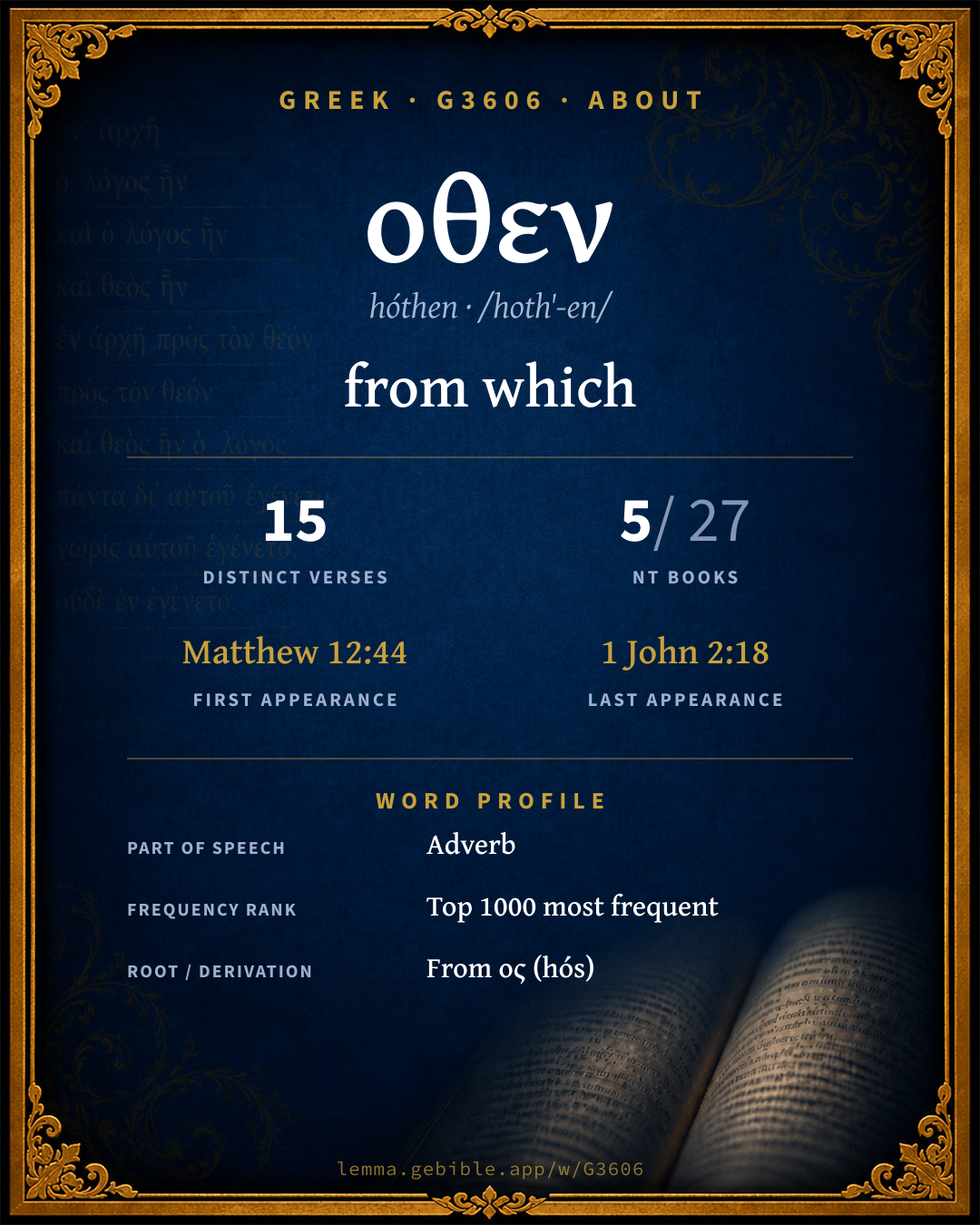
ὅθεν
from which
‘from which’ is one of 3 main senses fuller range ↓
Full lexicon entry — Thayer's Greek Lexicon
From Thayer's Greek Lexicon
Where this word appears
Grammar key — what these labels mean
Part of speech
- Adverb
- A word that modifies a verb, adjective, or other adverb.
Every verse where G3606 appears — 15 distinct verses across 5 books. Click any verse to open its interlinear word-by-word view. Verse text shown in the World English Bible for context — . Each verse’s Greek form is shown with its reference; the English is not keyword-highlighted, since the data carries no word-level English alignment. Use “Compare translations” on any verse to read it across multiple English versions. This concordance covers the Greek New Testament; Septuagint (Greek Old Testament) occurrences of this word are not indexed here.
Matthew 4 verses
- Matthew 12:44 ὅθεν adv Then he says, 'I will return into my house from which I came out,' and when he has come back, he finds it empty, swept, and put in order.
- Matthew 14:7 ὅθεν adv Whereupon he promised with an oath to give her whatever she should ask.
- Matthew 25:24 ὅθεν adv "He also who had received the one talent came and said, 'Lord, I knew you that you are a hard man, reaping where you did not sow, and gathering where you did not scatter.
- Matthew 25:26 ὅθεν adv "But his lord answered him, 'You wicked and slothful servant. You knew that I reap where I didn't sow, and gather where I didn't scatter.
Luke 1 verse
Acts 3 verses
- Acts 14:26 ὅθεν adv From there they sailed to Antioch, from where they had been committed to the grace of God for the work which they had fulfilled.
- Acts 26:19 ὅθεν adv "Therefore, King Agrippa, I was not disobedient to the heavenly vision,
- Acts 28:13 ὅθεν adv From there we circled around and arrived at Rhegium. After one day, a south wind sprang up, and on the second day we came to Puteoli,
Hebrews 6 verses
- Hebrews 2:17 ὅθεν adv Therefore he was obligated in all things to be made like his brothers, that he might become a merciful and faithful high priest in things pertaining to God, to make atonement for the sins of the people.
- Hebrews 3:1 Ὅθεν adv Therefore, holy brothers, partakers of a heavenly calling, consider the Apostle and High Priest of our confession, Jesus;
- Hebrews 7:25 ὅθεν adv Therefore he is also able to save to the uttermost those who draw near to God through him, seeing he ever lives to make intercession for them.
- Hebrews 8:3 ὅθεν adv For every high priest is appointed to offer both gifts and sacrifices. Therefore it is necessary that this high priest also have something to offer.
- Hebrews 9:18 ὅθεν adv Therefore even the first covenant has not been dedicated without blood.
- Hebrews 11:19 ὅθεν adv accounting that God is able to raise up even from the dead. Figuratively speaking, he also did receive him back from the dead.
1 John 1 verse
About this entry
At a glance — auto-summarized from this page’s data, not written by a person. Every figure links to its source below. This summary describes the numbers; it doesn’t interpret them.
οθεν — transliterated hóthen — is a Greek verb carrying the sense “from which.” Its earliest occurrence is Matthew 12:44. It appears 15 verses across 5 books of the Greek New Testament, among its uncommon vocabulary. More than a third of its appearances fall in Hebrews. Thayer's distinguishes 3 senses for it. See the sense tree, 15-verse concordance, and the renderings breakdown below.
Gloss history
Strong's 1890 vs modern scholarship
About this word
Strong's G3606 catalogs a Greek word from the Greek New Testament.
These counts are not copied from any lexicon or concordance. They are computed here, from the morphology-tagged Greek New Testament. What Lemma adds →
- 15
- distinct verses
- The word appears in 15 distinct verses.
- 5 / 27
- NT books
- The word appears in 5 of 27 New Testament books.
- #768
- by frequency
- Top 1000 most frequent Greek words (rank 768 of 5,347 Greek words by occurrence).
View all 15 occurrences in the concordance →
By section of the New Testament
By traditional corpus
Conventional, traditional groupings — biblical authorship is debated, so this is a traditional corpus grouping, not an authorship claim. Some books belong to more than one corpus (Luke is in both the Gospels and the Lukan corpus, and so on), so these shares overlap and need not total 100%. Each figure is a share of the word’s 15 distinct verses.
- Hebrews 6 verses · 40%
- Gospels 5 verses · 33%
- Lukan (Luke–Acts) 4 verses · 27%
- Johannine 1 verse · 7%
- General (Catholic) Epistles 1 verse · 7%
How translations render this word
Counts come from each version’s own published word-to-Strong’s tagging or interlinear alignment — an approximate guide to how each version renders this word, not a word-level alignment the data otherwise carries. Because each total is that version’s own tagged count, the per-version totals vary from one another and need not match the appearance or distinct-verse counts above. These counts may also differ from a printed concordance because Lemma counts each distinctly tagged rendering and does not collapse phrase taggings into a single head-word total. This is a fixed set of word-tagged versions (KJV, ASV, BSB, ULT) and does not change with the reading translation you choose elsewhere. Each version’s license is shown beside its name below (and on Sources).
- King James Version: Whence 4×, Wherefore 4×, Whereupon 3×
- American Standard Version: Wherefore 6×, Whence 4×, Where 2×
- Berean Standard Bible: Where 3×, From 2×, Therefore 2×
- unfoldingWord Literal Text: Which 7×, Where 3×, There 2×
King James Version Public Domain
Renders G3606 across 15 tagged occurrences — most commonly:
Plus 2 renderings that appear only once — usually multi-word phrases or single function words the recovered tagging swept in, not distinct renderings.
American Standard Version Public Domain
Renders G3606 across 15 tagged occurrences — most commonly:
Plus 3 renderings that appear only once — usually multi-word phrases or single function words the recovered tagging swept in, not distinct renderings.
Berean Standard Bible Public Domain
Renders G3606 across 12 tagged occurrences — most commonly:
Plus 5 renderings that appear only once — usually multi-word phrases or single function words the recovered tagging swept in, not distinct renderings. Not rendered by a distinct English word in 1 further occurrence.
unfoldingWord Literal Text CC BY-SA 4.0
Renders G3606 across 15 tagged occurrences — most commonly:
Plus 1 rendering that appears only once — usually multi-word phrases or single function words the recovered tagging swept in, not distinct renderings.
Senses in Thayer's
The 3 senses Thayer's distinguishes for this word, in lexicon order (not ranked by frequency or importance). The full entry — with sub-senses — is in the Lexicon Entry tab.
- of the place from which
- of the source from which a thing is known, from which, whereby
- of the cause from which, for which reason, wherefore, on which account
Word origin
Derived from ος (hós) (G3739) — who.
From G3739 with the directive enclitic of source; from which place or source or cause (adverbially or conjugationally): - from thence (from) whence where (-by -fore -upon).
— Strong’s Exhaustive Concordance (1890), public domain.
Forms in the corpus
The 2 distinct written forms G3606 takes in the Greek New Testament, most frequent first — each parse links to that case’s occurrences in the concordance.
| Form | Parsing | Example | Uses |
|---|---|---|---|
| ὅθεν hóthen | Adverb | Matthew 12:44 | 14 |
| Ὅθεν Hóthen | Adverb | Hebrews 3:1 | 1 |
Same root — word family
Other Thayer's entries built from the same root as G3606, grouped by Strong’s listed origin. These share a root / origin per the lexicon — not necessarily a shared meaning. Each links to that word’s own entry.
Derives from
Shares the same root
- ο εστι hó esti G3603 which is
- οποιος hopoîos G3697 what sort
- οποτε hopóte G3698 when
- οπου hópou G3699 where
- οπως hópōs G3704 how
- οσακις hosákis G3740 as often as
- οσος hósos G3745 how much
- οσπερ hósper G3746 whomever
- οστις hóstis G3748 whoever
- οτε hóte G3753 when
- ου hoû G3757 where
- ποσος pósos G4214 how much
- ως hōs G5613 as
Compare all same-root words → Showing 4 of 15 — not the complete family. They share a root, not necessarily a meaning.
Septuagint usage
The same Greek word οθεν appears 18 times in the Greek Old Testament (Septuagint), across 17 verses in 10 books.
- 18
- LXX occurrences
- Tagged occurrences of this Greek word in the Septuagint.
- 17
- verses
- Distinct Septuagint verses containing this word.
- 10 / 39
- OT books
- The word appears in 10 of the 39 Old Testament books.
Sample Septuagint occurrences
- Genesis 10:14 ὅθεν
- Exodus 5:11 ὅθεν
- Deuteronomy 9:28 ὅθεν
- Ruth 2:9 ὅθεν
- 2 Kings 17:33 ὅθεν
- Job 10:21 ὅθεν
- Isaiah 30:32 ὅθεν
- Jeremiah 7:8 ὅθεν
- Ezekiel 29:14 ὅθεν
- Daniel 2:11 ὅθεν
Septuagint occurrences (same lexeme)
Every verse where the same Strong’s number (G3606) appears in the Greek Septuagint. Verse text shown in the World English Bible for context; the Greek form is the matched word — the English is not keyword-highlighted.
- Genesis 10:14 ὅθεν Pathrusim, Casluhim (which the Philistines descended from), and Caphtorim.
- Genesis 13:3 ὅθεν He went on his journeys from the South even to Bethel, to the place where his tent had been at the beginning, between Bethel and Ai,
- Genesis 24:5 ὅθεν The servant said to him, "What if the woman isn't willing to follow me to this land? Must I bring your son again to the land you came from?"
- Exodus 5:11 ὅθεν Go yourselves, get straw where you can find it, for nothing of your work shall be diminished."
- Exodus 30:36 ὅθεν and you shall beat some of it very small, and put some of it before the testimony in the tent of meeting, where I will meet with you. It shall be to you most holy.
- Deuteronomy 9:28 ὅθεν lest the land whence you brought us out say, Because Yahweh was not able to bring them into the land which he promised to them, and because he hated them, he has brought them out to kill them in the wilderness.
- Deuteronomy 11:10 ὅθεν For the land, where you go in to possess it, isn't as the land of Egypt, from whence you came out, where you sowed your seed, and watered it with your foot, as a garden of herbs;
- Ruth 2:9 ὅθεν Let your eyes be on the field that they reap, and go after them: haven't I charged the young men that they shall not touch you? and when you are thirsty, go to the vessels, and drink of that which the young men have drawn.
- 2 Kings 17:33 ὅθεν They feared Yahweh, and served their own gods, after the manner of the nations from among whom they had been carried away.
- Job 10:21 ὅθεν Before I go where I shall not return from, To the land of darkness and of the shadow of death;
- Job 28:1 ὅθεν "Surely there is a mine for silver, And a place for gold which they refine.
- Job 34:15 ὅθεν All flesh would perish together, And man would turn again to dust.
- Isaiah 30:32 ὅθεν Every stroke of the appointed staff, which Yahweh shall lay on him, shall be with [the sound of] tambourines and harps; and in battles with the brandishing [of his arm] will he fight with them.
- Isaiah 44:11 ὅθεν Behold, all his fellows shall be disappointed; and the workmen, they are of men: let them all be gathered together, let them stand up; they shall fear, they shall be put to shame together.
- Jeremiah 7:8 ὅθεν Behold, you trust in lying words, that can't profit.
- Ezekiel 29:14 ὅθεν and I will bring back the captivity of Egypt, and will cause them to return into the land of Pathros, into the land of their birth; and they shall be there a base kingdom.
- Daniel 2:11 ὅθεν It is a rare thing that the king requires, and there is no other who can show it before the king, except the gods, whose dwelling is not with flesh.
These are occurrences of the same Greek lexeme (G3606) in the Septuagint — not a translation of any one Hebrew word. The store carries no word-level Hebrew↔Greek alignment, so no Hebrew original is asserted here. Counts come from the recovered LXX Strong's tagging — high-frequency vocabulary is well covered, while rare or late forms may be untagged — so they reflect tagged occurrences and may slightly undercount.