
Acts 7:38

Greek (Tischendorf 8th ed.) Acts 7:38 appears in the Greek New Testament. The text above is from the Tischendorf 8th edition. Each word links to its Strong’s number and a concise gloss. Click any word for its full Thayer’s Greek Lexicon entry.
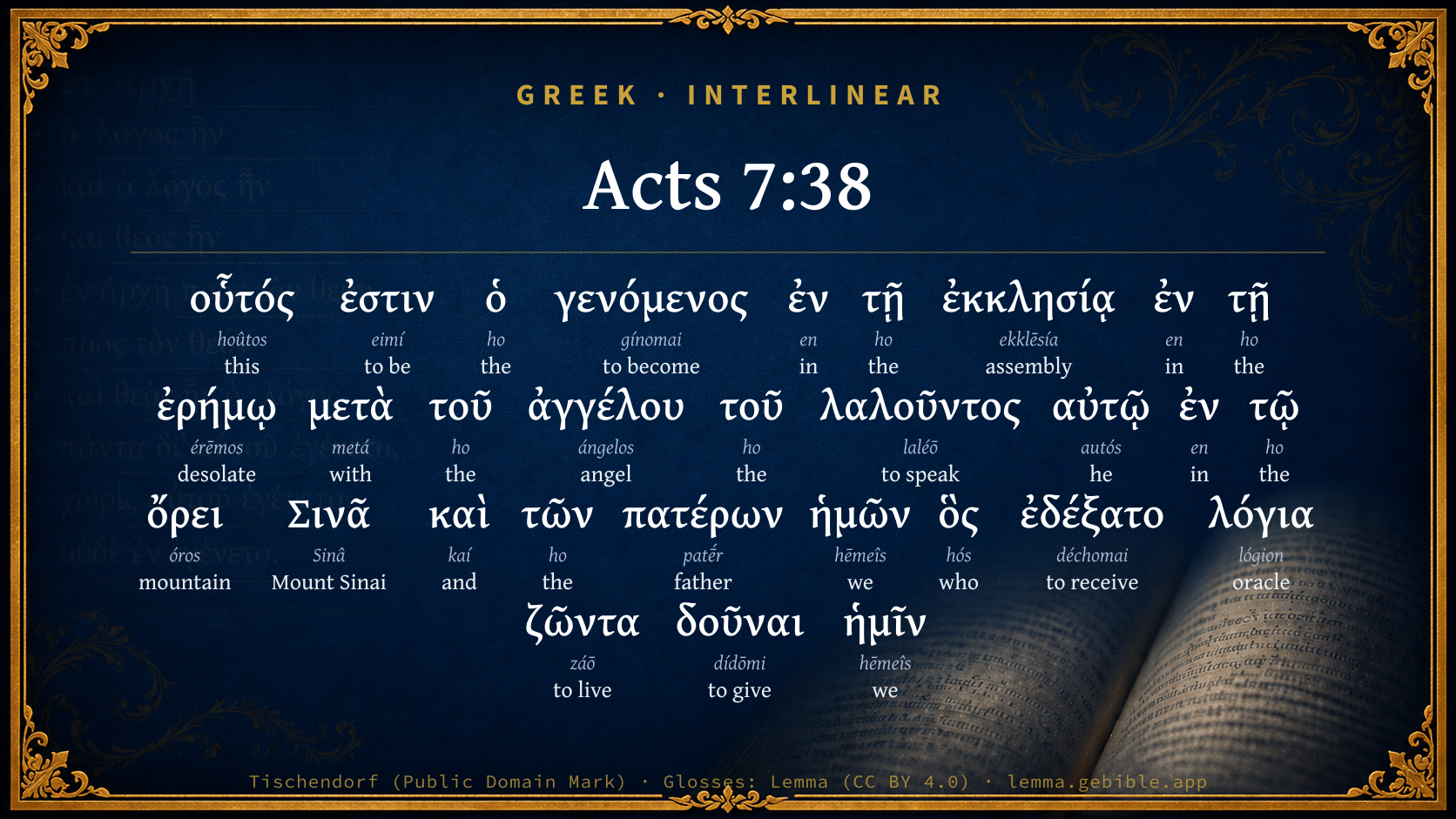
Download image
Cite this verse

Acts 7:38 (World English Bible). Public Domain. Lemma interlinear Bible study tool, https://lemma.gebible.app/v/acts/7/38.

Show BibTeX & RIS
BibTeX
RIS
English Translation
This is he who was in the assembly in the wilderness with the angel that spoke to him on Mount Sinai, and with our fathers, who received living oracles to give to us,
World English Bible · Public Domain
Highlights
  • 1 first appearance in the Greek New Testament
Full analysis ↓
Download a study sheet

One document with this verse’s original text, its word-by-word gloss line, the meaning frame, cross-references with their text, attributed commentary, and full source and license credits — printable, and it pastes into notes with its structure intact.

This verse Autodidact and up

Study sheet (.html) Plain text (.txt)

A passage Seminary Student

Up to 50 verses in one chapter. A passage sheet keeps up to 6 commentary sources and 12 cross-references per verse, in the order this page ranks them, and says so on the sheet whenever that leaves anything out. Ask for a single verse and you get the Autodidact verse sheet above.

Everything on this page stays free to read, with no account — the sheet is a download of what is already on screen, not access to it.

Want to remove ads? Support Godless Engineer
Compare translations 3

The same verse in 3 English versions, stacked beneath the original-language interlinear above. Click any original word for its lexicon entry.

Each is an independent rendering of the whole verse — the interlinear is not word-aligned to these translations.

Highlighted words mark where these versions differ — a whole-verse word diff, not a word-by-word alignment.

  • World English Bible Public Domain
    This is he who was in the assembly in the wilderness with the angel that spoke to him on Mount Sinai, and with our fathers, who received living oracles to give to us,
  • King James Version Public Domain
    This is he, that was in the church in the wilderness with the angel which spake to him in the mount Sina, and with our fathers: who received the lively oracles to give unto us:
  • unfoldingWord Literal Text CC BY-SA 4.0
    This is the one having been in the assembly in the wilderness with the angel speaking to him on Mount Sinai, and with our fathers, who received living words to give to us,

unfoldingWord Literal Text — © unfoldingWord, licensed CC BY-SA 4.0. Word-aligned USFM3 via Door43 (git.door43.org/unfoldingWord/en_ult).

Versions to compare (up to 4)

3 of 4 selected

Show all 19 translations

Every available English version of this verse, each an independent rendering of the whole verse.

  • World English Bible Public Domain
    This is he who was in the assembly in the wilderness with the angel that spoke to him on Mount Sinai, and with our fathers, who received living oracles to give to us,
  • Berean Standard Bible Public Domain
    He was in the assembly in the wilderness with the angel who spoke to him on Mount Sinai, and with our fathers. And he received living words to pass on to us.
  • Majority Standard Bible Public Domain
    He was in the assembly in the wilderness with the angel who spoke to him on Mount Sinai, and with our fathers. And he received a living word to pass on to us.
  • King James Version Public Domain
    This is he, that was in the church in the wilderness with the angel which spake to him in the mount Sina, and with our fathers: who received the lively oracles to give unto us:
  • American Standard Version (1901) Public Domain
    This is he that was in the church in the wilderness with the angel that spake to him in the Mount Sinai, and with our fathers: who received living oracles to give unto us:
  • Revised Version (1885) Public Domain
    This is he that was in the church in the wilderness with the angel which spake to him in the mount Sinai, and with our fathers: who received living oracles to give unto us:
  • Geneva Bible (1599) Public Domain
    This is he that was in the Congregation, in the wildernes with the Angell, which spake to him in mount Sina, and with our fathers, who receiued the liuely oracles to giue vnto vs.
  • Douay-Rheims (1899) Public Domain
    This is he that was in the church in the wilderness, with the angel who spoke to him on mount Sina, and with our fathers; who received the words of life to give unto us.
  • Young's Literal Translation Public Domain
    `This is he who was in the assembly in the wilderness, with the messenger who is speaking to him in the mount Sinai, and with our fathers who did receive the living oracles to give to us;
  • Literal Standard Version CC BY-SA 4.0
    This is he who was in the assembly in the wilderness, with the Messenger who is speaking to him in Mount Sinai, and with our fathers who received the living oracles to give to us;
  • Unlocked Literal Bible CC BY-SA 4.0
    This is the man who was in the assembly in the wilderness with the angel who had spoken to him on Mount Sinai. This is the man who was with our fathers; this is the man who received living words to give to us.
  • unfoldingWord Literal Text CC BY-SA 4.0
    This is the one having been in the assembly in the wilderness with the angel speaking to him on Mount Sinai, and with our fathers, who received living words to give to us,
  • Darby Bible Public Domain
    This is he who was in the assembly in the wilderness, with the angel who spoke to him in the mount Sinai, and with our fathers; who received living oracles to give to us;
  • World Messianic Bible Public Domain
    This is he who was in the assembly in the wilderness with the angel that spoke to him on Mount Sinai, and with our fathers, who received living revelations to give to us,
  • Webster's Bible Public Domain
    This is he, that was in the church in the wilderness with the angel who spoke to him on the mount Sina, and with our fathers: who received the living oracles to give to us:
  • Free Bible Version CC BY-SA 4.0
    Moses was with God's assembled people in the desert when the angel spoke to him at Mount Sinai, and there with our forefathers he received God's living word to give to us.
  • Bible in Basic English Public Domain
    This is the man who was in the church in the waste land with the angel who was talking to him in Sinai, and with our fathers; and to him were given the living words of God, so that he might give them to you.
  • Text-Critical English NT CC BY 4.0
    This is the man who was with our fathers in the assembly in the wilderness when the angel spoke to him on Mount Sinai. He received a living word to give to us.
  • Tyndale New Testament (1534) Public Domain
    This is he that was in the congregacion in the wyldernes with the angell which spake to him in the moute Syna and with oure fathers. This man receaved the worde of lyfe to geve vnto vs

Literal Standard Version (2020), Covenant Press — licensed CC BY-SA 4.0. Text via the HelloAO Bible API (eBible.org). Unlocked Literal Bible (unfoldingWord) — licensed CC BY-SA 4.0. Text via the HelloAO Bible API (eBible.org). unfoldingWord Literal Text — © unfoldingWord, licensed CC BY-SA 4.0. Word-aligned USFM3 via Door43 (git.door43.org/unfoldingWord/en_ult). Free Bible Version, Dr. Jonathan Gallagher — licensed CC BY-SA 4.0. Text via the HelloAO Bible API (eBible.org).

Word by word

More ways to search: Search by grammar → Find every occurrence → Compare this word →

Practice this passage: Drill this verse → Learn its vocabulary →

Σινᾶ
Sinâ
G4614
“Mount Sinai”
Noun, Proper, indeclinable
Part of Speech
Noun · Proper, indeclinable
Full Thayer's Definition

Origin: of hebrew origin H5514

TDNT: 11:42,1

Sinai = "thorny" 1. a mountain or rather a mountainous region in the peninsula of Arabia Petraea, made famous by the giving of the Mosaic law
  1. οὗτός hoûtos G3778 “this” Demonstrative pronoun, Nominative, Singular, Masculine
  2. ἐστιν eimí G1510 “to be” Verb, Present, Active, Indicative, 3rd person, Singular
  3. ὁ ho G3588 “the” Article, Nominative, Singular, Masculine
  4. γενόμενος gínomai G1096 “to become” Verb, Aorist, Middle deponent, Participle, Nominative, Singular, Masculine
  5. ἐν en G1722 “in” Preposition
  6. τῇ ho G3588 “the” Article, Dative, Singular, Feminine
  7. ἐκκλησίᾳ ekklēsía G1577 “assembly” Noun, Dative, Singular, Feminine
  8. ἐν en G1722 “in” Preposition
  9. τῇ ho G3588 “the” Article, Dative, Singular, Feminine
  10. ἐρήμῳ érēmos G2048 “desolate” Adjective, Dative, Singular, Feminine
  11. μετὰ metá G3326 “with” Preposition
  12. τοῦ ho G3588 “the” Article, Genitive, Singular, Masculine
  13. ἀγγέλου ángelos G32 “angel” Noun, Genitive, Singular, Masculine
  14. τοῦ ho G3588 “the” Article, Genitive, Singular, Masculine
  15. λαλοῦντος laléō G2980 “to speak” Verb, Present, Active, Participle, Genitive, Singular, Masculine
  16. αὐτῷ autós G846 “he” Personal pronoun, Dative, Singular, Masculine
  17. ἐν en G1722 “in” Preposition
  18. τῷ ho G3588 “the” Article, Dative, Singular, Neuter
  19. ὄρει óros G3735 “mountain” Noun, Dative, Singular, Neuter
  20. καὶ kaí G2532 “and” Conjunction
  21. τῶν ho G3588 “the” Article, Genitive, Plural, Masculine
  22. πατέρων patḗr G3962 “father” Noun, Genitive, Plural, Masculine
  23. ἡμῶν hēmeîs G2249 “we” Personal pronoun, 1st person, Genitive, Plural
  24. ὃς hós G3739 “who” Relative pronoun, Nominative, Singular, Masculine
  25. ἐδέξατο déchomai G1209 “to receive” Verb, Aorist, Middle deponent, Indicative, 3rd person, Singular
  26. λόγια lógion G3051 “oracle” Noun, Accusative, Plural, Neuter
  27. ζῶντα záō G2198 “to live” Verb, Present, Active, Participle, Accusative, Plural, Neuter
  28. δοῦναι dídōmi G1325 “to give” Verb, Aorist, Active, Infinitive
  29. ἡμῖν hēmeîs G2249 “we” Personal pronoun, 1st person, Dative, Plural

About this verse

These counts appear in no published source. They are computed here, from the morphology-tagged text and Lemma’s own curated glosses. What Lemma adds →

30
words
21
distinct lemmas
Acts
section

Notable vocabulary

The rarest word here is Σινᾶ Mount Sinai G4614 — appearing just 4 times in the whole Greek New Testament.

First appearance in Scripture

This word makes its first canonical appearance in the Greek New Testament here:

  • λόγια oracle G3051

Shared distinctive vocabulary

Σινᾶ Mount Sinai G4614 occurs in 4 verses of the Greek New Testament. Also found in:
Repetition

Words recur within this verse:

Cross-references

26

Topical passages linked to Acts 7:38 in the Treasury of Scripture Knowledge — connected by theme and wording, ordered by reader-vote popularity; previews shown in the World English Bible.

  • Romans 3:2 Much in every way! Because first of all, they were entrusted with the oracles of God.
  • Hebrews 5:12 For when by reason of the time you ought to be teachers, you again need to have someone teach you the rudiments of the first principles of the oracles of God. You have come to need milk, and not solid food.
  • Deuteronomy 33:4 Moses commanded us a law, An inheritance for the assembly of Jacob.
  • John 1:17 For the law was given through Moses. Grace and truth came through Jesus Christ.
  • Acts 7:53 You received the law as it was ordained by angels, and didn't keep it!"
  • 1 Peter 4:11 If any man speaks, let it be as it were oracles of God. If any man serves, let it be as of the strength which God supplies, that in all things God may be glorified through Jesus Christ, to whom belong the glory and the dominion forever and ever. Amen.
  • Deuteronomy 5:27–31 Go you near, and hear all that Yahweh our God shall say: and speak you to us all that Yahweh our God shall speak to you; and we will hear it, and do it.
  • Deuteronomy 6:1–3 Now this is the commandment, the statutes, and the ordinances, which Yahweh your God commanded to teach you, that you might do them in the land where you go over to possess it;
  • Deuteronomy 32:46–47 He said to them, Set your heart to all the words which I testify to you this day, which you shall command your children to observe to do, [even] all the words of this law.
  • Isaiah 63:9 In all their affliction he was afflicted, and the angel of his presence saved them: in his love and in his pity he redeemed them; and he bore them, and carried them all the days of old.
  • Exodus 19:3–17 Moses went up to God, and Yahweh called to him out of the mountain, saying, "This is what you shall tell the house of Jacob, and tell the children of Israel:
  • Exodus 20:19–20 They said to Moses, "Speak with us yourself, and we will listen; but don't let God speak with us, lest we die."
  • Exodus 21:1–11 "Now these are the ordinances which you shall set before them.
  • Numbers 16:3–35 and they assembled themselves together against Moses and against Aaron, and said to them, You take too much on you, seeing all the congregation are holy, everyone of them, and Yahweh is among them: why then lift yourselves up above the assembly of Yahweh?
  • Numbers 16:41–42 But on the next day all the congregation of the children of Israel murmured against Moses and against Aaron, saying, You have killed the people of Yahweh.
  • Deuteronomy 30:19–20 I call heaven and earth to witness against you this day, that I have set before you life and death, the blessing and the curse: therefore choose life, that you may live, you and your seed;
  • Nehemiah 9:13–14 You came down also on Mount Sinai, and spoke with them from heaven, and gave them right ordinances and true laws, good statutes and commandments,
  • Psalms 78:5–9 For he established a testimony in Jacob, And appointed a law in Israel, Which he commanded our fathers, That they should make them known to their children;
  • John 6:63 It is the spirit who gives life. The flesh profits nothing. The words that I speak to you are spirit, and are life.
  • Acts 7:30 "When forty years were fulfilled, an angel of the Lord appeared to him in the wilderness of Mount Sinai, in a flame of fire in a bush.
  • Acts 7:35 "This Moses, whom they refused, saying, 'Who made you a ruler and a judge?'--God has sent him as both a ruler and a deliverer by the hand of the angel who appeared to him in the bush.
  • Romans 9:4 who are Israelites; whose is the adoption, the glory, the covenants, the giving of the law, the service, and the promises;
  • Romans 10:6–10 But the righteousness which is of faith says this, "Don't say in your heart, 'Who will ascend into heaven?' (that is, to bring Christ down);
  • Galatians 3:19 What then is the law? It was added because of transgressions, until the seed should come to whom the promise has been made. It was ordained through angels by the hand of a mediator.
  • Hebrews 2:2 For if the word spoken through angels proved steadfast, and every transgression and disobedience received a just recompense;
  • Hebrews 4:12 For the word of God is living, and active, and sharper than any two-edged sword, and piercing even to the dividing of soul and spirit, of both joints and marrow, and is able to discern the thoughts and intentions of the heart.

Cross-references courtesy of OpenBible.info (CC BY 4.0).

Where the printed editions differ

2 variants

Places in this verse where the major printed Greek editions disagree on the wording in a way that affects the translation — a comparison of editions, not a manuscript-by-manuscript collation. The editions are the modern critical texts (Nestlé-Aland 28/27, SBL, Westcott-Hort, Tregelles, Tyndale House) and the traditional texts behind the KJV (the Textus Receptus and the Byzantine/Majority text). It is not a claim about which reading is original.

  1. Different wording
    λόγια

    “oracles”

    In NA28NA27TynSBLWHTregTR Not in Byz

    λόγον (logon) 'word' occurs in a few manuscripts (Byz) instead of λόγια (logia) 'oracles' in older manuscripts (NA28+NA27+Tyn+SBL+WH+Treg+TR)

  2. Different wording
    ἡμῖν·

    “to us;”

    In NA28NA27TynSBLTregTRByz Not in WH

    ὑμῖν (humin) 'to you' occurs in a few manuscripts (WH) instead of ἡμῖν· (hēmin) 'to us;' in older manuscripts (NA28+NA27+Tyn+SBL+Treg+TR+Byz)

Textual data: Translators Amalgamated Greek New Testament (STEPBible TAGNT) · CC BY 4.0.

Commentary

Notes on Acts 7:38 from classic Christian and Jewish commentators (each source and its license shown beneath its notes). The classic Christian expositions comment on the surrounding passage and are grouped to its opening verse, so a note may address several verses; the Jewish commentaries on the Tanakh (Rashi and others) are per-verse, so they appear only where the commentator wrote on this verse.

Lemma curates 59 commentaries, every one of them public domain or Creative Commons licensed, each selected and text-cleaned for this edition rather than reprinted as found. About our sources →

The Biblical Illustrator

Joseph S. Exell

Act_7:38

This is he … who received the lively oracles to give unto us.

Living oracle

Whatever sense lively (A.V.) may once have had, it can only now mislead: it is limited to certain special characteristics of life; living (R.V.) implies life in itself, life as a principle, life with all its manifold issues. The one is particular, the other is comprehensive. What more striking illustration could we have of this life, this vitality, than the great Bible Society, comprising members of many countries and churches, dispensing an income of more than £200,000 a year, dependent on gratuitous support, and bringing no gain to its members, concentrating all its energies and absorbing all its resources on the reproduction and the dissemination of one single Book--a Book, too, of which the latest page is some eighteen centuries old; claiming to have distributed already between ninety and a hundred million copies, and at this moment distributing year by year close upon three million of its volumes, whole or in part, in well-nigh every spoken language of the globe; however you may look at it this is a fact, to which the long roll of history presents not the faintest parallel. And yet this society does not stand alone. It is the handmaid of almost all the missionary associations throughout the world, to whatever church or whatever country they belong.

I. Life involves growth; growth is at once a characteristic and an evidence of life. We speak of life in a plant or tree, because it puts forth leaves and flowers and throws out fresh branches. We do not speak of a crystal as living. A crystal may be a very beautiful thing, but one thing it wants--Life. This figure fitly describes the Bible as contrasted with other sacred books. It did not come into being all at once; it was not the product of one mind or age; it is not a book, but a library; it is legislation, chronicles, poetry, philosophy, epistolography, allegory, romance, apocalyptic. It spreads over some thousands of years; it traverses the history of the race from the earliest dawn to the full noon-day of an elaborate civilisation. It was not written in any one place; Egypt, Assyria, Babylon, Persia, Greece, Rome, all contribute. Now we find ourselves wandering with nomadic tribes over lonely pastures beneath the starry sky; now we are dazzled by all the splendid surroundings of an Oriental despots court; now we are lodged in some humble peasant household, and now we stand face to face with the majesty and the insignia of the imperial law. Sea and land, mountain, field and forest, crowded city and trackless desert, each in its turn furnishes a theme for this ever-shifting drama. All the vicissitudes of human life, poverty, and wealth, mourning and joy, the marriage and the funeral, the secret communings of the individual soul, and the tumultuous activity of public life--all contribute their quota to its incidents.

II. Life involves unity--a unity underlying the various devolopment. There must be some principle of life from which all the growth is evolved, which stamps its character on all the parts, which secures the harmony and coherence of the whole. We speak of the germ in the plant, of the soul in the man. So it is with the Bible. Amidst all these marvellous diversities of time, place, condition, form, subject-matter, there is a principle of unity which is also the principle of life. This unity is quite as real in the different parts of the Bible as in the different; parts of a plant, or in the different ages of man. The first chapter of Genesis finds its natural and appropriate climax in the last chapter of Revelation, while all the intermediate parts have their proper place in the sequence written though they were long centuries apart and gathered together we hardly know when and we cannot say how; the New Testament latent in the Old, the Old Testament patent in the New. Its fame can never grow old or out of date. And this principle of life, this animated soul--what is it but the Eternal Word speaking through lawgiver and captain and priest and prophet and king, speaking in the continuous history of a nation and in the chequered but unbroken light of the Church until at length He became incarnate in the man Christ Jesus. The many modes and the many parts of the Divine revelation were harmonised, explained, completed when in the last days God spoke through His Son. Contrast this infinite variety, these worldwide interests and associations with the monotony of other great books. The Koran is Arabian, the Vedas are Indian, the Zendavesta is Persian, the Bible alone is cosmopolitan. Other books for the most part have a oneness of treatment, of subject-matter, even of style. They are like the statue fused in a mould; it may have a beauty of its own, but it is rigid; it has no movement and no life, and the purpose served by all this is that life speaks to life. As a living thing the Bible appeals to the mind, affections, historical instincts, domestic sympathies, political aspirations. It arrests first that it may instruct afterwards. And here in this intimate union of intensely human sympathies and interests with intensely Divine teaching, this close alliance of heaven and earth, the Bible ever is a type, a reflection, a counterpart of the Incarnation itself. In the Bible God stoops to man, in the Incarnation God becomes man. Thus the Incarnation is the ultimate satisfaction of all religious craving and the final goal of all religious history, beyond which no other step is possible or conceivable.

III. Life involves struggle. The Scriptures have proved themselves as living oracles by the controversies which they excite and the antipathies which they provoke. Is it not an eloquent fact that in the early persecutions, pre-eminently in the last and fiercest of all, the main object of attack was the sacred writings; that the foes of the gospel were ready enough to spare the lives of men if only they might take the life of the Book; that those were branded by their fellow-Christians with the name of traitor, not who had surrendered a human being, whether leader or confederate or friend, but who had betrayed the Book into the hands of the destroyer? Aye, these heathen persecutors were wise in their generation; they felt instinctively that these Scriptures were living things; that they were active and aggressive; that, as Luther said of St. Pauls Epistles, They have hands and feet--hands to grasp and feet to march; therefore they must be killed; they must be hurried out of sight. Was Milton so far wrong after all when he said that one who killed a good book is worse than a homicide; for, striking at the very breath of reason, he slays an immortality rather than a life? And as it was with the Greek Bible in the days of Diocletian, so was it also with the English Bible in the days of Henry. What a testimony to its living power is the record of its early days when that great man, who has won for himself an undying name, not only in English Christianity, but in English literature also, an outlaw and a wanderer in a foregin land, fled from city to city, carrying with him the half-translated texts, the half-printed sheets of his new version, the parent of our English Bible of to-day! Can we reflect without the deepest thanksgiving on this magnificent irony of the Divine goodness that within a stones-throw of the place where the gentle, tender-hearted, reasonable Tunstall committed to the flames the first issue of Tyndales New Testament as a thing to be abhorred and detested by all faithful Christian people, his latest successor in the see of Durham is able this day to congratulate a large, powerful, and wealthy society on its distributing within a single year no less than one million and a half copies of the English Bible, whole or in parts? (Bp. Lightfoot.)

The law of God, a living word

I. In itself it is living--an efflux of the living God; and was thus for man, in a state of innocence, a lawgiving life, not killing and oppressing, but regulating and forming.

II. In a state of sin it indeed at first proves itself as killing; it reveals spiritual death and threatens eternal; but even then it is not dead, but living, otherwise it could not as a fire burn in the hearts of sinners, and as a sword pierce them; and also it there operates to life, awakening the conscience and pointing to Him whose Word gives life.

III. In a state of grace it is not dead and abolished, but objectively in Christ, the Revealer and Fulfiller of the law, it has become living and embodied; and subjectively by the Holy Ghost it is employed as a motive of life, and as a power of sanctification in the heart and life of the believer. (K. Gerok.)

The Bible--its living freshness

I heard a gentleman say yesterday that he could walk any number of miles when the scenery was good; but, he added, When it is flat and uninteresting, how one tires! What scenery it is through which the Christian man walks--the towering mountains of predestination, the great sea of providence, the mighty cliffs of Divine promise, the green fields of Divine grace, the river that makes glad the city of God--oh, what scenery surrounds the Christian, and what fresh discoveries he makes at every step! The Bible is always a new book. If you want a novel, read your Bible; it is always new; there is not a stale page in the Word of Goal; it is just as fresh as though the ink were not yet dry, but had flowed to-day from the pea of inspiration. There have been poets whose sayings startled all England when first their verses were thrown broadcast over the land, but nobody reads their writings now; yet the pages that were written by David and by Paul are glowing with the radiant glory which was upon them when long ago the Holy Spirit spake by them. (C. H. Spurgeon.)

The Bible--its life organic

If the Bible were like a collection of stones, we might select some and put aside others, as less valuable and beautiful; and although in such selection we might make great mistakes, we should still be in possession of something more or less complete. But the Bible is like a plant, and all its parts are not mechanically or accidentally connected, but organically united, and hence a law of life rules here; and he who reveres life will neither add nor take away from the beautiful plant which the Father hath planted in and through Christ by the Spirit … Nobody asserts that a man would be killed if you cut off his hair and his nails. But there is a vital union of all his members. If you cut off my little finger I shall survive it; but it is my little finger you cut off, and it is a loss, a disfigurement. So with the Bible. It is not like a piece of cloth that you can clip and cut. It is a body, animated by one Spirit. (A. Saphir, D. D.)

The excellence of the Scriptures

I. The excellence of the scriptures.

1. They are lively oracles so called--

(1) In contradistinction to heathen oracles which proceeded from the pretended responses of senseless idols or departed spirits under the artful management of impostors. The Bible is the voice of the living and true God.

(2) Because they instruct men in the way of life.

(3) The Scriptures of both Testaments are called by this name because they are the means by which God communicates the knowledge of His will and of the way of salvation.

2. If we consider the sacred volume merely as history it is the most complete, entertaining, and instructive ever written. We have a view of the world from its creation to its final dissolution.

3. How grand, solemn, and interesting are its doctrines.

4. It exhibits the most correct view of human nature.

5. It prescribes the most excellent precepts and rules of life.

(1) It proposes the purest motives to virtue.

(2) It teaches the noblest virtues in the sublimest exercises.

(3) It furnishes the best defence against temptation, and the sweetest consolation in affliction.

(4) It has instituted the most excellent means of moral improvement in the order and discipline of the Church.

6. It gives us affecting illustrations of Gods attributes and providence in His various dealings toward the children of men.

II. We are bound to convey the scriptures to succeeding generations (Deu_4:5; Deu_6:7; Psa_78:1).

1. If the Scriptures are of such importance to ourselves they are equally so to our children.

2. Their excellence demonstrates our obligation to transmit them.

3. If we regard the temporal much more ought we to regard the eternal happiness of posterity. The former is promoted, the latter essential depends on the knowledge of the Scriptures.

4. That we may transmit them

(1) We must make a pious use of them ourselves: family worship.

(2) Have them read in our schools.

(3) Take care never to treat them with disrespect.

(4) Never allow our children to read books which treat them with ridicule.

(5) Maintain the preaching of the Word.

(6) Show our belief in and reverence for the Bible by that holy and blameless life it requires. (J. Lathrop, D. D.)

The Biblical Illustrator, edited by Joseph S. Exell (c. 1880s–1900s) — public domain. Text from a community e-Sword module.

Bengel's Gnomon

Johann Albrecht Bengel

Act 7:38. Οὗτος, this) Moses.—γενόμενος) Construed with μετά.—ἐν τῆ ἐκκλησίᾳ) It is not the people in this passage, but the congregation of the people, that is denoted.—μετὰ τοῦ ἀγγέλου—καὶ τῶν πατέρων, with the angel—and the fathers) Therefore Moses was mediator. Stephen does not say, with the angels, but with the Angel, i.e. of the covenant.—ἐδέξατο, received) did not invent.—λόγια, words) oracles: λόγιον, a diminutive, on account of the brevity of the several enunciations. Every paragraph that begins with that formula, And the Lord spake unto Moses, is in itself a λόγιον. The Decalogue especially is referred to.—ζῶντα, living) Living is his expression, not life-giving. He praises the law. It is fiery: it is living; Deu 33:2.

Bengel's Gnomon of the New Testament — English translation (T&T Clark, Edinburgh, 1860) — public domain. Text from a community e-Sword module.

Meyer's Critical & Exegetical Commentary

Heinrich August Wilhelm Meyer

Act_7:38. This is he who … had intercourse with the angel … and our fathers, was the mediator (Gal_3:19) between the two. On γίνομαι μετά, versor cum, which is no Hebraism, comp. Act_9:19, Act_20:18; Mar_16:10; Ast, Lex. Plat. I. p. 394.

ἐν τῇ ἐκκλησίᾳ ἐν τῇ ἐρήμῳ] in the assembly of the people (held for the promulgation of the law) in the desert, Exodus 19. This definite reference is warranted by the context, as it is just the special act of the giving of the law that is spoken of.

λόγια ζῶντα] i.e. utterances which are not dead, and so ineffectual, but living, in which, as in the self-revelations of the living God, there is effective power (Joh_6:51), as well with reference to their influence on the moulding of the moral life according to Gods will, as also especially with reference to the fulfilment of the promises and threatenings thereto annexed. Comp. 1Pe_1:23; Heb_5:12; Deu_32:47. Incorrectly Beza, Calvin, Grotius, Kuinoel, and others hold that ζῆν stands for ζωοποιεῖν. Even according to Paul, the law in itself is holy, just, good, spiritual, and given for life (Rom_7:12; Rom_7:14); that it nevertheless kills, arises from the abuse which the power of sin makes of it (Rom_7:5; Rom_7:13 ff.; 1Co_15:56), and is therefore an accidental relation.

Meyer — Critical and Exegetical Commentary on the New Testament — English translation by Peter Christie, edited by Frederick Crombie (T&T Clark, 1880) — public domain. Text from a community e-Sword module.

Expositor's Greek Testament

ed. W. Robertson Nicoll

Act 7:38 . οὗτός : again emphatic use. ἐκκλησίᾳ : “in the congregation,” R.V. margin: held in the wilderness for the giving of the law, although the word does not occur in Exo 19 , but cf. Deu 31:30 , Jos 8:35 (Act 9:2 ). By Wycliffe the word was translated “Church” here, but afterwards “congregation,” so in Tynd., Cranm., Gen., until A.V. again rendered “Church,” cf. Heb 2:12 , and on the word see above on Act 5:11 , Hort, Ecclesia , p. 3 ff., and B.D. 2 “Church”. In Heb 2:12 , R.V. reads “congregation” in text (but “Church” in margin), following Tynd. and Cranm., and Psa 22:22 from which the quotation is made (where both A. and R.V. have “congregation”). Schmiedel would dismiss the word as a later gloss, which has been inserted here in a wrong place, see Wendt (edit. 1899), p. 160, note. γενόμ .… μετὰ , cf. Act 9:19 , Act 20:18 (Mar 16:10 ); no Hebraism, cf. σύν in Luk 2:13 . τοῦ ἀγγέλου τοῦ λαλ ., but in Exodus Moses is said to speak with God, cf. Act 7:30 above, and see also Act 7:53 , “who was with the angel … and with our fathers,” i.e. , who acted as the mediator between the two parties, who had relations with them both, cf. Gal 3:19 , and Philo, Vit. Moys. , iii., 19, where Moses is called μεσίτης καὶ διαλλακτής , cf. also Heb 2:2 , and Jos., Ant. , xv., 5, 3; the latter passage represents Herod as saying that the Jews learned all that was most holy in their law διʼ ἀγγέλων παρὰ τοῦ Θεοῦ (see Westcott Hebrews , and Wetstein on Gal 3:19 ). On the title μεσίτης as given to Moses, see further Assumption of Moses , i., 14, and Charles’ note and introd. lxiii., but it does not follow that the inference is justified that the Apocryphal Book in question was known to the writer of St. Stephen’s speech. Dr. Charles maintains this on the ground of three passages, but of (1) it may be said that the term μεσίτης evidently could have been known from other sources than Acts, (2) the parallel between Act 7:36 and Assumption of Moses , iii., 11, is, as Dr. Charles admits, an agreement verbally “for the most part,” but the words “Egypt, the Red Sea, and the wilderness for forty years” might often be used as a summary of the history of Israel at a particular period, whilst the context with which the words are here associated is quite different from that in Assumption of Moses , l.c., and (3) there is no close resemblance between the prophecy from Amos quoted in Act 7:43 below and the prophecy in Assumption of Moses , ii., 1 3; in both the phraseology is quite general. Perhaps the omission of the word μετά before τῶν πατέρων gives emphasis to the privilege of “our fathers,” when one can speak of being with the angel and with them, Simcox, Language of the N. T. , p. 159. Thus Moses prefigures the Mediator of the new coventant, cf. Heb 8:5 ; Heb 9:15 ; Heb 12:24 , and the mention of this honour bestowed upon Moses emphasises still more fully the indignity which he received from his countrymen, cf. St. Chrysostom on the force of οὗτος in this verse. λόγια , cf. Rom 3:2 , as in LXX of the words of God, cf. Num 24:4 ; Num 24:16 , and chiefly for any utterance of God whether precept or promise, only once of human words (Psa 18 (19):14); so Philo speaks of the decalogue as τὰ δέκα λόγια , and Jos., B. J. , vi., 5, 4, of the prophecies of God in the O.T., and Philo writes τὸ λόγιον τοῦ προφήτου ( i.e. , Moses), Vit. Moys. , iii., 35, see Grimm-Thayer, sub v. , λόγιον , lit [208] , a little word, from the brevity of oracular responses. ζῶντα : “vim vitalem habentia,” Blass, cf. Heb 4:12 , 1Pe 1:23 , cf. Deu 32:47 . The words again show how far St. Stephen was from despising the Law of Moses, cf. Heb 4:12 , “living,” R.V. (“quick,” A.V.); 1Pe 1:3 ; 1Pe 2:5 , where R.V. has “living” instead of “lively”; in Psa 38:19 “lively” is retained in R.V. (see also in Exo 1:19 , in contrast to feeble, languid), cf. Spenser, Faërie Queene , iii., 8, 5. Here the word has the sense of living, i.e. , enduring, abiding, cf. “thy true and lively [living] word” in prayer for the Church Militant, cf. 1Pe 1:23 , R.V.

[208] literal, literally.

The Expositor's Greek Testament, edited by W. Robertson Nicoll (1897–1910) — public domain. Text from a community e-Sword module.

Jamieson, Fausset & Brown

Robert Jamieson, A. R. Fausset & David Brown

in the church--the collective body of God's chosen people; hence used to denote the whole body of the faithful under the Gospel, or particular sections of them.

This is he that was in the church in the wilderness, with the angel . . . and with our fathers--alike near to the Angel of the Covenant, from whom he received all the institutions of the ancient economy, and to the people, to whom he faithfully reported the living oracles and among whom he set up the prescribed institutions. By this high testimony to Moses, Stephen rebuts the main charge for which he was on trial.

Jamieson, Fausset & Brown — Commentary Critical and Explanatory on the Whole Bible (1871) — public domain (CC PDM 1.0). Text via the HelloAO Bible API.

Adam Clarke's Commentary

Verse 38. With the angel which spake to him] Stephen shows that Moses received the law by the ministry of angels; and that he was only a mediator between the angel of God and them.

The lively oracles] λογια ζωντα, The living oracles. The doctrines of life, those doctrines-obedience to which entitled them, by the promise of God, to a long life upon earth, which spoke to them of that spiritual life which every true believer has in union with his God, and promised that eternal life which those who are faithful unto death shall enjoy with him in the realms of glory.

The Greek word λογιον, which we translate oracle, signifies a Divine revelation, a communication from God himself, and is here applied to the Mosaic law; to the Old Testament in general, Ro 3:2; Heb 5:12; and to Divine revelation in general, 1Pe 4:11.

Adam Clarke's Commentary on the Bible (1810–1826) — public domain. Text from a community e-Sword/MySword module.

John Calvin's Commentaries

38. Stephen proceedeth to set forth the frowardness of the people, who though they were provoked [stirred up] with so many benefits of God, yet did they never cease maliciously to reject him. If they had been disobedient and unthankful to God before, yet this so wonderful a deliverance ought to have brought them into a better mind; but he declareth that they were always like themselves. It was meet that so many miracles should not only have stuck fast in their minds, but also have continued still before their eyes. But having forgotten all, they fly back suddenly unto the superstitions of Egypt. The memorial of their cruel servitude was yet fresh, which they had escaped by passing over the Red Sea; and yet they prefer those tyrants by whom they were more than cruelly handled, before their deliverer, This was, therefore, a heap of ungodliness most desperate, that their stubbornness could not be broken or overcome with so many benefits of God, but that they did always return unto their nature. This doth greatly augment the greatness of the offense, where Stephen saith that Moses was then with them in the wilderness. For besides that there appeareth here rare goodness and long-sufferance of the Lord, in bearing with them, they make themselves to be without all excuse, whilst that being beset on every side with so many straits, being brought into so great distress; having Moses to be their guide in their journey, and the faithful keeper of their life, they fall away nevertheless treacherously from God, Finally, it appeareth that they were like untamed beasts, whom God could not keep in obedience with so many bands. Therefore, inasmuch as Moses left not off to govern them even through the wilderness, under the conduct and aid of the angel, it is an easy matter to gather by this circumstance of time, how incurable and obstinate their frowardness was; as it was a point of monstrous rebellion, not to be humbled with miseries, and even with the very sight of death.

Whereas he saith, that Moses was with the angel and the fathers, there is a contrary respect. He was present with the fathers, that he might be their guide according to the commandment of the Lord; he was with the angel as a minister. Whereupon it followeth that he was no private person to whom this injury was done, but it was done to the governance of God, when the people could be kept back, with the reverence of neither, from running headlong into wicked rebellion. We have already spoken of the angel. But the participle [λαλουντος] or which spake, hath a double meaning. For it may be understood either of the first vision, whereby Moses was called to redeem the people, or of that speech which God had with Moses, after they were come over the Red Sea. And because Christ declared both ways, that he was the author of their deliverance, it is no great matter whether we choose; yea, there is no let but that it may be extended unto both. For he which began to speak to Moses from the beginning, that he might send him into Egypt, did continue the tenor of his speech afterward, until the work was finished.

Which received lively oracles. Erasmus translated it lively speech; but those which are expert in the Greek tongue, they shall know that I have more truly translated the words of Stephen. For there is greater majesty in Oracles than in Speech, I speak only of the word; for I know that whatsoever proceedeth out of the mouth of God, the same is an oracle. Moreover, he purchaseth authority for the doctrine of Moses in these words, because he uttereth nothing but that which proceeded from God, Whereupon it followeth, that they did not so much rebel against Moses as against God; whereby their stubbornness is more discovered, And this is a general way to establish doctrine, when men teach nothing but that which is commanded them by God. For what man dare make Moses inferior to him, who (as the Spirit affirmeth) ought only to be believed for this cause, because he faithfully unfolded and delivered the doctrine which he had received of God? But some men may ask this question, Why he called the law a living speech? For this title seemeth to disagree much with the words of Paul, where he saith that the law is the ministry of death, and that it worketh death, and that it is the strength of sin, (1 Corinthians 3:7.) If you take lively speech for that which is effectual, and cannot be made frustrate by the contempt of men, there shall be no contrariety; but I interpret it as spoken actively, for that which maketh to live. For seeing that the law is the perfect rule of godly and holy life, and it showeth the righteousness of God, it is counted, for good causes, the doctrine of life and salvation. And to this purpose serveth that solemn protestation of Moses, when he calleth heaven and earth to witness, that he hath set before them the way of death and life. In which sense the Lord himself complaineth, that his good law is broken, and his good commandments, whereof he had said, “He which shall do these things shall live in them,” (Ezekiel 20) Therefore the law hath life in itself. Yet if any man had liefer take living for that which is full of efficacy and strength, I will not greatly stand in contention.

And whereas it is called the ministry of death, that is accidental to it, because of the corrupt nature of man; for it doth not engender sin, but it findeth it in us. It offered life, but we, which are altogether corrupt, can have nothing but death by it. Therefore, it is deadly in respect of men alone. Though Stephen had respect unto a farther thing in this place; for he doth not only speak of the bare commandments, but comprehendeth all Moses’ doctrine, wherein the free promises are included, and so consequently, Christ himself, who is the only life and health of men. We must remember with what men Stephen had to do. They were such as were preposterously zealous of the law, who stayed only in the dead and deadly letter of the law; and, in the mean season, they raged against Stephen, because he sought Christ in the law, who is, indeed, the soul thereof. Therefore, by touching their perverse ignorance glancingly, he giveth them to understand that there is some greater and some more excellent thing hidden in the law than they have hitherto known. For as they were carnal, and content with an outward show, they sought no spiritual thing in it, yea, they would not so much as suffer the same to be showed them.

That he might give them to us. This serveth to refute the false accusation wherewith he was falsely burthened. For seeing he submitteth his neck to the yoke of the law, and professeth that he is one of Moses’ scholars, he is far from discrediting him amongst others. Yea, rather he turneth back the fault which was laid to his charge upon those which were the authors of the slander. That was, as it were, a common reproach for all the people, because the fathers would not obey the law. And therewithal he telleth them that Moses was appointed to be a prophet, not only for his time, but that his authority might be in force with the posterity, even when he was dead. For it is not meet that the doctrine of God should be extinguished together with ministers, or that it should be taken away. For what is more unlikely than that that should die whereby we have immortality? So must we think at this day. As the prophets and apostles spake unto the men of their time, so did they write unto us, and (that) the force of their doctrine is continual, because it hath rather God to be the author thereof than men. In the mean season, he teacheth that if any reject the word appointed for them, they reject the counsel of God.

John Calvin's Commentaries (1540-1563) — public domain. Text from the Calvin Translation Society English edition (1840s-50s) via the Christian Classics Ethereal Library (ccel.org). Calvin's coverage is partial (roughly two-thirds of the Bible); uncommented books and verses are honest gaps, never fabricated. The 19th-century editor's footnotes and remarks are omitted so the notes are faithfully Calvin's own voice.

Ellicott's Commentary for English Readers

(38) That was in the church in the wilderness.—The word ecclesia is used, as it had been in the LXX. (Deu_18:16; Deu_23:1; Psa_26:12), for the “congregation” of Israel. Of the earlier versions. Tyndale, Cranmer, and the Genevan, had given “congregation.” Even the Rhemish contented itself with “assembly.” The translators of 1611, acting on the instructions which were drawn up for their direction, did not see any reason for making this an exception to the rule, and so gave “church.” Assuming that ecclesia was so rendered elsewhere, it was, it may be admitted, right, as a matter of consistency, that it should be used here, as presenting the thought, which was emphasised in Stephen’s speech, that the society of believers in Christ was like, in character and in its relation to God, to that of Israel. The new ecclesia was the development of the old. (See Note on Mat_16:18.)

The lively oracles.—The noun was used by the Greeks for the solemn utterances of the Pythian oracles, and thus came to be used by the LXX. in connection with the Urim and Thummim of the high priest (Exo_28:30), and so for any answer from God (Num_24:4). In the New Testament it appears again in Rom_3:2; Heb_5:12; 1Pe_4:11.

A Bible Commentary for English Readers, edited by Charles John Ellicott (1878–1897) — public domain. Text from a community e-Sword module.

The Cambridge Bible for Schools and Colleges

gen. ed. J. J. S. Perowne

38. This is he, that was in the church [congregation] in the wilderness] i.e. with the congregation of Israel assembled at Mount Sinai.

with the angel which spake to him in the mount Sina [Sinai] As in Act_7:35, the angel is God Himself; just so in Act_7:31 the voice which spake is called “a voice of the Lord.”

and with our fathers] Jewish tradition says that the whole world was present at Sinai. Thus Midrash Rabbah on Exodus, cap. 28 ad fin.: “Whatever the prophets were to utter in prophecy in every generation they received from Mount Sinai,” and presently after, commenting on the words of Moses (Deu_29:15), Him that is not here with us this day, it is said, “These are the souls which were yet to be created,” i.e. to be sent into the world; and to explain (Deu_5:22) and he added no more, (on which they found the teaching that all revelation was completely given at Sinai,) they say, “The one voice was divided into seven voices, and these were divided into the seventy tongues,” which Jewish tradition held to be the number of the languages of the world.

who received the lively oracles to give unto us] Who (i.e. Moses) received living oracles, &c. Moses is thus shewn to have been a mediator (see Gal_3:19), and thus to have prefigured the mediator of a better covenant (Heb_8:6) and of the New Testament (Heb_9:15), even Jesus (Heb_12:24).

The oracles are called living, just as “the word of God” is called living [A. V. quick] (Heb_4:12), because it is a discerner of the thoughts and intents of the heart. On this effect cp. St Paul’s language concerning the law (Rom_7:9), “When the commandment came, sin revived, and I died.” But there is at the same time the other sense in the word, which appears when (Joh_6:51) Christ calls Himself “the living bread which came down from heaven.” For the law pointed onward to Christ, who should lead His people “unto living fountains of waters” (Rev_7:17). For the thought, cp. 1Pe_1:23, “The word of God which liveth and abideth for ever.”

The Cambridge Bible for Schools and Colleges (gen. ed. J. J. S. Perowne; Cambridge University Press, 1878–1918) — public domain. Text from a community e-Sword module.

John Gill's Exposition

This is he that was in the church in the wilderness,.... Which must be understood of the children of Israel, who were the then church of God, whom he had chosen and separated from the rest of the world, to be a peculiar people to himself, to whom were given the word and ordinances, the service of God, and the promises; and God always had, and will have a church, though that is sometimes in the wilderness; which has been the case under the Gospel dispensation, as well as before; Rev 12:6 and it was a peculiar honour to Moses, that he was in this church, though it was in the wilderness; even a greater honour than to be in Pharaoh's court. This has a particular respect to the time when all Israel were encamped at the foot of Mount Sinai, when Moses was not only in the midst of them, and at the head of them; but was

with the angel which spake to him in the Mount Sina: this is the same angel as before, in Act 7:30 and refers either to his speaking to him then, saying, I am the God of thy fathers, &c. which was at Mount Sinai; or rather to the time when the law was given on that mount; and it may be to both; it is true of each, though it, may more especially regard the latter; for it was the angel of the divine presence, the second person in the Trinity, the word of God, that bid Moses come up into the mount; and who spake all the ten words to him; and who is described in so grand and august a manner in Deu 33:2

and with our fathers; the Jewish ancestors, who came out of Egypt under Moses, with whom he was as their deliverer and ruler, their guide and governor:

who received the lively oracles to give unto us; he received from the angel which spake to him the law, to deliver to the children of Israel; which is called "the oracles", because it came from God, and contained his mind and will, and was a sure and infallible declaration of it; and "lively" ones, because delivered "viva voce", with an articulate voice, and in audible sounds, and because it is quick and powerful, sharper than a two-edged sword. The Vulgate Latin and Ethiopic versions render it, "the words of life": not that the law gives life, or points out the way of life and salvation to sinful men; it is to them all the reverse; it is the killing letter, and the ministration of condemnation and death: it is indeed a rule of life, or of walk and conversation to men, and it promises life in case of perfect obedience, Lev 18:5 but this is impracticable by fallen men, and therefore there is no life nor righteousness by the law. Though these lively oracles may be considered in a larger extent, as including all the promises of God respecting the Messiah, delivered to Moses, and all the rites and ordinances of the ceremonial law, which pointed out Christ, as the way of life, righteousness, and salvation, from whence they may very well take this name.

John Gill's Exposition of the Whole Bible (1746–1763) — public domain (CC PDM 1.0). Text via the HelloAO Bible API.

Trapp's Complete Commentary

John Trapp

38 This is he, that was in the church in the wilderness with the angel which spake to him in the mount Sina, and with our fathers: who received the lively oracles to give unto us:

Ver. 38. Lively oracles] That is, life giving oracles. The law is said to be the "strength of sin," 1Co 15:56. But this is by accident through our corruption.

John Trapp, A Commentary or Exposition upon All the Books of the Old and New Testament (1647–1656) — public domain. Text from a community e-Sword module.

Albert Barnes' Notes on the Bible

In the church - The word “church” means literally “the people called out,” and is applied with great propriety to the assembly or multitude called out of Egypt, and separated from the world. It has not, however, of necessity our idea of a church, but means the “assembly,” or people called out of Egypt and placed under the conduct of Moses.

With the angel - In this place there is undoubted reference to the giving of the Law on Mount Sinai. Yet that was done by God himself, Exo. 20: It is clear, therefore, that by “the angel” here, Stephen intends to designate him who was God. It may be observed, however, that “the Law” is represented as having been given by the ministry of an angel (in this place) and by the ministry of “angels,” Act 7:53; Heb 2:2. The essential idea is, that God did it by a messenger, or by mediators. The “character” and “rank” of the messengers, or of the “principal” messenger, must be learned by looking at all the circumstances of the case.

The lively oracles - See Rom 3:2. The word “oracles” here means “commands” or “laws” of God. The word “lively,” or “living” ζῶντα zōnta, stands in opposition to what is dead, or useless, and means what is vigorous, efficacious; and in this place it means that the commands were of such a nature, and given in such circumstances, as to secure attention; to produce obedience; to excite them to act for God - in opposition to laws which would fall powerless, and produce no effect.

Albert Barnes' Notes on the Bible (1834–1885) — public domain. Text from a community e-Sword/MySword module.

Haydock's Catholic Bible Commentary

This is he who was in the Church[4] in the wilderness, after God had by him delivered their Fathers out of their slavery in Egypt. --- An angel spoke to him on Mount Sinai. By this St. Stephen owns that the law was given by an angel to Moses: and also shews how falsely he was accused to have spoken against Moses, or against the law.

===============================

[BIBLIOGRAPHY]

In the assembly. Literally, in Ecclesia, Greek: en te ekklesia.

George Leo Haydock (1774–1849), Haydock's Catholic Family Bible and Commentary, 1859 edition — public domain. Excludes Psalms (Douay-Rheims chapter numbering differs from Protestant) and Deuterocanonical books (Catholic canon only).

Matthew Poole's English Annotations

In the church in the wilderness; or congregation; with the rest of the people in all their difficult journey.

The angel; see Act 7:30.

The lively oracles; God’s law and word is so called, as the only rule to walk by unto life, Deu 32:47; it is there said to be our life; and it is the only ordinary means of a spiritual and holy life, which it begets and preserves.

Matthew Poole's English Annotations on the Holy Bible (1683–1685) — public domain. Text from a community e-Sword/MySword module.

Whedon's Commentary on the Bible

Daniel D. Whedon

38. Church in the wilderness—A striking phrase to designate Israel in its official character as Church of God while walking through the desert and receiving God’s law.

The angel… in Sinai—The Shekinah, or luminous glory, was not only Jehovah himself, but was the Angel-Jehovah. The very word angel signifies messenger, or one sent; and though it generally designates a personal being, yet as a term of office it may be applied to any medium or intermediate by which God makes communication of intelligence or power to a finite being. “He maketh the winds his angels, and the flaming fires his ministers.” Hence the glory sent from the ineffable essence of God as the manifestation of himself was the sent God, the Angel-Jehovah. Hereby we have in the Old Testament the mystery of God the absolute and God self-revealed.

Lively oracles—Rather, living oracles. In the Greek language the word here used designated the responses received from the oracles of Paganism. But those were morally dead oracles, coming, it may be, from the wicked spirits of the dead, seducing men to their own condition. But these were living oracles, proceeding from the living God, full of a blessed life, imparting life to the souls of men.

38. Down—The opposite of up in the next verse. And as this up describes the ascending the bank, so the down most properly describes (not the alighting from the chariot but) the walking adown the bank.

Into—The Greek εις, into, signifies prevalently, but not universally, into, and not merely to. Here it is opposed to out of in the next verse. The Greek for out of, εκ, prevalently but not universally signifies out from, and not merely from, which is usually expressed by απο. Taking the correspondent force of both prepositions as they stand here, it ought to be conceded that an entrance of both Philip and the eunuch into the water most probably took place.

Even without the force of these prepositions, and in whatever mode the baptism was performed, the parties would naturally step into the water’s edge. A native of a southern clime, passing an arid desert, wearing nothing but light sandals, uninfluenced by a northerner’s fear of spoiling the polish of his boots, would step into the water even for the natural agreeableness.

Baptized—Performed that rite which images forth the “sprinkling of many nations.” (See note on Act_7:36.) Immersion fails to be the type of the antitype, the shedding forth of God’s regenerating Spirit.

The main support, we think, of the practice of immersion is derived not from Scripture practice, but, 1, from the pagan meaning of the word βαπτιζω; and, 2, from ecclesiastical tradition.

1. The sense of βαπτιζω in pagan authors denotes in some cases the descent of water on the subject.

2. Even if the pagan use of the word meant solely plunge, that decides not the New Testament meaning. Nearly every term borrowed from classic Greek to express a Christian use changes its force. The word εκκλησια, church, signifies a political town-meeting; the word δειπνον, supper, would require the Lord’s Supper to be always performed at evening.

3. Early Christian practice favours immersion; but the earliest ecclesiastical practice requires self-immersion, naked, thrice performed.

Daniel D. Whedon (gen. ed.), Commentary on the Old and New Testaments (1874–1909) — public domain. Text from a community e-Sword module.

The Pulpit Commentary

Sinai for Sins, A.V. (Hebrew for Greek form); living cracks for the lively cracks, A.V. In the church. St. Stephen probably used the word ejkklhsia without any reference to its special meaning, "the Church." It is used in a secular sense in Act_19:32, Act_19:39, and of the congregation of Israel in the LXX of 1Ch_13:2 /RAPC 1Ma 2:56; Ecc 44:15; and elsewhere. In Stephen"s time it could hardly have become widely known as the designation of the flock of Christ. On the whole, the marginal rendering, "the congregation," seems best, but with the idea attached that it was the Lord"s congregation. The angel which spake. It may be doubted whether the phrase, "the angel which spake to him in the mount Sinai," refers to the angel spoken of in ver. 30, or to the angel by whose mouth God spake the words of the ten commandments on Mount Sinai, as recorded in Exo_20:1-17; Deu_5:1-22. Chrysostom and most commentators seem to understand it of the angel who gave the Law; but Whitby, not without reason, thinks the reference is to the burning bush. Living oracles. In like manner, St. Paul calls the Holy Scriptures "the oracles of God", (Rom_3:2) and in Heb_5:12 we read again of "the first principles of the oracles of God," and St. Peter says, "Let him speak as the oracles of God". (1Pe_4:11) For the force of the living or lively oracles, see 1Pe_1:23, 1Pe_1:25. Stephen magnifies Moses by reminding his hearers how he had received the Law from God to give to the people.

The Pulpit Commentary (1880–1919), ed. H.D.M. Spence-Jones & Joseph S. Exell — public domain. Text from a community e-Sword module.

John Wesley's Explanatory Notes

This is he - Moses. With the angel, and with our fathers - As a mediator between them. Who received the living oracles - Every period beginning with, And the Lord said unto Moses, is properly an oracle. But the oracles here intended are chiefly the ten commandments. These are termed living, because all the word of God, applied by his Spirit, is living and powerful, Heb. iv, 12, enlightening the eyes, rejoicing the heart, converting the soul, raising the dead. Exod. xix, 3.

John Wesley, Explanatory Notes Upon the Whole Bible (1754–1765) — public domain. Text via the GEBible commentary corpus.

Scofield Reference Notes

C. I. Scofield

church

Israel in the land is never called a church. In the wilderness Israel was a true church (G. ecclesia = called-out assembly), but in striking contrast with the N.T. ecclesia

(See Scofield "Mat 16:18").

angel (See Scofield "Heb 1:4").

The Scofield Reference Bible (1917 edition), notes by C. I. Scofield — public domain. Text from a community e-Sword module.

McGarvey & Pendleton's Commentaries

J. W. McGarvey

See notes on verse 38

J. W. McGarvey (with Philip Y. Pendleton), Commentaries on the New Testament (The Fourfold Gospel, 1914; Acts; and the epistles) — public domain. Text from a community e-Sword/MySword module.

The People's New Testament

B. W. Johnson

38. This is he. Moses. That was in the church in the wilderness. The congregation of Israel, the typical church. Moses was its mediator. With the angel. The angel of the Covenant, who communicated the law to Moses in Sinai. See verse 53 and Exod. 23:20, 23. Lively oracles. The Word of life.

B. W. Johnson's The People's New Testament with Notes (1889–1891) — public domain. Electronic text from the Christian Classics Ethereal Library (CCEL) ThML edition.

unfoldingWord translationNotes

Door43 World Missions Community

General Information:

The quotation in verse 40 is from the writings of Moses.

This is the man who was in the assembly

"This is the man Moses who was among the Israelites"

This is the man

The phrase "This is the man" throughout this passage refers to Moses.

this is the man who received living words to give to us

God was the one who gave those words. AT: "this is the man to whom God spoke living words to give to us"

living words

Possible meanings are 1) "a message that endures" or 2) "words that give life." (See: Metonymy)

pushed him away from themselves

This metaphor emphasizes their rejection of Moses. AT: "they rejected him as their leader" (See: Metaphor)

in their hearts they turned back

Here "hearts" is a metonym for people's thoughts. To do something in the heart means to desire do to something. AT: "they desired to turn back" (See: Metonymy)

At that time

"When they decided to return to Egypt"

translationWords

assembly

desert

angel

Sinai

ancestor

obey

heart

turn

Egypt

Aaron

false god

Moses

unfoldingWord translationNotes — © Distant Shores Media and the Door43 World Missions Community, licensed CC BY-SA 4.0. Source: git.door43.org/Door43/en_tn.

Cambridge Greek Testament for Schools and Colleges

38. ἐν τῇ ἐκκλησίᾳ, in the congregation, i.e. with the congregation of Israel assembled at Mt. Sinai.

μετὰ τοῦ ἀγγέλου, with the angel. As in 35, the angel is God Himself; just so in Act 7:31 the voice which spake is called ‘a voice of the Lord.’

Σινᾶ, Sinai.

καὶ τῶν πατέρων ἡμῶν, and with our fathers. Jewish tradition says that the whole world was present at Sinai. Thus Midrash Rabbah on Exodus, cap. 28 ad fin.: ‘Whatever the prophets were to utter in prophecy in every generation they received from Mount Sinai’; and presently after, commenting on the words of Moses (Deu 29:15), him that is not here with us this day, it is said, ‘these are the souls which were yet to be created,’ i.e. to be sent into the world; and to explain (Deu 5:22) and he added no more (on which they found the teaching that all revelation was completely given at Sinai), they say, ‘the one voice was divided into seven voices, and these were divided into the seventy tongues,’ which Jewish tradition held to be the number of the languages of the world.

ὃ ἐδέξατο λόγια ζῶντα, who [i.e. Moses] received living oracles. Moses is thus shewn to have been a mediator (see Gal 3:19), and thus to have prefigured the mediator of a better covenant (Heb 8:6) and of the New Testament (Heb 9:15), even Jesus (Heb 12:24).

The oracles are called living, just as ‘the word of God’ is called living [A.V. quick] (Heb 4:12), because it is a discerner of the thoughts and intents of the heart. On this effect cf. St Paul’s language concerning the Law (Rom 7:9), ‘when the commandment came, sin revived, and I died.’ But there is at the same time the other sense in the word, which appears when (Joh 6:51) Christ calls Himself ‘the living bread which came down from heaven.’ For the Law pointed onward to Christ, who should lead His people ‘unto living fountains of waters’ (Rev 7:17). For the thought, Cf. 1Pe 1:23, ‘the word of God which liveth and abideth for ever.’

Cambridge Greek Testament for Schools and Colleges (Cambridge University Press, 1896; 21 vols, various authors incl. Carr, Maclear, Plummer, Farrar, Lumby, Moule, M. R. James, Simcox) — public domain. Text from a community e-Sword module.

Alford’s Greek Testament

Henry Alford

38.] γίνομαι μετά is not a Hebraism, as Kuin.: see reff.

That Moses conversed with both the Angel of the covenant and our fathers, implies that he was the mediator between them, as indeed ὃς ἐδέξατ. λόγ. ζ. more plainly declares.

ἐκκλησίᾳ probably, the assembly held (Exo_19) for the promulgation of the law at Mt. Sinai, not ‘the Church’ generally: but the article does not determine this: it would be expressed, whichever meaning we take. Wordsw. observes on the meaning which the words ἡ ἐκκλησία ἐν τῇ ἐρήμῳ carry for the student of Christian prophecy, Rev 12:1-6.

λόγια ζῶντα] living, see reff., not = ζωοποιοῦντα (Grot., Kuin.), ‘life-giving:’ still less to be understood ‘given vivá voce’ (Pisc. Alberti). So Soph. Tyr. 482, τὰ μεσόμφαλα γᾶς ἀπονοσφίζων | μαντεῖα· τὰ δʼ αἰεὶ | ζῶντα περιποτᾶται.

Henry Alford, The Greek Testament (1849–1861) — public domain. Text from a community e-Sword module.

Vincent's Word Studies in the New Testament

Marvin R. Vincent

Lively. Better, living, as Rev. Compare 1Pe 2:4, 5.

Marvin R. Vincent, Word Studies in the New Testament (1887–1900) — public domain. Text from a community e-Sword/MySword module.

Lesson kit

Teaching starters — assembled from the data on this page, not authored interpretation. Every prompt links to the verse data it draws on. Edit before teaching.

Acts, in the Acts, opens this verse with 30 words (21 distinct Greek lemmas). Its most distinctive word is Sinâ (“Mount Sinai”). A historical commentator’s framing appears above. Read the whole chapter for the surrounding context.

Discussion questions

  1. How does “Mount Sinai” (Sinâ) shape what this verse is saying?
  2. This is the first place “oracle” appears in Scripture (first appears here). What does its debut here establish?
  3. How does Acts 7:30, which shares the word «Mount Sinai», read alongside this verse?
  4. What does the repetition of “the” (7× in this one verse) do in this verse?
  5. The translations on this page render this verse differently — a whole-verse word diff, not a word-by-word alignment. What might account for the different wordings?
  6. Compare how The Biblical Illustrator and Bengel's Gnomon read this verse. Where do they agree or differ?

Things to notice

  • 1 word makes its first canonical appearance in Scripture here.
  • These translations choose different wording for 15 words in this verse.
  • “the” occurs 7× in this single verse.
  • 21 distinct Greek lemmas span 30 words in this verse.

Reading settings

Reading text

Shown beneath each verse's original-language words.

Old Testament
Old Testament edition

Read the OT as the Masoretic Hebrew (MT) or the Greek Septuagint (LXX).

English shown for the Greek Septuagint (in the Hebrew ↔ Greek comparison).

Comparing translations? Open the Compare panel on any verse page to stack up to four side by side.