ο
the
Full lexicon entry — Thayer's Greek Lexicon
From Thayer's Greek Lexicon
Where this word appears
See every Nominative-case word in the Greek New Testament →
Grammar key — what these labels mean
Part of speech
- Article
- The Greek definite article (“the”), agreeing with its noun in case, number, and gender.
Case
- Nominative
- The case of the subject (and the predicate nominative).
- Genitive
- The case of source, possession, or “of” — answers “whose / from what.”
- Accusative
- The case of the direct object and of extent.
- Dative
- The case of the indirect object, means, or location — “to / for / with / in.”
Gender
- Masculine
- Grammatically masculine.
- Feminine
- Grammatically feminine.
- Neuter
- Grammatically neuter.
Number
- Singular
- One.
- Plural
- More than one.
Page 2 of 3 — showing verses 201–400 of 551 distinct verses where G3588 appears in the Nominative case in the Book of John. Filtered view — show all forms. Click any verse to open its interlinear word-by-word view. Verse text shown in the World English Bible for context — . Each verse’s Greek form is shown with its reference; the English is not keyword-highlighted, since the data carries no word-level English alignment. Use “Compare translations” on any verse to read it across multiple English versions. This concordance covers the Greek New Testament; Septuagint (Greek Old Testament) occurrences of this word are not indexed here.
John
- John 7:10 οἱ τὴν art nom pl masc art acc sg fem But when his brothers had gone up to the feast, then he also went up, not publicly, but as it were in secret.
- John 7:11 οἱ τῇ art nom pl masc art dat sg fem The Jews therefore sought him at the feast, and said, "Where is he?"
- John 7:12 τῷ οἱ τὸν art dat sg masc art nom pl masc art acc sg masc There was much murmuring among the multitudes concerning him. Some said, "He is a good man." Others said, "Not so, but he leads the multitude astray."
- John 7:15 οἱ art nom pl masc The Jews therefore marveled, saying, "How does this man know letters, having never been educated?"
- John 7:16 ἡ τοῦ art nom sg fem art gen sg masc Jesus therefore answered them, "My teaching is not mine, but his who sent me.
- John 7:18 ὁ τὴν τὴν ὁ τὴν τοῦ art nom sg masc art acc sg fem art acc sg fem art nom sg masc art acc sg fem art gen sg masc He who speaks from himself seeks his own glory, but he who seeks the glory of him who sent him, the same is true, and no unrighteousness is in him.
- John 7:20 ὁ art nom sg masc The multitude answered, "You have a demon! Who seeks to kill you?"
- John 7:22 ὁ τὴν τοῦ τῶν art nom sg masc art acc sg fem art gen sg masc art gen pl masc Moses has given you circumcision (not that it is of Moses, but of the fathers), and on the Sabbath you circumcise a boy.
- John 7:23 ὁ ὁ art nom sg masc art nom sg masc If a boy receives circumcision on the Sabbath, that the law of Moses may not be broken, are you angry with me, because I made a man every bit whole on the Sabbath?
- John 7:26 οἱ ὁ art nom pl masc art nom sg masc Behold, he speaks openly, and they say nothing to him. Can it be that the rulers indeed know that this is truly the Christ?
- John 7:27 ὁ art nom sg masc However we know where this man comes from, but when the Christ comes, no one will know where he comes from."
- John 7:28 τῷ ὁ ὁ art dat sg neut art nom sg masc art nom sg masc Jesus therefore cried out in the temple, teaching and saying, "You both know me, and know where I am from. I have not come of myself, but he who sent me is true, whom you don't know.
- John 7:30 τὴν ἡ art acc sg fem art nom sg fem They sought therefore to take him; but no one laid a hand on him, because his hour had not yet come.
- John 7:31 τοῦ ὁ art gen sg masc art nom sg masc But of the multitude, many believed in him. They said, "When the Christ comes, he won't do more signs than those which this man has done, will he?"
- John 7:32 οἱ τοῦ οἱ οἱ art nom pl masc art gen sg masc art nom pl masc art nom pl masc The Pharisees heard the multitude murmuring these things concerning him, and the chief priests and the Pharisees sent officers to arrest him.
- John 7:33 ὁ τὸν art nom sg masc art acc sg masc Then Jesus said, "I will be with you a little while longer, then I go to him who sent me.
- John 7:35 οἱ τὴν τῶν τοὺς art nom pl masc art acc sg fem art gen pl masc art acc pl masc The Jews therefore said among themselves, "Where will this man go that we won't find him? Will he go to the Dispersion among the Greeks, and teach the Greeks?
- John 7:36 ὁ art nom sg masc What is this word that he said, 'You will seek me, and won't find me; and where I am, you can't come?'"
- John 7:37 τῇ τῇ τῆς ὁ art dat sg fem art dat sg fem art gen sg fem art nom sg masc Now on the last and greatest day of the feast, Jesus stood and cried out, "If anyone is thirsty, let him come to me and drink!
- John 7:38 ὁ ἡ τῆς art nom sg masc art nom sg fem art gen sg fem He who believes in me, as the Scripture has said, from within him will flow rivers of living water."
- John 7:39 τοῦ οἱ art gen sg neut art nom pl masc But he said this about the Spirit, which those believing in him were to receive. For the Holy Spirit was not yet given, because Jesus wasn't yet glorified.
- John 7:40 τοῦ τῶν ὁ art gen sg masc art gen pl masc art nom sg masc Many of the multitude therefore, when they heard these words, said, "This is truly the prophet."
- John 7:41 ὁ τῆς ὁ art nom sg masc art gen sg fem art nom sg masc Others said, "This is the Christ." But some said, "What, does the Christ come out of Galilee?
- John 7:42 ἡ τοῦ τῆς ὁ art nom sg fem art gen sg neut art gen sg fem art nom sg masc Hasn't the Scripture said that the Christ comes of the seed of David, and from Bethlehem, the village where David was?"
- John 7:45 οἱ τοὺς art nom pl masc art acc pl masc The officers therefore came to the chief priests and Pharisees, and they said to them, "Why didn't you bring him?"
- John 7:46 οἱ ὁ art nom pl masc art nom sg masc The officers answered, "No man ever spoke like this man!"
- John 7:47 οἱ art nom pl masc The Pharisees therefore answered them, "You aren't also led astray, are you?
- John 7:49 ὁ ὁ τὸν art nom sg masc art nom sg masc art acc sg masc But this multitude that doesn't know the law is accursed."
- John 7:51 ὁ τὸν art nom sg masc art acc sg masc "Does our law judge a man, unless it first hears from him personally and knows what he does?"
- John 8:2 τὸ ὁ art acc sg neut art nom sg masc Now very early in the morning, he came again into the temple, and all the people came to him. He sat down, and taught them.
- John 8:3 οἱ οἱ art nom pl masc art nom pl masc The scribes and the Pharisees brought a woman taken in adultery. Having set her in the midst,
- John 8:4 ἡ art nom pl masc they told him, "Teacher, we found this woman in adultery, in the very act.
- John 8:6 ὁ τῷ τὴν art nom sg masc art dat sg masc art acc sg fem They said this testing him, that they might have something to accuse him of. But Jesus stooped down, and wrote on the ground with his finger.
- John 8:7 ὁ τὸν art nom sg masc art nom sg masc But when they continued asking him, he looked up and said to them, "He who is without sin among you, let him throw the first stone at her."
- John 8:9 οἱ τῆς τῶν τῶν ὁ ἡ art nom pl masc art gen pl masc art gen sg fem art gen pl masc art gen pl masc art nom sg fem They, when they heard it, being convicted by their conscience, went out one by one, beginning from the oldest, even to the last. Jesus was left alone with the woman where she was, in the middle.
- John 8:10 ὁ τῆς ἡ οἱ art nom sg masc art nom sg masc art dat sg fem art gen sg fem Jesus, standing up, saw her and said, "Woman, where are your accusers? Did no one condemn you?"
- John 8:11 ἡ ὁ art nom sg fem art nom sg masc She said, "No one, Lord." Jesus said, "Neither do I condemn you. Go your way. From now on, sin no more."
- John 8:12 ὁ τὸ τοῦ ὁ τῇ τὸ τῆς art nom sg masc art nom sg neut art gen sg masc art nom sg masc art dat sg fem art acc sg neut art gen sg fem Again, therefore, Jesus spoke to them, saying, "I am the light of the world. He who follows me will not walk in the darkness, but will have the light of life."
- John 8:13 οἱ ἡ art nom pl masc art nom sg fem The Pharisees therefore said to him, "You testify about yourself. Your testimony is not valid."
- John 8:14 ἡ art nom sg fem Jesus answered them, "Even if I testify about myself, my testimony is true, for I know where I came from, and where I am going; but you don't know where I came from, or where I am going.
- John 8:16 ἡ ἡ ὁ art nom sg fem art nom sg fem art nom sg masc Even if I do judge, my judgment is true, for I am not alone, but I am with the Father who sent me.
- John 8:17 τῷ τῷ ἡ art dat sg masc art dat sg masc art nom sg fem It's also written in your law that the testimony of two people is valid.
- John 8:18 ὁ ὁ art nom sg masc art nom sg masc I am one who testifies about myself, and the Father who sent me testifies about me."
- John 8:19 ὁ τὸν τὸν art nom sg masc art acc sg masc art acc sg masc They said therefore to him, "Where is your Father?" Jesus answered, "You know neither me, nor my Father. If you knew me, you would know my Father also."
- John 8:20 τὰ τῷ τῷ ἡ art acc pl neut art dat sg neut art dat sg neut art nom sg fem Jesus spoke these words in the treasury, as he taught in the temple. Yet no one arrested him, because his hour had not yet come.
- John 8:22 οἱ art nom pl masc The Jews therefore said, "Will he kill himself, that he says, 'Where I am going, you can't come?'"
- John 8:25 ὁ τὴν art nom sg masc art acc sg fem They said therefore to him, "Who are you?" Jesus said to them, "Just what I have been saying to you from the beginning.
- John 8:26 ὁ τὸν art nom sg masc art acc sg masc I have many things to speak and to judge concerning you. However he who sent me is true; and the things which I heard from him, these I say to the world."
- John 8:28 ὁ τὸν τοῦ ὁ art nom sg masc art acc sg masc art gen sg masc art nom sg masc Jesus therefore said to them, "When you have lifted up the Son of Man, then you will know that I am he, and I do nothing of myself, but as my Father taught me, I say these things.
- John 8:29 ὁ τὰ art nom sg masc art acc pl neut He who sent me is with me. The Father hasn't left me alone, for I always do the things that are pleasing to him."
- John 8:31 ὁ τοὺς τῷ τῷ art nom sg masc art acc pl masc art dat sg masc art dat sg masc Jesus therefore said to those Jews who had believed him, "If you remain in my word, then you are truly my disciples.
- John 8:32 τὴν ἡ art acc sg fem art nom sg fem You will know the truth, and the truth will make you free."
- John 8:34 ὁ ὁ τὴν τῆς art nom sg masc art nom sg masc art acc sg fem art gen sg fem Jesus answered them, "Most assuredly I tell you, everyone who commits sin is the bondservant of sin.
- John 8:35 ὁ τῇ τὸν ὁ τὸν art nom sg masc art dat sg fem art acc sg masc art nom sg masc art acc sg masc A bondservant doesn't live in the house forever. A son remains forever.
- John 8:36 ὁ art nom sg masc If therefore the Son makes you free, you will be free indeed.
- John 8:37 ὁ ὁ art nom sg masc art nom sg masc I know that you are Abraham's seed, yet you seek to kill me, because my word finds no place in you.
- John 8:39 ὁ ὁ τοῦ τὰ τοῦ art nom sg masc art nom sg masc art gen sg masc art acc pl neut art gen sg masc They answered him, "Our father is Abraham." Jesus said to them, "If you were Abraham's children, you would do the works of Abraham.
- John 8:42 ὁ ὁ τοῦ art nom sg masc art nom sg masc art gen sg masc Therefore Jesus said to them, "If God were your Father, you would love me, for I came out and have come from God. For I haven't come of myself, but he sent me.
- John 8:44 τοῦ τοῦ τὰς τοῦ τῇ τὸ τῶν ὁ art gen sg masc art gen sg masc art acc pl fem art gen sg masc art dat sg fem art acc sg neut art gen pl neut art nom sg masc You are of your Father, the devil, and you want to do the desires of your father. He was a murderer from the beginning, and doesn't stand in the truth, because there is no truth in him. When he speaks a lie, he speaks on his own; for he is a liar, and the father of it.
- John 8:47 ὁ τοῦ τὰ τοῦ τοῦ art nom sg masc art gen sg masc art acc pl neut art gen sg masc art gen sg masc He who is of God hears the words of God. For this cause you don't hear, because you are not of God."
- John 8:48 οἱ art nom pl masc Then the Jews answered him, "Don't we say well that you are a Samaritan, and have a demon?"
- John 8:50 τὴν ὁ art acc sg fem art nom sg masc But I don't seek my own glory. There is one who seeks and judges.
- John 8:52 οἱ οἱ τὸν τὸν art nom pl masc art nom pl masc art acc sg masc art acc sg masc Then the Jews said to him, "Now we know that you have a demon. Abraham died, and the prophets; and you say, 'If a man keeps my word, he will never taste of death.'
- John 8:53 τοῦ οἱ art gen sg masc art nom pl masc Are you greater than our father, Abraham, who died? The prophets died. Who do you make yourself out to be?"
- John 8:54 ἡ ὁ ὁ art nom sg fem art nom sg masc art nom sg masc Jesus answered, "If I glorify myself, my glory is nothing. It is my Father who glorifies me, of whom you say that he is our God.
- John 8:56 ὁ τὴν τὴν art nom sg masc art acc sg fem art acc sg fem Your father Abraham rejoiced to see my day. He saw it, and was glad."
- John 8:57 οἱ art nom pl masc The Jews therefore said to him, "You are not yet fifty years old, and have you seen Abraham?"
- John 9:2 οἱ οἱ art nom pl masc art nom pl masc His disciples asked him, "Rabbi, who sinned, this man or his parents, that he was born blind?"
- John 9:3 οἱ τὰ τοῦ art nom pl masc art nom pl neut art gen sg masc Jesus answered, "Neither did this man sin, nor his parents; but, that the works of God might be revealed in him.
- John 9:8 Οἱ οἱ τὸ ὁ art nom pl masc art nom pl masc art acc sg neut art nom sg masc The neighbors therefore, and those who saw that he was blind before, said, "Isn't this he who sat and begged?"
- John 9:10 οἱ art nom pl masc They therefore were asking him, "How were your eyes opened?"
- John 9:11 ὁ ὁ τοὺς τὸν art nom sg masc art nom sg masc art acc pl masc art acc sg masc He answered, "A man called Jesus made mud, anointed my eyes, and said to me, 'Go to the pool of Siloam, and wash.' So I went away and washed, and I received sight."
- John 9:14 τὸν ὁ τοὺς art acc sg masc art nom sg masc art acc pl masc It was a Sabbath when Jesus made the mud and opened his eyes.
- John 9:15 οἱ ὁ τοὺς art nom pl masc art nom sg masc art acc pl masc Again therefore the Pharisees also asked him how he received his sight. He said to them, "He put mud on my eyes, I washed, and I see."
- John 9:16 τῶν ὁ τὸ art gen pl masc art nom sg masc art acc sg neut Some therefore of the Pharisees said, "This man is not from God, because he doesn't keep the Sabbath." Others said, "How can a man who is a sinner do such signs?" There was division among them.
- John 9:17 τῷ τοὺς ὁ art dat sg masc art acc pl masc art nom sg masc Therefore they asked the blind man again, "What do you say about him, because he opened your eyes?" He said, "He is a prophet."
- John 9:18 οἱ τοὺς τοῦ art nom pl masc art acc pl masc art gen sg masc The Jews therefore did not believe concerning him, that he had been blind, and had received his sight, until they called the parents of him who had received his sight,
- John 9:19 ὁ art nom sg masc and asked them, "Is this your son, who you say was born blind? How then does he now see?"
- John 9:20 οἱ ὁ art nom pl masc art nom sg masc His parents answered them, "We know that this is our son, and that he was born blind;
- John 9:22 οἱ τοὺς οἱ art nom pl masc art acc pl masc art nom pl masc His parents said these things because they feared the Jews; for the Jews had already agreed that if any man would confess him as Christ, he would be put out of the synagogue.
- John 9:23 οἱ art nom pl masc Therefore his parents said, "He is of age. Ask him."
- John 9:24 τὸν τῷ ὁ art acc sg masc art dat sg masc art nom sg masc So they called the man who was blind a second time, and said to him, "Give glory to God. We know that this man is a sinner."
- John 9:29 ὁ art nom sg masc We know that God has spoken to Moses. But as for this man, we don't know where he comes from."
- John 9:30 ὁ τὸ τοὺς art nom sg masc art nom sg neut art acc pl masc The man answered them, "How amazing! You don't know where he comes from, yet he opened my eyes.
- John 9:31 ὁ τὸ art nom sg masc art acc sg neut We know that God doesn't listen to sinners, but if anyone is a worshipper of God, and does his will, he listens to him.
- John 9:37 ὁ ὁ art nom sg masc art nom sg masc Jesus said to him, "You have both seen him, and it is he who speaks with you."
- John 9:38 ὁ art nom sg masc He said, "Lord, I believe!" and he worshiped him.
- John 9:39 ὁ τὸν οἱ οἱ art nom sg masc art acc sg masc art nom pl masc art nom pl masc Jesus said, "I came into this world for judgment, that those who don't see may see; and that those who see may become blind."
- John 9:40 τῶν οἱ art gen pl masc art nom pl masc Those of the Pharisees who were with him heard these things, and said to him, "Are we also blind?"
- John 9:41 ὁ ἡ art nom sg masc art nom sg fem Jesus said to them, "If you were blind, you would have no sin; but now you say, 'We see.' Therefore your sin remains.
- John 10:1 ὁ τῆς τὴν τῶν art nom sg masc art gen sg fem art acc sg fem art gen pl neut "Most assuredly, I tell you, one who doesn't enter by the door into the sheep fold, but climbs up some other way, the same is a thief and a robber.
- John 10:2 ὁ τῆς τῶν art nom sg masc art gen sg fem art gen pl neut But one who enters in by the door is the shepherd of the sheep.
- John 10:3 ὁ τὰ τῆς τὰ art nom sg masc art nom pl neut art gen sg fem art acc pl neut The gatekeeper opens the gate for him, and the sheep listen to his voice. He calls his own sheep by name, and leads them out.
- John 10:4 τὰ τὰ τὴν art acc pl neut art nom pl neut art acc sg fem Whenever he brings out his own sheep, he goes before them, and the sheep follow him, for they know his voice.
- John 10:6 τὴν ὁ art acc sg fem art nom sg masc Jesus spoke this parable to them, but they didn't understand what he was telling them.
- John 10:7 ὁ ἡ τῶν art nom sg masc art nom sg fem art gen pl neut Jesus therefore said to them again, "Most assuredly, I tell you, I am the sheep's door.
- John 10:8 τὰ art nom pl neut All who came before me are thieves and robbers, but the sheep didn't listen to them.
- John 10:9 ἡ art nom sg fem I am the door. If anyone enters in by me, he will be saved, and will go in and go out, and will find pasture.
- John 10:10 ὁ art nom sg masc The thief only comes to steal, kill, and destroy. I came that they may have life, and may have it abundantly.
- John 10:11 ὁ ὁ ὁ ὁ τὴν τῶν art nom sg masc art nom sg masc art nom sg masc art nom sg masc art acc sg fem art gen pl neut I am the good shepherd. The good shepherd lays down his life for the sheep.
- John 10:12 ὁ τὰ τὸν τὰ ὁ art nom sg masc art nom pl neut art acc sg masc art acc pl neut art nom sg masc He who is a hired hand, and not a shepherd, who doesn't own the sheep, sees the wolf coming, leaves the sheep, and flees. The wolf snatches the sheep, and scatters them.
- John 10:14 ὁ ὁ τὰ τὰ art nom sg masc art nom sg masc art acc pl neut art acc pl neut I am the good shepherd. I know my own, and I'm known by my own;
- John 10:15 ὁ τὸν τὴν τῶν art nom sg masc art acc sg masc art acc sg fem art gen pl neut even as the Father knows me, and I know the Father. I lay down my life for the sheep.
- John 10:17 ὁ τὴν art nom sg masc art acc sg fem Therefore the Father loves me, because I lay down my life, that I may take it again.
- John 10:21 τὰ art nom pl neut Others said, "These are not the sayings of one possessed by a demon. It isn't possible for a demon to open the eyes of the blind, is it?"
- John 10:22 τὰ τοῖς art nom pl neut art dat pl neut It was the Feast of the Dedication at Jerusalem.
- John 10:23 ὁ τῷ τῇ art nom sg masc art dat sg neut art dat sg fem It was winter, and Jesus was walking in the temple, in Solomon's porch.
- John 10:24 οἱ τὴν ὁ art nom pl masc art acc sg fem art nom sg masc The Jews therefore came around him and said to him, "How long will you hold us in suspense? If you are the Christ, tell us plainly."
- John 10:25 ὁ τὰ τῷ τοῦ art nom sg masc art nom pl neut art dat sg neut art gen sg masc Jesus answered them, "I told you, and you don't believe. The works that I do in my Father's name, these testify about me.
- John 10:27 τὰ τὰ τῆς art nom pl neut art nom pl neut art gen sg fem My sheep hear my voice, and I know them, and they follow me.
- John 10:29 ὁ τῆς τοῦ art nom sg masc art gen sg fem art gen sg masc My Father, who has given them to me, is greater than all. No one is able to snatch them out of my Father's hand.
- John 10:30 ὁ art nom sg masc I and the Father are one."
- John 10:31 οἱ art nom pl masc Therefore Jews took up stones again to stone him.
- John 10:32 ὁ τοῦ art nom sg masc art gen sg masc Jesus answered them, "I have shown you many good works from my Father. For which of those works do you stone me?"
- John 10:33 οἱ art nom pl masc The Jews answered him, "We don't stone you for a good work, but for blasphemy: because you, being a man, make yourself God."
- John 10:34 ὁ τῷ art nom sg masc art dat sg masc Jesus answered them, "Isn't it written in your law, 'I said, you are gods?'
- John 10:35 ὁ τοῦ ἡ art nom sg masc art gen sg masc art nom sg fem If he called them gods, to whom the word of God came (and the Scripture can't be broken),
- John 10:36 ὁ τὸν art nom sg masc art acc sg masc Do you say of him whom the Father sanctified and sent into the world, 'You blaspheme,' because I said, 'I am the Son of God?'
- John 10:38 τοῖς ὁ τῷ art dat pl neut art nom sg masc art dat sg masc But if I do them, though you don't believe me, believe the works; that you may know and believe that the Father is in me, and I in the Father."
- John 10:40 τοῦ τὸν τὸ art gen sg masc art acc sg masc art nom sg neut He went away again beyond the Jordan into the place where John was baptizing at first, and there he stayed.
- John 11:2 ἡ τὸν τοὺς ταῖς ὁ art nom sg fem art acc sg masc art acc pl masc art dat pl fem art nom sg masc It was that Mary who had anointed the Lord with ointment, and wiped his feet with her hair, whose brother, Lazarus, was sick.
- John 11:3 αἱ art nom pl fem The sisters therefore sent to him, saying, "Lord, behold, he for whom you have great affection is sick."
- John 11:4 ὁ ἡ τῆς τοῦ ὁ τοῦ art nom sg masc art nom sg fem art gen sg fem art gen sg masc art nom sg masc art gen sg masc But when Jesus heard it, he said, "This sickness is not to death, but for the glory of God, that God's Son may be glorified by it."
- John 11:5 ὁ τὴν τὴν τὸν art nom sg masc art acc sg fem art acc sg fem art acc sg masc Now Jesus loved Martha, and her sister, and Lazarus.
- John 11:8 οἱ οἱ art nom pl masc art nom pl masc The disciples told him, "Rabbi, the Jews were just trying to stone you, and are you going there again?"
- John 11:10 τῇ τὸ art dat sg fem art nom sg neut But if a man walks in the night, he stumbles, because the light isn't in him."
- John 11:11 ὁ art nom sg masc He said these things, and after that, he said to them, "Our friend, Lazarus, has fallen asleep, but I am going so that I may awake him out of sleep."
- John 11:12 οἱ art nom pl masc The disciples therefore said, "Lord, if he has fallen asleep, he will recover."
- John 11:13 ὁ τοῦ τῆς τοῦ art nom sg masc art gen sg masc art gen sg fem art gen sg masc Now Jesus had spoken of his death, but they thought that he spoke of taking rest in sleep.
- John 11:14 ὁ art nom sg masc So Jesus said to them plainly then, "Lazarus is dead.
- John 11:16 ὁ τοῖς art nom sg masc art dat pl masc Thomas therefore, who is called Didymus, said to his fellow disciples, "Let's go also, that we may die with him."
- John 11:17 ὁ τῷ art nom sg masc art dat sg neut So when Jesus came, he found that he had been in the tomb four days already.
- John 11:20 ἡ τῷ art nom sg fem art dat sg masc Then when Martha heard that Jesus was coming, she went and met him, but Mary stayed in the house.
- John 11:21 ἡ ὁ art nom sg fem art nom sg masc Therefore Martha said to Jesus, "Lord, if you would have been here, my brother wouldn't have died.
- John 11:22 τὸν ὁ art acc sg masc art nom sg masc Even now I know that, whatever you ask of God, God will give you."
- John 11:23 ὁ ὁ art nom sg masc art nom sg masc Jesus said to her, "Your brother will rise again."
- John 11:24 ἡ τῇ τῇ art nom sg fem art dat sg fem art dat sg fem Martha said to him, "I know that he will rise again in the resurrection at the last day."
- John 11:25 ὁ ἡ ἡ ὁ art nom sg masc art nom sg fem art nom sg fem art nom sg masc Jesus said to her, "I am the resurrection and the life. He who believes in me, though he die, yet will he live.
- John 11:26 ὁ τὸν art nom sg masc art acc sg masc Whoever lives and believes in me will never die. Do you believe this?"
- John 11:27 ὁ ὁ τοῦ ὁ τὸν art nom sg masc art nom sg masc art gen sg masc art nom sg masc art acc sg masc She said to him, "Yes, Lord. I have come to believe that you are the Christ, God's Son, he who comes into the world."
- John 11:28 τὴν ὁ art acc sg fem art nom sg masc When she had said this, she went away, and called Mary, her sister, secretly, saying, "The Teacher is here, and is calling you."
- John 11:30 ὁ τὴν τῷ ἡ art nom sg masc art acc sg fem art dat sg masc art nom sg fem Now Jesus had not yet come into the village, but was in the place where Martha met him.
- John 11:31 οἱ οἱ τῇ τὴν τὸ art nom pl masc art nom pl masc art dat sg fem art acc sg fem art acc sg neut Then the Jews who were with her in the house, and were consoling her, when they saw Mary, that she rose up quickly and went out, followed her, saying, "She is going to the tomb to weep there."
- John 11:32 ἡ τοὺς ὁ art nom sg fem art acc pl masc art nom sg masc Therefore when Mary came to where Jesus was, and saw him, she fell down at his feet, saying to him, "Lord, if you would have been here, my brother wouldn't have died."
- John 11:35 ὁ art nom sg masc Jesus wept.
- John 11:36 οἱ art nom pl masc The Jews therefore said, "See how much affection he had for him!"
- John 11:37 ὁ τοὺς τοῦ art nom sg masc art acc pl masc art gen sg masc Some of them said, "Couldn't this man, who opened the eyes of him who was blind, have also kept this man from dying?"
- John 11:39 ὁ τὸν ἡ τοῦ art nom sg masc art acc sg masc art nom sg fem art gen sg masc Jesus said, "Take away the stone." Martha, the sister of him who was dead, said to him, "Lord, by this time there is a stench, for he has been dead four days."
- John 11:40 ὁ τὴν τοῦ art nom sg masc art acc sg fem art gen sg masc Jesus said to her, "Didn't I tell you that if you believed, you would see God's glory?"
- John 11:41 τὸν ὁ τοὺς art acc sg masc art nom sg masc art acc pl masc So they took away the stone from the place where the dead man was lying. Jesus lifted up his eyes, and said, "Father, I thank you that you listened to me.
- John 11:44 ὁ τοὺς τὰς ἡ ὁ art nom sg masc art acc pl masc art acc pl fem art nom sg fem art nom sg masc He who was dead came out, bound hand and foot with wrappings, and his face was wrapped around with a cloth. Jesus said to them, "Free him, and let him go."
- John 11:45 τῶν οἱ τὴν art gen pl masc art nom pl masc art acc sg fem Therefore many of the Jews, who came to Mary and saw what Jesus did, believed in him.
- John 11:47 οἱ οἱ ὁ art nom pl masc art nom pl masc art nom sg masc The chief priests therefore and the Pharisees gathered a council, and said, "What are we doing? For this man does many signs.
- John 11:48 οἱ τὸν τὸ art nom pl masc art acc sg masc art acc sg neut If we leave him alone like this, everyone will believe in him, and the Romans will come and take away both our place and our nation."
- John 11:50 τοῦ τὸ art gen sg masc art nom sg neut nor do you consider that it is advantageous for us that one man should die for the people, and that the whole nation not perish."
- John 11:55 τὸ τῶν τῆς τοῦ art nom sg neut art gen pl masc art gen sg fem art gen sg masc Now the Passover of the Jews was at hand. Many went up from the country to Jerusalem before the Passover, to purify themselves.
- John 11:57 οἱ οἱ art nom pl masc art nom pl masc Now the chief priests and the Pharisees had commanded that if anyone knew where he was, he should report it, that they might seize him.
- John 12:1 Ὁ τοῦ art nom sg masc art gen sg masc Then six days before the Passover, Jesus came to Bethany, where Lazarus was, who had been dead, whom he raised from the dead.
- John 12:2 ἡ ὁ τῶν art nom sg fem art nom sg masc art gen pl masc So they made him a supper there. Martha served, but Lazarus was one of those who sat at the table with him.
- John 12:3 ἡ τοὺς τοῦ ταῖς τοὺς ἡ τῆς τοῦ art nom sg fem art acc pl masc art gen sg masc art dat pl fem art acc pl masc art nom sg fem art gen sg fem art gen sg neut Mary, therefore, took a pound of ointment of pure nard, very precious, and anointed the feet of Jesus, and wiped his feet with her hair. The house was filled with the fragrance of the ointment.
- John 12:4 ὁ τῶν ὁ art nom sg masc art gen pl masc art nom sg masc Then Judas Iscariot, Simon's son, one of his disciples, who would betray him, said,
- John 12:5 τὸ art nom sg neut "Why wasn't this ointment sold for three hundred denarii, and given to the poor?"
- John 12:7 ὁ τὴν τοῦ art nom sg masc art acc sg fem art gen sg masc But Jesus said, "Leave her alone. She has kept this for the day of my burial.
- John 12:9 ὁ τῶν τὸν τὸν art nom sg masc art gen pl masc art acc sg masc art acc sg masc A large crowd therefore of the Jews learned that he was there, and they came, not for Jesus' sake only, but that they might see Lazarus also, whom he had raised from the dead.
- John 12:10 οἱ τὸν art nom pl masc art acc sg masc But the chief priests conspired to put Lazarus to death also,
- John 12:12 Τῇ ὁ τὴν art dat sg fem art nom sg masc art acc sg fem On the next day a great multitude had come to the feast. When they heard that Jesus was coming to Jerusalem,
- John 12:13 τὰ τῶν ὁ ὁ τοῦ art acc pl neut art gen pl masc art nom sg masc art nom sg masc art gen sg masc they took the branches of the palm trees, and went out to meet him, and cried out, "Hosanna! Blessed is he who comes in the name of the Lord, the King of Israel!"
- John 12:14 ὁ art nom sg masc Jesus, having found a young donkey, sat on it. As it is written,
- John 12:15 ὁ art nom sg masc "Don't be afraid, daughter of Zion. Behold, your King comes, sitting on a donkey's colt."
- John 12:16 οἱ τὸ art nom pl masc art acc sg neut His disciples didn't understand these things at first, but when Jesus was glorified, then they remembered that these things were written about him, and that they had done these things to him.
- John 12:17 ὁ ὁ τὸν τοῦ art nom sg masc art nom sg masc art acc sg masc art gen sg neut The multitude therefore that was with him when he called Lazarus out of the tomb, and raised him from the dead, was testifying about it.
- John 12:18 ὁ τὸ art nom sg masc art acc sg neut For this cause also the multitude went and met him, because they heard that he had done this sign.
- John 12:19 οἱ ὁ art nom pl masc art nom sg masc The Pharisees therefore said among themselves, "See how you accomplish nothing. Behold, the world has gone after him."
- John 12:23 ὁ ἡ ὁ τοῦ art nom sg masc art nom sg fem art nom sg masc art gen sg masc Jesus answered them, "The time has come for the Son of Man to be glorified.
- John 12:24 ὁ τοῦ τὴν art nom sg masc art gen sg masc art acc sg fem Most assuredly I tell you, unless a grain of wheat falls into the earth and dies, it remains by itself alone. But if it dies, it bears much fruit.
- John 12:25 ὁ τὴν ὁ τὴν τῷ art nom sg masc art acc sg fem art nom sg masc art acc sg fem art dat sg masc He who loves his life will lose it. He who hates his life in this world will keep it to eternal life.
- John 12:26 ὁ ὁ ὁ art nom sg masc art nom sg masc art nom sg masc If anyone serves me, let him follow me. Where I am, there will my servant also be. If anyone serves me, the Father will honor him.
- John 12:27 ἡ τῆς τὴν art nom sg fem art gen sg fem art acc sg fem "Now my soul is troubled. What shall I say? 'Father, save me from this time?' But for this cause I came to this time.
- John 12:29 ὁ ὁ art nom sg masc art nom sg masc The multitude therefore, who stood by and heard it, said that it had thundered. Others said, "An angel has spoken to him."
- John 12:30 ἡ art nom sg fem Jesus answered, "This voice hasn't come for my sake, but for your sakes.
- John 12:31 τοῦ ὁ τοῦ art gen sg masc art nom sg masc art gen sg masc Now is the judgment of this world. Now the prince of this world will be cast out.
- John 12:34 ὁ τοῦ ὁ τὸν τὸν τοῦ ὁ τοῦ art nom sg masc art gen sg masc art nom sg masc art acc sg masc art acc sg masc art gen sg masc art nom sg masc art gen sg masc The multitude answered him, "We have heard out of the law that the Christ remains forever. How do you say, 'The Son of Man must be lifted up?' Who is this Son of Man?"
- John 12:35 ὁ τὸ τὸ ὁ τῇ art nom sg masc art nom sg neut art acc sg neut art nom sg masc art dat sg fem Jesus therefore said to them, "Yet a little while the light is with you. Walk while you have the light, that darkness doesn't overtake you. He who walks in the darkness doesn't know where he is going.
- John 12:38 ὁ τοῦ τῇ ὁ art nom sg masc art gen sg masc art dat sg fem art nom sg masc that the word of Isaiah the prophet might be fulfilled, which he spoke, "Lord, who has believed our report? To whom has the arm of the Lord been revealed?"
- John 12:44 ὁ τὸν art nom sg masc art acc sg masc Jesus cried out and said, "Whoever believes in me, believes not in me, but in him who sent me.
- John 12:45 ὁ τὸν art nom sg masc art acc sg masc He who sees me sees him who sent me.
- John 12:46 τὸν ὁ τῇ art acc sg masc art nom sg masc art dat sg fem I have come as a light into the world, that whoever believes in me may not remain in the darkness.
- John 12:48 ὁ τὰ τὸν ὁ τῇ art nom sg masc art acc pl neut art acc sg masc art nom sg masc art dat sg fem He who rejects me, and doesn't receive my sayings, has one who judges him. The word that I spoke, the same will judge him in the last day.
- John 12:49 ὁ art nom sg masc For I spoke not from myself, but the Father who sent me, he gave me a commandment, what I should say, and what I should speak.
- John 12:50 ἡ ὁ art nom sg fem art nom sg masc I know that his commandment is eternal life. The things therefore which I speak, even as the Father has said to me, so I speak."
- John 13:1 τῆς τοῦ ὁ ἡ τοῦ τὸν τοὺς τοὺς τῷ art gen sg fem art gen sg masc art nom sg masc art nom sg fem art gen sg masc art acc sg masc art acc pl masc art acc pl masc art dat sg masc Now before the feast of the Passover, Jesus knowing that his time had come that he would depart from this world to the Father, having loved his own who were in the world, he loved them to the end.
- John 13:3 ὁ τὰς τὸν art nom sg masc art acc pl fem art acc sg masc Jesus, knowing that the Father had given all things into his hands, and that he came forth from God, and was going to God,
- John 13:10 ὁ art nom sg masc Jesus said to him, "Someone who has bathed only needs to have his feet washed, but is completely clean. You are clean, but not all of you."
- John 13:13 ὁ ὁ art nom sg masc art nom sg masc You call me, 'Teacher' and 'Lord.' You say so correctly, for so I am.
- John 13:14 τοὺς ὁ ὁ τοὺς art acc pl masc art nom sg masc art nom sg masc art acc pl masc If I then, the Lord and the Teacher, have washed your feet, you also ought to wash one another's feet.
- John 13:18 ἡ ὁ τὸν τὴν art nom sg fem art nom sg masc art acc sg masc art acc sg fem I don't speak concerning all of you. I know whom I have chosen. But that the Scripture may be fulfilled, 'He who eats bread with me has lifted up his heel against me.'
- John 13:20 ὁ ὁ τὸν art nom sg masc art nom sg masc art acc sg masc Most assuredly I tell you, he who receives whomever I send, receives me; and he who receives me, receives him who sent me."
- John 13:22 οἱ art nom pl masc The disciples looked at one another, perplexed about whom he spoke.
- John 13:23 τῶν τῷ τοῦ ὁ art gen pl masc art dat sg masc art gen sg masc art nom sg masc One of his disciples, whom Jesus loved, was at the table, leaning against Jesus' breast.
- John 13:26 ὁ τὸ τὸ art nom sg masc art acc sg neut art acc sg neut Jesus therefore answered, "It is he to whom I will give this piece of bread when I have dipped it." So when he had dipped the piece of bread, he gave it to Judas, the son of Simon Iscariot.
About this entry
At a glance — auto-summarized from this page’s data, not written by a person. Every figure links to its source below. This summary describes the numbers; it doesn’t interpret them.
ο (ho) is a Greek word most often rendered “the.” Its English rendering has broadened — “which” classically, “the” (Berean Standard Bible) in modern versions; see the renderings breakdown. Spanning 6,958 verses in 27 books, it ranks among the most common words of the Greek New Testament. It first appears in Matthew 1:2. Related forms include τανυν, οδε and οιος. For the data behind this summary, explore the sense tree and the renderings breakdown below.
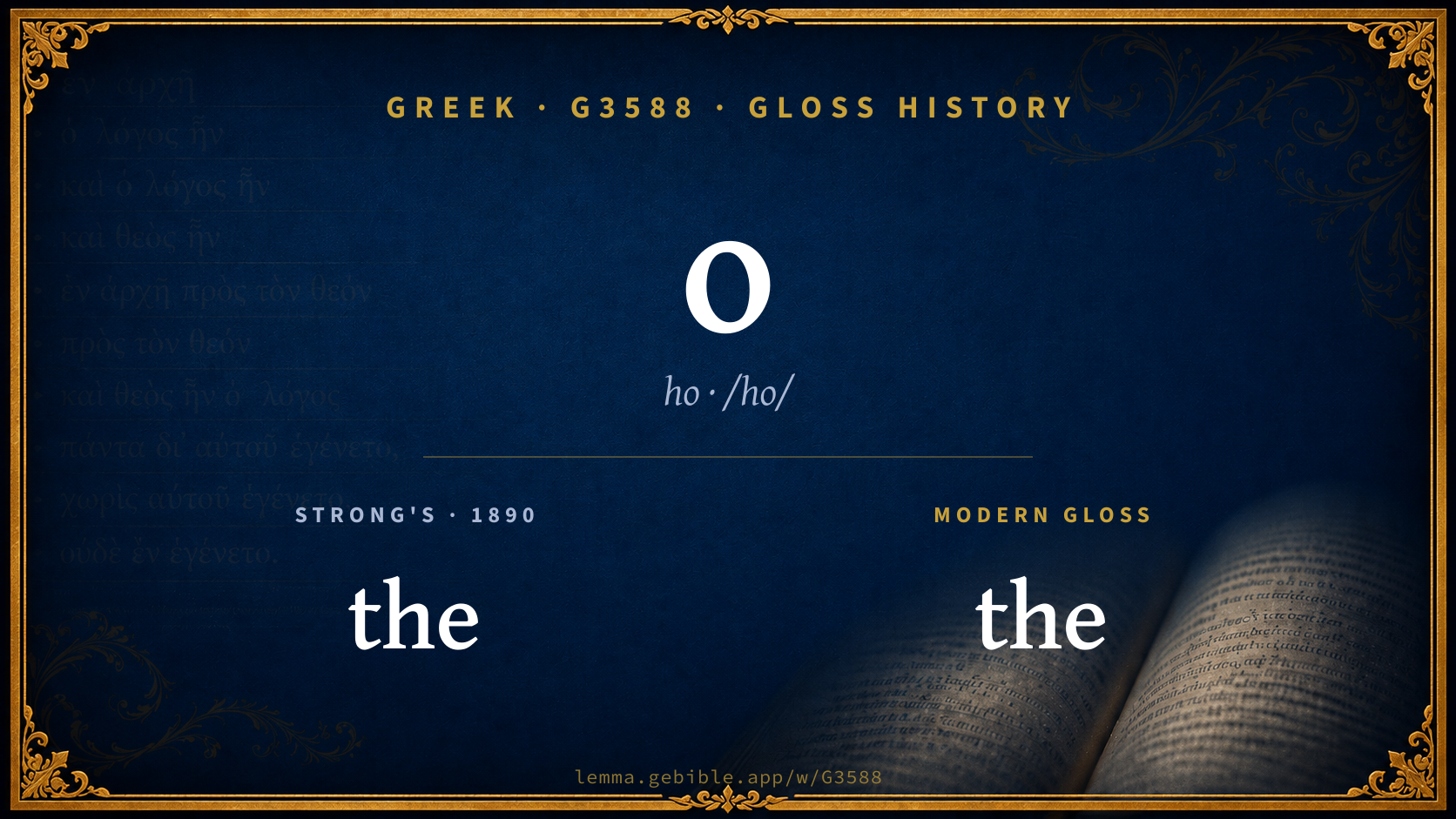
Gloss history
Strong's 1890 vs modern scholarship
About this word
Strong's G3588 catalogs a Greek word from the Greek New Testament.
These counts are not copied from any lexicon or concordance. They are computed here, from the morphology-tagged Greek New Testament. What Lemma adds →
- 6,958
- distinct verses
- The word appears in 6,958 distinct verses.
- 27 / 27
- NT books
- The word appears in 27 of 27 New Testament books.
- #1
- by frequency
- Most frequent Greek word — of 5,347 Greek words by occurrence.
View all 6,958 occurrences in the concordance →
By section of the New Testament
By traditional corpus
Conventional, traditional groupings — biblical authorship is debated, so this is a traditional corpus grouping, not an authorship claim. Some books belong to more than one corpus (Luke is in both the Gospels and the Lukan corpus, and so on), so these shares overlap and need not total 100%. Each figure is a share of the word’s 6,958 distinct verses.
- Gospels 3,366 verses · 48%
- Lukan (Luke–Acts) 1,951 verses · 28%
- Pauline corpus 1,635 verses · 23%
- Johannine 1,309 verses · 19%
- Revelation 386 verses · 6%
- General (Catholic) Epistles 371 verses · 5%
- Hebrews 263 verses · 4%
How translations render this word
Counts come from each version’s own published word-to-Strong’s tagging or interlinear alignment — an approximate guide to how each version renders this word, not a word-level alignment the data otherwise carries. Because each total is that version’s own tagged count, the per-version totals vary from one another and need not match the appearance or distinct-verse counts above. These counts may also differ from a printed concordance because Lemma counts each distinctly tagged rendering and does not collapse phrase taggings into a single head-word total. This is a fixed set of word-tagged versions (KJV, ASV, BSB, ULT) and does not change with the reading translation you choose elsewhere. Each version’s license is shown beside its name below (and on Sources).
- King James Version: Which 391×, Who 79×, Things 12×
- American Standard Version: That 206×, Who 79×, Which 73×
- Berean Standard Bible: The 7,625×, Who 563×, Of 346×
- unfoldingWord Literal Text: The 7,661×, God 966×, One 603×
King James Version Public Domain
Renders G3588 across 542 tagged occurrences — most commonly:
Plus other, less common renderings. Plus 22 renderings that appear only once — usually multi-word phrases or single function words the recovered tagging swept in, not distinct renderings. Not rendered by a distinct English word in 1 further occurrence.
American Standard Version Public Domain
Renders G3588 across 1,005 tagged occurrences — most commonly:
Plus other, less common renderings. Plus 68 renderings that appear only once — usually multi-word phrases or single function words the recovered tagging swept in, not distinct renderings. Not rendered by a distinct English word in 2 further occurrences.
Berean Standard Bible Public Domain
Renders G3588 across 9,912 tagged occurrences — most commonly:
Plus other, less common renderings. Plus 107 renderings that appear only once — usually multi-word phrases or single function words the recovered tagging swept in, not distinct renderings. Not rendered by a distinct English word in 9,622 further occurrences.
unfoldingWord Literal Text CC BY-SA 4.0
Renders G3588 across 20,796 tagged occurrences — most commonly:
Plus other, less common renderings. Plus 1,052 renderings that appear only once — usually multi-word phrases or single function words the recovered tagging swept in, not distinct renderings. Not rendered by a distinct English word in 3 further occurrences.
Senses in Thayer's
The 1 sense Thayer's distinguishes for this word, in lexicon order (not ranked by frequency or importance). The full entry — with sub-senses — is in the Lexicon Entry tab.
- this, that, these, etc.
Word origin
Origin: in all their inflections, the definite article
the masculine feminine (second) and neuter (third) forms in all their inflections; the definite article; the (sometimes to be supplied at others omitted in English idiom): - the this that one he she it etc.
— Strong’s Exhaustive Concordance (1890), public domain.
Forms in the corpus
The 42 distinct written forms G3588 takes in the Greek New Testament, most frequent first — each parse links to that case’s occurrences in the concordance.
Same root — word family
Other Thayer's entries built from the same root as G3588, grouped by Strong’s listed origin. These share a root / origin per the lexicon — not necessarily a shared meaning. Each links to that word’s own entry.
Derived from this word
- τανυν tanŷn G3569 present
- οδε hóde G3592 this
- οιος hoîos G3634 what sort of
- ος hós G3739 who
- ουτος hoûtos G3778 this
- σημερον sḗmeron G4594 this day
- ταυτα tautá G5024 thus
- τηλικουτος tēlikoûtos G5082 of such size
- τοι toí G5104 truly
- τοσουτος tosoûtos G5118 so great
- τοτε tóte G5119 then
- του toû G5120 his
- τουναντιον tounantíon G5121 on the contrary
- τουνομα toúnoma G5122 by name
Proper names from this root
People and places named from this root — a name, not an additional meaning of the word.
- θεος theós G2316 God
- ο ων και ο ην και ο ερχομενος ho ṑn kaí ho ēn kaí ho erchómenos G3801 He who is
Compare all same-root words → Showing 4 of 17 — not the complete family. 2 of the same-root words are proper names (people or places). They share a root, not necessarily a meaning.
Septuagint usage
The same Greek word ο appears 68,018 times in the Greek Old Testament (Septuagint), across 19,787 verses in 38 books.
- 68,018
- LXX occurrences
- Tagged occurrences of this Greek word in the Septuagint.
- 19,787
- verses
- Distinct Septuagint verses containing this word.
- 38 / 39
- OT books
- The word appears in 38 of the 39 Old Testament books.
Sample Septuagint occurrences
- Genesis 1:1 ὁ
- Exodus 1:1 ὁ
- Leviticus 1:1 ὁ
- Numbers 1:1 ὁ
- Deuteronomy 1:1 ὁ
- Joshua 1:1 ὁ
- Judges 1:1 ὁ
- Ruth 1:1 ὁ
- 1 Samuel 1:2 ὁ
- 2 Samuel 1:1 ὁ
- 1 Kings 1:1 ὁ
- 2 Kings 1:1 ὁ
Septuagint occurrences (same lexeme)
Every verse where the same Strong’s number (G3588) appears in the Greek Septuagint — showing the first 50 of 19,787. Verse text shown in the World English Bible for context; the Greek form is the matched word — the English is not keyword-highlighted.
- Genesis 1:1 ὁ In the beginning God created the heavens and the earth.
- Genesis 1:2 ὁ Now the earth was formless and empty. Darkness was on the surface of the deep. God's Spirit was hovering over the surface of the waters.
- Genesis 1:3 ὁ God said, "Let there be light," and there was light.
- Genesis 1:4 ὁ God saw the light, and saw that it was good. God divided the light from the darkness.
- Genesis 1:5 ὁ God called the light Day, and the darkness he called Night. There was evening and there was morning, one day.
- Genesis 1:6 ὁ God said, "Let there be an expanse in the midst of the waters, and let it divide the waters from the waters."
- Genesis 1:7 ὁ God made the expanse, and divided the waters which were under the expanse from the waters which were above the expanse, and it was so.
- Genesis 1:8 ὁ God called the expanse sky. There was evening and there was morning, a second day.
- Genesis 1:9 ὁ God said, "Let the waters under the sky be gathered together to one place, and let the dry land appear," and it was so.
- Genesis 1:10 ὁ God called the dry land Earth, and the gathering together of the waters he called Seas. God saw that it was good.
- Genesis 1:11 ὁ God said, "Let the earth put forth grass, herbs yielding seed, and fruit trees bearing fruit after their kind, with its seed in it, on the earth," and it was so.
- Genesis 1:12 ὁ The earth brought forth grass, herbs yielding seed after their kind, and trees bearing fruit, with its seed in it, after their kind: and God saw that it was good.
- Genesis 1:14 ὁ God said, "Let there be lights in the expanse of sky to divide the day from the night; and let them be for signs, and for seasons, and for days and years;
- Genesis 1:15 ὁ and let them be for lights in the expanse of sky to give light on the earth," and it was so.
- Genesis 1:16 ὁ God made the two great lights: the greater light to rule the day, and the lesser light to rule the night. He also made the stars.
- Genesis 1:17 ὁ God set them in the expanse of sky to give light to the earth,
- Genesis 1:18 ὁ and to rule over the day and over the night, and to divide the light from the darkness. God saw that it was good.
- Genesis 1:20 ὁ God said, "Let the waters swarm with swarms of living creatures, and let birds fly above the earth in the open expanse of sky."
- Genesis 1:21 ὁ God created the large sea creatures, and every living creature that moves, with which the waters swarmed, after their kind, and every winged bird after its kind. God saw that it was good.
- Genesis 1:22 ὁ God blessed them, saying, "Be fruitful, and multiply, and fill the waters in the seas, and let birds multiply on the earth."
- Genesis 1:24 ὁ God said, "Let the earth bring forth living creatures after their kind, cattle, creeping things, and animals of the earth after their kind," and it was so.
- Genesis 1:25 ὁ God made the animals of the earth after their kind, and the cattle after their kind, and everything that creeps on the ground after its kind. God saw that it was good.
- Genesis 1:26 ὁ God said, "Let us make man in our image, after our likeness: and let them have dominion over the fish of the sea, and over the birds of the sky, and over the cattle, and over all the earth, and over every creeping thing that creeps on the earth."
- Genesis 1:27 ὁ God created man in his own image. In God's image he created him; male and female he created them.
- Genesis 1:28 ὁ God blessed them. God said to them, "Be fruitful, multiply, fill the earth, and subdue it. Have dominion over the fish of the sea, over the birds of the sky, and over every living thing that moves on the earth."
- Genesis 1:29 ὁ God said, "Behold, I have given you every herb yielding seed, which is on the surface of all the earth, and every tree, which bears fruit yielding seed. It will be your food.
- Genesis 1:30 ὁ To every animal of the earth, and to every bird of the sky, and to everything that creeps on the earth, in which there is life, I have given every green herb for food." And it was so.
- Genesis 1:31 ὁ God saw everything that he had made, and, behold, it was very good. There was evening and there was morning, the sixth day.
- Genesis 2:1 ὁ The heavens and the earth were finished, and all the host of them.
- Genesis 2:2 ὁ On the seventh day God finished his work which he had made; and he rested on the seventh day from all his work which he had made.
- Genesis 2:3 ὁ God blessed the seventh day, and made it holy, because he rested in it from all his work which he had created and made.
- Genesis 2:4 ὁ This is the history of the generations of the heavens and of the earth when they were created, in the day that Yahweh God made earth and the heavens.
- Genesis 2:5 ὁ No plant of the field was yet in the earth, and no herb of the field had yet sprung up; for Yahweh God had not caused it to rain on the earth. There was not a man to till the ground,
- Genesis 2:6 ὁ but a mist went up from the earth, and watered the whole surface of the ground.
- Genesis 2:7 ὁ Yahweh God formed man from the dust of the ground, and breathed into his nostrils the breath of life; and man became a living soul.
- Genesis 2:8 ὁ Yahweh God planted a garden eastward, in Eden, and there he put the man whom he had formed.
- Genesis 2:9 ὁ Out of the ground Yahweh God made every tree to grow that is pleasant to the sight, and good for food; the tree of life also in the midst of the garden, and the tree of the knowledge of good and evil.
- Genesis 2:10 ὁ A river went out of Eden to water the garden; and from there it was parted, and became four heads.
- Genesis 2:11 ὁ The name of the first is Pishon: this is the one which flows through the whole land of Havilah, where there is gold;
- Genesis 2:12 ὁ and the gold of that land is good. There is aromatic resin and the onyx stone.
- Genesis 2:13 ὁ The name of the second river is Gihon: the same river that flows through the whole land of Cush.
- Genesis 2:14 ὁ The name of the third river is Hiddekel: this is the one which flows in front of Assyria. The fourth river is the Euphrates.
- Genesis 2:15 ὁ Yahweh God took the man, and put him into the garden of Eden to dress it and to keep it.
- Genesis 2:16 ὁ Yahweh God commanded the man, saying, "Of every tree of the garden you may freely eat:
- Genesis 2:17 ὁ but of the tree of the knowledge of good and evil, you shall not eat of it: for in the day that you eat of it you will surely die."
- Genesis 2:18 ὁ Yahweh God said, "It is not good that the man should be alone; I will make him a helper suitable for him."
- Genesis 2:19 ὁ Out of the ground Yahweh God formed every animal of the field, and every bird of the sky, and brought them to the man to see what he would call them. Whatever the man called every living creature, that was its name.
- Genesis 2:20 ὁ The man gave names to all cattle, and to the birds of the sky, and to every animal of the field; but for man there was not found a helper suitable for him.
- Genesis 2:21 ὁ Yahweh God caused a deep sleep to fall on the man, and he slept; and he took one of his ribs, and closed up the flesh in its place.
- Genesis 2:22 ὁ He made the rib, which Yahweh God had taken from the man, into a woman, and brought her to the man.
These are occurrences of the same Greek lexeme (G3588) in the Septuagint — not a translation of any one Hebrew word. The store carries no word-level Hebrew↔Greek alignment, so no Hebrew original is asserted here. Counts come from the recovered LXX Strong's tagging — high-frequency vocabulary is well covered, while rare or late forms may be untagged — so they reflect tagged occurrences and may slightly undercount.