
John 8:29

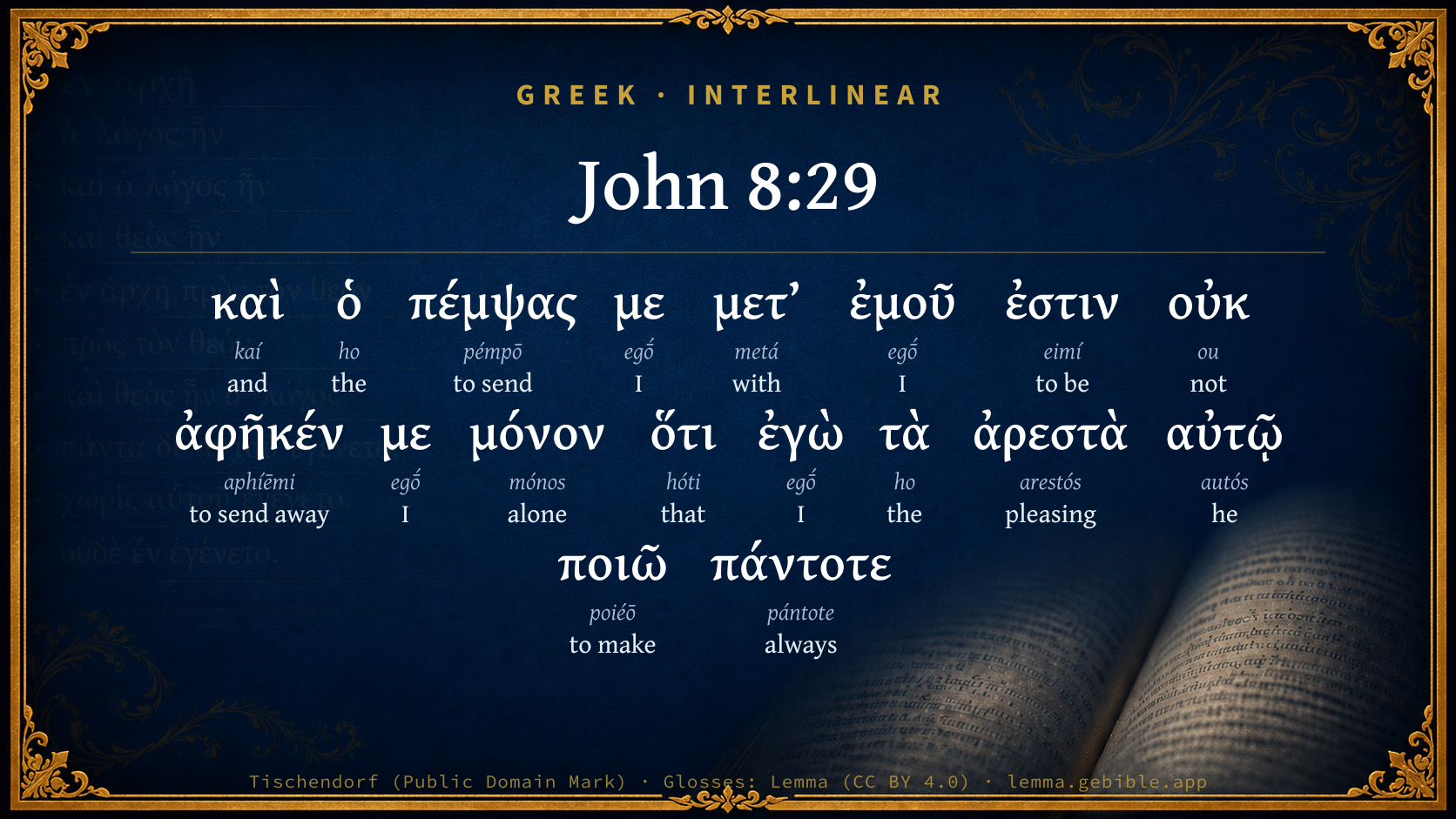
Greek (Tischendorf 8th ed.) John 8:29 appears in the Greek New Testament. The text above is from the Tischendorf 8th edition. Each word links to its Strong’s number and a concise gloss. Click any word for its full Thayer’s Greek Lexicon entry.
Download image
Cite this verse

John 8:29 (World English Bible). Public Domain. Lemma interlinear Bible study tool, https://lemma.gebible.app/v/john/8/29.

Show BibTeX & RIS
BibTeX
RIS
English Translation
He who sent me is with me. The Father hasn't left me alone, for I always do the things that are pleasing to him."
World English Bible · Public Domain
Highlights
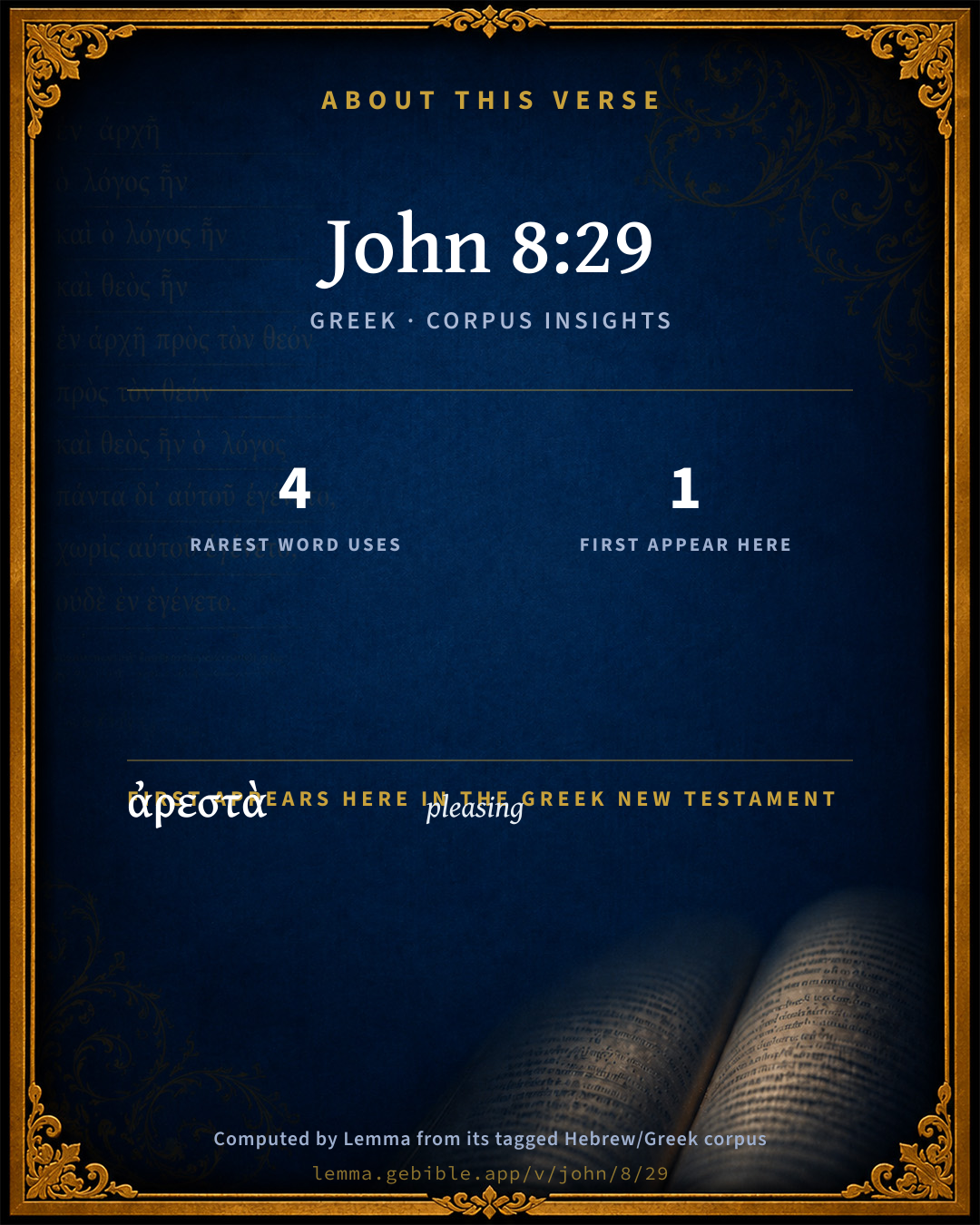
  • 1 first appearance in the Greek New Testament
Full analysis ↓
Download a study sheet

One document with this verse’s original text, its word-by-word gloss line, the meaning frame, cross-references with their text, attributed commentary, and full source and license credits — printable, and it pastes into notes with its structure intact.

This verse Autodidact and up

Study sheet (.html) Plain text (.txt)

A passage Seminary Student

Up to 50 verses in one chapter. A passage sheet keeps up to 6 commentary sources and 12 cross-references per verse, in the order this page ranks them, and says so on the sheet whenever that leaves anything out. Ask for a single verse and you get the Autodidact verse sheet above.

Everything on this page stays free to read, with no account — the sheet is a download of what is already on screen, not access to it.

Want to remove ads? Support Godless Engineer
Compare translations 3

The same verse in 3 English versions, stacked beneath the original-language interlinear above. Click any original word for its lexicon entry.

Each is an independent rendering of the whole verse — the interlinear is not word-aligned to these translations.

Highlighted words mark where these versions differ — a whole-verse word diff, not a word-by-word alignment.

  • World English Bible Public Domain
    He who sent me is with me. The Father hasn't left me alone, for I always do the things that are pleasing to him."
  • King James Version Public Domain
    And he that sent me is with me: the Father hath not left me alone; for I do always those things that please him.
  • unfoldingWord Literal Text CC BY-SA 4.0
    And the one having sent me is with me. He has not left me alone, because I always do what is pleasing to him.”

unfoldingWord Literal Text — © unfoldingWord, licensed CC BY-SA 4.0. Word-aligned USFM3 via Door43 (git.door43.org/unfoldingWord/en_ult).

Versions to compare (up to 4)

3 of 4 selected

Show all 19 translations

Every available English version of this verse, each an independent rendering of the whole verse.

  • World English Bible Public Domain
    He who sent me is with me. The Father hasn't left me alone, for I always do the things that are pleasing to him."
  • Berean Standard Bible Public Domain
    He who sent Me is with Me. He has not left Me alone, because I always do what pleases Him.”
  • Majority Standard Bible Public Domain
    He who sent Me is with Me. The Father has not left Me alone, because I always do what pleases Him.”
  • King James Version Public Domain
    And he that sent me is with me: the Father hath not left me alone; for I do always those things that please him.
  • American Standard Version (1901) Public Domain
    And he that sent me is with me; he hath not left me alone; for I do always the things that are pleasing to him.
  • Revised Version (1885) Public Domain
    And he that sent me is with me; he hath not left me alone; for I do always the things that are pleasing to him.
  • Geneva Bible (1599) Public Domain
    For he that sent me, is with me: the Father hath not left me alone, because I do alwayes those things that please him.
  • Douay-Rheims (1899) Public Domain
    And he that sent me, is with me, and he hath not left me alone: for I do always the things that please him.
  • Young's Literal Translation Public Domain
    and He who sent me is with me; the Father did not leave me alone, because I, the things pleasing to Him, do always.'
  • Literal Standard Version CC BY-SA 4.0
    and He who sent Me is with Me; the Father did not leave Me alone, because I always do the things pleasing to Him.”
  • Unlocked Literal Bible CC BY-SA 4.0
    He who sent me is with me, and he has not left me alone, because I always do what is pleasing to him.”
  • unfoldingWord Literal Text CC BY-SA 4.0
    And the one having sent me is with me. He has not left me alone, because I always do what is pleasing to him.”
  • Darby Bible Public Domain
    And he that has sent me is with me; he has not left me alone, because I do always the things that are pleasing to him.
  • World Messianic Bible Public Domain
    He who sent me is with me. The Father hasn’t left me alone, for I always do the things that are pleasing to him.”
  • Webster's Bible Public Domain
    And he that sent me is with me: the Father hath not left me alone; for I do always those things that please him.
  • Free Bible Version CC BY-SA 4.0
    The one who sent me is with me; he has not abandoned me, for I always do what pleases him.”
  • Bible in Basic English Public Domain
    He who sent me is with me; he has not gone from me, because at all times I do the things which are pleasing to him.
  • Text-Critical English NT CC BY 4.0
    He who sent me is with me. The Father has not left me alone, for I always do what pleases him.”
  • Tyndale New Testament (1534) Public Domain
    As he spake these wordes many beleved on him.

Literal Standard Version (2020), Covenant Press — licensed CC BY-SA 4.0. Text via the HelloAO Bible API (eBible.org). Unlocked Literal Bible (unfoldingWord) — licensed CC BY-SA 4.0. Text via the HelloAO Bible API (eBible.org). unfoldingWord Literal Text — © unfoldingWord, licensed CC BY-SA 4.0. Word-aligned USFM3 via Door43 (git.door43.org/unfoldingWord/en_ult). Free Bible Version, Dr. Jonathan Gallagher — licensed CC BY-SA 4.0. Text via the HelloAO Bible API (eBible.org).

Word by word

More ways to search: Search by grammar → Find every occurrence → Compare this word →

Practice this passage: Drill this verse → Learn its vocabulary →

ἀρεστὰ
arestós
G701
“pleasing”
Adjective, Accusative, Plural, Neuter
Part of Speech
Adjective
Case
Accusative
Number
Plural
Gender
Neuter
Full Thayer's Definition

Origin: from G700

TDNT: 08:36,8

1. pleasing, agreeable
  1. καὶ kaí G2532 “and” Conjunction
  2. ὁ ho G3588 “the” Article, Nominative, Singular, Masculine
  3. πέμψας pémpō G3992 “to send” Verb, Aorist, Active, Participle, Nominative, Singular, Masculine
  4. με egṓ G1473 “I” Personal pronoun, 1st person, Accusative, Singular
  5. μετ’ metá G3326 “with” Preposition
  6. ἐμοῦ egṓ G1473 “I” Personal pronoun, 1st person, Genitive, Singular
  7. ἐστιν eimí G1510 “to be” Verb, Present, Active, Indicative, 3rd person, Singular
  8. οὐκ ou G3756 “not” Particle, Negative
  9. ἀφῆκέν aphíēmi G863 “to send away” Verb, Aorist, Active, Indicative, 3rd person, Singular
  10. με egṓ G1473 “I” Personal pronoun, 1st person, Accusative, Singular
  11. μόνον mónos G3441 “alone” Adjective, Accusative, Singular, Masculine
  12. ὅτι hóti G3754 “that” Conjunction
  13. ἐγὼ egṓ G1473 “I” Personal pronoun, 1st person, Nominative, Singular
  14. τὰ ho G3588 “the” Article, Accusative, Plural, Neuter
  15. αὐτῷ autós G846 “he” Personal pronoun, Dative, Singular, Masculine
  16. ποιῶ poiéō G4160 “to make” Verb, Present, Active, Indicative, 1st person, Singular
  17. πάντοτε pántote G3842 “always” Adverb

About this verse

These counts appear in no published source. They are computed here, from the morphology-tagged text and Lemma’s own curated glosses. What Lemma adds →

18
words
14
distinct lemmas
Gospels
section

Notable vocabulary

The rarest word here is ἀρεστὰ pleasing G701 — appearing just 4 times in the whole Greek New Testament.

First appearance in Scripture

This word makes its first canonical appearance in the Greek New Testament here:

  • ἀρεστὰ pleasing G701

Shared distinctive vocabulary

ἀρεστὰ pleasing G701 occurs in 4 verses of the Greek New Testament. Also found in:
Repetition

Words recur within this verse:

Cross-references

23

Topical passages linked to John 8:29 in the Treasury of Scripture Knowledge — connected by theme and wording, ordered by reader-vote popularity; previews shown in the World English Bible.

  • John 6:38 For I have come down from heaven, not to do my own will, but the will of him who sent me.
  • John 16:32 Behold, the time is coming, yes, and has now come, that you will be scattered, everyone to his own place, and you will leave me alone. Yet I am not alone, because the Father is with me.
  • John 4:34 Jesus said to them, "My food is to do the will of him who sent me, and to accomplish his work.
  • John 5:30 I can of myself do nothing. As I hear, I judge, and my judgment is righteous; because I don't seek my own will, but the will of my Father who sent me.
  • John 15:10 If you keep my commandments, you will remain in my love; even as I have kept my Father's commandments, and remain in his love.
  • Isaiah 42:1 Behold, my servant, whom I uphold; my chosen, in whom my soul delights: I have put my Spirit on him; he will bring forth justice to the Gentiles.
  • John 8:16 Even if I do judge, my judgment is true, for I am not alone, but I am with the Father who sent me.
  • John 14:10–11 Don't you believe that I am in the Father, and the Father in me? The words that I tell you, I speak not from myself; but the Father who lives in me does his works.
  • 2 Timothy 4:17 But the Lord stood by me, and strengthened me, that through me the message might be fully proclaimed, and that all the Gentiles might hear; and I was delivered out of the mouth of the lion.
  • Isaiah 42:6 I, Yahweh, have called you in righteousness, and will hold your hand, and will keep you, and give you for a covenant of the people, for a light of the Gentiles;
  • John 14:31 But that the world may know that I love the Father, and as the Father commanded me, even so I do. Arise, let us go from here.
  • Isaiah 42:21 It pleased Yahweh, for his righteousness' sake, to magnify the law, and make it honorable.
  • Isaiah 49:4–8 But I said, I have labored in vain, I have spent my strength for nothing and vanity; yet surely the justice [due] to me is with Yahweh, and my recompense with my God.
  • Matthew 3:17 Behold, a voice out of the heavens said, "This is my beloved Son, with whom I am well pleased."
  • Matthew 17:5 While he was still speaking, behold, a bright cloud overshadowed them. Behold, a voice came out of the cloud, saying, "This is my beloved Son, in whom I am well pleased. Listen to him."
  • John 17:4 I glorified you on the earth. I have accomplished the work which you have given me to do.
  • 1 John 2:1 My little children, I write these things to you so that you may not sin. If anyone sins, we have a Counselor with the Father, Jesus Christ, the righteous.
  • Isaiah 50:4–9 The Lord Yahweh has given me the tongue of those who are taught, that I may know how to sustain with words him who is weary: he wakens morning by morning, he wakens my ear to hear as those who are taught.
  • Hebrews 5:8–9 though he was a Son, yet learned obedience by the things which he suffered.
  • Hebrews 4:15 For we don't have a high priest who can't be touched with the feeling of our infirmities, but one who has been in all points tempted like we are, yet without sin.
  • Hebrews 10:5–10 Therefore when he comes into the world, he says, "Sacrifice and offering you didn't desire, But a body did you prepare for me;
  • Hebrews 7:26 For such a high priest was fitting for us: holy, guiltless, undefiled, separated from sinners, and made higher than the heavens;
  • 2 Timothy 4:22 The Lord Jesus Christ be with your spirit. Grace be with you. Amen.

Cross-references courtesy of OpenBible.info (CC BY 4.0).

Where the printed editions differ

1 variant

Places in this verse where the major printed Greek editions disagree on the wording in a way that affects the translation — a comparison of editions, not a manuscript-by-manuscript collation. The editions are the modern critical texts (Nestlé-Aland 28/27, SBL, Westcott-Hort, Tregelles, Tyndale House) and the traditional texts behind the KJV (the Textus Receptus and the Byzantine/Majority text). It is not a claim about which reading is original.

  1. Extra text
    ὁ πατήρ,

    “<the> Father”

    In TRByz Not in NA28NA27TynSBLWHTreg

    ὁ πατήρ, (ho patēr) ' Father' is only in traditional manuscripts (TR+Byz)

Textual data: Translators Amalgamated Greek New Testament (STEPBible TAGNT) · CC BY 4.0.

Commentary

Notes on John 8:29 from classic Christian and Jewish commentators (each source and its license shown beneath its notes). The classic Christian expositions comment on the surrounding passage and are grouped to its opening verse, so a note may address several verses; the Jewish commentaries on the Tanakh (Rashi and others) are per-verse, so they appear only where the commentator wrote on this verse.

Lemma curates 59 commentaries, every one of them public domain or Creative Commons licensed, each selected and text-cleaned for this edition rather than reprinted as found. About our sources →

Bengel's Gnomon

Johann Albrecht Bengel

Joh 8:29. Καὶ, and) and so.—οὐκ ἀφῆκε με, hath not left me) The Præterite signifies that He is never at any time abandoned. The πάντοτε, always, corresponds to this.[226]—ὅτι, because) Comp. ch. Joh 15:10, “If ye keep My commandments, ye shall abide in My love, even as I have kept My Father’s commandments, and abide in His love.”—τὰ ἀρεστὰ αὐτῷ, the things, which are pleasing to Him) The same argument, by which the Jews were led to believe in Jesus Christ, serves also to prove the whole authority of Holy Scripture, and of the Christian religion. At all times, in all places, in every way, He requires of all, and teaches all, all those things, which are pleasing to God, and worthy of God.—πάντοτε, at all times) The Lord spake these things with the utmost sweetness).[227]

[226] In the next clause, i.e. I always please Him, therefore at no time does He leave me.—E. and T.

[227] Ver. 30, ἐπίστευσαν, believed) This was as it were the delicate bud of faith. But a severe conflict followed between good and evil, ver. 44.—V. g.

Bengel's Gnomon of the New Testament — English translation (T&T Clark, Edinburgh, 1860) — public domain. Text from a community e-Sword module.

Expositor's Greek Testament

ed. W. Robertson Nicoll

Joh 8:29 . καὶ ὁ πέμψας … πάντοτε . His fidelity to the purpose of the Father that sent Him secured His perpetual presence with Him. By His entire self-abnegation and freedom from self-will He gave room to the Spirit of the Father. Or, as Westcott supposes, the ὅτι clause may give the evidence or sign of the preceding rather than its cause; and the meaning may be that the result of the Father’s presence is seen in the perfect correspondence of the conduct of the Son with the will of the Father.

The Expositor's Greek Testament, edited by W. Robertson Nicoll (1897–1910) — public domain. Text from a community e-Sword module.

Jamieson, Fausset & Brown

Robert Jamieson, A. R. Fausset & David Brown

the Father hath not left me alone; for I do always those things that please him, &c.--that is, To you, who gnash upon Me with your teeth, and frown down all open appearance for Me, I seem to stand uncountenanced and alone; but I have a sympathy and support transcending all human applause; I came hither to do My Father's will, and in the doing of it have not ceased to please Him; therefore is He ever by Me with His approving smile, His cheering words, His supporting arm.

Jamieson, Fausset & Brown — Commentary Critical and Explanatory on the Whole Bible (1871) — public domain (CC PDM 1.0). Text via the HelloAO Bible API.

Adam Clarke's Commentary

Verse 29. The Father hath not left me alone] Though ye shalt have power to put me to death, yet this shall not be because he hath abandoned me. No-he is ever with me, because I do that which pleaseth him; and it is his pleasure that I should lay down my life for the salvation of the world. Does not our Lord allude to the following scriptures?-Sacrifice and offering thou didst not desire; my ears hast thou opened: (or, a body hast thou prepared me: Heb 10:5:) then said I, Lo, I come: this is written in the volume of the book concerning me. I delight to do thy will, O my God! Thy law is in my heart. Ps 40:6-8.

Adam Clarke's Commentary on the Bible (1810–1826) — public domain. Text from a community e-Sword/MySword module.

John Calvin's Commentaries

29. And he who hath sent me is with me. He again boasts that God, under whose guidance and authority he does every thing, will assist him, so that he shall not labor in vain and to no purpose, as if he had said, that the power of the Spirit of God accompanies his ministry. All faithful teachers ought to be endued with the same confidence, so as to entertain no doubt that the hand of God will be near them, when, with a pure conscience, they discharge such a ministry as he demands. For God does not furnish them with his word, in order that they may strike the air with an idle and useless sound, but makes his word successful by the secret efficacy of his Spirit, and at the same time guards them by his protection, that, when their enemies shall have been subdued, they may remain invincible against the whole world. And, indeed, if they judge of themselves and their own powers, they must give way every hour; so that the only method of pursuing is, to be convinced that they are supported by the hand of God.

Because I do always the things which please him. We must observe the reason why Christ declares that God is on his side, and that he will never be deprived of his assistance. It is, because he is regulated entirely by his will, and serves him in sincerity. For this is what he means by the word always, that he does not obey God only in part, but is entirely and unreservedly devoted to his service. Wherefore, if we desire to enjoy the same presence of God, our whole reason must be subjected to his authority; for if our senses hold the government in any degree, all our exertions will be fruitless, because the blessing of God will not be on them. And though for a time we may be delighted with the joyful prospect of success, yet the final result will be dismal.

The Father hath not left me alone By these words, he indirectly complains of the treachery of his nation, in which he found scarcely any that gave him their support. Yet he shows that he reckons this alone to be abundantly sufficient, that he has God to protect him. Such is the courage with which we ought to be animated in the present day, that we may not give way on account of the small number of believers; for, though the whole world be opposed to his doctrine, still we are not alone Hence, too, it is evident how foolish is the boasting of the Papists, who, while they neglect God, proudly boast of their vast numbers.

John Calvin's Commentaries (1540-1563) — public domain. Text from the Calvin Translation Society English edition (1840s-50s) via the Christian Classics Ethereal Library (ccel.org). Calvin's coverage is partial (roughly two-thirds of the Bible); uncommented books and verses are honest gaps, never fabricated. The 19th-century editor's footnotes and remarks are omitted so the notes are faithfully Calvin's own voice.

Ellicott's Commentary for English Readers

(29) The Father hath not left me alone.—The Greek words mean exactly, the Father (or, as the better MSS. read, without change of meaning, He) left Me not alone, and they are sometimes taken to refer to the time of His mission into the world. The context rather points to their application to every moment of life. He was ever conscious of a Presence which they knew not of, but which the future should reveal to them. We shall find Him resting in this consciousness again when He looks on to the dark hour when the disciples shall be scattered every man to his own, and He shall be left as men would think alone. (Comp. Note on Joh_16:32.)

For Ι do always those things that please him.—It would be less ambiguous to read, because I do always . . . The words furnish the reason for the presence of the Father in every act and moment of His life. All things done by Him at all times were in accordance with the Father’s will. In His human nature perpetual communion is conditioned by perpetual obedience. The same thought recurs in His words to the disciples in Joh_15:10. Comp. also, on the relation of the Son to the Father, Note on Joh_5:19.

Emphasis should be laid here upon the pronoun, “for I do always.” It was true of His human nature, as distinct from all others, that no act, at any moment of life, had cast its shadow on the brightness of the vision of the Father’s presence. Later in this same discourse (Joh_8:46) He appeals to their knowledge of His holy life. Here, in words that none other in human form could ever utter, He appeals to His own consciousness of a life, every act of which was pleasing in the presence of God.

[(b) Jesus is Light (continued).

(γ) True discipleship and freedom (Joh_8:30-59).

Freedom by the Son’s word (Joh_8:30-36).

Natural and ethical sonship (Joh_8:37-47).

Eternal life by the Son’s word. The Son’s eternity (Joh_8:48-59).]

A Bible Commentary for English Readers, edited by Charles John Ellicott (1878–1897) — public domain. Text from a community e-Sword module.

The Cambridge Bible for Schools and Colleges

gen. ed. J. J. S. Perowne

29. the Father hath not left me alone] Here again we have an aorist, not a perfect; ‘He left Me not alone’ (‘the Father’ being omitted in the best MSS.). It will depend on the interpretation whether the aorist or perfect is to be used in English. If it refers to God sending the Messiah into the world, then we must keep the aorist; He left. But if it refers to Christ’s experience in each particular case, the perfect may be substituted: He hath left. In some cases it is the idiom in English to use the perfect where the aorist is used in Greek, and then to translate the Greek aorist by the English aorist would be misleading. See on Joh_16:32.

for I do always] Or, because the things which are pleasing to Him I always do. ‘I’ and ‘always’ are emphatic; and ‘always’ literally means ‘on every occasion,’ which is somewhat in favour of the second interpretation in the preceding note. ‘He hath never left me alone, because in every case I do what pleaseth Him.’ The emphasis on ‘I’ is perhaps in mournful contrast to the Jews. In any case it is a distinct claim to Divinity. What blasphemous effrontery would such a declaration be in the mouth of any but the Incarnate Deity. The theory that Jesus was the noblest and holiest of teachers, but nothing more, shatters against such words as these. What saint or prophet ever dared to say, ‘The things which are pleasing to God I in every instance do?’ Comp. Joh_8:46. And if it be said, that perhaps Jesus never uttered these words, then it may also be said that perhaps He never uttered any of the words attributed to Him. We have the same authority for what is accepted as His as for what is rejected as not His. History becomes impossible if we are to admit evidence that we like, and refuse evidence that we dislike.

The Cambridge Bible for Schools and Colleges (gen. ed. J. J. S. Perowne; Cambridge University Press, 1878–1918) — public domain. Text from a community e-Sword module.

John Gill's Exposition

And ye shall know the truth,.... Either the truth of the Gospel, the truth as it is in Jesus; meaning, that they should have a larger knowledge of it, while others are ever learning, and never come to the knowledge of the truth; but the spirit of truth should lead them into all truth, and cause them to grow and increase in Gospel light and knowledge; or Jesus himself, who is the way, the truth, and the life; and the sense is, that they should know more of him, of the dignity of his person, of the nature and usefulness of his offices; of the efficacy of his blood, the excellency of his righteousness, and the fulness of his grace, and that for themselves:

and the truth shall make you free; from ignorance and error, and the prejudices of education, under which the whole nation laboured, and from the thraldom of the law.

John Gill's Exposition of the Whole Bible (1746–1763) — public domain (CC PDM 1.0). Text via the HelloAO Bible API.

Trapp's Complete Commentary

John Trapp

29 And he that sent me is with me: the Father hath not left me alone; for I do always those things that please him.

Ver. 29. And he that sent me is with me] So that I shall not labour altogether in vain, but accomplish the work that he hath given me to do. So shall all God’s faithful ministers (though they may think all their labour lost, and be ready to cry out, Eheu quam pingui macer est mihi taurus in arvo). Yet, if they strive to do always those things that please him, he will both protect and prosper them.

John Trapp, A Commentary or Exposition upon All the Books of the Old and New Testament (1647–1656) — public domain. Text from a community e-Sword module.

Albert Barnes' Notes on the Bible

Is with me - In working miracles, etc.

Hath not left me alone - Though men had forsaken and rejected him, yet God attended him.

Those things that please him - See Mat 3:17; “This is my beloved Son, in whom I am well pleased,” Phi 2:8; Isa 53:10-12; 2Pe 1:17; Luk 3:22; Mat 17:5. His undertaking the work of redemption was pleasing to God, and he had the consciousness that in executing it he did those things which God approved. It is a small matter to have men opposed to us, if we have a conscience void of offence, and evidence that we please God. Compare Heb 11:5; “Enoch - before his translation had this testimony that he pleased God.” See also 1Co 4:3.

Albert Barnes' Notes on the Bible (1834–1885) — public domain. Text from a community e-Sword/MySword module.

Matthew Poole's English Annotations

I have the presence of God with me, as I am Mediator; the Father hath not sent me into the world to do his will, and left me alone without his presence; for I do his will; I drive no separate design from my Father, but always do those things which please him. From whence all faithful ministers and Christians may learn how to conclude of God’s presence with them, which they can no longer promise to themselves, than they speak and do those things that please him.

Matthew Poole's English Annotations on the Holy Bible (1683–1685) — public domain. Text from a community e-Sword/MySword module.

Whedon's Commentary on the Bible

Daniel D. Whedon

29. He… is with me—Did some of these listeners fabricate for a moment the theory that this lifting up, in Joh_8:28, was a kingly elevation to the Messianic throne; and the Father who was with him, etc., was the aid to his high design? We have, then, the key to the brief belief of the many of the next verse.

Daniel D. Whedon (gen. ed.), Commentary on the Old and New Testaments (1874–1909) — public domain. Text from a community e-Sword module.

The Pulpit Commentary

And he that sent me of whom I now plainly speak to you as "the Fatheris with me. He is not in some inaccessible region of indifference to my mission or my word, but with me. He encompasses the Son of man, finds willing, unswerving response to his will in my words. He sent me, and commissioned me to undertake this work. He is affirming in his own way all my message, and corroborating my testimony. You have asked, "Where is thy Father?" and I now tell you, "He is with me." He (the Father) hath not left me at any moment of my career alone. He has confirmed and sustained my word, and upheld my life; and you can see the signs of this abiding communion: Because (i.e. Christ does not account for the abiding companionship by the fact of his own obedience, but refers to the reasons which his hearers might find for his great assertion; cf. Luk_7:47) I do always the things that are pleasing to him. I do this because he has never left me to my mere human nature. This self-consciousness of Christ is one of the loftiest and most entirely unique phenomena recorded in history. This absolute confidence with reference to his whole course lifts our Lord to a pinnacle of the loftiest elevation. He declares himself absolutely free from sin, and even in thought or deed to have left undone nothing that seemed good to the Father. If such an utterance had not flashed the conviction of his Divine nature upon some of his hearers, it is impossible to conceive what would or could have done so.

The Pulpit Commentary (1880–1919), ed. H.D.M. Spence-Jones & Joseph S. Exell — public domain. Text from a community e-Sword module.

John Wesley's Explanatory Notes

The Father hath not left me alone - Never from the moment I came into the world.

John Wesley, Explanatory Notes Upon the Whole Bible (1754–1765) — public domain. Text via the GEBible commentary corpus.

Burkitt's Expository Notes on the New Testament

William Burkitt

That is, he that sent and commissioned me for the great work of redemption, he is continually with me, both to assist and to accept me, I doing every thing that is agreeable to his holy will and pleasure.

Hence learn, 1. That the work of redemption in the hands of Jesus Christ, was a work well-pleasing to God the Father; the work itself was highly pleasing to him; and Christ’s way of managing it was well-pleasing also.

2. That the reason why it was thus well-pleasing to God, was, because he acted in a constant conformity to his Father’s will, kept to his Father’s commission, and executed his Father’s commands, doing always those things that pleaseth him.

Learn, 3. That as the Father and Christ were inseparable in respect of the unity of the divine essence; so the Father was always with Christ as Mediator, both to support and uphold him, to accept and reward him. The Father hath not left me alone, either in the doing of his will, or in the suffering of his pleasure.

Learn, 4. That those who desire the gracious and special presence of God with them in all conditions, particularly in times of sufferings and trouble; they must make it their care and study to please God, and to observe his will in all things: then God will be with them in his guiding presence, in his strengthening presence, in his comforting, in his quickening, in his sanctifying, sympathizing, and accepting, presence.

William Burkitt's Expository Notes on the New Testament (1700–1703) — public domain. Text from a community e-Sword module.

The People's New Testament

B. W. Johnson

29. The Father hath not left me alone. The Father was with him. He was with him and in him. He was “the brightness of the Father's glory.” He did those things that please him, and God was with him.

B. W. Johnson's The People's New Testament with Notes (1889–1891) — public domain. Electronic text from the Christian Classics Ethereal Library (CCEL) ThML edition.

Cambridge Greek Testament for Schools and Colleges

29. Omit (אBDLTX) ὁ πατήρ after μόνον (a gloss).

29. ἀφῆκεν. It will depend on the interpretation whether the aorist or perfect is to be used in English. If it refers to God sending the Messiah into the world, then, as in the cases of ἤκουσα and ἐδίδαξεν, we must keep the aorist; He left. But if it refers to Christ’s experience in each particular case, the perfect may be substituted; He hath left. In some cases (comp. Joh 13:13; Joh 13:34, Joh 15:9; Joh 15:12) it is the idiom in English to use the perfect where the aorist is used in Greek, and then to translate the Greek aorist by the English aorist would be misleading. see on Joh 16:32 and comp. οὐκ ἀμάρτυρον αὐτὸν ἀφῆκεν (Act 14:17).

ὅτι ἐγὼ κ.τ.λ. Because the things pleasing to Him I always do: πάντοτε is emphatic, and means ‘on every occasion,’ which is somewhat in favour of the second interpretation of οὐκ ἀφῆκέν με: ‘He hath never left Me alone because in every case I do what pleaseth Him.’ The emphasis on ἐγώ is perhaps in mournful contrast to the Jews. In any case it is a distinct claim to Divinity. What blasphemous effrontery would such a declaration be in the mouth of any but the Incarnate Deity! The theory that Jesus was the noblest and holiest of teachers, but nothing more, shatters against such words as these. What saint or prophet ever dared to say, ‘The things which are pleasing to God I in every instance do’? Comp. Joh 8:46, Joh 14:30, Joh 15:10. And if it be said, that perhaps Jesus never uttered these words, then it may also be said that perhaps He never uttered any of the words attributed to Him. We have the same authority for what is accepted as His as for what is rejected as not His. History becomes impossible if we are to admit evidence that we like, and refuse evidence that we dislike. Comp. 1Jn 3:22, and Ign. Magn. VIII.; ὃς κατὰ πάντα εὐηρέστησεν τῷ πέμψαντι αὐτόν. See on Joh 3:8, Joh 4:10.

Cambridge Greek Testament for Schools and Colleges (Cambridge University Press, 1896; 21 vols, various authors incl. Carr, Maclear, Plummer, Farrar, Lumby, Moule, M. R. James, Simcox) — public domain. Text from a community e-Sword module.

Alford’s Greek Testament

Henry Alford

29.] ἀφῆκεν, aor. referring to the appointment of the Father by which His work was begun, and which the μετʼ ἐμοῦ ἐστιν carries on through that work: see ch. 16:32.

ὅτι, because;—not ‘for,’ as if what follows were merely a token that it is so (Olsh.). The τὰ ἀρεστὰ αὐτ. ποιῶ πάντ. is the very essential being of the Son, and is the cause why the Father is ever with Him.

Henry Alford, The Greek Testament (1849–1861) — public domain. Text from a community e-Sword module.

International Critical Commentary

29. καὶ ὁ πέμψας με (see on 3:17 for the mission of the Son) μετʼ ἐμοῦ ἐστιν κτλ. This has already been said at v. 16, ὅτι μόνος οὐκ εἰμί, ἀλλʼ ἐγὼ καὶ ὁ πέμψας με, and is repeated 16:32 in a different context. Much more is implied here than in the saying of Peter that “God was with Him” (Act 10:38), for all through Jn. the ineffable union of the Son with the Father is behind the narrative (cf. 10:38).

οὐκ ἀφῆκέν με μόνον. ΓΔN add ὁ πατήρ unnecessarily; om. BDLTWΘ. The union of the preincarnate Son with the Father (17:5) was continued after the Incarnation.

ὅτι is causal, “because I do the things pleasing to Him.” Thus at 15:10 Jesus tells His disciples that by keeping His commandments they will abide in His love, even as He by keeping His Father’s commandments abides in the Father’s love. The adj. ἀρεστός occurs again in Jn. only at 1Jn 3:22, and there, as here, of doing the things that are pleasing to God, i.e. of keeping His commandments. See, for a similar use of ἀρεστός, Exo 15:26, Wisd. 9:18, Isa 38:3.

For the thought that the continual aim of Jesus was to do the will of the Father, cf. 4:34, 5:30, 6:38. Here He claims always (πάντοτε) to do that which is pleasing to the Father, a claim which implies a consciousness of sinlessness (cf. v. 46 below).

The language of Ignatius (Magn. 8), ὃς κατὰ πάντα εὐηρέστησεν τῷ πέμψαντι αὐτόν, seems to rest on this verse.

International Critical Commentary — older volumes (1896–1929), various authors — public domain. Text from a community e-Sword module.

Vincent's Word Studies in the New Testament

Marvin R. Vincent

The Father. The best texts omit.

Alone. See ver. 16.

Those things that please Him [τα αρεστα αυτω] . Literally, as Rev., the things that are pleasing to Him. Always [παντοτε] closing the sentence, is emphatic. Jesus ' holy activity is habitual and continuous. See Joh 4:34.

Marvin R. Vincent, Word Studies in the New Testament (1887–1900) — public domain. Text from a community e-Sword/MySword module.

Lesson kit

Teaching starters — assembled from the data on this page, not authored interpretation. Every prompt links to the verse data it draws on. Edit before teaching.

John, in the Gospels, opens this verse with 18 words (14 distinct Greek lemmas). Its most distinctive word is arestós (“pleasing”). A historical commentator’s framing appears above. Read the whole chapter for the surrounding context.

Discussion questions

  1. The word arestós carries the sense “pleasing.” How does it shape the verse?
  2. The word “pleasing” first appears here in Scripture. What is being introduced at this debut?
  3. Acts 6:2 shares the word «pleasing» with this verse. How do the two illuminate each other?
  4. “I” occurs 4× in this one verse. What is the effect of the repetition?
  5. These translations render this verse differently. What is at stake in choosing one wording over another?
  6. Reading how Bengel's Gnomon and Expositor's Greek Testament read this verse, where do the two commentators agree and where do they part?

Things to notice

  • 1 word makes its first canonical appearance in Scripture here.
  • These translations choose different wording for 11 words in this verse.
  • “I” occurs 4× in this single verse.
  • 14 distinct Greek lemmas span 18 words in this verse.

Reading settings

Reading text

Shown beneath each verse's original-language words.

Old Testament
Old Testament edition

Read the OT as the Masoretic Hebrew (MT) or the Greek Septuagint (LXX).

English shown for the Greek Septuagint (in the Hebrew ↔ Greek comparison).

Comparing translations? Open the Compare panel on any verse page to stack up to four side by side.