John 7:38

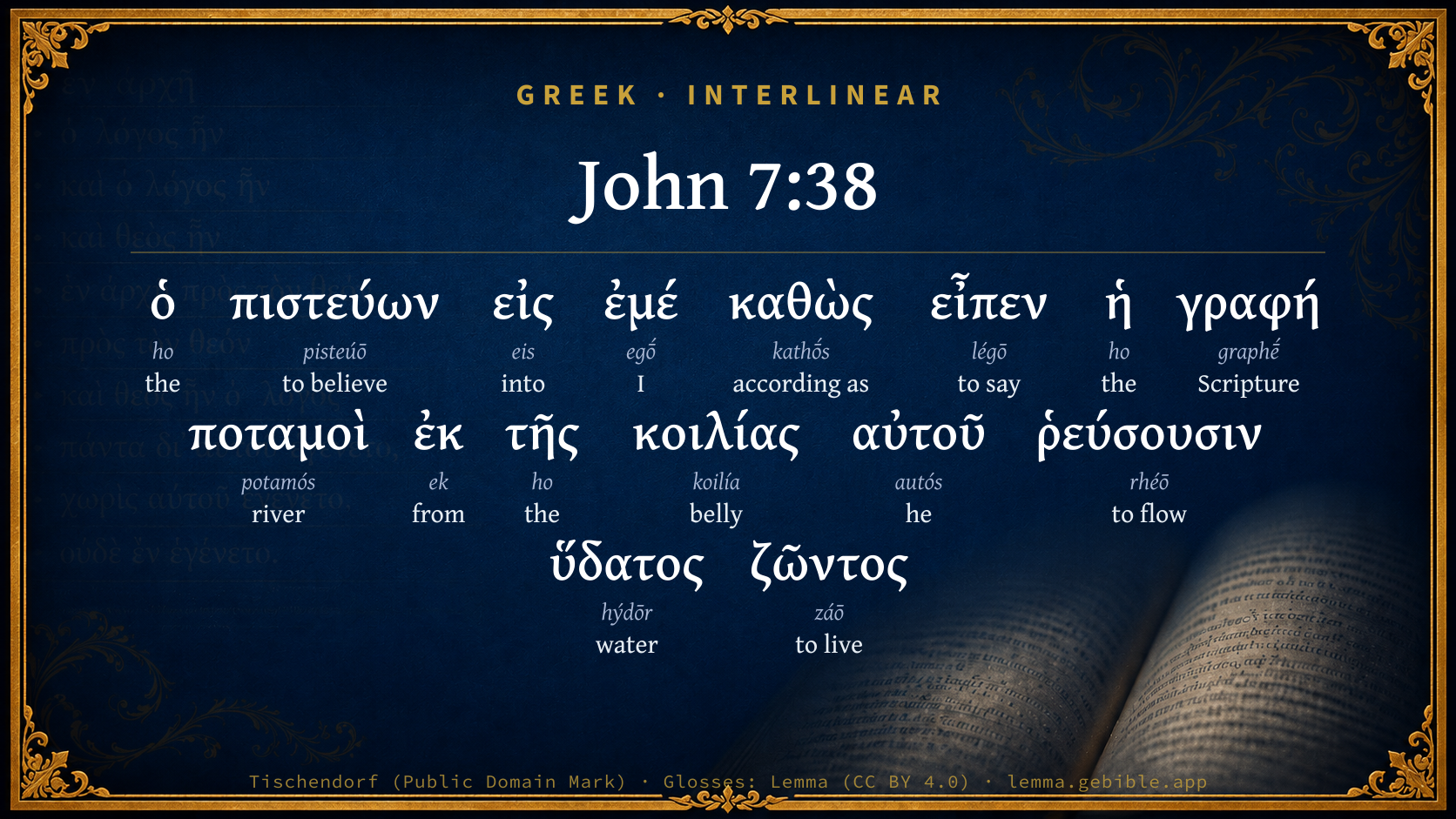
Greek (Tischendorf 8th ed.) John 7:38 appears in the Greek New Testament. The text above is from the Tischendorf 8th edition. Each word links to its Strong’s number and a concise gloss. Click any word for its full Thayer’s Greek Lexicon entry.
Download image
Cite this verse

John 7:38 (World English Bible). Public Domain. Lemma interlinear Bible study tool, https://lemma.gebible.app/v/john/7/38.

Show BibTeX & RIS
BibTeX
RIS
English Translation
He who believes in me, as the Scripture has said, from within him will flow rivers of living water."
World English Bible · Public Domain
Highlights
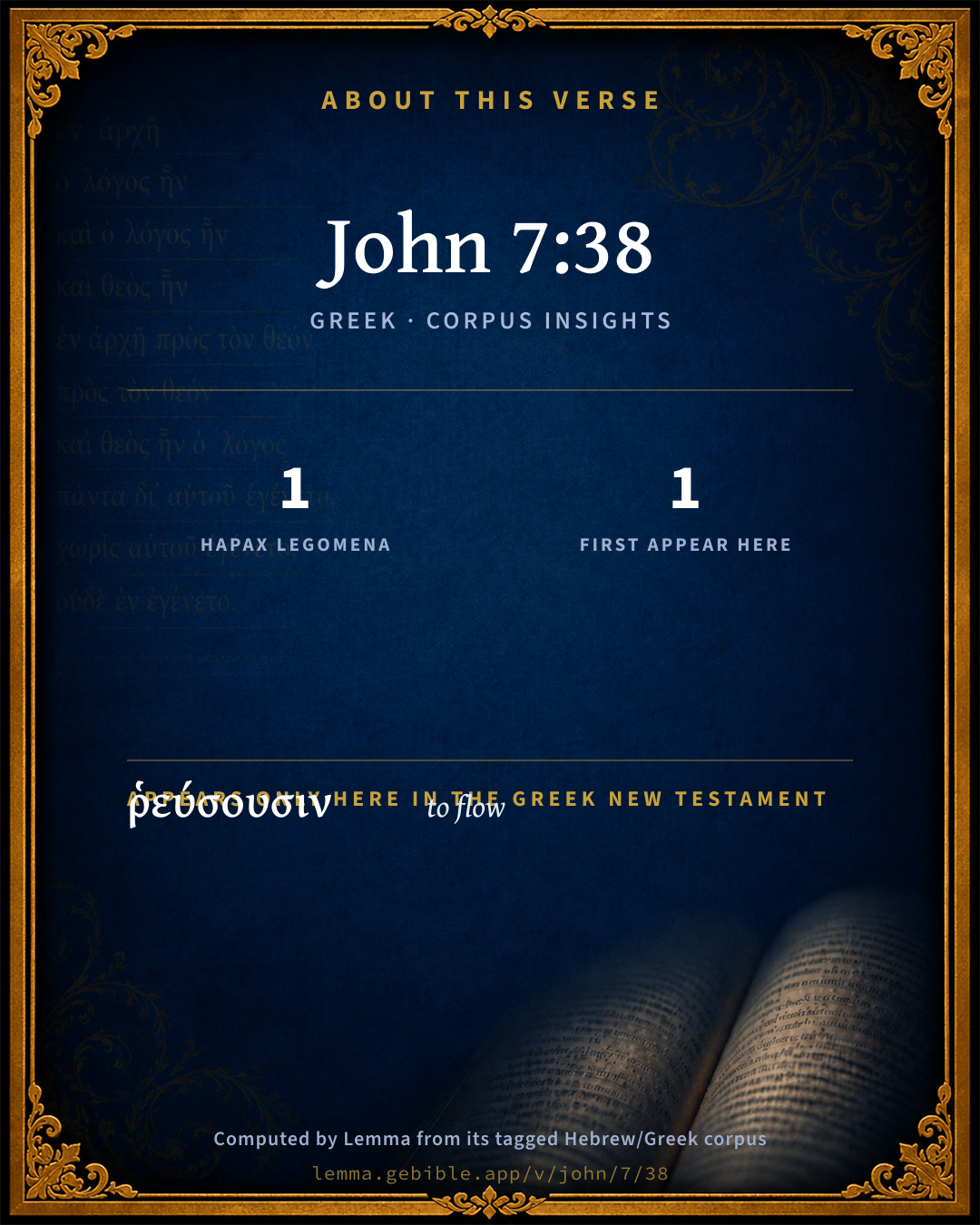
  • 1 hapax legomenon — only here in the Greek New Testament
  • 1 first appearance in the Greek New Testament
Full analysis ↓
Download a study sheet

One document with this verse’s original text, its word-by-word gloss line, the meaning frame, cross-references with their text, attributed commentary, and full source and license credits — printable, and it pastes into notes with its structure intact.

This verse Autodidact and up

Study sheet (.html) Plain text (.txt)

A passage Seminary Student

Up to 50 verses in one chapter. A passage sheet keeps up to 6 commentary sources and 12 cross-references per verse, in the order this page ranks them, and says so on the sheet whenever that leaves anything out. Ask for a single verse and you get the Autodidact verse sheet above.

Everything on this page stays free to read, with no account — the sheet is a download of what is already on screen, not access to it.

Want to remove ads? Support Godless Engineer
Compare translations 3

The same verse in 3 English versions, stacked beneath the original-language interlinear above. Click any original word for its lexicon entry.

Each is an independent rendering of the whole verse — the interlinear is not word-aligned to these translations.

Highlighted words mark where these versions differ — a whole-verse word diff, not a word-by-word alignment.

  • World English Bible Public Domain
    He who believes in me, as the Scripture has said, from within him will flow rivers of living water."
  • King James Version Public Domain
    He that believeth on me, as the scripture hath said, out of his belly shall flow rivers of living water.
  • unfoldingWord Literal Text CC BY-SA 4.0
    The one believing in me, just as the scripture says, ‘Rivers of living water will flow from his stomach.’”

unfoldingWord Literal Text — © unfoldingWord, licensed CC BY-SA 4.0. Word-aligned USFM3 via Door43 (git.door43.org/unfoldingWord/en_ult).

Versions to compare (up to 4)

3 of 4 selected

Show all 19 translations

Every available English version of this verse, each an independent rendering of the whole verse.

  • World English Bible Public Domain
    He who believes in me, as the Scripture has said, from within him will flow rivers of living water."
  • Berean Standard Bible Public Domain
    Whoever believes in Me, as the Scripture has said: ‘Streams of living water will flow from within him.’”
  • Majority Standard Bible Public Domain
    Whoever believes in Me, as the Scripture has said: ‘Streams of living water will flow from within him.’”
  • King James Version Public Domain
    He that believeth on me, as the scripture hath said, out of his belly shall flow rivers of living water.
  • American Standard Version (1901) Public Domain
    He that believeth on me, as the scripture hath said, from within him shall flow rivers of living water.
  • Revised Version (1885) Public Domain
    He that believeth on me, as the scripture hath said, out of his belly shall flow rivers of living water.
  • Geneva Bible (1599) Public Domain
    Hee that beleeueth in mee, as saith the Scripture, out of his bellie shall flowe riuers of water of life.
  • Douay-Rheims (1899) Public Domain
    He that believeth in me, as the scripture saith, Out of his belly shall flow rivers of living water.
  • Young's Literal Translation Public Domain
    he who is believing in me, according as the Writing said, Rivers out of his belly shall flow of living water;'
  • Literal Standard Version CC BY-SA 4.0
    he who is believing in Me, according as the Writing said, Rivers of living water will flow out of his belly”;
  • Unlocked Literal Bible CC BY-SA 4.0
    He who believes in me, just as the scripture says, rivers of living water will flow from his stomach.”
  • unfoldingWord Literal Text CC BY-SA 4.0
    The one believing in me, just as the scripture says, ‘Rivers of living water will flow from his stomach.’”
  • Darby Bible Public Domain
    He that believes on me, as the scripture has said, out of his belly shall flow rivers of living water.
  • World Messianic Bible Public Domain
    He who believes in me, as the Scripture has said, from within him will flow rivers of living water.”
  • Webster's Bible Public Domain
    He that believeth on me, as the scripture hath said, out of his belly shall flow rivers of living water.
  • Free Bible Version CC BY-SA 4.0
    If you trust in me, you will have streams of life-giving water flowing out from within you, as Scripture says.”
  • Bible in Basic English Public Domain
    He who has faith in me, out of his body, as the Writings have said, will come rivers of living water.
  • Text-Critical English NT CC BY 4.0
    Whoever believes in me, just as the Scripture has said, ‘From his innermost being will flow rivers of living water.’ ”
  • Tyndale New Testament (1534) Public Domain
    He that beleveth on me as sayeth the scripture out of his belly shall flowe ryvers of water of lyfe.

Literal Standard Version (2020), Covenant Press — licensed CC BY-SA 4.0. Text via the HelloAO Bible API (eBible.org). Unlocked Literal Bible (unfoldingWord) — licensed CC BY-SA 4.0. Text via the HelloAO Bible API (eBible.org). unfoldingWord Literal Text — © unfoldingWord, licensed CC BY-SA 4.0. Word-aligned USFM3 via Door43 (git.door43.org/unfoldingWord/en_ult). Free Bible Version, Dr. Jonathan Gallagher — licensed CC BY-SA 4.0. Text via the HelloAO Bible API (eBible.org).

Word by word

More ways to search: Search by grammar → Find every occurrence → Compare this word →

Practice this passage: Drill this verse → Learn its vocabulary →

ῥεύσουσιν
rhéō
G4482
“to flow”
Verb, Future, Active, Indicative, 3rd person, Plural
Part of Speech
Verb
Tense
Future
Voice
Active
Mood
Indicative
Person
3rd person
Number
Plural
Full Thayer's Definition

Origin: a primary verb

TDNT: None

1. to flow
  1. ὁ ho G3588 “the” Article, Nominative, Singular, Masculine
  2. πιστεύων pisteúō G4100 “to believe” Verb, Present, Active, Participle, Nominative, Singular, Masculine
  3. εἰς eis G1519 “into” Preposition
  4. ἐμέ egṓ G1473 “I” Personal pronoun, 1st person, Accusative, Singular
  5. καθὼς kathṓs G2531 “according as” Adverb
  6. εἶπεν légō G3004 “to say” Verb, Aorist, Active, Indicative, 3rd person, Singular
  7. ἡ ho G3588 “the” Article, Nominative, Singular, Feminine
  8. γραφή graphḗ G1124 “Scripture” Noun, Nominative, Singular, Feminine
  9. ποταμοὶ potamós G4215 “river” Noun, Nominative, Plural, Masculine
  10. ἐκ ek G1537 “from” Preposition
  11. τῆς ho G3588 “the” Article, Genitive, Singular, Feminine
  12. κοιλίας koilía G2836 “belly” Noun, Genitive, Singular, Feminine
  13. αὐτοῦ autós G846 “he” Personal pronoun, Genitive, Singular, Masculine
  14. ὕδατος hýdōr G5204 “water” Noun, Genitive, Singular, Neuter
  15. ζῶντος záō G2198 “to live” Verb, Present, Active, Participle, Genitive, Singular, Neuter

About this verse

These counts appear in no published source. They are computed here, from the morphology-tagged text and Lemma’s own curated glosses. What Lemma adds →

16
words
14
distinct lemmas
Gospels
section

Notable vocabulary

1 hapax legomenon — a word that appears only here in the entire Greek New Testament:

  • ῥεύσουσιν to flow G4482

First appearance in Scripture

This word makes its first canonical appearance in the Greek New Testament here:

  • ῥεύσουσιν to flow G4482

Shared distinctive vocabulary

ποταμοὶ river G4215 occurs in 17 verses of the Greek New Testament. Also found in:

Repetition

A word recurs within this verse:

Cross-references

14

Topical passages linked to John 7:38 in the Treasury of Scripture Knowledge — connected by theme and wording, ordered by reader-vote popularity; previews shown in the World English Bible.

  • John 4:14 but whoever drinks of the water that I will give him will never thirst again; but the water that I will give him will become in him a well of water springing up to eternal life."
  • Isaiah 44:3 For I will pour water on him who is thirsty, and streams on the dry ground; I will pour my Spirit on your seed, and my blessing on your offspring:
  • Isaiah 58:11 and Yahweh will guide you continually, and satisfy your soul in dry places, and make strong your bones; and you shall be like a watered garden, and like a spring of water, whose waters don't fail.
  • Isaiah 12:3 Therefore with joy you shall draw water out of the wells of salvation.
  • John 4:10 Jesus answered her, "If you knew the gift of God, and who it is who says to you, 'Give me a drink,' you would have asked him, and he would have given you living water."
  • Proverbs 10:11 The mouth of the righteous is a spring of life, But violence covers the mouth of the wicked.
  • Zechariah 14:8 It will happen in that day, that living waters will go out from Jerusalem; half of them toward the eastern sea, and half of them toward the western sea; in summer and in winter will it be.
  • Proverbs 18:4 The words of a man's mouth are like deep waters. The fountain of wisdom is like a flowing brook.
  • Galatians 5:22–23 But the fruit of the Spirit is love, joy, peace, patience, kindness, goodness, faithfulness,
  • Isaiah 59:21 As for me, this is my covenant with them, says Yahweh: my Spirit who is on you, and my words which I have put in your mouth, shall not depart out of your mouth, nor out of the mouth of your seed, nor out of the mouth of your seed's seed, says Yahweh, from henceforth and forever.
  • Ezekiel 47:1–12 He brought me back to the door of the house; and, behold, waters issued out from under the threshold of the house eastward; (for the forefront of the house was toward the east;) and the waters came down from under, from the right side of the house, on the south of the altar.
  • Job 32:18–19 For I am full of words. The spirit within me constrains me.
  • Deuteronomy 18:15 Yahweh your God will raise up to you a prophet from the midst of you, of your brothers, like me; to him you shall listen;
  • Ephesians 5:9 for the fruit of the Spirit is in all goodness and righteousness and truth,

Cross-references courtesy of OpenBible.info (CC BY 4.0).

Commentary

Notes on John 7:38 from classic Christian and Jewish commentators (each source and its license shown beneath its notes). The classic Christian expositions comment on the surrounding passage and are grouped to its opening verse, so a note may address several verses; the Jewish commentaries on the Tanakh (Rashi and others) are per-verse, so they appear only where the commentator wrote on this verse.

Lemma curates 59 commentaries, every one of them public domain or Creative Commons licensed, each selected and text-cleaned for this edition rather than reprinted as found. About our sources →

Joseph Benson's Commentary

Joh 7:38-39. He that believeth on me — With a living faith, and with his heart unto righteousness; as the Scripture hath said — As God in the Scriptures hath promised and attested in many places; out of his belly — From within him, from his mind and heart; shall flow rivers of living water — He shall receive spiritual blessings, or communications of divine grace, in so great an abundance, that he shall not only be refreshed and comforted himself, but shall be instrumental in refreshing and comforting others. The expression, Out of his belly shall flow rivers, is used with allusion to receptacles round springs, out of which great quantities of water flow by pipes: and the figure therefore signifies the plenitude of spiritual gifts and graces to be possessed by believers, and the happy effects which they should produce in the world. Thus the apostles and first messengers of Christ were both watered themselves and enabled to water others, Gentiles as well as Jews, not with small streams, but with large rivers of divine knowledge and grace, so that the countries, which till then had been barren, became exceeding fruitful in holiness and righteousness. Accordingly the evangelist adds, by way of explication, this spake he of the Spirit — Of the Holy Spirit’s gifts and graces; which they who believed on him should receive — Εμελλον λαμβανειν, were about to receive, namely, after the resurrection and ascension of Christ, according to his promise, Joh 14:16; and Joh 16:7. The extraordinary gifts of the Spirit had, in a great measure, ceased since the death of Zechariah and Malachi. They had been faintly manifested in the approach of the Messiah, as to Zechariah and Elizabeth, to Simeon and Anna, and especially to John the Baptist, who is said to have been filled with the Holy Ghost from his mother’s womb; but the full effusion of these gifts, foretold by Isaiah and Joel, took not place till after the ascension of Christ, and was yet to come. On the day of pentecost, and not before, these extraordinary gifts were communicated to the apostles, evangelists, and many other believers, to fit them for converting the world. The universality, however, of the invitation and promise here given, makes it evident that, on this occasion, our Lord had the ordinary influences of the Spirit in his eye, which the evangelist’s remark, that the Holy Ghost was not yet given, will not exclude; because, even these might at that time be said not to have been given, as they had been given but sparingly, in comparison of the plentiful distribution which was to be made of them to all believers after Christ’s ascension. Accordingly, the ordinary influences of the Spirit are often in Scripture represented as the consequences and reward of faith, Gal 3:14; Eph 1:12-14.

Joseph Benson's Commentary on the Old and New Testaments (1811–1818) — public domain. Text from a community e-Sword module.

Bengel's Gnomon

Johann Albrecht Bengel

Joh 7:38. Ὁ πιστεύων εἰς ἐμέ, He that believeth on Me) To believe is not parallel to the verb, to thirst, but to the verb, to come; ch. Joh 6:35. To this refer the they that believe of the following verse.—καθὼς εἶπεν ἡ γραφή, as the Scripture hath said) Scripture hath many things as to the promise of the Holy Spirit, under the figure of water: Isa 12:3, “Therefore with joy shall ye draw water out of the wells of salvation;” Isa 55:13, “Ho, every one that thirsteth, come ye to the waters—Incline your ear and come unto Me; hear, and your soul shall live;” Eze 47:1, etc., “Behold waters issued out from under the threshold of the house eastward;” Joh 7:9, “Every thing that liveth, which moveth, whithersoever the rivers shall come, shall live;” Joe 2:23, “Rejoice in the Lord your God; for He hath given you the former rain moderately, and He will cause to come down for you the rain, the former rain, and the latter rain;” which Jesus in this passage expresses in words adapted to the present occasion. But most especially pertinent to this passage is that one of Zec 14:8, ἐξελεύσεται ὕδωρ ζῶν ἐξ Ἱερουσαλήμ, κ.τ.λ., “Living waters shall go out from Jerusalem:” for that very chapter of Zechariah had been read in public, as the Haphtara [portion selected for the Lesson], on the first day of the Feast of Tabernacles, which Jesus, when He had come in the middle of the time of the feast, on the last day of it repeats at Jerusalem. He had not been present at the reading on the first day: He had not been taught letters, Joh 7:15, “How knoweth this man letters, having never learned?” therefore His quotation of the Lesson read ought to have had the more effect on His hearers.—κοιλίας, belly) בטן, the inmost recess, most capacious and most fruitful. The allusion is to the large jars in which, on the last day of that feast, water used to be borne from the fountain Siloah through the city to the sanctuary; for they had a large belly-like interior.—αὐτοῦ, His) Messiah’s. This is the fountain out of whose abundant flow believers receive, Joh 7:39.—ὕδατος ζῶντος) ὕδωρ ζῶν, Zech. as quoted above.

Bengel's Gnomon of the New Testament — English translation (T&T Clark, Edinburgh, 1860) — public domain. Text from a community e-Sword module.

Meyer's Critical & Exegetical Commentary

Heinrich August Wilhelm Meyer

Joh_7:38. The πίνειν is brought about by faith; hence the statement progresses: ὁ πιστεύων, κ.τ.λ.

καθὼς εἶπεν ἡ γρ.] is simply the formula of quotation, and cannot belong to ὁ πιστεύων εἰς ἐμέ, as if it denoted a faith which is conformable to Scripture (Chrysostom, Theophylact, Euthymius Zigabenus, Calovius, and most); ὁ πιστ., on the contrary, is the nominative absolute (see on Joh_6:39), and καθὼς εἶπεν, κ.τ.λ., belongs to the following ποταμοὶ, etc., the words which are described as a declaration of Scripture. There is no exactly corresponding passage, indeed, in Scripture; it is simply a free quotation harmonizing in thought with parts of various passages, especially Isa_44:3; Isa_55:1; Isa_58:11 (comp. also Eze_47:1; Eze_47:12; Zec_13:1; Zec_14:8; Joe_3:1; Joe_3:20; but not Son_4:12; Son_4:15). Godet refers to the account of the rock in the wilderness, Exo_17:6, Num_20:11; but this answers neither to the thing itself (for the subject is the person drinking) nor to the words. To think in particular of those passages in which mention is made of a stream flowing from the temple mount, the believer being represented as a living temple (Olshausen), is a gloss unwarranted by the context, and presents an inappropriate comparison (κοιλίας). This last is also in answer to Gieseler (in the Stud. u. Krit. 1829, p. 138 f.), whom Lange, L. J. II. p. 945, follows. To imagine some apocryphal or lost canonical saying (Whiston, Semler, Paulus; comp. also Weizsäcker, p. 518; Bleek, p. 234, and in the Stud. u. Krit. 1853, p. 331), or, as Ewald does, a fragment of Proverbs no longer extant, or of some such similar book, is too bold and unnecessary, considering the freedom with whieh passages of Scripture are quoted and combined, and the absence of any other certain trace in the discourses of Jesus of extra-canonical quotations, or of canonical quotations not now to be found in the O. T.; although, indeed, the characteristic ἐκ τῆς κοιλίας αὐτοῦ itself occurs in none of the above-named places, which is certainly surprising, and not to be explained by an inappropriate reference to Son_7:3 (Hengstenberg). But this expression, out of his body considering the connection of the metaphor, is very natural; the water which he drinks becomes in his body a spring from which streams of living water flow, i.e. the divine grace and truth which the believer has received out of Christs fulness into his inner life, does not remain shut up within, but will communicate itself in abundant measure as a life-giving stream to others, and thus the new divine life overflows from one individual on to others. As represented in the metaphor, these ποταμοί take their rise from the water which has been drunk and is in the κοιλία, and flow forth therefrom in an oral effusion;[270] for the effect referred to takes plaee in an outward direction by an inspired oral communication of ones own experience of Gods grace and truth (πιστεύομεν, διὸ καὶ λαλοῦμεν, 2Co_4:13). The mutual and inspired intercourse of Christians from Pentecost downwards, the speaking in psalms and hymns and spiritual songs, the mutual edification in Christian assemblies by means of the charismata even to the speaking with tongues, the entire work of the apostles, of a Stephen and so on, furnish an abundant historical commentary upon this text. It is clear, accordingly, that ΚΟΙΛΊΑ does not, as is usually supposed, denote the inner man, mans heart (Pro_20:27; Sir_19:12; Sir_51:21; LXX. Psa_40:9, following A.; comp. the Latin viscera), but must be left in its literal meaning belly in conformity with the metaphor which determines the expression.[271] The flowing forth of the water, moreover, is not to be understood as something operating upon the subject himself only (B. Crusius: his whole soul, from its very depth, shall have a continual quickening and satisfaction, comp. Maier), but as describing an efficacy in an outward direction, as ἐκ τ. κοιλ. shows, and therefore is not the same as the similar passage, chap. Joh_4:14. If we join ὁ πιστ. εἰς ἐμέ with inverts, πινέτω, αὐτοῦ must refer to Christ; and this is the meaning that we get: He that thirsteth, let him come to me; and he that believeth in me, let him drink of me: for to me refers what the Scripture hath said concerning a river which shall flow forth from Jehovah in the time of the Messiah. So Hahn, Theol. d. N. T. I. p. 229 f., and Gess, Pers. Chr. p. 166. But against this it is decisive, first, that he who believes on Jesus has already drunk of Him (Joh_6:35), and the call to come and drink must apply not to the believer, but to the thirsty; and secondly, that the expression ἐκ τῆς κοιλίας αὐτοῦ would be unnecessary and unmeaning, if it referred to Jesus, and not to him who has performed the ΠΙΝΈΤΩ (Nonnus, ΔΙᾺ ΓΑΣΤΡῸς ἘΚΕΊΝΟΥ).

ὝΔΩΡ ΖῶΝ, as in Joh_4:10; ΖῶΝΤΟς ΔῈ, ἬΓΟΥΝ ἈΕῚ ἘΝΕΡΓΟῦΝΤΟς, ἈΕΙΚΙΝΉΤΟΥ, Euthymius Zigabenus.

Observe further the ΠΟΤΑΜΟΊ emphatically taking the lead and standing apart; not in spoonfuls, nor with a pipe and tap, but in full streams, Luther.

[270] Comp. ἐρεύξομαι, Mat_13:35.

[271] Already Chrysostom and his followers took κοιλίας as equivalent to καρδίας; a confounding of the metaphor with its import. Hofmanns objection (Schriftbew. II. 2, p. 13), that the water here meant does not go into the belly at all, rests solely upon the same confusion of the figure with its meaning. According to the figure, it conies into the κοιλία because it is drunk, and this drinking is in like manner figurative. When Hofmann finds indicated in the word even a springing place of the Holy Spirit within the body, he cannot get rid of the idea of something withia the body as being implied in κοιλία, because the text itself presents this figure as being in harmony with that of the drinking; unless, indeed, the concrete expression is to give way to an exegetical prudery foreign to the text itself, and is to be blotted out at pleasure. κοιλία in no passage of the N. T. means anything else than body, belly.Strangely out of keeping with the unity of the figure, Lange, following Bengel (comp. also Weizsäcker), now finds in κοιλία an allusion to the belly of the golden pitcher (see on ver. 37), and Godet to the inner hollow of the rock whence the water flowed, so that ἐκ τ. κοιλ. αὐτοῦ corresponds with מִמֶּנּוּ, Exo_17:6. So inventive is the longing after types!

Meyer — Critical and Exegetical Commentary on the New Testament — English translation by Peter Christie, edited by Frederick Crombie (T&T Clark, 1880) — public domain. Text from a community e-Sword module.

Expositor's Greek Testament

ed. W. Robertson Nicoll

Joh 7:38 . ὁ πιστεύων … ζῶντος . [The nominative absolute is common.] No Scripture gives the words verbatim . Isa 58:11 has: “The Lord shall satisfy thy soul in drought: and thou shalt be like a watered garden, and like a spring of water whose waters fail not”. Cf. Joh 4:14 . The words seem to intimate that the believer shall not only have his own thirst quenched, but shall be a source of new streams for the good of others (O. Holtzmann). A remarkably analogous saying is quoted by Schoettgen from the Talmud: “Quando homo se convertit ad Dominum suum, tanquam fons aquis vivis impletur, et fluenta ejus egrediuntur ad omnis generis homines et ad omnes tribus”. At the same time it is not easy to see the relevancy of the saying if this meaning be attached to it, and the saying of Joh 4:14 is so similar that it seems preferable to understand it in the same sense, of the inseparableness and inwardness of the living water. Those who advocate the other meaning can certainly find confirmation for their view in the explanation added by John.

The Expositor's Greek Testament, edited by W. Robertson Nicoll (1897–1910) — public domain. Text from a community e-Sword module.

International Critical Commentary

38. καθὼς εἶπεν ἡ γραφή κτλ. ἡ γραφή always indicates a specific passage in the O.T. (see on 2:22), although (cf. v. 42 below) the quotation may not always be exact. Here, the source of the quotation cannot be identified with certainty, although, as we shall see, the idea of v. 38 is scriptural. The fact that we cannot precisely fix the quotation makes for the genuineness of the reminiscence here recorded. A writer whose aim was merely to edify, and who did not endeavour to reproduce historical incidents, would not have placed in the mouth of Jesus a scriptural quotation which no one has ever been able to identify exactly.

The passage has been punctuated in various ways:

(1) Chrysostom confines the quotation to the words “he that believeth in me,” taking the rest of v. 38 as words of Jesus. Thus the “scripture” might be Isa 28:16, quoted in Rom 9:33 in the form ὁ πιστεύων ἐπʼ αὐτῷ οὐ καταισχυνθήσεται. But this exegesis is a mere evasion of the difficulties.

(2) Some ancient Western authorities connect πινέτω with ὁ πιστεύων εἰς ἐμέ which follows, putting a stop after ἐμέ: “If any man thirst, let him come unto me, and let him drink that believeth on me. As the Scripture saith, Out of His belly shall flow rivers of living water.” By this arrangement, αὐτοῦ is understood of Christ, not of the believer.

The colometry of the O.L. codices d and e would agree with this punctuation.2 The Letter of the Churches of Vienne and Lyons3 has … τοῦ ὕδατος τῆς ζωῆς τοῦ ἐξιόντος ἐκ τῆς νηδύος τοῦ Χριστοῦ, Which takes αὐτοῦ as meaning Christ. So also Cyprian has “clamat dominus ut qui sitit ueniat et bibat de fluminibus aquae uiuae quae de eius uentre fluxerunt.”1 Many Western Fathers are cited to the same effect by Turner.2 Loisy and some other modern exegetes favour this view.

Burney held that this arrangement of clauses represented the sense, the Greek κοιλία being due to a misunderstanding of the underlying Aramaic, and a confusion of מְעִין “belly”(cf. Dan 2:32) with מַעְיָן “fountain.” He rendered v. 38 accordingly, “As the scripture hath said, Rivers shall flow forth from the fountain of living waters,” the allusion being to Eze 47:1. C. C. Torrey3 also appeals to the Aramaic, rendering “As the Scripture hath said, Out of the midst of her (i.e. Jerusalem) shall flow rivers of living water,” the reference being to Zec 14:8. These explanations are ingenious, but they do not disclose any exact citation from the O.T.

(3) We prefer the Eastern exegesis here. Origen is explicit in his reference of αὐτοῦ to the believer in Christ: εἰ γὰρ περὶ τοῦ πνεύματος εἴρηται ὡς ὕδωρ ζῶν ποταμῶν δίκην ἐκπορευόμενον ἐκ τοῦ πιστεύοντος …4 So, too, Cyril of Jerusalem (Cat. xvi. 2), Basil5 (in Psa 46:4), and Athanasius (Festal Letters, ix. 7, 44.).6 That Christ is the ultimate source of living water, which represents the Spirit, is common to all interpretations; but these writers understand also that those who receive it from Him hand it on in their turn to others.7 So in the Odes of Solomon (vi.) we have Christ the χείμαρρος8 or torrent of living water spreading over the world, while the ministers of this draught of the Spirit relieve many. This is the Johannine doctrine of the Spirit, appearing again in another form at 20:23.

The reference of ἐκ τῆς κοιλίας αὐτοῦ to the believer is in strict correspondence with the earlier passage 4:10-14, where it is said of the water which Christ gives that it will be in the believer πηγὴ ὕδατος ἁλλομένου εἰς ζωὴν αἰώνιον. The imagery of “If any man thirst, let him come unto me and drink,” goes back to Isa 55:1; and similarly (as at 4:14) the imagery of v. 38 goes back to Isa 58:11: “Thou shalt be like a spring of water whose waters fail not.” As we have seen on 4:14, this idea appears in many places in Hebrew literature, although the actual words cannot be traced. He who has drunk deep of the living waters which are the gift of Christ becomes himself, in his turn and in humbler measure, a fountain from which the water of life flows for the refreshment of others.

The κοιλία is regarded in the O.T. as the seat of man’s emotional nature (Pro 20:27). Water is often symbolic of the Divine Law (see on 4:10), and the Law is “in the heart” (Psa 40:8) of Yahweh’s servant, or, as some LXX texts have it, ἐν μέσῳ τῆς κοιλίας μου.The Psalm goes on: “I have not hid thy righteousness within my heart, I have declared thy faithfulness” (Psa 40:10). So again in Pro 18:4 we have: ὔδωρ βαθὺ λόγος ἐν καρδίᾳ ἀνδρός,ποταμὸς δὲ ἀναπηδύει καὶ πηγὴ ζωῆς. Hence the O.T. conception is that the Divine Law is in the heart (καρδία or κοιλία) of one inspired by the Spirit of Yahweh, like a fountain which cannot be repressed, but which perpetually sends forth a stream of living water. This is the Johannine teaching of 7:38.

The use of κοιλία is in accordance with the Semitic habit of expressing emphasis1 by mentioning some part of the body, e.g. “the mouth of Yahweh hath spoken it,” “His arm wrought salvation.” “Out of his belly” is only an emphatic way of saying “From him shall flow.” The living waters to the thought of the prophets (Zec 14:8. Eze 47:1) flowed from a holy place, viz. Jerusalem; but here they are said to flow from a holy man, viz. one who has believed in Christ.

There is no difficulty in the construction, ὁ πιστεύων εἰς ἐμέ being a suspended subject; cf. 15:5 ὁ μένων ἐν ἐμοί … οὖτος φέρει καρπόν, and see on 1:12.

International Critical Commentary — older volumes (1896–1929), various authors — public domain. Text from a community e-Sword module.

Geneva Bible (1599)

Geneva Bible translators

This is not read word for word in any place, but it seemeth to be taken out of many places where mention is made of the gifts of the holy Ghost, as Joel 2; Isa. 44, but especially in Isa. 55.

Geneva Bible (1599) marginal notes — public domain. Text via Bolls.life.

Jamieson, Fausset & Brown

Robert Jamieson, A. R. Fausset & David Brown

as the scripture hath said--These words belong to what follows, "Out of his belly, as the scripture hath said, shall flow," &c. referring not to any particular passage, but to such as Isa 58:11; Joe 3:18; Zac 14:8; Eze 47:1-12; in most of which the idea is that of waters issuing from beneath the temple, to which our Lord compares Himself and those who believe in Him.

out of his belly--that is, his inner man, his soul, as in Pro 20:27.

rivers of living water--(See on Joh 4:13). It refers primarily to the copiousness, but indirectly also to the diffusiveness, of this living water to the good of others.

Jamieson, Fausset & Brown — Commentary Critical and Explanatory on the Whole Bible (1871) — public domain (CC PDM 1.0). Text via the HelloAO Bible API.

Adam Clarke's Commentary

Verse 38. He that believeth on me, as the Scripture hath said] He who receives me as the Messiah, according to what the Scripture has said concerning me; my person, birth, conduct, preaching, and miracles, being compared with what is written there as ascertaining the true Messiah. Out of his belly-from his heart and soul; for in his soul shall this Spirit dwell.

Living water.] As a true spring is ever supplied with water from the great deep, with which it has communication, so shall the soul of the genuine believer be supplied with light, life, love, and liberty, and all the other graces of the indwelling Spirit, from the indwelling Christ. The Jews frequently compare the gifts and influences of the Holy Spirit to water in general-to rain, fountains, wells, rivers, c., c. The Scriptures abound in this metaphor. Ps 36:8, Ps 36:9; Isa 44:3; Isa 44:4; Joe 2:23.

Adam Clarke's Commentary on the Bible (1810–1826) — public domain. Text from a community e-Sword/MySword module.

John Calvin's Commentaries

38. He who believeth in me. He now points out the manner of coming, which is, that we must approach, not with the feet, but by faith; or rather, to come is nothing else than to believe, at least, if you define accurately the word believe; as we have already said that we believe in Christ, when we embrace him as he is held out to us in the Gospel, full of power, wisdom, righteousness, purity, life, and all the gifts of the Holy Spirit. Besides, he now confirms more plainly and fully the promise which we lately mentioned; for he shows that he has a rich abundance to satisfy us to the full.

Out of his belly shall flow rivers of living water. The metaphor appears, no doubt, to be somewhat harsh, when he says that rivers of living water shall flow out of the belly of believers; but there can be no doubt as to the meaning, that they who believe shall suffer no want of spiritual blessings. He calls it living water, the fountain of which never grows dry, nor ceases to flow continually. As to the word rivers being in the plural number, I interpret it as denoting the diversified graces of the Spirit, which are necessary for the spiritual life of the soul. In short, the perpetuity, as well as the abundance, of the gifts and graces of the Holy Spirit, is here promised to us. Some understand the saying — that waters flow out of the belly of believers — to mean, that he to whom the Spirit has been given makes a part to flow to his brethren, as there ought to be mutual communication between us. But I consider it to be a simpler meaning, that whosoever shall believe in Christ shall have a fountain of life springing up, as it were, in himself, as Christ said formerly,

He who shall drink of this water shall never thirst, (John 4:14;)

for while ordinary drinking quenches thirst only for a short time, Christ says that by faith we draw the Spirit, that he may become a fountain of water springing up into everlasting life

Still he does not say that, on the first day, believers are so fully satisfied with Christ, that ever afterwards they neither hunger nor thirst; but, on the contrary, the enjoyment of Christ kindles a new desire of him. But the meaning is, that the Holy Spirit is like a living and continually flowing fountain in believers; as Paul also declares that he is life in us, (Romans 8:10,) though we still carry about, in the remains of sin, the cause of death. And, indeed, as every one partakes of the gifts and graces of the Holy Spirit, according to the measure of his faith, we cannot possess a perfect fullness of them in the present life. But believers, while they make progress in faith, continually aspire to fresh additions of the Spirit, so that the first-fruits which they have tasted carry them forward to perpetuity of life. But we are also reminded by it, how small is the capacity of our faith, since the graces of the Spirit scarcely come into us by drops, which would flow like rivers, if we gave due admission to Christ; that is, if faith made us capable of receiving him.

As the Scripture saith. Some confine this to the former clause, and others to the latter clause; for my own part, I extend it to the entire scope of the discourse. Besides, Christ does not here, in my opinion, point out any particular passage of Scripture, but produces a testimony drawn from the ordinary doctrine of the Prophets. For whenever the Lord, promising an abundance of his Spirit, compares it to living waters, he looks principally to the kingdom of Christ, to which he directs the minds of believers. All the predictions of living waters, therefore, have their fulfillment in Christ, because he alone hath opened and displayed the hidden treasures of God. The reason why the graces of the Spirit are poured out on him is,

that we may all draw out of his fullness, (John 1:16.)

Those persons, therefore, whom Christ so kindly and graciously calls, and who wander in every direction, deserve to perish miserably.

John Calvin's Commentaries (1540-1563) — public domain. Text from the Calvin Translation Society English edition (1840s-50s) via the Christian Classics Ethereal Library (ccel.org). Calvin's coverage is partial (roughly two-thirds of the Bible); uncommented books and verses are honest gaps, never fabricated. The 19th-century editor's footnotes and remarks are omitted so the notes are faithfully Calvin's own voice.

Ellicott's Commentary for English Readers

(38) There can be little doubt that our English version rightly gives the meaning of the original here; though representatives of both the earliest and the latest schools of interpretation have tried so to read the verse as to avoid its difficulties. Some would attach the first clause to the preceding verse, reading, “If any man thirst, let him come unto Me; and let him that believeth on Me drink.” Others would have us think that the words, “as the Scripture hath said,” belong to the clause before them, and not to that which follows, making the sense, “He that believeth on Me according to the Scriptures, out of his belly (I say) shall flow rivers of living water.” The reader of the English will, it is believed, feel, and the reader of the Greek will feel still more strongly, that these are attempts to avoid what it is hard to explain, and that while they miss the difficulty they also miss the meaning.

He that believeth on me . . .—We have here an advance on the thought, “If any man thirst let him come unto Me and drink.” That represented the satisfaction of the individual mind. This teaches the fuller truth that every one in living communion with Christ becomes himself the centre of spiritual influence. There is in him a power of life which, when quickened by faith, flows forth as a river, carrying life and refreshment to others. No spirit grasps a great truth which satisfies its own yearnings as the waters of the fountain slake physical thirst, without longing to send it forth to others who are seeking what he himself had sought. There is in him a river whose waters no barrier can confine. This is the spirit of the prophet and the evangelist, of the martyr and the missionary. It is the spirit of every great teacher. It is the link which binds men together and makes the life of every Christian approach the life of Christ, for he lives not for himself but for the world.

The exact words “Out of his belly shall flow rivers of living water,” are not found in any part of the Canonical Scriptures of the Old Testament, and yet Christ Himself utters them with the formula of quotation. This will be a difficulty only to those who value letter and syllable above spirit and substance. It may be that the words which our Lord actually uttered in the current language of Jerusalem were nearer to the very words of some passage in the Old Testament than they seem to be in the Greek form in which St. John has preserved them to us. But it is instructive that the thought is that which our Lord Himself, or St. John as representing Him, considers as the essence of the quotation. The thought meets us again and again in the Old Testament. See the following passages: Exo_17:6; Num_20:11; Psa_114:8; Isa_44:3; Isa_55:1; Isa_58:11; Joe_2:23; Joe_3:18; Eze_47:1; Eze_47:12; Zec_13:1; Zec_14:8.

This frequent reference to the refreshment and life-giving power of water is the more natural in the East, where drought is a fearful evil ever to be guarded against, and a well of water a blessing always sought for as the first necessity of life.

The abundance is suggested by the contrast between the small quantity poured out in the Temple and the streams which flowed from the rock struck in the wilderness. The vessel they carried contained but three logs, or about a quart, of water, brought from the tank of Siloam. This was poured through a perforated silver bowl. In the spiritual interpretation the water shall not be carried to the Temple, for every believer shall be a temple of the Holy Ghost and a source of life; it shall not be a limited quantity in vessels of gold and silver, but shall be as rivers bursting forth in their strength and fulness.

A Bible Commentary for English Readers, edited by Charles John Ellicott (1878–1897) — public domain. Text from a community e-Sword module.

The Cambridge Bible for Schools and Colleges

gen. ed. J. J. S. Perowne

38. as the scripture hath said] This phrase undoubtedly refers to the words that follow: but inasmuch as no such text is found in Scripture, some have tried to force the phrase into connexion with what precedes, as if the meaning were ‘He that believeth on me in the way that Scripture prescribes.’ Although the exact words are not found in Scripture there are various texts of similar import: Isa_44:3; Isa_58:11; Zec_13:1; Zec_14:8, &c. But none of them contain the very remarkable expression ‘out of his belly.’

rivers of living water] In the Greek ‘rivers’ stands first with strong emphasis; rivers out of his belly shall flow, (rivers) of living water, in marked contrast to the ewer of water poured each day during the Feast. ‘He that believeth on me’ is of course a stage far in advance of ‘if any one thirst.’ A man may thirst for spiritual satisfaction, and yet not end in believing on Christ. But the believer cannot end in satisfying his own thirst; he at once becomes a fount whence others may derive refreshment. Whether he wills to be a teacher or no, the true Christian cannot fail to impart the spirit of Christianity to others.

The Cambridge Bible for Schools and Colleges (gen. ed. J. J. S. Perowne; Cambridge University Press, 1878–1918) — public domain. Text from a community e-Sword module.

John Gill's Exposition

But this spake he of the Spirit,.... These are the words of the evangelist, explaining the figurative expressions of Christ; showing, that by rivers of living water, he meant the Spirit in his gifts and graces; and which is the plain sense of the passages referred to by him, particularly Isa 44:3, and which, as before observed, the Jews supposed were intimated by their drawing and pouring water at the feast of tabernacles.

Which they that believe on him should receive; the apostles, and others, that had believed in Christ, and had received the Spirit, as a spirit of regeneration and sanctification; as a spirit of illumination and conversion; as a spirit of faith and adoption; but on the day of Pentecost they were to receive a larger, even an extraordinary measure of his gifts and grace, to qualify them for greater work and service:

for the Holy Ghost was not yet given; the word "given" is not in the original text; but is very properly supplied, as it is in the Vulgate Latin, Syriac, and Persic versions. The Arabic version renders it, "for the Holy Ghost was not yet come"; he was; he was in being as a divine person, equal with the Father and Son, so he was from everlasting; and he had been bestowed in his grace upon the Old Testament saints, and rested in his gifts upon the prophets of that dispensation; but, as the Jews themselves confess (f),

"after the death of the latter prophets, Haggai, Zachariah, and Malachi, the Holy Ghost removed from Israel.''

And they expressly say, be was not there in the time of the second temple. Maimonides says (g),

"they made the Urim and Thummim in the second temple, to complete the eight garments (of the priests) though they did not inquire by them; and why did they not inquire by them? because the Holy Ghost was not there; and every priest that does not speak by the Holy Ghost, and the Shekinah, does not dwell upon him, they do not inquire by him.''

They observe (h) there were five things in the first temple which were not in the second, and they are these,

"the ark with the mercy seat, and cherubim, the fire (from heaven), and the Shekinah, , "and the Holy Ghost", and the Urim and Thummim.''

Now, though he had removed, he was to return again; but as yet the time was not come, at least for the more plentiful donation of him: the reason of which was,

because that Jesus was not yet glorified; he had not as yet gone through his state of humiliation; he had not yet suffered, and died, and rose again, and ascended, and sat down at the right hand of God; for the Holy Spirit was to come upon his departure, and in consequence of his sufferings and death, and being made sin, and a curse for his people; and through his mediation and intercession, and upon his exaltation at the Father's right hand; when being made, and declared Lord and Christ, this should be notified by the effusion of his Spirit; see Act 2:33.

(f) T. Bab. Yoma, fol. 9. 2. Sota, fol. 48. 2. & Sanhedrin, fol. 11. 1. (g) Hilchot Cele Hamikdash, c. 10. sect. 10. Vid. T. Bab. Yoma, fol. 73. 2. (h) T. Bab. Yoma, fol. 21. 2. Vid. Jarchi & Kimchi in Hagg. i. 8.

John Gill's Exposition of the Whole Bible (1746–1763) — public domain (CC PDM 1.0). Text via the HelloAO Bible API.

Trapp's Complete Commentary

John Trapp

38 He that believeth on me, as the scripture hath said, out of his belly shall flow rivers of living water.

Ver. 38. {See Trapp on "Joh 7:37"}

John Trapp, A Commentary or Exposition upon All the Books of the Old and New Testament (1647–1656) — public domain. Text from a community e-Sword module.

Albert Barnes' Notes on the Bible

He that believeth on me - He that acknowledges me as the Messiah, and trusts in me for salvation.

As the scripture hath said - This is a difficult expression, from the fact that no such expression as follows is to be found literally in the Old Testament. Some have proposed to connect it with what precedes - “He that believeth on me, as the Old Testament has commanded or required” - but to this there are many objections. The natural and obvious meaning here is, doubtless, the true one; and Jesus probably intended to say, not that there was any particular place in the Old Testament that affirmed this in so many words, but that this was the substance of what the Scriptures taught, or this was the spirit of their declarations. Hence, the Syriac translates it in the plural - the Scriptures. Probably there is a reference more particularly to Isa 58:11, than to any other single passage: “Thou shalt be like a watered garden, and like a spring of water whose waters fail not.” See also Isa 44:3-4; Joe 3:18.

Out of his belly - Out of his midst, or out of his heart. The word “belly” is often put for the midst of a thing, the center, and the heart, Mat 12:40. It means here that from the man shall flow; that is, his piety shall be of such a nature that it will extend its blessings to others. It shall be like a running fountain - perhaps in allusion to statues or ornamented reservoirs in gardens. in which pipes were placed from which water was continually flowing. The Jews used the same figure: “His two reins are like fountains of water, from which the law flows.” And again: “When a man turns himself to the Lord, he shall be as a fountain filled with living water, and his streams shall flow to all the nations and tribes of men” (Kuinoel).

Rivers - This word is used to express abundance, or a full supply. It means here that those who are Christians shall diffuse large, and liberal, and constant blessings on their fellow-men; or, as Jesus immediately explains it, that they shall be the instruments by which the Holy Spirit shall be poured down on the world.

Living water - Fountains, ever-flowing streams. That is, the gospel shall be constant and life-giving in its blessings. We learn here:

1.That it is the nature of Christian piety to be diffusive.

2.That no man can believe on Jesus who does not desire that others should also, and who will not seek it.

3.That the desire is large and liberal - that the Christian desires the salvation of all the world.

4.That the faith of the believer is to be connected with the influence of the Holy Spirit, and in that way Christians are to be like rivers of living water.

Albert Barnes' Notes on the Bible (1834–1885) — public domain. Text from a community e-Sword/MySword module.

Haydock's Catholic Bible Commentary

Out of his belly shall flow rivers of living water. By this living water, are signified the gifts of the Holy Ghost, which were promised to the faithful. (Witham)

George Leo Haydock (1774–1849), Haydock's Catholic Family Bible and Commentary, 1859 edition — public domain. Excludes Psalms (Douay-Rheims chapter numbering differs from Protestant) and Deuterocanonical books (Catholic canon only).

Matthew Poole's English Annotations

We have had frequent occasion to open the term of believing on Christ. It may be doubted, whether those words,

as the Scripture hath said, be to be referred to the first or latter part of the text. If to the former, they are words expressive of that faith to which the following promise is made, which is not any assent, or slighty credit given to the word; but such a faith as the Scripture hath spoken of, as that faith which is justifying and saving.

Out of his belly shall flow rivers of living water; the general sense of the promises, that his soul shall abound with all saving and comfortable influences of saving grace.

The belly signifieth the heart, that part of man which is called the heart being in the belly. So Job 15:35; Psa 40:8.

The flowing of rivers of water, signifieth the plenty of spiritual influences with which believers shall be supplied; whether joy, knowledge, spiritual gifts, or graces. If any ask, where the Scripture speaketh this? I answer, in all those promises we meet with in the Old Testament, about pouring out the Spirit.

Matthew Poole's English Annotations on the Holy Bible (1683–1685) — public domain. Text from a community e-Sword/MySword module.

Whedon's Commentary on the Bible

Daniel D. Whedon

38. Out of his belly—As the priest poured the water from the belly of the golden pitcher. Thus shall the holy power go forth from the person of every believer to convince and convert the world. But as the next verse interprets the water to be the Spirit, is it biblical to say that the Holy Spirit flows forth from the believer? In view of this objection Stier has, with much plausibility, so punctuated the text as to give the following meaning: “If any man thirst let him come unto me; and let him drink that believeth in me; as the Scripture saith, Out of his belly shall flow rivers,” etc. The flowing forth of the rivers would by this interpretation be from the person of Christ himself. The term belly, or bowels, would then be borrowed not from the pitcher but from the mountain. The mountain is the base of the temple, and so the water flows forth from the temple as the Spirit flows forth from the body of Christ, the holy living temple.

Daniel D. Whedon (gen. ed.), Commentary on the Old and New Testaments (1874–1909) — public domain. Text from a community e-Sword module.

The Pulpit Commentary

He that believeth on me. The o pisteuwn in the nominative absolute, followed by another construction, gives great force to the mighty words. This is not the first time that Christ has represented believing under the form of both "coming" and "drinking." The one term seems to cover that part of faith in Christ which unites the soul to him, which sides with him, which utterly abandons self to take his word as true and his power as sufficient; the other term, when applied to participation in his blood, implies receiving into the soul the full solace of his imparted life. He that believeth on me, as the Scripture hath said, out of his belly shall rush torrents of living water. From his newly given, divinely imparted life shall proceed, as from the innermost depths of his consciousness, illimitable supplies of refreshment and fertility for others as well. Each soul will be a rock smitten in the thirsty land, from which crystal rivers of life-giving grace shall flow. Godet urges, against Meyer, the great sufficiency of this particular illustration of the rock in the wilderness as justifying the reference to the phrase, "as the Scripture hath said," and points especially Exo_17:6, "Behold, I will stand before thee there... in Horeb; and thou shalt smite the rock, and out of it (WNMmi) water shall come, that the people may drink". (cf. Num_20:11 Deu_8:15 Psa_114:8; passages read during the feast) He thinks the koiliav autou corresponds with "from out of it" of Exodus. Hengstenberg laid long and fantastic emphasis on the Canticles,where the koilia of the bride of Jehovah is described. It is certain that the numerous passages in the Old Testament, in which the gift of refreshing water is made the symbol of national mercies and spiritual blessings, do, for the most part, fall short of this remarkable expression. Still, Isa_44:3 Isa_55:1 Isa_58:11 Zec_14:8, all more or less approach the thought; but Eze_47:1-12, where from the altar the living, health giving, mighty river flows for the healing of the nations, is so akin to the saying of the Lord, as soon as we recognize the fact that he is greater than the temple, and that his Church is God"s temple, and each body of man a temple of the Holy Ghost, that all real difficulty vanishes. The whole history of the Church is one continuous comment and illustration of the exhaustless fulness of his Word. Just as a soul of man comes and drinks of the water of life, he becomes himself a perennial source of life to others. He supplies not cisterns of stagnant water, but rivers of living water. (Rom_8:9-11 1Co_3:16) Chrysostom adds, One may perceive what is meant, if he will consider the wisdom of Stephen, the tongue of Peter, the vehemence of Paul; how nothing withstood them not the anger of multitudes, nor the uprising of tyrants, nor plots of devils, nor daily deaths but, as rivers borne along with loud rushing sound, they went on their way."

The Pulpit Commentary (1880–1919), ed. H.D.M. Spence-Jones & Joseph S. Exell — public domain. Text from a community e-Sword module.

John Wesley's Explanatory Notes

He that believeth - This answers to let him come to me. And whosoever doth come to him by faith, his inmost soul shall be filled with living water, with abundance of peace, joy, and love, which shall likewise flow from him to others. As the Scripture hath said - Not expressly in any one particular place. But here is a general reference to all those scriptures which speak of the effusion of the Spirit by the Messiah, under the similitude of pouring out water. Zech. xiv, 8.

John Wesley, Explanatory Notes Upon the Whole Bible (1754–1765) — public domain. Text via the GEBible commentary corpus.

Burkitt's Expository Notes on the New Testament

William Burkitt

Here again Christ alludes to a Jewish custom; the Jews were wont at fountains to build great vessels of stone, and in the midst or belly of them to have pipes, through which the water passes. "Now, says Christ, Thus shall it be with every one that believeth on me; he shall be abundantly filled with the spirit of God, in all the sanctifying and saving graces of it." Christ and his Holy Spirit are a living fountain, whose waters never fail; they are not a water-brook, but a spring of waters: we shall never miss of the waters of life, if we seek unto and wait upon Christ for them. For if we believe on him out of our belly shall flow rivers of living waters, sufficient for ourselves, and wherewith to refresh others.

William Burkitt's Expository Notes on the New Testament (1700–1703) — public domain. Text from a community e-Sword module.

The People's New Testament

B. W. Johnson

38. He that believeth on me, as the scripture hath said. Notice that “believing” corresponds to “coming” in the preceding verse, showing that faith is the means that brings us to Christ. The reference is not to any single passage, but to the spirit of the Scripture, notably such passages as Isa. 55:1; 58:11; Psa. 36:8, 9. Out of his belly shall flow rivers of living water. Christ is the living water; he who believes upon Christ has Christ formed within him, and hence must become a fountain to dispense the living water whatever he goes.

B. W. Johnson's The People's New Testament with Notes (1889–1891) — public domain. Electronic text from the Christian Classics Ethereal Library (CCEL) ThML edition.

Cambridge Greek Testament for Schools and Colleges

38. ὁ πιστεύων. Nominativus pendens; comp. Joh 6:39; Joh 15:2.

καθὼς εἶπεν ἡ γρ. As the scripture said; as if some passage to this effect had recently been read. see on Joh 2:22. The phrase undoubtedly refers to the words that follow: but inasmuch as no such text is found in Scripture, some have tried to force the phrase into connexion with what precedes, as if the meaning were ‘He that believeth on me in the way that Scripture prescribes.’ Although the exact words are not found in Scripture there are various texts of similar import: Isa 44:3; Isa 58:11; Zec 13:1; Zec 14:8, &c. But none of them contain the very remarkable expression ‘out of his belly.’ Godet contends for Exo 17:6 and Num 20:11, and thinks that ‘out of it’ (Heb. ‘from within him’) is the source of ἐκ τῆς κοιλίας αὐτοῦ, and ‘abundant waters’ of ποταμοὶ ὕδατος, while ‘I will stand’ may possibly be alluded to in ‘Jesus was standing.’ In the LXX. there is no resemblance to the Greek here. Ποταμοί stands first with great emphasis; rivers out of his belly shall flow, rivers of living water; in marked contrast to the ewer of water poured each day of the Feast. (For the form ῥεύσουσιν see Winer, p. 109.) Note how, as so often in S. John, the conclusion of one thought is the starting-point of another. As in Joh 6:35, ‘coming to Christ’ is equivalent to ‘believing on Christ;’ and believing on Him is far in advance of thirsting for spiritual satisfaction, for a man may thirst and refuse to believe. But the believer cannot end in satisfying his own thirst; he at once becomes a fount whence others may derive refreshment. Whether he wills to be a teacher or no, the true Christian cannot fail to impart the spirit of Christianity to others. Thus we have three stages; (1) thirsting; (2) coming or believing; (3) being filled and supplying others.

Cambridge Greek Testament for Schools and Colleges (Cambridge University Press, 1896; 21 vols, various authors incl. Carr, Maclear, Plummer, Farrar, Lumby, Moule, M. R. James, Simcox) — public domain. Text from a community e-Sword module.

Alford’s Greek Testament

Henry Alford

38.] It is not certain what is meant by this ἡ ἐσχ. ἡμ. ἡ μεγ. The command, Lev 23:34, Lev 23:35, was to keep the feast seven days; the first to be a solemn assembly and a feast-sabbath,—then on the eighth day another solemn assembly and a feast-sabbath:—so also ib. ver. 39. (But in Deu 16:13 nothing is said of the eighth day.) In Neh 8:18 the feast is kept seven days, and on the eighth is a solemn assembly, “according unto the manner.” In Num 29:12-38, where minute directions are given for every day of the feast, the eighth day is reckoned in, as usual. Josephus, Antt. iii. 10. 4, gives a similar account. In 2 Macc. 10:6, we read ἡμέρας ὀκτώ, σκηνωμάτων τρόπον. But the eighth day was not properly one of the feast days; the people ceased to dwell in the tabernacles on the seventh day. Philo says of it, ἑπτὰ δὲ ἡμέραις ὀγδόην ἐπισφραγίζεται, καλέσας ἐξόδιον αὐτήν, οὐκ ἐκείνης ὡς ἔοικε μόνον τῆς ἑορτῆς, ἀλλὰ πασῶν τῶν ἐτησίων ὅσας καθηριθμήσαμεν· τελευταία γὰρ ἐστι τοῦ ἐνιαυτοῦ. De Septenario, § 24. And though this, as Lücke observes (ii. 224), may be pure conjecture, it is valuable, as shewing the fact the reason of which is conjectured; viz. that the eighth day was held in more than ordinary estimation. The eighth day then seems here to be meant, and the last of the feast to be popularly used, as in some of the citations above. But a difficulty attends this view. Our Lord certainly seems to allude here to the custom which prevailed during the seven days of the feast, of a priest bringing water in a golden vessel from the pool of Siloam with a jubilant procession to the temple, standing on the altar and pouring it out there, together with wine, while meantime the Hallel (Ps. 113-118.) was sung. This practice was by some supposed—as the dwelling in tabernacles represented their life in the desert of old—to refer to the striking of the rock by Moses:—by others, to the rain, for which they then prayed, for the seed of the ensuing year:—by the elder Rabbis (Maimonides, cited by Stier, iv. 331, edn. 2), to Isa 12:3, and the effusion of the Holy Spirit in the days of the Messiah. But it was universally agreed (with the single exception of the testimony of R. Juda Hakkadosh, quoted in the tract Succa, which itself distinctly asserts the contrary), that on the eighth day this ceremony did not take place. Now, out of this difficulty I would extract what I believe to be the right interpretation. It was the eighth day, and the pouring of water did not take place. But is therefore (as Lücke will have it) all allusion to the ceremony excluded? I think not: nay, I believe it is the more natural. For seven days the ceremony had been performed, and the Hallel sung. On the eighth day the Hallel was sung, but the outpouring of the water did not take place: “desideraverunt aliquid.” ‘Then Jesus stood and cried, &c.’ Was not this the most natural time? Was it not probable that He would have said it at such a time, rather even than while the ceremony itself was going on?

An attempt has been made to alter the punctuation thus: ἐάν τις διψᾷ, ἐρχέσθω πρός με, καὶ πινέτω ὁ πιστεύων εἰς ἐμέ· καθὼς εἶπεν ἡ γρ., ποταμοὶ κ.τ.λ. Of this I can only say, that it is surprising to me how any one accustomed to the style of our Evangelist can for a moment suppose it possible. The harshness of καὶ πινέτω ὁ π. εἰς ἐμέ is beyond all example. The ordinary punctuation, making ὁ πισ. εἰς ἐμέ a nom. abs., see ch. 6:39, is the only admissible one,—even were it beset with far greater difficulties than it is. (The punctuation above mentioned is strongly upheld against this note in Stier, edn. 2. In spite of what he there says, I cannot think it can ever make way among Biblical scholars. It introduces two subjects into the first part of the sentence, viz. ὁ διψῶν and ὁ πιστεύων εἰς ἐμέ, to the utter confusion of both sense and metaphor. The distinction, insisted on by Stier, between the believer on Christ, who was not only to come, but to drink,—and the people at the feast, who only witnessed the outpouring of the water,—and which he gives as a reason why πινέτω must stand emphatically before ὁ πιστ. its qualifying subject, will be quite as marked with the usual punctuation: nay even more so.)

On the first clauses, see notes on ch. 4:13, 14.

καθὼς εἶπ. ἡ γρ.] These words must apply to ποταμοὶ ἐκ τ. κ.…, since ὁ πιστ. εἰς ἐμέ could not form part of the citation. But we look in vain for such a text in the O.T., and an apocryphal or lost canonical book is out of the question.

I believe the citation to be intimately connected with the ceremony referred to, and that we must look for its place by consulting the passages where the flowing out of water from the temple (see above) is spoken of. The most remarkable of these is found in Eze 47:1-12. There a ποταμός of water of life (see ver. 9 especially) flows from under the threshold of the temple. Again in Zec 14:8, ἐξελεύσεται ὕδωρ ζῶν ἐξ Ἱερουσαλήμ. I believe these expressions to be all to which the citation applies, and the ἐκ τῆς κοιλίας αὐτοῦ to be the interpretation of the corresponding words in the prophecies. For the temple was symbolic (see ch. 2:21) of the Body of the Lord; and the Spirit which dwells in and flows forth from His glorified Body, dwells in and flows forth from His people also, who are made like unto Him, Gal 4:6: Rom 8:9-11Co 3:161Co_3:16.

Henry Alford, The Greek Testament (1849–1861) — public domain. Text from a community e-Sword module.

Vincent's Word Studies in the New Testament

Marvin R. Vincent

The scripture hath said. There is no exactly corresponding passage, but the quotation harmonizes with the general tenor of several passages, as Isa 55:1; Isa 58:11; Zec 13:1; Zec 14:8; Eze 47:1; Joe 3:18. Belly [κοιλιας] . The word is often used in the Old Testament for the innermost part of a man, the soul or heart. See Job 14:35; Job 32:19; Pro 18:8; Pro 20:27, 30. The rite of drawing and pouring out the water pointed back to the smitten rock in the desert. In Exo 17:6, "there shall come water out of it," is literally, "there shall come water from within him." The word belly here means the inmost heart of the believer, which pours forth spiritual refreshment. Compare 1Co 10:4; Joh 4:14.

Shall flow [ρευσουσιν] . The word occurs only here in the New Testament.

Rivers. A type of abundance. Compare Num 20:11.

Living water. Compare Joh 4:10.

Marvin R. Vincent, Word Studies in the New Testament (1887–1900) — public domain. Text from a community e-Sword/MySword module.

Lesson kit

Teaching starters — assembled from the data on this page, not authored interpretation. Every prompt links to the verse data it draws on. Edit before teaching.

John, in the Gospels, opens this verse with 16 words (14 distinct Greek lemmas). Its most distinctive word is rhéō (“to flow”). A historical commentator’s framing appears above. Read the whole chapter for the surrounding context.

Discussion questions

  1. The word rhéō carries the sense “to flow.” How does it shape the verse?
  2. 1 word here appears nowhere else in the Greek New Testament. Why might the author reach for such rare wording?
  3. This is the first place “to flow” appears in Scripture (first appears here). What does its debut here establish?
  4. How does Matthew 3:6, which shares the word «river», read alongside this verse?
  5. What does the repetition of “the” (3× in this one verse) do in this verse?
  6. These translations render this verse differently; the difference is in the English rendering, not the original. What questions does that raise?
  7. Compare how Joseph Benson's Commentary and Bengel's Gnomon read this verse. Where do they agree or differ?

Things to notice

  • 1 word in this verse appears nowhere else in the Greek New Testament.
  • 1 word makes its first canonical appearance in Scripture here.
  • These translations choose different wording for 16 words in this verse.
  • “the” occurs 3× in this single verse.
  • 14 distinct Greek lemmas span 16 words in this verse.

Reading settings

Reading text

Shown beneath each verse's original-language words.

Old Testament
Old Testament edition

Read the OT as the Masoretic Hebrew (MT) or the Greek Septuagint (LXX).

English shown for the Greek Septuagint (in the Hebrew ↔ Greek comparison).

Comparing translations? Open the Compare panel on any verse page to stack up to four side by side.