John 12:4

Greek (Tischendorf 8th ed.) John 12:4 appears in the Greek New Testament. The text above is from the Tischendorf 8th edition. Each word links to its Strong’s number and a concise gloss. Click any word for its full Thayer’s Greek Lexicon entry.
Download image
Cite this verse

John 12:4 (World English Bible). Public Domain. Lemma interlinear Bible study tool, https://lemma.gebible.app/v/john/12/4.

Show BibTeX & RIS
BibTeX
RIS
English Translation
Then Judas Iscariot, Simon's son, one of his disciples, who would betray him, said,
World English Bible · Public Domain
Download a study sheet

One document with this verse’s original text, its word-by-word gloss line, the meaning frame, cross-references with their text, attributed commentary, and full source and license credits — printable, and it pastes into notes with its structure intact.

This verse Autodidact and up

Study sheet (.html) Plain text (.txt)

A passage Seminary Student

Up to 50 verses in one chapter. A passage sheet keeps up to 6 commentary sources and 12 cross-references per verse, in the order this page ranks them, and says so on the sheet whenever that leaves anything out. Ask for a single verse and you get the Autodidact verse sheet above.

Everything on this page stays free to read, with no account — the sheet is a download of what is already on screen, not access to it.

Want to remove ads? Support Godless Engineer
Compare translations 3

The same verse in 3 English versions, stacked beneath the original-language interlinear above. Click any original word for its lexicon entry.

Each is an independent rendering of the whole verse — the interlinear is not word-aligned to these translations.

Highlighted words mark where these versions differ — a whole-verse word diff, not a word-by-word alignment.

  • World English Bible Public Domain
    Then Judas Iscariot, Simon's son, one of his disciples, who would betray him, said,
  • King James Version Public Domain
    Then saith one of his disciples, Judas Iscariot, Simon's son, which should betray him,
  • unfoldingWord Literal Text CC BY-SA 4.0
    But Judas Iscariot, one of his disciples, the one going to betray him, says,

unfoldingWord Literal Text — © unfoldingWord, licensed CC BY-SA 4.0. Word-aligned USFM3 via Door43 (git.door43.org/unfoldingWord/en_ult).

Versions to compare (up to 4)

3 of 4 selected

Show all 19 translations

Every available English version of this verse, each an independent rendering of the whole verse.

  • World English Bible Public Domain
    Then Judas Iscariot, Simon's son, one of his disciples, who would betray him, said,
  • Berean Standard Bible Public Domain
    But one of His disciples, Judas Iscariot, who was going to betray Him, asked,
  • Majority Standard Bible Public Domain
    But one of His disciples, Judas Iscariot, son of Simon, who was going to betray Him, asked,
  • King James Version Public Domain
    Then saith one of his disciples, Judas Iscariot, Simon's son, which should betray him,
  • American Standard Version (1901) Public Domain
    But Judas Iscariot, one of his disciples, that should betray him, saith,
  • Revised Version (1885) Public Domain
    But Judas Iscariot, one of his disciples, which should betray him, saith,
  • Geneva Bible (1599) Public Domain
    Then said one of his disciples, euen Iudas Iscariot Simons sonne, which should betray him:
  • Douay-Rheims (1899) Public Domain
    Then one of his disciples, Judas Iscariot, he that was about to betray him, said:
  • Young's Literal Translation Public Domain
    Therefore saith one of his disciples -- Judas Iscariot, of Simon, who is about to deliver him up --
  • Literal Standard Version CC BY-SA 4.0
    Therefore one of His disciples—Judas Iscariot, of Simon, who is about to deliver Him up—says,
  • Unlocked Literal Bible CC BY-SA 4.0
    Judas Iscariot, one of his disciples, the one who would betray him, said,
  • unfoldingWord Literal Text CC BY-SA 4.0
    But Judas Iscariot, one of his disciples, the one going to betray him, says,
  • Darby Bible Public Domain
    One of his disciples therefore, Judas [son] of Simon, Iscariote, who was about to deliver him up, says,
  • World Messianic Bible Public Domain
    Then Judah Iscariot, Simon’s son, one of his disciples, who would betray him, said,
  • Webster's Bible Public Domain
    Then saith one of his disciples, Judas Iscariot, Simon's son, who was to betray him,
  • Free Bible Version CC BY-SA 4.0
    But one of the disciples, Judas Iscariot, who would later betray Jesus, asked,
  • Bible in Basic English Public Domain
    But one of his disciples, Judas Iscariot (who was to give him up), said,
  • Text-Critical English NT CC BY 4.0
    Then one of his disciples, Judas Iscariot, Simon's son, who was about to betray him, said,
  • Tyndale New Testament (1534) Public Domain
    Then sayde one of his disciples name Iudas Iscariot Simons sonne which afterwarde betrayed him:

Literal Standard Version (2020), Covenant Press — licensed CC BY-SA 4.0. Text via the HelloAO Bible API (eBible.org). Unlocked Literal Bible (unfoldingWord) — licensed CC BY-SA 4.0. Text via the HelloAO Bible API (eBible.org). unfoldingWord Literal Text — © unfoldingWord, licensed CC BY-SA 4.0. Word-aligned USFM3 via Door43 (git.door43.org/unfoldingWord/en_ult). Free Bible Version, Dr. Jonathan Gallagher — licensed CC BY-SA 4.0. Text via the HelloAO Bible API (eBible.org).

Word by word

More ways to search: Search by grammar → Find every occurrence → Compare this word →

Practice this passage: Drill this verse → Learn its vocabulary →

Ἰσκαριώτης
Iskariṓtēs
G2469
“Judas”
Noun, Nominative, Singular, Masculine
Part of Speech
Noun
Case
Nominative
Number
Singular
Gender
Masculine
Full Thayer's Definition

Origin: of hebrew origin probably G377 and G7149

TDNT: None

Iscariot = "men of Kerioth" 1. the apostle who betrayed Jesus
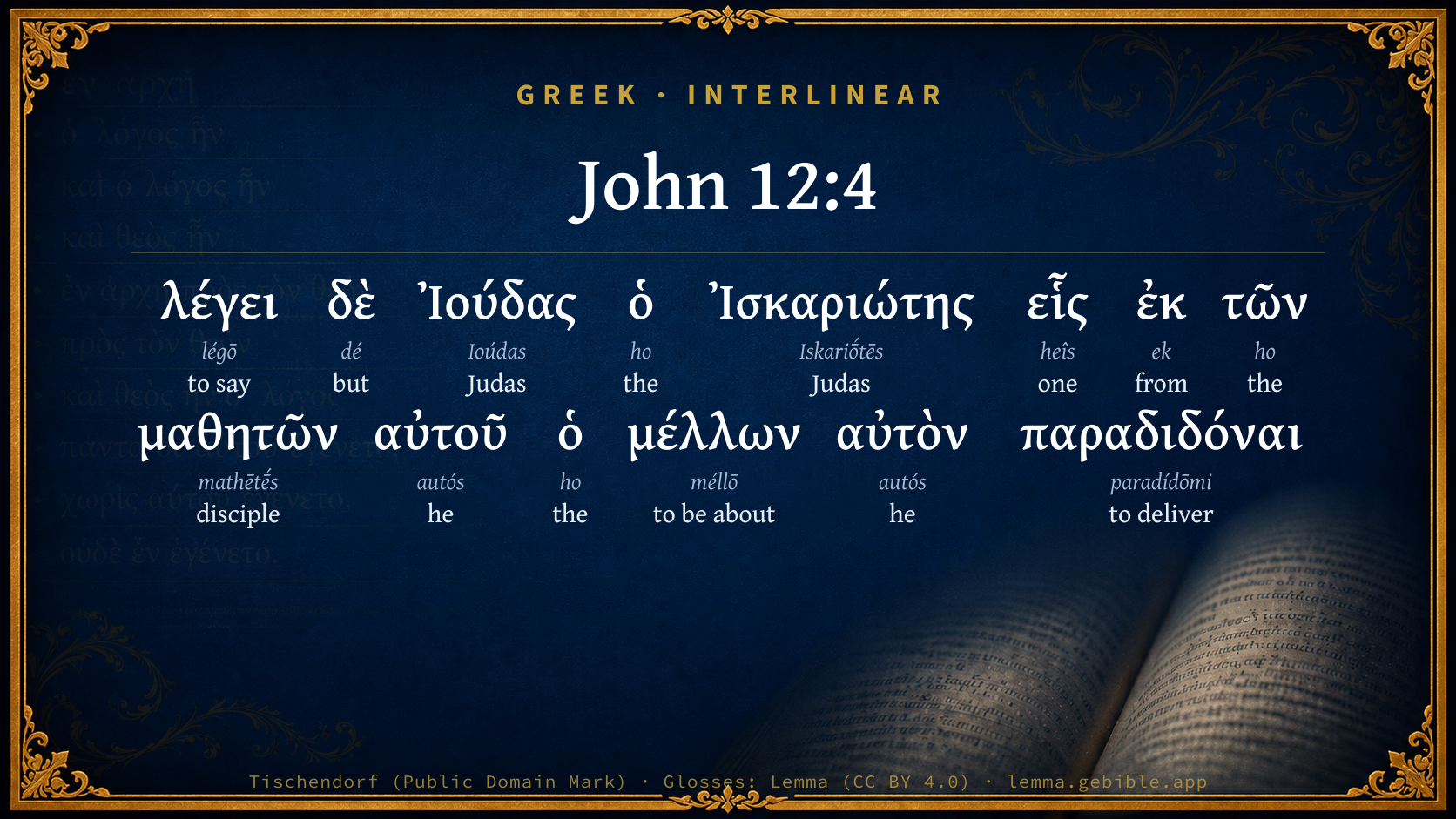
  1. λέγει légō G3004 “to say” Verb, Present, Active, Indicative, 3rd person, Singular
  2. δὲ dé G1161 “but” Conjunction
  3. Ἰούδας Ioúdas G2455 “Judas” Noun, Nominative, Singular, Masculine
  4. ὁ ho G3588 “the” Article, Nominative, Singular, Masculine
  5. εἷς heîs G1520 “one” Adjective, Nominative, Singular, Masculine
  6. ἐκ ek G1537 “from” Preposition
  7. τῶν ho G3588 “the” Article, Genitive, Plural, Masculine
  8. μαθητῶν mathētḗs G3101 “disciple” Noun, Genitive, Plural, Masculine
  9. αὐτοῦ autós G846 “he” Personal pronoun, Genitive, Singular, Masculine
  10. ὁ ho G3588 “the” Article, Nominative, Singular, Masculine
  11. μέλλων méllō G3195 “to be about” Verb, Present, Active, Participle, Nominative, Singular, Masculine
  12. αὐτὸν autós G846 “he” Personal pronoun, Accusative, Singular, Masculine
  13. παραδιδόναι paradídōmi G3860 “to deliver” Verb, Present, Active, Infinitive

About this verse

These counts appear in no published source. They are computed here, from the morphology-tagged text and Lemma’s own curated glosses. What Lemma adds →

14
words
11
distinct lemmas
Gospels
section

Notable vocabulary

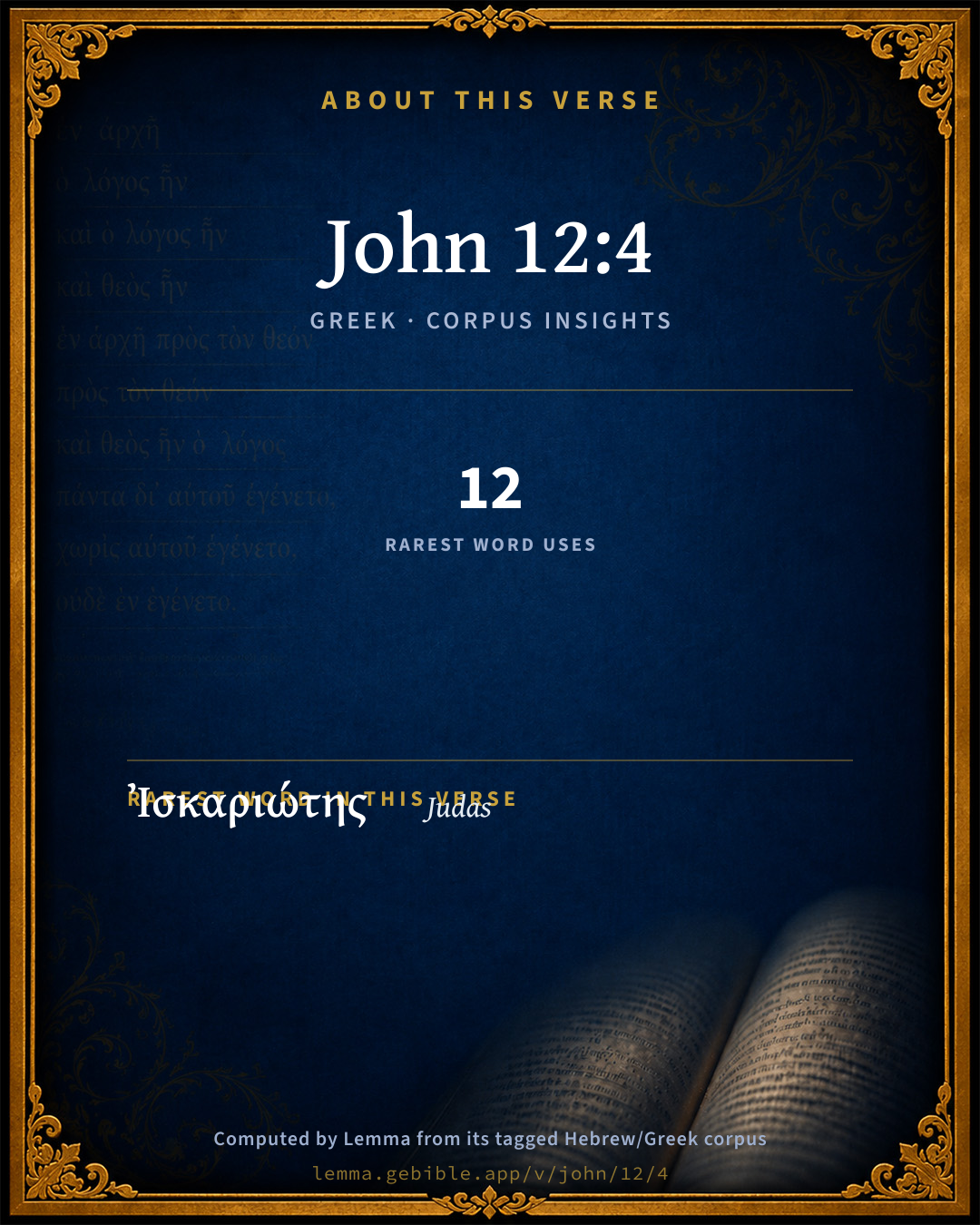
The rarest word here is Ἰσκαριώτης Judas G2469 — appearing just 12 times in the whole Greek New Testament.

Shared distinctive vocabulary

Ἰσκαριώτης Judas G2469 occurs in 12 verses of the Greek New Testament. Also found in:

Repetition

Words recur within this verse:

Cross-references

8

Topical passages linked to John 12:4 in the Treasury of Scripture Knowledge — connected by theme and wording, ordered by reader-vote popularity; previews shown in the World English Bible.

  • Matthew 10:4 Simon the Canaanite; and Judas Iscariot, who also betrayed him.
  • 1 Samuel 17:28–29 Eliab his eldest brother heard when he spoke to the men; and Eliab's anger was kindled against David, and he said, Why are you come down? and with whom have you left those few sheep in the wilderness? I know your pride, and the naughtiness of your heart; for you have come down that you might see the battle.
  • John 13:2 After supper, the devil having already put into the heart of Judas Iscariot, Simon's son, to betray him,
  • John 18:2–5 Now Judas, who betrayed him, also knew the place, for Jesus often resorted there with his disciples.
  • Ecclesiastes 4:4 Then I saw all the labor and achievement that is the envy of a man's neighbor. This also is vanity and a striving after wind.
  • Luke 6:16 Judas the son of James; and Judas Iscariot, who also became a traitor.
  • John 6:70–71 Jesus answered them, "Didn't I choose you, the twelve, and one of you is a devil?"
  • John 13:26 Jesus therefore answered, "It is he to whom I will give this piece of bread when I have dipped it." So when he had dipped the piece of bread, he gave it to Judas, the son of Simon Iscariot.

Cross-references courtesy of OpenBible.info (CC BY 4.0).

Where the printed editions differ

1 variant

Places in this verse where the major printed Greek editions disagree on the wording in a way that affects the translation — a comparison of editions, not a manuscript-by-manuscript collation. The editions are the modern critical texts (Nestlé-Aland 28/27, SBL, Westcott-Hort, Tregelles, Tyndale House) and the traditional texts behind the KJV (the Textus Receptus and the Byzantine/Majority text). It is not a claim about which reading is original.

  1. Extra text
    Σίμωνος

    “of Simon”

    In TRByz Not in NA28NA27TynSBLWHTreg

    Σίμωνος (Simōnos) 'of Simon' is only in traditional manuscripts (TR+Byz)

Textual data: Translators Amalgamated Greek New Testament (STEPBible TAGNT) · CC BY 4.0.

Commentary

Notes on John 12:4 from classic Christian and Jewish commentators (each source and its license shown beneath its notes). The classic Christian expositions comment on the surrounding passage and are grouped to its opening verse, so a note may address several verses; the Jewish commentaries on the Tanakh (Rashi and others) are per-verse, so they appear only where the commentator wrote on this verse.

Lemma curates 59 commentaries, every one of them public domain or Creative Commons licensed, each selected and text-cleaned for this edition rather than reprinted as found. About our sources →

Expositor's Greek Testament

ed. W. Robertson Nicoll

Joh 12:4 . Hence the οὖν in Joh 12:4 , λέγει οὖν εἶς … πτωχοῖς ; “one” of His disciples. Matthew (Mat 26:8 ) leaves all the disciples under the reproach, which John transfers to Judas alone. On the designation of Judas see Joh 6:71 . Westcott, however, with a harmonising tendency, says “Judas expressed what others felt”. But this is contradicted by the motive which John ascribes to Judas, Joh 12:6 . Διατί … δηναρίων . Three hundred denarii would equal a day labourer’s wage for one year.

The Expositor's Greek Testament, edited by W. Robertson Nicoll (1897–1910) — public domain. Text from a community e-Sword module.

Jamieson, Fausset & Brown

Robert Jamieson, A. R. Fausset & David Brown

Judas . . . who should betray him--For the reason why this is here mentioned, see on Mar 14:11.

Jamieson, Fausset & Brown — Commentary Critical and Explanatory on the Whole Bible (1871) — public domain (CC PDM 1.0). Text via the HelloAO Bible API.

John Calvin's Commentaries

4. One of his disciples, therefore, saith. Next follows the murmuring of Judas, which Matthew (Matthew 16:8) attributes to the disciples indiscriminately, and Mark (Mark 14:4) to some of them; but it is customary in Scripture to apply to many, by way of synecdoche, what belongs to one or to a few. Yet I think it is probable, that the murmuring proceeded from Judas alone, and that the rest were induced to give him their assent, as murmurings, by fanning a flame, easily kindle in us a variety of dispositions; and more especially, as we are too prone to form unfavorable judgments, slanders are readily embraced by us. But the credulity which the Spirit of God reproves in the Apostles is a warning to us not to be too easy and credulous in listening to calumnious statements.

John Calvin's Commentaries (1540-1563) — public domain. Text from the Calvin Translation Society English edition (1840s-50s) via the Christian Classics Ethereal Library (ccel.org). Calvin's coverage is partial (roughly two-thirds of the Bible); uncommented books and verses are honest gaps, never fabricated. The 19th-century editor's footnotes and remarks are omitted so the notes are faithfully Calvin's own voice.

Ellicott's Commentary for English Readers

(4) Then saith one of his disciples, Judas Iscariot.—Comp. Notes on Joh_6:70-71. St. Matthew tells us that the question was asked by “the disciples;” St. Mark, that it was asked by “certain persons;” St. John remembers that it was Judas who spoke, and he remembers that his words were characteristic of the man (Joh_12:6). He implies by the form in which he relates these words, that he spoke for himself, and that the others did not join in his feeling.

A Bible Commentary for English Readers, edited by Charles John Ellicott (1878–1897) — public domain. Text from a community e-Sword module.

The Cambridge Bible for Schools and Colleges

gen. ed. J. J. S. Perowne

4. Then saith, &c.] Rather, But Judas Iscariot, &c. The best authorities omit ‘Simon’s son.’

one of his disciples, Judas Iscariot] S. Mark says quite indefinitely, ‘some,’ S. Matthew, ‘his disciples.’ Each probably states just what he knew; S. Mark that the remark was made; S. Matthew that it came from the group of disciples; S. John that Judas made it, and why he made it. S. John was perhaps anxious that the unworthy grumbling should be assigned to the right person.

which should betray] Comp. Joh_6:71.

The Cambridge Bible for Schools and Colleges (gen. ed. J. J. S. Perowne; Cambridge University Press, 1878–1918) — public domain. Text from a community e-Sword module.

John Gill's Exposition

Then saith one of his disciples,.... Who had no true love for his master, was an hypocrite, and a covetous person:

Judas Iscariot; so called, to distinguish him from another Judas, an apostle; See Gill on Mat 10:4.

Simon's son; this is omitted in the Vulgate Latin, Syriac, Persic, and Ethiopic versions; See Gill on Joh 13:2;

which should betray him; and so he did; this was pre-determined by God, foretold in prophecy, and foreknown by Christ; and is observed here, to show the temper and character of the man.

John Gill's Exposition of the Whole Bible (1746–1763) — public domain (CC PDM 1.0). Text via the HelloAO Bible API.

Trapp's Complete Commentary

John Trapp

4 Then saith one of his disciples, Judas Iscariot, Simon’s son, which should betray him,

Ver. 4. Then said one of his disciples] St Matthew tells us, that all the disciples said thus. Judas was of so great esteem and authority among them, that what he did they are all said to do. So cunningly he had carried his conspiracy, that they all suspected themselves rather than Judas; every one said, Is it I?

John Trapp, A Commentary or Exposition upon All the Books of the Old and New Testament (1647–1656) — public domain. Text from a community e-Sword module.

Whedon's Commentary on the Bible

Daniel D. Whedon

4. Should betray him—Which was about to betray him.

Daniel D. Whedon (gen. ed.), Commentary on the Old and New Testaments (1874–1909) — public domain. Text from a community e-Sword module.

The Pulpit Commentary

But Judas the Iscariot, one of his disciples, who was about to betray him, said. The speaker here is singled out by name. Matthew refers the speech to the disciples generally, in whom the suggestion of Judas had stirred up (without guile or blame on their part) a not unnatural inquiry. Mark says "some" murmured to themselves, "Why this waste?" (loss, destruction). John (without the malice which Renan has attributed to the writer) mentions the source of the suggestion, "Judas Iscariot, Simon"s son." The word Simwnov , contained in T.R., is omitted here in the best texts. The fact that he was the traitor, being one of the well-known and awful events of the gospel history when John wrote some half a century later, might well be introduced by the evangelist, with no other than a purely historical motive.

The Pulpit Commentary (1880–1919), ed. H.D.M. Spence-Jones & Joseph S. Exell — public domain. Text from a community e-Sword module.

Kretzmann's Popular Commentary

Paul E. Kretzmann

The objection of Judas:

v. 4. Then saith one of His disciples, Judas Iscariot, Simon’s son, which should betray Him,

v. 5. Why was not this ointment sold for three hundred pence, and given to the poor?

v. 6. This he said, not that he cared for the poor, but because he was a thief, and had the bag, and bare what was put therein.

v. 7. Then said Jesus, Let her alone; against the day of My burying hath she kept this.

v. 8. For the poor always ye have with you; but Me ye have not always.

When Mary gave the wonderful evidence of her devotion to the Lord, all the disciples were more or less taken aback, Mat 26:8. Their frugal manner of living immediately scented useless extravagance. But there was one in their midst, Judas of Kerioth, the son of Simon, who afterwards betrayed the Lord, that voiced his objections in no uncertain terms. The value of the ointment was three hundred denarii (fifty dollars or somewhat more). Devoid of all sentiment and real feeling as he was, Judas demanded why the ointment had not been sold for this sum, in order that the money might be given to the poor. But his apparent solicitude for the poor people was all sham, intended to mask the real interest which he felt, that of getting the money into his clutches. The poor were nothing to him; to them he did not devote one moment of anxious thought. Judas was a thief. As treasurer of the little band of disciples he carried the wallet for them all, had complete charge of all moneys. Since a system of auditing was hardly to be thought of, Judas could easily abstract small sums from time to time. And here he was obliged to see a splendid opportunity lost. Note: Judas is a warning example for all times. He undoubtedly had been a simple believer in Christ when first he was called to join the little band of disciples. But the temptations connected with the office which was entrusted to him proved too much for his endurance. His love of money, his covetousness, came to the front; he began to steal, and faith fled from his heart. But with faith gone and avarice reigning in the heart, it was an easy matter for the devil to take possession of Judas to such an extent that he betrayed the Savior. Jesus did not wish to expose Judas at this time, and therefore is satisfied with taking Mary’s part and defending her action. He explained that the action of the woman was a part of the preparation for His burial, which was destined soon to take place. Far from censuring her, therefore, they should rather have commended her highly. And so far as the point raised by Judas was concerned: the poor they always had with them. There was always opportunity to do good to these unfortunates that were in destitute circumstances. But the presence of Jesus would soon be removed from them; there was but little time left to give Him special evidences of love and devotion. Thus this apparent extravagance, being occasional only, is fully justified. And the saying of Christ finds its application even today. It is self-evident that a congregation will take care of the poor in its own midst; but after this has been provided for, a little luxury in the interest of beautifying the services of the Lord is by no means displeasing to Him.

Paul E. Kretzmann, Popular Commentary of the Bible (1921–1924) — public domain. Text from a community e-Sword module.

unfoldingWord translationNotes

Door43 World Missions Community

the one who would betray him

"the one who later enabled Jesus' enemies to seize him"

Why was this perfume not sold for three hundred denarii and given to the poor?

This is a rhetorical question. You can translate it as a strong statement. AT: "This perfume could have been sold for three hundred denarii and the money could have been given to the poor!" (See: Rhetorical Question)

three hundred denarii

You can translate this as a numeral. AT: "300 denarii" (See: Numbers)

denarii

A denarius was the amount of silver that a common laborer could earn in one day of work. (See: Biblical Money)

Now he said this ... would steal from what was put in it

John explains why Judas asked the question about the poor. If your language has a way of indicating background information, you can use it here. (See: Background Information)

he said this, not because he cared about the poor, but because he was a thief

"he said this because he was a thief. He did not care about the poor"

translationWords

Judas Iscariot

disciple

betray

unfoldingWord translationNotes — © Distant Shores Media and the Door43 World Missions Community, licensed CC BY-SA 4.0. Source: git.door43.org/Door43/en_tn.

Cambridge Greek Testament for Schools and Colleges

4. Ἰούδας ὁ Ἰσκ. S. Mark (Mar 14:4) says, quite indefinitely, τινες; S. Matthew (Mat 26:8), οἱ μαθηταί. Each probably states just what he knew; S. Mark that the remark was made; S. Matthew that it came from the group of disciples; S. John that Judas made it, and why he made it. S. John was perhaps anxious that the unworthy grumbling should be assigned to the right person. For ὁ μέλλων αὐτὸν παρ. see on Joh 6:71.

Cambridge Greek Testament for Schools and Colleges (Cambridge University Press, 1896; 21 vols, various authors incl. Carr, Maclear, Plummer, Farrar, Lumby, Moule, M. R. James, Simcox) — public domain. Text from a community e-Sword module.

Alford’s Greek Testament

Henry Alford

4.] For Judas, we have οἱ μαθ. αὐτοῦ. Matt.,—τινές, merely, Mark. See note on Matt. ver. 8.

ὁ μέλλεν αὐτὸν παραδιδόναι is not inserted, nor are any such notices in St. John without significance. It has a pragmatic connexion with the narrative in hand. Only one with thoughts alien from Jesus could have originated such a murmur. And on the other hand, it may well be, as some have supposed, that by the rebuke of the Lord on this occasion, the traitorous scheme of Judas, long hidden in his inmost soul, may have been stimulated to immediate action.

Henry Alford, The Greek Testament (1849–1861) — public domain. Text from a community e-Sword module.

International Critical Commentary

4. The description of Judas is almost identical with that given in 6:71 (where see note).

We must read δέ (אBW) for the rec. οὖν.

Apparently we should omit ἐκ before τῶν μαθητῶν (with BLW 33 249), although it is inserted, in accordance with Jn.’s general habit (see on 1:40), by אADΘ. ἐκ is also omitted in similar sentences at 18:22, 19:34.

אBLW, fam. 1, and most vss. read here Ἰούδας ὁ Ἰσκαριώτης (cf. 14:22 for ὁ Ἰσκ.); but AΓΔΘ have Ἰούδας Σίμωνος Ἰσκαριώτης, introducing the name of his father (as at 6:71, 13:2).

The rec. text, following ADΘ, places the sentence εἷς [ἐκ] τῶν μαθητῶν αὐτοῦ before Ἰούδας; but אBLW place it after Ἰσκαριώτης.

For ὁ μέλλων, D has ὃς ἤμελλεν (perhaps a reminiscence of 6:71). μέλλων may convey the idea that Judas was predestined to betray Jesus (see on 3:14 and 6:71).

According to the Synoptists (Mar 14:4, Mat 26:8), the uneasy feeling that the ointment was wasted was shared by several of the onlookers, but Jn. specifically mentions Judas as the one who remonstrated. Perhaps he first suggested to the others the extravagance of what had been done by Mary in purchasing exceptionally rare and costly ointment.

International Critical Commentary — older volumes (1896–1929), various authors — public domain. Text from a community e-Sword module.

Vincent's Word Studies in the New Testament

Marvin R. Vincent

Simon 's son. Omit.

Marvin R. Vincent, Word Studies in the New Testament (1887–1900) — public domain. Text from a community e-Sword/MySword module.

Godet's Commentaries

Frédéric Louis Godet

Vv. 4-6. “Then one of his disciples, Judas, the son of Simon, the Iscariot, he who was soon to betray him, says: 5. Why was not this ointment sold for three hundred denarii and the price given to the poor? 6. Now this he said, not that he cared for the poor, but because he was a thief, and kept the purse and took what was put therein.”

This outbreak of indignation on the part of Judas is occasioned by the mean passion with which the evangelist charges him; but, like his treachery, it has a deeper source than avarice. For a long time (Joh 6:70) there had been in this heart a gloomy discontent with respect to the course followed by Jesus (Joh 6:70-71; comp. with Joh 12:15), and this feeling only waited for a pretext to manifest itself. In the Synoptics, it is the disciples (Matthew), some (Mark), who protest. It seems that on this occasion, as on others, Judas played among his fellowdisciples the part of the leaven which leavens the whole mass. Westcott says: “He expressed what the others thought.”

There is no doubt more than this: he excited among them a movement of discontent which would not have been awakened without him. We find here again a relation between John and the Synoptics which we have already pointed out in other stories. In the latter, the outlines are effaced: the former alone reproduces the characteristic features, as we might expect from a witness. Judas knows the exact price of the commodity in question, as if he were a tradesman. For the value of the denarius, see on Joh 6:7. The sum indicated was nearly equivalent, in the time of the emperors, to two hundred and sixty francs. It is found as identically the same sum in Mark. We have already remarked several similar coincidences between the two evangelists (Joh 12:3; Joh 6:7; Joh 6:10). Even independently of the subsequent fact of the treachery of Judas, attested by the four evangelists, it would be very rash to ascribe the accusation here formulated by John against Judas to a feeling of personal hatred, as modern criticism has allowed itself to do. The word γλωσσόκομον (properlyγλωσσοκομεῖον) denotes literally the case in which musicians kept the mouth-pieces of flutes; whence: box. This purse was probably a small portable cash-box. The property of Jesus and His disciples was mingled with that of the poor (Joh 13:29). This fund was supplied by voluntary gifts (Joh 12:5; Luk 8:1-3). We may see in Joh 20:15 how in the wordβαστάζειν, the sense of bearing, the only one used, in general, in the New Testament, is easily changed into that of taking away, purloining (de Wette, Meyer).

The simple meaning to bear is not impossible, however, if, with the Alexandrian authorities, we read ἕχων, having, instead of καί...εἶχε., and he had...and ....For by this means all tautology as between this clause and the following disappears. But it is absurd, in any case, to claim that the sense of taking away is excluded because of the article τά before βαλλόμενα, as if this article must signify that he took away everything which was placed in the box! It has been asked why Jesus, if He knew Judas, intrusted to him this office so perilous to his morality. We will not say, with Hengstenberg, that Jesus saw fit thus to call forth the manifestation of his sin, as the only means of accomplishing a cure. By such a course of action, Jesus would have put Himself, as it seems to us, in the place of God more completely than was accordant with the reality of His humanity. But is there clear proof that Jesus intervened directly in the choice of Judas as the treasurer of the company? Might not this have been an arrangement which the disciples had made among themselves and in which Jesus had not desired to mingle. Weiss thinks that Jesus had chosen Judas at first because he had a special gift in the financial sphere, and that afterwards He did not wish to interfere with a relation in which He recognized a divine dispensation.

Frédéric Louis Godet — Commentaries on Luke, John, Romans, and 1 Corinthians — English translation (T&T Clark, Edinburgh, 1870s–1890s) — public domain. Text from a community e-Sword module.

Lesson kit

Teaching starters — assembled from the data on this page, not authored interpretation. Every prompt links to the verse data it draws on. Edit before teaching.

John, in the Gospels, opens this verse with 14 words (11 distinct Greek lemmas). Its most distinctive word is Iskariṓtēs (“Judas”). A historical commentator’s framing appears above. Read the whole chapter for the surrounding context.

Discussion questions

  1. The word Iskariṓtēs carries the sense “Judas.” How does it shape the verse?
  2. Matthew 10:4 shares the word «Judas» with this verse. How do the two illuminate each other?
  3. “the” occurs 3× in this one verse. What is the effect of the repetition?
  4. The translations on this page render this verse differently — a whole-verse word diff, not a word-by-word alignment. What might account for the different wordings?
  5. Reading how Expositor's Greek Testament and Jamieson, Fausset & Brown read this verse, where do the two commentators agree and where do they part?

Things to notice

Reading settings

Reading text

Shown beneath each verse's original-language words.

Old Testament
Old Testament edition

Read the OT as the Masoretic Hebrew (MT) or the Greek Septuagint (LXX).

English shown for the Greek Septuagint (in the Hebrew ↔ Greek comparison).

Comparing translations? Open the Compare panel on any verse page to stack up to four side by side.