John 11:21

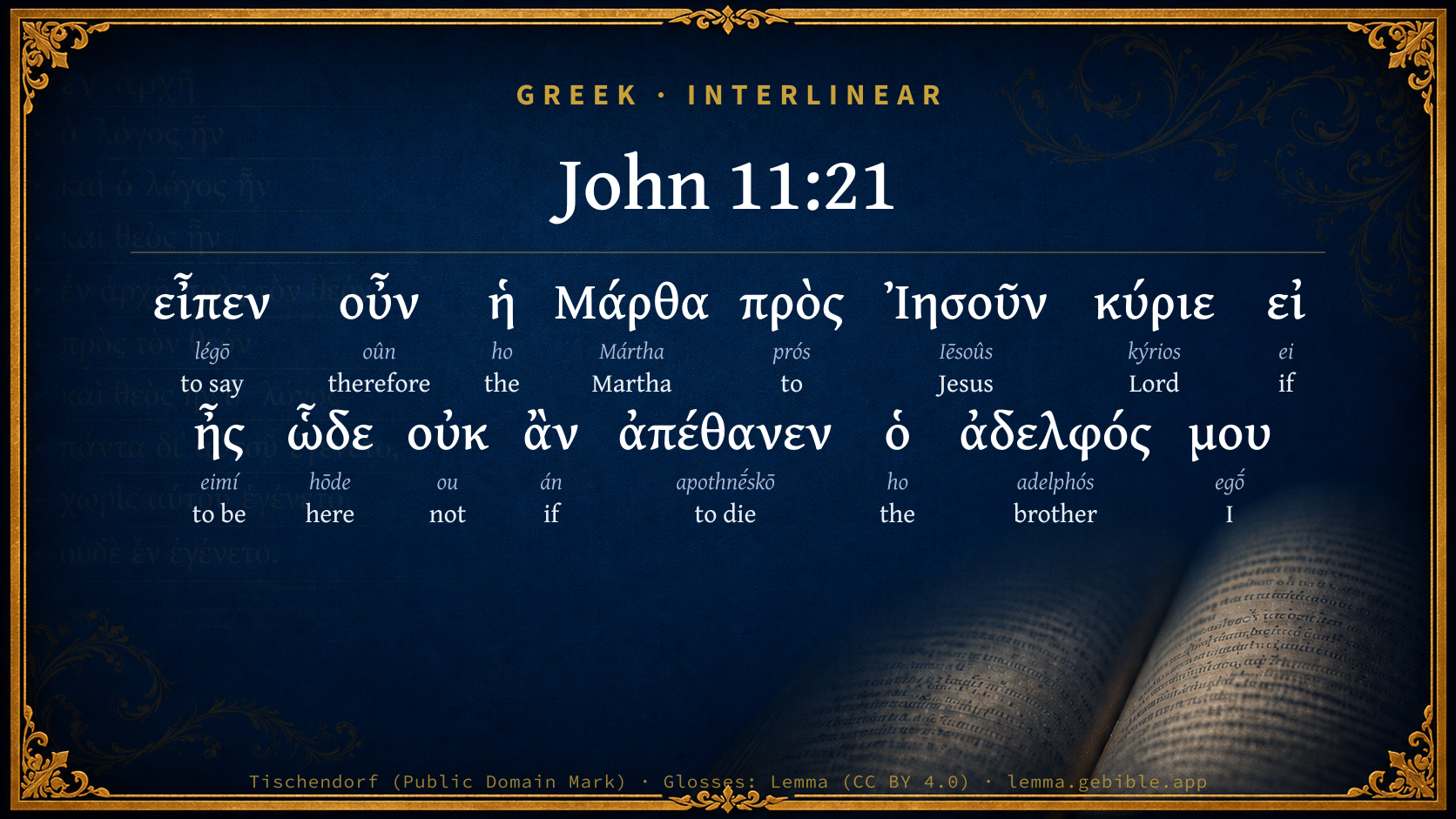
Greek (Tischendorf 8th ed.) John 11:21 appears in the Greek New Testament. The text above is from the Tischendorf 8th edition. Each word links to its Strong’s number and a concise gloss. Click any word for its full Thayer’s Greek Lexicon entry.
Download image
Cite this verse

John 11:21 (World English Bible). Public Domain. Lemma interlinear Bible study tool, https://lemma.gebible.app/v/john/11/21.

Show BibTeX & RIS
BibTeX
RIS
English Translation
Therefore Martha said to Jesus, "Lord, if you would have been here, my brother wouldn't have died.
World English Bible · Public Domain
Download a study sheet

One document with this verse’s original text, its word-by-word gloss line, the meaning frame, cross-references with their text, attributed commentary, and full source and license credits — printable, and it pastes into notes with its structure intact.

This verse Autodidact and up

Study sheet (.html) Plain text (.txt)

A passage Seminary Student

Up to 50 verses in one chapter. A passage sheet keeps up to 6 commentary sources and 12 cross-references per verse, in the order this page ranks them, and says so on the sheet whenever that leaves anything out. Ask for a single verse and you get the Autodidact verse sheet above.

Everything on this page stays free to read, with no account — the sheet is a download of what is already on screen, not access to it.

Want to remove ads? Support Godless Engineer
Compare translations 3

The same verse in 3 English versions, stacked beneath the original-language interlinear above. Click any original word for its lexicon entry.

Each is an independent rendering of the whole verse — the interlinear is not word-aligned to these translations.

Highlighted words mark where these versions differ — a whole-verse word diff, not a word-by-word alignment.

  • World English Bible Public Domain
    Therefore Martha said to Jesus, "Lord, if you would have been here, my brother wouldn't have died.
  • King James Version Public Domain
    Then said Martha unto Jesus, Lord, if thou hadst been here, my brother had not died.
  • unfoldingWord Literal Text CC BY-SA 4.0
    Martha then said to Jesus, “Lord, if you were here, my brother would not have died.

unfoldingWord Literal Text — © unfoldingWord, licensed CC BY-SA 4.0. Word-aligned USFM3 via Door43 (git.door43.org/unfoldingWord/en_ult).

Versions to compare (up to 4)

3 of 4 selected

Show all 19 translations

Every available English version of this verse, each an independent rendering of the whole verse.

  • World English Bible Public Domain
    Therefore Martha said to Jesus, "Lord, if you would have been here, my brother wouldn't have died.
  • Berean Standard Bible Public Domain
    Martha said to Jesus, “Lord, if You had been here, my brother would not have died.
  • Majority Standard Bible Public Domain
    Martha said to Jesus, “Lord, if You had been here, my brother would not have died.
  • King James Version Public Domain
    Then said Martha unto Jesus, Lord, if thou hadst been here, my brother had not died.
  • American Standard Version (1901) Public Domain
    Martha therefore said unto Jesus, Lord, if thou hadst been here, my brother had not died.
  • Revised Version (1885) Public Domain
    Martha therefore said unto Jesus, Lord, if thou hadst been here, my brother had not died.
  • Geneva Bible (1599) Public Domain
    Then said Martha vnto Iesus, Lord, if thou hadst bene here, my brother had not bene dead.
  • Douay-Rheims (1899) Public Domain
    Martha therefore said to Jesus: Lord, if thou hadst been here, my brother had not died.
  • Young's Literal Translation Public Domain
    Martha, therefore, said unto Jesus, `Sir, if thou hadst been here, my brother had not died;
  • Literal Standard Version CC BY-SA 4.0
    Martha, therefore, said to Jesus, “Lord, if You had been here, my brother had not died;
  • Unlocked Literal Bible CC BY-SA 4.0
    Martha then said to Jesus, “Lord, if you had been here, my brother would not have died.
  • unfoldingWord Literal Text CC BY-SA 4.0
    Martha then said to Jesus, “Lord, if you were here, my brother would not have died.
  • Darby Bible Public Domain
    Martha therefore said to Jesus, Lord, if thou hadst been here, my brother had not died;
  • World Messianic Bible Public Domain
    Therefore Martha said to Yeshua, “Lord, if you would have been here, my brother wouldn’t have died.
  • Webster's Bible Public Domain
    Then said Martha to Jesus, Lord, if thou hadst been here, my brother had not died.
  • Free Bible Version CC BY-SA 4.0
    Martha said to Jesus, “Lord, if you'd been here, my brother wouldn't have died.
  • Bible in Basic English Public Domain
    Then Martha said to Jesus, Lord, if you had been here my brother would not be dead.
  • Text-Critical English NT CC BY 4.0
    Then Martha said to Jesus, “Lord, if yoʋ had been here, my brother would not have died.
  • Tyndale New Testament (1534) Public Domain
    Then sayde Martha vnto Iesus: Lorde yf thou haddest bene here my brother had not bene deed:

Literal Standard Version (2020), Covenant Press — licensed CC BY-SA 4.0. Text via the HelloAO Bible API (eBible.org). Unlocked Literal Bible (unfoldingWord) — licensed CC BY-SA 4.0. Text via the HelloAO Bible API (eBible.org). unfoldingWord Literal Text — © unfoldingWord, licensed CC BY-SA 4.0. Word-aligned USFM3 via Door43 (git.door43.org/unfoldingWord/en_ult). Free Bible Version, Dr. Jonathan Gallagher — licensed CC BY-SA 4.0. Text via the HelloAO Bible API (eBible.org).

Word by word

More ways to search: Search by grammar → Find every occurrence → Compare this word →

Practice this passage: Drill this verse → Learn its vocabulary →

Μάρθα
Mártha
G3136
“Martha”
Noun, Nominative, Singular, Feminine
Part of Speech
Noun
Case
Nominative
Number
Singular
Gender
Feminine
Full Thayer's Definition

Origin: probably of Aramaic origin (meaning mistress)

TDNT: None

Martha = "she was rebellious" 1. was the sister of Lazarus and Mary of Bethany
  1. εἶπεν légō G3004 “to say” Verb, Aorist, Active, Indicative, 3rd person, Singular
  2. οὖν oûn G3767 “therefore” Conjunction
  3. ἡ ho G3588 “the” Article, Nominative, Singular, Feminine
  4. πρὸς prós G4314 “to” Preposition
  5. Ἰησοῦν Iēsoûs G2424 “Jesus” Noun, Accusative, Singular, Masculine
  6. κύριε kýrios G2962 “Lord” Noun, Vocative, Singular, Masculine
  7. εἰ ei G1487 “if” Conditional
  8. ἦς eimí G1510 “to be” Verb, Imperfect, Active, Indicative, 2nd person, Singular
  9. ὧδε hōde G5602 “here” Adverb
  10. οὐκ ou G3756 “not” Particle, Negative
  11. ἂν án G302 “if” Particle
  12. ἀπέθανεν apothnḗskō G599 “to die” Verb, Aorist, Active, Indicative, 3rd person, Singular
  13. ὁ ho G3588 “the” Article, Nominative, Singular, Masculine
  14. ἀδελφός adelphós G80 “brother” Noun, Nominative, Singular, Masculine
  15. μου egṓ G1473 “I” Personal pronoun, 1st person, Genitive, Singular

About this verse

These counts appear in no published source. They are computed here, from the morphology-tagged text and Lemma’s own curated glosses. What Lemma adds →

16
words
15
distinct lemmas
Gospels
section

Notable vocabulary

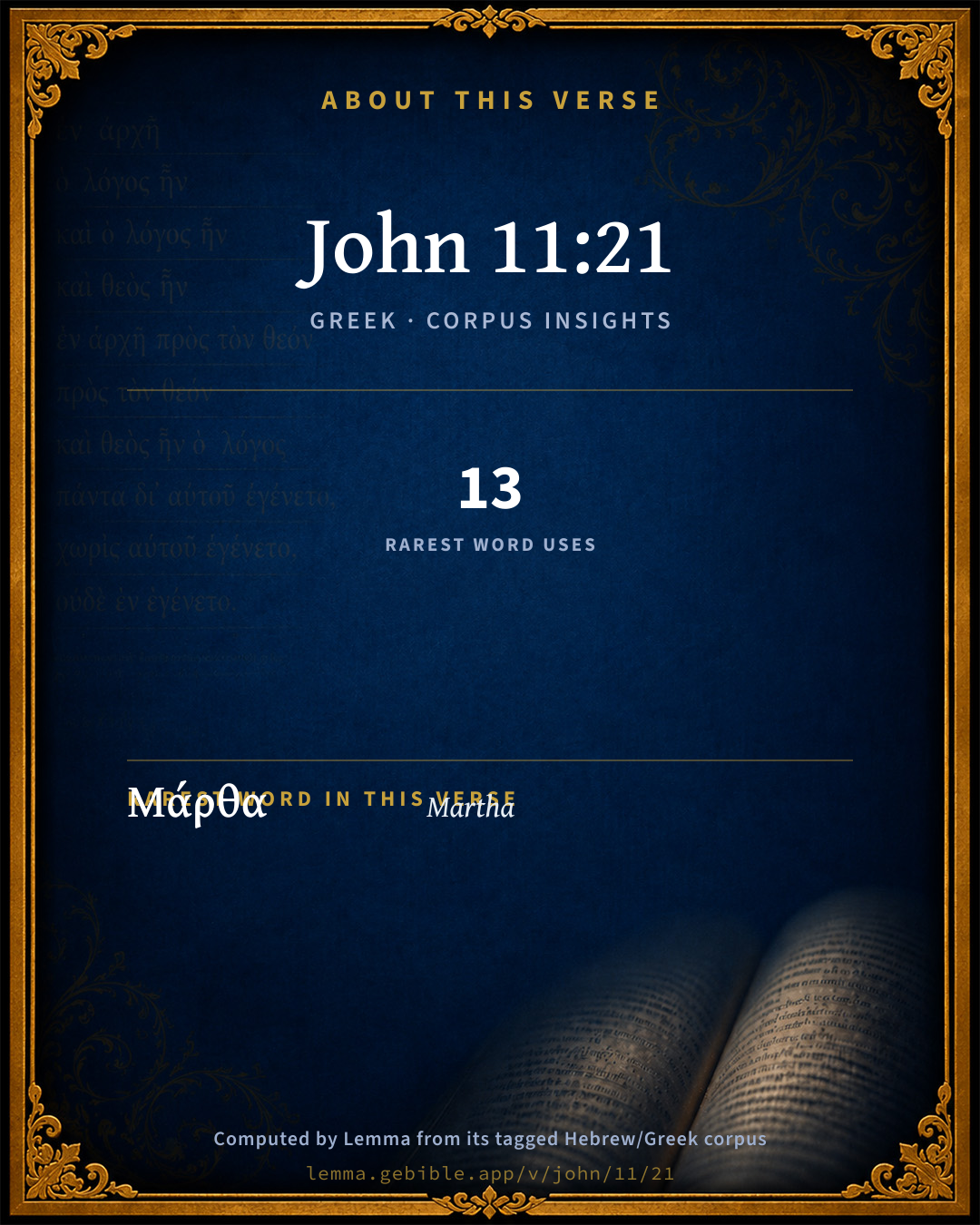
The rarest word here is Μάρθα Martha G3136 — appearing just 13 times in the whole Greek New Testament.

Shared distinctive vocabulary

Μάρθα Martha G3136 occurs in 12 verses of the Greek New Testament. Also found in:

Repetition

A word recurs within this verse:

Cross-references

10

Topical passages linked to John 11:21 in the Treasury of Scripture Knowledge — connected by theme and wording, ordered by reader-vote popularity; previews shown in the World English Bible.

  • Matthew 9:18 While he told these things to them, behold, a ruler came and worshiped him, saying, "My daughter has just died, but come and lay your hand on her, and she will live."
  • John 11:32 Therefore when Mary came to where Jesus was, and saw him, she fell down at his feet, saying to him, "Lord, if you would have been here, my brother wouldn't have died."
  • 1 Kings 17:18 She said to Elijah, What have I to do with you, you man of God? You have come to me to bring my sin to memory, and to kill my son!
  • Psalms 78:19 Yes, they spoke against God. They said, "Can God prepare a table in the wilderness?
  • Luke 7:6–10 Jesus went with them. When he was now not far from the house, the centurion sent friends to him, saying to him, "Lord, don't trouble yourself, for I am not worthy for you to come under my roof.
  • Luke 8:49–55 While he still spoke, one from the ruler of the synagogue's house came, saying to him, "Your daughter is dead. Don't trouble the Teacher."
  • John 4:47–49 When he heard that Jesus had come out of Judea into Galilee, he went to him, and begged him that he would come down and heal his son, for he was at the point of death.
  • John 11:37 Some of them said, "Couldn't this man, who opened the eyes of him who was blind, have also kept this man from dying?"
  • Luke 7:13–15 When the Lord saw her, he had compassion on her, and said to her, "Don't cry."
  • Psalms 78:41 They turned again and tempted God, And provoked the Holy One of Israel.

Cross-references courtesy of OpenBible.info (CC BY 4.0).

Commentary

Notes on John 11:21 from classic Christian and Jewish commentators (each source and its license shown beneath its notes). The classic Christian expositions comment on the surrounding passage and are grouped to its opening verse, so a note may address several verses; the Jewish commentaries on the Tanakh (Rashi and others) are per-verse, so they appear only where the commentator wrote on this verse.

Lemma curates 59 commentaries, every one of them public domain or Creative Commons licensed, each selected and text-cleaned for this edition rather than reprinted as found. About our sources →

Tyndale Open Study Notes

Tyndale Open Resources

11:21 Lord, if only you had been here: Mary later repeated Martha’s words (11:32), because both sisters knew Jesus’ reputation as a healer. They concluded that Jesus would have healed Lazarus, but they did not imagine that Jesus would restore him from death.

Tyndale Open Study Notes — © Tyndale Open Resources, licensed CC BY-SA 4.0. Text via the HelloAO Bible API.

Bengel's Gnomon

Johann Albrecht Bengel

Joh 11:21. Εἰ ἦς ὧδε, if Thou hadst been here) Thus Mary also expresses herself, Joh 11:32. From which it may be inferred that this was their language before their brother’s death, Would that the Lord Jesus were here. Himself stirs up the spark of faith, that lies hid in these words.

Bengel's Gnomon of the New Testament — English translation (T&T Clark, Edinburgh, 1860) — public domain. Text from a community e-Sword module.

Meyer's Critical & Exegetical Commentary

Heinrich August Wilhelm Meyer

Joh_11:21-22. Εἰ ἦς ὧδε] Not a reproach, but a lament: if Thou wert here, and stayedst not in the distant Peraea.

καὶ νῦν] Without ἀλλά (see the critical note) the expression simply connects past and present: and now, when he is dead. She then gives expression indirectly (ob voti magnitudinem, Grotius) to her confidence, which had quickly arisen in consequence of the arrival of Jesus, that by His prayer He would be able to raise the dead one to life. Having the confidence, she expresses the wish. We can understand from Joh_11:4 why, now that the healing could no longer be effected, she should think of a resurrection; for with her faith in Jesus, and her knowledge of His wonderful works, she must have felt sure that the declaration of Joh_11:4 would be fulfilled in some way or other. The less, therefore, may we adopt Calvins judgment: magis affectui suo indulget, quam se contineat sub fidei regula.

The position of the words αἰτήσῃ τὸν θεὸν, δώσει ὁ θεός is emphatic; their emphatic character is further heightened by the repetition of ὁ θεὸς (comp. Xen. Mem. i. 3. 2 : εὔχετο δὲ πρὸς τοὺς θεοὺς … ὡς τοὺς θεοὺς κάλλιστα εἰδότας). This word αἰτεῖσθαι, to beg for oneself, is not elsewhere used of Jesus praying to God (but ἐρωτᾶν, παρακαλεῖν, προσεύχεσθαι, δεῖσθαι); it corresponds to the intensity of Marthas emotion, which would lead her to choose the more concrete, more human expression (comp. Mat_7:9; Joh_15:16, al.). Thus naively, as to form, does she speak in the excitement of her feeling; for the idea of the superhuman relation of Jesus to God had not as yet presented itself in any way to her mind. But as to substance she was right; see Joh_11:41-42.

Meyer — Critical and Exegetical Commentary on the New Testament — English translation by Peter Christie, edited by Frederick Crombie (T&T Clark, 1880) — public domain. Text from a community e-Sword module.

Expositor's Greek Testament

ed. W. Robertson Nicoll

Joh 11:21 . Martha’s first words to Jesus, Κύριε … ἐτεθνήκει , “hadst Thou been here my brother had not died,” are “not a reproach but a lament,” Meyer. Mary uses the same words (Joh 11:32 ), suggesting that this had been the burden of their talk with one another; and even, as Bengel says, before the death “utinam adesset Dominus Jesus”.

The Expositor's Greek Testament, edited by W. Robertson Nicoll (1897–1910) — public domain. Text from a community e-Sword module.

Jamieson, Fausset & Brown

Robert Jamieson, A. R. Fausset & David Brown

Then said Martha . . . Lord, if thou hadst been here, my brother had not died--As Mary afterwards said the same thing (Joh 11:32), it is plain they had made this very natural remark to each other, perhaps many times during these four sad days, and not without having their confidence in His love at times overclouded. Such trials of faith, however, are not peculiar to them.

Jamieson, Fausset & Brown — Commentary Critical and Explanatory on the Whole Bible (1871) — public domain (CC PDM 1.0). Text via the HelloAO Bible API.

Adam Clarke's Commentary

Verse 21. If thou hadst been here, my brother had not died.] Mary said the same words to him a little after, Joh 11:32, which proves that these sisters had not a complete knowledge of the omnipotence of Christ: they thought he could cure at hand, but not at a distance; or they thought that it was because he did not know of their brother's indisposition that he permitted him to die. In either of these cases it plainly appears they had not a proper notion of his divinity; and indeed the following verse proves that they considered him in no other light than that of a prophet. Query - Was it not proper that Christ should, in general, as much as might be, hide the knowledge of his divinity from those with whom he ordinarily lodged? Had they known him fully, would not the reverence and awe connected with such a knowledge have overwhelmed them?

Adam Clarke's Commentary on the Bible (1810–1826) — public domain. Text from a community e-Sword/MySword module.

John Calvin's Commentaries

21. Lord, if thou hadst been here. She begins with a complaint, though in doing so she modestly expresses her wish. Her meaning may be expressed thus — “By thy presence thou mightst have delivered my brother from death, and even now thou canst do it, for God will not refuse thee any thing.” By speaking in this manner, she gives way to her feelings, instead of restraining them under the rule of faith. I acknowledge that her words proceeded partly from faith, but I say that there were disorderly passions mixed with them, which hurried her beyond due bounds. For when she assures herself that her brother would not have died, if Christ had been present, what ground has she for this confidence? Certainly, it did not arise from any promise of Christ.

The only conclusion therefore is, that she inconsiderately yields to her own wishes, instead of subjecting herself to Christ. When she ascribes to Christ power and supreme goodness, this proceeds from faith; but when she persuades herself of more than she had heard Christ declare, that has nothing to do with faith; for we must always hold the mutual agreement between the word and faith, that no man may rashly forge anything for himself, without the authority of the word of God. Besides, Martha attached too much importance to the bodily presence of Christ. The consequence is, that Martha’s faith, though mixed up and interwoven with ill-regulated desires, and even not wholly free from superstition, could not shine with full brightness; so that we perceive but a few sparks of it in these words.

John Calvin's Commentaries (1540-1563) — public domain. Text from the Calvin Translation Society English edition (1840s-50s) via the Christian Classics Ethereal Library (ccel.org). Calvin's coverage is partial (roughly two-thirds of the Bible); uncommented books and verses are honest gaps, never fabricated. The 19th-century editor's footnotes and remarks are omitted so the notes are faithfully Calvin's own voice.

Ellicott's Commentary for English Readers

(21) Lord, if thou hadst been here, my brother had not died.—We have exactly the same words spoken by Mary in Joh_11:32. They are the utterance of the thought which had already been expressed in their message (Joh_11:3), and had, we may think, been spoken more than once by the sisters to each other. These sisters are among the many who had received our Lord in the fulness of a true faith, of whom the Gospel narrative tells us nothing, or gives us, as here, but a passing glimpse. Their belief is stated in the definiteness of full conviction; but they, like the courtier, connect the power to save with the bodily presence of our Lord. (Comp. Joh_4:49.)

A Bible Commentary for English Readers, edited by Charles John Ellicott (1878–1897) — public domain. Text from a community e-Sword module.

The Cambridge Bible for Schools and Colleges

gen. ed. J. J. S. Perowne

21. if thou hadst been here] Not a reproach, however gentle (she does not say ‘hadst Thou come’), but an expression of deep regret. This thought had naturally been often in the sisters’ minds during the last four days (comp. Joh_11:32). They believe that Christ could and would have healed Lazarus: their faith and hope are not yet equal to anticipating His raising him from the dead. The gradual progress of Martha’s faith is very true to life, and reminds us of similar development in the woman of Samaria (Joh_4:19) and the man born blind (Joh_9:11), though she starts at a more advanced stage than they do. If all these three narratives are late fictions, we have three masterpieces of psychological study, as miraculous in the literature of the second century as would be a Gothic cathedral in the architecture of that age. For the construction comp. Joh_4:10, Joh_14:28.

The Cambridge Bible for Schools and Colleges (gen. ed. J. J. S. Perowne; Cambridge University Press, 1878–1918) — public domain. Text from a community e-Sword module.

John Gill's Exposition

When said Martha unto Jesus,.... When she was come to him,

Lord, if thou hadst been here my brother had not died: which expresses much faith, but with a mixture of weakness, as if the presence of Christ was necessary for the working a cure; whereas he could as well have restored her brother to health absent, as present, had it been his will, as he did the centurion's servant, and the nobleman's son of Capernaum.

John Gill's Exposition of the Whole Bible (1746–1763) — public domain (CC PDM 1.0). Text via the HelloAO Bible API.

Trapp's Complete Commentary

John Trapp

21 Then said Martha unto Jesus, Lord, if thou hadst been here, my brother had not died.

Ver. 21. Lord, if thou hadst been here, &c.] Was she sure of that? but why was he dead, if Christ would not, though he were not there? We are all too much fastened to his bodily presence: howbeit, we never come to believe indeed till we are well persuaded of his omnipotence. But how fitly may many a poor soul say to the bloody non-resident, Sir, if thou hadst been here, my brother, child, husband, had not been dead in his sins?

John Trapp, A Commentary or Exposition upon All the Books of the Old and New Testament (1647–1656) — public domain. Text from a community e-Sword module.

Haydock's Catholic Bible Commentary

If thou hast been here. These words shew that the faith of the two sisters was but weak; as if the Son of God was not everywhere: or as if he could not restore him to life when dead and buried. (Witham) --- Martha believed in Christ, but not as she ought to have done. She did not yet believe him to be God, but addressed him as one who is remarkable for virtue, and approved of by heaven. (St. John Chrysostom, hom. 61. in Joan.)

George Leo Haydock (1774–1849), Haydock's Catholic Family Bible and Commentary, 1859 edition — public domain. Excludes Psalms (Douay-Rheims chapter numbering differs from Protestant) and Deuterocanonical books (Catholic canon only).

Matthew Poole's English Annotations

Mary saith the same, Joh 11:32. They were both in an error, for Lazarus’s death was appointed and determined by an eternal counsel; and he was both sick and died for a wise end, that God might be glorified and his Son glorified in raising him from the dead; as we were before told, Joh 11:4. But it lets us see the vanity of our natures, who in the loss of our friends are ready to think, if such or such means had been used, we had not lost our friends; never considering our days are appointed, and we cannot pass the number of them. If any rational, probable means for continuing their lives be omitted, that also is not without the counsel of God, who having determined the issue, concealeth diseases, or the true and proper means for their cure, from physicians, or such as are about the sick persons. Nor did Martha and Mary fail in this only, but in that they made the Lord’s presence necessary to the preserving of the life of their brother, who, had he pleased, could, though absent, have kept him from death.

Matthew Poole's English Annotations on the Holy Bible (1683–1685) — public domain. Text from a community e-Sword/MySword module.

Whedon's Commentary on the Bible

Daniel D. Whedon

21. If thou hadst been here—Mary meets the Lord with the same first words, (Joh_11:32.) Stier beautifully paraphrases their correspondent utterances: “‘Alas, Lord, we have thought it a hundred times since our brother died;’ and they must tell him as soon as they saw him.” It was not reproach, for Lazarus died on the very day of their message; too soon for Jesus’s possible coming. But it is, “O that thou hadst been here! then my brother had not died.”

Daniel D. Whedon (gen. ed.), Commentary on the Old and New Testaments (1874–1909) — public domain. Text from a community e-Sword module.

The Pulpit Commentary

Martha therefore (having met her Lord) said unto Jesus, Lord, if thou hadst been here the ei hv wde expresses no complaint: "If thou hadst been here," a simple condition of what is now an impossible eventmy brother had not died. Meyer says, "If thou weft making thy residence in Bethany rather than in Peraea." This is somewhat unnatural, and would have been a complaint. Her faith had at least ground enough for this assurance, but she mounts above it. The two sisters, with their contrasted natures, had grasped the life-giving, joy-diffusing, heaven-revealing powers of Jesus. They had believed in him, with a gracious abandonment of all prejudice and in the sweeping force of a great illuminating love. They had said often this same thing to one another, and now Martha pours her high persuasion into the ears of her Lord; but she proceeds further.

The absence of Jesus.

Among our Lord"s friends none were more affectionate or more faithful than the favored family of Bethany. That, in the hours of their anxiety and of their mourning, Mary and Martha should have lamented the absence of the Master, is not surprising, nor does it call for any blame. But they did not simply regret that Jesus was not with them; they went further than this, and believed and said that, had he been present, the calamity which befell them would have been averted.

I THE TEMPER OF MIND WHICH LAMENTED THE BODILY ABSENCE OF JESUS IN AFFLICTION. When this is analyzed, it appears to be mixed.

1. There was faith. In their trouble, the first thought of the sisters was of Jesus. They sent to him an earnest entreaty to come and interpose on their behalf. When he came as they thought too late they welcomed and honored him. They threw themselves upon his sympathy, and professed their belief that, even now, their case was not beyond the, reach of his power and compassion. All this implied faith.

2. The faith, however, was imperfect. This appears from their laying undue stress upon Christ"s bodily presence. They ought to have been reassured by his language upon receiving tidings of his friend"s sickness. They ought to have reflected that his absence was no sign of his want of interest or affection, was no sign of any lapse of power. Their tone of mind evinced the imperfection of their faith.

II THE REASONS WHICH ACCOUNTED FOR THE BODILY ABSENCE OF JESUS IN THE TIME OF HIS FRIENDS" AFFLICTION.

1. The ultimate reason both for Lazarus"s sickness and death, and also for the Lord"s delay in visiting Bethany, was a moral reason, relating to his own ministry. The Son of Goal was hereby to be glorified; his mission was to be fulfilled.

2. More particularly, the faith of the disciples was called out and strengthened by this action of the Lord Jesus; it was partly "for their sake," to the end that "they might believe." They had witnessed many instances of his power; they were now to see the crowning proof of the omnipotence of him whom they trusted and honored.

3. The religious confidence of the sisters was to be developed, and a full confession was to be elicited from them. Much as they revered and loved their Lord, Martha and Mary had yet much to learn; and that their conception of Jesus and their faith in Jesus might be perfected, it was necessary that they should see him in a new light, and have a further proof of his Divinity. This end we know from the record to have been answered in their experience.

4. Many unbelieving Jews were convinced. Some such would not, in all likelihood, have been impressed by Christ"s sympathetic spirit, had he come to Bethany and pitied the sorrowful family, and saved Lazarus from death. But when they saw their neighbor raised from the dead, these men believed. Thus there was wisdom, there was love, even in that conduct of Jesus which seemed at first sight inconsiderate and unkind. T.

Martha"s faith.

We have here

I HER FAITH MANIFESTED.

1. In its strength. In her conversation with Jesus there axe proofs of a genuine and strong faith in him.

(1) Faith in his personal presence as capable of preventing her brother"s death. "If thou hadst been here," etc. She had full confidence in the efficacy of his power and influence, and the sincerity and warmth of his friendship, to stand between her brother and death had he been present.

(2) Faith in his ever and all prevailing influence with God. "I know that even now," etc. In her faith God was the great source of supreme and universal power and favor, and the intercession of Christ with him was all-prevailing and coextensive with the power of God, and ever present and available. Even now it was not too late.

(3) Faith in the great resurrection. That all the dead shall rise at the last day, and that her own brother would appear then among the vast throng.

This problem has baffled many a bright intellect, and staggered the faith of many a mighty giant, and driven him to the shades of doubt and unbelief. Then, as now, there was many a Sadducee and agnostic. But Martha was not one. This great and mysterious fact was a leading article in her faith, and could say to Jesus with serenity and full confidence, "I know that he shall rise," etc.

2. In its weakness. Though genuine, and strong in some of its features, it is still weak and incomplete. In her faith:

(1) Christ"s power is limited by place. "If thou hadst been here," etc. In her faith the presence or absence of Jesus made all the difference with regard to the exercise of his mighty and friendly power. Present he would and could, absent he could or would not. Her faith partook largely of the character of her religion, and had a tendency to localize Divine energy. In this she was very different from that ruler who deemed himself unworthy of Christ coming under his roof. And there was no need: "Speak the word only, and my servant shall be healed." In this his faith was right and strong; but Martha"s wrong and defective. Christ could prevent her brother"s death in Peraea as well as at Bethany if he so wished.

(2) Christ"s power is limited by prayer. With regard to the best of men, prayer is the medium of Divine power, and yet its limitation. In his human nature and official capacity Christ ever exercised prayer, but was not limited by it; he was really above it. Martha had fully grasped what he was in relation to God, but not what he was in himself, the Source and Giver of life; and her faith had not yet risen to the Divinity of his Person and mission.

(3) Christ"s power is limited by time. "If thou hadst been here;" but that is passed. "I know that he shall rise;" that is future and distant. Her faith could grasp the Divine power and infinite certainties of the present with regard to Jesus. "As the same yesterday," etc.

3. In its private struggles. In the language of Martha there are indications of the private struggles of her faith.

(1) Its struggle for some special favor, for consolation in their bereavement. Something which no one else could give. Her love was stronger than her faith, but still her faith timidly struggled for a blessing.

(2) Its struggle with doubt. That she had a faint belief that something great would be done seems evident. The sisters were too intelligent and true to dismiss as insignificant the message of their Lord. "This sickness is not unto death." Before his death they could well understand it, but what can it mean now? Scores of times it was pondered over in their minds. It must mean something good and great as coming from him, but what? There was a doubt, which is only the struggle of faith and its vacillation between light and darkness.

(3) Its struggle for a more definite knowledge and a clearer light. "I know that he shall rise," etc. This she said, not merely to indicate her faith in the distant resurrection, but also to draw him out, and it indicates the struggle of her faith for a nearer and a clearer light, and a more present help and solace.

II HER FAITH STRENGTHENED.

1. By its own trials.

(1) It was tried by the absence of Jesus. Whoever would be absent from their brother"s bedside, he was fully expected to be there. But he was not. Although sent for, he came not. A great disappointment, and a severe shock to faith.

(2) By his long delay. He was expected at the heel of the message; but came not for several days, and their brother was in the grave.

(3) It was tried by their sad bereavement. Their brother was dead dead, while he might be alive if Jesus had been there. Faith was really in a storm. The night was dark, and there was no light but that of the resurrection; but that was too dim and distant to be but of little support.

(4) Faith is strengthened after all by its own trials. It gains strength by trouble, disappointment, and opposition. It gains strength in weakness, and is prepared for more; and down in the region of doubt it is often trained to take higher flights, to receive sublimer truths and grander visions.

2. By the special revelation of Christ of himself. (Ver. 25) He reveals himself.

(1) As the Resurrection and the Life. There is an inseparable connection between the two. The former is the effect, the latter the cause. Jesus reveals himself first in relation to the effect, for this is first seen, and our first concern on this side. This was uppermost in Martha"s thoughts. This was the subject of her constant meditation, towards which her faith stretched forth; and here Jesus meets her. I am the Resurrection." But, as usual, he stops not on the surface with the effect, but leads faith down to the cause. "And the Life." This is complete, and faith is in the light.

(2) As being all this himself. "I am," etc. Not "I can raise the dead," but "I am," etc. Not "I can give life by prayer to God," but "I am the Life." He is this in himself, in virtue of the Divinity of his Person and commission. He is the Resurrection and the Life, physically and spiritually.

(3) He is all this now. "I am," etc. Not "I shall be at some future period," but "I am now, irrespective of time." Thus, to Martha"s faith, what was distant is near, what was future is present, and the resurrection and the life are embodied before her in the person of her Lord. The resurrection is not entirely future, but in Christ it is potentially now.

3. By a revelation of the wonderful effects of faith in him.

(1) With regard to the believing dead. "He that believeth on me, though he died," etc. They continue to live in spite of the dissolution of the body, and shall live in union with it again.

(2) With regard to believing survivors. "Whosoever liveth," etc. The death of believers is not really death; to faith death is abolished. It is only a pleasant change, a sweet sleep, and a natural departure from the land of the dying to the land of the living. The life of faith is uninterrupted. "Shall never die." It is not in the least interrupted by the dissolution of the body, but suddenly advanced. What we call death is really a resurrection with Christ into a sublimer state of being, a birth to a higher life and a more perfect manhood.

(3) Faith in Christ produce these effects with regard to all believers without distinction. "Whosoever," etc.

4. Her faith is strengthened gradually. Jesus feeds faith as a mother feeds her babe, little by little; and he teaches faith to move as a mother teaches her child to walk, or as an eagle teaches her young to fly. She takes them on her back and soars aloft and throws them down on the friendly air, and repeats the process till they are able to reach the highest altitudes themselves. Thus Christ taught Martha"s faith gradually and helpfully. "This sickness is not unto death." His absence, the death, the disappointment and doubt; but he comes at last, and in his welcome presence and revealing and hopeful words faith obtains a resting-place. "Thy brother shall rise again." Thus gradually, by self-exercise and Divine support, faith is taught to soar aloft till at last she reached the grand heights of the resurrection and the life.

III HER FAITH TRIUMPHANT. "Yea, Lord," etc.

1. Her faith accepts him fully.

(1) As the Christ.

(2) As the Son of God.

(3) As the One expected to come into the world. Who would fill all the world"s expectations and wants, and carry out his Divine purposes. Her faith accepts him as being all he had just revealed, and much more.

(4) As the Lord of her faith and whole spiritual being, who should rule over her, and to whom she would submit.

1. Although her understanding could not fully grasp his revelation, her faith could fully accept him. We are not to think that she understood all that Jesus had just told her; but, failing this, her faith embraced his Person and mission with implicit trust and hope.

2. In accepting him she ensured all at once. What he had just said, after all, contained only a few crumbs from his rich table, a few drops from the inexhaustible ocean of his power and love. Instead of remaining with these, her faith embraced him altogether, and ensured at once his Divine and infinite fullness.

3. She makes a hearty and full confession of her faith. The confession is fuller than the request. "Believest thou this?" "Yea, Lord," and much more: "I believe that thou," etc. To believe in Christ is much more than to believe a few truths of his revelation. Probably Martha"s head had become dizzy in looking down from the heights of the resurrection and the life; but faith came to the rescue, and threw her arms around him who is both, and there found a safe repose and a glorious triumph.

LESSONS.

1. In some directions too much may be expected of Christ. "If thou hadst been here," etc. There is a slight complaint in these words, as if Christ were bound to be there. But he was under no obligation to keep even Lazarus alive. Too much often is expected of his personal presence, time, attention, and service. He had other places to visit, other things to do, other wants to supply, and purposes of his own to accomplish. Some are ignorant and selfish enough to monopolize Christ and his ministers to serve their own personal and private ends.

2. In the right directions too little is expected of him. The appetite is often keener for the physical than for the spiritual, for the personal than for the general, for the temporal than for the eternal. Many are more anxious for health of body than for health of soul, for a physical resurrection than for a spiritual one. They prefer a dead graveyard to a living sanctuary, and some interesting talk from the minister during the week to a good sermon on the sabbath. Too little is expected of Jesus in the right direction. He will not satisfy our whims and low appetites, but wilt save our souls to the uttermost.

3. In the right direction too much cannot be expected of him. The more the better. The more by faith we expect, the more he will give and we receive. "According to thy faith be it unto thee." Expect as much as we like, his grace will exceed our highest expectations, and will surprise us with more. Martha"s expectations were for a future resurrection at the last day, but Jesus surprised her with a present one in himself; and that very day became to her a day of resurrection.

4. The absolute necessity and importance of faith in Christ. It is necessary to the gracious operations of Jesus and to our participation of his grace. Without it even he could not do much, and we can do or enjoy nothing. But with it, in relation to our highest interest, Christ is omnipotent, and we through him are eternally happy and blessed. "He that believeth in me, though he were dead," etc. B.T.

The Pulpit Commentary (1880–1919), ed. H.D.M. Spence-Jones & Joseph S. Exell — public domain. Text from a community e-Sword module.

The People's New Testament

B. W. Johnson

21. If thou hadst been here. Martha's faith made her believe that Jesus would have healed Lazarus, but even she did not expect him to call back from the grave one already buried.

B. W. Johnson's The People's New Testament with Notes (1889–1891) — public domain. Electronic text from the Christian Classics Ethereal Library (CCEL) ThML edition.

unfoldingWord translationNotes

Door43 World Missions Community

my brother would not have died

Lazarus was the younger brother. AT: "my younger brother would still be alive" (See: Assumed Knowledge and Implicit Information)

Your brother will rise again

Lazarus was the younger brother. AT: "Your younger brother will become alive again" (See: Assumed Knowledge and Implicit Information)

translationWords

Martha

Jesus

lord

brother

die

God

raise

unfoldingWord translationNotes — © Distant Shores Media and the Door43 World Missions Community, licensed CC BY-SA 4.0. Source: git.door43.org/Door43/en_tn.

Cambridge Greek Testament for Schools and Colleges

21. οὐκ ἂν ἀπέθανεν ὁ ἀδελφός μον for ὁ ἀδ. μ. οὐκ ἂν ἐτεθνήκει.

21. εἰ ἦς ὦδε, κ.τ.λ. Not a reproach, however gentle (she does not say ‘hadst Thou come’), but an expression of deep regret. This thought had naturally been often in the sisters’ minds during the last four days (comp. Joh 11:32). They believe that Christ could and would have healed Lazarus: their faith and hope are not yet equal to anticipating His raising him from the dead. The gradual progress of Martha’s faith is very true to life, and reminds us of similar development in the woman of Samaria (Joh 4:19), the βασιλικός (Joh 4:53), and the man born blind (Joh 9:11), though she starts at a more advanced stage than they do. If all these four narratives are late fictions, we have four masterpieces of psychological study, as miraculous in the literature of the second century as would be a Gothic cathedral in the architecture of that age. For the construction comp. Joh 4:10, Joh 14:28.

Cambridge Greek Testament for Schools and Colleges (Cambridge University Press, 1896; 21 vols, various authors incl. Carr, Maclear, Plummer, Farrar, Lumby, Moule, M. R. James, Simcox) — public domain. Text from a community e-Sword module.

Alford’s Greek Testament

Henry Alford

21.] This saying has evidently been the leading thought of the four days since their brother’s death. Mary repeats it, ver. 32.

Henry Alford, The Greek Testament (1849–1861) — public domain. Text from a community e-Sword module.

International Critical Commentary

21. εἶπεν οὖν (οὖν being resumptive) ἡ Μάρθα πρὸς Ἰησοῦν. Cf. 2:3 for the constr. λέγειν πρός τινα. The rec., with AC2DLWΘ, inserts τόν before Ἰησοῦν, but om. אBC* See on 1:29.

κύριε. See on v. 3.

εἰ ἦς ὧδε κτλ., “if thou hadst been here, my brother had not died.” Mary greets Jesus with the same words (v. 32). No doubt, Martha and Mary had said this to each other many times during the last four days. The greeting may imply a reproach, suggesting that if Jesus had started immediately after He heard of Lazarus’ illness, He would have kept him from death (see on v. 6). On the other hand, the sisters do not say “if thou hadst come here,” but “if thou hadst been here,” which may only imply wistful regret.

ἀπέθανεν. So אBC*DLW, but AC3ΓΔ have ἐτεθνήκει Θ has τεθνήκει.

International Critical Commentary — older volumes (1896–1929), various authors — public domain. Text from a community e-Sword module.

Lesson kit

Teaching starters — assembled from the data on this page, not authored interpretation. Every prompt links to the verse data it draws on. Edit before teaching.

John, in the Gospels, opens this verse with 16 words (15 distinct Greek lemmas). Its most distinctive word is Mártha (“Martha”). A historical commentator’s framing appears above. Read the whole chapter for the surrounding context.

Discussion questions

  1. How does “Martha” (Mártha) shape what this verse is saying?
  2. Luke 10:38 shares the word «Martha» with this verse. How do the two illuminate each other?
  3. “the” occurs 2× in this one verse. What is the effect of the repetition?
  4. These translations render this verse differently; the difference is in the English rendering, not the original. What questions does that raise?
  5. Reading how Tyndale Open Study Notes and Bengel's Gnomon read this verse, where do the two commentators agree and where do they part?

Things to notice

Reading settings

Reading text

Shown beneath each verse's original-language words.

Old Testament
Old Testament edition

Read the OT as the Masoretic Hebrew (MT) or the Greek Septuagint (LXX).

English shown for the Greek Septuagint (in the Hebrew ↔ Greek comparison).

Comparing translations? Open the Compare panel on any verse page to stack up to four side by side.