John 10:2

Greek (Tischendorf 8th ed.) John 10:2 appears in the Greek New Testament. The text above is from the Tischendorf 8th edition. Each word links to its Strong’s number and a concise gloss. Click any word for its full Thayer’s Greek Lexicon entry.
Download image
Cite this verse

John 10:2 (World English Bible). Public Domain. Lemma interlinear Bible study tool, https://lemma.gebible.app/v/john/10/2.

Show BibTeX & RIS
BibTeX
RIS
English Translation
But one who enters in by the door is the shepherd of the sheep.
World English Bible · Public Domain
Download a study sheet

One document with this verse’s original text, its word-by-word gloss line, the meaning frame, cross-references with their text, attributed commentary, and full source and license credits — printable, and it pastes into notes with its structure intact.

This verse Autodidact and up

Study sheet (.html) Plain text (.txt)

A passage Seminary Student

Up to 50 verses in one chapter. A passage sheet keeps up to 6 commentary sources and 12 cross-references per verse, in the order this page ranks them, and says so on the sheet whenever that leaves anything out. Ask for a single verse and you get the Autodidact verse sheet above.

Everything on this page stays free to read, with no account — the sheet is a download of what is already on screen, not access to it.

Want to remove ads? Support Godless Engineer
Compare translations 3

The same verse in 3 English versions, stacked beneath the original-language interlinear above. Click any original word for its lexicon entry.

Each is an independent rendering of the whole verse — the interlinear is not word-aligned to these translations.

Highlighted words mark where these versions differ — a whole-verse word diff, not a word-by-word alignment.

  • World English Bible Public Domain
    But one who enters in by the door is the shepherd of the sheep.
  • King James Version Public Domain
    But he that entereth in by the door is the shepherd of the sheep.
  • unfoldingWord Literal Text CC BY-SA 4.0
    But the one entering through the gate is the shepherd of the sheep.

unfoldingWord Literal Text — © unfoldingWord, licensed CC BY-SA 4.0. Word-aligned USFM3 via Door43 (git.door43.org/unfoldingWord/en_ult).

Versions to compare (up to 4)

3 of 4 selected

Show all 19 translations

Every available English version of this verse, each an independent rendering of the whole verse.

  • World English Bible Public Domain
    But one who enters in by the door is the shepherd of the sheep.
  • Berean Standard Bible Public Domain
    But the one who enters by the gate is the shepherd of the sheep.
  • Majority Standard Bible Public Domain
    But the one who enters by the gate is the shepherd of the sheep.
  • King James Version Public Domain
    But he that entereth in by the door is the shepherd of the sheep.
  • American Standard Version (1901) Public Domain
    But he that entereth in by the door is the shepherd of the sheep.
  • Revised Version (1885) Public Domain
    But he that entereth in by the door is the shepherd of the sheep.
  • Geneva Bible (1599) Public Domain
    But he that goeth in by the doore, is the shepheard of the sheepe.
  • Douay-Rheims (1899) Public Domain
    But he that entereth in by the door is the shepherd of the sheep.
  • Young's Literal Translation Public Domain
    and he who is entering through the door is shepherd of the sheep;
  • Literal Standard Version CC BY-SA 4.0
    and he who is entering through the door is shepherd of the sheep;
  • Unlocked Literal Bible CC BY-SA 4.0
    He who enters through the gate is the shepherd of the sheep.
  • unfoldingWord Literal Text CC BY-SA 4.0
    But the one entering through the gate is the shepherd of the sheep.
  • Darby Bible Public Domain
    but he that enters in by the door is [the] shepherd of the sheep.
  • World Messianic Bible Public Domain
    But one who enters in by the door is the shepherd of the sheep.
  • Webster's Bible Public Domain
    But he that entereth by the door, is the shepherd of the sheep.
  • Free Bible Version CC BY-SA 4.0
    The one who comes in through the gate is the shepherd of the sheep.
  • Bible in Basic English Public Domain
    He who goes in by the door is the keeper of the sheep.
  • Text-Critical English NT CC BY 4.0
    But he who enters by the gate is the shepherd of the sheep.
  • Tyndale New Testament (1534) Public Domain
    He that goeth in by the dore is the shepeherde of the shepe:

Literal Standard Version (2020), Covenant Press — licensed CC BY-SA 4.0. Text via the HelloAO Bible API (eBible.org). Unlocked Literal Bible (unfoldingWord) — licensed CC BY-SA 4.0. Text via the HelloAO Bible API (eBible.org). unfoldingWord Literal Text — © unfoldingWord, licensed CC BY-SA 4.0. Word-aligned USFM3 via Door43 (git.door43.org/unfoldingWord/en_ult). Free Bible Version, Dr. Jonathan Gallagher — licensed CC BY-SA 4.0. Text via the HelloAO Bible API (eBible.org).

Word by word

More ways to search: Search by grammar → Find every occurrence → Compare this word →

Practice this passage: Drill this verse → Learn its vocabulary →

ποιμήν
poimḗn
G4166
“shepherd”
Noun, Nominative, Singular, Masculine
Part of Speech
Noun
Case
Nominative
Number
Singular
Gender
Masculine
Full Thayer's Definition

Origin: of uncertain affinity

TDNT: 14:05,9

1. a herdsman, esp. a shepherd a. in the parable, he to whose care and control others have committed themselves, and whose precepts they follow 2. metaph. a. the presiding officer, manager, director, of any assembly: so of Christ the Head of the church 1. of the overseers of the Christian assemblies 2. of kings and princes The tasks of a Near Eastern shepherd were: - to watch for enemies trying to attack the sheep - to defend the sheep from attackers - to heal the wounded and sick sheep - to find and save lost or trapped sheep - to love them, sharing their lives and so earning their trust.
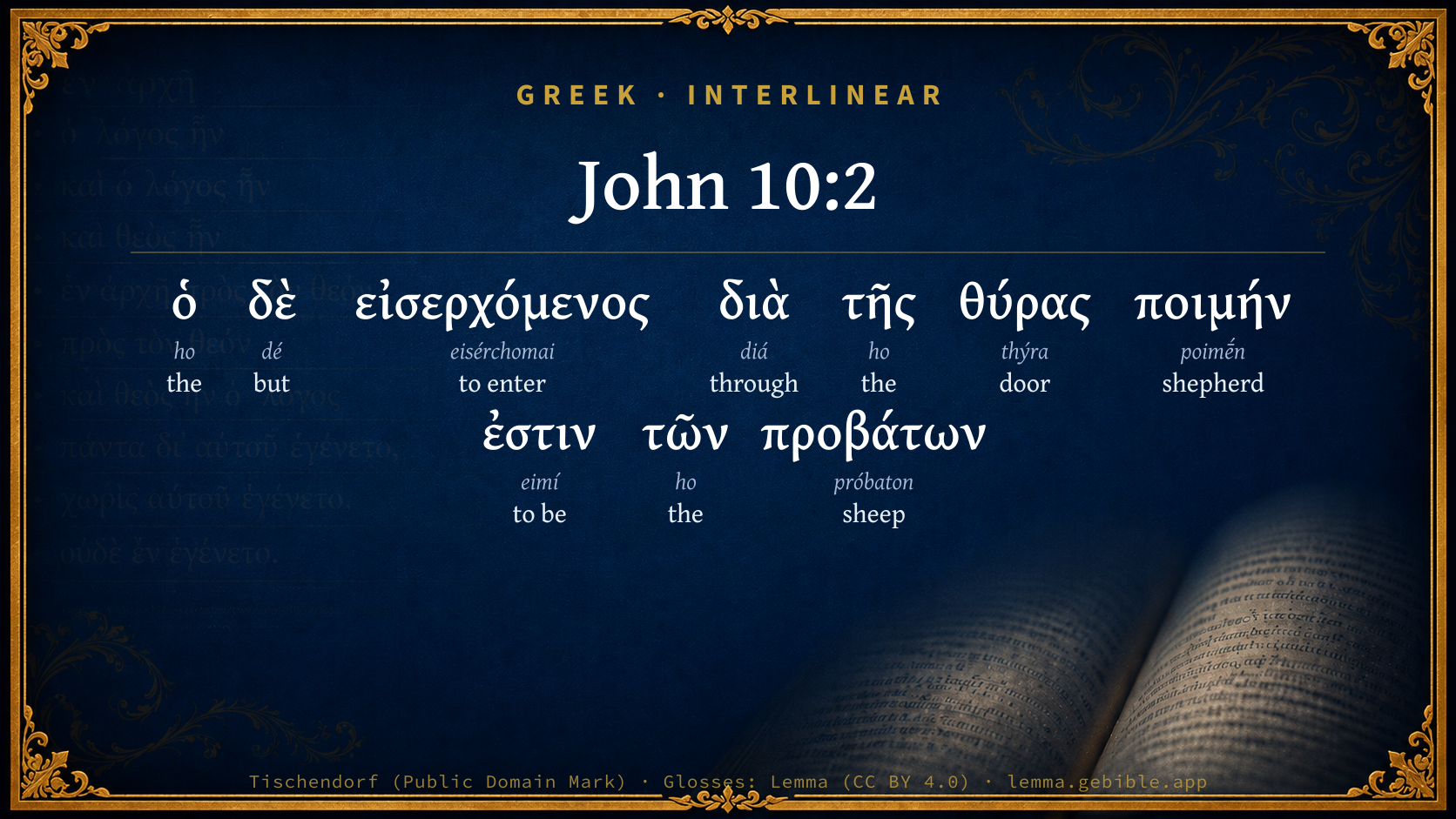
  1. ὁ ho G3588 “the” Article, Nominative, Singular, Masculine
  2. δὲ dé G1161 “but” Conjunction
  3. εἰσερχόμενος eisérchomai G1525 “to enter” Verb, Present, Middle or Passive deponent, Participle, Nominative, Singular, Masculine
  4. διὰ diá G1223 “through” Preposition
  5. τῆς ho G3588 “the” Article, Genitive, Singular, Feminine
  6. θύρας thýra G2374 “door” Noun, Genitive, Singular, Feminine
  7. ἐστιν eimí G1510 “to be” Verb, Present, Active, Indicative, 3rd person, Singular
  8. τῶν ho G3588 “the” Article, Genitive, Plural, Neuter
  9. προβάτων próbaton G4263 “sheep” Noun, Genitive, Plural, Neuter

About this verse

These counts appear in no published source. They are computed here, from the morphology-tagged text and Lemma’s own curated glosses. What Lemma adds →

10
words
8
distinct lemmas
Gospels
section

Notable vocabulary

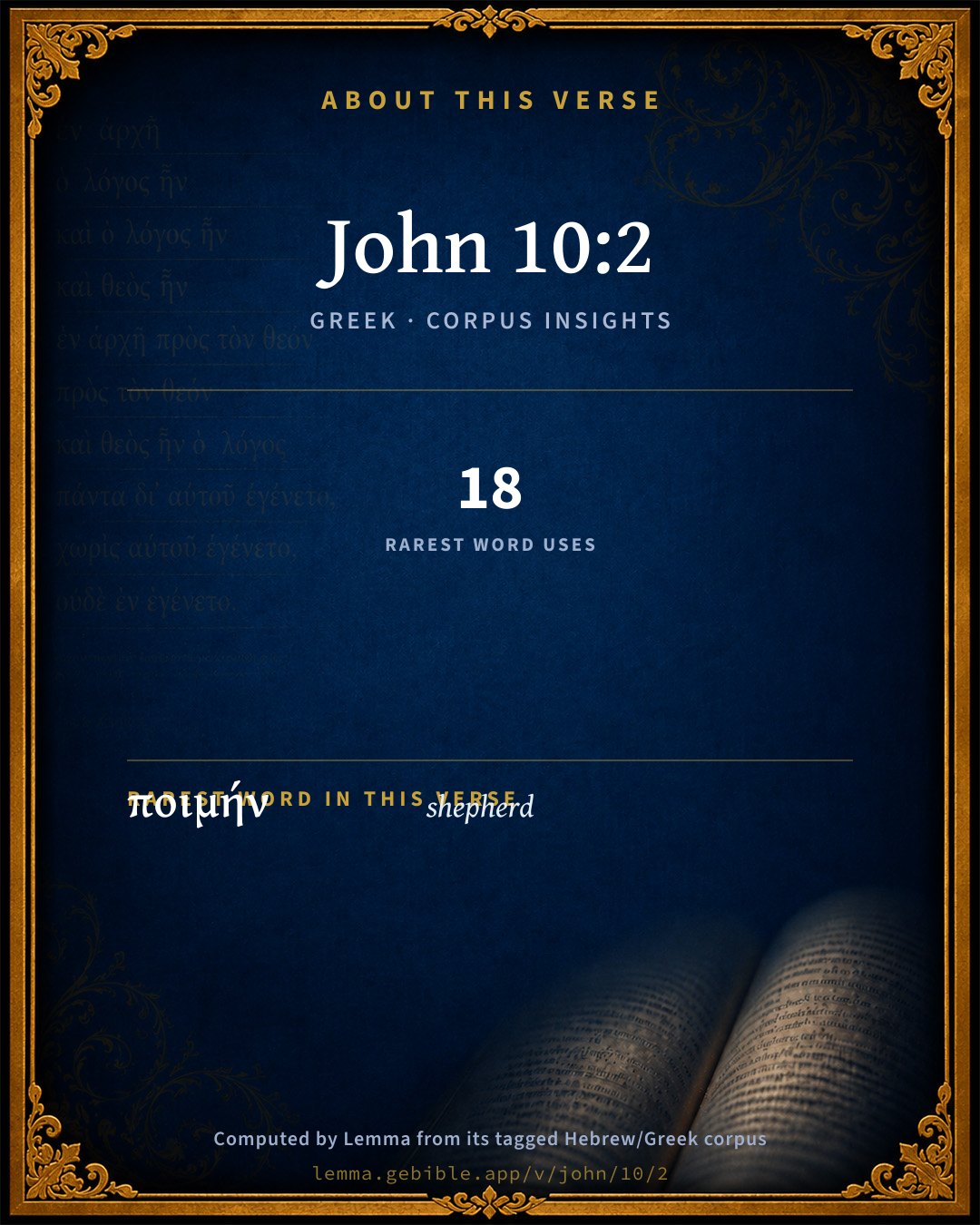
The rarest word here is ποιμήν shepherd G4166 — appearing just 18 times in the whole Greek New Testament.

Shared distinctive vocabulary

ποιμήν shepherd G4166 occurs in 17 verses of the Greek New Testament. Also found in:

Repetition

A word recurs within this verse:

Cross-references

23

Topical passages linked to John 10:2 in the Treasury of Scripture Knowledge — connected by theme and wording, ordered by reader-vote popularity; previews shown in the World English Bible.

  • John 10:14 I am the good shepherd. I know my own, and I'm known by my own;
  • Acts 20:28 Take heed, therefore, to yourselves, and to all the flock, in which the Holy Spirit has made you overseers, to shepherd the assembly of the Lord and God which he purchased with his own blood.
  • Psalms 23:1 Yahweh is my shepherd: I shall lack nothing.
  • 1 Peter 5:4 When the chief Shepherd is revealed, you will receive the crown of glory that doesn't fade away.
  • Isaiah 40:11 He will feed his flock like a shepherd, he will gather the lambs in his arm, and carry them in his bosom, [and] will gently lead those who have their young.
  • Ecclesiastes 12:11 The words of the wise are like goads; and like nails well fastened are words from the masters of assemblies, which are given from one shepherd.
  • John 10:9 I am the door. If anyone enters in by me, he will be saved, and will go in and go out, and will find pasture.
  • John 10:11–12 I am the good shepherd. The good shepherd lays down his life for the sheep.
  • 1 Timothy 4:14 Don't neglect the gift that is in you, which was given to you by prophecy, with the laying on of the hands of the elders.
  • Psalms 80:1 Hear us, Shepherd of Israel, You who lead Joseph like a flock, You who sit above the cherubim, shine forth.
  • Ezekiel 34:23 I will set up one shepherd over them, and he shall feed them, even my servant David; he shall feed them, and he shall be their shepherd.
  • Zechariah 11:3 A voice of the wailing of the shepherds! For their glory is destroyed: a voice of the roaring of young lions! For the pride of the Jordan is ruined.
  • Zechariah 11:5 Their buyers slaughter them, and go unpunished. Those who sell them say, 'Blessed be Yahweh, for I am rich;' and their own shepherds don't pity them.
  • Zechariah 11:8 I cut off the three shepherds in one month; for my soul was weary of them, and their soul also loathed me.
  • John 10:7 Jesus therefore said to them again, "Most assuredly, I tell you, I am the sheep's door.
  • Hebrews 13:20 Now may the God of peace, who brought again from the dead the great shepherd of the sheep with the blood of an eternal covenant, our Lord Jesus,
  • Isaiah 63:11 Then he remembered the days of old, Moses [and] his people, [saying], Where is he who brought them up out of the sea with the shepherds of his flock? where is he who put his holy Spirit in the midst of them?
  • Micah 5:5 He will be our peace when Assyria invades our land, And when he marches through our fortresses, Then we will raise against him seven shepherds, And eight leaders of men.
  • Zechariah 13:7 "Awake, sword, against my shepherd, And against the man who is close to me," says Yahweh of Hosts. Strike the shepherd, and the sheep will be scattered; And I will turn my hand against the little ones.
  • 1 Timothy 3:2–7 The overseer therefore must be without reproach, the husband of one wife, temperate, sensible, modest, hospitable, good at teaching;
  • Titus 1:5 I left you in Crete for this reason, that you would set in order the things that were lacking, and appoint elders in every city, as I directed you;
  • 1 Peter 2:25 For you were going astray like sheep; but are now returned to the Shepherd and Overseer of your souls.
  • Revelation 1:20–2:1 the mystery of the seven stars which you saw in my right hand, and the seven golden lampstands. The seven stars are the angels of the seven assemblies. The seven lampstands are seven assemblies.

Cross-references courtesy of OpenBible.info (CC BY 4.0).

Commentary

Notes on John 10:2 from classic Christian and Jewish commentators (each source and its license shown beneath its notes). The classic Christian expositions comment on the surrounding passage and are grouped to its opening verse, so a note may address several verses; the Jewish commentaries on the Tanakh (Rashi and others) are per-verse, so they appear only where the commentator wrote on this verse.

Lemma curates 59 commentaries, every one of them public domain or Creative Commons licensed, each selected and text-cleaned for this edition rather than reprinted as found. About our sources →

Joseph Benson's Commentary

Joh 10:2-5. He that entereth in by the door is the shepherd, &c. — “This mode of speaking, with us, conveys the notion that the shepherd is the only person who enters by the door; yet the door-keeper, and the sheep themselves, enter also the same way. The original expression is manifestly intended to denote the constant, not the peculiar, use which the shepherd makes of the door, as opposed to the constant use of thieves and robbers, to force their entrance by breaking or climbing over the fence. The comparison is made, not to the folds used by the common people in remote parts of the country, but to those belonging to the rich in the neighbourhood of a populous city, where the walls and other fences need to be stronger, and the entrance more carefully kept, on account of the greater danger from thieves.” — Campbell. To him the porter openeth — As the shepherd will always choose to enter in by that which is the regular appointed way, so, as soon as he approaches, the door-keeper opens the fold; that is, God in his providence, and by the influence of his Spirit, makes way for such a one to exercise his ministry among his people, and gives success to it. For as it is not unworthy of Christ to be styled the door, by which both the sheep and the true pastors enter, so neither is it unworthy of God the Father to be styled the door-keeper. See Act 14:27; and Act 16:14; Col 4:3; Rev 3:8. It was supposed by Sir Isaac Newton, that as the words were spoken near the temple, where sheep were kept in folds to be sold for sacrifices, Christ here alludes to what was peculiar in those folds; that as they were kept locked, they not only excluded the thief, but the shepherd, till the door-keeper opened them. “But I cannot think,” says Dr. Doddridge, “whatever occasion Christ might take from the sight of sheep to represent his people under that image, and himself as a shepherd, he would describe them like sheep shut up in a pen to be sold for sacrifice: nor does the shepherd’s leading them out, &c., agree with this circumstance. In countries where there were so many savage beasts, it might be ordinarily necessary to have the folds better secured than among us; and the chief shepherd might often leave a servant to watch them while thus shut up, and come himself to lead them out to pasture in the morning.” And the sheep hear his voice — The people of God, knowing him to be a true pastor, hearken unto him. All the circumstances here mentioned exactly agree with the customs of the ancient eastern shepherds. They called their sheep by name, went before them, and the sheep followed them. So real Christians hear, attend to, understand, and obey the voice of a shepherd whom Christ hath sent: and he counteth them his own, dearer than any friend or brother; calleth them by name — That is, instructs, advises, directs, encourages each by name, and leadeth them out in the paths of righteousness, beside the waters of comfort. And when he putteth forth his own sheep — Leads them out into the pastures of the ordinances, invites them to the enjoyment of the privileges, and urges them to the practice of the duties of true Christianity; he goeth before them — In all these particulars, and in all the ways of God, teaching them in every point by example, as well as by precept; and the sheep follow him — They tread in his steps; for they know his voice — Having the witness in themselves, that his words are the truth, the wisdom, and the power of God. Reader, art thou a shepherd of souls? Then answer to God: is it thus with thee and thy flock? And a stranger will they not follow — One whom Christ hath not sent, who does not answer the preceding description. Him they will not follow; and who can constrain them to it? But will flee from him — As from the plague. For they know not the voice of strangers — They cannot relish it. It is harsh and grating to them. They find nothing of God therein. In other words, as sheep will not follow a strange shepherd, so the people of God will not hearken to false teachers, or to such as do not declare, plainly, fully, and with a divine unction, the very word of the truth of the gospel: but will avoid them, for they can easily distinguish them from the true messengers of God by their fruits, that is, by their doctrine and practice, and the inefficacy of their preaching to convert, sanctify, and save the souls of men.

Joseph Benson's Commentary on the Old and New Testaments (1811–1818) — public domain. Text from a community e-Sword module.

Bengel's Gnomon

Johann Albrecht Bengel

Joh 10:2. Ὁ δὲ εἰσερχόμενος, but he who enters) through Christ: Joh 10:9, “The door.”

Bengel's Gnomon of the New Testament — English translation (T&T Clark, Edinburgh, 1860) — public domain. Text from a community e-Sword module.

Meyer's Critical & Exegetical Commentary

Heinrich August Wilhelm Meyer

Joh_10:2-3. Ποιμήν] Shepherd, without article qualitatively; it characterizes such a one, not specially as the owner (the antithesis to the hireling first appears in Joh_10:12), but in general, in opposition to the robber.

ὁ θυρωρὸς ἀνοίγει] belongs to the description of the legitimate mode of entering, and is not intended to have any special explanation; for which reason also no further notice is taken of it in Joh_10:7-8. It must not, therefore, be explained either of God (Calvin, Maldonatus, Bengel, Tholuck, Ewald, Hengstenberg, following Joh_6:44 f.); or of the Holy Spirit, Act_13:2 (Theodoret, Heracleon, Ruperti, Aretius, Corn. a Lapide, and several others, also Lange); or of Christ (Cyril, Augustine); or of Moses (Chrysostom, Theodore of Mopsuestia, Euth. Zigabenus, Luther, following Deu_18:15); or of John the Baptist (Godet, after Joh_1:7). He enters into the fold, and the sheep hear His voice (His call, His address, His appeal); they listen to it as to the voice which is known to them (comp. Joh_10:4). Comp. the shepherds cry to his flock, σίττα, in Theocr. iv. 46, viii. 69.

τὰ πρόβατα] are the sheep in the fold generally. It was common for several flocks to pass the night in one fold; and their shepherds, because they come every morning to lead out the individual flocks, are known to all the sheep in the fold. On the contrary, τὰ ἴδια πρόβατα are the sheep which belong to the special flock of him who has entered;[60] these he calls κατʼ ὄνομα, i.e. not merely ὀνομαστί (that would be merely ὄνομα, or ὀνόματι, or ἐπʼ ὀνόματος, Polyb. 5. 35. 2, 11. 15. 1), but distributivelyby their names, each by its name, ἐκ τῆς εἰς ἕκαστον ἄκρας φροντίδος, Euth. Zigabenus. To give to the individual animals of their flock a name was not an unusual custom among the shepherds of ancient times. See Interpp. ad Theocr. 5. 101; Pricaeus on the passage. In Langes view (Leben Jesu, II. p. 955) the ἴδια πρόβ. are the favourite sheep (image of the elect), the bellwethers, which are followed by the whole flock (τὰ πρόβατα, Joh_10:4). This is incorrect; for, on the one hand, ἴδια alone would not sufficiently support this notion (comp. Joh_10:12); and on the other, ἔμπροσθεν πορεύεται and ἀκολουθεῖ, Joh_10:4, are so completely correlate, that αὐτῶν and τὰ πρόβατα must necessarily be the same: at all events, αὐτοῖς must otherwise have been used instead of αὐτῷ, Joh_10:4.

ἐξάγει] to pasture, Joh_10:9-10. Looking back to Joh_9:34; Joh_9:22, Godet imports into the words the idea of separation from the old theocracy, which is devoted to ruin.[61] Such a thought is contained neither in the words (Pollux, i. 250) nor in the context.

[60] Into the beautiful general figure of τὰ πρόβατα, the word ἴδια introduces a special, individual element, which makes it all the richer and more telling. It has been incorrectly maintained (by Bengel, Luthardt, Hengstenberg, and others), that although ἰδία is first associated with πρόβατα when it occurs for the second time, the πρόβατα which hear must necessarily be the same as those which are afterwards described as τὰ ἴδια πρόβατα. These latter are no doubt among the πρόβατα which hear; but it is only τὰ ἴδια that the shepherd calls by name, and so forth. Thus the particular Church belongs to the Universal.

[61] Similarly even Luther: It denotes the Christian freedom from the law and judgment.

Meyer — Critical and Exegetical Commentary on the New Testament — English translation by Peter Christie, edited by Frederick Crombie (T&T Clark, 1880) — public domain. Text from a community e-Sword module.

Expositor's Greek Testament

ed. W. Robertson Nicoll

Joh 10:2 . On the other hand, ὁ δὲ εἰσερχόμενος … προβάτων , “but he that entereth by the door is shepherd of the sheep”. The shepherd is known by his using the legitimate mode of entrance. What that is, He does not here explicitly state. The shepherd is further recognised by his treatment of the sheep, τὰ ἴδια πρόβατα καλεῖ [better φωνεῖ ] κατʼ ὄνομα , “his own sheep he calls by name”. ἴδια perhaps as distinguished from others in the same fold; perhaps merely a strong possessive. As we have names for horses, dogs, cows, so the Eastern shepherds for their sheep. [“Many of the sheep have particular names,” Van Lennep, Bible Lands , i. 189. It was also a Greek custom to name sheep, and Wetstein quotes from Longus, ὁ δὲ Δάφνις ἐκάλεσέ τινας αὐτῶν ὀνομαστί ] ὅταν … αὐτοῦ . When he has put all his own out of the fold, they follow him, because they know his voice: the shepherd walking in front as is still the custom in the East. This method cannot be adopted by strangers “because the sheep know not the voice of strangers”. “There is a story of a Scotch traveller who changed clothes with a Jerusalem shepherd and tried to lead the sheep; but the sheep followed the shepherd’s voice and not his clothes.” Plummer. So that the shepherd’s claim is justified not only by his method of entrance but by his Knowledge of the names of the individual sheep and by their knowledge of him and confidence in him. The different methods are illustrated in Andrewes and Laud, the former saying “Our guiding must be mild and gentle, else it is not duxisti , but traxisti , drawing and driving and no leading”; the latter, of whom it was said that he “would never convince an opponent if he could suppress him”. See Ottley’s Andrewes , 159.

The Expositor's Greek Testament, edited by W. Robertson Nicoll (1897–1910) — public domain. Text from a community e-Sword module.

Jamieson, Fausset & Brown

Robert Jamieson, A. R. Fausset & David Brown

he that entereth in by the door is the shepherd of the sheep--a true, divinely recognized shepherd.

Jamieson, Fausset & Brown — Commentary Critical and Explanatory on the Whole Bible (1871) — public domain (CC PDM 1.0). Text via the HelloAO Bible API.

Adam Clarke's Commentary

Verse 2. He that entereth in by the door] Observe here the marks, qualities, and duties of a good pastor; The first mark is, that he has a lawful entrance into the ministry by the internal call of Christ, namely, by an impulse proceeding from his Spirit, upon considerations which respect only his glory, and upon motives which aim at nothing but the good of his Church, the salvation of souls, the doing the will of God, and the sacrificing himself entirely to his service, and to that of the meanest of his flock.

Adam Clarke's Commentary on the Bible (1810–1826) — public domain. Text from a community e-Sword/MySword module.

Ellicott's Commentary for English Readers

(2) But he that entereth in by the door.—See Notes on Joh_10:7-9.

Is the shepherd of the sheep.—Better, is a shepherd of the sheep. The word here (comp. Joh_10:12) simply characterises him that entereth by the door as a shepherd, in opposition to the robber who climbeth over the fence.

(2) Joh_10:16 of this chapter finds the commencement of its fulfilment in this mission. The appointment of a new body of disciples, whose very number is symbolical of a wider work, was the first step in the bringing in of the “other sheep.” The Twelve answered to the number of the tribes of Israel; but the Seventy represent the nations of the world. The directions for this work to each body are nearly identical, but the restrictions laid upon the Twelve are not laid upon the Seventy.

A Bible Commentary for English Readers, edited by Charles John Ellicott (1878–1897) — public domain. Text from a community e-Sword module.

The Cambridge Bible for Schools and Colleges

gen. ed. J. J. S. Perowne

2. is the shepherd of the sheep] Better, is a shepherd of the sheep. There is more than one flock in the fold, and therefore more than one shepherd to visit the fold. The Good Shepherd has not yet appeared in the allegory. The allegory indeed is two-fold; in the first part (1–5), which is repeated (7–9), Christ is the Door of the fold; in the second part (11–18) He is the Shepherd; Joh_10:10 forming a link between the two parts.

The Cambridge Bible for Schools and Colleges (gen. ed. J. J. S. Perowne; Cambridge University Press, 1878–1918) — public domain. Text from a community e-Sword module.

John Gill's Exposition

But he that entereth in by the door,.... With a divine commission, and by a divine authority, who comes not of himself, but is sent; does not take the honour to himself, or thrust in himself, and assume an office to himself, but is called unto it, and invested in it, he

is the shepherd of the sheep; by whom Christ means himself, as is evident from Joh 10:11, whose the sheep are, and who takes care of them, and feeds them, as a shepherd does his flock; and which holds true of any under shepherd, having his mission and commission, and deriving his authority from Christ.

John Gill's Exposition of the Whole Bible (1746–1763) — public domain (CC PDM 1.0). Text via the HelloAO Bible API.

Trapp's Complete Commentary

John Trapp

2 But he that entereth in by the door is the shepherd of the sheep.

Ver. 2. But he that entereth in by the door] That is, called by Christ to the office of his undershepherd. In physicis aer non faeit seipsum ignem, sed fit a superiori, saith Aquinas.

Is the shepherd of the sheep] To the which is required, that he be both learned and loving. This note ariseth out of the notation of the word here used. (Ποιμην quasi οιμην, of οις, a sheep, and μαω, to desire earnestly.)

John Trapp, A Commentary or Exposition upon All the Books of the Old and New Testament (1647–1656) — public domain. Text from a community e-Sword module.

Albert Barnes' Notes on the Bible

He that entereth by the door - This was the way in which a shepherd had access to his flock. In Joh 10:7 Jesus says he is the door. In this place he refers to those who by him - that is, in accordance with his spirit and law become ministers of religion.

Is the shepherd of the sheep - Christ does not here refer to himself, for he is the way or door by which others enter; but he refers to all the ministers of the gospel who have access to the church by him. In the original, the article “the” is missing before the word shepherd - “is a shepherd.” By his entering in this manner he shows that he is a shepherd one who cares for his flock, and does not come to kill and destroy.

Albert Barnes' Notes on the Bible (1834–1885) — public domain. Text from a community e-Sword/MySword module.

Matthew Poole's English Annotations

As it is amongst men, the true shepherd goes into the sheepfold by the door; so it is in the church of God. He that taketh not the honour of governing the church to himself, but being called of God, as Aaron was, he is the shepherd of the sheep. This very argument the apostle useth to prove Christ to be the true High Priest, Heb 5:4,5, because he glorified not himself to be made a High Priest, but was made one by him who said unto him, Psa 110:4, (quoted there also, Joh 10:6), Thou art a Priest for ever after the order of Melchisedec. God (whose the church is, called his heritage, his peculiar people, & c.) was the Door, by which Christ, the chief Shepherd, entered into the flock; he made him the Head of the church. Eph 5:23. For this he is said to be sent; and often makes himself known to us under the notion of him whom the Father hath sent. And the under shepherds must also derive from Christ: as the Father’s will in sending Christ was his door, so the will of Christ in sending others is their door; that is, their only true way of entering upon the charge of the flock of Christ. As my Father hath sent me, even so send I you, Joh 20:21. There is a double sending; the one is extraordinary, of which mission Christ speaketh to his apostles in that place; thus the apostles and first ministers of the gospel were sent; Christ breathed on them, and said, Receive ye the Holy Ghost, Joh 20:22; and there was yet a fuller sending of these first shepherds, in the days of Pentecost, Act 2:17. And there is a more ordinary sending, as to which God revealed his will, 2Ti 2:2, The things that thou hast heard of me among many witnesses, the same commit thou to faithful men, who shall be able to teach others. Thus the apostles, Act 14:23, did themselves ordain elders in every church. And Paul for this purpose left Titus in Crete, to set in order the things that are wanting, and ordain elders in every city, Tit 1:5. Whosoever entereth into any place in the church, for the feeding and governing of it, that way which God hath directed in his word, he entereth in by the door, he is the true shepherd. Concerning Christ’s title, and his way of entrance, and the first preachers of the gospel, immediately sent by Christ, and declared to be sent by the effusion of the Spirit in the days of Pentecost, there can be no question made by any who believeth the Scriptures of the Old and New Testament. This text declares, that whosoever cometh into the church with right, and as a true shepherd to it, must come in at the door, by a call from God, (as Christ was sent), or from Christ; either by an extraordinary mission, or in such a method and order as Christ hath in his word directed, either from his own month, or by the mouths of his apostles, whom he, ascending up into heaven, left in the first charge of his church. This is that which every one ought in the first place to look after. We shall observe in God’s whole course with his church, that in the corruption of the state of the church, when it was eminently deviated from the rule he had set, he sent some by an extraordinary mission. Such were the prophets, whose writings make up a part of Scripture. Such were the apostles, and first ministers of the gospel. Such, we say, were our first reformers in Germany, and other parts: nor is it any prejudice to it, that they were able to work no miracles; we read of no miracles wrought by the prophets of old, unless by two or three of them. Their faithful declaring the will of God, and calling men back to the plain law of God in a time when the generality were obviously departed from it; together with their spirit of courage and boldness in their work, was evidence enough that God had sent them. But this text only declareth this general truth, That every true shepherd coming into the church, must come in the right way, by the door. So the great Shepherd of the sheep did, being sent by his Father, whose the church is, to take care of it: so must all inferior shepherds do, by him whom God the Father hath made the door; according to whose directions all the affairs of the church must be ordered.

Matthew Poole's English Annotations on the Holy Bible (1683–1685) — public domain. Text from a community e-Sword/MySword module.

The Pulpit Commentary

But he that enters in by the door is a shepherd of the sheep. Let him be who he may, Pharisee or priest, prophet or king, pastor or evangelist, unless he approach the sheep by the right "way" he demeans and condemns himself. If he come by the door into the fold, he may be so far presumably a shepherd. One fold might contain several flocks, and a shepherd might lead these flocks into different enclosures according to his wisdom and care for his sheep. Neander, Godet, and Watkins think it possible that the whole imagery may have been borrowed from the eye. The shepherds towards evening were probably gathering their scattered flocks, according to Oriental custom, into their well-known enclosures, and Jesus with his audience might have seen them doing it if they gazed out from the courts of the temple over the neighboring hills (see also Thomson, "The Land and the Book," 1:301, a passage which provides an admirable commentary on this parable). There is no absolute need that the customary and well-known habit of the country-side should have been visible at the moment. The abundantly attested practice furnished to his hearers all needful corroboration. The deeper significance of the passage lies in the prophetic symbolism of Jer_23:1-4 Isa_40:11 Psa_23:1-3 Psa_78:52 Num_27:17 Eze_34:23, 31 37:24. Jehovah was the Shepherd of Israel, (Psa_80:1) and he would appoint once more in their Messiah-King a David, who should be his gracious Representative and Agent. All these representations were gathered up in Christ"s wonderful parable of the lost sheep. (Luk_15:3-7) Thoma endeavors to credit the author of the Gospel with this ideal picture of the contrast between the true and false shepherd.

The Pulpit Commentary (1880–1919), ed. H.D.M. Spence-Jones & Joseph S. Exell — public domain. Text from a community e-Sword module.

The People's New Testament

B. W. Johnson

2. He that entereth in by the door. The one who comes in by the door is the shepherd. The figure is very plain to those familiar with Eastern sheepfolds. The door is for the shepherd and the sheep, while those who get in otherwise are robbers who seek to prey upon the sheep.

B. W. Johnson's The People's New Testament with Notes (1889–1891) — public domain. Electronic text from the Christian Classics Ethereal Library (CCEL) ThML edition.

Cambridge Greek Testament for Schools and Colleges

2. ποιμήν ἐστιν τ. πρ. Is a shepherd of the sheep. There is more than one flock in the fold, and therefore more than one shepherd to visit the fold. The Good Shepherd has not yet appeared in the allegory. The allegory indeed is twofold, or even threefold; in the first part (1–5), which is repeated (7–9), Christ is the Door of the fold; in the second part (11–18) He is the Shepherd; Joh 10:10 forming a link between the two main parts.

Cambridge Greek Testament for Schools and Colleges (Cambridge University Press, 1896; 21 vols, various authors incl. Carr, Maclear, Plummer, Farrar, Lumby, Moule, M. R. James, Simcox) — public domain. Text from a community e-Sword module.

International Critical Commentary

2. ὁ δὲ εἰσερχόμενος κτλ. On the other hand, a man coming into the court or fold by the door presumably is entitled to do so. He is a shepherd, whose business it is to look after the sheep. He is ποιμὴν προβάτων (Gen 4:2). The application of this to Jesus comes later. So far the picture is true of all sheepfolds and shepherds.

International Critical Commentary — older volumes (1896–1929), various authors — public domain. Text from a community e-Sword module.

Vincent's Word Studies in the New Testament

Marvin R. Vincent

The shepherd [ποιμην] . Better, a shepherd. It is the character rather than the person that is contemplated.

Marvin R. Vincent, Word Studies in the New Testament (1887–1900) — public domain. Text from a community e-Sword/MySword module.

Lesson kit

Teaching starters — assembled from the data on this page, not authored interpretation. Every prompt links to the verse data it draws on. Edit before teaching.

John, in the Gospels, opens this verse with 10 words (8 distinct Greek lemmas). Its most distinctive word is poimḗn (“shepherd”). A historical commentator’s framing appears above. Read the whole chapter for the surrounding context.

Discussion questions

  1. The word poimḗn carries the sense “shepherd.” How does it shape the verse?
  2. Matthew 9:36 shares the word «shepherd» with this verse. How do the two illuminate each other?
  3. “the” occurs 3× in this one verse. What is the effect of the repetition?
  4. These translations render this verse differently. What is at stake in choosing one wording over another?
  5. Reading how Joseph Benson's Commentary and Bengel's Gnomon read this verse, where do the two commentators agree and where do they part?

Things to notice

  • These translations choose different wording for 8 words in this verse.
  • “the” occurs 3× in this single verse.
  • 8 distinct Greek lemmas span 10 words in this verse.

Reading settings

Reading text

Shown beneath each verse's original-language words.

Old Testament
Old Testament edition

Read the OT as the Masoretic Hebrew (MT) or the Greek Septuagint (LXX).

English shown for the Greek Septuagint (in the Hebrew ↔ Greek comparison).

Comparing translations? Open the Compare panel on any verse page to stack up to four side by side.