John 10:23

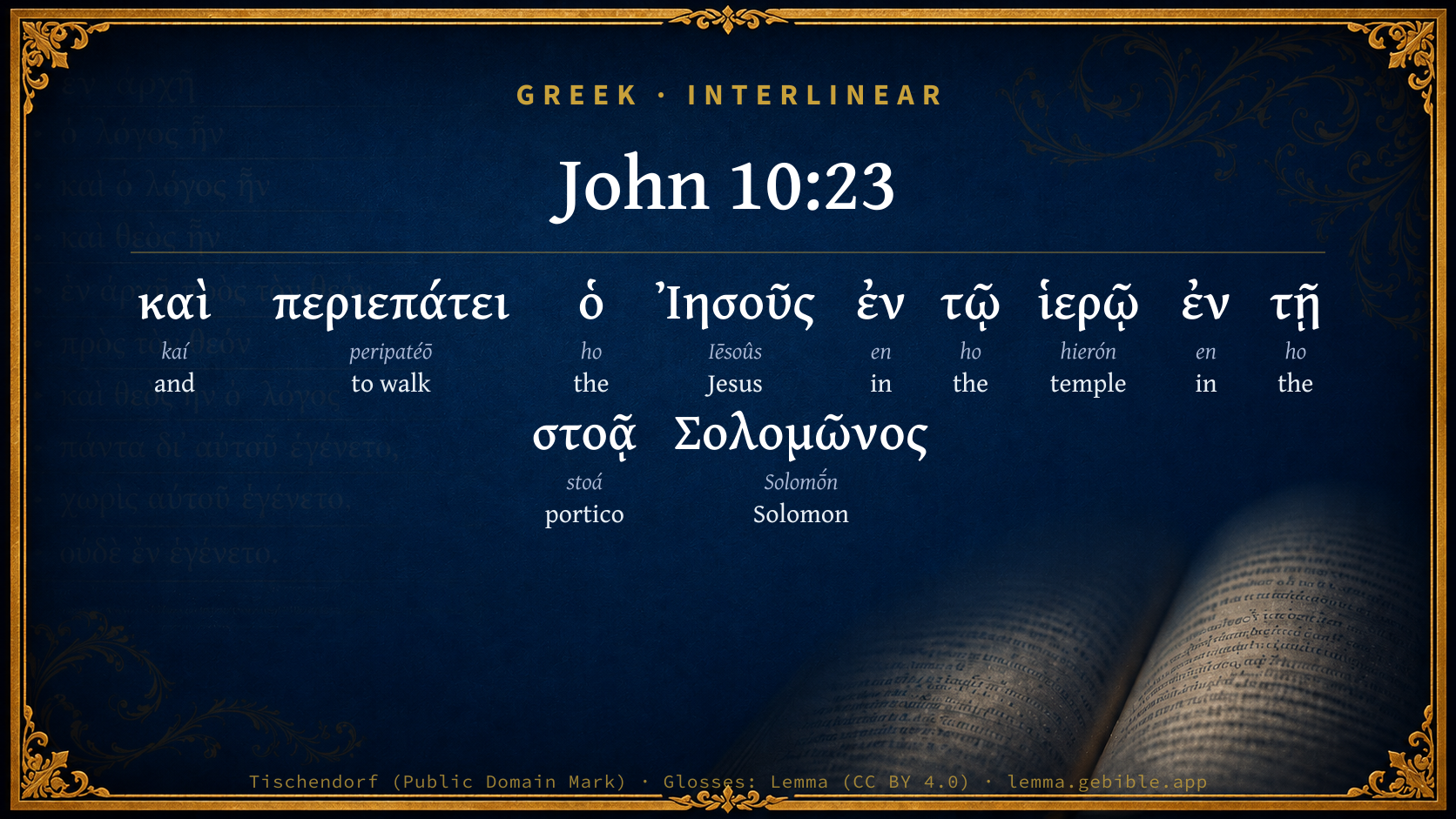
Greek (Tischendorf 8th ed.) John 10:23 appears in the Greek New Testament. The text above is from the Tischendorf 8th edition. Each word links to its Strong’s number and a concise gloss. Click any word for its full Thayer’s Greek Lexicon entry.
Download image
Cite this verse

John 10:23 (World English Bible). Public Domain. Lemma interlinear Bible study tool, https://lemma.gebible.app/v/john/10/23.

Show BibTeX & RIS
BibTeX
RIS
English Translation
It was winter, and Jesus was walking in the temple, in Solomon's porch.
World English Bible · Public Domain
Download a study sheet

One document with this verse’s original text, its word-by-word gloss line, the meaning frame, cross-references with their text, attributed commentary, and full source and license credits — printable, and it pastes into notes with its structure intact.

This verse Autodidact and up

Study sheet (.html) Plain text (.txt)

A passage Seminary Student

Up to 50 verses in one chapter. A passage sheet keeps up to 6 commentary sources and 12 cross-references per verse, in the order this page ranks them, and says so on the sheet whenever that leaves anything out. Ask for a single verse and you get the Autodidact verse sheet above.

Everything on this page stays free to read, with no account — the sheet is a download of what is already on screen, not access to it.

Want to remove ads? Support Godless Engineer
Compare translations 3

The same verse in 3 English versions, stacked beneath the original-language interlinear above. Click any original word for its lexicon entry.

Each is an independent rendering of the whole verse — the interlinear is not word-aligned to these translations.

Highlighted words mark where these versions differ — a whole-verse word diff, not a word-by-word alignment.

  • World English Bible Public Domain
    It was winter, and Jesus was walking in the temple, in Solomon's porch.
  • King James Version Public Domain
    And Jesus walked in the temple in Solomon's porch.
  • unfoldingWord Literal Text CC BY-SA 4.0
    and Jesus was walking in the temple on the porch of Solomon.

unfoldingWord Literal Text — © unfoldingWord, licensed CC BY-SA 4.0. Word-aligned USFM3 via Door43 (git.door43.org/unfoldingWord/en_ult).

Versions to compare (up to 4)

3 of 4 selected

Show all 19 translations

Every available English version of this verse, each an independent rendering of the whole verse.

  • World English Bible Public Domain
    It was winter, and Jesus was walking in the temple, in Solomon's porch.
  • Berean Standard Bible Public Domain
    and Jesus was walking in the temple courts in Solomon’s Colonnade.
  • Majority Standard Bible Public Domain
    and Jesus was walking in the temple courts in Solomon’s Colonnade.
  • King James Version Public Domain
    And Jesus walked in the temple in Solomon's porch.
  • American Standard Version (1901) Public Domain
    it was winter; and Jesus was walking in the temple in Solomon's porch.
  • Revised Version (1885) Public Domain
    and Jesus was walking in the temple in Solomon’s porch.
  • Geneva Bible (1599) Public Domain
    And Iesus walked in the Temple, in Salomons porche.
  • Douay-Rheims (1899) Public Domain
    And Jesus walked in the temple, in Solomon's porch.
  • Young's Literal Translation Public Domain
    and Jesus was walking in the temple, in the porch of Solomon,
  • Literal Standard Version CC BY-SA 4.0
    and Jesus was walking in the temple, in the porch of Solomon,
  • Unlocked Literal Bible CC BY-SA 4.0
    It was winter, and Jesus was walking in the temple in the porch of Solomon.
  • unfoldingWord Literal Text CC BY-SA 4.0
    and Jesus was walking in the temple on the porch of Solomon.
  • Darby Bible Public Domain
    And Jesus walked in the temple in the porch of Solomon.
  • World Messianic Bible Public Domain
    It was winter, and Yeshua was walking in the temple, in Solomon’s porch.
  • Webster's Bible Public Domain
    And Jesus walked in the temple in Solomon's porch.
  • Free Bible Version CC BY-SA 4.0
    Jesus was walking in the Temple through Solomon's Porch. The Jews surrounded him, asking,
  • Bible in Basic English Public Domain
    And Jesus was walking in the Temple, in Solomon's covered way.
  • Text-Critical English NT CC BY 4.0
    and Jesus was walking in the temple courts, in Solomon's Portico.
  • Tyndale New Testament (1534) Public Domain
    and Iesus walked in Salomons porche.

Literal Standard Version (2020), Covenant Press — licensed CC BY-SA 4.0. Text via the HelloAO Bible API (eBible.org). Unlocked Literal Bible (unfoldingWord) — licensed CC BY-SA 4.0. Text via the HelloAO Bible API (eBible.org). unfoldingWord Literal Text — © unfoldingWord, licensed CC BY-SA 4.0. Word-aligned USFM3 via Door43 (git.door43.org/unfoldingWord/en_ult). Free Bible Version, Dr. Jonathan Gallagher — licensed CC BY-SA 4.0. Text via the HelloAO Bible API (eBible.org).

Word by word

More ways to search: Search by grammar → Find every occurrence → Compare this word →

Practice this passage: Drill this verse → Learn its vocabulary →

στοᾷ
stoá
G4745
“portico”
Noun, Dative, Singular, Feminine
Part of Speech
Noun
Case
Dative
Number
Singular
Gender
Feminine
Full Thayer's Definition

Origin: probably from G2476

TDNT: None

1. a portico, a covered colonnade where people can stand or walk protected from the weather and the heat of the sun 2. the portico built by Solomon in the eastern part of the temple (which in the temple's destruction by the Babylonians was left uninjured, and remained down to the time of King Agrippa, to whom the care of the temple was entrusted by the emperor Claudius, and who on account of its antiquity dare not demolish it and build anew.
  1. καὶ kaí G2532 “and” Conjunction
  2. περιεπάτει peripatéō G4043 “to walk” Verb, Imperfect, Active, Indicative, 3rd person, Singular
  3. ὁ ho G3588 “the” Article, Nominative, Singular, Masculine
  4. Ἰησοῦς Iēsoûs G2424 “Jesus” Noun, Nominative, Singular, Masculine
  5. ἐν en G1722 “in” Preposition
  6. τῷ ho G3588 “the” Article, Dative, Singular, Neuter
  7. ἱερῷ hierón G2411 “temple” Noun, Dative, Singular, Neuter
  8. ἐν en G1722 “in” Preposition
  9. τῇ ho G3588 “the” Article, Dative, Singular, Feminine
  10. Σολομῶνος Solomṓn G4672 “Solomon” Noun, Genitive, Singular, Masculine

About this verse

These counts appear in no published source. They are computed here, from the morphology-tagged text and Lemma’s own curated glosses. What Lemma adds →

11
words
8
distinct lemmas
Gospels
section

Notable vocabulary

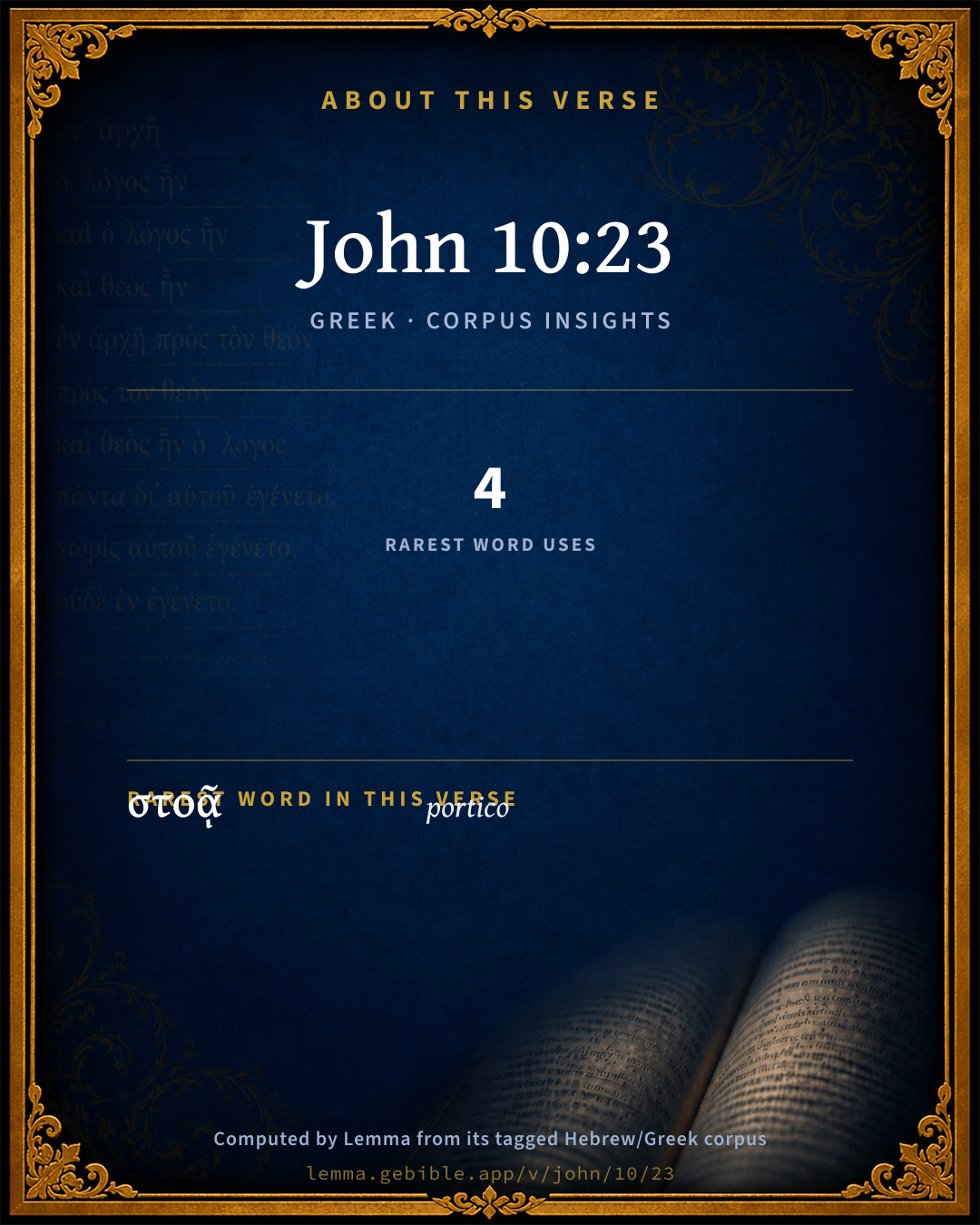
The rarest word here is στοᾷ portico G4745 — appearing just 4 times in the whole Greek New Testament.

Shared distinctive vocabulary

στοᾷ portico G4745 occurs in 4 verses of the Greek New Testament. Also found in:

Repetition

Words recur within this verse:

Cross-references

2

Topical passages linked to John 10:23 in the Treasury of Scripture Knowledge — connected by theme and wording, ordered by reader-vote popularity; previews shown in the World English Bible.

  • Acts 3:11 As the lame man who was healed held on to Peter and John, all the people ran together to them in the porch that is called Solomon's, greatly wondering.
  • Acts 5:12 By the hands of the apostles many signs and wonders were done among the people. They were all with one accord in Solomon's porch.

Cross-references courtesy of OpenBible.info (CC BY 4.0).

Commentary

Notes on John 10:23 from classic Christian and Jewish commentators (each source and its license shown beneath its notes). The classic Christian expositions comment on the surrounding passage and are grouped to its opening verse, so a note may address several verses; the Jewish commentaries on the Tanakh (Rashi and others) are per-verse, so they appear only where the commentator wrote on this verse.

Lemma curates 59 commentaries, every one of them public domain or Creative Commons licensed, each selected and text-cleaned for this edition rather than reprinted as found. About our sources →

Tyndale Open Study Notes

Tyndale Open Resources

10:23 Massive covered colonnades surrounded the four sides of the central courtyard of the Temple. Solomon’s Colonnade, on the east, provided shelter from winter weather.

Tyndale Open Study Notes — © Tyndale Open Resources, licensed CC BY-SA 4.0. Text via the HelloAO Bible API.

Expositor's Greek Testament

ed. W. Robertson Nicoll

Joh 10:23 . For the sake of shelter Jesus was walking with His disciples [ περιεπάτει ] in Solomon’s Porch, a cloister on the east side of the Temple area (Joseph., Antiq. , xx. 9, 7) apparently reared on some remaining portions of Solomon’s building.

The Expositor's Greek Testament, edited by W. Robertson Nicoll (1897–1910) — public domain. Text from a community e-Sword module.

Geneva Bible (1599)

Geneva Bible translators

The unbelievers and proud men accuse the Gospel of darkness, which darkness indeed is within themselves.

Geneva Bible (1599) marginal notes — public domain. Text via Bolls.life.

Jamieson, Fausset & Brown

Robert Jamieson, A. R. Fausset & David Brown

Jesus walked . . . in Solomon's porch--for shelter. This portico was on the east side of the temple, and JOSEPHUS says it was part of the original structure of Solomon [Antiquities, 20.9.7].

Jamieson, Fausset & Brown — Commentary Critical and Explanatory on the Whole Bible (1871) — public domain (CC PDM 1.0). Text via the HelloAO Bible API.

Adam Clarke's Commentary

Verse 23. Solomon's porch.] By what we find in Josephus, Ant. b. xx. c. 8, s. 7, a portico built by Solomon, on the east side of the outer court of the temple, was left standing by Herod, when he rebuilt the temple. This portico was four hundred cubits long, and was left standing, probably, because of its grandeur and beauty. But when Agrippa came to Jerusalem, a few years before the destruction of the city by the Romans, and about eighty years after Herod had begun his building, (till which time what Herod had begun was not completed,) the Jews solicited Agrippa to repair this portico at his own expense, using for argument, not only that the building was growing ruinous, but that otherwise eighteen thousand workmen, who had all of them, until then, been employed in carrying on the works of the temple, would be all at once deprived of a livelihood.

Adam Clarke's Commentary on the Bible (1810–1826) — public domain. Text from a community e-Sword/MySword module.

John Calvin's Commentaries

23. And Jesus was walking in the temple, in Solomon’s porch. The Evangelist gives to Solomon’s porch the designation of the temple; not that it was the sanctuary, but only an appendage to the temple Nor does he mean the ancient porch which was built by Solomon, which had been altogether destroyed by the Chaldeans, but that which the Jews — perhaps immediately after their return from the Babylonish captivity — built after the pattern of the ancient porch, and gave it the same name, that it might be more highly honored; and Herod afterwards built a new temple.

John Calvin's Commentaries (1540-1563) — public domain. Text from the Calvin Translation Society English edition (1840s-50s) via the Christian Classics Ethereal Library (ccel.org). Calvin's coverage is partial (roughly two-thirds of the Bible); uncommented books and verses are honest gaps, never fabricated. The 19th-century editor's footnotes and remarks are omitted so the notes are faithfully Calvin's own voice.

Ellicott's Commentary for English Readers

(23) And Jesus walked in the temple . . .—Better, and Jesus was walking. The scene is remembered and pictured as it took place.

In Solomon’s porch.—The place is mentioned again in Act_3:11; Act_5:12. It was rather a cloister or arcade than what we usually call a porch. It is said to have been on the east of the Temple, and to have been a relic of the original building which had survived all destructions and restorations, and had brought down its founder’s name from its founder’s time. (Comp. Jos. Ant. xx. 9, § 7.) It does not seem clear, however, that Josephus calls anything more than the eastern wall by the name of Solomon, and he calls the cloister above it simply the “Eastern cloister.” It is more likely that the true position of “Solomon’s porch” is to be found in one of the subterranean structures which existed in the time of our Lord, and exist now as they did in the time of Solomon. Caspari would identify the corridor under El-Aksa with “Solomon’s porch,” and thus connect the place where our Lord walked at this feast with the Holy Church of Zion, and the place of the outpouring of the Holy Ghost. (Chron. and Geogr., Introd., Append. § 22; Eng. Trans., pp. 297-9. Comp. Note on refs. in Acts.) The place as mentioned here is another instance of the writer’s remembrance of topographical details connected with the Temple. (Comp. Joh_8:20.) The fact that it was winter, and the fact that He was walking in this covered cloister or crypt, explain each other.

A Bible Commentary for English Readers, edited by Charles John Ellicott (1878–1897) — public domain. Text from a community e-Sword module.

The Cambridge Bible for Schools and Colleges

gen. ed. J. J. S. Perowne

23. in Solomon’s porch] This was a cloister or colonnade in the Temple-Courts, apparently on the east side. Tradition said that it was a part of the original building which had survived the various destructions and rebuildings. No such cloister is mentioned in the account of Solomon’s Temple, and perhaps the name was derived from the wall against which it was built. It is mentioned again Act_3:11 (where see note) and Joh_5:12. Foundations still remaining probably belong to it.

The Cambridge Bible for Schools and Colleges (gen. ed. J. J. S. Perowne; Cambridge University Press, 1878–1918) — public domain. Text from a community e-Sword module.

John Gill's Exposition

And Jesus walked in the temple,.... To keep himself warm, and to secure him the better from the inclemency of the weather:

in Solomon's porch; which was covered over, and the outside of it was enclosed with a wall, which made it very convenient for such a purpose: this was on the outside of the temple eastward, and was a very magnificent structure: the account Josephus (n) gives of it is this;

"there was a porch without the temple, overlooking a deep valley, supported by walls of four hundred cubits, made of four square stone, very white; the length of each stone was twenty cubits, and the breadth six; the work of king Solomon, who first founded the whole temple.''

Now, though this was not the porch that was built by Solomon, yet as it was built on the same spot, and in imitation of it, it bore his name; mention is made of it in Act 3:11.

(n) Antiqu. l. 20. c. 8. sect. 7.

John Gill's Exposition of the Whole Bible (1746–1763) — public domain (CC PDM 1.0). Text via the HelloAO Bible API.

Trapp's Complete Commentary

John Trapp

23 And Jesus walked in the temple in Solomon’s porch.

Ver. 23. And Jesus walked in the temple] Taking the opportunity of that public meeting to do good, as the bee is abroad as soon as the sun ariseth. The Greeks were great walkers, as the Stoics in their porch, &c. But the Turks wonder to see a man walk to and fro, and usually ask him whether he be out of his way, or out of his wits? (Biddulph.) Pliny said to his nephew, when he saw him walk out some hours without studying, Poteras has horas non perdere.

In Solomon’s porch] So the Jews called that porch (for honour’s sake) which they built again after the Captivity; and which, together with the whole temple, was beautified by Herod the Great, to curry favour with the people, which yet would not be, for they hated him extremely. Partim ambitione ductus, partita Iudaeorum benevolentiam captans. (Bez. Annot. in Joh 1:20)

John Trapp, A Commentary or Exposition upon All the Books of the Old and New Testament (1647–1656) — public domain. Text from a community e-Sword module.

Albert Barnes' Notes on the Bible

Solomon’s porch - The porch or covered way on the east of the temple. See the notes at Mat 21:12.

Albert Barnes' Notes on the Bible (1834–1885) — public domain. Text from a community e-Sword/MySword module.

Haydock's Catholic Bible Commentary

In the gallery of Solomon, which was near the temple, supposed to be attached to the eastern gate of the court, and called beautiful. See Acts iii. 2.

George Leo Haydock (1774–1849), Haydock's Catholic Family Bible and Commentary, 1859 edition — public domain. Excludes Psalms (Douay-Rheims chapter numbering differs from Protestant) and Deuterocanonical books (Catholic canon only).

Matthew Poole's English Annotations

Of this Solomon’s porch we read, 1Ki 6:3, that Solomon built the porch before the temple of the house, twenty cubits long, and ten cubits broad. This was the place where they walked in winter. Though this was destroyed when Jerusalem was destroyed by the Babylonians; yet it seemeth that there was one built that was like it, and kept that name. It should seem that it was a place better defended from the weather, than those other parts of the temple where in summer time they used to walk.

Matthew Poole's English Annotations on the Holy Bible (1683–1685) — public domain. Text from a community e-Sword/MySword module.

Whedon's Commentary on the Bible

Daniel D. Whedon

23. Jesus walked… in Solomon’s porch—With an expressive abruptness the Evangelist presents Jesus walking in the great eastern piazza of the temple, and relates the scene which is counterpart and completion of the above discourse. Protected by the covert of the portico from the wet storm of a Jewish winter day, walking perhaps with the Evangelist, he is suddenly, εκυκλωσαν, encircled by a number of the very doubters of Joh_10:19-21, the sight of whom calls up to mind the image of shepherd and sheep, Joh_10:26-29.

To the pagan temples of Greece there was customarily fixed a portico for the convenience of walkers and talkers; and it is curious to remark that from two of the words used in this verse, περιπατει and στοα, two philosophical sects were named, respectively, Peripatetics and Stoics. This porch of Solomon was by some held to have been a work of that monarch, left undestroyed by the Assyrians.

We endorse the opinion of Lange, (against the protest of Stier,) that these Jews were not ironical, but most earnest in this movement, yet earnest after their own way. By the miracles of Jesus they were compelled to attribute to him some more than human power; but his teachings, so anti-Judaic, and, as they felt, anti-Mosaic, repelled them. They therefore, as in a body, encompassed him round, as if to make him prisoner, and if he will consent to be their sort of a Messiah, to make him their Messiah. It was an attempt, upon a much smaller scale, resembling the effort to make him king, in Joh_6:15.

Daniel D. Whedon (gen. ed.), Commentary on the Old and New Testaments (1874–1909) — public domain. Text from a community e-Sword module.

The Pulpit Commentary

And Jesus walked in the temple in Solomon"s porch. He walked in Solomons portico that part of the temple of Herod which the apostles afterwards adopted as the scene of some of their most explicit assertions of the gospel. (Act_3:11 Act_5:12) It was associated with the grandest events in their national history; for it was reared on the substructions of Solomon"s temple, which even to the present day are intact (Robinson"s "Palestine," 1:289; Palestine Exploration Society"s Reports; "Recovery of Jerusalem," frontispiece, pp. 17, 226, 309-319). The Lord walked there because it was winter, and wintry weather. This reveals a little touch of the hand of an eye-witness. We need not ask for any more transcendental explanation. The note of time, moreover, implies that two months had elapsed since the Feast of Tabernacles. Wieseler calculates that the Feast of Tabernacles closed on October 19, and the Feast of Dedication began on December 20, and, if so, time is left for a portion of the Galilaean ministry cited in Lu 10-13 Ezr_10:9-13 shows that the time referred to was after a period of heavy rain, and may account for Jesus walking in the shelter of the portico.

The Pulpit Commentary (1880–1919), ed. H.D.M. Spence-Jones & Joseph S. Exell — public domain. Text from a community e-Sword module.

John Wesley's Explanatory Notes

In Solomon's portico - Josephus informs us, that when Solomon built the temple, he filled up a part of the adjacent valley, and built a portico over it toward the east. This was a noble structure, supported by a wall four hundred cubits high: and continued even to the time of Albinus and Agrippa, which was several years after the death of Christ.

John Wesley, Explanatory Notes Upon the Whole Bible (1754–1765) — public domain. Text via the GEBible commentary corpus.

Burkitt's Expository Notes on the New Testament

William Burkitt

In these verses we have recorded a new and fresh debate betwixt our Saviour and the Jews, and therein we have observable, 1. The time of this debate, Joh 10:22.

It was at the feast of dedication, in the winter, our Saviour taking that opportunity to publish his doctrine, when a concourse of people were gathered together at that solemnity.

Observe, 2. That place of this debate, in Solomon’s porch.

Although the temple and porch built by Solomon were destroyed by the Babylonians: yet when the temple was rebuilt, there was a porch like it, which retained the ancient name.

Observe, 3. The debate itself; If thou be the Christ tell us plainly. Not that they affected the knowledge of the truth, but only designed to ensnare him: for it he had affirmed himself to be the Messias, he had brought himself in danger of the Roman governor; because the Jews expected the Messias to be a temporal prince, that should deliver them from the Roman power.

Now if Christ had declared himself such a Messias as the Jews expected, it might have cost him his life. Therefore his hour being not yet come, he answers with his usual prudence and weariness to their ensnaring question.

Learn hence, That Christ’s enemies are full of subtile policies, and can turn themselves into all shapes, that, if possible, they may entrap and ensnare him; and accordingly, they pretend here great earnestness of desire to be satisfied, whether he was indeed the true and promised Messias; when in truth they had another design.

Observe, 4. The wisdom and caution of our Saviour’s answer; he refers them to his miracles, The works that I do in my father’s name, they bear witness of me. Our Saviour’s miraculous work were sufficient for the Jews to have grounded and bottomed their faith upon, and to have confirmed them in the belief, that he was the promised and expected Messias, had not prejudice, obstinacy, and malice, blinded their eyes, that they could neither see nor consider.

Observe, lastly, How Christ points out to these Jews the true cause of their infidelity: which was not the obscurity of his doctrine, but their not being his sheep; that is, not as yet converted, they not having the properties of his sheep, which he sites down in the following verses.

Learn hence, That men’s final unbelief under the means of faith, is a clear evidence of their being in a lost and perishing condition.

Infidelity is the sin that doth consign a man over to damnation; and to such as sit under the gospel, doth not only procure damnation, but no damnation like it.

William Burkitt's Expository Notes on the New Testament (1700–1703) — public domain. Text from a community e-Sword module.

The People's New Testament

B. W. Johnson

23. Walked … in Solomon's porch. A long covered colonnade that was a part of the temple.

B. W. Johnson's The People's New Testament with Notes (1889–1891) — public domain. Electronic text from the Christian Classics Ethereal Library (CCEL) ThML edition.

Cambridge Greek Testament for Schools and Colleges

23. ἐν τ. στ. Σ.] This was a cloister or colonnade in the Temple-Courts, apparently on the east side. Tradition said that it was a part of the original building which had survived the various destructions. No such cloister is mentioned in the account of Solomon’s Temple, and perhaps the name was derived from the wall against which it was built. It is mentioned again Act 3:11; Act 5:12 as the recognised place of worship for the first disciples. Foundations still remaining may belong to it. For ἱερόν see on Joh 2:14; Joh 2:19.

Cambridge Greek Testament for Schools and Colleges (Cambridge University Press, 1896; 21 vols, various authors incl. Carr, Maclear, Plummer, Farrar, Lumby, Moule, M. R. James, Simcox) — public domain. Text from a community e-Sword module.

International Critical Commentary

23. “It was winter, and Jesus was walking in the Temple, in Solomon’s porch.” That is, He was giving His teaching under shelter, because of the severity of the season, in the eastern cloister of the Temple precincts (for τὸ ἱερόν, the Temple enclosure, see on 2:14). This vivid touch suggests that the writer is thoroughly familiar with the place and the conditions under which instruction was given there. At the time when the Fourth Gospel was written, the Temple had been for some years in ruins; but the note of time and circumstance is easily explicable, if we have here the reminiscence of an eye-witness of the scene.

ἡ στοὰ τοῦ Σολομῶνος is mentioned again, Act 3:11, Act 5:12.

International Critical Commentary — older volumes (1896–1929), various authors — public domain. Text from a community e-Sword module.

Vincent's Word Studies in the New Testament

Marvin R. Vincent

Solomon 's porch. A covered colonnade on the eastern side of the outer court of the temple. According to Josephus it was a relic of Solomon 's days, which had remained intact in the destruction of the temple by Nebuchadnezzar.

Marvin R. Vincent, Word Studies in the New Testament (1887–1900) — public domain. Text from a community e-Sword/MySword module.

Lesson kit

Teaching starters — assembled from the data on this page, not authored interpretation. Every prompt links to the verse data it draws on. Edit before teaching.

John, in the Gospels, opens this verse with 11 words (8 distinct Greek lemmas). Its most distinctive word is stoá (“portico”). A historical commentator’s framing appears above. Read the whole chapter for the surrounding context.

Discussion questions

  1. The word stoá carries the sense “portico.” How does it shape the verse?
  2. How does John 5:2, which shares the word «portico», read alongside this verse?
  3. What does the repetition of “the” (3× in this one verse) do in this verse?
  4. These translations render this verse differently; the difference is in the English rendering, not the original. What questions does that raise?
  5. Compare how Tyndale Open Study Notes and Expositor's Greek Testament read this verse. Where do they agree or differ?

Things to notice

  • These translations choose different wording for 5 words in this verse.
  • “the” occurs 3× in this single verse.
  • 8 distinct Greek lemmas span 11 words in this verse.

Reading settings

Reading text

Shown beneath each verse's original-language words.

Old Testament
Old Testament edition

Read the OT as the Masoretic Hebrew (MT) or the Greek Septuagint (LXX).

English shown for the Greek Septuagint (in the Hebrew ↔ Greek comparison).

Comparing translations? Open the Compare panel on any verse page to stack up to four side by side.