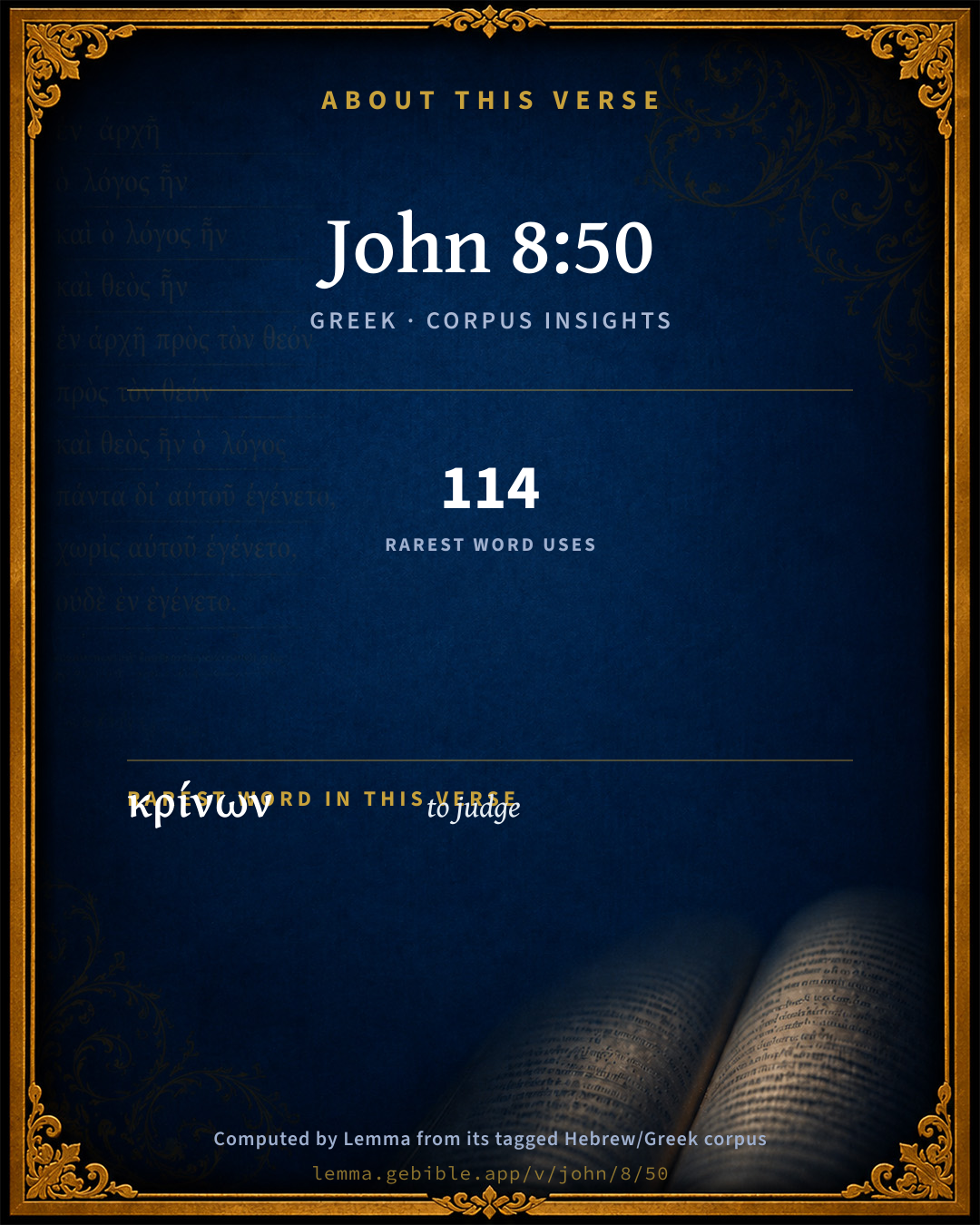
John 8:50

Greek (Tischendorf 8th ed.) John 8:50 appears in the Greek New Testament. The text above is from the Tischendorf 8th edition. Each word links to its Strong’s number and a concise gloss. Click any word for its full Thayer’s Greek Lexicon entry.
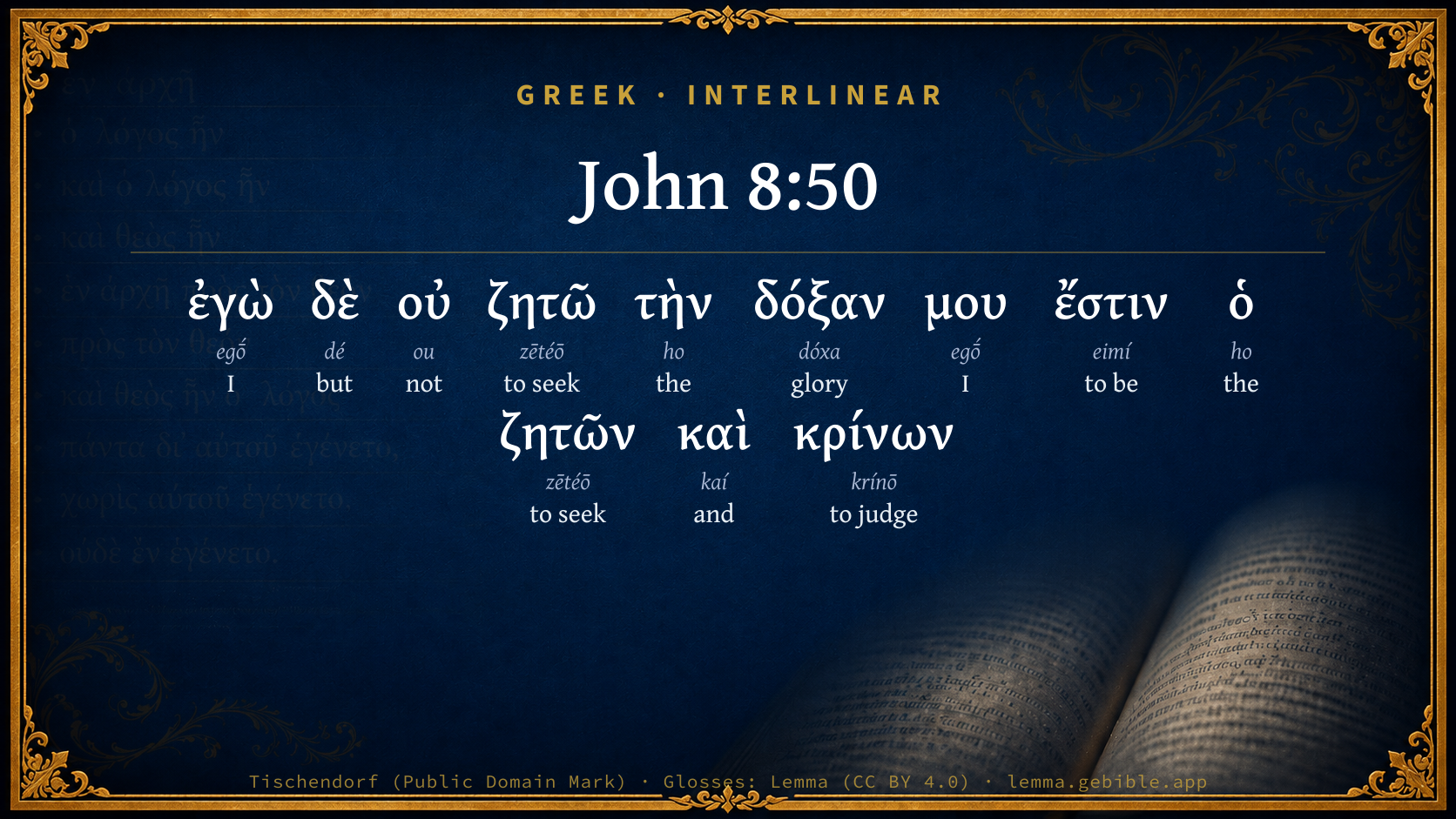
Download image
Cite this verse

John 8:50 (World English Bible). Public Domain. Lemma interlinear Bible study tool, https://lemma.gebible.app/v/john/8/50.

Show BibTeX & RIS
BibTeX
RIS
English Translation
But I don't seek my own glory. There is one who seeks and judges.
World English Bible · Public Domain
Download a study sheet

One document with this verse’s original text, its word-by-word gloss line, the meaning frame, cross-references with their text, attributed commentary, and full source and license credits — printable, and it pastes into notes with its structure intact.

This verse Autodidact and up

Study sheet (.html) Plain text (.txt)

A passage Seminary Student

Up to 50 verses in one chapter. A passage sheet keeps up to 6 commentary sources and 12 cross-references per verse, in the order this page ranks them, and says so on the sheet whenever that leaves anything out. Ask for a single verse and you get the Autodidact verse sheet above.

Everything on this page stays free to read, with no account — the sheet is a download of what is already on screen, not access to it.

Want to remove ads? Support Godless Engineer
Compare translations 3

The same verse in 3 English versions, stacked beneath the original-language interlinear above. Click any original word for its lexicon entry.

Each is an independent rendering of the whole verse — the interlinear is not word-aligned to these translations.

Highlighted words mark where these versions differ — a whole-verse word diff, not a word-by-word alignment.

  • World English Bible Public Domain
    But I don't seek my own glory. There is one who seeks and judges.
  • King James Version Public Domain
    And I seek not mine own glory: there is one that seeketh and judgeth.
  • unfoldingWord Literal Text CC BY-SA 4.0
    Now I do not seek my glory; there is one seeking and judging.

unfoldingWord Literal Text — © unfoldingWord, licensed CC BY-SA 4.0. Word-aligned USFM3 via Door43 (git.door43.org/unfoldingWord/en_ult).

Versions to compare (up to 4)

3 of 4 selected

Show all 19 translations

Every available English version of this verse, each an independent rendering of the whole verse.

  • World English Bible Public Domain
    But I don't seek my own glory. There is one who seeks and judges.
  • Berean Standard Bible Public Domain
    I do not seek My own glory. There is One who seeks it, and He is the Judge.
  • Majority Standard Bible Public Domain
    I do not seek My own glory. There is One who seeks it, and He is the Judge.
  • King James Version Public Domain
    And I seek not mine own glory: there is one that seeketh and judgeth.
  • American Standard Version (1901) Public Domain
    But I seek not mine own glory: there is one that seeketh and judgeth.
  • Revised Version (1885) Public Domain
    But I seek not mine own glory: there is one that seeketh and judgeth.
  • Geneva Bible (1599) Public Domain
    And I seeke not mine owne praise: but there is one that seeketh it, and iudgeth.
  • Douay-Rheims (1899) Public Domain
    But I seek not my own glory: there is one that seeketh and judgeth.
  • Young's Literal Translation Public Domain
    and I do not seek my own glory; there is who is seeking and is judging;
  • Literal Standard Version CC BY-SA 4.0
    and I do not seek My own glory; there is [One] who is seeking and is judging;
  • Unlocked Literal Bible CC BY-SA 4.0
    I do not seek my glory; there is one seeking and judging.
  • unfoldingWord Literal Text CC BY-SA 4.0
    Now I do not seek my glory; there is one seeking and judging.
  • Darby Bible Public Domain
    But I do not seek my own glory: there is he that seeks and judges.
  • World Messianic Bible Public Domain
    But I don’t seek my own glory. There is one who seeks and judges.
  • Webster's Bible Public Domain
    And I seek not my own glory: there is one that seeketh and judgeth.
  • Free Bible Version CC BY-SA 4.0
    I'm not here looking to glorify myself. But there is one who does this for me and who judges in my favor.
  • Bible in Basic English Public Domain
    I, however, am not in search of glory for myself: there is One who is searching for it and he is judge.
  • Text-Critical English NT CC BY 4.0
    I do not seek my own glory; there is one who seeks it, and he is the judge.
  • Tyndale New Testament (1534) Public Domain
    I seke not myne awne prayse: but ther is one that seketh and iudgeth.

Literal Standard Version (2020), Covenant Press — licensed CC BY-SA 4.0. Text via the HelloAO Bible API (eBible.org). Unlocked Literal Bible (unfoldingWord) — licensed CC BY-SA 4.0. Text via the HelloAO Bible API (eBible.org). unfoldingWord Literal Text — © unfoldingWord, licensed CC BY-SA 4.0. Word-aligned USFM3 via Door43 (git.door43.org/unfoldingWord/en_ult). Free Bible Version, Dr. Jonathan Gallagher — licensed CC BY-SA 4.0. Text via the HelloAO Bible API (eBible.org).

Word by word

More ways to search: Search by grammar → Find every occurrence → Compare this word →

Practice this passage: Drill this verse → Learn its vocabulary →

κρίνων
krínō
G2919
“to judge”
Verb, Present, Active, Participle, Nominative, Singular, Masculine
Part of Speech
Verb
Tense
Present
Voice
Active
Mood
Participle
Case
Nominative
Number
Singular
Gender
Masculine
Full Thayer's Definition

Origin: perhaps a primitive word

TDNT: 18:21,5

1. to separate, put asunder, to pick out, select, choose 2. to approve, esteem, to prefer 3. to be of opinion, deem, think, to be of opinion 4. to determine, resolve, decree 5. to judge a. to pronounce an opinion concerning right and wrong 1. to be judged, i.e. summoned to trial that one's case may be examined and judgment passed upon it b. to pronounce judgment, to subject to censure 1. of those who act the part of judges or arbiters in matters of common life, or pass judgment on the deeds and words of others 6. to rule, govern a. to preside over with the power of giving judicial decisions, because it was the prerogative of kings and rulers to pass judgment 7. to contend together, of warriors and combatants a. to dispute b. in a forensic sense 1. to go to law, have suit at law
  1. ἐγὼ egṓ G1473 “I” Personal pronoun, 1st person, Nominative, Singular
  2. δὲ dé G1161 “but” Conjunction
  3. οὐ ou G3756 “not” Particle, Negative
  4. ζητῶ zētéō G2212 “to seek” Verb, Present, Active, Indicative, 1st person, Singular
  5. τὴν ho G3588 “the” Article, Accusative, Singular, Feminine
  6. δόξαν dóxa G1391 “glory” Noun, Accusative, Singular, Feminine
  7. μου egṓ G1473 “I” Personal pronoun, 1st person, Genitive, Singular
  8. ἔστιν eimí G1510 “to be” Verb, Present, Active, Indicative, 3rd person, Singular
  9. ὁ ho G3588 “the” Article, Nominative, Singular, Masculine
  10. ζητῶν zētéō G2212 “to seek” Verb, Present, Active, Participle, Nominative, Singular, Masculine
  11. καὶ kaí G2532 “and” Conjunction

About this verse

These counts appear in no published source. They are computed here, from the morphology-tagged text and Lemma’s own curated glosses. What Lemma adds →

12
words
9
distinct lemmas
Gospels
section

Repetition

Words recur within this verse:

Cross-references

6

Topical passages linked to John 8:50 in the Treasury of Scripture Knowledge — connected by theme and wording, ordered by reader-vote popularity; previews shown in the World English Bible.

  • John 5:41 I don't receive glory from men.
  • John 8:54 Jesus answered, "If I glorify myself, my glory is nothing. It is my Father who glorifies me, of whom you say that he is our God.
  • John 7:18 He who speaks from himself seeks his own glory, but he who seeks the glory of him who sent him, the same is true, and no unrighteousness is in him.
  • John 5:20–23 For the Father has affection for the Son, and shows him all things that he himself does. He will show him greater works than these, that you may marvel.
  • John 12:47–48 If anyone listens to my sayings, and doesn't believe, I don't judge him. For I came not to judge the world, but to save the world.
  • John 5:45 "Don't think that I will accuse you to the Father. There is one who accuses you, even Moses, on whom you have set your hope.

Cross-references courtesy of OpenBible.info (CC BY 4.0).

Commentary

Notes on John 8:50 from classic Christian and Jewish commentators (each source and its license shown beneath its notes). The classic Christian expositions comment on the surrounding passage and are grouped to its opening verse, so a note may address several verses; the Jewish commentaries on the Tanakh (Rashi and others) are per-verse, so they appear only where the commentator wrote on this verse.

Lemma curates 59 commentaries, every one of them public domain or Creative Commons licensed, each selected and text-cleaned for this edition rather than reprinted as found. About our sources →

Bengel's Gnomon

Johann Albrecht Bengel

Joh 8:50. Οὐ ζητῶ, I do not seek) as ye suppose; and therefore think it right, that I should be treated with insult.—ἔστιν, there is) I do not seek My own glory; nor is there any need that I should seek it; for My Father vindicates it.

Bengel's Gnomon of the New Testament — English translation (T&T Clark, Edinburgh, 1860) — public domain. Text from a community e-Sword module.

Meyer's Critical & Exegetical Commentary

Heinrich August Wilhelm Meyer

Joh_8:50-51. I, however, in contrast to this unrighteousness by which you wound my honour, seek not the honour which belongs to me

ἔστιν ὁ ζητ. κ. κρίνων, there is one (comp. Joh_5:45) who seeks it (qui me honore afficere velit, Grotius), and pronounces judgment, that is, as a matter of fact, between me and my revilers. The expression καὶ κρίνων includes a reference, on the one hand, to the glorification of Jesus, by which He was to be justified (Joh_16:10; comp. the διό, Php_2:9); and, on the other, as regards His opponents, a hint at their just punishment (with eternal death, Joh_8:51). Hence He adds in Joh_8:51 a solemn assurance concerning that which is necessary to the obtaining of eternal life, instead of this punitive κρίσις, to wit, the keeping of His word; thus deciding that the exclusion of His opponents from eternal life was inevitable as long as they did not return to μετάνοια; but also pointing out the only way to salvation which was still remaining open to them. Quite arbitrarily some have treated Joh_8:51 as not forming part of His discourse to His enemies. Calvin and De Wette remark: After a pause, Jesus turns again to those who believed on Him, in the sense of Joh_8:31. Lücke maintains, indeed, that the discourse is addressed to His opponents, but regards it rather as the conclusion of the line of thought begun at Joh_8:31 f. than a direct continuation of Joh_8:50. The connection with Joh_8:50 is in this way likewise surrendered. The discourse is a direct continuation of the import of καὶ κρίνων, for the result of this κρίνειν to the opponents of Jesus is death.

ἐάν τις, etc.] Note the emphasis which is given to the pronoun by the arrangement of the words τὸν ἐμὸν λόγον. It is the word of Christ, whose keeping has so great an effect. τηρεῖν is not merely keeping in the heart (Tholuck), but, as always, when united with τὸν λόγον, τὰς ἐντολὰς, etc., keeping by fulfilling them (Joh_8:55; Joh_14:15; Joh_14:21; Joh_14:23 f., Joh_15:20, Joh_17:6). This fulfilment includes even the faith demanded by Jesus (Joh_3:36; comp. the conception of ὑπακοὴ πίστεως), and also the accomplishment of all the duties of life which He enjoins as the fruit and test of faith.

θάνατον οὐ μὴ θεωρ. εἰς τ. αἰ.] not: he will not die for ever (Kaeuffer, de ζωῆς αἰων., not. p. 114), but: he will never die, i.e. he will live eternally. Comp. Joh_8:52; Joh_11:25 ff; Joh_5:25; Joh_6:50. Death is here the antithesis to the Messianic ζωή, which the believer possesses even in its temporal development, and which he will never lose.

On θεωρ. comp. Psa_89:44; Luk_2:25; see also on Joh_3:36. The article is not necessary to θάνατος (Joh_11:4, and very frequently in the N. T.); see Ellendt, Lex. Soph. II. p. 234.

Meyer — Critical and Exegetical Commentary on the New Testament — English translation by Peter Christie, edited by Frederick Crombie (T&T Clark, 1880) — public domain. Text from a community e-Sword module.

Geneva Bible (1599)

Geneva Bible translators

That is, that will revenge both your despising of me, and of him.

Geneva Bible (1599) marginal notes — public domain. Text via Bolls.life.

Jamieson, Fausset & Brown

Robert Jamieson, A. R. Fausset & David Brown

I seek not mine own glory: there is one that seeketh--that is, evidently, "that seeketh My glory"; requiring "all men to honor the Son even as they honor the Father"; judicially treating him "who honoreth not the Son as honoring not the Father that hath sent Him" (Joh 5:23; and compare Mat 17:5); but giving to Him (Joh 6:37) such as will yet cast their crowns before His throne, in whom He "shall see of the travail of his soul, and be satisfied" (Isa 53:11).

Jamieson, Fausset & Brown — Commentary Critical and Explanatory on the Whole Bible (1871) — public domain (CC PDM 1.0). Text via the HelloAO Bible API.

Adam Clarke's Commentary

Verse 50. I seek not mine own glory] Another proof that I am not influenced by any spirit but that which proceeds from God. But there is one that seeketh-i.e. my glory-and judgeth-will punish you for your determined obstinacy and iniquity.

Adam Clarke's Commentary on the Bible (1810–1826) — public domain. Text from a community e-Sword/MySword module.

Ellicott's Commentary for English Readers

(50) And I seek not mine own glory.—The words are immediately connected with those which have preceded. They dishonoured Him. This to one who sought His own glory would have been matter of concern. For Him whose whole life was one of self-denial, their dishonour finds nothing which it can wound. His words repeat what He had taught them before. (See Notes on Joh_5:41; Joh_7:18.)

There is one that seeketh and judgeth.—Comp. Joh_5:45. The thought here is that though He Himself seeks not His own glory, the Father seeketh for the honour of the Son, and judgeth between Him and those who dishonour Him. The result of the judgment as to those who keep not His word is expressed in the next verse; and as to Himself in Joh_16:10.

A Bible Commentary for English Readers, edited by Charles John Ellicott (1878–1897) — public domain. Text from a community e-Sword module.

The Cambridge Bible for Schools and Colleges

gen. ed. J. J. S. Perowne

50. And I seek not mine own glory] Better, But I seek not My glory. ‘It is not because I seek glory for Myself that I speak of your dishonouring Me: My Father seeks that for Me and pronounces judgment on you.’ Comp. Joh_8:54 and Joh_5:41.

The Cambridge Bible for Schools and Colleges (gen. ed. J. J. S. Perowne; Cambridge University Press, 1878–1918) — public domain. Text from a community e-Sword module.

John Gill's Exposition

Art thou greater than our father Abraham?.... So the woman of Samaria said, concerning Jacob, Joh 4:12. The Jews had a mighty opinion of their ancestors, especially of Abraham; and yet they allow the Messiah to be greater than he, as Jesus truly was: so one of their ancient commentators (w) on those words of Isa 52:13 thus paraphrases them,

""Behold my servant shall deal prudently", this is the King Messiah; "he shall be exalted" above Abraham, as it is written, Gen 14:22, "and extolled" above Moses, as it is written, Num 11:12, and he shall be higher than the ministering angels, as it is written, Eze 1:26, for he shall be , "greater than the fathers".''

They add here, of Abraham,

which is dead; he was a great and good man, and yet dead:

and the prophets are dead; though they truly kept, and faithfully delivered the word of God:

whom makest thou thyself? who art a poor carpenter's son, a Galilean, a Nazarene, and yet makest thyself greater than Abraham, or any of the prophets; yea, makest thyself to be God, to promise security from death, and an everlasting continuance of life upon keeping thy word.

(w) Tachuma apud Huls. p. 321.

John Gill's Exposition of the Whole Bible (1746–1763) — public domain (CC PDM 1.0). Text via the HelloAO Bible API.

Trapp's Complete Commentary

John Trapp

50 And I seek not mine own glory: there is one that seeketh and judgeth.

Ver. 50. There is one that seeketh and judgeth] The less a man strives for himself, the more is God his champion; those that honour him he will honour. Those that drown all self-respects in his glory, and study his share more than their own, shall he found to "praise, and honour, and glory," in that great amphitheatre at the last day, 1Pe 1:7.

John Trapp, A Commentary or Exposition upon All the Books of the Old and New Testament (1647–1656) — public domain. Text from a community e-Sword module.

Albert Barnes' Notes on the Bible

Mine own glory - My own praise or honor. In all his teaching this was true. He did not seek to exalt or to vindicate himself. He was willing to lie under reproach and to be despised. He regarded little, therefore, their taunts and accusations; and even now, he says, he would not seek to vindicate himself.

There is one that seeketh and judgeth - God will take care of my reputation. He seeks my welfare and honor, and I may commit my cause into his hands without attempting my own vindication. From these verses Joh 8:46-50 we may learn:

1. That where men have no sound arguments, they attempt to overwhelm their adversaries by calling odious and reproachful names. Accusations of heresy and schism, and the use of reproachful terms, are commonly proof that men are not only under the influence of unchristian feeling, but that they have no sound reasons to support their cause.

2. It is right to vindicate ourselves from such charges, but it should not be done by rendering railing for railing. “In meekness we should instruct those that oppose themselves, if God peradventure will give them repentance to the acknowledging of the truth,” 2Ti 2:25.

3. We should not regard it as necessarily dishonorable if we lie under reproach. If we have a good conscience, if we have examined for ourselves, if we are conscious that we are seeking the glory of God, we should be willing, as Jesus was, to bear reproach, believing that God will in due time avenge us, and bring forth our righteousness as the light, and our judgment as the noonday, Psa 37:6.

Albert Barnes' Notes on the Bible (1834–1885) — public domain. Text from a community e-Sword/MySword module.

Matthew Poole's English Annotations

Christ very often reminds them of this, that in what he spake and did, he sought not his own honour and reputation; which both obviated an objection they might make against him, and also convinced them of his truth and sincerity in what he did. But, saith he, though I seek not my own honour, yet there is one who cometh himself in my honour and glory; and you must expect that he should judge and condemn you for all your hard speeches which you have spoken against me.

Matthew Poole's English Annotations on the Holy Bible (1683–1685) — public domain. Text from a community e-Sword/MySword module.

Whedon's Commentary on the Bible

Daniel D. Whedon

50. Not mine own glory—Though he asserts his own dignity as divine, yet it is for no vain glory to himself, but for the glory of God the Father.

One that seeketh—That seeketh and obtaineth the glory, for it is His supreme right.

And judgeth—Judgeth those who withhold his glory or dishonour his Son.

Daniel D. Whedon (gen. ed.), Commentary on the Old and New Testaments (1874–1909) — public domain. Text from a community e-Sword module.

The Pulpit Commentary

But, in honouring my Father, and in quietly bearing your unjustifiable reproaches, I am not seeking my glory. (cf. vers. 28, 42Jo 7:18) The claim of Christ to be and do so much is made because he has the happiness of the world, the salvation and life of men, and the glory of the Father as his consuming passion. He is not seeking his own glory; he is only crowning himself with the crown of utter self-abnegation. But, while he repudiates all care for his own glory, he knows that, there is One to whom that glory is dear, who seeketh his glory, and with whom it is perfectly safe, and who judgeth with absolute impartiality and infinite knowledge. Westcott quotes in illustration of o zhtwn , Philo on Gen_42:22, "He that seeketh maketh inquisition for blood is not man, but God, or the Logos, or the Divine Law" ("De Jos.," 29).

The Pulpit Commentary (1880–1919), ed. H.D.M. Spence-Jones & Joseph S. Exell — public domain. Text from a community e-Sword module.

John Wesley's Explanatory Notes

I seek not my own glory - That is, as I am the Messiah, I consult not my own glory. I need not. For my Father consulteth it, and will pass sentence on you accordingly.

John Wesley, Explanatory Notes Upon the Whole Bible (1754–1765) — public domain. Text via the GEBible commentary corpus.

The People's New Testament

B. W. Johnson

50. I seek not mine own glory. He cared little therefore for their abuse, and sought not to defend himself.

B. W. Johnson's The People's New Testament with Notes (1889–1891) — public domain. Electronic text from the Christian Classics Ethereal Library (CCEL) ThML edition.

unfoldingWord translationNotes

Door43 World Missions Community

Connecting Statement:

Jesus continues answering the Jews.

there is one seeking and judging

This refers to God.

Truly, truly

See how you translated this in John 01:51.

keeps my word

Here "word" is a metonym for the "teachings" of Jesus. AT: "obeys my teachings" or "does what I say" (See: Metonymy)

see death

This is an idiom that means to experience death. Here Jesus is referring to spiritual death. AT: "die spiritually" (See: Idiom)

translationWords

seek

glory

judge

amen

die

unfoldingWord translationNotes — © Distant Shores Media and the Door43 World Missions Community, licensed CC BY-SA 4.0. Source: git.door43.org/Door43/en_tn.

Cambridge Greek Testament for Schools and Colleges

50. ἐγὼ δὲ οὐ ζ. But it is not I who seek. ‘It is not because I seek glory for Myself that I speak of your dishonouring Me: the Father seeks that for Me and pronounces judgment on you.’ Comp. Joh 8:54 and Joh 5:41. There is no contradiction between this and Joh 5:22. In both cases God’s law operates of itself: the wicked sentence themselves, rather than are sentenced by Him or by the Son.

Cambridge Greek Testament for Schools and Colleges (Cambridge University Press, 1896; 21 vols, various authors incl. Carr, Maclear, Plummer, Farrar, Lumby, Moule, M. R. James, Simcox) — public domain. Text from a community e-Sword module.

Alford’s Greek Testament

Henry Alford

50.] ‘Ye dishonour me;—not that I seek my own honour, but His who sent me. There is One who seeketh my honour (ch. 5:23), and will have me honoured; and who judgeth between me and you, between truth and falsehood.’

Supply τ. δόξαν μου after ζητῶν, but not after κρίνων.

Henry Alford, The Greek Testament (1849–1861) — public domain. Text from a community e-Sword module.

International Critical Commentary

50. However, He goes on to explain that their insulting words did not affect Him. ἐγὼ δὲ οὐ ζητῶ τὴν δόξαν μου: if He did so, it would be nothing (cf. 5:41, 7:18, 8:54).

ἔστιν ὁ ζητῶν καὶ κρίνων, “there is One who seeks (my honour), and (in doing so) pronounces judgment (as between us).” It is only the δόξα that comes from God that is worth having (5:44, 8:54). To win the approval of God for any act or thought is to be “judged”; and this Jesus applied to Himself, strange as the thought may be to us of the Father “judging” the Son. But we cannot separate ζητῶν from κρίνων, and ὁ ζητῶν refers to the Father as seeking to honour the Son (see on v. 54).

There is no incongruity, even of expression, with 5:22, where the office of the judgment of mankind is reserved to the Son Himself.

International Critical Commentary — older volumes (1896–1929), various authors — public domain. Text from a community e-Sword module.

Vincent's Word Studies in the New Testament

Marvin R. Vincent

There is one that seeketh. That seeks my honor and judges between me and my opposers.

Marvin R. Vincent, Word Studies in the New Testament (1887–1900) — public domain. Text from a community e-Sword/MySword module.

Lesson kit

Teaching starters — assembled from the data on this page, not authored interpretation. Every prompt links to the verse data it draws on. Edit before teaching.

John, in the Gospels, opens this verse with 12 words (9 distinct Greek lemmas). Its most distinctive word is krínō (“to judge”). A historical commentator’s framing appears above. Read the whole chapter for the surrounding context.

Discussion questions

  1. What does “to judge” (krínō) contribute to the verse as a whole?
  2. John 5:41 shares this passage’s theme. How do the two illuminate each other?
  3. “to seek” occurs 2× in this one verse. What is the effect of the repetition?
  4. These translations render this verse differently. What is at stake in choosing one wording over another?
  5. Reading how Bengel's Gnomon and Meyer's Critical & Exegetical Commentary read this verse, where do the two commentators agree and where do they part?

Things to notice

  • These translations choose different wording for 12 words in this verse.
  • “to seek” occurs 2× in this single verse.
  • 9 distinct Greek lemmas span 12 words in this verse.

Reading settings

Reading text

Shown beneath each verse's original-language words.

Old Testament
Old Testament edition

Read the OT as the Masoretic Hebrew (MT) or the Greek Septuagint (LXX).

English shown for the Greek Septuagint (in the Hebrew ↔ Greek comparison).

Comparing translations? Open the Compare panel on any verse page to stack up to four side by side.