John 11:32

Greek (Tischendorf 8th ed.) John 11:32 appears in the Greek New Testament. The text above is from the Tischendorf 8th edition. Each word links to its Strong’s number and a concise gloss. Click any word for its full Thayer’s Greek Lexicon entry.
Download image
Cite this verse

John 11:32 (World English Bible). Public Domain. Lemma interlinear Bible study tool, https://lemma.gebible.app/v/john/11/32.

Show BibTeX & RIS
BibTeX
RIS
English Translation
Therefore when Mary came to where Jesus was, and saw him, she fell down at his feet, saying to him, "Lord, if you would have been here, my brother wouldn't have died."
World English Bible · Public Domain
Download a study sheet

One document with this verse’s original text, its word-by-word gloss line, the meaning frame, cross-references with their text, attributed commentary, and full source and license credits — printable, and it pastes into notes with its structure intact.

This verse Autodidact and up

Study sheet (.html) Plain text (.txt)

A passage Seminary Student

Up to 50 verses in one chapter. A passage sheet keeps up to 6 commentary sources and 12 cross-references per verse, in the order this page ranks them, and says so on the sheet whenever that leaves anything out. Ask for a single verse and you get the Autodidact verse sheet above.

Everything on this page stays free to read, with no account — the sheet is a download of what is already on screen, not access to it.

Want to remove ads? Support Godless Engineer
Compare translations 3

The same verse in 3 English versions, stacked beneath the original-language interlinear above. Click any original word for its lexicon entry.

Each is an independent rendering of the whole verse — the interlinear is not word-aligned to these translations.

Highlighted words mark where these versions differ — a whole-verse word diff, not a word-by-word alignment.

  • World English Bible Public Domain
    Therefore when Mary came to where Jesus was, and saw him, she fell down at his feet, saying to him, "Lord, if you would have been here, my brother wouldn't have died."
  • King James Version Public Domain
    Then when Mary was come where Jesus was, and saw him, she fell down at his feet, saying unto him, Lord, if thou hadst been here, my brother had not died.
  • unfoldingWord Literal Text CC BY-SA 4.0
    Then as soon as Mary came where Jesus was, having seen him, she fell down at his feet, saying to him, “Lord, if you were here, my brother would not have died.”

unfoldingWord Literal Text — © unfoldingWord, licensed CC BY-SA 4.0. Word-aligned USFM3 via Door43 (git.door43.org/unfoldingWord/en_ult).

Versions to compare (up to 4)

3 of 4 selected

Show all 19 translations

Every available English version of this verse, each an independent rendering of the whole verse.

  • World English Bible Public Domain
    Therefore when Mary came to where Jesus was, and saw him, she fell down at his feet, saying to him, "Lord, if you would have been here, my brother wouldn't have died."
  • Berean Standard Bible Public Domain
    When Mary came to Jesus and saw Him, she fell at His feet and said, “Lord, if You had been here, my brother would not have died.”
  • Majority Standard Bible Public Domain
    When Mary came to Jesus and saw Him, she fell at His feet and said, “Lord, if You had been here, my brother would not have died.”
  • King James Version Public Domain
    Then when Mary was come where Jesus was, and saw him, she fell down at his feet, saying unto him, Lord, if thou hadst been here, my brother had not died.
  • American Standard Version (1901) Public Domain
    Mary therefore, when she came where Jesus was, and saw him, fell down at his feet, saying unto him, Lord, if thou hadst been here, my brother had not died.
  • Revised Version (1885) Public Domain
    Mary therefore, when she came where Jesus was, and saw him, fell down at his feet, saying unto him, Lord, if thou hadst been here, my brother had not died.
  • Geneva Bible (1599) Public Domain
    Then when Mary was come where Iesus was, and sawe him, she fell downe at his feete, saying vnto him, Lord, if thou haddest bene here, my brother had not bene dead.
  • Douay-Rheims (1899) Public Domain
    When Mary therefore was come where Jesus was, seeing him, she fell down at his feet, and saith to him: Lord, if thou hadst been here, my brother had not died.
  • Young's Literal Translation Public Domain
    Mary, therefore, when she came where Jesus was, having seen him, fell at his feet, saying to him, `Sir, if thou hadst been here, my brother had not died;'
  • Literal Standard Version CC BY-SA 4.0
    Mary, therefore, when she came where Jesus was, having seen Him, fell at His feet, saying to Him, “Lord, if You had been here, my brother had not died”;
  • Unlocked Literal Bible CC BY-SA 4.0
    When Mary came to the place where Jesus was and saw him, she fell down at his feet and said to him, “Lord, if you had been here, my brother would not have died.”
  • unfoldingWord Literal Text CC BY-SA 4.0
    Then as soon as Mary came where Jesus was, having seen him, she fell down at his feet, saying to him, “Lord, if you were here, my brother would not have died.”
  • Darby Bible Public Domain
    Mary therefore, when she came where Jesus was, seeing him, fell at his feet, saying to him, Lord, if thou hadst been here, my brother had not died.
  • World Messianic Bible Public Domain
    Therefore when Miriam came to where Yeshua was and saw him, she fell down at his feet, saying to him, “Lord, if you would have been here, my brother wouldn’t have died.”
  • Webster's Bible Public Domain
    Then when Mary had come where Jesus was, and saw him, she fell down at his feet, saying to him, Lord, if thou hadst been here, my brother had not died.
  • Free Bible Version CC BY-SA 4.0
    When Mary arrived at the place where Jesus was and saw him, she fell at his feet and said, “Lord, if you'd been here, my brother wouldn't have died.”
  • Bible in Basic English Public Domain
    When Mary came to where Jesus was and saw him, she went down at his feet, saying, Lord, if you had been here my brother would not be dead.
  • Text-Critical English NT CC BY 4.0
    When Mary came to where Jesus was and saw him, she fell at his feet and said to him, “Lord, if yoʋ had been here, my brother would not have died.”
  • Tyndale New Testament (1534) Public Domain
    Then when Mary was come where Iesus was and sawe him she fell doune at his fete sayinge vnto him: Lorde yf thou haddest bene here my brother had not bene deed.

Literal Standard Version (2020), Covenant Press — licensed CC BY-SA 4.0. Text via the HelloAO Bible API (eBible.org). Unlocked Literal Bible (unfoldingWord) — licensed CC BY-SA 4.0. Text via the HelloAO Bible API (eBible.org). unfoldingWord Literal Text — © unfoldingWord, licensed CC BY-SA 4.0. Word-aligned USFM3 via Door43 (git.door43.org/unfoldingWord/en_ult). Free Bible Version, Dr. Jonathan Gallagher — licensed CC BY-SA 4.0. Text via the HelloAO Bible API (eBible.org).

Word by word

More ways to search: Search by grammar → Find every occurrence → Compare this word →

Practice this passage: Drill this verse → Learn its vocabulary →

αὐτοῦ
autoû
G847
“there”
Adverb
Part of Speech
Adverb
Full Thayer's Definition

Origin: genitive (i.e. possessive) of G846 , used as an adverb of location

TDNT: None

1. in that place, there, here
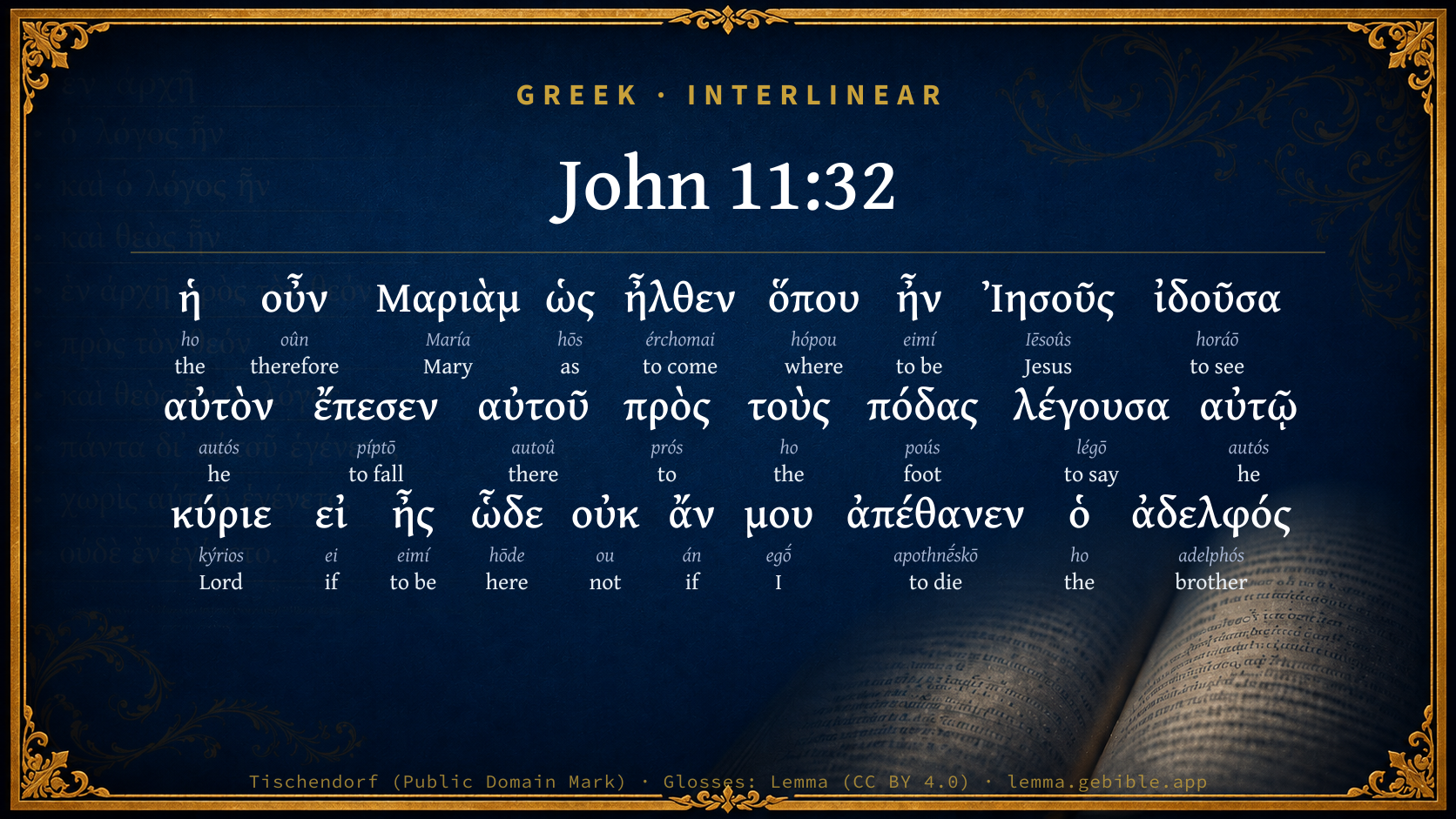
  1. ἡ ho G3588 “the” Article, Nominative, Singular, Feminine
  2. οὖν oûn G3767 “therefore” Conjunction
  3. Μαριὰμ María G3137 “Mary” Noun, Proper, indeclinable
  4. ὡς hōs G5613 “as” Adverb
  5. ἦλθεν érchomai G2064 “to come” Verb, Aorist, Active, Indicative, 3rd person, Singular
  6. ὅπου hópou G3699 “where” Adverb
  7. ἦν eimí G1510 “to be” Verb, Imperfect, Active, Indicative, 3rd person, Singular
  8. Ἰησοῦς Iēsoûs G2424 “Jesus” Noun, Nominative, Singular, Masculine
  9. ἰδοῦσα horáō G3708 “to see” Verb, Aorist, Active, Participle, Nominative, Singular, Feminine
  10. αὐτὸν autós G846 “he” Personal pronoun, Accusative, Singular, Masculine
  11. ἔπεσεν píptō G4098 “to fall” Verb, Aorist, Active, Indicative, 3rd person, Singular
  12. πρὸς prós G4314 “to” Preposition
  13. τοὺς ho G3588 “the” Article, Accusative, Plural, Masculine
  14. πόδας poús G4228 “foot” Noun, Accusative, Plural, Masculine
  15. λέγουσα légō G3004 “to say” Verb, Present, Active, Participle, Nominative, Singular, Feminine
  16. αὐτῷ autós G846 “he” Personal pronoun, Dative, Singular, Masculine
  17. κύριε kýrios G2962 “Lord” Noun, Vocative, Singular, Masculine
  18. εἰ ei G1487 “if” Conditional
  19. ἦς eimí G1510 “to be” Verb, Imperfect, Active, Indicative, 2nd person, Singular
  20. ὧδε hōde G5602 “here” Adverb
  21. οὐκ ou G3756 “not” Particle, Negative
  22. ἄν án G302 “if” Particle
  23. μου egṓ G1473 “I” Personal pronoun, 1st person, Genitive, Singular
  24. ἀπέθανεν apothnḗskō G599 “to die” Verb, Aorist, Active, Indicative, 3rd person, Singular
  25. ὁ ho G3588 “the” Article, Nominative, Singular, Masculine
  26. ἀδελφός adelphós G80 “brother” Noun, Nominative, Singular, Masculine

About this verse

These counts appear in no published source. They are computed here, from the morphology-tagged text and Lemma’s own curated glosses. What Lemma adds →

27
words
23
distinct lemmas
Gospels
section

Notable vocabulary

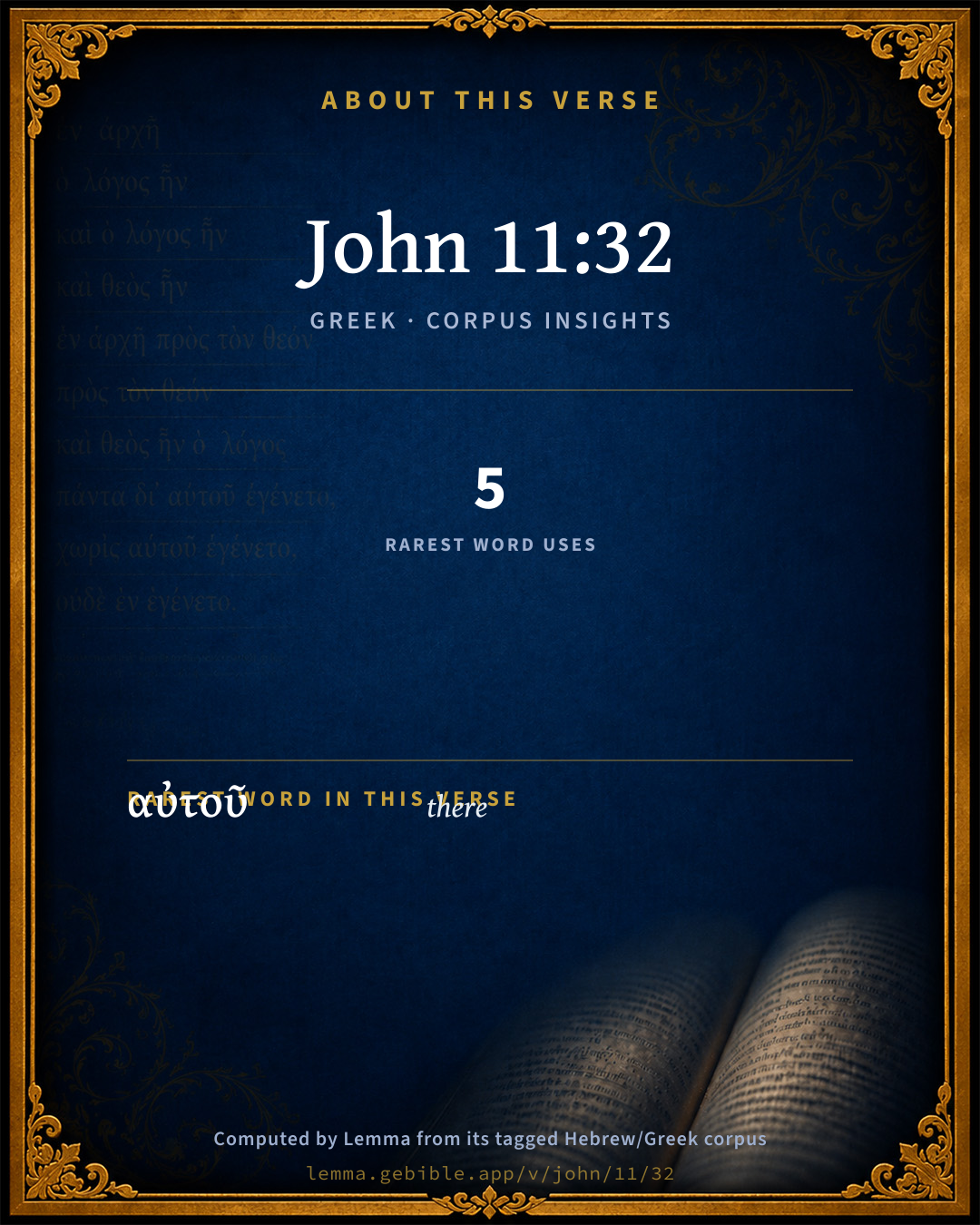
The rarest word here is αὐτοῦ there G847 — appearing just 5 times in the whole Greek New Testament.

Shared distinctive vocabulary

αὐτοῦ there G847 occurs in 5 verses of the Greek New Testament. Also found in:

Repetition

Words recur within this verse:

Cross-references

8

Topical passages linked to John 11:32 in the Treasury of Scripture Knowledge — connected by theme and wording, ordered by reader-vote popularity; previews shown in the World English Bible.

  • John 11:21 Therefore Martha said to Jesus, "Lord, if you would have been here, my brother wouldn't have died.
  • Luke 5:8 But Simon Peter, when he saw it, fell down at Jesus' knees, saying, "Depart from me, for I am a sinful man, Lord."
  • Luke 17:16 He fell on his face at Jesus' feet, giving him thanks; and he was a Samaritan.
  • Luke 8:41 Behold, there came a man named Jairus, and he was a ruler of the synagogue. He fell down at Jesus' feet, and begged him to come into his house,
  • Revelation 5:14 The four living creatures said, "Amen!" The elders fell down and worshiped.
  • Revelation 22:8 Now I, John, am the one who heard and saw these things. When I heard and saw, I fell down to worship before the feet of the angel who had shown me these things.
  • Revelation 5:8 Now when he had taken the book, the four living creatures and the twenty-four elders fell down before the Lamb, each one having a harp, and golden bowls full of incense, which are the prayers of the saints.
  • John 11:37 Some of them said, "Couldn't this man, who opened the eyes of him who was blind, have also kept this man from dying?"

Cross-references courtesy of OpenBible.info (CC BY 4.0).

Commentary

Notes on John 11:32 from classic Christian and Jewish commentators (each source and its license shown beneath its notes). The classic Christian expositions comment on the surrounding passage and are grouped to its opening verse, so a note may address several verses; the Jewish commentaries on the Tanakh (Rashi and others) are per-verse, so they appear only where the commentator wrote on this verse.

Lemma curates 59 commentaries, every one of them public domain or Creative Commons licensed, each selected and text-cleaned for this edition rather than reprinted as found. About our sources →

The Biblical Illustrator

Joseph S. Exell

Joh_11:32

When Mary was come she fell down at His feet, saying unto Him, Lord, if Thou hadst been here, my brother had not died (see Joh_11:21)

Christs delay to interpose against death

1.

Mary fell at His feet; formerly she was willing to sit at them. The soul is never, as amid such desolation, constrained to cling to a friend that sticketh closer than a brother.

2. There is continued confidence--it is still Lord, notwithstanding what had happened--seen in the conviction that an earlier arrival would have brought deliverance, and leading to a hope of help even in this extremity.

3. Mary uses the same words as Martha (Joh_11:21). Perhaps they had often said so. But Mary did not finish her appeal as Martha did (Joh_11:22); not that her faith was less strong: it was finished in her own heart. Tears break in and check utterance (Joh_11:33).

4. Yet with this faith there is wonder at Christs absence, which almost verges on reproach. Why so late? We shall look at the question in the light the narrative gives.

I. THE STRANGENESS OF CHRISTS DELAY TO INTERPOSE AGAINST DEATH.

1. Turn to the circumstances around us, as Martha and Mary may have done. Consider

(1) What death is to the sufferer. No happy translation. The end of all earthly sufferings but more dreaded than all. Mans heart recoils from its accompaniments. When we see a friend moving forward to his doom, what means do we not exhaust to save him? Yet Christ suffered Lazarus to die. And how many have been struck down since of the most lovely and loving; and yet death has no power without Christs permission.

(2) What a bereavement death is to the survivors! In a Christian it is not the dead who are to be mourned, but those whom they leave. What ages of agony are lived while the wavering balance is watched! And then the anguish of the parting, and the slow groping which follows to realize it! The childless mother, etc., have wrestled over the dying and moaned over the dead and none seemed to listen.

(3) What a ground of reproach death has furnished to the enemies of Christ. There was no lack of unbelieving Jews in Bethany to take advantage of Christs absence. Something like the feeling of the Psalmist must have been theirs, My tears have been my meat … while they said unto me, where is thy God, and so now over closed graves we hear the reproach, Where is the promise of His coming? etc., and the Christian heart wearies for some interposition to vindicate its claim. Arise, O God, etc.

2. Turn from our circumstances to Christ as these sisters did. We believe

(1) That Christ is fully aware of our need. When a friend fails us through ignorance, we do not blame him. As soon as the sisters apprehended danger they sent to Jesus. Without this we know that Christ understands all our need. He can draw nearer than the nearest, and His foot does not step forward to the rescue. Is it not strange

(2) That Christ has full power to interpose (Joh_11:22; Joh_11:42). He has not only omnipotence, but the moral right and power, having paid the ransom price. The keys of death hang at His girdle, and that He should not use them occasions strange thoughts.

(3) That it is the desire of Christ to interpose (Joh_11:5; Joh_11:33). But if He felt so deeply why did He not come sooner? And if He meant not to interpose why should He weep? (Jer_14:8). Our very confidence in Christ becomes the occasion of bewildering doubts. Lord … help Thou our unbelief.

II. THE REASON FOR CHRISTS DELAY WHICH MAY BE FOUND IN THIS HISTORY. Other reasons there are to be found in the Bible, and probably outside. But here we see that Christ delays

1. That His friends when dying may have confidence in Him, and have an opportunity for showing it. We have no account of Lazaruss death, but the period has its peculiar use in every spiritual history.

(1) The great end of Christs dealing with any soul is to convince it that in Him it has an all-sufficient life, and that with Him it can pass safely through every emergency. But this course of teaching would want its crown if it did not end in death. He invites the soul, and constrains it to put all its confidence into that last act of surrender knowing Him whom it believes, and feeling that underneath are the everlasting arms.

(2) Death is the last touch of that purifying fire which Christ employs to melt the fallen nature, free it from its dross, and fuse it into His likeness.

2. That the sorrowing friends may learn entire reliance on Him. It is a subject for study how Christ leads on these sisters from a dead brother to the Resurrection and the Life, and teaches them through their loss to gain what they could never lose any more. Christ separates our friends from us for a while that we may learn to find our all in Himself.

3. That in the midst of death the union of sympathy between Christ and His friends is perfected. Jesus had given them many tokens of His love while Lazarus lived, but none with that touching tenderness which came forth at his grave. The fellowship of suffering brings hearts and lives together more than all the fellowship of joy. When Jesus wept the mourners knew He was one with them. Gethsemane shows us the agony of Christs soul for mans sin--the grave at Bethany His agony of heart at mans suffering.

4. That God makes this a world of spiritual probation. By His delay Christ tried the character of all who knew the case, and Christs delays now are the touchstone of spiritual life. You who would have Him never suffer the tears of His people to fall would lead men to seek Him, not for the love they bore Him, but for outward benefits. But God defers the time for interposition in order that He may sift their characters and prepare them for the day of judgment.

5. That He brings in thereby a grander and final issue. (J. Ker, D. D.)

Trials should be borne cheerfully

In the days of King Solomon there lived among the Jews a wise man named Lokman. His master once gave him a very bitter kind of melon, called the coloquintida; he ate without making wry faces or speaking a word. How was it possible for you to swallow so nauseous a fruit? asked the master. Lokman answered: I have received so many sweets from you that it is not wonderful I should have swallowed the only bitter fruit you ever gave me. The master was so much charmed with this reply that he gave Lokman his liberty. The beautiful answer teaches us a lesson. We must take the gifts from our heavenly Father with a smiling face; but when He sees best for our good to send us something we do not like, our countenance falls, and even if we do not speak, our sullen discontent is apparent to all. Fretful impatience under bereavement:--The Duchess of Beaufort, on the death of the Duke, shut herself up in a room hung with black and refused all comfort. A Quaker, who found her thus disconsolate, in the deepest mourning, ejaculated, What! hast thou not forgiven God Almighty yet? The rebuke had such an effect that she immediately rose and went about her usual and necessary business. (Madame DArblay.)

Resignation taught by the sorrows of others

Peace, Mary, peace, said a godly woman, who had lost all her family, to a godless neighbour who was rebelling against the Providence that had taken one child of many; Peace, Mary; while I have six pairs of empty shoes to look on, you have but one. (T. Guthrie, D. D.)

The Biblical Illustrator, edited by Joseph S. Exell (c. 1880s–1900s) — public domain. Text from a community e-Sword module.

Bengel's Gnomon

Johann Albrecht Bengel

Joh 11:32. Ἔπεσεν αὐτοῦ εἰς τοὺς πόδας, she fell at His feet) This Martha had not done. Mary thus makes amends for her slowness in going to meet Him. [Herein she gives a specimen of the most profound reverence arising out of faith.—V. g.]

Bengel's Gnomon of the New Testament — English translation (T&T Clark, Edinburgh, 1860) — public domain. Text from a community e-Sword module.

Meyer's Critical & Exegetical Commentary

Heinrich August Wilhelm Meyer

Joh_11:32. Ἔπεσεν, etc.] Not so Martha, Joh_11:21. Marys feelings were of an intenser and stronger kind.

αὐτοῦ πρὸς τ. πόδας] at His feet (πρός, Mar_5:22; Mar_7:25). So afterwards, μου ὁ ἀδελφός. my brother had not died, as in Joh_13:6, and very often in the New Testament and in Greek writers; see Kühner, § 627 A 4; Stallbaum, ad Plat. Rep. p. 518 C.

εἰ ἦς ὧδε, etc.] like Martha in Joh_11:21, but without adding anything beyond her tears. This thought had unquestionably been the oft-repeated refrain of their mutual communications on the subject of their sorrow.

No further conversation takes place, because the Ἰουδαῖοι by coming with her disturbed them, Joh_11:31; Joh_11:33; according to Luthardt, because Jesus wished a deed to take the place of words; but of this there is no hint in the text.

Meyer — Critical and Exegetical Commentary on the New Testament — English translation by Peter Christie, edited by Frederick Crombie (T&T Clark, 1880) — public domain. Text from a community e-Sword module.

Expositor's Greek Testament

ed. W. Robertson Nicoll

Joh 11:32 . Consequently when she reaches Jesus she has only time to fall at His feet and exclaim, in Martha’s words, Κύριε … ἀδελφός . The sight of Jesus, ἰδοῦσα αὐτόν , produced a more vehement demonstration of grief than in Martha. Cf. Cicero, in Verrem , Joh 11:39 . “Mihi obviam venit et … mihi ad pedes misera jacuit, quasi ego excitare filium ejus ab inferis possem.” Wetstein.

The Expositor's Greek Testament, edited by W. Robertson Nicoll (1897–1910) — public domain. Text from a community e-Sword module.

John Calvin's Commentaries

32. She fell at his feet. From her falling down at his feet we learn that Christ was honored in that house beyond the ordinary custom of men. For, though it was customary to throw themselves down on the ground in the presence of kings and great men, yet as Christ had nothing about him, according to the flesh, that was royal or magnificent, it was for a different purpose that Mary fell down at his feet Indeed, she would not have done so, if she had not been convinced that he was the Son of God.

Lord, if thou hadst been here. Though she appears to speak of Christ respectfully, yet we have lately pointed out what is faulty in these words; for the power of Christ, which filled heaven and earth, ought not to have been limited to his bodily presence.

John Calvin's Commentaries (1540-1563) — public domain. Text from the Calvin Translation Society English edition (1840s-50s) via the Christian Classics Ethereal Library (ccel.org). Calvin's coverage is partial (roughly two-thirds of the Bible); uncommented books and verses are honest gaps, never fabricated. The 19th-century editor's footnotes and remarks are omitted so the notes are faithfully Calvin's own voice.

Ellicott's Commentary for English Readers

(32) Lord, if thou hadst been here.—The words are precisely the same as those which Martha had uttered (Joh_11:21). She adds no more. It may be that she was prevented doing so by the presence of the Jews; but the next verse suggests rather that her emotion was too powerful for words, and that the only possible language was that of a suppliant lying at His feet and weeping.

A Bible Commentary for English Readers, edited by Charles John Ellicott (1878–1897) — public domain. Text from a community e-Sword module.

The Cambridge Bible for Schools and Colleges

gen. ed. J. J. S. Perowne

32. Then when Mary] Mary therefore when.

she fell down at his feet] Nothing of the kind is reported of Martha, Joh_11:21. Here again the difference of character between the two sisters appears.

Lord, if thou hadst been here] The same words as those of Martha, Joh_11:21. No doubt the sisters had expressed this thought to one another often in the last few days. Mary’s emotion is too strong for her; she can say no more than this; contrast Joh_11:22. The Jews coming up prevent further conversation. For the construction comp. Joh_4:10, Joh_14:28.

The Cambridge Bible for Schools and Colleges (gen. ed. J. J. S. Perowne; Cambridge University Press, 1878–1918) — public domain. Text from a community e-Sword module.

John Gill's Exposition

When Jesus therefore saw her weeping,.... At his feet, who, for sorrow and grief of heart, could say no more to him; but having expressed these words, burst out into floods of tears:

and the Jews also weeping, which came with her; either through sympathy with her, or hypocritically:

he groaned in the spirit; in his human soul; and which shows, that he had a real human soul, subject to passions, though sinless ones. The word signifies an inward motion of the mind, through indignation and anger; and it may be partly at the weakness of Mary's faith, and at her immoderate sorrow; and partly at the hypocrisy of the Jews: or else this inward groaning was through grief, sympathizing with Mary, and her friends, his human soul being touched with a fellow feeling of their griefs and sorrows:

and was troubled; or troubled himself; threw himself into some forms and gestures of sorrow, and mourning, as lifting up his eyes, wringing his hands, and changing the form of his countenance.

John Gill's Exposition of the Whole Bible (1746–1763) — public domain (CC PDM 1.0). Text via the HelloAO Bible API.

Trapp's Complete Commentary

John Trapp

32 Then when Mary was come where Jesus was, and saw him, she fell down at his feet, saying unto him, Lord, if thou hadst been here, my brother had not died.

Ver. 32. She fell down at his feet] Giving him divine honour, before all the Jews that were present. So did not Martha, that we read of. Mary had been more diligent in hearing and meditation of the word; hence her greater love and respect to Christ.

John Trapp, A Commentary or Exposition upon All the Books of the Old and New Testament (1647–1656) — public domain. Text from a community e-Sword module.

Whedon's Commentary on the Bible

Daniel D. Whedon

32. Fell down at his feet—Mary’s ardent soul appears in every motion. As soon, quickly, (Joh_11:29,) hastily, (Joh_11:31,) she fell down at his feet, (32.) She utters, like Martha, her double note of sorrow over what is, and what, alas! might have been; but, unlike Martha, she utters no saving clause of hope, (Joh_11:22.) Jesus answers her not as Martha, with a promise, but with the deed. He is here, and Lazarus is about to live.

Daniel D. Whedon (gen. ed.), Commentary on the Old and New Testaments (1874–1909) — public domain. Text from a community e-Sword module.

The Pulpit Commentary

Mary therefore, when she came where Jesus was, and when she saw him, fell at his feet, and in other ways showed more intensity of feeling than did the energetic sister, who in many ways is the feminine type of what Peter was as a man. She is not altogether silent, but sobbed forth the very words which her sister had uttered before. Thus had they often said one to another while Lazarus was yet alive, "Oh that the Lord Jesus were here!" Lord, said she, if thou hadst been here, my brother had not died. The position of mou , which in some manuscripts was placed before apeyanen is here emphatic, as though Mary had in some way especially claimed Lazarus as her brother more than Martha"s. She does not add a word of remonstrance or suggestion. She moans forth the same confident expression of her sense of the love and power of Jesus.

Unavailing regrets and unfounded fancies.

It is in human nature to lean upon the presence of friends and patrons. In their absence it seems as if we could not help exclaiming, "Ah! if only we had been supported by their nearness, their countenance, their encouragement, then all would have been otherwise, all would have been far better with us!" So the soldier regrets the absence of his commander; the official the absence of his chief; the child the absence of his parent. And so, sometimes, like Mary of Bethany, the Christian laments the absence of his Lord.

I ONE SAYS, "IF THOU, LORD, HADST BEEN HERE, I WOULD HAVE BELIEVED ON THEE." To some Jesus seems so far away, in time, in space, that they feel it hard to cherish faith in him. But such should remember that faith is more truly faith when it is tried by the distance of its object. "Blessed," said Christ, "are those who, not having seen, yet believe.

II ANOTHER SAYS, "IF THOU, LORD, HADST BEEN HERE, I SHOULD HAVE RESISTED. TEMPTATION." In the absence of the mighty Master, how can the servant stand? Yet, reflection assures us that the Spirit of Christ and the Word of Christ are sufficient to enable the tempted to resist the adversary, and to overcome in the trial. Peter yielded to temptation, and denied his Lord, in his very presence. The same Peter afterwards boldly confessed his Lord when that Lord was no longer present in the body upon earth.

III ANOTHER SAYS, "IF THOU, LORD, HADST BEEN HERE, I SHOULD HAVE BEEN SPARED THIS SORROW, OR, AT THE LEAST, I SHOULD HAVE BEEN SUPPORTED UNDER IT?" But this is not certain. Trouble is often to the Christian it should be always blessing, even though in disguise. If so, wisdom and love may permit it, whether Christ be, as to the body, present or absent. And certainly his Divine supports and consolations may be experienced, even though his form be not seen, his voice not heard.

IV ANOTHER SAYS, "IF THOU, LORD, HADST BEEN HERE, I WOULD HAVE BOLDLY ENCOUNTERED PERSECUTION AND DARED DEATH." They who through timidity and faithlessness fail in witnessing to their Lord, and then make to themselves this excuse, prove how little knowledge they have of their own hearts. Some have thought, "If, like the dying malefactor, we could have hung by the side of Jesus, with his presence to encourage and his example to cheer us, then we could have dared to die for him; but how can we suffer for his sake when unnoticed, unsupported, and alone?" This way of thinking overlooks Christ"s spiritual presence. In reality, they who suffer for him "suffer with him.

V ANOTHER SAYS, "IF, LORD, THOU HADST BEEN HERE, THEN THY WORK ENTRUSTED TO MY HANDS WOULD HAVE PROSPERED." There are those who fear that in this spiritual dispensation, where no present Lord stands ready to work signs and wonders for the conviction of men, it is vain to hope for great results to follow the preaching of the gospel and the witness of the saints. Yet it cannot be denied that greater works than those wrought during Christ"s ministry were effected after his ascension, and that the spiritual economy was introduced into the world with signal trophies of might and signal omens of victory. It is not the Master"s bodily absence which accounts for the slow progress of the truth and kingdom of Christ. Spiritual causes account for this lamentable fact; spiritual powers alone can check the advance of error, and hasten the kingdom of God, of righteousness, of truth. The Church has not faith enough in the Lord"s own assurance, "Lo, I am with you always, even unto the end of the world.

APPLICATION. It is well for us to remember that, as a matter of fact and reality, Christ is always here. His Spirit is near our spirit. He is truly present to those who have faith. When duty is difficult and arduous, let us reflect, Christ is here! When temptation is urgent, or when trials are severe, let us not forget that Christ is here! When bereavement overtakes us, and we are very sensible that those whom we have loved, and upon whom we have relied, are gone, then let us cherish the comforting assurance that Christ is here! T.

The Pulpit Commentary (1880–1919), ed. H.D.M. Spence-Jones & Joseph S. Exell — public domain. Text from a community e-Sword module.

John Wesley's Explanatory Notes

She fell at his feet - This Martha had not done. So she makes amends for her slowness in coming.

John Wesley, Explanatory Notes Upon the Whole Bible (1754–1765) — public domain. Text via the GEBible commentary corpus.

Cambridge Greek Testament for Schools and Colleges

32. ἔπεσεν. Nothing of the kind is told of Martha (Joh 11:21). Here again the difference of character between the two appears.

οὐκ ἄν μου ἀπ. The same words as those of Martha (Joh 11:21); but the pronoun is here more prominent, indicating how acutely personal her loss was. No doubt the sisters had expressed this thought to one another often in the last few days. Mary’s emotion is too strong for her; she can say no more than this; contrast Joh 11:22. The Jews coming up prevent further conversation. For the construction comp. Joh 5:10, Joh 14:28.

Cambridge Greek Testament for Schools and Colleges (Cambridge University Press, 1896; 21 vols, various authors incl. Carr, Maclear, Plummer, Farrar, Lumby, Moule, M. R. James, Simcox) — public domain. Text from a community e-Sword module.

Alford’s Greek Testament

Henry Alford

32.] The words of Mary are fewer, and her action more impassioned, than those of her sister: she was perhaps interrupted by the arrival of the Jews: cf. ver. 33.

Kühner, Gram. § 627, Anm. 4, remarks that when the genitive of the enclitic personal pronoun is prefixed to its substantive, a slight sense of the dativus commodi is given: “non mihi frater mortuus esset.”

Henry Alford, The Greek Testament (1849–1861) — public domain. Text from a community e-Sword module.

International Critical Commentary

32. When Mary met Jesus, she fell at His feet, impulsive and demonstrative creature as she was, and said, as Martha had said, “Lord, if thou hadst been here, my brother had not died” (see on v. 21). She is described by Lk. (10:39) as sitting at His feet for instruction, and later she anointed His feet (12:3), probably for the second time (see Introductory Note on 12:1-8).

πρὸς τοὺς πόδας. So אBC*DLW, but AC3ΓΔΘ give εἰς τοὺς πόδας. πρός is the preposition used by Mk. (5:22, 7:25) when telling of Jairus and the Syrophœnician woman falling at the feet of Jesus. So, too, is it used in Rev 1:17 and (in the LXX) at Est 8:3. But εἰς τοὺς πόδας in a context like this would be curious Greek. Lk. prefers to use παρά (8:41, 17:16; but cf. Act 5:10)

Jesus Weeps, and, Being Directed by the Mourners, Goes to the Tomb (vv. 33-38)

International Critical Commentary — older volumes (1896–1929), various authors — public domain. Text from a community e-Sword module.

Lesson kit

Teaching starters — assembled from the data on this page, not authored interpretation. Every prompt links to the verse data it draws on. Edit before teaching.

John, in the Gospels, opens this verse with 27 words (23 distinct Greek lemmas). Its most distinctive word is autoû (“there”). A historical commentator’s framing appears above. Read the whole chapter for the surrounding context.

Discussion questions

  1. The word autoû carries the sense “there.” How does it shape the verse?
  2. Matthew 26:36 shares the word «there» with this verse. How do the two illuminate each other?
  3. “to be” occurs 2× in this one verse. What is the effect of the repetition?
  4. These translations render this verse differently. What is at stake in choosing one wording over another?
  5. Reading how The Biblical Illustrator and Bengel's Gnomon read this verse, where do the two commentators agree and where do they part?

Things to notice

Reading settings

Reading text

Shown beneath each verse's original-language words.

Old Testament
Old Testament edition

Read the OT as the Masoretic Hebrew (MT) or the Greek Septuagint (LXX).

English shown for the Greek Septuagint (in the Hebrew ↔ Greek comparison).

Comparing translations? Open the Compare panel on any verse page to stack up to four side by side.