
John 8:9

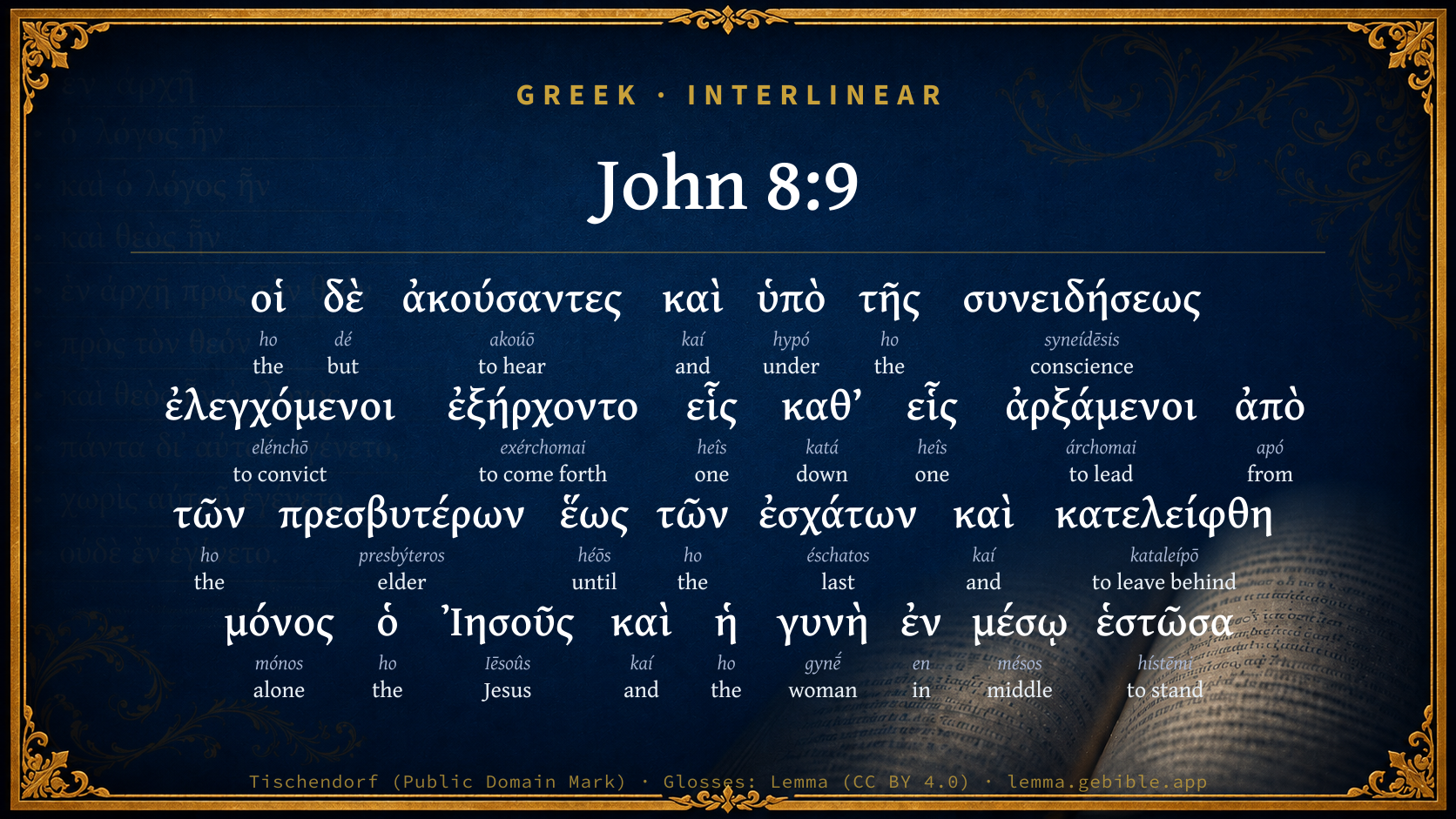
Greek (Tischendorf 8th ed.) John 8:9 appears in the Greek New Testament. The text above is from the Tischendorf 8th edition. Each word links to its Strong’s number and a concise gloss. Click any word for its full Thayer’s Greek Lexicon entry.
Download image
Cite this verse

John 8:9 (World English Bible). Public Domain. Lemma interlinear Bible study tool, https://lemma.gebible.app/v/john/8/9.

Show BibTeX & RIS
BibTeX
RIS
English Translation
They, when they heard it, being convicted by their conscience, went out one by one, beginning from the oldest, even to the last. Jesus was left alone with the woman where she was, in the middle.
World English Bible · Public Domain
Highlights
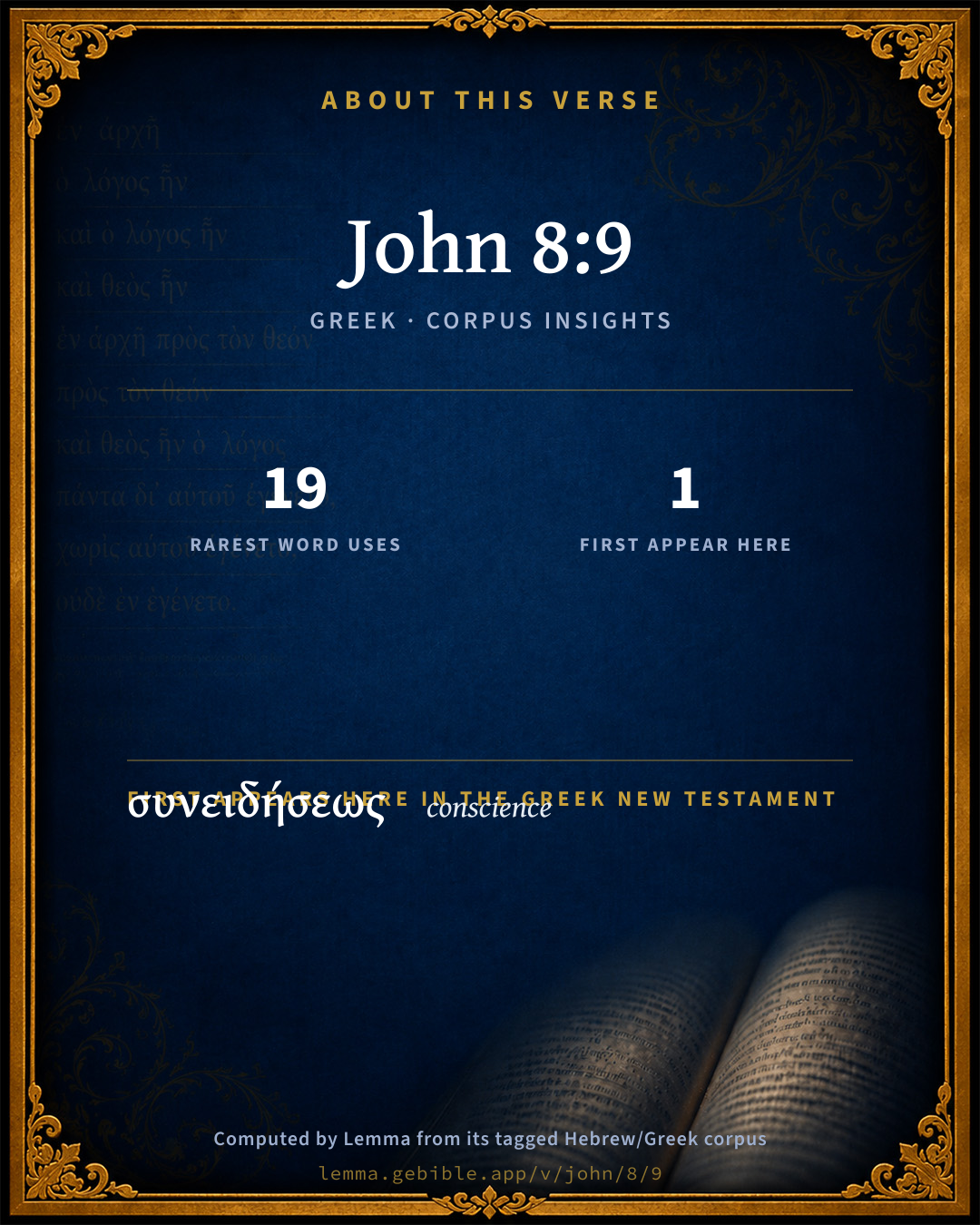
  • 1 first appearance in the Greek New Testament
Full analysis ↓
Download a study sheet

One document with this verse’s original text, its word-by-word gloss line, the meaning frame, cross-references with their text, attributed commentary, and full source and license credits — printable, and it pastes into notes with its structure intact.

This verse Autodidact and up

Study sheet (.html) Plain text (.txt)

A passage Seminary Student

Up to 50 verses in one chapter. A passage sheet keeps up to 6 commentary sources and 12 cross-references per verse, in the order this page ranks them, and says so on the sheet whenever that leaves anything out. Ask for a single verse and you get the Autodidact verse sheet above.

Everything on this page stays free to read, with no account — the sheet is a download of what is already on screen, not access to it.

Want to remove ads? Support Godless Engineer
Compare translations 3

The same verse in 3 English versions, stacked beneath the original-language interlinear above. Click any original word for its lexicon entry.

Each is an independent rendering of the whole verse — the interlinear is not word-aligned to these translations.

Highlighted words mark where these versions differ — a whole-verse word diff, not a word-by-word alignment.

  • World English Bible Public Domain
    They, when they heard it, being convicted by their conscience, went out one by one, beginning from the oldest, even to the last. Jesus was left alone with the woman where she was, in the middle.
  • King James Version Public Domain
    And they which heard it, being convicted by their own conscience, went out one by one, beginning at the eldest, even unto the last: and Jesus was left alone, and the woman standing in the midst.
  • unfoldingWord Literal Text CC BY-SA 4.0
    But each of the Jews went out, beginning with the oldest, so that they all went out, and he was left alone, with the woman being in the midst.

unfoldingWord Literal Text — © unfoldingWord, licensed CC BY-SA 4.0. Word-aligned USFM3 via Door43 (git.door43.org/unfoldingWord/en_ult).

Versions to compare (up to 4)

3 of 4 selected

Show all 19 translations

Every available English version of this verse, each an independent rendering of the whole verse.

  • World English Bible Public Domain
    They, when they heard it, being convicted by their conscience, went out one by one, beginning from the oldest, even to the last. Jesus was left alone with the woman where she was, in the middle.
  • Berean Standard Bible Public Domain
    When they heard this, they began to go away one by one, beginning with the older ones, until only Jesus was left, with the woman standing there.
  • Majority Standard Bible Public Domain
    When they heard this and were convicted by their consciences, they began to go away one by one, beginning with the older ones, until only Jesus was left, with the woman standing there.
  • King James Version Public Domain
    And they which heard it, being convicted by their own conscience, went out one by one, beginning at the eldest, even unto the last: and Jesus was left alone, and the woman standing in the midst.
  • American Standard Version (1901) Public Domain
    And they, when they heard it, went out one by one, beginning from the eldest, `even' unto the last: and Jesus was left alone, and the woman, where she was, in the midst.
  • Revised Version (1885) Public Domain
    And they, when they heard it, went out one by one, beginning from the eldest, even unto the last: and Jesus was left alone, and the woman, where she was, in the midst.
  • Geneva Bible (1599) Public Domain
    And when they heard it, being accused by their owne conscience, they went out one by one, beginning at ye eldest euen to the last: so Iesus was left alone, and the woman standing in the mids.
  • Douay-Rheims (1899) Public Domain
    But they hearing this, went out one by one, beginning at the eldest. And Jesus alone remained, and the woman standing in the midst.
  • Young's Literal Translation Public Domain
    and they having heard, and by the conscience being convicted, were going forth one by one, having begun from the elders -- unto the last; and Jesus was left alone, and the woman standing in the midst.
  • Literal Standard Version CC BY-SA 4.0
    and they having heard, and being convicted by the conscience, were going forth one by one, having begun from the elders—to the last; and Jesus was left alone, and the woman standing in the midst.
  • Unlocked Literal Bible CC BY-SA 4.0
    When they heard it, they left one by one, beginning with the oldest. Finally Jesus was left alone, with the woman who had been in the middle.
  • unfoldingWord Literal Text CC BY-SA 4.0
    But each of the Jews went out, beginning with the oldest, so that they all went out, and he was left alone, with the woman being in the midst.
  • Darby Bible Public Domain
    But they, having heard [that], went out one by one beginning from the elder ones until the last; and Jesus was left alone and the woman standing there.
  • World Messianic Bible Public Domain
    They, when they heard it, being convicted by their conscience, went out one by one, beginning from the oldest, even to the last. Yeshua was left alone with the woman where she was, in the middle.
  • Webster's Bible Public Domain
    And they who heard it, being convicted by their own conscience, went out one by one, beginning at the eldest, even to the last: and Jesus was left alone, and the woman standing in the midst.
  • Free Bible Version CC BY-SA 4.0
    When they heard this they began to leave, one by one, starting with the oldest, leaving Jesus alone in the middle of the crowd with the woman still standing there.
  • Bible in Basic English Public Domain
    And when his words came to their ears, they went out one by one, starting with the oldest even to the last, because they were conscious of what was in their hearts: and Jesus was there by himself with the woman before him.
  • Text-Critical English NT CC BY 4.0
    When they heard this, they were convicted by their own consciences and began to go away one by one, starting with the older men. So Jesus was left alone, with the woman there before him.
  • Tyndale New Testament (1534) Public Domain
    And assone as they hearde that they went out one by one the eldest fyrst. And Iesus was lefte a lone and the woman stondynge in the myddes.

Literal Standard Version (2020), Covenant Press — licensed CC BY-SA 4.0. Text via the HelloAO Bible API (eBible.org). Unlocked Literal Bible (unfoldingWord) — licensed CC BY-SA 4.0. Text via the HelloAO Bible API (eBible.org). unfoldingWord Literal Text — © unfoldingWord, licensed CC BY-SA 4.0. Word-aligned USFM3 via Door43 (git.door43.org/unfoldingWord/en_ult). Free Bible Version, Dr. Jonathan Gallagher — licensed CC BY-SA 4.0. Text via the HelloAO Bible API (eBible.org).

Word by word

More ways to search: Search by grammar → Find every occurrence → Compare this word →

Practice this passage: Drill this verse → Learn its vocabulary →

ἐλεγχόμενοι
elénchō
G1651
“to convict”
Verb, Present, Passive, Participle, Nominative, Plural, Masculine
Part of Speech
Verb
Tense
Present
Voice
Passive
Mood
Participle
Case
Nominative
Number
Plural
Gender
Masculine
Full Thayer's Definition

Origin: of uncertain affinity

TDNT: 09:53,2

1. to convict, refute, confute a. generally with a suggestion of shame of the person convicted b. by conviction to bring to the light, to expose 2. to find fault with, correct a. by word 1. to reprehend severely, chide, admonish, reprove 2. to call to account, show one his fault, demand an explanation b. by deed 1. to chasten, to punish
  1. οἱ ho G3588 “the” Article, Nominative, Plural, Masculine
  2. δὲ dé G1161 “but” Conjunction
  3. ἀκούσαντες akoúō G191 “to hear” Verb, Aorist, Active, Participle, Nominative, Plural, Masculine
  4. καὶ kaí G2532 “and” Conjunction
  5. ὑπὸ hypó G5259 “under” Preposition
  6. τῆς ho G3588 “the” Article, Genitive, Plural, Masculine
  7. συνειδήσεως syneídēsis G4893 “conscience” Noun, Genitive, Singular, Feminine
  8. ἐξήρχοντο exérchomai G1831 “to come forth” Verb, Imperfect, Middle or Passive deponent, Indicative, 3rd person, Singular
  9. εἷς heîs G1520 “one” Adjective, Nominative, Singular, Masculine
  10. καθ’ katá G2596 “down” Preposition
  11. εἷς heîs G1520 “one” Adjective, Nominative, Singular, Masculine
  12. ἀρξάμενοι árchomai G756 “to lead” Verb, Aorist, Middle, Participle, Nominative, Plural, Masculine
  13. ἀπὸ apó G575 “from” Preposition
  14. τῶν ho G3588 “the” Article, Genitive, Singular, Feminine
  15. πρεσβυτέρων presbýteros G4245 “elder” Adjective, Genitive, Plural, Masculine, Comparative
  16. ἕως héōs G2193 “until” Adverb
  17. τῶν ho G3588 “the” Article, Genitive, Plural, Masculine
  18. ἐσχάτων éschatos G2078 “last” Adjective, Genitive, Plural, Masculine, Superlative
  19. καὶ kaí G2532 “and” Conjunction
  20. κατελείφθη kataleípō G2641 “to leave behind” Verb, Aorist, Passive, Indicative, 3rd person, Singular
  21. μόνος mónos G3441 “alone” Adjective, Nominative, Singular, Masculine
  22. ὁ ho G3588 “the” Article, Genitive, Plural, Masculine
  23. Ἰησοῦς Iēsoûs G2424 “Jesus” Noun, Nominative, Singular, Masculine
  24. καὶ kaí G2532 “and” Conjunction
  25. ἡ ho G3588 “the” Article, Nominative, Singular, Feminine
  26. γυνὴ gynḗ G1135 “woman” Noun, Nominative, Singular, Feminine
  27. ἐν en G1722 “in” Preposition
  28. μέσῳ mésos G3319 “middle” Adjective, Dative, Singular, Neuter
  29. ἑστῶσα hístēmi G2476 “to stand” Verb, Perfect, Active, Participle, Nominative, Singular, Feminine

About this verse

These counts appear in no published source. They are computed here, from the morphology-tagged text and Lemma’s own curated glosses. What Lemma adds →

30
words
22
distinct lemmas
Gospels
section

Notable vocabulary

The rarest word here is ἐλεγχόμενοι to convict G1651 — appearing just 19 times in the whole Greek New Testament.

First appearance in Scripture

This word makes its first canonical appearance in the Greek New Testament here:

  • συνειδήσεως conscience G4893

Shared distinctive vocabulary

ἐλεγχόμενοι to convict G1651 occurs in 19 verses of the Greek New Testament. Also found in:
Repetition

Words recur within this verse:

Cross-references

20

Topical passages linked to John 8:9 in the Treasury of Scripture Knowledge — connected by theme and wording, ordered by reader-vote popularity; previews shown in the World English Bible.

  • Ecclesiastes 7:22 for often your own heart knows that you yourself have likewise cursed others.
  • Romans 2:15 in that they show the work of the law written in their hearts, their conscience testifying with them, and their thoughts among themselves accusing or else excusing them)
  • 1 John 3:20 because if our heart condemns us, God is greater than our heart, and knows all things.
  • Genesis 42:21–22 They said one to another, "We are most assuredly guilty concerning our brother, in that we saw the distress of his soul, when he begged us, and we wouldn't listen. Therefore this distress has come on us."
  • Job 5:12–13 He frustrates the devices of the crafty, So that their hands can't perform their enterprise.
  • Psalms 71:13 Let my accusers be disappointed and consumed. Let them be covered with disgrace and scorn who want to harm me.
  • John 8:10 Jesus, standing up, saw her and said, "Woman, where are your accusers? Did no one condemn you?"
  • Romans 2:22 You who say a man shouldn't commit adultery, do you commit adultery? You who abhor idols, do you rob temples?
  • 1 Kings 2:44 The king said moreover to Shimei, You know all the wickedness which your heart is privy to, that you did to David my father: therefore Yahweh shall return your wickedness on your own head.
  • 1 Kings 17:18 She said to Elijah, What have I to do with you, you man of God? You have come to me to bring my sin to memory, and to kill my son!
  • Job 20:5 That the triumphing of the wicked is short, The joy of the godless but for a moment?
  • Job 20:27 The heavens shall reveal his iniquity, The earth shall rise up against him.
  • Psalms 9:15–16 The nations have sunk down in the pit that they made; In the net which they hid, their own foot is taken.
  • Psalms 40:14 Let them be disappointed and confounded together who seek after my soul to destroy it. Let them be turned backward and brought to dishonor who delight in my hurt.
  • Psalms 50:21 You have done these things, and I kept silent. You thought that the "I AM" was just like you. I will rebuke you, and accuse you in front of your eyes.
  • Luke 12:1–3 Meanwhile, when a multitude of many thousands had gathered together, so much so that they trampled on each other, he began to tell his disciples first of all, "Beware of the yeast of the Pharisees, which is hypocrisy.
  • Luke 13:17 As he said these things, all his adversaries were disappointed, and all the multitude rejoiced for all the glorious things that were done by him.
  • John 8:12 Again, therefore, Jesus spoke to them, saying, "I am the light of the world. He who follows me will not walk in the darkness, but will have the light of life."
  • Mark 6:14–16 King Herod heard this, for his name had become known, and he said, "John the Baptizer has risen from the dead, and therefore these powers are at work in him."
  • John 8:2 Now very early in the morning, he came again into the temple, and all the people came to him. He sat down, and taught them.

Cross-references courtesy of OpenBible.info (CC BY 4.0).

Where the printed editions differ

7 variants

Places in this verse where the major printed Greek editions disagree on the wording in a way that affects the translation — a comparison of editions, not a manuscript-by-manuscript collation. The editions are the modern critical texts (Nestlé-Aland 28/27, SBL, Westcott-Hort, Tregelles, Tyndale House) and the traditional texts behind the KJV (the Textus Receptus and the Byzantine/Majority text). It is not a claim about which reading is original.

  1. Extra text
    οἱ δὲ ἀκούσαντες

    “<the> And having heard”

    In NA28NA27TynWHTRByz Not in SBLTreg
  2. Extra text
    καὶ ὑπὸ τῆς συνειδήσεως ἐλεγχόμενοι

    “and by <the> conscience being convicted”

    In TRByz Not in NA28NA27TynSBLWHTreg
  3. Extra text
    ἐξήρχοντο εἷς καθ εἷς ἀρξάμενοι ἀπὸ τῶν πρεσβυτέρων

    “they were going away one by one having begun from the elder ones”

    In NA28NA27TynWHTRByz Not in SBLTreg
  4. Extra text
    ἕως τῶν ἐσχάτων,

    “until of the last”

    In TR Not in NA28NA27TynSBLWHTregByz
  5. Extra text
    καὶ κατελείφθη μόνος,

    “and He was left alone,”

    In NA28NA27TynWHTRByz Not in SBLTreg
  6. Extra text
    ὁ Ἰησοῦς

    “<the> Jesus”

    In TRByz Not in NA28NA27TynSBLWHTreg
  7. Extra text
    καὶ ἡ γυνὴ ἐν μέσῳ

    “and the woman in [the] midst”

    In NA28NA27TynWHTRByz Not in SBLTreg

Textual data: Translators Amalgamated Greek New Testament (STEPBible TAGNT) · CC BY 4.0.

Commentary

Notes on John 8:9 from classic Christian and Jewish commentators (each source and its license shown beneath its notes). The classic Christian expositions comment on the surrounding passage and are grouped to its opening verse, so a note may address several verses; the Jewish commentaries on the Tanakh (Rashi and others) are per-verse, so they appear only where the commentator wrote on this verse.

Lemma curates 59 commentaries, every one of them public domain or Creative Commons licensed, each selected and text-cleaned for this edition rather than reprinted as found. About our sources →

Tyndale Open Study Notes

Tyndale Open Resources

8:9 The jury crumbled as they slipped away. One accuser departed, followed by another, and then a succession of bystanders.

Tyndale Open Study Notes — © Tyndale Open Resources, licensed CC BY-SA 4.0. Text via the HelloAO Bible API.

Bengel's Gnomon

Johann Albrecht Bengel

Joh 8:9. Ἀπὸ τῶν πρεσβυτέρων, beginning with the elders) These had been most conscience-struck. Great was the force of Jesus’ words, [throwing open the inmost recesses of men.—V. g.]—μόνος, alone) not one of those, who had proposed the case, remaining. Others, who also were of the Pharisees, remained, as appears from comparing Joh 8:3; Joh 8:13.

Bengel's Gnomon of the New Testament — English translation (T&T Clark, Edinburgh, 1860) — public domain. Text from a community e-Sword module.

Expositor's Greek Testament

ed. W. Robertson Nicoll

Joh 8:9 . οἱ δὲ … ἐσχάτων . “And they when they heard it went out one by one, beginning from the elders until the last.” [The words which truly describe the motive of this departure, καὶ ὑπὸ τῆς συνειδήσεως ἐλεγχόμενοι , are deleted by Tr. W.H.R.] πρεσβυτέρων refers not to the elders by office but by age. They naturally took the lead, and the younger men deferentially allowed them to pass and then followed. Thus κατελείφθη μόνος … ἑστῶσα . Jesus was left sitting and the woman standing before Him. But only those would retire who had been concerned in the accusation: the disciples and those who had previously been listening to Him would remain.

The Expositor's Greek Testament, edited by W. Robertson Nicoll (1897–1910) — public domain. Text from a community e-Sword module.

Jamieson, Fausset & Brown

Robert Jamieson, A. R. Fausset & David Brown

they . . . convicted . . . went out one by one . . . Jesus was left alone--that is, without one of her accusers remaining; for it is added.

the woman in the midst--that is, of the remaining audience. While the trap failed to catch Him for whom it was laid, it caught those who laid it. Stunned by the unexpected home thrust, they immediately made off--which makes the impudence of those impure hypocrites in dragging such a case before the public eye the more disgusting.

Jamieson, Fausset & Brown — Commentary Critical and Explanatory on the Whole Bible (1871) — public domain (CC PDM 1.0). Text via the HelloAO Bible API.

Adam Clarke's Commentary

Verse 9. Being convicted by their own conscience] So it is likely they were all guilty of similar crimes. Their own is not in the original, and is needless: being convicted by conscience is expressive enough.

Beginning at the eldest even unto the last] Απο των πρεσβυτερων ἑως των εσχατων, from the most honourable to those of the least repute. In this sense the words are undoubtedly to be understood.

The woman standing in the midst.] But if they all went out, how could she be in the midst? It is not said that all the people whom our Lord had been instructing went out, but only her accusers: see Joh 8:2. The rest undoubtedly continued with their teacher.

Adam Clarke's Commentary on the Bible (1810–1826) — public domain. Text from a community e-Sword/MySword module.

John Calvin's Commentaries

9. And being reproved by their conscience. Here we perceive how great is the power of an evil conscience. Though those wicked hypocrites intended to entrap Christ by their cavils, yet as soon as he pierces their consciences by a single word, shame puts them to flight. This is the hammer with which we must break the pride of hypocrites. They must be summoned to the judgment-seat of God. Though it is possible that the shame, with which they were struck before men, had greater influence over them than the fear of God, still it is a great matter that, of their own accord, they acknowledge themselves to be guilty, when they thus fly away as if they were confounded. It is immediately added,

Beginning from the eldest even to the last. Our attention is drawn to this circumstance, that, according as each of them surpassed the others in honorable rank, he was the more quickly moved by his condemnation. And would to God that our scribes, who in the present day sell their labors to the Pope to make war with Christ, had at least as much modesty as those men; but they are so destitute of shame that, while they have rendered themselves infamous by every detestable crime, they glory in the fact that they are permitted to be as abominable as they choose, without being punished. We ought also to observe how widely this conviction of sin, by which the scribes were affected, differs from true repentance. For we ought to be affected by the judgment of God in such a manner, that we shall not seek a place of concealment to avoid the presence of the Judge, but rather shall go direct to Him, in order to implore his forgiveness.

Jesus was left alone. This was brought about by the Spirit of wisdom, that those wicked men, having gained nothing by tempting Christ, went away. Nor is there any reason to doubt that we shall succeed in defeating all the contrivances of our enemies, provided that we permit ourselves to be governed by the same Spirit. But it frequently happens that they gain an advantage over us, because, not attending to their snares, we are not careful to take advice, or rather, trusting to our own wisdom, we do not consider how much we need the government of the Holy Spirit. He says that Christ remained alone; not that the people, whom he was formerly teaching, had left him, but because all the scribes, who had brought the adulteress, gave him no farther annoyance. When it is said that the woman remained with Christ, let us learn by this example that there is nothing better for us than to be brought, as guilty, to his tribunal, provided that we surrender ourselves mildly and submissively to his government.

John Calvin's Commentaries (1540-1563) — public domain. Text from the Calvin Translation Society English edition (1840s-50s) via the Christian Classics Ethereal Library (ccel.org). Calvin's coverage is partial (roughly two-thirds of the Bible); uncommented books and verses are honest gaps, never fabricated. The 19th-century editor's footnotes and remarks are omitted so the notes are faithfully Calvin's own voice.

Ellicott's Commentary for English Readers

(9) The readings of the texts here differ considerably, but without any essential difference of meaning. “Being convicted by their own conscience” is probably an addition made by some copyist to explain the meaning, which is quite clear without it.

Beginning at the eldest.—Literally, beginning at the elders; but our version gives the right sense, and prevents the possible mistake of understanding the word to mean the elders of the people. So “the last” should probably be taken, not of the lowest in official rank, but of the last who went out.

And Jesus was left alone, and the woman standing in the midst.—The scribes and Pharisees had probably stood close to Him. The woman was at some little distance, naturally shrinking from their gaze; but there is a crowd of people, including the disciples, around her, for they are in the Temple, and before this interruption He was engaged in teaching the people (Joh_8:2). Her accusers had “set her in the midst” (Joh_8:2), where she now stands. The whole scene is pictured with the minute detail of an eye-witness, who remembers how the persons were grouped, how the accusers went out one after another, and then, how Jesus was left alone, apart from the crowd, but that the others were still present.

A Bible Commentary for English Readers, edited by Charles John Ellicott (1878–1897) — public domain. Text from a community e-Sword module.

The Cambridge Bible for Schools and Colleges

gen. ed. J. J. S. Perowne

9. being convicted by their own conscience] These words are probably a gloss added by some copyist, like ‘as though He heard them not,’ added by our translators (Joh_8:6).

beginning at the eldest] Literally, beginning at the elders: but it means the elders in years, not the Elders; so that our translators have done well to avoid a literal rendering which would have been misleading. Meyer suggests that the oldest would be shrewd enough to slip away at once without compromising themselves further; certainly they would have the largest experience of life and its temptations.

was left alone] Not that there were no witnesses, but that they had withdrawn to a distance. The graphic precision of this verse indicates the account of an eyewitness.

standing in the midst] Literally, being in the midst, where the brutality of her accusers had placed her (Joh_8:3).

The Cambridge Bible for Schools and Colleges (gen. ed. J. J. S. Perowne; Cambridge University Press, 1878–1918) — public domain. Text from a community e-Sword module.

John Gill's Exposition

She saith, no man, Lord,.... No man said a word to me, or lift up his hand against me, or moved a stone at me:

and Jesus said unto her, neither do I condemn thee; Christ came not into the world to act the part of a civil magistrate, and therefore refused to arbitrate a case, or be concerned in dividing an inheritance between two brethren, Luk 12:13. Nor did he come into the world to condemn it, but that the world, through him, might be saved, Joh 3:17; nor would he pass any other sentence on this woman, than what he had done; nor would he inflict any punishment on her himself; but suitably and agreeably to his office; as a prophet, he declares against her sin, calls her to repentance, and bids her

go and sin no more; lest as he said to the man he cured at Bethesda's pool, a worse thing should come unto her. Wherefore the Jew (s) has no reason to object to this conduct of Christ, as if he acted contrary to the law, in Deu 13:5. "Thou shalt put the evil away from the midst of thee"; and also to the sanctions of all civil laws among men, which order the removal of evil, by putting delinquents to death; and he observes, that those that believe in him, do not follow him in this, but put adulterers and adulteresses to death; and that indeed, should his example and instructions take place, all courts of judicature must cease, and order be subverted among men: but it should be observed, that our Lord manifested a regard, even to the law of Moses, when he bid this woman's accusers that were without sin, to cast the first stone at her; though as for the law in Deu 13:5, that respects a false prophet, and not an adulterer or an adulteress; nor do the civil laws of all nations require death in the case of adultery; and did they, Christ here, neither by his words nor actions, contradicts and sets aside any such laws of God or man; he left this fact to be inquired into, examined, and judged, and sentence passed by proper persons, whose business it was: as for himself, his office was not that of a civil magistrate, but of a Saviour and Redeemer; and suitably to that he acted in this case; he did not connive at the sin, he reproved for it; nor did he deny that she ought to suffer according to the law of Moses, but rather suggests she ought; but as this was not his province, he did not take upon him to pronounce any sentence of condemnation on her; but called her to repentance, and, as the merciful and compassionate Saviour, gave her reason to hope pardon and eternal life.

(s) R. Isaac Chizzuk Emuna, par. 2. c. 47. p. 435, 436.

John Gill's Exposition of the Whole Bible (1746–1763) — public domain (CC PDM 1.0). Text via the HelloAO Bible API.

Trapp's Complete Commentary

John Trapp

9 And they which heard it, being convicted by their own conscience, went out one by one, beginning at the eldest, even unto the last: and Jesus was left alone, and the woman standing in the midst.

Ver. 9. Convicted by their own conscience] Which is God’s spy and man’s overseer, index, iudex, vindex: a sign, a judge a defender, so that sinners are self-condemned αυτοκατακριτοι, and often betrayed by their own blushing and heart beating, when yet the offence is secret. Yea, a man feels an inward shame in his own heart, disgracing and abusing him, though he make no outward show of it. For albeit an innocent person, upon the foulness of an aspersion, may conceive shame, as did David, Psa 44:15, yet it is usually the effect of an ill conscience.

John Trapp, A Commentary or Exposition upon All the Books of the Old and New Testament (1647–1656) — public domain. Text from a community e-Sword module.

Albert Barnes' Notes on the Bible

Beginning at the eldest - As being conscious of more sins, and, therefore, being desirous to leave the Lord Jesus. The word “eldest” here probably refers not to age, but to benefit - from those who were in highest reputation to the lowest in rank. This consciousness of crime showed that the state of the public morals was exceedingly corrupt, and justified the declaration of Jesus that it was an adulterous and wicked generation, Mat 16:4.

Alone - Jesus only was left with the woman, etc.

In the midst - Her accusers had gone out, and left Jesus and the woman; but it is by no means probable that the people had left them; and, as this was in the temple on a public occasion, they were doubtless surrounded still by many. This is evident from the fact that Jesus immediately Joh 8:12 addressed a discourse to the people present.

Albert Barnes' Notes on the Bible (1834–1885) — public domain. Text from a community e-Sword/MySword module.

Haydock's Catholic Bible Commentary

Went out one by one,[2] confounded, and as it is in the ordinary Greek copies, convicted by their own conscience. (Witham)

===============================

[BIBLIOGRAPHY]

Greek: apo tes suneideseos, elegchomenoi.

George Leo Haydock (1774–1849), Haydock's Catholic Family Bible and Commentary, 1859 edition — public domain. Excludes Psalms (Douay-Rheims chapter numbering differs from Protestant) and Deuterocanonical books (Catholic canon only).

Matthew Poole's English Annotations

This was an age of very great corruption as to men’s lives and manners, as well as to doctrine, and corruption of worship; and as other enormities of life were very common and ordinary amongst them, so it is very probable were adulteries, and that their rulers and teachers were not without great guilt. Now, see the power of conscience, when set on work by God; these accusers’ consciences were to them as a thousand witnesses; they were reproved and convicted by them, and not able to stand under the reflections of them, or to say any thing in answer to what our Saviour had said: they went away one after another; and possibly it is particularly noted that they began

at the eldest, because the consciences of the eldest of them charged them more deeply for more and greater sins. Jesus was left not wholly alone, for the next words tell us, that the woman was still left standing in the midst; and no doubt but his apostles were there, for they constantly attended him; and no doubt divers others were also there: but the meaning is, that he was by this means quit of the scribes’ and Pharisees’ company, who were gone out of shame, being thus convicted by their own consciences, which told them, that whatsoever this woman was, they were no fit accusers.

Matthew Poole's English Annotations on the Holy Bible (1683–1685) — public domain. Text from a community e-Sword/MySword module.

Whedon's Commentary on the Bible

Daniel D. Whedon

9. Convicted by their own conscience—There is an interval of silence, Jesus writing, they ruminating. Not a man would dare lift a stone. If this be the Messiah, none dares assume in such a presence that himself is pure. If he be not Messiah, the Roman law may deal with the man who leads in execution. The whole scene becomes intolerable to the actors, and they retreat. Of the gross licentiousness of the Jews at this period, even of those most jealous for Jewish institutions, Josephus furnishes ample proof. “There is evidence,” says Tholuck, “that at this period many of the Rabbins high in position were living in adultery.”

One by one—It was easier for any one to lead in the departing than in the stoning.

Beginning at the eldest— Who from the gravity of their age may have held themselves most excusable from flinging the deathly missile.

The last—Who could leave without any comrade to witness his shame.

Jesus… alone—Jesus, as ever, is victor.

Woman standing—Petrified, doubtless, with fear and shame. She had been surrendered over to death; every moment, perhaps, she expected to be led without the city to the execution. Minute after minute had passed of suspense but of dawning hope. The Searcher of hearts alone knew how her conscience may have been awakened by the near approach of death.

Daniel D. Whedon (gen. ed.), Commentary on the Old and New Testaments (1874–1909) — public domain. Text from a community e-Sword module.

The Pulpit Commentary

And they when they heard it (being convicted by theirown conscience), they went out one by one. Their conscience convinced them that the spirit of the Law is greater than its letter. The phrase expressing the action of conscience was probably an explanatory and true gloss, which accounted for the sudden change of front. It was a proof of the ally which Divine law has within the human breast. The whole crowd, rather than the humbled woman, is condemned, but self-condemned and silent. This event speaks for the moral sense which had been paralyzed rather than obliterated in this people. (The expression, "one by one," eiv ka , in which eiv is treated as indeclinable, is occasionally found in later Greek, but only once in the New Testament, (Mar_14:19) is not in D, but in several of the codices and cursives, and it is retained in R.T.) The slow rather than simultaneous disappearance of the gang of accusers is a highly dramatic touch, and the remaining clause, beginning from the eldest, even unto the last, heightens the impression. The phrase presbuterwn need not refer to office, but to age, and the "last" need not necessarily mean the youngest, but those that were left when the most responsible men found that they had carried their question too far, and had retired. And Jesus was left alone; i.e. so far as these accusers were concerned. The multitudes who had gathered round him were still waiting for his words (see ver. 2). This fact is involved in the substance of the narrative, whether the periscope belongs to the Gospel of John or not. And the woman where she was, in the midst of the assembly that remained, more likely cowering in shame and mortal fear than standing brazen-faced or daring before that awful Presence. These two ("Miseria et Misericordia," as said Augustine), "Misery and Pity," face one another, and in the presence of a multitude of disciples and other listeners, Misery waits for Pity to speak for perfect holiness and perfect mercy to do its will. There is One seated there who is without sin. He is at liberty, on his own showing, to condemn, and even to execute his fierce displeasure against a sin which he had, in his great inaugural discourse, charged upon the ill-regulated desires and evil glances of men.

The Pulpit Commentary (1880–1919), ed. H.D.M. Spence-Jones & Joseph S. Exell — public domain. Text from a community e-Sword module.

John Wesley's Explanatory Notes

Beginning at the eldest - Or the elders. Jesus was left alone -By all those scribes and Pharisees who proposed the question. But many others remained, to whom our Lord directed his discourse presently after.

John Wesley, Explanatory Notes Upon the Whole Bible (1754–1765) — public domain. Text via the GEBible commentary corpus.

unfoldingWord translationNotes

Door43 World Missions Community

General Information:

While some texts have Joh 7:53 - 8:11, the best and earliest texts do not include them.

one by one

"one after another"

Woman, where are your accusers

When Jesus called her "woman," he was not trying to make her feel insignificant. If people in your language group would think that he was doing that, this can be translated without the word "Woman."

translationWords

condemn

lord

unfoldingWord translationNotes — © Distant Shores Media and the Door43 World Missions Community, licensed CC BY-SA 4.0. Source: git.door43.org/Door43/en_tn.

Cambridge Greek Testament for Schools and Colleges

9. Omit καὶ ὑπὸ τῆς συνειδήσεως ἐλεγχόμενοι after ἀκούσαντες, and ἕως τῶν ἐσχάτων after πρεσβυτέρων (both obvious glosses). Οὖσα for ἑστῶσα.

9. The variations in this verse are considerable, but the substance is the same. Καὶ ὑπὸ τ. συνειδήσεως ἐλεγχόμενοι is probably a gloss like μὴ προσποιούμενος in Joh 8:6. Another gloss here is ‘understanding His upbraiding.’ Both additions are right as interpretations. The word of God, ‘sharper than any two-edged sword,’ had pierced them and proved ‘a discerner of the thoughts of their hearts’ (Heb 4:12).

ἀρξ. ἀπὸ τ. πρεσβυτέρων. The elders in years, not the official Elders. Meyer suggests that the oldest would be shrewd enough to slip away without compromising themselves further: certainly they would have the largest experience of life and its temptations.

μόνος. The multitude may or may not have withdrawn with the woman’s accusers; the disciples probably had not moved. But of the actors in the scene only two were left, she who needed compassion and He who could bestow it: relicti sunt duo, misera et Misericordia (S. Augustine). The woman was in the midst, where the brutality of her accusers had placed her (Joh 8:3).

Cambridge Greek Testament for Schools and Colleges (Cambridge University Press, 1896; 21 vols, various authors incl. Carr, Maclear, Plummer, Farrar, Lumby, Moule, M. R. James, Simcox) — public domain. Text from a community e-Sword module.

Alford’s Greek Testament

Henry Alford

9.] They had said, τὰς τοιαύτας—they now perceive that they themselves were τοιοῦτοι. There is no historical difficulty in this conduct of the Pharisees, as Olshausen finds;—they were struck by the power of the word of Christ. It was a case somewhat analogous to that in which His ἐγώ εἰμι struck His foes to the ground, ch. 18:6.

The variations of reading are very wide (see digest) in the latter part of the verse. We can hardly (with some) lay any stress on πρεσβυτέρων, as indicating the natural order of conviction of sin. If the consciences of older sinners have heavier loads on them, those of younger ones are more tender.

μόνος, i.e. with the multitude and the disciples; the woman standing between Him and the disciples on one hand,—and the multitude on the other.

10,

Henry Alford, The Greek Testament (1849–1861) — public domain. Text from a community e-Sword module.

International Critical Commentary

9. The rec., following EGHKS, after ἀκούσαντες interpolates the explanatory gloss καὶ ὑπὸ τῆς συνειδήσεως ἐλεγχόμενοι: om. DMUΓΛ fam. 13, 1071 and the Lat. vss.

For the whole clause οἱ δὲ ἀκ … καθʼ εἷς, D gives only ἕκαστος δὲ τῶν Ἰουδαίων ἐξήρχετο, while fam. 13 have only ἐξῆλθον εἶς καθʼ εἶς.

After πρεσβυτέρων the rec. adds, with SUΛ fam. 13, ἕως τῶν ἐσχάτων, while D 1071 add ὥστε πάντας ἐξελθεῖν, but both additions are om. in EGHKMΓ, etc. Westcott-Hort suggest that πάντες ἀνεχώρησαν (cf. M 264) originally followed πρεσβυτέρων as an independent clause.

The glosses are unnecessary, although doubtless right in the explanations they offer. The elder men (πρεσβύτεροι, a word not occurring in Jn.; cf. 3Jn 1:1) were naturally the first to leave, having taken the lead in trying to ensnare Jesus, and having been silenced by His suggestion that they must have felt the power of the temptation which had overcome the woman. If the scene is to be placed in the week following the Triumphal Entry, their acquiescence in the moral authority which Jesus exercised is more readily intelligible. They dared not press the moral issue before the admiring and awestruck people.

For εἷς καθʼ εἷς, cf. Mar 14:19; it is not a Johannine phrase.

καὶ κατελείφθη μόνος. μόνος is om. by fam. 13. Perhaps some disciples were present, and nothing is said of their going away, but the words may mean that Jesus and the woman were left quite alone (as the rec. text indicates), the onlookers feeling the painfulness of the scene. Augustine says: “Remansit magna miseria et magna misericordia” (Enarr. in Psa_1. § 8). Yet the woman remained ἐν μέσῳ, which suggests the presence of a little group; and, furthermore, the words that Jesus said to her were overheard and were preserved.

κατελείφθη. The verb καταλείπειν is not used by Jn.

International Critical Commentary — older volumes (1896–1929), various authors — public domain. Text from a community e-Sword module.

Godet's Commentaries

Frédéric Louis Godet

Ver. 9. If the Pharisees had been sincere in their indignation against the accused, it was the time to lead her to the presence of the officially constituted judge. But it was not the evil that they were set against: it was Jesus. Recognizing the fact that their design has failed, they take the only course which remains for them, that of withdrawing, and they make thus the tacit avowal of the odious intention which had brought them. Πρεσβύτεροι is not here an official name; it is the oldest who, as the most venerable representatives of public morality, had taken their place at the head of the company: ἔσχατοι, the last, does not mean the youngest or the last in respect to social position, but simply, as Meyer says, the last who left. The word alone implies only the departure of the accusers.

Frédéric Louis Godet — Commentaries on Luke, John, Romans, and 1 Corinthians — English translation (T&T Clark, Edinburgh, 1870s–1890s) — public domain. Text from a community e-Sword module.

Lesson kit

Teaching starters — assembled from the data on this page, not authored interpretation. Every prompt links to the verse data it draws on. Edit before teaching.

John, in the Gospels, opens this verse with 30 words (22 distinct Greek lemmas). Its most distinctive word is elénchō (“to convict”). A historical commentator’s framing appears above. Read the whole chapter for the surrounding context.

Discussion questions

  1. The word elénchō carries the sense “to convict.” How does it shape the verse?
  2. The word “conscience” first appears here in Scripture. What is being introduced at this debut?
  3. Matthew 18:15 shares the word «to convict» with this verse. How do the two illuminate each other?
  4. “one” occurs 2× in this one verse. What is the effect of the repetition?
  5. The translations on this page render this verse differently — a whole-verse word diff, not a word-by-word alignment. What might account for the different wordings?
  6. Reading how Tyndale Open Study Notes and Bengel's Gnomon read this verse, where do the two commentators agree and where do they part?

Things to notice

  • 1 word makes its first canonical appearance in Scripture here.
  • These translations choose different wording for 19 words in this verse.
  • “one” occurs 2× in this single verse.
  • 22 distinct Greek lemmas span 30 words in this verse.

Reading settings

Reading text

Shown beneath each verse's original-language words.

Old Testament
Old Testament edition

Read the OT as the Masoretic Hebrew (MT) or the Greek Septuagint (LXX).

English shown for the Greek Septuagint (in the Hebrew ↔ Greek comparison).

Comparing translations? Open the Compare panel on any verse page to stack up to four side by side.